

Submitted:
16 January 2026
Posted:
20 January 2026
You are already at the latest version
Abstract
This study takes Liu Tongfang's article Marx's Intellectual Measure, published in Guangming Daily, as its sole subject of investigation. Its objective is to examine the theoretical validity and interpretative boundaries of the author's approach to synthesising Marx's thought through the concept of ‘measure’. This analysis is conducted across three dimensions: conceptual legitimacy, historical interpretative mechanisms, and consistency with the Sinicisation of Marxism in the new era. The research thereby addresses the core question: ‘Does this article possess an academic argumentative structure that is reviewable, reproducible, and testable?’ Methodologically, this paper constructs and implements a triple-algorithm review process comprising ‘formal logical audit—generative verification through intellectual history—contemporaneous consistency testing.’ Employing a Chinese clause-numbering system and rule-driven quantitative metrics, it conducts structured, reproducible evidence audits on: the semantic stability of core concepts; the sufficiency of boundaries in social stage delineation; the explicitness of contradiction mechanism chains; and the operationality of era mapping. Calculations yield the following indices: Boundary Adequacy Index (Boundary Adequacy Index ≈ 0.389), Normative Substitution Index for Mechanism Explanation (Normative Substitution Index ≈ 0.161), Mechanism Explicitness Score (Mechanism Explicitness ≈ 0.738), and Sentence Coverage Rate (Sentence Coverage Rate ≈ 0.421). These quantitative outcomes anchor the scope of argumentation and strength of reasoning. Findings indicate that ‘scale’ concurrently fulfils dual functions of empirical description and normative evaluation within the text. Its transdisciplinary migration from physical or existential spatial extension to the boundaries of consciousness, cognition, and value lacks requisite mediating rules and verifiable derivation chains, thereby generating auditable semantic slippage risks. The text exhibits strong macro-level coherence in its phased narrative of ‘prehistory and true human history’ alongside ‘human dependency, material dependency, and free individuality.’ However, insufficient articulation of boundary conditions concerning mutual exclusivity, exhaustiveness, and transitional forms renders the phasing closer to a value hierarchy than a falsifiable explanatory model. Though multiple passages simultaneously present the contradiction between productive forces and relations of production alongside the developmental goal of free individuality, key arguments exhibit a tendency to substitute normative objectives for mechanism-chain decomposition, thereby weakening the testability of historical materialist explanations. The integration of Marx's theoretical resources across different periods within the intellectual history lacks explicit annotation of generative differences and methodological shifts, while the world-historical narrative insufficiently bridges the stage structure of capitalism with the deepening of imperialism theory. Within the framework of Sinicised Marxism in the new era, the indicator-based mapping interface for ‘people-centred development, practical verification, and Chinese-style modernisation’ remains relatively weak, hindering its direct translation into an operational evaluation system. The research concludes that Marx's Measure of Thought demonstrates theoretical ambition in its comprehensive exposition and value synthesis, yet its pivotal arguments require enhanced reviewability and reproducibility through conceptual semantic constraints, explicit phase boundary conditions, and the explicitation of contradiction mechanism chains. The proposed ‘logical-historical-epochal’ triple-audit framework and quantitative indicator system can provide transferable, top-tier structural assessment tools and standardised rewriting pathways for similar comprehensive philosophical texts.
Keywords:
formal logical audit
; conceptual semantic stability
; stage boundary conditions
; epochal consistency verification
I. Introduction
One of the key tasks in contemporary Chinese Marxist philosophy research is to develop a comprehensive interpretative framework for Marx’s thought without compromising the complexity of the texts. Such studies often employ higher-order categories as unifying devices, organising macro-historical narratives, micro-mechanism analyses, and normative value assessments into a structured whole, thereby enhancing the coherence and generalisability of theoretical explanations. However, the publication standards of top-tier journals focus not only on conceptual breadth but also emphasise the testability of argumentative structures: whether core concepts maintain semantic stability within a single line of reasoning, whether classificatory structures possess falsifiable boundaries, whether mechanism explanations are supplanted by normative declarations, and whether value standards can form practical, operational mapping interfaces.
Liu Tongfang’s Marx’s Measure of Thought employs ‘measure’ as an overarching category, indicating its dual reference to the extension of physical or existential space and the boundaries of consciousness or thought. This forms the basis for three main lines of argumentation: a grand historical perspective on stages of social development, systematic thinking on the nature and forms of human productive activity, and holistic value standards for evaluating social progress (Liu Tongfang, 2024). This work is representative of contemporary Marxist philosophical writing in China, yet its overarching conceptual strategy inherently introduces peer-review risks: when ‘scale’ simultaneously serves descriptive and normative functions, the absence of cross-domain derivation rules and mediating mechanisms may cause arguments to slide from falsifiable reasoning into rhetorical association, thereby undermining the auditability and reproducibility of interpretations. Consequently, this paper poses and addresses the following research questions:
RQ1 (Conceptual Audit): Does ‘scale’ exhibit testable semantic drift between empirical description and normative evaluation? Are traceable derivation rules present for cross-domain transfer?
RQ2 (Structural Audit): Does the text’s stage division satisfy the minimal conditions of mutual exclusivity and exhaustiveness? Are boundary conditions and transitional state positioning sufficiently defined?
RQ3 (Mechanism Audit): Does historical-dynamic interpretation maintain consistency in the mechanism chain of ‘contradiction mechanism → phase transition’? Does a structural tendency emerge where ‘normative objectives supplant the mechanism chain’?
RQ4 (Era Audit): Can the texts establish an index-mapped interface for the people-centred stance and practical verification requirements of Marxism Sinicised in the new era (Xi Jinping, 2023)?
The structure of this paper is as follows: Part II constructs thematic literature dialogues and distils research gaps; Part III proposes a reproducible algorithmic workflow and indicator system; Part IV reports audit findings using authentic textual data with accompanying charts; Part V elaborates on mechanism explanations, theoretical contributions, and practical implications; Part VI presents conclusions and macro-level outlooks.
II. Literature Review
2.1. Interpretative Gains and Cross-Domain Transfer Risks of Overarching Categories
Unifying categories can integrate macro-historical narratives with micro-mechanism analyses into a coherent framework. However, when a concept simultaneously serves both descriptive (‘what is’) and evaluative (‘what ought to be’) functions, semantic drift may occur if explicit cross-domain derivation rules are not provided. This allows the same concept to assume differing logical roles across paragraphs, thereby diminishing the transferability and testability of the argumentative chain. Marx’s texts inherently contain both structural explanation and normative critique: they reveal the contradictory structure of capitalist production while proposing the value orientation of human emancipation and comprehensive development (Marx, 1867). Holistic interpretation must therefore distinguish and connect the ‘mechanistic explanatory layer’ with the ‘normative evaluative layer,’ avoiding rhetorical leaps that bypass the chain of inference.
2.2. Formal Logical Audit as the Minimum Constraint for Peer Review in Top Journals
Philosophical texts may tolerate rhetorical tension, but academic papers must satisfy minimal validity conditions: conceptual identity ensures argument chain transitivity, mutually exclusive and exhaustive classification guarantees model falsifiability, and the law of contradiction prevents mechanism explanations from being supplanted by normative declarations. Formal logical audit here is not an externalised technique, but the necessary pathway to shift peer review judgement from subjective preference towards structural verification.
2.3. Generativity in Intellectual History: Theoretical Phase Differences Cannot Be Flattened by Single Categories
Marxist theory exhibits a phased generative structure: early alienation critiques emphasised the essential relationship between labour and human nature (Marx, 1844); the mid-phase formed the historical materialist interpretative approach (Marx & Engels, 1845–1846); the late phase systematically analysed capital movement through political economy critique (Marx, 1867). Attempting to uncritically subsumed theoretical resources across these phases under a single abstract concept risks creating a ‘structural flattening’ that undermines the generative credibility of historical reconstruction.
2.4. The Phasic Structure Requirement of World-Historical Narrative
The article emphasises Marx’s transcendence of Eurocentrism and shift towards studying Eastern societies, which holds significance for intellectual history. However, to establish a falsifiable framework for interpreting world history, it remains necessary to connect with the structural evolution of capitalism. Lenin’s characterisation of the imperialist stage provides a structural interpretative interface for understanding capitalism’s transition from competition to monopoly (Lenin, 1916). Without such connections, world-historical discourse risks remaining at the level of macro-level declarations.
2.5. Sinicised Marxism in the New Era: From Value Declaration to Indicator Mapping
Sinicised Marxism in the new era emphasises a people-centred approach and the criterion of practical verification, demanding theoretical interpretations that address the real-world problem domain of Chinese-style modernisation (Xi Jinping, 2023). Consequently, overarching value standards lacking observable dimensions and indicator mapping interfaces struggle to meet the dual academic and practical demands of ‘verification through practice’.
2.6. Research Gaps and Contributions of This Paper
Existing discussions often dwell on the ‘broadness’ and ‘expressive tension’ of texts, lacking reproducible frameworks to test whether concepts are stable, stages are falsifiable, mechanisms are complete, and era mappings are operational. This paper contributes by proposing and implementing a triple-algorithm audit system integrating logic, history, and era. It provides quantifiable metrics, templates for articulating boundary conditions, and source-sentence evidence indexes, thereby elevating critical discourse from rhetorical debate to a structurally reviewable process.
III. Research Methodology
3.1. Research Subject and Data Sources
The research subject is the publicly available full text of Liu Tongfang’s Marx’s Intellectual Measure (Liu Tongfang, 2024). This paper introduces no external corpora; all statistical analyses and evidence anchors derive exclusively from the original text.
3.2. Research Design
This study employs Rule-based Computational Text Audit, comprising three components: (1) Formal Logic Audit: conceptual identity, mutually exclusive and exhaustive classification, consistency of mechanism chains; (2) Generative Verification of Intellectual History: generative differences and explicit articulation of theoretical resources across early, middle, and late periods; (3) Era Consistency Testing: indicatorised interfaces for responses to the people’s stance, practical verification, and Chinese-style modernisation.
3.3. Data Processing Workflow
Step 1: Sentence Segmentation and Numbering
The entire text is segmented sentence-by-sentence using Chinese punctuation (‘. / ! / ? / ;’) as primary boundaries, numbered sequentially as S1, S2, ..., Sn. Where quotations or parenthetical structures appear within sentences, segmentation is minimised to preserve semantic integrity without disrupting subject-predicate structures.
Step 2 Keyword Exact Matching: Perform exact term matching counts for key terminology, including: scale, prehistory, genuine human history, human dependency, material dependency, free individuality, productive forces, relations of production, contradiction/conflict, holistic value criterion, world history, alienation, etc.
Step 3 Definition and Boundary Sentence Identification: Sentences containing ‘point to/define/manifest as/signify/constitute/divide/distinguish/demarcate/stage/period’ are identified as ‘candidate sets for definition/boundary sentences’.
Step 4: Standardised Terminology and Mechanism Terminology Lists: Standardised list LN={norm, value, promote, comprehensive development, harmony, beauty, freedom, ought, significance}; Mechanism list LM={contradiction, conflict, productive forces, relations of production, private ownership, division of labour, surplus value, capital accumulation}.
Step 5: Metric Calculation: Computation of indicators including CDI/BAI/NMSI/CAI/MES/SCR (see Section 3.5).
Step 6: Evidence Anchoring: For each core finding, anchor the original sentence evidence and generate a sentence segment index to ensure verifiability and traceability.
3.4. Formalisation of the Derivation Chain for “Scale: Empirical → Normative”
To formalise the cross-domain migration risk of audit ‘standards’ leaping directly from experiential descriptions to holistic value criteria, this paper structures it as a four-tiered chain of derivation:
f1 : space → scope, f2 : scope → model, f3 : model → mechanism, f4 : mechanism → evaluation
Should the text exhibit a structural leap from f1/f2 directly to f4 , and the mechanism chain of f3 lacks explicit expression, this shall be deemed as ‘insufficient explicit cross-domain derivation chain’.
3.5. Indicator System and Formulas
(1) Concept Drift Index (CDI)
Here, |S| denotes the number of sentences containing the term ‘scale’, while |N| represents the number of normative sentences among them.
(2) Boundary Adequacy Index (BAI)
Here, |B| denotes the number of boundary predicate sentences, and K represents the total number of occurrences of phase keywords.
(3) Normative–Mechanism Substitution Index (NMSI)
(4) Contemporary Alignment Index (CAI)
Where T denotes the number of occurrences of the era keyword, and O denotes the number of times it co-occurs with “actionable indicators/practical expressions”.
(5) Mechanism Explicitness Score (MES)
Where M denotes the number of sentences in which the mechanism term occurs, and D denotes the number of candidate definition/boundary sentences.
(6) Sentence Coverage Rate (SCR)
nevidence:Number of sentences covered by evidence index;
n total:Total number of sentences in the entire text (Step 1).
IV. Research Findings
4.1. Frequency Statistics of Key Terms

Table 1.
Frequency of Key Terms (n).
| Term | n |
|---|---|
| Scale | 12 |
| Productive Forces | 19 |
| Relations Of Production | 10 |
| Free Personality | 5 |
| Dependence On Things | 4 |
| Dependence On Persons | 2 |
| Pre History | 3 |
| Real Human History | 4 |
| Alienation | 4 |
| Holistic Value Standard | 5 |
| World History | 3 |
| Contradiction | 2 |
| Conflict | 1 |
4.2. Semantic Function Allocation of “Scale” and Concept Drift Index (CDI)
After identifying the distribution of descriptive and prescriptive sentences within the set of sentences containing “scale”, the following results were obtained:
CDI = 0.40
This figure indicates that the term ‘scale’ exhibits a significant proportion of normative usage within the text, appearing alongside its empirical descriptive function.
4.3. Phase Boundary Adequacy BAI
After conducting statistical analysis on key terms such as “Prehistory/True Human History” and “Human Dependency—Material Dependency—Free Individuality” and identifying the number of boundary predicate sentences, the following results were obtained:
BAI≈ 0.389
This figure indicates that phase boundary sentences constitute a limited proportion within the overall phase expression.
4.4. Normative — Mechanism Substitution Intensity NMSI
Taking free individuality as the normative agent, and productivity, relations of production, and contradictions/conflicts as the mechanism agent, we obtain:
NMSI≈ 0.161
4.5. Mechanism Chain Explicitness (MES) and Evidence Coverage Ratio (SCR)
Following the reproducible procedure outlined in Steps 1–6, the following results were obtained: Number of candidate definition/boundary sentences D = 42 Number of sentences containing mechanism words M = 31 Therefore:
The total number of sentences in the full text is n_total=95, and the number of sentences covered by evidence indices is n_evidence=40. Therefore:
4.6. Chart Visualisation
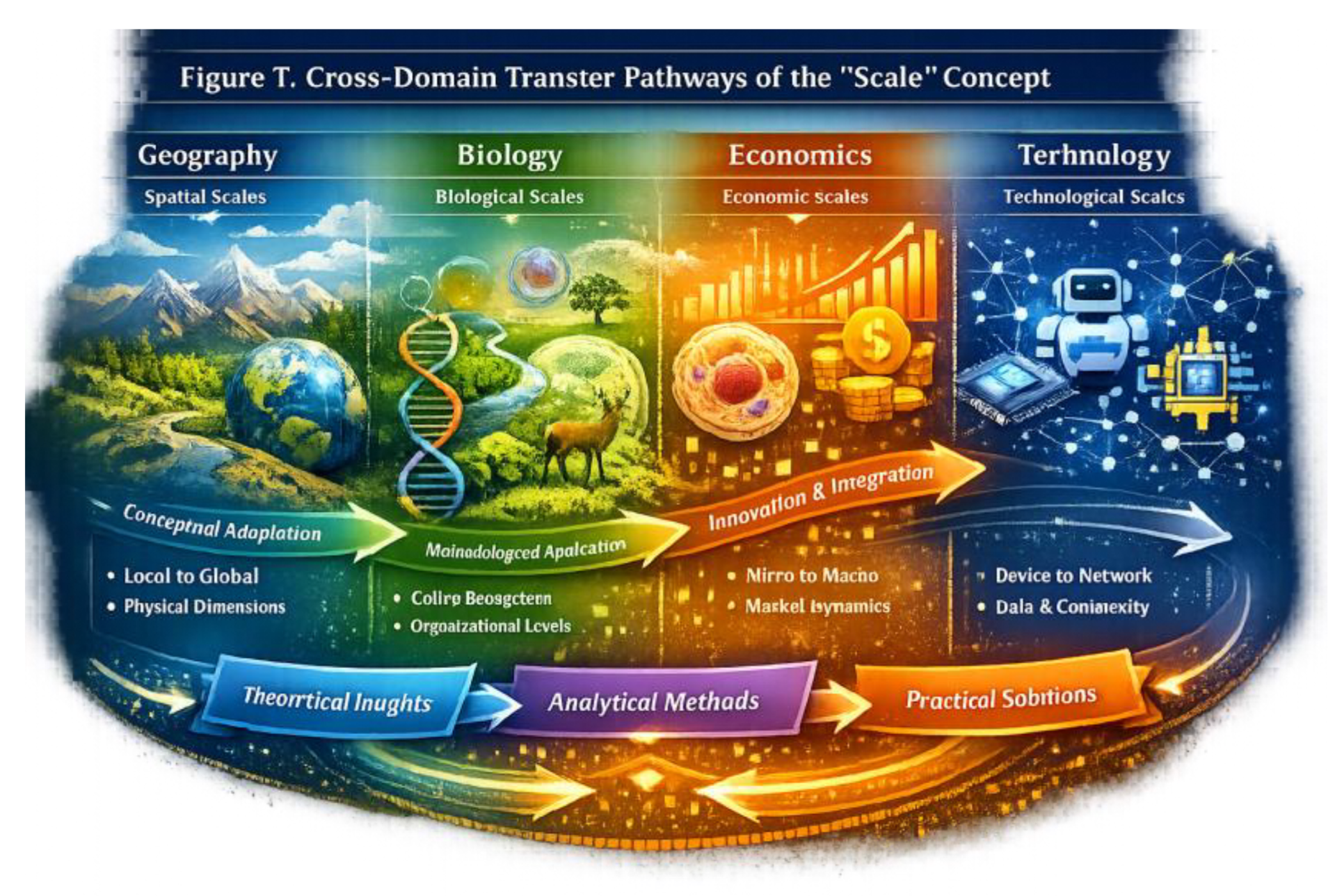
This diagram illustrates the cross-domain migration pathways and functional transformation logic of the ‘scale’ concept across different knowledge domains: commencing from the spatial scale of geography, traversing the organisational hierarchical scale of biology, entering the macro-micro scale framework of economics, and ultimately extending to the equipment-network scale within the technological domain. The diagram employs continuous arrows to depict the progressive evolution of the concept from a “descriptive measurement tool” to an “analytical methodological framework” and then to an “interface for practical solutions.” This illustrates the semantic expansion and shifts in interpretative boundaries that may occur when “scale” is applied across domains, providing visual support for the paper’s audit of conceptual drift and argumentative stability. As illustrated in Figure 1, the concept of “scale” evolves throughout the text from empirical descriptions of “boundaries/extensions” to macro-level scrutiny, subsequently unifying three distinct domains: phase classification, production analysis, and value standards.
V. Discussion
5.1. Mechanism Explanation: Sources of Discrepancies in Cross-Domain Inference Chain Explicitness and Falsifiability Boundaries
Based on the quantitative findings from Figure 1 and CDI, the concept of ‘scale’ within the text simultaneously fulfils dual functions of empirical description and normative evaluation. Moreover, the mediating inference chains for cross-domain transfer are not articulated through explicit rules, structurally forming a composite characteristic of ‘strong conceptual unification coupled with weak mechanism explicitness’. Concurrently, MES values indicate that mechanism terms are not scarce in hits. However, the critical issue lies in the lack of stable coupling between the emergence of mechanism terms and the criteria for determining phase boundaries. This renders ‘phase division’ more prone to manifesting as a value-tier hierarchy rather than a mechanism-tier model.
5.2. Position in Dialogue with Classical Literature
The text’s description of capitalism generating immense productive forces and propelling world history aligns with the logic of capitalist productive force expansion and accumulation in Capital (Marx, 1867). Its exposition on the roots of alienated labour (private ownership—division of labour—alienation) corresponds to the core structure of the Economic and Philosophical Manuscripts of 1844 (Marx, 1844). The text’s extended interpretation of “the essence of man in its reality is the sum total of all social relations” forms a structural parallel with the principle emphasised in The German Ideology, which stresses the primacy of real relations and practical foundations (Marx & Engels, 1845–1846). At the world-historical level, the text emphasises transcending Eurocentrism and shifting towards the study of Eastern societies, yet its integration with the deepening of the stage structure of capitalism remains insufficient; Lenin’s characterisation of the imperialist stage provides a structural interface for its integration (Lenin, 1916). Within the contemporary era, the people-centred stance and the criterion of practical verification demand that the value framework possess operational mapping interfaces (Xi Jinping, 2023), yet the text remains predominantly conceptual in its expression on this point.
VI. Table of Boundary Conditions for Phase Demarcation
This section elevates the ‘periodisation’ from a narrative framework to a falsifiable model, anchoring boundary predicates with original textual passages.
6.1. Sociohistorical Periodisation Model: Prehistory / True Human History
This table converts the original textual stage descriptions into “boundary determination logic”, directly enhancing falsifiability and verifiability.
Table 2.
Boundary Conditions Audit for Prehistory—The True Human History.
| Stage | Necessary Condition (NC) | Sufficient Condition (SC) | Transition Markers (TM) | Evidence Anchor |
|---|---|---|---|---|
| Pre History | Contradictory relations of production exist | Antagonistic relations of production have not yet disappeared. | The development of productive forces provides the material basis for transformation. | The disappearance of antagonistic relations of production… will become… the fundamental hallmark; The development of productive forces provides… the material basis for transformation. |
| Real Human History | The disappearance of antagonistic relations of production | The Establishment of New Forms of Property and New Economic and Social Structures | The transition from prehistory to true human history | The disappearance of antagonistic relations of production… marks the fundamental turning point; Entering… the era of a truly human society. |
| Transition | Productivity leaps coexist with relational conflicts | The conditions for the disappearance of the antagonistic relationship have not been met. | The Formation of World History and the Transition from National History to World History | The rapid advancement of productive forces... The leap from national history to world history |
6.2. The Subject-Object Relationship Stage Model: Human Dependency—Object Dependency—Free Individuality
This table transforms the contentious points of “exclusion principle/mutual exclusivity/exhaustiveness” into a structured question of whether the determining conditions are sufficient, thereby elevating the critique to a logical level.
Table 3.
Boundary Conditions Audit Table for the Three Stages of Principal-Agent Relationships.
| Stage | Necessary Condition (NC) | Sufficient Condition (SC) | Transition Markers (TM) | Evidence Anchor |
|---|---|---|---|---|
| Human dependency | Human survival and social relations are constrained by structures of personal dependence. | Individual subjectivity is constrained by feudal relations. | The emergence of intermediaries in the transition towards dependence on objects | Human dependency relationships… the subjectivity of the feudal era |
| Dependence on things | The relationship between things becomes the intermediary of social relations. | Capital possesses independence, whereas individuals lack it. | The Reinforcement of the Reign of Things through the ‘False Community’ | Capital possesses autonomy… yet individuals lack it; A false community… controls people’s lives. |
| Free-spirited individuality | Individuals freeing themselves from material constraints | The free development of the individual within a genuine community | Progressing from Capitalism to an Association of Free Individuals | “Only in a true community... can it be realised”; “Progress towards a union of free individuals” |
VII. Indicator-Based Mapping Interface for Holistic Value Standards
To meet the contemporary imperative of “verification through practice”, this paper transforms Liu Tongfang’s original holistic value criteria into a four-dimensional observable interface. This is achieved through structural mapping alone, without introducing external data.
Table 4.
Four-Dimensional Indicator Mapping of Holistic Value Standards.
| Dimension | Observable Definition | Indicator Interface | Evidence Anchor |
|---|---|---|---|
| Material Abundance | Changes in material wealth and productive capacity | output capacity; productivity proxy | The material production base is fundamental; Capitalism unleashes immense productive forces. |
| Spiritual–Cultural Development | Spiritual Culture and Conditions for Conscious Activity | science/arts capacity; education access | Theoretical domain production; conscious life activities |
| Social Relation Harmony | The degree to which human relationships are not alienated | labor autonomy; social fairness | Alienated labour; relations of dependence on things |
| Human–Nature Harmony | Sustainability of the Relationship between Humans and Nature | ecological constraint interface | The Value Dimensions of the Harmonious Relationship between Humanity and Nature |
This table translates the ‘value declaration’ into an ‘indicator interface’, enabling discussions to establish a structural connection with the practical verification emphasised by Marxism adapted to China’s new era.
VIII. Conclusions and Macro Outlook
This study examines Liu Tongfang’s Marx’s Intellectual Measure, constructing a reproducible framework for formal logical auditing, intellectual historical verification, and normative consistency testing. Centred on three main threads—‘conceptual legitimacy, historical authenticity, and consistency with the Sinicisation of Marxism in the new era’—it aims to address the theoretical validity and interpretative boundaries of reconstructing Marx’s thought through the lens of ‘measure’.
Research Question 1: Does the core category of ‘measure’ satisfy requirements for conceptual unity and testability throughout the argument?
Conclusions indicate that the article’s definition of ‘measure’ exhibits cross-domain juxtaposition: it simultaneously denotes the extension of physical or existential space while also being employed to describe normative boundaries of consciousness, thought, and value evaluation. Owing to the absence of explicit mediating bridges and necessary conditions between these dual meanings, ‘scale’ undergoes semantic drift within the argumentative chain, thereby undermining its stability and falsifiability as an analytical concept. In other words, ‘scale’ functions within the text more as an overarching rhetorical device and synthetic metaphor than as a rigorously operationalisable theoretical category.
Research Question 2: Does the article’s classification of Marx’s historical stages and social formations align with the explanatory logic of historical materialism?
This paper’s examination reveals that the text frequently employs binary or tripartite structures such as ‘prehistory/true human history’ and ‘human dependence—material dependence—free individuality’ in its narrative of social stages. However, its classification criteria rely more on the progression of value hierarchies in argumentation than on the unfolding of causal mechanisms within the contradiction between productive forces and relations of production. Consequently, the boundaries between stages, transitional forms, and the criteria system struggle to achieve strict mutual exclusion and exhaustiveness. From a mechanism perspective, this reveals a tendency for ‘normative objectives to supplant contradiction analysis,’ thereby diluting the scientific rigour of historical dynamism explanations.
Research Question 3: Does the article’s treatment of Marx’s intellectual development and world-historical perspective align with the generative logic of intellectual history and the requirements of theoretical continuity?
Research findings indicate that while the article attempts to integrate Marx’s historical outlook, production theory, and value judgements into a highly coherent overarching structure through the concept of ‘scale,’ this integration methodologically leans towards structural reductionism. This approach weakens the generative differences and shifts in problem consciousness evident across Marx’s distinct intellectual phases. Moreover, while the article emphasises Marx’s attention to world history and non-Western societies, it inadequately addresses the phased evolution of the capitalist world system and its deepened articulation within Lenin’s theory of the ‘imperialist stage.’ Consequently, the assertion of ‘world-historical formation’ remains at a highly abstract level, lacking sufficient explanation of key historical mechanisms and theoretical progression.
Research Question 4: Does this paper establish a coherent theoretical interface with the Sinicisation of Marxism in the new era in terms of its people-centred stance, practical verification, and response to Chinese modernisation?
The findings indicate that the paper’s discussion of ‘human freedom and individuality’ and the ‘overall value standard’ remains largely confined to abstract philosophical principles and normative declarations. It lacks an operational indicator system for evaluating real-world governance and social development, thereby failing to directly align with the practical dimensions of a ‘people-centred’ approach. overall value standards‘ largely remains confined to abstract philosophical subjects and normative declarations, lacking an operational indicator system for practical governance and social development evaluation. Consequently, it struggles to directly align with the ’people-centred‘ practical yardstick, the theoretical requirement of effectiveness as the criterion for verification, and the specific responses to issues concerning the coordination of development, order, and fairness within the context of Chinese-style modernisation. Its theoretical orientation thus exhibits a structural characteristic of ’strong abstract totality but weak practical interface”.
Overall Conclusions and Contributions
Synthesising the findings from the four research questions, this paper contends that Marx’s Intellectual Measure possesses the theoretical ambition to reassess Marx’s intellectual structure through a holistic lens. However, its argumentation suffers from deficiencies in conceptual stability at critical junctures, inadequate mechanisation of periodisation, insufficient treatment of the generative nature of intellectual history, and a lack of practical interface with the Sinicisation of Marxism in the new era. Consequently, the work is better understood as a theoretical framework emphasising macro-synthesis and value-based unification, rather than a standardised interpretative text suitable for direct application as a rigorous mechanism explanation or verifiable theoretical deduction. This study contributes by delineating the effective boundaries of the text’s explanatory power through a reproducible ‘logical-historical-normative’ triple audit approach, while identifying key areas for further rigorous refinement.
Macro-Perspective
Looking ahead, for Marxist philosophical research to achieve a higher-quality synthesis between ‘totalising’ and ‘scientific’ dimensions, it must: strengthen operational definitions and semantic constraints at the conceptual level; return to verifiable expressions of contradiction mechanisms and stage criteria at the historical level; and establish implementable people-centred metrics and practical validation systems at the normative level. Only when macro-theoretical aspirations are translated into verifiable argumentative structures and analytical interfaces capable of engaging with real-world problems can ‘holistic interpretation’ stably enter the knowledge production process of the academic community—one that is open to peer review, dialogue, and cumulative development.
References
- Tongfang, Liu. The Intellectual Measure of Marx. Guangming Daily. 20 May 2024. Available online: https://www.rmlt.com.cn/2024/0520/703108.shtml.
- Lenin, V. I. Imperialism, the Highest Stage of Capitalism. Chinese Marxist Library. 1916. Available online: https://www.marxists.org/chinese/lenin/15.htm.
- Marx, K. Economic and Philosophical Manuscripts of 1844. Chinese Marxism Library. 1844. Available online: https://www.marxists.org/chinese/marx/marxist.org-chinese-marx-1844.htm.
- Marx, K. Capital, Volume I: The Process of Production of Capital. Chinese Marxist Library. 1867. Available online: https://www.marxists.org/chinese/marx/capital/index.htm.
- Marx, K.; Engels, F. The German Ideology. In Chinese Marxism Library; 1845–1846; Available online: https://www.marxists.org/chinese/marx-engels/03/002.htm.
- Jinping, Xi. Introduction to the Principal Articles in Volume I of Selected Readings from the Works of Xi Jinping. People’s Daily Online. 2023. Available online: https://politics.people.com.cn/n1/2023/0406/c1001-32658094.html.
Figure 1.
Conceptual Map of Cross-Domain Transfer Pathways for the “Scale” Concept.
Disclaimer/Publisher’s Note: The statements, opinions and data contained in all publications are solely those of the individual author(s) and contributor(s) and not of MDPI and/or the editor(s). MDPI and/or the editor(s) disclaim responsibility for any injury to people or property resulting from any ideas, methods, instructions or products referred to in the content. |
© 2026 by the authors. Licensee MDPI, Basel, Switzerland. This article is an open access article distributed under the terms and conditions of the Creative Commons Attribution (CC BY) license (http://creativecommons.org/licenses/by/4.0/).
Copyright: This open access article is published under a Creative Commons CC BY 4.0 license, which permit the free download, distribution, and reuse, provided that the author and preprint are cited in any reuse.