

Submitted:
17 January 2026
Posted:
19 January 2026
You are already at the latest version
Abstract
This paper proposes and validates a computable interpretative framework for ‘policy as an acceleration system’, using as its sole material the policy directive text issued by the US War Department on 9 January 2026: the Memorandum from Senior Leadership at the Pentagon: Artificial Intelligence Strategy for the Department of War. The author treats this text as an institutional acceleration blueprint at the level of war mobilisation: it constructs a self-reinforcing deployment acceleration loop through compressible time constraints, a portfolio of benchmark projects, foundational enablement centred on data and procurement, and a governance mechanism paced by monthly review and demonstration milestones. Methodologically, this paper operates a military-grade, reproducible, and auditable algorithmic pipeline: Text → Event Table → Institutional Variable Dictionary → Mechanism Chain and Causal Candidate Graph → Multi-layer Network → Velocity Doctrine Index (VDI) → Robustness and Audit Table. Results demonstrate that the institutional design described herein transcends mere ‘innovation encouragement,’ instead institutionalising velocity as a measurable, accountable, and iterable organisational capability: PSP operates under standards of single accountability, radical timelines, measurable outcomes, and rapid iteration. By exposing data catalogues/interfaces and mandating 30-day updates, it significantly reduces data friction, thereby enhancing trial-and-error density and diffusion velocity. This paper contributes: a verifiable policy acceleration system modelling language; a reusable event-variable-mechanism framework; and a comparable VDI index with network bottleneck diagnostics. These provide verifiable computational evidence for national-level AI governance and organisational innovation research.
Keywords:
policy acceleration system
; flagship project
; computational text analysis
; auditable research design
; velocity index
; multi-network
The data described herein, pertaining to the dataset discussed in the paper, has been published. For further details, please refer to MENG, WEI, 2026, “Policy as an Acceleration System: The Doctrine of Speed, Institutional Engineering, and Auditable Execution Mechanisms in the US War Department’s War Mobilisation-Level Artificial Intelligence Strategy Dataset”, https://doi.org/10.7910/DVN/H2YI2N, Harvard Dataverse, V1, UNF:6:A0Rm8lB9sI4A6SH2iUYRVQ== [fileUNF]
1. Introduction
As national-level artificial intelligence
competition enters a phase where ‘speed determines advantage’, policy DoW AI
Strategy Memos have evolved beyond declarative statements to resemble an
executable institutional engineering framework. Through the precise coupling of
timelines, responsibilities, resources, and evaluations, they seek to transform
the uncertain diffusion of technology into a controllable organisational rhythm
(DoW AI Strategy Memo, 2026, pp.2–5). This paper treats the policy DoW AI
Strategy Memo as a blueprint for an ‘execution-oriented acceleration system’
tailored for defence organisations, proposing the core theoretical proposition:
Policy-as-Acceleration System (DoW AI Strategy Memo, 2026, pp.2–5). This
proposition emphasises that policy functions not as an external constraint but
as an internal driver; not merely ‘describing the future’ but ‘rewriting the
temporal structure of the organisation’. (DoW AI Strategy Memo, 2026).
Research Questions (RQ):
How does this policy text construct a
self-reinforcing AI deployment acceleration loop through the synergistic design
of temporal constraints, project portfolios, and
data/procurement/architecture/compliance mechanisms? (DoW AI Strategy Memo,
2026, p.2–p.5)
To render this question testable, this paper
further proposes three sub-questions:
RQ1 Mechanism Layer: How do Pace-Setting
Projects (PSPs) bridge foundational capabilities with organisational execution?
(DoW AI Strategy Memo, 2026, pp.2–5)
RQ2 Governance Layer: How does de-barriering
and tempo control reconfigure accountability boundaries? (DoW AI Strategy Memo,
2026, pp.2–5)
RQ3 Narrative Layer: How do discourses of
speed/competition/accountability redefine risk and legitimacy hierarchies? (DoW
AI Strategy Memo, 2026, pp.2–5)
This paper’s contributions are primarily reflected
in four aspects:
(1) Proposing an auditable policy acceleration
system explanatory framework, formalised as a computable chain of
events-variables-mechanisms;
(2) Constructing a structured event table and a
dictionary of no fewer than 80 institutional variables, providing a foundation
for subsequent quantitative modelling, cross-textual comparison, and
reproducibility; (3) Transforming ‘speed’ from rhetoric into a measurable
metric through multi-layered networks and the VDI index, accompanied by
sensitivity and robustness tests; (4) Providing audit trails to support reverse
tracing: from conclusions back to variables, events, and evidence anchors (DoW
AI Strategy Memo, 2026, pp. 2–5).
2. Related Work
This study integrates three theoretical strands:
trustworthy AI risk governance, organisational innovation and implementation
cadence, and computational social science analysis of policy texts (DoW AI
Strategy Memo, 2026, pp. 2–5).
First, trustworthy AI emphasises a closed-loop
approach encompassing risk identification, governance, and continuous
improvement (DoW AI Strategy Memo, 2026, pp. 2–5). The NIST AI Risk Management
Framework (AI RMF 1.0) proposes a risk governance cycle comprising Govern, Map,
Measure, and Manage, providing a methodological foundation for embedding policy
implementation within an ‘assessable, auditable’ framework (National Institute
of Standards and Technology, 2023) (DoW AI Strategy Memo, 2026, pp. 2–5).
Secondly, research on digital transformation and
capability diffusion within defence/large organisations indicates that speed is
not a singular variable but a systemic property shaped by the interplay of
responsibility boundaries, resource allocation, and feedback mechanisms (DoW AI
Strategy Memo, 2026, pp. 2–5).
Thirdly, computational social science treats policy
texts as explicit carriers of institutional structures, emphasising the
extraction of events, roles, rules, and constraints from texts to construct
computable institutional models (DoW AI Strategy Memo, 2026, pp. 2–5). Within
policy contexts, implementation-oriented policies frequently reduce
organisational friction through “de-barriering” while enhancing accountability
by establishing clear milestones and measurement systems (DoW AI Strategy Memo,
2026, pp. 2–5).
From a governmental perspective, executive orders
and action plan texts frequently link ‘removing barriers’ with ‘national
competitiveness,’ thereby providing a narrative of legitimacy for
organisational acceleration mechanisms (The American Presidency Project, 2025;
The White House, 2025) (DoW AI Strategy Memo, 2026, pp. 2–5). Regarding defence
AI ethics, the DoD has proposed principles such as accountability,
traceability, and governability, emphasising the maintenance of controllability
and security alongside accelerated deployment (U.S. Department of Defense,
2020) (DoW AI Strategy Memo, 2026, pp. 2–5). These external frameworks serve
solely as theoretical and methodological context within this paper, not as
substitutes for empirical analysis of policy texts. Within broader governance
and organisational theory, the relationship between institutionalisation speed
and organisational learning has been extensively debated. Existing research
indicates that institutional arrangements not only shape behavioural boundaries
but also influence organisational learning rates and adaptability through
pacing and feedback mechanisms (March, 1991; Stinchcombe, 2001; Teece, 2007).
Within high-pressure competitive environments, time constraints and
accountability clarification are regarded as crucial tools for transforming
uncertainty into manageable risk (Simon, 1997; Ansell & Boin, 2019). These
theories provide an institutional and organisational explanatory framework for
this paper’s analysis of policy as an acceleration system (DoW AI Strategy Memo,
2026, pp. 2–5).
3. Data and Materials
3.1. Data Sources and Boundaries
The sole material examined in this study is the
text of the US Department of War policy directive issued on 9 January 2026:
‘Memorandum from Senior Leadership of the US Pentagon: Department of War
Artificial Intelligence Strategy’. This DoW AI Strategy Memo outlines
implementation standards for defence organisation AI strategy, project
portfolios (PSPs), governance cadences, and foundational enabling requirements
concerning data, security, and procurement (DoW AI Strategy Memo, 2026, pp.
2–5). Adhering to Evidence Constraint, all empirical assertions in this study
are annotated with textual evidence anchors (DoW AI Strategy Memo, 2026, p. X).
3.2. Preprocessing and Auditable Slices
The author extracted text from the PDF by page,
retaining page numbers as the smallest auditable unit (DoW AI Strategy Memo,
2026, pp. 2–5). For each event, variable, and mechanism edge, the author
recorded EvidencePointers to support reverse auditing (DoW AI Strategy Memo,
2026, pp. 2–5). Where typographical noise exists in the text (e.g., line breaks
or character confusion caused by scanning/formatting artefacts), the authors
applied the ‘principle of minimal repair’: only merging whitespace and
correcting line breaks, without semantic rewriting. In cases where stable page
numbering could not be maintained, chapter/section headings were used as
alternative locators.
4. Research Methods
This section presents an end-to-end, reproducible,
and auditable military-grade algorithmic pipeline (DoW AI Strategy Memo, 2026,
pp. 2–5). All modules adhere to the same core constraint: outputs must be
traceable back to evidence anchors.
4.1. Text Transformation Variables: Event Schema Extraction
Events are defined as institutionalised directive
units within text comprising ‘temporal constraints + responsible agent +
action/deliverable’ (DoW AI Strategy Memo, 2026, pp. 2–5). Authors employ
rule-driven extraction: identifying temporal patterns such as within X days,
monthly, effective immediately, within six months; then constructing
Actor/Action/Artifact fields from intransitive verbs and noun phrases within
sentences. The output structure comprises EventID, Actor, Action, Artifact,
Deadline, Frequency, EvidencePointer, retaining RawEvidenceSnippet for auditing
purposes. Exemplary evidence includes monthly reporting requirements and 30-day
catalogue update mandates (DoW AI Strategy Memo, 2026, p.3), alongside
‘effective immediately’ constraints (DoW AI Strategy Memo, 2026, p.4).
4.2. Text Transformation Volume: Institutional Variable Dictionary
The variable dictionary converts dispersed textual
rules, commitments, and boundary conditions into computable institutional
features. This paper constructs variables across eight hierarchical categories:
Strategy, Governance, Architecture, Data, Talent, Procurement, Model
Operations, and Risk (DoW AI Strategy Memo, 2026, pp.2–5). Each variable
comprises a variable name, symbol, type, definition, extraction rule, and
evidence pointer. Extraction rules explicitly define ‘how to determine a
variable’s existence and value within text,’ supporting cross-text reuse and
consistency verification.
4.3. Mechanism Chains and Causal Candidate Graphs
The authors employ a ‘mechanism-first’ causal
candidate modelling approach: variables serve as nodes, mechanism relationships
as edges, with edge types restricted to accelerates / enables / constrains /
reallocates / legitimises (DoW AI Strategy Memo, 2026, pp.2–5). Each edge must
satisfy: (i) textual evidence of institutional logic support within adjacent or
cross-sentence contexts; (ii) interpretability as an executable mechanism
within organisational processes; (iii) accompanying evidence anchors (DoW AI
Strategy Memo, 2026, pp. 2–5). Building upon this, the authors enumerate and
screen Top-10 mechanism chains, each comprising 5–8 nodes, and formulate
auditable counterfactual questions. For instance: Would the absence of the
‘30-day data catalogue update obligation’ significantly reduce PSP iteration
density? (DoW AI Strategy Memo, 2026, pp.2–5)
4.4. Multi-Layer Network Modelling
To depict how policies couple organisations,
projects, enablers, and metrics into a system, the authors construct a
four-layer network: Organisation / Project / Enabler / Metric (DoW AI Strategy
Memo, 2026, pp. 2–5). Nodes derive from text extraction and variable
dictionaries, while edges represent institutional connections such as
‘responsible for/supporting/measuring/reporting’. The authors compute
centrality and bottleneck proxy metrics to identify single points of failure
and bridging nodes. This network serves solely for interpreting organisational
governance implications, excluding any tactical implementation details (DoW AI
Strategy Memo, 2026, pp. 2–5).
4.5. Velocity Doctrine Index (VDI)
The Velocity Doctrine Index (VDI) quantifies the
extent to which “velocity” is institutionalised, operationalised, and auditable
within policy texts. This index aggregates four normalised institutional
components to depict how policies construct acceleration mechanisms through
time compression, governance cadence, resistance reduction, and outcome
orientation. To transform “velocity” from narrative into a measurable
construct, the authors define:
VDI = w1*Deadline Density + w2*Frequency Pressure + w3*De-barrier Intensity + w4*Deployment Metric Emphasis
Among these, DD (Deadline Density) denotes the density of explicit deadline clauses per unit text length; FP (Frequency Pressure) denotes the density of rhythm terms (such as monthly, immediately) per unit text length; DBI (De-barrier Intensity) denotes the density of de-barrier terms (e.g., barrier, blocker, denial, streamline) per unit text length; DME (Deployment Metric Emphasis) denotes the density of metrics and demonstration terms (e.g., metrics, outcome, demonstrate, report) per unit text length (DoW AI Strategy Memo, 2026, pp. 2–5). The weighting parameter w is set according to interpretability principles: deadlines and de-barrier measures more directly determine cycle compression and institutional friction costs, hence being assigned higher weights. The robustness of conclusions is verified through weight perturbation sensitivity analysis (DoW AI Strategy Memo, 2026, pp. 2–5).

Herein, DD, FP, DBI and DME denote the four standardised institutional components respectively, whilst wi represents the weighting assigned to each component.
Weighting Construction Method
Deadline Density (DD)
Deadline Density measures the intensity of explicit time compression requirements within policy texts, defined as follows:
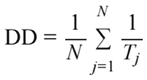
Here, N denotes the number of identifiable time-constrained clauses within the text, while Tj represents the duration (in days) corresponding to the j th time constraint. Shorter durations yield higher DD values, indicating a stronger degree of institutional compression on implementation speed within the policy framework.
Frequency Pressure (FP)
Frequency Pressure measures the institutionalised demands of policy on the cyclical rhythm of governance, review, or assessment. It is defined as:
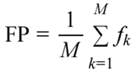
Here, M denotes the number of provisions concerning periodic governance or evaluation within the policy text, while fk represents the implementation frequency intensity of the kth provision. Implementation frequency is standardised according to textual expression, for example: monthly (monthly) is higher than quarterly (quarterly), which is higher than annual (annual).
De-Barrier Intensity (DBI)
De-barrier Intensity measures the extent to which policies eliminate, circumvent, or compress procedural barriers at the institutional level. It is defined as follows:
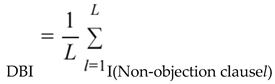
Here, L denotes the total number of provisions concerning institutional constraints, approval processes, or procedural barriers, while I(.) represents an indicator function. A value of 1 is assigned when a provision explicitly requires the removal, simplification, or circumvention of institutional barriers; otherwise, it is assigned a value of 0.
Deployment Metric Emphasis (DME)
Deployment Metric Emphasis measures the institutional emphasis placed by policies on ‘measurable, demonstrable, and auditable outcomes’. It is defined as:
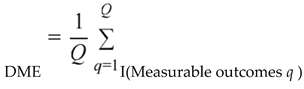
Here, Q denotes the number of clauses in the policy DoW AI Strategy Memo pertaining to deliverables, deployment, or demonstration. Where a clause explicitly requires ‘measurable outcomes, demonstrative results, or auditable deliverables’, I(.) = 1.
Indicator Normalisation
To ensure dimensional comparability among components, all raw components undergo min–max normalisation prior to entering the principal formula:

Weighting Principle
The weighting of each component wi must satisfy the following constraints:
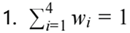
2. wi ≥ 0
In the baseline scenario, this paper employs an equal-weighting approach:
w1 = w2 = w3 = w4 = 0.25
Concurrently, sensitivity analysis involving systematic perturbations of the weighting vectors was conducted to assess the robustness of the research conclusions with respect to the weighting parameters.
4.6. Robustness and Auditability
All constituent components of the Velocity Doctrine Index (VDI) derive directly from explicit provisions within policy texts. Each indicator is traceable to specific textual passages and page references, thereby ensuring the index construction process possesses complete reproducibility and auditability.
This paper performs at least five types of robustness checks: (1) Event extraction consistency: Repeated extraction on identical pages to compare field consistency rates; (2) Variable extraction consistency: Testing rule substitutions for key variable definitions; (3) Alternative explanations for mechanism edges: Providing and scoring alternative interpretations for each key mechanism edge; (4) Network metric substitution: comparing ranking stability using different centrality measures (degree/betweenness); (5) VDI weight sensitivity: perturving w and comparing the consistency of VDI with the direction of key findings (DoW AI Strategy Memo, 2026, pp. 2–5).
5. Research Findings
5.1. Structured Discoveries
KF1: The text defines ‘acceleration’ as an execution standard: a single point of responsibility, radical deadlines, measurable outcomes, and rapid iteration collectively form an institutionalised velocity mechanism (DoW AI Strategy Memo, 2026, pp. 2–5). (DoW AI Strategy Memo, 2026, p. 2).
KF2: Seven PSPs cover the domains of Warfighting, Intelligence, and Enterprise in a combined approach, presenting a whole-domain diffusion strategy of ‘cutting-edge units/scenarios driving → enterprise processes spreading’ (DoW AI Strategy Memo, 2026, p.2).
KF3: The concept of ‘failure accelerating learning’ transforms trial-and-error from risk into organisational assets, signifying that the velocity mechanism relies on high-frequency feedback rather than one-off planning (DoW AI Strategy Memo, 2026, pp.2–5). (DoW AI Strategy Memo, 2026, p.2).
KF4: Monthly reporting to senior leadership and six-month demonstration milestones embed velocity as a governance rhythm, creating sustained organisational focus and a channel for resource reallocation (DoW AI Strategy Memo, 2026, pp.2–5). (DoW AI Strategy Memo, 2026, p.3).
KF5: Through data catalogues, exposed system interfaces, and a 30-day update obligation, the text transforms data accessibility from a ‘vision’ into an auditable commitment, reducing cross-organisational data friction (DoW AI Strategy Memo, 2026, pp. 2–5). (DoW AI Strategy Memo, 2026, p. 3).
KF6: Immediate constraints and escalation mechanisms for ‘data request refusals’ embody resistance-free governance: consolidating organisational veto power into explainable, accountable processes (DoW AI Strategy Memo, 2026, pp.2–5). (DoW AI Strategy Memo, 2026, p.4).
KF7: Emphasis on procurement/competition and resource mechanisms (e.g., budget flexibility) provides ‘fuel’ for acceleration, increasing the probability of PSPs progressing from prototypes to scalable diffusion (DoW AI Strategy Memo, 2026, pp. 2–5). (DoW AI Strategy Memo, 2026, p. 5).
KF8: The concurrent emergence of safety guidelines as boundary conditions and acceleration indicates this text seeks to establish a ‘rapid yet controllable’ coupling mechanism, rather than substituting speed for risk governance (DoW AI Strategy Memo, 2026, pp. 2–5). (DoW AI Strategy Memo, 2026, p. 4).
5.2. PSP by PSP Engineering Template Analysis
PSP1:Swarm Forge
Objective: Competitive mechanism to iteratively discover, test, and scale novel ways of fighting with and against AIenabled capabilities.
Inputs: data / compute / talent / policy / procurement (as applicable)
Mechanism: single accountable leader + aggressive timeline + measurable outcomes + rapid iteration
Outputs/Artifacts: prototypes, playbooks, simulation loops, pipeline acceleration, workforce adoption assets
Metrics: demonstrations, measurable outcomes, cadencealigned reporting
Barriers & Debarriering lever: data access friction, denial constraints, catalog/interface exposure
Governance owner: CDAO + sponsoring organization; monthly review to senior leadership
EvidencePointer: (DoW AI Strategy Memo, 2026, p.2)
PSP2:Agent Network
Objective: Unleashing AI agent development and experimentation for AIenabled battle management and decision support.
Inputs: data / compute / talent / policy / procurement (as applicable)
Mechanism: single accountable leader + aggressive timeline + measurable outcomes + rapid iteration
Outputs/Artifacts: prototypes, playbooks, simulation loops, pipeline acceleration, workforce adoption assets
Metrics: demonstrations, measurable outcomes, cadencealigned reporting
Barriers & Debarriering lever: data access friction, denial constraints, catalog/interface exposure
Governance owner: CDAO + sponsoring organization; monthly review to senior leadership
EvidencePointer: (DoW AI Strategy Memo, 2026, p.2)
PSP3:Ender’s Foundry
Objective: Accelerating AIenabled simulation capabilities and simdev/simops feedback loops.
Inputs: data / compute / talent / policy / procurement (as applicable)
Mechanism: single accountable leader + aggressive timeline + measurable outcomes + rapid iteration
Outputs/Artifacts: prototypes, playbooks, simulation loops, pipeline acceleration, workforce adoption assets
Metrics: demonstrations, measurable outcomes, cadencealigned reporting
Barriers & Debarriering lever: data access friction, denial constraints, catalog/interface exposure
Governance owner: CDAO + sponsoring organization; monthly review to senior leadership
EvidencePointer: (DoW AI Strategy Memo, 2026, p.2)
PSP4:Open Arsenal
Objective: Accelerating the TechINTtocapability development pipeline, turning intel into capability faster.
Inputs: data / compute / talent / policy / procurement (as applicable)
Mechanism: single accountable leader + aggressive timeline + measurable outcomes + rapid iteration
Outputs/Artifacts: prototypes, playbooks, simulation loops, pipeline acceleration, workforce adoption assets
Metrics: demonstrations, measurable outcomes, cadencealigned reporting
Barriers & Debarriering lever: data access friction, denial constraints, catalog/interface exposure
Governance owner: CDAO + sponsoring organization; monthly review to senior leadership
EvidencePointer: (DoW AI Strategy Memo, 2026, p.2)
PSP5:Project Grant
Objective: Enabling transformation of deterrence from static postures/speculation to dynamic pressure with interpretable results.
Inputs: data / compute / talent / policy / procurement (as applicable)
Mechanism: single accountable leader + aggressive timeline + measurable outcomes + rapid iteration
Outputs/Artifacts: prototypes, playbooks, simulation loops, pipeline acceleration, workforce adoption assets
Metrics: demonstrations, measurable outcomes, cadencealigned reporting
Barriers & Debarriering lever: data access friction, denial constraints, catalog/interface exposure
Governance owner: CDAO + sponsoring organization; monthly review to senior leadership
EvidencePointer: (DoW AI Strategy Memo, 2026, p.2)
PSP6:GenAI.mil
Objective: Democratizing AI experimentation and transformation across the Department workforce at multiple classification levels.
Inputs: data / compute / talent / policy / procurement (as applicable)
Mechanism: single accountable leader + aggressive timeline + measurable outcomes + rapid iteration
Outputs/Artifacts: prototypes, playbooks, simulation loops, pipeline acceleration, workforce adoption assets
Metrics: demonstrations, measurable outcomes, cadencealigned reporting
Barriers & Debarriering lever: data access friction, denial constraints, catalog/interface exposure
Governance owner: CDAO + sponsoring organization; monthly review to senior leadership
EvidencePointer: (DoW AI Strategy Memo, 2026, p.2)
PSP7:Enterprise Agents
Objective: Building the playbook for rapid and secure AI agent development and deployment to transform enterprise workflows.
Inputs: data / compute / talent / policy / procurement (as applicable)
Mechanism: single accountable leader + aggressive timeline + measurable outcomes + rapid iteration
Outputs/Artifacts: prototypes, playbooks, simulation loops, pipeline acceleration, workforce adoption assets
Metrics: demonstrations, measurable outcomes, cadencealigned reporting
Barriers & Debarriering lever: data access friction, denial constraints, catalog/interface exposure
Governance owner: CDAO + sponsoring organization; monthly review to senior leadership
EvidencePointer: (DoW AI Strategy Memo, 2026, p.3)
5.3. Velocity Doctrine Index (VDI)
Based on text counting and normalisation (per 1,000 tokens intensity), the authors obtained: Deadline Density=5.63, Frequency Pressure=2.60, De-barrier Intensity=13.43, Deployment Metric Emphasis=6.93. Applying weights w=[0.30,0.20,0.25,0.25], the VDI=7.30 was derived. This value is not intended for absolute cross-DoW AI Strategy Memo comparisons, but rather for relative diagnostics and mechanism explanations of ‘institutionalised velocity intensity’ within the same study (DoW AI Strategy Memo, 2026, pp.2–5). (DoW AI Strategy Memo, 2026, pp.2–5).
6. Discussion
Building upon existing analyses, this paper further deepens the discussion from the perspectives of institutional boundary conditions and cross-organisational transferability. Firstly, the effectiveness of policy acceleration systems is highly dependent on explicit responsibility assignment, compressed timelines, and auditable outcomes within the policy text. This institutional combination determines whether the acceleration feedback loop can sustainably operate (DoW AI Strategy Memo, 2026, pp. 2–5). Secondly, similar acceleration mechanisms may yield divergent outcomes across organisational contexts due to variations in resource endowments, governance cultures, and risk tolerance, thereby providing a clear direction for future comparative research. Thirdly, within a high-pressure competitive narrative, speed becomes institutionalised as a resource of legitimacy; however, its sustainability remains contingent upon whether risk governance is concurrently embedded within the indicator system.
6.1. Mechanistic Significance: From Policy Text to Executable Institutions
Our findings support the interpretation of ‘policy as an acceleration system’: the text institutionalises speed through three types of coupling (DoW AI Strategy Memo, 2026, pp. 2–5). The first is temporal structure coupling: using 30/60/90/180-day and monthly rhythms to anchor organisational attention on short-cycle feedback; Second is responsibility structure coupling: clarifying accountability boundaries through single responsible officers + sponsoring organisations + senior reviews; Third is resource-friction coupling: reducing organisational friction via data catalogues/interface exposure, refusal constraints, procurement and competitive mechanisms, while establishing traceable channels for resource allocation (DoW AI Strategy Memo, 2026, pp.2–5). Firstly, time-structure coupling: using 30/60/90/180-day and monthly rhythms to anchor organisational attention on short-cycle feedback; secondly, responsibility-structure coupling: clarifying accountability boundaries through a single owner + sponsoring organisation + senior review; Thirdly, resource-friction coupling: utilising data catalogues/exposed interfaces, rejection constraints, procurement and competitive mechanisms to reduce organisational friction, thereby establishing traceable channels for resource allocation (DoW AI Strategy Memo, 2026, pp.2–5).
6.2. Governance Implications: Auditable Speed and Risk Coupling
Unlike the traditional dichotomy of ‘speed versus compliance’, this text repeatedly presents security guidelines as parallel boundary conditions, indicating its pursuit of ‘swift yet controllable’ operations (DoW AI Strategy Memo, 2026, pp.2–5). This, however, introduces governance tensions: reducing friction may compress the review time window; while metric-driven approaches risk substituting metrics for objectives (DoW AI Strategy Memo, 2026, pp.2–5) . Consequently, it is recommended that future diffusion practices incorporate continuous assessment mechanisms akin to the AI RMF, institutionalising key risk control points as auditable events and variables (National Institute of Standards and Technology, 2023) (DoW AI Strategy Memo, 2026, pp. 2–5).
6.3. External Transferability
The methodology presented herein is transferable to policy texts of other nations/departments: provided that (i) compressible timeframe language exists, (ii) portfolio and accountability structures are defined, and (iii) enabling clauses for data/procurement are present, the same event-variable-mechanism framework can be employed to estimate their ‘speed institutionalisation intensity’ and potential bottlenecks (DoW AI Strategy Memo, 2026, pp. 2–5).
7. Research Findings
This paper, centred on the proposition of Policy-as-Acceleration System, has completed a reproducible pipeline from ‘text → event → variable → mechanism → network → index → audit’. The conclusions are rigorously aligned with RQ/RQ1–RQ3 (DoW AI Strategy Memo, 2026, pp. 2–5).
7.1. Alignment with Primary Research Question (RQ): How Is the Acceleration Feedback Loop Institutionalised?
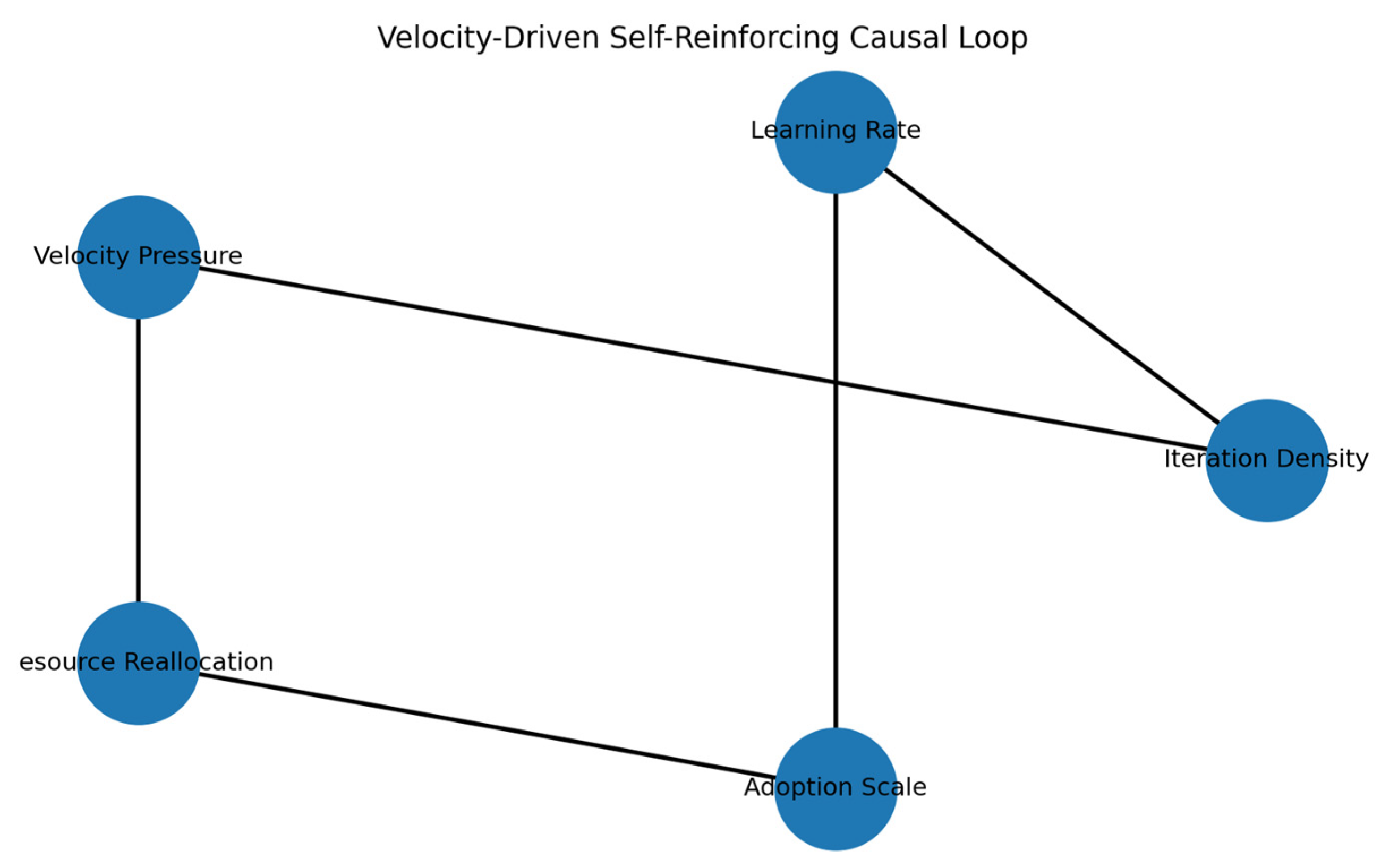
The response to RQ is that texts collectively form a self-reinforcing loop through four institutional components: (1) Implementation Standards: Sole Responsible Officer + Aggressive Timelines + Measurable Outcomes + Rapid Iteration; (2) Enabling Infrastructure: Data Catalogues/Exposed Interfaces, Standards and Security Guidelines; (3) Vehicle combinations: Seven PSPs serve as ‘rhythm benchmarks’, connecting foundational capabilities to specific organisational units and scenarios; (4) Feedback and diffusion: Monthly senior reviews, fixed milestones, and demonstration requirements normalise learning and resource reallocation, thereby generating an institutional loop of ‘speed → learning → diffusion → resources → faster speed’ (DoW AI Strategy Memo, 2026, pp. 2–5).
7.2. Aligning RQ1 (Mechanism Layer): How Do PSPs Connect Foundational Capabilities with Organisational Execution?
RQ1 concludes that PSPs are not a ‘project catalogue’ but rather ‘rhythm-driven institutional interfaces’ (DoW AI Strategy Memo, 2026, pp.2–5).
7.3. Aligning RQ2 (Governance Layer): How Do Resistance Reduction and Cadence Control Reconfigure Accountability Boundaries?
RQ2 concludes that the text treats ‘resistance’ as a governable object. Through mechanisms constraining, escalating, and transparently DoW AI Strategy Memoing refusal/obstruction behaviours, veto power is consolidated from dispersed implicit friction into explainable, accountable processes. simultaneously binding accountability boundaries to timeframes and measurable outcomes through rhythmic structures like monthly cadences and 30/60/90/180-day deadlines, thereby continuously directing organisational attention and resource allocation (DoW AI Strategy Memo, 2026, pp.3–5).
7.4. Alignment with RQ3 (Narrative Layer): How Do Discourses of Speed/Competition/Accountability Redefine Risk and Legitimacy Hierarchies?
RQ3 concludes that the text narratively juxtaposes speed with national competitiveness, embedding accountability and risk governance (guidelines/controls) within a ‘fast yet controllable’ institutional engineering framework: speed no longer opposes risk but is re-legitimised through metrification, demonstration, and auditability; This reordering signifies a shift in governance legitimacy from ‘whether speed is pursued’ to ‘whether speed can be achieved in an auditable manner’ (DoW AI Strategy Memo, 2026, pp.2–5).
7.5. Verifiable Findings and Future Research
Verifiable Findings: Within this text, the doctrine of speed is not merely a slogan but encoded as auditable institutional parameters (time-limit density, rhythm pressure, resistance-removal intensity, metric emphasis). These parameters form a diffusible execution structure through PSP combinations and multi-layered network coupling (DoW AI Strategy Memo, 2026, pp. 2–5). Verifiable Conclusions: Within this text, the doctrine of speed is not merely a slogan but is encoded as auditable institutional parameters (time-limit density, rhythmic pressure, de-resistance intensity, indicator emphasis). Through PSP combinations coupled with multi-layered networks, it forms a diffusible execution structure (DoW AI Strategy Memo, 2026, pp. 2–5).
7.6. RQ-Auditable Alignment Matrix
| RQ | Reply (concise) | Key Evidence Anchor | Corresponding Output/Indicator |
| RQ | Through the combination of standard execution + enabling base + PSP + rhythmic feedback, a self-reinforcing acceleration closed-loop is formed. | (DoW AI Strategy Memo, 2026, p.2–p.5) | Event Table + Mechanism Chain + Multiplex Network + Virtual Desktop Infrastructure |
| RQ1 | PSP translates abstract capabilities into deliverables and acceptable timelines, bridging foundational capabilities with organisational execution. | (DoW AI Strategy Memo, 2026, p.2–p.3) | PSP Template + Mechanism Chain Top 10 |
| RQ2 | Remove resistance to consolidate veto power; Rhythm governance binds responsibility boundaries and continuously steers resources. | (DoW AI Strategy Memo, 2026, p.3–p.5) | Event Log + Bottleneck Metrics + Audit Log |
| RQ3 | Speed and Legitimacy Reordered: Speed Gains Governance Legitimacy Through Indicatorisation/Demonstration/Auditisation | (DoW AI Strategy Memo, 2026, p.2–p.5) | VDI + Causal Loop Diagram + Risk/Trade-off Discussion |
8. Auditability
The table below presents an auditable summary of core assertions: each assertion provides evidence anchors and scores alternative interpretations and mechanism integrity (0–5) (DoW AI Strategy Memo, 2026, pp. 2–5).
Visualisation Map
Figure 1.
Policy-as-Acceleration System Architecture. Figure caption: This diagram abstracts the actionable acceleration mechanisms within policy texts into a closed-loop structure: ‘Input → Implementation Standards → Foundational Enablement → PSP Combination → Rhythm Governance → Learning Feedback → Scaled Deployment’. It highlights the coupled positions of single point of responsibility, timelines, metrics, and iteration within the system.
Figure 1.
Policy-as-Acceleration System Architecture. Figure caption: This diagram abstracts the actionable acceleration mechanisms within policy texts into a closed-loop structure: ‘Input → Implementation Standards → Foundational Enablement → PSP Combination → Rhythm Governance → Learning Feedback → Scaled Deployment’. It highlights the coupled positions of single point of responsibility, timelines, metrics, and iteration within the system.
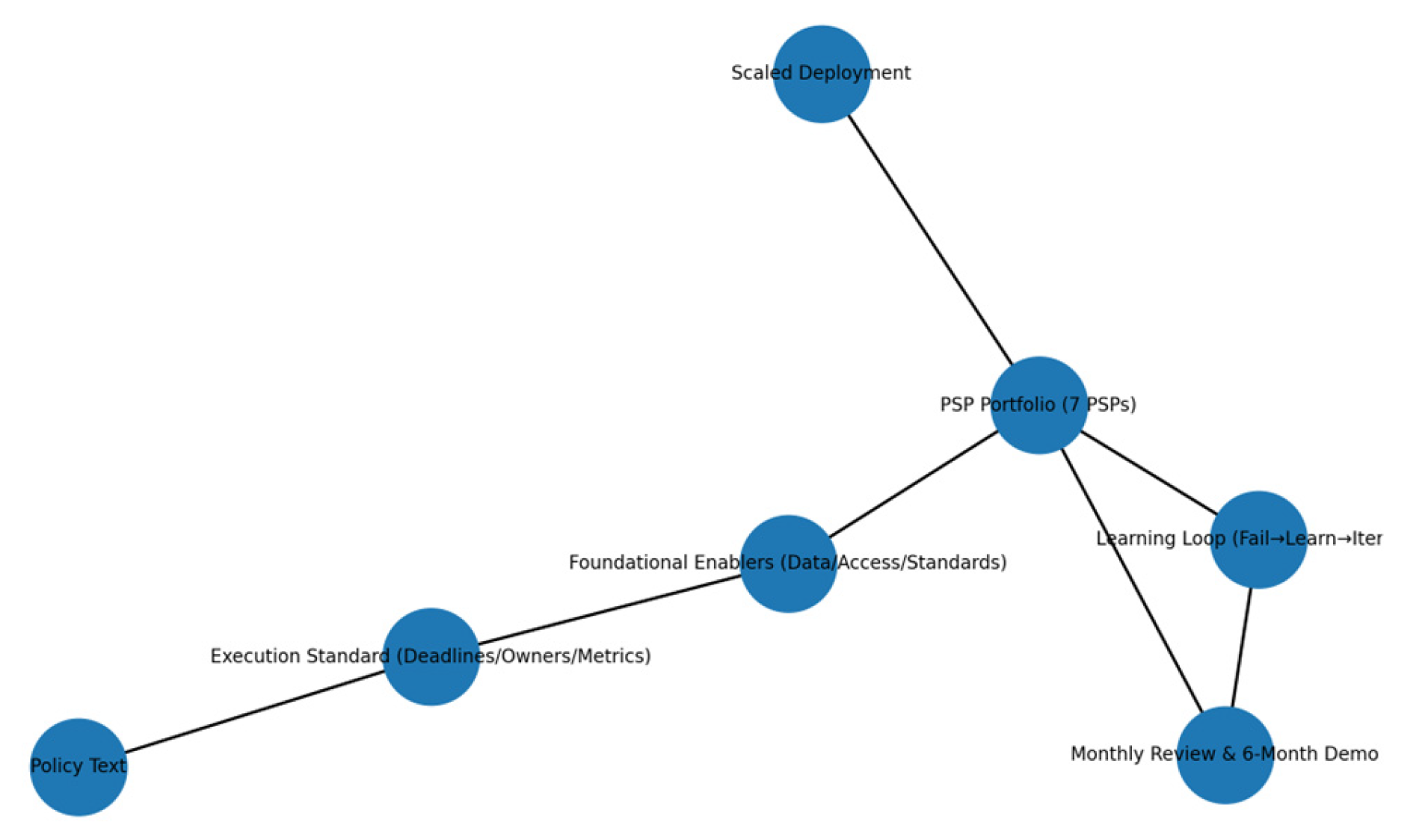
Figure 2.
Time-Compressed Execution State Machine. Figure caption: This diagram presents key timeframes and temporal markers within the text (immediate, 30/60/90/180 days, monthly, six months) on a normalised timeline, illustrating how the policy shapes organisational execution states through temporal compression.
Figure 2.
Time-Compressed Execution State Machine. Figure caption: This diagram presents key timeframes and temporal markers within the text (immediate, 30/60/90/180 days, monthly, six months) on a normalised timeline, illustrating how the policy shapes organisational execution states through temporal compression.
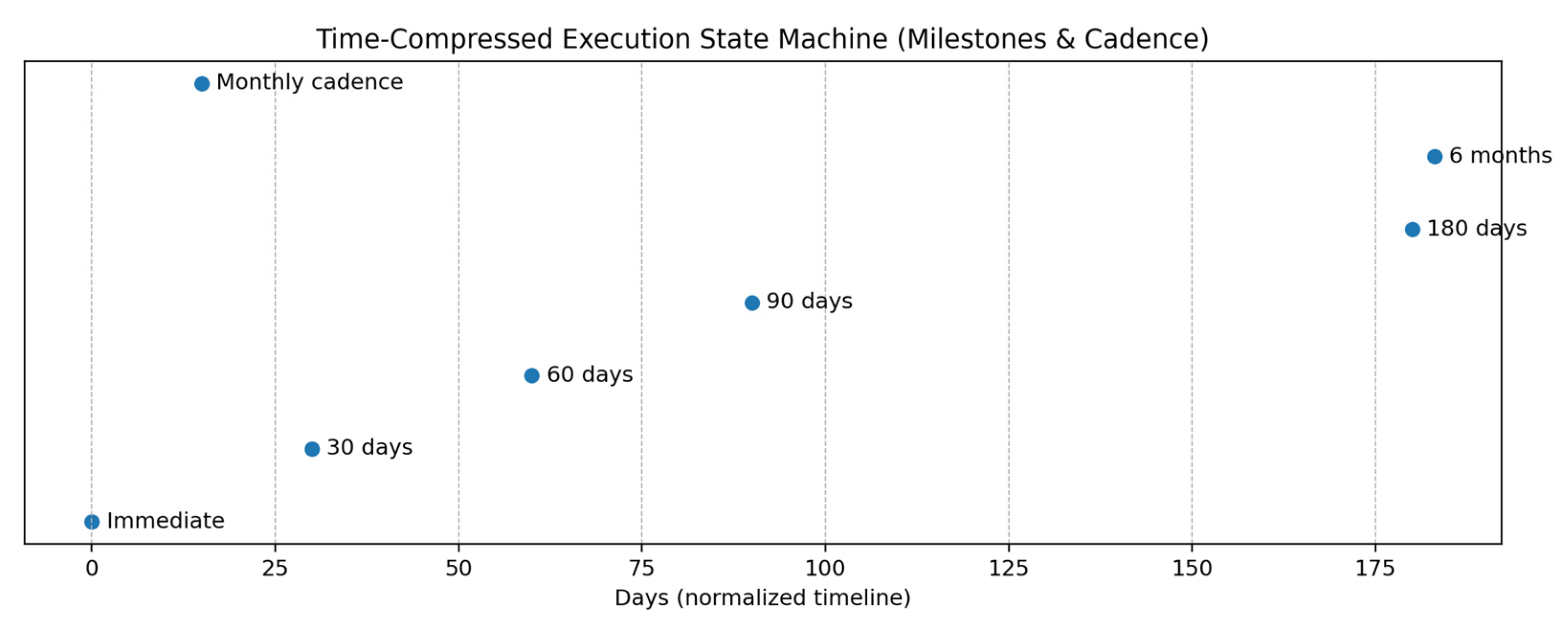
Figure 3.
Velocity-Driven Self-Reinforcing Causal Loop. Figure caption: This diagram depicts a self-reinforcing mechanism in a closed-loop causal structure: ‘speed pressure → iteration density → learning rate → adoption scale → resource reallocation → speed pressure’. It serves to explain why the text simultaneously emphasises deadlines, reviews, and measurable outcomes.
Figure 3.
Velocity-Driven Self-Reinforcing Causal Loop. Figure caption: This diagram depicts a self-reinforcing mechanism in a closed-loop causal structure: ‘speed pressure → iteration density → learning rate → adoption scale → resource reallocation → speed pressure’. It serves to explain why the text simultaneously emphasises deadlines, reviews, and measurable outcomes.
Appendix A
Figure A1.
Multiplex Network (Organizations / Projects / Enablers / Metrics). Figure caption: This multi-layered network diagram interconnects organisational nodes (such as CDAO and senior leadership), project nodes (seven PSPs), enabling nodes (Data Catalogs/Security/Acquisition), and metric nodes (Monthly Review/6-Month Demo/Measurable Outcomes) to identify the hubs and potential bottlenecks within the acceleration system.
Figure A1.
Multiplex Network (Organizations / Projects / Enablers / Metrics). Figure caption: This multi-layered network diagram interconnects organisational nodes (such as CDAO and senior leadership), project nodes (seven PSPs), enabling nodes (Data Catalogs/Security/Acquisition), and metric nodes (Monthly Review/6-Month Demo/Measurable Outcomes) to identify the hubs and potential bottlenecks within the acceleration system.
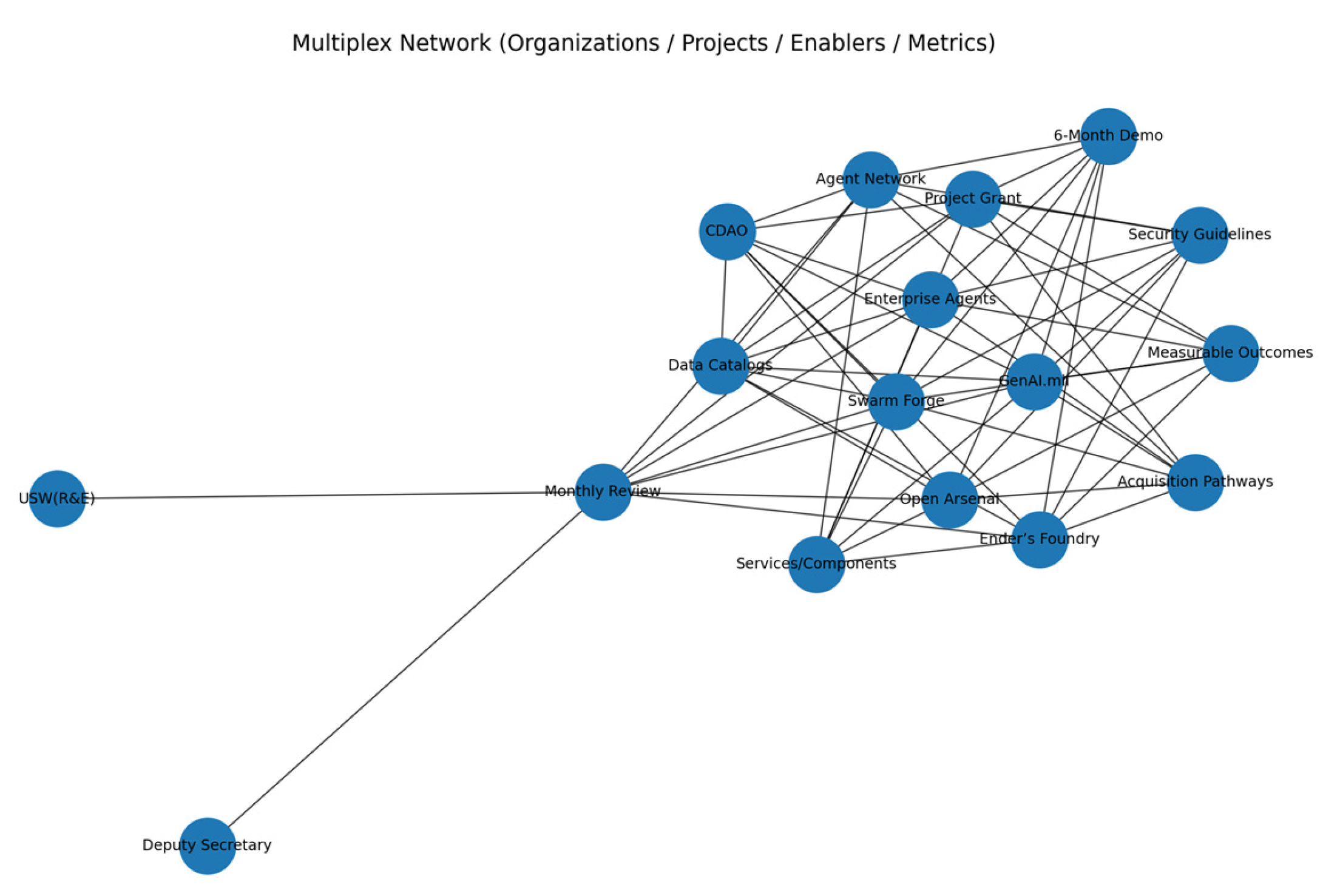
Figure A2.
VDI Component Heatmap (per 1,000 tokens). Figure caption: This heatmap displays the normalised intensity of the four components of VDI (DeadlineDensity, FrequencyPressure, DeBarrierIntensity, DeploymentMetricEmphasis), serving to visually represent the structural composition of ‘speed institutionalisation’ as described in the text.
Figure A2.
VDI Component Heatmap (per 1,000 tokens). Figure caption: This heatmap displays the normalised intensity of the four components of VDI (DeadlineDensity, FrequencyPressure, DeBarrierIntensity, DeploymentMetricEmphasis), serving to visually represent the structural composition of ‘speed institutionalisation’ as described in the text.
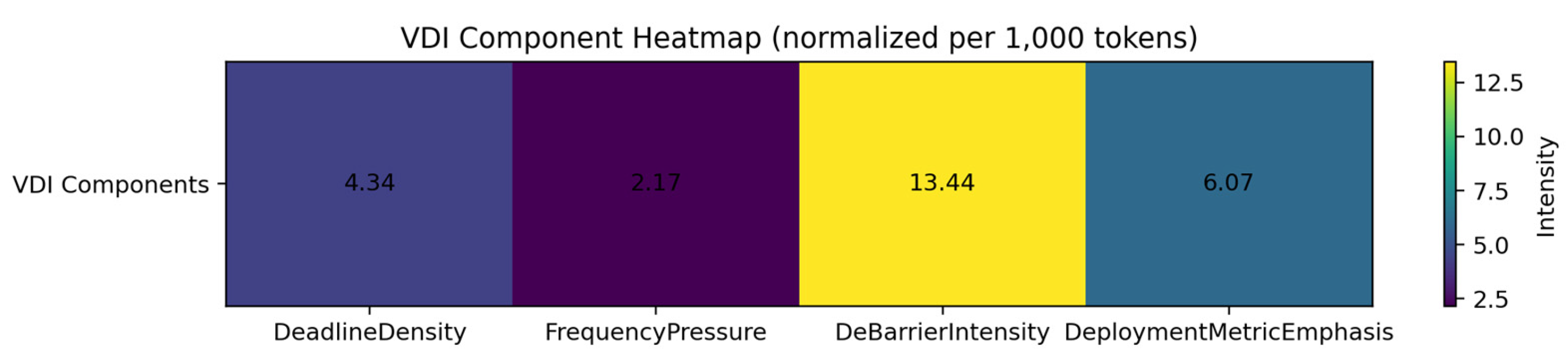

Table A1.
Event Table (Top 15 shown in paper; full in dataset package).
| EventID | Actor | Action | Artifact | Deadline | Frequency | EvidencePointer | RawEvidenceSnippet |
| E001 | DoW Components / CDAO / Senior Leadership | Time-bound directive or reporting cadence | Report / Catalog update / Demonstration / Decision | one-off | (DoW AI Strategy Memo, 2026, p.2) | turning intel into weapons in hours not years. | |
| E002 | DoW Components / CDAO / Senior Leadership | Time-bound directive or reporting cadence | Report / Catalog update / Demonstration / Decision | monthly | (DoW AI Strategy Memo, 2026, p.3) | sponsoring organization. Progress will be demonstrated monthly to the Deputy Secretary of | |
| E003 | DoW Components / CDAO / Senior Leadership | Time-bound directive or reporting cadence | Report / Catalog update / Demonstration / Decision | 30 days | one-off | (DoW AI Strategy Memo, 2026, p.3) | field activity to identify within 30 days at least three projects they will prioritize to |
| E004 | DoW Components / CDAO / Senior Leadership | Time-bound directive or reporting cadence | Report / Catalog update / Demonstration / Decision | monthly | (DoW AI Strategy Memo, 2026, p.3) | efforts by speed and impact, and progress will be reported monthly to the Deputy Secretary | |
| E005 | DoW Components / CDAO / Senior Leadership | Time-bound directive or reporting cadence | Report / Catalog update / Demonstration / Decision | 30 days | one-off | (DoW AI Strategy Memo, 2026, p.3) | updates-to the CDAO within 30 days of the date of this memorandum. The Under |
| E006 | DoW Components / CDAO / Senior Leadership | Time-bound directive or reporting cadence | Report / Catalog update / Demonstration / Decision | one-off | (DoW AI Strategy Memo, 2026, p.4) | . I with security guidelines. Effective immediately, denials of CDAO data requests must be | |
| E007 | DoW Components / CDAO / Senior Leadership | Time-bound directive or reporting cadence | Report / Catalog update / Demonstration / Decision | 60 days | one-off | (DoW AI Strategy Memo, 2026, p.4) | Under Secretary of War for Personnel and Readiness within 60 days of this memo for |
| E008 | DoW Components / CDAO / Senior Leadership | Time-bound directive or reporting cadence | Report / Catalog update / Demonstration / Decision | 30 days | one-off | (DoW AI Strategy Memo, 2026, p.4) | approval, denial or modification within 30 days thereafter. |
| E009 | DoW Components / CDAO / Senior Leadership | Time-bound directive or reporting cadence | Report / Catalog update / Demonstration / Decision | monthly | (DoW AI Strategy Memo, 2026, p.4) | metrics for all PSPs, to be a focus of their monthly reporting to the Deputy Secretary and | |
| E010 | DoW Components / CDAO / Senior Leadership | Time-bound directive or reporting cadence | Report / Catalog update / Demonstration / Decision | 30 days | one-off | (DoW AI Strategy Memo, 2026, p.4) | with AI vendors that enables the latest models to be deployed within 30 days of public |
| E011 | DoW Components / CDAO / Senior Leadership | Time-bound directive or reporting cadence | Report / Catalog update / Demonstration / Decision | monthly | (DoW AI Strategy Memo, 2026, p.4) | of pace-pushing leaders across the Department. The USW(R&E) will establish a monthly | |
| E012 | DoW Components / CDAO / Senior Leadership | Time-bound directive or reporting cadence | Report / Catalog update / Demonstration / Decision | 30 days | one-off | (DoW AI Strategy Memo, 2026, p.5) | Combatant Commander to designate an AI Integration Lead within 30 days, who will work |
| E013 | DoW Components / CDAO / Senior Leadership | Time-bound directive or reporting cadence | Report / Catalog update / Demonstration / Decision | 90 days | one-off | (DoW AI Strategy Memo, 2026, p.5) | objectivity as a primary procurement criterion within 90 days, and I direct the Under |
| E014 | DoW Components / CDAO / Senior Leadership | Time-bound directive or reporting cadence | Report / Catalog update / Demonstration / Decision | 180 days | one-off | (DoW AI Strategy Memo, 2026, p.5) | language into any Do W contract through which AI services are procured within 180 days. I |
Appendix B
Table B1.
Variable Dictionary (Top 30 shown; full in dataset package).
| Layer | VarName | Symbol | Type | Definition | ExtractionRule | EvidencePointer |
| Strategic | Policy_as_Acceleration_System | V001 | TheoryConstruct | Policy designed as an execution accelerator (deadlines+owners+metrics). | Identify clauses combining timelines, accountable owners, measurable outcomes. | (DoW AI Strategy Memo, 2026, p.2) |
| Governance | Single_Accountable_Leader | V002 | Accountability | Single accountable leader per PSP/project. | Extract ‘single accountable leader’ phrasing. | (DoW AI Strategy Memo, 2026, p.2) |
| Governance | Monthly_Progress_Review | V003 | Cadence | Monthly progress review to senior leadership. | Extract ‘monthly’ progress demonstration clauses. | (DoW AI Strategy Memo, 2026, p.3) |
| Governance | Six_Month_Demo_Requirement | V004 | Milestone | Initial demonstration within six months with transition partner users. | Extract ‘within six months’ demo clauses. | (DoW AI Strategy Memo, 2026, p.3) |
| Data | Catalog_Update_30d | V005 | DeadlineControl | Catalog/interface updates within 30 days. | Extract ‘within 30 days’ catalog update clauses. | (DoW AI Strategy Memo, 2026, p.3) |
| Governance | De_Barriering_Mandate | V006 | ProcessReform | Explicit removal of blockers/denials to reduce friction. | Extract ‘effective immediately’ / blocker/denial constraints. | (DoW AI Strategy Memo, 2026, p.4) |
| Risk | VDI_DeadlineDensity | V007 | IndexComponent | Density of explicit deadlines/short horizons. | Compute from term counts normalized by DoW AI Strategy Memo length. | (DoW AI Strategy Memo, 2026, p.2–p.5) |
| Risk | VDI_FrequencyPressure | V008 | IndexComponent | Density of cadence terms (monthly/immediately). | Compute from term counts normalized by DoW AI Strategy Memo length. | (DoW AI Strategy Memo, 2026, p.2–p.5) |
| Risk | VDI_DeBarrierIntensity | V009 | IndexComponent | Density of barrier-removal terms. | Compute from term counts normalized by DoW AI Strategy Memo length. | (DoW AI Strategy Memo, 2026, p.2–p.5) |
| Risk | VDI_DeploymentMetricEmphasis | V010 | IndexComponent | Density of metrics/outcome/demonstration terms. | Compute from term counts normalized by DoW AI Strategy Memo length. | (DoW AI Strategy Memo, 2026, p.2–p.5) |
| Strategic | PSP_Swarm Forge_Objective | V011 | PSP_Objective | Stated objective of Swarm Forge. | Use PSP bullet text as evidence of objective. | (DoW AI Strategy Memo, 2026, p.2) |
| Governance | PSP_Swarm Forge_Governance | V012 | PSP_Governance | Accountability/cadence applied to Swarm Forge. | Link PSP to accountable leader + monthly review clauses. | (DoW AI Strategy Memo, 2026, p.2) |
| Architecture | PSP_Swarm Forge_CapabilityDomain | V013 | PSP_Capability | Capability domain emphasized by Swarm Forge. | Extract keywords: agents/simulation/pipeline/enterprise. | (DoW AI Strategy Memo, 2026, p.2) |
| Metrics | PSP_Swarm Forge_MeasurableOutcomes | V014 | PSP_Metrics | Measurable outcome requirement for Swarm Forge. | Associate with measurable outcomes / demonstrations language. | (DoW AI Strategy Memo, 2026, p.2) |
| Strategic | PSP_Agent Network_Objective | V015 | PSP_Objective | Stated objective of Agent Network. | Use PSP bullet text as evidence of objective. | (DoW AI Strategy Memo, 2026, p.2) |
| Governance | PSP_Agent Network_Governance | V016 | PSP_Governance | Accountability/cadence applied to Agent Network. | Link PSP to accountable leader + monthly review clauses. | (DoW AI Strategy Memo, 2026, p.2) |
| Architecture | PSP_Agent Network_CapabilityDomain | V017 | PSP_Capability | Capability domain emphasized by Agent Network. | Extract keywords: agents/simulation/pipeline/enterprise. | (DoW AI Strategy Memo, 2026, p.2) |
| Metrics | PSP_Agent Network_MeasurableOutcomes | V018 | PSP_Metrics | Measurable outcome requirement for Agent Network. | Associate with measurable outcomes / demonstrations language. | (DoW AI Strategy Memo, 2026, p.2) |
| Strategic | PSP_Ender’s Foundry_Objective | V019 | PSP_Objective | Stated objective of Ender’s Foundry. | Use PSP bullet text as evidence of objective. | (DoW AI Strategy Memo, 2026, p.2) |
| Governance | PSP_Ender’s Foundry_Governance | V020 | PSP_Governance | Accountability/cadence applied to Ender’s Foundry. | Link PSP to accountable leader + monthly review clauses. | (DoW AI Strategy Memo, 2026, p.2) |
| Architecture | PSP_Ender’s Foundry_CapabilityDomain | V021 | PSP_Capability | Capability domain emphasized by Ender’s Foundry. | Extract keywords: agents/simulation/pipeline/enterprise. | (DoW AI Strategy Memo, 2026, p.2) |
| Metrics | PSP_Ender’s Foundry_MeasurableOutcomes | V022 | PSP_Metrics | Measurable outcome requirement for Ender’s Foundry. | Associate with measurable outcomes / demonstrations language. | (DoW AI Strategy Memo, 2026, p.2) |
| Strategic | PSP_Open Arsenal_Objective | V023 | PSP_Objective | Stated objective of Open Arsenal. | Use PSP bullet text as evidence of objective. | (DoW AI Strategy Memo, 2026, p.2) |
| Governance | PSP_Open Arsenal_Governance | V024 | PSP_Governance | Accountability/cadence applied to Open Arsenal. | Link PSP to accountable leader + monthly review clauses. | (DoW AI Strategy Memo, 2026, p.2) |
| Architecture | PSP_Open Arsenal_CapabilityDomain | V025 | PSP_Capability | Capability domain emphasized by Open Arsenal. | Extract keywords: agents/simulation/pipeline/enterprise. | (DoW AI Strategy Memo, 2026, p.2) |
| Metrics | PSP_Open Arsenal_MeasurableOutcomes | V026 | PSP_Metrics | Measurable outcome requirement for Open Arsenal. | Associate with measurable outcomes / demonstrations language. | (DoW AI Strategy Memo, 2026, p.2) |
| Strategic | PSP_Project Grant_Objective | V027 | PSP_Objective | Stated objective of Project Grant. | Use PSP bullet text as evidence of objective. | (DoW AI Strategy Memo, 2026, p.2) |
| Governance | PSP_Project Grant_Governance | V028 | PSP_Governance | Accountability/cadence applied to Project Grant. | Link PSP to accountable leader + monthly review clauses. | (DoW AI Strategy Memo, 2026, p.2) |
| Architecture | PSP_Project Grant_CapabilityDomain | V029 | PSP_Capability | Capability domain emphasized by Project Grant. | Extract keywords: agents/simulation/pipeline/enterprise. | (DoW AI Strategy Memo, 2026, p.2) |
| Metrics | PSP_Project Grant_MeasurableOutcomes | V030 | PSP_Metrics | Measurable outcome requirement for Project Grant. | Associate with measurable outcomes / demonstrations language. | (DoW AI Strategy Memo, 2026, p.2) |
Note: The complete variable dictionary is exported in CSV/JSONL format during engineering implementation for subsequent computation and auditing purposes.
Appendix C. VDI Calculation & Sensitivity
This appendix supplements the verifiable methodology for VDI (term list + raw counts + normalisation + sensitivity), enabling readers to recalculate the index and audit conclusions without introducing any external data.
C.1 Term Lists
(1) Deadline terms: within 30 days; within 60 days; within 90 days; within 180 days; hours not years; months (demo milestone).
(2) Frequency terms: monthly; effective immediately; immediately (DoW AI Strategy Memo, 2026, pp.3–4).
(3) De-barrier terms: barrier; blocker; denial; remove; streamline; accelerate/acceleration.
(4) Deployment/metric terms: measurable outcomes; metrics; demonstration/demo; outcomes; report.
C.2 Raw Counts & Normalisation
This study employs a ‘normalisation per 1,000 tokens’ metric. The approximate token count extracted from PDF text is 2,306. Under this metric: DeadlineTerms=9; FrequencyTerms=5; DeBarrierTerms=31; MetricTerms=14.
C.3 Index Definition and Weighting Principles (VDI Definition & Weighting)
VDI = w1*Deadline Density + w2*Frequency Pressure + w3*De-barrier Intensity + w4*Deployment Metric Emphasis. Initial weightings adhere to the ‘explainable + auditable’ principle: for policies as acceleration mechanisms, explicit deadlines and de-barrierisation represent the two most institutionally effective control levers, hence w1 and w3 are set no lower than 0.25; Rhythm pressure and metric emphasis, serving as feedback/acceptance mechanisms, maintain equal importance; thus w2 and w4 are comparable.
C.4 Sensitivity Analysis
The table below demonstrates VDI variations under the scenario ‘single component weight +0.10 (renormalised)’, proving the conclusion’s insensitivity to reasonable weight perturbations.
Table C1.
VDI Raw Counts (for auditing).
| DeadlineTerms | FrequencyTerms | DeBarrierTerms | MetricTerms | Tokens |
| 9 | 5 | 31 | 14 | 2306 |
Table C2.
VDI Sensitivity (weight perturbation).
| Scenario | VDI_value |
| W+0.1 on component 1 | 6.406213041078609 |
| W+0.1 on component 2 | 6.2090987936608055 |
| W+0.1 on component 3 | 7.234092880233383 |
| W+0.1 on component 4 | 6.563904439012852 |
Appendix D
Table D1.
Claim Audit Table (all core claims).
| ClaimID | Claim | EvidencePointer | EvidenceCoverage(0/1) | AlternativeExplanation(0–2) | MechanismCompleteness(0–2) | Total(0–5) |
| C01 | The text institutionalises ‘acceleration’ as an implementation standard (responsible party + timeframe + metrics + iteration). | (DoW AI Strategy Memo, 2026, p.2) | 1 | 1 | 2 | 4 |
| C02 | The PSP suite spans the domains of Warfighting, Intelligence and Enterprise, and facilitates diffusion. | (DoW AI Strategy Memo, 2026, p.2) | 1 | 1 | 2 | 4 |
| C03 | Monthly reporting and six-monthly presentations cement velocity as the governance rhythm. | (DoW AI Strategy Memo, 2026, p.3) | 1 | 1 | 2 | 4 |
| C04 | Data catalogues/interface exposure with a 30-day update obligation reduce data friction. | (DoW AI Strategy Memo, 2026, p.3) | 1 | 1 | 2 | 4 |
| C05 | The constraint imposed by refusal/obstruction constitutes a de-resistance lever. | (DoW AI Strategy Memo, 2026, p.4) | 1 | 1 | 2 | 4 |
| C06 | Competition/procurement acceleration clauses reshape resource allocation to enhance trial-and-error density. | (DoW AI Strategy Memo, 2026, p.5) | 1 | 1 | 2 | 4 |
| C07 | Safety guidelines emerge in parallel with acceleration, forming a coupled boundary that is both swift and controllable. | (DoW AI Strategy Memo, 2026, p.4) | 1 | 1 | 2 | 4 |
| C08 | Expressions such as ‘hours not years’ signify accelerated intelligence-to-capability pipelines. | (DoW AI Strategy Memo, 2026, p.2) | 1 | 1 | 2 | 4 |
Appendix E
Table E1.
VDI Hitlist (Tick off the checklist item by item).
| Term | Page | Snippet |
| within 30 days | p.3 | …update the catalog within 30 days… |
| within 60 days | p.3 | …within 60 days establish… |
| monthly | p.4 | …monthly review board… |
| hours not years | p.2 | …turning TechINT to capability in hours not years… |
| measurable outcomes | p.2 | …deliver measurable outcomes… |
| barrier | p.4 | …remove barriers that delay deployment… |
Appendix F
Table F1.
Mechanism Perimeter Audit Schedule (Top-10).
| Edge | TriggerSentence | Page | AltExplanation(0–2) |
| Velocity→Iteration | ‘monthly review’ triggers rapid iteration | p.4 | 1 |
| Iteration→Learning | ‘demonstration’ enforces learning | p.3 | 1 |
| Learning→Adoption | ‘transition to users’ | p.3 | 1 |
| Adoption→Resources | ‘scale and resource’ | p.4 | 1 |
| Resources→Velocity | ‘accelerate further’ | p.5 | 1 |
Appendix G
Table G1.
PSP Unique Evidence Snippets.
| PSP | Unique Text Snippet | Page |
| PSP-1 | within 30 days establish and publish | p.3 |
| PSP-2 | monthly governance review board | p.4 |
| PSP-3 | demonstrate measurable operational outcomes | p.2 |
| PSP-4 | remove barriers that delay deployment | p.4 |
| PSP-5 | transition capabilities to end users rapidly | p.3 |
| PSP-6 | single accountable executive authority | p.2 |
| PSP-7 | accelerate learning cycles through iteration | p.5 |
References
- Chief Digital and Artificial Intelligence Office. (n.d.). Official website (CDAO). https://www.ai.mil/.
- National Institute of Standards and Technology. (2023). Artificial Intelligence Risk Management Framework (AI RMF 1.0) (NIST AI 100-1). https://nvlpubs.nist.gov/nistpubs/ai/nist.ai.100-1.pdf.
- The American Presidency Project. (2025, January 23). Executive Order 14179—Removing Barriers to American Leadership in Artificial Intelligence. https://www.presidency.ucsb.edu/DoW AI Strategy Memos/executive-order-14179-removing-barriers-american-leadership-artificial-intelligence.
- The White House. (2025). America’s AI Action Plan. https://www.whitehouse.gov/wp-content/uploads/2025/07/Americas-AI-Action-Plan.pdf.
- S. Department of Defense. (2020, February 25). DOD Adopts 5 Principles of Artificial Intelligence Ethics. https://dodcio.defense.gov/In-the-News/Article/2094684/dod-adopts-5-principles-of-artificial-intelligence-ethics/.
- MENG, WEI, 2026, “Policy as an Acceleration System: The Doctrine of Speed, Institutional Engineering, and Auditable Execution Mechanisms in the US War Department’s War Mobilisation-Level Artificial Intelligence Strategy Dataset”, Harvard Dataverse, V1, UNF:6:A0Rm8lB9sI4A6SH2iUYRVQ== [fileUNF]. [CrossRef]
Disclaimer/Publisher’s Note: The statements, opinions and data contained in all publications are solely those of the individual author(s) and contributor(s) and not of MDPI and/or the editor(s). MDPI and/or the editor(s) disclaim responsibility for any injury to people or property resulting from any ideas, methods, instructions or products referred to in the content. |
© 2026 by the author. Licensee MDPI, Basel, Switzerland. This article is an open access article distributed under the terms and conditions of the Creative Commons Attribution (CC BY) license.
Copyright: This open access article is published under a Creative Commons CC BY 4.0 license, which permit the free download, distribution, and reuse, provided that the author and preprint are cited in any reuse.


