

Submitted:
16 January 2026
Posted:
19 January 2026
You are already at the latest version
Abstract
The rapid development of smart cities addresses urban challenges from population growth, resource management, and sustainability needs. Smart cities rely on Systems of Systems (SoS)—interconnected, independent systems—to achieve capabilities beyond individual components. This analysis explores SoS principles like operational autonomy, geographic distribution, and evolutionary growth in smart cities, with applications spanning healthcare, transportation, public safety, and energy efficiency. Case studies from India, Atlanta, and Porto illustrate successful SoS implementations using data-driven methods like open data platforms and IoT devices to tackle issues such as traffic congestion and resource allocation. Applying SoS frameworks in urban traffic light management can significantly reduce congestion and enhance transportation efficiency through dynamic data sharing and predictive analytics. By transforming traffic lights into interconnected ’smart sensors,’ real-time responses to traffic conditions, proactive congestion management, and improved emergency access are enabled. Addressing interoperability, scalability, and data security challenges ensures seamless system integration, supporting sustainable urban mobility.
Keywords:
smart cities
; system of systems (SoS)
; operational autonomy
; IoT integration
; privacy and security in smart cities
; traffic light management
1. Introduction
The term ‘smart city’ was first coined in 1998 but the meaning and context of the term are still misunderstood by many. This is because the definition of a ‘smart city’ is so vague and varied, with some claiming it is the ‘smartness footprint’ of a city, some saying it is the city’s communication technology and mesh metropolitan information, the attributes of a city’s ICT, or the urban living labs. Even the way that a city’s smartness is measured varies with some using education level indices of its inhabitants, some focusing on the innovativeness of the city’s enterprises. The term’s first appearance in the literature was generated through the knowledge base of urban simulations but has continued to evolve into the new focus of eco-cities [1]. Smart cities are heavily dependent on the employment of Information Communication Technology (ICT) systems, social capital, human resources, and environmental assets for their improvement, smooth functioning, sustainability, and overall quality and integrity. The development of the smart city is crucial for the future of urban areas. It stands to resolve a number of key obstacles associated with the currently unsustainable pace of urbanization. From a technological perspective, the term ‘smart’ refers to self-awareness, knowledge, and learning[2]. The interpretation and application of information from fast moving environments is a crucial element for the deployment of smart city, many efforts should be done including but not limited to evaluation and assessment of the current level for the city smartness, which can be done using the maturity model , on another side taking experience and knowledge from the existing smart cities will make the deployment faster and easier. Concepts like open data concept could also be used to share data across cities to open room for the innovativeness and creation of new smart application which will make cities smarter. Open data is one of the most important concepts in smart city deployment process where the sensed data in Internet of Things (IoT) environment, for example, can be shared either freely or in a paid manner to make a seamless transition to what is called a data driven economy which allows businesses or individual citizens to make money out of sharing their own data with other parties. The engagement of public and businesses and accepting to share their data will help towards the fast deployment of smart cities and smart applications However, the smart city can be simply seen as a complex System of Systems (SoS), which are highly interconnected with each other[3]. So, it is essential to study the notion of SoS and how does it evolve over time. The term ‘SoS’ is used to refer to a series or array of systems which originates when autonomous and valuable systems are assimilated into a bigger whole with the ability to provide key assets and skills. It should be noted that while all examples of SoS counts as ‘systems,’ a system doesn’t have to be SOS. Nevertheless, SoS and autonomous systems adhere to the widely endorsed perception of ‘systems,’ because they represent a whole that is bigger than the total of the parts. Plus, they are defined by their connections and each is made up of multiple components, so they both fit the established definition.
At the beginning, the system was very simple and has a simple objective or task to do. Any prediction over the evolution of these new forms of systems engineering is difficult to make; however, it is fair to envisage that they will have a long and secure future. The complexity of modern technology has increased that have led to numerous new obstacles and challenges being presented in networks, human systems integration, architecture and software and hardware engineering. Additionally, the sheer scale of some of these engineering feats is being performed on a level that was unimaginable less than a few decades ago. This suggests that the engineering problems of the future will all be solved with systems engineering in one form or in combination. The necessity to interact with other systems from other disciplines to satisfy the new user requirements is substantial and the introduction of new concept of SoS is a normal evolution. Nowadays smartness of the city is a crucial and fateful thing to have not a luxury thing to enjoy. One simple example to justify this are the problems introduced by the huge population increase challenge, which might cause congestion problem. This congestion problem if it is not solved will cause other problems such as to find a parking spot for your car quickly, which will increase the pollution from gas emissions produced by cars, waste time and money[4]. Another problem could be caused from the congestion problem, in case of a disaster happening and a need for the best and shortest route to follow to rescue a life of a person and which is the best hospital which has the enough resources needed for the person in need. These real time communications should be done and implemented smartly by letting more than one system to interact efficiently. So many other smart applications are in need to be implemented, by allowing shared data concept to be applied but at the same time those shared data should be secured and private, so only the authorized parties are allowed to see that information.
2. What Is SOS ?
The System of Systems (SoS) framework is a structural and operational methodology employed to combine various separate, autonomous systems into a unified network capable of accomplishing intricate, overarching goals. In a System of Systems (SoS), each constituent system retains its managerial and operational independence while collaborating with other systems to achieve a collective capability that exceeds the capabilities of any individual system. This paradigm is especially efficient for applications in smart cities, where several systems—such as transportation, healthcare, public safety, and energy—must integrate cohesively to tackle complex urban issues. SoS frameworks are defined by decentralized operational control, progressive development, and intricate inter-system communications that enable these autonomous systems to evolve and adapt jointly.
2.1. Types of SoS
The US Department of Defense (DoD) is a high-level department of the US government. It is tasked with directing and monitoring those forces and collectives within the government which are designed to uphold national safety and protect military forces. For a long time, DoD systems have focused keenly on the construction of more autonomous structures. However, the department has also acknowledged the need for cohesive, cooperative systems too. SoS systems engineering involves the structuring, evaluation,preparation, and assimilation of the abilities and assets of multiple new and existing systems. The aim is to create a SoS system with abilities which are superior than they would be if the systems were operated individually. This is achieved by joining a number of independent (but capable of connection) and cooperative systems[5]. From a technical perspective, the DoD functions as an SoS to help security chiefs unite armed forces and defense systems (for example, weapons activation). The goal is to fulfill a specific military objective. ‘The majority of military structures are now connected to a SoS whether or not they are labeled as one.’ Despite this, expansion and procurement continue to emphasize the importance of autonomous structures. In fact, many systems are originally constructed and refined without any thought for key SoS requirements[5]. The DoD, as it exists today, contains various types of SoS. Refer to Table 1 for more details.
2.2. SoS Management
One of the dominant features of SoS is the need for independent, coexisting funding and management authorities at the systems and SoS levels. These intersecting authorities draw attention due to the associated management issues over decision making rather than the technical implications of systems engineering. This has led to stakeholders attempting to establish improved governance processes that are able to overcome these intersecting management issues that have, so far, characterized SoS. These management issues are notable as effective SoS management needs to span numerous organizational boundaries to achieve completion of the required plan and objectives. Therefore, for any SoS plan, there is a notable need for experienced managers That have knowledge, expertise and flexibility to negotiate and tackle the many competing interests within the SoS field. The complexity, cost and scope of the planning process and engineering project are vastly increased with SoS, which also introduces the requirement of management agreement and inter-program activity coordination between numerous program managers (PMs). These PMs are the stakeholders who may, or may not, have a specific, personal interest in the program. These PMs are required to identify complex solutions that cannot simply be answered with an increase in systems engineering. These PMs need a structured management and governance approach for the SoS program to appease the overseeing independent authorities who are focused on effectively juggling the numerous governance processes of such a project. As such, they are unlikely to accept any advice or guidance from a system engineer who is not controlled by them; this often makes the systems Engineer’s position untenable and difficult when attempting to manage a SoS project. It is, therefore, necessary to ensure an adequate, structured administration and governance system that is able to overcome these issues in order that the SoS systems engineer is fully effective in all process phases. Whilst it is noted that this structure is needed for effective SoS projects, it is beyond the scope of this paper to make recommendations for these management and administrative structures[5].
2.3. Net-Centric Enterprise Systems
In Net-Centric Enterprise Systems can be seen as a collection of services, one or more services can be selected by operational or tactical users based on their own requirements. In addition to the importance of SoS and collaborative structures, there is also a need for better NCE systems. In fact, the value of these particular structures is a result of the government exploiting opportunities presented by commercial networking systems to bolster national security assets and gain more benefits from the employment of data across organizations [5]. The NCE and SoS systems share a number of key features and obstacles. From a national security and organizational viewpoint: They don’t regulate or have possession of their individual parts. Assets and skills are offered up by various owners Budgeting and finance can only be roughly estimated, because asset requirements are not fully realized from the viewpoint of SE: Engineers must play a much broader role, across multiple systems SoS and NCE engineers must focus on cross-cutting capability needs Engineers play a key role in negotiating and coordinating these needs and their solutions over time, establishing an architectural approach that allows them to do so. Engineers need to adopt more comprehensive responsibilities (serving more than one system)[6]. Engineers need to be directly involved in determining and organizing asset requirements and resolutions (as part of a consistent process), so they also need to work on creating architectural frameworks which help them to achieve this. NCE and SoS engineers need to make the cross cutting of asset requirements a top priority [5].
2.4. System of systems attributes:
SoS presents the following features:
- Operational autonomy: Every individual system of the SoS functions according to its own objectives and needs. It operates at a suitably high level and offers valuable services without having to connect to other systems [7].
- Evolutionary expansion: The various systems of the SoS are improved and enhanced on a regular basis, but not necessarily at the same time. It may be useful, in future, to implement frameworks which create more cohesive improvement agendas (for example, the software blocking method) [7]. Managerial autonomy: The individual systems of the SoS are controlled by various departments/agencies. From a DoD perspective, these controlling ‘agents’ might be in charge of distinct (but related) aspects of defense [7].
- Geographic Allocation: To be precise, the systems inside most SoS are not co-located. It is not an absolute necessity, but it is very uncommon for a substantial fielded SoS to contain fully co-located structures [7].
- Developing Actions: The actions of the SoS (in its entirety) are not represented by any one of the individual systems it contains. In fact, these developing (or emergent) activities are a result of communication between the systems. The challenge is shaping the activities into a useful form. [7].
2.5. Modeling and Simulation
Systems acquisition and engineering are often supported by the frequently used technical tool set of modeling and simulation (M&S). These M&S are used to support the initial concept analysis, the design stage, the test and evaluation (T&E) of the developmental prototype, the integration stage and the final operation T&E. These M&S have distinct characteristics that make them invaluable for the systems engineer of the SoS team. Systems engineering of SoS is largely supported by M&S in a number of ways. The derived models are often used as a key stage of an integrated analytical framework that enables the understanding of the complex interactive, emergent behaviors of the numerous systems. These M&S also enable the systems engineering team of the SoS to identify new capabilities of existing systems and offer opportunities of integration that can benefit the user and the SoS organizers. M&S processed are also able to support requirements analysis, solution options, architecture analysis and other approaches and alternatives that need evaluation to generate the required solution[8]. The effective application of M&S can support the different stages of T&E throughout the systems engineering SoS process as it is often unfeasible to completely test, analyze and evaluate the SoSs capabilities. Indeed, the SoS SE team should consider the results of the M&S to predict the end-to-end SoS performance before it is fully implemented. It is often Advisable for a model-based process to the adopted and utilized by the SoS SE team for these reasons. Nevertheless, it is often challenging the effectively utilize and validate the M&S within this environment. As such, it is often necessary to validate each model in turn from the commencement of the project so that any potential problems can be identified, acknowledged and assessed in the earliest stages of the SoS lifecycle. It is therefore necessary to include M&S planning in the early stages of the SE plan and identify any required resources that are needed to develop, construct, validate and assess the M&S to back up the T&E in the SE SoS project[5].
2.6. SOS applications
2.6.1. Healthcare
This chapter explores the diverse range of possibilities associated with the use of System of System Engineering (SoSE) across the healthcare industries. There is much evidence to suggest that SoS (simulation, incremental modelling, validation, etc.) can support the construction of improved healthcare sectors. It will help to formulate and maintain increasingly humane, fair, and valuable structures of care so that patients always receive the best possible services. In many countries, populations are aging at a remarkable rate. This is leading to completely new challenges and some very complex social, cultural, political, technical, and economic problems. Existing systems are not robust enough to provide long term solutions, so better network architectures are needed. Contemporary healthcare does not make good use of resources, labor, technology, or financing. It bears a surprising degree of inaccuracy and fatigue. Avoidable human errors lead to patient suffering and it is very important that future healthcare systems focus on eliminating this. In 2005, the Institute of Medicine and the National Academies of Engineering (IOM-NAE) released a report on the condition of the healthcare sector in America. It discussed a number of key challenges, such as the 80% of ER departments which describe themselves as regularly ‘overloaded’ to the point at which forced closure is the only option (at least once per week). In addition, 30-40% of waste is produced yearly by medical expenditures. Currently, around 90,000 patients are severely injured or killed every year as a result of healthcare mistakes. Add to this the growing frustrations over how many hours doctors and nurses now find themselves working (often to exhaustion) and rapidly rising patient numbers and it is easy to see how the situation has become critical. There is a huge challenge ahead when it comes to improving the current use of slow, low quality, and unreliable forms of communication. Patient data is not handled in an efficient way. Everything from lab outcomes to vital signs, prescriptions, surgical surveys, diagnostic imaging, and more could be substantially refined and enhanced. According to data provided by the IOM-NAE report, $600-800 million could be spared and channeled back into healthcare services if the huge amounts of waste were resolved. It attributes much of this waste to flawed and impractical services. When it comes to hospital ER departments, the problems are just as urgent. Most experience overloading to such a serious degree that they are forced to close their doors to patients. While there is no single root cause of this, the IOM-NAE report identifies some of the influencing factors. For instance, the ER department is where patients without medical insurance go to receive treatment, because it is usually their only option. Without the means to pay for care, they delay the need for hospital attention and only turn up at the ER when their condition is already critical. Aside from causing physical ‘overloads,’ this means that doctors have to access patient information very quickly and it isn’t always possible. The data might exist only with primary care physicians or on public clinic records that are not immediately available to hospitals. Ultimately, most ER patients have to be treated ‘from scratch,’ and this significantly increases waiting times. As a response to the crisis, the government has launched a number of emergency initiatives. In 2004, the US Secretary of Health used a presidential order to create the National Healthcare Information Network. The aim was to unify patient record systems and make sure that all healthcare providers could access them when needed. Yet, the US healthcare sector is so vast and complex that a single system is not suitable. Instead, the NHIN is a sprawling series of interconnected systems which is similar to the internet itself. It functions in much the same way a credit card and ATM systems do; data has to be secure, but it also needs to be shared across many different providers and organizations. To be precise, the overarching objective of the NHIN is to develop a reliable, safe national data interoperability framework. Due to its complex and broad nature, the NHIN may actually have the capacity to achieve the key requirements set out by the IOM-NAE. The hope is that it will decrease waiting times and improve the precision and value of decision-making processes. Most importantly, it has the potential to support smoother utilization of data system tools by assimilating the newest and most comprehensive forms of patient information available. The healthcare crisis is at its peak and a solution requires the integration of systems of tooling, thinking, and engineering.
2.6.2. Socio-Technical Systems
In [9], researchers introduced a new type of systems called socio-technical system. As the authors mentioned, there are two forms of complexity named the object of the design and the design approach. In the object of the design, the purpose of the design itself can be getting more complex over time. To clarify this an example of the evolution of typewriter is introduced. During the early stages of the typewriter, it was simply a mechanical system with an objective to print characters on a piece of paper. Then it evolves to be designed by different systems interacting together (electrical and mechanical systems). The complexity of the system is increasing and nowadays it is not just involving interconnected multidisciplinary systems technical systems, but also it engages a non-technical element, so the overall system is now called socio-technical system. On the other hand, the design approach is also getting more complex over time, where at the earliest stages the designer is responsible on delivering the object itself with the required specifications. However, nowadays this is not acceptable and should be extended to include testing, maintenance and disposal phases of the designed object. In [9], three types of systems are explained. The first type can be exemplified by a landing gear in an airplane, which does not need any agent or social institution to function as it is supposed to. Another type, where agent is involved but not the social institution for the object (e.g. airplane) to function as it is supposed to. The third type mentioned is the most complex one, which requires a social institution and agents to function properly, an example on this type is the civil aviation system, this system is socio-technical, since a human behavior and interaction is part of the whole socio-technical system to determine the functionality (billing, determining the routes, etc.) of the whole system [10]. Two examples among many others are discussed in [9], which are the Automated Guided Vehicle (AGV) and Cadastral system. The main objective of the AGV system is to transport goods and people in private or public roads. However, some countries regulations prevent the transportation of people using unmanned vehicle in the public areas. Those regulations, which are here, considered the social element in AGV socio-technical system is affecting the overall function of the technical system (the unmanned vehicle). So, an interaction between the technical system and social element should be considered to issue a special regulation to legalize the usage of the AGV system in public road (probably, under some restrictions). The core of AGV system is considered technical with a small social element relation. On the other hand, Cadstral system composes of three components which are the people, social institution of ownership and the land itself. In Cadstral system, the main component in the socio-technical system is the social component. Cadstral system provisions information about lands taken from the social element, which is the social institution of ownership. The relation between the people and the land ownership is described in the social institution of ownership and the land assigned to a specific person with the defined boundaries of the land [9].
2.6.3. Smart City
Smart cities utilize many frameworks to address urban challenges, emphasizing connectivity, interoperability, data security, and scalability. One common model discussed is the Smart City Maturity & Benchmark Model, which enabling planners to assess a city’s "smartness" by evaluating its strengths and weaknesses across five essential dimensions: infrastructure, community engagement, economic growth, and environmental sustainability. This model aids in establishing transformation objectives that cities can pursue over time, enhancing strategic decision-making in urban development. Furthermore, frameworks that incorporate Internet of Things (IoT) and data-driven methodologies are examined, facilitating real-time data interchange, improving resource management, and aiding applications in sectors such as public safety, transportation, and energy. This section emphasizes the significance of a scalable and secure System of Systems (SoS) approach for the sustainable and adaptable development of smart cities through the comparison of various models and frameworks.[11].
Applying the SoS framework to traffic light management can significantly reduce congestion and improve transportation efficiency in urban areas. Traditional traffic lights usually don’t have the ability to change dynamically in response to conditions in real time; instead, they work separately or in small groups. By sharing data with other lights, road sensors, and pertinent municipal infrastructure, a SoS strategy turns each traffic light into an independent yet connected part of a larger system. Traffic lights in a SoS framework can adapt to shifting traffic conditions, including accidents or periods of high traffic, by utilizing IoT devices and data-driven platforms to optimize signal timings and reduce bottlenecks. Through this integration, traffic lights become "smart sensors" that control traffic at specific junctions and support a citywide plan to reduce congestion and speed up travel times[12].
A traffic light SoS framework’s predictive capabilities, which enable traffic systems to transition from reactive to proactive congestion management, further increase its value. Predictive analytics built into the SoS can anticipate patterns of congestion and modify traffic signals beforehand by utilizing historical data, meteorological data, event schedules, and real-time traffic updates[13]. For instance, the system may anticipate and optimize traffic signal cycles around the city in advance of a high-traffic event, averting possible gridlocks before they happen. Additionally, by communicating with the SoS, emergency response vehicles might be granted priority access at junctions, which would improve public safety and response times. Only when traffic signals and other systems function as components of an integrated system of systems (SoS) that supports ongoing, data-driven modifications that reduce congestion and guarantee more efficient transportation flow can this degree of anticipatory, coordinated management be accomplished[14].
Interoperability, scalability, and data security issues must also be resolved when implementing a SoS strategy in traffic light systems. To guarantee smooth data transmission between all components, integrating several autonomous systems—such as traffic signals, road sensors, and control centers—requires a strong communication protocol. The SoS framework must take into account a variety of urban environments in order to handle scalability, enabling cities with varying sizes and levels of congestion to successfully implement the system. Since real-time data shared between systems, including vehicle counts, incident reports, and position data, must be shielded from unwanted access, data security and privacy are particularly crucial. Research on scalable, secure, and flexible SoS frameworks will improve urban mobility and residents’ quality of life by enabling traffic systems to operate consistently across cities and giving municipalities the ability to proactively manage congestion[15].
2.6.4. Obstacles in smart city development
The rapid development of cities worldwide has led to in considerable issues in resource management, public safety assurance, and sustainability maintenance. Traditional solutions are inadequate to manage the escalating complexity and requirements of modern urban environments. To tackle these difficulties, smart cities have developed through the integration of various independent systems, referred to as SoS. The primary challenge in smart city development is the complex integration of multiple systems, each functioning autonomously with distinct objectives and infrastructures. The significant obstacles that prevent effective implementation include:
- Operational and Managerial Autonomy: Components of a smart city SoS functions autonomously, complicating collaboration among diverse sectors, including transportation, healthcare, and public safety.[16].
- Geographic Distribution: Smart city systems are frequently dispersed across different areas, complicating data integration and real-time decision-making.[17].
- Data Privacy and Security: The increased collection of data from various systems and stakeholders renders the preservation of privacy and security a significant concern.[18].
- Scalability and Sustainability: Implementing smart city efforts requires solutions that are both innovative and capable of being scaled and sustained over time.
Addressing these challenges requires an integrated approach to ensure that smart city systems can communicate efficiently, operate cohesively, and protect the data of its citizens. Only by overcoming these hurdles can cities improve resource management, enhance safety, and provide better services to their populations[19].
3. SoS framework for Smart City
In light of these urbanization challenges, it is logical to ask what kind of impact trace technologies could have and whether they might help with the construction of smart cities. As already discussed, data on the actions of cars, human beings, animals, and buildings can be a real advantage for commerce, healthcare, public safety, national security, and urban planning. Refer to Figure 1 for details on how trace data can support the construction of better cities [20].
- A. Smart Transportation:If applied in the right way, trace information could create smoother, more efficient transportation systems for cities. When utilizing trace data, cars may be treated as ‘floating sensors.’ They collect and transmit valuable insights on traffic congestion, road conditions, routes, supply, and demand, collisions, road safety, and more [20][21].
- B. Smart Urban Planning:The first is related to overall demand, so data on the number of visitors/users is crucial. The second, on the other hand, can be resolved with information on mobility and activity habits/preferences [20].
-
C. Smart Public Health: It could be argued that the close supervision and monitoring of vulnerable patients is an important part of disease control and public safety. Certainly, there is the potential for enhancing public health by gathering trace information on patients, with a particular focus on the vulnerable and chronically ill. If these people were monitored, it would be easier to predict their needs and offer the right care as and when needed, rather than retroactively, after a crisis has occurred [20]. Trace data could be used in the following ways:
- Monitoring behaviors of patients: patient trace technology allows for the creation of ‘smart’ healthcare structures. They are able to gather insights on patient habits, actions, and compulsions (for example, number of times they urinate).
- Controlling dissemination of epidemics:often, disease outbreaks are spread by physical contact and, specifically, the movement of large amounts of people in urban spaces. When used on a wider scale, trace information can help scientists and doctors to understand how diseases spread and how best to avoid situations which encourage their propagation [20].
- Reducing health problems: large scale, chronic epidemics (like heart disease) present big challenges for developed countries. They are increasingly linked to social behaviors, rather than genetic markers, so it is very important that scientists get the data they need to identify the root causes. For instance, sedentary work in offices can lead to serious spinal problems and obesity, but more exercise and a good diet are effective solutions [20].
-
D. Smart Public Security: Human trace technologies and public safety are closely connected, because public safety is heavily intertwined with individual habits and activities. The monitoring of social events, for example, is a big part of keeping people safe, particularly when it comes to public parades, presentations, charity events, etc[22]. In fact, anywhere that large numbers of people may gather creates the potential for trouble. Therefore, the actions of dangerous individuals, vulnerable citizens, and emergency response teams are all analyzed and interpreted [20]. Trace technologies could be used to benefit public security in the following ways:
- Identifying unwanted actions: the majority of people adhere to regular, predictable routines (work during the day and relax in the evening). If an individual is suspected of dangerous or illegal activities, they can be traced to see if their normal routines have been disrupted [20].
- Tracking/supervising public events:gatherings of people are usually associated with atypical human movements. These patterns can be tracked and interpreted via trace technologies [20].
- Identifying and monitoring vulnerable people: with human traces, it becomes easier to identify injured, missing, and vulnerable people, particularly after natural disasters and terrorist attacks. Conversely, they can also be used to search for criminals and protect regions from violence and trafficking [20].
-
E. Smart Commerce: Trace technologies also hold many benefits when it comes to commerce and consumption. For instance, visitor frequency metrics can be used to identify the most impactful spots for advertisements. The more people pass through the area, the more valuable it is as a marketing territory [20]. Trace technologies can be used for commerce in the following ways:
- Geographic services: the most lucrative commercial use of trace technologies is related to geography and location-based purchases. It extends to social media platforms, transport tracking apps, trip planning tools, and recommendation services (restaurants, bars, shops, etc.)[24].
- Intelligent marketing: marketing is a crucial part of maintaining and expanding a company. The selection of when and where to place advertisements is very important, because it determines how many people will see them. Trace technologies allow businesses to maximize their potential by identifying the areas with the most exposure [20].
- Enhancing purchasing experiences: by logging and tracking purchases, businesses can build up a picture of what shoppers want and which aspects of the purchasing experience most please them. For instance, shopper traces in retail parks can determine how long people spend browsing particular products [20].
4. Smart City Application - Digital Home Integration
For the ‘Smart City,’ the primary objective is to improve quality of life for inhabitants. This means that all of its functions have to make life more enjoyable, smoother, easier, or satisfying. One way to achieve this is to give people more control over their immediate environments. With the addition of intelligent, instinctive systems (for heating, lighting, cleaning, etc.), it becomes easier to manage a home and keep up with daily routines. Security is always a top priority so intelligent cities must be able to monitor the movements of citizens, control access to areas, and minimize human errors across all aspects of government and care[23]). To be successful, smart systems should be constructed as modular entities. This means that, as well as being capable of interaction with other systems, they should also standalone as modifiable units. It should be relatively simple to eliminate or include new features. Such a development is very sophisticated, because it allows for full variability and adaptation. To be precise, the system can be changed and edited according to the location it is designed to serve and its unique needs. For this reason, it would support the variable applications across a spectrum of environments (work, home, education, etc.) Currently, the best technology for the job is related to smartphone devices. For example, a smartphone app could be employed as a way to request approval to visit certain areas or buildings. Over the last five years, the usage rate for smartphones has increased dramatically[24]. Now, a huge percentage of the global population own or have access to one of these devices. Therefore, the technology could be utilized as an end device to facilitate interactions between the system and the user. To further the ‘app for access’ proposal, a printed circuit board (PCB) component could be installed inside doorframes. It would take the form of an active, transmitting device which is operational at all times. The PCB is a fairly simple Bluetooth hosted system and it is designed to link user smartphones to points of access. In very simple terms, it would use the app to determine whether to provide or deny access. The system would also have to incorporate a network card for remote access, a microcontroller, and a channel for database queries[23]). First, a query is sent (via the app) to the database. Then, the decision to reject or accept is transmitted over Ethernet. One question which would need more thought is the potential for some kind of data memory within the PCB. Namely, whether this would be a valuable addition or whether the remote chain of request and response is sufficient. The schematic is showed in the figure below.
Figure 2.
Basic architecture of the system including all devices proposed [23]).
Figure 2.
Basic architecture of the system including all devices proposed [23]).
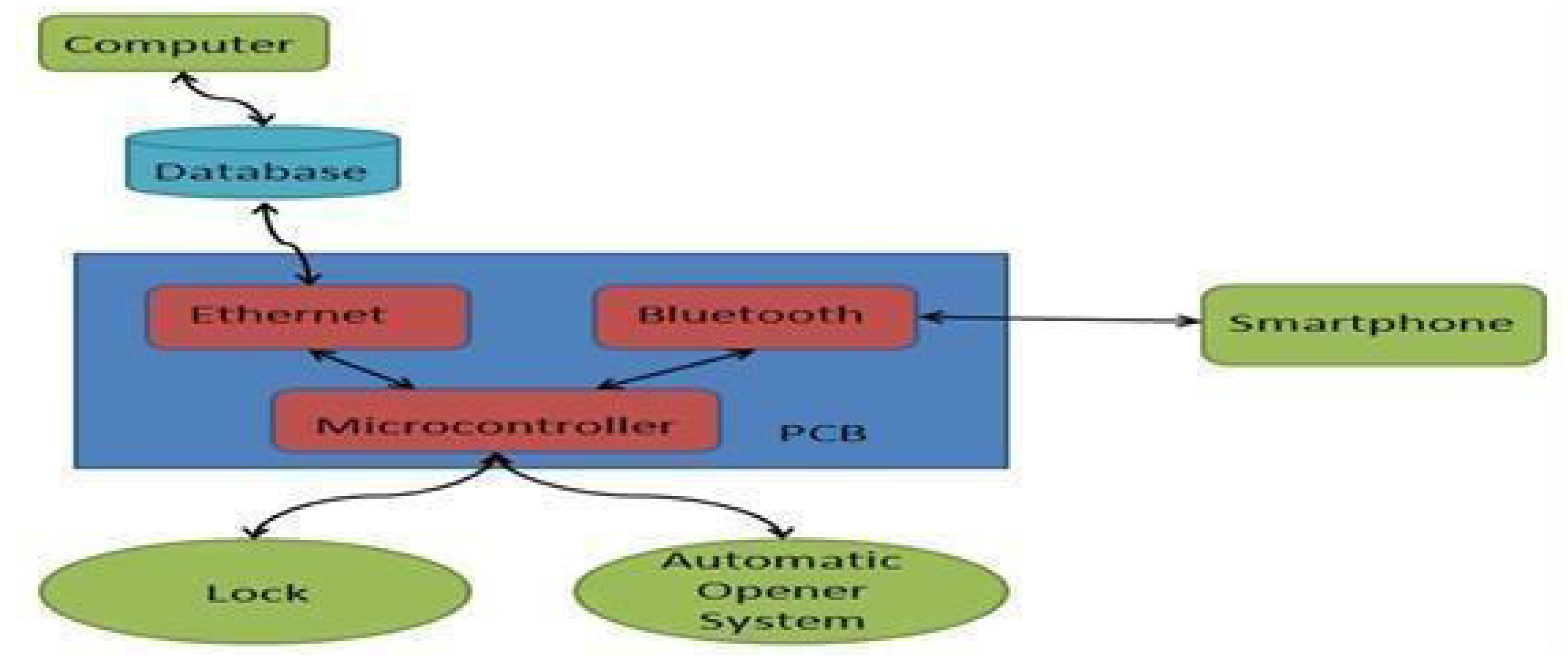
Technologies have been used: It should be noted that the core of the PCB would contain a microcontroller. The best type of microcontroller for the job is a DSPIC. It is very powerful,performs at a rapid rate, and it provides a high enough calculation capacity. The aim of the device is regulating the operation of the system and to communicate with corresponding [25].
4.1. Technologies Used in Digital Home Systems
- A. Bluetooth: Bluetooth is a valuable technology and could support interactions between the smartphone device and the other components on the system. Therefore, it is the ideal choice for this proposal. Near Field Communication (NFC) is one other solution, but it doesn’t offer the same range or capabilities as Bluetooth. There is a good chance that a user would not be able to access an entry point in a natural, automatic fashion. To be precise, they would have to hold the smartphone in their hand, instead of just having it on their person. This is the main reason why NFC is not suitable. Similarly, ZigBee could be employed, but it is more complex and doesn’t always work well with smartphone devices. For all of these reasons, Bluetooth is the only viable option. It is already assimilated with smartphone devices and has been working smoothly for many years. Essentially, it creates a small, localized wireless network around the user. This is known as a Wireless Personal Area Network (or WPAN). As the network is restricted to the user and can be easily controlled (turned on and off in seconds), it also happens to be an energy efficient system.[23]).
- B. Ethernet The method of connection needs to be as straightforward as possible in this case. Therefore, when it comes to facilitating a connection between the PCB and the external system, the best choice is Ethernet. For one thing, it is already the most commonly used technology. For another, it makes linking up to the remote server much faster and simpler.
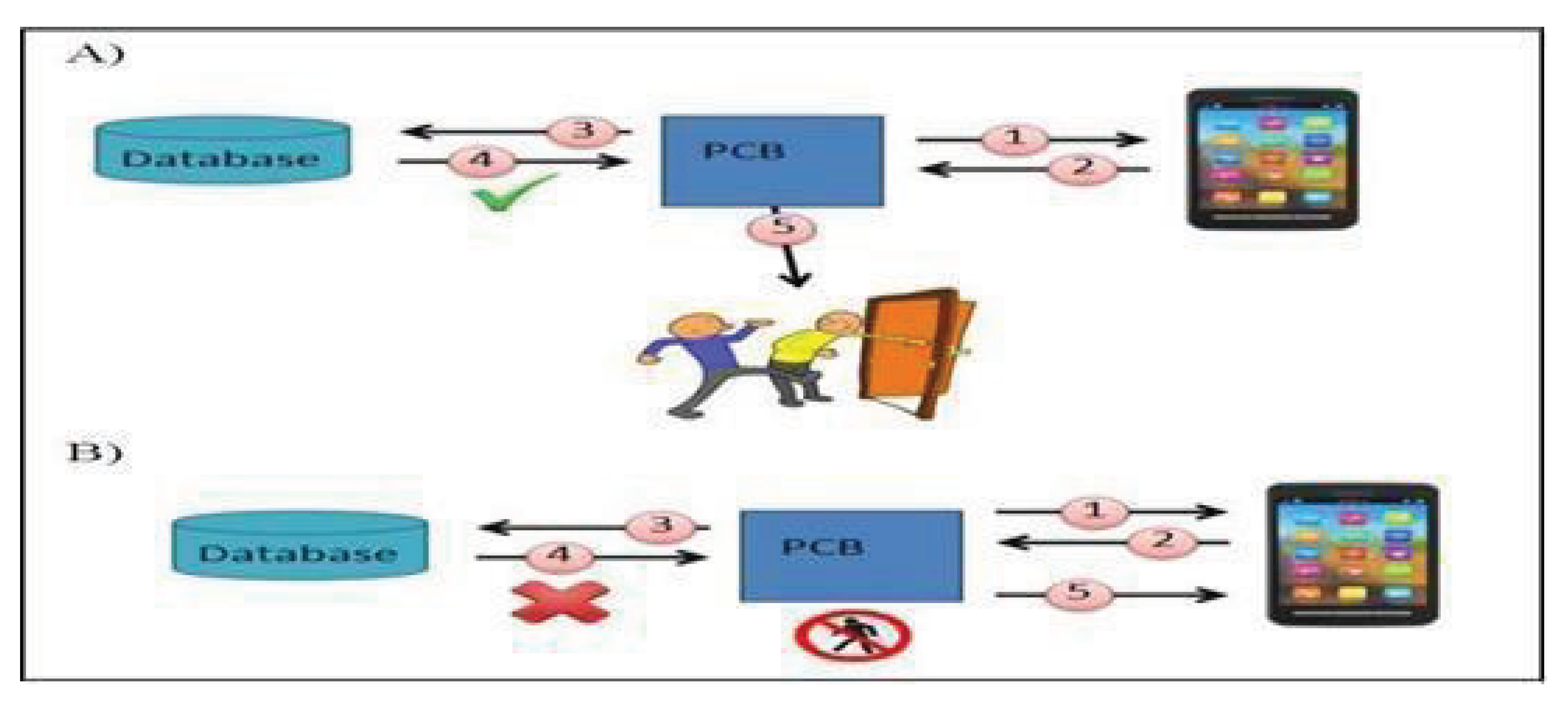
Refer to the figure below for more on the system processes.[23])
Figure 3.
Authentication procedure for proposed system.[23]).
Figure 3.
Authentication procedure for proposed system.[23]).
4.2. Access Scenarios in Digital Home Systems
The following scenarios outline the system’s response based on device authorization:
Scenario A:
Step One: The PCB consistently tracks its immediate area for incoming devices.
Step Two: It identifies the presence of a device and requests clarification.
Step Three: It sends a request to the database to find out if the device is authorized to pass.
Step Four: The request says ‘Approved.’
Step Five: The PCB provides access to the entry point.
Scenario B:
Step One: The PCB consistently tracks its immediate area for incoming devices.
Step Two: It identifies the presence of a device and requests clarification.
Step Three: It sends a request to the database to find out if the device is authorized to pass.
Step Four: The request says ‘Denied’.
Step Five: The PCB denies access (keeps the door closed) and informs the smartphone of this with a message.
The responsibility for approving or denying access will lie with the system manager. They are the only person with the authority to make this decision. With the use of a basic desktop app, it should be easy to add and remove permissions at speed. If alterations are made to a specific individual, they are notified via an automatic message to their smartphone. The use of a managerial app holds great potential, but it would have to be utilized in a formal, standardized manner by all managers, in all buildings. The only piece of data needed to make a change is a telephone number[23]). In addition to making the final decision, the manger will also have the power to regulate access in various ways. For instance, instead of granting full access to an individual (with no caveats), they can choose to provide access only for a certain amount of time or on a specific day. When this idea is visualized in a domestic setting, the benefits become even clearer. Many families employ outside help to assist them with family routines. They might have a nanny, gardener, or personal assistant. To keep these routines running smoothly, trusted individuals require access to the home but, in many cases, this is conditional. For instance, a babysitter needs access for long enough to carry out their job but not when the tenants of the house are home. In regards to the system manager, they will be able to track the movements of anybody who passes through the entry point, because their entrance and exit is logged. The level of variability is very important for this proposal as it is what makes the system unique. By allowing for a whole series of scenarios and conditions, it takes pressure off the manager and negates the need for manual intervention without compromising on security. In an emergency, it would take just seconds to open or close the door. This is an invaluable power when it comes to building fires, terrorist attacks, and other dangerous incidents. Refer to Figure 2.5 for details on the management system [28].
Figure 4.
Management system for proposed system.
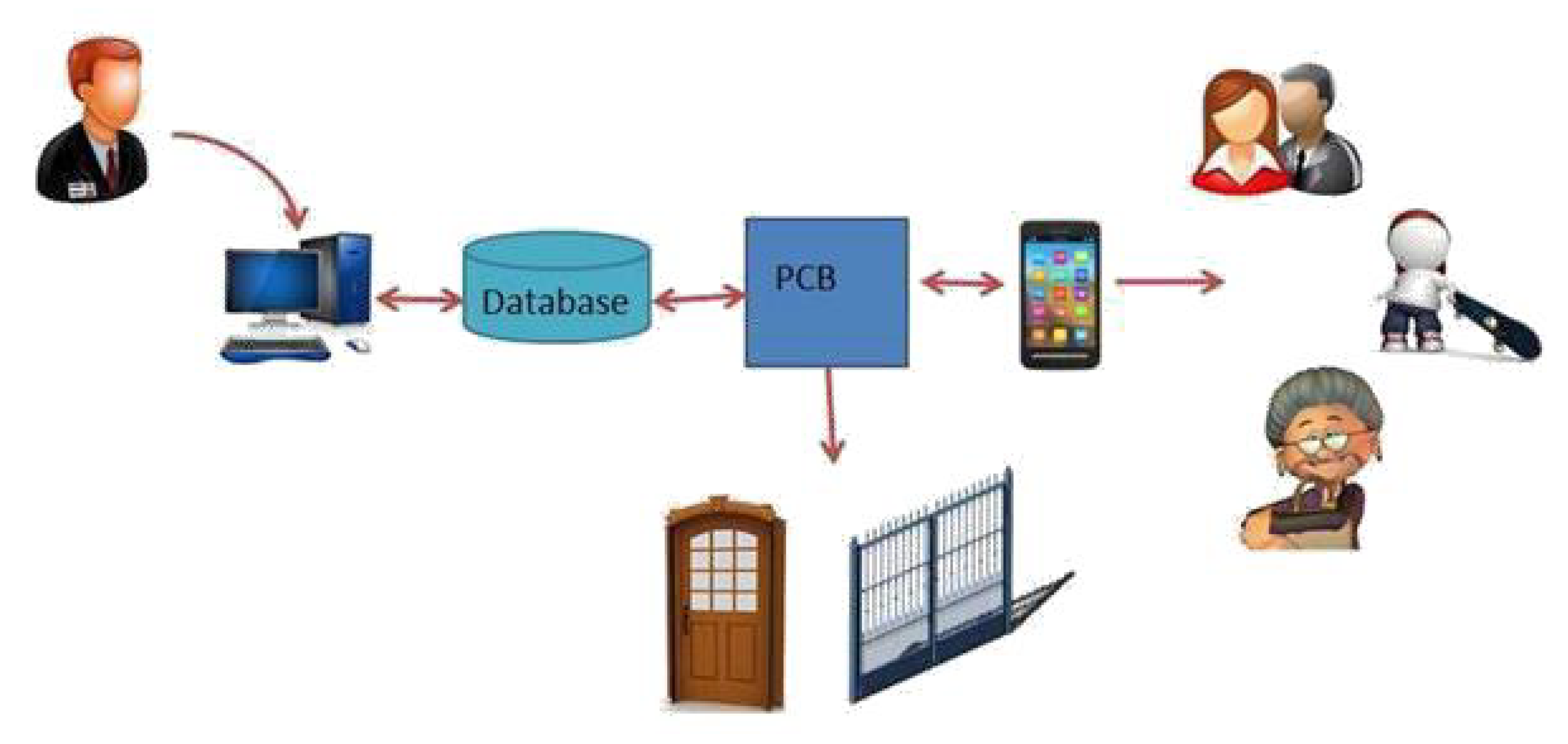
The system manager is authorized to open or close a door using only the phone number of the user who is requesting access”.[23])
5. Smart Cities Comparison Using SoS
In this section, we will present some successful stories of smart city deployment in different contexts and compare them using SoS framework.
5.1. Smart City in India
Over the last two decades, India has experienced a remarkable rate of population expansion. By 2050, the number of people living in its cities is predicted to be around 705 million. As a result, the government has been facing some very urgent problems. It is struggling to work out how it will continue to feed, water, clothe, transport, and house this staggering number of people. Among the biggest challenges are migration into the cities from rural areas, the wasteful employment of key resources, land and water pollution, and vastly undeveloped infrastructure. As a response to the huge demand for urban resources, the Indian government is now attempting to create innovative ‘Smart Cities.One hundred of these cities are planned and a combination of strategies will be used to construct them [29].
ICT systems will play a big part in their development. The main aims are to produce viable, sustainable living environments with the ability to generate jobs and economic opportunities and also to vastly increase quality of life overall. If planned and implemented correctly, the ‘One Hundred Smart Cities’ scheme could help India learn from its past mistakes and move forward with better, stronger ways of living and building. For all of these reasons, the government is currently committed to making the initiative a success [29].
In 2014, the Minister of Finance gave an address which contained the following declaration: As the rewards of contemporary progress are now accessible to more people than ever before, the rate of migration into cities is on the rise. We are seeing the birth of a new middle class and people are demanding a better quality of life for their children. In light of all this, it is clear that our current cities are not equipped to deal with the ways in which the population will change. The One Hundred Smart Cities scheme is, therefore, an absolute necessity [29].
In 2013, there was a housing deficit of 108 million units for a population of 258 families or households. Of this number, the cities accounted for 25.7 million of the missing homes. The housing deficit (in total) expanded at a CAGR of 0.7% over a ten-year period, from 2003 to 2013. Crucially, this gap increased more rapidly (1.8%) in the cities. The current administration has made a promise to provide homes for everybody by the year 2022. This is a special milestone, because it will mark seventy-five years since the country gained its independence. Yet, as huge numbers of people continue to move from rural regions to the urban territories, it will get harder for the Indian government to provide for all of its people[24].
As CRISIL Research explains, while there is a general shortage of housing across the whole country, the situation is much more urgent in the cities because social and cultural developments are encouraging more people to move there. By 2018, the (total) housing deficit is predicted to be around 114 million units. The main reason for this is the speed at which the population is expanding. In 2022, India is expected to be home to 1.3 billion people, with around a third of this number residing in urban regions.
The One Hundred Smart Cities scheme is the government response to the crisis. The funding awarded to the project is around Rs. 7,060 crores. These smart cities will function as ‘satellite’ territories to the bigger cities. It is designed to tackle the problems caused by fast paced urbanization and relief some of the pressure on existing infrastructures.
5.2. Smart Transportation in Atlanta
Atlanta’s population, like that of many other cities, is rapidly expanding. People are attracted to this urban metropolis due to the offered low-cost urban lifestyle, which has the added benefit of having the world’s busiest airport. However, despite the rapidity of this population expansion and some accompanying developments, the infrastructure of Atlanta in some parts is over 100 years old [11]. This ageing infrastructure creates significant challenges for the citizens of the city which has led the City of Atlanta to develop a smart city initiative (SMARTATL), which is able to utilize an integrated technological approach to overcome these issues.
Figure 5.
Atlanta’s Smart City Objectives. [11]
Figure 5.
Atlanta’s Smart City Objectives. [11]
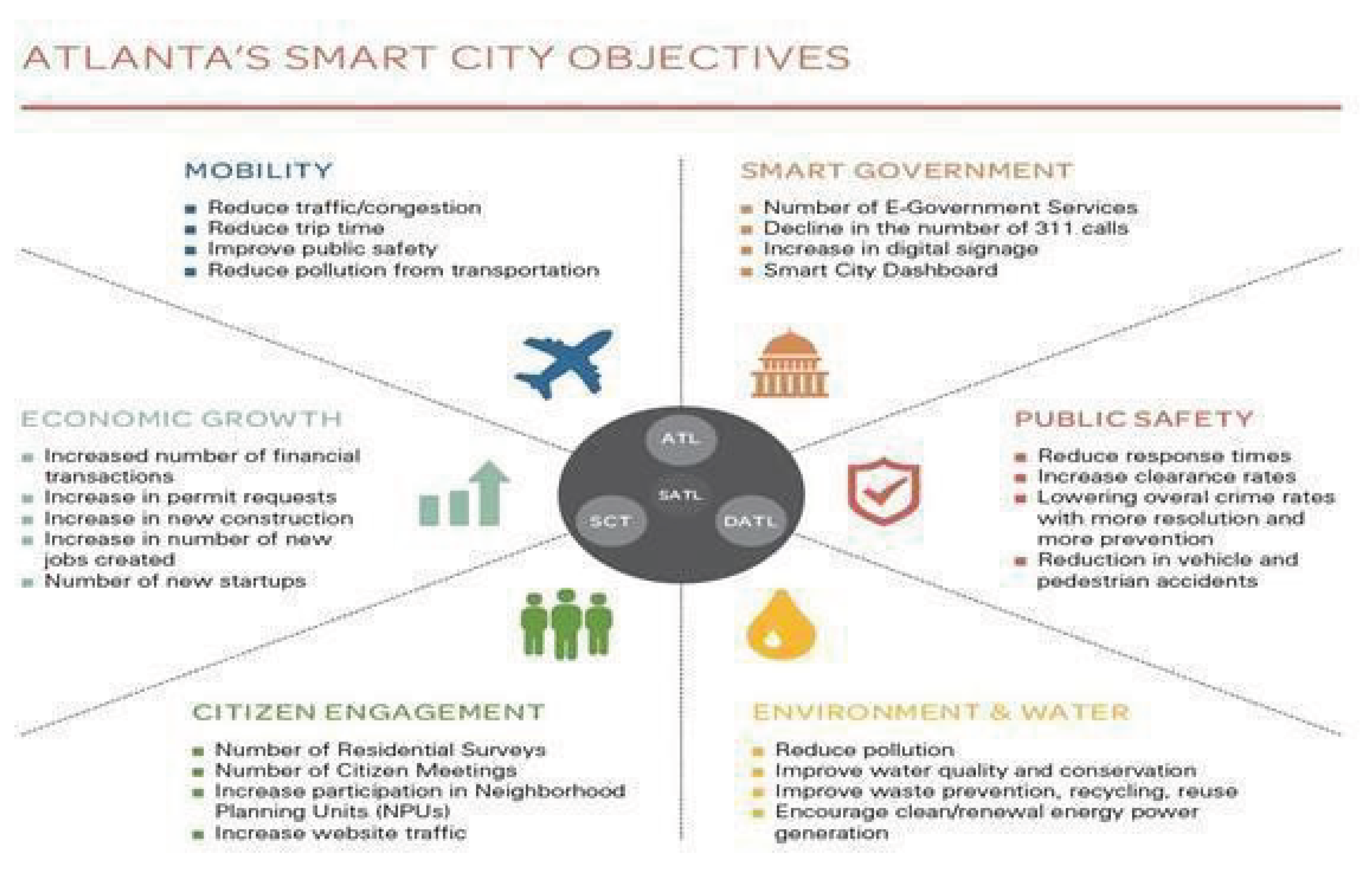
The process was commenced by the City undertaking a population wide survey of its residents to identify their infrastructure issue. This survey highlighted a number of patterns across the city, but many of these ranked differently between the city’s differing locations. Nevertheless, using this technique, coupled with the TM Forum’s Smart City Maturity and Benchmark Model, allowed the City of Atlanta to generate a map of smart city objectives[26].
5.3. Smart Transportation in Portugal’s Porto City
Testing of the suggested real-time person-oriented traffic signal control plan algorithm was undertaken using a four-arm isolated intersection case study in Portugal’s Porto city. Traffic lights control all movements of traffic, whereby competition for green times is between vehicles and pedestrians. For design of traffic signal plan, the movement of pedestrians was considered ‘Protected’, implying that movement of pedestrians could cross the intersection safely due to lack of conflict. The profile of demand features vehicle and pedestrian matrix demand with a variety of occupancy for 1, 2, and 3 individuals. In this study, traffic data gathered in CiViTAS-Elan project for the intersection was used Notably, 25 replications were conducted for both cases of traffic signal control, namely the baseline and the proposed. The quantity of traffic users attended to was identical in the two cases but slightly higher within the proposed case [31]. During the initial hour of simulation period, the change for mean travel time was analogous; however, during the second hour, the suggested approach shows better results compared to the actual operation where there is an exponential increment in the mean travel time [32].
5.4. Smart Transportation in Bah´ıa Blanca in Argentina
As installation of traffic lights is done in cities and their number continues to escalate, there is a high level of complexity on their joint programming as a result of increased number of combinations appearing, therefore, the need to implement automated systems to have the traffic lights cycles optimally programmed is without any doubt [27]. From this point of view, the present research attempts in the area of automated traffic control signals focus on two key ingenuities Subsequently, the design of automated models of traffic control signals’ adaptation has been done to adjust cycle program duration all through the day since these adjustments are demanded by vehicles in queues. The functioning of these types of tools has a direct correlation with the sensor system and the system’s real-time computation [28]. While these tools efficiently function in various cities around the globe, the ideal traffic network management is defined by a huge operational cost and the ideal world generally seems to repeat traffic flow patterns (holidays, rush hour, etc.). The application of intelligent approaches for extensive and diverse study cases still remains an open case[29]. This problem is quite complicated as the higher the total adjacent intersections, the higher the interaction between the traffic lights (worsening this problem by generating a high epistasis between variables). The current PSO (particle swarm optimize) technique has been proposed founded on the above problems with the intent of identifying efficient traffic light cycle programs combined with SUMO (simulator of urban mobility)[30]), typically a renowned microscopic traffic simulator. The main reasons justifying the application of PSO rather than other optimization methods are as follows. To begin with, PSO is a renowned algorithm considered to carry out a quick convergence to apposite solutions[31]. Second, implementation of canonical PSO is quite simple and necessitates few tuning parameters[32]. Lastly, PSO belongs to the class of intelligence algorithm that may forecast issues when handling this problem utilizing independent system agents for online application.
Two large and heterogeneous metropolitan locations comprising of numerous traffic lights situated in two major cities have been tested in this study using this model [33].
5.5. Smart Transportation in Malaga in Spain
This study has effectively offered a proposal of an optimization approach founded on PSO algorithm capable of locating successful traffic light programs. Solution assessment has been dome using SUMO, which is a renowned microscopic traffic simulator. This algorithm has been associated with competent traffic light cycle programs considered in major cities. The current PSO (particle swarm optimize) technique has been proposed founded on the problems inherent in the existing models with the intent of identifying efficient traffic light cycle programs combined with SUMO (simulator of urban mobility)[34]. The main reasons justifying the application of PSO rather than other optimization methods are as follows. To begin with, PSO is a renowned algorithm considered to carry out a quick convergence to apposite solutions. Second, implementation of canonical PSO is quite simple and necessitates few tuning parameters [35] Lastly, PSO belongs to the class of intelligence algorithm that may forecast issues when handling this problem utilizing independent system agents for online application.
5.6. Comparison
Table 2 provides a more detailed comparison of the different case studies by focusing on each one’s unique goals, specific urban challenges, applied technologies, and outcomes.
- Operational Autonomy: The case studies demonstrate that each system inside the System of Systems functions autonomously while enhancing the overall effectiveness of the smart city. The healthcare systems in India exhibited notable advancements in patient care and resource management due to increased operational autonomy. Likewise, Atlanta’s transportation systems employed data-driven strategies to enhance traffic flow, demonstrating how autonomy can result in more efficient urban services.
- Comparative Insights: Our comparative analysis of smart city initiatives in Porto, Atlanta, and numerous Indian cities elucidates the strengths and weaknesses of System of Systems deployments. The Indian government’s strategy for developing ’Smart Cities’ seeks to tackle the issues of growing urbanization, whereas Atlanta’s measures concentrate on upgrading its deteriorating infrastructure. Notwithstanding their distinct circumstances, both cities aim to utilize technology to improve urban living conditions[4].
- Implications of Findings: The results of these case studies highlight the imperative for strong data sharing and protection of privacy as urban areas become more interconnected. The National Healthcare Information Network shows how integrated systems can reduce the demands on healthcare practitioners by facilitating prompt access to patient data.
- Lessons Learned: Each case study provides significant insights for forthcoming smart city initiatives. The incorporation of IoT technologies in Atlanta can guide analogous initiatives in other metropolitan areas, highlighting the significance of real-time data analytics in decision-making processes.
- Recommendations for Future Research:Future research should concentrate on creating frameworks that improve interoperability and security in the implementation of SoS within urban management across many sectors. Addressing these areas will be essential for guaranteeing the long-term viability and success of smart city efforts worldwide[25].
6. Research Gap
The paper explores significant research gaps within the Systems of Systems (SoS) framework in smart cities, emphasizing the necessity for improved interoperability and data security. As smart cities get more networked, current frameworks fail to facilitate seamless communication across various technologies. The amalgamation of several autonomous systems in metropolitan settings, each possessing distinct operational frameworks, presents considerable obstacles to seamless interaction and effective data transmission. Thus, a significant research gap exists in creating a cohesive framework that allows these diverse systems to function jointly while maintaining security. Resolving these difficulties is essential for fostering effective, unified citywide operations capable of handling intricate metropolitan demands[36].
Additionally, the paper emphasizes the imperative for scalable solutions customized to diverse city sizes and requirements. Contemporary SoS implementations frequently exhibit insufficient adaptability, constraining their efficacy among cities of varying dimensions and capabilities. A comprehensive framework must encompass real-time data distribution and predictive analytics for dynamic resource management while emphasizing scalable security protocols to safeguard citizen data in highly networked settings. Addressing this gap could enable future research to produce flexible solutions that facilitate smart city advancement in both small and large urban environments, ensuring that all cities can utilize SoS frameworks for sustainable development and enhanced quality of life. The article delineates significant research deficiencies within the Systems of Systems (SoS) paradigm in smart cities, emphasizing the necessity for improved interoperability and data security. As smart cities get more networked, current frameworks fail to facilitate seamless communication across various technologies. The amalgamation of several autonomous systems in metropolitan settings, each possessing distinct operational frameworks, presents considerable obstacles to seamless interaction and effective data transmission. Thus, a significant research gap exists in creating a cohesive framework that allows these diverse systems to function jointly while maintaining security. Resolving these difficulties is essential for fostering effective and cohesive citywide operations capable of handling complicated metropolitan demands[37].
7. Conclusions and Future Works
For the fast deployment of smart city around the world, a lot of efforts has been accomplished by many researchers. One of the most important contributions in the literature is the introduction of the maturity model[38]. This model as discussed previously has been used to assess the smartness of the city and to see how far it is from the desired objective and level of smartness. It composed of five different levels, which assesses the level of connectivity between different systems in the city. However, this model concentrates on the level of openness and interconnection between different systems in the city to satisfy and increase the competiveness of the city[39]. In addition to checking the level of interconnection other aspects should be considered to know the real situation of the city under study. For better assessment and evaluation process, other maturity models should be proposed which assess the level of security, level of privacy, level of infrastructure[35]. Each model will also have five different levels inside. Since the provisioning of security and privacy needs a level of infrastructure (software, hardware, etc.) to be available. This has to be assessed, to know the readiness level of the city to support applications with different levels of security and privacy.
Future work should concentrate on addressing the observed deficiencies, especially with cross-system communication and data security. A framework facilitating enhanced interoperability among systems in smart cities must be established. This may encompass enhancements in real-time data distribution, predictive analytics for resource distribution, and more stringent security measures. Another area forfurther investigation is the development of more scalable solutions that can be adapted to diverse city sizes and requirements, guaranteeing that both small and large cities can leverage SoS implementations without compromising system efficiency or data security. These developments will be crucial for guaranteeing the long-term sustainability and success of smart cities[40].
References
- Anthopoulos, L.G. Understanding the smart city domain: A literature review. In Transforming city governments for successful smart cities; Springer, 2015; pp. 9–21. [Google Scholar]
- Talebkhah, M.; Sali, A.; Gordan, M.; Hashim, S.J.; Rokhani, F.Z. Comprehensive review on development of smart cities using industry 4.0 technologies. IEEE Access, 2023. [Google Scholar]
- Sittón-Candanedo, I.; Alonso, R.S.; García, Ó.; Gil, A.B.; Rodríguez-González, S. A Review on Edge Computing in Smart Energy by means of a Systematic Mapping Study. Electronics 2019. [Google Scholar] [CrossRef]
- Houssein, E.H.; Othman, M.A.; Mohamed, W.M.; Younan, M. Internet of Things in Smart Cities: Comprehensive Review, Open Issues, and Challenges. IEEE Internet of Things Journal 2024, 11, 34941–34952. [Google Scholar] [CrossRef]
- Dahmann, J.S.; Baldwin, K.J.; Rebovich, G. Systems of Systems and Net-Centric Enterprise Systems. 2009. [Google Scholar]
- Sofronova, E. Evolutionary Computations for Traffic Signals Optimization. Procedia Computer Science 14th International Symposium "Intelligent Systems, 2021; 186, pp. 802–811. [Google Scholar] [CrossRef]
- Jamshidi, M.M. System of systems engineering - New challenges for the 21st century. IEEE Aerospace and Electronic Systems Magazine 2008, 23, 4–19. [Google Scholar] [CrossRef]
- Hensher, D.; Button, K. Handbook of Transport Systems and Traffic Control; Pergamon, 2001. [Google Scholar]
- Ottens, M.; Franssen, M.; Kroes, P.; Poel, I. 8.1.1 Systems engineering of socio-technical systems. INCOSE International Symposium 2005, 15, 1122–1130. [Google Scholar] [CrossRef]
- Di Nardo, M.; Gallo, M.; Madonna, M.; Santillo, L. A Conceptual Model of Human Behaviour in Socio-technical Systems; 09 2015; pp. 598–609. [Google Scholar] [CrossRef]
- TM Forum. Insights on Smart Cities and ICT Development. https://inform.tmforum.org, 2016. Accessed: September 29, 2024.
- Moshayedi, A.J.; Roy, A.S.; Taravet, A.; Liao, L.; Wu, J.; Gheisari, M. A Secure Traffic Police Remote Sensing Approach via a Deep Learning-Based Low-Altitude Vehicle Speed Detector through UAVs in Smart Cites: Algorithm, Implementation and Evaluation. Future Transportation 2023, 3, 189–209. [Google Scholar] [CrossRef]
- Dui, H.; Zhang, S.; Liu, M.; Dong, X.; Bai, G. IoT-Enabled Real-Time Traffic Monitoring and Control Management for Intelligent Transportation Systems. IEEE Internet of Things Journal 2024, PP, 1–1. [Google Scholar] [CrossRef]
- Khasawneh, M.A.; Awasthi, A. Intelligent Meta-Heuristic-Based Optimization of Traffic Light Timing Using Artificial Intelligence Techniques. Electronics 2023, 12, 4968. [Google Scholar] [CrossRef]
- S.S., R; Rajendran, L. Real-Time Adaptive Traffic Control System For Smart Cities. In Proceedings of the 2021 International Conference on Computer Communication and Informatics (ICCCI), 2021; pp. 1–6. [Google Scholar] [CrossRef]
- Torkjazi, M.; Raz, A. A Review on Integrating Autonomy Into System of Systems: Challenges and Research Directions. IEEE Open Journal of Systems Engineering 2024, PP, 1–22. [Google Scholar] [CrossRef]
- Houssein, E.; A. Abdelwahab, M.; Makram Mohamed, W.; Younan, M. Internet of Things in Smart Cities: Comprehensive Review, Open Issues and Challenges. IEEE Internet of Things Journal 2024, PP, 1–1. [Google Scholar] [CrossRef]
- Dey, S. Data Privacy and Security in Smart Cities: Avoiding Problems and Resolution 2025, 323–352. [CrossRef]
- Trigka, M.; Dritsas, E. Edge and Cloud Computing in Smart Cities. Future Internet 2025, 17. [Google Scholar] [CrossRef]
- Pan, G.; Qi, G.; Zhang, W.; Li, S.; Wu, Z.; Yang, L. Trace Analysis and Mining for Smart Cities: Issues, Methods, and Applications. Communications Magazine, IEEE 2013, 51, 120–126. [Google Scholar] [CrossRef]
- Khasawneh, M.A.; Awasthi, A. Intelligent Traffic Light Control. In Proceedings of the Proceedings of the 2nd African International Conference on Industrial Engineering and Operations Management (IEOM), December 2020; pp. 7–10. [Google Scholar]
- Imankulova, B.; Yafooz, W.M.; Alshammari, K.; Alshemali, B.; Yahya, A.E.; Abd Almisreb, A. Tracing Data Origins in Smart Cities: An IoT Perspective. IEEE Access 2025, 13, 130201–130214. [Google Scholar] [CrossRef]
- Alba, E. Intelligent Systems for Smart Cities; 07 2015; pp. 707–722. [Google Scholar] [CrossRef]
- Corporation, Z. Smart city maturity and transformation assessment model; Technical report; ZTE Corporation, 2016. [Google Scholar]
- Paul, D.A.; Findikgil, M. A Comparative Framework Analysis of the Strategies, Challenges and Opportunities for Sustainable Smart Cities; 2023; pp. 187–211. [Google Scholar] [CrossRef]
- Nielsen, C.; Larsen, P.; Fitzgerald, J.; Woodcock, J.; Peleska, J. Systems of Systems Engineering. ACM Computing Surveys 2015, 48, 1–41. [Google Scholar] [CrossRef]
- Sánchez-Medina, J.; Galán-Martín, M.C.; Rubio-Royo, E. Traffic Signal Optimization Using Evolutionary Algorithms: A Case Study in Urban Traffic Management. In Proceedings of the Proceedings of the 11th International IEEE Conference on Intelligent Transportation Systems (ITSC), Beijing, China, 2008; pp. 323–328. [Google Scholar] [CrossRef]
- Bingham, E. Real-Time Traffic Management Systems: Challenges and Sensor Integration. In Proceedings of the Proceedings of the International Conference on Traffic Flow and Sensor Systems, San Francisco, CA, USA, 2001; pp. 89–95. [Google Scholar] [CrossRef]
- Handbook of Transport Systems and Traffic Control; Hensher, D.A., Button, K.J., Eds.; Pergamon: Oxford, UK, 2001. [Google Scholar]
- Krajzewicz, D.; Hertkorn, G.; Rössel, C.; Wagner, P. SUMO (Simulation of Urban MObility) - An Open-Source Traffic Simulation. In Proceedings of the Proceedings of the 4th Middle East Symposium on Simulation and Modelling (MESM), Sharjah, UAE, 2006; pp. 183–187. [Google Scholar]
- Clerc, M.; Kennedy, J. The Particle Swarm: Explosion, Stability, and Convergence in a Multidimensional Complex Space. IEEE Transactions on Evolutionary Computation 2002, 6, 58–73. [Google Scholar] [CrossRef]
- Montes de Oca, M.; Stützle, T.; Enden, K.; Dorigo, M. Incremental social learning in particle swarms. IEEE Trans Syst Man Cybern Part B. IEEE transactions on systems, man, and cybernetics. Part B, Cybernetics: a publication of the IEEE Systems, Man, and Cybernetics Society 2010, 41, 368–84. [Google Scholar] [CrossRef]
- García-Nieto, J.; Alba, E.; Olivera, A. Swarm intelligence for traffic light scheduling: Application to real urban areas. Eng. Appl. of AI 2012, 25, 274–283. [Google Scholar] [CrossRef]
- AFOLABI, I.; UZUANWU, C.; MISHRA, C.; JOSHUA, A.; BABALOLA, D.; ADIMCHI, C.; OKECHUKWU, O. INTEGRATION OF AUTONOMOUS VEHICLES WITH SMART CITY INFRASTRUCTURE FOR ENHANCED PUBLIC TRANSPORTATION. International Journal of African Innovation and Multidisciplinary Research 2025. [Google Scholar] [CrossRef]
- Teklu, F.; Sumalee, A.; Watling, D. A Genetic Algorithm Approach for Optimizing Traffic Control Signals Considering Routing. Comp.-Aided Civil and Infrastruct. Engineering 2007, 22, 31–43. [Google Scholar] [CrossRef]
- Mitropoulos, L.; Kortsari, A.; Mizaras, V.; Ayfantopoulou, G. Mobility as a Service (MaaS) Planning and Implementation: Challenges and Lessons Learned. Future Transportation 2023, 3, 498–518. [Google Scholar] [CrossRef]
- Cavalcante, E.; Cacho, N.; Lopes, F.; Batista, T.; Oquendo, F. Thinking smart cities as systems-of-systems: A perspective study. In Proceedings of the Proceedings of the 2nd International Workshop on Smart, 2016; pp. 1–4. [Google Scholar]
- ZTEsoft. Smart City Maturity Model: A Strategic Approach for Fast Deployment. ZTEsoft Corporation, Technical report. Shenzhen, China, 2016. [Google Scholar]
- MITRE Corporation. Systems Engineering Guide. https://www.mitre.org/sites/default/files/publications/se-guide-book-interactive.pdf, 2025. Accessed: 2025-10-30.
- Prasetyo, Y.A.; Lubis, M. Smart city architecture development methodology (SCADM): A Meta-analysis using SOA-EA and SoS approach. Sage Open 2020, 10, 2158244020919528. [Google Scholar] [CrossRef]
Figure 1.
Applications of trace mining for smart cities [20].
Figure 1.
Applications of trace mining for smart cities [20].
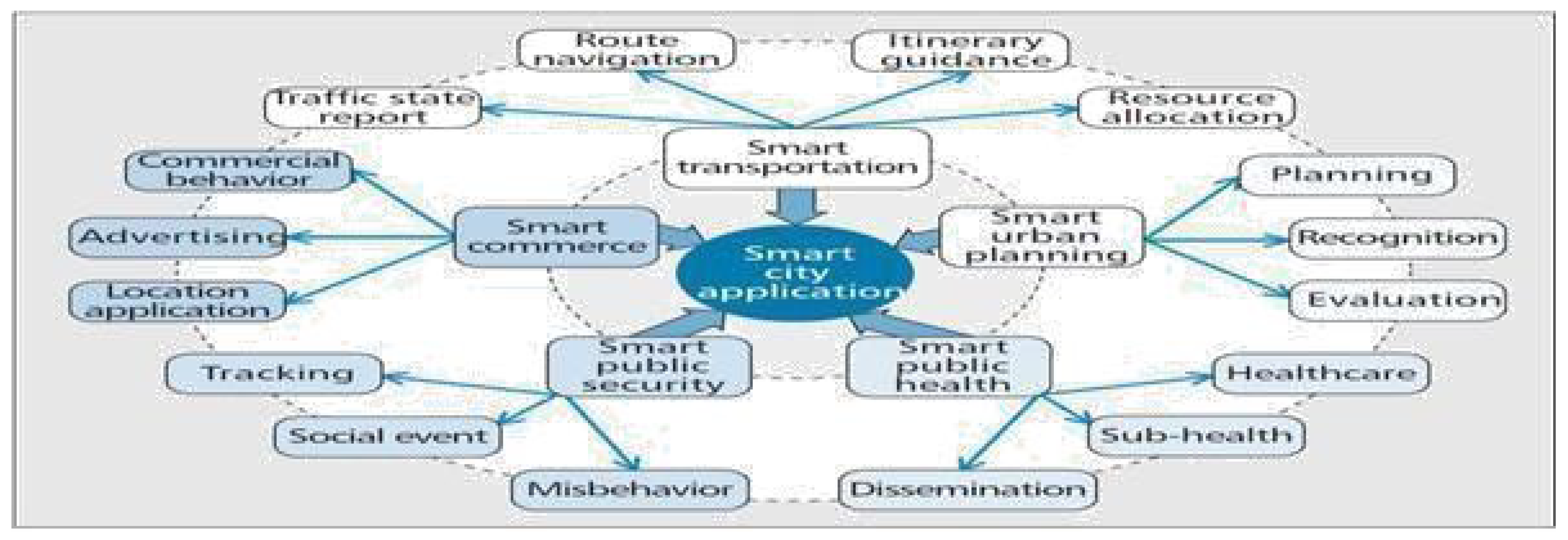

Table 1.
Types of System of Systems (SoS)
| Type | Definition |
|---|---|
| Virtual | Virtual SoS lack a central management authority and a centrally agreed upon purpose for the system-of-systems. Large-scale behavior emerges—and may be desirable—but this type of SoS must rely upon relatively invisible mechanisms to maintain it[6] |
| Collaborative | In collaborative SoS, the component systems interact more or less voluntarily to fulfill agreed-upon central purposes. |
Table 2.
Comparison of Case Study Review
| Section | Case Study | Objectives | Challenges Addressed | Technologies Used | Outcomes |
|---|---|---|---|---|---|
| 5.1 | Smart City in India | Create sustainable smart cities | Rapid urbanization, resource management | ICT systems, open data initiatives | Improved quality of life, economic opportunities |
| 5.2 | Smart Transportation in Atlanta | Enhance infrastructure and manage population growth | Aging infrastructure, varied local challenges | TM Forum’s Smart City Maturity Model, resident surveys | Smart city objectives mapped; prioritized infrastructure solutions |
| 5.3 | Smart Transportation in Porto | Optimize traffic signal timing for safety and efficiency | Balancing pedestrian/vehicle flow | Real-time person-oriented control plan, CiViTAS-Elan project data | Reduced mean travel time, safer pedestrian movement |
| 5.4 | Bahía Blanca, Argentina | Automate traffic light programming | High complexity in intersection programming | Particle Swarm Optimization (PSO), SUMO (microscopic simulator) | Improved traffic flow; dynamic response to vehicle demand |
| 5.5 | Smart Transportation in Malaga | Optimize traffic light cycles with adaptive programming | Urban traffic flow complexities, scalability | PSO, SUMO for real-time simulation | Efficient cycle programming; reduced congestion |
Disclaimer/Publisher’s Note: The statements, opinions and data contained in all publications are solely those of the individual author(s) and contributor(s) and not of MDPI and/or the editor(s). MDPI and/or the editor(s) disclaim responsibility for any injury to people or property resulting from any ideas, methods, instructions or products referred to in the content. |
© 2026 by the authors. Licensee MDPI, Basel, Switzerland. This article is an open access article distributed under the terms and conditions of the Creative Commons Attribution (CC BY) license (http://creativecommons.org/licenses/by/4.0/).
Copyright: This open access article is published under a Creative Commons CC BY 4.0 license, which permit the free download, distribution, and reuse, provided that the author and preprint are cited in any reuse.


