

Submitted:
16 January 2026
Posted:
16 January 2026
You are already at the latest version
Abstract
In Türkiye, where agriculture consumes 75% of available water and national irrigation efficiency is only 51.3%, irrigation modernization—the conversion of classical open-channel irrigation systems to pressurized pipe systems—presents a primary strategy to achieve significant water savings. This study provides a comprehensive economic assessment of the potential of this strategy. A twofold methodology was employed: first, a cost-benefit analysis (CBA) of the 36,108 ha Ivriz irrigation project, and second, a national model to simulate the economic impact of modernizing nation’s 4.9 million hectares currently irrigated by such classical systems. The Ivriz case study reveals that project viability is entirely contingent on the on-farm efficiency achieved post-modernization. At 60% efficiency, water savings are insufficient to make the project economically feasible, whereas at 90% efficiency, substantial water savings render the project highly profitable. At the national level, the analysis indicates that the conserved water could be used to expand Türkiye’s irrigated area by 1.77-2.98 million hectares, generating an additional \(3.47-\)5.84 billion in annual agricultural income. The findings conclude that while modernization represents a powerful investment, its success requires a comprehensive policy framework that not only funds infrastructure conversion but also mandates integrated support programs to ensure farmers adopt the high-efficiency technologies needed to achieve these savings.
Keywords:
irrigation modernization
; cost-benefit analysis
; water saving
; water use efficiency
; agricultural economics
; Türkiye
1. Introduction
The sustainable management of water resources has become a global challenge, driven by the compounding pressures of climate change, rapid population growth, and increasing urbanization [1]. In this context, Türkiye faces significant risks from water stress, exacerbated by intense competition for water among agricultural, industrial, and domestic users. The agricultural sector is central to this challenge, as it is the country's predominant water user, accounting for 75% of total water resources utilized [2]. The sustainability of this sector, which is vital for national food security, depends on the efficiency of its water use. However, a critical efficiency gap exists within Türkiye's existing irrigation infrastructure. Approximately 64% of the country's irrigation network relies on traditional open-channel systems, which are highly susceptible to conveyance losses. This results in a national average irrigation efficiency of 51.3%, indicating that nearly half of the diverted water is lost before it is effectively used [3]. This inefficiency not only waste a scarce resource but also constrains the nation's agricultural productivity.
In response, irrigation modernization—the conversion of outdated open-channel systems to modern, pressurized pipe networks—has emerged as a primary strategic solution. This technological transition directly addresses conveyance losses and, crucially, enables the adoption of high-efficiency on-farm irrigation methods like drip and sprinkler systems [4]. While several technical studies and feasibility reports on modernization exist, few attempts have been made to quantify the national-level economic potential using empirical, bottom-up methods. This paper aims to contribute to this field by addressing the following research questions:
- Is the modernization of a large-scale, traditional irrigation scheme economically viable at the project level?
- What is the potential aggregate impact on national agricultural income if modernization were implemented across all eligible systems in Türkiye?
To answer these questions, the remainder of this paper is structured as follows. Section 2 reviews the relevant literature on irrigation modernization and the economic evaluation of public works to situate the study within the existing body of knowledge. Section 3 details the methodology employed, covering both the project-level case study and the national-level impact assessment model. Section 4 presents the key findings from both analyses. Finally, Section 5 discusses the interpretation and policy implications of these results, concluding with specific recommendations and directions for future research.
2. Literature Review
This study is situated at the intersection of water resource management, agricultural economics, and public policy evaluation. The literature review is structured around three core themes: the global and national rationale for irrigation modernization, the established methodologies for its economic evaluation, and the specific research gap in the Turkish context that this paper aims to address.
2.1. The Imperative for Modernization: From Global Scarcity to National Strategy
A vast body of literature establishes that growing water scarcity, driven by climate change and demographic pressures, poses a significant threat to global food security [5,6,7,8]. Within this context, the agricultural sector is consistently identified as the largest consumer of freshwater resources, making irrigation efficiency a global concern. Studies have extensively reported the high conveyance losses inherent in traditional open-channel systems due to seepage and evaporation, framing them as a primary source of water wastage in arid and semi-arid regions [9,10,11].
In response, irrigation modernization—the conversion of these systems to pressurized networks—has emerged as a key policy instrument worldwide. International experience, particularly in Mediterranean countries like Spain, provides an example. Spurred by policy drivers such as the EU Water Framework Directive, Spain's modernization efforts have been widely analyzed, with studies consistently highlighting a crucial "dual benefit": the reduction of conveyance losses at the network level and, critically, the enabling of high-efficiency on-farm technologies such as drip and sprinkler irrigation [12]. This literature establishes that the value of modernization lies not only in the infrastructure itself but also in its capacity to unlock additional efficiency gains at the farm level, thereby affecting water demand elasticity and agricultural productivity [13]. This global rationale is directly applicable to Türkiye, where studies have documented similarly low national irrigation efficiency rates attributable to the prevalence of traditional infrastructure [2].
2.2. Methodological Foundations for Economic Evaluation
The economic assessment of large-scale public works, such as irrigation modernization, relies on well-established methodologies. Cost-Benefit Analysis (CBA) is widely regarded as the gold standard for evaluating such projects, as it provides a systematic process for determining whether a project's long-term benefits outweigh its costs [14]. Within the CBA framework, key financial metrics such as Net Present Value (NPV), Benefit-Cost Ratio (BCR), and Internal Rate of Return (IRR) are employed to assess project viability.
The Net Present Value (NPV) is a critical metric as it measures the absolute net gain, in monetary terms, that a project is expected to generate for society over its economic lifespan. The NPV approach has been widely applied to evaluate the economic feasibility of various irrigation-related investments [15,16,17]. It is calculated by summing all discounted benefits and costs over the project’s economic life. The general equation is expressed as follows:
where represents the net cash inflow during period , is the total initial investment cost, is the discount rate, and denotes the economic life of the project.
The Benefit–Cost Ratio (BCR) provides a relative measure of economic viability by comparing the total discounted benefits to the total discounted costs. The BCR is frequently used in the comparative investment analysis of different irrigation systems [18,19,20]. It is calculated as the ratio of the present value of benefits to the present value of costs. A project is considered economically feasible when the BCR exceeds one.
The Internal Rate of Return (IRR) is another key profitability indicator that reflects a project’s intrinsic rate of return. Technically, the IRR is defined as the discount rate at which the Net Present Value of a project equals zero. It is a powerful metric for assessing investment returns [21] and has been a standard component of irrigation project evaluation methodologies for decades [22,23]. The decision rule for IRR is to compare it with a benchmark rate, typically the discount rate (i) used in the analysis. A project is deemed economically acceptable if its IRR exceeds this benchmark rate.
A crucial element of this analysis is the selection of an appropriate discount rate for valuing future cash flows. The chosen rate reflects society’s preference for present consumption over future consumption and is a central topic in the economic appraisal of public investment projects. In the Turkish context, existing empirical studies provide evidence supporting the use of a 5% social discount rate for agricultural and irrigation investments [24].
2.3. Identifying the Research Gap in the Turkish Context
The Turkish academic literature on irrigation is extensive; however, it has predominantly focused on specific, isolated dimensions of the sector, leaving a critical gap in comprehensive national-level economic assessment. A review of existing studies reveals several dominant research streams.
A substantial body of work has concentrated on the institutional and managerial dimensions of irrigation systems, particularly following the transfer of scheme management from the state to local user organizations. These studies have primarily evaluated the performance of Water User Associations (WUAs), emphasizing indicators such as fee collection rates, operational efficiency, and financial cost recovery [25,26]. Other contributions have examined the importance of maintenance, repair, and rehabilitation activities for the physical sustainability of transferred irrigation schemes [27] or have applied benchmarking techniques to assess and compare the operational performance of existing systems at the regional level [28].
Another central strand of the literature has focused on farm-level or small-scale project-level economic analyses. These studies typically assess the profitability of adopting specific on-farm pressurized irrigation technologies for particular crops or regions [29,30]. In contrast, others provide comparative economic evaluations of modern irrigation technologies, such as drip versus sprinkler systems [31].
Despite their valuable insights, the existing literature exhibits two critical analytical gaps. First, at the project level, there is a notable absence of comprehensive cost–benefit analyses that evaluate the complete technological modernization of large-scale traditional open-channel irrigation systems. In particular, holistic economic assessments that quantify the full stream of benefits arising from modernization—specifically the economic value of conserved water in terms of additional irrigable area and the income generated by restoring land that has become non-operational due to infrastructure maintenance deficiencies—are largely missing.
Second, and more importantly, the national-level economic potential of a widespread irrigation modernization strategy remains unquantified. There is an apparent lack of research that simulates the aggregate economic consequences of modernizing Türkiye’s 4.9 million hectares of land currently irrigated through classical open-channel systems.
This study is designed explicitly to address these two interconnected gaps. It provides a comprehensive project-level Cost–Benefit Analysis of a large-scale modernization project and, critically, uses the empirically derived results from this case study as the foundation for the first national-scale simulation of the economic impacts of a complete irrigation modernization strategy. By integrating project-level evidence with a national-level analytical framework, the study offers a robust, policy-relevant contribution to decision-making on water security and agricultural development in Türkiye.
3. Methodology
The methodology of this study is twofold, consisting of a detailed project-level case study and a national-level impact assessment model. Both analytical components center on irrigation efficiency, the primary mechanism by which irrigation modernization generates economic benefits, namely water savings.
3.1. The Concept and Calculation of Irrigation Efficiency
Overall irrigation efficiency (e) is defined as the ratio of the crop water requirement (CWR) to the actual volume of water diverted from the source (Vd). It represents the proportion of diverted irrigation water that is beneficially consumed by crops, accounting jointly for losses occurring during water conveyance, distribution, and field application.
Irrigation efficiency is determined by two fundamental components: the efficiency of water conveyance and the efficiency of field-level application [32]. This relationship is expressed as:
where ec denotes conveyance efficiency, and ea represents field application efficiency.
e = ec x ea
Conveyance efficiency (ec) reflects the performance of the water transport network from the source to the farm gate and is highly dependent on infrastructure type. In this study, ec values are based on the technical standards of Türkiye’s State Hydraulic Works (DSİ), which specify an efficiency of 85% for traditional open-channel irrigation systems and nearly 100% for modern pressurized pipe networks [33].
Field application efficiency (ea) captures the effectiveness of water application at the farm level and depends on the irrigation method used by farmers. This study adopts the indicative efficiency values reported by the FAO, whereby traditional surface irrigation exhibits an efficiency of 60%, sprinkler irrigation 75%, and drip irrigation 90% [32].
3.2. Case Study: The Ivriz Irrigation Modernization Project
The Ivriz irrigation scheme, located in Konya, was selected as a representative case study. This large-scale, state-developed irrigation system covers a gross command area of 39,995 ha, of which 36,108 ha constitutes the net area designed for irrigation (Figure 1). The scheme exemplifies the challenges faced by traditional open-channel irrigation networks, including low water-use efficiency and underutilization of irrigable land.
The overall irrigation efficiency of the Ivriz scheme is approximately 58%, calculated as the ratio of the net crop water requirement (4,394 m³/ha) to the actual water diverted (7,576 m³/ha). In addition to these efficiency losses, substantial infrastructure maintenance deficiencies have rendered 2,578 ha of the designated net irrigable area currently non-operational. As a result, the Ivriz scheme provides a critical empirical setting for quantifying the potential benefits of irrigation modernization, both in terms of water savings and the recovery of underproductive land.
The economic viability of the proposed modernization was evaluated using an incremental cost–benefit analysis framework over a 50-year project lifespan. This framework compares the projected streams of costs and benefits under a “with-project” scenario—characterized by a fully modernized, pressurized pipe system—with those under a “without-project” baseline scenario, in which the existing open-channel system continues to operate with its current inefficiencies. Only incremental cash flows, defined as the additional costs and benefits attributable directly to the modernization investment, are considered in the analysis.
To capture uncertainty related to farmer adoption of modern on-farm irrigation technologies following infrastructure upgrading, the analysis is conducted under three distinct scenarios. After modernization, conveyance efficiency (ec) is assumed to reach 100% [33]. Consequently, the overall irrigation efficiency (e) equals the field application efficiency (ea). The scenarios are therefore defined directly by the FAO’s indicative ea values for different irrigation methods [32]:
- Scenario 1 (60% Overall Efficiency): A conservative scenario in which farmers continue to use traditional surface irrigation (ea = 60%).
- Scenario 2 (75% Overall Efficiency): A moderate scenario reflecting a widespread transition to sprinkler irrigation (ea = 75%).
- Scenario 3 (90% Overall Efficiency): An optimistic scenario assuming a complete shift toward high-efficiency drip irrigation (ea = 90%).
The cash flows are composed of the project’s costs and benefits, which were determined as follows. The cost stream includes the initial investment required to convert the open-channel network to a pressurized pipe system, estimated at approximately $204.8 million and assumed to be disbursed in equal installments over five years. The existing system (without a project) incurs an annual O&M cost of $1.25 million. While a modern system is expected to have significantly lower O&M costs, this potential cost saving represents an additional, unquantified benefit. To ensure a deliberately conservative analysis, this study assumes that the O&M cost in the “with project” scenario equals the baseline. Therefore, the incremental annual O&M cost is assumed to be zero, and the only cost considered in the analysis is the initial capital investment.
The total annual benefit is composed of two components: (1) the income generated from bringing the 2,578 ha of previously unirrigated land back into production, a direct result of the modernization investment resolving maintenance issues; and (2) the economic value of the water saved through increased efficiency. To quantify this second component, the economic value of the saved water is estimated by calculating the potential net agricultural income that could be generated if the saved water were used in productive agricultural activity. Both benefit streams are valued using an average net income gain of $1,431 per hectare. This value of $1,431 per hectare represents the average net income gain from irrigation, based on the typical cropping pattern in the Ivriz region.
The calculation follows a multi-step process for each scenario. The required volume of irrigation water diverted from the source per hectare after modernization is determined using the previously defined irrigation efficiency formulation,
where CWR denotes the crop water requirement, and e represents overall irrigation efficiency. Per-hectare water savings (WS) are calculated as the difference between the current volume of irrigation water diverted from the source (Vdcurrent) and the post-modernization diverted volume (Vdmodern). The current baseline diversion is defined as Vdcurrent = 7,576 m³/ha,
WS = Vdcurrent – Vdmodern
The total area generating incremental economic benefits is determined by combining two distinct effects of the modernization project. The first is a direct benefit of infrastructure rehabilitation: the restoration of 2,578 ha that were previously non-operational due to maintenance deficiencies. By addressing these failures, the project returns this land directly to irrigated agricultural production.
The second effect is the expansion of irrigable land enabled by water conservation. As water savings are generated only from land that was actively irrigated under baseline conditions, savings are assumed to originate from the 33,530 ha currently consuming diverted irrigation water. The total volume of conserved water is then reallocated to irrigate additional land. This two-part logic is expressed in the following formulation,
where Areaadd,modern represents the total additional irrigable area generated by modernization. The additional irrigable area (Areaadd,modern) is multiplied by the average net income gain per hectare ($1,431), reflecting the typical cropping pattern in the project area, to obtain the total annual economic benefit. The resulting streams of incremental costs and benefits are subsequently evaluated using three standard economic performance indicators—Net Present Value (NPV), Benefit–Cost Ratio (BCR), and Internal Rate of Return (IRR)—applying a social discount rate of 5% [24].
3.3. National Level Impact Assessment Model
To extrapolate the findings from the project-level case study to the national scale, a national-level impact assessment model was developed to estimate the aggregate economic effects of a nationwide irrigation modernization effort. The model evaluates the potential returns from modernizing all 4.9 million hectares currently irrigated through classical poen channel systems in Türkiye. The methodology is based on a detailed water-balance calculation under two alternative post-modernization scenarios.
3.3.1. Post-Modernization Irrigation Efficiency Calculation
Two scenarios are considered.
Baseline Scenario (Current On-Farm Practices)
This scenario assumes that, following network modernization, the national distribution of on-farm irrigation methods remains unchanged. In a modernized system, conveyance efficiency (ec) is assumed to be 100%; therefore, overall irrigation efficiency equals field application efficiency (ea). The post-modernization national average efficiency (ebase,avg) is calculated as a weighted average of application efficiencies across irrigation methods, using their national prevalence (Papp,j):
where j denotes the set of on-farm irrigation methods (surface, sprinkler, drip), Papp,j represents the national share of each method, and ea,j is the corresponding field application efficiency. Based on official statistics, the national shares are 55.4% for surface irrigation, 23.5% for sprinkler irrigation, and 21.1% for drip irrigation [3].
Optimistic Scenario (Shift to Efficient Practices).
This scenario assumes that modernization induces a structural shift toward more efficient on-farm irrigation technologies, resulting in an irrigation mix of 50% sprinkler and 50% drip irrigation. The weighted-average efficiency () is calculated using the same formulation as in Equation 7, with updated proportions reflecting this new distribution (50% sprinkler, 50% drip, and 0% surface).
3.3.2. Calculation of Post-Modernization Water Diversion
For each scenario, post-modernization irrigation water diversion per hectare is calculated by dividing the crop water requirement (CWR = 4,852 m³/ha) by the corresponding average irrigation efficiency as follows:
For the baseline scenario:
For the optimistic scenario:
3.3.3. Estimation of Water Savings
Water savings per hectare for the base scenario (WSbase) and the optimistic scenario (WSopt) are computed by subtracting the post-modernization water diversions for the base scenario (Vdbase) and the optimistic scenario (Vdopt) from the current water diversion (Vdcurrent).
WSbase = Vdcurrent – Vdbase
WSopt = Vdcurrent – Vdopt
3.3.4. Additional Irrigable Area Calculation
The additional irrigable area generated per hectare for each scenario is calculated by dividing the per-hectare water savings by the post-modernization water diversion for that scenario. Specifically, for the baseline and optimistic scenarios, the formulas are expressed as follows:
To estimate the total national additional irrigable area, the per-hectare results are multiplied by Türkiye’s total area currently irrigated using traditional systems (4.9 million hectares).
TotalAreaadd,base = Areaadd,base x 4,900,000
TotalAreaadd,opt = Areaadd,opt x 4,900,000
3.3.5. Economic Valuation of Additional Irrigable Area
The economic valuation of the additional irrigable area is conducted by translating the physical expansion into monetary terms based on average cropping patterns observed in Türkiye’s irrigated agricultural regions. Crop shares and crop-specific income increases are derived from official statistics published by the State Hydraulic Works (DSİ, 2024), which report observed crop distributions and income gains associated with irrigation, as summarized in Table 1.
4. Results
4.1. Economic Profitability of the ˙Ivriz Project
The cost-benefit analysis of the ˙Ivriz modernization project demonstrates substantial variation in economic outcomes across all three analytical scenarios. Table 2 details the intermediate calculations and final economic indicators for each scenario.
The results clearly show that the economic viability of the ˙Ivriz modernization project is highly sensitive to the level of on-farm efficiency achieved after the infrastructure upgrade. In Scenario 1 (60% efficiency, representing continued use of surface irrigation), the project generates a negative NPV of -$100.9 million, a BCR of only 0.43, and an IRR of 1%, indicating that under these conditions the investment is not economically feasible. This highlights the critical importance of achieving behavioral change at the farm level. Infrastructure modernization alone is insufficient without corresponding improvements in application efficiency.
In contrast, Scenario 2 (75% efficiency, reflecting a transition to sprinkler systems) shows moderate feasibility, with a positive NPV of $76.4 million and a BCR of 1.43, and an IRR of 7%. While the returns are relatively low, the project becomes justifiable under these assumptions.
Scenario 3 (90% efficiency, assuming widespread adoption of drip irrigation) delivers robust economic returns: a NPV of $253.8 million, BCR of 2.43, and an IRR of 12%, confirming that only under high-efficiency conditions does the project achieve strong economic performance.
Overall, the findings reinforce that the full benefit of modernization depends not just on infrastructure investment but also on active adoption of high-efficiency irrigation technologies by farmers.
4.2. Estimated National Economic Impact
The national-level assessment demonstrates that irrigation modernization generates substantial physical and economic benefits under both analyzed scenarios. The key quantitative results are presented in Table 3.
These results confirm that modernizing Türkiye’s existing irrigation infrastructure can substantially expand the area of productive irrigated land and generate high economic returns. Even under the conservative baseline scenario, in which current on-farm irrigation practices persist after modernization, the projected annual net income increase is approximately 146 billion TL (3.47 billion USD). Under the optimistic scenario, which assumes widespread adoption of sprinkler and drip irrigation technologies, annual net income gains could reach up to 245.4 billion TL (5.84 billion USD).
These findings underscore the strategic importance of irrigation modernization as a policy instrument for enhancing agricultural productivity, improving water-use efficiency, and supporting rural economic development at scale.

Table 3.
National level results of irrigation modernization under two scenarios.
| Indicator | Unit | Baseline Scenario | Optimistic Scenario |
|---|---|---|---|
| Post-Modernization Efficiency (e) | % | 69.86 | 82.5 |
| Water Use per Hectare (WU) | m3/ha | 6,946 | 5,881 |
| Water Savings per Hectare (WS) | m3/ha | 2,513 | 3,577 |
| Additional Irrigable Area per Hectare | ha | 0.36 | 0.61 |
| Total Additional Irrigable Area | ha | 1,772,952 | 2,980,875 |
| Estimated Income Increase | billion TL/year | 146 | 245.4 |
| Estimated Income Increase | billion USD/year | 3.47 | 5.84 |
5. Discussion and Conclusion
5.1. Interpretation of Results and Policy Implications
The results of this study provide a robust, quantitative validation for pursuing a national irrigation modernization strategy in Türkiye. The findings from the Ivriz case study underscore a critical point: the economic success of modernization is contingent on the improved conveyance efficiency and improved field application efficiency. The project’s negative NPV under the 60% efficiency scenario illustrates that merely replacing open channels with pressurized pipes—thereby eliminating conveyance losses are an insufficient investment if farmers continue to use inefficient surface irrigation methods. The project only becomes economically viable and profitable when the infrastructure upgrade enables and is accompanied by a shift to more efficient on-farm systems like sprinkler and drip irrigation, as seen in Scenarios 2 and 3.
This project-level insight has profound policy implications when scaled to the national level. The potential annual income gains of $3.47 to $5.84 billion indicate that irrigation modernization is not merely an environmental or water-saving project but a powerful engine of economic growth. Such an increase in agricultural income would substantially enhance national food security, improve rural livelihoods, and strengthen the agricultural sector’s contribution to the national economy. These findings justify treating irrigation modernization as a strategic national priority that warrants significant public investment. The core policy implication is that government strategy must be twofold: it must fund the infrastructure conversion while simultaneously implementing programs that ensure farmers have the means and motivation to adopt complementary on-farm technologies.
5.2. Policy Recommendations
The economic analysis conducted in this study provides a clear and actionable framework for guiding irrigation-sector policy in Türkiye. To ensure that public investments in modernization yield both water savings and sustainable economic returns, the following evidence-based recommendations are proposed:
Establish Financial Incentive Programs Tied to On-Farm Efficiency: The profitability of irrigation modernization is fundamentally dependent on improvements in on-farm application efficiency. As demonstrated in the Ivriz case study (Section 4.1, Table 2), the investment generates a negative Net Present Value (NPV) of –$100.9 million and a Benefit-Cost Ratio (BCR) of 0.43 if farmers continue to use traditional surface irrigation (60% efficiency). Only when field application efficiency increases to 75% or 90% through the adoption of sprinkler or drip irrigation does the project become economically viable. Therefore, infrastructure investments must be accompanied by targeted financial mechanisms— such as capital grants, subsidized credit, or equipment vouchers—that incentivize and enable farmers to transition to high-efficiency irrigation methods. This approach is essential to safeguard the viability of modernization investments.
Integrate Formal Farmer Support Strategies into All Modernization Projects: As emphasized in the national-level findings (Section 4.2), infrastructure conversion alone is insufficient to achieve the full economic benefits of modernization. The national income gain increases from $3.47 billion under the baseline scenario to $5.84 billion under the optimistic scenario—a 68% improvement attributablesolely to changes in on-farm behavior. To close this gap, all modernization initiatives must institutionalize a formal farmer support strategy as a mandatory project component. This should include structured training programs, field demonstrations, and technical assistance services to ensure farmers possess the knowledge and confidence to adopt advanced irrigation technologies.
Require Quantification of Environmental and Social Co-Benefits in Future Evaluations: This study provides a conservative estimate of modernization’s economic impact by focusing solely on direct income gains. However, modernization is also likely to produce substantial positive externalities, including improved water quality through pressurized delivery, and enhanced resilience to climate variability. To capture the full societal value of these projects, policy should mandate that future feasibility studies include a structured analysis—and where feasible, a monetary valuation—of key co-benefits. This will enable more accurate cost-benefit appraisals and strengthen the justification for public investment.
5.3. Limitations and Future Research Directions
While this study provides a robust macro-level economic case for modernization, its scope and assumptions present clear avenues for future research to refine and build upon these findings:
Methodological Scope and Regional Heterogeneity: The national-level model relies on aggregated data and national averages for key variables. While this provides a robust macro-level estimate, it inherently does not capture the significant heterogeneity across Türkiye’s diverse agricultural regions in terms of costs, crop patterns, and water availability. Consequently, the economic viability of modernization in a specific scheme may differ from the national average, reinforcing the need for the region-specific prioritization.
Farmer Adoption Dynamics: This analysis utilizes three discrete on-farm efficiency scenarios (60%, 75%, and 90%) to model the economic outcomes. This is a simplification of the complex socio-economic reality of technology adoption. Future research should employ econometric or agent-based models to simulate farmer adoption behavior more dynamically, considering factors such as farm size, access to credit, risk aversion, and the effectiveness of extension services. This would provide more nuanced projections of the likely economic returns over time.
Quantification of Environmental and Social Externalities: As stated, this analysis focuses on direct economic impacts. A significant limitation is the exclusion of quantifiable social and environmental co-benefits. Future studies should aim to monetize these positive externalities within an expanded cost-benefit analysis framework. This includes valuing benefits such as improved water quality from reduced fertilizer runoff, the carbon footprint reduction from decreased water pumping, and enhanced rural employment opportunities. Quantifying these benefits would almost certainly strengthen the already strong economic case for modernization.
Economic Robustness Under Climate Change Scenarios: The model assumes static climate conditions and water availability. Given the long lifespan of these infrastructure projects, their performance under future climate change is a critical uncertainty. Future research should integrate downscaled climate models (GCMs) to assess the economic robustness of modernization investments against various climate shocks, such as prolonged droughts, altered precipitation patterns, and changes in crop water requirements due to rising temperatures. This would validate modernization not just as an economic investment, but as a critical climate adaptation strategy for Turkish agriculture.
Author Contributions
Conceptualization, G.D. and S.K.; methodology, G.D.; software, G.D.; validation, G.D. and S.K.; formal analysis, G.D.; investigation, G.D.; resources, G.D.; data curation, G.D.; writing—original draft preparation, G.D.; writing—review and editing, G.D. and S.K.; visualization, G.D.; supervision, S.K.; project administration, G.D.; funding acquisition, not applicable. All authors have read and agreed to the published version of the manuscript.
Funding
This research received no external funding.
Data Availability Statement
The original contributions presented in this study are included in the article. Further inquiries can be directed to the corresponding authors.
Conflicts of Interest
The authors declare no conflicts of interest.
Abbreviations
The following abbreviations are used in this manuscript:
| Areaadd,base | Additional irrigable area under the baseline scenario |
| Areaadd,modern | Additional irrigable area under the post-modernization (project-level) scenario |
| Areaadd,opt | Additional irrigable area under the optimistic scenario |
| BCR | Benefit–Cost Ratio |
| CBA | Cost–Benefit Analysis |
| CWR | Crop Water Requirement |
| DSİ | State Hydraulic Works of Türkiye |
| e | Overall irrigation efficiency |
| ea | Field application efficiency |
| ebase,avg | Average overall irrigation efficiency under the baseline scenario |
| ec | Conveyance efficiency |
| eopt,avg | Average overall irrigation efficiency under the optimistic scenario |
| FAO | Food and Agriculture Organization of the United Nations |
| IRR | Internal Rate of Return |
| NPV | Net Present Value |
| Papp,j | National proportion of on-farm irrigation method |
| Vd | Volume of water diverted from the source |
| Vdcurrent | Current volume of water diverted from the source |
| Vdmodern | Post-modernization volume of water diverted from the source |
| Vdopt | Post-modernization volume of water diverted under the optimistic scenario |
| WS | Water savings |
| WSbase | Water savings under the baseline scenario |
| WSopt | Water savings under the optimistic scenario |
| WUAs | Water User Associations |
References
- United Nations. The United Nations world water development report 2023: Partnerships and cooperation for water; UNESCO, 2023. [Google Scholar]
- Çakmak, B.; Avcı, S. Assessment of agricultural water consumption in İzmir Province. Turkish Journal of Agriculture-Food Science and Technology 2025, 13(5), 1278–1284. [Google Scholar] [CrossRef]
- DSİ. 2024 evaluation report of irrigation schemes operated and transferred by DSİ. Ministry of Forestry, Department of Operation and Maintenance, 2025.
- Özkan, B.; Güleryüz, H. A comparison of the effects of drip and furrow irrigation methods on the yield and quality of cotton. Journal of Field Crops Central Research Institute 1995, 4(1). [Google Scholar]
- Hanjra, M. A.; Qureshi, M. E. Global water crisis and future food security in an era of climate change. Food Policy 2010, 35(5), 365–377. [Google Scholar] [CrossRef]
- Misra, A. K. Climate change and challenges of water and food security. International Journal of Sustainable Built Environment 2014, 3(1), 153–165. [Google Scholar] [CrossRef]
- Cheeseman, J. Food security in the face of salinity, drought, climate change, and population growth. In Halophytes for food security in dry lands; Academic Press, 2016; pp. 111–123. [Google Scholar]
- Dinar, A.; Tieu, A.; Huynh, H. Water scarcity impacts on global food production. Global Food Security 2019, 23, 212–226. [Google Scholar] [CrossRef]
- Ali, M. H. Water conveyance loss and designing conveyance system. In Practices of irrigation & on-farm water management; Springer, 2010; Volume 2, pp. 1–34. [Google Scholar]
- Rijo, M.; Pereira, L. S. Measuring conveyance efficiencies to improve irrigation water management. Irrigation and Drainage Systems 1987, 1(3), 267–276. [Google Scholar] [CrossRef]
- Bekchanov, M. Conveyance efficiency and irrigation water productivity under varying water supply conditions in arid lowlands of Central Asia. Agricultural Water Management 2024, 293, 108697. [Google Scholar] [CrossRef]
- Berbel, J.; Gómez-Limón, J. A. The impact of water-pricing policy in Spain: An analysis of three irrigated areas. Agricultural Water Management 2000, 43(2), 219–238. [Google Scholar] [CrossRef]
- Berbel, J.; Expósito, A.; Gutiérrez-Martín, C.; Mateos, L. Effects of the irrigation modernization in Spain 2002–2015. Water Resources Management 2019, 33(5), 1835–1849. [Google Scholar] [CrossRef]
- Gittinger, J. P. Economic analysis of agricultural projects, 2nd ed.; Johns Hopkins University Press, 1982. [Google Scholar]
- Adusumilli, N.; Davis, S.; Fromme, D. Economic evaluation of using surge valves in furrow irrigation of row crops in Louisiana: A net present value approach. Agricultural Water Management 2016, 174, 61–65. [Google Scholar] [CrossRef]
- Elyamany, A. H.; El-Nashar, W. Y. Estimating life cycle cost of improved field irrigation canal. Water Resources Management 2016, 30(1), 99–113. [Google Scholar] [CrossRef]
- Pani, I.; Putranto, D. D. A.; Wardhani, P. K. Net present value (NPV) of the rehabilitated irrigation channels to increase agricultural production. International Journal of Advanced Technology and Engineering Exploration 2021, 8(78), 576. [Google Scholar] [CrossRef]
- Ağızan, S.; Bayramoğlu, Z. Comparative investment analysis of agricultural irrigation systems. Tekirdağ Ziraat Fakültesi Dergisi 2021, 18(2), 222–233. [Google Scholar] [CrossRef]
- Gorain, S.; Singh, D. R.; Kumar, P.; Venkatesh, P.; Jha, G. K. Social costs and benefits analysis of drip irrigation system in Northern Maharashtra. Economic Affairs 2018, 63(4), 1061–1065. [Google Scholar] [CrossRef]
- Romero, P.; García, J.; Botía, P. Cost–benefit analysis of a regulated deficit-irrigated almond orchard under subsurface drip irrigation conditions in Southeastern Spain. Irrigation Science 2006, 24(3), 175–184. [Google Scholar] [CrossRef]
- You, L.; Xie, H.; Wood-Sichra, U.; Guo, Z.; Wang, L. Irrigation potential and investment return in Kenya. Food Policy 2014, 47, 34–45. [Google Scholar] [CrossRef]
- Hogg, H. C.; Vieth, G. R. Method for evaluating irrigation projects. Journal of the Irrigation and Drainage Division 1977, 103(1), 43–52. [Google Scholar] [CrossRef]
- Thrikawala, S.; Batzlen, C.; Korale-Gedara, P. Cost–Benefit Analysis of irrigation projects. In Agricultural Policy Analysis: Concepts and Tools for Emerging Economies; Springer, 2022; pp. 295–330. [Google Scholar]
- Keskin, M.; Demir, Y. Sulama projelerinin ekonomik analizinde kullanılan sosyal iskonto oranının belirlenmesi üzerine bir araştırma. Ziraat Fakültesi Dergisi 2018, 23(4), 759–766. [Google Scholar]
- Yazar, A. Participatory irrigation management (PIM) in Turkey: A case study in the Lower Seyhan irrigation project. In Water valuation and cost recovery mechanisms in the developing countries of the Mediterranean region; Hamdy, A., Lacirignola, C., Lamaddalena, N., Eds.; CIHEAM, 2002; pp. 191–210. [Google Scholar]
- Cakmak, B.; Kibaroglu, A.; Kendirli, B.; Gokalp, Z. Assessment of the irrigation performance of transferred schemes in Turkey: A case study analysis. Irrigation and Drainage 2010, 59(2), 138–149. [Google Scholar] [CrossRef]
- Koç, C. Sustainability of irrigation schemes transferred in Turkey. Irrigation and Drainage 2018, 67(2), 242–250. [Google Scholar] [CrossRef]
- Cakmak, B.; Beyribey, M.; Yildirim, Y. E.; Kodal, S. Benchmarking performance of irrigation schemes: A case study from Turkey. Irrigation and Drainage 2004, 53(2), 155–163. [Google Scholar] [CrossRef]
- Kaltu, S.; Güneş, E. Mısırda (Zea mays L.) farklı sulama sistemlerinin verim ve gelir üzerine etkisi. Tarım Bilimleri Araştırma Dergisi 2010, 2, 27–31. [Google Scholar]
- Atabey, B.; Erdem, T. Trakya Bölgesi koşullarında damla sulama uygulamalarının ekonomik açıdan değerlendirilmesi. Adnan Menderes Üniversitesi Ziraat Fakültesi Dergisi 2016, 13(1), 53–61. [Google Scholar] [CrossRef]
- Soydam, A.; Çakmak, B. Toplu basınçlı sulama sistemlerinin ekonomik yönden karşılaştırılması; Yaylak Projesi 1400 nolu yedeği örneği. Journal of Agricultural Sciences 2006, 12(1). [Google Scholar]
- FAO. Irrigation water management: Irrigation scheduling. Food and Agriculture Organization of the United Nations, n.d. Available online: https://www.fao.org/4/T7202E/t7202e08.htm.
- State Hydraulic Works of Türkiye (DSİ). Planlı su dağıtım rehberi; Guideline for planned water distribution: Ankara, Türkiye, 2015. [Google Scholar]
- State Hydraulic Works of Türkiye (DSİ). Sulama ile sağlanan ortalama verim ve üretim değeri artışları, 2013-2024 [Average Yield and Production Value Increases Achieved Through Irrigation]. 2024. Available online: https://www.dsi.gov.tr/Sayfa/Detay/2186.
Figure 1.
The Ivriz irrigation scheme in Türkiye, highlighting the project’s command area and key pipeline infrastructure.
Figure 1.
The Ivriz irrigation scheme in Türkiye, highlighting the project’s command area and key pipeline infrastructure.
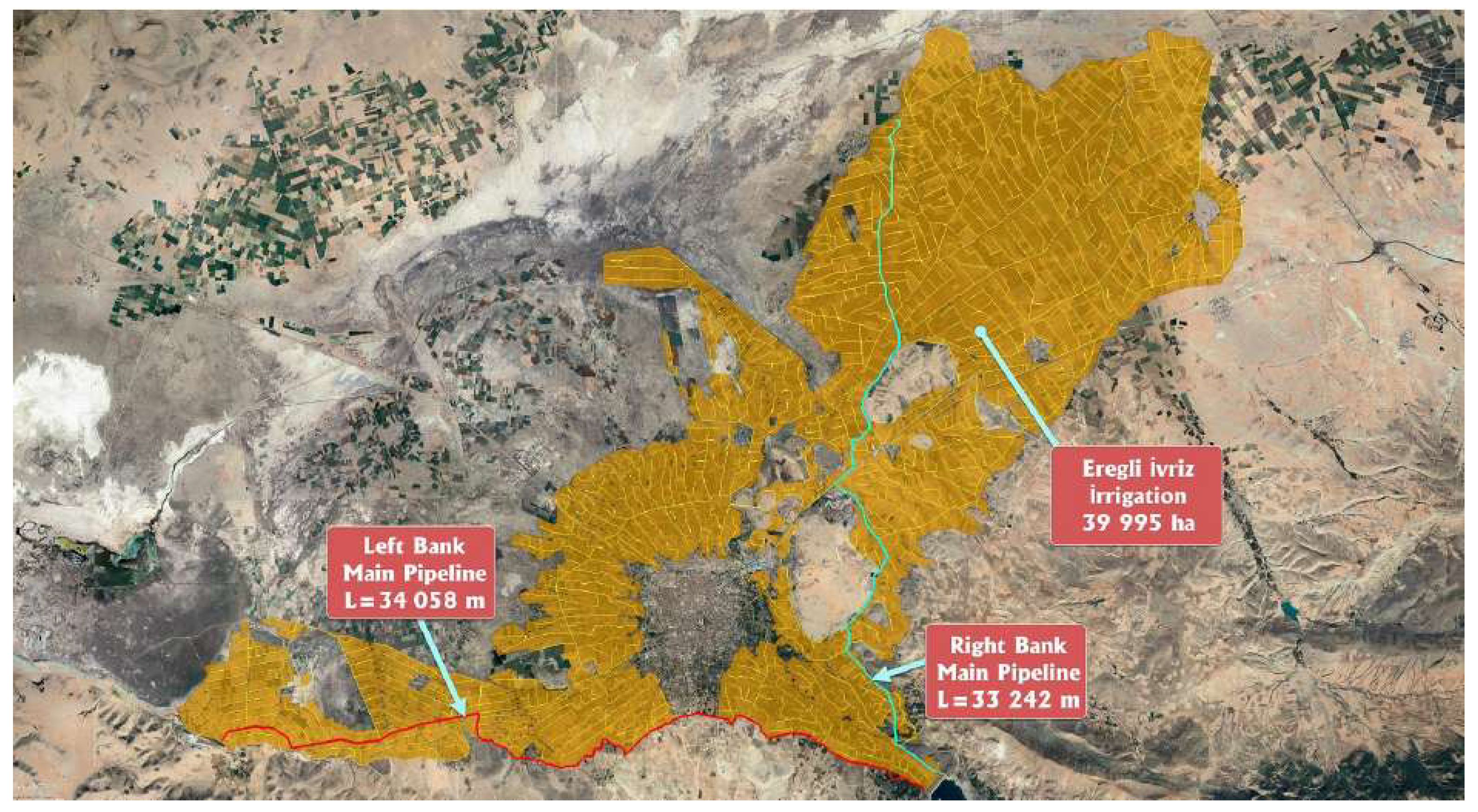
Table 1.
Average cultivation shares and income increases per decare in irrigated areas of Türkiye.
| Crop Category | Cultivation Share (%) | Income Increase per Decare (TL) |
|---|---|---|
| Cotton | 13 | 7,241.3 |
| Corn | 23 | 5,568.8 |
| Sugar Beet | 5 | 6,299.8 |
| Forage Crops | 6 | 6,206.1 |
| Cereals | 15 | 3,232.9 |
| Fruits & Vegetables | 17 | 18,732.0 |
| Others | 21 | 7,879.0 |
Table 2.
Economic Results of the Ivriz Irrigation.
| Category | Indicator | Scenario 1 (60% Eff.) | Scenario 2 (75% Eff.) | Scenario 3 (90% Eff.) |
|---|---|---|---|---|
| Physical Projections | Post-Modernization Water Diversion (m³/ha) | 7,323 | 5,859 | 4,882 |
| Water Savings (m³/ha) | 253 | 1,717 | 2,694 | |
| Additional Irrigable Area (ha) | 3,734 | 12,398 | 21,062 | |
| Monetary Projections | Total Annual Benefit (USD) | 5,343,073 | 17,741,186 | 30,139,300 |
| Economic Viability Metrics | Net Present Value (NPV) (USD) | -100,903,903 | 76,438,656 | 253,781,215 |
| Benefit–Cost Ratio (BCR) | 0.43 | 1.43 | 2.43 | |
| Internal Rate of Return (IRR) (%) | 1 | 7 | 12 |
Disclaimer/Publisher’s Note: The statements, opinions and data contained in all publications are solely those of the individual author(s) and contributor(s) and not of MDPI and/or the editor(s). MDPI and/or the editor(s) disclaim responsibility for any injury to people or property resulting from any ideas, methods, instructions or products referred to in the content. |
© 2026 by the authors. Licensee MDPI, Basel, Switzerland. This article is an open access article distributed under the terms and conditions of the Creative Commons Attribution (CC BY) license.
Copyright: This open access article is published under a Creative Commons CC BY 4.0 license, which permit the free download, distribution, and reuse, provided that the author and preprint are cited in any reuse.