

Submitted:
15 January 2026
Posted:
16 January 2026
You are already at the latest version
Abstract
This systematic review examined the validity and reliability of wearable inertial sensor systems to quantify spatiotemporal gait parameters in post‑stroke adults, a population in which gait asymmetry, altered motor control, and compensatory strategies challenge accurate measurements. Four databases were searched up to December 2025, and studies were included when they assessed concurrent validity or test–retest reliability of wearable derived spatiotemporal parameters against laboratory-based reference systems. Fifteen studies involving a total of 286 participants were analyzed. Spatial parameters as gait speed, cadence, and step and stride length showed consistent good‑to‑excellent agreement with reference instruments and high test–retest reliability. Temporal parameters demonstrated greater heterogeneity, with larger absolute errors, wider limits of agreement, and lower relative agreement, particularly for swing time. Paretic‑side measurements showed reduced between instrument agreement compared to the non‑paretic side, although within‑subject reliability remained moderate to high. No consistent influence of sensor number on measurement accuracy. Overall, wearable inertial sensors provide robust estimates of spatial gait parameters in post‑stroke populations, while temporal outcomes remain limited, likely due to the challenge to detect gait events that arise from stroke-related alterations in gait biomechanics. Taking these findings as a whole suggests that deviations from regular gait biomechanics, whether due to reduced speed particularly at low walking speeds of 0.4 m/s, asymmetry, or to the use of assistive devices, compromise the ability of wearable-based algorithms to accurately identify gait events.
Keywords:
post-stroke gait
; spatiotemporal gait parameters
; inertial measurement units
; wearable sensors
1. Introduction
Strokes are the second leading cause of mortality and the primary cause of disability worldwide [1,2]. According to recent estimates from the Global Burden of Disease study, approximately 11.9 million new stroke cases occur annually, while 93.8 million people live with functional sequelae from stroke events [3]. Gait disturbances are among the most disabling post-stroke consequences, limiting autonomy [4], restricting participation in the activities of daily living [5] and increasing the risk of falls [6] even in patients with relatively high levels of independence. Only around 50% of whom achieve fully autonomous ambulation after stroke [7,8,9]. Gait impairments, which are closely associated with hemiparesis, are characterized by reduced walking speed, decreased step length and cadence, prolonged swing phase, reduced knee and hip flexion, increased variability and asymmetry of gait patterns as well as abnormalities in the kinematics and kinetics of the lower limbs [10,11,12,13]. Insufficient weight transfer towards the affected limb, delays in postural responses and a compensatory shift of the center of mass towards the unaffected side further compromise gait efficiency [14,15]. Gait deficits arise from a complex interplay of symptoms present in people with stroke such as spasticity, muscle weakness, impaired intermuscular coordination, postural control deficits, and reduced somatosensory sensitivity. Ultimately, this cluster of symptoms affects the efficiency, stability and safety of walking [16,17,18].
Consequently, an accurate and comprehensive gait assessment is essential to guide clinical intervention to promote a greater independence in activities of daily living in this population. Gait is commonly assessed in clinical setting through the use of conventional clinical tools such as timed walking tests [19] and distance-based assessments [20], observational standardized scales [21] or patient-reported outcome measures [22]. Although these approaches are widely used because they are low cost and easy to use, they lack the kinematic and spatiotemporal resolution required to accurately characterize gait impairments, capture subtle motor deficits or describe inter-individual variability in post-stroke walking patterns [23,24]. Instrumented laboratory methods allow for a detailed analysis; however, their high cost, specialized infrastructure requirements and extensive training and data processing time restrict routine clinical use [25,26]. Therefore, quantitative and integrative approaches are needed to enable a comprehensive gait evaluation, optimize clinical interpretation and support evidence-based therapeutic decisions. Recent technological advances have facilitated the development of portable inertial sensors that can measure spatiotemporal gait parameters previously accessible only in specialized laboratories [27]. These devices offer clear advantages, including lower cost, low energy consumption, ease of use and light weight, therefore allowing for their application in both clinical settings and patients’ daily environments [28]. However, clinical implementation in post-stroke populations remains limited, primarily due to the scarcity of studies supporting their reliability, validity and sensitivity. Previous reviews on wearable technologies for post-stroke gait have mainly focused on the reliability and validity of basic outcomes, such as gait speed or step count [29,30]. However, a comprehensive and clinically interpretable systematic evaluation of the measurement error of these devices in relation to gold standards (i.e., concurrent validity) and the consistency across measures (i.e., reliability) of spatiotemporal gait parameters is still necessary. Moreover, existing evidence has not yet been examined in relation to key sources of methodological heterogeneity, including number of sensors and participants’ level of disability of the most affected limb [28,30,31,32,33,34], which limit the comparability across studies and hindering the transfer of wearable-based gait assessment into clinical practice. Consequently, the aim of this systematic review is to examine how key methodological decisions and participants’ disability influence the reliability and validity of spatiotemporal gait parameters derived from wearable inertial sensors in post-stroke populations.
2. Materials and Methods
This systematic review was conducted in accordance with the PRISMA 2020 guidelines and previously registered in PROSPERO (CRD420251155668; September 29, 2025). The review framework considered the construct of interest, spatiotemporal gait parameters in post-stroke adults, the measurement instruments which consisted of wearable devices incorporating inertial sensors and the psychometric properties under evaluation, which included reliability, validity and measurement error.
2.1. Protocol Clarification
Three deviations from the originally registered PROSPERO protocol were made to better align the review with its objectives. First, randomized controlled trials (RCTs) were initially included; however, during the screening phase it became clear that RCTs did not report the level of methodological detail required to evaluate measurement properties of wearable devices. For this reason, no RCTs were included. Second, although AMSTAR-2, Cochrane RoB-2 and ROBINS-I were noted in the PROSPERO record for risk of bias assessment, these tools were not applied as they are not appropriate for evaluating measurement properties. Instead, the COSMIN checklist was used and the certainty of evidence was assessed using the GRADE approach, as originally intended. Third, the inclusion criteria were refined: only studies measuring at least two spatiotemporal gait parameters were considered.
2.2. Eligibility Criteria
Studies were eligible when they examined adults aged 18 years or older with a clinical stroke diagnosis, regardless of their post-stroke phase and who were capable of walking independently or with assistive devices. Concurrent validity and test–retest reliability studies were included if they reported psychometric properties of wearable devices based on inertial sensors during gait assessment and they assessed at least one spatiotemporal gait parameter other than gait speed or cadence. Specifically, concurrent validity studies had to include at least a concordance or agreement index between the wearable device and the gold standard instrument (optical motion capture systems, instrumented walkways or video cameras). Validity studies were excluded if they only presented mean error differences or statistical comparisons between instruments. Within- and between-session test–retest reliability studies were included if they reported at least one absolute or relative reliability index. In addition, studies were excluded if they involved additional neurological, psychiatric, musculoskeletal, or rheumatological conditions, or any contraindication to gait evaluation or physical activity. Studies focusing on insole- or sock-based sensor systems were also excluded. Trials that used additional reference systems, such as motion capture or pressure walkways, were included if wearable-derived outcomes were reported independently. Articles published in English were considered.
2.3. Information Sources and Search Strategy
A systematic search was conducted independently by two reviewers (V.M.-P. and D.S.-G.) in the following electronic databases: CENTRAL, PubMed, Embase, and Scopus. Search terms combined keywords and MeSH terms related to stroke, wearable devices, gait, and psychometric properties, adapted for each database (Supplementary material 1). The reference lists of the included studies were manually screened to identify additional relevant publications. Searches included all articles published up to December 23rd, 2025.
2.4. Study Selection
Titles and abstracts were independently screened by two reviewers (V.M.-P. and D.S.-G.), and potentially eligible articles were assessed in full text. Any discrepancies between the reviewers were resolved through discussion or consultation with a third reviewer (D.B.) Duplicate records were removed prior to screening. The selection process is illustrated in a PRISMA flow diagram (Figure 1).
2.5. Data Extraction
Data extraction was independently performed by two reviewers (V.M.-P. and D.S.-G.). Any discrepancies were resolved through discussion or consultation with a third reviewer (D.B.). The extracted information included study characteristics (age, number of participants, sex, post stroke phase (time since stroke), gait speed, functional ambulation categories, paretic side, assistive device used), device characteristics (type of wearable, brand/model, number and placement of sensors, sampling frequency, software used), measurement conditions, reference standards employed (type, brand/model, placement, protocol) and spatiotemporal gait parameters assessed (minimum two per study, including walking speed, cadence, step and stride length, step and stride time, stance and swing time, double support, variability, asymmetry, and any additional parameters). For validity outcomes, extracted metrics included concurrent validity indexes related to the degree of relative [Intraclass correlation, coefficient (ICC), Pearson’s r, etc.] or absolute agreement [Bland–Altman limits of agreements (LoA), standard deviation (SD), root mean square error (RMSE), mean absolute error (MAE), etc.] between instruments. For reliability studies, extracted outcomes included test–retest absolute [standard error of measurement (SEM), SD, coefficient of variation (CV), minimal detectable change (MDC), etc.] or relative indexes [ICC, Pearson’s r, etc.].
2.6. Risk of Bias/Quality Assessment
The methodological quality and risk of bias of the included studies were independently assessed by two reviewers (V.M.-P. and D.S.-G.) using a modified version [35] of the Consensus-based Standards for the Selection of Health Measurement Instruments (COSMIN) risk-of-bias tool for observational studies [36]. Any disagreements were resolved through discussion or consultation with a third reviewer (D.B). For this review, the quality assessment comprised seven domains for concurrent validity studies and five domains for reliability studies. Each dimension was rated as excellent, good, fair, or poor quality; then, the overall methodological quality of each study was determined using the “worst-score-counts” principle, by which the lowest domain rating defined the final quality classification.
2.7. Data Synthesis
A narrative synthesis was conducted to summarize the psychometric properties of wearable devices for gait assessment. Validity and reliability outcomes were grouped by device type, number and placement of sensors, assessed spatiotemporal gait parameters and context of application.
To enhance comparability across studies assessing agreement between instruments in the concurrent validity, ± LoA at 95% was used as the primary common metric. When LoA were not explicitly reported, they were estimated from related agreement indices, including the RMSE and the MAE. Specifically, 95% LoA was calculated as ±1.96 × RMSE. When only MAE was available, a normal error distribution was assumed, such that MAE ≈ 0.8 × SD; consequently, 95% LoA was estimated as ±1.96 × (MAE / 0.8). ICC was considered as the primary metric for assessing concordance between instruments.
To enhance comparability across studies assessing absolute reliability, the MDC at the 95% confidence level (MDC₉₅) was used as the primary metric. The MDC is equivalent to the smallest detectable change (SDC) or the smallest detectable difference (SDD). When MDC values were not explicitly reported, they were derived from related agreement indices, specifically the SEM, using the formula MDC₉₅ = 1.96 × √2 × SEM. We chose to register and compute MDC from related outcomes as it accepted by researchers and clinicians to be a benchmark to distinguish between clinically relevant and irrelevant changes following therapeutic interventions or disease worsening [37]. ICC were used as the primary metric for assessing relative reliability. Predefined qualitative categorization for ICC was set at excellent (≥0.90), good (0.750–0.899), moderate (0.500–0.749) and poor (<0.500) [38].
3. Results
The full database created for the present systematic review is available in Supplementary material 2. The 15 studies included in this systematic review on spatiotemporal gait parameters measured with wearable inertial sensors comprised a total of 286 post-stroke participants, predominantly in the chronic phase. The mean age across studies ranged from 51.6 to 69.0 years. Participants’ gait impairment showed marked heterogeneity, with reported gait speeds ranging from below 0.4 m/s to above 1.0 m/s. Hemiparesis distribution was reported in ten studies, with 92 participants presenting left-sided and 88 right-sided involvement. The use of assistive devices was documented in seven studies, with prevalence ranging from 13% to 83%.

Table 1.
Characteristics of the participants included in the selected studies.
| Authors (Year) | Age (years) | n | Sex |
Post-stroke phase (time since stroke) |
Gait speed (m/s) | FAC | Paretic side | Assistive device use (%) |
| Contreras et al., (2024) | 52.3 ± 26.7 | 15 | 2 F 13 M |
N/A | 0.86 ± 0.17 m/s (without AD) 0.49 ± 0.18 m/s (with AD) |
N/A | N/A | N/A |
| De Miguel-Fernández et al., (2023) | 58.5 ± 10.9 | 6 | 2 F 4 M |
Chronic (10.2 ± 11 years) |
0.34–1.14 m/s | 2–4 | 6 L | 83.3% (Cane: 4, AFO: 3) |
| Desai et al., (2023) | 51.6 ± 12.7 | 23 | 10 F 13 M |
Chronic (97 ± 66 months) |
0.40 ± 0.20 m/s | 3–5 | 11 L 12 R |
N/A |
| Ensink et al., (2023) | 61 ± 11 | 10 | 3 F 7 M |
N/A | Median 0.62 m/s (0.14–1.73 m/s) |
3–5 | 4 L 6 R |
N/A |
| Hendriks et al., (2022) | 69 ± 9 | 11 | 5 F 6 M |
N/A | 0.73 ± 0.30 m/s (10MWT) 0.51 ± 0.16 m/s (spontaneous) |
2–5 | 5 L 6 R |
N/A |
| Huber et al., (2022) | 63.1 ± 12.4 | 20 | 7 F 13 M |
Chronic (76 months) |
Median 1.34 m/s (IQR 0.77–1.47; range 0.38–1.77) |
3–5 | 9 L 11 R |
0% |
| Lefeber et al., (2019) | 67 | 25 | 12 F 13 M |
Subacute 84.4 ± 41.7 days |
0.70 ± 0.22 m/s (paretic) 0.76 ± 0.23 m/s (non-paretic) |
3-4 | N/A | AD: 56% (Cane: 12%, Crutches: 16%, AFO: 4%, Rollator: 20%, Walker: 4%) |
| Lanotte et al., (2024) | 62.3 ± 14.3 | 39 | 17 F 22 M |
Acute-Subacute (17 ± 11.9 days) |
0.03–2.00 m/s | N/A | 16 L 23 R |
N/A |
| Moore et al., (2017) | 63 ± 11 | 23 | 4 F 19 M |
Chronic (66 ± 48 months) |
0.90 ± 0.40 m/s | N/A | N/A | Cane/other: 3 (13%), AFO Push Aequi: 4 (17%) |
| Naef et al., (2025) | 63.9 ± 15.5 | 21 | 10 F 11 M |
Subacute (5.19 ± 10.73 months) |
>0.8 m/s (76.1%) 0.4–0.8 m/s (19.1%) <0.4 m/s (4.8%) |
N/A | 16 L 5 R |
Rollator: 1 (4.76%), Dropped foot stimulator: 1 (4.76%), Foot orthoses: 3 (14.29%) |
| Punt et al., (2014) | 61.8 ± 8.8 | 33 | 16 F 17 M |
Chronic (5.6 ± 3.8 years) |
0.88 m/s (mean 6MWT) | 3–5 | N/A | N/A |
| Revi et al., (2024) | 61±12 | 8 | 8 M | Chronic (5.4 ± 2.5 years) |
0.93 ± 0.33 m/s | N/A | 4 L 4 R |
N/A |
| Schwarz et al., (2023) | 62 | 28 | 9 F 19 M |
Chronic (63.71 months) |
1.03 m/s (mean 10MWT) | N/A | 15 L 13 R |
AD: 9 (32%) AFO: 4 (14%) |
| Trojaniello et al., (2015) | 58.6 ± 12.1 | 10 | 2 F 8 M |
N/A | 0.61 ± 0.24 m/s | 2-5 | N/A | 6 (60%) |
| Wüest et al., (2016) | 64.7 ± 9.2 | 14 | 2 F 12 M |
N/A | 0.57 ± 0.17 m/s | N/A | 6 L 8 R |
5 (35.7%) |
| Post stroke phases = Acute (1–7 days), Subacute (7 days–6 months), Chronic (>6 months); Age, time since stroke and gait speed data are presented as Mean ± SD (standard deviation); n = sample size; R = right hemisphere; L = left hemisphere; AD = assistive device; CVA = cerebrovascular accident (stroke); CA = community ambulators; HA = Household ambulators; AFO = ankle-foot orthosis; Rollator = four-wheeled walking aid; Walker = standard walking frame; FAC = Functional Ambulation Classification. | ||||||||
Table 2.
Wearable characteristics and protocol design of the selected studies.
Across the 15 included studies, 11 assessed validity [26,38,39,40,41,42,43,44,45,46,47], 8 of them evaluated reliability [32,38,39,42,47,48,49,50]. Out of these, there were 4 examined that examined both measurement properties [38,39,42,47]. The most frequently reported spatiotemporal parameters were spatial variables [i.e., walking speed (9), stride length (9), cadence (7) and step length (5)] followed by temporal parameters [i.e., stance time (7), swing time (6), stride time (5) and step time (3)) and support-related metrics, particularly double support time (4)].
Most studies compared wearable-derived outcomes against reference instruments, primarily optical motion capture systems or instrumented walkways, while a smaller number employed video-based analyses. Walking protocols varied and included the 10-meter, 1-minute, 2-minute, 5-minute, and 6-minute walking tests and walkway and treadmill walking. One study calculated the spatial-temporal gait parameters from the modified Timed Up and Go tests. Assessments were conducted under self-selected gait speed in most of the cases (n=13). Sensor placement depended on the number of units used. There were single-sensor configurations located at the waist or L4-L5 (n=4), 2-sensor configurations placed on the lower limb (n=6) and multi-sensor systems (3 to 17 sensors) distributed across the feet, shanks, thighs, trunk, and lumbar region.
Validity
Overall, several studies were classified as having fair or poor overall quality as a result of applying the worst-score-counts principle, despite reporting acceptable validity outcomes. Most studies obtained good to excellent ratings in domains related to the description of the gold standard and the statistical indices used for the validation analysis. Conversely, sample size adequacy and handling of missing data were the most frequent methodological shortcomings, often rated as fair or poor. A full risk of bias analysis can be found in supplementary material 3.
Absolute (Table 3) and relative (Table 4) agreement analyses demonstrated good to excellent agreement between wearable sensor–based systems and reference instruments for gait speed, cadence, step length and stride length. When comfortable speed was assessed, LoA% values below 20% were observed in 88.0% of cases (22/25), while ICC values exceeded 0.75 in 91.1% (31/34) and 0.90 in 76.5% (26/34) of the reported outcomes. LoA range from 0.05–0.15 m·s⁻¹ for gait speed, 1–3 steps·min⁻¹ for cadence, and 0.05–0.08 m for stride length. Lower agreement scores were observed in the study by Punt et al. [39], who showed that error between instruments increased (LoA%: 11.4-17.8%) when participants walked at a slower pace than the regular and faster speed (LoA%: 6.7-21.1%) for cadence and step length while ICC was similar. The study by Contreras et al. [40] also showed that walking with an assistive device reduced relative agreement (ICC: 0.64–0.76) and increased measurement error (LoA%: 20.7–40.3%) compared with walking without an assistive device (ICC: 0.88–0.92; LoA%: 14.4–23.0%) for gait speed, step length and stride length, swing time and double support duration percentage.
Temporal gait parameters showed lower agreement. Only 20% of cases (4/20) showed absolute errors below 100 ms, while LoA% values exceeded 20% in 60.9% of cases (14/23). Relative validity was also reduced, with ICC values below 0.75 in 47.8% of cases (11/23).
When validity outcomes were stratified by limb side, spatiotemporal parameters derived from the paretic limb showed larger measurement error than those obtained from the non-paretic side. Across four studies, LoA for stride length on the paretic limb ranged from 9–17 cm, whereas values for the non-paretic limb were consistently lower, typically ranging from 4–9 cm. For temporal parameters, absolute errors on the paretic side ranged between 80 and 330 ms, compared with 40–230 ms on the non-paretic side. In terms of relative agreement, all spatiotemporal parameters derived from the non-paretic limb showed good to excellent agreement with reference instruments except in Lefeber et al. [42] for swing and stance time (ICC=0.63). In contrast, paretic-side measures showed greater variability, reaching ICC values above 0.75 in 69.2% of outcomes (9/13).
Regarding the number of sensors, no clear differences were observed between the LoA shown by single sensors placed on the lower back and sensor-based systems placed on the lower limb.
*Pearson’s correlation; **Lin’s concordance correlation coefficients; *ICC calculated the absolute time (s); $Agreement indexes were calculated from the gait temporal outcomes in percentage of the gait cycle; 2MWT: 2-minute walking test; 5MWT: 5-minute walking test; 6MWT: 6-minute walking test; TUG: Timed up & go.
Reliability
Overall, applying the worst-score-counts principle led several studies to be classified as having fair or poor overall quality due to the low sample sizes and poor handling of the missing data. All studies correctly calculated the ICC as the main reliability index. The full risk of bias analysis can be found in the supplementary material 3.
Absolute (Table 5) and relative reliability (Table 6) analyses showed good to excellent test–retest reliability for gait speed, cadence, step length and stride length across most of the wearable sensor–based systems. For these parameters, absolute measurement error, MDC% values fell below 20% in 73.3% of the cases (22/30), while ICC values exceeded 0.75 in 93.9% (31/33) and 0.90 in 81.8% (27/33) of the reported outcomes. Multi-sensor systems (≥ 3 sensors) showed good absolute reliability scores with MDC ranging from 0.01–0.08 m·s⁻¹ for gait speed, and from 0.01–0.06 m for step/stride length, apart from the study by Schwarz et al. [32] conducted in short walking trials. Single or two sensor systems showed higher MDC ranging from 0.13–0.32 m·s⁻¹ for gait speed, and from 0.02–0.31 m for step/stride length. Relative reliability analyses showed that ICC scores were similar independently of the number of sensors.
Temporal gait parameters showed poorer reliability values. Only 40.0% of cases (6/15) showed absolute errors below 100 ms, while LoA% exceeded 20% in 52.4% of cases (11/21). Conversely, relative reliability was good to excellent, with ICC values above 0.75 in 76.9% of cases (20/26).
When reliability outcomes were stratified by limb side, the studies that performed side-specific analyses did not report consistent differences between the paretic (ICC: 0.55-0.99; LoA%: 5.7-42.0%) and non-paretic limbs (ICC: 0.55-0.99; LoA%: 5.6-50.8%).
4. Discussion
The results of this systematic review indicate that the performance of wearable inertial sensor systems for quantifying spatiotemporal gait parameters in the post-stroke population is heterogeneous and clearly depends on the type of parameter analyzed. Overall, spatial parameters showed generally good validity and reliability, whereas temporal parameters exhibited a more limited performance. Gait disturbance caused by the affected side (i.e., paretic side) also limited the ability of the wearable system to accurately determine spatiotemporal gait parameters compared to the reference systems but not the reliability of the results. The number of sensors didn’t seem to determine the accuracy of the wearable system compared to the reference system, but it limited the test-retest reliability.
Our main results showed that gait speed, cadence, and step and stride lengths consistently emerged as the most robust indicator, showing the lowest absolute errors and the highest levels of agreement with the reference systems [26,38,39,40,41,42,43,44,45,46,47] as well as the best reliability scores [32,38,39,42,47,48,49,50]. In contrast, temporal parameters showed larger error discrepancies and test-retest variability. Although this pattern observed in the post-stroke population was largely consistent with findings reported in meta-analyses of healthy adults [33] and older adults [51], our results showed slightly poorer relative agreement and relative reliability in the temporal parameters. Based on ICC/r comparison, gait speed, cadence and step and stride length were the most robustly estimated parameters, showing a relative agreement and reliability in post-stroke populations (ICC/r ≈ 0.75–0.95) comparable with the agreement observed in older adults (ICC/r ≈ 0.80–0.95) and in healthy adults (ICC/r ≈ 0.85–0.99). The strength of the association between wearable-based measures and reference systems, together with their high test–retest consistency, supports the use of the wearable systems included in this review as valid tools to rank/classify stroke patients according to their level of impairment in these gait parameters [52]. Furthermore, the absolute reliability analyses based on the MDC estimates indicate that changes exceeding approximately 0.2 m·s⁻¹ in gait speed, 9 steps·min⁻¹ in cadence and 16 cm in step or stride length, as detected by most wearable systems, can be interpreted at the individual level as true changes in patient status, rather than as consequences of measurement error or normal biological variability [52,53].
Temporal parameters exhibited a more heterogeneous behavior compared to spatial parameters. Discrepancies between wearable-based and reference systems, as well as absolute test–retest reliability, frequently exceeded the LoA and MDC values of 100 ms, or 20%, particularly for stance and swing time. The fact that stride and step time showed better validity and reliability scores may be related to fact that they only require detecting the initial contact for their calculations, while it is necessary to detect the final contact for stance and swing time [42]. Although the estimation of temporal parameters by wearable devices in stroke patients seems compromised, relative reliability showed good to excellent ICC scores (ICC/r ≈ 0.80–0.99) for stride and step time, and moderate to excellent ICC scores (ICC/r ≈ 0.80–0.99) for most stance time and most of the swing time estimations (ICC/r ≈ 0.56–0.99). These results are comparable with those observed in both healthy adults and older adults [33,51] for stride, step, stance time and swing time (ICC/r ≈ 0.81–0.99). From the authors’ perspective, the observation of high relative reliability (i.e., high ICC values), despite the large absolute test–retest error (i.e., high MDC), may be explained by the fact that ICC estimates depend on the ratio between-subject and within-subject variability [54]. In this context, stroke patients may exhibit a marked heterogeneity in gait performance across individuals (high between-subject variability), which can yield high ICC values even when the test-retest consistency within individuals is relatively low. These findings suggest that, for temporal gait parameters, between-subject variability associated with differing levels of disability outweighs within-subject variability, thereby increasing relative reliability estimates. Consequently, although absolute measurement error remains substantial, wearable-based assessments of temporal parameters may still be considered sufficiently reliable to rank or classify individuals and to monitor group-level trends in post-stroke populations. Conversely, the high absolute test-rest fluctuations suggest that detecting small individual-level changes in temporal parameters can be challenging.
The lower absolute agreement and reliability observed in our review, particularly for temporal gait parameters, may be partly attributable to limitations of gait event–detection algorithms when applied to individuals with pronounced biomechanical alterations [54], such as those commonly observed after a stroke [55]. Supporting this interpretation, Punt et al. [39] reported that wearable devices exhibited larger measurement errors at slower walking speeds, while Contreras et al. [40] observed increased errors when gait was assessed under assisted walking conditions. Taken together, these findings suggest that deviations from regular gait biomechanics, whether due to reduced speed, especially at low walking speeds of 0.4 m/s [56], to asymmetry [57] or to the use of assistive devices, compromise the ability of wearable-based algorithms to accurately identify gait events. Comparison between paretic and non-paretic limb seem to support this idea. Both spatial and temporal gait parameters showed reduced concurrent validity of the wearable device on the paretic side compared to the non-paretic side. These differences are likely caused by post-stroke biomechanical alterations, including slower, more rigid gait, asymmetric swing-to-stance ratios and reduced dorsiflexion observed mainly in the paretic limb [58]. It must be noted that, despite the lower absolute agreement between the wearable and reference system on the paretic side, test–retest reliability remained similar between limbs. While Lefeber et al. [42] found lower test-retest consistency for the paretic limb, Schwarz et al. [32] found the opposite results.
Finally, owing to the limited number of available studies, this review was unable to elucidate the potential influence of sensor numbers on the accuracy of temporal gait parameters in post-stroke populations. In contrast, the larger body of evidence evaluating the reliability of multi-sensor wearable systems (≥ 3 sensors) assessing gait speed and step and stride length suggests that they might present an enhanced ability to detect subtle changes in the stroke patient’s gait status in those parameters. Based on the findings by Desai et al. [47], Schwarz et al. [32] and Wüest et al. [50] findings, small changes in gait speed (>0.08 m·s⁻¹) and step or stride length (>6 cm) may be interpreted as clinically relevant when assessed using multi-sensor wearable configurations. Conversely, based on the single- or dual-sensor system reliability findings [38,48,49], larger changes (ranging from 0.13 to 0.32 m·s⁻¹ for gait speed and from 0.02 to 0.31 m for step or stride length depending on the sensor system) would be required to ensure that the observed differences reflect the true change in stroke gait status rather than day-to-day variability.
4.1. Limitations and Future Research
This systematic review has several limitations that should be considered when interpreting its findings. The included studies were characterized by small sample sizes, heterogeneous walking protocols and variability in sensor placement and algorithms, which limit generalizability. Moreover, few of the studies explicitly examined the influence of patient-specific factors, such as motor impairment severity, gait asymmetry and walking speed on wearable system performance. In addition, this review did not address the impact the algorithm selection had on the reliability of the gait event detection (e.g., initial contact, toe-off, etc.) which are precursors to spatiotemporal outcomes. Future research should address all these voids by clarifying their impact on the validity, reliability, and responsiveness of inertial sensor–based gait measures. In addition, longitudinal and real-world studies (including evaluations of responsiveness to clinical interventions and investigations into the minimum sensor configurations required for accurate parameter estimation), are needed to enhance the clinical and translational relevance of wearable gait assessment technologies.
5. Conclusions
Wearable inertial sensor systems provide valid and reliable measurements of post-stroke gait parameters, particularly for spatial metrics. Temporal parameters remain more susceptible to measurement error, especially on the paretic side when compared with reference systems; however, test–retest reliability was comparable between limbs. Finally, this review was unable to determine whether sensor quantity alone influences measurement accuracy relative to reference systems, although multi-sensor wearable configurations appear to yield more stable test–retest gait assessments.
Supplementary Materials
The following supporting information can be downloaded at website of this paper posted on Preprints.org.
Author Contributions
Conceptualization, V.M.-P., D. S.-G., J.G.-C., C.B.-P., C.D.-M., and D.B.; methodology, V.M.-P., D. S.-G., C.B.-P., P.R.-A., L. M.-N., and D.B..; validation, C.D.-M., P.R.-A., L. M.-N. and D.B.; V.M.-P., D. S.-G., D.B.; data curation, V.M.-P., D. S.-G., D.B.; writing—original draft preparation, V.M.-P., D. S.-G., D.B.; writing—review and editing, V.M.-P., D.B., C.D.-M., J.G.-C., P.R.-A., L. M.-N., I.P., S.M.-S., L.T., B.M.-M., E.G.-A., and D.S.-G.; supervision, D.B., C.B.-P., C.D.-M.; project administration, B.M.-M., E. G.-A., C.B.-P., I.P.; funding acquisition, B.M.-M., E. G.-A. All authors have read and agreed to the published version of the manuscript.
Funding
This research was developed within “The JADE Health Joint Action” funded by the European Union under GA 101183247.
Institutional Review Board Statement
Not applicable.
Informed Consent Statement
Not applicable.
Data Availability Statement
Data are available as Supplementary material in this article.
Conflicts of Interest
The authors declare no conflicts of interest. The funders had no role in the design of the study; in the collection, analyses or interpretation of data; in the writing of the manuscript; or in the decision to publish the results. Funded by the European Union. Views and opinions expressed are however those of the author(s) only and do not necessarily reflect those of the European Union or HaDEA. Neither the European Union nor the granting authority can be held responsible for them.”.
Abbreviations
The following abbreviations are used in this manuscript:
| ICC | Intraclass correlation coefficient |
| LoA | Bland–Altman limits of agreement |
| SD | Standard deviation |
| RMSE | Root mean square error |
| MAE | Mean absolute error |
| SEM | Standard error of measurement |
| CV | Coefficient of variation |
| MDC | Minimal detectable change |
References
- Townsend, N; Wilson, L; Bhatnagar, P; Wickramasinghe, K; Rayner, M; Nichols, M. Cardiovascular disease in Europe: Epidemiological update 2016. In European Heart Journal; Oxford University Press, 2016; Vol. 37, pp. 3232–45. [Google Scholar]
- European Cardiovascular Disease Statistics 2017 edition [Internet]. Available online: www.ehnheart.org.
- Feigin, VL; Brainin, M; Norrving, B; Martins, SO; Pandian, J; Lindsay, P; et al. World Stroke Organization: Global Stroke Fact Sheet 2025. In International Journal of Stroke; SAGE Publications Inc., 2025; Vol. 20, pp. 132–44. [Google Scholar]
- Lord, SE; McPherson, K; McNaughton, HK; Rochester, L; Weatherall, M. Community ambulation after stroke: how important and obtainable is it and what measures appear predictive? Arch Phys Med Rehabil 2004, 85(2), 234–9. [Google Scholar] [CrossRef] [PubMed]
- Mayo, NE; Wood-Dauphinee, S; Côté, R; Durcan, L; Carlton, J. Activity, participation, and quality of life 6 months poststroke. Arch Phys Med Rehabil 2002, 83(8), 1035–42. [Google Scholar] [CrossRef]
- Bower, K; Thilarajah, S; Pua, YH; Williams, G; Tan, D; Mentiplay, B; et al. Dynamic balance and instrumented gait variables are independent predictors of falls following stroke. J Neuroeng Rehabil 2019, 16(1), 3. [Google Scholar] [CrossRef]
- Jorgensen, HS; Nakayama, H; Raaschou, HO; Olsen, TS; Jergensen, HS. Recovery of Walking Function in Stroke Patients: The Copenhagen Stroke Study; Arch Phys Med Rehabil, 1995; Vol. 76. [Google Scholar]
- Jorgensen, HS; Nakayama, H; Raaschou, HO; Vive-Larsen, J; St¢ier, M; Olsen, TS; et al. Outcome and Time Course of Recovery in Stroke. Part I: Outcome. The Copenhagen Stroke Study, 1995. [Google Scholar]
- Algurén, B; Lundgren-Nilsson, Å; Sunnerhagen, KS. Functioning of stroke survivors - A validation of the ICF core set for stroke in Sweden. Disabil Rehabil. 2010, 32(7), 551–9. [Google Scholar] [CrossRef]
- Chen, G; Patten, C; Kothari, DH; Zajac, FE. Gait differences between individuals with post-stroke hemiparesis and non-disabled controls at matched speeds. Gait Posture 2005, 22(1), 51–6. [Google Scholar] [CrossRef]
- Alammari, BJ; Schoenwether, B; Ripic, Z; Kirk-Sanchez, N; Eltoukhy, M; Bishop, L. Validity of AI-Driven Markerless Motion Capture for Spatiotemporal Gait Analysis in Stroke Survivors. Sensors 2025, 25(17). [Google Scholar] [CrossRef]
- Patterson, KK; Gage, WH; Brooks, D; Black, SE; McIlroy, WE. Evaluation of gait symmetry after stroke: A comparison of current methods and recommendations for standardization. Gait Posture 2010, 31(2), 241–6. [Google Scholar] [CrossRef] [PubMed]
- Wang, Y; Mukaino, M; Ohtsuka, K; Otaka, Y; Tanikawa, H; Matsuda, F; et al. Gait characteristics of post-stroke hemiparetic patients with different walking speeds. International Journal of Rehabilitation Research 2020, 43(1), 69–75. [Google Scholar] [CrossRef]
- Ishii, F; Matsukawa, N; Horiba, M; Yamanaka, T; Hattori, M; Wada, I; et al. Impaired ability to shift weight onto the non-paretic leg in right-cortical brain-damaged patients. Clin Neurol Neurosurg 2010, 112(5), 406–12. [Google Scholar] [CrossRef]
- Hsiao, HY; Gray, VL; Borrelli, J; Rogers, MW. Biomechanical control of paretic lower limb during imposed weight transfer in individuals post-stroke. J Neuroeng Rehabil 2020, 17(1). [Google Scholar] [CrossRef] [PubMed]
- Wist, S; Clivaz, J; Sattelmayer, M. Muscle strengthening for hemiparesis after stroke: A meta-analysis. Ann Phys Rehabil Med. 2016, 59(2), 114–24. [Google Scholar] [CrossRef]
- Chia, FSF; Kuys, S; Low Choy, N. Sensory retraining of the leg after stroke: systematic review and meta-analysis. In Clinical Rehabilitation; SAGE Publications Ltd, 2019; Vol. 33, pp. 964–79. [Google Scholar]
- Mahmoudzadeh, A; Nakhostin Ansari, N; Naghdi, S; Ghasemi, E; Motamedzadeh, O; Shaw, BS; et al. Role of Spasticity Severity in the Balance of Post-stroke Patients. Front Hum Neurosci 2021, 15. [Google Scholar] [CrossRef]
- Collen, FM; Wade, DT; Bradshaw, CM. Mobility after stroke: Reliability of measures of impairment and disability. Int Disabil Stud. 1990, 12(1), 6–9. [Google Scholar] [CrossRef]
- Enright, PL. The six-minute walk test. Respir Care 2003, 48(8), 783–5. [Google Scholar]
- Holden, MK; Gill, KM; Magliozzi, MR; Nathan, J; Piehl-Baker, L. Clinical Gait Assessment in the Neurologically Impaired. Phys Ther. 1984, 64(1), 35–40. [Google Scholar] [CrossRef] [PubMed]
- Duncan, PW; Lai, SM; Bode, RK; Perera, S; DeRosa, J. Stroke Impact Scale-16. Neurology 2003, 60(2), 291–6. [Google Scholar] [CrossRef]
- Hulleck, AA; Menoth Mohan, D; Abdallah, N; El Rich, M; Khalaf, K. Present and future of gait assessment in clinical practice: Towards the application of novel trends and technologies. Front Med Technol 2022, 4. [Google Scholar] [CrossRef]
- Mohan, DM; Khandoker, AH; Wasti, SA; Ismail Ibrahim Ismail Alali, S; Jelinek, HF; Khalaf, K. Assessment Methods of Post-stroke Gait: A Scoping Review of Technology-Driven Approaches to Gait Characterization and Analysis. In Frontiers in Neurology; Frontiers Media S.A., 2021; Vol. 12. [Google Scholar]
- Haeuber, E; Shaughnessy, M; Forrester, LW; Coleman, KL; Macko, RF. Accelerometer monitoring of home- and community-based ambulatory activity after stroke. Arch Phys Med Rehabil. 2004, 85(12), 1997–2001. [Google Scholar] [CrossRef] [PubMed]
- Trojaniello, D; Ravaschio, A; Hausdorff, JM; Cereatti, A. Comparative assessment of different methods for the estimation of gait temporal parameters using a single inertial sensor: Application to elderly, post-stroke, Parkinson’s disease and Huntington’s disease subjects. Gait Posture 2015, 42(3), 310–6. [Google Scholar] [CrossRef] [PubMed]
- Clay, L; Webb, M; Hargest, C; Adhia, DB. Gait quality and velocity influences activity tracker accuracy in individuals post-stroke. Top Stroke Rehabil 2019, 26(6), 412–7. [Google Scholar] [CrossRef]
- Prisco, G; Pirozzi, MA; Santone, A; Esposito, F; Cesarelli, M; Amato, F; et al. Validity of Wearable Inertial Sensors for Gait Analysis: A Systematic Review. Diagnostics 2024, 15(1), 36. [Google Scholar] [CrossRef]
- Peters, DM; O’Brien, ES; Kamrud, KE; Roberts, SM; Rooney, TA; Thibodeau, KP; et al. Utilization of wearable technology to assess gait and mobility post-stroke: a systematic review. In Journal of NeuroEngineering and Rehabilitation; BioMed Central Ltd, 2021; Vol. 18. [Google Scholar]
- da Silva, RS; da Silva, ST; Cardoso, DCR; Quirino, MAF; Silva, MHA; Gomes, LA; et al. Psychometric properties of wearable technologies to assess post-stroke gait parameters: A systematic review. In Gait and Posture; Elsevier B.V., 2024; Vol. 113, pp. 543–52. [Google Scholar]
- Mathunny, JJ; Karthik, V; Devaraj, A; Jacob, J. A scoping review on recent trends in wearable sensors to analyze gait in people with stroke: From sensor placement to validation against gold-standard equipment. Proc Inst Mech Eng H 2023, 237(3), 309–26. [Google Scholar] [CrossRef]
- Schwarz, A; Al-Haj Husain, A; Einaudi, L; Thürlimann, E; Läderach, J; Awai Easthope, C; et al. Reliability and Validity of a Wearable Sensing System and Online Gait Analysis Report in Persons after Stroke. Sensors 2023, 23(2). [Google Scholar] [CrossRef]
- Kobsar, D; Charlton, JM; Tse, CTF; Esculier, JF; Graffos, A; Krowchuk, NM; et al. Validity and reliability of wearable inertial sensors in healthy adult walking: A systematic review and meta-analysis. In Journal of NeuroEngineering and Rehabilitation; BioMed Central Ltd., 2020; Vol. 17. [Google Scholar]
- Celik, Y; Stuart, S; Woo, WL; Godfrey, A. Gait analysis in neurological populations: Progression in the use of wearables. Med Eng Phys. 2021, 87, 9–29. [Google Scholar] [CrossRef] [PubMed]
- Feehan, LM; Geldman, J; Sayre, EC; Park, C; Ezzat, AM; Yoo, JY; et al. Accuracy of Fitbit Devices: Systematic Review and Narrative Syntheses of Quantitative Data. JMIR Mhealth Uhealth 2018, 6(8), e10527. [Google Scholar] [CrossRef] [PubMed]
- Mokkink, LB; Boers, M; van der Vleuten, CPM; Bouter, LM; Alonso, J; Patrick, DL; et al. COSMIN Risk of Bias tool to assess the quality of studies on reliability or measurement error of outcome measurement instruments: a Delphi study. BMC Med Res Methodol 2020, 20(1), 293. [Google Scholar] [CrossRef]
- Moreno-Navarro, P; Manca, A; Martinez, G; Ventura, L; Barbado, D; Vera-García, FJ; et al. Test-Retest Reliability and Known-Groups Validity of Trunk Muscle Tests in People With Multiple Sclerosis: A Cross-Sectional, Case-Control Study. Phys Ther 2021, 101(5). [Google Scholar] [CrossRef]
- Moore, SA; Hickey, A; Lord, S; Del Din, S; Godfrey, A; Rochester, L. Comprehensive measurement of stroke gait characteristics with a single accelerometer in the laboratory and community: A feasibility, validity and reliability study. J Neuroeng Rehabil 2017, 14(1). [Google Scholar] [CrossRef]
- Punt, M; Van Alphen, B; Van De Port, IG; Van Dieën, JH; Michael, K; Outermans, J; et al. Clinimetric properties of a novel feedback device for assessing gait parameters in stroke survivors [Internet]. 2014. Available online: http://www.jneuroengrehab.com/content/11/1/30.
- Contreras, C; Stanley, EC; Deschamps-Prescott, C; Burnap, S; Hopkins, M; Browning, B; et al. Evaluation of Smartphone Technology on Spatiotemporal Gait in Older and Diseased Adult Populations. Sensors 2024, 24(17). [Google Scholar] [CrossRef] [PubMed]
- De Miguel-Fernández, J; Salazar-Del Rio, M; Rey-Prieto, M; Bayón, C; Guirao-Cano, L; Font-Llagunes, JM; et al. Inertial sensors for gait monitoring and design of adaptive controllers for exoskeletons after stroke: a feasibility study. Front Bioeng Biotechnol. 2023, 11. [Google Scholar] [CrossRef]
- Lefeber, N; Degelaen, M; Truyers, C; Safin, I; Beckwee, D. Validity and Reproducibility of Inertial Physilog Sensors for Spatiotemporal Gait Analysis in Patients With Stroke. IEEE Trans Neural Syst Rehabil Eng. 2019, 27(9), 1865–74. [Google Scholar] [CrossRef]
- Lanotte, F; Okita, S; O’Brien, MK; Jayaraman, A. Enhanced gait tracking measures for individuals with stroke using leg-worn inertial sensors. J Neuroeng Rehabil 2024, 21(1). [Google Scholar] [CrossRef]
- Arumukhom Revi, D; De Rossi, SMM; Walsh, CJ; Awad, LN. Estimation of Walking Speed and Its Spatiotemporal Determinants Using a Single Inertial Sensor Worn on the Thigh: From Healthy to Hemiparetic Walking. Sensors (Basel) 2021, 21(21). [Google Scholar] [CrossRef]
- Ensink, C; Smulders, K; Warnar, J; Keijsers, N. Validation of an algorithm to assess regular and irregular gait using inertial sensors in healthy and stroke individuals. PeerJ 2023, 11. [Google Scholar] [CrossRef]
- Hendriks, MMS; Vos-van der Hulst, M; Weijs, RWJ; van Lotringen, JH; Geurts, ACH; Keijsers, NLW. Using Sensor Technology to Measure Gait Capacity and Gait Performance in Rehabilitation Inpatients with Neurological Disorders. Sensors 2022, 22(21). [Google Scholar] [CrossRef]
- Desai, R; Martelli, D; Alomar, JA; Agrawal, S; Quinn, L; Bishop, L. Validity and reliability of inertial measurement units for gait assessment within a post stroke population. Top Stroke Rehabil 2024, 31(3), 235–43. [Google Scholar] [CrossRef]
- Huber, SK; Knols, RH; Held, JPO; Christen, T; de Bruin, ED. Agreement, Reliability, and Concurrent Validity of an Outdoor, Wearable-Based Walk Ratio Assessment in Healthy Adults and Chronic Stroke Survivors. Front Physiol 2022, 13. [Google Scholar] [CrossRef] [PubMed]
- Naef, AC; Duarte, G; Neumann, S; Shala, M; Branscheidt, M; Awai, CE. Toward Unsupervised Capacity Assessments for Gait in Neurorehabilitation: Validation Study. J Med Internet Res. 2025, 27. [Google Scholar] [CrossRef]
- Wüest, S; Massé, F; Aminian, K; Gonzenbach, R; de Bruin, ED. Reliability and validity of the inertial sensor-based Timed “Up and Go” test in individuals affected by stroke. J Rehabil Res Dev. 2016, 53(5), 599–610. [Google Scholar] [CrossRef] [PubMed]
- Yin, L; Xu, X; Wang, R; Li, F; Wang, Y; Wang, L. Validity and reliability of inertial measurement units on gait, static balance and functional mobility performance among community-dwelling older adults: a systematic review and meta-analysis. EFORT Open Rev. 2025, 10(4), 172–85. [Google Scholar] [CrossRef] [PubMed]
- Weir, JP. Quantifying Test-Retest Reliability Using the Intraclass Correlation Coefficient and the SEM. The Journal of Strength and Conditioning Research 2005, 19(1), 231. [Google Scholar] [PubMed]
- Lexell, JE; Downham, DY. How to Assess the Reliability of Measurements in Rehabilitation. Am J Phys Med Rehabil 2005, 84(9), 719–23. [Google Scholar] [CrossRef]
- Prasanth, H; Caban, M; Keller, U; Courtine, G; Ijspeert, A; Vallery, H; et al. Wearable Sensor-Based Real-Time Gait Detection: A Systematic Review. Sensors 2021, 21(8), 2727. [Google Scholar] [CrossRef]
- Patterson, KK; Parafianowicz, I; Danells, CJ; Closson, V; Verrier, MC; Staines, WR; et al. Gait Asymmetry in Community-Ambulating Stroke Survivors. Arch Phys Med Rehabil. 2008, 89(2), 304–10. [Google Scholar] [CrossRef] [PubMed]
- Posada-Ordax, J; Cosin-Matamoros, J; Losa-Iglesias, ME; Becerro-de-Bengoa-Vallejo, R; Esteban-Gonzalo, L; Martin-Villa, C; et al. Accuracy and Repeatability of Spatiotemporal Gait Parameters Measured with an Inertial Measurement Unit. J Clin Med. 2021, 10(9), 1804. [Google Scholar] [CrossRef]
- Chia Bejarano, N; Ambrosini, E; Pedrocchi, A; Ferrigno, G; Monticone, M; Ferrante, S. A Novel Adaptive, Real-Time Algorithm to Detect Gait Events From Wearable Sensors. IEEE Transactions on Neural Systems and Rehabilitation Engineering 2015, 23(3), 413–22. [Google Scholar] [CrossRef]
- Olney, SJ; Richards, C. Hemiparetic gait following stroke. Part I: Characteristics. Gait Posture 1996, 4(2), 136–48. [Google Scholar] [CrossRef]
Figure 1.
Flow chart outlining the study selection process following the PRISMA 2020 guidelines.
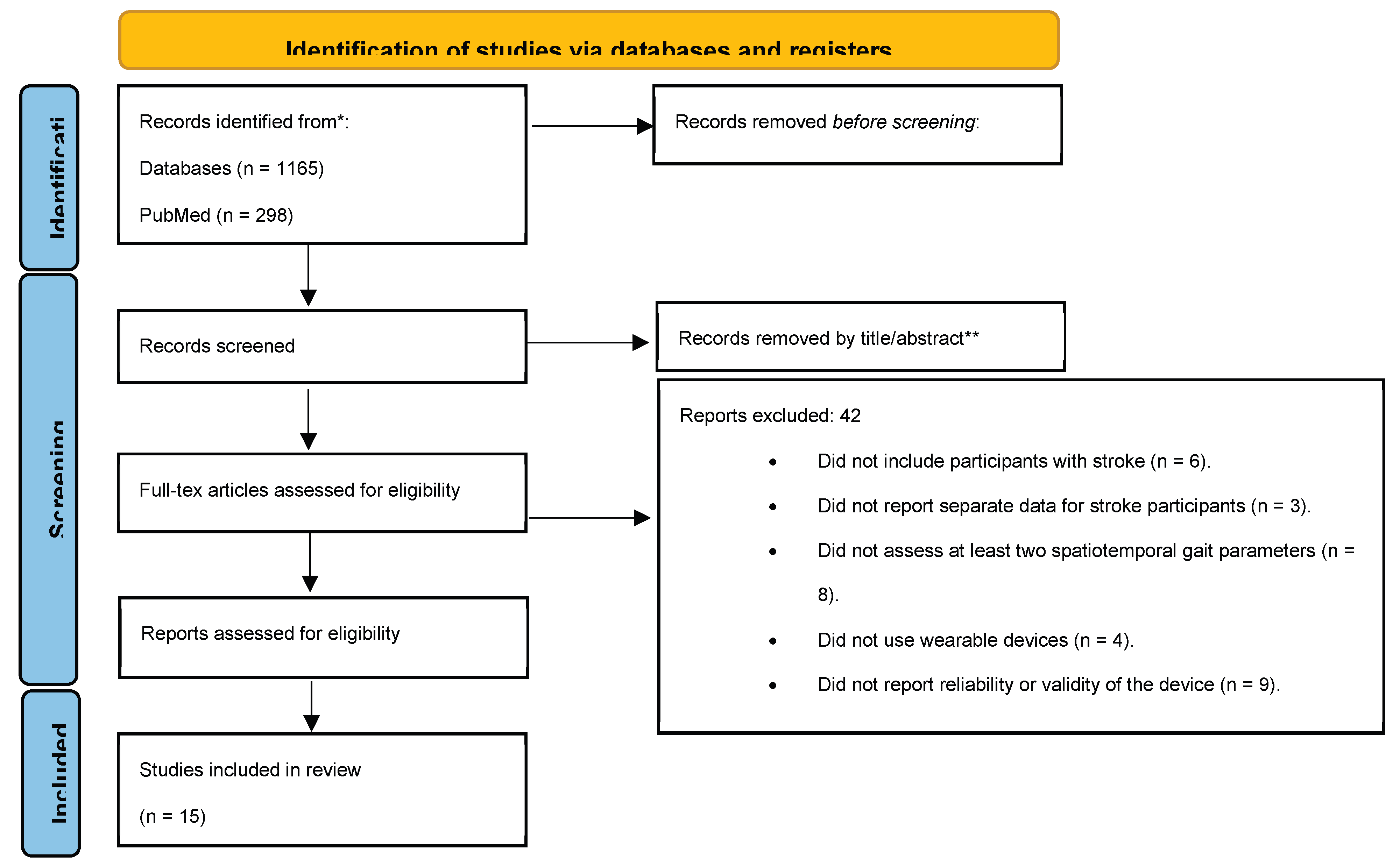
Table 3.
Limits of agreement between the inertial sensor device and the gold standard instrument in raw (original units) and relative to the mean (%) units.
Table 3.
Limits of agreement between the inertial sensor device and the gold standard instrument in raw (original units) and relative to the mean (%) units.
| Authors (Year) | Conditions |
Speed (m/s) |
Cadence (step/min) |
Step Length (m) |
Stride Length (m) |
Step Time (s) |
Stride Time (s) |
Stance Time (s) |
Swing Time (s) |
Double Support (%) |
| 1 SENSOR | ||||||||||
| Punt et al. (2014) – 2MWT (Treadmill) | ||||||||||
| FESTA | CS-15% | 10.23 (11.4%) | 0.08 (17.8%) | |||||||
| CS | 6.45 (6.9%) | 0.06 (12.1%) | ||||||||
| CS+15% | 6.49 (6.7%) | 0.05 (10.4%) | ||||||||
| Moore et al., (2017) – 2MWT (25-m track) | ||||||||||
| AX3 | 0.05 (-----) | 0.30 (-----) | 0.21 (-----) | 0.06 (-----) | 0.21 (-----) | |||||
| Trojaniello et al., (2015) – 1MWT (12-m walkway) | ||||||||||
| OpalTM, APDM | Paretic side | 0.17 (12.52%) | 0.22 (32.91%) | 0.33 (34.66%) | 0.32 (78.88%) | |||||
| Non-paretic side | 0.06 (4.72%) | 0.22 (32.54%) | 0.23 (24.50%) | 0.23 (56.35%) | ||||||
| 2 SENSORS | ||||||||||
| Contreras et al. (2024) – 2MWT (Treadmill) | ||||||||||
| One Stop | with AD | 0.23 (40.3%) | 1.56 (1.9%) | 0.19 (46.4%) | 0.31 (37.3%) | ----- (20.7%) | 11.2 (30.2%) | |||
| without AD | 0.15 (16.3%) | 1.89 (1.8%) | 0.10 (23.6%) | 0.15 (14.4%) | ----- (12.2%) | 6.9 (23.0%) | ||||
| De Miguel-Fernández et al., (2023) – 5MWT (Treadmill) | ||||||||||
| BNO055, Bosch | Paretic side | 0.17 (6.7%) | 0.09 (19.0%) | 0.10 (5.9%) | ----- (9.2%) | ----- (20.7%) | ||||
| Non-paretic side | 0.09 (18.3%) | 0.04 (2.3%) | ----- (9.2%) | ----- (27.9%) | ||||||
| Lefeber et al. (2019) – 10 trials (12-m walkway) | ||||||||||
| Physilog4, S. 10D | Paretic side | 0.10 (14.0%) | 3.21 (3.4%) | 0.12 (12.3%) | 0.08 (9.1%) | 0.08 (15.1%) | 10.5 (32.7%) | |||
| Non-paretic side | 0.05 (6.7%) | 2.82 (3.0%) | 0.04 (4.8%) | 0.19 (19.8%) | 0.19 (42.2%) | 15.4 (47.3%) | ||||
| Lanotte et al., (2024) – 6 trials (10-m walkway) | ||||||||||
| Bionic Pro | 0.36 (------) | 0.40 (------) | 0.52 (------) | 0.45 (------) | 0.70 (-----)* | |||||
| Revi et al. (2021) – 6MWT (26.6-m track) | ||||||||||
| MTw Awinda | Paretic side | 0.08 (-----) | 0.10 (-----) | |||||||
| Non-paretic side | 0.06 (-----) | 0.07 (-----) | ||||||||
| ≥ 3 SENSORS | ||||||||||
| Ensink et al., (2023) – 2MWT (Treadmill) | ||||||||||
| MTw Awinda (4 sen.) | 0.06 (9.5%) | 0.12 (15.1%) | 0.08 (5.5%) | |||||||
| ICC decimal digits have been rounded to two digits. For temporal parameters, ICC values are presented in non-italics or italics when the original units were raw (s) or standardized to the stride time (%). *LoA calculated the absolute time (s); CS = Comfortable Speed; AD = Assistive device; 1MWT: 1-minute walking test; 2MWT: 2-minute walking test; 5MWT: 5-minute walking test; 6MWT: 6-minute walking test. | ||||||||||
Table 4.
Relative agreement between the inertial sensor device and the gold standard instrument assessed through the Intraclass Correlation Coefficient (ICC).
Table 4.
Relative agreement between the inertial sensor device and the gold standard instrument assessed through the Intraclass Correlation Coefficient (ICC).
Table 5.
Absolute test-retest reliability assessed through the minimal detectable change in original units and relative to the mean (%).
Table 5.
Absolute test-retest reliability assessed through the minimal detectable change in original units and relative to the mean (%).
Table 6.
Relative test-retest reliability measured through the Intraclass Correlation Coefficient (ICC).
Table 6.
Relative test-retest reliability measured through the Intraclass Correlation Coefficient (ICC).
Disclaimer/Publisher’s Note: The statements, opinions and data contained in all publications are solely those of the individual author(s) and contributor(s) and not of MDPI and/or the editor(s). MDPI and/or the editor(s) disclaim responsibility for any injury to people or property resulting from any ideas, methods, instructions or products referred to in the content. |
© 2026 by the authors. Licensee MDPI, Basel, Switzerland. This article is an open access article distributed under the terms and conditions of the Creative Commons Attribution (CC BY) license (http://creativecommons.org/licenses/by/4.0/).
Copyright: This open access article is published under a Creative Commons CC BY 4.0 license, which permit the free download, distribution, and reuse, provided that the author and preprint are cited in any reuse.


