

Submitted:
14 January 2026
Posted:
14 January 2026
You are already at the latest version
Abstract
This paper addresses the mind-body problem by highlighting the concept of continuity. Building on philosophical definitions, it introduces an "ontology of continuity" thesis to bridge the mental and the physical. Based on the thesis, the paper introduces a “neuro-subjective interactive (NSI)” model, which incorporates empirical studies from brain science. The model suggests that subjective experiences and neural activities are inter-dependent. Instead of separating between human mentality and its physical base, the paper posits that our mentality is constituted by both physical (neural) and non-physical (subjective) elements. This approach addresses two major challenges in the mind-body problem: causal overdetermination and physical causal closure.
Keywords:
supervenience
; continuity
; panpsychism
; overdetermination
; physicalism
1. Introduction
This paper delves into the ontological nature of the mental and physical. But what is ontology? Broadly, it is understood as the study of being. According to Hofweber (2023), there are “at least two parts to the overall philosophical project of ontology” (Section 3.1). The first one concerns “what there is, what exists, what the stuff of reality is made out of.” The second one involves “what the most general features and relations of these things are.” However, clarifying these two aspects is not an easy task. Hofweber also points out that “[o]ne of the troubles with ontology is that it not only isn’t clear what there is, it also isn’t so clear how to settle questions about what there is.” So, should we abandon this inquiry? Certainly not.
Hofweber argues that the “larger discipline of ontology” involves the “study of ontological commitment, i.e. what we or others are committed to.” Given that the mind-body problem is one of the most intensely debated topics today, it is worth investigating the relationships between the mental and physical by assuming their ontological validity. That is, we need not be led to believe, unlike the ancient Greek philosopher Zeno, that the world is an illusion.
When examining the mind-body problem, we face the fundamental question: what is the nature of the mental, and how does it relate to the physical? In seeking to answer this question, this paper emphasizes the significance of continuity in both mental and physical realms. Specifically, the paper proposes that continuity be viewed as an ontological construct that bridges the two.
To that end, Section 2 introduces key definitions regarding the mind-body problem. Subsequently, Section 3 provides an “ontology of continuity” thesis by comparing physicalism and idealism. Section 4 investigates several features of our mind by referring to several empirical studies. Finally, Section 5 presents a supervenience model that attempts to resolve Jaegwon Kim’s causal overdetermination and causal closure of the physical. Section 6 discusses potential critiques of this paper and also considers other positions in the mind-body problem debate. The conclusion will summarize the paper’s major points and suggest that it offers a meaningful extension to the debate surrounding the mind-body problem.
2. Definitions
Physicalists argue that the mental is ultimately physical. Although “the world might contain many items that at first glance don’t seem physical – items of a biological, or psychological, or moral, or social or mathematical nature,” “at the end of the day such items are physical, or at least bear an important relation to the physical” (Stoljar, 2022, Section 0). The word “physical” sounds intuitive. It can refer to anything that can be perceived through our senses. But how exactly should we define it? According to Ney (2008), “many interpret physicalism as the doctrine that everything is physical, where to be physical is to be countenanced by physics” (p. 1035). However, Hempel (1980) notes that “the physicalistic claim that the language of physics can serve as a unitary language of science is inherently obscure” (p. 194). Why? Physics is constantly evolving, as “it will no doubt undergo further changes” (p. 195). This means that physics is yet incomplete, which suggests that definition of physicalism rests upon an unstable foundation. Considering the difficulty in formulating precise definitions in the mind-body problem, this paper will use conditional statements for definitions. For instance, instead of stating that “The physical is X,” this paper will use the form: “If something is physical, it is X.” See below:
Definitions
(1) If something is physical, it has a spatiotemporal form but has no awareness.
(2) If something is spatiotemporal, it is spatially/temporally continuous.
(3) If something is continuous, it forms its own type of wholeness through connectivity.
(4) If something is spatial, it involves a simultaneous representation of connectivity.
(5) If something is temporal, it involves a successive representation of connectivity.
(6) If something is mental, it has awareness and perceives the spatiotemporal form of the physical.
(7) If something has awareness, it continuously retains its self-identity temporally.
(8) If something focuses on an object, it encounters the otherness of the object.
(9) If something is perceived, the perception begins as awareness occurs to focus on the something as its spatiotemporal form is immediately externalized (i.e., “otherness” is manifested).
Panpsychists may have a different idea about (1). They hold “that everything is conscious, which many find counterintuitive” (Chalmers, 1996, p. 153). Nonetheless, Chalmers claims that “we ought to take the possibility of some sort of panpsychism seriously,” since “there seem to be no knockdown arguments against the view” (p. 299). However, for the sake of discussion, this paper does not accept that all physical matter has a certain form of consciousness on an individual level. Instead, this paper proposes that the universe as a whole may possess a mental element.
Regarding (2), we say that something spatiotemporal is necessarily continuous, for otherwise it can have no significance in the empirical world. If something is spatial, it necessarily occupies space. Everything that occupies space has an extension. Or even a segment within empty space is an extension within it. An extension exhibits internal connectivity. Similarly, if something is temporal, it necessarily has an extension in temporal passage. Anything lacking extension in temporal passage is atemporal.
(3) must be understood with caution. The “continuous” as defined therein differs from the notion of mathematical continuity. It is also unrelated to whether our space or time is seamlessly continuous or gappy. The core feature of continuity is that seemingly isolated features can combine to create a unified whole. For instance, a melody is spatiotemporally continuous as its acoustic wave propagates physically through the air. The crests and troughs of the wave, though they are seen as opposites, constitute one melodious sound. Similarly, two particles of a tangible object, despite their spatial separation, are still the components of the same object. The object’s continuity is demonstrated through the numerous connectivities of such particles that constitute the object. These connectivities are static rather than dynamic. Thus, (4) states that the “spatial” involves a simultaneous representation of connectivity.
Meanwhile, (5) states that the “temporal” involves a successive representation of connectivity. It has a dynamic element. Or it can be thought of as a flow. For example, the motion of an object in our eyes can be interpreted to be a collection of successive snapshots of the same object. Although these snapshots are separated by intervals, they create an impression of oneness in the temporal dimension.
According to (6), mentality has two features: awareness and perception. (7) defines awareness based on the retention of self-identity. But what is “retention”? This is well established in Husserl (1928/1991, pp. 25-29). For instance, by taking the “tone” (sound) as an instance of a “hylectic datum” (i.e., sensory datum), Husserl states: “It begins and ends; and after it has ended, its whole duration-unity, the unity of the whole process in which it begins and ends, ‘recedes’ into the ever more distant past. In this sinking back, I still ‘hold onto it,’ have it in a ‘retention’” (emphasis added, p. 25).
(8) notes that as a subject focuses on an object, it encounters the “otherness” of the object. But why is this definition necessary? During perception, there must be an initial moment when the subject becomes aware of perceiving the object. However, it is hard to exactly define when this perception begins. It must occur on a subliminal level at first. But even if we could pinpoint the biological timing that this subliminal processing begins, it is unclear how much time should pass from that timing. For instance, suppose that the subliminal processing begins at timing “X.” But does this mean that perception begins exactly when the clock hits “X”? Wouldn’t at least some time need to pass after that point for perception to fully occur? Specifically, shouldn’t we say that initial perception occurs over the time span from X to X + ẟ, however small “ẟ” might be? In other words, perception requires that there be a time span rather than an exact singular timing coordinate. Although we cannot be certain about the exact numerical value of ẟ, we can conceptually understand that perception begins as the subject consciously or subconsciously becomes aware of the object’s otherness.
In (9), note that perception begins as awareness “occurs to focus on the something.” In other words, the subject’s perception of the physical may be purely accidental regardless of the subject’s intention. In this sense, the spatiotemporal form of the physical is revealed as external to the subject. This externalization happens because the continuity of its spatiotemporal form is mapped onto the continuity of the subject’s awareness (but not exactly on a one-on-one basis). Subsequently, the perception proceeds as the spatiotemporal form manifests by aligning with the retention held by the awareness. In other words, the image of the spatiotemporally continuous external form is continuously held in a temporal manner.
Based on the nine definitions, let us examine more closely the relationship between the mental and the physical.
3. Ontology of Continuity
If everything is physical, it could exist without the mental. After all, it is logically possible that there is a world where the physical exists but the mental does not. Specifically:
Physicalists’ view:
From a vantage point outside all the conceivable worlds, it is possible that the physical exists without the mental having to exist in those worlds, because the ontology of the physical (whose essence is continuity) is self-sufficient.
However, this view raises one question. Definition (1) states that the physical lacks awareness and has no first-person perspective. Thus, it lacks the self-sufficiency to exhibit its spatiotemporal continuity. So how can it be established that the physical exists in its spatiotemporal form in those worlds? Perhaps, its continuity exists only in potential? To ensure the actual existence of the physical, idealists (who believe that the mental takes ontological precedence over the physical) might respond as follows.
Idealists’ view:
From a vantage point outside all the conceivable worlds, it is possible that the physical exists without the mental having to exist in those worlds, because the continuity of the physical is materialized by the mental that occupies the vantage point. The very fact that the physical may exist on its own is entirely due to the presence of a hypothetical being that stipulates it as such.
In other words, the supposed self-sufficiency of the physical rests upon the metaphysical existence of the mental. This mental must be something greater than our mind. Our mind is finite and cannot capture the full continuity of the physical. Simply put, our perceptions do not fully represent the physical. For instance, our cognitive system filters out much of the available information when observing an object. If it processed every bit of information, this would place a huge load on our brain. That would be inefficient from an evolutionary viewpoint.
But why would physical continuity need to be perceived for the physical to exist? Also, even if there is no being that actually perceives its continuity, this might not matter because the laws of physics fully describe its “continuity” (again, this is not mathematical continuity). For instance, Meillassoux (2008) maintains that “the mathematizable properties of [an] object are exempt from the constraint of a [subject’s] relation [to the world], and that they are effectively in the object in the way in which I conceive them, whether I am in relation with this object or not” (p. 3). Meanwhile, Žižek (2012) notes that “even in the sphere of pure conceptual reasoning, the succession of moves does not work as an atemporal chain of consequences” (p. 629). The laws of physics are expressed through mathematical equations and understood through conceptual reasoning. Without a mental being to engage in such reasoning, why would the equations have to exist? This suggests that the universe may require some form of mental element.
Does this idea sound too mystical? Perhaps, but it may not be far removed from the belief in the self-sufficiency of the physical. In fact, this self-sufficiency can be interpreted as the actualization, through some form of mentality, of its potential to exist in its continuity. Whether or not they agree with this idea, physicalists must admit that their stance is inherently metaphysical.1 In any case, we can argue that continuity, as an ontological construct, connects between the mental and physical. Specifically, the mental perceives the continuity of the physical in its independent form, while the physical exists in its continuity due to the metaphysical presence of the mental. Let us call this an “ontology of continuity” thesis. This will be discussed in the context of the mind-body problem. But before then, we will first examine several empirical studies from brain science.
4. Features of Our Mind
Our mind is believed to have the following features.
(A) The conscious is an immediately present portion of the mind, which experiences “nowness,” during which awareness at the beginning of the nowness is continuously retained, along with the other intermediate occasions of awareness, up to awareness at the end of the nowness.
(B) The subconscious is a non-immediately present portion of the mind, which organizes/modifies/integrates information in the background.
(C) Perception, judgment, and emotion -- which are subjective experiences -- occur on both conscious and subconscious levels, entirely dependent on corresponding neural activities at all times.2
(D) In response to the subjective experiences, another neural activity takes place to encode and store their information in the memory.
(E) The mind differs from artificial intelligence (AI), which continuously appears, from the viewpoint of the conscious, to process information under design rather than processing information based on the sense of continuity.
Let us examine (A) more closely. According to Wang et al. (2015), “temporal perception is implemented in a ‘time window’ of approximately 3 s which we experience as ‘present’” (p. 405). However, 3 seconds is too long to suggest that there is only a single instance of “awareness” within that period. According to Rayner (1998), “[w]hen we read, look at a scene, or search for an object, we continually make eye movements called saccades,” between which “our eyes remain relatively still during fixations for about 200 – 300 ms” (p. 373). When reading a text, “new information is acquired from the text only during fixations” (p. 378). This shows that we experience multiple occasions of awareness in the present moment.
With regard to (B), Luo et al. (2024) note that when the brain is at rest, “the Default Mode Network (DMN) is activated” (p. 1). Specifically, “neural activities such as beta wave rhythm regulation, ‘subconscious’ divergence thinking mode initiation, hippocampal function, and neural replay occur during default mode” (emphasis added, p. 1). Their research suggests that the subconscious portion of our mind works to organize the information learned through conscious training even when we are not working on it.
Now let us turn to (C). When the conscious perceives objects, what parts of the brain work? Rowe et al. (2024) discuss the roles of the prefrontal cortex (PFC) and “posterior cortical areas” (p. 284). Specifically, “[o]ne family of the theories proposes that the PFC is necessary for perception,” while the other “postulates that the PFC is not necessary and that other areas (e.g., posterior cortical areas) are more important for conscious perception” (p. 284). Rowe et al. claim that their observations “provide partial support for both posterior and prefrontal theories of consciousness but do not provide strong support for either on their own” (p. 296). This likely suggests that conscious perception is a distributed process that involves both of them. Additionally, the PFC is known for its crucial role in our conscious judgment-making.
Perception occurs on a subconscious level as well. Dehaene et al. (2006) describe “subliminal processing” as “a condition of information inaccessibility where bottom-up activation is insufficient to trigger a large-scale reverberating state in a global network of neurons with long range axons” (p. 206). Even if some sensory information was received, a person may not be aware of it because the corresponding input was too weak. For instance, if a person is presented with a word but it is immediately “masked” by another visual stimulus (e.g., random letters or shapes), she may not be consciously aware of seeing the word. Nonetheless, it can still be processed at a subliminal level. This indicates subconscious-level perception. Judgment, too, can occur on a subconscious level. Yin and Knowlton (2006) state that “intentional, goal-directed actions” “often proceed automatically, as habitual responses to antecedent stimuli” (p. 464). They note that the “distinct networks involving the basal ganglia are the neural implementations of actions and habits.” The basal ganglia is a crucial organ in the brain that helps to make spontaneous judgments through habits. Although their study focuses on habitual decision-making that bypasses conscious control, it serves as an example of how subconscious judgments are formed.
Regarding (D), the hippocampus plays an important role in remembering subjective experiences. According to Frankland and Bontempi (2005), “the central tenet of most contemporary views of system consolidation” in brain science suggests that “the hippocampus functions as a temporary store for new information, but permanent storage depends on a broadly distributed cortical network” (p. 119). While the PFC is involved in realization of our subjective experiences, the hippocampus stores the neural representations of the subjective content before they are consolidated into long-term memory in the cortex. Meanwhile, the short-term memory that the conscious relies on is called a “working memory.” Baddeley (2003) says, “the concept of working memory proposes that a dedicated system maintains and stores information in the short term, and that this system underlies human thought processes. Current views of working memory involve a central executive” (p. 829). Although the exact mechanism of the working memory is not yet fully understood, the “central executive … is likely to engage multiple brain regions in a functionally coherent network, including dorsolateral prefrontal cortex” (p. 836).
In (E), what does it mean that AI only “continuously appears” to process information? Today, the most prominent AI systems are Large Language Models (LLM). Bender et al. (2021) say: “Contrary to how it may seem when we observe its output, an LM is a system for haphazardly stitching together sequences of linguistic forms it has observed in its vast training data, according to probabilistic information about how they combine, but without any reference to meaning: a stochastic parrot” (pp. 616-617). Yet, skeptics note that the meaning of “meaning” is inherently ambiguous. Also, when considering that human language is fluid and context-dependent, it may be unreasonable to expect LLMs to possess a single, unified understanding of meaning. Moreover, there may be no true “understanding” of meaning. From a purely functional viewpoint, if LLMs perform well enough in real-world tasks, they may have no qualitative difference from human reasoning. In addition, every error they might make could be justified when considering human fallibility.
The power of LLMs is undeniable. Since they have been trained on vast amounts of data (accumulated through collective human efforts) and can connect information at a speed far beyond human capacity, they can provide information or even novel insights that nobody can individually. But they may still fall short of reaching a level of understanding where “retention” takes place. Without retention, there can be no perspective from which to make judgments. Any “first-person perspective” held by LLMs is arguably non-existent. Furthermore, any information synthesis performed on their part may subtly differ from ours because they do not rely on the sense of continuity. This could result in a qualitative difference between their response and ours. But how can this difference be shown?
While discussing a difference between human and machine intelligence, Lee (2024) somewhat abruptly notes that time traveling to the past is “philosophically worth considering, even though it is unlikely to materialize in reality” (p. 21). In his view, “[i]f a human agent in the past received our knowledge of her history (which would be regarded as a form of future knowledge for her), she would generate a non-trivial response to it. However, a machine agent would not be able to” (p. 27). This is only presented as a pure metaphysical possibility, because it violates the principle of causality in physics. Nevertheless, suppose the impossible. Say, the human agent came to know about her future. Then, despite there being no causal link between her distant past and her new found knowledge, she would be able to provide a non-trivial response to it. For example, she might ask: “Whatever action I take right now, was that also predetermined?” (p. 24). This illustrates the continuity of her subjective experience, as she can synthesize her “current” knowledge of her state with the “future” knowledge of her in a continuous way.
On the other hand, AI only operates under a set of specific rules under a mechanical architecture, even if it employs “stochastic” reasoning. Thus, it would be unable to provide a non-trivial response to knowledge of its future. This does not mean that the AI would not respond in a “continuous” way. It certainly could. From a third-person perspective (i.e., our perspective), the way that AI produces its response appears continuous, because the AI is part of the physical. However, AI lacks anything we might call non-physical, e.g., a first-person perspective. As a result, it experiences no continuity in information processing. Accordingly, the content of its potential response would be “obvious,” producing something like “The seminar tires me” (p. 22). Although this metaphysical difference between the two cannot be directly observed in our empirical world, it remains latent in their operational difference.
Next, we will explore the above features in relation to two major challenges in the mind-body problem: causal overdetermination and physical causal closure. Following this, we will discuss two models of our mind that meet this challenge.
5. New Supervenience Model
(1) Causal Overdetermination
John Searle claims that “[m]ental phenomena are caused by neurophysiological processes in the brain and are themselves features of the brain” (Kim, 1995, p. 189). However, Kim counters that it does not provide a “simple solution” to the mind-body problem (p. 189). Kim questions Searle’s rationale for rejecting reductionism while embracing supervenience. But what exactly is supervenience?
Kim (1998) explains: “Mental properties supervene on physical properties, in that necessarily any two things (in the same or different possible worlds) indiscernible in all physical properties are indiscernible in mental respects” (p. 10). This means that there can be no change in the mental unless there is any corresponding change in the physical. The supervenience of “phenomenal properties” on the physical has “nomological necessity” (i.e., necessary by virtue of the natural laws of the universe).
Kim does not believe that one can reject reductionism if she accepts supervenience. His position is based on causal overdetermination. Kim (1995, p. 193) explains it as follows:
Let:
M = mental property
B = biological property
Mental event = instantiation of M = instantiation of B
Assumption: M has causal powers to cause other properties to be instantiated.
Case 1: The property that M can cause to be instantiated is itself a mental property (M*). (Same-level causation)
Case 2: The property that M can cause to be instantiated is a biological property. (Downward causation)
Observations:
M* is also caused by some underlying biological property (B*).
Thus, M* has two distinct sufficient causes (i.e., M and B*).
In other words, M* is causally overdetermined.
Kim (1998) ironically describes this as a “bless[ing] with an overabundance of causes” (p. 43). He highlights that an “antireductive physicalist who wants to remain a mental realist ... must give an account of how the mental cause and the physical cause of one and the same event are related to each other” (p. 37). Since there is no viable solution to this problem, Kim turns to reductive physicalism.3 He observes that “[r]eductive physicalism saves the mental but only as a part of the physical” (p. 120). Ultimately, he concludes: “To think that one can be a serious physicalist and at the same time enjoy the company of things and phenomenon that are nonphysical ... is an idle dream.” Kim does not seem to deny the reality of subjective experience. It is a brute fact that it exists. Qualia (i.e., the “what it feels like” aspect of our subject experience) is undeniable. But why does it exist? Is the mental just an epiphenomenal outcome (i.e., a byproduct of the physical brain with no causal power)? This will be discussed in more detail in the following sub-section.
(2) Neuro-Subjective Interactive (NSI) Model
This paper argues that subjective experience is crucial for generating sophisticated information for the brain. Without subjective experience, the brain would only receive the crudest form of information and fail to acquire complex thinking abilities. As noted earlier, human intelligence is set apart from AI due to its ability to continuously synthesize information to output a high-level judgment. This synthesis is possible only when an agent can retain information up to reaching a final judgment. However, Kim’s core implication is that, since every subjective experience is ultimately neuronal in the physical sense, the brain may work perfectly well without them. But this is not the case. To clarify, let us revisit Features (C) and (D).
According to (C), subjective experience depends entirely on its corresponding neural activity at all times. (D) alleges that another neural activity takes place to encode and store the content of the subjective experience. Previously, we saw that the conscious relies on the “working memory.” For instance, understanding a sentence requires that we retain our understanding of a subject word4 within the sentence until we recognize its predicate. This is impossible without memory.
The implication is that when our conscious is working, it relies on multiple neural processes. Specifically, one type of neural activity generates our subjective experience. Simultaneously, another neural process takes place to carry information about the content of the subjective experience and provide it to the existing neural activity that the subjective experience supervenes on. This interaction enables the sense of awareness. Additionally, information may be retrieved through neural pathways from the long-term memory to inform and guide the current neural activity. These processes establish a feedback loop, which enables the subjective experience to proceed to a subsequent stage while supervening on a corresponding neural activity. This is what the paper refers to as a neuro-subjective interactive (NSI) model. See the figure below.
Figure 1.
Neuro-Subjective Interactive (NSI) Model.
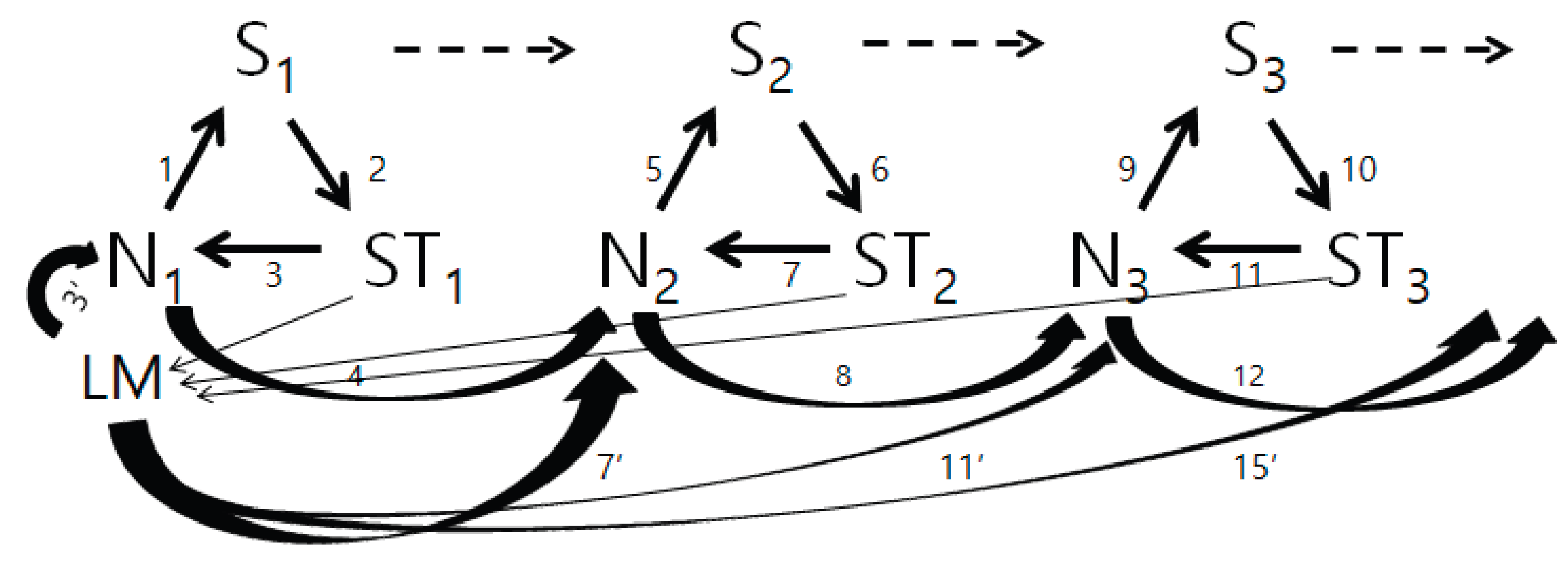
N1, N2, and N3 stand for neural activities that subjective experiences S1, S2, and S3 supervene on. These individual subjective experiences are assumed to be as simplistic as possible. In other words, no single subjective experience constitutes a complex thinking activity that unfolds over a prolonged time.
ST1, ST2, and ST3 represent the short-term memory encoding of S1, S2, and S3. The nature of continuity present within the perception/judgment forming each of S1, S2, and S3 adds sophistication to the information. This information is fed back in short-term neural form to N1, N2, and N3. This helps to retain the sense of awareness.
LM stands for the long-term memory, which also receives the information from ST1, ST2, and ST3. Relevant information may be provided from LM to N1, N2, and N3. This enriches the subjective experiences.
Without the influence of subjective experiences, the pattern of neural activities across the brain, as we understand them today, would look quite different. It is possible that the neural activities are worked out through the mediating role of subjective experiences. These experiences provide sophisticated information to the neural that spontaneous reflexes or AIs cannot. This addresses Kim’s concern that the mental may be epiphenomenal. It also overcomes causal overdetermination.
Conventionally, we assume that the mental entirely supervenes on the physical. This is valid. Yet, the traditional supervenience model may create an impression of a rigid separation between the mental and physical. In contrast, our model considers the subjective experience as a component of the tetrad: N – S – ST – LM. This as a whole constitutes the biological mental. In other words, both the subjective and neural, which are believed to belong in different realms, are the critical components of human mentality (not the mentality assumed by idealists). As such, rather than placing a strict hierarchical distinction between the physical and the mental, the NSI model suggests that our mentality be understood to comprise both the subjective experience and its physical basis. In other words, the brain is a kind of biological information-processing machine that operates through the subjective as well as the neural. Consider the following scenario.
A person sees a pigeon on the street (S1). The perception supervenes on the neural (N1). The perception is immediately encoded in neural form (ST1) and fed back to the neural (N1). This leads to the sense of awareness during which the perception is happening. At the same time, ST1 triggers the long-term memory (LM) to provide related information to the neural (N1). (This triggering process would not have occurred in the same way without the subjective experience (S1), which integrates the sensory input into a continuous spatiotemporal perception of the pigeon.) Due to the triggering, her vague memory of reading a news article on the germs spread by pigeons comes up. This can be either a subconscious process or a process where the memory surfaces on a conscious level. Let us assume that it is subconscious. This subconscious processing can trigger a sense of disgust with the pigeon. Then, it guides the neural (N1) to proceed to a new neural form (N2). Since N2 is an extension from N1, the influence of N1 remains in N2. This retains the sense of continuity from N1 to N2. The new neural (N2) can now generate a subjective experience (S2) of abhorrence of the pigeon. This experience is an emotional one. The abhorrence is transformed into neural information (ST2). Then, this information is fed back to N2, together with information from LM suggesting that it is preferable to create a distance from the object of abhorrence. All of this leads to N3. By supervening on N3, she makes a judgment that she should walk away. As information on this judgment is transferred through ST3 to N3, together with an instruction to run from LT, she may proceed to a subjective state of physically running (i.e., S4 supervening on N4).
As shown above, the NSI model overcomes a limitation of non-reductive physicalism5 (i.e., causal overdetermination) by assigning a “functional” role to the subjective in the context of neural workings. This also naturally resolves a limitation of reductive physicalism propounded by Kim. Reductive physicalism cannot explain the role that the subjective plays within neural processes. But the above model does. That is, the subjective provides information to the neural and influences its activity.
However, the model raises concerns. First, it does not explain how the subjective arises from the physical, nor how the content of subject experiences is encoded into neural form. Second, subjective experiences seem to have only a passive role in the neural processing. They appear to function only as intermediaries.
As for the first concern, note that the principles of supervenience between the biological-chemical-physical are equally elusive. But still, we may try a metaphysical resolution. Section 3 proposed an “ontology of continuity” thesis in order to bridge the mental and physical. This approach shares some sympathy with what Chalmers (1996) calls “psychophysical laws” (p. 127). They specify “how phenomenal (or protophenomenal) properties depend on physical properties.” In addition, they “will not interfere with physical laws; physical laws already form a closed system. Instead, they will be supervenience laws, telling us how experience arises from physical processes.” Since “the dependence of experience on the physical cannot be derived from physical laws, so any final theory must include laws of this variety.” Although the conception of psychophysical laws remains speculative, it provides a tentative holistic framework. The ontology of continuity can provide a basis for the compatibility between the physical and mental. This can justify why psychophysical laws may be possible.
Then, what about the “encoding” process? Empirically, it is well known that events in our lives mold our brain structure. For instance, the deep traumas of war may substantially “rewire” the victims’ brains. However, it is also hard to know what enables this transition from the subjective to the neural encoding. Given the upward and downward6 transitions between the subjective and neurons, we might have to add that they establish a dialectical relationship where one cannot exist without the other.
The second concern is addressed through a derivative version of the NSI model in the next sub-section. However, before illustrating the model, a brief mention should be made on the relationship between perception and awareness. In Definition (9), perception is defined based on awareness. However, in our evolutionary history, it is more likely that perception preceded awareness. The initial rudimentary forms of life on earth most certainly relied on automatic, spontaneous reflexes rather than conscious thinking. This would have provided an evolutionary advantage of quickly detecting prey or avoiding enemies. This cumulative process of building upon the history of sensory experiences likely led to a vague sense of self. As life forms grew more and more sophisticated, along with the development of memory organs, this sense of self would have become more substantial. The perceptive function powered by this sense of self enabled more sophisticated “judgments” for survival. In other words, instead of purely relying on automatic reflexes, they began to develop a more complex understanding of their environmental circumstances through “awareness.” All this culminated in the emergence of homo sapiens, which acquired the ability to engage in reasoning by abstracting from perceptions, powered by both short-term and long-term memories.
(3) NSI Model Simplified
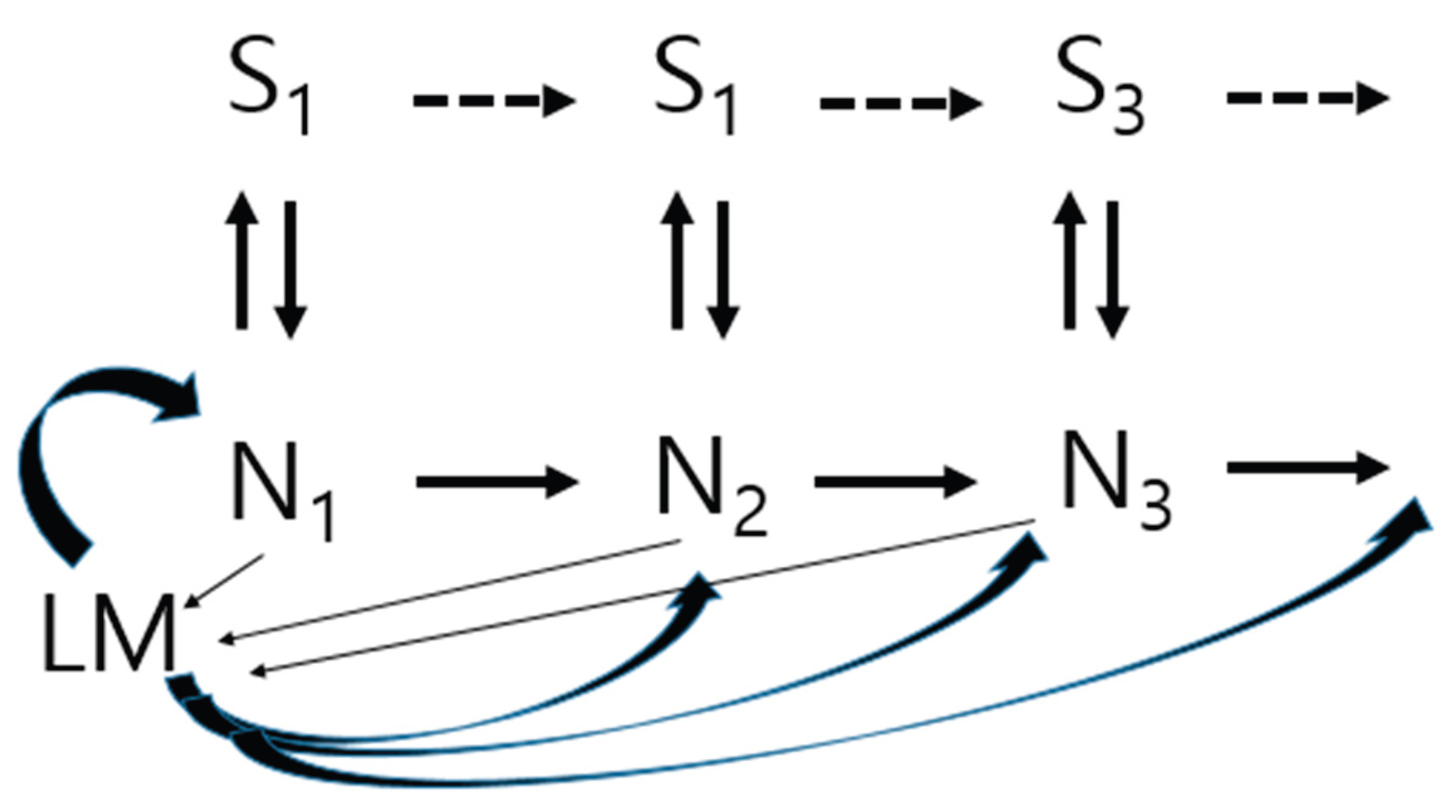
Now, in the NSI model, suppose that the respective time lapses between N1, N2, and N3; and ST1, ST2, and ST3 became incredibly short. Then, it would look like they were almost one and the same. This is illustrated as follows.
In the figure, the subjective proceeds almost in parallel with the neural. Without the neural, the subjective cannot unfold. It is totally dependent on the physical. Meanwhile, the neural would not function in the same way without subjective experiences involved. Therefore, the subjective and neural establish a co-dependent relationship. Specifically, as the respective lapses between N1, N2, and N3; and ST1, ST2, and ST3 become increasingly shorter, along with the diminishing lapses between N1, N2, and N3, the subjective establishes continuity over these discrete processes. This creates a mental experience. Again, this continuity is grounded in the compatibility between the mental and physical assured by the ontology of continuity. It proceeds on its own terms with the neural backing it up at all times. This explanation overcomes, at least partially, the concern that the subjective is merely passive. Although the model as depicted in Figure 2 does not fully illustrate an active, agential aspect of the human psyche, it is somewhat close to it. Its difference from the NSI model lies in approximating the agential aspect of the human mind.
The next section discusses potential critiques of the models and their underlying basis.
6. Potential Critiques and Other Views
(1) Physical Causal Closure
Kim might question the NSI model by invoking “physical causal closure.” Kim (1998) states:
“One way of stating the principle of physical causal closure of the physical domain is this: If you pick any physical event and trace out its causal ancestry or posterity, that will never take you outside the physical domain. That is, no causal chain will take you outside the physical domain. That is, no causal chain will ever cross the boundary between the physical and the nonphysical. … If you reject this principle, you are ipso facto rejecting the in-principle completability of physics -- that is, the possibility of a complete and comprehensive physical theory of all physical phenomena” (p. 40).
Meanwhile, the NSI model posits that the subjective experience, as a non-physical cause, influences, through a subsequent neural representation of the subjective experience, an existing neural activity on which the subjective experience supervenes. Technically speaking, this violates the physical causal closure principle. However, in Section 3, we already discussed a limitation of physicalism. Physicalism cannot justify itself. It does not justify the vantage point from which it is determined that the physical can exist alone in all conceivable worlds. The continuity of the physical cannot be established unless it relies on some form of mental element. When physicists assert that every physical phenomenon should be explained through the laws of physics, who is saying it? Also, physical causal closure is a conceptual tool to be employed when observing physical phenomena. This tool may have limits when applied to explaining our mentality. Similarly, Chalmers (1996) notes: “The laws and causal relations themselves are posited to explain existing physical phenomena, namely the manifold regularities present in nature, whereas consciousness is a brute explanandum” (p. 86).
Admittedly, the brain is a physical entity that is subject to the laws of physics. Nevertheless, our capacity for reasoning demands more explanation than physical laws. Instead of totally subjugating our mentality to the physical realm, it is preferable to take a more holistic view that looks beyond physical causal closure. This is what the NSI model attempts to do.
(2) Other Views
This paper might be criticized for being substance dualist. In the classical sense, substance dualism is Cartesian dualism. It says that the mind and body are separate substances, but direct interaction can be achieved between them. Specifically, Rodrigues (2014) distinguishes between “strong substance dualism” and “moderate substance dualism” (p. 202). The former states that “[s]ouls are immaterial objects whose properties are mental and they are distinct and independent of the body and the brain,” while the latter says that the “souls” are “not independent of the body and the brain.” Rodrigues defines soul as “a capacity for mentality” (p. 205). The NSI model aligns better with the moderate version. Still, there is a subtle difference. The NSI model highlights that both the subjective and the neural are the critical components of our mentality. Then, according to the model, soul should be partially physical. Furthermore, although the model assumes a leap between the subjective and neural, it does not state that our mentality directly interacts with the physical. Its workings are more intricate than naïve substance dualism.
Nevertheless, the ontology of continuity thesis may be dualistic, although it focuses more on compatibility between the two. It stipulates that the physical exists only when the existence of mentality is ensured in a metaphysical sense. This metaphysical notion might be criticized for being unclear. It could mean, roughly, that mentality (such as ours) has the potentiality to emerge7 through a physical means or that the universe as a whole has some form of mentality that our finite mind cannot grasp. This is essentially an idealistic stance.
Meanwhile, libertarianism may be viewed as an idealized version of our second model. “According to libertarian accounts, at least on certain occasions people can be genuinely free agents. This means that sometimes they can be sources of their actions, as opposed to mere witnesses or bystanders of them” (Morales, 2023, p. 6). Unfortunately, the second model does not deliver on its aim to fully illustrate this libertarian notion. As noted earlier, it only approximates the agential aspect of our mind. The NSI model, too, is limited to conceptualizing our mentality as a biological information processing mechanism.
Another interesting view is non-reductive monism. This suggests that the physical is the only fundamental type of substance in the universe. But mental properties do exist. They depend on the physical. Nonetheless, they are not reducible into physical properties. This position is defended by MacDonald & MacDonald (2006). They believe that “mental properties supervene on physical ones” and conclude that the “mental properties … are not themselves constitutive properties of the events …, but rather, supervene on those events’ physical, constitutive properties” (p. 561). In their view, “mental properties of events could be causally relevant to the effects their instancings bring about” (p. 543). But they are not “causally efficacious.” Although their distinction between causal relevance and efficacy may conceptually bypass causal overdetermination, this does not seem to convincingly overcome epiphenomenalism. Their efforts to assign a special characteristic to our mentality end up prioritizing physical causality in order to avoid causing trouble with Kim’s physical causal closure. In contrast, the NSI model adamantly acknowledges subjective experiences’ distinction over the physical while placing them within the context of brain functioning.
Consequently, the NSI model may be viewed as an idealist-influenced revisionary version of non-reductive physicalism. While traditional non-reductive physicalism primarily explains that the mental supervenes on the physical, the model expands on this by describing mentality as a combination of neural (physical) processes and a subjective element that supervenes on part of these processes. Specifically, neural activity functions to construct a coherent picture of the self and the external world in terms of their continuity. It generates a qualitatively different subjective experience through which the existing neural activity is reorganized by referring to itself and being informed on the past by the long-term memory.
7. Conclusions
The major ideas of the paper are summarized below.
(I) Ontology of Continuity
Continuity, as an ontological construct, connects between the mental and the physical, as the mental perceives the continuity of the physical in its independent form, while the physical exists in its continuity due to the metaphysical presence of the mental.
(II) Consciousness
By entirely relying on neural activity, through the consecutive steps of nowness that depend on the short-term memory, the conscious portion of our mind (i) perceives the physical world and (ii) makes judgments by building upon abstractions from the perceptions, while the subconscious dynamically modifies/integrates/organizes the information, which is accumulated through the perceptions and judgments in the long-term memory, in order to feed it back to the conscious when needed.
(III) Neuro-Subjective Interactive (NSI) Model
Subjective experience consistently supervenes on the neural, with its continuity enhancing the complexity of information to be provided to the neural. Specifically, this subjective content is continuously encoded in the short-term memory and fed back to the neural, sustaining the sense of awareness. The information retrieved from long-term memory contributes to the complexity of judgments formed through subjective experience. The compatibility between the subjective and the neural is grounded in the ontology of continuity thesis.
Through the above ideas, the paper sought to overcome physicalism. At the same time, it made efforts to resolve causal overdetermination and physical causal closure. Although the paper’s conceptions do not definitively solve the problems in the contemporary mind-body problem debate, the author hopes that they build a meaningful extension to inspire further thoughts on the issue.
| 1 | Sider (2011) notes that “[t]here is no ametaphysical Archimedean point from which to advance deflationary metametaphysics, since any such metaphysics is committed to at least this much substantive metaphysics: reality lacks a certain sort of structure” (p. i). |
| 2 | All this perception and judgment take place through relevant neural activities. According to Tononi and Koch (2015), the “neural correlates of consciousness (NCC) have been defined as the minimal neural mechanisms that are jointly sufficient for any one conscious percept, thought or memory” (p. 2). “Every experience will have an associated NCC: one for seeing a red patch, another one for hearing a high C.” |
| 3 | This is the view that the mind is ultimately reducible to the physical. Regarding reducibility, Stoljar (2022) states: “Reductionism is true iff for each mental predicate F, there is a physical predicate G such that a sentence of the form ‘x is F iff x is G’ is analytically true” (emphasis added, Section 3.1). Simply put, the mental can be explained fully through a mere conceptual analysis of physical truths. But is it obviously true that the mental logically follows from the physical? We may boldly claim that if that is true, it is only because the physical is what the mental perceives of and abstracts from reality. |
| 4 | Our initial recognition of the subject word occurs as we come to “focus” on it as in Definition (8) in Section 2. That is, we encounter its “otherness.” But when does real comprehension of the subject word begin? It likely begins when information is retrieved from the long-term memory and synthesized with the information from the recognition. The comprehension of the subject word is almost subconscious, as it unfolds spontaneously. |
| 5 | This view says that while mental states are fully dependent on physical states, they cannot be fully reduced to physical states. The distinction between non-reductive physicalism and emergentism is often blurred. For details, see Barnes (2012, pp. 897-899). |
| 6 | The downward transition subtly differs from “downward causation.” Downward causation suggests that higher-level mental phenomena influence lower-level physical processes. Meanwhile, the downward transition is a process where the content of a subjective experience is transformed into neural form to be used by a neural activity that is generating the subjective experience. Thus, in our model, the downward causation is to be understood as a process where N1, N2, and N3 affect themselves through subjective experiences while the long-term memory is influencing them in the background. |
| 7 | A stronger version of this view is shared by Hanna (2006): “Things can exist without existing human persons, and in fact did so for millions of years before we came along. But things could not have existed unless it were really possible for us to come along” (emphasis added) (p. 32). |
References
- Baddeley, A. D. (2003). Working memory: Looking back and looking forward. Nature Reviews Neuroscience, 4(10), 829-839. [CrossRef]
- Barnes, E. (2012). Emergence and fundamentality. Mind, 121(484), 873–902. [CrossRef]
- Bender, E. M., Gebru, T., McMillan-Major, A., & Shmitchell, S. (2021). On the dangers of stochastic parrots: Can language models be too big? Proceedings of the 2021 ACM Conference on Fairness, Accountability, and Transparency (FAccT '21), 610–623. [CrossRef]
- Chalmers, D. J. (1996). The conscious mind: In search of a fundamental theory. Oxford University Press.
- Dehaene, S., Changeux, J. P., Naccache, L., Sackur, J., & Sergent, C. (2006). Conscious, preconscious, and subliminal processing: A testable taxonomy. Trends in Cognitive Sciences, 10(5), 204-211. [CrossRef]
- Frankland, P. W., & Bontempi, B. (2005). The organization of recent and remote memories. Nature Reviews Neuroscience, 6(2), 119–130. [CrossRef]
- Hanna, R. (2006). Kant, science, and human nature. Oxford University Press.
- Hempel, C. G. (1980). Comments on Goodman's Ways of Worldmaking. Synthese, 45(2), 193-199. [CrossRef]
- Husserl, E. (1991). On the Phenomenology of the Consciousness of Internal Time (1893–1917) (J. B. Brough, Trans.). Kluwer Academic Publishers. (Original work published 1928).
- Hofweber, T. (2023). Logic and ontology. In E. N. Zalta & U. Nodelman (Eds.), The Stanford encyclopedia of philosophy (Summer 2023 ed.). Stanford University. https://plato.stanford.edu/archives/sum2023/entries/logic-ontology/.
- Kim, J. (1995). Mental causation in Searle's "biological naturalism." Philosophy and Phenomenological Research, 55(1), 189-194. https://www.jstor.org/stable/2108318.
- Kim, J. (1998). Mind in a physical world: An essay on the mind-body problem and mental causation. The MIT Press.
- Lee, J. J. (2024). Rethinking human and machine intelligence under determinism. PROMETEICA - Revista de Filosofia y Ciencias, 30, 19-27. [CrossRef]
- Luo, W., Liu, B., Tang, Y., Huang, J., & Wu, J. (2024). Rest to promote learning: A brain default mode network perspective. Behavioral Sciences, 14(4), 349. [CrossRef]
- Meillassoux, Q. (2008). After finitude: An essay on the necessity of contingency (R. Brassier, Trans.). Continuum.
- Morales, J. (2023). Emergent agent causation. Synthese, 201, 138. [CrossRef]
- Ney, A. (2008). Defining physicalism. Philosophy Compass, 3(5), 1033-1048. [CrossRef]
- Rayner, K. (1998). Eye movements in reading and information processing: 20 years of research. Psychological Bulletin, 124(3), 372–422. [CrossRef]
- Rodrigues, J. G. (2014). There are no good objections to substance dualism. Philosophy, 89(2), 199–222. [CrossRef]
- Rowe, E. G., Garrido, M. I., & Tsuchiya, N. (2023). Feedforward connectivity patterns from visual areas to the front of the brain contain information about sensory stimuli regardless of awareness or report. Cortex, 172, 284–300. [CrossRef]
- Sider, T. (2011). Writing the book of the world. Oxford University Press.
- Stoljar, D. (2022). Physicalism. In E. N. Zalta (Ed.), The Stanford Encyclopedia of Philosophy (Winter 2022 Edition). Stanford University. https://plato.stanford.edu/entries/physicalism/.
- Tononi, G., & Koch, C. (2015). Consciousness: Here, there and everywhere? Philosophical Transactions of the Royal Society B: Biological Sciences, 370(1668), 20140167. [CrossRef]
- Wang, L., Lin, X., Zhou, B., Pöppel, E., & Bao, Y. (2015). Subjective present: A window of temporal integration indexed by mismatch negativity. Cognitive Processing, 16(4), 405–414. [CrossRef]
- Yin, H. H., & Knowlton, B. J. (2006). The role of the basal ganglia in habit formation. Nature Reviews Neuroscience, 7(6), 464–476. [CrossRef]
- Žižek, S. (2012). Less Than Nothing: Hegel and the Shadow of Dialectical Materialism. Verso.
Disclaimer/Publisher’s Note: The statements, opinions and data contained in all publications are solely those of the individual author(s) and contributor(s) and not of MDPI and/or the editor(s). MDPI and/or the editor(s) disclaim responsibility for any injury to people or property resulting from any ideas, methods, instructions or products referred to in the content. |
© 2026 by the authors. Licensee MDPI, Basel, Switzerland. This article is an open access article distributed under the terms and conditions of the Creative Commons Attribution (CC BY) license (http://creativecommons.org/licenses/by/4.0/).
Copyright: This open access article is published under a Creative Commons CC BY 4.0 license, which permit the free download, distribution, and reuse, provided that the author and preprint are cited in any reuse.