

Submitted:
13 January 2026
Posted:
14 January 2026
You are already at the latest version
Abstract
Background: Sensor-based systems and virtual reality (VR) technologies provide new opportunities for the objective, technology-driven assessment and training of visuo-motor performance in applied contexts such as sport. Methods: This study examined the effects of an integrated visual training program combining stroboscopic stimula-tion, VR-based vergence exercises, and instrumented reaction-light tasks in adolescent handball players. Twenty-eight youth athletes completed two baseline assessments separated by six weeks, followed by a six-session training program integrated into reg-ular team practice. Sensor-derived outcome measures included dynamic accommoda-tive performance, simple and choice visual reaction times, peripheral-field response metrics, binocular alignment, stereoscopic depth perception, and basic oculomotor function. Results: Compared with both baseline measurements, the intervention pro-duced selective improvements in accommodative facility—particularly near–far fo-cusing speed—and in multiple reaction-time conditions involving manual and deci-sion-based responses. Specific peripheral-field locations showed increased response scores, whereas binocular alignment, AC/A ratio, near phoria, and stereoscopic acuity remained unchanged. Conclusions: These findings indicate that technology-supported visual training protocols incorporating sensor-based reaction systems and VR stimuli can be associated with measurable adaptations in dynamic visuomotor processing while preserving fundamental binocular vision parameters.
Keywords:
virtual reality
; sensor-based assessment
; visuomotor performance
; reaction time
; human performance
; sports vision
; stroboscopic training
1. Introduction
Handball is a fast-paced invasion sport in which players must continuously interpret complex visual information to make rapid and accurate decisions. In this context, sensor-based assessment and training technologies offer valuable tools to objectively quantify visuomotor demands and adaptations during performance. Actions such as anticipating an opponent’s movement, locating teammates under pressure, and executing precise passes or shots depend heavily on visual–perceptual processing. Beyond physical conditioning and technical proficiency, perceptual and cognitive demands—particularly those linked to visual processing—are increasingly recognized as key contributors to performance in team sports [1].
Several visual abilities are especially relevant in handball and can be objectively quantified using instrumented systems. Peripheral vision supports spatial awareness and enables players to detect stimuli outside the central visual field, an ability in which handball players often outperform athletes from more visually constrained sports [2]. Reaction speed is equally critical, as players must respond instantly to unexpected passes, defensive rotations, or shooting opportunities. Recent studies have used reaction-light systems and exergame-based platforms to both quantify and enhance these responses under controlled conditions [3,4]. Elite players also show advanced anticipatory behaviour, using subtle visual cues to predict opponents’ actions and make faster, more accurate decisions [5,6]. Collectively, these abilities contribute to visuomotor performance, a determinant of throwing accuracy, interception ability, and overall movement efficiency [7].
Given the importance of these skills, interest in technology-assisted visual training has increased in recent years. Stroboscopic eyewear, which intermittently occludes vision, has been shown to enhance visual pathway efficiency and reduce electrophysiological latencies in handball and other open-skill sports [8]. In addition, research using controlled perturbations of visual input has demonstrated that stroboscopic vision can modify perceptual–motor coupling and facilitate the processing of multiple moving objects, suggesting broader benefits for decision-making under time pressure [9].
Technological tools such as reaction-light systems provide instrumented, time-resolved measures of visuomotor responses, allowing both training and quantitative assessment of reaction performance. Virtual reality (VR) and dichoptic training further enable controlled stimulation of binocular and accommodative functions in standardised and sport-specific environments, offering reproducible conditions for visual training and measurement.
Despite these developments, important gaps remain in literature. Although evidence on visual training effects reported in recent studies is growing, longitudinal data are limited, and few studies have examined whether improvements detected through sensor-derived visual and reaction-time metrics reflect meaningful changes in applied visuomotor performance. Moreover, little is known about how integrated approaches—such as stroboscopic stimulation, VR-based vergence exercises, and field-based reaction tasks—may interact to induce measurable perceptual–motor adaptations in adolescent handball players.
Recent theoretical work has highlighted the value of virtual and augmented environments for developing representative decision-making skills. According to Janssen et al. [10], VR can recreate perceptual conditions that closely resemble those encountered during competition while maintaining experimental control, supporting its use for perceptual–motor training and assessment. This perspective is consistent with earlier applications of VR in sport, which demonstrated that immersive virtual environments allow precise control of visual information and task constraints while preserving key perception–action couplings relevant to performance [11].
Understanding how integrated visual training methods affect key perceptual–motor abilities, as captured by sensor-based outcome measures, is therefore highly relevant for practitioners seeking evidence-based and time-efficient strategies to enhance visuomotor responsiveness in youth handball.
Within this context, sensor-based assessment systems combined with virtual reality environments offer a human-centered approach to quantify and enhance visuomotor and reaction-time processes in applied sports settings.
Accordingly, the aim of this study was to examine the effects of an integrated visual training program incorporating stroboscopic stimulation, VR-based vergence exercises, and instrumented reaction-light tasks on sensor-derived reaction speed and visual performance metrics in youth handball players.
2. Materials and Methods
2.1. Study Design
This study followed a quasi-experimental repeated-measures design including two baseline assessments separated by six weeks, followed by a six-session integrated visual training program. All players served as their own controls by completing two pre-intervention evaluations to account for natural variability in visual and visuomotor measures.
A schematic flow diagram was created to summarize the structure of the study and to improve the clarity of the methodological process. All 28 participants completed two baseline assessments separated by a six-week control period without visual training. After this period, all players underwent a six-session integrated visual-training program combining stroboscopic stimulation, VR-based vergence exercises, and reaction-light drills. A post-training assessment was conducted after the intervention, and all participants were included in the final analysis. The flow of participants and the sequence of procedures are illustrated in Figure 1.
2.2. Participants
Twenty-eight youth handball players from Club Ikasa (Boadilla del Monte, Madrid, Spain) participated in the study. All athletes competed in under-18 categories and had a mean age of 16.85 ± 1.00 years (range: 14.99–18.44). All participants were active federation players with normal or corrected-to-normal visual acuity and no history of ocular pathology. Written informed consent was obtained from parents or legal guardians, and verbal assent was obtained from all participants.
2.3. Ethical Approval
The study was conducted in accordance with the principles of the Declaration of Helsinki and approved by the Research Ethics Committee (CEIm) of Hospital Clínico San Carlos, Madrid, Spain (Approval ID: 23/415-E; date of approval: 28 June 2023). As the study involved minors, written informed consent was obtained from parents or legal guardians, and assent was obtained from all participants. All personal data were processed in accordance with the European General Data Protection Regulation (GDPR, EU 2016/679).
2.4. Baseline Visual Assessment
Before the intervention, all athletes completed a comprehensive visual examination during two training sessions between 18:00 and 21:00. The assessment included:
- Monocular and binocular visual acuity
- Static and dynamic refractive status
- Oculomotor motility assessment
- Binocular vision (phorias, vergence ranges, near point of convergence)
- Accommodative function (facility, amplitude, response)
- Colour vision and contrast sensitivity
- Peripheral visual field screening
- Selected visual–perceptual abilities relevant to handball
After six weeks without exposure to visual training, the full protocol was repeated to establish a second baseline, used as the control comparison for the intervention.
2.5. Training Intervention
The integrated visual training program consisted of six sessions, performed during regular team training, each lasting approximately 15 minutes. Sessions included:
(A) Reaction-light drills (10 minutes per session): Two motor–perceptual exercises were performed using four reaction-light devices positioned 2.95 m from the goal area.
Exercise 1:
Players responded to a sequence of colour stimuli presented on a laptop screen via a custom HTML program. When a coloured circle was displayed (blue, yellow, purple, green, red), the player activated the corresponding reaction-light sensor, then sprinted to perform a throw at the goal quadrant matching that colour. Two facing lines of players alternated activation and throwing actions. Stroboscopic eyewear (Senaptec®, alternating-eye mode, fast duty cycle) was worn by half of the athletes in each repetition.
Exercise 2:
Three reaction-light units were placed equidistantly from the goal. Players were assigned one of two colours, with lights activating in alternating random order. The player holding the ball passed to the first athlete in the opposite line only when the activated light matched the assigned colour, then sprinted to deactivate the sensor. Two versions of this drill were used:
- Version 1: players returned to their original line
- Version 2: players repositioned via the opposite side of the light array
Stroboscopic eyewear was used with an increased occlusion frequency (0.5 s open/0.5 s closed) in alternating sets.
(B) VR-based vergence training (5 minutes per session): The final component employed the Dicopt Home© VR platform to stimulate convergence and divergence. Diplopia difficulty was progressively increased across sessions (levels 1, 3, and 5). Convergence and divergence tasks alternated between sessions to ensure balanced stimulation of binocular function.
2.6. Outcome Measures
Primary outcome:
- Reaction speed (manual/podal reaction time according to the club protocol)
Secondary outcomes:
- Vergence facility
- Near point of convergence
- Accommodative facility
- Contrast sensitivity
- Visual acuity
- Peripheral awareness (where applicable)
All measures were obtained at Baseline 1, Baseline 2 (control), and Post-intervention.
2.7. Statistical Analysis
Descriptive statistics (mean ± SD) were computed for all variables. Normality was examined using the Shapiro–Wilk test. For normally distributed variables (e.g., accommodative facility), paired t-tests were applied. For non-parametric variables, the Wilcoxon signed-rank test was used. Between-group comparisons (strobo vs. non-strobo) employed Mann–Whitney U tests. Statistical significance was set at p < 0.05. Analyses were conducted using SPSS v.27 (IBM Corp., Armonk, NY, USA).
3. Results
Twenty-eight youth handball players completed all evaluations. The sample had a mean age of 16.85 ± 1.00 years (range: 14.99–18.44) and showed normal or corrected-to-normal binocular visual acuity (0.96 ± 0.30). After optical compensation, all players achieved binocular VA ≥ 0.9. Weekly training load averaged 3516.33 ± 1352.99 METs, consistent with competitive youth performance (Table 1).
Stereopsis measured using the Howard–Dolman test fell within normal limits (–4.37 ± 16.32 mm). Hess test values showed no relevant horizontal or torsional deviations (median 0–2 units across positions), and oculomotor performance assessed with the DIVE system demonstrated symmetric fixation, saccadic and pursuit behavior between eyes, consistent with expected norms for this age group.
Accommodation and binocular variables remained stable across the two pre-training evaluations. After the visual training program, a significant improvement in left-eye accommodative facility was observed (mean change 7.50 ± 3.70 cpm; p = 0.03), while no significant change was detected in the right eye. AC/A ratio and near phoria did not differ significantly after the intervention (p > 0.37), indicating that vergence–accommodation coupling and baseline binocular alignment remained stable (Figure 2).
Visual-field performance showed no significant changes during the control period. However, specific peripheral positions demonstrated significant improvement following training (p = 0.043–0.046), suggesting a modest enhancement of functional peripheral awareness. A representative peripheral position (D17) exhibited a significant increase in its peripheral-response score (from 467.89 ± 78.26 to 604.29 ± 95.03; p = 0.046), indicating greater peripheral sensitivity and supporting the interpretation of a small expansion of the useful visual field (Figure 3).
Reaction-time variables showed no differences during the control period. In contrast, the integrated visual training program produced clear improvements in several reaction-time conditions, particularly in manual tasks. The PR21–PR11 condition improved significantly (p = 0.037), and multiple task-specific reaction codes showed highly significant reductions, including T00013–T00003 and T00014–T00004 (both p < 0.001), as well as T00021–T00011 (p = 0.013), T00023–T00013 (p = 0.013) and T00024–T00014 (p < 0.001). These findings indicate a robust enhancement of visuomotor processing speed, especially in manual, decision-based tasks (Figure 4). A summary of the significant reaction-time outcomes is presented in Table 2.
Overall, the integrated stroboscopic, VR-based and reaction-light visual training program produced significant improvements in reaction speed and accommodative facility, while oculomotor function, binocular alignment and basic vergence parameters remained stable. These results suggest a specific effect of the intervention on dynamic visual skills and visuomotor performance relevant to handball.
No adverse events or dropouts were reported during the intervention period. Together, these findings support the effectiveness of an integrated visual training protocol in enhancing reaction performance and selective visual skills in youth handball players.
4. Discussion
The present study demonstrates that an integrated visual training program combining stroboscopic stimulation, virtual reality (VR)–based vergence exercises, and instrumented reaction-light tasks can induce selective improvements in visuomotor performance in youth handball players. Specifically, significant gains were observed in dynamic accommodation, particularly near–far focusing speed, as well as consistent reductions in visual reaction times across both simple and decision-based tasks. In contrast, no meaningful changes were detected in ocular alignment, stereoscopic depth perception, or basic oculomotor function, suggesting that the intervention selectively targeted dynamic visuomotor abilities while preserving fundamental binocular vision parameters.
These findings are consistent with previous research in sports vision training and extend existing evidence by integrating multiple technology-based components within a single program. Prior studies have shown that stroboscopic stimulation can enhance visuomotor processing and reduce response times in open-skill sports. For example, Zwierko et al. [8] reported faster visuomotor responses following stroboscopic training and attributed these effects to increased efficiency of visual information processing. The present results support this interpretation, indicating that intermittent visual occlusion may promote functional adaptations related to rapid visual processing.
Similarly, the improvements in reaction-time performance observed in this study align with the work of Badau et al. [3,4], who demonstrated that training protocols incorporating reaction-light systems and exergame-based tasks can enhance response speed in team sports, including handball. Their findings highlighted the potential of light-based stimuli to improve manual reaction times, reinforcing the role of instrumented systems as effective tools for both training and objective assessment of visuomotor performance.
An important aspect of the present work is that these adaptations were detected using objective, sensor-derived outcome measures, underscoring the sensitivity of instrumented assessment systems to detect selective functional changes, in line with previous evidence supporting the use of wearable and in-field sensor technologies for objective sport performance evaluation [12]. In particular, the increased response scores observed at specific peripheral-field locations suggest enhanced efficiency of peripheral visual processing. Such adaptations may allow players to detect lateral stimuli more effectively without shifting gaze away from the primary focus of action, a critical requirement in fast-paced invasion sports.
These results are in line with previous studies reporting more efficient use of peripheral vision in expert athletes compared with less experienced individuals [13,14]. Effective peripheral perception provides contextual information that supports rapid and situationally appropriate decision-making. Experimental evidence further supports this interpretation. Using multiple object tracking paradigms, Vater et al. [15] showed that participants rely heavily on peripheral vision to detect changes in dynamic environments, reinforcing the importance of peripheral processing in contexts that resemble the demands of team sports.
The observed improvement in accommodative facility may also have relevant functional implications. Faster accommodative responses enable more efficient shifts of visual focus between the ball, teammates, and opponents, facilitating information acquisition under time constraints. When combined with reduced reaction times, these changes may support more fluent visuomotor processing and more effective motor responses. In this regard, Poltavski and Biberdorf [16] reported that athletes with faster reaction times and more efficient focus switching exhibited superior performance, which is consistent with the functional interpretation of the adaptations observed in the present study.
Although the current investigation focused on basic visuomotor abilities, it is plausible that these adaptations provide a functional foundation for higher-level perceptual–cognitive processes, such as anticipation and situational awareness. Elite athletes have been shown to rely on subtle visual cues and rapid scene interpretation to anticipate opponents’ actions and optimize decision-making [5]. While anticipatory skills were not directly assessed in this study, the reductions in reaction time and improvements in peripheral responsiveness observed here may provide a functional basis for the development of such abilities in applied settings.
From an applied perspective, the findings suggest that integrating sensor- and VR-based visual training components into regular practice sessions may represent a feasible strategy to enhance visuomotor responsiveness without increasing physical training load. This approach may be particularly relevant for coaches and practitioners seeking complementary interventions aimed at improving decision speed and visual processing efficiency in youth athletes.
The study presents several methodological strengths. The inclusion of two baseline assessments allowed control for natural variability in visual and visuomotor measures, providing a robust pre-intervention reference. In addition, the integrated training protocol combined multiple technology-assisted components rather than targeting a single visual function in isolation. The use of objective clinical, perceptual, and visuomotor measures enabled a multidimensional evaluation of intervention effects, and embedding the program within regular team training supported its practical applicability.
Several limitations should also be acknowledged. The quasi-experimental design, without an independent randomized control group, limits causal inference, although the dual-baseline approach partially mitigates this constraint. The sample consisted of adolescent players from a single club, which may limit generalizability to other age groups or competitive levels. Moreover, the study did not include direct on-court performance metrics, precluding definitive conclusions regarding the competitive impact of the observed visuomotor improvements.
Future research should incorporate objective on-court performance measures and longitudinal designs to examine the persistence of the adaptations identified here. Combining sensor-based assessment systems, VR technologies, and sport-specific performance metrics may provide a more comprehensive understanding of the potential of integrated visual training approaches in handball and other team sports.
Overall, the present findings indicate that an integrated visual training approach assessed through instrumented measurement systems can produce specific and consistent visuomotor adaptations in youth handball players, supporting the use of sensor-based technologies as valuable tools for applied human performance assessment and development.
5. Conclusions
In conclusion, an integrated visual training program combining stroboscopic stimulation, VR-based vergence exercises, and reaction-light tasks produced selective but meaningful improvements in visuomotor performance among youth handball players. The intervention enhanced dynamic accommodation, manual and choice reaction speed, and peripheral visual awareness, while leaving binocular alignment and basic oculomotor function stable.
These findings indicate that integrated, technology-assisted visual training can effectively target dynamic visual and perceptual–motor skills that are relevant for fast-paced team sports such as handball. Although further studies incorporating longer follow-up periods and objective on-court performance measures are needed, the present results support the use of sensor- and VR-based visual training approaches as practical tools for developing visuomotor performance in adolescent athletes.
Supplementary Materials
The following supporting information can be downloaded at the website of this paper posted on Preprints.org, Supplementary File S1: Ethics Committee approval (CEIm Hospital Clínico San Carlos, Approval ID: 23/415-E); Supplementary File S2: Informed consent forms for parents/legal guardians and adolescent participants.
Author Contributions
Conceptualization, R.B.-V., J.E.C.-S., and F.J.P.-M.; methodology, R.B.-V., J.E.C.-S., and F.J.P.-M.; software, R.B.-V. and J.E.C.-S.; validation, R.B.-V., J.E.C.-S., S.B.-P., and F.J.P.-M.; formal analysis, R.B.-V. and F.J.P.-M.; investigation, R.B.-V., J.E.C.-S., R.G.-J., and C.O.-C.; resources, F.J.P.-M.; data curation, R.B.-V. and R.G.-J.; writing—original draft preparation, R.B.-V. and F.J.P.-M.; writing—review and editing, all authors; visualization, R.B.-V. and J.E.C.-S.; supervision, F.J.P.-M.; project administration, F.J.P.-M.; funding acquisition, not applicable. All authors have read and agreed to the published version of the manuscript.
Funding
Please add: This research received no external funding.
Institutional Review Board Statement
The study was conducted in accordance with the Declaration of Helsinki and approved by the Research Ethics Committee (CEIm) of Hospital Clínico San Carlos, Madrid, Spain (Approval ID: 23/415-E; date of approval: 28 June 2023).
Informed Consent Statement
Informed consent was obtained from all subjects involved in the study.
Data Availability Statement
The data presented in this study are not publicly available due to privacy and ethical restrictions, as they involve sensitive data collected from adolescent participants. Data supporting the findings of this study are available from the corresponding author upon reasonable request and with appropriate ethical approval.
Conflicts of Interest
The authors declare no conflicts of interest.
Abbreviations
The following abbreviations are used in this manuscript:
| AC/A | Accommodative Convergence/Accommodation ratio |
| ANOVA | Analysis of Variance |
| cpm | Cycles per minute (accommodative facility frequency) |
| D17, D65, D86, D154, D192 | Peripheral-field positions evaluated by the visual-field software |
| Hz | Hertz (frequency of stroboscopic stimulation) |
| NPC | Near Point of Convergence |
| NPA | Near Point of Accommodation |
| PPD | Pupillary distance (inter-pupillary distance), if applicable |
| SD | Standard Deviation |
| SPSS | Statistical Package for the Social Sciences |
| UFOV | Useful Field of View |
| VR | Virtual Reality |
References
- Hinz, M.; Lehmann, N.; Aye, N.; Melcher, K.; Tolentino-Castro, J.W.; Wagner, H.; et al. Differences in decision-making behavior between elite and amateur team-handball players in a near-game test situation. Front. Psychol. 2022, 13, 854208. [CrossRef]
- Petro, B.; Lénárt, Á.; Gaál, Z.A.; Kojouharova, P.; Kökény, T.; Ökrös, C.; et al. Automatic detection of peripheral stimuli in shooters and handball players: An event-related potential study. Exp. Brain Res. 2021, 239, 1531–1538. [CrossRef]
- Badau, D.; Badau, A.; Ene-Voiculescu, C.; Larion, A.; Ene-Voiculescu, V.; Mihaila, I.; et al. The impact of implementing an exergame program on the level of reaction time optimization in handball, volleyball, and basketball players. Int. J. Environ. Res. Public Health 2022, 19, 5598. [CrossRef]
- Badau, D.; Stoica, A.M.; Litoi, M.F.; Badau, A.; Duta, D.; Hantau, C.G.; et al. The impact of peripheral vision on manual reaction time using Fitlight technology for handball, basketball and volleyball players. Bioengineering 2023, 10, 697. [CrossRef]
- Mann, D.L.; Schaefers, T.; Cañal-Bruland, R. Action preferences and the anticipation of action outcomes. Acta Psychol. 2014, 152, 1–9. [CrossRef]
- Świdwa, J.; Klatt, S.; Kantanista, A. Gaze behavior and decision-making among handball referees: Exploring gender and expertise differences. PeerJ 2025, 13, e19401. [CrossRef]
- Popowczak, M.; Domaradzki, J.; Rokita, A.; Zwierko, M.; Zwierko, T. Predicting visual-motor performance in a reactive agility task from selected demographic, training, anthropometric, and functional variables in adolescents. Int. J. Environ. Res. Public Health 2020, 17, 5322. [CrossRef]
- Zwierko, M.; Jedziniak, W.; Popowczak, M.; Rokita, A. Effects of a six-week stroboscopic training program on visuomotor reaction speed in goal-directed movements in young volleyball players: A study focusing on agility performance. BMC Sports Sci. Med. Rehabil. 2024, 16, 59. [CrossRef]
- Bennett, S.J.; Hayes, S.J.; Uji, M. Stroboscopic vision when interacting with multiple moving objects: Perturbation is not the same as elimination. Front. Psychol. 2018, 9, 1290. [CrossRef]
- Janssen, T.; Müller, D.; Mann, D.L. From natural towards representative decision making in sports: A framework for decision making in virtual and augmented environments. Sports Med. 2023, 53, 1851–1864. [CrossRef]
- Bideau, B.; Kulpa, R.; Vignais, N.; Brault, S.; Multon, F.; Craig, C. Using virtual reality to analyze sports performance. IEEE Comput. Graph. Appl. 2010, 30, 14–21. [CrossRef]
- Camomilla, V.; Bergamini, E.; Fantozzi, S.; Vannozzi, G. Trends supporting the in-field use of wearable inertial sensors for sport performance evaluation: A systematic review. Sensors 2018, 18, 873. [CrossRef]
- Williams, A.M.; Davids, K. Visual search strategy, selective attention, and expertise in soccer. Res. Q. Exerc. Sport 1998, 69, 111–128. [CrossRef]
- Vítor de Assis, J.; Costa, V.; Casanova, F.; Cardoso, F.; Teoldo, I. Visual search strategy and anticipation in tactical behavior of young soccer players. Sci. Med. Footb. 2021, 5, 158–164. [CrossRef]
- Vater, C.; Kredel, R.; Hossner, E.J. Detecting single-target changes in multiple object tracking: The case of peripheral vision. Atten. Percept. Psychophys. 2016, 78, 1004–1019. [CrossRef]
- Poltavski, D.; Biberdorf, D. The role of visual perception measures used in sports vision programs in predicting actual game performance in Division I collegiate hockey players. J. Sports Sci. 2015, 33, 597–608. [CrossRef]
Figure 1.
Study flow diagram summarizing assessments, control period, training sessions, and final evaluation.
Figure 1.
Study flow diagram summarizing assessments, control period, training sessions, and final evaluation.

Figure 2.
Pre–post change in accommodative facility OI.
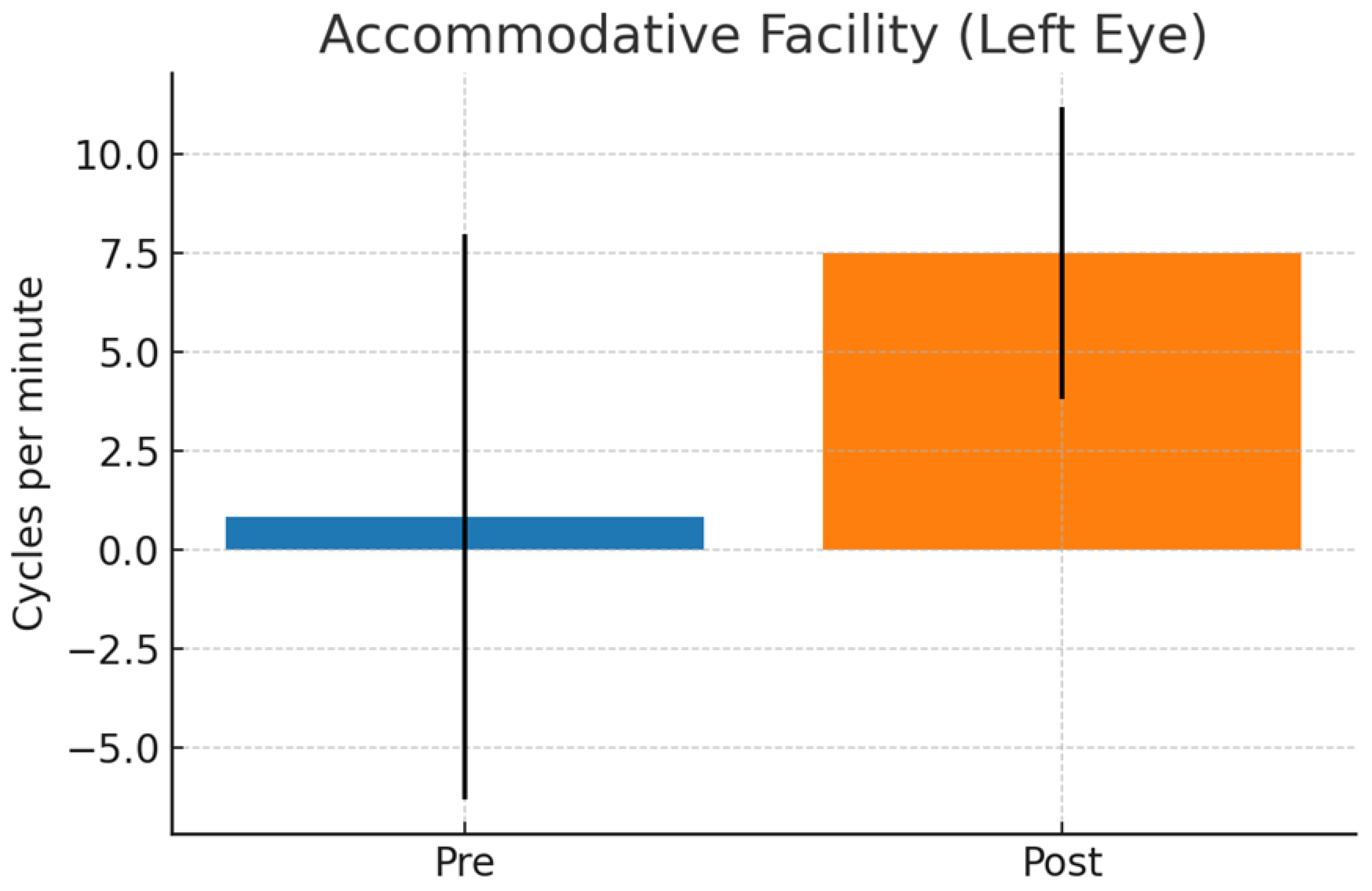
Figure 3.
Visual-field performance at a representative peripheral position (D17). Bars represent the peripheral-response score generated by the assessment software for each condition (Pre and Post). Higher values indicate greater peripheral sensitivity. Error bars represent standard deviations.
Figure 3.
Visual-field performance at a representative peripheral position (D17). Bars represent the peripheral-response score generated by the assessment software for each condition (Pre and Post). Higher values indicate greater peripheral sensitivity. Error bars represent standard deviations.
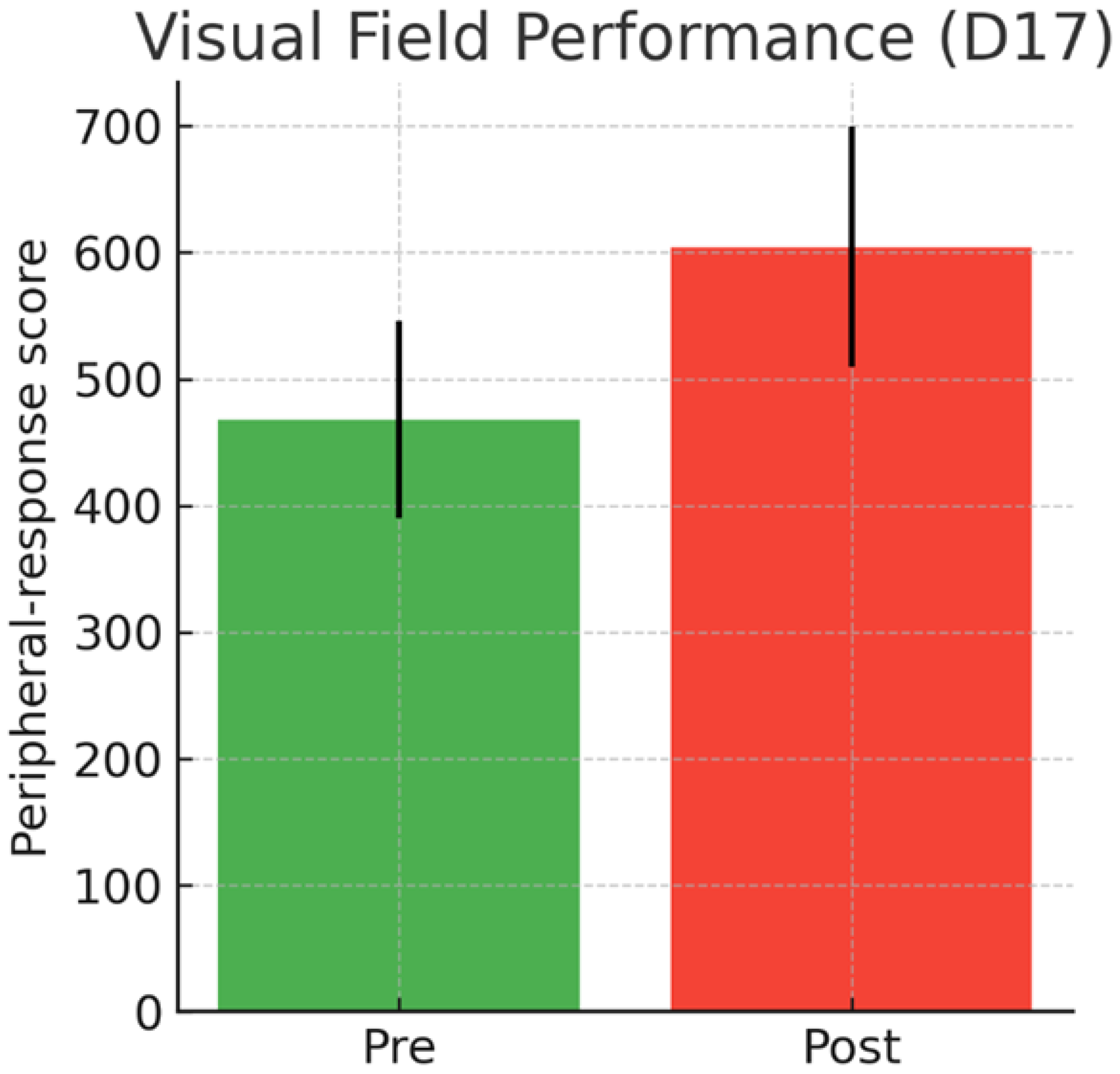
Figure 4.
Elective reaction time (PR21–PR11) before and after the visual training program. Bars represent mean ± SD. A significant decrease was observed after training (p = 0.037), indicating improved visuomotor speed.
Figure 4.
Elective reaction time (PR21–PR11) before and after the visual training program. Bars represent mean ± SD. A significant decrease was observed after training (p = 0.037), indicating improved visuomotor speed.
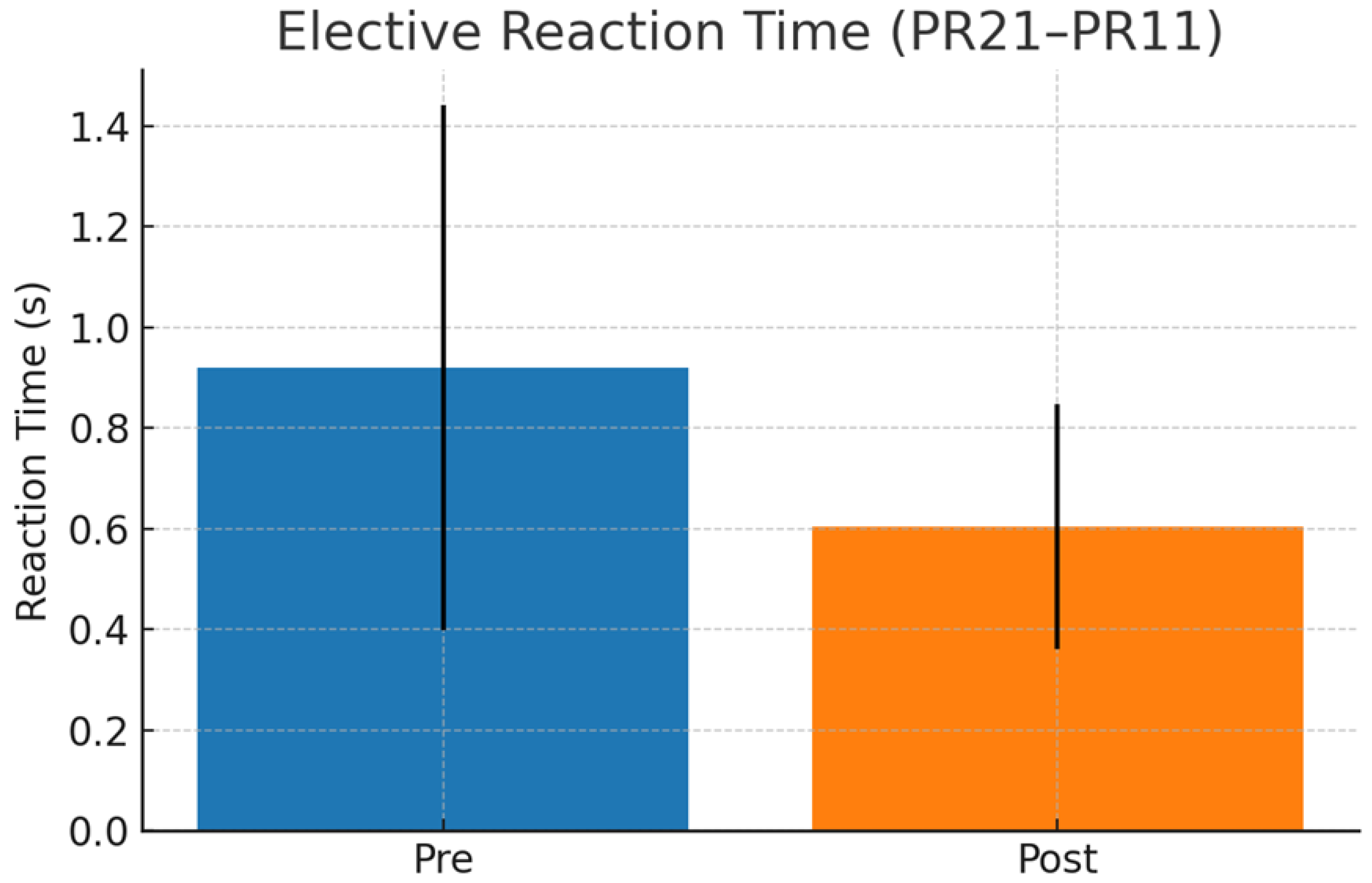

Table 1.
Baseline characteristics of the sample.
| Variable | Mean ± SD/n (%) | Range |
|---|---|---|
| Age (years) | 16.85 ± 1.00 | 14.99 – 18.44 |
| Height (cm) | 179.33 ± 0.67 | Not applicable |
| Body mass (kg) | 65.33 ± 0.88 | Not applicable |
| Weekly training load (METs) | 3516.33 ± 1352.99 | Not applicable |
| Binocular visual acuity (decimal) | 0.96 ± 0.30 | Not applicable |
| Reduced habitual acuity (<0.8) | OD: 21.4% • OS: 28.6% • OU: 21.4% | Not applicable |
| Refractive status (D) | OD: –3.25 to +4.00 • OS: –3.00 to +2.50 | Not applicable |
| Astigmatism (n) | OD: 5 players (–0.50 ± 0.17) • OS: 5 players (–0.90 ± 0.91) | Not applicable |
| Stereopsis (Howard–Dolman, mm) | –4.37 ± 16.32 | –39 to 46 |
Table 2.
Summary of significant reaction-time results.
| Outcome | Control | Training | p-value | Interpretation |
|---|---|---|---|---|
| Left-eye accommodative facility (cpm) | 0.83 ± 7.14 | 7.50 ± 3.70 | 0.03 | Significant improvement after training |
| Right-eye accommodative facility (cpm) | – | No change | >0.05 | Stable |
| AC/A ratio | 1.10 ± 3.99 | 0.33 ± 2.02 | 0.80 | No effect |
| Near phoria (Δ) | 1.64 ± 11.30 | 2.00 ± 3.00 | 0.37 | No effect |
| Visual field (D17) | 467.89 ± 78.26 | 604.29 ± 95.03 | 0.046 | Improved peripheral performance |
| Reaction time PR21–PR11 (ms) | No change | Improved | 0.037 | Faster visuomotor response |
| Reaction time T00013–T00003 (ms) | – | Improved | <0.001 | Strong effect |
| Reaction time T00014–T00004 (ms) | – | Improved | <0.001 | Strong effect |
| Reaction time T00021–T00011 (ms) | – | Improved | 0.013 | Significant |
| Reaction time T00023–T00013 (ms) | – | Improved | 0.013 | Significant |
| Reaction time T00024–T00014 (ms) | – | Improved | <0.001 | Strong effect |
Disclaimer/Publisher’s Note: The statements, opinions and data contained in all publications are solely those of the individual author(s) and contributor(s) and not of MDPI and/or the editor(s). MDPI and/or the editor(s) disclaim responsibility for any injury to people or property resulting from any ideas, methods, instructions or products referred to in the content. |
© 2026 by the authors. Licensee MDPI, Basel, Switzerland. This article is an open access article distributed under the terms and conditions of the Creative Commons Attribution (CC BY) license (http://creativecommons.org/licenses/by/4.0/).
Copyright: This open access article is published under a Creative Commons CC BY 4.0 license, which permit the free download, distribution, and reuse, provided that the author and preprint are cited in any reuse.


