

Submitted:
12 January 2026
Posted:
13 January 2026
You are already at the latest version
Abstract
As demand for EVs (Electric Vehicles), WSNs (Wireless Sensor Networks), and IoT (Internet of Things) devices continues to grow, efficient battery health monitoring has emerged as a critical requirement. Conventional BMS (Battery Management System) designs rely on wired, centralized architectures, which are not only costly and less scalable but also highly prone to operational failures. To mitigate these inherent drawbacks, recent studies have shifted toward exploring wireless, low-power, and contactless alternatives. This paper reviews emerging sensing solutions and machine learning techniques for battery state and health estimation. It also examines WBMS (Wireless Battery Management System) advancements from theoretical frameworks to prototypes, covering health monitoring, cycle/discharge tracking, thermal management, and second-life reuse. Additionally, we discuss integrating techniques including EIS (electrochemical impedance spectroscopy), ultrasonic sensing with IoT systems and advanced machine learning models. Furthermore, it explores innovative diagnostic approaches and highlights algorithmic frameworks for real-time diagnostics. Overall, this work provides a comprehensive view of intelligent, wireless battery monitoring technologies and identifies key challenges and research opportunities for scalable deployment in cyber-physical systems.
Keywords:
battery sensing
; wireless diagnostics
; state of charge
; machine learning
; multi-modal
; second life battery
1. Introduction
The rapid growth of electric vehicles (EVs), unmanned aerial vehicles (UAVs), and grid-scale energy storage has significantly increased global reliance on lithium-ion batteries (LIBs) [89]. In 2023, the EV market alone consumed over 450 GWh of LIBs, with projections exceeding 1.5 TWh by 2030. Similarly, the commercial drone market, expected to reach $54.6 billion by 2030 [92], relies heavily on high-performance batteries to extend flight times. However, battery degradation, manifested as capacity fade, increased internal resistance, and thermal instability, remains a critical challenge that directly impacts safety, efficiency, and operational costs, making robust and real-time battery state monitoring essential to mitigate these risks [95].
Conventional battery health monitoring relies on wired sensors integrated into battery management systems (BMS), which provide real-time measurements of parameters including voltage, current, temperature, and impedance. For example, coulomb counting tracks state of charge (SOC) by integrating current over time [97], while electrochemical impedance spectroscopy (EIS) analyzes frequency-domain responses to diagnose aging mechanisms. Despite their widespread use, these methods face inherent limitations: scalability issues in large-scale deployments (e.g., grid storage with thousands of cells), added complexity from wiring harnesses [98], and limited sensitivity to early-stage degradation, particularly in sealed battery systems. Recent surveys have uncovered that many BMS-related failures stem from sensor or wiring faults [15], underscoring the need for more robust alternatives.
To overcome the limitations of traditional battery monitoring, researchers are developing contactless sensing techniques such as millimeter-wave radar, optical/thermal sensors, and near-field communication (NFC). These systems enable non-intrusive, physically isolated monitoring, enhancing safety by reducing electrical short circuits and thermal hazards while simplifying integration and maintenance. When combined with edge AI and signal processing algorithms, contactless sensing achieves robust real-time SoC and SoH estimation, even under dynamic operating conditions. However, challenges such as environmental sensitivity, sensor alignment, and signal attenuation require careful engineering optimization. The emerging adoption of wireless signal analysis and remote sensing technologies facilitates next-generation monitoring systems that offer enhanced efficiency, scalability, and lower maintenance needs, which proves particularly essential for large-scale energy storage systems (ESS) and physically constrained applications.
Over the past decades, comprehensive reviews on battery monitoring technologies have primarily focused on conventional BMSs, diagnostic algorithms, and data-driven condition assessment models [3]. These surveys, however, have largely overlooked wireless battery sensing technologies, especially their roles in real-time performance tracking, health assessment, and condition monitoring, and even individual studies on related topics suffer from narrow scopes. For example, Cao et al. (2024) examined wireless BMS architectures based on BLE, Zigbee, and NFC (addressing system integration challenges) but failed to explore battery signal acquisition methods or underlying sensing techniques [104]. Li et al. (2019) reviewed data-driven battery health prediction using machine learning, but their analysis was limited to wired sensing, neglecting wireless or embedded solutions for real-world scenarios [8]; Basic et al. (2023) developed an NFC-based wireless battery sensor for EVs and second-life battery (SLB) based applications (emphasizing secure data access and low-power operation) but constrained their study to single-interface implementations without comparing broader sensing approaches [4]; Mohammed (2021) acknowledged wireless monitoring’s potential for adaptive EV charging strategies but did not incorporate real-time sensing technologies into the analysis. These literature reveals a critical research gap: while wireless communication protocols in battery systems and data-driven battery health estimation [112] are well-covered, no comprehensive review links these two domains via wireless battery sensing and often overlook wireless capture/transmission of key physical signals (e.g., acoustic, electromagnetic, temperature, impedance) for continuous contactless battery monitoring [167].
To address this gap, this survey focuses on reviewing contactless sensing technologies in battery monitoring, organizing them into four integrated dimensions that combine classification and performance evaluation. First, we classify these technologies by the types of physical signals detected (e.g., temperature, acoustic, electromagnetic, impedance) and assess their accuracy and reliability for battery health monitoring, directly addressing the overlooked signal-capture gap mentioned earlier. Second, we analyze data processing methods (from local to cloud computing), focusing on their impact on real-time monitoring via latency and responsiveness, which bridges the disconnect between data-driven methods and wireless systems. Third, we examine the integration of machine learning and multimodal sensing techniques, as these enhance data fusion, fault diagnosis, and predictive accuracy, a key link between sensing data and health estimation. Finally, we assess their applicability across environments (EVs, ESS, SLB), considering adaptability to specific requirements, to reflect real-world deployment needs.
We aim to clarify the current research landscape, highlight effective approaches, further identify remaining gaps, and guide future work to improve the accuracy, scalability, and practical deployment of wireless battery monitoring systems. The overview of this survey is illustrated in Figure 1.
2. Contactless Sensing Modalities
Contactless sensing is a key solution for battery health monitoring, solving core limitations of traditional contact-based methods (e.g., wiring complexity, invasiveness, limited access to dense or enclosed packs). These sensing modalities enable real-time, non-invasive detection of battery states (e.g., temperature, state of charge) and early faults (e.g., thermal runaway) by using physical signals including thermal radiation, acoustic waves, and electromagnetic fields that propagate without direct electrical or mechanical contact. We elaborate on three core contactless sensing categories (thermal/environmental, acoustic/vibration, electromagnetic/impedance-based) below (see Figure 2), focusing on their working principles, applications, performance metrics, and challenges.
2.1. Thermal and Environmental Sensing
Recent advances in BMS utilize infrared (IR) and non-contact temperature sensors for early thermal runaway detection in battery packs [14]. IR temperature sensors (e.g., pyroelectric sensor arrays [16]) directly measure surface temperature via emitted infrared radiation, enabling fast, non-invasive identification of overheating cells or hot spots in dense or inaccessible modules. Concurrently, wireless temperature-sensing solutions integrate two functionally distinct core components: non-contact temperature-sensing modules (e.g., IR detectors), a sensing modality that acquires temperature via non-contact signal detection, and wireless data transmission components, which relay the measured data using communication technologies (e.g., passive UHF RFID tags, NFC modules, UWB transceivers). This setup supports flexible sensor placement in battery packs, even wire-inaccessible areas, with IR sensors capturing temperature data and UHF RFID/NFC/UWB enabling wireless data transfer.
The effectiveness of such temperature-sensing solutions relies on two key metrics: high sensitivity and spatial resolution, both critical for effective surface-level temperature monitoring [25]. Detecting subtle temperature changes matters, but so does precisely locating them, especially in dense cell packs where low-resolution sensing misses localized heating or faults. Recent studies stress monitoring accuracy also depends heavily on sensor count and placement in the pack [27]. Thus, distributed high-spatial-resolution sensor arrays enable accurate, real-time mapping of thermal events across cells, ensuring early detection of potential safety risks.
From a broader perspective, thermal and environmental sensing technologies offer distinct advantages for real-world battery packs and enclosures. Their flexible installation and wireless data transmission support multi-sensor deployment in crowded or hard-to-reach areas without adding wiring complexity, boosting scalability and coverage [28]. They also enable non-invasive integration (no wiring or cell modification), further safeguarding battery integrity. Conversely, their performance hinges on careful sensor placement and robust wireless communication, as dense enclosures, metal components, temperature, vibration, and electromagnetic interference can disrupt sensor operation and signal quality. However, studies confirm these contactless solutions excel at enhancing battery safety and reliability when coverage and integration challenges are properly addressed.
2.2. Acoustic and Vibration Sensing
Acoustic emission (AE) and ultrasonic sensing techniques enable early-stage, non-invasive fault detection in electrochemical energy storage systems. In vanadium redox flow batteries (VRBs), pulse-echo methods monitor hydrogen evolution and estimate bubble flow rates [43]. In lithium-ion batteries, MCS sensors detect external short circuits and mechanical vibrations, with high temperature tolerance and deformation capacity. These sensors outperform traditional voltage-current monitoring, especially when integrated with Backscatter Communication (BackCom) for wireless, battery-free operation in sustainable, next-generation IoT systems.
The precise monitoring capabilities of such ultrasonic sensing technologies, in particular, stem from their sensitivity to signal changes inside batteries. Ultrasonic signals travel through battery electrolytes and structural components, revealing disruptions caused by gas formation or mechanical stress [45]. Variations in sound speed indicate changes in material properties, while increased attenuation highlights energy loss from scattering by bubbles or internal defects. These signals help capture critical failure modes such as hydrogen evolution, electrode loosening, or electrolyte delamination issues that are often undetectable by voltage or current measurements alone [46]. Thus, acoustic propagation offers deep insights into both the electrochemical and structural health of batteries.
However, despite these advantages, acoustic sensing technologies still face key challenges when scaled for broader practical use. Acoustic sensing technologies face challenges in signal stability, noise isolation, and bubble detection reliability. In VRBs, attenuation coefficients are more robust than sound speed for tracking SoC and hydrogen generation [43]. Missed detection may occur due to small or adsorbed bubbles, requiring precise sensor integration and configuration. BackCom offers low-power wireless data transmission but depends on stable ambient signals. Future acoustic telemetry systems may combine embedded AI and on-board processors to enhance real-time, autonomous battery health monitoring capabilities [49].
2.3. Electromagnetic and Impedance-Based Sensing
In recent advancements in contactless battery health monitoring, electromagnetic techniques, particularly radio frequency (RF) sensing [70] and electrochemical impedance spectroscopy (EIS) proxies, have gained momentum. These methods operate by detecting subtle perturbations in the electromagnetic field caused by internal changes in battery chemistry or structure. For example, RF backscatter and resonant frequency shifts provide insights into electrolyte degradation and thermal effects. Unlike classical EIS, which traditionally requires direct electrical contact with the target, contactless EIS proxies infer impedance characteristics indirectly through electromagnetic coupling mechanisms such as coupling loops or non-invasive probes: rather than establishing a physical electrical connection to the measured object, they utilize electromagnetic fields generated by the probe or loop to interact with the target, thereby detecting changes in impedance without direct contact. This modification bridges the gap between conventional EIS’s high accuracy and the demand for contactless sensing in scenarios where direct electrical contact is impractical or disruptive, while also reducing the need for invasive wiring and enabling seamless integration into compact and complex battery enclosures (e.g., EV battery packs). The challenge, however, lies in tuning the sensing frequency to balance penetration depth with sensitivity, especially in dense multi-cell configurations.
Within electromagnetic sensing technologies, near-field techniques and probe-based coupling form a practical subset, with unique advantages for specific battery monitoring scenarios. A subset of electromagnetic sensing relies on near-field techniques and probe-based coupling [157]. This approach involves inductive or capacitive coupling to measure voltage and current without direct electrical contact. Contactless Rogowski coils and Hall-effect sensor arrays, for instance, have been demonstrated for real-time current monitoring while maintaining electrical isolation. In multi-layer battery environments, these sensors can be placed near bus bars or conductor paths to retrieve dynamic current profiles. Additionally, integrating near-field signal acquisition with localized data processing (such as FPGA or edge-based microcontrollers) improves the system’s response time. This consistency challenge under varying stresses directly points to a core requirement for all electromagnetic sensing technologies: robustness, which is critical for large-scale industrial use.
Robustness is a decisive factor for the widespread deployment of electromagnetic and impedance-based sensing [167]. Batteries deployed in different environments, ranging from consumer electronics to aerospace, exhibit varied chemical profiles and degradation mechanisms. Consequently, sensor systems must be resilient to EMI, temperature drift, and humidity [77]. Some research proposes adaptive calibration protocols and machine learning-based correction algorithms to tackle these inconsistencies. Comparative studies have shown that impedance proxies retain relatively high accuracy across lithium-ion, lithium-iron-phosphate, and nickel-metal hydride chemistries when properly trained [96]. Nonetheless, reproducibility in field deployments continues to limit industrial uptake, prompting the need for hybrid approaches that combine electromagnetic sensing with auxiliary data streams such as thermal and acoustic signatures.
3. Data Processing for Contactless Sensing
Data processing is the core of reliable contactless battery sensing, determining the system’s responsiveness, scalability and adaptability. To meet diverse demands-from real-time monitoring to long-term health prediction-three interrelated processing paradigms have been developed. This section examines them systematically to form a comprehensive framework for optimizing contactless battery health monitoring, as shown in Figure 3.
3.1. Local and Edge Processing
Microcontroller-based signal processing has emerged as a foundational element in enabling contactless, embedded battery diagnostics, providing the hardware core for localized data handling. In [29], an STM32 microcontroller was used to extract radar features in real time and perform edge AI-based capacity classification while [30] demonstrated its application in distributed, ultra-low-power sensing with embedded ML for local signal analysis. Complementing this, [84] showed an ESP32 platform supporting real-time acquisition and preprocessing of battery parameters before wireless transmission, and [76] explored lightweight fault detection strategies (e.g., threshold-based alerts, statistical filtering) optimized for constrained hardware. Together, these implementations reduce system latency, improve energy efficiency, and lay the groundwork for continuous, external computation-free monitoring, highlighting localized intelligence as a cornerstone of scalable contactless battery health systems.
Building on this microcontroller-enabled embedded processing, edge computing further optimizes contactless monitoring by refining how localized computation interacts with data transmission. It reduces communication burden and power usage by shifting processing closer to the data source: [29] (consistent with its earlier microcontroller work) showed local signal processing/classification on an STM32 cutting data transmission volume, while [88]’s embedded smart sensing only sent critical insights over networks to lower energy costs and preserve bandwidth. [86] extended this with an ESP32 that preprocessed signals and transmitted only essential health indicators, and [87] used on-device lightweight models for selective anomaly detection and data reporting. These advances confirm local processing not only ensures timely diagnostics but also boosts system efficiency-a key advantage that becomes even more critical in safety-critical scenarios like EVs, where the stakes of latency or inefficiency rise sharply.
Several studies address these demands: [91] proposed onboard health monitoring systems to predict failures and assess SoH, mitigating thermal/electrical hazards; [93] introduced clustering algorithms to categorize faults and enhance reliability during dynamic driving; and [103] detailed real-time state estimation models tailored for automotive power batteries under variable loads. Supporting this, [107]’s rapid testing techniques enabled efficient SoH evaluations without sacrificing fault detection accuracy. Collectively, these designs build fault-tolerant EV systems where data-driven diagnostics safeguard passenger safety; embedded analytics and wireless alerts further strengthen onboard decision-making and response times. As EV adoption grows, this integrated tech stack offers a scalable path to safer battery integration across fleets and consumer platforms.
3.2. Cloud-Based and Remote Processing
While edge-based solutions excel at real-time, on-site data handling, they often face limitations in long-term trend analysis and large-scale fleet management–gaps that cloud-based processing frameworks are uniquely positioned to fill. As vital components for long-term battery health prediction, cloud systems offer enhanced scalability, centralized analytics, and real-time decision-making by leveraging advanced computational resources and historical data. By transmitting battery telemetry to the cloud, for instance, systems can refine SoH and Remaining Useful Life estimations [12,119] demonstrates this with an ESP32-based architecture that streams data to the cloud for continuous monitoring and condition-based predictions, while [5] integrates IoT gateways and cloud-hosted machine learning to detect early EV battery degradation. This cloud-centric approach extends beyond automotive use cases: [120] applies it to aquatic battery systems (highlighting centralized data access) and [79] emphasizes its value in fleet-wide comparative analysis and adaptive trend modeling. Critically, cloud frameworks not only reduce onboard processing demands and enable periodic predictive model retraining (boosting long-term accuracy) but also ensure reliability through proper data encryption and access control [118], balancing performance with long-range battery asset visibility.
Yet cloud reliance also exposes a key challenge for contactless battery sensing systems-especially those integrated with wireless and IoT communication: latency, bandwidth limitations, and data reliability issues. As noted in [29], delays in transmitting data to cloud servers can hinder timely decision-making in critical applications, a problem that ties directly to architecture choices for battery health monitoring. Centralized designs (e.g., [12,127]), which push all sensed data to a cloud or central unit, simplify long-term trend analysis but exacerbate latency and communication overhead-particularly for wide-ranging or remote systems. In contrast, distributed approaches (e.g., [128,129]) process signals locally at the sensing source, enabling faster anomaly responses and lighter network loads, but are constrained by embedded devices’ limited memory and computing power (restricting local execution of advanced algorithms). To reconcile these trade-offs, real-world deployments increasingly adopt hybrid architectures: they combine edge-level speed for real-time detection with cloud depth for long-term analytics, tailoring the balance to specific application requirements and system limitations.
3.3. Hybrid Architectures and Real-Time Responsiveness
Hybrid sensing architectures in battery systems employ local microcontrollers for fast, low-power preliminary detection such as identifying bubbles through changes in sound speed or measuring thermal irregularities while offloading intensive tasks like SoC and SoH prediction to cloud platforms [78]. This separation enables real-time responsiveness at the edge and leverages advanced machine learning models (e.g., LSTM-SVR) in the cloud [130]. Cloud services can integrate vast field data and high-resolution signals to model complex degradation behavior more accurately than standalone embedded systems. This division also reduces the computational burden on field devices, enabling lightweight designs and extending their operational lifetimes.
These hybrid systems achieve low-latency and reliable monitoring by combining local responsiveness with remote intelligence. Local MCUs quickly detect anomalies such as acoustic variability from gas bubbles to ensure fast alerts, while the cloud processes time-series trends using algorithms like recursive Gaussian Processes [131]. This dual-tier setup enables near-instant health checks while delivering high prediction accuracy () for SoC and SoH [37]. The result is an architecture that balances speed and accuracy, supporting predictive maintenance and safety. Additionally, the use of spatiotemporal modeling techniques [133] ensures robustness even when edge data is noisy or incomplete.
However, deploying hybrid architectures in real battery systems presents challenges such as power constraints, data communication limits, and system complexity. Edge MCUs must use ultra-low-power components (e.g., 75nA SoC management units) and efficient RF modules to ensure minimal energy consumption [48]. Wireless communication introduces energy overhead and requires topology-aware planning (e.g., star or hybrid networks) [139]. Although cloud offloading reduces local computation, frequent transmission of high-resolution sensor data can strain limited battery resources, requiring intelligent energy-budget-aware scheduling [148]. System designers must carefully balance monitoring accuracy, data granularity, and energy efficiency to enable sustained real-time operation in field conditions.
4. Multimodal Fusion in Contactless Monitoring
Building on the data processing for contactless sensing (which outlined workflows to extract insights from non-invasive sensor data), this section focuses on multimodal fusion to advance contactless battery health monitoring. While standalone contactless sensing and data processing enable basic state estimation (e.g., SoC, SoH), fusing diverse sensor data such as acoustic, thermal, and electromagnetic signals addresses single-signal limitations such as vulnerability to interference or incomplete capture of battery states. As shown in Figure 4, this section is organized into three parts: machine learning for state estimation using processed contactless data, key multimodal fusion techniques and architectures, and implementation challenges (and corresponding solutions) for scaling these systems.
4.1. Machine Learning for State Estimation
Traditional machine learning algorithms and models have been widely adopted for SoC and SoH estimation using non-invasive sensor data. Methods such as Support Vector Machine Classification (SVM), Support Vector Machine Regression (SVR) [39], K-means Clustering, Gaussian Processes [40], and linear and polynomial regressions are frequently employed to capture vital relationships in voltage, current, temperature, and impedance signals. Additionally, recent developments in deep learning models such as Long Short-Term Memory (LSTM) networks [41], autoencoders, Random Vector Functional Link (RVFL) [38], and transfer learning models [32] have demonstrated enhanced accuracy in modeling complex time series and capturing non-linear battery degradation patterns. These models also adapt to diverse conditions and battery types, making them valuable for real-world applications.
The effectiveness of machine learning models for SoC and SoH estimation heavily relies on selecting specific input features extracted from sensor signals. Inputs such as thermal gradients, surface temperature [34], voltage and current curves, acoustic signatures [33], and impedance spectra [35] offer unique insights into battery behavior. For instance, thermal and expansion signals typically indicate localized heating or early cell degradation, while electrochemical impedance [36] and relaxation voltage [60] help capture subtle aging patterns. By mapping and properly selecting these diverse inputs to outputs like SoC or SoH, models can identify and predict degradation patterns that might otherwise remain undetected. This not only helps achieve high accuracy but also enables early fault detection in contactless battery health monitoring.
Although promising, machine learning approaches for contactless battery health monitoring face several implementation barriers [61]. To effectively deploy such systems, high-quality data is required, yet this can be difficult to obtain for diverse battery types and rare failure patterns. Techniques such as transfer learning and domain adaptation help address data scarcity [62], while proper feature selection and multi-modal sensor integration [63] remain critical for robust performance. Moreover, real-world battery packs may present issues with wireless interference, sensor placement, and environmental noise, which can affect data reliability and model accuracy if not suitably addressed. Additionally, while deep learning models excel in complex environments, their explainability is typically more limited compared to traditional methods. Hence, contactless battery health monitoring requires careful system design, training, calibration, and maintenance.
4.2. Multimodal Fusion Techniques
Recent studies present the fusion of acoustic [64], thermal [65], and electromagnetic signals as a key strategy to enhance the robustness of contactless battery health monitoring. By integrating data from expansion, surface temperature, and pyroelectric sensors [66], as well as impedance sensors and electromagnetic techniques (e.g., EIS, RFID, mmWave radar) [70], research demonstrates substantial gains in diagnostic accuracy and early fault detection. Unlike single-signal monitoring where faults like micro-short circuits or local overheating may go undetected, multimodal sensor fusion provides a more comprehensive assessment of batteries’ mechanical and thermal states. This approach directly addresses the limitations of individual sensors (e.g., thermal sensors’ susceptibility to environmental noise) and strengthens the overall reliability of battery monitoring in complex scenarios.
To efficiently integrate the aforementioned multimodal signals, three typical fusion architectures have been widely explored for battery monitoring: early fusion [151], late fusion [69], and attention-based mechanisms [68]. Early fusion combines signals (e.g., acoustic, thermal) at the feature input stage, allowing machine learning models to capture cross-signal correlations (e.g., the link between acoustic emissions and thermal runaway precursors) before prediction—studies show this significantly improves fault detection accuracy [152]. Late fusion, by contrast, merges outputs of separate single-signal models at the decision level; it offers strong robustness when individual signals are inconsistent or partially missing [153], such as when an impedance sensor fails temporarily. Advanced approaches, including autoencoders (for dimensionality reduction and noise filtering [154]) and deep learning models with attention mechanisms, further optimize performance by prioritizing high-value features (e.g., transient voltage fluctuations over steady-state signals), enabling more precise signal integration in practical diagnostics.
The combined strengths of these fusion architectures make multimodal techniques highly reliable for battery diagnostics under variable and challenging conditions. For instance, in electric vehicle (EV) battery packs where temperature swings, vibration, and wireless interference are common, fusing expansion, surface temperature, and impedance signals mitigates the impact of degraded or noisy sensors, maintaining overall output accuracy [153]. Beyond accuracy, these approaches also enable earlier fault detection warnings: for example, fusion of acoustic and thermal signals can identify electrode cracking 2–3 charge cycles earlier than single-modal monitoring. By reducing reliance on individual sensors and bridging complementary signals (e.g., using electromagnetic data to validate thermal anomalies), multimodal fusion ensures consistent, reliable operation even in adverse environments—addressing a critical gap in real-world battery health management.
4.3. Implementation Challenges and Opportunities
The implementation of multimodal fusion based contactless battery health monitoring systems presents several obstacles [155,158], such as sensor calibration, data labeling, and deployment costs, some of which have been mentioned elsewhere. Correct sensor calibration and placement are critical [156], as improper alignment or insufficient/wrong calibration can lead to inaccurate readings and reduced model reliability. Moreover, it is crucial to adequately track inputs and outputs to obtain accurate SoC and SoH estimations from models. However, the need for large, labeled datasets to train ML models poses a challenge [63]: collecting high-quality, labeled battery health data is often difficult, especially for rare failure cases. Lastly, deployment costs remain a barrier, as adding reliable sensors and wireless modules [159] while ensuring secure BMS integration increases system complexity and expenses. Research, however, shows ongoing advances toward compact, cost-effective sensor designs.
When it comes to large battery arrays and diverse applications, scalability remains a central challenge. While wireless and distributed sensor systems enable practical deployment across cells, ensuring reliable data collection and maintaining calibration grow increasingly complex as system size expands. Domain adaptation methods such as transfer learning [160,162] are essential for enabling models to generalize across different battery cells [161], pack configurations, operational environments, and applications. These methods leverage patterns and knowledge from previously trained models, helping mitigate the scarcity of labeled data [163]. Still, achieving robust scalability requires further advancements in sensor integration, data management, and model adaptation.
Looking forward, several promising research directions can address current limitations in contactless battery health monitoring. Self-supervised [164] and semi-supervised [166,168] learning reduce reliance on accurate labeled datasets by using unlabeled or partially labeled data. Federated [165] and distributed learning enable privacy-preserving training and cross-device knowledge sharing, supporting widespread deployment without centralized data. Additionally, advances in multi-modal fusion, adaptive algorithms, and edge computing will boost diagnostic accuracy, robustness, and real-time performance. As research progresses, these technologies should solve key challenges like scalability, data scarcity, and deployment complexity.
5. Application Scenarios and Deployment
Wireless and contactless battery monitoring systems are critical across diverse real-world contexts, each with unique operational constraints, safety demands, and performance requirements. These contexts span EVs’ harsh dynamic environments, grid-scale ESS’ stationary long-duration needs, and second-life batteries’ uncertain reuse. This section examines how these technologies address scenario-specific challenges: for EVs, overcoming EMI, vibration, and space limits while integrating with automotive-grade BMS and safety standards; for second-life reuse, solving health uncertainty, enabling non-invasive maintenance, and scaling WSN deployment; and for stationary ESS, developing diagnostic tools for efficient sorting, triage, and long-term reliability. These analyses highlight contactless sensing’s adaptability and role in safer, more sustainable battery operation across key industry use cases.
5.1. Electric Vehicles
EV battery-health monitoring must operate amid aggressive electrical and mechanical stressors. High-voltage inverters and fast-switching power electronics create broadband interference that can corrupt wireless links; several teams note 2.4 GHz solutions are especially susceptible, motivating alternatives like NFC for short-range, interference-resilient sensor readouts and authenticated pack access [19]. Tight pack packaging and long wiring harnesses introduce galvanic isolation and connector challenges; moving to cell-level sensing (wired or wireless) reduces weakest-cell blind spots but tightens space for antennas, shielding, and thermal isolation. Real-world experiments inside EV packs highlight stringent QoS and deterministic sampling requirements; channel-hopping MACs (e.g., IEEE 802.15.4e/2015 TSCH) mitigate multi-path and external interferers via time-slotting and frequency diversity, improving reliability in noisy enclosures [30]. Mobility brings intermittent backhaul, as IoT/telematics paths (cellular/Wi-Fi) face connectivity gaps, latency, and packet loss, so edge processing, buffering, and store-and-forward become essential [20]. Finally, the thermally active pack demands sensing accurate across steep gradients; thermal management constraints limit redundancy and dictate careful placement and hardening of sensors against shock and vibration, with calibration strategies to suppress drift over a vehicle’s life [24].
The integration of wireless and contactless sensors into automotive battery monitoring offers a promising pathway to overcome EMI, vibration, and space-related challenges in EV packs. Millimeter-wave radar has demonstrated the ability to track lithium battery capacity with high accuracy, enabling real-time state estimation without invasive probes [29]. Similarly, piezoelectric and pyroelectric thin-film sensors provide continuous mapping of thermal and mechanical stress across cell surfaces, maintaining durability during dynamic drive cycles [21]. Wireless thermal monitoring platforms based on passive RFID tags achieve meter-scale readout distances with precise temperature tracking, making them suitable for harsh charging environments [22]. In addition, low-power wireless protocols such as IEEE 802.15.4e/2015 TSCH have been validated for in-pack communication, using frequency hopping and time-slotting to maintain robust links under EMI [30]. Automotive-focused wireless cell sensors further reduce wiring complexity, eliminate galvanic isolation issues, and enable per-cell SoC and SoH estimation [23]. While these advances confirm the viability of contactless sensing, their deployment in production EVs requires co-design with automotive qualification standards to ensure electromagnetic resilience, packaging robustness, and long-term fault tolerance.
The adoption of wireless and contactless sensing in automotive battery management systems introduces complex challenges related to functional reliability and regulatory compliance. Signal integrity and synchronization must be preserved despite the harsh electromagnetic environment of high-voltage inverters and converters, where noise can disrupt deterministic data exchange [30]. The asynchronous behavior of low-power wireless protocols further complicates fault detection, as milliseconds of delay can affect cutoff mechanisms for overcharge, short-circuit, or thermal runaway protection [19]. Ensuring compliance with functional safety standards such as ISO 26262 and electronic component qualifications like AEC-Q100 requires rigorous hardware validation, environmental stress testing, and long-term fault-tolerance strategies [23]. Integration also demands redundant sensing and failsafe firmware logic to keep critical protection features operable even under partial wireless failure [77]. Beyond reliability, interoperability remains a barrier: fragmented data formats and non-uniform communication frameworks hinder seamless deployment across heterogeneous EV platforms [56]. Addressing these issues requires a co-design philosophy where sensors, embedded controllers, and wireless protocols are jointly engineered for resilience, while standardization efforts converge on unified data exchange and qualification practices to ensure safety without sacrificing scalability.
5.2. Second-Life and Reuse Applications
Grid-scale and industrial energy storage systems (ESS) [13], which range from lithium-ion packs to vanadium redox flow batteries (VFBs), require robust monitoring to ensure operational safety, longevity, and reliability across diverse usage scenarios. Factors such as extreme temperatures, frequent cycling, partial discharge events, and hydrogen gas generation in redox chemistries accelerate degradation and introduce operational safety concerns [50]. Second-life EV batteries reused in stationary applications often lack comprehensive monitoring infrastructure, driving demand for lightweight, non-invasive diagnostics and accurate SoH estimation methods [51]. Effective monitoring directly supports grid resilience, decarbonization goals, and the long-duration storage required for high-penetration renewable energy integration across distributed energy networks, as illustrated in Figure 5.
Non-invasive sensing techniques, such as ultrasonic pulse-echo (for gas bubble detection), infrared thermography, and voltage-based machine learning, offer real-time battery health insights without disrupting normal operation or requiring physical teardown. In VFBs, pulse-echo systems reliably predict hydrogen evolution and assess the SoC of anolyte fluids, thereby preventing thermal or pressure-related failures during charging cycles [43]. In lithium-ion systems, acoustic resonance, sample entropy, or entropy-based methods can flag internal short circuits or over-discharge damage before they escalate [52]. These fast, modular diagnostics improve safety, reduce maintenance costs, and enable precise fault localization—a feature especially critical in modular or second-life battery applications deployed in remote locations.
Wireless Sensor Networks (WSNs), built on low-power microcontrollers (MCUs) and mesh protocols, enable scalable, cost-effective battery monitoring in both stationary and mobile ESS applications [54]. Whether deployed in second-life lithium packs, vanadium redox flow batteries, or hybrid microgrids, these networks support distributed sensing, rapid fault alerts, and cloud-based synchronization for historical trend analysis. The study in [55] discusses devices such as ESP32 development boards or Raspberry Pi gateways, which gather voltage, current, acoustic, and temperature data for low-latency real-time remote diagnostics. RESTCONF-based APIs, data compression techniques, and adaptive duty cycling protocols help maximize sensor lifetime and minimize bandwidth, making WSNs ideal for real-time, long-term monitoring in industrial, smart grid, and off-grid storage environments.
5.3. Stationary Energy Storage Systems
Second-life battery applications face a significant challenge of health uncertainty, as their true condition is usually unknown due to missing usage history and unclear degradation mechanisms. This is because second-life batteries often lack extensive measurement and monitoring infrastructure [170]. Without accurate SoH assessments [169], substantial discrepancies can arise between the actual and estimated health of batteries, compromising the safety and performance of repurposed cells. Furthermore, vital health indicators—such as residual capacity, internal resistance, and electrochemical component conditions—are difficult to determine directly in second-life batteries, adding uncertainty to the reuse process and posing barriers to the safety and reliability of reused-battery applications.
Contactless diagnostic methods, such as EIS proxy, multimodal sensor fusion, RFID, and contactless capacity sensing, have gained momentum as tools for rapidly assessing the safety and usability of second-life batteries, enabling the estimation of their SoH and fault detection. Moreover, these technologies allow for the efficient assessment of large numbers of used batteries without the need for disassembly or invasive cell testing [171]. By providing accurate health information and supporting quick safety checks, contactless diagnostics assist in the selection and reuse of batteries, significantly reducing risks and improving the overall efficiency of second-life battery management.
The integration of contactless diagnostic techniques into smart, automated sorting and triage systems enables efficient and reliable management of second-life batteries. These systems ensure that only batteries meeting stringent safety and performance thresholds are repurposed, minimizing the risk of failure in second-life deployments. By rapidly assessing their SoH and safety status, these systems can direct batteries to the most suitable applications or recycling pathways based on their post-use condition [173]. Early-stage, non-invasive SoH assessment [172] facilitates classification and optimizes resource allocation, reducing human error and time-consuming manual labor. Lastly, such smart integration supports scalable and sustainable battery lifecycle management by minimizing waste and maximizing the useful life of each cell.
6. Challenges and Future Direction
6.1. Summary of Findings
This survey synthesizes recent progress in wireless and contactless battery monitoring systems across four central dimensions. First, we examine the multiple physical signals leveraged for state estimation, including temperature (monitored via distributed arrays, surface, and pyroelectric sensors), acoustic signals, mechanical sensing data, electromagnetic methods (such as RFID/NFC), and impedance-based techniques. These physical signals are key for tracking battery health, detecting faults early, preventing thermal runaway, and monitoring aging processes. Second, we analyze data processing strategies ranging from feature extraction and signal fusion to real-time edge and cloud computation, and emphasize their impact on system latency, responsiveness, and accuracy. Third, we highlight the integration of traditional machine learning, deep learning, and multimodal sensing techniques; when combined, these techniques enhance predictive accuracy, enable advanced fault diagnosis, and support adaptive monitoring across diverse conditions. Finally, we assess the applicability of these technologies in real-world scenarios (including EVs, stationary storage, IoT deployments, and second-life battery use), while accounting for specific adaptability requirements and scalability limitations.
Advances in contactless battery monitoring have highlighted promising wireless and passive sensing technologies, such as UHF RFID, NFC modules, and pyroelectric sensor arrays, for scalable, non-invasive monitoring across systems of distinct sizes. Multimodal sensor fusion, which integrates temperature, acoustic, and impedance signals [2], has substantially improved diagnostic accuracy and early fault detection, while also demonstrating a transformative enhancement in SoC estimation across batteries under diverse operating conditions. Furthermore, developments in edge computing and compact sensor design have enhanced real-time analytics and reduced deployment barriers. Nevertheless, persistent challenges include sensor calibration and placement, the collection of high-quality labeled data, system cost, wireless interference, and ensuring model robustness across diverse applications.
Contactless battery monitoring technologies offer significant value in terms of safety, sustainability, and operational efficiency. By enabling early detection of faults and thermal runaway risks through non-invasive, real-time sensing, these systems play a vital role in preventing hazardous incidents and maintaining battery integrity. Moreover, these approaches reduce wiring complexity and physical intrusion, thereby providing more sustainable battery management and facilitating the application of second-life batteries and large-scale energy storage. Additionally, advancements in compact design and scalable deployment enhance efficiency, lower installation costs, and support seamless integration in electric vehicles, stationary energy storage systems, and Internet of Things networks. Collectively, these benefits position contactless monitoring as a disruptive enabler for safer, more sustainable, and more efficient energy systems.
6.2. Research Challenges
Despite notable advancements in wireless and contactless battery monitoring, several technical barriers persist that hinder scalability and real-time reliability as illustrated in Figure 6. Signal quality degradation is a persistent issue, often caused by electromagnetic interference, attenuation, or packet loss—factors that reduce the fidelity of impedance, temperature, or radar-based measurements. Hardware limitations further constrain performance: miniaturized low-cost sensors struggle with limited battery life, restricted sampling resolution, and thermal instability under harsh conditions. These trade-offs are magnified in embedded and vehicular environments, where strict power budgets and compact enclosures limit design flexibility. Data sparsity also remains a core challenge: insufficient failure data, sparse labeling, and short longitudinal records undermine the accuracy of supervised learning and heuristic models [137]. Generalization across domains is still problematic, as transfer learning and adaptation methods remain sensitive to noise and fluctuating operating conditions. Interoperability adds another layer of difficulty, as non-standardized communication protocols and fragmented platforms hinder seamless integration. Addressing these issues requires low-noise sensor design, robust wireless links, and efficient edge analytics to ensure consistent operation. Ultimately, standardized frameworks and richer multimodal datasets are needed to develop trustworthy and scalable health monitoring solutions.
A second major challenge concerns the seamless integration of wireless and contactless health monitoring systems with existing battery management systems (BMS) under strict power constraints [57]. Conventional BMS platforms are designed around deterministic wired interfaces, while wireless modules introduce asynchronous behavior, latency, and packet collisions—issues that complicate fault detection and closed-loop control. The limited power budget of sensor nodes further restricts sampling frequency, signal conditioning, and onboard analytics, particularly in passive or energy-harvested configurations [141]. These limitations are amplified when advanced functions such as edge inference, adaptive calibration, or secure communication are implemented, as they significantly increase duty cycles and reduce operating lifetime [142]. Co-locating wireless modules near high-current buses or DC/DC converters also generates voltage ripple and electromagnetic noise, which can impair stability unless carefully mitigated through isolation and filtering. Additionally, heterogeneous hardware designs and the lack of standardized power interfaces across BMS vendors create compatibility barriers that limit interoperability [59]. Addressing these challenges requires the coordinated co-design of energy-aware architectures that align sensor power profiles, communication schemes, and diagnostic thresholds with existing BMS logic. Such unified integration strategies are essential for balancing accuracy, safety, and longevity in next-generation battery management.
A third major barrier to the large-scale deployment of wireless battery monitoring systems is the lack of standardized frameworks for sensor interfacing, communication protocols, and data representation. Existing solutions frequently rely on proprietary firmware, custom payload structures, and vendor-specific interfaces—factors that restrict reuse across platforms and drive up integration costs. Variations in physical layers, such as Bluetooth Low Energy (BLE), Zigbee, NFC, and IEEE 802.15.4, further complicate interoperability, as differences in packet structures and command-response logic hinder the portability of sensor modules between manufacturers. The absence of harmonized formats for transmitting critical parameters—including State-of-Health (SoH), impedance, and thermal profiles—creates additional challenges when integrating with cloud-based diagnostic platforms or over-the-air update systems. These inconsistencies delay validation and certification processes while limiting the scalability of predictive maintenance strategies and fleet analytics tools. To overcome these issues, collaborative efforts among original equipment manufacturers (OEMs), sensor suppliers, and standards bodies are essential to define unified data exchange formats, modular hardware interfaces, and interoperable middleware layers. Establishing such frameworks would enable plug-and-play deployment, reduce integration overhead, and accelerate the adoption of cross-platform monitoring solutions in next-generation electric vehicle ecosystems.
6.3. Opportunities and Future Work
Emerging advances in MEMS-based sensors, self-powered sensors and flexible electronic platforms are opening new opportunities for non-intrusive, real-time monitoring of battery health in constrained automotive environments [43]. These next-generation sensors can conform to irregular cell geometries while maintaining resilience to thermal stress, vibration, and electromagnetic interference, which ensures reliable signal acquisition [184]. Meanwhile, breakthroughs in machine learning, particularly transformer architectures and multimodal pretraining, enable the fusion of heterogeneous inputs such as impedance spectra, charging curves, and thermal profiles [181]. By leveraging these models, complex degradation pathways can be captured more effectively, even when labeled datasets are sparse or incomplete. This combination of adaptive sensing and data-driven intelligence has the potential to significantly improve the accuracy and robustness of SoH estimation. Looking ahead, such innovations pave the way for self-learning and adaptive monitoring frameworks that can dynamically adjust to evolving operating conditions in EVs.
Advancing wireless and AI-driven battery monitoring requires large-scale field trials to validate sensor reliability under diverse load profiles, thermal environments, and EMI-prone conditions. These trials should generate standardized, high-resolution datasets that capture multimodal signals, including voltage, current, impedance, and thermal responses, across different battery chemistries and degradation states. Such datasets are critical for reproducible research and provide the foundation for robust benchmarking of algorithms and sensor designs. Establishing open benchmarks with clearly defined evaluation protocols for SoH and SoC estimation would enable fair cross-model comparisons and accelerate innovation [131]. To be impactful, these benchmarks must reflect real-world variability and ensure the consistent reporting of data quality, sampling rates, and uncertainty measures. Collaborative initiatives between industry, academia, and standards organizations are vital to coordinate dataset creation, benchmarking, and governance. Collectively, these efforts will create a transparent pathway toward the scalable and certifiable deployment of next-generation battery monitoring systems.
Contactless sensing offers transformative opportunities for future smart battery systems by providing real-time, non-invasive access to parameters such as temperature gradients, strain, and localized impedance. These modalities, including mmWave radar, piezoelectric films, and NFC-based readouts, enable early detection of safety-critical events like internal shorts or thermal runaway precursors. By supporting predictive maintenance, they can reduce downtime, extend operational life, and enhance reliability in EVs and grid-scale storage. Continuous sensing also feeds digital twin models, where virtual replicas forecast performance and degradation under dynamic operating conditions. In connected ecosystems, these data streams integrate seamlessly with cloud-based analytics and over-the-air optimization. Such integration enables adaptive charging strategies, fleet-wide diagnostics, and second-life battery assessments. Ultimately, standardized contactless platforms will become central to autonomous energy management, improving safety, sustainability, and scalability across smart infrastructure.
7. Conclusions
This survey reviews the advancements, challenges, and applications of wireless and contactless battery monitoring, covering physical sensing (thermal, acoustic, electromagnetic), data processing (edge, cloud, hybrid), multimodal AI fusion, and deployments (EVs, second-life batteries, stationary ESS). Key technologies like MEMS sensors, mmWave radar, and transformer models enable non-invasive real-time SoC/SoH monitoring, with multimodal fusion boosting diagnostic robustness; yet barriers persist, including signal interference, hardware power limits, sparse data, and lacking BMS integration standards. Future work should focus on low-power adaptive sensors, open benchmarks and datasets, and scaled field trials, as converging hardware, wireless tech, and AI will make contactless monitoring pivotal for safer, more sustainable battery systems in EVs, grid storage, and other areas.
Nomenclature
| EV | Electrical Vehicles | WSN | Wireless Sensor Networks |
| IoT | Internet of Things | BMS | Battery Management System |
| UAV | Unmanned Aerial Vehicles | WBMS | Wireless Battery Management System |
| LIBs | Lithium-ion Batteries | EIS | Electrochemical Impedance Spectroscopy |
| SOC | State of Charge | SOH | State of Health |
| IR | Infrared | UHF | Ultra High Frequency |
| RFID | Radio-Frequency Identification | NFC | Near Field Communication |
| AE | Acoustic Emission | VRBs | Vanadium Redoxflow Batteries |
| MCS | Micro Control Sensor | BackCom | Backscatter Communication |
| EMI | Electromagnetic Interference | LSTM | Long Short-Term Memory |
| MCU | Micro Control Unit | BLE | Bluetooth Low Energy |
| SLB | Second Life Battery | MAC | Medium Access Control |
| QoS | Quality of Service | ESS | Energy Storage System |
References
- Li, X.; Ye, P.; Li, J.; Liu, Z.; Cao, L.; Wang, F.-Y. From features engineering to scenarios engineering for trustworthy AI: I&I, C&C, and V&V. IEEE Intelligent Systems 2022, 37(4), 18–26. [Google Scholar] [CrossRef]
- Huang, S.; Guo, Y.; Huo, P.; Li, Q. Redefining Vibration Sensing: AI-Driven Analytics, Self-Powered Systems, and Multi-Modal Fusion——A Review. IEEE Sensors Journal. 2025. [Google Scholar] [CrossRef]
- Samanta, A.; Chowdhuri, S.; Williamson, S. S. Machine learning-based data-driven fault detection/diagnosis of lithium-ion battery: A critical review. Electronics 2021, 10(11), 1309. [Google Scholar] [CrossRef]
- Basic, F.; Laube, C. R.; Stratznig, P.; Steger, C.; Kofler, R. Wireless BMS architecture for secure readout in vehicle and second life applications. 2023 8th International Conference on Smart and Sustainable Technologies (SpliTech), 2023; IEEE; pp. 1–6. [Google Scholar]
- Multamäki, M. Near real-time IoT data pipeline architectures. Master’s thesis, M. Multamäki, 2024. [Google Scholar]
- Gozuoglu, A. IoT-enhanced battery management system for real-time SoC and SoH monitoring using STM32-based programmable electronic load. Internet of Things 2025, 30, 101509. [Google Scholar] [CrossRef]
- Mohammed, S. A. Q.; Jung, J.-W. A comprehensive state-of-the-art review of wired/wireless charging technologies for battery electric vehicles: Classification/common topologies/future research issues. IEEE Access 2021, 9, 19572–19585. [Google Scholar] [CrossRef]
- Li, Y.; Liu, K.; Foley, A. M.; Zülke, A.; Berecibar, M.; Nanini-Maury, E.; Van Mierlo, J.; Hoster, H. E. Data-driven health estimation and lifetime prediction of lithium-ion batteries: A review. Renewable and Sustainable Energy Reviews 2019, 113, 109254. [Google Scholar] [CrossRef]
- Basic, E.; Sarajlic, E.; Hadzialic, M. NFC-Based Wireless Sensor for EV Battery Monitoring: Secure Data Access and Low-Power Operation. In Proceedings of the 15th International Conference on Wireless and Mobile Communications, 2023; pp. 89–96. [Google Scholar] [CrossRef]
- Cao, Z.; Gao, W.; Fu, Y.; Mi, C. Wireless battery management systems: innovations, challenges, and future perspectives. Energies 2024, 17(13), 3277. [Google Scholar] [CrossRef]
- Lee, D.; Cho, S.; Ryu, H.; Pu, Y.; Yoo, S.-S.; Lee, M.; Hwang, K. C.; Yang, Y.; Lee, K.-Y. A Highly linear, AEC-Q100 compliant signal conditioning ic for automotive piezo-resistive pressure sensors. IEEE Transactions on Industrial Electronics 2018, 65(9), 7363–7373. [Google Scholar] [CrossRef]
- Gou, B.; Xu, Y.; Feng, X. State-of-health estimation and remaining-useful-life prediction for lithium-ion battery using a hybrid data-driven method. IEEE Transactions on Vehicular Technology 2020, 69(10), 10854–10867. [Google Scholar] [CrossRef]
- Saini, P.; Gidwani, L. An investigation for battery energy storage system installation with renewable energy resources in distribution system by considering residential, commercial and industrial load models. Journal of Energy Storage 2022, 45, 103493. [Google Scholar] [CrossRef]
- Tran, M.-K.; Mevawalla, A.; Aziz, A.; Panchal, S.; Xie, Y.; Fowler, M. A review of Lithium-Ion Battery Thermal runaway modeling and diagnosis Approaches. Processes 2022, 10(6), 1192. [Google Scholar] [CrossRef]
- Le Gall, G.; Montavont, N.; Papadopoulos, G. Z. Enabling IEEE 802.15.4-2015 TSCH based Wireless Network for Electric Vehicle Battery Management. 2020 IEEE Symposium on Computers and Communications (ISCC), 2020; pp. 1–6. [Google Scholar] [CrossRef]
- Zhang, D.; Wu, H.; Bowen, C. R.; Yang, Y. Recent advances in pyroelectric materials and applications. Small 2021, 17(51). [Google Scholar] [CrossRef]
- Benouakta, S.; Hutu, F.; Duroc, Y. Passive UHF RFID Yarn For Temperature Sensing Applications. 2021 IEEE International Conference on RFID Technology and Applications (RFID-TA), 2021; pp. 13–15. [Google Scholar] [CrossRef]
- Liu, Y.; Ouyang, C.; Wang, Z.; Xu, J.; Mu, X.; Swindlehurst, A. L. Near-Field Communications: A Comprehensive Survey. IEEE Communications Surveys & Tutorials 2025, 27(3), 1687–1728. [Google Scholar] [CrossRef]
- Basic, F.; Gaertner, M.; Steger, C. Secure and trustworthy NFC-Based sensor readout for battery packs in battery management systems. IEEE Journal of Radio Frequency Identification 2022, 6, 637–648. [Google Scholar] [CrossRef]
- Mohammadi, F.; Rashidzadeh, R. An overview of IoT-enabled monitoring and control systems for electric vehicles. IEEE Instrumentation & Measurement Magazine 2021, 24(3), 91–97. [Google Scholar]
- Hu, X.; Jiang, Z.; Yan, L.; Yang, G.; Xie, J.; Liu, S.; Zhang, Q.; Xiang, Y.; Min, H.; Peng, X. Real-time visualized battery health monitoring sensor with piezoelectric/pyroelectric poly (vinylidene fluoride-trifluoroethylene) and thin film transistor array by in-situ poling. Journal of Power Sources 2020, 467, 228367. [Google Scholar] [CrossRef]
- Wang, B.; Fernandez, J. H.; Massoud, A. A wireless battery temperature monitoring system for electric vehicle charging. 2019 IEEE SENSORS, 2019; IEEE; pp. 1–4. [Google Scholar]
- Schneider, M.; Ilgin, S.; Jegenhorst, N.; Kube, R.; Püttjer, S.; Riemschneider, K.-R.; Vollmer, J. Automotive battery monitoring by wireless cell sensors. 2012 IEEE International Instrumentation and Measurement Technology Conference Proceedings, 2012; IEEE; pp. 816–820. [Google Scholar]
- Jape, V.; Deore, M.; Kulkarni, H.; Chaphekar, S.; Patel, P.; Jadhav, S. Monitoring the Battery Health in Electric Vehicles through IOT. 2024 International Conference on Intelligent Systems and Advanced Applications (ICISAA), 2024; IEEE; pp. 1–5. [Google Scholar]
- Bücher, T.; Drummer, D.; Kúdelka, S.; Fink, A. Printed temperature sensor array for high-resolution thermal mapping. Scientific Reports 2022, 12(1), 14747. [Google Scholar] [CrossRef]
- Kafadarova, V.; Malcheva, B.; Yanev, Y.; Kunev, V. A system for determining the surface temperature of batteries by means of infrared thermography. Batteries 2023, 9(10), 519. [Google Scholar] [CrossRef]
- Deshpande, V. M.; Bhattacharya, R.; Subbarao, K. Sensor Placement With Optimal Precision for Temperature Estimation of Battery Systems. IEEE Control Systems Letters 2022, 6, 1082–1087. [Google Scholar] [CrossRef]
- Gao, X.; Lai, X.; Lin, X. Temperature Sensor Deployment for Scalable Battery Packs. ASME 2020 Dynamic Systems and Control Conference (p. V003T13A012), 2020; American Society of Mechanical Engineers. [Google Scholar] [CrossRef]
- An, D.; Chen, Y. Q. A miniature millimeter-wave radar based contactless lithium polymer battery capacity sensing with edge artificial intelligence. 2022 18th IEEE/ASME International Conference on Mechatronic and Embedded Systems and Applications (MESA), 2022; IEEE; pp. 1–6. [Google Scholar]
- Le Gall, G.; Montavont, N.; Papadopoulos, G. Z. Enabling IEEE 802.15.4-2015 TSCH based wireless network for electric vehicle battery management. 2020 IEEE symposium on computers and communications (ISCC), 2020; IEEE; pp. 1–6. [Google Scholar]
- Cao, Z.; Gao, W.; Fu, Y.; Mi, C. Wireless Battery Management Systems: Innovations, Challenges, and Future Perspectives. Energies 2024, 17(13), 3471. [Google Scholar] [CrossRef]
- Amogne, ZE; et al. Transfer Learning Based on Transferability Measures for SOH Estimation of Lithium-Ion Batteries. Batteries 2023, 9(5), 280. [Google Scholar] [CrossRef]
- Hoq, M.; et al. Correlation of acoustic emission signatures with internal changes in lithium-ion batteries. Journal of Energy Storage (in press / early access) 2025. [Google Scholar] [CrossRef]
- Xu, L.; et al. Surface Temperature Assisted State of Charge Estimation Based on Infrared Thermal Imaging and GRU Model. Sensors 2025, 25(15), 4863. [Google Scholar] [CrossRef]
- Al-Smadi, M. K.; Abu Qahouq, J. A. State of Health Estimation for Lithium-Ion Batteries Based on Transition Frequency’s Impedance and Other Impedance Features with Correlation Analysis. Batteries 2025, 11(4), 133. [Google Scholar] [CrossRef]
- Giazitzis, S.; et al. TinyML models for SoH estimation of lithium-ion batteries leveraging EIS measurements. Journal of Power Sources (in press / early access) 2025. [Google Scholar] [CrossRef]
- Li, X.; Ju, L.; Geng, G.; Jiang, Q. Data-driven state-of-health estimation for lithium-ion battery based on aging features. Energy 2023, 274, 127378. [Google Scholar] [CrossRef]
- Zhang, Y.; et al. State-of-Health Estimation for Lithium-Ion Battery via an Improved RVFL Model. Journal of Energy Storage 2024. [Google Scholar] [CrossRef]
- Yin, Z.; Chen, Y.; Zhang, H.; Li, J. Health State Prediction of Lithium-Ion Battery Based on Improved Sparrow Search Algorithm and Support Vector Regression (ISSA-SVR). Energies 2024, 17(22), 5671. [Google Scholar] [CrossRef]
- Li, B.; Wu, X.; Zhang, Y.; Chen, H. State-of-health estimation method for fast-charging lithium-ion batteries based on Sparse Gaussian Process Regression (SGPR). Reliability Engineering & System Safety 2024, 243, 109164. [Google Scholar] [CrossRef]
- Xu, G.; Xu, J.; Zhu, Y. LSTM-based estimation of lithium-ion battery SOH using data characteristics and spatio-temporal attention. PLOS ONE 2024, 19(12), e0312856. [Google Scholar] [CrossRef] [PubMed]
- Sedláčková, E.; Pražanová, A.; Plachỳ, Z.; Klusoňová, N.; Knap, V.; Dušek, K. Acoustic Emission Technique for Battery Health Monitoring: Comprehensive Literature Review. Batteries 2025, 11(1), 14. [Google Scholar] [CrossRef]
- Yan, L.; Zang, X.; Nie, Z.; Zhong, L.; Deng, Z. D.; Wang, W. Online and noninvasive monitoring of battery health at negative-half cell in all-vanadium redox flow batteries using ultrasound. Journal of Power Sources 2023, 580, 233417. [Google Scholar] [CrossRef]
- Yang, D.; Guo, H.; Wang, Y.; Wang, K. Research Progress of Lithium-Ion Battery Monitoring Technology Based on Noninvasive Magnetic Induction Sensors. ACS Applied Electronic Materials 2025, 7(11), 4907–4923. [Google Scholar] [CrossRef]
- Reichmann, B.; Sharif-Khodaei, Z. Ultrasonic guided waves as an indicator for the state-of-charge of Li-ion batteries. Journal of Power Sources 2023, 576, 233189. [Google Scholar] [CrossRef]
- Wong, B.; McCann, J. A. Failure detection methods for pipeline networks: From acoustic sensing to cyber-physical systems. Sensors 2021, 21(15), 4959. [Google Scholar] [CrossRef]
- Chang, S.; Ding, Y. Development in ambient backscatter communications. IET Microwaves, Antennas & Propagation 2023, 17(13), 963–973. [Google Scholar] [CrossRef]
- Wang, B.; Hernandez Fernandez, J.; Massoud, A. A Wireless Battery Temperature Monitoring System for Electric Vehicle Charging. 2019 IEEE SENSORS, 2019; pp. 1–4. [Google Scholar] [CrossRef]
- Lund, T. On-board processing with AI for more autonomous and capable satellite systems; 2022. [Google Scholar]
- Sharmoukh, W. Redox flow batteries as energy storage systems: materials, viability, and industrial applications. RSC advances 2025, 15(13), 10106–10143. [Google Scholar] [CrossRef] [PubMed]
- Haroun, H. Available at SSRN 5195487; Extending the Lifecycle: A Comprehensive Review of Advanced Strategies for Estimating and Modeling Soh and Sop In Second-Life Batteries for Stationary Applications.
- Li, X.; Wang, Q.; Xu, C.; Wu, Y.; Li, L. Survey of Lithium-Ion Battery Anomaly Detection Methods in Electric Vehicles. IEEE Transactions on Transportation Electrification, 2024. [Google Scholar]
- Dasari, H. A.; Rammohan, A. Evaluating fault detection strategies for lithium-ion batteries in electric vehicles. Engineering Research Express 2024, 6(3), 032302. [Google Scholar] [CrossRef]
- Trigka, M.; Dritsas, E. Wireless Sensor Networks: From Fundamentals and Applications to Innovations and Future Trends. In IEEE Access; 2025. [Google Scholar]
- Gazis, A.; Papadongonas, I.; Andriopoulos, A.; Zioudas, C.; Vavouras, T. A comprehensive review of sensor technologies, instrumentation, and signal processing solutions for low-power Internet of Things systems with mini-computing devices. arXiv 2025, arXiv:2503.13466. [Google Scholar]
- Manikandan, S.; Sundar, S. S.; Kumaran, K.; Thirumeni, M. Design and Implementation of Battery Management And Wireless Charging in Electric Vehicles Using IoT. 2024 10th International Conference on Communication and Signal Processing (ICCSP), 2024; IEEE; pp. 194–199. [Google Scholar]
- Islam, M. R.; Rahman, M.; Sarkar, T.; Islam, M.; Asadullah, M. Development of a Real-Time Battery Monitoring solution with IoT Technology for Improved Safety and Performance in Electric Machines. International Journal of Research and Innovation in Social Science 2024, 8(3s), 1012–1024. [Google Scholar] [CrossRef]
- Basic, F.; Gaertner, M.; Steger, C. Secure and Trustworthy NFC-Based Sensor Readout for Battery Packs in Battery Management Systems. IEEE Journal of Radio Frequency Identification 2022, 6, 637–648. [Google Scholar] [CrossRef]
- Qin, L.; Ding, Z.; Mo, X.; Wang, S.; Zhao, L.; Li, H.; Yang, Y.; Zou, L.; Liu, X. Design and Research of VRLA Battery Condition Monitoring Integrated Chip Based on Wireless Communication Network. 2022 Asia Power and Electrical Technology Conference (APET), 2022; IEEE; pp. 345–349. [Google Scholar] [CrossRef]
- Zhang, S.; et al. Voltage relaxation-based state-of-health estimation of lithium-ion batteries using convolutional neural networks and transfer learning. Journal of Energy Storage 2023, 73, 108579. [Google Scholar] [CrossRef]
- Zeng, X.; Berecibar, M. Emerging sensor technologies and physics-guided methods for monitoring automotive lithium-based batteries. Communications Engineering 2025, 4(1). [Google Scholar] [CrossRef]
- Feng, Y.; Hu, G.; Li, X.; Zhang, Z. Adapting amidst Degradation: cross domain li-ion battery health estimation via Physics-Guided Test-Time training. arXiv.org 2024. [Google Scholar]
- Liu, H.; Li, C.; Hu, X.; Li, J.; Zhang, K.; Xie, Y.; Wu, R.; Song, Z. Multi-modal framework for battery state of health evaluation using open-source electric vehicle data. Nature Communications 2025, 16(1). [Google Scholar] [CrossRef]
- Sedláčková, E.; Pražanová, A.; Plachý, Z.; Klusoňová, N.; Knap, V.; Dušek, K. Acoustic Emission Technique for Battery Health Monitoring: Comprehensive Literature Review. Batteries 2025, 11(1), 14. [Google Scholar] [CrossRef]
- Bian, X.; Zou, C.; Fridholm, B.; Sundvall, C.; Wik, T. Smart Sensing Breaks the Accuracy Barrier in Battery State Monitoring. arXiv 2025, arXiv:2503.22408. [Google Scholar] [CrossRef]
- Hu, X.; Jiang, Z.; Yan, L.; Yang, G.; Xie, J.; Liu, S.; Zhang, Q.; Xiang, Y.; Min, H.; Peng, X. Real-time visualized battery health monitoring sensor with piezoelectric/pyroelectric poly (vinylidene fluoride-trifluoroethylene) and thin film transistor array by in-situ poling. Journal of Power Sources 2020, 467, 228367. [Google Scholar] [CrossRef]
- An, D.; Chen, Y. A Miniature Millimeter-Wave Radar Based Contactless Lithium Polymer Battery Capacity Sensing with Edge Artificial Intelligence. 2022 18th IEEE/ASME International Conference on Mechatronic and Embedded Systems and Applications (MESA), 2022; pp. 1–6. [Google Scholar] [CrossRef]
- Zou, B.; Xiong, M.; Wang, H.; Ding, W.; Jiang, P.; Hua, W.; Zhang, Y.; Zhang, L.; Wang, W.; Tan, R. A deep learning approach for State-of-Health estimation of Lithium-Ion batteries based on a Multi-Feature and Attention Mechanism collaboration. Batteries 2023, 9(6), 329. [Google Scholar] [CrossRef]
- Lin, M.; Wu, D.; Meng, J.; Wu, J.; Wu, H. A multi-feature-based multi-model fusion method for state of health estimation of lithium-ion batteries. Journal of Power Sources 2021, 518, 230774. [Google Scholar] [CrossRef]
- Yan, B.; Roberts, I. P. Advancements in Millimeter-Wave Radar Technologies for Automotive Systems: A Signal Processing Perspective. Electronics 2025, 14(7), 1436. [Google Scholar] [CrossRef]
- Toro, U. S.; Wu, K.; Leung, V. C. M. Backscatter Wireless Communications and Sensing in Green Internet of Things. IEEE Transactions on Green Communications and Networking 2022, 6(1), 37–55. [Google Scholar] [CrossRef]
- Messing, M.; Shoa, T.; Habibi, S. Estimating battery state of health using electrochemical impedance spectroscopy and the relaxation effect. Journal of Energy Storage 2021, 43, 103210. [Google Scholar] [CrossRef]
- Yang, D.; Guo, H.; Wang, Y.; Wang, K. Research Progress of Lithium-Ion Battery Monitoring Technology Based on Noninvasive Magnetic Induction Sensors. ACS Applied Electronic Materials 2025, 7(11), 4907–4923. [Google Scholar] [CrossRef]
- Wang, Y.; Long, T.; Zou, M.; Sun, P.; Gong, J.; Wang, L.; Shillaber, L.; Blaabjerg, F.; Jiang, K.; Zeng, Z. Transmission Line Rogowski Coil: Isolated Current Sensor With Bandwidth Exceeding 3 GHz for Wide-Bandgap Device. IEEE Transactions on Power Electronics 2023, 38(11), 13599–13605. [Google Scholar] [CrossRef]
- Zhu, K.; Lee, W. K.; Pong, P. W. T. Non-Contact Capacitive-Coupling-Based and Magnetic-Field-Sensing-Assisted Technique for Monitoring Voltage of Overhead Power Transmission Lines. IEEE Sensors Journal 2017, 17(4), 1069–1083. [Google Scholar] [CrossRef]
- Hu, Y. Research on SOC Estimation Algorithm and Battery Health Diagnosis and Monitoring System for Automotive Power Battery. 2023 3rd Asia-Pacific Conference on Communications Technology and Computer Science (ACCTCS), 2023; IEEE; pp. 38–44. [Google Scholar]
- Liu, Q.; Huang, Q.; Guo, H.; Zhang, X.; Wang, K.; Zhang, Q.; Xu, H.; Xu, J.; Tashiro, Y.; Li, Z.; et al. Contactless sensor for real-time monitoring of lithium battery external short circuit based on magnetoelectric elastomer composites. Journal of Power Sources 2024, 589, 233776. [Google Scholar] [CrossRef]
- Wang, W.; Liu, S.; Ma, X.-Y.; Jiang, J.; Yang, X.-G. Advancing smart Lithium-ion batteries: a review on multi-physical sensing technologies for Lithium-ion batteries. Energies 2024, 17(10), 2273. [Google Scholar] [CrossRef]
- Miao, M.; Yu, J.; Yang, P.; Yue, S.; Zhou, R. Selective Domain Adaptation Network for Lithium-ion Battery Health Monitoring. 2023 IEEE International Conference on Prognostics and Health Management (ICPHM), 2023; IEEE; pp. 112–118. [Google Scholar]
- Messing, M.; Shoa, T.; Habibi, S. Estimating battery state of health using electrochemical impedance spectroscopy and the relaxation effect. Journal of Energy Storage 2021, 43, 103210. [Google Scholar] [CrossRef]
- Bian, X.; Zou, C.; Fridholm, B.; Sundvall, C.; Wik, T. Smart sensing breaks the accuracy barrier in battery state monitoring. Energy Storage Materials 2025, 104410. [Google Scholar] [CrossRef]
- An, D.; Chen, Y. A miniature millimeter-wave radar based contactless lithium polymer battery capacity sensing with edge artificial intelligence. 2022 18th IEEE/ASME International Conference on Mechatronic and Embedded Systems and Applications (MESA), 2022; IEEE; pp. 1–6. [Google Scholar]
- Le Gall, G.; Montavont, N.; Papadopoulos, G. Z. Enabling IEEE 802.15. 4-2015 TSCH based wireless network for electric vehicle battery management. 2020 IEEE symposium on computers and communications (ISCC), 2020; IEEE; pp. 1–6. [Google Scholar]
- Haldar, S.; Gol, S.; Mondal, A.; Banerjee, R. IoT-enabled advanced monitoring system for tubular batteries: Enhancing efficiency and reliability. E-Prime-Advances in Electrical Engineering, Electronics and Energy 2024, 9, 100709. [Google Scholar] [CrossRef]
- Hu, Y. Research on SOC Estimation Algorithm and Battery Health Diagnosis and Monitoring System for Automotive Power Battery. 2023 3rd Asia-Pacific Conference on Communications Technology and Computer Science (ACCTCS), 2023; IEEE; pp. 38–44. [Google Scholar]
- Chang, Y.-H.; Wu, F.-C.; Lin, H.-W. Design and implementation of esp32-based edge computing for object detection. Sensors 2025, 25(6), 1656. [Google Scholar] [CrossRef] [PubMed]
- Ping, J. M.; Nixon, K. J. Simulating Battery-Powered TinyML Systems Optimised using Reinforcement Learning in Image-Based Anomaly Detection. arXiv 2024, arXiv:2403.05106. [Google Scholar]
- Alamu, R.; Karkala, S.; Hossain, S.; Krishnapatnam, M.; Aggarwal, A.; Zahir, Z.; Pandhare, H. V.; Shah, V. Efficient TinyML Architectures for Anomaly Detection in Industrial IoT Sensors. 2025. [Google Scholar]
- Schneider, M.; Ilgin, S.; Jegenhorst, N.; Kube, R.; Püttjer, S.; Riemschneider, K.-R.; Vollmer, J. Automotive battery monitoring by wireless cell sensors. 2012 IEEE International Instrumentation and Measurement Technology Conference Proceedings, 2012; pp. 816–820. [Google Scholar] [CrossRef]
- Jape, V.; Deore, M.; Kulkarni, H.; Chaphekar, S.; Patel, P.; Jadhav, S. Monitoring the Battery Health in Electric Vehicles through IOT. 2024 International Conference on Intelligent Systems and Advanced Applications (ICISAA), 2024; pp. 1–5. [Google Scholar] [CrossRef]
- Zhang, W.; et al. Onboard predictive health management for EV lithium-ion batteries using hybrid models. IEEE Transactions on Transportation Electrification 2023, 9(3), 3502–3513. [Google Scholar]
- Zhang, N.; Zhou, J.; Bai, Q.; Wang, J. Study on the Fast Testing Method for the Health Status of Power Battery in Electric Vehicles. 2023 5th International Academic Exchange Conference on Science and Technology Innovation (IAECST), 2023; pp. 1307–1312. [Google Scholar] [CrossRef]
- Lu, X.; et al. New energy electric vehicle battery health prediction using vibration signals and clustering algorithms. Heliyon 2024, 10(2), e23562. [Google Scholar]
- Lee, J. D. Fast real-time state-of-health estimation using sparse model identification (SINDy). Journal of Intelligent & Robotic Systems 2025, 108(4), 2274. [Google Scholar]
- Chen, C.; Chen, B.; Wang, T.; Zheng, J.; Lin, Z. Battery Health Assessment and Life Prediction in Battery Management System. 2022 3rd International Conference on Electronic Communication and Artificial Intelligence (IWECAI), 2022; pp. 87–90. [Google Scholar] [CrossRef]
- Messing, M.; Shoa, T.; Habibi, S. Estimating battery state of health using electrochemical impedance spectroscopy and the relaxation effect. Journal of Energy Storage 2021, 43, 103210. [Google Scholar] [CrossRef]
- Mohammadi, F.; Rashidzadeh, R. An Overview of IoT-Enabled Monitoring and Control Systems for Electric Vehicles. IEEE Instrumentation & Measurement Magazine 2021, 24(3), 91–97. [Google Scholar] [CrossRef]
- Kim, T.; Lee, C.; Ochoa, J. J.; Lee, H.; Kim, K.; Park, J.-H. Hybrid Bar-Delta Filter-Based Health Monitoring for Multicell Lithium-Ion Batteries using an Internal Short-Circuit Cell Model. 2021 IEEE 12th International Symposium on Power Electronics for Distributed Generation Systems (PEDG), 2021; pp. 1–7. [Google Scholar] [CrossRef]
- Basic, F.; Gaertner, M.; Steger, C. Secure and Trustworthy NFC-Based Sensor Readout for Battery Packs in Battery Management Systems. IEEE Journal of Radio Frequency Identification 2022, 6, 637–648. [Google Scholar] [CrossRef]
- Le Gall, G.; Montavont, N.; Papadopoulos, G. Z. Enabling IEEE 802.15.4-2015 TSCH based Wireless Network for Electric Vehicle Battery Management. 2020 IEEE Symposium on Computers and Communications (ISCC), 2020; pp. 1–6. [Google Scholar] [CrossRef]
- An, D.; Chen, Y. A Miniature Millimeter-Wave Radar Based Contactless Lithium Polymer Battery Capacity Sensing with Edge Artificial Intelligence. 2022 18th IEEE/ASME International Conference on Mechatronic and Embedded Systems and Applications (MESA), 2022; pp. 1–6. [Google Scholar] [CrossRef]
- Bian, X.; Zou, C.; Fridholm, B.; Sundvall, C.; Wik, T. Smart sensing breaks the accuracy barrier in battery state monitoring. Energy Storage Materials 2025, 104410. [Google Scholar] [CrossRef]
- Lee, J. D.; Seo, D.; Shin, J.; Bang, H. Fast Real-Time State-of-Health Estimation Method for Lithium-ion Battery using Sparse Identification of Nonlinear Dynamics. Journal of Intelligent & Robotic Systems 2025, 111(3), 1–13. [Google Scholar]
- Cao, Z.; Gao, W.; Fu, Y.; Mi, C. Wireless battery management systems: innovations, challenges, and future perspectives. Energies 2024, 17(13), 3277. [Google Scholar] [CrossRef]
- Basic, F.; Gaertner, M.; Steger, C. Secure and trustworthy NFC-Based sensor readout for battery packs in battery management systems. IEEE Journal of Radio Frequency Identification 2022, 6, 637–648. [Google Scholar] [CrossRef]
- Wang, B.; Fernandez, J. H.; Massoud, A. A wireless battery temperature monitoring system for electric vehicle charging. 2019 IEEE SENSORS, 2019; IEEE; pp. 1–4. [Google Scholar]
- Ning, J.; Xiao, B.; Zhong, W.; Xiao, B. A rapid detection method for the battery state of health. Measurement 2022, 189, 110502. [Google Scholar] [CrossRef]
- Islam, M. R.; Rahman, M.; Sarkar, T.; Islam, M.; Asadullah, M. Development of a Real-Time Battery Monitoring solution with IoT Technology for Improved Safety and Performance in Electric Machines. International Journal of Research and Innovation in Social Science 2024, 8(3s), 1012–1024. [Google Scholar] [CrossRef]
- Hu, Y. Research on SOC Estimation Algorithm and Battery Health Diagnosis and Monitoring System for Automotive Power Battery. 2023 3rd Asia-Pacific Conference on Communications Technology and Computer Science (ACCTCS), 2023; IEEE; pp. 38–44. [Google Scholar]
- Mohammadi, F.; Rashidzadeh, R. An overview of IoT-enabled monitoring and control systems for electric vehicles. IEEE instrumentation & measurement magazine 2021, 24(3), 91–97. [Google Scholar]
- Mohammadi, F.; Rashidzadeh, R. An overview of IoT-enabled monitoring and control systems for electric vehicles. IEEE instrumentation & measurement magazine 2021, 24(3), 91–97. [Google Scholar]
- Xie, K.; Gou, B.; Wang, Y.; Yang, S. A Transfer Learning-Based Data-Driven Method for State-of-Health Estimation of Lithium-Ion Batteries. 2024 Energy Conversion Congress & Expo Europe (ECCE Europe), 2024; IEEE; pp. 1–8. [Google Scholar]
- An, D.; Chen, Y. A miniature millimeter-wave radar based contactless lithium polymer battery capacity sensing with edge artificial intelligence. 2022 18th IEEE/ASME International Conference on Mechatronic and Embedded Systems and Applications (MESA), 2022; IEEE; pp. 1–6. [Google Scholar]
- Bian, X.; Zou, C.; Fridholm, B.; Sundvall, C.; Wik, T. Smart sensing breaks the accuracy barrier in battery state monitoring. Energy Storage Materials 2025, 104410. [Google Scholar] [CrossRef]
- Messing, M.; Shoa, T.; Habibi, S. Estimating battery state of health using electrochemical impedance spectroscopy and the relaxation effect. Journal of Energy Storage 2021, 43, 103210. [Google Scholar] [CrossRef]
- Miao, M.; Yu, J.; Yang, P.; Yue, S.; Zhou, R. Selective Domain Adaptation Network for Lithium-ion Battery Health Monitoring. 2023 IEEE International Conference on Prognostics and Health Management (ICPHM), 2023; IEEE; pp. 112–118. [Google Scholar]
- Islam, M. R.; Rahman, M.; Sarkar, T.; Islam, M.; Asadullah, M. Development of a Real-Time Battery Monitoring solution with IoT Technology for Improved Safety and Performance in Electric Machines. International Journal of Research and Innovation in Social Science 2024, 8(3s), 1012–1024. [Google Scholar] [CrossRef]
- Wu, D.; Xu, Z.; Wang, Q.; Jin, Z.; Xu, Y.; Wang, C.; He, X. A brief review of key technologies for cloud-based battery management systems. Journal of Electronic Materials 2024, 53(12), 7334–7354. [Google Scholar] [CrossRef]
- Isa, A. A. H.; Iqbal, M. T. Remote Low-Cost Web-Based Battery Monitoring System and Control Using LoRa Communication Technology. Journal of Electronics and Electrical Engineering 2024, 134–159. [Google Scholar] [CrossRef]
- Pratama, I. P. E. W.; Mujiyanti, S. F.; Safitri, D. R.; Nanta, T. L.; Patrialova, S. N.; Kurniawan, I. A. Battery Health Monitoring System on Photovoltaic-Based Aerators in Vannamei Shrimp Pond. 2024 International Conference on Technology and Policy in Energy and Electric Power (ICTPEP), 2024; IEEE; pp. 398–402. [Google Scholar]
- Graf, F.; Watteyne, T.; Villnow, M. Monitoring performance metrics in low-power wireless systems. ICT Express 2024, 10(5), 989–1018. [Google Scholar] [CrossRef]
- El Bahnasawi, M.; Gebser, M.; Kambale, W. V.; Salem, M.; Chedjou, J. C.; Kyamakya, K. Combining Autoencoder and Cellular Neural Networks for Enhanced Direct Multi-Step Forecasting of Short and Long-Term Multivariate Time Series in Battery Health Monitoring: A Preliminary Feasibility Analysis. 2024 International Conference on Applied Mathematics & Computer Science (ICAMCS), 2024; IEEE; pp. 191–193. [Google Scholar]
- Duong, P. L. T.; Raghavan, N. Li-ion Battery Second-Life State of Health (SoH) Estimation with Polynomial Chaos. 2024 Global Reliability and Prognostics and Health Management Conference (PHM-Beijing), 2024; IEEE; pp. 1–7. [Google Scholar]
- Le Gall, G.; Montavont, N.; Papadopoulos, G. Z. Enabling IEEE 802.15. 4-2015 TSCH based wireless network for electric vehicle battery management. 2020 IEEE symposium on computers and communications (ISCC), 2020; IEEE; pp. 1–6. [Google Scholar]
- Shin, Y.; Hur, J.; Lee, G.; Koo, J.; Choi, J.; Lee, S.-J.; Choi, S. EV-CAST: Interference and Energy-Aware Video Multicast Exploiting Collaborative Relays. 2019 IEEE 16th International Conference on Mobile Ad Hoc and Sensor Systems (MASS), 2019; IEEE; pp. 317–325. [Google Scholar]
- Gou, B.; Xu, Y.; Feng, X. State-of-health estimation and remaining-useful-life prediction for lithium-ion battery using a hybrid data-driven method. IEEE Transactions on Vehicular Technology 2020, 69(10), 10854–10867. [Google Scholar] [CrossRef]
- Li, H.; Kaleem, M. B.; Liu, Z.; Wu, Y.; Liu, W.; Huang, Z. IoB: Internet-of-batteries for electric Vehicles–Architectures, opportunities, and challenges. Green Energy and Intelligent Transportation 2023, 2(6), 100128. [Google Scholar] [CrossRef]
- Zhao, J.; Qu, X.; Wu, Y.; Fowler, M.; Burke, A. F. Artificial intelligence-driven real-world battery diagnostics. Energy and AI 2024, 18, 100419. [Google Scholar] [CrossRef]
- Mishra, S.; Panigrahi, C. K.; Debdas, S.; Varma, D. V. P.; Yadav, M. IoT Enabled Battery Status Monitoring System for Electric Vehicles. 2023 IEEE 3rd International Conference on Sustainable Energy and Future Electric Transportation (SEFET), 2023; IEEE; pp. 1–5. [Google Scholar]
- Ma, Y.; Yao, M.; Liu, H.; Tang, Z. State of health estimation and remaining useful life prediction for lithium-ion batteries by improved particle swarm optimization-back propagation neural network. Journal of Energy Storage 2022, 52, 104750. [Google Scholar] [CrossRef]
- Schaeffer, J.; Lenz, E.; Gulla, D.; Bazant, M. Z.; Braatz, R. D.; Findeisen, R. Gaussian process-based online health monitoring and fault analysis of lithium-ion battery systems from field data. Cell Reports Physical Science 2024, 5(11). [Google Scholar] [CrossRef]
- Li, X.; Ju, L.; Geng, G.; Jiang, Q. Data-driven state-of-health estimation for lithium-ion battery based on aging features. Energy 2023, 274, 127378. [Google Scholar] [CrossRef]
- Lv, Z.; Song, Y.; He, C.; Xu, L. Remaining useful life prediction for lithium-ion batteries incorporating spatio-temporal information. Journal of Energy Storage 2024, 88, 111626. [Google Scholar] [CrossRef]
- Wang, B.; Hernandez Fernandez, J.; Massoud, A. A Wireless Battery Temperature Monitoring System for Electric Vehicle Charging. 2019 IEEE SENSORS, 2019; pp. 1–4. [Google Scholar] [CrossRef]
- An, D.; Chen, Y. A Miniature Millimeter-Wave Radar Based Contactless Lithium Polymer Battery Capacity Sensing with Edge Artificial Intelligence. 2022 18th IEEE/ASME International Conference on Mechatronic and Embedded Systems and Applications (MESA), 2022; pp. 1–6. [Google Scholar] [CrossRef]
- Wang, B.; Hernandez Fernandez, J.; Massoud, A. A Wireless Battery Temperature Monitoring System for Electric Vehicle Charging. 2019 IEEE SENSORS, 2019; pp. 1–4. [Google Scholar] [CrossRef]
- Xie, K.; Gou, B.; Wang, Y.; Yang, S. A Transfer Learning-Based Data-Driven Method for State-of-Health Estimation of Lithium-Ion Batteries. 2024 Energy Conversion Congress & Expo Europe (ECCE Europe), 2024; pp. 1–8. [Google Scholar] [CrossRef]
- Le Gall, G.; Montavont, N.; Papadopoulos, G. Z. Enabling IEEE 802.15.4-2015 TSCH based Wireless Network for Electric Vehicle Battery Management. 2020 IEEE Symposium on Computers and Communications (ISCC), 2020; pp. 1–6. [Google Scholar] [CrossRef]
- Zhang, S.; Yin, B.; Zhang, W.; Cheng, Y. Topology aware deep learning for wireless network optimization. IEEE Transactions on Wireless Communications 2022, 21(11), 9791–9805. [Google Scholar] [CrossRef]
- Islam, M. R.; Rahman, M.; Sarkar, T.; Islam, M.; Asadullah, M. Development of a Real-Time Battery Monitoring solution with IoT Technology for Improved Safety and Performance in Electric Machines. International Journal of Research and Innovation in Social Science 2024, 8(3s), 1012–1024. [Google Scholar] [CrossRef]
- Graf, F.; Watteyne, T.; Villnow, M. Monitoring performance metrics in low-power wireless systems. ICT Express 2024, 10(5), 989–1018. [Google Scholar] [CrossRef]
- Jeong, J.-H.; Jo, H.; Zhou, Q.; Nishat, T. A. H.; Wu, L. Active management of battery degradation in wireless sensor network using deep reinforcement learning for group battery replacement. arXiv 2025, arXiv:2503.15865. [Google Scholar] [CrossRef]
- Basic, F.; Gaertner, M.; Steger, C. Secure and Trustworthy NFC-Based Sensor Readout for Battery Packs in Battery Management Systems. IEEE Journal of Radio Frequency Identification 2022, 6, 637–648. [Google Scholar] [CrossRef]
- Qin, L.; Ding, Z.; Mo, X.; Wang, S.; Zhao, L.; Li, H.; Yang, Y.; Zou, L.; Liu, X. Design and Research of VRLA Battery Condition Monitoring Integrated Chip Based on Wireless Communication Network. 2022 Asia Power and Electrical Technology Conference (APET), 2022; pp. 345–349. [Google Scholar] [CrossRef]
- Islam, M. R.; Rahman, M.; Sarkar, T.; Islam, M.; Asadullah, M. Development of a Real-Time Battery Monitoring solution with IoT Technology for Improved Safety and Performance in Electric Machines. International Journal of Research and Innovation in Social Science 2024, 8(3s), 1012–1024. [Google Scholar] [CrossRef]
- Qin, L.; Ding, Z.; Mo, X.; Wang, S.; Zhao, L.; Li, H.; Yang, Y.; Zou, L.; Liu, X. Design and Research of VRLA Battery Condition Monitoring Integrated Chip Based on Wireless Communication Network. 2022 Asia Power and Electrical Technology Conference (APET), 2022; pp. 345–349. [Google Scholar] [CrossRef]
- Le Gall, G.; Montavont, N.; Papadopoulos, G. Z. Enabling IEEE 802.15.4-2015 TSCH based Wireless Network for Electric Vehicle Battery Management. 2020 IEEE Symposium on Computers and Communications (ISCC), 2020; pp. 1–6. [Google Scholar] [CrossRef]
- Yang, J.; Shah, A. A.; Pezaros, D. A survey of energy optimization approaches for computational task offloading and resource allocation in MEC networks. Electronics 2023, 12(17), 3548. [Google Scholar] [CrossRef]
- Basic, F.; Gaertner, M.; Steger, C. Secure and Trustworthy NFC-Based Sensor Readout for Battery Packs in Battery Management Systems. IEEE Journal of Radio Frequency Identification 2022, 6, 637–648. [Google Scholar] [CrossRef]
- Jape, V.; Deore, M.; Kulkarni, H.; Chaphekar, S.; Patel, P.; Jadhav, S. Monitoring the Battery Health in Electric Vehicles through IOT. 2024 International Conference on Intelligent Systems and Advanced Applications (ICISAA), 2024; pp. 1–5. [Google Scholar] [CrossRef]
- Barnum, G.; Talukder, S.; Yue, Y. On the Benefits of Early Fusion in Multimodal Representation Learning. arXiv.org 2020. [Google Scholar]
- Wang, P.; Chen, J.; Lan, F.; Li, Y.; Feng, Y. Multiscale feature fusion approach to early fault diagnosis in EV power battery using operational data. Journal of Energy Storage 2024, 98, 112812. [Google Scholar] [CrossRef]
- Sidheekh, S.; Tenali, P.; Mathur, S.; Blasch, E.; Natarajan, S. On the Robustness and Reliability of Late Multi-Modal Fusion using Probabilistic Circuits. 2024 27th International Conference on Information Fusion (FUSION), 2024; pp. 1–8. [Google Scholar] [CrossRef]
- Hong, S.; Kang, M.; Kim, J.; Baek, J. Sequential application of denoising autoencoder and long-short recurrent convolutional network for noise-robust remaining-useful-life prediction framework of lithium-ion batteries. Computers & Industrial Engineering 2023, 179, 109231. [Google Scholar] [CrossRef]
- Valizadeh, A.; Amirhosseini, M. H. Machine learning in Lithium-Ion Battery: Applications, challenges, and future trends. SN Computer Science 2024, 5(6). [Google Scholar] [CrossRef]
- Zheng, Y.; Che, Y.; Hu, X.; Sui, X.; Stroe, D.-I.; Teodorescu, R. Thermal state monitoring of lithium-ion batteries: Progress, challenges, and opportunities. Progress in Energy and Combustion Science 2023, 100, 101120. [Google Scholar] [CrossRef]
- Yang, D.; Guo, H.; Wang, Y.; Wang, K. Research Progress of Lithium-Ion Battery Monitoring Technology Based on Noninvasive Magnetic Induction Sensors. ACS Applied Electronic Materials 2025, 7(11), 4907–4923. [Google Scholar] [CrossRef]
- Moradian, J. M.; Ali, A.; Yan, X.; Pei, G.; Zhang, S.; Naveed, A.; Shehzad, K.; Shahnavaz, Z.; Ahmad, F.; Yousaf, B. Sensors Innovations for smart Lithium-Based Batteries: Advancements, opportunities, and potential challenges. Nano-Micro Letters 2025, 17(1), 279. [Google Scholar] [CrossRef]
- Kim, J. M.; Lee, H.-T. Configuration study of next-generation BMS based on Wireless Sensor Network. International Journal of Science and Technology Research Archive 2025, 8(2), 110–114. [Google Scholar] [CrossRef]
- Ni, Z.; Li, B.; Yang, Y. Deep domain adaptation network for transfer learning of state of charge estimation among batteries. Journal of Energy Storage 2023, 61, 106812. [Google Scholar] [CrossRef]
- Che, Y.; Zheng, Y.; Onori, S.; Hu, X.; Teodorescu, R. Increasing generalization capability of battery health estimation using continual learning. Cell Reports Physical Science 2023, 4(12), 101743. [Google Scholar] [CrossRef]
- Liu, K.; Peng, Q.; Che, Y.; Zheng, Y.; Li, K.; Teodorescu, R.; Widanage, D.; Barai, A. Transfer learning for battery smarter state estimation and ageing prognostics: Recent progress, challenges, and prospects. Advances in Applied Energy 2022, 9, 100117. [Google Scholar] [CrossRef]
- Tang, X.; Liu, K.; Li, K.; Widanage, W. D.; Kendrick, E.; Gao, F. Recovering large-scale battery aging dataset with machine learning. Patterns 2021, 2(8), 100302. [Google Scholar] [CrossRef]
- Chen, J. C. Degradation Self-Supervised Learning for Lithium-ion Battery Health Diagnostics. arXiv 2025, arXiv:2503.08083. [Google Scholar]
- Lai, R.; Wang, J.; Tian, Y.; Tian, J. FedCBE: A federated-learning-based collaborative battery estimation system with non-IID data. Applied Energy 2024, 368, 123534. [Google Scholar] [CrossRef]
- Salucci, C. B.; Bakdi, A.; Glad, I. K.; Vanem, E.; De Bin, R. A novel semi-supervised learning approach for State of Health monitoring of maritime lithium-ion batteries. Journal of Power Sources 2022, 556, 232429. [Google Scholar] [CrossRef]
- Bian, X.; Zou, C.; Fridholm, B.; Sundvall, C.; Wik, T. Smart sensing breaks the accuracy barrier in battery state monitoring. Energy Storage Materials 2025, 104410. [Google Scholar] [CrossRef]
- Xiang, Y.; Fan, W.; Zhu, J.; Wei, X.; Dai, H. Semi-supervised deep learning for lithium-ion battery state-of-health estimation using dynamic discharge profiles. Cell Reports Physical Science 2024, 5(1), 101763. [Google Scholar] [CrossRef]
- Iqbal, H.; Sarwar, S.; Kirli, D.; Shek, J. K. H.; Kiprakis, A. E. A survey of second-life batteries based on techno-economic perspective and applications-based analysis. Carbon Neutrality 2023, 2(1). [Google Scholar] [CrossRef]
- Cui, X.; Khan, M. A.; Singh, S.; Sharma, R.; Onori, S. Towards a BMS2 Design Framework: Adaptive Data-driven State-of-health Estimation for Second-Life Batteries with BIBO Stability Guarantees. arXiv 2024, arXiv:2401.04734. [Google Scholar] [CrossRef]
- Ezpeleta, I.; Fernández, J.; Giráldez, D.; Freire, L. Rapid and Non-Invasive SOH estimation of Lithium-Ion cells via automated EIS and EEC models. Batteries 2025, 11(9), 325. [Google Scholar] [CrossRef]
- Vignesh, S.; Che, H. S.; Selvaraj, J.; Tey, K. S. State of health indicators for second life battery through non-destructive test approaches from repurposer perspective. Journal of Energy Storage 2024, 89, 111656. [Google Scholar] [CrossRef]
- Tao, S.; Ma, R.; Zhao, Z.; Ma, G.; Su, L.; Chang, H.; Chen, Y.; Liu, H.; Liang, Z.; Cao, T.; et al. Generative learning assisted state-of-health estimation for sustainable battery recycling with random retirement conditions. Nature Communications 2024, 15(1), 54454. [Google Scholar] [CrossRef] [PubMed]
- Chacón, X. C. A.; Laureti, S.; Ricci, M.; Cappuccino, G. A review of Non-Destructive Techniques for Lithium-Ion Battery Performance Analysis. World Electric Vehicle Journal 2023, 14(11), 305. [Google Scholar] [CrossRef]
- Yang, F.; Mao, Q.; Cheng, K.-W. E.; Dai, J. Recent advances in ultrasound-based battery diagnostics: A reinforcement learning perspective. Sustainable Energy Technologies and Assessments 2025, 82, 104521. [Google Scholar] [CrossRef]
- Li, B.; Luo, D.; Zhou, M.; Jiang, D.; Li, A. A review of online Battery Impedance Spectroscope acquisition Method based on Power Electronic System. Green Energy and Intelligent Transportation 2025, 100252. [Google Scholar] [CrossRef]
- Basic, F.; Laube, C. R.; Stratznig, P.; Steger, C.; Kofler, R. Wireless BMS Architecture for Secure Readout in Vehicle and Second life Applications. 2023 8th International Conference on Smart and Sustainable Technologies (SpliTech), 2023; IEEE; pp. 1–6. [Google Scholar] [CrossRef]
- Gasper, P.; Schiek, A.; Smith, K.; Shimonishi, Y.; Yoshida, S. Predicting battery capacity from impedance at varying temperature and state of charge using machine learning. Cell Reports Physical Science 2022, 3(12), 101184. [Google Scholar] [CrossRef]
- Fu, S.; Bridges, G. E.; Kordi, B. RFID Sensor with Integrated Energy Harvesting for Wireless Measurement of dc Magnetic Fields. Sensors 2025, 25(10), 3024. [Google Scholar] [CrossRef]
- Yan, L.; Zang, X.; Nie, Z.; Zhong, L.; Deng, Z. D.; Wang, W. Online and noninvasive monitoring of battery health at negative-half cell in all-vanadium redox flow batteries using ultrasound. Journal of Power Sources 2023, 580, 233417. [Google Scholar] [CrossRef]
- Khan, M. A.; Thatipamula, S.; Onori, S. Onboard Health Estimation using Distribution of Relaxation Times for Lithium-ion Batteries. IFAC-PapersOnLine 2024, 58(28), 917–922. [Google Scholar] [CrossRef]
- Le Gall, G.; Montavont, N.; Papadopoulos, G. Z. Enabling IEEE 802.15. 4-2015 TSCH based wireless network for electric vehicle battery management. 2020 IEEE symposium on computers and communications (ISCC), 2020; IEEE; pp. 1–6. [Google Scholar]
- Basic, F.; Gaertner, M.; Steger, C. Secure and trustworthy NFC-Based sensor readout for battery packs in battery management systems. IEEE Journal of Radio Frequency Identification 2022, 6, 637–648. [Google Scholar] [CrossRef]
- Peng, J.; Zhao, X.; Ma, J.; Meng, D.; Zhu, J.; Zhang, J.; Yan, S.; Zhang, K.; Han, Z. Enhancing lithium-ion battery monitoring: A critical review of diverse sensing approaches. ETransportation 2024, 22, 100360. [Google Scholar] [CrossRef]
Figure 1.
The survey structure and content coverage.
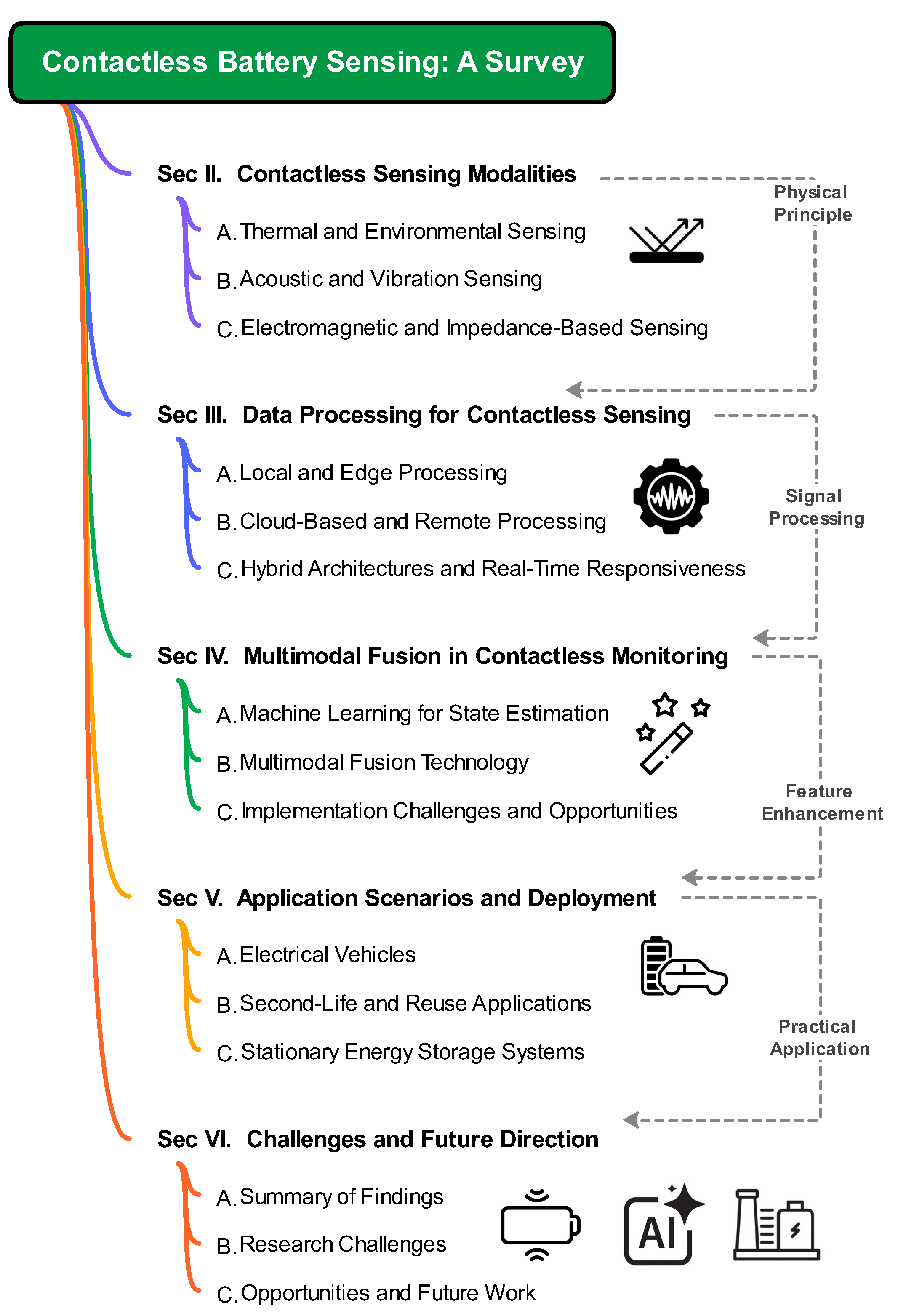
Figure 2.
The existing contactless sensing modalities.
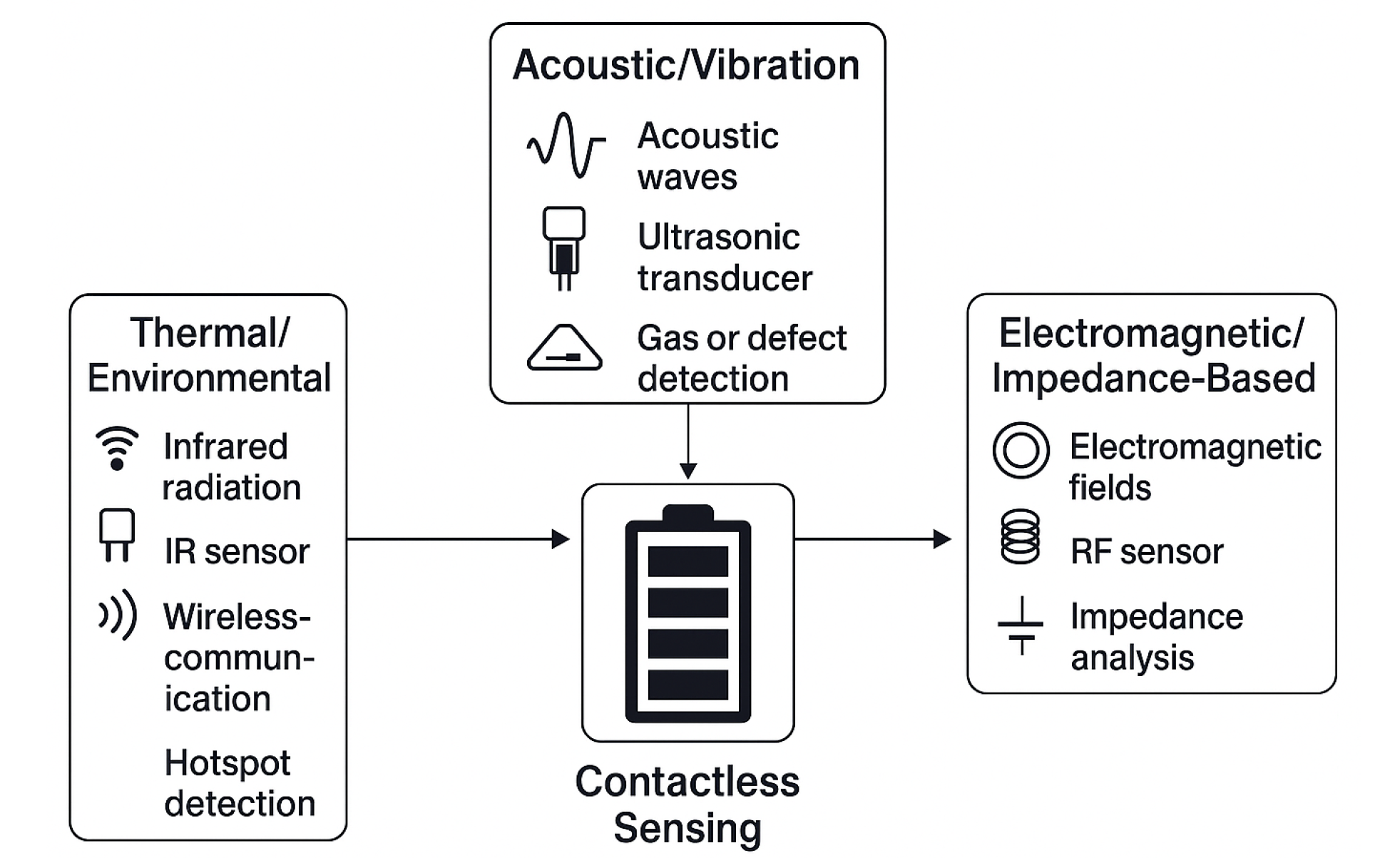
Figure 3.
Three data processing modes and their relations.
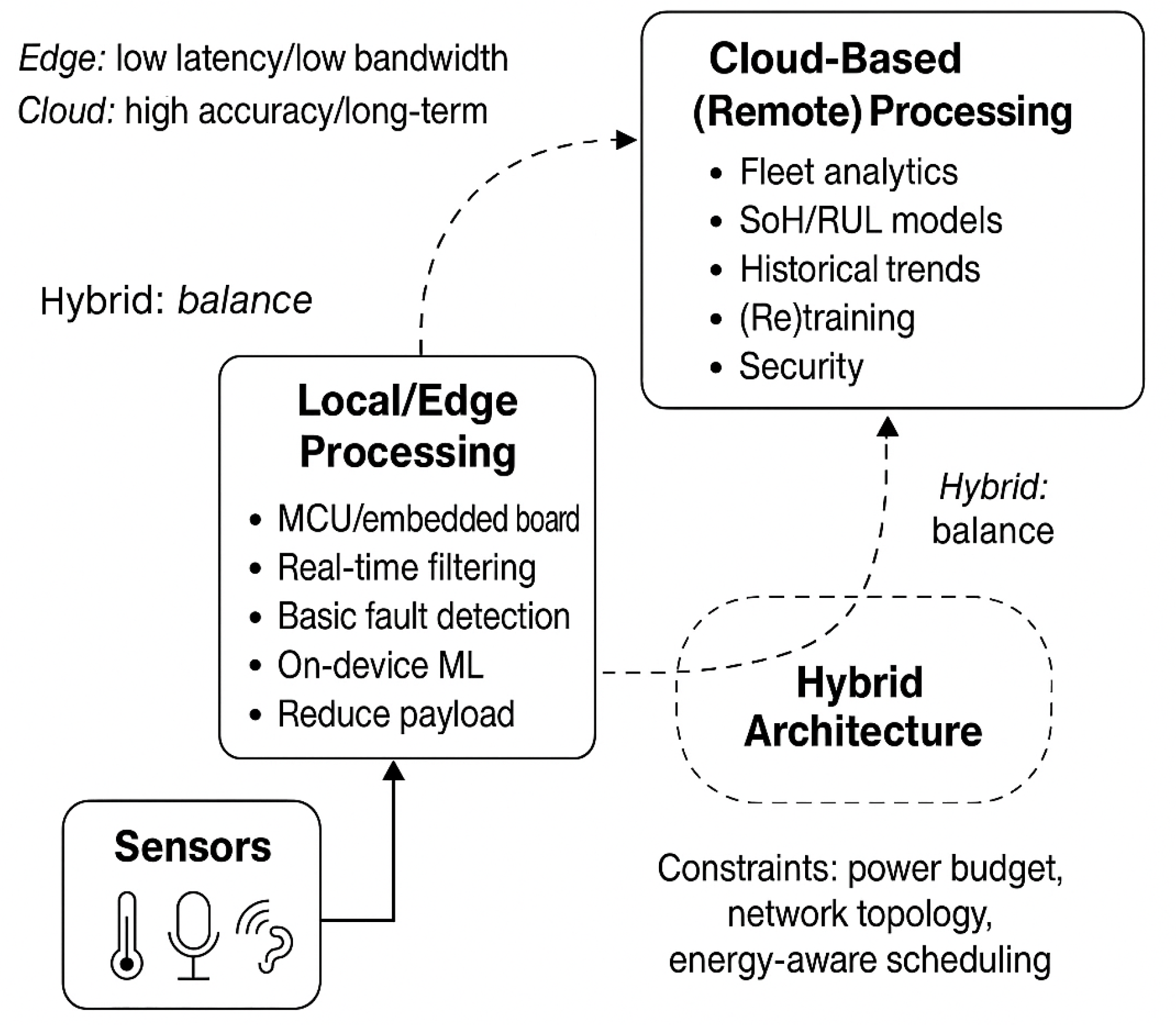
Figure 4.
Multimodal fusion techniques for feature enhancement.
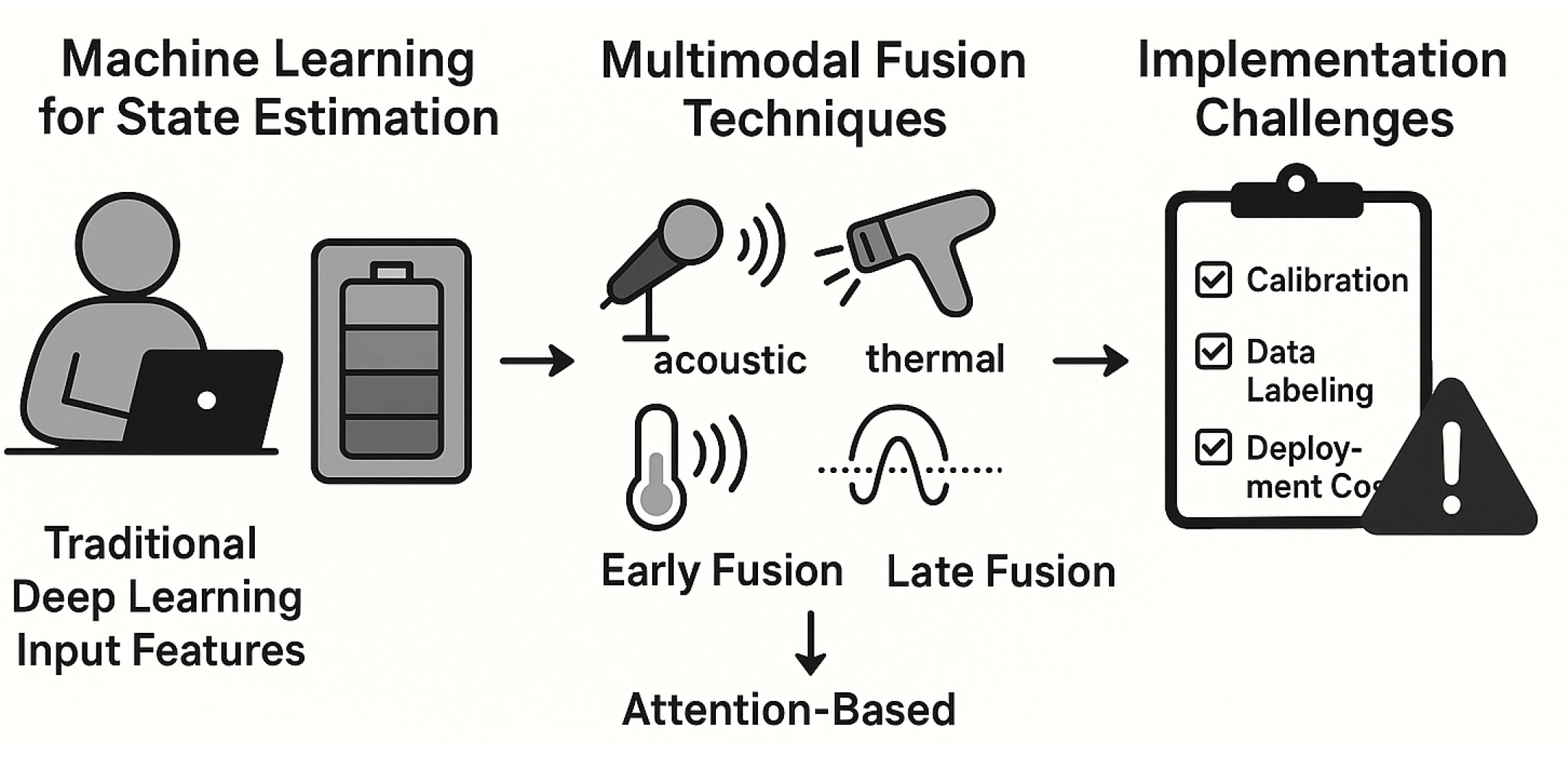
Figure 5.
Workflow of contactless State-of-Health (SoH) diagnostics and triage for second-life battery management.
Figure 5.
Workflow of contactless State-of-Health (SoH) diagnostics and triage for second-life battery management.
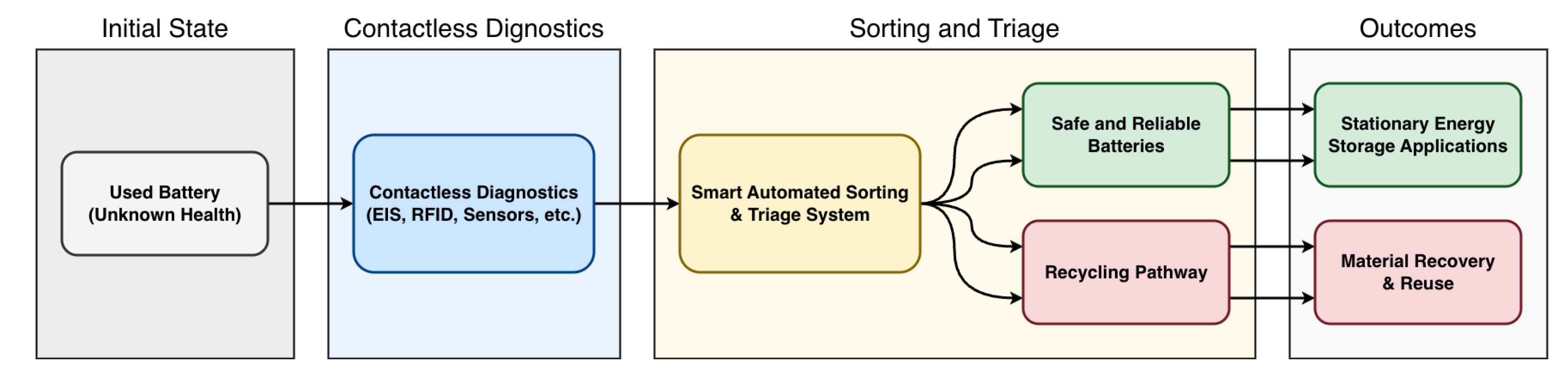
Figure 6.
Challenges and future direction.
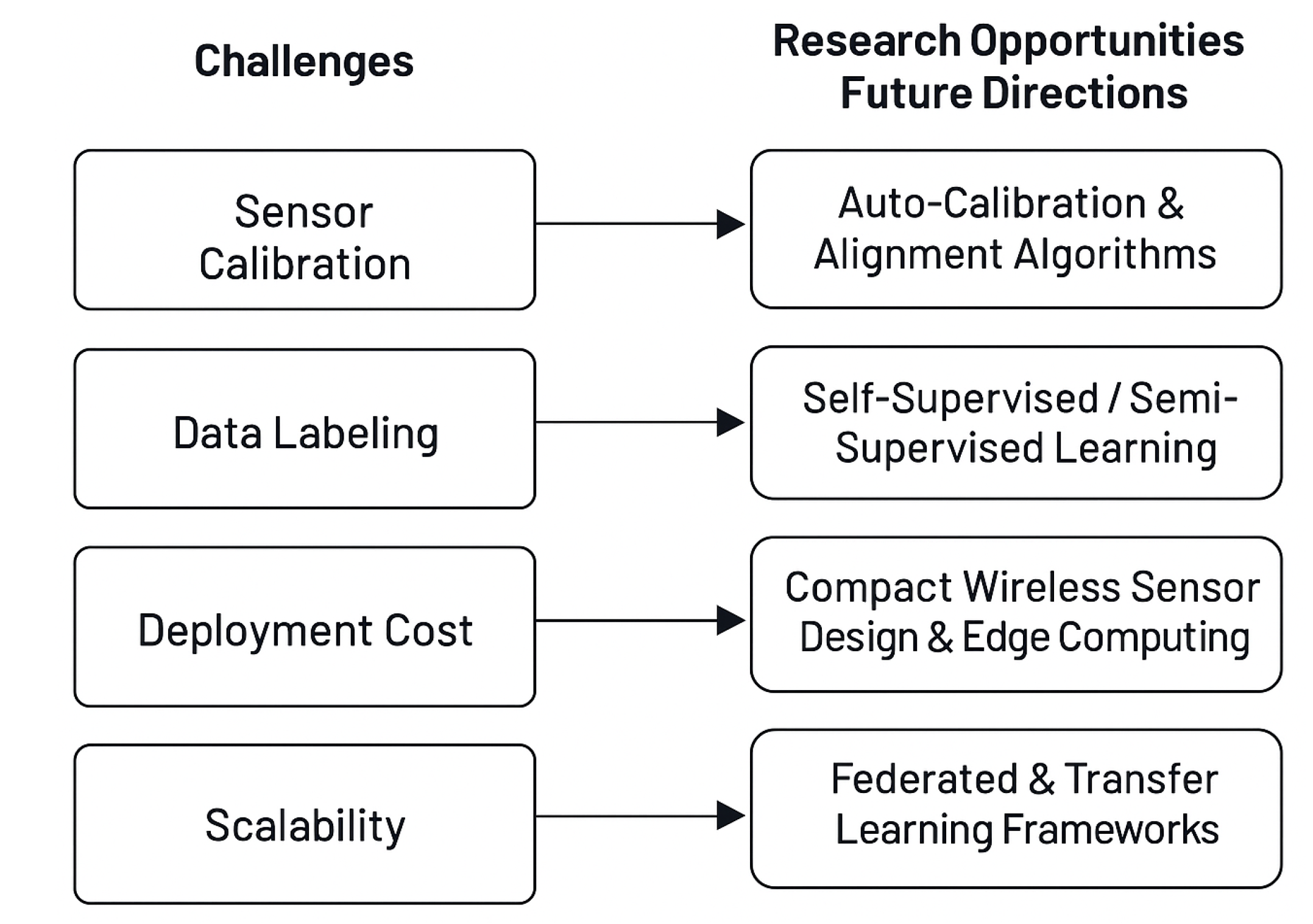
Disclaimer/Publisher’s Note: The statements, opinions and data contained in all publications are solely those of the individual author(s) and contributor(s) and not of MDPI and/or the editor(s). MDPI and/or the editor(s) disclaim responsibility for any injury to people or property resulting from any ideas, methods, instructions or products referred to in the content. |
© 2026 by the authors. Licensee MDPI, Basel, Switzerland. This article is an open access article distributed under the terms and conditions of the Creative Commons Attribution (CC BY) license (http://creativecommons.org/licenses/by/4.0/).
Copyright: This open access article is published under a Creative Commons CC BY 4.0 license, which permit the free download, distribution, and reuse, provided that the author and preprint are cited in any reuse.


