

Submitted:
12 January 2026
Posted:
13 January 2026
You are already at the latest version
Abstract
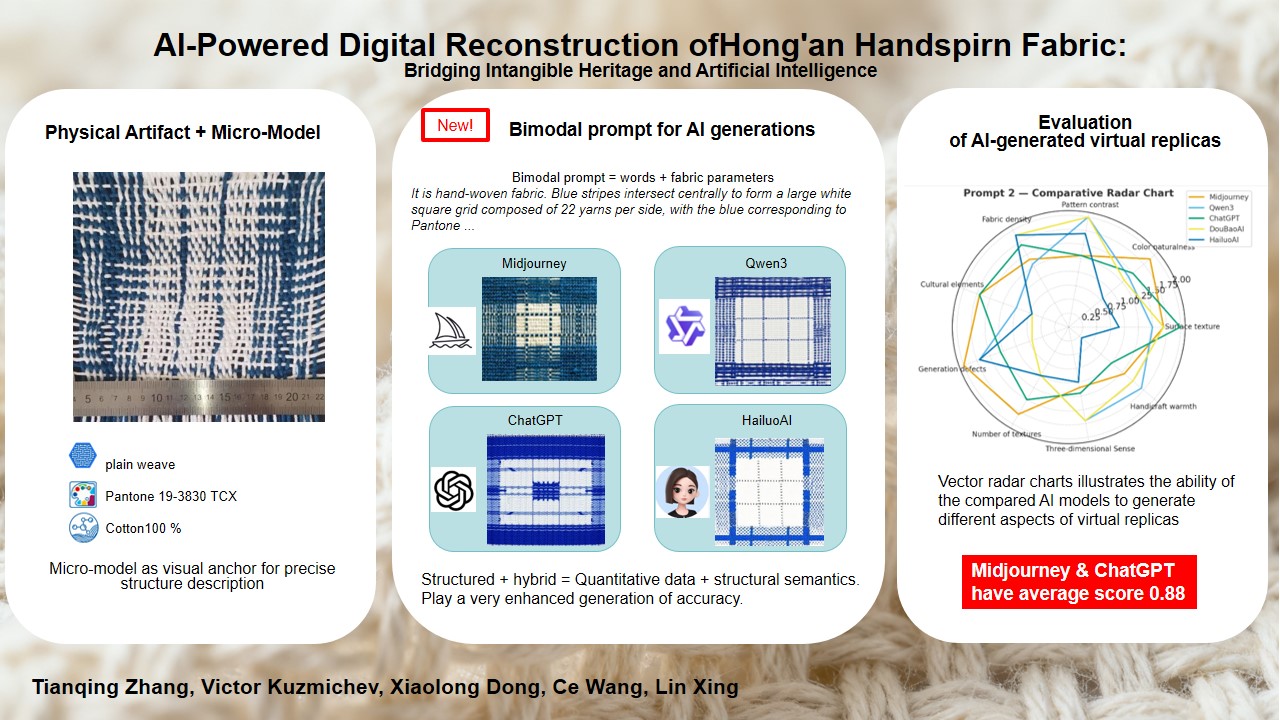
This study develops an innovative method for the attribution and visual reconstruction of hand-woven fabrics using artificial intelligence, employing Chinese Hong'an Homespun as a case study. The paper proposes a comprehensive algorithm integrating microscopic analysis, physical micro-model creation, and bimodal prompt engineering. The semantic differential method with a five-point scale was applied for objective evaluation of visual replica of historical fabrics. Comparative testing of AI models (Midjourney, ChatGPT, Qwen3, DouBaoAI, HailuoAI) revealed significant differences in their ability to reproduce characteristic features of hand weaving. The results demonstrate the superiority of detailed prompts with precise quantitative parameters and confirm the effectiveness of micro-models as visual anchors. The research establishes new standards in the digital documentation of cultural heritage and opens prospects for preserving traditional textile techniques. The most successful AI are Midjourney and ChatGPT have achieved an average score of 0.88 on the semantic scale, confirming the practical applicability of the method.
Keywords:
AI
; hand-woven fabrics
; semantic differential
; prompt engineering
; cultural heritage
; digital reconstruction
; Hong'an Homespun
; textile fabric
1. Introduction
Hong’an coarse cloth has been hand-woven since the Ming Dynasty using traditional spinning wheels and treadle looms passed down through generations in Hong’an, Hubei Province. Made from locally grown cotton through 72 artisanal steps—including ginning, spinning, dyeing, warping, and weaving—it yields fabric of standard size (0.47 m wide, ~13.33 m long) with distinctive rustic aesthetics and cultural significance [1]. Historically, cotton was abundant in the region, and “the hum of looms resonated in every household.” The resulting fabric is durable, soft, breathable, thermoregulatory (warm in winter, cool in summer), wrinkle-resistant, and static-free. Its textured surface creates micro-massage points with documented dermatological benefits. Woven on wooden inclined-beam looms, it embodies natural simplicity and ethnic artistry, reflecting over 4,000 years of Chinese textile heritage. Recognized as a Provincial Intangible Cultural Heritage and a National Geographical Indication Product, Hong’an Homespun features a natural palette (indigo, black, white), strong abrasion resistance, and deep grain patterns that merge daily utility with folk tradition—often described as “the interwoven nostalgia of Jing-Chu culture” (Xu, Ye and Zhao 2019; Xu, Y. M., Ye, H. G., & Zhao, H. 2019) [2,3].
1.1. AI Applications in Textile Design
While AI can generate hyper-realistic images (Gangadharbatla, H. 2022) [5], it struggles to replicate human serendipity in creative processes (Erdelez, S. 1997) [4]. In textiles, AI models predict two key property categories: physical (strength, elasticity, air permeability) and tactile (softness, roughness) (Turkmen, B. G., Celik, P., Sehit, H., & Ute, T. B. 2024) [6]. Traditional evaluation methods—lab tests and expert panels—are slow, costly, and subjective (Kim, H., Kim, S., & Park, C. K. 2023; Kenkare, N. 2005) [7,8], prompting interest in AI-driven automation. Machine learning excels at processing large datasets, modeling nonlinear relationships, and improving prediction accuracy (Elkateb, S. N. 2022;Metin, A., &Bilgin, T. T. 2024) [9,10]. It can also integrate contextual variables like environment and user preference. Yet challenges remain: limited generalizability, high computational costs, and poor model interpretability (Youn, S., West, A., &Mathur, K. 2024; Seçkin, M., Seçkin, A. Ç.,Demircioglu, P., &Bogrekci, I. 2023) [11,12].
For handfeel prediction, standardized frameworks enhance objectivity (Booth, A., Papaioannou, D., & Sutton, A. 2012) [13]. CNNs and hybrid models (e.g., YOLOv4-R-CNN) enable defect detection and parameter estimation like stiffness (Ouyang, W., Xu, B., Hou, J., & Yuan, X. 2019; Arshad, S. R., &Shahzad, M. K. 2024) [14,15]. Makarama, O., Van, H., Hong,M. 2023, achieved 99% accuracy in material parameter prediction using transformers [16]. Other studies report high performance: 92% accuracy in texture classification (Rasouli, M., Chen, Y., Basu, A., Kukreja, S. L., &Thakor, N. V. 2018) [17]; ≈95% accuracy in softness/flexibility prediction (Xue, Z., Zeng, X., &Koehl, L. 2017; Xue, Z., Zeng, X., Koehl, L., & Shen, L. 2015) [18,19]; 99.3% accuracy in tactile property prediction via ResNet-50 (Gültekin, E., Çelik, H. I., Nohut, S., & Elma, S. K. 2020) [20].
1.2. Application of Semantic Differential Scale
The semantic differential scale (SDS) offers a quantifiable framework to evaluate AI-generated content, reducing subjectivity. It serves three purposes: (1) measuring semantic alignment between AI output and human perception; (2) benchmarking model performance to guide optimization; and (3) assessing user preferences to align outputs with human expectations.
While not directly tied to the core study, historical linguistic methods—such as tracing textile-related loanwords (e.g., Spanish algodón from Arabic), analyzing place-name roots (e.g., "-wick" or Chinese “Sangyuan”), or reconstructing proto-language roots like Indo-European webh- (“to weave”)—reveal ancient trade and technology diffusion (Menéndez-Benito, V., &Schwenter, S. A. 2019; Pokorny, J. 1959–1969) [21,22]. However, interpreting historical textiles is hindered by material fragility (most survive only as fragments) and ambiguous terminology. Ancient terms often exhibit polysemy (e.g., “tissue” or Chinese “锦” [jin]) or semantic drift (e.g., “purple” once meant Phoenician crimson, not violet), risking modern misinterpretation (Lombardini, L. 2012; Gaspa, S., Michel, C., &Nosch, M. L. 2017; Nosch, M. L., & Michel, C.) [23,24,25].
This research aims to develop and validate an algorithm for generating visual replicas of historical textiles by integrating physical micro-models, bimodal prompts, and semantic differential analysis.
Flowchart of research (algorithm) shown in Figure 1.
Table 1 shows the content of step 1 as more important step in this study.
2. Objects of Research
The image materials of the cases used in this analysis are all sourced from Hong'an Handspun Fabrics in Hong'an County, Hubei Province. As a highly representative traditional handicraft of the local area, Hong'an Handspun Fabric carries profound regional cultural heritage and unique manual textile techniques. Its fabric texture, color matching, and pattern styles all exhibit distinct local characteristics, providing rich and typical sample support for AI-based traceability research on handspun textiles.
The reasons for selecting Hong'an handspun fabric images as cases are as follows. Firstly, the samples have strong uniqueness. The manual production process of Hong'an handspun fabric is irreproducible and significantly different from mechanically produced textiles, with distinct details such as the yarn direction, weave density, and defect characteristics on the fabric surface. Secondly, it has high cultural recognition. The traditional patterns (such as the "Swastika Pattern" and "Meander Pattern") and color system (mainly using natural dyes like indigo and ochre) of Hong'an Handspun Fabric have clear regional cultural orientation. This can help AI not only determine "whether a textile is handspun" during the traceability process but also further associate it with the in-depth attribution of "which regional traditional manual textile category it belongs to," thereby improving the accuracy and cultural relevance of traceability. Thirdly, it can provide a sufficient number of samples for AI model training, avoiding model bias caused by a single type of sample and ensuring the scientificity and reliability of AI-based attribution analysis for handspun textiles.
Figure 2 shows the chosen fabrics and its rapports.
The chosen fabri
The chosen fabrics have next features.
(1) Fabric craftsmanship texture - heavy and rugged, 100% pure cotton handwoven; core material, craftsmanship, and touch. Uneven, ridged texture - iconic tactile feature ("roughness"); plain weave with uneven handspun yarns; the texture origin (natural irregularities of handspun yarns); yarn knots and thickness variations; typical traces of hand spinning. Extremely high density, approximately 300 g/m² - quantitative parameter ensuring a thick and substantial texture.
(2) Color decoration - three classic colors (natural indigo, carbon black, and natural white). Wide alternating stripes - iconic pattern (can be replaced by simple geometric grids or classic indigo checkered patterns). Rustic elegance and primitive simplicity - aesthetic keywords highlighting "refinement in roughness".
(3) Cultural Expression - fabric embodies both daily utility and folk artistry.
Sample 1 incorporates two horizontally aligned blue yarns and two vertically aligned blue yarns, systematically distributed to form a nine-cell matrix. The corner square patterns of this matrix are structured as follows. Upper-left quadrant is composed of three vertical white yarns interspersed with four vertical dark blue yarns. Upper-right quadrants composed of three horizontal white yarns. Lower-left quadrant is composed of three horizontal white yarns. Lower-right quadrant is composed of three vertical white yarns separated by four vertical dark blue yarns. Each weft yarn interlaces alternately over and under individual warp yarns. The corner square patterns are interconnected by dotted-line configured yarns. The pattern cells are systematically arranged and extended quad axially along vertical and horizontal orientations.
Sample 2 incorporates two horizontally aligned blue yarns and two vertically aligned blue yarns, systematically distributed to form a nine-cell matrix. The corner square patterns of this matrix are structured as follows. Upper-left quadrant is composed of three vertical white yarns interspersed with four vertical dark blue yarns. Upper-right quadrants composed of three horizontal white yarns. Lower-left quadrant is composed of three horizontal white yarns. Lower-right quadrant is composed of three vertical white yarns separated by four vertical dark blue yarns. Each weft yarn interlaces alternately over and under individual warp yarns. The corner square patterns are interconnected by dotted-line configured yarns.
Sample 3 comprises four distinct sectors. Upper-left quadrant is composed of three vertical white yarns interspersed with four vertical dark blue yarns. Upper-right quadrant is composed of three horizontal white yarns separated by four horizontal dark blue yarns. Lower-left quadrant is composed of three horizontal white yarns partitioned by four horizontal dark blue yarns. Lower-right quadrant is composed of three vertical white yarns alternating with four vertical dark blue yarns. All parallel yarns interlace in an over-under alternation pattern relative to the warp orientation. The pattern cells are systematically arranged and extended quad axially along vertical and horizontal orientations.
3. Methods of Research and Tools
3.1. Micro-Models of Fabric
Next properties of the fabrics were investigated and shown in Table 2.
To visualize the fabric structures, enlarged models of the thread interlacing were created, preserving the original two-color weaving rapport as micro-models. The micro-models were made from cotton cords of two colors (the same as original fabrics) with a diameter of 3 mm, following the procedure below:
(1) Control marks for the positions of the warp threads were placed along the edges of a rigid cardboard frame at 3 mm intervals. The repeat pattern of the original fabric was replicated by alternating white and blue threads. Each end was secured to the frame's mount.
(2) After fixing the warp threads, they were additionally tensioned and aligned starting from a control mark. This prevented sagging and ensured stable weaving geometry.
(3) The weft threads (cotton cords) were sequentially passed through the warp, following the interlacing order according to the pattern repeat. A needle was used to pass the cord, ensuring it remained strictly perpendicular to the warp.
(4)Interlacing Fixation: Each weft thread was secured to the frame's mount. Upon completion, the macro-model was temporarily stitched to prevent the weave from shifting.
(5) The micro-models were photographed under the same conditions as the original fabric samples.
Figure 3 shows photographs of all the micro-models.
Figure 3 shows that the micro-models successfully visualize the "live" relief, demonstrate variability in thread thickness, and highlight the characteristics of the linear-graphic pattern created by the plain weave using differently colored threads.
The micro-models were visually compared with the original fabric. When discrepancies were found, individual threads were tightened or re-laid to achieve an exact match with the fabric's pattern.
The results of comparing Sample 1 and its micro-model are provided as an example.
The original fabric (Figure 2a) is made in plain weave. Its repeat pattern is a square divided into four sectors. In each sector, the stripes of threads are oriented perpendicularly to those in adjacent sectors. The sectors form a checkerboard alternation: vertical lines ↔ horizontal lines. The color scheme is white and blue. The effect is a visual imitation of mosaic or a weaving "labyrinth".
The original weave consists of even, straight lines; each "cell" of the repeat is formed by the strict alternation of white and blue threads. It features clear geometry: vertical stripes, horizontal stripes, and square blocks.
In the micro-model (Figure 3a), the structure is preserved: the repeat is divided into squares with different stripe directions. However, it differs from the original fabric in having less uniform threads (threads shift, and their varying thickness is visible). In some areas, the weave "shifts," forming slight diagonal waves. In the center of the micro-model, the alternation is not as strictly ordered.
Thus, while the weave pattern is correctly replicated, there are technical inaccuracies in tension and density.
3.2. AI Types
More popular AI - Qwen3 max [26], ChatGPT [27], Midjourney [28], DouBaoAI [29], and HailuoAI [31] - were used in this study.
Hong’an homespun fabric represents a distinctive textile category, whose significance stems from the integration of objective technical parameters (high density, gram weight, tensile strength, and natural composition) with subjectively perceived yet powerfully qualitative attributes (expressive handcrafted textures, rustic elegance, minimalist decorations, and profound cultural-historical connotations). While AI can partially characterize the fabric through quantifiable metrics (e.g., density and gram weight), its essential distinction from other textiles resides in inherently non-quantifiable dimensions: artisanal craftsmanship, material memorability, and the unique “nostalgic essence” it embodies.
Two types of prompts which are different in details according to fabric rapports were used to achieve the most authentic reproduction effect.
3.2.1. Basic One Modal Prompt
The basic one modal prompt mainly contains the following core information. Its overall description is relatively concise, focusing on qualitative expressions, while lacking precise quantification and structured details:
(1) fabric basic properties include clearly specification of the fabric type such as hand-woven fabric, and core color combinations by marking the Pantone color numbers corresponding to key colors (such as Pantone 19-4053 TCX, 19-3831 TCX).
(2) pattern and texture features include briefly describing the pattern form (such as blue stripes crossing to form white checks, interweaving of blue lines in different shades, black and white squares alternating into a grid) and special designs (such as black dot-shaped weaving holes on blue stripes forming a negative space design, patterns similar to traditional Chinese geometric patterns), but fail to elaborate on the composition rules of the patterns.
(3) shooting and visual conditions explain by means of the shooting angle (all shots are taken vertically downward), light conditions (uniform light, soft light creating soft shadows), and the way the fabric is placed (laid flat).
(4) craftsmanship texture includes a mention of the fabric texture (fine, coarse weave), the visibility of the interweaving of warp and weft threads, and the handmade natural imperfections.
3.2.2. Improved Bimodal Prompts
Building on the basic one modal prompt, the improved bimodal prompt significantly expands the information by incorporating quantitative data, structured decomposition, and process details, resulting in a more accurate and systematic description:
1) quantitative details of fabric and pattern include clearly specification of the number and types of yarns, such as "each side of the large white check is composed of 22 yarns", "the width of the blue stripe is 9 warp yarns", "the width of the fine blue thread is 2 warp yarns", and "4 vertical white warp yarns are arranged with 5 vertical black warp yarns". Specific numbers are used to define pattern dimensions and yarn distribution.
2) refine the logic of pattern composition, for example, decompose the four corner areas of the matrix (the upper-left corner consists of 3 vertical white yarns interspersed with 4 vertical dark blue yarns, the upper-right corner consists of 3 horizontal white yarns, etc.), and clarify the yarn interweaving rules for different areas.
3) in-depth explanation of process technology by adding supplement specific weaving methods, such as "each weft yarn is alternately interwoven above and below a single warp yarn" and "yarns in a dot configuration connect the four-corner square patterns". The description of structural features enhance by proposing the concept of a "symmetrical grid" structure, and clarify the combination relationship of various parts of the fabric (e.g., "the right side is woven by alternately arranging 2 horizontal white weft yarns and 3 horizontal black weft yarns to form a rectangular stripe pattern").
4) basic information was retained and optimized by adding maintain core attributes (fabric type, Pantone color number, shooting angle, lighting conditions, manual defects) while improving expression accuracy. For instance, "vertical shooting angle" was specified as "vertical downward viewing angle", "uniform light" as "balanced light" to emphasize stability.
Table 3 shows the main differences between two types of prompts.
3.3. Mat
Table 4 shows the content of basic one modal and the improved bimodal prompts.
Semantic Differential Method for an Images Validation
The semantic differential method constructs to evaluate the dimensions by setting up groups of studied visual replica. It consists of traditional numerical scoring with a symmetric scale (e.g., -2 to +2), where each scale point corresponds to specific descriptions rather than abstract scores.
To evaluate of Hong’an homespun AI-Generated images, five-level semantic differential scale consisting scoring criteria: -2 → -1 → 0 → +1 → +2 was designed. The SDC has 3 groups (visual effects, structure, properties) and nine indicators of its. Table 5 shows the scores of SDC.
Sensory visual analysis of visual replica generated by the five different AI have been done after printing all images on a paper A4. 30 participating professional teachers and students in fashion design analyzed the printed images item by item in accordance with the aforementioned evaluation objects and standards. After the scoring was completed, the average score of each image firstly calculated under each of the 9 evaluation indicators, then the overall average score for each type of AI computed. Finally, these average scores used to compare the performance of images through to complete the entire questionnaire evaluation and statistics process.
4. Results Obtained
Figure 4 shows the images generated by the basic one modal prompts.
The results of SDC application after analyzing the images generated by means of basic one modal prompt are shown in Table 6.
Figure 6 shows the vector radar charts illustrating the ability of the compared AI models to generate different aspects of virtual replicas.
5. Discussion
5.1. Analyze AI's Understanding of Basic One Modal Prompts
As Table 6 shown, the possibilities of AI used could be ranged by this way.
(1) Surface texture presentation
ChatGPT (1.3)=DouBaoAI (1.6)>Qwen3 (1) = Midjourney (1) > HailuoAI (0.3),
(2) Color naturalness presentation
Qwen3 (1) > ChatGPT (0.8) = Midjourney (0.8) > DouBaoAI (0.7) = HailuoAI (0.5),
(3) Pattern contrast
ChatGPT (1.2) = HailuoAI (1.2) > DouBaoAI (1) = Midjourney (1) > Qwen3 (0.7),
(4) Fabric density
DouBaoAI (1.7) = HailuoAI (1.7) > ChatGPT (1) = Midjourney (1) > Qwen3 (0.5),
(5) Cultural elements
Midjourney (0.7) = ChatGPT (0.7) > Qwen3 (0) = DouBaoAI (0) = HailuoAI (-0.6),
(6) Generation defects
Midjourney (0.7) = Qwen3 (0.7) = chatGPT (0.7) = HailuoAI (0) > DouBaoAI (-0.7),
(7) Texture quantity
Midjourney (1.2) > chatGPT (0.8) > HailuoAI (0.7)>Qwen3 (-0.3) = DouBaoAI (-0.3),
(8)Three-dimensional sense
Qwen3 (1.7) = DouBaoAI (1.7) > chatGPT (1) > Midjourney (0.8) > HailuoAI (-1),
(9) Handmade texture
Midjourney (1.4) > Qwen3 (1.4) > HailuoAI (1.4) > chatGPT (1.1) > DouBaoAI (1.0).
After this analysis comprehensive performance of AI their an advantages (strong ability) and disadvantages (weak ability) due to basic prompts shows in Table 8.
As Table 8 shown, ChatGPT has the best comprehensive performance, especially good at "detail restoration" (surface texture, patterns) and "cultural symbol recognition", making it suitable for the generation needs of "traditional fabrics and culture-related patterns".
Midjourney has outstanding advantages in color and texture, and is suitable for generating ordinary fabrics that require high "visual authenticity" (natural colors, rich details).
DouBaoAI and Qwen3 have moderate performance with different focuses (DouBaoAI is strong in density, Qwen3 is strong in three-dimensional sense), and are suitable for scenarios that have demands on a single dimension (such as density and three-dimensional sense).
HailuoAI has the weakest comprehensive performance, only performing moderately in pattern contrast and fabric density. It has a high defect rate and insufficient details, so it is not recommended for high-demand fabric generation tasks.
5.2. Analyze AI's Understanding of Improved Bimodal Prompts
As Table 7 shown, the possibilities of AI used could be ranged by this way.
(1) Surface texture presentation
ChatGPT (2.0)>Midjourney (1.6) = Qwen3 (1.6) > DouBaoAI (1.5) > HailuoAI (1.4),
(2) Color naturalness presentation
Midjourney (1.9) > ChatGPT (1.6) = Qwen3 (1.6) > DouBaoAI (1.5) = HailuoAI (1.5),
(3) Pattern contrast
ChatGPT (2.0) = HailuoAI (2.0) > DouBaoAI (1.5) > Midjourney (1.25) = Qwen3 (1.25),
(4) Fabric density
DouBaoAI (1.9) = HailuoAI (1.9) > ChatGPT (1.8) > Midjourney (1.4) > Qwen3 (1.3),
(5) Cultural elements are ranking by next score
Midjourney (1.8) = ChatGPT (1.8) > Qwen3 (0.8) = DouBaoAI (0.8) = HailuoAI (0.8),
(6) Generation defects
Midjourney (1.5) = Qwen3 (1.5) = chatGPT (1.5) = DouBaoAI (1.5) > HailuoAI (1.0),
(7) Texture quantity
Midjourney (1.9) > ChatGPT (1.4) > Qwen3 (1.3) = DouBaoAI (1.3) > HailuoAI (0.9),
(8) Three-dimensional sense
Qwen3 (1.8) > DouBaoAI (1.6) > chatGPT (1.3) > Midjourney (1.1) > HailuoAI (1.0),
(9) Handmade texture
Midjourney (1.4) > Qwen3 (1.4) > HailuoAI (1.4) > chatGPT (1.1) > DouBaoAI (1.0).
After this analysis comprehensive performance of AI their an advantages (strong ability) and disadvantages (weak ability) due to improved bimodal prompts shows in Table 9.
As Table 9 shown, ChatGPT has good abilities at "detail restoration" (surface texture, patterns) and "cultural symbol recognition", making it suitable for the generation needs of traditional fabrics and culture-related patterns.
Midjourney has outstanding advantages in color and texture, and is suitable for generating ordinary fabrics that require high visual authenticity (natural colors, rich details).
DouBaoAI and Qwen3 have good performance with different focuses (DouBaoAI is strong in density, Qwen3 is strong in three-dimensional sense), and are suitable for scenarios that have demands on a single dimension (such as density and three-dimensional sense).
HailuoAI has the weakest comprehensive performance, only performing moderately in pattern contrast and fabric density. It has a high defect rate and insufficient details, so it is not recommended for high-demand fabric generation tasks.
5.3. Comparison Basic and Improved Prompts
As shown in Table 6 and Table 7, all AI models benefit from the bimodal prompt: average scores increased by a factor of 2 (Midjourney, DouBaoAI, ChatGPT) or 3 (Qwen3, HailuoAI). The positive impact of the bimodal prompt led to improvements across all nine evaluation indicators, with the average score rising from 0.6 to 1.4 points. This confirms the effectiveness of enriching prompts with detailed descriptions that bring the visual replica closer to the original artifact.
As Figure 7 shown, the growth of visual replicas quality is different for compared AI: the biggest growth for HailuoAI (+212%) and Qwen3 (+183%), stable growth for Midjourney (+84%) and ChatGPT (+78%), moderate growth for DouBaoAI (+95%).
The increased confidence in the generated images is attributed to the following factors:
(1)An information parsing accuracy from "vague description" to "quantitative definition" for more precise AI understanding, enabling AI to more accurately capture key information and reduce comprehension deviations. The basic prompts mostly use non-quantitative descriptions such as "thin blue stripes", "large white checks", and "two horizontal lines" (e.g., "two horizontal lines and two vertical indigo yarns" in Sample 1). AI tends to have comprehension deviations due to subjective terms like "thin/large". The improved prompts supply specific quantitative data (e.g., "white squares composed of 22 yarns on each side" and "blue stripes 9 warp yarns wide" in Sample 1; "spaced 3 white warp yarns apart" and "thin lines 2 warp yarns wide" in Sample 2), and clarify yarn types (warp/weft) and color-corresponding standards (Pantone color code binding).
This indicates that AI can accurately parse information presented as "quantitative parameters + clear classification", avoid misinterpreting "vague adjectives", and achieve an understanding that better aligns with the actual fabric structure.
(2) Detail restoration from "overall summary" to "local disassembly" for deeper AI understanding due to disassembling local structures and supplementing process details. Improved prompt sallow AI to understand the microscopic composition of fabrics rather than just their macroscopic features. Basic prompts only summarize the overall effect (e.g., "dark blue and gray two-tone with lines in different directions" and "checkerboard interleaved distribution" in Sample 3) without mentioning the logic of local structures. The improved prompts disassemble the overall pattern into local units (e.g., "the upper left part consists of 3 white warp yarns + 4 dark blue warp yarns, and the upper right part consists of 3 white warp yarns + 4 dark blue weft yarns" in Sample 3; "the four-corner squares are divided into upper left/upper right/lower left/lower right, with different yarn arrangements in each area" in Sample 1), and supplement weaving processes (e.g., "each weft yarn interlaces alternately above and below the warp yarns" and "dashed-structure yarns connect the four-corner squares").
This shows that AI can understand the hierarchical relationship between "whole and part", and even capture "weaving process details", rather than merely staying at superficial visual descriptions—markedly enhancing the depth of understanding.
(3) Structural cognition ability raised from "disordered information" to "pattern extraction" for more systematic AI understanding by extracting structural patterns and unifying expression logic, the improved prompts help AI identify the design logic of fabrics (such as symmetry and repetition) instead of receiving information in isolation:
The basic prompts resent information in a disorderly manner (e.g., stacking features like "dark blue and white vertical stripes, black dot holes, and thin stripes" in Sample 2 without explaining their positional relationships). AI easily overlooks the connections between elements.
The improved prompts clarify the spatial relationships and design patterns of elements (e.g., "a blue stripe in the center, with one thin blue line on each side separated by 3 white warp yarns, totaling 3 vertical blue lines" and "uniform yarn thickness forming a 'symmetrical grid' color presentation" in Sample 2; "stripes on the right are symmetrical to those on the left, both featuring a checkered structure of 'alternating white warp yarns + black warp yarns' in Sample 4"), and unify the expression of "shooting angle/lighting" (e.g., fixing "shot vertically downward with uniform lighting" to avoid ambiguity in basic prompts like "vertical shooting angle with uniformity").
This reflects that AI can understand "spatial layout patterns" and "core design concepts (e.g., symmetry)", and even reduce ambiguity by unifying expression logic—significantly strengthening its ability to systematically understand information.
Thus, AI demonstrates significantly better understanding of the improved prompts than the basic ones. Through "quantitative parameters + local disassembly + pattern extraction", optimized multimodal prompts transform vague, disorderly descriptions into precise, systematic information. AI’s understanding upgrades from "superficial visual recognition" to "in-depth structural and process cognition": it can not only accurately parse specific parameters but also grasp the relationship between parts and the whole, as well as identify design logic. This essentially achieves comprehensive understanding of "fabric details, processes, and design patterns", providing a more reliable information foundation for subsequent generation of fabric images that meet requirements or conduct fabric analysis.
Based on the research findings, the following workflow for generating visual replicas of hand-woven fabrics has been established for the future research:
(1) determination of qualitative and quantitative fabric characteristics;
(2) fabrication of a physical micro-model;
(3) photography of the original fabric and the micro-model;
(4) prompt writing structured as follows (Table 10):
(5)uploading the prompt and the image of micro-models of fabric rapport.
By this way which combining the bimodal prompt and micro image of fabric the possibility of AI to understand the prompt will be increased.
6. Conclusions
This study demonstrates an effective interdisciplinary approach—combining AI, semantic analysis, and textile research—to attribute and visually reconstruct handwoven fabrics, using Hong’an Homespun as a case study. AI-generated images of Hong’an Dabu checkered cloth often fail to capture its defining traits: regularity, symmetry, and repetition in line and color patterns. AI struggles with complex weaving terminology, precise yarn counts, and numerical descriptors, though it accurately interprets photographic terms like “high resolution,” “studio lighting,” and “sharp focus.”
An algorithm for generating faithful visual replicas was developed, integrating microscopic fabric analysis, structural parameter measurement, physical micro-model creation, and bimodal prompting (text + image).
Key findings are:
(1) The method—microscopy, micro-models, and structured bimodal prompts—proved scientifically robust. Semantic differential scales enabled objective AI output evaluation, while micro-models acted as visual anchors for prompt refinement and error analysis.
(2) AI models varied significantly: Midjourney and ChatGPT performed best (avg. score 0.88), balancing texture, color, and structure; DouBaoAI (0.77) rendered 3D effects well but missed geometric precision; Qwen3 (0.55) and HailuoAI (0.33) struggled with core hand-woven features.
(3) Improved prompts—featuring quantitative data (yarn count, Pantone codes) and technical terms—greatly boosted accuracy. Yet AI still falters with numerical precision and specialized vocabulary, underscoring the need for domain-specific training data.
(4) Digital reconstruction of heritage textiles like Hong’an Homespun is not just technical but cultural—it must convey “rustic elegance,” “handmade warmth,” and rhythmic pattern harmony. The fusion of craft knowledge and AI creates a sustainable bridge between intangible heritage and digital futures.
(5) The method enables digital archives of endangered weaves, educational tools, and industry applications in prototyping and technique preservation.
Future work should focus on: textile-specialized AI models, tools for local detail control, deeper integration of semantic scales in prompting, and continued use of handcrafted micro-models to guide and validate generation.
Author Contributions
Methodology, Victor Kuzmichev; Validation, Ce Wang and Lin Xing; Formal analysis, Ce Wang; Resources, Tianqing Zhang; Data curation, Tianqing Zhang; Writing – review & editing, Victor Kuzmichev; Supervision, Victor Kuzmichev; Project administration, Xiaolong Dond and Lin Xing; Funding acquisition, Xiaolong Dond.
Funding
This work was supported by the Hebei Provincial Department of Science and Technology under Grant 2023HBQZYCXY013 "Research and development of a Digital System for Intelligent Wearable Design Based on Northern Weaving and Embroidery Techniques", P.R.C.
Institutional Review Board Statement
Not applicable.
Data Availability Statement
The original contributions presented in this study are included in the article/supplementary material. Further inquiries can be directed to the corresponding author(s).
Conflicts of Interest
The authors declare no conflict of interes.
References
- Hong'an County Chronicles Compilation Committee. (1992). Hong'an County Chronicles. Shanghai People's Publishing House. Unregistered DOI. http://rendezixun.com/m/product/huazhong/1238.html.
- Xu, Y., Ye, H., & Zhao, H. Research on the development of non-heritage derivatives of Hong'an dabu clothing. Tianjin Textile Science & Technology. (2019), (05), 1–4. [CrossRef]
- Xu, Y. M., Ye, H. G., & Zhao, H. (2019). Research on the development of intangible cultural heritage derivatives of Hong'an Dabu clothing. Tianjin Textile Science & Technology, (05), 1–4. [CrossRef]
- Erdelez, S. (1997). Information encountering: a conceptual framework for accidental information discovery. In Proceedings of an international conference on Information seeking in context (pp. 412–421).:Unregistered DOI. http://www.shurl.cc/5bd18c05dc86a5c02e9c7f6d79320e60.
- Gangadharbatla, H. (2022). The role of AI attribution knowledge in the evaluation of artwork. Empirical Studies of the Arts, 40(2), 125–142. [CrossRef]
- Turkmen, B. G., Celik, P., Sehit, H., & Ute, T. B. (2024). Investigation of the effects of hollow yarn structure and woven fabric construction on fabric performance: Mechanical properties. The Journal of The Textile Institute, 115, 490–503. [CrossRef]
- Kim, H., Kim, S., & Park, C. K. (2023). Prediction of fabric drape coefficient using simple measurement method. Journal of Engineering Fibers and Fabrics, 18. [CrossRef]
- Kenkare, N. (2005). Fabric Drape Measurement: A Modified Method Using Digital Image Processing. Journal of Textile and Apparel, Technology and Management, 4(3), 1–8.http://www.tx.ncsu.edu/jtatm.
- Elkateb, S. N. (2022). Prediction of Mechanical Properties of Woven Fabrics by ANN. Fibres and Textiles in Eastern Europe, 30(4), 54–59. [CrossRef]
- Metin, A., & Bilgin, T. T. (2024). Automated machine learning for fabric quality prediction: A comparative analysis. PeerJ Computer Science, 10. [CrossRef]
- Youn, S., West, A., & Mathur, K. (2024). Evaluation of a new artificial intelligence-based textile digitization using fabric drape. Textile Research Journal, 94(17), 2001–2018. [CrossRef]
- Seçkin, M., Seçkin, A. Ç., Demircioglu, P., & Bogrekci, I. (2023). FabricNET: A Microscopic Image Dataset of Woven Fabrics for Predicting Texture and Weaving Parameters through Machine Learning. Sustainability, 15(21). [CrossRef]
- Booth, A., Papaioannou, D., & Sutton, A. (2012). Systematic Approaches to a Successful Literature Review. SAGE Publications Ltd.Unregistered DOI. ISBN (9780857021342).
- Ouyang, W., Xu, B., Hou, J., & Yuan, X. (2019). Fabric Defect Detection Using Activation Layer Embedded Convolutional Neural Network. IEEE Access, 7. [CrossRef]
- Arshad, S. R., & Shahzad, M. K. (2024). Deep Learning Based Fabric Defect Detection. Research Reports on Computer Science, 3(1), 1–11. [CrossRef]
- Makarama, O., Van, H., Hong,M.(2023). Video Classification of Cloth Simulations: Deep Learning and Position-Based Dynamics for Stiffness Prediction.Applied Sciences 2023, 13(9), 5521. [CrossRef]
- Rasouli, M., Chen, Y., Basu, A., Kukreja, S. L., & Thakor, N. V. (2018). An Extreme Learning Machine-Based Neuromorphic Tactile Sensing System for Texture Recognition. IEEE Transactions on Biomedical Circuits and Systems, 12(2), 313–325. [CrossRef]
- Xue, Z., Zeng, X., & Koehl, L. (2017). Development of a method based on fuzzy comprehensive evaluation and genetic algorithm to study relations between tactile properties and total preference of textile products. The Journal of The Textile Institute, 108. [CrossRef]
- Xue, Z., Zeng, X., Koehl, L., & Shen, L. (2015). Development of an Intelligent Model to Predict Tactile Properties from Visual Features of Textile Products. In 2015 10th International Conference on Intelligent Systems and Knowledge Engineering (ISKE), 229–236. [CrossRef]
- Gültekin, E., Çelik, H. I., Nohut, S., & Elma, S. K. (2020). Predicting air permeability and porosity of nonwovens with image processing and artificial intelligence methods. The Journal of The Textile Institute, 111(11), 1641–1651. [CrossRef]
- Menéndez-Benito, V., & Schwenter, S. A. (2019). Loanwords as a window into cultural contact and diffusion: A cross-linguistic study. Language Sciences, 73, 101–116. [CrossRef]
- Pokorny, J. (1959–1969). Indogermanisches Etymologisches Wörterbuch (Vols. 1–2).Unregistered DOI. https://indo-european.info/pokorny-etymological-dictionary/indogermanisches-etymologisches-woerterbuch.htm.
- Lombardini, L. (2012). Textiles: An Introduction. Berg Publishers.Unregistered DOI.https://www.bloomsbury.com/uk/textiles-an-introduction-9781847888728/.
- Gaspa, S., Michel, C., & Nosch, M. L. (2017). Remarks on the Interpretation of Some Ambiguous Greek Textile Terms. In Textile Terminologies from the Orient to the Mediterranean and Europe, 1000 BC to 1000 AD (pp. 202–211). Zea Books. [CrossRef]
- Nosch, M. L., & Michel, C. (Eds.). (n.d.). Textile Terminologies in the Ancient Near East and Mediterranean from the Third to the First Millennnia BC. Oxbow Books.ISBN(9781842179758).
- Qwen AI. (n.d.). Qwen Chat. Retrieved September 20, 2025, from https://chat.qwen.ai.
- ChatGPT (n.d.).ChatGPTHomepage. Retrieved September 20, 2025, from https://chat.openai.com/.
- Midjourney. (n.d.). Midjourney Homepage. Retrieved September 20, 2025, from https://www.midjourney.com/account.
- Doubao. (n.d.). Doubao AI. Retrieved September 20, 2025, from https://www.doubao.com/.
- Hailuo AI. (n.d.). Hailuo AI Video Creation. Retrieved September 20, 2025, from https://hailuoai.video/create.
Figure 1.
Flowchart of research.
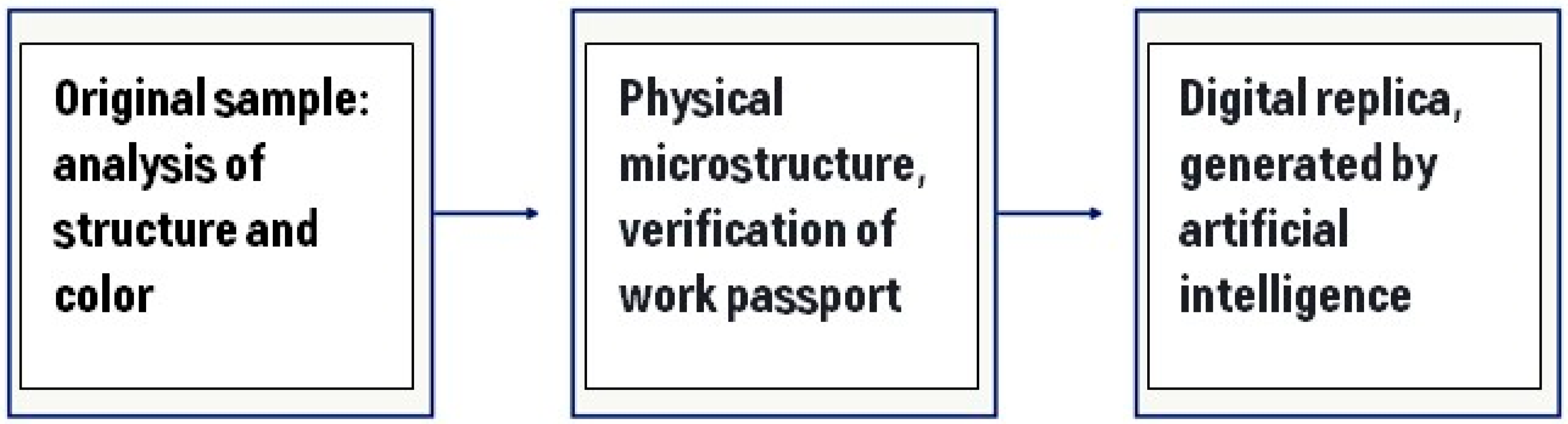
Figure 2.
Three samples of Hong'an handspun fabrics and its rapports.
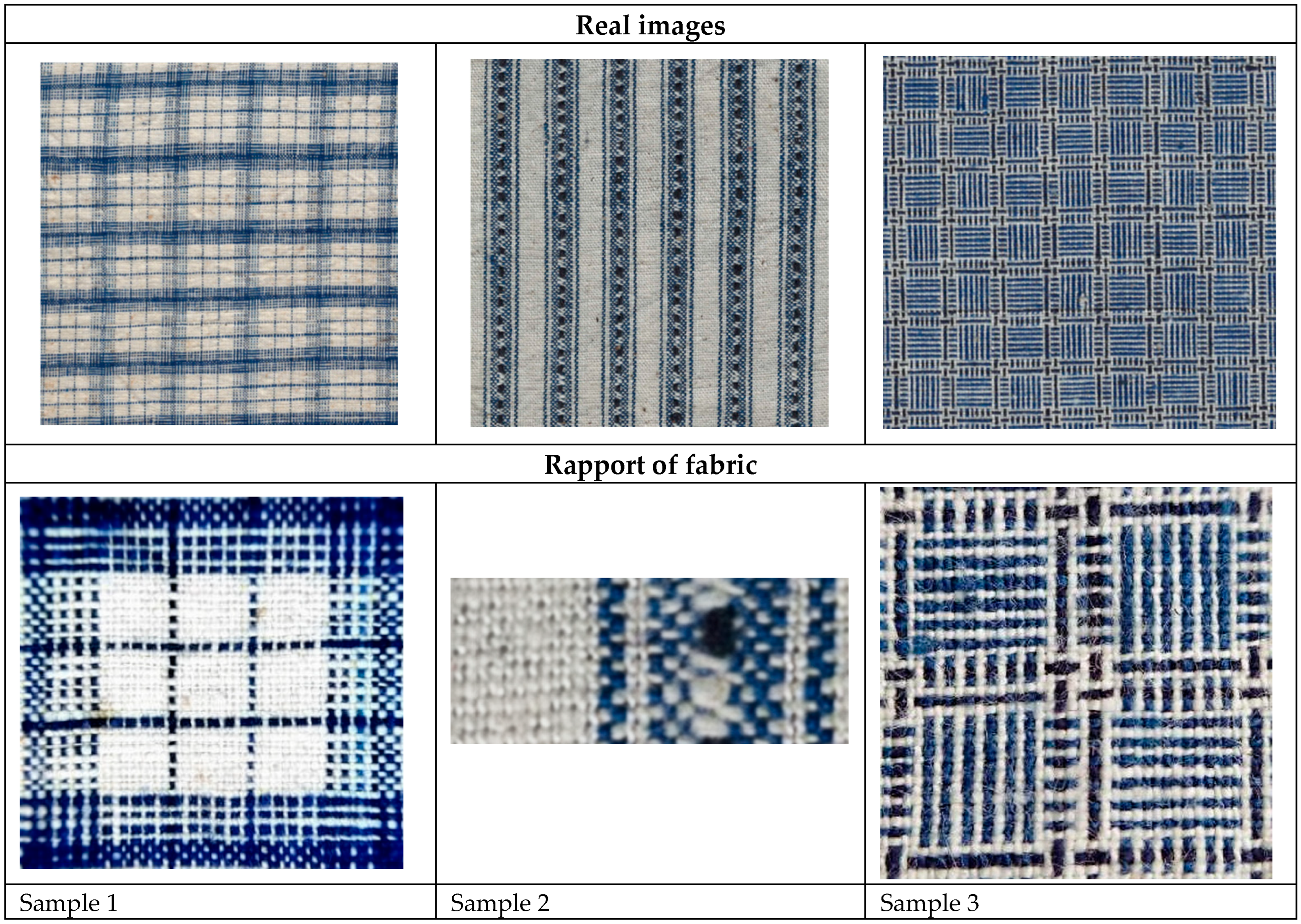
Figure 3.
The micro-models of fabric rapport with the scale.
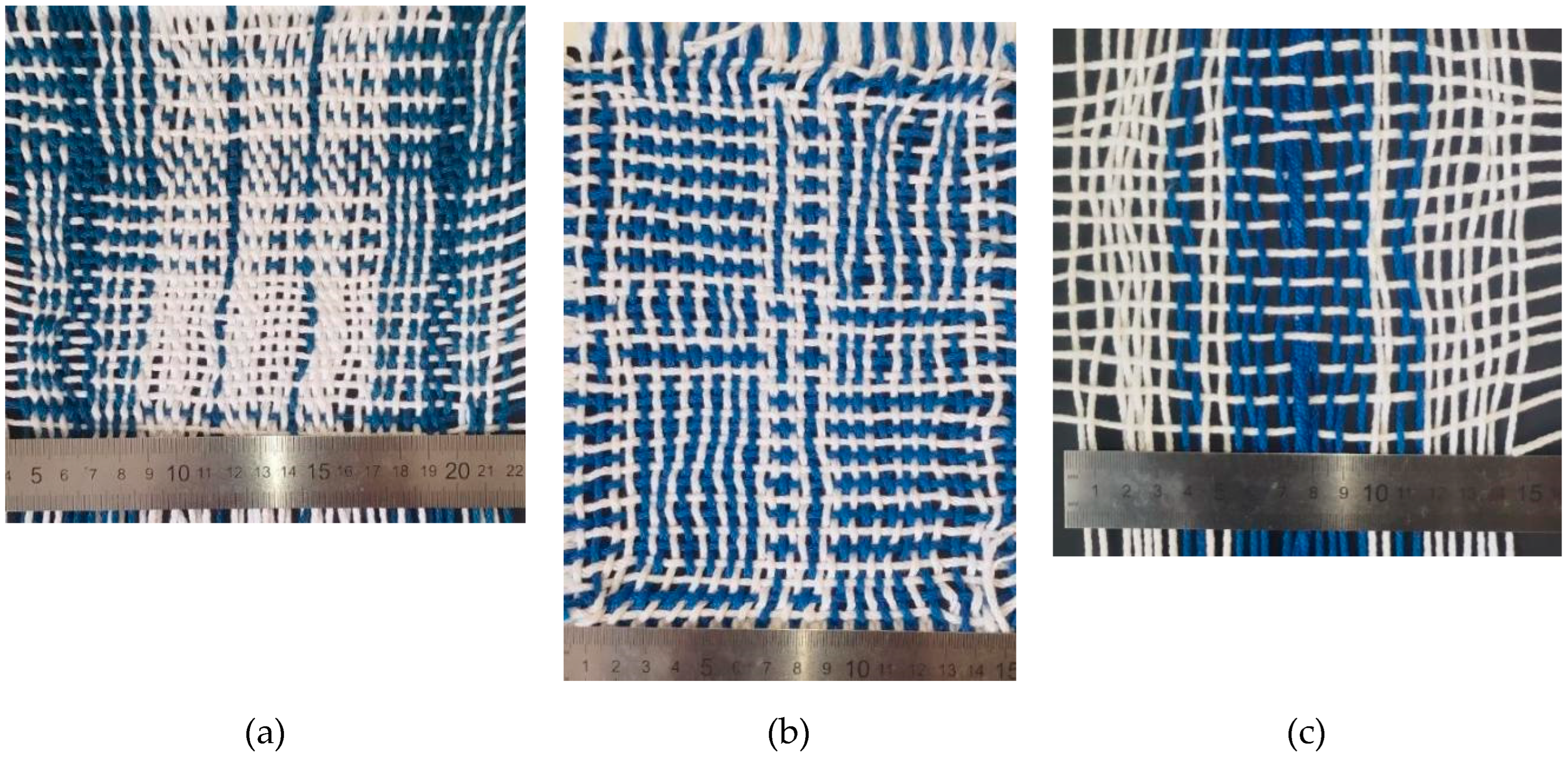
Figure 4.
(left to right) Real images and the images generated by basic one modal prompts byMidjourney, Qwen3, ChatGPT, DouBaoAI and HailuoAI.
Figure 4.
(left to right) Real images and the images generated by basic one modal prompts byMidjourney, Qwen3, ChatGPT, DouBaoAI and HailuoAI.
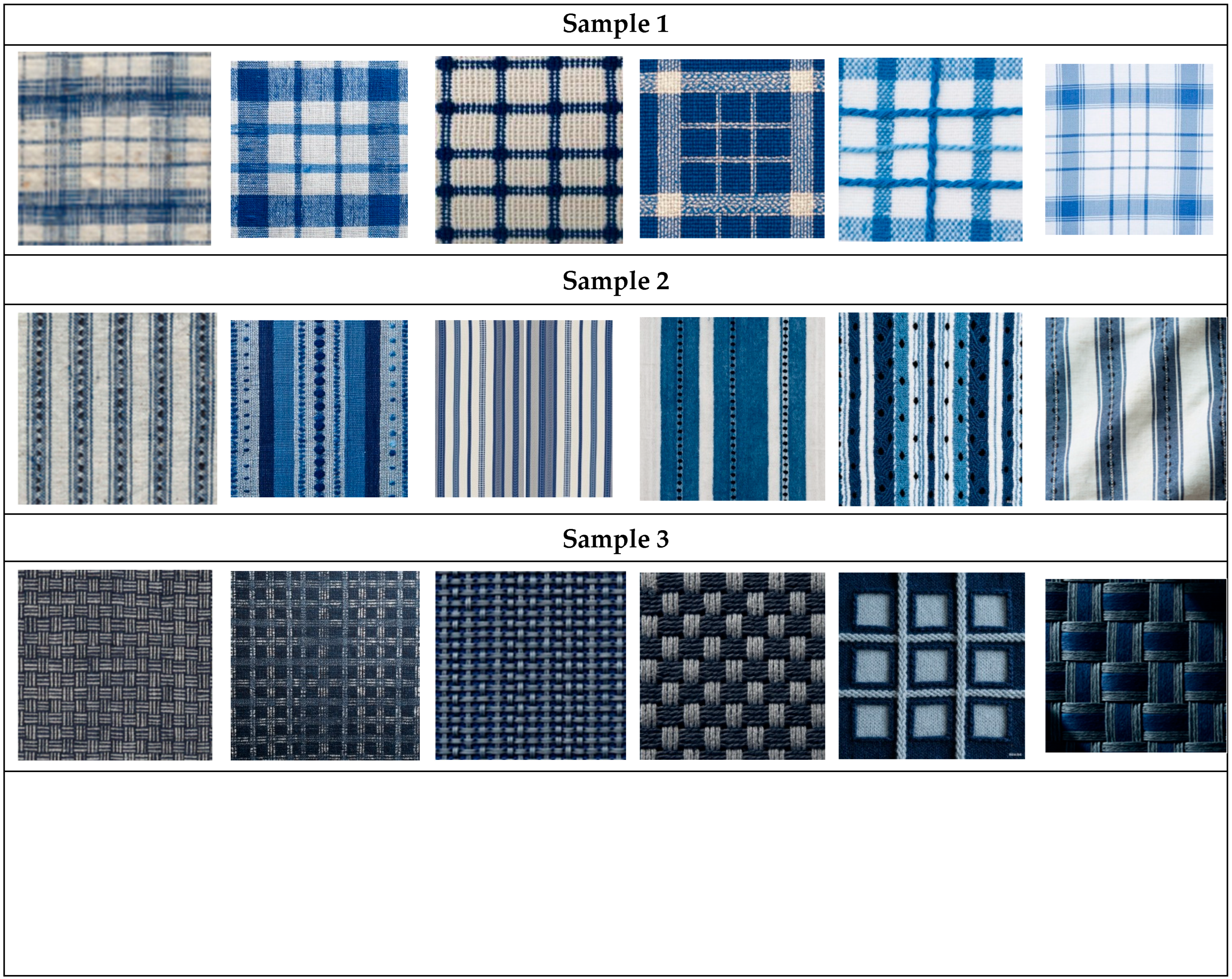
Figure 6.
Comparative radar chats for basic one modal prompt 1 (a) and improved bimodal prompt 2 (b).
Figure 6.
Comparative radar chats for basic one modal prompt 1 (a) and improved bimodal prompt 2 (b).
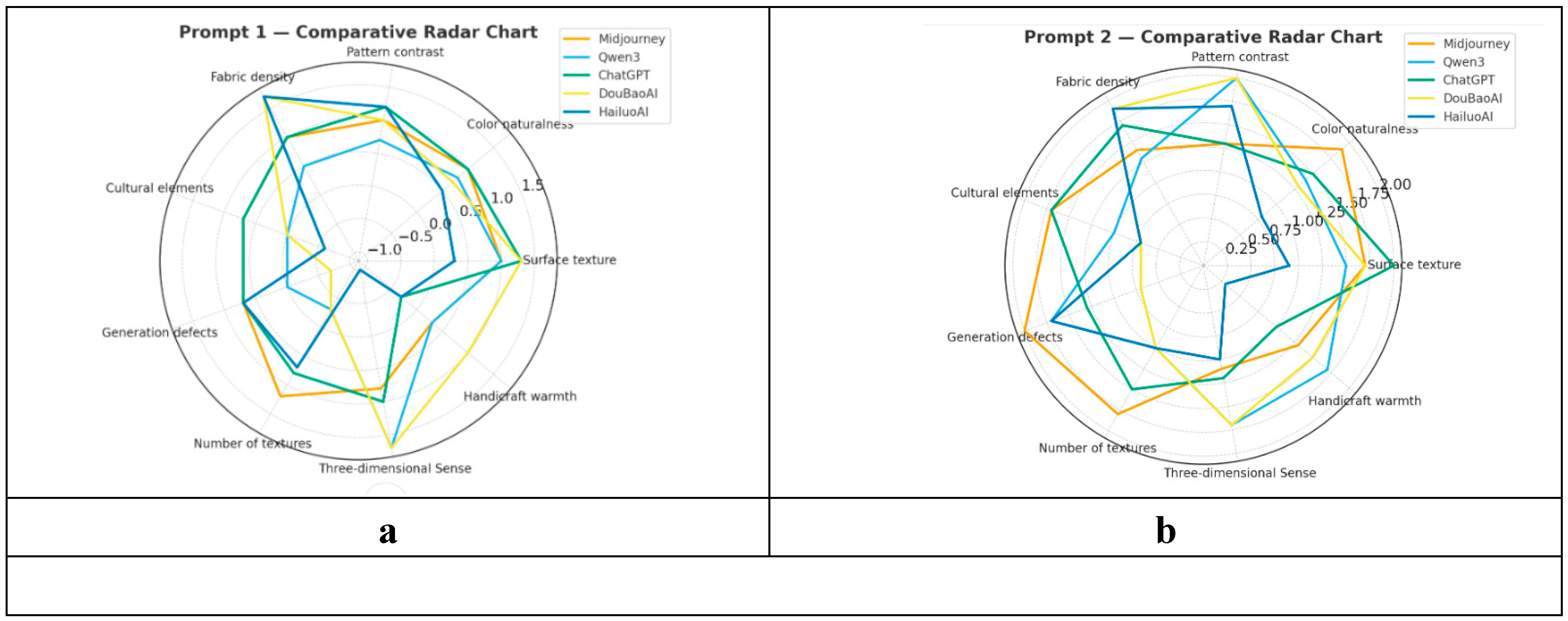
Figure 7.
shows how the improving of basic prompt influences on visual replicas quality.
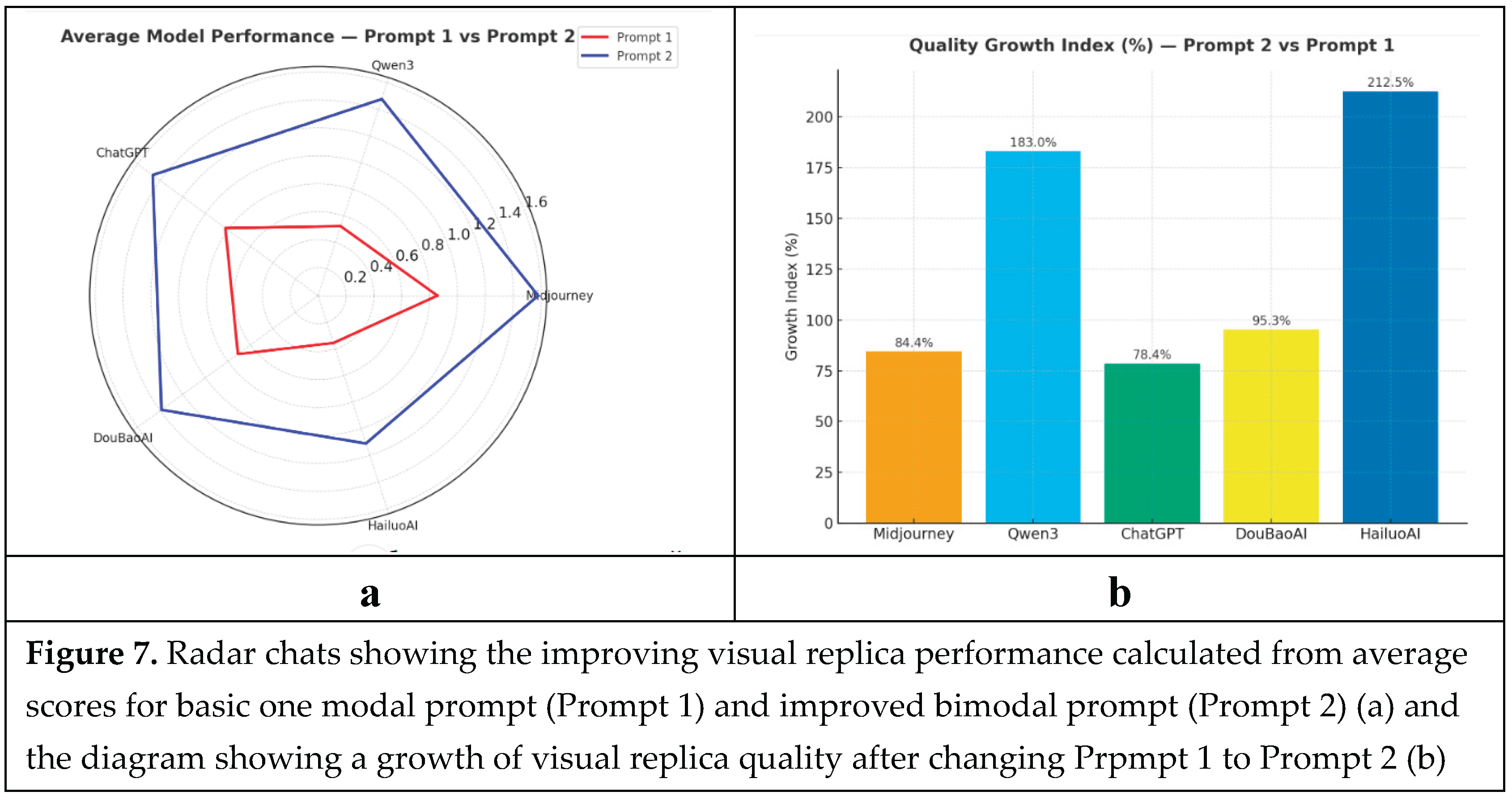

Table 1.
Flowchart of research of Step 1.
| No. | Steps | Detailed description |
|---|---|---|
| 1 | Data collection and processing | Physical characteristics: Collect data on the physical properties of various fabrics, such as fiber composition, thickness, weight, and elasticity. These quantitative data are obtained through laboratory measurements—for example, determining fiber composition using a fiber analyzer and measuring fabric thickness with a thickness gauge. |
| Visual features: High-resolution images of fabric samples can be analyzed to extract critical visual attributes, such as color and texture. Color features can be quantified by Pantone color, and texture features can be extracted with the help of image processing algorithms. | ||
| 2 | Semantic data collection | The semantic difference scale is employed to systematically quantify subjective user perceptions of textile materials. design a carefully curated set of bipolar adjective pairs (e.g., “soft-hard”) that comprehensively capture tactile, visual and functional fabric attributes. |
| 3 | Data processing | The abnormal values and abnormal expressions in the understanding of collected fabric feature data are removed through preliminary AI experiments. For numerical fabric feature data and semantic data, standardize processing to make them have a unified dimension. |
| 4 | Feature selection and extraction | The preprocessed fabric characteristic data undergoes rigorous feature selection and extraction to effectively reduce the dimensionality of irrelevant descriptors and retain the most representative features. These optimized features are used as input variables for subsequent attribution analysis. |
| 5 | Attribution evaluation and optimization | The trained model establishes mapping relationships between fabric characteristics and user semantic perceptions. For instance, the model may learn positive correlations between specific fiber compositions and perceptual descriptors like “softness”. The constructed prompt words are evaluated to measure the model performance with indicators such as accuracy and error. Based on the evaluation results, adjust the parameters or structure of the prompt words to optimize AI performance to ensure that the AI can accurately attribute the relationship between fabric features and user semantic perception. |
Please highlight c
Table 2.
Basic characteristics of the fabrics.
| Characteristic | Value | |||
|---|---|---|---|---|
| sample 1 | sample 2 | sample 3 | ||
| 1 | Interweave Type | plain weave | plain weave | plain weave |
| 2 | Density, yarns/1 cm: wrap weft |
21 17 |
18 15 |
22 22 |
| 3 | Strength | high | medium | medium |
| 4 | Relief | smooth | smooth | textured |
| 5 | Pantone code | 19-3830TCX | 19-3830TCX. | 19-3830 TCX |
| 6 | Cotton content, % | 100 | 100 | 100 |
Table 3.
Basic features of the both prompts.
| Comparison dimensions | Basic one modal prompt | Improved bimodal prompt |
|---|---|---|
| Degree of information quantification | There is no quantitative data, only qualitative descriptions such as "thin stripes" and "large checks" | Use a large number of specific numbers (such as the number of yarns, stripe width) to precisely define the size and distribution |
| Pattern structure disassembly | Only describe the overall pattern shape (such as "forming a nine - grid", "grid - like structure"), without regional subdivision | Divide the pattern into specific areas (four corners and quadrants, left and right sides), and clarify the yarn composition and interweaving rules of each area. |
| Depth of Process Details | Only mention "warp and weft interweaving" and "handmade", without specific description of the weaving method | Supplement the alternating interweaving methods of weft and warp yarns, as well as the yarn connection logic (such as dot - shaped yarn connection), and clarify the process types such as "plain weave". |
| Expression logic and framework | The information is fragmented. Simply list it according to "fabric - pattern - shooting - texture" | The structure is clear. First, disassemble the composition details of each part of the fabric, and then explain the shooting and visual conditions to form a logical chain of "part - whole". |
| Design concept extraction | There is no clear design concept, only vague associations such as "similar to traditional Chinese geometric patterns" are mentioned. | Put forward structured concepts such as "symmetric grid" to strengthen the systematicness and regularity of the design. |
Table 4.
Content of the prompts.
| Sample | Basic one modal prompt | Improved bimodal prompt |
|---|---|---|
| 1 | Hand-woven fabric. The fine blue stripes cross the middle to form a large white lattice, Blue is Pantone 19-4053 TCX. and there are two horizontal lines and two longitudinal indigo yarns in the large white lattice, forming nine checks within the white lattice. The blue yarn weave pattern is dotted and the blue and white weave check. The texture is delicate, the vertical shooting angle is uniform, and the light is uniform. It can be seen that the warp and weft are intertwined, with handmade natural imperfections. | It is hand-woven fabric. Blue stripes intersect centrally to form a large white square grid composed of 22 yarns per side, with the blue corresponding to Pantone 19-4053 TCX. The large white grid incorporates two horizontally aligned blue yarns and two vertically aligned blue yarns, systematically distributed to form a nine-cell matrix. The corner square patterns of this matrix are structured as follows. Upper-left quadrant is composed of three vertical white yarns interspersed with four vertical dark blue yarns. Upper-right quadrants composed of three horizontal white yarns. Lower-left quadrant is composed of three horizontal white yarns. Lower-right quadrant is composed of three vertical white yarns separated by four vertical dark blue yarns. Each weft yarn interlaces alternately over and under individual warp yarns. The corner square patterns are interconnected by dotted-line configured yarns. Balanced yarn thickness ensures chromatic presentation in a symmetrical grid formation. Imaged from a vertical downward perspective under even illumination, the fabric reveals meticulously interlaced warp and weft threads, preserving artisanal imperfections inherent to hand-weaving techniques. |
| 2 | The linen fabric has vertical stripes in deep indigo and white, and the pattern is an intricate weave of different shades of blue lines. Blue is Pantone 19-4053TCX. Each blue stripe has regularly spaced black dot braided holes that form a dotted pattern that removes color from the material to create a negative space design. There is also a pinstripe on each side of the main stripe. The fabric is laid flat. Shoot vertically downwards with even lighting. It can be seen that the warp and weft are intertwined, with handmade natural imperfections. | A handcrafted plain white cotton fabric serves as the base, featuring a vertical blue stripe with a width of 9 warp yarns. At the center of this blue stripe, a black-and-white dotted line is formed by interwoven black yarns. On both sides of the blue stripe, spaced 3 white warp yarns apart, there are thin blue lines each with a width of 2 warp yarns, resulting in three vertical blue lines in total. The white and blue colors (Pantone 19-4053TCX) are woven using warp and weft yarns of identical thickness. Balanced yarn thickness ensures chromatic presentation in a “symmetrical grid” formation. Imaged from a vertical downward perspective under even illumination, the fabric reveals meticulously interlaced warp and weft threads, preserving artisanal imperfections inherent to hand-weaving techniques. |
| 3 | A two-tone weave pattern in dark blue and gray with lines in different directions, The dark blue color is Pantone 19-3831 TCX. A small square pattern, three vertical and three horizontal gray yarns are intertwined to form a checkerboard-like staggered distribution, with dark blue as the base color. Soft light creates soft shadows on the surface, accentuating its intricate design. The top-down view captures the complete distribution across the entire canvas, showing a seamless arrangement of threads in a symmetrical manner. It can be seen that the warp and weft are intertwined, with handmade natural imperfections | The handmade plain weave pattern consists of four parts, the upper left is composed of three vertical white warp yarns spaced by four vertical dark blue warp threads, the upper right is composed of three horizontal white warp yarns spaced by four horizontal dark blue weft yarns, the lower left is composed of three horizontal white warp yarns interspersed with four horizontal dark blue warp yarns, and the lower right is composed of three vertical white warp yarns composed of four vertical dark blue warp intervals. The shooting angle is vertically downward, and the light is evenly balanced. It can be seen that the warp and weft are intertwined, with handmade natural imperfections. |
Table 5.
SDC for visual replica evaluation.
| Evaluation Dimension | Severely Inconsistent | Obvious Defect | Basic Compliance | Good Performance | Perfect Restore |
| -2 | -1 | 0 | +1 | 2 | |
| A. Visual effects | |||||
| 1. Surface Texture | Smooth as silk, without three-dimensional sense | Slight sense of concavity and convexity (concavity-convexity), similar to cheap cotton fabric | Shallow grooves visible, but without "roughness" | Clear nodules, occasional traces of hand-spun yarn | Strong "bark-like" concave and convex with deep grooves and knots prominent |
| 2. Color Naturalness | Dazzling fluorescent blue/false black | Oversaturated indigo or grayish black | Close to Pantone standard but with a plastic-like feel | Natural dye tones, slight color spots | The earth tone of indigo is the same as the Pantone color number, and there is a natural transition between black and white |
| 3. Pattern Contrast | Stripes blurred and difficult to distinguish | Blurred boundaries (>1mm transition zone) | Clear demarcation but without sharpness | Sharp edges, excessive is more natural | Knife-like precision of color block demarcation |
| 4. Fabric Density | Translucent to see the background (sparse like a net) | Local yarn gaps visible | Minimum gaps (similar to denim) | Tightly knitted, unevenly distributed locally | The structure is compact and evenly distributed |
| 5. Cultural Elements | Abstract patterns, irrelevant to Hong’an homespun | Stripes with distorted proportions | Basic patterns correct but without cultural details | Traditional stripes/grids + hints of weaving tools | Typical pattern background element |
| 6. Generation Defects | Obvious repeated patterns/digital noise | Local deformation or blurring | Slight edge defects | 1-2 minor flaws | Zero defects |
| B. Structure | |||||
| 7. Number of textures | The number of textures varies greatly from the number needed | The number of textures is quite different from the number required | The number of textures varies quite a bit from the number needed | The number of textures is less than what is needed | The number of textures is the same as the required number |
| C. Properties | |||||
| 8. Three-dimensional Sense | Completely flat 2D effect | Faint shadows visible when magnified | Medium depth, main grooves with shadows | Strong yarn projection under side light | 3D tactile "on paper" |
| 9. Handicraft Warmth | Industrial perfectionism (flawless) | Excessively regular, mechanical symmetry | Slight changes in yarn thickness | Visible hand-knotted nodules/asymmetric beauty | Vivid irregularities: burrs, uneven dyeing, etc |
Table 6.
SDC scores for different AIs images generated by basic one modal prompt.
| Criteria | Sample | Scores | Average score | ||||
| Midjourney | Qwen3 | ChatGPT | DouBaoAI | HailuoAI | |||
| 1.Surface texture | 1 | 1 | 1 | 1 | 1 | 0 | 1 |
| 2 | 2 | 1 | 1 | 1 | 0 | ||
| 3 | 0 | 1 | 2 | 2 | 1 | ||
| average score | 1 | 1 | 1.3 | 1.3 | 0.3 | ||
| 2.Color naturalness | 1 | 1 | 1 | 1 | 1 | 0 | 0.8 |
| 2 | 0 | 1 | 0 | 0 | 1.5 | ||
| 3 | 1.5 | 1 | 1.5 | 1 | 0 | ||
| average score | 0.8 | 1 | 0.8 | 0.7 | 0.5 | ||
| 3.Pattern contrast | 1 | 1 | 1 | 1 | 1 | 1 | 1.2 |
| 2 | 2 | 1 | 1 | 1 | 1.5 | ||
| 3 | 0 | 0 | 1.5 | 1 | 1 | ||
| average score | 1 | 0.7 | 1.2 | 1 | 1.2 | ||
| 4.Fabric density | 1 | 1 | 0.5 | 1 | 2 | 2 | 11.2 |
| 2 | 1 | 1 | 2 | 1 | 2 | ||
| 3 | 1 | 0 | 0 | 2 | 1 | ||
| average score | 1 | 0.5 | 1 | 1.7 | 1.7 | ||
| 5.Cultural elements | 1 | 1 | 0 | 1 | 0 | -1 | 0.2 |
| 2 | 1 | 0 | 0 | 0 | 0 | ||
| 3 | 0 | 0 | 1 | 0 | -1 | ||
| average score | 0.7 | 0 | 0.7 | 0 | -0.6 | ||
| 6.Generation defects | 1 | 0 | 0 | 1 | 0 | 1 | 0.3 |
| 2 | 1 | 0 | 0 | -1 | 0 | ||
| 3 | 1 | 0 | 1 | -1 | 1 | ||
| average score | 0.7 | 0 | 0.7 | -0.7 | 0.7 | ||
| 7. Number of textures | 1 | 2 | -1 | 1 | 0 | 1 | 0.4 |
| 2 | 1 | 0 | 1 | 0 | 1 | ||
| 3 | 0.5 | 0 | 0.5 | -1 | 0 | ||
| average score | 1.2 | -0.3 | 0.8 | -0.3 | 0.7 | ||
| 8.Three-dimensional Sense | 1 | 1 | 2 | 1 | 2 | -1 | 1 |
| 2 | 1.5 | 1 | 0 | 1 | -2 | ||
| 3 | 0 | 2 | 2 | 2 | 0 | ||
| average score | 0.8 | 1.7 | 1 | 1.7 | -1 | ||
| 9.Handicraft warmth | 1 | 1 | 0 | -1 | 1 | 0 | 0.2 |
| 2 | 1 | 1 | 0 | 1 | -1 | ||
| 3 | 0 | 0 | 0 | 1 | 0 | ||
| average score | 0.3 | 0.3 | -0.3 | 1 | -0.3 | ||
| Average score | 0.8 | 0.5 | 0.8 | 0.7 | 0.4 | 0.6 | |
Table 8.
Comprehensive Score Ranking of AI by basic prompts.
| AI | Comprehensive average score | Strong ability | Weak ability |
|---|---|---|---|
| Midjourney | 0.8 | Surface Texture, Pattern Contrast, Cultural Elements | Three-Dimensional Sense, Handmade Texture |
| ChatGPT | 0.8 | Color Naturalness, Texture Quantity, Cultural Elements | Pattern Contrast, Three-Dimensional Sense |
| DouBaoAI | 0.7 | Fabric Density, Generation Defect Control | Cultural Elements, Handmade Texture, Texture Quantity |
| Qwen3 | 0.7 | Three-Dimensional Sense, Generation Defect Control | Fabric Density, Cultural Elements |
| HailuoAI | 0.4 | Pattern Contrast, Fabric Density | Generation Defects, Texture Quantity, Three-Dimensional Sense |
Table 9.
Comprehensive score ranking of AI by bimodal prompts.
| AI | Comprehensive Average Score | Strong ability | Weak ability |
|---|---|---|---|
| ChatGPT | 1.5 | Surface Texture, Pattern Contrast, Cultural Elements | Three-Dimensional Sense, Handmade Texture |
| Midjourney | 1.6 | Color Naturalness, Texture Quantity, Cultural Elements | Pattern Contrast, Three-Dimensional Sense |
| DouBaoAI | 1.4 | Fabric Density, Generation Defect Control | Cultural Elements, Handmade Texture, Texture Quantity |
| Qwen3 | 1.5 | Three-Dimensional Sense, Generation Defect Control | Fabric Density, Cultural Elements |
| HailuoAI | 1.1 | Pattern Contrast, Fabric Density | Generation Defects, Texture Quantity, Three-Dimensional Sense |
Table 10.
The structure of rational prompt.
| Prompt element | An example/writing guide |
|---|---|
| positive prompt (what should be included) | |
| Fundamental description | Seamless textile surface with a pattern based on the provided repeat unit image. Photorealistic macro shot. |
| Condition | maintain the composition from the micro-model. |
| Fabric type | satin silk, 3/1 twill (denim-like texture), herringbone wool tweed, twill 3/1, satin 5-harness, herringbone, basket weave, jacquard. |
| Colors and color ratios | deep indigo blue (#0A1E6B) and natural off-white (#F9F9F4). Exact color relationships: [color 1] and [color 2/3]. |
| Weave structure | 3/1 twill weave, 5-harness satin weave, herringbone, basket weave, jacquard. Repeat structure by quadrants (2x2) with alternating stripe orientation: vertical warp stripes in three quadrants, horizontal weft stripes in one quadrant. |
| Fabric parameters | Density: ~5–7 threads per cm, clear geometric rhythm. |
| Surface texture | Texture character: [light nap/silky sheen/matte graininess], [S or Z twist], micro-fibers, slightly uneven thickness, natural crossings and overlaps. [If needed: pronounced diagonal ridges for twill / V-shaped 'herringbones' / smooth mirror-like surface for satin / raised patterns for jacquard]. Controlled shadows between threads, readable over-under intersections. |
| Weave characteristics | Plain weave with visible thread interlacing, minor manual irregularities in thread thickness and tension |
| Lighting | [soft/hard] [direction] light, natural color rendition, shallow depth of field, muted background in highlights. |
| Final appearance | Square repeat unit laid flat, symmetrical, with clear edges, no folds, no imitation of fabric draping, and no background interference |
| negative prompt (what should be excluded) | |
| Exclude the following elements and styles: cartoon or illustrative style, vector graphics, 3D render, plastic look, glossy tubes, wireframe models, perfectly even lines, flat fills, embroidery, knitting or stitching effects, text, logos, watermarks, visible pattern seams, excessive sharpness, digital noise, blurriness, and low resolution | |
Disclaimer/Publisher’s Note: The statements, opinions and data contained in all publications are solely those of the individual author(s) and contributor(s) and not of MDPI and/or the editor(s). MDPI and/or the editor(s) disclaim responsibility for any injury to people or property resulting from any ideas, methods, instructions or products referred to in the content. |
© 2026 by the authors. Licensee MDPI, Basel, Switzerland. This article is an open access article distributed under the terms and conditions of the Creative Commons Attribution (CC BY) license (http://creativecommons.org/licenses/by/4.0/).
Copyright: This open access article is published under a Creative Commons CC BY 4.0 license, which permit the free download, distribution, and reuse, provided that the author and preprint are cited in any reuse.


