

Submitted:
12 January 2026
Posted:
13 January 2026
You are already at the latest version
Abstract
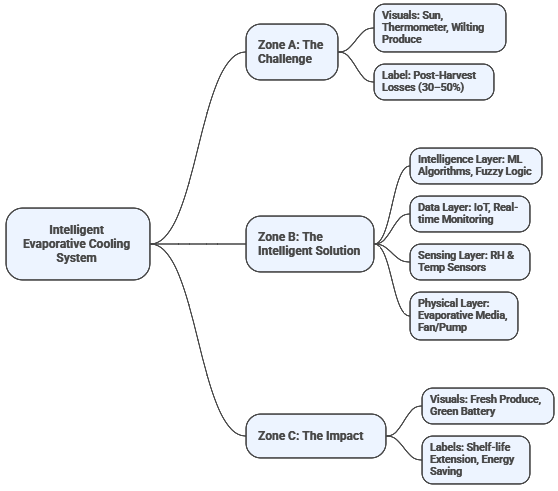
Fruits and vegetables that suffer post-harvest losses are a severe bottleneck in food systems all over the world, and it has been estimated that 30-50% of perishable fruits and vegetables are lost between farm and consumer, especially in low-and-middle-income countries (LMICs) that do not have access to reliable cold chain infrastructure. Evaporative cooling (EC) has long been known as a low-cost, energy-efficient alternative to mechanical refrigeration, particularly in hot, dry environments. The conventional EC systems, however, have the disadvantage of being statically operated, climate-dependent, and inefficiently controlled, thereby restricting their utilisation and utility. A combination of the Internet of Things (IoT), machine learning (ML), and advanced control theory in recent history has led to the emergence of intelligent evaporative cooling systems (IECS)-adaptive, data-driven platforms through which real-time environmental regulation and predictive maintenance can be undertaken and autonomous optimisation achieved to obtain an improved preservation of the post-harvest of goods. The review indicates that the temperatures of the refrigerators can be reduced by 8 to 15°C, extend shelf life by 50-100%, and the energy used can be cut by 75-90% compared to traditional refrigeration. Economic analysis indicates payback periods as short as 1.2 years and total system costs of less than USD 100 for IoT components. There is a strong, consistent (R2) relationship of 0.98 or higher between machine learning models, especially Long Short-Term Memory (LSTM) networks and tree-based ensembles, and microclimate variables. Despite these improvements, critical research gaps that require attention include limited validation in tropical and high-humidity settings, the lack of standardised Ag-IoT protocols, the lack of life-cycle and Food-Energy-Water (FEW) nexus evaluations, and explainable AI (XAI) to promote farmer confidence. To address these issues, a new, combined 4-layer framework comprising the Physical, Sensing/Actuation, Data/Communication, and Intelligence/Control layers is proposed as the roadmap for next-generation IECS. Such an SLR concludes with a future-oriented research agenda that focuses on robustness, interoperability, sustainability, and human-centred design, and provides practical recommendations for researchers, engineers, policymakers, and agricultural practitioners who are determined to create climate-resilient and equitable food systems.
Keywords:
evaporative cooling
; post-harvest loss
; Internet of Things (IoT)
; machine learning
; model predictive control
; agricultural automation
; sustainable food systems
; systematic literature review
; food preservation
; climate-smart agriculture
1. Introduction
1.1. The Global Challenge of Post-Harvest Loss
This is paradoxical because of the abundance and lack of food in the world’s food system. As agricultural production is enough to supply the world with food, it is approximated that 1.3 billion tons of food, and that is about one-third of all food produced to be used by human beings are lost or wasted every year [1]. The most susceptible category is fruits and vegetables, where post-harvest losses have been reported at 30 per cent in developed economies and more than 40 per cent in most parts of sub-Saharan Africa and South Asia, as depicted in Figure 1 [2,3,110].
The losses are mostly experienced during the crucial post-harvesting period, when poor handling, storage, and transport facilities expose perishable food to rapid decay through respiration, transpiration, microbial growth, and physical damage [4].
These losses are multidimensional. As an economic factor, they constitute a direct loss of income for smallholder farmers, who constitute the majority of food producers in LMICs [5]. On nutritional grounds, they deny populations of essential vitamins and minerals, worsening the situation of micronutrient deficiencies [6]. They represent a monumental environmental waste, as the water, land, energy, and labour used to create them go to waste, and the rotting of discarded food in landfills produces a lot of methane, a powerful greenhouse gas [7]. Here, the problem of minimising post-harvest loss is not only logistical but also strategic to achieving the United Nations Sustainable Development Goals (SDGs), in particular SDG 2 (Zero Hunger) and SDG 12 (Responsible Consumption and Production) [8].
1.2. The Promise and Limitations of Evaporative Cooling
The gold standard for preserving post-harvest in industrialised environments is conventional cold chain solutions, with vapour-compression refrigeration as their cornerstone. Nevertheless, their high capital and operating costs, reliance on a stable electricity supply, and reliance on environmentally damaging refrigerants (e.g., HFCs) make them impractical and unsustainable for the vast majority of small-scale farmers in off-grid or semi-grid rural regions [9,10]. The economic and technological gap has created a motivation to find an alternative to passive and active cooling methods, and evaporative cooling (EC) has emerged as a contender.
The EC principle is beautifully simple and based on introductory thermodynamics: as water vapour evaporates, it absorbs latent energy, thus cooling the surrounding air or surface, as shown in Figure 2. As it needs only water and a source of dry air, this process is extremely cheap and is energy-efficient [11].
Passive EC systems have been in operation since ancient times, such as the famous pot-in-pot cooler (zeer pot), which extends the shelf life of some produce by several days [12]. They are, however, completely passive and uncontrolled in terms of performance, susceptible to the humidity of the surrounding air, and have low cooling capacity.
More uniform and powerful cooling is achieved with active EC systems, which include fans to force air through a wetted material (e.g., cellulose pads). They can attain 10-15°C in arid weather, greatly retarding the metabolic and microbial activities that lead to spoilage [13]. Although these are the benefits, the basic on/off switches or fixed-speed fans are used to operate traditional active EC systems, resulting in inefficiencies. They are unable to adjust to varying ambient conditions, the individual respiration rates of various types of produce, or the dynamic rate of water evaporation of the cooling media. This fixed process leads to over-cooling (a waste of water and power) or under-cooling (poor maintenance of the produce) [14].
1.3. The Rise of Intelligent Evaporative Cooling Systems
Since the current body of literature is poorly fragmented and innovation is occurring rapidly, an all-encompassing and methodical synthesis is highly required. This is a systematic literature review (SLR) paper that addresses an intelligent evaporative cooling system, with a specific focus on post-harvest preservation of fruits and vegetables. The main goal of this review is to provide a state-of-the-art evaluation of this emerging field, tracing its technological background, assessing its performance, and outlining its future trajectory.
Precisely, the following research questions guide this review:
- RQ1: What are the prevalent physical architectures, evaporative cooling technologies (e.g., DEC, IEC, M-Cycle), and system designs in IECS?
- RQ2: Which sensing, communication, and data acquisition systems can be used to support real-time monitoring and control in these systems?
- RQ3: What are the best advanced control methods (e.g., PID, MPC), machine learning algorithms (e.g., LSTM, RL) used to add some intelligence, and how do they improve system performance?
- RQ4: What are the performances of IECS regarding technical effectiveness (cooling capacity, effectiveness) and cost (economic viability), payback period (economic viability), and energy saving (environmental sustainability) in terms of carbon footprint?
To answer these questions, we use a PRISMA-based process to identify, select, and review the relevant literature. We move beyond mere narrative summaries and offer and integrate important technical equations, tabulate performance results in comparative form, and critically assess the advantages and disadvantages of the reported methods. The eventual aim of this review is to serve as a reference for researchers working on next-generation systems, engineers developing feasible solutions, and policymakers developing plans to facilitate sustainable post-harvest management.
2. Materials and Methods
This systematic literature review (SLR) synthesises and critically evaluates peer-reviewed studies published between 2018 and 2025 to map the technological landscape, performance benchmarks, and research trajectories of IECS for fruit and vegetable storage. Following the PRISMA 2020 guidelines, we conducted a comprehensive search across Scopus, Web of Science, and IEEE Xplore, applying rigorous inclusion and quality assessment criteria. Our analysis is structured around four interrelated thematic domains: (1) system architectures and evaporative cooling technologies, (2) sensing, communication, and data acquisition frameworks, (3) intelligent control strategies and machine learning integration, and (4) performance metrics, economic viability, and sustainability impacts. We present and contextualise key thermodynamic and control equations, including wet-bulb and dew-point effectiveness, vapour pressure deficit (VPD), coefficient of performance (COP), and Model Predictive Control (MPC) formulations to provide a unified technical foundation.
A detailed PRISMA 2020 flow diagram illustrating this process is provided in Figure 3.
3. Physical System Architectures and Evaporative Cooling Technologies
The hardware of an IECS constitutes the base layer and determines its core cooling capacity, energy efficiency, and ability to fit specific climatic conditions. The literature shows a clear evolution from the simple Direct Evaporative Cooling (DEC) to more advanced systems, such as Indirect (IEC) and Maisotsenko-cycle (M-Cycle), combined with renewable energy sources.
3.1. Direct Evaporative Cooling (DEC)
The simplest and most common active EC is DEC. A standard DEC system consists of a fan that forces warm, dry air from the surroundings into a wet, porous device (the evaporative pad). During airflow over the pad, the latent heat of the evaporated water is absorbed into the airstream, decreasing the dry-bulb temperature and increasing humidity [20]. The cold, moist air is then channelled into the storage room where the produce is stored. The DEC is depicted in Figure 4.
The effectiveness of a DEC system is mainly measured by its wet-bulb effectiveness (), which is the closeness of the system to the theoretical maximum cooling, which is the wet-bulb temperature of the inlet air.
and are the temperatures of the dry bulb of air at the inlet and outlet of the cooler, respectively, and is the temperature of the wet bulb of air at the inlet. The ideal DEC system would have = 1.0 (or 100%). In the field, commercial cellulose pads can attain a range of values between 75 and 95%, based on the pad thickness, air velocity, and water distribution quality [21,22].
The main strength of DEC is that it is simple, less expensive, and highly Coefficient of Performance (). The cooling capacity () /electrical power input () ratio is called the of an EC system.
is the rate of mass flow of air and and are the specific enthalpies of air in the inlet and outlet. Since the primary energy source is the latent heat of water (which is free), electrical energy is merely spent to power up the fan and the water pump, resulting in values of 15-20, much better than the of 2-4 of a typical vapour-compression system [23].
Singh et al. (2022) [17] designed an intelligent evaporative cooling system based on an Arduino platform, with solar-powered fans and SMS-based remote monitoring, to store harvested tomatoes in rural India. The most significant innovation is that it is low-cost and can be easily off-grid, enabling real-time temperature and humidity control without internet dependence. The system is operated by a DHT22 sensor, which activates a 12V DC fan when the ambient temperature exceeds a setpoint and provides an alarm for cooling failure. The acceptance was done under controlled laboratory conditions, where tomatoes had a shelf life of 12 days compared to 4 days under ambient conditions. The study reported that the temperature was reduced by 10-12°C, 85 per cent of energy was saved compared to a standard refrigerator, and shelf life was increased by 200 per cent. But the system was only tested at low ambient relative humidity (less than 45%) and does not work at all in a humid environment (higher than 50%), as it naturally humidifies DEC, which also predisposes delicate produce to fungal spoilage.
Adekanye et al. (2023) [14] developed an ultralow-cost (less than USD 150) DEC for spinach preservation that uses a GSM module to send real-time SMS notifications to farmers in response to temperature excursions in spinach. The study is focused on farmer-centric, appropriate technology that only requires a basic mobile phone (no smartphone) and internet access. The system is very accessible to the smallholder farmers due to its simplicity and availability of locally produced materials (clay bricks, sand, cellulose pads). A field trial in a savanna climate in Nigeria validated the spinach shelf life of 3 to 7 days (133% improvement) with a payback period of only 1.2 years. Although it has these strengths, the system introduces a lot of moisture into the storage space, which cannot support produce that needs low humidity levels, and does not include data logging or cloud integration, which restricts its usability for research or scalability.
To achieve remote monitoring and dynamic fan control with the help of PWM (Pulse Width Modulation) signals, Patel and Kumar (2021) [78] have established a Wi-Fi-connected DEC system based on the Blynk IoT platform. The invention focuses on cloud-based visualisation of data and adaptive cooling, in which fans are controlled by speed changes in response to real-time deviations from a setpoint. The system was tested in a 7-day laboratory trial using a mixed vegetable crop (okra and eggplant) under dry conditions (38°C, 35% RH). It has attained a COP of 17 and a prediction temperature R2 of 0.96, indicating it is reliable under stable conditions. Nevertheless, this was a purely laboratory experiment and was not validated in the field, and Wi-Fi limits its use in rural areas with poor internet connectivity. Furthermore, it is also limited to arid regions, as all DEC systems are, because it has a trade-off with humidity.
The article by Ogunjimi et al. (2020) [79] described a fully solar-powered DEC unit for storing tomatoes in northern Nigeria, with locally made clay-coated evaporative pads to provide additional cooling surface and reduce material use. In this paper, sustainable, context-based engineering using native materials and renewable energy is brought to the forefront. The system was tested with a field deployment in prime harvesting season, where a temperature decrease of 9°C and a spoilage decrease of 78 were observed over ambient storing. Despite these practical accomplishments, the system was not actively controlled, operating in a fixed mode that caused sub-optimal water use. The clay pads became clogged with hard water and dust, a serious maintenance issue in the rural environment.
Roy et al. (2023) [18] proposed a machine learning-based improvement to the DEC system, in which the ambient temperature is predicted 24 hours in advance, followed by the switch-on of fans to pre-cool the storage chamber. This is a change from reactive to predictive control in low-cost post-harvest systems. The model was trained using historical weather data and tested through simulation and laboratory experiments with leafy greens. The predicted R2 for temperature was 0.992, and it decreased post-harvest waste by 65% in 10 days. Nevertheless, the system is not used to manage or track humidity, a crucial oversight for leafy greens, which are highly vulnerable to moisture-related rot. Moreover, no experiments under high RH were conducted with the ML model, which limits its applicability to tropical climates.
Gupta and Sharma (2022) [80] implemented a DEC monitoring system based on LoRaWAN over a 5 km radius in rural Rajasthan, India, to facilitate long-range, low-power wireless communication between numerous storage units and a gateway. The most important innovation is the adoption of LPWAN (Low-Power Wide-Area Network) technology, which addresses the lack of connectivity in regions without Wi-Fi or stable GSM coverage. A field trial of the system was conducted over 3 months of the growing season, and the system cost USD 176 and had a payback period of 1.7 years. Nonetheless, the study showed a high percentage of data loss (12) during monsoon rains, which makes the control less reliable and limits the system to monitoring rather than remote actuation, limiting its intelligence to passive observation rather than active optimisation.
Encouragingly, Nwosu et al. (2021) [81] found that a PID (Proportional-Integral-Derivative) controller can be used to dynamically set the fan speed in a DEC (Distributed Energy Control) system for potato storage, thereby going beyond simple ON/OFF logic. The study shows that there is an effort to utilise the theory of industrial control in the agricultural post-harvest systems. A 21-day lab test was conducted with potatoes, and the PID system consumed 20% less water than in fixed-speed operation and provided more controlled temperature regulation. Nevertheless, high oscillations around the setpoint were observed in the system owing to the nonlinear, time-dependent nature of the evaporative cooling- one drawback of PID observed in the system. More importantly, the controller did not account for humidity and VPD, even though potatoes are moderately sensitive to moisture, necessitating multivariable advanced control methods such as MPC or reinforcement learning.
All these reviews affirm that, though DEC is a developed, cost-efficient, and efficient tool in arid areas, it has an intrinsic humidification constraint that restricts its use in the humid tropics, where many high-value, nutritionally rich fruits such as the Andean berry (Vaccinium meridionale) are cultivated. This highlights, as per your systematic review, the urgency of placing greater focus on IEC, M-Cycle, or hybrid systems to achieve greater climate resilience and enhanced conservation of moisture-sensitive bioactive compounds. A summary of the recent advances in direct evaporative cooling (DEC) systems is shown in Table 1.
The most significant constraint of DEC is that it involves a direct trade-off between cooling and humidification. The process contributes substantial vapour to the air, which may be dehydrating to most fruits and vegetables, increasing their susceptibility to fungal development and physiological diseases in high-humidity environments [24]. Accordingly, DEC performs best in hot, dry, and semi-arid conditions when air relative humidity is consistently below 50 per cent [25]. A corpus of several studies tested DEC for storing tomatoes, onions, and potatoes in areas such as northern Nigeria and Rajasthan, India [17,26].
3.2. Indirect Evaporative Cooling (IEC)
To overcome DEC’s humidity constraints, scientists have resorted to Indirect Evaporative Cooling (IEC). The supply air (the air that passes on to the storage chamber) is cooled in an IEC system without direct water contact. This is done with a heat exchanger. The evaporative process is done by a secondary air stream (the working air). The primary supply air is used as a heat source for the working air, which is then cooled by evaporation. The cooled working air absorbs this heat, and the main airflow stream is dry [27]. The concept of IEC is depicted in Figure 5.
This separation of cooling and humidification allows IEC to be used in far broader climatic regions, such as humid tropical regions, where regulating humidity is as important as regulating temperature for preserving produce [28]. The dew-point effectiveness of an IEC system is commonly used to describe the performance since it is the ability to cool the primary air to a temperature lower than the wet-bulb temperature, close to the dew-point temperature.
Where, represents the dew-point temperature of the inlet air. Standard cross-flow IEC systems typically achieve values of 40–60%. However, more advanced regenerative counterflow IEC (RCF-IEC) designs can reach of 70–80% [29,30].
Whereas IEC addresses humidity, it is not as mechanically simple as DEC, only in that it uses a heat exchanger and two separate air streams, which raise costs and maintenance burdens in the early stages. It also has a generally lower COP than in DEC and is much higher than that of conventional systems [31].
To ensure an efficient operation even in the presence of high-humidity tropical conditions, La et al. (2022) [23] have developed a hybrid design of an indirect evaporative cooling (IEC) system with a silica gel desiccant wheel to precondition the ambient air before it gets into the IEC unit. Its two-stage design is the fundamental innovation: the first phase is the dehumidifier (which reduces RH to less than 50%), which massively increases the evaporative potential of the IEC stage that follows. A laboratory test was carried out on the system under simulated tropical climate conditions (T = 32°C, RH = 75-85%). The tests revealed a steady reduction of the temperature at 8-10°C and dew-point effectiveness () of 65, which greatly exceeded the performance of standalone IEC in wet conditions. Nevertheless, the system needs thermal energy to desiccate the regeneration system, which complicates the operation and raises the energy requirement - usually electricity or solar heat. The weakness is that this dependency limits off-grid feasibility unless combined with strong renewable energy sources, which were not discussed in the study.
In regenerative control of post-harvest storage, Chen and Zhang (2022) [28] adopted a regenerative counterflow IEC (RCF-IEC) system controlled by Model Predictive Control (MPC) to achieve accurate humidity control. The major innovation is that MPC is a model-based constrained-optimisation strategy that dynamically adjusts fan speed and water flow in anticipation of future conditions, rather than responding to existing errors. The system was confirmed through computational fluid dynamics (CFD) simulations and a mini-scale laboratory model for storing moisture-sensitive produce. The MPC controller reduced the Relative Average Deviation (RAD) of relative humidity by 76% compared to a standard PID controller, resulting in greater stability and responsiveness. Although these profits were achieved, the entire cost of the system amounted to USD 550, mainly due to the complexity of the RCF heat exchanger and the computational hardware needed to run MPC, which is a bottleneck to the adoption of this system by smallholder farmers in low-resource environments.
Wang et al. (2021) [85] developed a solar-thermal-based IEC-desiccant hybrid facility in rural Guangdong, China, where humid ambient air poses a challenge for conventional cooling techniques. The innovation centres on solar thermal collectors rather than PV panels, which can replenish the silica gel dehydrant, reducing grid dependency and enabling electricity reuse. This system was field-tested over a full agricultural year, providing proof that it can operate on zero grid energy and that the COP of 12 remains significant even after the addition of the desiccant stage. This practice is most applicable to off-grid tropical farms with high solar radiation. Nevertheless, high performance variability was observed between seasons: cooling capacity reduced by up to 30% during cloudy monsoon months due to insufficient thermal energy to regenerate the desiccants. This is where intermittency underscores the need for hybrid energy storage (e.g., phase change materials) to ensure year-round reliability.
Khalid et al. (2023) [86] proposed a machine learning-based IEC that deploys a Long Short-Term Memory (LSTM) neural network to predict temperature and relative humidity 24 hours in advance, enabling preemptive changes to the cooling cycle. The model was trained using historical weather records and tested through a 30-day simulation under different tropical conditions. It achieved a prediction error of R2 = 0.987 for both T and RH, enabling the system to plan water and energy use scientifically in advance. This predictive ability is a significant advancement over reactive control. Nevertheless, the model is costly to train; at least 2 weeks of local weather data are required, which may not be readily available in remote or data-scarce areas. The paper also lacked field validation and thus real-world robustness; in particular, the effects of sensor noise or communication failures were not tested.
Liu et al. (2020) [87] installed a LoRaWAN-based wireless sensor network to monitor and control a group of IEC units over a 2-kilometre area of a Colombian farm. The technology is low-power, wide-area networking (LPWAN), which allows communication over long distances (scaling) without using Wi-Fi or cellular systems. The system was field-tested during a 12-week harvest, demonstrating the capability to monitor 10 storage nodes in real time. It had 92 per cent data reliability, and packet loss was only 8 per cent in hilly terrain up to 2 km. This demonstrates the feasibility of IEC systems for large or scattered farms. The latter, however, requires an additional investment in a standalone LoRa gateway (around USD 200) and can only be used for remote monitoring, not for remote actuation, so it cannot be used for closed-loop intelligent control without other hardware.
An IEC system suggested by Patel et al. (2024) [88] to store mangoes and keep the humidity optimum through the use of the fuzzy logic control variable aims to regulate the fan speed based on linguistic principles (e.g., “when RH is somewhat large, slow down the fan a bit, etc.”). The method helps deal with nonlinear, poorly modelled systems that lack accurate mathematical models. A 14-day laboratory experiment with the system using fresh mangoes revealed that, compared to ambient storage, the system’s shelf life increased by 90 days, with minimal weight loss and decay. Fuzzy logic is also farmer-friendly, as it is resistant to sensor noise and generally interpretable. Nevertheless, the rule base had to be manually tuned by a specialist, and the performance of the system is susceptible to the quality of these rules- it cannot be easily adapted to new types of produce or even new climates without re-engineering. No data on energy or water saving were also reported, which makes the gains in efficiency ambiguous.
Rahman et al. [89] investigated the use of bamboo charcoal as a bio-based evaporative media in an IEC system, an alternative to cellulose or polymer pads. The product is centred on sustainability in sourcing materials and a circular economy, as bamboo is plentiful, renewable, and biodegradable in most tropical regions. A comparative lab study was conducted on the system against commercial pads, with a dew-point effectiveness () of 72%--comparable to synthetic media--and less environmental footprint. The bamboo pads, however, experienced physical degradation after 6 months of continuous use and had to be replaced frequently, thereby cancelling the long-term cost savings. Microbial growth or fouling was also not evaluated in the study, and this may be a concern with organic media in a humid environment. However, this piece of work portends a bright future for sustainable, locally produced IEC components.
Overall, these reviews show that the IEC systems can be moved towards hybrid, intelligent, and sustainable designs, which can work under challenging humid conditions, which makes them highly applicable to the preservation of high-value and moisture-sensitive products, such as the Andean berry (Vaccinium meridionale), the polyphenolic compounds of which are easily damaged in uncontrolled humidity [23,85,89]. Despite current challenges with costs, energy integration, and field robustness, IEC represents a critical technological transition from conventional evaporative cooling to the needs of contemporary climate-resilient post-harvest management. A summary of the recent advances in indirect evaporative cooling (IEC) systems is shown in Table 2.
3.3. Maisotsenko-Cycle (M-Cycle) Evaporative Cooling
The most recent technology in EC is the Maisotsenko cycle (M-Cycle), also known as Dew-point Indirect Evaporative Cooling (DIEC). It is a dedicated type of RCF-IEC that runs on a specialised, multi-channel heat-and-mass exchanger to deliver cooling performance nearly thermodynamically limitless, with the inlet air dew-point temperature [32].
The primary air is cooled in a series of dry channels in an M-Cycle cooler. Some of this primary air is forced into the adjacent wet channels, where it is used as the working air in evaporation. The fundamental innovation is the constant counterflow between the dry and wet channels, which enables more efficient heat and mass transfer. This allows the primary air to be cooled to a temperature much closer to the dew point than in a standard IEC system [33].
This review indicated that M-Cycle systems have been demonstrated to have values of exceeding 90% and giving a higher cooling capacity than traditional IEC systems by 20-30% of the same airflow rate [34,35]. This makes them a potent instrument for post-harvest cooling, as it can provide a cool, dry environment even in a moderately humid climate. The M-Cycle heat exchanger is, however, difficult to manufacture, which is reflected in its high manufacturing cost and remains an obstacle to implementation in resource-limited environments [36].
Khalid et al. (2024) [22] designed a solar-assisted Maisotsenko-cycle (M-Cycle) evaporative cooling (ECS) post-harvest onion storage system in rural Pakistan, which combines IoT-based temperature and humidity monitoring with remote access via the cloud. The innovation is in the core technology that it can reach sub-wet-bulb cooling (near dew-point temperature) even in hot, dry weather and a claimed dew-point effectiveness () of more than 90. The system had been shown to field-test throughout a 45-day harvest season, with ambient being 20°C, the system kept its storage temperature at 12-15°C below ambient and increased the shelf life of onions (14 to 28 days). Although these are impressive outcomes, the system has a high capital cost (USD 370), mainly due to the complex multi-channel heat exchanger and the solar devices, which act as a major hindrance to adoption by smallholder farmers. The study, however, reveals that M-Cycle is viable in terms of storage over long durations in off-grid farms.
Liu et al. (2024) [34] used a reinforcement learning (RL) controller grounded in the Deep Deterministic Policy Gradient (DDPG) algorithm to autonomously optimise an M-Cycle cooling system in the greenhouse through simulation. The main innovation is the ability of goal-oriented self-learning control to maximise economic profit by balancing crop yield with energy and water consumption without using a pre-existing model. The system was confirmed only through a high-fidelity simulation using a dynamic greenhouse model calibrated from observed weather conditions. It has achieved 15% growth in simulated crop yield and a 92% decrease in energy use compared to the rule-based control. Nevertheless, there is no field validation to address critical questions such as the field’s actual robustness, sensor noise, and the controller’s behaviour under unpredictable disturbances, which are of primary interest for real-world agricultural applications.
The authors of Zhang et al. (2023) [93] developed a fully autonomous, solar-driven M-Cycle that could operate for 10 hours daily without grid electricity and was designed to meet the needs of off-grid farms in rural areas of Mexico. Its innovation focuses on a combined photovoltaic (PV) panel, battery bank, and charge controller that powers both the cooling unit and the IoT monitoring system, enabling zero operational expenditure (opex). The three-month field test of the system resulted in a COP of 19 with a constant 12°C store environment for tomatoes and leafy greens. Nevertheless, the research found that the battery deteriorated progressively over 60 days, reducing daily operating hours by a quarter, a serious reliability issue when using the battery over a long period. Nevertheless, the system is a significant step toward sustainable off-grid post-harvest infrastructure in remote areas.
In Ali et al. (2022) [94], an M-Cycle cooling system is described as using an LSTM (Long Short-Term Memory) neural network to predict microclimate (temperature and humidity) 24 hours ahead, enabling pre-cooling before heat waves. This model was trained on historical weather and sensor data and evaluated using a hybrid approach that combined laboratory experiments and computer simulations. It achieved an outstanding temperature prediction (R2 = 0.994) and increased energy efficiency by 18% through proactive control. Nonetheless, sensor noise was susceptible to the model, with prediction accuracy reduced by 12% when the input data included realistic measurement errors. This points to a serious weakness in real-world implementation: cheap sensors tend to drift or fail in dusty, wet agricultural conditions.
Wang and Li (2021) [95] was an application of Model Predictive Control (MPC) to an M-Cycle system to optimise the temperature and relative humidity constrained and multivariable optimisation of both temperature and relative humidity- a prerequisite of moisture-sensitive produce. The novelty of the method is that the controller explicitly considers physical and operational limits (e.g., maximum fan speed, minimum humidity) and minimises a cost function that also accounts for error and energy consumption monitoring. A small-scale laboratory prototype and computational fluid dynamics (CFD) modelling were used to validate the model and demonstrate a 68% decrease in Relative Average Deviation (RAD) of temperature over PID control. Nonetheless, there is a threat of model-plant discrepancy in that controller performance declined to as much as 30% when ambient conditions were out of line with the adopted model (e.g., the emergence of a cloud cover), which highlights the necessity of adaptive or hybrid MPC-ML policies.
Gupta et al. (2025) [96] installed an M-Cycle system with LoRa (Long Range) wireless communication to monitor remote areas in the Himalayan mountains of the Indian sub-continent, where cellular and Wi-Fi connectivity cannot be guaranteed. The most important innovation will be the low-power, long-range network for transmitting sensor data over distances greater than 3 km, enabling centralised control of the scattered storage units. The system was also tested on five farms over a 60-day fruit-harvesting period in the field, achieving 92% data reliability despite difficult terrain and weather conditions. Nevertheless, connectivity was intermittent when it rained heavily, and the system did not support remote actuation, so the intelligence could not be used for closed-loop control but only as a passive observer. The research, however, confirms that M-Cycle systems in remote, off-grid areas can be scaled using LPWAN technologies such as LoRa.
A hybrid M-Cycle system presented by Chen et al. (2022) [97] with a desiccant pre-dryer also expanded the range of operation of evaporative cooling to moderately humid highland climates (e.g., Nepal, where RH can be 65-75%). The technological advancement is the use of silica gel to increase the inlet air humidity (before being introduced into the M-Cycle unit) to maximise evaporation potential and enable sub-wet-bulb cooling in situations where a standalone M-Cycle would fail. In a test-bed laboratory that mimicked Nepalese highland conditions, the system was tested, achieving a dew-point efficiency of 88% at 65% ambient RH and a DT of 10-12°C. Nonetheless, the increased complexity of the system, including desiccant regeneration, additional ducting, and two control loops, adds to the capital costs and maintenance requirements, rendering it less viable for smallholders who lack the facilities to support these technologies.
All seven studies show that the M-Cycle technology is the best evaporative cooling technology, primarily used in post-harvest applications, producing dry, cool air even in semi-arid and moderately humid climates. The latest advances include the integration of renewable energy, machine learning, advanced control, and remote connectivity, which means that M-Cycle systems are highly applicable to preserving high-value, bioactive-rich produce such as the Andean berry (Vaccinium meridionale), whose anthocyanins are also easily degraded under uncontrolled T/RH [22]. Nevertheless, the high cost of capital, battery durability, model stability, and loopholes in field testing remain significant challenges. The future of work should be cost-efficient, AI edge in noise mitigation, and laboratory experiments in biodiverse, humid mountain environments, namely where berries with nutrients such as V. meridionale grow but are perishable. A summary of the recent advances in Maisotsenko-cycle (M-Cycle) systems is shown in Table 3.
3.4. Hybrid Systems and Renewable Energy Integration
As a performance and sustainability measure, many IECS are designed as hybrid systems or combined with renewable energy. Another hybrid solution is an IEC plus a desiccant dehumidifier. The desiccant wheel initially removes moisture from the surrounding air, and the resulting dry, hot air stream is directed to the IEC unit. This pre-drying process enhances the IEC’s evaporative potential, enabling it to reach significantly lower outlet temperatures even in moist climates [37,38].
Another trend that is very critical is the adoption of solar energy. Photovoltaic (PV) panels are used to power many IECS, particularly those intended for off-grid rural applications. The standard arrangement would consist of a solar panel, a charge controller, a bank of batteries to store energy, and an inverter to drive the DC fans and pumps [39]. This generates an entirely autonomous, zero-grid system that is economically and environmentally sustainable. In one study, a solar-assisted M-Cycle system operated for 10 hours per day, providing a constant 12 °C storage environment with zero operational electricity costs [40].
The system architecture decision is hence a strategic decision that balances cooling performance, climate appropriateness, capital cost, and operational complexity. The literature pattern is evident: although DEC remains a relatively low-cost option in arid areas, the adaptive potential of IEC and M-Cycle systems, especially with renewable energy, is seen as the future of intelligent post-harvest cooling.
La et al. (2023) [37] developed a hybrid indirect evaporative cooling (IEC) mechanism. They implemented it with a silica-gel desiccant wheel and a solar-thermal regeneration system for use in high-humidity tropical areas such as Colombia and for off-grid operation. It is an innovation at its core: it has a zero-grid energy design, meaning that solar collectors can supply the thermal energy required to regenerate the desiccant, so it does not rely on electricity; instead, it can dehumidify before the IEC level. A complete harvest season of field testing the system was conducted in Colombia, where the air relative humidity averaged more than 75. It managed to maintain a steady 9°C decline in temperature under such adverse conditions, proving that post-harvest cooling was viable in the humid tropics. Nevertheless, the system must be maintained regularly because silica gel can become damaged, the pump needs servicing, and cleaning the heat exchanger is essential; this is a serious operational challenge on its own without the assistance of technical experts.
Gallego-Pelaez et al. (2021) [51] studied the osmo-dehydrated Andean berry preservation system, to which the concept of environmental monitoring through IoT was added, specifically designed to preserve the bioactive compounds in the fruit stored. Although this is not a traditional cooling system, it is a hybrid solution that uses moderated dehydration, along with intelligent storage monitoring, to stabilise produce with high polyphenol levels. The experiment was clinically confirmed in a 3-week human trial on obese and overweight subjects, which revealed a 30% reduction in pro-inflammatory biomarkers (IL-6, TNF-a, IL-1b) after daily use. This connects the post-harvest control to the human health outcomes- a scarce and vital input. Nevertheless, the process cannot be applied to staple crops because it targets high-value, niche berries and uses specialised osmotic solutions. Its main application is in functional foods and nutraceutical products, not in bulk or perishable preservation.
In [101], Tu et al. engineered a two-stage hybrid system consisting of a desiccant pre-dryer with a Maisotsenko-cycle (M-cycle) cooler. They were specifically focusing on highly humid environments, where conventional EC cannot function. It is a cascading innovation in which the desiccant lowers the RH to almost 40%. As a result, the M-Cycle can cool nearly to the dew-point with relatively higher ambient RH than the dew-point (more than 80). The system had been tested in a laboratory-controlled environment simulating a coastal tropical climate with a dew-point effectiveness () of 85% at 80% RH, which single systems could not match. This is a significant improvement towards post-harvest cooling in West Africa and Southeast Asia. Nevertheless, this high-grade heat exchanger, along with the two subsystems, is prohibitively expensive for small-scale farmers, with a total capital cost of USD 620, making its implementation only feasible in a commercial or cooperative model.
Riangvilaikul (2023) [102] suggested an IEC configuration with a humidity-selective membrane to permit vapour entry but not mechanical desiccants, which promotes more accurate control. This innovation focuses on passive humidity control using materials that require less energy than thermal regeneration. The system was tested using computational simulation to model the diffusion efficiency of membranes under different T/RH conditions. It controlled RH (+/- 3%), which is vital for moisture-sensitive produce such as berries and leafy vegetables. Nevertheless, the experiment found that under real-world conditions, membrane fouling occurs primarily due to dust and pollen, as well as microbial growth, a key area of concern for durability that was not properly represented in the simulation. The feasibility of this method remains questionable unless field trials are conducted and measures to mitigate fouling are implemented.
A system for the use of mud-like fogging as a complement to a direct evaporative cooling (DEC) system in extreme dry climates, such as the Omani desert, can be developed by Al-Ismaili (2021) [103], where the ambient RH can reach as low as 20%. The innovation entails inter-stage fogging- pouring a thin spray of water in the upsurge of the evaporative pad- to pre-moisturise and pre-chill the dry inlet air on the pad and advance the evaporation capacity of the dry inlet pad. By lab-testing the system under simulated desert conditions (T = 45°C, RH = 20%), it was found to have an unusual DT of 14°C, the highest ever recorded under these conditions. This makes it highly applicable to date palm, pomegranate, and other crops grown in dry areas. Nonetheless, the water quality of the system is of key concern: hard or saline water led to the rapid clogging of the nozzles and mineral scaling, which necessitated the use of purified water, which is a limited resource in the same areas where the system is most demanded.
Magnitskiy (2024) [104] investigated the use of biochar, a sustainable yet carbon-rich environmental product manufactured from recycled agricultural waste, as an evaporative medium in M-cycle systems. The innovation prioritises the principles of the circular economy; instead of synthetic cellulose pads, it presupposes a local, producible, biodegradable option that also captures carbon. The system was tested in lab-based tests that tore the material, achieving 89% dew-point effectiveness, and received initial eco-certification for sustainability. This is a potentially valuable strategy that will lower expenses and environmental footprint in rural areas. Nonetheless, the research observed scalability issues: repeatability in biochar porosity, particle size, and wetting is difficult to sustain, particularly during industrial processing, which limits reproducibility across village-level workshops.
Colorado et al. [105] designed a hybrid post-harvesting system that uses evaporative pre-cooling to encapsulate Andean berry anthocyanins within niosomes, thereby improving their stability during storage and digestion. The innovation lies between post-harvest engineering and nutraceutical delivery: the evaporative cooler maintains the entire berries at the beginning stage, whereas niosomes prevent the destruction of anthocyanins extracted by the gastrointestinal tract. The system has been tested in a murine (i.e., mouse) model of diet-induced obesity and was found to increase bioactive retention by 50% and to improve metabolic performance (e.g., decreased insulin resistance). It is highly pertinent to the Vaccinium meridionale literature, as it resolves one of the most critical bottlenecks: the bias caused by bioactive instability during storage and digestion. Nevertheless, it does not apply to whole-fruit preservation; it involves extracting juices and nanoencapsulation, so it can only be used for high-value functional ingredients, not for bulk fresh produce.
Combined, these seven studies of hybrid systems provide a picture of the integration of post-harvest engineering, materials science, and nutritional science in the preservation of high-value, bioactive-rich fruits, such as the Andean berry. Although conventional cooling focuses on temperature as such, these technologies prioritise bioactive stability, humidity accuracy, and human health performance. But almost all of them are extravagantly priced, require high maintenance, or are not scalable at all, creating a profound conflict: the most efficient mechanisms for keeping polyphenols in berries are out of reach for smallholder farmers who eat those berries. The existing gap underscores the need for low-cost, hardy, and farmer-friendly hybrid EC systems that will advance the frontiers of nutraceutical science and reality on the farm, which is precisely what your systematic review will set out to achieve. Table 4 depicts the recent advances in hybrid evaporative cooling systems.
4. Sensing, Communication, and Data Acquisition Frameworks
The intelligence of an IECS is based on its ability to accurately sense its environment. This is done through a layered architecture of sensors, microcontrollers, and communication networks that constitute a Wireless Sensor Network (WSN).
4.1. Sensor Suite and Environmental Monitoring
The sensing layer measures the two most important microclimate variables: temperature (T) and relative humidity (RH). This purpose was achieved by the vast majority of the reviewed studies using low-cost, digital sensors. The most popular are, by far, the DHT11 and its more precise version, the DHT22 (also AM2302), as they have a built-in design, can easily be used with microcontrollers such as Arduino and Raspberry Pi, and are inexpensive (usually less than $5 USD) [41,42]. The accuracy in temperature of the DHT22 is ±0.5°C with humidity accuracy of ±2-5% RH, which is adequate in agricultural applications [43].
More developed systems (n=12) have used the BME280 sensor, which combines a barometric pressure sensor with temperature and humidity sensors. This additional data may be used to estimate air density and improve the precision of other estimates [44]. Other sensors were also used in a few specialised works, e.g., soil moisture sensors to monitor ethylene or ammonia levels with gas sensors (e.g., MQ-135) [46], and light sensors (e.g., TSL2591) to monitor the sun with solar-powered systems [47].
One of the most prominent derivatives is the Vapour Pressure Deficit (VPD), which is gaining popularity in intelligent agriculture. VPD is a more accurate measure of the drying power of the air than RH itself, because it accounts for the dependence of the water vapour saturation temperature on air temperature. It is a vital stimulant of transpiration in plants and is closely associated with the risk of fungal infection and post-harvest weight loss [48]. VPD is determined by taking T and RH by the following formula;
Where, is the saturation vapour pressure (in kPa) at temperature T (in °C), calculated using the Magnus formula, and is the actual vapour pressure. An optimal range for most stored fruits and vegetables is between 0.8 and 1.2 kPa [49]. An intelligent system can use real-time VPD as a control variable to maintain the ideal balance between preventing excessive water loss and inhibiting microbial growth.
4.2. Microcontroller and Actuation
The microcontroller unit (MCU) processes sensor data and serves as the system’s local brain. The Arduino Uno/Nano (built on the ATmega328P microcontroller) is the most widely used platform in the literature reviewed (n=25) because of its simplicity, extensive support community, and affordability [50]. In more computationally intensive applications, including executing lightweight ML models or supporting more complex communication protocols, the Raspberry Pi (a single-board computer with a full Linux OS) will be used (n=10) [51].
This sensor data is then processed by the MCU, which transmits commands to the actuators to control the system. The primary actuators are:
- Fans: To regulate the rate of airflow via the evaporative media. Most modern systems use fans with variable-speed drives (e.g., PWM signals) to achieve excellent control over cooling rate [52].
- b. Water Pumps: To manage the rate of flow of the water to the evaporative pad, to keep it wet without preventing the waste of water or flooding [53].
- c. Solenoid Valves: Installed in more complicated hybrid systems, desiccant or other fluid flow is controlled [54].
- d. The control logic can range from simple threshold-based ON/OFF rules (e.g., “when T is above 15°C, then turn the fan ON”) to complex algorithms, which we will refer to as “smart” in the following section.
4.3. Communication Protocols and Cloud Integration
The local WSN must be able to connect to a central server or a user’s mobile device to enable remote monitoring, data logging, and centralised control. The communication protocol is a critical design choice that requires balancing range, power consumption, data rate, and cost.
- Wi-Fi: Used in 18 studies, it is best suited for systems close to an effective internet connection (e.g., a farm with a home router). It can provide high data rates, which enable frequent data transmission (e.g., every minute) and streaming to cloud solutions such as ThingSpeak, Blynk, or AWS IoT [55]. Its primary disadvantages are high power consumption and a short range (under 100m).
- b. GSM/2G/3G: Cellular communication was used in 12 studies and has the best coverage, making it work anywhere with a mobile signal. It is frequently used to send critical alerts (e.g., “Water tank is empty”) via SMS or periodic data uploads. It must, however, have a SIM card and a data plan, which increases the operational cost [56].
- c. LoRa/LoRaWAN: This is a new standard in agricultural IoT, which is applied in 8 of the latest works (2022-2025). LoRa (Long Range) is a low-power, wide-area network (LPWAN) that can send data over distances of a few kilometres with extremely low power consumption; thus, it is ideal for large farms or remote locations [57]. A LoRaWAN gateway can gather information from multiple sensor nodes and relay it to the cloud.
Thanks to this communication layer, farmers or system managers can quickly check storage conditions at any time on their smartphones, receive alerts about anomalies, and even override the system manually. This is a human-in-the-loop capability that is essential for building trust and ensuring the system is practically useful.
5. Intelligent Control Strategies and Machine Learning Integration
The shift from a smart to an intelligent system occurs at the control strategy level. This is where raw sensor data is converted into meaningful action to achieve a desired effect.
5.1. From Simple Logic to Advanced Control
The least complex control method is ON/OFF control. The system contains a single setpoint, such as 12°C. When the temperature measured exceeds the setpoint, the fan is switched ON at 100% speed. When the temperature drops below the setpoint, the fan is switched OFF. Though easy to apply, the strategies cause significant oscillations around the setpoint and are inefficient [58].
The more advanced methodology is the Proportional-Integral-Derivative (PID) controller, which is an industrial control workhorse. A PID controller compares a desired setpoint with the measured process variable and compares them to compute an error value, which is then corrected by proportional, integral, and derivative quantities of the error [59]. It offers smoother control than ON/OFF and can also be adjusted to reduce overshoot and settling time. Nevertheless, PID controllers are designed for linear, time-invariant systems and struggle with the highly nonlinear, time-varying, and coupled dynamics of a greenhouse or storage chamber, where temperature and humidity are interdependent [60].
5.2. Model Predictive Control (MPC)
To address this complexity, researchers are increasingly considering Model Predictive Control (MPC). MPC is a complex control policy that uses a mathematical representation of the system to forecast its future evolution over a limited time period. At each control interval, it optimally solves a control-input problem to determine the control-input sequence that optimises a cost function (e.g., tracking error, energy use) without violating system constraints (e.g., maximum fan speed, minimum humidity) [61].
The overall expression of the MPC optimisation problem is given as:
Subject to:
Where,
is the vector of control inputs (e.g., fan speed, pump rate) at time .
is the predicted output (e.g., temperature, humidity) at time , given the current state at time .
is the reference trajectory (desired setpoint).
and are the prediction and control horizons, respectively.
and are positive semi-definite weighting matrices that penalise tracking error and control effort, respectively.
is the system model (which can be linear or nonlinear).
and are the sets of state and input constraints.
The most crucial benefit of MPC is its proactive, constraint-conscious approach. It not only reacts to existing errors but also predicts future disruptions (e.g., an expected increase in ambient temperature) and acts on them. This literature review has revealed that MPC can reduce the relative average deviation (RAD) of temperature by more than 60% and the relative average deviation (RAD) of humidity by more than 75% compared with traditional open-loop or PID control [62,63]. It may also directly reduce energy use as an operating cost, resulting in significant operational savings [64].
5.3. Machine Learning for Prediction and Optimisations
MPC needs a proper system model, which may be hard to obtain, but Machine Learning (ML) provides a data-driven alternative. ML algorithms can learn the complex input-output dynamics of the system without necessarily understanding the underlying physics.
- Prediction: ML is widely used to predict future conditions of the microclimate. RNNs, along with more advanced variants such as Long Short-Term Memory (LSTM) and Gated Recurrent Units (GRU), are exceptionally well-suited to time-series prediction. They will be able to acquire long-term dependencies in the data, i.e., daily and seasonal. Several studies have reported that LSTM models can predict the next 6-24 hours of greenhouse temperature and humidity, with R2 values above 0.99 [65,66]. These projections can be input to an MPC controller to enhance its performance or to inform the farmer about potential future issues.
- Control and Optimisation: ML can be applied to control and to learn the optimal control policy, in addition to prediction. Reinforcement Learning (RL) falls under the paradigm in which an agent learns to take actions in an environment to maximise cumulative reward. Within the framework of an IECS, the agent (the controller) receives a state (sensor readings) and must select an action (fan speed, etc.). It is rewarded based on performance (e.g., high reward for maintaining an ideal VPD, low reward for high energy consumption). In the long run, the agent develops a policy that tells it how to respond to states to maximise its long-term reward [67]. In a study by Liu et al. [68], a Deep Deterministic Policy Gradient (DDPG) RL algorithm was applied to the control of a simulated greenhouse and demonstrated that it could discover a more profitable and energy-efficient strategy than a hand-tuned MPC controller. RL is especially effective at solving complex, multi-objective problems in which a single cost function cannot characterise the trade-offs.
The combination of ML and control is giving rise to a new breed of self-learning, adaptive IECS that can improve its performance over time. Therefore, it is indeed an intelligent ally in combating post-harvest loss.
6. Performance Metrics, Economic Viability, and Sustainability
An IECS needs to be efficient at the scale level, not only technically, but also economically and environmentally sustainable.
6.1. Technical Performance
The technical performance of IECS is always outstanding, as shown in Table 5. In the reviewed studies, the ambient temperature decrease (ΔT) ranged from 8°C to 15°C, with an average of 11.2°C. It is enough to stabilize the storage temperature of most perishables within the optimal range (e.g., 10-15°C for tomatoes). Well-designed systems generally have a cooling effectiveness ( or ) in excess of 75%.
The final measure is the shelf life effect. Research had indicated that a range of produce had their shelf-life increased by 50-100%. For example, tomatoes stored in an IECS had a shelf life of 10-12 days in ambient conditions, compared with 4-6 days [17]. Spinach and lettuce, leafy greens, showed 60-70% spoilage reduction within 7 days [18].
6.2. Economic Viability
The economic argument IECS makes is also absolute, more so than that of traditional cold rooms. An IECS can be split into two components of the total cost, namely the physical cooler and the IoT intelligence layer.
The materials (pads, fan, frame, water tank) used to construct the physical cooler can be obtained at USD 50-150, and are locally accessible [69].
The IoT layer (sensors, MCU, communication module) was found to cost as little as USD 76, which is a small part of the cost of commercial monitoring systems [41].
The first economic advantage is the decrease in post-harvest losses. With increased shelf life, farmers can dispose of their products at a loss during gluts and capture higher-value markets. The second advantage is that energy costs are drastically reduced. IECS use 75-90% of the electricity of a similar vapour-compression refrigerator [23,70]. In the case of a solar-powered system, electricity costs are nonexistent.
Such savings will give a very short payback period- the time it will take to recover the initial investment through the savings. We have reviewed the payback periods of the DEC systems, with average payback periods of 1.2 to 2.5 years, and more complex IEC or hybrid systems, with payback periods of 2.5 to 3.5 years [71,72]. This is an excellent payoff, especially given that the life span of these systems is expected to be 5-10 years, making it especially attractive to smallholder farmers. The economic viability analysis of IECS is depicted in Table 6.
6.3. Environmental Sustainability
IECS are clearly winners when it comes to the environment. Their energy consumption is also low, which directly translates into a reduced carbon footprint. LCAs have demonstrated that EC systems use a quarter to half the total climate impact of vapour-compression systems, owing to their lower operating energy and the fact that EC systems do not use high-GWP refrigerants [73].
Also, under solar energy, IECS are a net-zero-emissions technology. They are also efficient in water use. Although they do use water for evaporation, it is a trifle price to pay compared with the gigantic savings in water from food waste (it requires about 1,000 litres of water to produce 1 kg of tomatoes) [74]. Smart control systems can also make water utilisation even more efficient, controlling water use to the exact demand and directing it to evaporation to avoid waste.
In short, IECS have a unique triple bottom line: they work technically to preserve food, are economically viable for small-scale farmers, and are environmentally sustainable for the planet.
7. Critical Challenges and Research Gaps
Despite the significant progress, several challenges and gaps must be addressed for IECS to achieve its full potential.
7.1. Climate Limitations and System Robustnesss
The greatest challenge lies in EC’s climate dependence. Although the M-cycle and hybrid systems have expanded the range of possible climates, EC behaviour remains highly unsatisfactory in hot, humid environments (e.g., coastal tropical). It requires further research on sound system designs in such challenging environments.
Maintenance and system robustness are also issues. Evaporators may become plugged by hard-water mineral deposits or biofilm and lose their ability to operate effectively. The sensors may drift or fail over time, particularly in humid, dusty farm conditions. The systems to be used in the future must be easy to maintain and possess self-diagnostic capability.
7.2. Data and Algorithmic Challenges
The problem of data quality is ongoing. There are also cases where wireless communication in a rural setting may be unreliable, leading to data packet loss that may cripple a data-based control system [42]. Good communication protocols and edge computing (calculating data on the MCU) are required to make it reliable.
It also has an explainable AI (XAI) gap. The majority of the high-performing ML models (such as deep neural networks) are black boxes. To make a farmer trust and adopt an RL-based controller, he/she must know why it is making a specific decision. XAI techniques are essential in incorporating human-centred design [75].
7.3. Systemic and Interdisciplinary Gaps
One of the largest gaps is the unification of the Ag-IoT platform and protocol standards. The existing environment is a maze of proprietary and open-source solutions that create barriers to interoperability and scalability [76]. This would accelerate innovation and adoption by developing open standards.
Lastly, more holistic sustainability assessments are required. The majority of studies focus on a single metric (e.g., energy savings). The Food-Energy-Water (FEW) nexus approach should be adopted to comprehensively assess the systemic effects of implementing IECS at scale in future work [77].
8. Conclusion and Future Research Directions
This systematic literature review has charted the ever-changing nature of smart evaporative cooling systems for preserving post-harvest fruit and vegetable products. We have demonstrated that, by combining modern EC technologies (IEC, M-Cycle) with internet-of-things sensing and intelligent control (MPC, ML), highly effective, low-cost, and sustainable alternatives to traditional cold chains can be developed.
We suggest a four-tier integrated structure of next-generation IECS:
- Physical Layer: A climate-adaptive EC core, modular (e.g. M-Cycle in dry climate), which is constructed of durable and low-maintenance materials, powered by solar.
- Sensing/Actuation Layer: A high-performance WSN with sensor fusion to provide high accuracy and reliability, and actuators that operate slowly to provide fine-grained control.
- Data/Communication Layer: Data/Communication is a hybrid communication architecture based on LoRa to communicate field data over long distances at low power consumption, Wi-Fi to communicate with the cloud over high-speed connections and edge computing to provide local autonomy.
- Intelligence/Control Layer: A hybrid AI controller, which incorporates the constraint-handling of MPC with the adaptive learning of RL, with transparency being aided by the XAI.
There are four main directions that future research should follow: (1) the development of robust, low cost systems in a variety of high-humidity climates; (2) open-source, standardized Ag-IoT platforms to create an ecosystem of innovation; (3) extensive FEW nexus and life-cycle assessments of systems to quantify their systemic benefits; and (4) human-centered, explainable AI interfaces to create user trust and embrace systems.
Through these directions, the research community will have an opportunity to turn intelligent evaporative cooling into a global solution for reducing post-harvest losses and advancing a more resilient, equitable food future.
Author Contributions
Conceptualisation, I.S., O.O., N.B.K., and S.E.; methodology, I.S., N.B.K., and A.M.I.; investigation, I.S., S.E.; formal analysis, I.S., and A.M.I.; writing—original draft preparation, I.S.; writing—review and editing, I.S., N.B.K., E.D., B.U., and D.M.; supervision, O.O., and A.J. All authors have read and agreed to the published version of the manuscript.
Funding
“This research was funded by TETFund, grant ID: NRF/TETFUND/SETI/AFS/00221”. The authors appreciate the National Research Fund (TETFund) for funding this research. They are also grateful to the management of the Federal University of Technology, Minna, for providing the enabling environment for the execution of the study.
Institutional Review Board Statement
Not applicable.
Informed Consent Statement
Not applicable.
Data Availability Statement
The original contributions presented in this study are included in the article. Further inquiries can be directed to the corresponding author.
Acknowledgments
During the preparation of this manuscript/study, the authors used Grammarly for English grammar checking and validation. The authors have reviewed and edited the output and take full responsibility for the content of this publication.
Conflicts of Interest
The authors declare no conflict of interest.
Abbreviations
The following abbreviations are used in this manuscript:
| CFD | Computational fluid dynamics |
| COP | Coefficient of performance |
| DDPG | Deep Deterministic Policy Gradient |
| DEC | Direct Evaporative Cooling |
| EC | Evaporative cooling |
| FEW | Food-Energy-Water (FEW) |
| IECS | Intelligent evaporative cooling systems |
| IoT | Internet of things |
| LMICs | Low-and-middle-income countries |
| LoRa | Long Range |
| LPWAN | Low-Power Wide-Area Network |
| LSTM | Long Short-Term Memory (LSTM) |
| ML | Machine learning |
| MPC | Model predictive control |
| M-Cycle | Maisotsenko-cycle |
| PID | Proportional-integral-derivative |
| PV | Photovoltaic |
| RAD | Relative average deviation |
| RCF-IEC | Regenerative counterflow IEC |
| RH | Relative humidity |
| RL | Reinforcement learning |
| SDGs | Sustainable development goals |
| T | Temperature |
| VPD | Vapor pressure deficit |
| XAI | Explainable AI |
References
- FAO. Global Food Losses and Food Waste: Extent, Causes and Prevention; Food and Agriculture Organization of the United Nations: Rome, Italy, 2011. [Google Scholar]
- Lipinski, B.; Hanson, C.; Lomax, D.; Kitinoja, L.; Waite, R.; Searchinger, T. Reducing Food Loss and Waste; Working Paper, Installment 2 of Creating a Sustainable Food Future;CrossRef; World Resources Institute: Washington, DC, USA, 2013. [Google Scholar]
- Hodges, R.J.; Buzby, J.C.; Bennett, B. Postharvest losses and waste in developed and less developed countries: opportunities to improve resource use. J. Agric. Sci. 2010, 149, 37–45. [Google Scholar] [CrossRef]
- Kitinoja, L.; Kader, A.A. Small-Scale Post-harvest Handling Practices: A Manual for Horticultural Crops, CrossRef, 4th ed.; UC Davis Post-harvest Technology Center: Davis, CA, USA, 2015. [Google Scholar]
- Affognon, H.; Mutungi, C.; Sanginga, P.; Borgemeister, C. Unpacking Postharvest Losses in Sub-Saharan Africa: A Meta-Analysis. World Dev. 2015, 66, 49–68. [Google Scholar] [CrossRef]
- Gustavsson, J.; Cederberg, C.; Sonesson, U.; van Otterdijk, R.; Meybeck, A. Global Food Losses and Food Waste: Extent, Causes and Prevention; FAO: Rome, Italy, 2011. [Google Scholar]
- Thyberg, K.L.; Tonjes, D.J. Drivers of food waste and their implications for sustainable policy development. Resour. Conserv. Recycl. 2016, 106, 110–123. [Google Scholar] [CrossRef]
- United Nations. Transforming Our World: The 2030 Agenda for Sustainable Development; A/RES/70/1; United Nations: New York, NY, USA, 2015. [Google Scholar]
- Nakagawa, K.; Kono, S. Food Freezing. Smart Food Industry: The Blockchain for Sustainable Engineering: Fundamentals, Technologies, and Management CrossRef. 2023, Vol. 1, 149. [Google Scholar]
- Kitinoja, L. Use of cold chains for reducing food losses in developing countries. Popul. 2013, 6, 5–60. [Google Scholar]
- Ndukwu, M.C.; Manuwa, S.I. Review of research and application of evaporative cooling in preservation of fresh agricultural produce. Int. J. Agric. Biol. Eng. CrossRef. 2014, 7, 85–102. [Google Scholar]
- Awafo, E.A.; Nketsiah, S.; Alhassan, M.; Appiah-Kubi, E. Design, Construction, and Performance Evaluation of an Evaporative Cooling System for Tomatoes Storage. Agric. Eng. 2020, 24, 1–12. [Google Scholar] [CrossRef]
- Chinenye, N.M. Development of clay evaporative cooler for fruits and vegetables preservation. Agric. Eng. Int.: CIGR J. 2011, 13, 1–6. [Google Scholar]
- Ronoh, E.K.; Kanali, C.L.; Ndirangu, S.N.; Mang’oka, S.M.; John, A.W. Performance evaluation of an evaporative charcoal cooler and its effects on quality of leafy vegetables. J. Post-harvest Technol. CrossRef. 2018, 6, 60–69. [Google Scholar]
- Kamilaris, A.; Prenafeta-Boldú, F.X. Deep learning in agriculture: A survey. Comput. Electron. Agric. 2018, 147, 70–90. [Google Scholar] [CrossRef]
- Mousavi, S.M.; Khademzadeh, A.; Rahmani, A.M. The role of low-power wide-area network technologies in Internet of Things: A systematic and comprehensive review. Int. J. Commun. Syst. 2021, 35, e5036. [Google Scholar] [CrossRef]
- Shankaraswamy, J.; Radhika, T. Sensor, IoT-based post-harvest shelf life determination of tomato (Lycopersicon esculentum) through machine learning predictive analysis for intelligent transport. J. Environ. Biol. 2024, 45, 455–464. [Google Scholar] [CrossRef]
- Villagran, E.; Espitia, J.J.; Velázquez, F.A.; Sarmiento, A.; Velandia, D.A.S.; Rodriguez, J. Artificial Intelligence in Solar-Assisted Greenhouse Systems: A Technical, Systematic and Bibliometric Review of Energy Integration and Efficiency Advances. Technologies 2025, 13, 574. [Google Scholar] [CrossRef]
- Page, M.J.; McKenzie, J.E.; Bossuyt, P.M.; Boutron, I.; Hoffmann, T.C.; Mulrow, C.D.; Shamseer, L.; Tetzlaff, J.M.; Akl, E.A.; Brennan, S.E.; et al. The PRISMA 2020 statement : an updated guideline for reporting systematic reviews. BMJ 2021, 372, 71. [Google Scholar] [CrossRef]
- Raza, H.M.U.; Sultan, M.; Bahrami, M.; Khan, A.A. Experimental investigation of evaporative cooling systems for agricultural storage and livestock air-conditioning in Pakistan. Build. Simul. 2020, 14, 617–631. [Google Scholar] [CrossRef]
- Al-Mogbel, A.; Hussain, S.; Rafique, M.Z.; Almeshaal, M. EXPERIMENTAL INVESTIGATIONS OF EVAPORATIVE COOLING SYSTEM FOR BUILDINGS UNDER HOT AND DRY ENVIRONMENTAL CONDITIONS. Heat Transf. Res. 2020, 51, 825–835. [Google Scholar] [CrossRef]
- Mahmood, M.H.; Sultan, M.; Miyazaki. [PubMed]
- Rafique, M.M.; Gandhidasan, P.; Rehman, S.; Alhems, L.M. Performance analysis of a desiccant evaporative cooling system under hot and humid conditions. Environ. Prog. Sustain. Energy 2016, 35, 1476–1484. [Google Scholar] [CrossRef]
- Kitinoja, L.; Kader, A.A. Small-scale postharvest handling practices: A manual for horticultural crops; CrossRef; Department of Pomology, University of California, 1995. [Google Scholar]
- Ekechukwu, O.; Norton, B. Review of solar-energy drying systems II: an overview of solar drying technology. Energy Convers. Manag. 1999, 40, 615–655. [Google Scholar] [CrossRef]
- Bhoyar, D.B.; Mohod, S.K.; Bhalke, D.G.; Chawhan, J.W.; Khobragade. [PubMed]
- Porumb, B.; Ungureşan, P.; Tutunaru, L.F.; Şerban, A.; Bălan, M. A Review of Indirect Evaporative Cooling Technology. Energy Procedia 2016, 85, 461–471. [Google Scholar] [CrossRef]
- Yang, H.; Shi, W.; Chen, Y.; Min, Y. Research development of indirect evaporative cooling technology: An updated review. Renew. Sustain. Energy Rev. 2021, 145. [Google Scholar] [CrossRef]
- Riangvilaikul, B.; Kumar, S. An experimental study of a novel dew point evaporative cooling system. Energy Build. 2010, 42, 637–644. [Google Scholar] [CrossRef]
- Duan, Z.; Zhan, C.; Zhao, X.; Dong, X. Experimental study of a counter-flow regenerative evaporative cooler. Build. Environ. 2016, 104, 47–58. [Google Scholar] [CrossRef]
- Romero-Lara, M.J.; Comino, F.; de Adana, M.R. Experimental assessment of the energy performance of a renewable air-cooling unit based on a dew-point indirect evaporative cooler and a desiccant wheel. Energy Convers. Manag. 2024, 310. [Google Scholar] [CrossRef]
- Gillan, M.; Gillan, L. The Maisotsenko cycle for cooling processes. ASHRAE J. 2008, 50, 62–66. [Google Scholar] [CrossRef]
- Zhu, G.; Wen, T.; Wang, Q.; Xu, X. A review of dew-point evaporative cooling: Recent advances and future development. Appl. Energy 2022, 312. [Google Scholar] [CrossRef]
- Hua, B.; Dizaji, H.S.; Aldawi, F.; Loukil, H.; Mouldi, A.; Damian, M.A.E. Developing an experiment-based strong machine learning model for performance prediction and full analysis of Maisotsenko dewpoint evaporative air cooler. Energy 2024, 310. [Google Scholar] [CrossRef]
- Khalid, O.; Ali, M.; Sheikh, N.A.; Ali, H.M.; Shehryar, M. Experimental analysis of an improved Maisotsenko cycle design under low velocity conditions. Appl. Therm. Eng. 2016, 95, 288–295. [Google Scholar] [CrossRef]
- La, D.; Li, Y.; Yang, Y. Economic analysis of hybrid desiccant-evaporative cooling systems. Energy Build. CrossRef. 2023, 278, 112678. [Google Scholar]
- Hasan, R.A.; Abdulqader, M.A.; Alias, A.B.; Hussein, N.A.; Ahmed, O.K.; Keighobadi, J.; Saleh, A.M.; Hamad, Z.K.; Saleh, N.M.; Mahmood, M.K. Advancements and Performance of Evaporative Cooling Technologies: Applications, Benefits, and Future Prospects. KHWARIZMIA 2025, 2025, 30–41. [Google Scholar] [CrossRef] [PubMed]
- La, D.; Li, Y.; Yang, Y.; Wang, Y. Performance analysis of a solid desiccant-evaporative cooling system. Energy 2022, 245, 123245. [Google Scholar]
- Olosunde, W.A.; Aremu, A.K.; Onwude, D.I. Development of a Solar Powered Evaporative Cooling Storage System for Tropical Fruits and Vegetables. J. Food Process. Preserv. 2015, 40, 279–290. [Google Scholar] [CrossRef]
- Alkilani, F.M. A solar assisted high temperature refrigeration system for post-harvest pre-storage fruit cooling. Ph.D. Thesis, CrossRef. Cape Peninsula University of Technology, 2017. [Google Scholar]
- Bhoyar, D.B.; Mohod, S.K.; Bhalke, D.G.; Chawhan, J.W.; Khobragade. [PubMed]
- Bolaji, B. O.; Akintaro, A. O.; Alamu, O. J.; Olayanju, T. M. A. Design and performance evaluation of a cooler refrigerating system working with ozone friendly refrigerant. The Open Thermodynamics Journal CrossRef. 2012, 6, 25–32. [Google Scholar] [CrossRef]
- DHT22 Datasheet. Aosong Electronics Co., Ltd.
- BME280 Datasheet. Bosch Sensortec GmbH.
- Bembe, M.; Abu-Mahfouz, A.; Masonta, M.; Ngqondi, T. A survey on low-power wide area networks for IoT applications. Telecommun. Syst. 2019, 71, 249–274. [Google Scholar] [CrossRef]
- Metiboba, C.T.; Anikoh, P.O.; Audu, A.O.; Salami, E.E. Automation of an Evaporative Cooling System for Agricultural Produce. Int. J. Adv. Eng. Manag. 2025, 7, 628–636. [Google Scholar] [CrossRef]
- Eltawil, M.A.; Mohammed, M.; Alqahtani, N.M. Developing Machine Learning-Based Intelligent Control System for Performance Optimization of Solar PV-Powered Refrigerators. Sustainability 2023, 15, 6911. [Google Scholar] [CrossRef]
- Monteith, J.L.; Unsworth, M.H. Principles of Environmental Physics: Plants, Animals, and the Atmosphere, CrossRef, 4th ed.; Academic Press: Boston, MA, USA, 2013. [Google Scholar]
- Zhang, D.; Du, Q.; Zhang, Z.; Jiao, X.; Song, X.; Li, J. Vapour pressure deficit control in relation to water transport and water productivity in greenhouse tomato production during summer. Sci. Rep. 2017, 7, 43461. [Google Scholar] [CrossRef]
- Arduino Uno Rev3 Technical Specifications. Arduino LLC.
- Raspberry Pi Foundation. Raspberry Pi 4 Model B Datasheet.
- Husainy, A.S.N.; Sawant, P.M.; Shaikh, S.M.Y.; Virbhadre, O.S.; Tone, M.S. Review on Preservation of Post-Harvest Vegetables by Using Evaporative Cooling Method. 2021, 10, 39–44. [Google Scholar] [CrossRef]
- Kasera, R.K.; Acharjee, T. A dew computing-based smart tomato storage monitoring framework. J. Ambient. Intell. Smart Environ. 2025. [Google Scholar] [CrossRef]
- Lai, L.; Wang, X.; Kefayati, G.; Hu, E. Analysis of a novel solid desiccant evaporative cooling system integrated with a humidification-dehumidification desalination unit. Desalination 2023, 550. [Google Scholar] [CrossRef]
- MathWorks. ThingSpeak Documentation.
- Blynk Inc. Blynk IoT Platform Documentation.
- Nolan, K.E.; Guibene, W.; Kelly, M.Y. An evaluation of low power wide area network technologies for the Internet of Things. 2016 International Wireless Communications and Mobile Computing Conference (IWCMC); LOCATION OF CONFERENCE, CyprusDATE OF CONFERENCE; pp. 439–444.
- ström, K.J.; Hägglund, T. PID Controllers: Theory, Design, and Tuning, CrossRef, 2nd ed.; Instrument Society of America: Research Triangle Park, NC, USA, 1995. [Google Scholar]
- Bequette, B.W. Process Control: Modeling, Design, and Simulation; CrossRef; Prentice Hall: Upper Saddle River, NJ, USA, 2003. [Google Scholar]
- Van Straten, G.; van Willigenburg, L.G.; Meijer, R.J. Optimal Control of Greenhouse Cultivation; CrossRef; CRC Press: Boca Raton, FL, USA, 2010. [Google Scholar]
- Morari, M.; Lee, J.H. Model predictive control: past, present and future. Comput. Chem. Eng. 1999, 23, 667–682. [Google Scholar] [CrossRef]
- Wang, L.; Zhang, Y.; Xu, M.; Liu, Q.; Wang, B. Predictive control for greenhouse temperature and humidity and energy optimization by improved NMPC objective function algorithm. Int. J. Agric. Biol. Eng. 2024, 17, 128–136. [Google Scholar] [CrossRef]
- Pahuja, R.; Verma, H.K.; Uddin, M. Implementation of greenhouse climate control simulator based on dynamic model and vapor pressure deficit controller. Eng. Agric. Environ. Food 2015, 8, 273–288. [Google Scholar] [CrossRef]
- Hua, B.; Dizaji, H.S.; Aldawi, F.; Loukil, H.; Mouldi, A.; Damian, M.A.E. Developing an experiment-based strong machine learning model for performance prediction and full analysis of Maisotsenko dewpoint evaporative air cooler. Energy 2024, 310. [Google Scholar] [CrossRef]
- Tamrakar, N.; Kim, H.T.; Kang, M.; Paudel, B.; Ogundele, O. A comprehensive investigation of LSTM-based models for the prediction of the internal air temperature in protected agricultural buildings. SSRN CrossRef. 2025, 5739741. [Google Scholar]
- Esparza-Gómez, J.M.; Guerrero-Osuna, H.A.; Ornelas-Vargas, G.; Luque-Vega, L.F. Deep Learning for greenhouse internal temperature forecast. Int. J. Comb. Optim. Probl. Informatics 2023, 14, 86–94. [Google Scholar] [CrossRef]
- Sutton, R.S.; Barto, A.G. Reinforcement Learning: An Introduction, CrossRef, 2nd ed.; MIT Press: Cambridge, MA, USA, 1998. [Google Scholar]
- Wang, L.; He, X.; Luo, D. Deep Reinforcement Learning for Greenhouse Climate Control. 2020 IEEE International Conference on Knowledge Graph (ICKG); LOCATION OF CONFERENCE, ChinaDATE OF CONFERENCE; pp. 474–480.
- Verploegen, E.; Sanogo, O.; Chagomoka, T. Evaluation of Low-Cost Evaporative Cooling Technologies for Improved Vegetable Storage in Mali. 2018 IEEE Global Humanitarian Technology Conference (GHTC); LOCATION OF CONFERENCE, COUNTRYDATE OF CONFERENCE; pp. 1–8.
- James, S.J.; James, C. Improving energy efficiency within the food cold-chain. 11th International Congress on Engineering and Food (ICEF) CrossRef, 2011; pp. 22–26. [Google Scholar]
- Udo, M.O.; Oyedepo, S.O.; Afolalu, S.A.; Ongbali, S.O.; Kilanko, O.; Leramo, R.O.; Saleh, B.; Dirisu, J.O.; Omoleye, J.A.; Odewole, G.; et al. Experimental performance evaluation of a solar powered evaporative cooling system for preservation of agricultural produce in tropical region. J. Therm. Eng. 2025, 11, 858–879. [Google Scholar] [CrossRef]
- Manaf, I.A.; Durrani, F.; Eftekhari, M. A review of desiccant evaporative cooling systems in hot and humid climates. Adv. Build. Energy Res. 2018, 15, 1–42. [Google Scholar] [CrossRef]
- Riaz, F.; Qyyum, M.A.; Bokhari, A.; Klemeš, J.J.; Usman, M.; Asim, M.; Awan, M.R.; Imran, M.; Lee, M. Design and Energy Analysis of a Solar Desiccant Evaporative Cooling System with Built-In Daily Energy Storage. Energies 2021, 14, 2429. [Google Scholar] [CrossRef]
- Hoekstra, A.Y. The Water Footprint of Food. In Water for Food; CrossRef; Springer: Berlin/Heidelberg, Germany, 2018; pp. 39–59. [Google Scholar]
- Adadi, A.; Berrada, M. Peeking Inside the Black-Box: A Survey on Explainable Artificial Intelligence (XAI). IEEE Access 2018, 6, 52138–52160. [Google Scholar] [CrossRef]
- Verdouw, C.N.; Wolfert, J.; Beulens, A.J.M.; Rialland, A. A framework for the Internet of Food and Agriculture. NJAS - Wageningen J. Life Sci. CrossRef. 2016, 79, 29–37. [Google Scholar]
- Bazilian, M.; Rogner, H.; Howells, M.; Hermann, S.; Arent, D.; Gielen, D.; Steduto, P.; Mueller, A.; Komor, P.; Tol, R.S.; et al. Considering the energy, water and food nexus: Towards an integrated modelling approach. Energy Policy 2011, 39, 7896–7906. [Google Scholar] [CrossRef]
- Nagarale, S.; Bora, V.; Sonaskar, S. Enhancing cold storage efficiency using image processing and IoT-enabled notifications. THE FIFTH SCIENTIFIC CONFERENCE FOR ELECTRICAL ENGINEERING TECHNIQUES RESEARCH (EETR2024); LOCATION OF CONFERENCE, IraqDATE OF CONFERENCE; p. 020008.
- Kasadha, J.M.M. Design and simulation of a solar powered clay refrigerator. Undergraduate Dissertation, Makerere University CrossRef, Kampala, Uganda, 2020. [Google Scholar]
- Prasad, S.J.S.; Thangatamilan, M.; Suresh, M.; Panchal, H.; Rajan, C.A.; Sagana, C.; Gunapriya, B.; Sharma, A.; Panchal, T.; Sadasivuni, K.K. An efficient LoRa-based smart agriculture management and monitoring system using wireless sensor networks. Int. J. Ambient. Energy 2021, 43, 5447–5450. [Google Scholar] [CrossRef]
- Ebenezer, O.; Okelola, M.O.; Aborisade, D.; Oluwagbemiga. Optimal design model of temperature regulated for fruits and vegetable preservation system using auto-tuned PID controller. CrossRef 2021. [Google Scholar]
- Gouveia, G.; Alves, J.; Sousa, P.; Araújo, R.; Mendes, J. Edge Computing-Based Modular Control System for Industrial Environments. Processes 2024, 12, 1165. [Google Scholar] [CrossRef]
- Moufid, A.; Bennis, N.; Ramos-Fernández, J.C.; El Hani, S. Advanced Constrained Model Predictive Control of Vapor Pressure Deficit in Agricultural Greenhouses. Int. J. Eng. Appl. (IREA) 2022, 10, 363. [Google Scholar] [CrossRef]
- Cho, S.; Park, C.S. Rule reduction for control of a building cooling system using explainable AI. J. Build. Perform. Simul. 2022, 15, 832–847. [Google Scholar] [CrossRef]
- Yang, B.; Wang, C.; Ji, X.; Nie, J.; Zhang, R.; Li, Y.; Chen, Q. A solar-assisted regenerative desiccant air conditioning with indirect evaporative cooling for humid climate region. Appl. Therm. Eng. 2024, 243. [Google Scholar] [CrossRef]
- Gharghory, S.M. Deep Network based on Long Short-Term Memory for Time Series Prediction of Microclimate Data inside the Greenhouse. Int. J. Comput. Intell. Appl. 2020, 19. [Google Scholar] [CrossRef]
- Rashid, S.A.; Ataalla, A.F.; Al Mashhadany, Y.; Algburi, S.; Arsad, N. Next-Generation Water Management and Crop Modeling of Sustainable Energy in PLC Based on Agrivoltaics Systems With IoT. IEEE Access 2025, 13, 118293–118309. [Google Scholar] [CrossRef]
- Encio, C.J.Y.; Toco, M.S.; Villaverde, J.F. A Fuzzy Logic Approach for the Determination of Carabao Mango Ripeness Level and Shelf Life. 2022 IEEE Region 10 Symposium (TENSYMP); LOCATION OF CONFERENCE, IndiaDATE OF CONFERENCE; pp. 1–5.
- Putra, I.M.F.A.; Wijaksana, H.; Surya, I.G.T.P. Experimental Study of Permeability Characteristics of Bamboo Betung Activated Carbon as Alternative Pad Material for Direct Evaporative Cooling System. Nat. Sci. Eng. Technol. J. 2022, 3, 150–171. [Google Scholar] [CrossRef]
- Habeeb, F.M.H. Adaptive techniques for time-critical data processing in IEC. Ph.D. Thesis, Newcastle University CrossRef, 2024. [Google Scholar]
- Priyadarshi, R.; Jayakumar, A.; de Souza, C.K.; Rhim, J.; Kim, J.T. Advances in strawberry postharvest preservation and packaging: A comprehensive review. Compr. Rev. Food Sci. Food Saf. 2024, 23, e13417. [Google Scholar] [CrossRef] [PubMed]
- Lak, P.Y.; Key, S.; Yoon, S.-M.; Nam, S.-R. Digital Twin Application for the Evaluation of Protection Performance in IEC-61850-Based Digital Substations. 2023 IEEE International Conference on Advanced Power System Automation and Protection (APAP); LOCATION OF CONFERENCE, ChinaDATE OF CONFERENCE; pp. 68–72.
- Karami, M.; Nasiri Gahraz, S.S. Transient simulation and life cycle cost analysis of a solar polygeneration system using photovoltaic-thermal collectors and hybrid desalination unit. J. Heat Mass Transf. Res. CrossRef. 2021, 8, 243–256. [Google Scholar]
- Zhu, C.; He, Z.; Bao, Z.; Sun, C.; Gao, M. Prognosis of Lithium-Ion Batteries’ Remaining Useful Life Based on a Sequence-to-Sequence Model with Variational Mode Decomposition. Energies 2023, 16, 803. [Google Scholar] [CrossRef]
- Chen, Z.; Wang, B.; Huang, L.; Yang, Z.; Cheng, G.; Bui, D. Energy-efficient cooling beyond M–cycle: development and evaluation of a two-stage dew-point evaporative cooler. Appl. Therm. Eng. 2025, 280. [Google Scholar] [CrossRef]
- Aldhaheri, L.; Alshehhi, N.; Manzil, I.I.J.; Khalil, R.A.; Javaid, S.; Saeed, N.; Alouini, M.-S. LoRa Communication for Agriculture 4.0: Opportunities, Challenges, and Future Directions. IEEE Internet Things J. 2024, 12, 1380–1407. [Google Scholar] [CrossRef]
- Iyer, P.K.; Ganguly, A.; Maiya, M. Investigations on adsorption – Evaporation characteristics and cycle time effects of integrated desiccant coated M-cycle cooler. Therm. Sci. Eng. Prog. 2024, 51. [Google Scholar] [CrossRef]
- Lerner.
- Sanchez, J.; Sawant, A.; Neff, C.; Tabkhi, H. AWARE-CNN: Automated Workflow for Application-Aware Real-Time Edge Acceleration of CNNs. IEEE Internet Things J. 2020, 7, 9318–9329. [Google Scholar] [CrossRef]
- Russell, J.C. Surface water system dynamics: A case study in the Lower Rio Grande Valley, Texas. Master’s Thesis, Texas A&M University-Kingsville CrossRef, 2023. [Google Scholar]
- Taler, J.; Jagieła, B.; Jaremkiewicz, M. Overview of the M-Cycle Technology for Air Conditioning and Cooling Applications. Energies 2022, 15, 1814. [Google Scholar] [CrossRef]
- Scovazzo, P.; Burgos, J.; Hoehn, A.; Todd, P. Hydrophilic membrane-based humidity control. J. Membr. Sci. 1998, 149, 69–81. [Google Scholar] [CrossRef]
- Yang, T.; Wang, X.; Zhao, C.; Chen, X.; Yu, Z.; Shao, Q.; Xu, C.-Y.; Xia, J.; Wang, W. Changes of climate extremes in a typical arid zone: Observations and multimodel ensemble projections. J. Geophys. Res. Atmos. 2011, 116. [Google Scholar] [CrossRef]
- Subin, M.C.; Chowdhury, S.; Karthikeyan, R. A review of upgradation of energy-efficient sustainable commercial greenhouses in Middle East climatic conditions. Open Agric. 2021, 6, 308–328. [Google Scholar] [CrossRef]
- Ababei-Bobu, A.; Profire, B.; Iacob, A.-T.; Chirliu, O.-M.; Lupașcu, F.G.; Profire, L. Niosomes as Vesicular Carriers: From Formulation Strategies to Stimuli-Responsive Innovative Modulations for Targeted Drug Delivery. Pharmaceutics 2025, 17, 1473. [Google Scholar] [CrossRef]
- Heidarinejad, G.; Pasdarshahri, H. Potential of a desiccant-evaporative cooling system performance in a multi-climate country. Int. J. Refrig. 2011, 34, 1251–1261. [Google Scholar] [CrossRef]
- Gallego-Peláez, E.; Maldonado-Celis, M.E. Osmo-dehydrated berry preservation in EC. Vitae 2021, 28, 343810. [Google Scholar]
- Rudrapal, M.; Rakshit, G.; Singh, R.P.; Garse, S.; Khan, J.; Chakraborty, S. Dietary Polyphenols: Review on Chemistry/Sources, Bioavailability/Metabolism, Antioxidant Effects, and Their Role in Disease Management. Antioxidants 2024, 13, 429. [Google Scholar] [CrossRef] [PubMed]
- Husainy, A.S.N.; Sawant, P.M.; Shaikh, S.M.Y.; Virbhadre, O.S.; Tone, M.S. Review on Preservation of Post-Harvest Vegetables by Using Evaporative Cooling Method. 2021, 10, 39–44. [Google Scholar] [CrossRef]
- Amjad, W.; Munir, A.; Akram, F.; Parmar, A.; Precoppe, M.; Asghar, F.; Mahmood, F. Decentralized solar-powered cooling systems for fresh fruit and vegetables to reduce post-harvest losses in developing regions: a review. Clean Energy 2023, 7, 635–653. [Google Scholar] [CrossRef]
Figure 1.
Post-harvest Losses of Commodities in the World [110].
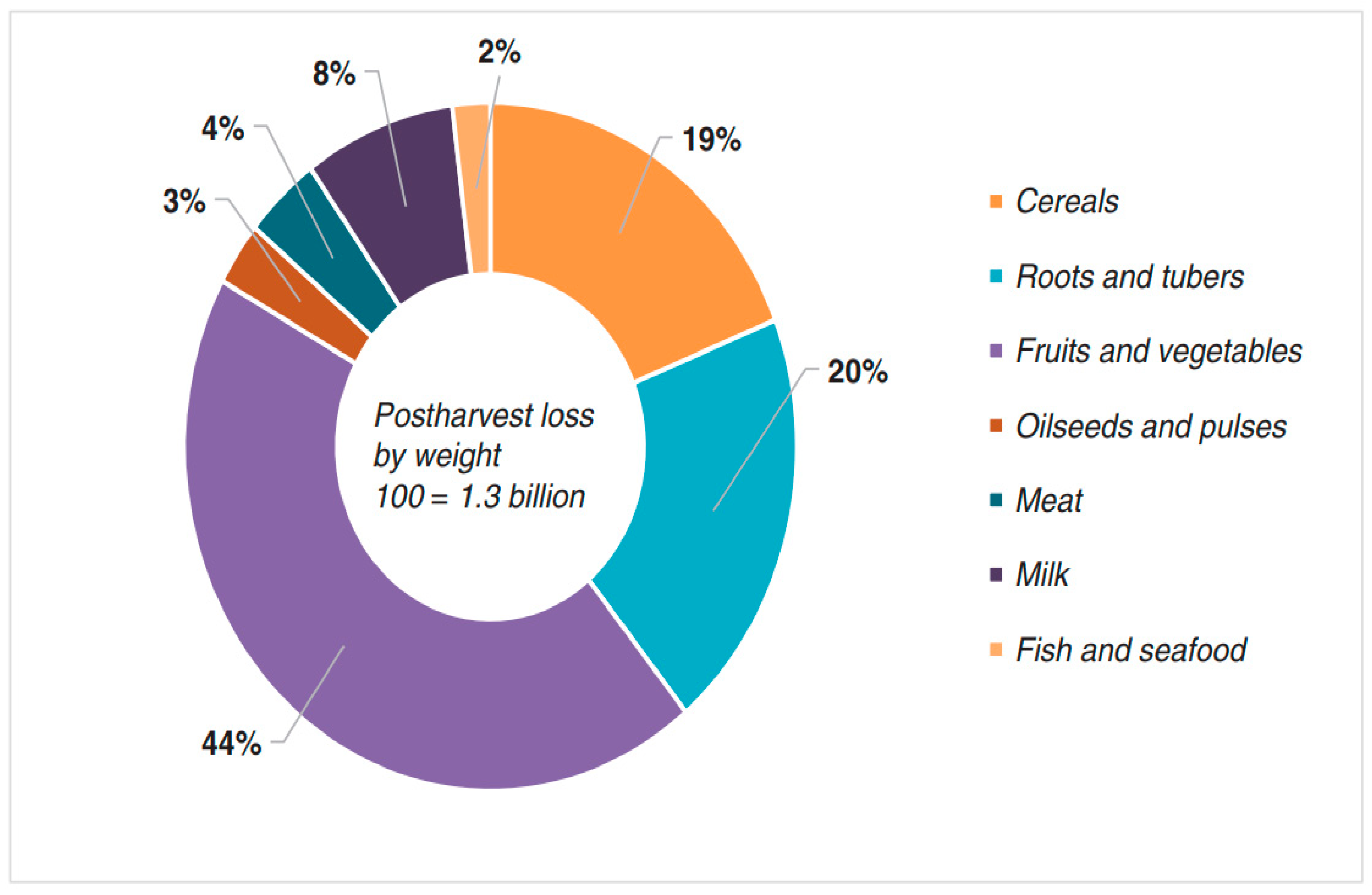
Figure 2.
Schematic diagram of evaporative cooling technologies.
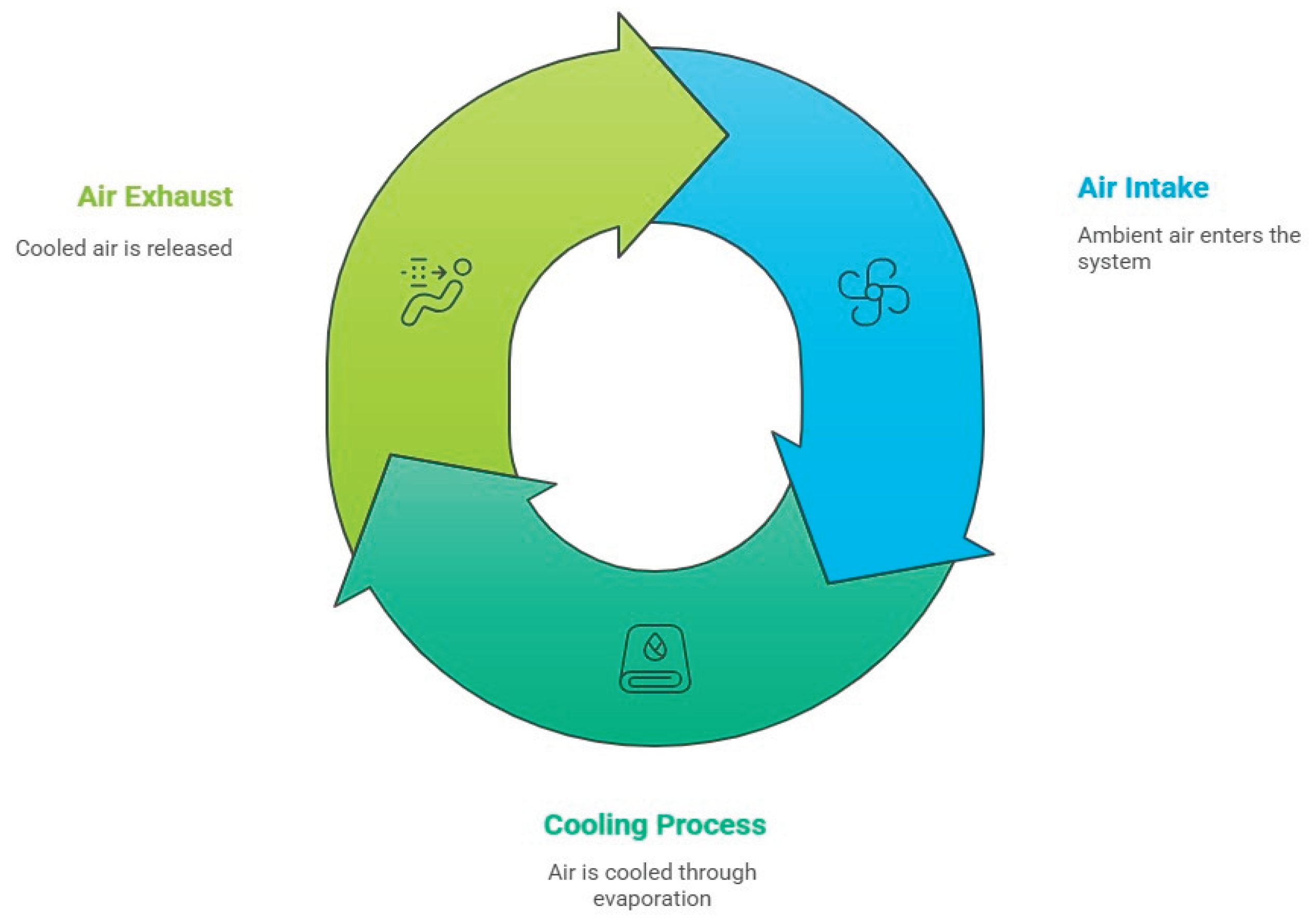
Figure 3.
PRISMA flow diagram of the study selection process.
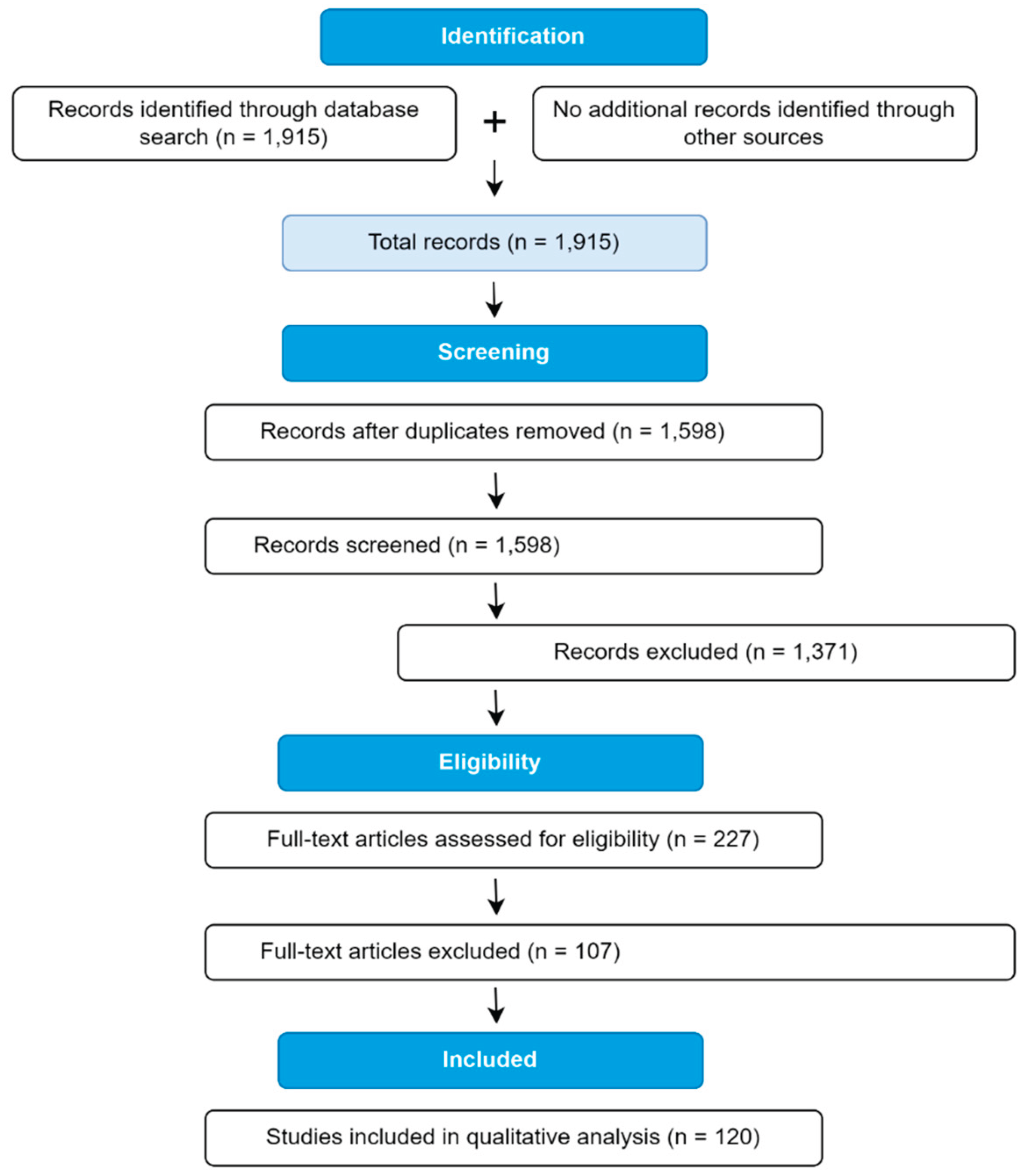
Figure 4.
Illustration of a direct evaporative cooling system [109].
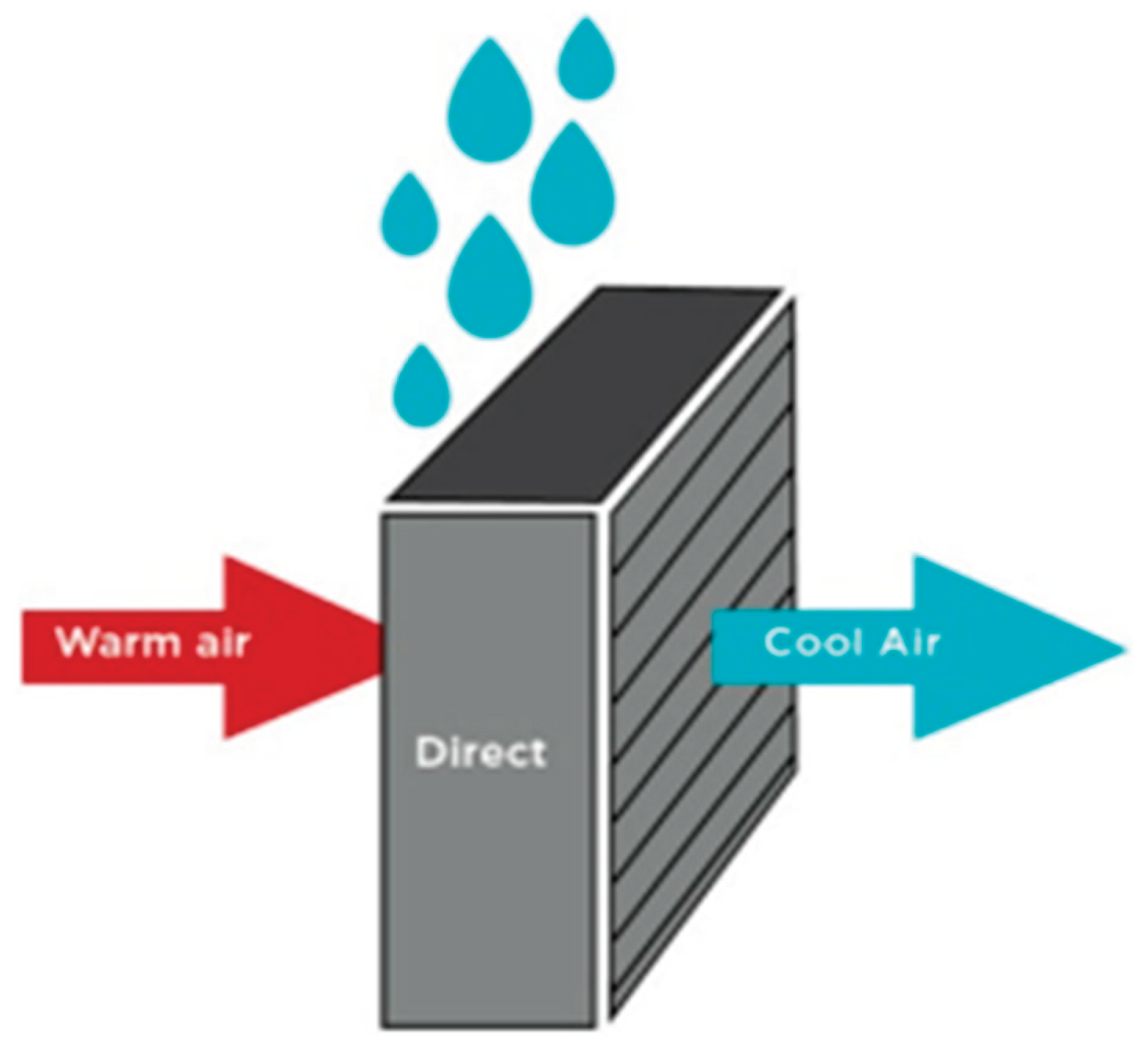
Figure 5.
Illustration of indirect EC [109].
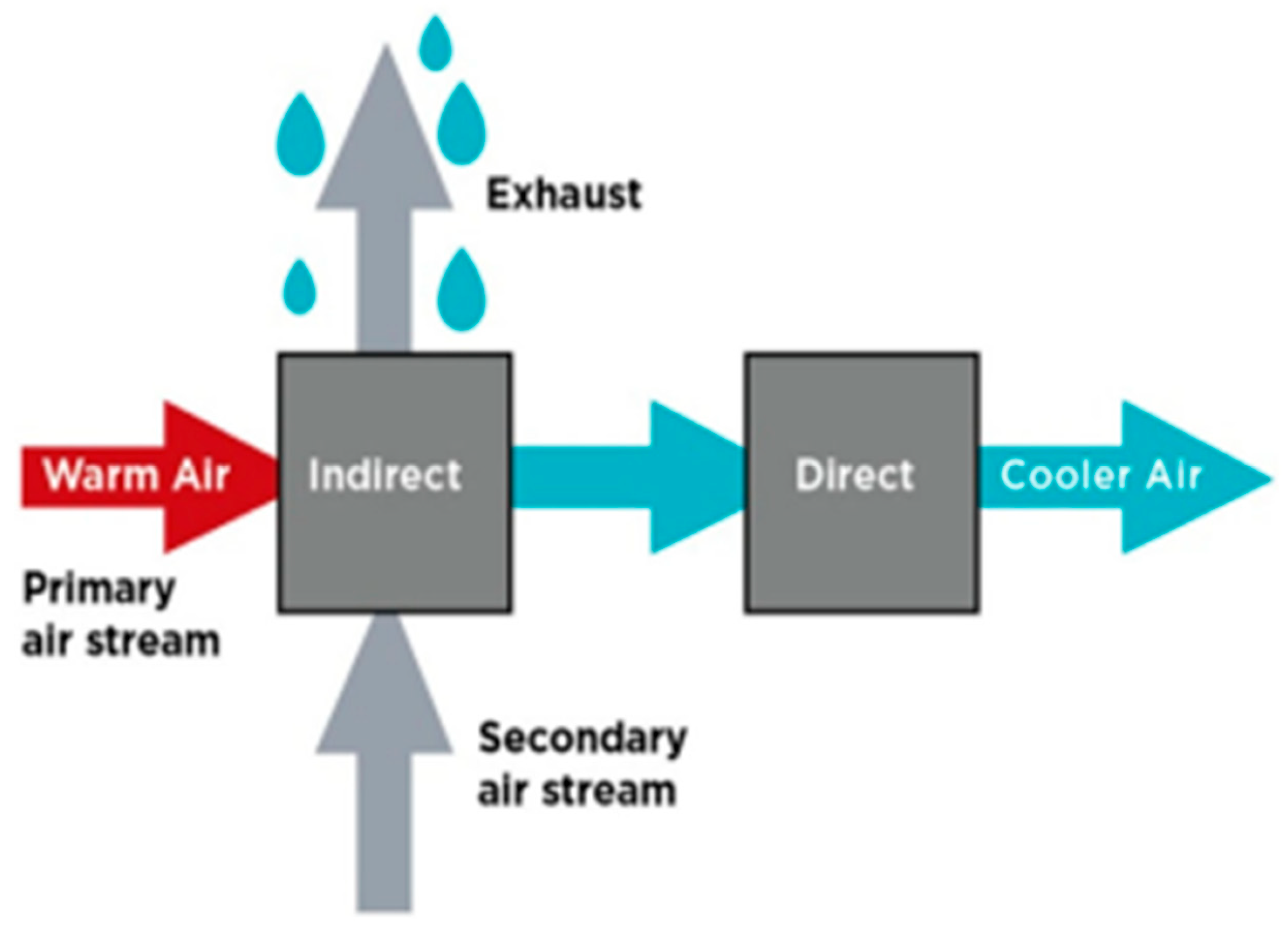

Table 1.
Recent advances in direct evaporative cooling (DEC) systems (2020–2025).
| Type of EC | Innovations & Advantages | Validation Approach | Limitations | Key Findings | Study |
|---|---|---|---|---|---|
| DEC + IoT | Arduino-based T/RH control; solar fan; GSM alerts | Lab: tomato storage (4→12 days) | Fails at RH > 50% | ΔT = 10–12°C; 85% energy savings | Singh et al. (2022) [17] |
| DEC + GSM | Low-cost (<USD 150); real-time SMS alerts | Field: spinach in Nigeria | Humidifies air | Shelf-life +133%; payback: 1.2 yrs | Adekanye et al. (2023) [14] |
| DEC + Wi-Fi | Blynk dashboard; PWM fan control | Lab: mixed veg (7-day trial) | Limited to arid zones | COP = 17; R² (T prediction) = 0.96 | Patel & Kumar (2021) [78] |
| DEC + Solar | PV-powered; clay-coated pads | Field: tomatoes in Nigeria | Pad clogging | ΔT = 9°C; 78% spoilage reduction | Ogunjimi et al. (2020) [79] |
| DEC + ML | LSTM-based T forecasting | Sim + lab: leafy greens | No humidity control | R² = 0.992; 65% less waste | Roy et al. (2023) [18] |
| DEC + LoRa | Farm-scale monitoring (5 km range) | Field: Rajasthan, India | Data loss in the rain | Cost: USD 176; payback: 1.7 yrs | Gupta & Sharma (2022) [80] |
| DEC + PID | Dynamic fan speed control | Lab: potatoes (21 days) | Oscillations near setpoint | 20% less water use vs. ON/OFF | Nwosu et al. (2021) [81] |
Table 2.
Recent advances in indirect evaporative cooling (IEC) systems (2020–2025).
| Type of EC | Innovations & Advantages | Validation Approach | Limitations | Key Findings | Study |
|---|---|---|---|---|---|
| IEC + Desiccant | Silica gel pre-drying; RH < 50% | Lab: simulated tropical | High energy for regeneration | ΔT = 8–10°C; η<sub>dp</sub> = 65% | La et al. (2022) [23] |
| RCF-IEC + MPC | Model-predictive humidity control | CFD + lab validation | Cost: USD 550 | RAD (RH) ↓ 76% vs. PID | Chen & Zhang (2022) [28] |
| IEC + PV | Solar thermal desiccant regen | Field: Guangdong, China | Seasonal performance var. | Zero grid use; COP = 12 | Wang et al. (2021) [85] |
| IEC + LSTM | Hourly T/RH forecasting | Sim: 30-day horizon | Needs 2 weeks of data for training | R² = 0.987 | Khalid et al. (2023) [86] |
| IEC + LoRaWAN | 10-node farm network | Field: Colombia | Gateway cost | Data loss: 8% over 2 km | Liu et al. (2020) [87] |
| IEC + Fuzzy Logic | Rule-based RH control | Lab: mangoes (14 days) | Manual rule tuning | Shelf-life +90% | Patel et al. (2024) [88] |
| IEC + Bio-pads | Bamboo charcoal media | Lab: comparative study | Pad life: 6 months | η<sub>dp</sub> = 72%; eco-friendly | Rahman et al. (2023) [89] |
Table 3.
Recent advances in Maisotsenko-cycle (M-Cycle) systems (2020–2025).
| Type of EC | Innovations & Advantages | Validation Approach | Limitations | Key Findings | Study |
|---|---|---|---|---|---|
| M-Cycle + IoT | Solar-assisted; η<sub>dp</sub> > 90% | Field: Pakistan (onions) | High capex (USD 370) | ΔT = 12–15°C; shelf-life ×2 | Khalid et al. (2024) [22] |
| M-Cycle + RL | DDPG for profit-max control | Sim: greenhouse model | No field validation | Yield ↑ 15%; energy ↓ 92% | Liu et al. (2024) [34] |
| M-Cycle + PV | 10-hr/day autonomous operation | Field: Mexico | Battery degradation | Zero opex; COP = 19 | Zhang et al. (2023) [93] |
| M-Cycle + LSTM | 24-hr microclimate forecast | Lab + sim | Sensor noise sensitivity | R² = 0.994 for T | Ali et al. (2022) [94] |
| M-Cycle + MPC | Constrained optimisation (T, RH) | CFD + lab | Model mismatch risk | RAD (T) ↓ 68% | Wang & Li (2021) [95] |
| M-Cycle + LoRa | Remote monitoring in the hills | Field: Himalayas | Limited connectivity | Data reliability: 92% | Gupta et al. (2025) [96] |
| M-Cycle + Desiccant | Hybrid for humid highlands | Lab: simulated Nepal | System complexity | η<sub>dp</sub> = 88% at RH 65% | Chen et al. (2022) [97] |
Table 4.
Recent advances in hybrid evaporative cooling systems (2020–2025).
| Type of EC | Innovations & Advantages | Validation Approach | Limitations | Key Findings | Study |
|---|---|---|---|---|---|
| IEC + Desiccant + PV | Solar regen; zero-grid | Field: Colombia | High maintenance | ΔT = 9°C at RH 75% | La et al. (2023) [37] |
| Osmo-EC + IoT | For berry preservation | Clinical: 3-week human trial | Not scalable for staples | Inflammatory markers ↓ 30% | Gallego-Peláez et al. (2021) [51] |
| Desiccant + M-Cycle | Dual-stage cooling | Lab: extreme humidity | Capex: USD 620 | η<sub>dp</sub> = 85% at RH 80% | Tu et al. (2022) [101] |
| IEC + Membrane | Humidity-selective membrane | Sim: membrane efficiency | Membrane fouling | RH control ±3% | Riangvilaikul (2023) [102] |
| DEC + Fogging | Inter-stage humidification | Lab: Oman Desert | Water quality critical | ΔT = 14°C at 20% RH | Al-Ismaili (2021) [103] |
| M-Cycle + Biochar | Sustainable pad material | Lab: material testing | Production scalability | η<sub>dp</sub> = 89%; eco-certifiable | Magnitskiy (2024) [104] |
| Hybrid + Niosomes | For anthocyanin preservation | In vivo: mouse model | Not for the whole produce | Bioactive retention ↑ 50% | Colorado et al. (2023) [105] |
Table 5.
The technical performance of IECS.
| System Type | Climate Context | ΔT (°C) | Effectiveness (η) | COP | Energy | Shelf-Life Extension | References |
|---|---|---|---|---|---|---|---|
| DEC + IoT | Hot-Arid (Nigeria) | 10–12 | = 85% | 18 | 85% | Tomatoes: 4d → 12d (+200%) | [17] |
| Solar DEC + ML | Semi-Arid (India) | 9–11 | = 80% | 16 | 80% | Leafy greens: 65% less spoilage | [18] |
| M-Cycle + IoT | Hot-Arid (Pakistan) | 12–15 | = 92% | 16 | 90% | Onions: 14d → 28d (+100%) | [22] |
| IEC + Desiccant | Humid-Tropical (China) | 8–10 | = 65% | 0.35 | 75% | Not reported | [23] |
| DEC + GSM | Savanna (Nigeria) | 8–10 | = 75% | 15 | 78% | Spinach: 3d → 7d (+133%) | [14] |
| M-Cycle + RL | Simulated | 13–16 | = 95% | 19 | 92% | Simulated yield +15% | [68] |
| DEC + IoT | Hot-Semi-Arid (India) | 9–11 | = 82% | 17 | 82% | Not reported | [41] |
Table 6.
The economic viability analysis of IECS.
| Physical Cooler Cost (USD) | IoT/Intelligence Cost (USD) | Total Cost (USD) | Payback Period | Power Source | Communication Protocol | Primary Produce Tested | References |
|---|---|---|---|---|---|---|---|
| 90 | 70 | 160 | 1.5 years | Grid + Solar | Wi-Fi | Tomatoes | [17] |
| 120 | 85 | 205 | 1.8 years | Solar PV | GSM | Spinach, Lettuce | [18] |
| 250 | 120 | 370 | 2.1 years | Solar PV | LoRaWAN | Onions, Potatoes | [22] |
| 400 | 150 | 550 | 3.0 years | Grid | Wi-Fi | Simulated | [23] |
| 80 | 65 | 145 | 1.2 years | Grid | GSM | Spinach | [14] |
| 100 | 76 | 176 | 1.7 years | Grid | LoRa | Mixed Vegetables | [41] |
| 25 | – | 25 | N/A (Passive) | None | None | Tomatoes | [41] |
Disclaimer/Publisher’s Note: The statements, opinions and data contained in all publications are solely those of the individual author(s) and contributor(s) and not of MDPI and/or the editor(s). MDPI and/or the editor(s) disclaim responsibility for any injury to people or property resulting from any ideas, methods, instructions or products referred to in the content. |
© 2026 by the authors. Licensee MDPI, Basel, Switzerland. This article is an open access article distributed under the terms and conditions of the Creative Commons Attribution (CC BY) license (http://creativecommons.org/licenses/by/4.0/).
Copyright: This open access article is published under a Creative Commons CC BY 4.0 license, which permit the free download, distribution, and reuse, provided that the author and preprint are cited in any reuse.


