
Preprint
Review

This version is not peer-reviewed.

Occupational Stress as a Modifiable Risk Factor for Atherosclerotic Coronary Artery Disease: Evidence, Mechanisms, and Interventions

Submitted:

12 January 2026

Posted:

13 January 2026

You are already at the latest version

Abstract

Cardiovascular diseases, particularly atherosclerotic coronary artery disease (CAD), remain among the leading causes of mortality worldwide. Although traditional risk factors—such as arterial hypertension, dyslipidemia, diabetes mellitus, obesity, smoking, and physical inactivity—are well established, accumulating evidence highlights the significant role of psychosocial factors in modulating cardiovascular risk. Among these, occupational stress—conceptualized through models such as job strain (high job demands combined with low control) and effort–reward imbalance—has been consistently associated with an increased risk of coronary events. The interaction between occupational stress and classical cardiovascular risk factors remains insufficiently elucidated and challenging to quantify. This review examines the current scientific evidence regarding the relationship between occupational stress and CAD, synthesizing findings from major epidemiological studies and relevant meta-analyses. Chronic exposure to work-related stress activates neuroendocrine pathways, including the hypothalamic–pituitary–adrenal axis and the sympathetic nervous system, promotes a state of low-grade systemic inflammation, and facilitates the adoption of unhealthy behaviors such as smoking, poor dietary habits, physical inactivity, and excessive alcohol consumption. These mechanisms contribute to endothelial dysfunction, hypercoagulability, and acceleration of the atherosclerotic process. Landmark investigations, including the INTERHEART study, meta-analyses conducted by Kivimäki and colleagues, and prospective studies by Chandola on the metabolic syndrome, support both the cumulative and independent impact of occupational stress on cardiovascular risk. Although the proportion of risk attributable to occupational stress is lower than that associated with traditional risk factors, its modifiable nature underscores a substantial potential for targeted preventive interventions. Strategies aimed at reducing occupational stress encompass individual-level approaches (stress management programs, lifestyle modification, psychological support), organizational interventions (optimizing the balance between job demands and employee control, enhancing social support in the workplace), and public health policies (occupational health promotion programs, regulatory measures addressing work-related stress, and screening for occupational stress). Recognizing occupational stress as a modifiable risk factor for CAD has important implications for both clinical practice and public health. Future research should focus on large-scale longitudinal studies, the identification of stress-related biomarkers, and the cost-effectiveness of stress-reduction interventions in the prevention and management of coronary artery disease.

Keywords: 
;  ;  ;  ;  ;  ;  ;  ;  

1. Introduction

Cardiovascular diseases, particularly atherosclerotic coronary artery disease (CAD), rank among the leading causes of death worldwide, according to the World Health Organization. Until recently, medical approaches have focused predominantly on so-called classical risk factors—arterial hypertension, dyslipidemia, obesity, diabetes mellitus, smoking, and physical inactivity. However, a growing body of research suggests that psychosocial factors may play a significant role in increasing or reducing the risk of developing coronary events [1].
Socioprofessional stress—defined as stress experienced in the workplace and within associated social interactions—can be conceptualized in several forms: job strain, described as the combination of high job demands and low decision latitude; effort–reward imbalance, referring to situations in which the effort invested at work is not matched by adequate rewards; and low social support, characterized by insufficient emotional, informational, or instrumental support from colleagues or supervisors [2,3,4].
Numerous epidemiological studies and meta-analyses have demonstrated a significant association between exposure to these forms of stress and an increased risk of myocardial infarction, angina pectoris, and other clinical manifestations of CAD [5,6,7].The mechanisms involved encompass both neuroendocrine responses—particularly activation of the hypothalamic–pituitary–adrenal axis—and unhealthy behaviors that may arise as consequences of chronic stress, such as smoking, excessive alcohol consumption, physical inactivity, and overeating.
The aim of this review is to provide an in-depth analysis of the existing literature investigating the role of socioprofessional stress in the pathogenesis, progression, and prognosis of atherosclerotic coronary artery disease. By presenting and discussing the principal studies and meta-analyses in this field, we seek to highlight the clinical and public health implications of occupational stress, as well as potential directions for intervention and prevention.

2. Materials and Methods

For the purpose of this review, a manual search was conducted across major scientific databases, including PubMed, ScienceDirect, and Google Scholar. The search strategy employed combinations of the following keywords: occupational stress, socioprofessional stress, job strain, effort–reward imbalance, coronary artery disease, atherosclerosis, and psychosocial factors. Both original research articles (cohort and case–control studies) and secondary sources, including meta-analyses and narrative or systematic reviews, were considered, provided they specifically assessed the association between work-related stress and the risk of atherosclerotic coronary artery disease.
The inclusion criteria comprised publication in internationally recognized peer-reviewed journals (such as The Lancet, BMJ, Circulation, and Psychosomatic Medicine); the use of representative study populations and/or rigorous methodologies for assessing occupational stress and cardiovascular status; and a clear definition of either a causal relationship or a statistically significant association between socioprofessional stress and coronary artery disease.
Studies lacking quantitative data or focusing exclusively on other forms of stress (e.g., posttraumatic or family-related stress) without incorporating an occupational dimension were excluded. The final body of evidence was subjected to a thematic qualitative analysis, with particular emphasis on the proposed biological and behavioral mechanisms, the strength and consistency of reported associations, and the implications for clinical practice as well as public health policies.
Generative artificial intelligence tools (ChatGPT, version GPT-5.1, OpenAI, San Francisco, CA, USA) were used for figure generation and minor linguistic adjustments to improve text clarity and readability.

3. Traditional Cardiovascular Risk Factors: Setting the Context for Occupational Stress

To place the role of socioprofessional stress into proper context, it is useful to briefly review the classical risk factors for atherosclerotic coronary artery disease (CAD), which have been consistently confirmed by numerous clinical trials and epidemiological studies. These include arterial hypertension—where increased arterial pressure accelerates atherosclerosis and raises myocardial workload; dyslipidemia—characterized by elevated plasma levels of low-density lipoprotein cholesterol and triglycerides, which promote atherogenesis; smoking—whose toxic constituents cause endothelial injury and increase the risk of atherothrombosis; obesity—associated with insulin resistance, dyslipidemia, and hypertension; diabetes mellitus—where chronic hyperglycemia leads to endothelial dysfunction and impaired lipid metabolism; and physical inactivity—which compromises cardiovascular function and facilitates weight gain.
In addition to these well-established factors, psychosocial determinants have gained increasing recognition, among which socioprofessional stress appears to play a significant contributory role in cardiovascular risk modulation [1].

4. Individual Factors and Susceptibility to Stress

Although socioprofessional stress is a well-documented risk factor for atherosclerotic coronary artery disease (CAD), not all individuals respond uniformly to chronic stress exposure. This interindividual variability can be explained by a complex interplay of genetic, psychological, and socioeconomic factors.

4.1. Genetic Factors

Several studies have identified genetic polymorphisms that may influence neuroendocrine stress responses. For instance, polymorphisms in the glucocorticoid receptor gene (NR3C1) can modulate sensitivity to cortisol, thereby affecting hypothalamic–pituitary–adrenal axis reactivity. Similarly, functional variants of the serotonin transporter gene (5-HTTLPR) have been associated with heightened stress reactivity and an increased risk of depression and anxiety—conditions that may amplify the adverse cardiovascular effects of chronic stress exposure [8].

4.2. Psychological Factors

Personality traits and coping mechanisms play a pivotal role in determining how stress impacts cardiovascular health. Type A personality characteristics—such as excessive competitiveness, time urgency, and hostility—have been associated with an increased risk of CAD. In contrast, individuals exhibiting psychological resilience demonstrate a greater capacity to adapt to stress through effective coping strategies, optimism, and strong social support networks, resulting in a lower cardiovascular risk. Affective disorders, particularly depression and anxiety, which frequently coexist with occupational stress, have been independently linked to autonomic dysfunction and chronic low-grade inflammation, both of which contribute to cardiovascular disease development [9].

4.3. Socioeconomic Factors

Individuals with lower socioeconomic status and educational attainment are disproportionately exposed to cardiovascular risk through multiple pathways. These include employment in occupations characterized by high demands and low control, limited access to healthcare services and cardiovascular screening, and increased exposure to additional stressors such as financial insecurity and reduced social support. Socioeconomic disadvantage has been consistently associated with poorer cardiovascular outcomes and heightened vulnerability to stress-related disease [10].

5. Definition and Conceptualization of Socioprofessional Stress

5.1. The Demand–Control Model (Karasek)

The Job Demand–Control model, developed by Robert Karasek in 1979, examines how job characteristics influence employees’ health and well-being. According to this model, occupational stress arises from the interaction between psychological job demands and the degree of control—or decision latitude—that workers have over how their tasks are performed.
The core components of the model include job demands, referring to workload, task complexity, and time pressure, and job control, defined as autonomy in decision-making and the ability to use and develop one’s skills. High job demands are associated with increased stress, whereas a high level of control may mitigate the negative effects of demanding work conditions.
Based on these dimensions, four main job typologies are described: high-strain jobs (high demands and low control), which are associated with an increased risk of burnout and cardiovascular disease; active jobs (high demands and high control), which, although demanding, may provide opportunities for learning and personal development, potentially leading to higher job satisfaction; passive jobs (low demands and low control), which may result in boredom and reduced motivation; and low-strain jobs (low demands and high control), considered the least stressful and most favorable for health.
The model was later expanded to incorporate social support in the workplace, resulting in the Job Demand–Control–Support model. This extension emphasizes that support from colleagues and supervisors can buffer the adverse health effects of high demands and low control. Overall, the demand–control framework provides a valuable conceptual basis for understanding how workplace characteristics shape occupational stress and employee health, highlighting the importance of balancing job demands with adequate control and social support [11].

5.2. The Effort–Reward Imbalance Model (Siegrist)

The Effort–Reward Imbalance (ERI) model, proposed by Johannes Siegrist, is grounded in the premise that psychosocial stress occurs when the effort invested at work—such as high workload, time pressure, and responsibility—exceeds the rewards received, including salary, social recognition, career advancement opportunities, and job security.
Key elements of the ERI model are effort–reward imbalance, which reflects a disproportion between high effort and low reward and is strongly linked to chronic stress, and overcommitment, defined as a personal pattern of excessive work-related engagement despite insufficient rewards. Overcommitment may exacerbate stress responses and further increase cardiovascular risk.
Empirical studies have shown that effort–reward imbalance is associated with heightened cortisol secretion and sympathetic nervous system activity, endothelial dysfunction and hypercoagulability, and an increased risk of hypertension, diabetes, and metabolic syndrome. It has also been linked to depression, anxiety, and occupational burnout. Meta-analyses, including those conducted by Kivimäki and colleagues, indicate that individuals exposed to a high effort–reward imbalance have a 1.5- to 2-fold higher risk of developing cardiovascular disease. The ERI model is considered complementary to Karasek’s demand–control framework, as it focuses on reciprocity and fairness in the work environment rather than autonomy alone [12].

5.3. Social Support

Social support, both in the workplace (from colleagues and supervisors) and outside of it (family and friends), represents an important buffering factor against stress. Adequate social support can attenuate perceived stress and enhance coping capacity, whereas its absence may intensify stress perception and reduce resilience. Low social support has been associated with increased vulnerability to cardiovascular disease and poorer health outcomes, underscoring its relevance as a key psychosocial determinant in occupational health [4].

6. Pathophysiological Mechanisms Linking Stress to Atherogenesis

6.1. Neuroendocrine Activation and Inflammatory Response

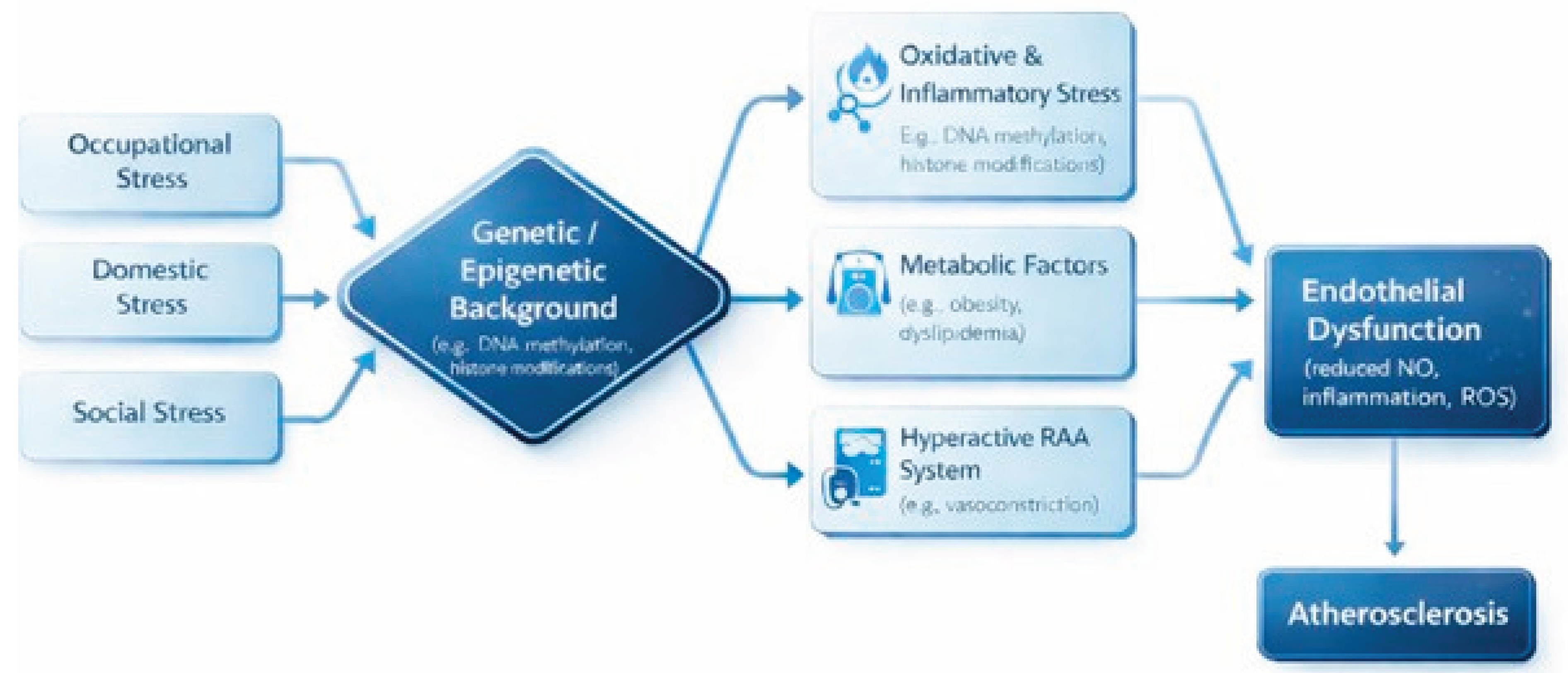
Chronic exposure to socioprofessional stress leads to hyperactivation of the hypothalamic–pituitary–adrenal (HPA) axis, resulting in increased cortisol secretion, as well as enhanced sympathetic nervous system activity with elevated release of catecholamines (adrenaline and noradrenaline). These responses contribute to increases in heart rate and blood pressure, thereby imposing additional hemodynamic stress on the myocardium and arterial endothelium. Moreover, sustained neuroendocrine activation stimulates the release of proinflammatory cytokines, including interleukins and tumor necrosis factor-α (TNF-α), promoting a state of chronic low-grade systemic inflammation. This inflammatory milieu is now widely recognized as a key driver of atherosclerosis initiation and progression [13].

6.2. Interaction with Behavioral Risk Factors

Individuals exposed to chronic stress are more likely to adopt maladaptive health behaviors that further amplify cardiovascular risk. These include increased tobacco and alcohol consumption as coping mechanisms, irregular eating patterns with excessive caloric intake or diets rich in fats and sugars (“comfort eating”), which predispose to obesity and dyslipidemia, as well as reduced physical activity due to fatigue and time constraints. Such behavioral factors may act as mediators in the relationship between stress and the progression of atherosclerotic coronary artery disease, reinforcing the adverse cardiovascular impact of chronic stress exposure [2].

6.3. Endothelial Dysfunction and Hypercoagulability

Chronic stress may directly impair endothelial function through increased oxidative stress and reduced bioavailability of nitric oxide, a critical mediator of vascular homeostasis. In parallel, elevated levels of catecholamines and cortisol promote prothrombotic states, characterized by increased fibrinogen levels and enhanced platelet aggregation. These alterations contribute to endothelial injury, plaque instability, and a heightened risk of acute coronary events, thereby linking stress-related neuroendocrine dysregulation to clinically relevant cardiovascular outcomes [2].

7. Markers of Chronic Stress and Cardiovascular Risk

Beyond classical cardiovascular biomarkers such as NT-proBNP and C-reactive protein (CRP), emerging markers of chronic stress provide deeper insight into the underlying pathophysiological mechanisms linking stress exposure to cardiovascular disease.

7.1. Inflammatory Biomarkers

Prolonged exposure to chronic stress is associated with a state of low-grade systemic inflammation, reflected by elevated circulating levels of proinflammatory cytokines. Increased concentrations of interleukin-6 (IL-6) (normal range: 0–5 pg/mL) and tumor necrosis factor alpha (TNF-α) (normal values: <8–10 pg/mL) have been consistently reported in individuals exposed to sustained psychosocial stress. In addition, C-reactive protein (CRP) remains a widely used marker for cardiovascular risk stratification, with levels <1 mg/L indicating low risk, 1–3 mg/L moderate risk, and >3 mg/L high cardiovascular risk. These inflammatory biomarkers reflect stress-induced immune activation and play a central role in endothelial dysfunction and atherogenesis [14].

7.2. Markers of Neuroendocrine Activation

Markers of neuroendocrine stress responses offer valuable information regarding hypothalamic–pituitary–adrenal (HPA) axis and sympathetic nervous system activation. Salivary and plasma cortisol levels are commonly used indicators of HPA axis activity, with persistently elevated values reflecting chronic stress exposure. Catecholamines (adrenaline and noradrenaline) are closely linked to sympathetic overactivation and hemodynamic stress. In addition, neuropeptide Y (NPY) has emerged as a biomarker associated with maladaptive stress responses, vasoconstriction, and the development of arterial hypertension. Collectively, these markers capture the neuroendocrine dimension of stress-related cardiovascular risk [13].

7.3. Epigenetic Biomarkers

Stress-induced epigenetic modifications may exert long-term effects on cardiovascular health. DNA methylation of the NR3C1 gene, which encodes the glucocorticoid receptor, can alter cortisol sensitivity and disrupt feedback regulation of the HPA axis. Furthermore, altered expression of specific microRNAs—such as miR-146a and miR-21—has been implicated in vascular inflammation, immune dysregulation, and the progression of atherosclerosis. These epigenetic changes provide a potential mechanistic link between chronic stress exposure and sustained cardiovascular vulnerability [8].

7.4. Heart Rate Variability (HRV) Reactivity to Stress
A substantial body of evidence has demonstrated significant alterations in heart rate variability (HRV) parameters in response to experimentally induced and real-life stress. Most studies report a reduction in high-frequency (HF) components of HRV, indicating decreased parasympathetic activity, alongside an increase in low-frequency (LF) components, reflecting sympathetic activation. Stress induction protocols have included cognitively demanding tasks, exposure to noise, and socially stressful situations, with consistent HRV responses observed across different methodologies.
Both time-domain measures (e.g., SDNN, RMSSD) and frequency-domain indices (e.g., HF and LF power) have shown sensitivity to stress-related autonomic changes, offering a comprehensive assessment of autonomic nervous system dynamics. These stress-induced HRV alterations underscore a shift toward sympathetic dominance and parasympathetic withdrawal, supporting the utility of HRV as a noninvasive biomarker for stress assessment and monitoring in both clinical and research settings [15].
Figure 1. Neuroendocrine, metabolic, and inflammatory pathways mediating the relationship between socioprofessional stress and atherosclerosis.
Preprints 193939 g001

8. Epidemiological and Clinical Evidence

8.1. The Kivimäki et al. Meta-Analysis (2012)

In the 2012 meta-analysis published in The Lancet, led by Mika Kivimäki and colleagues, the association between occupational stress and the risk of coronary heart disease was investigated using individual participant data. The study pooled data from 13 European cohort studies, comprising a total of 197,473 participants free of coronary heart disease at baseline. Among these, approximately 15% reported exposure to job strain.
Over a mean follow-up period of 7.5 years, 2,358 major coronary events were documented. After adjustment for age and sex, individuals exposed to occupational stress exhibited a 23% higher risk of developing coronary heart disease compared with those without job strain (hazard ratio [HR] 1.23; 95% confidence interval [CI] 1.10–1.37). Importantly, the association remained statistically significant after excluding coronary events occurring within the first 3 or 5 years of follow-up, suggesting that the findings were not driven by reverse causality.
The relationship between job strain and coronary heart disease was consistent across multiple subgroups, including sex, age categories, and socioeconomic strata. The population-attributable fraction of coronary heart disease related to occupational stress was estimated at approximately 3.4%, indicating a modest but measurable impact at the population level. However, the authors emphasized that these results may not be directly generalizable beyond European populations.
The authors concluded that although reducing occupational stress could contribute to lowering the incidence of coronary heart disease, the expected impact would likely be smaller than that achieved by targeting traditional risk factors such as smoking or hypertension [7].

8.2. Chandola et al. (2006) and the Metabolic Syndrome

In a prospective study published in The British Medical Journal in 2006, Chandola and colleagues examined the relationship between chronic work-related stress and the development of metabolic syndrome. The study included 10,308 British civil servants aged 35–55 years who were followed for a mean duration of 14 years as part of the Whitehall II cohort.
Participants who were frequently exposed to occupational stress had more than a twofold increased risk of developing metabolic syndrome compared with those without job strain (age- and employment-grade–adjusted odds ratio [OR] 2.25; 95% CI 1.31–3.85). This association remained significant after adjustment for unhealthy behaviors, including smoking, poor diet, and physical inactivity.
A clear social gradient in the prevalence of metabolic syndrome was observed, with employees in lower occupational grades exhibiting a higher risk. Occupational stress partially explained this gradient, suggesting a mediating role between socioeconomic position and metabolic risk. These findings underscore chronic work-related stress as an independent and clinically relevant risk factor for metabolic syndrome, with important implications for cardiovascular prevention strategies [2].

8.3. The INTERHEART Study (Rosengren et al., 2004)

The INTERHEART study, published in The Lancet in 2004 by Rosengren and colleagues, evaluated the association between psychosocial risk factors and the risk of acute myocardial infarction. This large international case–control study included 11,119 patients with a first acute myocardial infarction and 13,648 control subjects from 52 countries, representing diverse geographic regions and ethnic backgrounds.
Participants were assessed for work-related stress, home stress, financial stress, and major life events during the preceding year. Depression and perceived control over life circumstances were also evaluated. Frequent work-related stress was reported by 23% of cases compared with 17.9% of controls, while permanent work stress was reported by 10% of cases versus 5% of controls. After adjustment for age, sex, geographic region, and smoking, work-related stress was associated with a significantly increased risk of myocardial infarction.
Similarly, frequent home-related stress (11.6% vs. 8.6%) and permanent domestic stress (3.5% vs. 1.9%) were more prevalent among cases than controls. Overall stress—whether occupational, domestic, or both—was associated with a higher risk of myocardial infarction, particularly among individuals reporting persistent stress exposure. Severe financial stress and major life events were also more common among cases and independently associated with increased risk.
Depression was reported by 24% of patients compared with 17.6% of controls, further supporting its role as a psychosocial risk factor for myocardial infarction. The authors concluded that psychosocial stressors are consistently associated with acute myocardial infarction across populations worldwide [3,16].

8.4. The Role of Social Support (Orth-Gomér et al., 1993)

In a study published in Psychosomatic Medicine in 1993, Orth-Gomér and colleagues investigated the relationship between social support and the incidence of coronary heart disease in middle-aged Swedish men. The study included a random sample of 736 men aged 50 years, all born in 1933 and residing in Gothenburg, Sweden. Participants were followed for six years to assess the incidence of myocardial infarction and coronary heart disease–related mortality.
Social support was evaluated across two dimensions: emotional attachment, reflecting support from close personal relationships, and social integration, representing support from a broader social network. Lower levels of emotional attachment were observed among men who developed coronary heart disease, with a near-significant association (p = 0.07). In contrast, reduced social integration was significantly associated with incident coronary heart disease (p = 0.04).
Multivariable analyses demonstrated that both dimensions of social support remained independent predictors of new coronary events, alongside smoking. These findings highlight the importance of social relationships as psychosocial determinants of cardiovascular health [4,10,17].

8.5. Netterstrøm et al. (2010)

In a study published in the Scandinavian Journal of Work, Environment & Health, Netterstrøm and colleagues examined the development of depressive symptoms and the incidence of depression among Danish civil servants exposed to major organizational restructuring. No significant differences in depressive symptoms or incident depression were observed between employees affected by mergers or job changes and control subjects.
These findings suggest that not all forms of occupational stress uniformly translate into adverse mental health outcomes, highlighting the heterogeneity of stress-related health effects [5].

8.6. Kivimäki et al. (2013)

In a 2013 meta-analysis published in PLOS ONE, Kivimäki and colleagues investigated the association between job strain and cardiovascular risk factors. Job strain was associated with an increased risk of diabetes, smoking, physical inactivity, and obesity, but not with blood pressure, lipid profile, or alcohol consumption.
These findings indicate that occupational stress contributes to cardiovascular risk predominantly through behavioral and metabolic pathways rather than through direct effects on traditional hemodynamic risk factors [6].

9. Practical Implications and Intervention Strategies

9.1. Assessment of Psychosocial Risk in Clinical Practice

In light of the available evidence, the integration of occupational stress assessment into routine clinical practice is recommended, particularly in patients with established cardiovascular risk factors. The use of standardized questionnaires, such as the Job Content Questionnaire and the Effort–Reward Imbalance Questionnaire, may facilitate the identification of individuals at increased psychosocial risk. Incorporating psychosocial risk evaluation into cardiovascular risk stratification may improve the detection of vulnerable patients and support a more comprehensive, patient-centered preventive approach [3,12].

9.2. Individual-Level Interventions

Stress management at the individual level may be achieved through structured training programs aimed at developing effective coping skills, as well as through relaxation techniques such as mindfulness, controlled breathing, and yoga. Psychological counseling represents an additional cornerstone for individuals experiencing chronic occupational stress.
Moreover, the promotion of a healthy lifestyle remains essential and includes the adoption of a balanced diet, increased physical activity, smoking cessation, and limitation of alcohol consumption. Social support also plays a critical role by encouraging the development of supportive networks involving family, friends, and colleagues, as well as participation in activities that enhance social cohesion and emotional well-being. These interventions have been shown to mitigate stress-related autonomic and inflammatory responses, thereby contributing to cardiovascular risk reduction [4,9].

9.3. Organizational-Level Interventions

At the organizational level, balanced work design is fundamental and may be achieved through measures such as reducing excessive workload, establishing clear and realistic objectives, providing constructive feedback, and ensuring rewards that are proportional to the effort invested. Increasing employees’ control over daily decision-making processes and actively involving them in project planning and management can further attenuate job strain.
Fostering a culture of social support within the workplace is equally important. This can be accomplished by strengthening collegial relationships through team-building activities, as well as by offering opportunities for mentorship and access to psychological counseling services. Organizational interventions addressing both structural and relational aspects of work have the potential to substantially reduce occupational stress and its adverse health consequences [7,9].

9.4. Public Health Implications

At the population level, recognizing socioprofessional stress as a modifiable risk factor for atherosclerotic coronary artery disease justifies targeted investments in occupational health policies. These may include regulations governing working hours and mandatory rest periods, legislative measures aimed at preventing workplace harassment and ensuring safe working conditions, and the development of national programs dedicated to stress screening and counseling in high-demand occupational sectors.
Such public health initiatives align with contemporary cardiovascular prevention frameworks and emphasize the need for multisectoral collaboration to address psychosocial determinants of cardiovascular disease [1,3].
10. Comparative Analysis of Intervention Strategies
10.1. Individual Versus Organizational Interventions
A key aspect in reducing occupational stress lies in comparing the effectiveness of different intervention strategies. Individual-level interventions—such as relaxation techniques, mindfulness-based approaches, and psychological counseling—may improve the psychophysiological response to stress and enhance individual coping capacity. However, their effectiveness tends to be limited when the underlying work environment remains persistently stressful.
In contrast, organizational-level interventions—including workload reduction, decreasing the number of working days where feasible and in proportion to employees’ age and professional experience, increasing job autonomy, and promoting a supportive work environment—have been shown to exert a more substantial and sustained impact on long-term health outcomes. These strategies address the structural determinants of occupational stress and are therefore more likely to produce durable reductions in cardiovascular risk [1,5].
10.2. The Role of Pharmacological Treatments
In severe cases of chronic stress associated with high cardiovascular risk, selected pharmacological therapies may be considered as adjunctive measures. For example, beta-blockers may attenuate the effects of stress on the sympathetic nervous system, while selective serotonin reuptake inhibitors (SSRIs) are effective in treating depression and anxiety commonly associated with chronic stress exposure. In addition, statins may exert pleiotropic anti-inflammatory effects that partially counteract stress-induced vascular inflammation.
Although pharmacological interventions do not directly address the psychosocial sources of stress, they may play a supportive role in comprehensive cardiovascular risk management when combined with behavioral and organizational strategies [2,9].
10.3. International Models of Successful Intervention
Several countries have implemented occupational health policies that have demonstrated tangible benefits in stress reduction and employee well-being. For example, Sweden and the Netherlands have adopted progressive labor and occupational health policies, including reductions in working hours, increased professional autonomy, and the implementation of mandatory workplace wellness programs.
In addition, the formal recognition of burnout as an occupational or medical condition in certain healthcare systems has facilitated earlier diagnosis, improved access to support services, and greater institutional accountability. These international experiences highlight the potential effectiveness of policy-level interventions and underscore the importance of integrating occupational health into broader public health and cardiovascular prevention strategies [5,6].
11. Discussion and Future Research Directions
In light of the convergent findings of the studies analyzed, it has become increasingly evident that socioprofessional stress should be regarded as a modifiable risk factor for atherosclerotic coronary artery disease. This relationship appears to be partially mediated by traditional cardiovascular risk factors—such as arterial hypertension, dyslipidemia, and obesity—while a growing body of research highlights the presence of direct effects of stress on vascular endothelial function, inflammatory pathways, and metabolic regulation.
Despite this progress, important knowledge gaps persist. Methodological heterogeneity across studies—particularly with regard to the subjective assessment of stress exposure—continues to limit the comparability of results and the strength of causal inference. Consequently, there is a pressing need for large-scale longitudinal studies designed to monitor the temporal evolution of stress-related inflammatory biomarkers and metabolic intermediates, as well as to evaluate the cost-effectiveness of occupational stress-reduction interventions implemented at the population level and their impact on cardiovascular morbidity and mortality.
Further research should also focus on identifying mediating and moderating factors that influence the relationship between socioprofessional stress and cardiovascular disease. These include the roles of sex, age, socioeconomic status, and cultural background, which may differentially shape stress perception, physiological responses, and vulnerability to cardiovascular outcomes. Addressing these dimensions will be essential for developing targeted, equitable, and effective prevention strategies in both clinical and public health contexts.
12. Conclusions
This review highlights the significant role of socioprofessional stress in the pathogenesis and progression of atherosclerotic coronary artery disease. The underlying mechanisms are complex and involve neuroendocrine activation, chronic low-grade inflammation, and the adoption of unhealthy behaviors. Epidemiological evidence derived from large multicenter studies and robust meta-analyses supports the notion that work-related stress may be considered an independent cardiovascular risk factor, with an impact comparable to that of traditional risk determinants.
Accordingly, the implementation of effective stress prevention and management strategies may play a crucial role in reducing the overall burden of cardiovascular disease. Furthermore, organizational-level interventions and public health policies aimed at ensuring appropriate working conditions, adequate social support, and a balanced relationship between occupational demands and individual resources have the potential to improve cardiovascular health at the population level.

Author Contributions

Conceptualization, Popescu Dan; Methodology, Popescu Dan and Ciobanu Mara; Supervision Nechita Alexandru; Writing – original draft, Popescu Dan; Writing – review & editing, Ciobanu Mara and Nechita Alexandru.

Funding

This research received no external funding.

Institutional Review Board Statement

Not applicable.

Informed Consent Statement

Not applicable.

Data Availability Statement

No new data were created or analyzed in this study. Data sharing is not applicable to this article.

Acknowledgments

During the preparation of this manuscript, the authors used ChatGPT (OpenAI, 2025) to assist in figure generation and minor linguistic adjustments to improve text clarity and readability. The authors have reviewed and edited the output and take full responsibility for the content of this publication.

Conflicts of Interest

The authors declare no conflict of interest.

Abbreviations

The following abbreviations are used in this manuscript:
CAD Coronary artery disease
CRP C-reactive protein
CVD Cardiovascular disease
ERI Effort–reward imbalance
ESC European Society of Cardiology
HF High-frequency component (of heart rate variability)
HPA axis Hypothalamic–pituitary–adrenal axis
HRV Heart rate variability
IL-6 Interleukin-6
JCQ Job Content Questionnaire
LDL Low-density lipoprotein
LF Low-frequency component (of heart rate variability)
NAFLD Non-alcoholic fatty liver disease
NT-proBNP N-terminal pro–B-type natriuretic peptide
RMSSD Root mean square of successive differences
SDNN Standard deviation of normal-to-normal RR intervals
SNS Sympathetic nervous system
TNF-α Tumor necrosis factor alpha

References

  1. Rozanski, A.; Blumenthal, J.A.; Kaplan, J. Impact of psychological factors on the pathogenesis of cardiovascular disease and implications for therapy. Circulation 1999, 99(16), 2192–2217. [Google Scholar] [CrossRef] [PubMed]
  2. Chandola, T.; Brunner, E.; Marmot, M. Chronic stress at work and the metabolic syndrome: Prospective study. BMJ 2006, 332(7540), 521–525. [Google Scholar] [CrossRef] [PubMed]
  3. Rosengren, A.; Hawken, S.; Ounpuu, S.; et al. Association of psychosocial risk factors with risk of acute myocardial infarction in 52 countries (the INTERHEART study): Case-control study. Lancet 2004, 364(9438), 953–962. [Google Scholar] [CrossRef] [PubMed]
  4. Orth-Gomér, K.; Rosengren, A.; Wilhelmsen, L. Lack of social support and incidence of coronary heart disease in middle-aged Swedish men. Psychosom Med. 1993, 55(1), 37–43. [Google Scholar] [CrossRef] [PubMed]
  5. Power, N.; Kelly, S; Gallagher, J.; et al. Job strain and the incidence of heart diseases: A prospective community study in Quebec, Canada. J Psychosom Res. 2020, 139, 110268. [Google Scholar] [CrossRef] [PubMed]
  6. Kivimäki, M.; Singh-Manoux, A.; Nyberg, S.T.; Jokela, M.; Virtanen, M. Job strain and risk of obesity: Systematic review and meta-analysis of cohort studies. Int J Obes (Lond) 2015, 39(11), 1597–1600. [Google Scholar] [CrossRef] [PubMed]
  7. Kivimäki, M.; Nyberg, S.T.; Batty, G.D.; et al. Job strain as a risk factor for coronary heart disease: A collaborative meta-analysis of individual participant data. Lancet 2012, 380(9852), 1491–1497. [Google Scholar] [CrossRef] [PubMed]
  8. Lukas, E.; Veeneman, R.R.; Smit, D.J.A.; et al. A genetic exploration of the relationship between posttraumatic stress disorder and cardiovascular diseases. Transl Psychiatry 2025, 15(1), 1. [Google Scholar] [CrossRef] [PubMed]
  9. Lichtman, J.H.; Bigger, J.T., Jr.; Blumenthal, J.A.; Frasure-Smith, N.; Kaufmann, P.G.; Lespérance, F.; et al. Depression and coronary heart disease: Recommendations for screening, referral, and treatment: A science advisory from the American Heart Association. Circulation 2008, 118(17), 1768–1775. [Google Scholar] [CrossRef] [PubMed]
  10. Schultz, WM; Kelli, HM; Lisko, JC; Varghese, T; Shen, J; Sandesara, P.; et al. Socioeconomic status and cardiovascular outcomes: Challenges and interventions. Circulation 2018, 137(20), 2166–2178. [Google Scholar] [CrossRef] [PubMed]
  11. Karasek, R.A. Job demands, job decision latitude, and mental strain: Implications for job redesign. Adm Sci Q. 1979, 24, 285–308. [Google Scholar] [CrossRef]
  12. Siegrist, J. Adverse health effects of high-effort/low-reward conditions. J Occup Health Psychol. 1996, 1(1), 27–41. [Google Scholar] [CrossRef] [PubMed]
  13. Franklin, T.B.; Saab, B.J.; Mansuy, I.M. Neural mechanisms of stress resilience and vulnerability. Neuron 2012, 75(5), 747–761. [Google Scholar] [CrossRef] [PubMed]
  14. Valaitienė, J.; Laučytė-Cibulskienė, A. Oxidative stress and its biomarkers in cardiovascular diseases. Artery Res. 2024, 30(1), 18. [Google Scholar] [CrossRef]
  15. Kim, H.G.; Cheon, E.J.; Bai, D.S.; Lee, Y.H.; Koo, B.H. Stress and heart rate variability: A meta-analysis and review of the literature. Psychiatry Investig. 2018, 15(3), 235–245. [Google Scholar] [CrossRef] [PubMed]
  16. Visseren, F.L.J.; Mach, F.; Smulders, Y.M.; Carballo, D.; Koskinas, K.C.; Bäck, M.; et al. ESCScientific Document Group 2021 ESCGuidelines on cardiovascular disease prevention in clinical practice Eur Heart, J. 2021, 42(34), 3227–3337. [Google Scholar] [CrossRef] [PubMed]
  17. McEwen, B.S.; Gianaros, P.J. Central role of the brain in stress and adaptation: Links to socioeconomic status, health, and disease. Ann N Y Acad Sci. 2010, 1186, 190–222. [Google Scholar] [CrossRef] [PubMed]
Disclaimer/Publisher’s Note: The statements, opinions and data contained in all publications are solely those of the individual author(s) and contributor(s) and not of MDPI and/or the editor(s). MDPI and/or the editor(s) disclaim responsibility for any injury to people or property resulting from any ideas, methods, instructions or products referred to in the content.
Copyright: This open access article is published under a Creative Commons CC BY 4.0 license, which permit the free download, distribution, and reuse, provided that the author and preprint are cited in any reuse.
Prerpints.org logo

Preprints.org is a free preprint server supported by MDPI in Basel, Switzerland.

Subscribe

Disclaimer

Terms of Use

Privacy Policy

Privacy Settings

© 2026 MDPI (Basel, Switzerland) unless otherwise stated