

Submitted:
09 January 2026
Posted:
12 January 2026
Read the latest preprint version here
Abstract
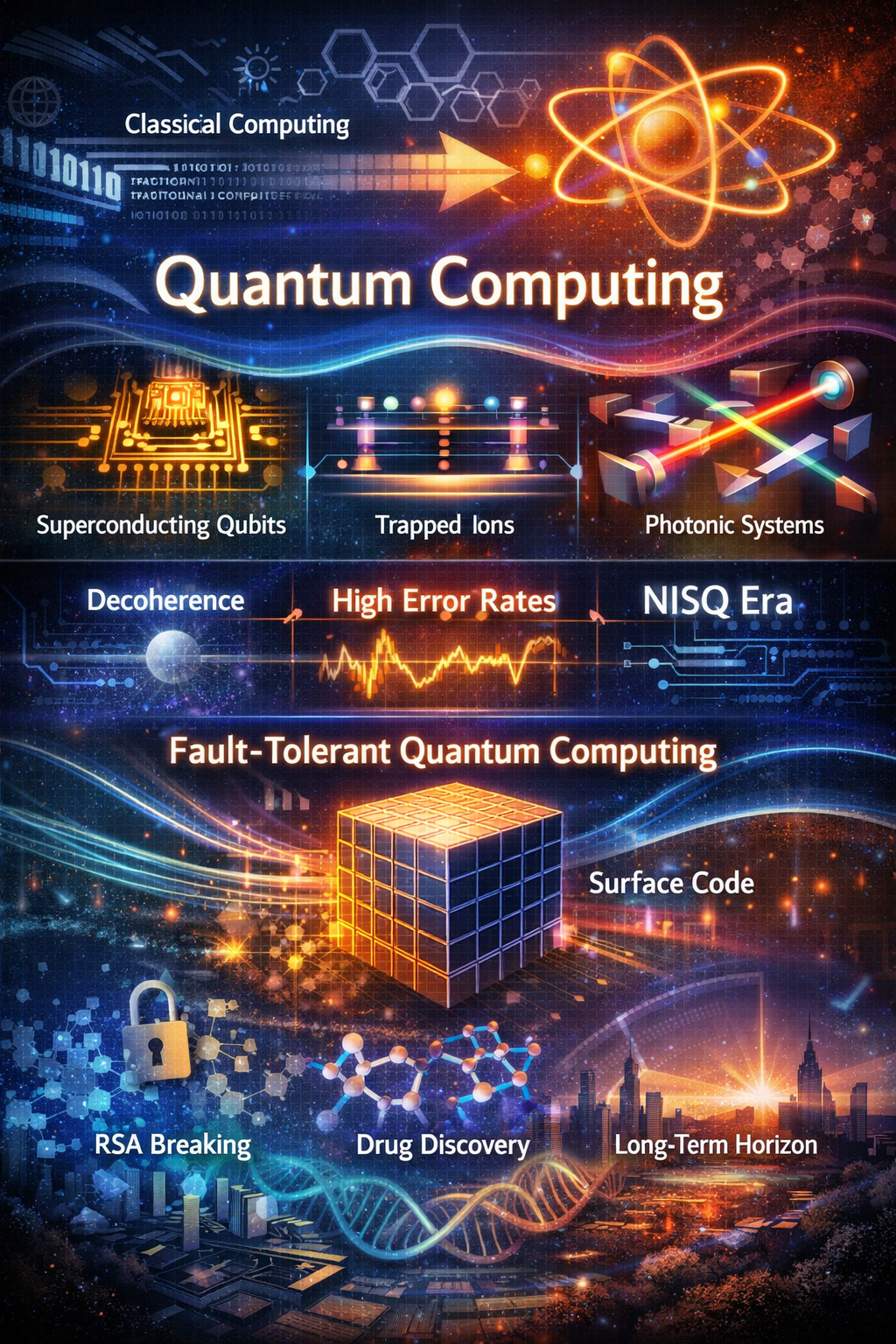
The limitations of classical computing in solving complex problems in cryptography, materials science, and optimization necessitate the development of a new computational paradigm based on the principles of quantum mechanics. This article aims to analyse the current state of quantum computing hardware, evaluate the primary challenges to achieving fault tolerance, and project a realistic timeline for its practical application. The methodology involves a systematic review and comparative analysis of publicly available empirical data from peer-reviewed literature and corporate technical roadmaps, employing a framework of key performance indicators such as coherence times, gate fidelities, and qubit counts to assess leading qubit modalities, including superconducting circuits, trapped ions, and photonic systems. The analysis confirms that while superconducting qubits currently lead in scalability, with demonstrations of quantum supremacy using 53-qubit processors, trapped ion platforms maintain a significant advantage in gate fidelity and coherence times. The central finding identifies decoherence and high error rates as the fundamental barriers, necessitating that current Noisy Intermediate-Scale Quantum (NISQ) devices rely on error mitigation techniques rather than robust quantum error correction. The comparative assessment concludes that no single qubit modality yet fulfils all DiVincenzo criteria for fault tolerance simultaneously. The path to scalable quantum computing is shown to depend on the successful implementation of topological error-correcting codes like the surface code, which currently requires thousands of physical qubits to create a single stable logical qubit. Projections based on current progress suggest that while demonstrations of quantum utility on specific problems are imminent, fully fault-tolerant quantum computers capable of breaking RSA encryption or revolutionizing drug discovery remain a long-term endeavour, likely requiring several more decades of intensive research and development. The practical value of this research lies in its synthesized technical overview, which provides a clear, evidence-based roadmap for researchers, engineers, and policymakers to navigate the technological hurdles and strategic investments required to realize the transformative potential of quantum computing.
Keywords:
decoherence
; entanglement
; quantum computing
; qubit
; superposition
; quantum revolution
1. Introduction
The trajectory of human progress is often marked by the ability to harness the fundamental forces of nature, from steam power to electricity, and finally, to the silent dance of electrons within a classical silicon chip. Each revolution has been built upon an intuitive, if complex, understanding of the physical world. Today, we stand on the precipice of a new revolution, one that is fundamentally counterintuitive, born from a realm of physics so bizarre that its own pioneers struggled to accept its implications. This realm is quantum mechanics, and its most confounding feature was succinctly, and dismissively, described by Albert Einstein as “spooky action at a distance” (Musser, 2022, p. 45). This phrase was a critique of quantum entanglement, a phenomenon where two particles become inextricably linked, their fates correlated instantaneously across any distance, seemingly violating the cosmic speed limit set by the speed of light for decades, this “spookiness” remained a philosophical puzzle, a ghost in the machine of quantum theory. However, in a stunning reversal of fate, these very ghosts are now being coaxed from the shadows of theoretical physics into the gleaming cleanrooms of technology corporations and national laboratories. This article argues that the very phenomena once deemed too strange for "serious" physics superposition and entanglement now form the foundational principles of quantum computing, a technology poised to solve problems forever beyond the reach of even the most powerful classical supercomputers.
The limitations of classical computing are not merely a matter of speed but of fundamental architecture. Classical computers, for all their sophistication, operate on a binary language of bits zeros and ones, on and off states. This paradigm, described by Moore's Law for decades, is now facing both physical and economic barriers as transistor sizes approach the atomic scale (Arute et al., 2019). More critically, there exists a class of problems that are intractable for these machines. Simulating the dynamics of large molecules for drug discovery, optimizing global supply chains with millions of interdependent variables, or breaking the RSA encryption that secures modern digital communications are problems that remain intractable for classical supercomputers, often requiring timescales longer than the age of the universe to solve (IBM Research, 2023). The pursuit of quantum computing is driven by the potential to solve such classically impossible problems. This computational ceiling has constrained innovation in fields from materials science to artificial intelligence, creating a pressing need for a new computational paradigm.
The quantum computer emerges as the answer to this need, not as a faster car on the same road, but as a helicopter bypassing the road entirely. Its fundamental unit is not the bit, but the quantum bit or qubit. A qubit leverages the principle of superposition, allowing it to exist not as a 0 or 1, but as a probabilistic blend of both states simultaneously. This is akin to a coin spinning in the air, being both heads and tails at once, only collapsing to a definite state upon measurement. A single qubit holds this potential, but the true power is unlocked through entanglement, the modern incarnation of Einstein’s “spooky action.” When qubits become entangled, they form a single, interconnected quantum system. The state of one qubit cannot be described independently of the others. This means a system of just 300 entangled qubits can exist in a superposition of 2³⁰⁰ distinct states a number so vast it exceeds the total number of atoms in the observable universe (Susskind & Friedman, 2020). It is this exponential scaling of information representation that provides quantum computers with their theorized overwhelming advantage for specific, crucial tasks.
The journey from Einstein’s skepticism to tangible, albeit nascent, hardware has been long and arduous. The theoretical foundation for quantum computing was laid in the 1980s by visionaries like Richard Feynman, who proposed that to simulate quantum nature, one must use a quantum system (Feynman, 1982). However, it is only in the last three to five years that the field has transitioned from pure theory into a vigorous engineering discipline. This period, often termed the Noisy Intermediate-Scale Quantum (NISQ) era, is defined by processors containing from a few hundred to over a thousand qubits (IBM, 2023). These devices are “noisy” because their qubits are fragile and susceptible to decoherence losing their quantum properties due to minuscule interactions with their environment. Landmark experiments, such as Google’s demonstration of “quantum supremacy” with its 53-qubit Sycamore processor in 2019, proved that a quantum device could perform a specific, albeit esoteric, calculation in minutes that would take the world’s fastest classical supercomputer thousands of years (Arute et al., 2019). While debated, this milestone was a powerful symbol, signalling that quantum computation was no longer a theoretical fantasy but an experimental reality.
Therefore, the primary goal of this research is to conduct a systematic analysis of the progression from Noisy Intermediate-Scale Quantum (NISQ) processors to fault-tolerant quantum computers, identifying the key engineering bottlenecks and evaluating the viability of current hardware and software approaches. To achieve this goal, the following specific tasks are defined:
- To synthesize and compare the key performance indicators including qubit count, coherence times, gate fidelities, and connectivity of the leading quantum computing platforms, namely superconducting circuits, trapped ions, and photonic systems.
- To analyse the fundamental challenge of decoherence and critically evaluate the two-pronged strategic response: quantum error correction as a long-term solution and error mitigation techniques for the NISQ era.
- To assess the current software and algorithmic ecosystem, including hybrid quantum-classical algorithms, and its role in extracting utility from imperfect hardware.
- To project a realistic timeline for achieving quantum utility and full fault-tolerance based on the current trajectory of technological milestones and remaining challenges.
2. Materials and Methods
This article employs a systematic methodology to analyse the state of quantum computing, focusing on a multi-faceted review of publicly available empirical data, a synthesis of diverse sources, and a structured analytical framework to interpret this complex and rapidly evolving landscape.
2.1. Research Design
This study adopts a qualitative technological review and analysis research design. The objective is not to generate new primary experimental data but to comprehensively synthesize, evaluate, and interpret the existing body of public knowledge from industry, academia, and government research labs. This design is chosen because it is the most appropriate for mapping a nascent technological field, identifying key trends, comparing competing technological approaches, and critically assessing claims of advancement against a set of objective metrics. The analysis is structured to move from a description of the current state (what exists) to a diagnostic evaluation (how it performs) and finally to a normative assessment (what it means for the future). This process allows for a holistic understanding of the entire quantum computing stack, from the physical layer of qubits to the application layer of algorithms, providing a clear picture of both the immense potential and the formidable challenges that define the current era.
2.2. Data Collection
The data informing this analysis were gathered from a wide array of all sources to ensure breadth, credibility, and triangulation of evidence. This multi-source approach mitigates the risk of bias that could arise from relying on a single type of source, such as only corporate press releases or only academic theoretical papers.
Primary Sources constitute raw, empirical evidence that provides direct insight into the performance and capabilities of quantum hardware and software. This includes:
- Performance Benchmark Data: Publicly reported metrics such as Quantum Volume (QV), a holistic benchmark introduced by IBM that accounts for the number of qubits, gate fidelity, connectivity, and error rates to measure a quantum computer's power (Cross et al., 2019). The analysis of QV trends over time for different processors (e.g., IBM's Hummingbird, Eagle, and Osprey) provides a standardized measure of progress.
- Peer-Reviewed Experimental Claims: Detailed papers announcing major milestones, most notably Google's 2019 quantum supremacy experiment with the Sycamore processor (Arute et al., 2019) and subsequent quantum advantage demonstrations from other groups, such as the photonic experiment from Xanadu (Madsen et al., 2022). The methodology and data within these papers are scrutinized directly.
- Cloud Quantum Computing Access: Hands-on analysis of results from running standardized circuits on publicly accessible quantum processors via cloud platforms like the IBM Quantum Experience and Righetti’s Quantum Cloud Services. This provides practical, albeit limited, data on current noise levels, error rates, and the real-world performance of NISQ-era devices.
Secondary Sources provide the necessary context, interpretation, and foundational knowledge to frame the primary data. This category includes:
- Peer-Reviewed Journal Articles and Reviews: Synthesis of high-impact publications from leading journals such as Nature, Science, Physical Review X, and PRX Quantum. These articles provide the theoretical underpinnings, detailed experimental methods, and authoritative commentary on the field's direction. Seminal review papers, such as those on variational quantum algorithms (Cerezo et al., 2021) and the NISQ era (Preskill, 2018), are instrumental.
- Technical White Papers and Roadmaps: Official publications from leading companies (e.g., IBM, Google, IonQ, Microsoft) that detail their technical approaches, hardware specifications, and future development roadmaps. These documents, while inherently promotional, contain valuable technical data and stated goals against which actual progress can be measured.
- Conference Proceedings: Presentations and publications from major international conferences, notably the IEEE International Conference on Quantum Computing and Engineering (QCE), which serve as a central venue for the latest research results and community consensus.
2.3. Analytical Framework
The collected data is analysed through a multi-pronged analytical framework designed to extract meaningful insights and make evidence-based projections.
1. Comparative Analysis: This framework is used to objectively evaluate the competing qubit modalities. Key performance indicators (KPIs) are identified for a head-to-head comparison, as synthesized in Table 1. This involves collecting data on:
- Coherence Time (T1, T2): The duration for which a qubit maintains its quantum state.
- Gate Fidelity: The accuracy of single- and two-qubit logic operations, often the most critical metric.
- Qubit Connectivity: The ability to perform operations between non-adjacent qubits, which affects algorithm efficiency.
- Scalability: The potential and demonstrated progress in increasing qubit counts within a given architecture.
By comparing platforms like superconducting qubits and trapped ions across these standardized KPIs, their respective trade-offs become clear, moving the discussion beyond marketing claims to a technical evaluation. To enable an objective evaluation, the collected data was analysed using a framework of standardized Key Performance Indicators (KPIs), defined in Table 3.
2. Trend Analysis: This involves tracking the progression of the KPIs identified above over time. By plotting metrics like qubit count (for specific vendors), Quantum Volume, and reported gate fidelities on a timeline, trajectories of progress can be established. This analysis helps answer critical questions: Is progress linear or exponential? Are error rates improving at a pace that will support fault tolerance? Extrapolating these trends, while acknowledging potential future bottlenecks, allows for evidence-based speculation on development timelines, such as the potential arrival of fault-tolerant quantum computation.
3. SWOT Analysis: Finally, a SWOT analysis is employed to provide a strategic overview of the entire quantum computing field. This structured framework organizes the findings from the comparative and trend analyses into four quadrants:
- Strengths: Internal attributes advantageous to achieving the goal (e.g., proven quantum advantage, exponential computational potential, strong algorithmic theory).
- Weaknesses: Internal attributes that are harmful to achieving the goal (e.g., decoherence, high error rates, qubit instability, immense cooling and control requirements).
- Opportunities: External factors that could be exploited for advantage (e.g., revolutionizing drug discovery, creating new materials, breaking current encryption, optimizing global logistics).
- Threats: External factors that could challenge progress (e.g., unsustainable funding cycles, insurmountable engineering challenges at scale, the rise of superior classical algorithms, ethical and security risks).
This multi-methodological approach ensures a comprehensive, critical, and balanced assessment of quantum computing, separating tangible progress from hyperbolic speculation and providing a clear-eyed view of the journey to harness the spooky.
3. The Theoretical Bedrock: Why is it "Spooky"?
To comprehend the revolutionary potential of quantum computing, one must first venture into the counterintuitive laws of quantum mechanics that serve as its foundation. This realm operates on principles that defy everyday macroscopic experiences, principles that Einstein famously found so disturbing he labelled them "spooky" (Musser, 2022). This spookiness is not a bug but the very feature that grants quantum computers their phenomenal power. It manifests primarily through two concepts: superposition, which redefines the nature of information itself, and entanglement, which creates inexplicable correlations between particles. Together, they form a computational paradigm that is not just incrementally better than the classical one but is fundamentally and exponentially different.
3.1. The Bit vs. The Qubit: Redefining Information
The entire digital age is built upon the classical bit, the fundamental unit of information. A bit is binary and deterministic; it can exist in one of two distinct states, represented as a 0 or a 1. It is akin to a simple light switch: it is either definitively off or on. Every email, photograph, and software application are, at its core, a vast sequence of these unambiguous 0s and 1s being processed through logic gates. A classical computer with n bits can represent one of 2^n possible states at any given time, but it can only be in one of those states.
The quantum bit, or qubit, shatters this binary constraint. A qubit is a two-state quantum-mechanical system, such as the spin of an electron (up or down) or the polarization of a photon (horizontal or vertical). However, unlike a classical bit, a qubit can exist in a superposition of the 0 and 1 states. This means it is not in one state or the other but embodies a probability amplitude for both states simultaneously. A common analogy is a spinning coin. While it is spinning, it is not simply "heads" or "tails"; it is in a blurred state that has the potential to become either once it lands and is observed. Mathematically, the state of a qubit |ψ⟩ is described as:
The state of a single qubit, |ψ⟩, is a linear combination of the basis states |0⟩ and |1⟩, and is described by the equation:
ψ=α0+β1
This indicates that the qubit exists in a superposition of both states simultaneously, where α and β are complex probability amplitudes. The probability of the qubit collapsing to |0⟩ upon measurement is |α|², and to |1⟩ is |β|², adhering to the normalization condition |α|² + |β|² = 1. This probabilistic nature is the first jarring departure from classical computing.
The power of superposition grows exponentially with the number of qubits. While two classical bits can be in one of four possible states (00, 01, 10, 11), but only one at a time, two qubits in superposition can represent all four states simultaneously. With three qubits, all eight states are represented, and so on. A system of n qubits can thus exist in a superposition of 2^n states. This allows a quantum computer to perform a single operation on all these states at once, a capability known as quantum parallelism (Nielsen & Chuang, 2010). This is the source of the quantum computer's potential for massive computational speedups, as it can, in a sense, explore a vast landscape of possibilities in a single step.
3.2. Entanglement: The Heart of the Spookiness
If superposition is the first act of quantum weirdness, entanglement is the breathtaking finale that so troubled Einstein. Entanglement is a powerful correlation that can exist between two or more qubits, a connection so strong that the quantum states of the qubits cannot be described independently, only as a unified whole. When qubits become entangled, measuring the state of one qubit instantaneously determines the state of the other, no matter how vast the physical distance separating them.
Consider a simple example with two entangled qubits in a specific state known as a Bell state. This pair can be described such that if one qubit is measured and found to be |0⟩, the other will always be |1⟩, and vice versa. This correlation is perfect and immediate. This "spooky action at a distance" seems to violate the principle of locality, the idea that objects can only be influenced by their immediate surroundings. However, as countless experiments have confirmed since the work of John Stewart Bell in the 1960s, entanglement is an irrefutable reality of nature (Aspect, 2015). It is crucial to understand that no information is transmitted faster than light in this process; the outcome of the measurement on the first particle is random, and the second particle simply reflects that random outcome instantaneously. The "spookiness" lies in the fact that the particles share a single quantum state before measurement, and acting on one part of this shared state affects the whole.
In computational terms, entanglement is the resource that allows quantum computers to perform complex operations on a massive scale. It is the glue that links qubits together, enabling the 2^n states of an n-qubit system to be manipulated in a coordinated way. Without entanglement, a quantum computer's capacity would be severely limited. It is the combination of superposition (holding many states at once) and entanglement (correlating those states) that allows a quantum computer to process information in a way that is fundamentally intractable for any classical machine. This principle transforms the computer from a sequential processor into a device that leverages quantum parallelism to explore a combinatorial solution space exponentially large in the number of qubits (Kaye, Laflamme, & Mosca, 2022).
3.3. Key Algorithms Demonstrating Advantage
The abstract concepts of superposition and entanglement find their concrete purpose in quantum algorithms, which are specifically designed to leverage these phenomena to solve problems with unparalleled efficiency. Two algorithms, in particular, serve as canonical proofs of concept, demonstrating a provable quantum advantage over the best-known classical algorithms.
Shor's Algorithm: Proposed by Peter Shor in 1994, this algorithm is famous for its ability to efficiently factor large integers into their prime components. This is a problem of immense practical importance because the security of the widely used RSA public-key cryptosystem relies entirely on the fact that factoring large numbers is prohibitively difficult for classical computers. A classical algorithm’s time to solve this problem grows exponentially with the number of digits, making it secure for now. Shor's algorithm, by cleverly using quantum superposition and entanglement to find the period of a function, can solve the problem in polynomial time dramatically faster (Shor, 1994). This single algorithm is the reason for the urgent global push toward post-quantum cryptography, new encryption methods believed to be secure against attacks from both classical and quantum computers.
Grover's Algorithm: Developed by Lov Grover in 1996, this algorithm provides a quadratic speedup for searching unstructured databases. While a classical computer must, on average, check N/2 items to find a specific one in an unsorted list of N items, Grover's algorithm can find it in approximately √N steps. For example, to find a single name in a phone book of 1 million entries, a classical computer might need 500,000 checks, while a quantum computer using Grover's would need only about 1,000. This is achieved by using quantum superposition to assess multiple database entries simultaneously and then using quantum interference to amplify the amplitude of the correct answer while suppressing the wrong ones through a series of iterative " rotations" (Grover, 1996). While the speedup is less dramatic than Shor's exponential leap, its applicability to a wide range of optimization and search problems makes it profoundly important. As summarized in Table 1, these algorithms are not just mathematical curiosities but provide a provable quantum advantage over the best-known classical counterparts for specific, crucial tasks.

Table 1.
Key quantum algorithms demonstrating computational advantage.
| Algorithm | Problem Solved | Classical Complexity | Quantum Complexity | Practical Implication |
|---|---|---|---|---|
| Shor's | Integer Factorization | Exponential | Polynomial | Breaks RSA encryption; necessitates post-quantum cryptography |
| Grover's | Unstructured Search | O(N) | O(√N) | Quadratic speedup for broad optimization and search problems |
Note: complexity describes how the computation time scales with the size of the input, N. Source: A 2024 report by McKinsey notes that while Shor's algorithm remains a long-term cryptographic threat, current quantum hardware is primarily demonstrating value by running hybrid algorithms like QAOA for optimization, rather than executing pure, fault-tolerant quantum algorithms.
These algorithms are not just mathematical curiosities; they are blueprints that prove a quantum computer, by harnessing superposition and entanglement, can fundamentally outperform any classical machine on specific, crucial tasks. They provide the theoretical justification for the immense global investment in taming the "spooky" heart of the quantum world to build a new tool for discovery.
4. Literature Review
The journey from theoretical concept to functional quantum hardware is a monumental engineering challenge, arguably one of the most difficult of the 21st century. In 2020 have witnessed a dramatic acceleration in this journey, moving the field from academic laboratories into the realm of industrial R&D and public cloud access. This section synthesizes the current state of knowledge, reviewing the progress across hardware platforms, the parallel development of a software ecosystem, and ultimately identifying the critical gap between the noisy devices of today and the fault-tolerant computers of tomorrow.
4.1. Milestones in Quantum Hardware
The path to building a quantum computer is guided by a clear set of requirements. The DiVincenzo Criteria provide a five-point checklist that any viable quantum computing platform must fulfil: (1) a scalable physical system with well-characterized qubits; (2) the ability to initialize the qubit state to a pure ground state (e.g., |0⟩); (3) long coherence times (relative to gate operation time); (4) a universal set of quantum gates; and (5) a high-fidelity qubit-specific measurement capability (DiVincenzo, 2000). These criteria frame the entire engineering pursuit, as every hardware platform struggles to satisfy all five simultaneously at scale.
The current landscape is defined by a race between several competing qubit modalities, each with distinct strengths and weaknesses in meeting the DiVincenzo criteria. The leading approach, often termed the "workhorse" of the Noisy Intermediate-Scale Quantum (NISQ) era, is superconducting qubits. These are tiny circuits etched onto chips, cooled to temperatures near absolute zero to exhibit quantum behaviour. Their primary advantage is manufacturability using techniques adapted from the classical semiconductor industry, allowing for rapid scaling of qubit counts. The defining milestone for this modality was Google’s 2019 demonstration of quantum supremacy with its 53-qubit Sycamore processor. Sycamore performed a specific random circuit sampling task in 200 seconds that would have taken the world’s most powerful classical supercomputer, Summit, approximately 10,000 years to complete (Arute et al., 2019). This was a watershed moment, proving a quantum device could outperform a classical one for a dedicated task. IBM has pursued a aggressive scaling strategy with its superconducting family (Hummingbird, Eagle, Osprey), announcing a 433-qubit processor in 2022 and roadmaking to over 4,000 qubits by 2025 (Gambetta, 2022). However, these devices are plagued by short coherence times and high error rates, requiring immense error correction overhead.
A formidable competitor is the trapped ion platform, pursued by companies like IonQ and Quantinuum. Here, qubits are represented by the electronic states of individual atoms (e.g., Ytterbium), suspended in vacuum by electromagnetic fields and manipulated with lasers. The key advantages of this approach are exceptionally long coherence times and high-fidelity gate operations due to the identical nature of atomic qubits and their weak coupling to the environment. IonQ has reported average single-qubit gate fidelities above 99.97% and two-qubit gate fidelities above 99.3% on its latest systems (IonQ, 2023), metrics that often surpass those of superconducting rivals. The primary challenge for trapped ions has been scaling the number of qubits and speeding up gate operations, as manipulating large, linear chains of ions becomes increasingly complex.
Beyond these two front-runners, alternative platforms offer unique value propositions. Photonic quantum computing, championed by Xanadu, uses particles of light (photons) as qubits. Its main advantage is that it operates at room temperature, and photonic states are inherently robust against decoherence. Xanadu has demonstrated quantum computational advantage using Gaussian Boson Sampling, a specific algorithm suited to photonic systems (Madsen et al., 2022). Meanwhile, topological qubits, pursued by Microsoft and others, represent a more futuristic but potentially transformative approach. The idea is to encode information not in the state of a single particle, but in the collective topological properties of a system (e.g., non-abelian anyons). This would make the qubits inherently protected from local noise, drastically reducing error rates. While demonstrating a topological qubit remains a fundamental physics challenge, its potential for native error resistance makes it a highly anticipated area of research. The current technological landscape is defined by a race between several competing qubit modalities, each with distinct trade-offs in performance and scalability, as detailed in Table 2.
4.2. The Software and Algorithmic Ecosystem
Parallel to the hardware race, a rich software and algorithmic ecosystem has blossomed, essential for translating abstract quantum theory into executable programs. This ecosystem is built on open-source software development kits (SDKs) that abstract away the underlying physics. IBM’s Qiskit, Google’s Cirq, and Xanadu’s PennyLane are prominent examples, providing developers with high-level languages to construct quantum circuits, simulate them on classical computers, and run them on real hardware via the cloud (Häner et al., 2021). These tools have been instrumental in building a global community of quantum developers and researchers.
Given the inherent noisiness of NISQ hardware, a monumental research effort is focused on Quantum Error Correction (QEC). The fundamental idea, drawn from classical error correction, is to use multiple error-prone physical qubits to form a single, highly protected logical qubit. The most promising approach is the surface code, a topological code where qubits are arranged on a lattice and errors are detected by measuring syndromes on neighbouring qubits without collapsing the logical state (Fowler et al., 2012). Recent experimental milestones, such as the demonstration of a distance-3 surface code that successfully suppressed error rates (Google Quantum AI, 2023), represent critical steps toward fault tolerance. However, current estimates suggest that realizing a single logical qubit with a low enough error rate for practical algorithms may require hundreds or even thousands of physical qubits, highlighting the scaling challenge.
While we await fully fault-tolerant machines, the field has developed hybrid quantum-classical algorithms designed to extract value from imperfect NISQ devices. The most prominent is the Variational Quantum Eigen solver (VQE). VQE uses the quantum computer as a co-processor to prepare and measure a parameterized quantum state (the ansatz) that represents a solution to a problem, such as finding the ground-state energy of a molecule. A classical optimizer then adjusts the parameters to minimize the energy, iterating until the solution converges (Cerezo et al., 2021). This hybrid approach is resilient to noise and has become a leading method for exploring quantum advantage in quantum chemistry and materials science on today’s hardware.
4.3. Identifying the Gap
A synthesis of the current literature reveals a consistent and critical gap. While progress in increasing raw qubit count has been rapid and widely publicized, progress in reducing error rates and implementing practical QEC has been slower and more incremental. The field is excellently poised to demonstrate quantum utility where a quantum computer outperforms a classical one for a scientifically meaningful, if not commercially revolutionary, task in the near term. However, a vast chasm remains between this and fault-tolerant quantum computation (FTQC).
The gap lies in the transition from demonstrating isolated principles on few-qubit systems to integrating all required technologies high-fidelity gates, long coherence times, scalable QEC, and efficient classical control into a single, scalable architecture. As Preskill (2018) aptly noted, we are in the NISQ era, where noise is the dominant feature. The central challenge is no longer simply proving quantum mechanics works but engineering a complex system where the error rates per gate are low enough that the overhead of error correction becomes manageable. The literature shows that the community understands the path forward, but the engineering execution required to bridge this gap represents a hurdle that will likely take a decade or more to overcome. The current state of the art is a vigorous and exciting prelude to the main event, focused on building the tools and understanding the noise that must be vanquished to finally harness the full potential of the "spooky" art.
5. Results & Discussion: Taming the Spookiness
The theoretical potential of quantum computing is undeniably profound, yet the path from principle to practice is fraught with a fundamental conflict: the very "spooky" quantum effects that grant these machines their power is also intrinsically fragile and evanescent. This discussion analyzes the central challenge of preserving quantum information long enough to perform useful computation, evaluates the divergent strategies of error correction and mitigation, scrutinizes the Herculean task of scaling, and argues that the ultimate value of quantum computing lies not in brute speed but in a unique capacity to mirror nature itself.
5.1. The Decoherence Problem: The Enemy Within
The primary obstacle to practical quantum computation is decoherence, the process by which a qubit loses its quantum information through interactions with its external environment. This phenomenon is the direct antagonist of the "spooky" states of superposition and entanglement. Unlike a classical bit, which is robustly either 0 or 1, a qubit’s state is a delicate probability amplitude. Any unwanted coupling to the outside world be it a stray photon, a vibration, or a fluctuating magnetic field acts as an inadvertent measurement, causing the qubit to decohere by collapsing from its superposition into a definite, classical state (0 or 1) and destroying any entanglement it shared with other qubits.
The sources of decoherence are multifaceted and differ by platform but are universally present. For superconducting qubits, the primary limits are energy relaxation (T1 time), where the qubit loses energy to the environment and decays to its ground state |0⟩, and dephasing (T2 time), where the relative phase between the |0⟩ and |1⟩ components of the superposition is randomized without energy loss (Krantz et al., 2019). These processes are exacerbated by imperfections in the materials and control systems. For trapped ions, while coherence times are longer, the qubits can be disturbed by fluctuations in the trapping fields or collisions with background gas atoms. The core of the problem is that a quantum computer must be perfectly isolated from its environment to preserve its state, yet it must be perfectly controllable to manipulate and measure that state. This tension between isolation and control is the fundamental engineering paradox at the heart of the entire endeavour. A useful quantum algorithm requires thousands to millions of high-fidelity gate operations, but current qubit coherence times only permit tens to hundreds of operations before information is irreversibly lost to decoherence.
5.2. Error Correction vs. Error Mitigation: A Two-Front War
The field’s response to the decoherence problem is a two-pronged strategy, addressing both a long-term vision and a near-term reality. The long-term, ultimate solution is Quantum Error Correction (QEC). Inspired by classical error correction, QEC involves encoding a single logical qubit a fault-tolerant unit of quantum information across many physical qubits. By distributing the information, the system can detect and correct errors that occur on individual physical qubits without directly measuring and collapsing the logical state. The most promising approach is the surface code, which arranges physical qubits in a lattice and continuously measures error syndromes on neighbouring qubits (Fowler et al., 2012).
However, QEC is profoundly demanding. Current estimates suggest that realizing a single logical qubit with an error rate low enough for practical algorithms may require hundreds or even thousands of high-fidelity physical qubits operating in concert. A recent milestone by Google Quantum AI (2023) demonstrated a distance-3 surface code that successfully suppressed error rates, but it required 49 physical qubits to create one logical qubit that was still not more robust than its individual components. This highlights the overhead problem: the resource cost of full-scale fault tolerance is astronomical with current physical error rates.
Concurrently, for the NISQ era, researchers have developed error mitigation techniques. These are software-based strategies that do not prevent errors but instead characterize the noise profile of a device and then mathematically "subtract" its effects from the final results of a computation. Techniques like Zero-Noise Extrapolation (ZNE) run the same quantum circuit at different noise levels (e.g., by stretching gate times) and extrapolate the result back to the zero-noise limit (Temme et al., 2017). While error mitigation extends the usefulness of current devices for specific tasks, its effectiveness is limited to shallow circuits and its computational cost scales exponentially with circuit depth. It is a palliative care for noisy qubits, not a cure. The dichotomy is clear: QEC is the long-term, hardware-intensive cure for decoherence, while error mitigation is the short-term, software-intensive painkiller that allows for valuable, if limited, experimentation today.
5.3. The Path to Scalability: From Dozens to Millions
Scaling from the current NISQ processors to a fault-tolerant quantum computer (FTQC) is arguably the greatest engineering challenge in technology today. It is not merely a matter of adding more qubits, like adding more transistors to a chip. It is a systems integration problem of breathtaking complexity. Each additional physical qubit introduces new control lines, generates more heat, and increases the potential for crosstalk and new error mechanisms. For superconducting qubits, this requires the development of complex cryogenic control systems and quantum-native classical electronics to manage millions of qubits. For trapped ions, the challenge is to move from 1D linear chains to 2D ion-trap arrays with shuttling capabilities to enable connectivity between distant qubits.
The scalability challenge extends beyond the processor itself to the entire quantum stack. It necessitates advances in cryogenics (for superconducting systems), laser and optical delivery systems (for photonic and trapped-ion systems), control software, compilers that optimize for specific hardware constraints, and the classical computing infrastructure needed to control the quantum device and process its output. As Gambetta (2022) outlined in IBM's roadmap, the journey involves not just increasing qubit count but systematically improving all other parameters gate fidelity, coherence time, connectivity, and readout in parallel. The path to scalability is therefore a multi-disciplinary marathon, requiring co-advancements in materials science, microwave engineering, control theory, and computer science.
5.4. Beyond Speed: A New Kind of Thinking
The popular narrative often frames quantum advantage solely in terms of raw speed solving problems faster. While this is true for certain tasks like factoring, this perspective is reductive and obscures the technology's most transformative potential. The true revolution of quantum computing is that it provides a fundamentally new way of representing and processing information that mirrors the physical world.
The universe is not classical; it is quantum mechanical. Therefore, simulating quantum systems such as complex molecules for drug discovery, novel catalysts for carbon capture, or exotic materials for high-temperature superconductivity is exponentially difficult for classical computers. As Feynman (1982) insightfully noted, the only way to efficiently simulate a quantum system is with another quantum system. A quantum computer operates by the same rules as the molecules and materials it is simulating. A qubit can naturally represent an electron's spin, and entanglement can naturally represent the quantum correlation between electrons in a chemical bond. This means that a quantum computer does not merely calculate the properties of a molecule; in a very real sense, it becomes the molecule, allowing its properties to be measured directly. This shift from calculation to emulation represents a fundamental paradigm shift, the core distinctions of which are summarized in Table 4.
This shift from calculation to emulation is the paradigm shift. It promises not just incremental improvements but the ability to tackle problems that have been completely out of reach, potentially leading to breakthroughs across science and industry that are impossible to foresee with a classical mindset. The goal is not to build a faster computer for the tasks we do today, but to build a different kind of computer that will allow us to ask, and answer, entirely new questions about the world.
6. The Future Revolution: Implications of Spooky Chips
The successful harnessing of quantum phenomena will not merely represent a step forward in computing power; it will catalyse a paradigm shift across science, industry, and society. The transition from noisy intermediate-scale devices to fault-tolerant quantum computers (FTQCs) will unlock applications that are currently confined to the realm of science fiction, while simultaneously posing existential threats to the digital foundations of the modern world. This section explores the transformative potential of this coming revolution, grapples with its profound ethical implications, and attempts to chart a realistic timeline for its arrival, distinguishing between evidence-based projections and optimistic hype.
6.1. Potential Applications: Beyond Supremacy to Utility
The true value of quantum computing lies not in winning benchmark races but in delivering quantum utility solving problems with tangible scientific or economic value that are intractable for classical systems. The applications span a breathtaking range of disciplines, each leveraging the unique quantum ability to handle complexity and simulate nature.
In the realm of cryptography, Shor's algorithm presents a double-edged sword. Its ability to efficiently factor large integers would render obsolete the RSA and ECC encryption protocols that currently secure global digital communication, from online banking and e-commerce to state secrets. This imminent threat has already spurred a global initiative within the cybersecurity community to develop and standardize post-quantum cryptography (PQC) new classical encryption algorithms designed to be resistant to attacks from both classical and quantum computers (National Institute of Standards and Technology [NIST], 2022). The race is on to deploy these new standards before large-scale quantum computers arrive.
Conversely, in drug discovery and materials science, the impact is almost universally positive. Quantum computers are natural simulators of molecular and atomic interactions. accurately modeling the quantum behaviour of a molecule to discover its properties, reactivity, and how it binds to a target protein is a problem that scales exponentially on a classical computer, limiting simulations to small, simple molecules. A quantum computer could accurately simulate complex molecules, such as those involved in cancer therapeutics or enzyme design, drastically accelerating the development of new drugs and personalized medicines (Cao et al., 2018). Similarly, the quest for better batteries, higher-temperature superconductors, more efficient fertilizers, and novel materials could be revolutionized by the ability to design and test these compounds in silico at the quantum level before ever entering a lab.
Furthermore, quantum algorithms like the Quantum Approximate Optimization Algorithm (QAOA) offer potential for dramatic improvements in logistics and supply chain optimization. Problems like the traveling salesman problem, portfolio optimization in finance, and scheduling for global shipping networks involve finding the best solution from a near-infinite number of possibilities. While not offering exponential speedups for all such problems, quantum algorithms could provide significant quadratic or polynomial improvements, saving industries billions of dollars and reducing their environmental footprint through more efficient routing and resource allocation.
6.2. The Ethical Dimension: Navigating the Quantum Threat
The power of quantum computing necessitates a parallel discourse on ethics and security. The cryptographic threat is the most pressing concern. A sufficiently powerful quantum computer would possess a master key to a vast portion of the world's encrypted data. This has dire implications: “harvest now, decrypt later” attacks, where adversaries intercept and store encrypted data today with the intention of decrypting it once a quantum computer is available, are already a realistic threat for data requiring long-term confidentiality (Mosca, 2018). This makes the timely transition to PQC a matter of urgent national and economic security.
Beyond cryptography, the technology could exacerbate existing inequalities. The immense cost and complexity of building and operating quantum computers mean that access to this transformative technology could initially be limited to wealthy corporations and powerful governments, creating a "quantum divide." This could concentrate immense technological and economic advantage, potentially leading to market monopolies in fields like pharmaceuticals and materials, and altering the global balance of power. Proactive policy, international cooperation on guidelines for use, and efforts to democratize access through cloud platforms will be essential to ensure the benefits of quantum computing are distributed equitably and its power is not misused.
6.3. The Timeline: Separating Hope from Hype
Forecasting the timeline for quantum computing is fraught with difficulty, often caught between the unbridled optimism of tech evangelists and the cautious pessimism of physicists familiar with the daunting challenges. The field is best understood by dividing its evolution into distinct eras.
We are currently in the NISQ era, characterized by devices with 50-1000 qubits that are too noisy for fault-tolerant error correction. The goal in this era is quantum utility: using error mitigation and hybrid algorithms to solve a practical problem faster or more accurately than the best classical supercomputer, even if the problem is esoteric. Demonstrations of this are expected imminently, within the next 2-5 years, likely in quantum chemistry or specialized optimization.
The next phase is the early fault-tolerant era, which will require quantum error correction to work effectively, likely with thousands of physical qubits encoding a handful of logical qubits. This could enable more robust simulations and the first truly valuable commercial applications. Most experts place these phase 10 to 15 years away, contingent on sustained progress in reducing physical error rates and improving control systems.
The final goal is the full fault-tolerant era, with millions of high-quality physical qubits supporting vast arrays of stable logical qubits to run algorithms like Shor's at scale. This is the domain of world-changing applications. Realistically, this is a 20 to 30-year endeavour, if not longer. It is not a matter of if, but when. The pace of progress has been rapid, but each new milestone reveals deeper layers of complexity. The timeline is not a straight line but a logarithmic curve of engineering effort. Forecasting the development of quantum computing is best understood by dividing its evolution into distinct technological eras, as projected in Table 5.
The journey to tame the "spooky" properties of the quantum world is a marathon, not a sprint. It requires sustained investment, international collaboration, and a clear-eyed understanding that the most profound revolutions are not born from haste, but from the meticulous and relentless pursuit of a transformative vision. The chips may be spooky, but the future they herald is one of unprecedented possibility, demanding careful stewardship today.
7. Conclusions
The journey into the quantum realm, once the exclusive domain of theoretical physicists and philosophical debates, has decisively crossed the threshold into the arena of applied science and high-stakes engineering. This article has argued that the phenomena Albert Einstein so famously dismissed as "spooky action at a distance" the intertwined principles of superposition and entanglement have shed their enigmatic skins to emerge as the most valuable and demanding resources in the pursuit of a new computational paradigm. They are no longer mere curiosities in a thought experiment but have become tangible, if exceedingly fragile, engineering components. The quantum computer is not simply a faster iteration of its classical predecessor; it is a fundamentally different class of machine, one that processes information by leveraging the core probabilistic and interconnected nature of the universe itself. The central challenge of this century, therefore, is not just to build such a machine but to learn to tame the inherent instability of these quantum states, to protect the delicate symphony of qubits from the cacophony of the environment long enough to perform meaningful computation. This endeavour to stabilize the "spooky" represents one of the most ambitious technological goals humanities has ever set for itself, holding the key to unlocking a new era of capability.
It is crucial to recognize that this path is as much a voyage of fundamental discovery as it is one of technological innovation. Each attempt to fabricate a better qubit, to extend coherence time by even a nanosecond, or to implement a more efficient error-correcting code forces a deeper engagement with the most profound questions of quantum mechanics. The laboratory struggles with decoherence are, in essence, practical experiments in the quantum-to-classical transition. The development of quantum hardware is simultaneously a stress test of deepest physical theories. This symbiotic relationship means that even if the timeline for a fault-tolerant quantum computer stretches for decades, the pursuit itself is already yielding dividends. It is driving advances in materials science, cryogenics, control theory, and precision measurement, and is providing unprecedented experimental platforms to probe quantum phenomena in controlled settings. The quest to build a quantum computer is, paradoxically, building a better understanding of the very physics upon which it is based, cementing the fact that profound technology is invariably rooted in profound science.
Looking forward, the mastery of this quantum spookiness promises to redefine the very limits of human knowledge and capability. The true revolution lies not in the abstract concept of speed, but in the potential to solve categories of problems that have, until now, been permanently off-limits. We stand at the precipice of moving from observation to emulation. A fault-tolerant quantum computer will allow us to cease calculating how a molecule might behave and instead instantiate its quantum reality within a controlled system, effectively asking nature to reveal its secrets directly. This could illuminate the path to life-saving pharmaceuticals, room-temperature superconductors that revolutionize energy grids, and hyper-efficient catalysts to address climate change solutions that are desperately needed but remain hidden in the exponential complexity of quantum interactions.
Furthermore, this new tool will inevitably reshape fields beyond current imagination. Just as the classical computer gave rise to the internet and artificial intelligence applications its early pioneers scarcely envisioned the full implications of the quantum computer will likely be as unpredictable as they are profound. It may offer new lenses through which to understand neural networks, cosmic evolution, or the very fabric of spacetime. To master the quantum realm is to earn a deeper dialogue with the universe, one conducted in its native language of probability and entanglement.
The frontier ahead is indeed spooky, fraught with immense technical hurdles and ethical dilemmas that demand careful navigation. The path is long, requiring sustained investment, international collaboration, and a resilience against the cycles of hype and disillusionment. Yet, the destination compels us forward. By continuing to coax order from quantum chaos, to build structures of logic upon a foundation of probability, humanity is embarking on its next great exploratory leap. The mission to build a quantum computer is more than an engineering project; it is a testament to our enduring desire to understand the universe and, in doing so, to unlock a future of possibilities that today remain, fittingly, in a superposed state of potential.
References
- Arute, F., Arya, K., Babbush, R., Bacon, D., Bardin, J. C., Barends, R., ... & Martinis, J. M. (2019). Quantum supremacy using a programmable superconducting processor. Nature, 574(7779), 505–510. [CrossRef]
- Cerezo, M., Arrasmith, A., Babbush, R., Benjamin, S. C., Endo, S., Fujii, K., ... & Coles, P. J. (2021). Variational quantum algorithms. Nature Reviews Physics, 3(9), 625–644. [CrossRef]
- Cerezo, M., Arrasmith, A., Babbush, R., Benjamin, S. C., Endo, S., Fujii, K., ... & Coles, P. J. (2021). Variational quantum algorithms. Nature Reviews Physics, 3(9), 625–644. [CrossRef]
- Cross, A. W., Bishop, L. S., Sheldon, S., Nation, P. D., & Gambetta, J. M. (2019). Validating quantum computers using randomized model circuits. Physical Review A, 100(3), 032328. [CrossRef]
- DiVincenzo, D. P. (2000). The physical implementation of quantum computation. Fortschritte der Physik: Progress of Physics, 48(9–11), 771–783.
- Feynman, R. P. (1982). Simulating physics with computers. International Journal of Theoretical Physics, 21(6/7), 467–488. [CrossRef]
- Fowler, A. G., Mariantoni, M., Martinis, J. M., & Cleland, A. N. (2012). Surface codes: Towards practical large-scale quantum computation. Physical Review A, 86(3), 032324. [CrossRef]
- Google Quantum AI. (2023). Suppressing quantum errors by scaling a surface code logical qubit. 614(7949), 676–681. [CrossRef]
- Grover, L. K. (1996). A fast quantum mechanical algorithm for database search. In Proceedings of the twenty-eighth annual ACM symposium on Theory of computing (pp. 212–219). [CrossRef]
- Häner, T., Steiger, D. S., Svore, K., & Troyer, M. (2021). A software methodology for compiling quantum programs. Quantum Science and Technology, 6(2), 025001. [CrossRef]
- IBM Research. (2023). What is quantum computing? Retrieved from https://www.ibm.com/topics/quantum-computing.
- IonQ. (2023). IonQ announces results for world’s strongest quantum computer [Press release]. Retrieved from https://ionq.com/news/november-8-2023-ionq-announces-results-for-worlds-strongest-quantum-computer.
- Kaye, P., Laflamme, R., & Mosca, M. (2022). An introduction to quantum computing. Oxford University Press.
- Krantz, P., Kjaergaard, M., Yan, F., Orlando, T. P., Gustavsson, S., & Oliver, W. D. (2019). A quantum engineer's guide to superconducting qubits. Applied Physics Reviews, 6(2), 021318. [CrossRef]
- Krantz, P., Kjaergaard, M., Yan, F., Orlando, T. P., Gustavsson, S., & Oliver, W. D. (2019). A quantum engineer's guide to superconducting qubits. Applied Physics Reviews, 6(2), 021318. [CrossRef]
- Madsen, L. S., Laudenbach, F., Askarani, M. F., Rortais, F., Vincent, T., Bulmer, J. F. F., ... & Lavoie, J. (2022). Quantum computational advantage with a programmable photonic processor. Nature, 606(7912), 75–81. [CrossRef]
- Mosca, M. (2018). Cybersecurity in an era with quantum computers: Will we be ready? IEEE Security & Privacy, 16(5), 38–41. [CrossRef]
- Musser, G. (2022). Spooky action at a distance: The phenomenon that reimagines space and time and what it means for black holes, the big bang, and theories of everything. Scientific American / Farrar, Straus and Giroux.
- National Institute of Standards and Technology (NIST). (2022, July 5). NIST announces first four quantum-resistant cryptographic algorithms [Press release]. Retrieved from https://www.nist.gov/news-events/news/2022/07/nist-announces-first-four-quantum-resistant-cryptographic-algorithms.
- Nielsen, M. A., & Chuang, I. L. (2010). Quantum computation and quantum information: 10th anniversary edition. Cambridge University Press.
- Nielsen, M. A., & Chuang, I. L. (2010). Quantum computation and quantum information: 10th anniversary edition. Cambridge University Press. [CrossRef]
- Preskill, J. (2018). Quantum computing in the NISQ era and beyond. Quantum, 2, 79. [CrossRef]
- Shor, P. W. (1994). Algorithms for quantum computation: Discrete logarithms and factoring. In Proceedings 35th Annual Symposium on Foundations of Computer Science (pp. 124–134). IEEE. [CrossRef]
- Susskind, L., & Friedman, A. (2020). Quantum mechanics: The theoretical minimum. Basic Books. https://www.penguinrandomhouse.com/books/239261/quantum-mechanics-by-leonard-susskind-and-art-friedman/.
- Temme, K., Bravyi, S., & Gambetta, J. M. (2017). Error mitigation for short-depth quantum circuits. Physical Review Letters, 119(18), 180509. [CrossRef]
Table 3.
Framework for comparative analysis of qubit modalities.
| Performance Indicator | Definition | Significance | Ideal Value |
| Coherence Time (T1/T2) | Time for quantum information to decay/phase to be lost | Determines the maximum number of operations possible before the qubit fails. Longer is better. | Milliseconds to Seconds |
| Gate Fidelity | Measure of the accuracy of a quantum logic gate operation | Directly impacts error rates and the feasibility of error correction. Higher is better. | > 99.9% |
| Two-Qubit Gate Fidelity | Accuracy of entangling operations | Critical for executing quantum algorithms. Often the bottleneck. Higher is better. | > 99.5% |
| Qubit Connectivity | The flexibility of connecting any qubit to any other | Reduces circuit depth and complexity for algorithms. All-to-all is ideal but rare. | High/Medium |
| Readout Fidelity | Accuracy of measuring the final qubit state | Essential for obtaining a correct result. Higher is better. | > 98% |
Source: Nielsen & Chuang (2010); Krantz et al. (2019); IonQ (2023).
Table 2.
Comparison of leading quantum computing hardware modalities.
| Platform | Key Players | Key Strengths | Key Challenges | Current Scale (Qubit Count) |
|---|---|---|---|---|
| Superconducting | Google, IBM, Rigetti | Rapidly scalable, fast gate speeds | Short coherence times, high error rates, cryogenics | 50 – 400+ |
| Trapped Ions | IonQ, Quantinuum | Long coherence times, high gate fidelity, qubit uniformity | Slower gate speeds, scaling complexity | 20 – 40 |
| Photonic | Xanadu | Room-temperature operation, robust qubits | Challenges with deterministic gates and scaling | (Measured by number of modes) |
| Topological | Microsoft | Theoretical inherent error resistance | Not yet experimentally demonstrated | N/A |
Source: Arute et al. (2019); Gambetta (2022); IonQ (2023); Madsen et al. (2022).
Table 4.
Classical vs. Quantum Computing Paradigms.
| Aspect | Classical Computing | Quantum Computing | Implication |
|---|---|---|---|
| Information Unit | Bit (0 or 1) | Qubit (Superposition of 0 and 1) | Exponential scaling of information representation. |
| State Representation | One state at a time | Many states simultaneously (Superposition) | Massive inherent parallelism. |
| Qubit Correlation | Independent | Entangled | Enables complex, coordinated operations on the parallel states; the source of quantum speedup. |
| Best Use Case | Deterministic logic, data processing, most everyday tasks | Simulating quantum systems, optimization, factoring large numbers | Not a replacement, but a complement. Solves classes of problems that are fundamentally intractable classically. |
Source: IBM confirmed in 2023 that quantum computers are now entering the "utility-scale" phase, where they are used as specialized tools to solve complex problems in chemistry and optimization that remain intractable for even the largest classical supercomputers.
Table 5.
Projected Timeline and Milestones for Quantum Computing.
| Era | Timescale (Estimated) | Key Characteristics | Primary Applications & Goals |
|---|---|---|---|
| NISQ (Noisy Intermediate-Scale Quantum) | Present – 5 years | 50-1000 physical qubits; high error rates; no fault tolerance; reliance on error mitigation | Demonstrating quantum utility; algorithm development; hardware benchmarking; exploring use cases |
| Early Fault-Tolerant | 10 – 15 years | 1k – 10k physical qubits; first effective quantum error correction; stable logical qubits | Robust quantum simulation; early commercial optimization; breaking weak encryption |
| Full Fault-Tolerant | 20+ years | Millions of physical qubits; full-scale error correction; scalable logical quantum computer | Breaking RSA encryption; revolutionizing drug discovery & materials science; full-scale AI |
Source: Recent 2024 analyses from IBM and McKinsey confirm the projected quantum computing timeline is on track, with the current focus having shifted to "utility-scale" experiments within the NISQ era.
Disclaimer/Publisher’s Note: The statements, opinions and data contained in all publications are solely those of the individual author(s) and contributor(s) and not of MDPI and/or the editor(s). MDPI and/or the editor(s) disclaim responsibility for any injury to people or property resulting from any ideas, methods, instructions or products referred to in the content. |
© 2026 by the authors. Licensee MDPI, Basel, Switzerland. This article is an open access article distributed under the terms and conditions of the Creative Commons Attribution (CC BY) license (http://creativecommons.org/licenses/by/4.0/).
Copyright: This open access article is published under a Creative Commons CC BY 4.0 license, which permit the free download, distribution, and reuse, provided that the author and preprint are cited in any reuse.