

Submitted:
09 January 2026
Posted:
12 January 2026
You are already at the latest version
Abstract
Remote sensing has revolutionized monitoring landscapes that are inaccessible or impractical to survey on the ground. Satellite platforms such as Sentinel-2 enable assessment of ecosystem changes over extensive areas with high temporal frequency, while Unmanned Aerial Systems (UAS) offer flexible, ultra-high-resolution observations ideal for site-specific analysis and sensitive environments. This study compares the performance of Sentinel-2 and Phantom 4 multispectral RTK data for monitoring vegetation dynamics in Mediterranean shrubland ecosystems, focusing on the Normalized Difference Vegetation Index (NDVI). Both platforms produced broadly consistent patterns in seasonal and interannual vegetation dynamics. However, UAS outperformed satellite data in capturing fine-scale heterogeneity, regeneration patches, and subtle disturbance responses, particularly in sparsely vegetated or heterogeneous terrain where satellite metrics may be insensitive. The comparison of NDVI across platforms accounted for standardized processing, harmonization, radiometric and atmospheric correction, and spatial resolution differences. Results show platform selection can be optimized according to monitoring objectives: satellite data are well suited for large-scale, long-term ecosystem monitoring and regional environmental modelling, while UAS data provide critical detail for localized management, early stress detection, and restoration prioritization. A combined approach enhances ecosystem disturbance assessments and resource management by binding the strengths of both wide-area coverage and precise spatial detail.
Keywords:
UAS
; satellite
; shrubland
; NDVI
; forest monitoring
1. Introduction
Remote sensing allows for efficient monitoring of landscapes that would be impractical or impossible to survey entirely on the ground. Satellite imagery can cover hundreds or thousands of square meters in a single scene, enabling researchers to assess ecosystem disturbances in remote and difficult-to-reach areas and at larger scales than ground surveys. Adding to this, many satellites provide frequent revisit times, allowing for near real-time monitoring of ecosystem changes. For example, the Sentinel-2 constellation provides data with 5-day temporal and 10-m spatial resolution, which is useful for detecting and tracking changes in ecosystems [1].
Unmanned Aerial Systems (UAS) are also valuable remote sensing tools for ecosystem monitoring. UAS can capture very high-resolution imagery, access remote areas, reduce operational costs, minimizing wildlife disturbance, among others. These features make UAS ideal for on-demand data collection and monitoring sensitive environments [2].
Satellite and UAS remote sensing each have distinct strengths and limitations for monitoring ecosystem disturbances. Satellites are particularly effective for capturing large-scale and long-term environmental patterns and provide standardized multispectral data that enable consistent temporal and spatial comparisons [3]. However, they often lack fine spatial resolution, can be hindered by cloud cover, have fixed revisit schedules, and require complex data processing. UAS, on the other hand, deliver higher-resolution imagery, are flexible for on-demand data collection, and can integrate multiple sensors for detailed local assessments [4]. However, UAS flights have limited spatial coverage and durations, particularly due to battery life. Despite the reduced spatial resolution of their images, satellite sensors can be sensitive to sub-pixel scale features. Yet, this sensitivity can be uneven, depending on the cover type, surface heterogeneity and sensor characteristics [5,6]. The choice between these two technologies depends on study scale and objectives, with a combined approach often yielding the best results for comprehensive ecosystem monitoring [1,2,7].
High-resolution UAS data can also be used to validate and calibrate coarser satellite data, enhancing the accuracy and reliability of satellite-derived information. The combination of broad satellite coverage and detailed UAS imagery provides a comprehensive view of ecosystem structure and function, capturing both long-term trends and fine-scale changes. This comparison aids in optimizing monitoring methods by highlighting the strengths and limitations of each approach [4].
Nowadays, remote sensing is a critical tool for monitoring vegetation dynamics, offering unique insights into the growth and health of ecosystems. Shrubland ecosystems, characterized by their diverse and spatially complex vegetation, present challenges for effective monitoring. In forest assessment studies comparing UAS and satellite platforms, the focus on the RED and Near-Infrared (NIR) spectral bands is scientifically justified by the foundational role of the Normalized Difference Vegetation Index (NDVI), which is universally recognized for monitoring vegetation dynamics and forest health. NDVI is mathematically defined using only the reflectance values from the RED and NIR bands, exploiting the contrast between low RED reflectance and high NIR reflectance characteristic of healthy vegetated surfaces. This index provides a robust, sensitive, and widely validated measure in estimating vegetation cover, canopy density, and biomass, as well as detecting forest cover changes, estimating aboveground biomass, and assessing carbon stock. Moreover, it is widely adopted because of simplicity, reliability, and strong correlation with vegetation state and productivity, with spatiotemporal dynamics closely mirroring those of forest ecosystems (Gutman et al., 2021a). NDVI, derived from these two bands, is widely used for being highly effective in While other spectral bands may offer supplementary information, NDVI’s reliance exclusively on RED and NIR reflectance values ensures consistency, comparability, and cross-platform integration, which are essential for long-term forest monitoring and for comparing data between UAS and satellite sources [8,9]. While satellite-derived NDVI offers a broad, synoptic perspective that captures long-term trends and overall recovery progress across extensive areas, the high-resolution UAS-derived NDVI (4-cm) is sensitive to fine-scale variations and can detect subtle differences in vegetation regrowth that may be obscured at coarser resolutions [4,10].
2. Materials and Methods
2.1. Methodology
The methodology employed in this study for cross-platform comparison is summarized in the workflow in Figure 1.
This methodology was designed to evaluate the potential of integrating satellite and UAS-derived data for vegetation monitoring, with steps organised into data acquisition (Section 2.3), and processing and analysis (Section 2.4). While the Flow diagram highlights the parallel workflows of the S2 and P4MS platforms, the underlying methodological framework incorporates essential considerations to ensure compatibility and comparability across datasets. For S2, preprocessing included cloud filtering and surface reflectance correction to generate high-quality, consistent NDVI data. In the P4MS workflow, ground control points (GCPs) and radiometric calibration panels ensured high geometric and radiometric accuracy. Spatial alignment between datasets was achieved using ArcGIS Pro to downscale P4MS data to match the area and resolution of S2, ensuring seamless multisource data integration.
The results obtained from these complementary workflows are analysed temporally, focusing on mean NDVI values for the whole study area; and spatially, focusing on pixel-by-pixel differences in RED, NIR and NDVI values to evaluate the sensitivity of each platform to spatial coverage, and temporal consistency, thereby establishing a robust foundation for an integrated remote sensing framework in vegetation monitoring.
2.2. Study Area
The study area is located 8 km to the southwest of the geodetic centre of Portugal (around 39º37’20”N 8º6’25’’W, Figure 2), in a Mediterranean climate zone at the transition of Köppen-Geiger classes Csa and Csb, with dry summers, an average temperature of 22⁰ C in the warmest month [11]. It is a plateau of sedimentary sandstone deposits, at an elevation of 240-250 m a.s.l. A wildfire affected the study area on 13 August 2017 [12] and the fire severity varied between moderate and high (EFFIS, 2017). Before the wildfire, the tree coverage was approximately 90% Maritime Pine (Pinus pinaster Ait.) and 10% Eucalypt (Eucalyptus globulus Labill.). All pine trees were killed by the fire and all the shrubs were consumed, making it impossible to determine which shrub species were present. The dominant shrub species when this study was done (2022-2024) were Arbutus unedo, Cistus psilosepalus, Agrostis truncatula, and Cistus ladanifer, and the tree species Pinus pinaster and Eucalyptus globulus. The study area covers 128 763 m2. Within the study area, two sub-areas were selected to determine cover-related influences in the results: the ‘Shrubland’ sub-area, with 6 610 m2, corresponding to the shrubs; and an ‘Eucalyptus’ sub-area, with 1 774 m2, corresponding to an area where the soil was ploughed, and Eucalyptus were planted in early spring of 2021.
2.3. Data Acquisition
2.3.1. Subsubsection
UAS data acquisition was carried out with the DJI Phantom 4 Multispectral RTK (P4MS) (DJI, Shenzhen, China) equipped with real-time kinetics (RTK) module, a 5-band multispectral camera and an incident light sensor (ILS). The multispectral setup of P4MS includes a red band (B3) centred at 650 nm (with 16 nm bandwidth), and a Near-Infrared (NIR) band centred at 840 nm (with 26 nm bandwidth), both being relevant for NDVI calculation (Figure 3). To ensure accurate and reliable data, RTK was always enabled, and ground control points (GCPs) were deployed and fixed in the area to improve and validate the geometric accuracy. The GCPs were georeferenced with a Trimble R780 (Trimble Inc., Sunnyvale, CA, USA) Global Navigation Satellite System (GNSS) receiver in RTK mode. One Spectralon reflectance panel (Labsphere, North Sutton, NH, USA) was set up on each flight day to radiometrically correct the images during the data processing phase. The flights always took place during solar noon to minimise shadows, and the flight missions were planned and executed with the DJI GS Pro app for iOS. The flown area covers the same as the study area, the ground sampling distance (GSD) was set to 4 cm/pixel, and the front and side picture overlap was set to 75%. The app automatically adjusts the flight lines’ angle throughout the year to align ILS sensor perpendicularly with the solar radiation. More details can be found in da Silva et al. (2024). In total, the data from fourteen flights were included in this study (Table 1).
2.3.2. Sentinel-2
The Sentinel-2 (S2) mission is currently based on a constellation of two identical satellites, Sentinel-2A (S2A) and Sentinel-2B (S2B) [15]. Both satellites include a Multispectral Instrument (MSI), including visible and NIR region bands with a spatial resolution up to 10m. Those bands relevant for calculating the NDVI at such spatial resolution, include the red band (B4) which is centred at 665 nm (with 30 nm bandwidth), while the NIR band (B8) is centred at 842nm (with 115 nm bandwidth) [15] (Figure 3).
Compared to the Landsat series (currently with Landsat 8 OLI and Landsat 9 OLI-2) (USGS, 2019, 2022), which operates in a similar optical multispectral setup, the S2 MSI platform offers several benefits [18]. Not only it includes an improved spatial resolution (up to 10 m, instead of 30 m), but also slightly improved revisit frequency times as a constellation of satellites (up to 5 days, instead of 8 days). Compared to the current Landsat platforms, S2A and S2B have been referred to be more affected by multitemporal geometric consistency issues (e.g., Rufin et al., 2021). Nevertheless, due to the significant improvements in terms of spatial and temporal resolutions, S2 MSI constitutes an ideal candidate for enabling comparisons between optical multispectral satellite and UAS data.
To enable multitemporal and spatial analysis through satellite remote sensing, radiometric and atmospheric processing is required. The S2 MSI offers Level 2A Surface Reflectance products that include radiometric, geometric and atmospheric corrections (ESA, 2015).
The analysis and processing of long time-series of S2 data, is often a highly time-consuming and computationally intensive task due to the frequent satellite revisit times. The Google Earth Engine (GEE) platform, with its big data processing capabilities [20] is particularly useful in such tasks. At the moment of writing of this article, the GEE Data Catalogue includes two S2 Surface Reflectance product series: Non-Harmonized (S2_SR) and Harmonized (S2_SR_HARMONIZED).
The S2 Harmonized dataset was developed in response to the changes implemented with PROCESSING_BASELINE ’04.00’, 2022-01-25. According to the S2 Precise Orbit Determination products and specifications [21], the changes included provision of negative radiometric values, by implementing a radiometric offset which would be added up to the image reflectance at Level-1C. These changes had been introduced for avoiding the loss of information due to clamping of negative values in the predefined range occurring over dark surfaces. In practice, this means that S2 scenes with PROCESSING_BASELINE '04.00' or above have their DN (value) range shifted by 1000 (Non-Harmonized S2 MSI: MultiSpectral Instrument, Level-2A). While the S2 Non-Harmonized preserves such changes, the Harmonized collection shifts data in newer scenes to be in the same range as in older scenes.
In this study, both the S2 Non-Harmonized and Harmonized series were included to provide a comprehensive analysis of the potential effects of radiometric processing and harmonization on NDVI retrievals. The Non-Harmonized series represents the original Level-2A Surface Reflectance products directly provided by the Copernicus program. In contrast, the Harmonized series is a derivative dataset provided through Google Earth Engine, designed to adjust for radiometric inconsistencies introduced with PROCESSING_BASELINE ’04.00’ and later. While the Harmonized dataset improves comparability between older and newer scenes, it may also introduce subtle biases or artifacts. Including both series allows for a more robust assessment of S2 data reliability and facilitates understanding of the potential implications of radiometric harmonization when comparing satellite and UAS-derived vegetation indices.
Using the GEE platform, every available scene with up to 15% overall cloud cover was considered, in order to extract the corresponding bands 4 (RED) and 8 (NIR), and directly calculate the NDVI values of each scene, and exporting to geoTIFF format. After implementing the GEE script, a total of 30 images were selected from each S2 Harmonized and Non-Harmonized series.
2.4. Data Processing and Analysis
The P4MS images were processed with Agisoft Metashape Professional version 2.1 (Agisoft LLC, St. Petersburg, Russia). Image processing followed the guidelines given by da Silva et al. (2024). Software parameters for picture alignment were set to High, followed by a bundle block adjustment using one GCP, which, together with RTK, is expected to ensure a geometric accuracy in the order of about 5 cm or better. The radiometric correction was executed with laboratory reflectance values from a reflectance panel introduced in the area flown on each acquisition mission. ILS data was included for overcast days.
The multispectral band setup of P4MS and S2 sensors (Figure 3) provide a solid basis for using vegetation indices. This alignment further justifies the use of the NDVI, which maximizes the contrast between the strong reflectance of health vegetation and its absorption in the RED, being particularly relevant for differentiating vegetation and soil, even under variable reflectance conditions. One of the key differences between UAS and satellite remote sensing datasets is the spatial resolution. The P4MS orthophotomaps and corresponding NDVI were built considering a 0.04 m spatial resolution, while the S2 and corresponding NDVI maps have a 10 m spatial resolution. To match both datasets in terms of pixel size, the ArcGIS Pro software version 3.2.1 (Esri, Redlands, CA, USA) includes two main groups of raster downscaling methods: the Aggregate (Spatial Analyst) and the Resample (Data Management) tool.) The Aggregate Mean function was selected for downsampling P4MS data from 0.04 m to 10 m resolution because it provides the most appropriate statistical representation of spectral values within each aggregated pixel, preserving critical vegetation index characteristics while minimizing methodological bias. Unlike interpolation-based resampling methods such as nearest neighbour, bilinear, or cubic convolution, which are designed for geometric transformation rather than statistical summarization, the aggregate mean function calculates the arithmetic average of all high-resolution pixels contained within each target grid cell, ensuring that no spectral information is artificially created or lost. The aggregate mean was calculated with snapping in respect to one S2 MSI scene (for pixel alignment purposes).
3. Results
3.1. Temporal Analysis
Figure 4 includes an overview of the time series of each platform, as mean NDVI values, obtained from S2 MSI Harmonized and Non-Harmonized datasets (10 m pixel size), alongside with the P4MS datasets (4 cm pixel size; and 10 m aggregate pixels) for the entire study area. Despite only including scenes with overall cloud coverage under 15%, both S2 series include two significantly lower values of NDVI on 19-Apr-2022 and 3-Jun-2023. A visual inspection of the NDVI maps for these scenes (Figure 5), revealed that the study area was heavily affected by clouds/cloud shadows on those dates. This was confirmed by the occurrence of minimal NDVI values and the Scene Classification Layer (SCL) included with S2 Level-2A products, which identified such pixels as Medium/High Cloud probability, or Snow (the latter likely corresponding to a false detection of high-altitude clouds, as suggested by [23]). For this reason, these scenes were discarded from further analysis.
For all datasets, the time series demonstrates the fundamental seasonal rhythms characteristic of vegetation phenology, with pronounced variations in NDVI values corresponding to different growth stages and environmental conditions. For the studied period, the mean NDVI of the S2 Harmonized series ranged from 0.45 to 0.74 and the S2 Non-Harmonized series ranged from 0.24 to 0.36 (Figure 4), highlighting the impact of different baseline processing methodologies.
A comparison of the two S2 time series reveals consistent seasonal variations, with the Harmonized series showing higher annual amplitude than the Non-Harmonized. Both S2 series have higher mean NDVI values in winter scenes and the highest difference (54%) between Harmonized and Non-Harmonized was observed on 20-Dec-2023. The S2 Harmonized series consistently provides higher NDVI values throughout the time series, being the difference between Harmonized and Non-Harmonized more pronounced during peak growing seasons. This effect is a consequence of the radiometric offset between both dataset series. The initial 1000 DN offset, when transformed into NDVI, introduces -2000 in the Harmonized series denominator, which increases the NDVI values.
The overlapping symbols demonstrate that the ArcGIS aggregate mean function used to transform the 4 cm P4MS data (black triangles in Figure 4) to 10 m resolution (purple crosses in Figure 4) preserves the mean NDVI values, an arithmetic consequence of the mean of the aggregated means equalling the mean of all 4 cm P4MS values, since each aggregation contains the same number of observations. For this reason, within the study area, the spatial heterogeneity at sub-10 meter scales does not affect the aggregated mean NDVI value.
The overall amplitude of mean P4MS values demonstrates greater variation than either of the S2 series, ranging from 0.22 to 0.63. This enhanced dynamic range reflects the higher spatial resolution and sensor sensitivity of the drone-based platform. The highest mean NDVI values in the P4MS data were registered in winter, with summer/early autumn resulting in the lowest values, following a similar seasonal pattern to the satellite data but with greater amplitude variation.
In comparison to the closest coeval S2 scenes, the P4MS lower values are closer to the Non-Harmonized series, while the highest values are closer to the Harmonized series.
While the four data series capture the fundamental seasonal dynamics of vegetation, the temporal patterns demonstrate the complex interplay between sensor characteristics, processing methods, and vegetation dynamics, justifying and in-depth spatial analysis.
3.2. Spatial Analysis
In order to do a detailed pixel-by-pixel spatial analysis, four dates were selected for representing four consecutive seasons: 11-Oct-2022 (autumn), 23-Feb-2023 (winter), 19-Apr-2023 (spring) and 18-July-2023 (summer). The selection of these dates was based on the temporal proximity between satellite overpass and UAS flight, i.e., the closest coeval scenes were chosen. Figure 6 presents the NDVI values of each 10 m pixel for the datasets S2 Harmonized, S2 Non-Harmonized, P4MS Aggregate Mean, and 0.04 m pixel for the P4MS dataset. The Figure also shows insets, both depicting the same location - which features a pathway intersection and a young eucalyptus plantation – but at different spatial resolutions.
The S2 Harmonized and Non-Harmonized NDVI maps consistently display broad-scale gradients in greenness aligned with vegetation patterns observed in the field. However, the Harmonized maps, across all four scenes examined, visibly exhibit slightly higher brightness and spatial contrast, corresponding to elevated NDVI values as previously demonstrated in the temporal analysis. As a consequence of the NDVI transformation, the differences between both S2 series becomes no longer a simple additive offset, manifesting as a non-linear rescaling of NDVI values that compensates for the compression of Non-Harmonized data and restoring its dynamic range; such transformation enhances subtle spatial texture and the demarcation of medium- and high-NDVI zones. This increased NDVI contrast is especially conspicuous during winter and spring dates (23-Feb-2023, 19-Apr-2023), underscoring the influence of the radiometric offset correction applied during harmonization on the preservation of phenological gradients and intra-field spatial heterogeneity. In comparison, the S2 Non-Harmonized NDVI maps appear dimmer and less spatially contrasted, reflecting the compression of NDVI values caused by the DN offset in Processing Baseline ≥ ‘04.00’. Patches that are silhouetted clearly in the Harmonized product become more diffuse and homogeneous in the S2 Non-Harmonized version, particularly during phases of maximum vegetative vigor. When inspected visually at a given spatial resolution and bit depth, this apparent dampening of contrast may complicate the discrimination of vegetation states or subtle management effects at the landscape scale when using Non-Harmonized data and NDVI, especially for applications requiring multi-temporal spatial change detection.
The original 0.04 m P4MS scenes reveal fine-scale details—including individual tree crowns and narrow tracks—and display the widest NDVI range of all datasets, as would be expected with the higher resolution. These details, which are spatially aliased in S2 products, highlight the advantage of UAS multispectral mapping for applications requiring the discrimination of small-scale ecological processes. After aggregation to 10 m, the P4MS scenes maintain their overall mean NDVI values while smoothing extreme highs and lows, with key structural patterns and contrast between vegetated and non-vegetated areas remaining visible.
Spatial patterns observed across the four dates reveal the dynamic response of vegetation to seasonal change (in agreement with Figure 4), visible at both 10 m and 0.04 m resolutions. During autumn and winter, all four datasets show relatively elevated NDVI levels, with the most vigorous zones delineated clearly. In spring, a slightly patchier spatial structure emerges, possibly linked to phenological lags or small-scale soil moisture effects. By summer, NDVI intensity is somewhat diminished and spatial heterogeneity increases, as evidenced by a broader spectrum of patch sizes and contrasts within the P4MS and, to a lesser extent, in the P4MS aggregate mean and S2 maps. The synchronous nature of these spatial trends across platforms supports the conclusion that inter-annual and intra-annual variation in vegetation condition is reliably reflected in all datasets. Still, only the P4MS 0.04 m resolution product exposes the finer grain of these changes, revealing the within-field variability concealed at the satellite scale. Seasonal contrasts in the prominence of these patterns underscore how temporally dynamic processes manifest spatially at scales ranging from meters to tens of meters.
For the Non-Harmonized series (Figure 7b), differences are consistently negative in all scenes, indicating a systematic underestimation of reflectance values compared to the downscaled P4MS data throughout the entire study period. In contrast, the Harmonized series (Figure 7a) shows a positive difference in the RED band for the October 2022 scene, while exhibiting negative differences in both bands for the remaining dates. Comparison between Figure 7a and Figure 7b reveals that the offset is more substantial relative to the S2 Non-Harmonized series than to the S2 Harmonized series, especially in autumn and winter scenes. This pattern suggests that radiometric harmonization of S2 translates to greater consistency and reduced overall bias in the comparison with high-resolution UAS reflectance data.
The consistent spatial patterns observed across all seasonal scenes demonstrate that the temporal drift is spatially uniform across the study area. The boxplot statistics show that while individual pixel-level variations exist, the overall temporal trend is systematic and affects the entire spatial domain similarly. The persistence of outlier patterns across temporal scenes suggests a consistent spatial heterogeneity in sensor responses, with specific locations showing extreme differences that remain spatially consistent over time. This spatial persistence suggests site-specific factors such as topographic effects, vegetation structure, or soil background that consistently influence sensor comparisons.
Evaluation of Figure 7a and b underscores the critical role of S2 data harmonization for multi-sensor research. Across both bands and all seasons, reflectance differences relative to the Harmonized series are consistently less negative, have narrower interquartile and whisker ranges, and fewer extreme outliers compared to differences relative to the Non-Harmonized series.
Figure 8 and Figure 9 present comprehensive NDVI difference maps calculated as P4MS Aggregate Mean minus S2 Harmonized and Non-Harmonized datasets (n = 1278 10 m pixels per map), respectively, across four seasonal examples and summary statistics spanning the entire time series (n = 12 scenes). These maps (together in the boxplots in the Annex Figure A1) reveal distinct patterns in sensor agreement that vary both temporally and spatially.
For the autumn scene, Figure 8 illustrates a predominantly orange tint, indicating that P4MS Aggregate NDVI Mean values are consistently lower than S2 Harmonized observations. The observed difference ranges from–0.54 to +0.05 NDVI units, and minority green flecks cover less than 1% of the area, reflecting only rare cases where P4MS exceeds S2 Harmonized. In contrast, Figure 9 (autumn) displays a lighter orange-to-yellow palette, demonstrating smaller negative differences between P4MS Aggregate Mean and S2 Non-Harmonized, ranging from –0.30 to +0.27 NDVI units, with some small green patches indicating a few locations where P4MS is higher. The winter scene (February 2023) notably shifts for both products. Figure 8 transitions to a more yellow-green pattern in several areas, signaling that the difference between P4MS Aggregate Mean and S2 Harmonized approaches zero or is mildly positive, with values from -0.26 up to +0.26 NDVI. This patchiness reflects partial seasonal convergence in NDVI readings. Figure 9, however, is considerably more green, showing the largest areas with positive (P4MS > S2 Non-Harmonized) differences, which can exceed +0.50 NDVI in parts of the study area. This indicates instances where the P4MS Aggregate NDVI Mean reads higher NDVI than the S2 Non-Harmonized, most prominently in winter. Spring (April 2023) in Figure 8 presents a predominantly yellow pattern, with some light green and orange patchiness, meaning differences are close to zero or mildly negative—ranging between –0.33 and 0.13—though some localized patches differ more strongly. Figure 9 continues this green pattern, suggesting P4MS readings are frequently higher than S2 Non-Harmonized throughout the scene in spring as well. During summer (July 2023), Figure 8 displays a mostly uniform light-orange tone, with mean differences of –0.08 NDVI across the study area and relatively little variance. Figure 9 is more yellow-green in summer, again indicating that P4MS Aggregate Mean is closer or even higher than S2 Non-Harmonized NDVI in many areas.
Panel (e) in both figures shows the long-term mean of these differences, and panel (f) shows the standard deviation across scenes. In Figure 8e (Harmonized), the mean difference map is a blend of yellow and orange, with the majority of the area having a negative mean difference but some local green indicating zones where P4MS can surpass S2 Harmonized on occasion. In Figure 9 e (Non-Harmonized), the mean difference is more spatially heterogeneous, with frequent yellow-green patches, indicating a more balanced difference between P4MS and S2 Non-Harmonized over time. Standard deviation panels (f) from both figures (especially Figure 8f) highlight slightly higher variability in certain regions, albeit with overall low to moderate interannual variation. Annex Figure A1 boxplots confirm these visual trends: the P4MS Aggregate Mean consistently reads lower NDVI than S2 Harmonized (median differences mostly negative across all seasons), while the comparison with S2 Non-Harmonized is more variable and includes more instances of positive difference, especially in winter and spring. The interquartile ranges of the boxplots are in line with the spatial variability seen in the maps.
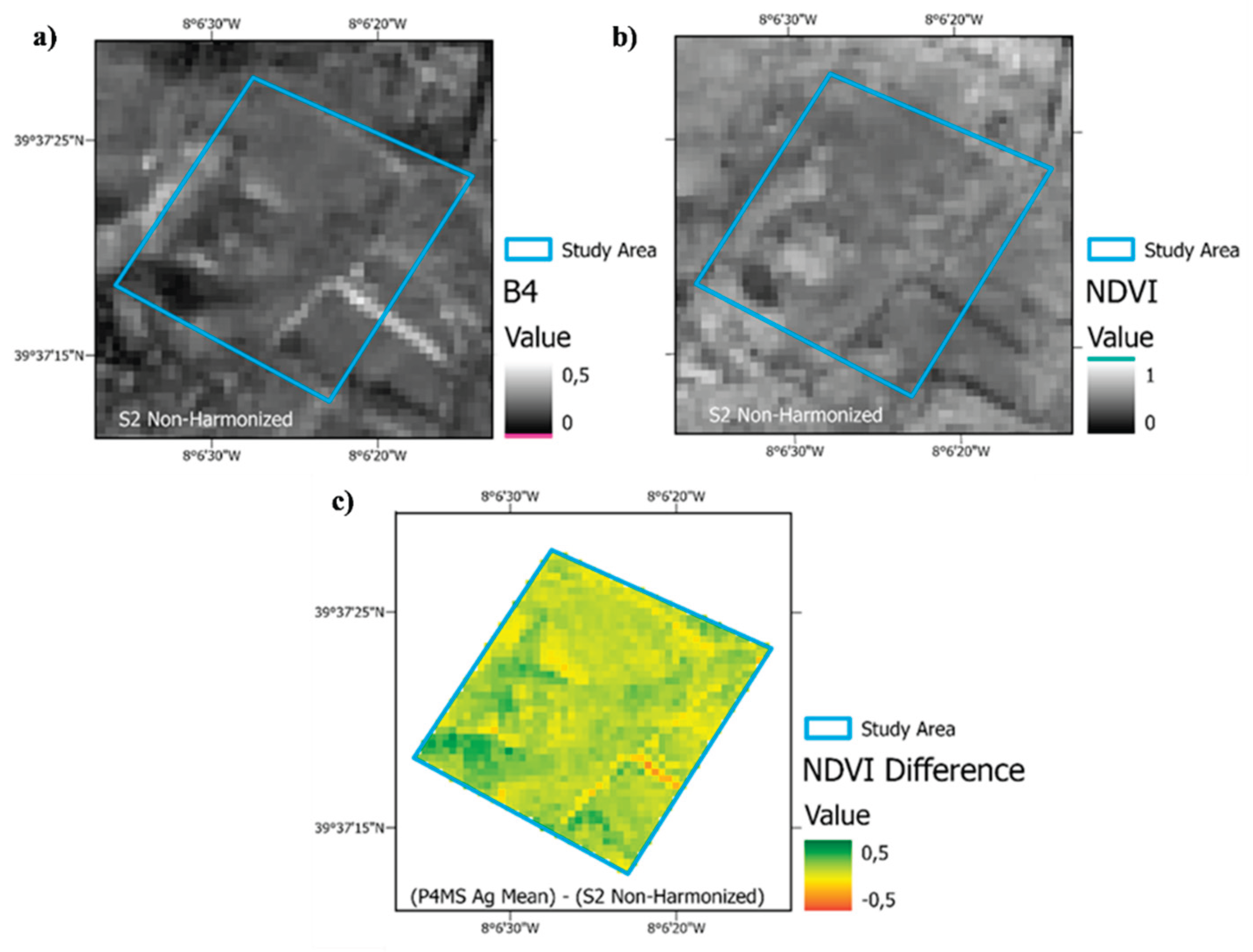
To better understand some of the apparent spatiotemporal differences between both S2 series, an additional analysis was conducted for the 20-Dec-2023 scene (Figure 10), focusing on the RED band (B4) and NDVI values derived from the S2 Harmonized dataset. This analysis reveals that for the Harmonized series, the RED band contains several areas with reflectance equal to 0 (Figure 10a, in purple) which in turn leads to NDVI values equal to 1 (Figure 10b, in cyan) because the NIR reflectance in these pixels is non-zero. These NDVI = 1 values are artifacts resulting from zero RED reflectance and are absent in the corresponding Non-Harmonized series (Annex Figure A5). A comparison with the original high resolution orthophotomap (Figure 2) confirms that these areas correspond to shadowed locations, caused by local topography – due to lower elevations and northwest-facing slopes.
The statistical analysis of NDVI differences between P4MS Aggregate NDVI Mean and S2 (Table 2), reveals fundamental disparities between Harmonized and Non-Harmonized processing approaches across the four seasonal scenes examined. The dataset encompasses 1,278 10 m pixels per comparison, providing robust statistical power for detecting systematic biases and distributional characteristics.
When comparing P4MS Aggregate NDVI Mean to S2 Harmonized NDVI, all seasonal periods demonstrate consistently negative mean differences, ranging from -0.297 in October 2022 to -0.043 in February 2023. The median difference values closely mirror the means, with differences typically within 0.01 NDVI units, indicating relatively symmetric distributions. October 2022 exhibits the most pronounced negative bias with a mean difference of -0.297 and median of -0.304, suggesting that P4MS values are systematically lower than S2 Harmonized NDVI values during autumn conditions. February 2023 shows the smallest bias magnitude with a mean difference of -0.043 and median of -0.047, indicating improved agreement during winter conditions. In contrast, the comparison between P4MS Aggregate Mean and S2 Non-Harmonized data reveals predominantly positive differences across all seasons. October 2022 shows near-zero bias with a mean difference of 0.002 and median of 0.006, representing the closest agreement between sensor systems. February 2023 exhibits the largest positive bias with a mean difference of 0.281 and median of 0.285, indicating that P4MS values substantially exceed S2 Non-Harmonized observations during winter conditions. Spring and summer periods maintain moderate positive biases, with mean differences of 0.105 and 0.144 respectively. The shape and symmetry of NDVI difference distributions further illuminate these seasonal patterns. Harmonized comparisons are right-skewed in all seasons, meaning most pixels show negative differences but a minority reach near-zero or positive values; their heavy tails (kurtosis) underscore occasional large outliers. Non-Harmonized comparisons tend toward slight left skew in most seasons, reflecting a predominance of positive differences with some pixels showing lower or negative offsets, and exhibit more moderate kurtosis. These distributional characteristics signal that simple mean corrections will not fully address the complex bias and tail behavior inherent in multi-sensor datasets. Temporally, the magnitude and sign of mean NDVI differences follow distinct seasonal rhythms depending on processing: S2 Harmonized bias decreases steadily from pronounced autumn underestimation to minimal winter offset, whereas S2 Non-Harmonized bias peaks in winter before subsiding through spring and summer.
Analysing the two sub-regions that can be clearly identified in the study area (Figure 2), the three scatterplots in Figure 11 reveal positive relationships between P4MS Aggregate Mean NDVI and S2 NDVI under both Harmonized and Non-Harmonized processing schemes. Across the entire study area (Figure 11a), P4MS values are on average 0.13 NDVI units lower than the Harmonized product and 0.13 units higher than the Non-Harmonized, producing two bands in the scatter where Harmonized points lie mostly above and Non-Harmonized mostly below the one-to-one line. The tighter clustering around the Harmonized line (SD ≈ 0.10) versus the broader spread with the Non-Harmonized (SD ≈ 0.13) underscores how harmonization reduces overall variability. In the shrubland sub-region (Figure 11b), where NDVI values are lower and vegetation is sparse, P4MS Aggregate Mean remains approximately 0.14 units below S2 Harmonized and 0.12 units above S2 Non-Harmonized. The scatter here is slightly more constrained for the Harmonized comparison (SD ≈ 0.09) than for the Non-Harmonized (SD ≈ 0.12). This alignment suggests that harmonization is particularly effective at capturing subtle greenness variations in low-cover environments, where uncorrected data would otherwise under-represent even modest changes in vegetation. Within the young eucalyptus sub-region (Figure 11c), P4MS NDVI underestimates Harmonized values by around 0.14 units (SD ≈ 0.11) but matches Non-Harmonized almost exactly on average (mean difference ≈ 0 units, SD ≈ 0.14). Here, the scatter reveals that S2 Harmonized NDVI is closer to an one-to-one agreement with P4MS, despite a slightly larger spread due to landscape heterogeneity (this area has patches of bare soil, due to mobilization for the plantation). In contrast, the negligible mean offset with Non-Harmonized data masks the persistent structural bias in that product, which fails to capture the full greenness range of dense canopies.
4. Discussion
Understanding the complementary strengths of medium-resolution Sentinel-2 (S2) multispectral imagery (10 m) and high-resolution DJI Phantom 4 multispectral (P4MS) data (4 cm) is important for scalable forest health monitoring. The results here reported reveal strong seasonally coherent NDVI trajectories across platforms, but also systematic offsets, likely tied to sensor design, atmospheric corrections, and sub-pixel heterogeneity.
Although subtle, NDVI patterns reveals a consistent year-round upward trend, with both seasonal maximums (i.e., winter and spring), and seasonal minimums (i.e., summer and autumn) becoming higher in the second monitoring year than in the first. The growing mean NDVI values likely reflect an overall increase in the biomass density and greenness, which may result from vegetation recovery processes, such as secondary regrowth and increased maturity. In longer-term studies, the effects of climatic conditions and, in particular, drought patterns, on post-fire vegetation recovery can also be observed through NDVI changes [24,25]. The predominance of slow-growing species associated with natural post-fire succession (e.g., Cistus psilosepalus, Agrostis truncatula, and Cistus ladanifer), reflects the unique climatic and ecological conditions of this fire-affected landscape. The study area, representing a Mediterranean shrubland ecosystem five to seven years post-fire, demonstrates recovery patterns consistent with established trajectories for moderate to high fire severity areas [26,27].
The observed similarity in NDVI trends between UAS and satellite datasets aligns with findings from other authors, demonstrating that both satellite-derived and UAV-based multispectral imagery can detect similar large-scale patterns [3,28,29]. Additionally, research has shown that combining high-resolution UAS imagery with satellite data can improve the detection of fine-scale vegetation dynamics (as in Figure 6 and Figure 8), particularly in semi-arid and fire-affected landscapes, where regrowth patterns can be highly variable and require frequent monitoring [30,31,32].
The consistently higher NDVI amplitude of P4MS compared to the S2 data suggests a higher signal-to-noise ratio, likely due to factors such as differences in spectral resolution (particularly in the NIR bands), minimal atmospheric absorption (unlike the S2 datasets), and a significantly finer spatial resolution [33,34,35]. The sensors from the two considered platforms have differences in the spectral values, particularly in the near-infrared band (Figure 3). The narrower spectral bandwidth of the P4MS in relation to S2 leads to more precise spectral measurements and, potentially, to more accurate vegetation index calculations [36]. The minimal atmospheric absorption affecting UAS data, as opposed to satellite imagery, can be a significant factor in the observed differences since satellite-based measurements require atmospheric correction, which can introduce uncertainties [34]. UAS-based sensors often provide cleaner signals, especially in heterogeneous landscapes, due to their ability to capture pure vegetation pixel, which is directly linked to their finer spatial resolution [33,35].
The higher NDVI variability observed in the P4MS dataset can be attributed to its higher spatial resolution. High-resolution sensors can capture distinct surface features, such as individual plants or bare soil patches, within individual pixels. The lower variability observed in the S2 dataset likely results from its coarser spatial resolution, where each 10 m pixel integrates signals from multiple surface types. Aggregated 10 m P4MS maps retained key NDVI gradients observed in the 0.04 m resolution (Figure 6), confirming that downscaling can conserve first-order spatial signals when patch sizes exceed ¼ of the aggregation kernel. However, fine-scale variability—such as seedling clusters in the eucalyptus sub-area—was lost after aggregation, supporting that S2 can obscure vital regeneration hotspots in early post-fire years [37]. The larger scatter and offset in shrubland pixels than in planted eucalyptus rows (as seen in the Scatterplots in Figure 11), is consistent with mixed-pixel dilution documented in other studies [38].
As verified in the example shown in Figure 10, the lower sun elevation angles during winter may significantly affect the quality and interpretability of remote sensing imagery. As the sun angle decreases, longer shadows cast by terrain and vegetation can obscure surface features and distort spectral signatures. Additionally, reduced incident radiation at lower sun angles diminishes the signal-to-noise ratio, weakening the overall data quality and amplifying noise effects. These challenges are further compounded by radiometric offsets in some datasets, which can introduce artifacts such as clipping in shadowed areas [39]. Such artifacts obscure subtle spectral variations and may compromise the accuracy of vegetation indices or land cover classifications [40]. Moreover, the seasonal variation in shadowing and processing artifacts complicates time-series analyses, introducing inconsistencies in the study of vegetation dynamics or land cover changes [41]. Careful consideration of these effects is essential for accurate interpretation of datasets, particularly when analysing seasonal or multi-temporal changes.
Satellite and UAS imagery each offer distinct advantages and limitations for vegetation monitoring. Satellite systems like S2 provide consistent, regular data acquisition, making them ideal for long-term, large-scale monitoring. However, their relatively lower spatial resolution can limit the detection of fine-scale vegetation features, and the data is highly susceptible to atmospheric conditions, requiring complex corrections to ensure accuracy. In contrast, UAS operate at much lower altitudes, achieving significantly higher spatial resolutions that allow for detailed detection of vegetation characteristics. Since they are largely unaffected by atmospheric interference, UAS data do not require atmospheric corrections, adding to their application for localized studies.
5. Conclusions
This study demonstrates that both satellite-based (Sentinel-2) and UAS-derived (P4MS) high-resolution multispectral imagery capture broadly consistent seasonal patterns and vegetation dynamics in Mediterranean shrubland ecosystems, though differences emerge depending on spatial scale and vegetation structure. The results show that while coarser satellite data effectively tracks broad temporal trends and landscape-level changes, UAS systems offer detailed insight into fine-scale spatial heterogeneity, regeneration patches, and local disturbance responses that may be missed or diluted at the satellite scale – especially in areas with sparse or heterogeneous cover. Careful harmonisation, consideration of sensor characteristics, and rigorous processing workflows are necessary to minimise bias when comparing indices like NDVI across platforms; downsampling methods can help bridge resolution gaps, but differences in radiometric and atmospheric effects must still be addressed for robust cross-platform use.
Given the overall coherence between satellite and UAS observations, the choice of platform can be tailored to specific management or research needs. For large-scale, long-term monitoring or for informing environmental models such as those assessing ecosystem productivity or carbon dynamics, Sentinel-2 provides reliable, accessible data suitable for regional applications. Conversely, for site-specific management, such as restoration planning, early stress detection, or prioritising interventions, UAS imagery adds critical value by revealing sub-decametric patterns and microhabitat variability. The findings of this study support the strategic selection of remote sensing approaches based on monitoring objectives, ecosystem characteristics, and resource constraints, and highlight the utility of both platforms for robust environmental modelling and effective management of Mediterranean ecosystems recovering from disturbance.
Author Contributions
EO: Data curation; Formal analysis; Investigation; Methodology; Validation; Visualization; Writing – original draft; Writing – review & editing. TS: Data curation, Formal analysis; Investigation; Writing – review & editing. LP: Conceptualization; Data curation; Formal analysis; Methodology; Software; Supervision; Validation; Writing – review & editing. NV: Conceptualization; Formal analysis; Methodology; Writing – review & editing. JK: Conceptualization; Funding Acquisition; Software; Writing – review & editing. BO: Conceptualization; Data curation; Funding acquisition; Investigation; Methodology; Project administration; Resources; Supervision; Validation; Visualization; Writing – review & editing. All authors have read and agreed to the published version of the manuscript.
Funding
This research was funded by ModelEco (PTDC/ASP-SIL/3504/2020) http://doi.org/10.54499/PTDC/ASP-SIL/3504/2020, funded by national funds (OE) through FCT/MCTES. Tiago van der Worp Silva was funded by national funds through FCT – Fundação para a Ciência e Tecnologia, I.P. in the form of a Ph.D Grant [2023.01767.BDANA].
Data Availability Statement
Data can be made available upon request by email to the corresponding author.
Acknowledgments
The authors acknowledge financial support to CESAM by national funds through FCT – Fundação para a Ciência e a Tecnologia I.P., under the project/grant UID/50006 + LA/P/0094/2020.
Conflicts of Interest
The authors declare no conflicts of interest.
Appendix A
Figure A1.
NDVI difference boxplots, calculated as P4MS Aggregate Mean minus coeval Sentinel-2 Non-Harmonized observations, according to four seasonal examples (a) Autumn, (b) Winter, (c) Spring, and (d) Summer.
Figure A1.
NDVI difference boxplots, calculated as P4MS Aggregate Mean minus coeval Sentinel-2 Non-Harmonized observations, according to four seasonal examples (a) Autumn, (b) Winter, (c) Spring, and (d) Summer.
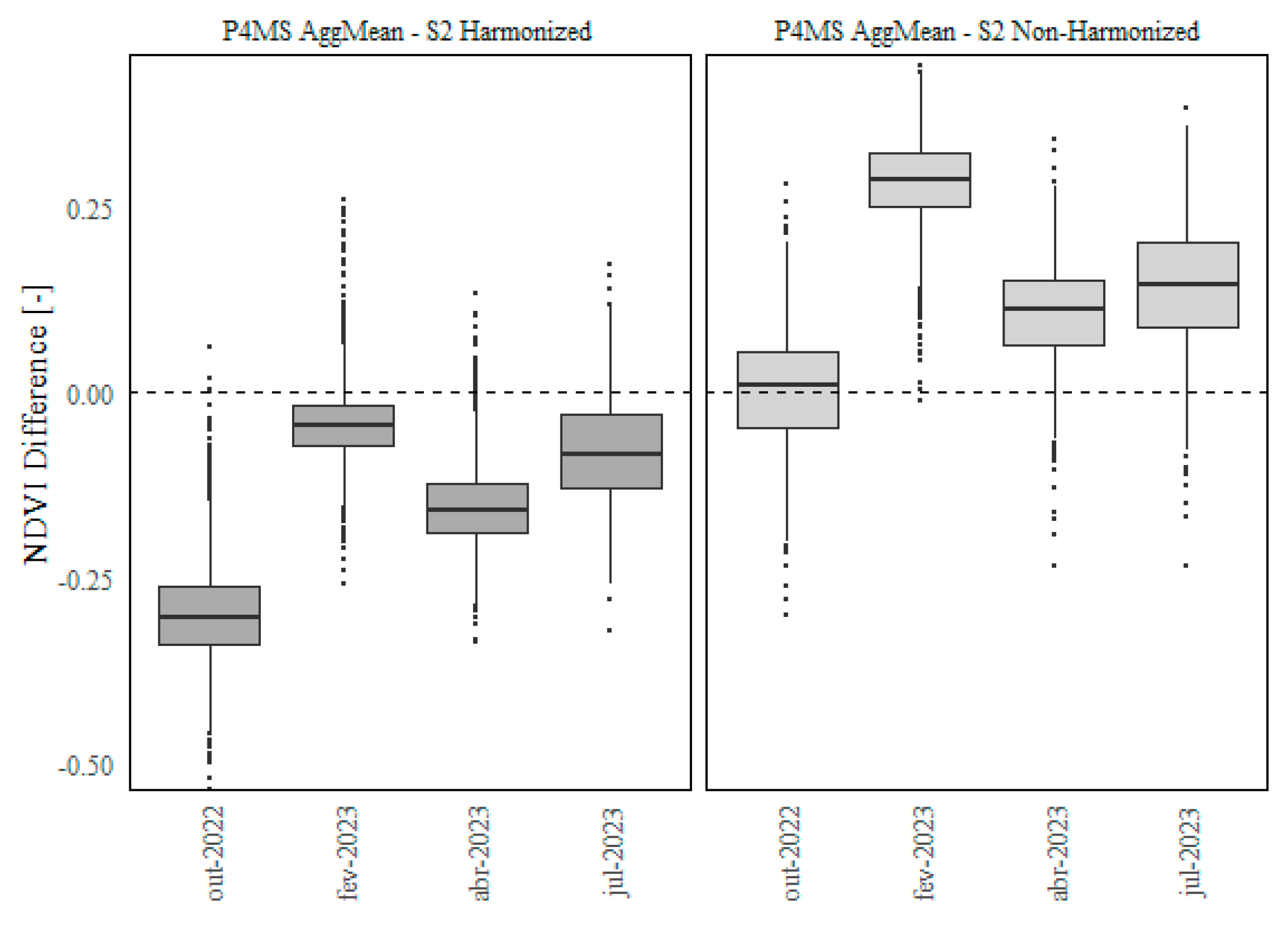
Figure A2.
Scenes from 20-Dec-2023, including: (a) surface reflectance values of Band 4 from S2 Non-Harmonized (with reflectance = 0 in purple); (b) NDVI values from S2 Non-Harmonized (with NDVI = 1 in green-ish-cyan); and (c) NDVI difference values between P4MS Aggregate Mean and S2 Non-Harmonized.
Figure A2.
Scenes from 20-Dec-2023, including: (a) surface reflectance values of Band 4 from S2 Non-Harmonized (with reflectance = 0 in purple); (b) NDVI values from S2 Non-Harmonized (with NDVI = 1 in green-ish-cyan); and (c) NDVI difference values between P4MS Aggregate Mean and S2 Non-Harmonized.
References
- Wang, R.; Sun, Y.; Zong, J.; Wang, Y.; Cao, X.; Wang, Y.; Cheng, X.; Zhang, W. Remote Sensing Application in Ecological Restoration Monitoring: A Systematic Review. Remote Sens (Basel) 2024, 16.
- Sun, Z.; Wang, X.; Wang, Z.; Yang, L.; Xie, Y.; Huang, Y. UAVs as Remote Sensing Platforms in Plant Ecology: Review of Applications and Challenges. Journal of Plant Ecology 2021, 14, 1003–1023. [CrossRef]
- Li, M.; Shamshiri, R.R.; Weltzien, C.; Schirrmann, M. Crop Monitoring Using Sentinel-2 and UAV Multispectral Imagery: A Comparison Case Study in Northeastern Germany. Remote Sens (Basel) 2022, 14, 1–21. [CrossRef]
- Senf, C. Seeing the System from Above: The Use and Potential of Remote Sensing for Studying Ecosystem Dynamics. Ecosystems 2022, 25, 1719–1737. [CrossRef]
- Ryu, J.H.; Moon, H.D.; Lee, K. Do; Cho, J.; Ahn, H.Y. Evaluation of Surface Reflectance and Vegetation Indices Measured by Sentinel-2 Satellite Using Drone Considering Crop Type and Surface Heterogeneity. Korean Journal of Remote Sensing 2024, 40, 657–673. [CrossRef]
- Isaev, E.; Kulikov, M.; Shibkov, E.; Sidle, R.C. Bias Correction of Sentinel-2 with Unmanned Aerial Vehicle Multispectral Data for Use in Monitoring Walnut Fruit Forest in Western Tien Shan, Kyrgyzstan. J Appl Remote Sens 2022, 17, 22204. [CrossRef]
- del Río-Mena, T.; Willemen, L.; Vrieling, A.; Nelson, A. How Remote Sensing Choices Influence Ecosystem Services Monitoring and Evaluation Results of Ecological Restoration Interventions. Ecosyst Serv 2023, 64. [CrossRef]
- Mehmood, K.; Anees, S.A.; Muhammad, S.; Hussain, K.; Shahzad, F.; Liu, Q.; Ansari, M.J.; Alharbi, S.A.; Khan, W.R. Analyzing Vegetation Health Dynamics across Seasons and Regions through NDVI and Climatic Variables. Sci Rep 2024, 14. [CrossRef]
- Gutman, G.; Skakun, S.; Gitelson, A. Revisiting the Use of Red and Near-Infrared Reflectances in Vegetation Studies and Numerical Climate Models. Science of Remote Sensing 2021, 4, 100025. [CrossRef]
- Pastonchi, L.; Di Gennaro, S.F.; Toscano, P.; Matese, A. Comparison between Satellite and Ground Data with UAV-Based Information to Analyse Vineyard Spatio-Temporal Variability. Oeno One 2020, 54, 919–934. [CrossRef]
- Kottek, M.; Grieser, J.; Beck, C.; Rudolf, B.; Rubel, F. World Map of the Köppen-Geiger Climate Classification Updated. Meteorologische Zeitschrift 2006, 15, 259–263. [CrossRef]
- ICNF 10.o Relatório Provisório de Incêndios Florestais - 2017; 2017;
- EFFIS COPERNICUS - Emergency Management Service. EFFIS - European Forest Fire Information System. Available online: https://effis.jrc.ec.europa.eu/ (accessed on 19 September 2017).
- da Silva, T. van der W.; Gomes Pereira, L.; Oliveira, B.R.F. Assessing Geometric and Radiometric Accuracy of DJI P4 MS Imagery Processed with Agisoft Metashape for Shrubland Mapping. Remote Sens (Basel) 2024, 16, 4633. [CrossRef]
- ESA Sentinel-2 User Handbook; 2015; Vol. Rev2;.
- USGS Landsat 9 Data Users Handbook Landsat 9 Data Users Handbook Version 1.0. 2022, 107.
- USGS Landsat 8 Data Users Handbook. EROS 2019, 8, 106.
- Astola, H.; Häme, T.; Sirro, L.; Molinier, M.; Kilpi, J. Comparison of Sentinel-2 and Landsat 8 Imagery for Forest Variable Prediction in Boreal Region. Remote Sens Environ 2019, 223, 257–273. [CrossRef]
- Rufin, P.; Frantz, D.; Yan, L.; Hostert, P. Operational Coregistration of the Sentinel-2A/B Image Archive Using Multitemporal Landsat Spectral Averages. IEEE Geoscience and Remote Sensing Letters 2021, 18, 712–716. [CrossRef]
- Amani, M.; Ghorbanian, A.; Ahmadi, S.A.; Kakooei, M.; Moghimi, A.; Mirmazloumi, S.M.; Moghaddam, S.H.A.; Mahdavi, S.; Ghahremanloo, M.; Parsian, S.; et al. Google Earth Engine Cloud Computing Platform for Remote Sensing Big Data Applications: A Comprehensive Review. IEEE J Sel Top Appl Earth Obs Remote Sens 2020, 13, 5326–5350. [CrossRef]
- ESA S2 Processing.
- ESRI ArcGIS Pro Geoprocessing Tool Reference.
- Louis, J.; Pflug, B.; Debaecker, V.; Mueller-Wilm, U.; Iannone, R.Q.; Boccia, V.; Gascon, F. Evolutions of Sentinel-2 Level-2a Cloud Masking Algorithm Sen2Cor Prototype First Results. International Geoscience and Remote Sensing Symposium (IGARSS) 2021, 2021-July, 3041–3044. [CrossRef]
- Blanco-Rodríguez, M.Á.; Ameztegui, A.; Gelabert, P.; Rodrigues, M.; Coll, L. Short-Term Recovery of Post-Fire Vegetation Is Primarily Limited by Drought in Mediterranean Forest Ecosystems. Fire Ecology 2023, 19. [CrossRef]
- Viana-Soto, A.; Aguado, I.; Salas, J.; García, M. Identifying Post-Fire Recovery Trajectories and Driving Factors Using Landsat Time Series in Fire-Prone Mediterranean Pine Forests. Remote Sens (Basel) 2020, 12. [CrossRef]
- Ortega, M.; Lora, Á.; Yocom, L.; Zumaquero, R.; Molina, J.R. Effects of Fire Recurrence and Severity on Mediterranean Vegetation Dynamics: Implications for Structure and Composition in Southern Spain. Science of the Total Environment 2025, 961. [CrossRef]
- Peris-Llopis, M.; Vastaranta, M.; Saarinen, N.; González-Olabarria, J.R.; García-Gonzalo, J.; Mola-Yudego, B. Post-Fire Vegetation Dynamics and Location as Main Drivers of Fire Recurrence in Mediterranean Forests. For Ecol Manage 2024, 568. [CrossRef]
- Thapa, S.; Garcia Millan, V.E.; Eklundh, L. Assessing Forest Phenology: A Multi-Scale Comparison of near-Surface (UAV, Spectral Reflectance Sensor, Phenocam) and Satellite (MODIS, Sentinel-2) Remote Sensing. Remote Sens (Basel) 2021, 13. [CrossRef]
- Bollas, N.; Kokinou, E.; Polychronos, V. Comparison of Sentinel-2 and Uav Multispectral Data for Use in Precision Agriculture: An Application from Northern Greece. Drones 2021, 5. [CrossRef]
- Abdullah, M.M.; Al-Ali, Z.M.; Blanton, A.; Charabi, Y.; Abulibdeh, A.; Al-Awadhi, T.; Srinivasan, S.; Fadda, E.; Mohan, M. UAVs for Improving Seasonal Vegetation Assessment in Arid Environments. Front Environ Sci 2024, 12, 1–5. [CrossRef]
- Bousquet, E.; Mialon, A.; Rodriguez-Fernandez, N.; Mermoz, S.; Kerr, Y. Monitoring Post-Fire Recovery of Various Vegetation Biomes Using Multi-Wavelength Satellite Remote Sensing. Biogeosciences 2022, 19, 3317–3336. [CrossRef]
- Ogungbuyi, M.G.; Mohammed, C.; Fischer, A.M.; Turner, D.; Whitehead, J.; Harrison, M.T. Integration of Drone and Satellite Imagery Improves Agricultural Management Agility. Remote Sens (Basel) 2024, 16. [CrossRef]
- Sozzi, M.; Kayad, A.; Gobbo, S.; Cogato, A.; Sartori, L.; Marinello, F.; Singh, V.; Huang, Y. Economic Comparison of Satellite, Plane and UAV-Acquired NDVI Images for Site-Specific Nitrogen Application: Observations from Italy. 2021. [CrossRef]
- Moravec, D.; Komárek, J.; Medina, S.L.C.; Molina, I. Effect of Atmospheric Corrections on NDVI: Intercomparability of Landsat 8, Sentinel-2, and UAV Sensors. Remote Sens (Basel) 2021, 13. [CrossRef]
- Gati, B. Comparison of Vegetation Indices Obtained by Drone and Satellite. E3S Web of Conferences 2024, 590, 01008. [CrossRef]
- Shan, T.; Isaev, E.; Kulikov, M.; Shibkov, E.; Sidle, R.C. Bias Correction of Sentinel-2 with Unmanned Aerial Vehicle Multispectral Data for Use in Monitoring Walnut Fruit Forest in Western. J Appl Remote Sens 2022, 17.
- Martinez, J.L.; Lucas-borja, M.E.; Plaza-alvarez, P.A.; Denisi, P.; Moreno, M.A.; Hernández, D.; González-romero, J.; Zema, D.A. Comparison of Satellite and Drone-based Images at Two Spatial Scales to Evaluate Vegetation Regeneration after Post-fire Treatments in a Mediterranean Forest. Applied Sciences (Switzerland) 2021, 11. [CrossRef]
- Wang, H.; Muller, J.D.; Tatarinov, F.; Yakir, D.; Rotenberg, E. Disentangling Soil, Shade, and Tree Canopy Contributions to Mixed Satellite Vegetation Indices in a Sparse Dry Forest. Remote Sens (Basel) 2022, 14. [CrossRef]
- Galvao, L.S.; Ponzoni, F.J.; Epiphanio, J.C.N.; Rudorff, B.F.T.; Formaggio, A.R. Sun and View Angle Effects on NDVI Determination of Land Cover Types in the Brazilian Amazon Region with Hyperspectral Data. Int J Remote Sens 2004, 25, 1861–1879. [CrossRef]
- Oliveira, E.R.; Disperati, L.; Cenci, L.; Pereira, L.G.; Alves, F.L. Multi-Index Image Differencing Method (MINDED) for Flood Extent Estimations. Remote Sens (Basel) 2019, 11. [CrossRef]
- Alavipanah, S.K.; Karimi Firozjaei, M.; Sedighi, A.; Fathololoumi, S.; Zare Naghadehi, S.; Saleh, S.; Naghdizadegan, M.; Gomeh, Z.; Arsanjani, J.J.; Makki, M.; et al. The Shadow Effect on Surface Biophysical Variables Derived from Remote Sensing: A Review. Land (Basel) 2022, 11.
Figure 1.
Flow Diagram of the Methodology for Cross-Platform Comparison of NDVI-Based Vegetation Monitoring.
Figure 1.
Flow Diagram of the Methodology for Cross-Platform Comparison of NDVI-Based Vegetation Monitoring.
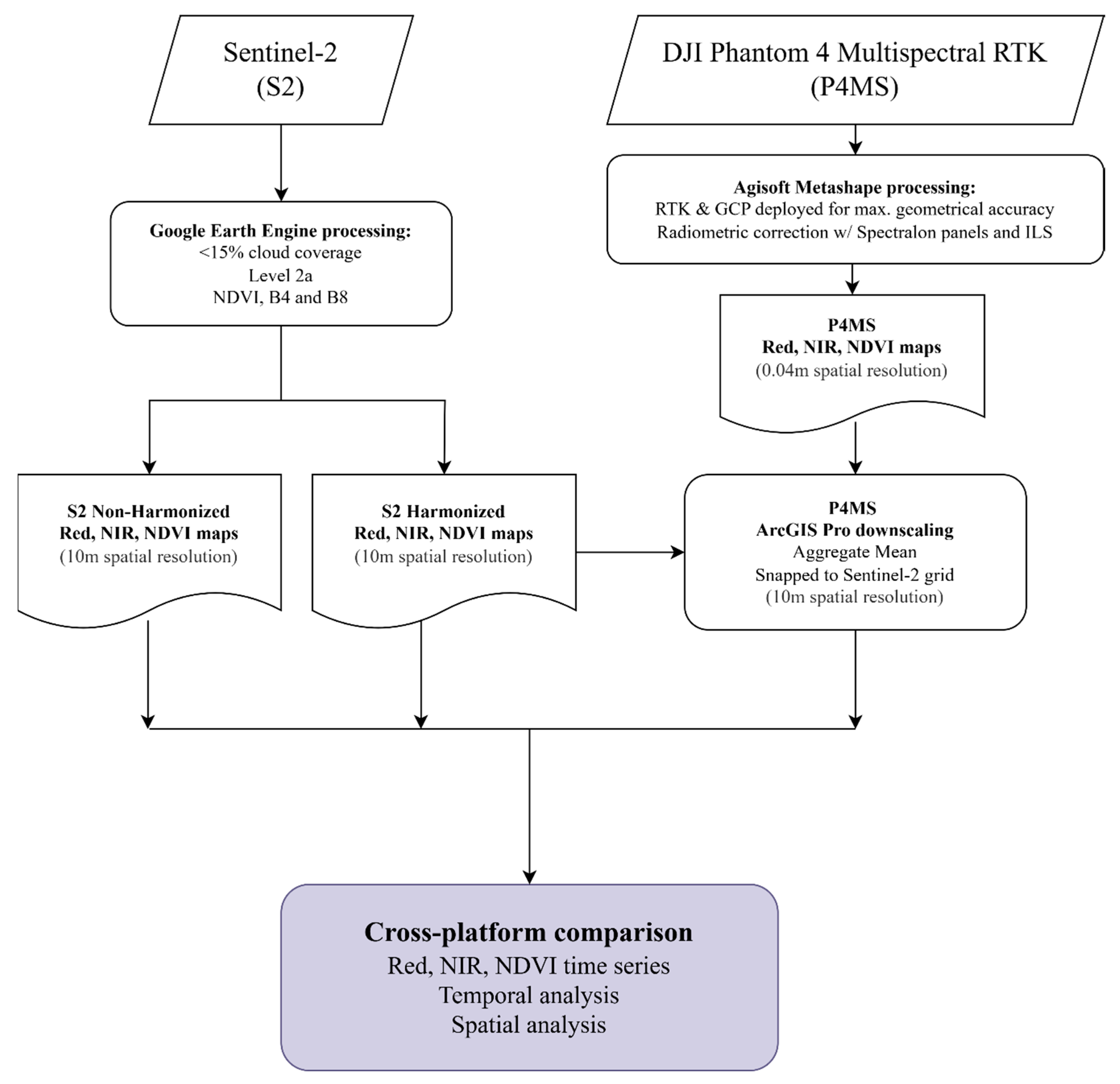
Figure 2.
Location of the study area and corresponding sub-areas. (Background composition: Phantom 4 Multispectral RTK true colour RGB - 20-Dec-2023; Reference Coordinate System: WGS84).
Figure 2.
Location of the study area and corresponding sub-areas. (Background composition: Phantom 4 Multispectral RTK true colour RGB - 20-Dec-2023; Reference Coordinate System: WGS84).
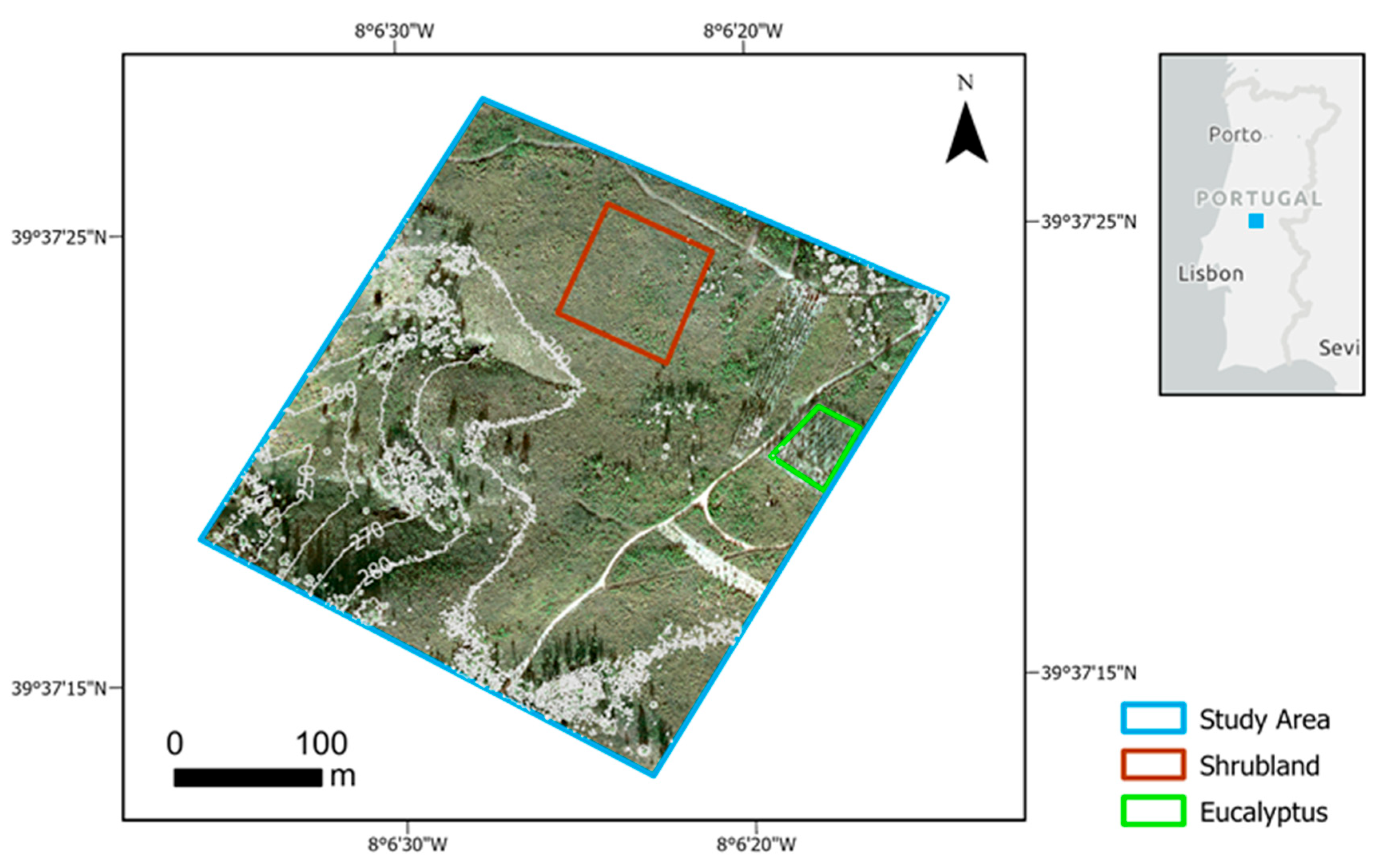
Figure 3.
Multispectral band setup of P4MS and S2 (with 10 m spatial resolution) sensors, within the visible and NIR range.
Figure 3.
Multispectral band setup of P4MS and S2 (with 10 m spatial resolution) sensors, within the visible and NIR range.
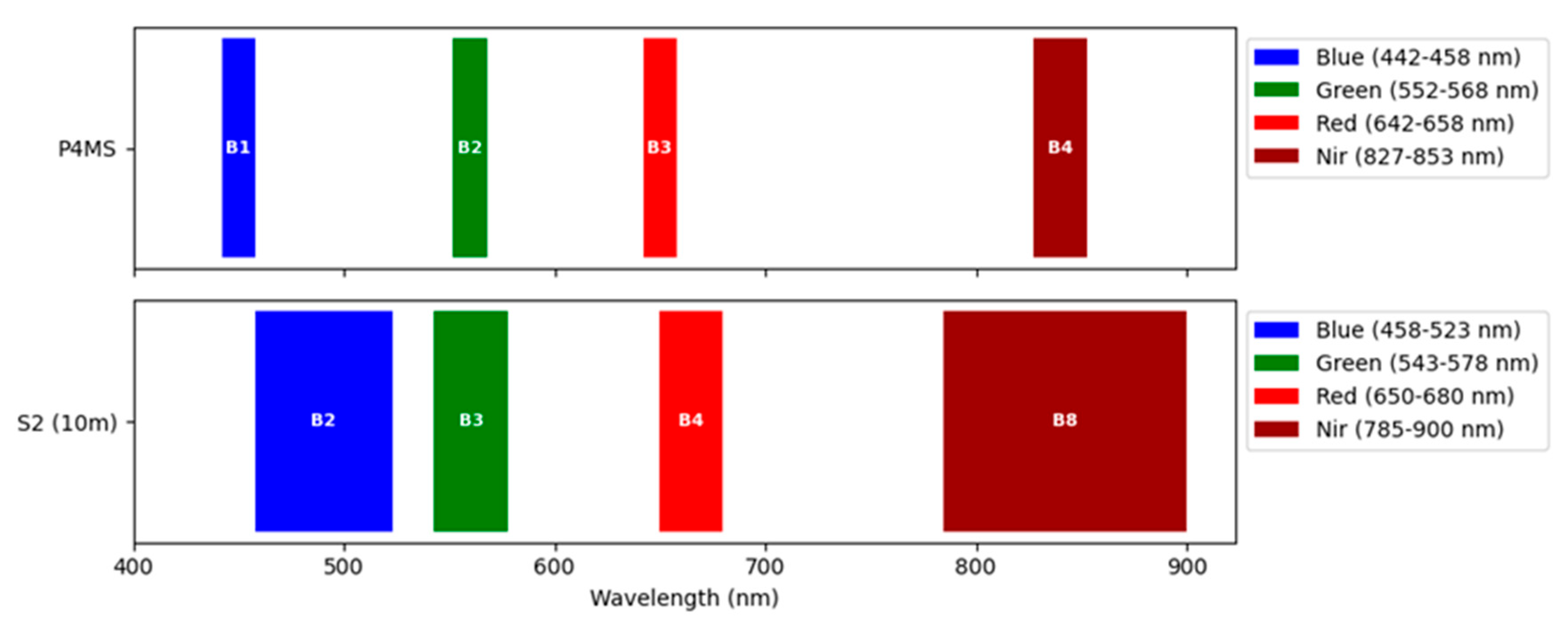
Figure 4.
Mean values of NDVI timeseries, obtained for the whole Study Area), according to different datasets: S2 Harmonized, S2 Non-Harmonized and P4MS (with “×” highlighting two outlier points for each S2 dataset).
Figure 4.
Mean values of NDVI timeseries, obtained for the whole Study Area), according to different datasets: S2 Harmonized, S2 Non-Harmonized and P4MS (with “×” highlighting two outlier points for each S2 dataset).
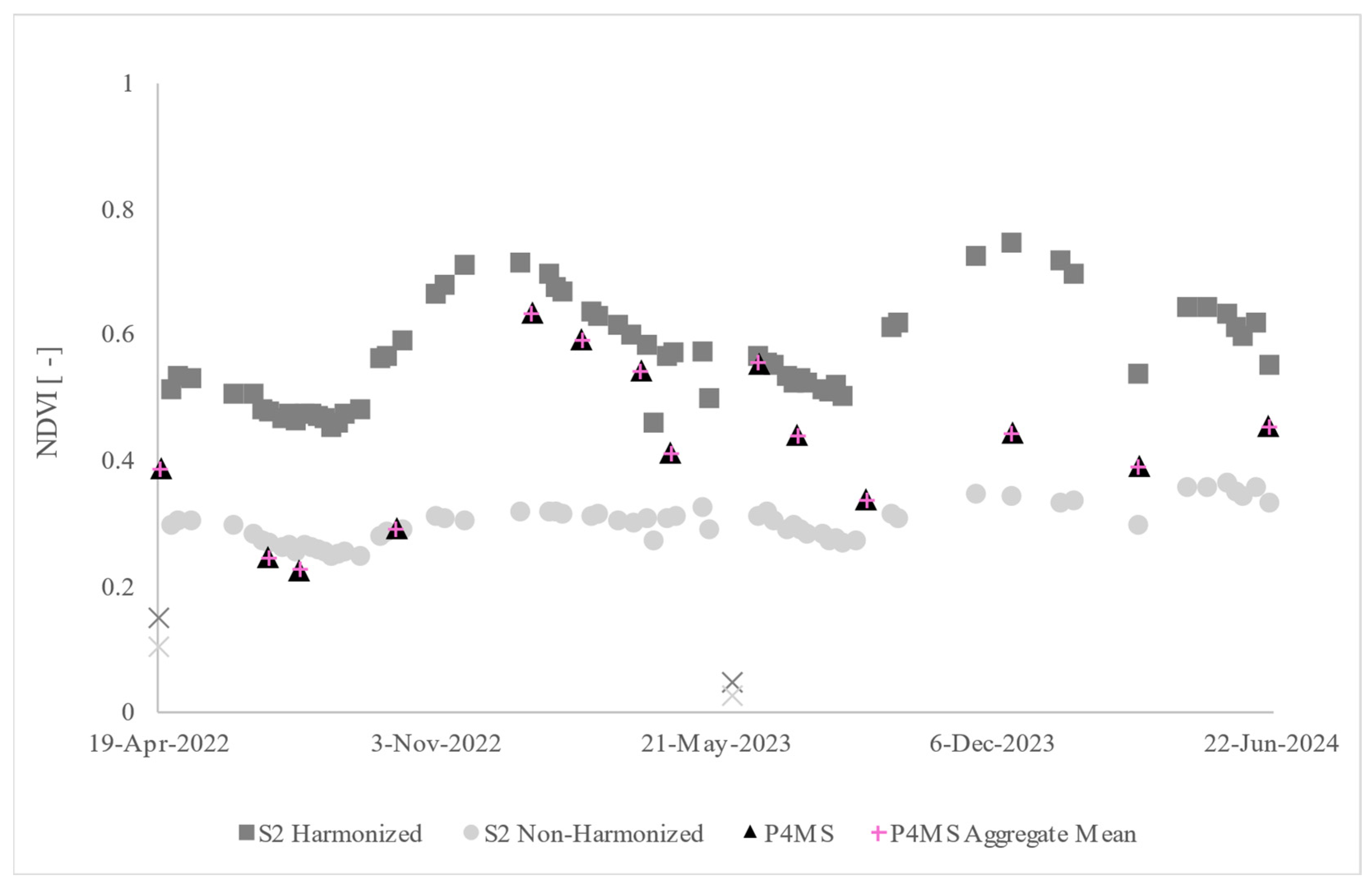
Figure 5.
Scenes associated to clouds/cloud shadows (from 19-Apr-2022 and 3-Jun-2023), represented as: (a) S2 Harmonized NDVI and (b) S2 Scene Classification Layer (SCL).
Figure 5.
Scenes associated to clouds/cloud shadows (from 19-Apr-2022 and 3-Jun-2023), represented as: (a) S2 Harmonized NDVI and (b) S2 Scene Classification Layer (SCL).
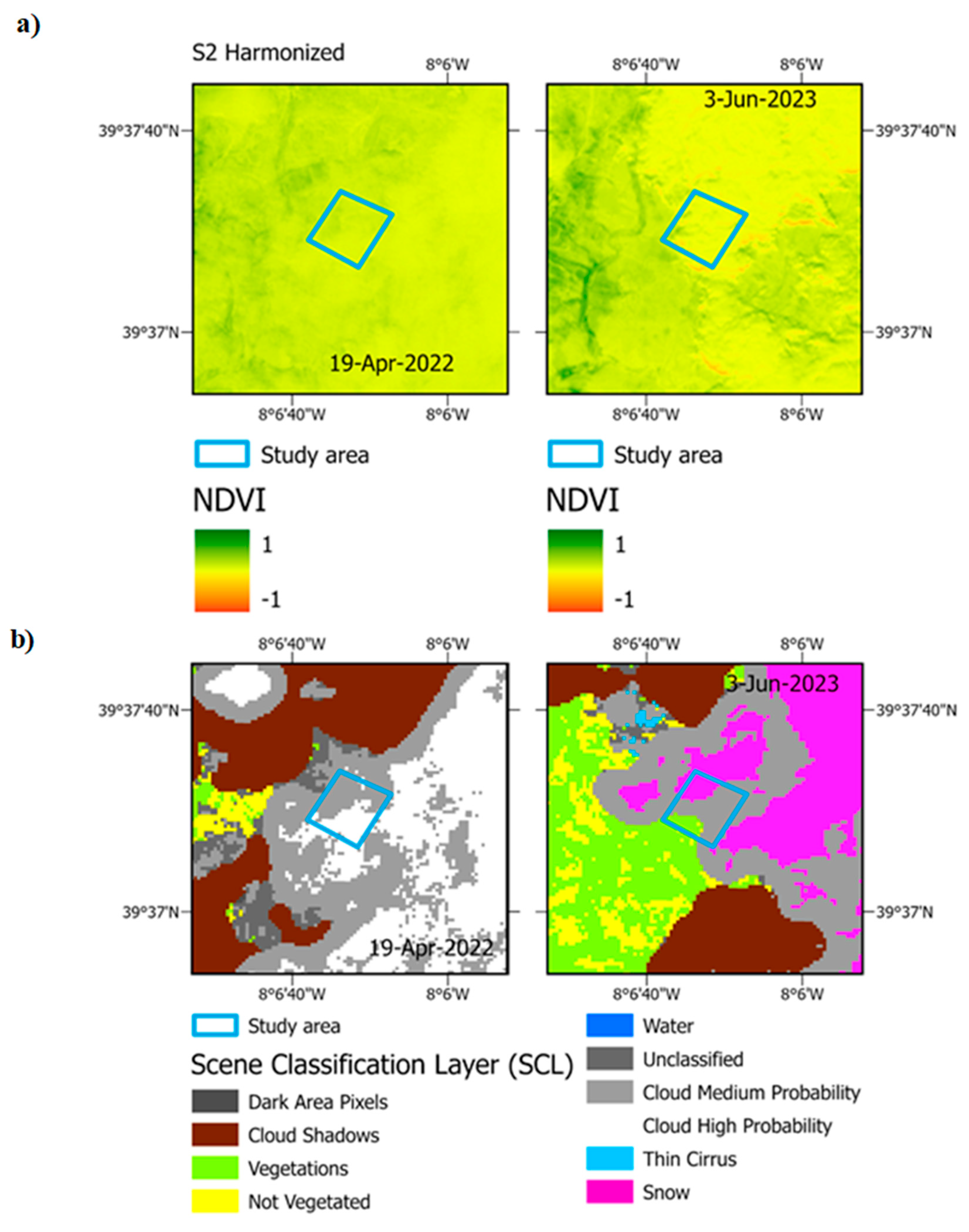
Figure 6.
Consecutive seasonal coeval NDVI maps from Oct-2022, Feb-2023, Apr-2023 and July-2023 (Autumn to Summer), acquired by Sentinel-2 Harmonized, S2 Non-Harmonized, P4MS and P4MS Aggregate Mean. The two Insets (on the left) include a pathway intersection and young eucalyptus plantation location, highlighting the differences of spatial resolution between satellite (Sentinel-2 Harmonized) and UAV (P4MS) platforms.To understand the impact of radiometric harmonization on cross-platform data integration and, ultimately, on vegetation monitoring accuracy, we analyzed spatial variability in reflectance differences using boxplots (Figure 7). Figure 7a and Figure 7b show the differences between the downscaled P4MS and S2 MSI Harmonized, and S2 MSI Non-Harmonized series, respectively, for the RED and NIR bands across the same four seasonal scenes from October 2022 to July 2023. Each boxplot represents n=1278 10 m pixels, providing robust statistical representation of the spatial distribution of sensor differences across the study area. The temporal analysis suggests a systematic drift in sensor relationships over this study period. The increasingly negative trend suggests that the P4MS sensor consistently measures lower reflectance values compared to the S2 MSI sensor as time progresses from October 2022 to July 2023. This temporal drift pattern is particularly pronounced in the NIR band, where the spatial variability also increases substantially over the same period.
Figure 6.
Consecutive seasonal coeval NDVI maps from Oct-2022, Feb-2023, Apr-2023 and July-2023 (Autumn to Summer), acquired by Sentinel-2 Harmonized, S2 Non-Harmonized, P4MS and P4MS Aggregate Mean. The two Insets (on the left) include a pathway intersection and young eucalyptus plantation location, highlighting the differences of spatial resolution between satellite (Sentinel-2 Harmonized) and UAV (P4MS) platforms.To understand the impact of radiometric harmonization on cross-platform data integration and, ultimately, on vegetation monitoring accuracy, we analyzed spatial variability in reflectance differences using boxplots (Figure 7). Figure 7a and Figure 7b show the differences between the downscaled P4MS and S2 MSI Harmonized, and S2 MSI Non-Harmonized series, respectively, for the RED and NIR bands across the same four seasonal scenes from October 2022 to July 2023. Each boxplot represents n=1278 10 m pixels, providing robust statistical representation of the spatial distribution of sensor differences across the study area. The temporal analysis suggests a systematic drift in sensor relationships over this study period. The increasingly negative trend suggests that the P4MS sensor consistently measures lower reflectance values compared to the S2 MSI sensor as time progresses from October 2022 to July 2023. This temporal drift pattern is particularly pronounced in the NIR band, where the spatial variability also increases substantially over the same period.
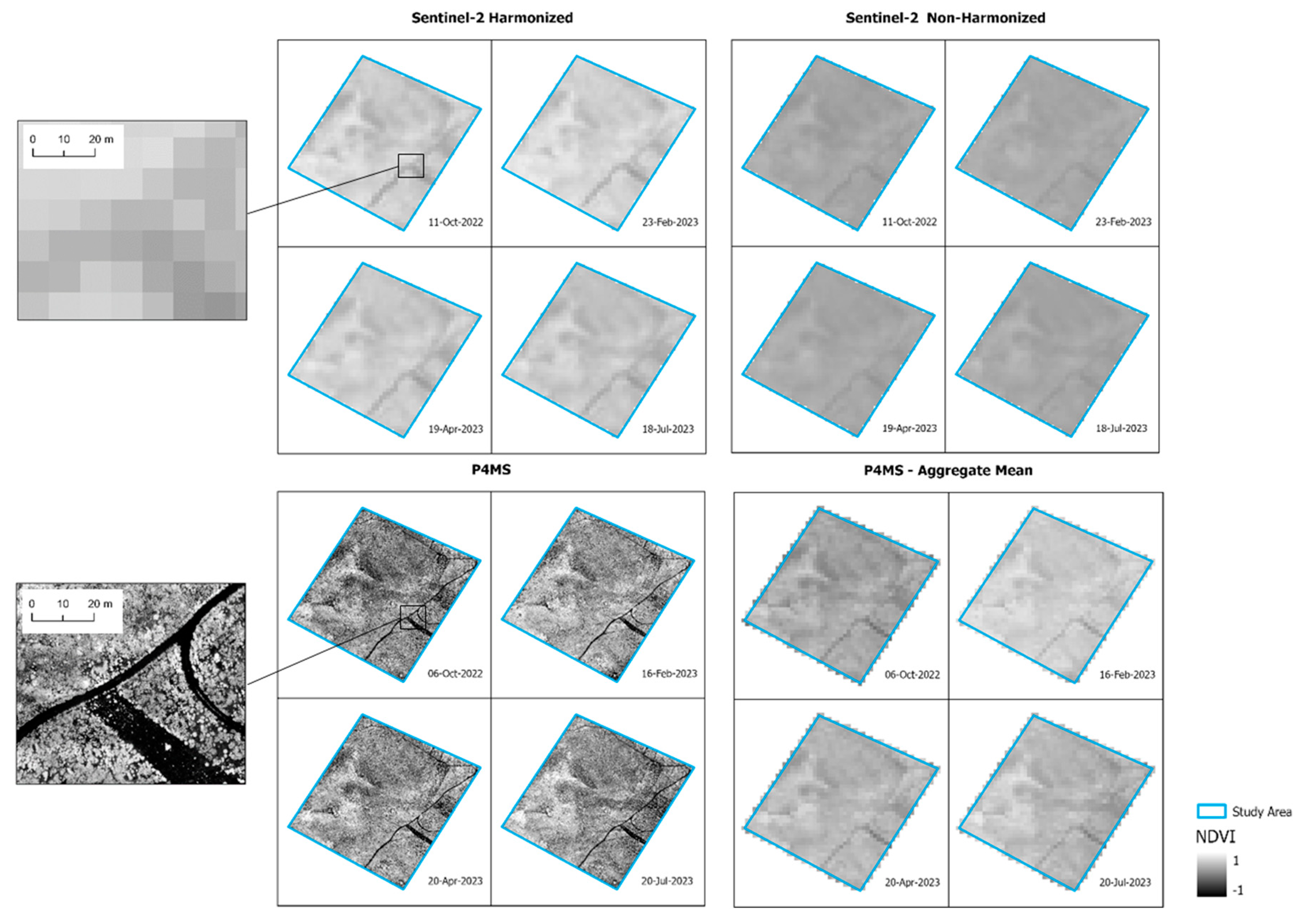
Figure 7.
Boxplots of reflectance differences between downscaled P4MS and S2 MSI sensors across equivalent Red and NIR bands for four seasonal scenes (from October 2022 to July 2023), relative to (a) Harmonized; and (b) the Non-Harmonized series.
Figure 7.
Boxplots of reflectance differences between downscaled P4MS and S2 MSI sensors across equivalent Red and NIR bands for four seasonal scenes (from October 2022 to July 2023), relative to (a) Harmonized; and (b) the Non-Harmonized series.
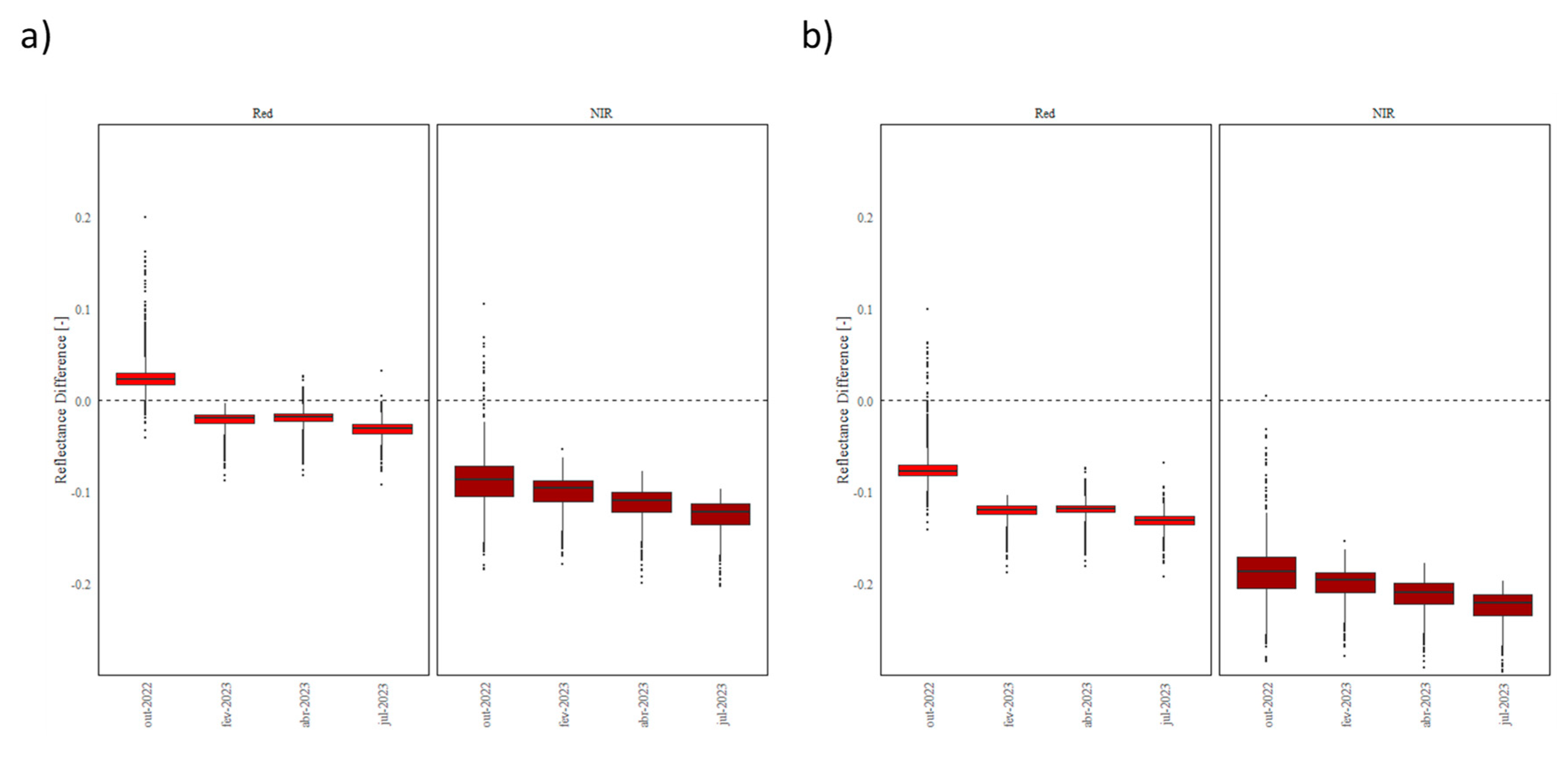
Figure 8.
NDVI difference maps calculated as P4MS Aggregate Mean minus coeval Sentinel-2 Harmonized observations. Panels show seasonal examples: (a) Autumn, (b) Winter, (c) Spring, and (d) Summer. Panels (e) and (f) present the mean and standard deviation of NDVI differences across the entire time series, respectively.
Figure 8.
NDVI difference maps calculated as P4MS Aggregate Mean minus coeval Sentinel-2 Harmonized observations. Panels show seasonal examples: (a) Autumn, (b) Winter, (c) Spring, and (d) Summer. Panels (e) and (f) present the mean and standard deviation of NDVI differences across the entire time series, respectively.
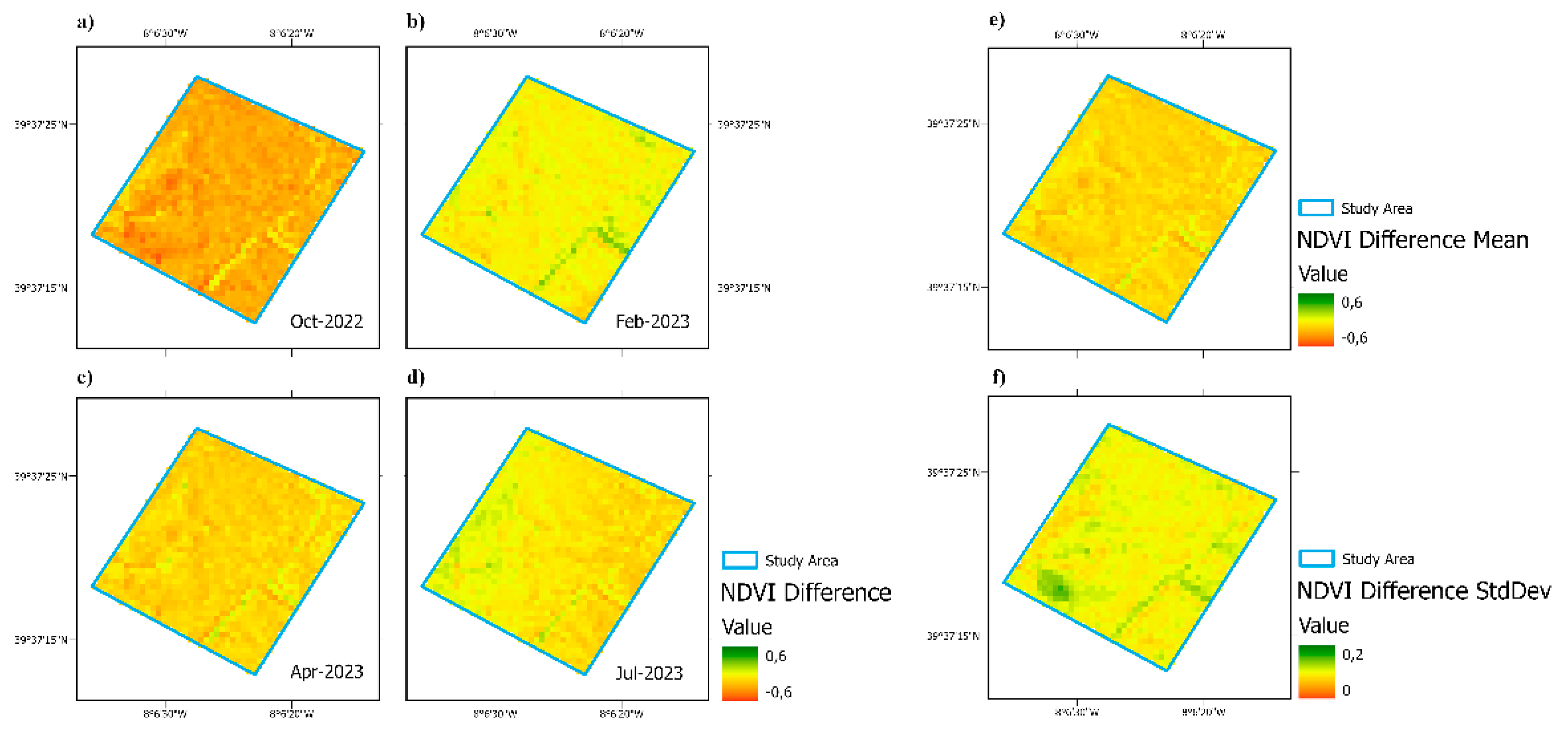
Figure 9.
NDVI difference maps calculated as P4MS Aggregate Mean minus coeval Sentinel-2 Non-Harmonized observations. Panels show seasonal examples: (a) Autumn, (b) Winter, (c) Spring, and (d) Summer. Panels (e) and (f) present the mean and standard deviation of NDVI differences across the entire time series, respectively.
Figure 9.
NDVI difference maps calculated as P4MS Aggregate Mean minus coeval Sentinel-2 Non-Harmonized observations. Panels show seasonal examples: (a) Autumn, (b) Winter, (c) Spring, and (d) Summer. Panels (e) and (f) present the mean and standard deviation of NDVI differences across the entire time series, respectively.
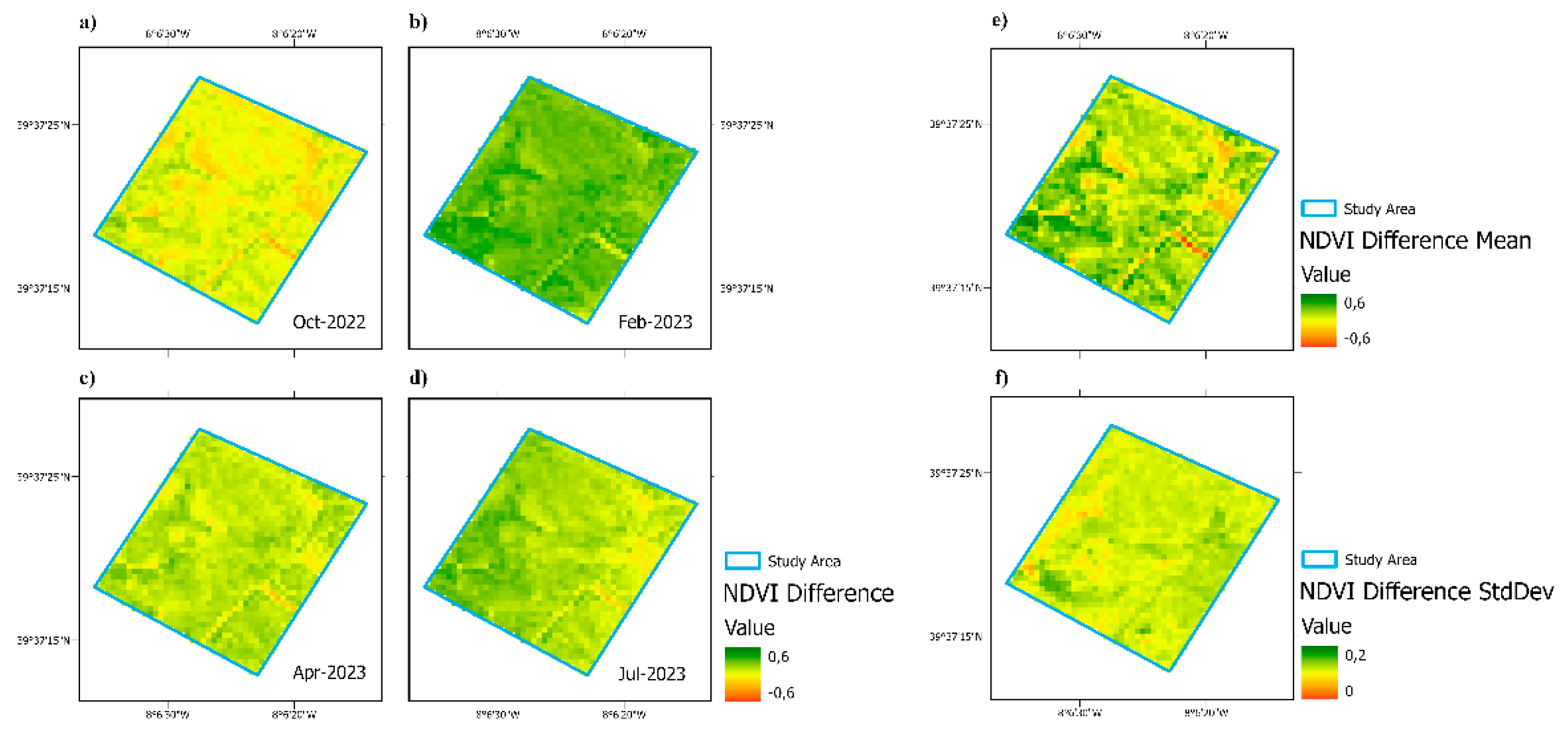
Figure 10.
Scenes from 20-Dec-2023, including: (a) surface reflectance values of Band 4 (Red) from S2 Harmonized (with reflectance = 0 in purple); and (b) NDVI values from S2 Non-Harmonized (with NDVI = 1 in greenish-cyan).
Figure 10.
Scenes from 20-Dec-2023, including: (a) surface reflectance values of Band 4 (Red) from S2 Harmonized (with reflectance = 0 in purple); and (b) NDVI values from S2 Non-Harmonized (with NDVI = 1 in greenish-cyan).
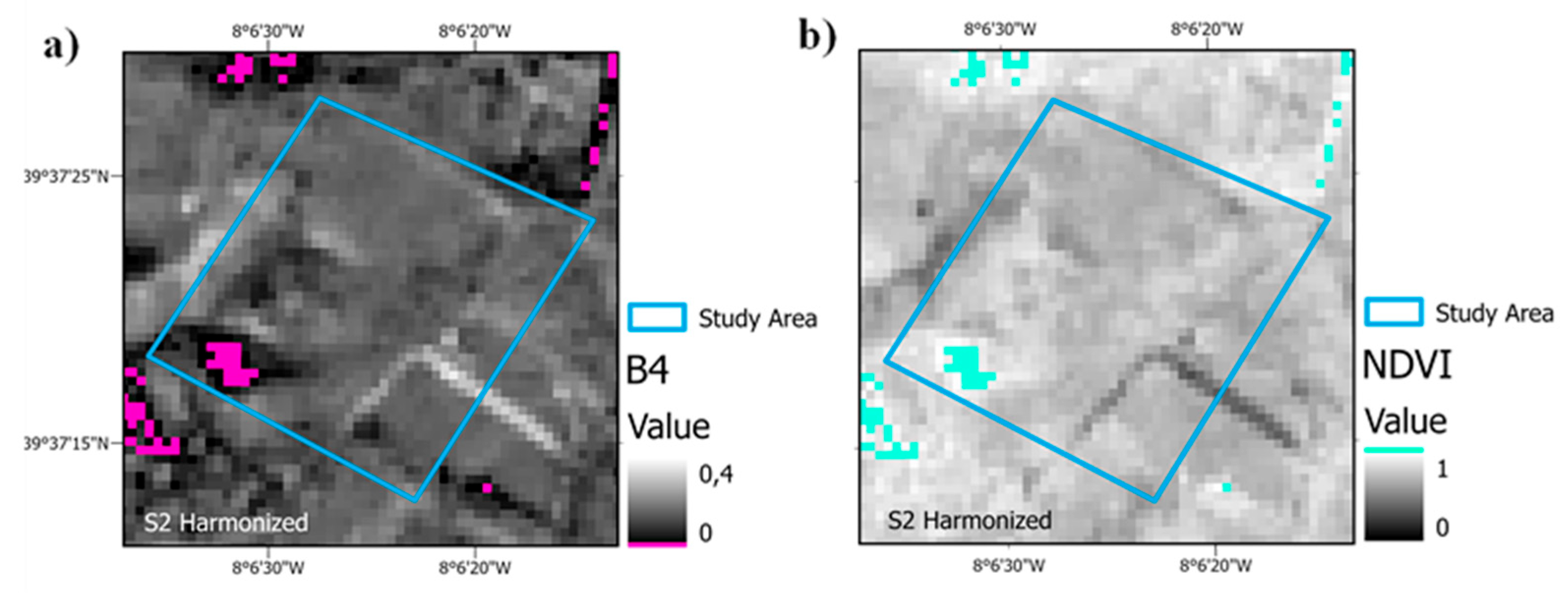
Figure 11.
Scatterplots of coeval Normalized Difference Vegetation Index (NDVI) values comparing P4MS Aggregate Mean NDVI with Sentinel-2 Harmonized and Sentinel-2 Non-Harmonized for: (a) the entire study area (n=16614), (b) the shrubland sub-region (n=858), and (c) the eucalyptus sub-region (n=234).
Figure 11.
Scatterplots of coeval Normalized Difference Vegetation Index (NDVI) values comparing P4MS Aggregate Mean NDVI with Sentinel-2 Harmonized and Sentinel-2 Non-Harmonized for: (a) the entire study area (n=16614), (b) the shrubland sub-region (n=858), and (c) the eucalyptus sub-region (n=234).
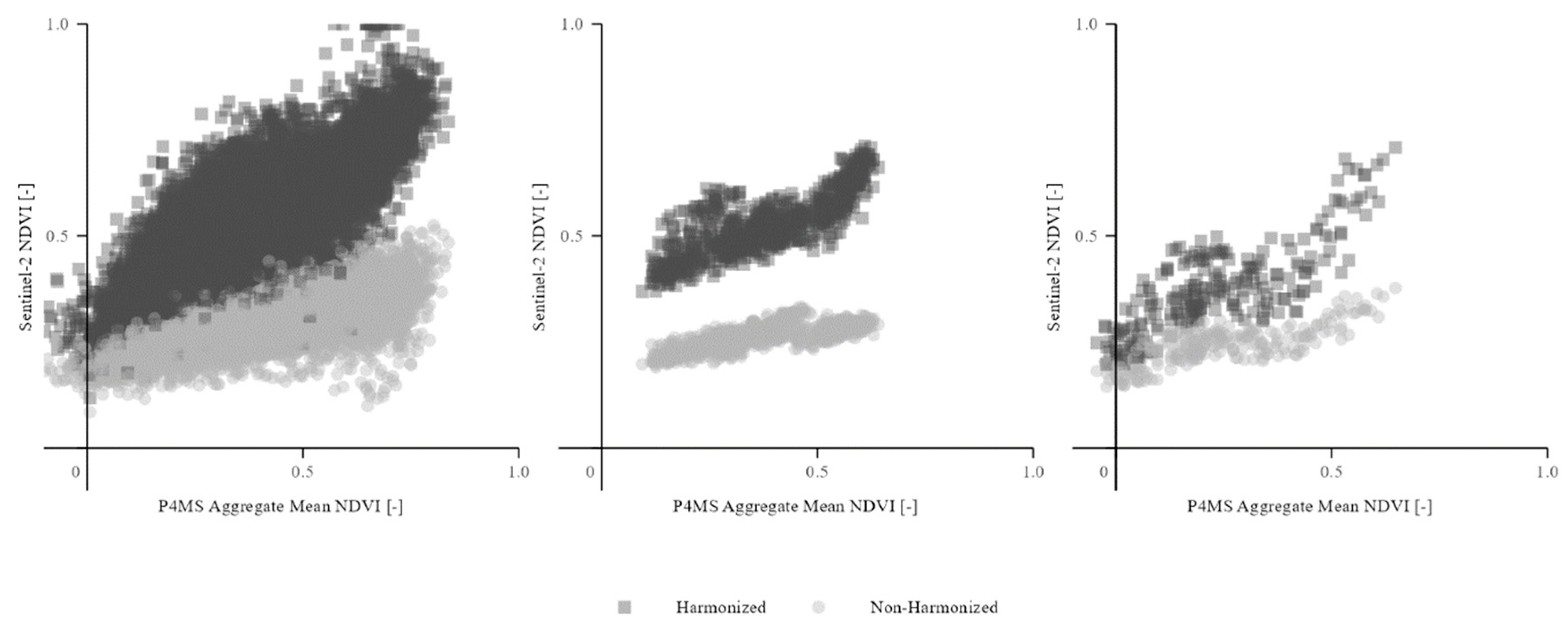

Table 1.
Summary of the processed P4MS scenes, alongside the closest available coeval Sentinel-2 (S2) scenes. In bold – most coeval pairs; (*) scenes affected by clouds.
Table 1.
Summary of the processed P4MS scenes, alongside the closest available coeval Sentinel-2 (S2) scenes. In bold – most coeval pairs; (*) scenes affected by clouds.
| P4MS | S2 | ∆t [days] | P4MS | S2 | ∆t [days] | P4MS | S2 | ∆t [days] |
|---|---|---|---|---|---|---|---|---|
| - | 19-Apr-2022(*) | - | - | 5-Nov-2022 | - | 20-Jul-2023 | 18-Jul-2023 | -2 |
| 21-Apr-2022 | 29-Apr-2022 | 8 | - | 10-Nov-2022 | - | - | 23-Jul-2023 | - |
| - | 4-May-2022 | - | - | 25-Nov-2022 | - | - | 28-Jul-2023 | - |
| - | 14-May-2022 | - | 11-Jan-2023 | 4-Jan-2023 | -7 | - | 7-Aug-2023 | - |
| - | 13-Jun-2022 | - | - | 24-Jan-2023 | - | - | 12-Aug-2023 | - |
| - | 28-Jun-2022 | - | - | 29-Jan-2023 | - | - | 17-Aug-2023 | - |
| - | 3-Jul-2022 | - | - | 3-Feb-2023 | - | - | 22-Aug-2023 | - |
| 7-Jul-2022 | 8-Jul-2022 | 1 | 16-Feb-2023 | 23-Feb-2023 | 7 | 7-Sep-2023 | 1-Sep-2023 | -6 |
| - | 18-Jul-2022 | - | - | 28-Feb-2023 | - | - | 26-Sep-2023 | - |
| - | 23-Jul-2022 | - | - | 15-Mar-2023 | - | - | 1-Oct-2023 | - |
| 29-Jul-2022 | 28-Jul-2022 | -1 | 30-Mar-2023 | 25-Mar-2023 | -5 | - | 25-Nov-2023 | - |
| - | 2-Aug-2022 | - | - | 4-Apr-2023 | - | 20-Dec-2023 | 20-Dec-2023 | 0 |
| - | 7-Aug-2022 | - | - | 9-Apr-2023 | - | - | 24-Jan-2024 | - |
| - | 12-Aug-2022 | - | 20-Apr-2023 | 19-Apr-2023 | -1 | - | 3-Feb-2024 | - |
| - | 17-Aug-2022 | - | - | 24-Apr-2023 | - | 19-Mar-2024 | 19-Mar-2024 | 0 |
| - | 22-Aug-2022 | - | - | 14-May-2023 | - | - | 23-Apr-2024 | - |
| - | 27-Aug-2022 | - | - | 19-May-2023 | - | - | 8-May-2024 | - |
| - | 1-Sep-2022 | - | - | 3-Jun-2023(*) | - | - | 23-May-2024 | - |
| - | 11-Sep-2022 | - | 22-Jun-2023 | 23-Jun-2023 | 1 | - | 28-May-2024 | - |
| - | 26-Sep-2022 | - | - | 28-Jun-2023 | - | - | 2-Jun-2024 | - |
| - | 1-Oct-2022 | - | - | 3-Jul-2023 | - | - | 12-Jun-2024 | - |
| 6-Oct-2022 | 11-Oct-2022 | 5 | - | 13-Jul-2023 | - | 20-Jun-2024 | 22-Jun-2024 | 2 |
Table 2.
Summary statistics of the NDVI difference maps between P4MS Aggregate Mean and the coeval Sentinel 2 Harmonized and Non Harmonized maps. n = 1278 10-m pixels.
Table 2.
Summary statistics of the NDVI difference maps between P4MS Aggregate Mean and the coeval Sentinel 2 Harmonized and Non Harmonized maps. n = 1278 10-m pixels.
| (P4MS AgMean) - (S2 Harmonized) | (P4MS AgMean) - (S2 Non-Harmonized) | |||||||
|---|---|---|---|---|---|---|---|---|
| Oct-2022 | Feb-2023 | Apr-2023 | Jul-2023 | Oct-2022 | Feb-2023 | Apr-2023 | Jul-2023 | |
| Mean | -0,297 | -0,043 | -0,154 | -0,082 | 0,002 | 0,281 | 0,105 | 0,144 |
| Median | -0,304 | -0,047 | -0,160 | -0,084 | 0,006 | 0,285 | 0,109 | 0,144 |
| Std. Dev. | 0,073 | 0,058 | 0,060 | 0,072 | 0,081 | 0,062 | 0,070 | 0,089 |
| Min | -0,536 | -0,261 | -0,340 | -0,325 | -0,301 | -0,014 | -0,236 | -0,235 |
| Max | 0,058 | 0,258 | 0,130 | 0,172 | 0,280 | 0,452 | 0,339 | 0,382 |
| Sum | -380,198 | -55,403 | -196,406 | -104,255 | 1,957 | 359,576 | 133,930 | 184,138 |
| Skewness | 0,790 | 1,016 | 0,830 | 0,187 | -0,172 | -0,609 | -0,401 | -0,179 |
| Kurtosis | 5,198 | 7,503 | 5,289 | 2,905 | 3,189 | 4,468 | 3,946 | 3,232 |
Disclaimer/Publisher’s Note: The statements, opinions and data contained in all publications are solely those of the individual author(s) and contributor(s) and not of MDPI and/or the editor(s). MDPI and/or the editor(s) disclaim responsibility for any injury to people or property resulting from any ideas, methods, instructions or products referred to in the content. |
© 2026 by the authors. Licensee MDPI, Basel, Switzerland. This article is an open access article distributed under the terms and conditions of the Creative Commons Attribution (CC BY) license (http://creativecommons.org/licenses/by/4.0/).
Copyright: This open access article is published under a Creative Commons CC BY 4.0 license, which permit the free download, distribution, and reuse, provided that the author and preprint are cited in any reuse.


