

Submitted:
09 January 2026
Posted:
12 January 2026
You are already at the latest version
Abstract
Employee happiness has become a central concern for the social dimension of sustainability, particularly within small and medium-sized enterprises (SMEs) operating in emerging economies. This study examines the relationship between organizational self-management practices and employee happiness in Peruvian SMEs, adopting a predictive approach based on Partial Least Squares Structural Equation Modeling (PLS-SEM). Organizational Self-Management Practices (OSMP) are modeled as a high-er-order construct integrating holacracy-inspired practices and organizational self-management practices. Data were collected from 383 SME employees through a structured questionnaire. The results indicate that OSMP has a positive and statistically significant influence on employee happiness (β = 0.461, p < 0.001), explaining 46.6% of the variance in the endogenous construct (R² = 0.466). These findings highlight the relevance of advanced self-management practices for promoting employee well-being and con-tribute to the literature on social sustainability by providing empirical evidence from an underexplored emerging economy context.
Keywords:
organizational self-management
; holacracy-inspired practices
; employee happiness
; SMEs
; PLS-SEM
; emerging economy
1. Introduction
Small and medium-sized enterprises (SMEs) play a central role in employment generation, regional development, and social stability, particularly in emerging economies where they constitute the backbone of productive activity [1,2]. In Peru, SMEs account for a substantial proportion of formal private employment, making them a strategic setting for examining organizational practices that contribute to sustainable work environments and employee well-being [3]. From a sustainability perspective, organizational success is increasingly evaluated not only through economic performance but also through social outcomes, including employee happiness, well-being, and quality of working life [4,5,6].
Recent research published in Sustainability emphasizes that sustainable organizations must integrate human-centered management practices alongside environmental and economic strategies [5,7]. Employee happiness and psychosocial well-being have been identified as key components of the social dimension of sustainability, closely linked to productivity, organizational commitment, and long-term resilience [6,8,9]. Consequently, understanding how organizational design and management practices influence employee happiness has become a critical research agenda within sustainability and organizational studies.
Employee happiness at work has evolved from a narrow focus on job satisfaction to a broader, multidimensional construct encompassing positive affect, meaningful work, engagement, and psychological well-being [10,11,12]. Empirical studies indicate that autonomy, participatory decision-making, and supportive organizational climates are consistently associated with higher levels of employee happiness and sustainable work outcomes [13,14,15]. In SMEs, however, the implementation of such practices often occurs informally, making their effects less predictable and underexplored [16].
In response to dissatisfaction with rigid hierarchical structures, organizations have increasingly experimented with alternative forms of governance that distribute authority and promote employee autonomy. Holacracy represents one of the most prominent governance models within this movement, proposing a role-based system characterized by decentralized authority, transparency, and self-organizing teams [17,18]. Although originally developed in innovative and knowledge-intensive firms, holacracy-inspired practices have attracted growing attention in the sustainability literature due to their potential to foster empowerment, adaptability, and employee well-being [19].
Closely related to holacracy, organizational self-management refers more broadly to management practices that enable employees to regulate their work, share responsibility, and participate actively in decision-making processes [20,21]. Rooted in theories of self-determination and intrinsic motivation, self-management has been associated with higher engagement, commitment, and psychological well-being [22,23]. Nevertheless, empirical evidence remains mixed, particularly in SMEs and emerging economies, where resource constraints and managerial capabilities may limit effective implementation [16,24].
1.1. Holacracy and Distributed Organizational Governance
Holacracy is grounded in post-bureaucratic governance models that seek to replace traditional hierarchical structures with systems based on roles, circles, and distributed authority [17]. From an organizational perspective, such systems align with contemporary work design approaches that emphasize autonomy, role clarity, and active participation in decision-making processes [14,15]. However, empirical evidence indicates that the effects of holacracy are highly context-dependent and largely influenced by the extent to which its principles are genuinely internalized by employees rather than merely implemented at a formal or symbolic level [18,19].
1.2. Organizational Self-Management and Motivational Theories
Organizational self-management is closely linked to Self-Determination Theory, which posits that autonomy, competence, and relatedness constitute fundamental psychological needs underlying intrinsic motivation and well-being [12,22]. In work contexts, self-management is operationalized through practices that allow employees to regulate their tasks, share responsibilities, and participate in relevant decision-making processes [19,21]. Prior empirical studies have reported positive associations between self-management, employee well-being, and performance, particularly in teams and organizations characterized by flexible and non-hierarchical structures [23,26].
1.3. Employee Happiness and Social Sustainability
Employee happiness is a multidimensional construct that integrates job satisfaction, positive affect, and psychological well-being at work [8,9]. From a sustainability perspective, employee well-being represents a core pillar of the social dimension of sustainable development and sustainable human resource management practices [4,5,6,7,25]. Previous research has demonstrated that organizational practices fostering autonomy, fairness, and participation positively influence employee happiness and contribute to sustainable organizational outcomes [5,24].
Addressing these gaps, the present study examines the influence of Organizational Self-Management Practices (OSMP), conceptualized as a higher-order construct integrating holacracy-inspired practices and organizational self-management practices, on employee happiness in SMEs in Peru. Using Partial Least Squares Structural Equation Modeling (PLS-SEM) and data from 383 SME employees, this research provides predictive evidence on how advanced self-management practices contribute to employee happiness in an under-researched emerging economy context.
Despite the growing body of research on alternative organizational forms, several gaps remain. First, most empirical studies on holacracy and self-management have focused on large organizations or developed economies, leaving SMEs in emerging contexts underrepresented [19,25]. Second, few studies have examined holacracy-inspired practices and broader self-management practices simultaneously, limiting comparative insights into their relative influence on employee happiness [21,26]. Third, quantitative studies employing predictive techniques such as Partial Least Squares Structural Equation Modeling (PLS-SEM) are still scarce in the Latin American context [27,28].
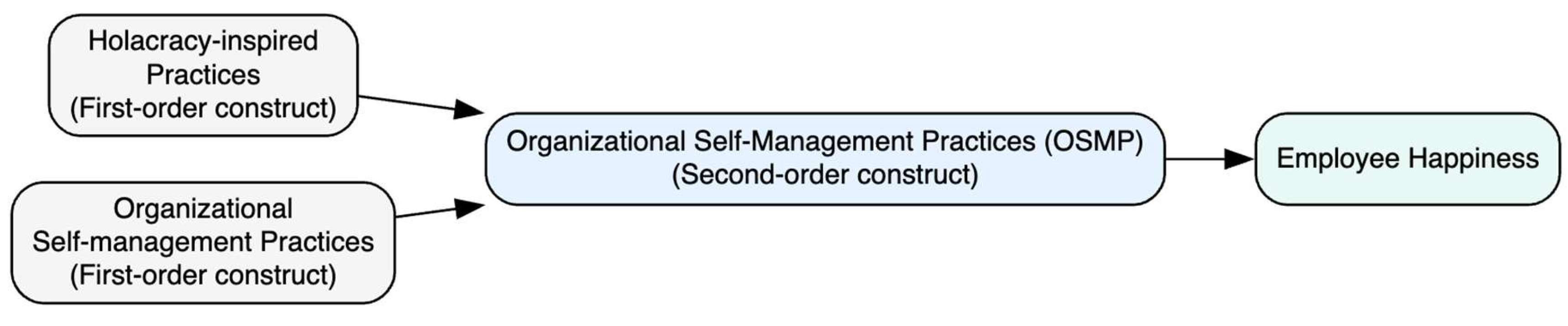
Figure 1.
Structural model of Organizational Self-Management Practices (OSMP) and Employee Happiness.
Figure 1.
Structural model of Organizational Self-Management Practices (OSMP) and Employee Happiness.
2. Materials and Methods
2.1. Research Design
This study adopted a quantitative, non-experimental, and cross-sectional research design. The purpose was to examine the relationships between organizational self-management practices and employee happiness as perceived by workers in small and medium-sized enterprises (SMEs). A correlational and explanatory approach was employed, as the study aimed to analyze the predictive capacity of self-management-oriented practices on employee happiness without manipulating any study variables. This design is appropriate for organizational research focused on understanding perceptual and behavioral relationships in real work contexts.
2.2. Population and Sample
The target population consisted of formal employees working in small and medium-sized enterprises (SMEs) located in the coastal provinces of the Ancash region, Peru, where economic activity is predominantly concentrated in the commerce and services sectors. SMEs represent a substantial proportion of employment in the Peruvian economy, particularly in coastal regions characterized by high levels of commercial and service-related activity.
The sample size was estimated using a 95% confidence level and a 5% margin of error. A total of 383 valid responses were collected and included in the final analysis, which is considered statistically adequate for the objectives of this study.
Due to the absence of an official, comprehensive, and fully disaggregated sampling frame of SME employees by province and economic sector, a probabilistic sampling strategy was implemented using simple random sampling based on an available registry of SMEs operating in the region. Employees were selected proportionally across participating firms to ensure adequate representation within organizations.
This sampling approach is commonly employed in organizational and management research conducted in emerging economies and is considered appropriate when access to exhaustive employee-level sampling frames is limited.
2.3. Data Collection Procedure
Due to the absence of an official, fully disaggregated sampling frame of SME employees, participant selection was conducted using an available registry of SMEs operating in the region. Employees were invited to participate through organizational coordination within each firm, following proportional criteria to ensure representation across participating organizations.
Data were collected through an online questionnaire administered using Google Forms. Participation was voluntary and anonymous. Prior to accessing the questionnaire, all participants were presented with an informed consent form that clearly explained the objectives of the study, the voluntary nature of participation, and the confidentiality of the information provided. Only respondents who explicitly agreed to participate were allowed to proceed with the survey. The data collection process complied with ethical standards for research involving human participants.
2.4. Measurement Instruments
Holacracy-inspired practices and organizational self-management practices were conceptualized as two distinct yet highly interrelated first-order reflective constructs. Given their strong theoretical proximity in promoting employee autonomy, distributed authority, and decentralized decision-making, and to ensure adequate discriminant validity, both constructs were subsequently modeled as reflective indicators of a higher-order reflective construct, termed Organizational Self-Management Practices (OSMP). This hierarchical modeling approach allows for a more comprehensive assessment of their joint influence on employee happiness while mitigating potential multicollinearity at the first-order level.
2.5. Data Analysis Technique
The analysis followed a two-stage approach. First, the measurement model was evaluated by assessing internal consistency reliability, convergent validity, and discriminant validity. Special attention was given to the hierarchical modeling of Organizational Self-Management Practices (OSMP) as a second-order reflective construct composed of two first-order dimensions: holacracy-inspired practices and organizational self-management practices.
Second, the structural model was evaluated by examining path coefficients, coefficients of determination (R2), effect sizes (f2), and predictive relevance (Q2), with statistical significance assessed through a bootstrapping procedure using 5,000 subsamples.
Partial Least Squares Structural Equation Modeling (PLS-SEM) was employed to analyze the data using SmartPLS software. PLS-SEM was selected due to its suitability for predictive research, its ability to handle complex models with multiple latent variables, and its robustness when dealing with non-normal data distributions and moderate sample sizes.
Additionally, to address potential concerns regarding common method bias inherent in cross-sectional, self-reported data, a full collinearity assessment was conducted. Variance Inflation Factor (VIF) values below 3.3 were considered indicative of the absence of serious common method bias.2.6. Ethical Considerations
The study adhered to ethical standards for research involving human participants. Participation was voluntary, anonymity and confidentiality were guaranteed, and no personally identifiable information was collected. The research protocol was approved by the Vice-Rectorate for Research of Universidad César Vallejo under Resolution No. P-2025-192-VI-UCV and was conducted in accordance with institutional ethical guidelines.
Data Availability Statement
The data presented in this study are available from the corresponding author upon reasonable request. The dataset contains anonymized responses and is not publicly available due to ethical and confidentiality considerations.
Generative AI Statement
Generative artificial intelligence tools were used to assist in language editing and analytical support during manuscript preparation. No generative AI was used for data collection, data generation, or data manipulation. All statistical analyses were conducted using the original dataset collected from the participants.
3. Results
3.1. Measurement Model Assessment
The measurement model was evaluated by examining indicator reliability, internal consistency reliability, convergent validity, and discriminant validity. Indicator reliability was assessed through the standardized outer loadings of each item. As shown in Table 1, all indicators exhibited satisfactory factor loadings (λ ≥ 0.70), with the exception of item FEL1, which presented a slightly lower loading (λ = 0.697). Given its theoretical relevance to the construct of employee happiness, the item was retained for further analysis.
Internal consistency reliability and convergent validity were evaluated using Cronbach’s alpha, composite reliability (CR), and average variance extracted (AVE). As reported in Table 2, all constructs exceeded the recommended thresholds (α ≥ 0.70, CR ≥ 0.70, AVE ≥ 0.50), indicating adequate reliability and convergent validity.
Discriminant validity was initially assessed using the heterotrait–monotrait ratio of correlations (HTMT). The initial HTMT analysis indicated high correlations between holacracy-inspired practices and organizational self-management practices (HTMT > 0.90), suggesting limited discriminant validity between these two first-order constructs.
In line with their conceptualization as closely related facets of a broader organizational phenomenon, both constructs were subsequently integrated into a higher-order reflective construct (Organizational Self-Management Practices). Following this hierarchical modeling approach, discriminant validity was reassessed at the second-order level. As shown in Table 3, all HTMT values between the higher-order construct and employee happiness were below the conservative threshold of 0.85, confirming adequate discriminant validity in the final measurement model.
3.2. Structural Model Assessment
The structural model was assessed by analyzing path coefficients, statistical significance, and effect sizes. The results of the structural model are presented in Table 4 and illustrated in Figure 2. The results reveal a positive and statistically significant relationship between OSMP and Employee Happiness (β = 0.461, t = 10.463, p < 0.001), indicating that higher levels of organizational self-management practices are associated with greater employee happiness. The effect size (f2 = 0.290) suggests a medium-to-large substantive impact of OSMP on the endogenous construct. Additionally, the model explains a substantial proportion of variance in Employee Happiness (R2 = 0.466), demonstrating adequate explanatory power in line with recommended thresholds for PLS-SEM models.
3.3. Predictive Power of the Model
The predictive power of the model was evaluated using the coefficient of determination (R2) and the Stone–Geisser’s Q2 value. As shown in Table 5, the model explained 46.6% of the variance in employee happiness (R2 = 0.466), indicating moderate explanatory power. The Q2 value was greater than zero, confirming the predictive relevance of the model.
3.4. Common Method Bias Assessment
To examine the presence of common method bias, a full collinearity assessment was performed. The VIF values for all latent variables in the model were below the recommended threshold of 3.3, indicating that common method bias is unlikely to affect the validity of the results.
4. Discussion
The present study examined the influence of holacracy-inspired practices and organizational self-management practices on employee happiness in SMEs in Peru using a PLS-SEM approach. The findings provide empirical support for the relevance of alternative organizational practices in promoting employee well-being, contributing to the growing literature on social sustainability and sustainable work in emerging economies.
First, the findings confirm that Organizational Self-Management Practices (OSMP), conceptualized as a higher-order construct integrating holacracy-inspired practices and organizational self-management practices, play a significant role in enhancing employee happiness (β = 0.461, p < 0.001). Rather than operating as independent predictors, these practices function as interrelated dimensions of a broader organizational phenomenon characterized by distributed authority, autonomy, role clarity, and participatory decision-making. From the employees’ perspective, such practices are experienced as a unified organizational reality, which justifies their integration at the higher-order level.
This finding aligns with theoretical arguments suggesting that distributed authority and participatory governance enhance employees’ sense of autonomy and psychological empowerment [17,19]. From the perspective of work design theories, OSMP is consistent with models emphasizing enriched jobs and meaningful participation as key antecedents of employee well-being [13,14,15]. While prior qualitative and conceptual studies have highlighted both the potential benefits and limitations of holacracy as an organizational model [18], the present study extends this literature by providing quantitative evidence of its positive association with employee happiness when embedded within a broader self-management framework. Importantly, these results contribute empirical evidence from SMEs in an emerging economy, a context that remains underexplored in existing research on organizational self-management and employee well-being [16,20].
Second, the results suggest that within the broader OSMP construct, self-management practices represent an important foundational dimension supporting employee happiness. Rather than exerting an independent effect, these practices contribute to the overall self-management framework by fostering autonomy-supportive work environments, consistent with self-determination theory [12,22]. In SMEs, where formal governance systems are often implemented unevenly, self-management practices may operate informally and interact with other organizational mechanisms, reinforcing the need to conceptualize them as part of an integrated organizational capability rather than as isolated predictors [16,21].
Taken together, these findings suggest that while both constructs contribute to employee happiness, holacracy-inspired practices may offer a more structured and impactful framework for enhancing well-being in organizational settings. This supports arguments in the literature that formalized governance systems can provide clearer role definitions and decision-making processes than loosely implemented self-management practices [18,19]. Importantly, the model explained a substantial proportion of the variance in employee happiness (R2 = 0.466), indicating moderate explanatory power and reinforcing the relevance of organizational design in understanding employee well-being outcomes [8,25].
From a sustainability perspective, the results underscore the importance of integrating human-centered organizational practices into sustainability agendas. Employee happiness is increasingly recognized as a critical outcome of sustainable human resource management and socially sustainable organizations [4,5,6,7,24]. By demonstrating that alternative organizational practices are associated with higher levels of happiness among SME employees, this study extends sustainability research beyond environmental and economic dimensions to include the social and psychological conditions of work. These results directly support SDG 8 (Decent Work and Economic Growth) by promoting participatory and inclusive work environments, and SDG 3 (Good Health and Well-being) by enhancing employees’ psychological well-being and job-related happiness. In emerging economies, such practices may strengthen the long-term resilience and sustainability of SMEs.
Finally, this study contributes to the literature by providing empirical evidence from a Latin American SME context, addressing calls for more research in emerging economies [2,16,20]. Nevertheless, the findings should be interpreted in light of certain limitations. The cross-sectional design precludes causal inferences, and future longitudinal studies could further examine the dynamic effects of holacracy and self-management practices over time. Additionally, qualitative approaches may complement these findings by exploring how employees interpret and experience such practices in daily work contexts.
5. Conclusions
This study examined the influence of Organizational Self-Management Practices (OSMP) on employee happiness in small and medium-sized enterprises (SMEs) in Peru using a Partial Least Squares Structural Equation Modeling (PLS-SEM) approach. OSMP was conceptualized as a higher-order construct integrating holacracy-inspired practices and organizational self-management practices. The findings provide robust empirical evidence that advanced self-management practices grounded in distributed authority, autonomy, and participatory governance contribute positively to employee happiness within an emerging economy context.
The results demonstrate that OSMP has a positive and statistically significant effect on employee happiness, highlighting the importance of adopting comprehensive self-management frameworks rather than isolated managerial practices. From the employees’ perspective, practices associated with role clarity, decentralized decision-making, and autonomy are experienced as an integrated organizational reality, reinforcing the relevance of modeling these dimensions at the higher-order level. This finding underscores that employee well-being is enhanced not by the formal adoption of specific governance labels, such as holacracy, but by the consistent implementation of self-management principles in everyday organizational practices.
From a theoretical standpoint, this study contributes to the literature on sustainable organizations by empirically linking organizational self-management practices with employee happiness, a key component of social sustainability. By integrating insights from self-determination theory and contemporary work design perspectives, the study extends existing research that has predominantly focused on large organizations or developed economies. The findings confirm that post-bureaucratic governance and self-management practices can be meaningfully examined through employees’ perceptions, even when such models are implemented informally or adapted to local organizational contexts.
From a practical perspective, the results offer relevant implications for SME managers and policymakers. Rather than fully adopting complex and formalized governance systems, SMEs may benefit from progressively introducing self-management practices that promote autonomy, participatory decision-making, and role transparency. Such practices can foster employee happiness and contribute to the social dimension of organizational sustainability without requiring extensive structural transformations or high implementation costs.
Despite its contributions, this study has certain limitations. The cross-sectional research design does not allow for causal inferences, and the reliance on self-reported data may introduce common method bias. In addition, the sample was limited to SMEs located in coastal provinces of a single region in Peru, which may constrain the generalizability of the findings to other geographical or cultural contexts.
Future research should adopt longitudinal designs to examine how organizational self-management practices evolve over time and how their long-term effects influence employee well-being. Further studies could also explore potential mediating and moderating mechanisms—such as organizational culture, leadership styles, or psychological empowerment—and conduct comparative analyses across sectors or countries to deepen understanding of self-management practices and their role in promoting sustainable organizations.
Author Contributions
Conceptualization, “M.CP”.; methodology, “M.CP”.; software, “M.CP”.; validation, “M.CP” and “W.CA”.; formal analysis, “M.CP” and “W.CA”.; investigation, “W.CA”.; resources, “W.CA”.; data curation, “M.CP”.; writing—original draft preparation, “M.CP” and “W.CA”.; writing—review and editing, “M.CP” and “W.CA”.; visualization, “W.CA”.; supervision, “M.CP”.; project administration, “M.CP”. All authors have read and agreed to the published version of the manuscript.
Funding
The author(s) declare that financial support was received for the publication of this article. The APC was funded by Universidad César Vallejo.
Institutional Review Board Statement
The study was conducted in accordance with the Declaration of Helsinki and approved by the Institutional Review Board of Universidad César Vallejo (Vicerrectorado de Investigación), approval code RESOLUCIÓN DE VICERRECTORADO DE INVESTIGACIÓN N° P-2025-192-VI-UCV.
Informed Consent Statement
Informed consent was obtained from all subjects involved in the study.
Data Availability Statement
The data presented in this study are available on request from the corresponding author. The data are not publicly available due to privacy and ethical restrictions.
Acknowledgments
During the preparation of this manuscript, the authors used ChatGPT (OpenAI) for language editing and structural refinement. The authors have reviewed and edited the content and take full responsibility for the final version of the manuscript.
Conflicts of Interest
The authors declare no conflicts of interest. The funders had no role in the design of the study; in the collection, analyses, or interpretation of data; in the writing of the manuscript; or in the decision to publish the results.
References
- OECD. Small and Medium-Sized Enterprises (SMEs) and Inclusive Growth; OECD Publishing: Paris, France, 2017. [Google Scholar] [CrossRef]
- Beck, T.; Demirguc-Kunt, A.; Levine, R. SMEs, growth, and poverty. Journal of Economic Growth 2005, 10, 199–229. [Google Scholar] [CrossRef]
- INEI. Características de las Micro y Pequeñas Empresas en el Perú; Instituto Nacional de Estadística e Informática: Lima, Peru, 2023; Available online: https://www.inei.gob.pe.
- Elkington, J. Enter the triple bottom line. In The Triple Bottom Line; Routledge: London, UK, 2018. [Google Scholar]
- Pfeffer, J. Building sustainable organizations: The human factor. Academy of Management Perspectives 2010, 24, 34–45. [Google Scholar] [CrossRef]
- De Vos, A.; Van der Heijden, B.; Akkermans, J. Sustainable careers: Towards a conceptual model. Journal of Vocational Behavior 2020, 117, 103196. [Google Scholar] [CrossRef]
- Kramar, R. Beyond strategic human resource management: Is sustainable HRM the next approach? Human Resource Management Review 2014, 24, 106–118. [Google Scholar] [CrossRef]
- Fisher, C.D. Happiness at work. International Journal of Management Reviews 2010, 12, 384–412. [Google Scholar] [CrossRef]
- Warr, P. Work, happiness, and unhappiness; Lawrence Erlbaum Associates: Mahwah, NJ, USA, 2007. [Google Scholar] [CrossRef]
- Diener, E.; Oishi, S.; Lucas, R.E. National accounts of subjective well-being. American Psychologist 2015, 70, 234–242. [Google Scholar] [CrossRef] [PubMed]
- Bakker, A.B.; Demerouti, E. Job demands–resources theory. Journal of Occupational Health Psychology 2017, 22, 273–285. [Google Scholar] [CrossRef] [PubMed]
- Ryan, R.M.; Deci, E.L. Self-determination theory and the facilitation of intrinsic motivation. American Psychologist 2000, 55, 68–78. [Google Scholar] [CrossRef]
- Hackman, J.R.; Oldham, G.R. Motivation through the design of work. Organizational Behavior and Human Performance 1976, 16, 250–279. [Google Scholar] [CrossRef]
- Grant, A.M.; Parker, S.K. Redesigning work design theories. Academy of Management Annals 2009, 3, 317–375. [Google Scholar] [CrossRef]
- Parker, S.K. Beyond motivation: Job and work design for development. Academy of Management Annals 2014, 8, 1–44. [Google Scholar] [CrossRef]
- Rauch, A.; Wiklund, J. Entrepreneurial orientation and performance in SMEs. Entrepreneurship Theory and Practice 2009, 33, 761–787. [Google Scholar] [CrossRef]
- Robertson, B.J. Holacracy: The New Management System for a Rapidly Changing World; Henry Holt: New York, NY, USA, 2015. [Google Scholar]
- Bernstein, E.; Bunch, J.; Canner, N.; Lee, M. Beyond the holacracy hype. Harvard Business Review 2016, 94, 38–49. [Google Scholar]
- Lee, M.Y.; Edmondson, A.C. Self-managing organizations: Exploring the limits. Academy of Management Annals 2017, 11, 1–51. [Google Scholar] [CrossRef]
- Laloux, F. Reinventing Organizations; Nelson Parker: Brussels, Belgium, 2014. [Google Scholar]
- Martela, F. What makes self-managing organizations novel? Human Relations 2019, 72, 189–218. [Google Scholar] [CrossRef]
- Deci, E.L.; Olafsen, A.H.; Ryan, R.M. Self-determination theory in work organizations. Annual Review of Organizational Psychology and Organizational Behavior 2017, 4, 19–43. [Google Scholar] [CrossRef]
- Van Mierlo, H.; Rutte, C.G. Self-managing teams and well-being. Journal of Occupational Health Psychology 2016, 21, 334–345. [Google Scholar] [CrossRef]
- Salas-Vallina, A.; Alegre, J.; Fernández, R. Happiness at work and organisational citizenship behavior. Journal of Management & Organization 2017, 23, 1–17. [Google Scholar] [CrossRef]
- Guest, D.E. Human resource management and employee well-being. Journal of Management 2017, 43, 1–28. [Google Scholar] [CrossRef]
- Alarcón, G.M.; Edwards, J.M.; Menke, L.E. Autonomy and well-being at work. Journal of Occupational Health Psychology 2011, 16, 1–12. [Google Scholar] [CrossRef]
- Hair, J.F.; Hult, G.T.M.; Ringle, C.M.; Sarstedt, M. A Primer on Partial Least Squares Structural Equation Modeling (PLS-SEM); Sage: Thousand Oaks, CA, USA, 2017. [Google Scholar]
- Ringle, C.M.; Sarstedt, M.; Straub, D.W. A critical look at the use of PLS-SEM in MIS research. MIS Quarterly 2012, 36, iii–xiv. [Google Scholar] [CrossRef]
Figure 2.
Holacracy-inspired practices and organizational self-management practices are modeled as first-order reflective dimensions of the higher-order construct Organizational Self-Management Practices (OSMP).
Figure 2.
Holacracy-inspired practices and organizational self-management practices are modeled as first-order reflective dimensions of the higher-order construct Organizational Self-Management Practices (OSMP).
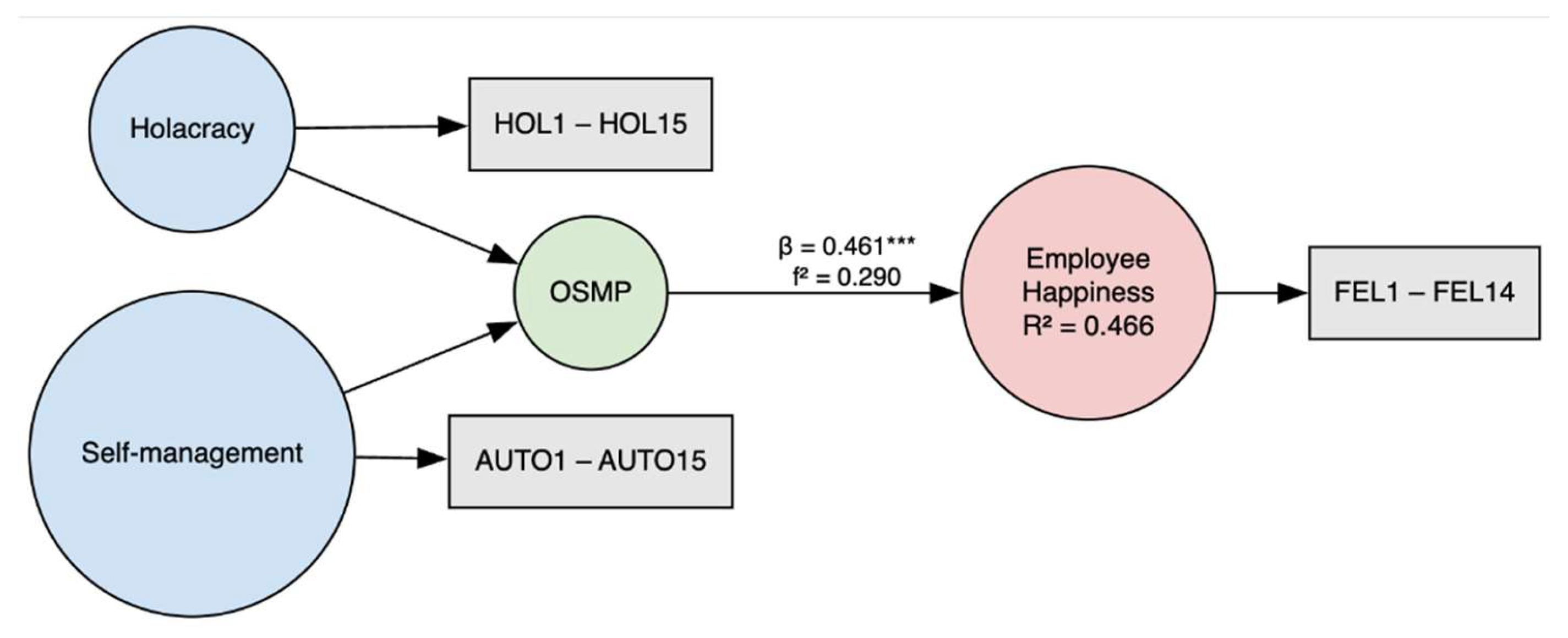

Table 1.
Outer loadings.
| Item | Construct | Loading | Status |
|---|---|---|---|
| HOL1 | Holacracy | 0.729 | Pass |
| HOL2 | Holacracy | 0.766 | Pass |
| HOL3 | Holacracy | 0.772 | Pass |
| HOL4 | Holacracy | 0.779 | Pass |
| HOL5 | Holacracy | 0.758 | Pass |
| HOL6 | Holacracy | 0.749 | Pass |
| HOL7 | Holacracy | 0.768 | Pass |
| HOL8 | Holacracy | 0.768 | Pass |
| HOL9 | Holacracy | 0.784 | Pass |
| HOL10 | Holacracy | 0.789 | Pass |
| HOL11 | Holacracy | 0.771 | Pass |
| HOL12 | Holacracy | 0.744 | Pass |
| HOL13 | Holacracy | 0.731 | Pass |
| HOL14 | Holacracy | 0.763 | Pass |
| HOL15 | Holacracy | 0.753 | Pass |
| AUTO1 | Organizational Self-Management | 0.781 | Pass |
| AUTO2 | Organizational Self-Management | 0.817 | Pass |
| AUTO3 | Organizational Self-Management | 0.765 | Pass |
| AUTO4 | Organizational Self-Management | 0.788 | Pass |
| AUTO5 | Organizational Self-Management | 0.800 | Pass |
| AUTO6 | Organizational Self-Management | 0.816 | Pass |
| AUTO7 | Organizational Self-Management | 0.784 | Pass |
| AUTO8 | Organizational Self-Management | 0.791 | Pass |
| AUTO9 | Organizational Self-Management | 0.776 | Pass |
| AUTO10 | Organizational Self-Management | 0.779 | Pass |
| AUTO11 | Organizational Self-Management | 0.802 | Pass |
| AUTO12 | Organizational Self-Management | 0.790 | Pass |
| AUTO13 | Organizational Self-Management | 0.774 | Pass |
| AUTO14 | Organizational Self-Management | 0.798 | Pass |
| AUTO15 | Organizational Self-Management | 0.813 | Pass |
| FEL1 | Employee Happiness | 0.697 | Check |
| FEL2 | Employee Happiness | 0.761 | Pass |
| FEL3 | Employee Happiness | 0.757 | Pass |
| FEL4 | Employee Happiness | 0.735 | Pass |
| FEL5 | Employee Happiness | 0.746 | Pass |
| FEL6 | Employee Happiness | 0.761 | Pass |
| FEL7 | Employee Happiness | 0.752 | Pass |
| FEL8 | Employee Happiness | 0.762 | Pass |
| FEL9 | Employee Happiness | 0.777 | Pass |
| FEL10 | Employee Happiness | 0.767 | Pass |
| FEL11 | Employee Happiness | 0.770 | Pass |
| FEL12 | Employee Happiness | 0.773 | Pass |
| FEL13 | Employee Happiness | 0.762 | Pass |
| FEL14 | Employee Happiness | 0.743 | Pass |
Note. Outer loadings (λ) of the reflective indicators for each construct. The recommended threshold is λ ≥ 0.70. One item (FEL1) shows a marginally lower loading, which was retained due to its theoretical relevance and adequate construct-level reliability and validity.
Table 2.
Reliability and convergent validity of the measurement model.
| Construct | Cronbach’s Alpha (α) | Composite Reliability (CR) | Average Variance Extracted (AVE) |
| Holacracy | 0.948 | 0.954 | 0.580 |
| Organizational Self-Management | 0.957 | 0.962 | 0.627 |
| Employee Happiness | 0.942 | 0.949 | 0.570 |
Note. Cronbach’s α = Cronbach’s alpha; CR = composite reliability; AVE = average variance extracted. All values exceed the recommended thresholds (α ≥ 0.70, CR ≥ 0.70, AVE ≥ 0.50).
Table 3.
Discriminant validity (HTMT).
| Construct | Organizational Self-Management Practices (OSMP) | Employee Happiness |
| Organizational Self-Management Practices (OSMP) | — | 0.662 |
| Employee Happiness | 0.662 | — |
Note. HTMT values below 0.85 indicate adequate discriminant validity.
Table 4.
Structural model results obtained through PLS-SEM.
| Path | β | t-value | p-value | f2 |
| Organizational Self-Management Practices (OSMP) → Employee Happiness | 0.461 | 10.463 | < 0.001 | 0.290 |
Note. Path coefficients, significance levels, and effect sizes correspond to the structural relationship between the second-order construct Organizational Self-Management Practices (OSMP) and Employee Happiness, as estimated in the final PLS-SEM model.
Table 5.
Predictive power of the structural model.
| Endogenous Construct | R2 | Q2 |
|---|---|---|
| Employee Happiness | 0.466 | 0.455 |
Note. Coefficient of determination (R2) and Stone–Geisser’s Q2 values for the endogenous construct. R2 indicates moderate explanatory power, while Q2 values greater than zero confirm predictive relevance of the model.
Disclaimer/Publisher’s Note: The statements, opinions and data contained in all publications are solely those of the individual author(s) and contributor(s) and not of MDPI and/or the editor(s). MDPI and/or the editor(s) disclaim responsibility for any injury to people or property resulting from any ideas, methods, instructions or products referred to in the content. |
© 2026 by the authors. Licensee MDPI, Basel, Switzerland. This article is an open access article distributed under the terms and conditions of the Creative Commons Attribution (CC BY) license.
Copyright: This open access article is published under a Creative Commons CC BY 4.0 license, which permit the free download, distribution, and reuse, provided that the author and preprint are cited in any reuse.


