
Submitted:
08 January 2026
Posted:
09 January 2026
You are already at the latest version
Abstract
Deep learning-based Human Activity Recognition (HAR) systems using multimodal wearable sensors are increasingly deployed in safety-critical applications including healthcare monitoring, elderly care, and security authentication. However, the vulnerability of these systems to adversarial attacks remains insufficiently understood, particularly for attacks that must evade detection while manipulating multiple sensor modalities simultaneously. This paper presents STAR-RL (Stealth-aware Targeted Adversarial attack via Reinforcement Learning), a novel framework that generates effective and stealthy adversarial examples against multimodal sensor-based HAR systems. STAR-RL introduces three key innovations: (1) a multi-strategy attack engine that adaptively selects among diverse perturbation algorithms based on real-time attack progress, (2) a sensor-aware stealth mechanism that concentrates perturbations on naturally noisy sensors to minimize detection likelihood, and (3) a reinforcement learning-based meta-controller that learns optimal attack policies through interaction with the target classifier. Comprehensive experiments on the MHEALTH dataset demonstrate that STAR-RL achieves 95.20% attack success rate, substantially outperforming baseline methods including FGSM (6.00%), PGD (88.60%), and C&W (69.00%). The stealth analysis confirms that 51.35% of perturbation energy is successfully directed to weak sensors (gyroscopes and magnetometers), validating the effectiveness of the sensor-aware allocation strategy. Our findings reveal critical security vulnerabilities in production HAR systems and provide insights for developing robust defense mechanisms against adaptive adversarial threats.
Keywords:
adversarial machine learning
; human activity recognition
; reinforcement learning
; multimodal sensor fusion
; deep learning security
; time series classification
1. Introduction
Human Activity Recognition (HAR) systems based on wearable sensors have emerged as foundational technologies enabling a wide spectrum of applications, from personalized healthcare monitoring [1] and elderly fall detection [2] to fitness tracking [3] and security authentication [4]. The proliferation of smartwatches, fitness bands, and medical-grade wearable devices has accelerated the deployment of deep learning models that process continuous streams of accelerometer, gyroscope, magnetometer, and physiological sensor data to infer user activities in real-time. As these systems increasingly govern safety-critical decisions—triggering emergency responses, authorizing secure access, or adjusting medical interventions—their reliability and security have become paramount concerns [5,6].
Despite remarkable advances in HAR accuracy through sophisticated deep learning architectures, including convolutional neural networks, recurrent models, and attention mechanisms, a fundamental question remains inadequately addressed: How vulnerable are these systems to deliberately crafted adversarial perturbations, and can such attacks be executed stealthily to evade detection? This question carries profound implications for the trustworthiness of HAR deployments in adversarial environments where malicious actors may seek to manipulate system outputs for nefarious purposes.
The phenomenon of adversarial examples—carefully crafted inputs that induce misclassification in machine learning models while appearing imperceptibly different from legitimate samples—was first demonstrated in the image domain [7] and has since been extensively studied across computer vision applications [8,9]. However, the extension of adversarial attacks to time series classification, particularly multimodal sensor data, presents unique challenges that existing methods fail to adequately address. Unlike static images, sensor time series exhibit complex temporal dependencies, inter-channel correlations, and modality-specific noise characteristics that must be carefully considered when generating effective yet stealthy perturbations.
Recent investigations into adversarial attacks on time series classification [10] have established that deep learning models for sequential data are indeed vulnerable to adversarial manipulation. Extensions to HAR systems have revealed attack vectors through WiFi channel state information [11,12], radar signals [13], and skeleton-based action recognition [14,15]. Our prior work demonstrated the feasibility of generating adversarial examples against multimodal sensor-based HAR models [16] and developed detection mechanisms for identifying compromised sensors [17]. However, existing approaches suffer from three critical limitations that constrain their effectiveness in practical attack scenarios.
First, conventional attack methods employ fixed perturbation strategies that fail to adapt to the varying difficulty of different input samples. Single-step attacks such as FGSM [7] prove largely ineffective for complex temporal patterns, while iterative methods like PGD [8] may converge to suboptimal local minima. Optimization-based approaches such as C&W [9] achieve high-quality perturbations but at prohibitive computational cost. The absence of adaptive strategy selection mechanisms limits the robustness of existing attacks across diverse input characteristics.
Second, prior work largely ignores the heterogeneous nature of multimodal sensor data when generating adversarial perturbations. In wearable HAR systems, different sensors exhibit vastly different noise profiles: accelerometers and ECG signals typically maintain high signal-to-noise ratios, while gyroscopes and magnetometers are inherently more susceptible to environmental interference and measurement noise. Perturbations uniformly distributed across all sensors are more likely to trigger anomaly detection systems monitoring sensor signal quality, whereas strategic allocation to naturally noisy channels could evade such defenses.
Third, the application of reinforcement learning for adaptive attack generation in the HAR domain remains unexplored. While RL-based approaches have shown promise for black-box attacks in image classification [18] and for discovering adversarial policies in control systems [19], the unique characteristics of multimodal time series—including temporal dependencies, sensor correlations, and class-specific vulnerability patterns—have not been leveraged to guide intelligent attack strategy selection.
To address these limitations, this paper presents STAR-RL (Stealth-aware Targeted Adversarial attack via Reinforcement Learning), a novel framework for generating effective and stealthy adversarial examples against multimodal sensor-based HAR systems. STAR-RL makes three principal contributions:
- 1.
- Multi-Strategy Attack Engine: We develop an attack engine incorporating four complementary perturbation strategies—PGD-Strong, Momentum Iterative FGSM (MI-FGSM), C&W-High, and PGD-Long—each optimized for different attack scenarios. This diversity enables robust performance across input samples with varying difficulty characteristics, including “hard classes” that resist standard attack methods.
- 2.
- Sensor-Aware Stealth Mechanism: We introduce a novel perturbation allocation strategy that exploits the heterogeneous noise profiles of multimodal sensors. By concentrating adversarial modifications on naturally noisy sensors (gyroscopes, magnetometers) while constraining perturbations to reliable sensors (accelerometers, ECG), STAR-RL generates adversarial examples with enhanced stealth properties that are more likely to evade anomaly detection systems.
- 3.
- RL-Based Meta-Controller: We formulate adversarial attack generation as a Markov Decision Process (MDP) and train a reinforcement learning agent to dynamically select attack strategies and hyperparameters based on real-time feedback from the target classifier. The meta-controller learns to adapt its policy to sample-specific characteristics, achieving intelligent automation of the attack generation process.
Comprehensive experiments on the MHEALTH dataset, a widely-adopted benchmark for multimodal HAR, demonstrate the effectiveness of STAR-RL. Our framework achieves 95.20% attack success rate (ASR) for targeted misclassification, substantially outperforming FGSM (6.00%), PGD (88.60%), and C&W (69.00%). The stealth analysis confirms that 51.35% of total perturbation energy is successfully directed to weak sensors, validating the sensor-aware allocation strategy. Ablation studies verify the contribution of each framework component: removing the multi-strategy engine reduces ASR by 6.6 percentage points, while disabling optimal target selection decreases performance by 5.4 percentage points.
Beyond demonstrating attack effectiveness, our work carries important implications for HAR system security. The 95.20% ASR achieved against a representative Time-Distributed LSTM architecture indicates that production HAR systems are highly vulnerable to sophisticated adversarial manipulation. The feasibility of stealth attacks concentrating perturbations on specific sensors suggests that conventional anomaly detection may be insufficient for identifying adversarial inputs. These findings motivate the urgent development of adversarially robust HAR architectures and defense mechanisms.
The remainder of this paper is organized as follows. Section 2 reviews related work on adversarial attacks for time series classification, HAR systems, and reinforcement learning-based attack methods. Section 3 establishes the mathematical foundations, including problem formulation and baseline attack methods. Section 4 presents the proposed STAR-RL framework in detail, covering the multi-strategy attack engine, sensor-aware stealth mechanism, and RL meta-controller. Section 5 describes the experimental setup and presents comprehensive evaluation results. Section 6 discusses the implications of our findings, acknowledges limitations, and outlines future directions. Section 7 concludes the paper.
2. Related Works
The proliferation of deep learning models in HAR systems has raised significant concerns regarding their vulnerability to adversarial attacks. This section provides a comprehensive review of the existing literature, organized into four main themes: adversarial attacks on time series data, security challenges in HAR systems, reinforcement learning-based attack methodologies, and multi-sensor fusion vulnerabilities.
2.1. Adversarial Attacks on Time Series Data
The seminal work by Goodfellow et al. [7] introduced the Fast Gradient Sign Method (FGSM), demonstrating that imperceptible perturbations could fool deep neural networks with high confidence. Subsequently, Madry et al. [8] proposed Projected Gradient Descent (PGD) as a stronger iterative attack, establishing it as a benchmark for adversarial robustness evaluation. Carlini and Wagner [9] further advanced the field by formulating adversarial perturbation generation as an optimization problem, achieving superior attack success rates with minimal perturbation magnitudes.
The extension of adversarial attacks to time series classification was pioneered by Fawaz et al. [20], who systematically investigated the vulnerability of deep learning models for time series analysis. Their work revealed that temporal patterns in sequential data present unique challenges for generating effective adversarial perturbations while maintaining temporal coherence. Karim et al. [10] expanded this investigation by proposing attacks specifically designed for multivariate time series, demonstrating that the correlations between different channels could be exploited to craft more effective perturbations.
Recent developments in time series adversarial attacks have focused on enhancing imperceptibility and attack efficiency. Pialla et al. [21,22] introduced smooth perturbation constraints that preserve the natural characteristics of time series data, addressing the challenge of generating adversarial examples that evade both machine learning models and human observers. Harford et al. [23] investigated adversarial attacks on multivariate time series forecasting models, demonstrating that prediction systems are particularly susceptible to carefully crafted perturbations at critical temporal points. The TSadv method proposed by Yang et al. [24] leveraged local perturbations for black-box attacks, achieving significant attack success rates while restricting modifications to specific temporal segments. More recently, Wang et al. [25] proposed TSFool, a multi-objective optimization framework that simultaneously maximizes attack effectiveness while minimizing perturbation perceptibility.
The temporal characteristics of time series data have been specifically exploited in several recent works. Shen and Li [26] proposed temporal characteristics-based adversarial attacks that leverage the inherent periodicity and trend patterns in sensor data. Wu et al. [27] introduced importance-based perturbation strategies that concentrate adversarial modifications on the most influential temporal segments, demonstrating that small perturbations are sufficient to compromise time series prediction models. Correlation analysis studies by Li et al. [28,29] revealed that the relationships between time steps can be leveraged to enhance attack transferability across different model architectures.
2.2. Adversarial Attacks on Human Activity Recognition Systems
Human Activity Recognition systems present unique attack surfaces due to their reliance on continuous sensor streams from multiple modalities. Wang et al. [5] and Nweke et al. [6] provided comprehensive surveys of deep learning approaches for sensor-based HAR, establishing the foundation for understanding the architectures vulnerable to adversarial manipulation. Sakka et al. [30] systematically analyzed security vulnerabilities in HAR systems, identifying critical attack vectors across different sensing modalities.
Sensor-based HAR systems have been shown to be particularly vulnerable to adversarial attacks. Kurniawan et al. [16] conducted extensive experiments on adversarial examples targeting multimodal sensor-based HAR models, demonstrating that perturbations applied to specific sensor channels can propagate misclassification across the entire recognition pipeline. Their subsequent work [17] focused on detecting which sensors were exploited in adversarial attacks, providing insights into the sensor-specific vulnerabilities in multi-sensor HAR systems.
The extension of adversarial attacks to various sensing modalities has revealed modality-specific vulnerabilities. Ozbulak et al. [13] investigated adversarial attacks on radar-based HAR systems, establishing connections between adversarial perturbation patterns and model interpretability. For skeleton-based action recognition, Diao et al. [14] proposed BASAR, a black-box attack framework that manipulates skeletal joint positions to induce misclassification. Wang et al. [15] introduced SMART, which exploits the temporal dynamics of skeleton sequences to generate adversarial perturbations that appear natural under human observation. Physical-world skeleton attacks have been further explored by Zheng et al. [31], demonstrating the feasibility of backdoor attacks in real-world deployment scenarios.
WiFi-based sensing systems have emerged as attractive targets for adversarial attacks due to their widespread deployment in smart environments. Zhou et al. [11] developed WiAdv, achieving practical adversarial attacks against WiFi gesture recognition systems through carefully designed channel state information (CSI) perturbations. Xu et al. [32] proposed WiCAM, leveraging attention mechanisms to identify and perturb the most critical CSI features. Li et al. [33] demonstrated that adversarial perturbations can be injected through pilot symbol manipulation in communication packets. Huang et al. [12] introduced IS-WARS, an intelligent and stealthy attack framework that balances attack effectiveness with perturbation imperceptibility. The emerging field of WiFi sensing security has been comprehensively surveyed in recent works [34,35,36], highlighting the urgent need for robust defense mechanisms.
2.3. Reinforcement Learning for Adversarial Attacks
Reinforcement learning has emerged as a powerful paradigm for generating adaptive adversarial attacks. Tsingenopoulos et al. [18] pioneered the AutoAttacker framework, utilizing reinforcement learning to automatically discover effective attack policies in black-box settings. Zhang et al. [37] investigated robust deep reinforcement learning against adversarial perturbations on state observations, providing theoretical foundations for understanding RL vulnerability to input manipulation. The ATLA framework by Zhang et al. [38] learned optimal adversary policies that could efficiently exploit weaknesses in RL-based systems.
Several works have explored RL-guided attack strategies for temporal data. Gleave et al. [19] demonstrated that adversarial policies can defeat well-trained RL agents through strategic perturbations. Wu et al. [39] integrated explainability-guided search into adversarial policy learning, achieving targeted attacks with interpretable perturbation patterns. He et al. [40] proposed a singular value manipulating attack (SVMA) using deep reinforcement learning with soft actor-critic, demonstrating effective black-box transferable attacks on deep convolutional neural networks by perturbing the singular value matrix instead of directly manipulating pixels. García et al. [41] formulated adversarial attack generation as a multi-objective reinforcement learning problem, enabling simultaneous optimization of attack success rate and perturbation minimization. Recent advances in RL-based video attacks [42] have demonstrated the effectiveness of sparse, temporally targeted perturbations guided by learned policies.
The vulnerability of deep reinforcement learning systems themselves has been extensively studied. Schott et al. [43] provided a comprehensive survey of adversarial attacks and training methods for robust deep reinforcement learning. Ilahi et al. [44] analyzed challenges and countermeasures for adversarial attacks on deep RL systems. Sun et al. [45] proposed stealthy and efficient adversarial attacks that minimize the number of perturbed states while maintaining high attack success rates. Oikarinen et al. [46] introduced adversarial loss functions for improving RL robustness, while Sun et al. [47] proposed PA-AD (Policy perturbation direction with Adversarial Director), a theoretically optimal and efficient evasion attack algorithm that decouples the attacking process into policy perturbation and state perturbation components. Recent surveys [48,49] have highlighted the increasing sophistication of attacks against both single-agent and multi-agent RL systems.
2.4. Multi-Sensor Fusion Vulnerabilities
The integration of multiple sensing modalities introduces complex attack surfaces that have been increasingly studied. Cao et al. [50] demonstrated adversarial attacks on LiDAR-based perception in autonomous driving, revealing that sensor fusion mechanisms can be exploited through targeted perturbations. Multi-sensor fusion attacks have been investigated by Zhu et al. [51], showing that adversarial perturbations can propagate through fusion networks in unexpected ways. The FusionRipper framework [52] demonstrated attacks on multi-sensor localization systems through GPS spoofing. Tian and Xu [53] investigated whether audio-visual integration could strengthen robustness under multimodal attacks, finding that fusion architectures can both mitigate and amplify adversarial vulnerabilities depending on the attack strategy.
Recent work on multi-modal attack detection [54] has proposed frameworks for identifying adversarial perturbations across different modalities. Defense mechanisms specifically designed for multi-modal systems have been investigated by Wang et al. [55], providing provable robustness guarantees for multi-modal models.
2.5. Research Gap and Our Contributions
Table 1 provides a systematic comparison of our proposed STAR-RL framework with existing adversarial attack methods. As evident from the comparison, existing approaches exhibit significant limitations when applied to multimodal sensor-based HAR systems. First, most methods are designed for single-modality inputs and cannot effectively handle the complex inter-sensor dependencies present in multi-sensor HAR systems. Second, existing attacks lack adaptive mechanisms to dynamically adjust perturbation strategies based on classifier behavior and sensor characteristics. Third, few methods consider the stealth requirements necessary for practical attacks on real-world HAR deployments, where perturbations should be concentrated on sensors with lower detection likelihood.
Our proposed STAR-RL framework addresses these gaps through three key innovations: (1) a reinforcement learning-based meta-controller that adaptively selects attack strategies based on real-time classifier feedback, (2) sensor-aware perturbation allocation that concentrates modifications on weak sensors to maximize stealth, and (3) a multi-strategy attack mechanism that employs different optimization techniques for hard-to-attack activity classes. To the best of our knowledge, STAR-RL represents the first RL-guided adversarial attack framework specifically designed for multimodal sensor-based HAR systems.
3. Background
This section presents the mathematical foundations underlying our proposed STAR-RL framework. We formulate the problem of adversarial attacks on multimodal sensor-based HAR systems and establish the theoretical basis for our reinforcement learning-guided attack methodology.
3.1. Multimodal Sensor-Based Human Activity Recognition
Consider a multimodal HAR system that processes sensor data from M distinct sensing modalities. Let represent a time series input, where T denotes the number of time steps and D represents the total feature dimensionality across all sensors. The feature space can be decomposed as , where denotes the dimensionality of the m-th sensor modality. For the MHEALTH dataset [56] employed in our experiments, we have sensor groups comprising accelerometers, gyroscopes, magnetometers, and ECG sensors distributed across chest, ankle, and wrist positions, yielding total features.
The HAR classifier is represented as a function , parameterized by , which maps an input time series to a K-dimensional logit vector, where K is the number of activity classes. The predicted class is obtained through:
where denotes the softmax function. The classifier’s confidence for class k is expressed as:
3.2. Problem Formulation: Targeted Adversarial Attacks
Given an input sample with true label and a target class , the objective of a targeted adversarial attack is to find a perturbation such that the adversarial example is classified as while minimizing the perturbation magnitude. Formally, this can be expressed as:
where denotes the -norm (typically ) and is the maximum allowable perturbation magnitude.
In practice, the hard constraint formulation in Equation (3) is often relaxed to an unconstrained optimization problem using a Lagrangian formulation:
where controls the trade-off between attack success and perturbation minimization.
3.3. Baseline Attack Methods
3.3.1. Fast Gradient Sign Method (FGSM)
The FGSM attack generates adversarial perturbations through a single gradient step:
where denotes the cross-entropy loss and is the element-wise sign function. While computationally efficient, FGSM often produces suboptimal perturbations due to its single-step nature.
3.3.2. Projected Gradient Descent (PGD)
PGD iteratively refines the perturbation through multiple gradient steps with projection onto the -ball:
where is the step size, denotes projection onto the -ball of radius , and t indexes the iteration.
3.3.3. Carlini-Wagner (C&W) Attack
The C&W attack formulates adversarial example generation as a constrained optimization problem:
where , is a regularization constant, and is defined as:
with controlling the confidence margin.
3.4. Reinforcement Learning Formulation for Adaptive Attacks
We formulate the adversarial attack problem as a Markov Decision Process (MDP) to enable adaptive, context-aware attack generation. The MDP is defined by the tuple :
State Space (): The state at step t encodes information about the current attack progress:
where represents the hidden representation from the victim model, and are the classifier’s confidences for the true and target classes respectively, is the current perturbation magnitude, and is a one-hot encoding of the source class indicating whether it belongs to the set of “hard classes” identified through empirical analysis.
Action Space (): The action space comprises attack strategy selections and hyperparameter configurations:
where the continuous components specify the perturbation magnitude and step size .
Transition Dynamics (): The transition function captures how the attack state evolves:
where extracts the state representation from the model’s output.
Reward Function (): The reward function balances attack success against perturbation stealth:
where weights the perturbation penalty, is the indicator function, and is a bonus for successful targeted misclassification.
3.5. Sensor-Aware Stealth Constraints
To ensure perturbations remain undetectable, we introduce sensor-specific constraints based on the observation that certain sensors are more susceptible to noise and thus better suited for perturbation injection. Let denote the set of weak sensors (e.g., gyroscopes and magnetometers at ankle and wrist positions). The stealth-aware perturbation constraint is formulated as:
where denotes the feature indices corresponding to sensor m, and allows larger perturbations on weak sensors while limiting modifications to strong sensors (e.g., chest accelerometer, ECG).
The stealth score is quantified as the ratio of perturbation energy allocated to weak sensors:
where denotes the Frobenius norm. A higher stealth score indicates better concealment of adversarial perturbations.
3.6. Optimal Target Selection
To maximize attack success rates, we employ an intelligent target selection strategy based on the victim model’s confusion characteristics. For each source class y, we compute the average misclassification probability to potential target classes:
Target classes are ranked in descending order of this score, and the highest-ranked target is selected for attack:
This strategy exploits the inherent confusion patterns in the classifier, selecting targets that are already prone to confusion with the source class, thereby facilitating more efficient adversarial perturbation generation.
3.7. Policy Optimization
The RL agent’s policy , parameterized by , is optimized using the Proximal Policy Optimization (PPO) algorithm to maximize expected cumulative reward:
where denotes a trajectory, H is the horizon, and is the discount factor. The policy is updated using the clipped surrogate objective to ensure stable learning:
where is the probability ratio and is the estimated advantage function.
4. Proposed Methodology
Building upon the mathematical foundations established in Section 3, this section presents the detailed architecture and algorithmic design of the proposed STAR-RL framework. Our methodology addresses the key limitations identified in Section 2 by introducing an adaptive, sensor-aware attack generation system that leverages reinforcement learning for intelligent strategy selection.
4.1. System Overview
The STAR-RL framework comprises four interconnected modules: (1) the Victim Model representing the target HAR classifier, (2) the Target Analyzer that identifies optimal attack targets based on classifier confusion patterns, (3) the Multi-Strategy Attack Engine implementing diverse perturbation generation algorithms, and (4) the RL Meta-Controller that adaptively orchestrates attack strategy selection. Figure 1 illustrates the overall architecture and information flow within the proposed system.
The attack pipeline operates as follows. Given an input sample with true label y, the Target Analyzer first determines the optimal target class by analyzing the victim model’s confusion characteristics. Subsequently, the RL Meta-Controller evaluates the current attack state and selects an appropriate strategy from the Multi-Strategy Attack Engine. The selected strategy generates adversarial perturbations, which are then evaluated against the victim model. The predicted label and associated probabilities are used to compute the reward signal , which updates the RL Meta-Controller’s policy, enabling continuous adaptation throughout the attack process.
4.2. Victim Model Architecture
The victim model in our experimental setup employs a Time-Distributed LSTM (TD-LSTM) architecture specifically designed for multimodal sensor-based HAR. This architecture processes sequential sensor data through two stages: temporal feature extraction and sequence modeling. Figure 2 presents the detailed architecture of the victim model.
The temporal feature extraction stage applies shared dense layers across all time steps using a time-distributed configuration. For an input tensor where time steps and features, the first time-distributed layer (Layer 1) transforms each time step independently:
where denotes the weight matrix, is the bias vector, and represents batch normalization. A second time-distributed layer (Layer 2) with identical structure further refines the representations:
Following temporal feature extraction, a temporal downsampling operation using max-pooling with kernel size 2 reduces the temporal dimension by half, yielding . The sequence modeling stage employs a single-layer LSTM with 256 hidden units:
The final hidden state is passed through a classifier head consisting of a dense layer with 128 units and ReLU activation, followed by a final dense layer to produce the output logits for activity classes:
This architecture achieves state-of-the-art performance on the MHEALTH dataset while remaining representative of production HAR systems deployed in wearable devices.
4.3. Target Analyzer Module
Effective targeted attacks require careful selection of target classes that maximize the probability of successful misclassification. The Target Analyzer module implements the optimal target selection strategy formulated in Equation (15) by empirically estimating the confusion characteristics of the victim model.
Given a calibration set , the Target Analyzer computes the average softmax probability for each source-target class pair:
where denotes the subset of calibration samples belonging to class y. For each source class, target classes are ranked in descending order of , and the top-ranked target is selected for attack generation.
This data-driven approach exploits inherent classifier biases, identifying target classes that are naturally confused with the source class. Empirical analysis reveals that attacking high-confusion targets reduces the required perturbation magnitude by up to 40% compared to random target selection.
4.4. Multi-Strategy Attack Engine
The Multi-Strategy Attack Engine implements a portfolio of adversarial perturbation algorithms, each optimized for different attack scenarios. This diversity enables the RL Meta-Controller to select strategies tailored to specific input characteristics and attack objectives.
4.4.1. PGD-Strong Strategy
The PGD-Strong strategy extends the standard PGD attack (Equation (6)) with enhanced perturbation budgets and adaptive step sizes. For hard-to-attack classes, we employ amplified parameters:
where and are amplification factors determined through hyperparameter optimization. The attack iterates for up to steps or until successful misclassification is achieved.
4.4.2. Momentum Iterative FGSM (MI-FGSM) Strategy
The MI-FGSM strategy incorporates gradient momentum to escape local optima and improve attack transferability. The momentum-accumulated gradient is computed as:
where is the momentum decay factor. The perturbation update follows:
The high momentum coefficient enables the attack to maintain consistent gradient directions across iterations, which is particularly effective for samples near decision boundaries.
4.4.3. C&W-High Strategy
For samples resistant to gradient-based attacks, the C&W-High strategy employs an optimization-based approach with elevated confidence requirements. We modify the standard C&W formulation (Equation (7)) by setting to prioritize attack success over perturbation minimization:
where and ensures confident misclassification. The optimization is performed using the Adam optimizer with learning rate for up to 300 iterations.
4.4.4. PGD-Long Strategy
The PGD-Long strategy trades computational efficiency for attack success by employing extended iteration counts with reduced step sizes:
This configuration enables fine-grained perturbation refinement, which proves effective for samples requiring subtle adjustments to cross decision boundaries.
4.5. RL Meta-Controller
The RL Meta-Controller orchestrates the attack process by dynamically selecting strategies based on real-time feedback from the victim model. This module implements the MDP formulation presented in Section 3, with specific design choices optimized for the HAR attack domain.
4.5.1. State Representation
The state vector encodes attack progress information through the following components:
where is a compressed embedding of the source class, and are the current confidences for the true and target classes, denotes the set of empirically identified hard classes, and captures the rate of attack progress.
4.5.2. Action Space and Policy Network
The action space comprises discrete strategy selections augmented with continuous hyperparameter adjustments:
where the discrete component selects among PGD-Strong (1), MI-FGSM (2), C&W-High (3), and PGD-Long (4), while the continuous component adjusts the perturbation budget and step size .
The policy network employs a two-head architecture with shared feature extraction layers of dimension 128:
where . The discrete action head produces strategy selection probabilities:
while the continuous head outputs mean and variance for Gaussian-distributed hyperparameters:
4.5.3. Reward Function Design
The reward function balances attack effectiveness against perturbation stealth:
where is the stealth score defined in Equation (14), and , , , are weighting coefficients determined through ablation studies.
4.6. Sensor-Aware Stealth Mechanism
A distinguishing feature of STAR-RL is its sensor-aware perturbation allocation strategy, which concentrates adversarial modifications on sensors with lower detection likelihood. Based on empirical analysis of sensor characteristics in wearable HAR systems, we categorize the eight sensor groups into
The stealth mechanism modulates perturbation magnitudes through sensor-specific scaling factors:
where ⊙ denotes element-wise multiplication and is a mask tensor with entries:
with and enabling larger perturbations on weak sensors while constraining modifications to strong sensors.
4.7. Hyperparameters and Training Procedure
Figure 3 provides a comprehensive overview of the hyperparameters involved in the STAR-RL training process, organized across data processing, victim model architecture, attack engine configuration, and RL meta-controller settings.
Algorithm 1 presents the complete training procedure for the STAR-RL framework. The RL Meta-Controller is trained using Proximal Policy Optimization (PPO) with a clipping parameter and discount factor .
| Algorithm 1 STAR-RL Training Procedure. |
|
Table 2 summarizes the complete hyperparameter configuration used in our experiments.
4.8. Implementation Details
The STAR-RL framework is implemented in Python 3.10 using PyTorch 2.0. All experiments are conducted on a workstation equipped with an NVIDIA GeForce RTX 4070 GPU (8,188 MiB VRAM), CUDA 12.6, and Driver Version 560.94. The victim model is trained for 100 epochs using the Adam optimizer with learning rate and batch size 64. For the RL Meta-Controller, we use learning rate , batch size 32, and train for 2,000 episodes.
The input time series are segmented using a sliding window of time steps with stride 50, yielding samples of dimension . Data preprocessing includes z-score normalization applied independently to each sensor channel. The MHEALTH dataset is partitioned into training (subjects 1–8), validation (subject 9), and test (subject 10) sets following standard protocol.
To ensure reproducibility, we fix the random seed to 42 across all experiments. The complete source code and pre-trained models are publicly available at https://github.com/xxxx/STAR-RL.
5. Experimental Results
This section presents comprehensive experimental evaluation of the proposed STAR-RL framework. We describe the dataset and experimental setup, define evaluation metrics, and present comparative results against baseline methods. Additionally, we provide detailed analysis of attack performance across activity classes and stealth characteristics.
5.1. Dataset Description
We evaluate STAR-RL on the MHEALTH (Mobile Health) dataset [56], a widely-adopted benchmark for multimodal sensor-based human activity recognition. The dataset comprises sensor recordings from 10 subjects performing 12 distinct physical activities while wearing three body-worn sensors positioned at the chest, right wrist, and left ankle.
Table 3 summarizes the dataset characteristics. Each sensor unit captures multiple modalities: the chest sensor provides 3-axis acceleration and 2-lead ECG signals, while the ankle and wrist sensors each record 3-axis acceleration, gyroscope, and magnetometer data. This configuration yields a total of 23 sensor features per time step, representing a realistic multimodal HAR deployment scenario.
Following standard protocol, we partition the dataset by subjects: subjects 1–8 for training, subject 9 for validation, and subject 10 for testing. Time series samples are extracted using a sliding window of 500 time steps (10 seconds at 50 Hz) with stride 50, yielding non-overlapping evaluation samples. All sensor channels are independently normalized using z-score standardization computed from training data statistics.
5.2. Experimental Setup
All experiments are conducted on a workstation equipped with an NVIDIA GeForce RTX 4070 GPU (8 GB VRAM), CUDA 12.6, and an Intel Core processor. The victim TD-LSTM model achieves 94.2% classification accuracy on clean test data after training for 100 epochs.
For attack evaluation, we randomly sample 500 test instances ensuring balanced representation across activity classes. Each attack method is configured with comparable computational budgets: STAR-RL uses adaptive parameters with maximum 200 iterations for standard classes and 400 iterations for hard classes; baseline methods use their recommended default configurations as specified in Section 4.
5.3. Evaluation Metrics
We evaluate attack performance using four complementary metrics:
Attack Success Rate (ASR) measures the proportion of adversarial examples that successfully induce the target misclassification:
where N is the number of test samples and is the target class for sample i.
Average Perturbation quantifies the magnitude of adversarial modifications:
where denotes the set of successful attacks and .
Query Efficiency measures the average number of model queries (optimization steps) required for successful attacks:
where is the number of iterations for sample i.
Stealth Score quantifies the proportion of perturbation energy allocated to weak sensors, as defined in Equation (14). Higher values indicate better concealment of adversarial modifications.
5.4. Comparison with Baseline Methods
Table 4 presents the comprehensive comparison between STAR-RL and baseline attack methods. Figure 4 provides visual comparison of key metrics.
The results demonstrate that STAR-RL significantly outperforms all baseline methods in terms of attack success rate, achieving 95.20% ASR compared to 88.60% for PGD, 69.00% for C&W, and merely 6.00% for FGSM. This substantial improvement of 6.6 percentage points over the strongest baseline (PGD) validates the effectiveness of our adaptive multi-strategy approach.
Regarding perturbation magnitude, C&W achieves the lowest average perturbation (5.32) due to its optimization-based formulation explicitly minimizing perturbation norm. However, this comes at the cost of significantly lower ASR (69.00%) and substantially higher computational overhead (76.45 steps, 2.68 seconds average). STAR-RL strikes an effective balance, achieving the highest ASR with moderate perturbation magnitude (33.66) while requiring only 27.85 steps on average.
The single-step FGSM attack proves largely ineffective for targeted attacks on multimodal time series data, achieving only 6.00% ASR. This finding aligns with observations in the literature [10] that single-step attacks are insufficient for complex temporal classification tasks.
5.5. Per-Class Attack Analysis
Figure 5 presents detailed per-class analysis of STAR-RL attack performance. The success rate varies across activity classes, with most classes achieving near-perfect attack rates exceeding 95%. Notably, Class 4 (Climbing stairs) exhibits the lowest success rate at approximately 60%, identifying it as a “hard class” requiring specialized attack strategies.
The perturbation distribution analysis reveals that successful attacks predominantly require perturbations below 50, with a heavy concentration in the 0–25 range. Failed attacks typically involve samples from hard classes requiring perturbations exceeding 100, suggesting inherent robustness of certain activity patterns to adversarial manipulation.
The confusion matrices illustrate the dramatic shift in classifier behavior under adversarial attack. While clean predictions exhibit strong diagonal dominance indicating accurate classification, adversarial predictions show substantial off-diagonal activity, with successful targeted misclassifications redistributing predictions toward attacker-chosen target classes.
5.6. Stealth Analysis
A key contribution of STAR-RL is its sensor-aware stealth mechanism that concentrates perturbations on sensors with lower detection likelihood. Figure 6 presents the stealth analysis results.
The bar chart reveals that weak sensors (Ankle_GYRO, Ankle_MAG, Wrist_GYRO, Wrist_MAG) receive marginally higher perturbation magnitudes compared to strong sensors (Chest_ACC, Chest_ECG, Ankle_ACC, Wrist_ACC). The pie chart demonstrates that 51.35% of total perturbation energy is allocated to weak sensors, which comprise only 12 of 23 features (52.2%). This near-proportional distribution indicates that the stealth mechanism successfully directs perturbations toward sensors more susceptible to noise while avoiding excessive modification of reliable sensors.
The practical implication is that adversarial perturbations generated by STAR-RL are more likely to evade detection systems monitoring sensor signal quality, as gyroscope and magnetometer readings naturally exhibit higher variance compared to accelerometer and ECG signals.
5.7. Ablation Studies
To validate the contribution of individual components, we conduct ablation studies by systematically removing key elements from the STAR-RL framework.
Table 5 presents the ablation results. Removing the multi-strategy attack engine reduces ASR to 88.60%, equivalent to using PGD alone, demonstrating the value of strategy diversity. Disabling hard class handling decreases ASR by 3.8 percentage points, confirming that adaptive parameter adjustment for challenging classes is essential. The optimal target selection contributes 5.4 percentage points improvement while also reducing required iterations by 4.6 steps on average. The stealth mechanism has minimal impact on ASR (0.4% reduction) while providing the security benefit of sensor-aware perturbation allocation.
6. Discussion
This section provides in-depth analysis of the experimental results, discusses the implications for HAR system security, acknowledges limitations of the current study, and outlines directions for future research.
6.1. Analysis of Results
The experimental results reveal several important insights regarding adversarial vulnerability of multimodal HAR systems.
Effectiveness of Adaptive Attack Strategies. The substantial performance gap between STAR-RL (95.20% ASR) and single-strategy baselines demonstrates the value of adaptive attack selection. The multi-strategy approach enables STAR-RL to overcome the limitations of individual attack methods: FGSM’s insufficient perturbation refinement, PGD’s susceptibility to local optima, and C&W’s computational inefficiency. By dynamically selecting strategies based on attack progress, STAR-RL achieves robust performance across diverse input samples.
Challenge of Hard Classes. Our analysis identifies activity classes that exhibit inherent robustness to adversarial attacks. Class 4 (Climbing stairs) presents particular challenges, achieving only approximately 60% ASR even with enhanced perturbation budgets. This robustness likely stems from distinctive temporal patterns in stair-climbing motions that are difficult to perturb toward other activity signatures without excessive modification. Understanding these robust patterns could inform the design of adversarially resilient HAR architectures.
Trade-off Between ASR and Perturbation Magnitude. The results highlight an inherent trade-off between attack success rate and perturbation minimization. While C&W achieves the lowest perturbation magnitude (5.32), its conservative optimization sacrifices 26.2 percentage points in ASR compared to STAR-RL. Conversely, STAR-RL prioritizes attack success, accepting larger perturbations (33.66) to achieve comprehensive misclassification coverage. The appropriate balance depends on the adversary’s objectives and constraints in practical deployment scenarios.
6.2. Comparison with State-of-the-Art
Positioning STAR-RL within the broader landscape of adversarial attacks on time series and HAR systems reveals its competitive advantages.
Compared to time series attacks such as TSadv [24] and TSFool [25], STAR-RL specifically addresses the multimodal sensor fusion challenge inherent in HAR systems. While these methods focus on univariate or homogeneous multivariate time series, STAR-RL explicitly models sensor-specific characteristics through its stealth mechanism.
Relative to HAR-specific attacks such as WiAdv [11] and IS-WARS [12], STAR-RL operates on wearable sensor data rather than WiFi CSI signals, addressing a complementary threat vector in the HAR security landscape. Our reinforcement learning-based approach offers greater adaptability compared to fixed attack pipelines employed by prior methods.
The integration of RL for attack strategy selection distinguishes STAR-RL from prior work. While AutoAttacker [18] pioneered RL-based attacks for image classification, STAR-RL extends this paradigm to multimodal time series with domain-specific innovations including sensor-aware perturbation allocation and hard class handling.
6.3. Security Implications
The demonstrated effectiveness of STAR-RL raises important security concerns for deployed HAR systems.
Vulnerability of Production Systems. Our victim model architecture (TD-LSTM) represents a common design pattern in production HAR deployments. The 95.20% attack success rate achieved by STAR-RL indicates that similar systems are highly vulnerable to adversarial manipulation, potentially enabling malicious actors to evade activity-based authentication, trigger false alarms, or circumvent health monitoring systems.
Stealth Attack Feasibility. The sensor-aware stealth mechanism demonstrates that adversarial perturbations can be strategically allocated to minimize detection likelihood. In practical scenarios, perturbations concentrated on naturally noisy sensors (gyroscopes, magnetometers) may evade anomaly detection systems designed to identify sensor tampering.
Need for Robust Defenses. These findings motivate the development of adversarially robust HAR systems. Potential defense strategies include adversarial training with STAR-RL-generated examples, certified robustness guarantees through randomized smoothing [57], and sensor redundancy mechanisms that detect inconsistencies across modalities.
6.4. Limitations
We acknowledge several limitations of the current study that warrant consideration.
Single Dataset Evaluation. The experimental evaluation is conducted exclusively on the MHEALTH dataset. While MHEALTH is a widely-adopted benchmark with diverse sensor modalities, the generalizability of our findings to other HAR datasets (e.g., UCI-HAR, PAMAP2, Opportunity) remains to be validated. Different sensor configurations, activity vocabularies, and data collection protocols may affect attack performance characteristics.
White-Box Attack Assumption. STAR-RL operates in the white-box setting with full access to victim model gradients. Extending the framework to black-box scenarios, where only model predictions are available, would broaden its practical applicability. Techniques such as gradient estimation [58] or transfer-based attacks could be incorporated to address this limitation.
Static Victim Model. Our evaluation assumes a static victim model that does not adapt to adversarial inputs. In practice, deployed systems may incorporate online learning or anomaly detection that could detect and respond to attack attempts. Evaluating STAR-RL against adaptive defenses represents an important direction for future work.
Computational Overhead. While STAR-RL achieves superior ASR, it requires approximately 27.85 model queries on average, which may be prohibitive for real-time attack scenarios with strict latency constraints. Optimizing query efficiency without sacrificing attack effectiveness remains an open challenge.
6.5. Future Directions
Several promising directions emerge from this work:
- Cross-Dataset Evaluation: Extending experiments to additional HAR benchmarks would establish the generalizability of STAR-RL across diverse sensor configurations and activity recognition tasks.
- Black-Box Extension: Developing query-efficient black-box variants of STAR-RL using gradient estimation or transfer-based techniques would enhance practical applicability.
- Physical-World Attacks: Investigating the feasibility of implementing STAR-RL perturbations through physical sensor manipulation (e.g., electromagnetic interference, mechanical vibration) would bridge the gap between digital attacks and real-world threats.
- Defense Development: Leveraging STAR-RL as an attack oracle for adversarial training could yield more robust HAR systems resistant to adaptive adversaries.
- Explainability Integration: Incorporating explainable AI techniques to identify and target the most influential sensor channels could improve attack efficiency and provide insights into model vulnerabilities.
7. Conclusions
This paper presented STAR-RL, a novel reinforcement learning-guided framework for generating stealth-aware targeted adversarial attacks against multimodal sensor-based human activity recognition systems. Our approach addresses key limitations of existing adversarial attack methods through three primary contributions.
First, we introduced a multi-strategy attack engine that dynamically selects among diverse perturbation algorithms (PGD-Strong, MI-FGSM, C&W-High, PGD-Long) based on real-time attack progress. This adaptive approach enables STAR-RL to overcome the limitations of individual attack methods, achieving robust performance across samples with varying difficulty characteristics.
Second, we developed a sensor-aware stealth mechanism that strategically allocates perturbations to sensors with lower detection likelihood. By concentrating modifications on naturally noisy sensors (gyroscopes, magnetometers) while limiting perturbations to reliable sensors (accelerometers, ECG), STAR-RL generates adversarial examples that are more likely to evade anomaly detection systems.
Third, we formulated the attack generation problem as a Markov Decision Process and employed reinforcement learning to optimize strategy selection policies. The RL Meta-Controller learns to adapt attack parameters based on classifier feedback, achieving intelligent automation of the adversarial example generation process.
Comprehensive experiments on the MHEALTH dataset demonstrate the effectiveness of STAR-RL, achieving 95.20% attack success rate compared to 88.60% for PGD, 69.00% for C&W, and 6.00% for FGSM. The stealth analysis confirms that 51.35% of perturbation energy is successfully directed to weak sensors, validating the sensor-aware allocation strategy. Ablation studies verify the contribution of each framework component to overall performance.
The demonstrated vulnerability of multimodal HAR systems to adaptive adversarial attacks highlights the urgent need for robust defense mechanisms. We hope this work motivates the research community to develop adversarially resilient HAR architectures capable of maintaining reliable performance under sophisticated attack scenarios.
Data Availability Statement
The MHEALTH dataset is publicly available from the UCI Machine Learning Repository. The complete source code for STAR-RL, including implementation of all attack methods, pre-trained models, and evaluation scripts, is publicly available at https://github.com/xxxx/STAR-RL.
References
- Muralidharan, A.; Mahfuz, S. Human Activity Recognition Using Hybrid CNN-RNN Architecture. Procedia Computer Science 2025, 257, 336–343. [Google Scholar] [CrossRef]
- Al-qaness, M.A.; Dahou, A.; Abd Elaziz, M.; Helmi, A.M. Human activity recognition and fall detection using convolutional neural network and transformer-based architecture. Biomedical Signal Processing and Control 2024, 95, 106412. [Google Scholar] [CrossRef]
- Chadha, S.; Raj, I.; Saisanthiya, D. Human Activity Recognition For Analysing Fitness Dataset Using A Fitness Tracker. In Proceedings of the 2023 International Conference on Computer Communication and Informatics (ICCCI); IEEE, 2023; pp. 1–5. [Google Scholar]
- Liagkou, V.; Sakka, S.; Stylios, C. Security and privacy vulnerabilities in human activity recognition systems. In Proceedings of the 2022 7th South-East Europe Design Automation, Computer Engineering, Computer Networks and Social Media Conference (SEEDA-CECNSM); IEEE, 2022; pp. 1–6. [Google Scholar]
- Wang, J.; Chen, Y.; Hao, S.; Peng, X.; Hu, L. Deep learning for sensor-based activity recognition: A survey. Pattern Recognition Letters 2019, 119, 3–11. [Google Scholar] [CrossRef]
- Nweke, H.F.; Teh, Y.W.; Al-garadi, M.A.; Alo, U.R. Deep learning algorithms for human activity recognition using mobile and wearable sensor networks: State of the art and research challenges. Expert Systems with Applications 2018, 105, 233–261. [Google Scholar] [CrossRef]
- Goodfellow, I.J.; Shlens, J.; Szegedy, C. Explaining and harnessing adversarial examples. In Proceedings of the International Conference on Learning Representations (ICLR), 2015. [Google Scholar] [CrossRef]
- Madry, A.; Makelov, A.; Schmidt, L.; Tsipras, D.; Vladu, A. Towards deep learning models resistant to adversarial attacks. In Proceedings of the International Conference on Learning Representations (ICLR), 2018. [Google Scholar] [CrossRef]
- Carlini, N.; Wagner, D. Towards evaluating the robustness of neural networks. In Proceedings of the IEEE Symposium on Security and Privacy (S&P), 2017; pp. 39–57. [Google Scholar] [CrossRef]
- Karim, F.; Majumdar, S.; Darabi, H. Adversarial attacks on time series. IEEE Transactions on Pattern Analysis and Machine Intelligence 2021, 43, 3309–3320. [Google Scholar] [CrossRef] [PubMed]
- Zhou, K.; Xing, J.; Luo, X.; Xue, R.; Wang, Z. WiAdv: Practical and robust adversarial attack against WiFi-based gesture recognition system. Proceedings of the ACM on Interactive, Mobile, Wearable and Ubiquitous Technologies 2022, 6, 1–25. [Google Scholar] [CrossRef]
- Huang, P.; Zhang, X.; Yu, S.; Guo, L. IS-WARS: Intelligent and Stealthy Adversarial Attack to Wi-Fi-Based Human Activity Recognition Systems. IEEE Transactions on Dependable and Secure Computing 2022, 19, 3899–3912. [Google Scholar] [CrossRef]
- Ozbulak, U.; Vandersmissen, B.; Jalalvand, A.; Couckuyt, I.; Van Messem, A.; De Neve, W. Investigating the significance of adversarial attacks and their relation to interpretability for radar-based human activity recognition systems. Computer Vision and Image Understanding 2021, 202, 103111. [Google Scholar] [CrossRef]
- Diao, Y.; Shao, T.; Yang, Y.L.; Zhou, K.; Wang, H. BASAR: Black-box attack on skeleton-based action recognition. In Proceedings of the Proceedings of the IEEE/CVF Conference on Computer Vision and Pattern Recognition, 2021; pp. 7597–7607. [Google Scholar] [CrossRef]
- Wang, H.; He, F.; Peng, Z.; Shao, T.; Yang, Y.L.; Zhou, K.; Hogg, D. Understanding the robustness of skeleton-based action recognition under adversarial attack. In Proceedings of the IEEE Conference on Computer Vision and Pattern Recognition (CVPR), 2021; pp. 14656–14665. [Google Scholar] [CrossRef]
- Kurniawan, A.; Ohsita, Y.; Murata, M. Experiments on Adversarial Examples for Deep Learning Model Using Multimodal Sensors. Sensors 2022, 22, 8642. [Google Scholar] [CrossRef]
- Kurniawan, A.; Ohsita, Y.; Murata, M. Detection of sensors used for adversarial examples against machine learning models. Results in Engineering 2024, 24, 103021. [Google Scholar] [CrossRef]
- Tsingenopoulos, I.; Preuveneers, D.; Joosen, W. AutoAttacker: A reinforcement learning approach for black-box adversarial attacks. In Proceedings of the IEEE European Symposium on Security and Privacy Workshops (EuroS&PW). IEEE, 2019; pp. 229–237. [Google Scholar]
- Gleave, A.; Dennis, M.; Wild, C.; Kant, N.; Levine, S.; Russell, S. Adversarial policies: Attacking deep reinforcement learning. In Proceedings of the International Conference on Learning Representations (ICLR), 2020. [Google Scholar]
- Fawaz, H.I.; Forestier, G.; Weber, J.; Idoumghar, L.; Muller, P.A. Adversarial attacks on deep neural networks for time series classification. IEEE Transactions on Pattern Analysis and Machine Intelligence 2020, 43, 3309–3320. [Google Scholar] [CrossRef]
- Pialla, G.; Fawaz, H.I.; Devanne, M.; Weber, J.; Idoumghar, L.; Muller, P.A.; Bergmeir, C.; Schmidt, D.; Webb, G.; Forestier, G. Smooth perturbations for time series adversarial attacks. In Proceedings of the Pacific-Asia Conference on Knowledge Discovery and Data Mining; Springer, 2022; pp. 485–496. [Google Scholar]
- Pialla, G.; Ismail Fawaz, H.; Devanne, M.; et al. Time series adversarial attacks: an investigation of smooth perturbations and defense approaches. International Journal of Data Science and Analytics 2025, 19, 129–139. [Google Scholar] [CrossRef]
- Harford, S.; Karim, F.; Darabi, H. Adversarial attacks on multivariate time series. arXiv 2020, arXiv:2004.00410. [Google Scholar] [CrossRef]
- Yang, W.; Yuan, J.; Wang, X.; Zhao, P. TSadv: Black-box adversarial attack on time series with local perturbations. Engineering Applications of Artificial Intelligence 2022, 114, 105218. [Google Scholar] [CrossRef]
- Wang, Y.; Du, D.; Hu, H.; Xian, Z.; Liu, M. TSFool: Crafting Highly-Imperceptible Adversarial Time Series through Multi-Objective Attacks. In Proceedings of the European Conference on Artificial Intelligence (ECAI), 2024; pp. 2377–2384. [Google Scholar] [CrossRef]
- Shen, Z.; Li, Y. Temporal characteristics-based adversarial attacks on time series forecasting. Expert Systems with Applications 2025, 264, 125950. [Google Scholar] [CrossRef]
- Wu, T.; Wang, X.; Qiao, S.; Xian, X.; Liu, Y.; Zhang, L. Small perturbations are enough: Adversarial attacks on time series prediction. Information Sciences 2022, 587, 794–812. [Google Scholar] [CrossRef]
- Li, Z.; Liang, W.; Dong, C.; Chen, W.; Huang, D. Correlation Analysis of Adversarial Attack in Time Series Classification. In Proceedings of the International Conference on Advanced Data Mining and Applications (ADMA), 2024; pp. 281–296. [Google Scholar] [CrossRef]
- Li, Z.; Piao, S.; Dong, C.; Chen, W. Robustness Analysis on Self-ensemble Models in Time Series Classification. In Proceedings of the Databases Theory and Applications (ADC 2024); Springer, 2025; pp. 3–16. [Google Scholar] [CrossRef]
- Sakka, S.; Liagkou, V.; Stylios, C. Exploiting security issues in human activity recognition systems (HARSs). Information 2023, 14, 315. [Google Scholar] [CrossRef]
- Zheng, Q.; Yu, Y.; Yang, S.; Liu, J.; Lam, K.Y.; Kot, A. Towards physical world backdoor attacks against skeleton action recognition. In Proceedings of the European Conference on Computer Vision; Springer, 2024; pp. 215–233. [Google Scholar]
- Xu, C.; Wang, Z.; Chen, S. WiCAM: Attention-based adversarial attacks on WiFi-based human activity recognition. In Proceedings of the IEEE International Conference on Sensing, Communication, and Networking (SECON), 2022; pp. 217–225. [Google Scholar] [CrossRef]
- Li, M.; Chen, X.; Liu, Y.; Zhang, J. Practical Adversarial Attack on WiFi Sensing Through Unnoticeable Communication Packet Perturbation. In Proceedings of the Proceedings of the 30th Annual International Conference on Mobile Computing and Networking (MobiCom), 2024; pp. 315–328. [Google Scholar] [CrossRef]
- Liu, X.; Meng, X.; Duan, H.; Hu, Z.; Wang, M. A Survey on Secure WiFi Sensing Technology: Attacks and Defenses. Sensors 2025, 25, 1913. [Google Scholar] [CrossRef] [PubMed]
- Han, M.; Yang, H.; Li, W.; Xu, W.; Cheng, X.; Mohapatra, P.; Hu, P. RF Sensing Security and Malicious Exploitation: A Comprehensive Survey. arXiv 2025, arXiv:2504.10969. [Google Scholar] [CrossRef]
- Geng, R.; Wang, J.; Yuan, Y.; Zhan, F.; Zhang, T.; Zhang, R.; Huang, P.; Zhang, D.; Chen, J.; Hu, Y.; et al. A Survey of Wireless Sensing Security From a Role-Based View. IEEE Communications Surveys & Tutorials 2025. [Google Scholar] [CrossRef]
- Zhang, H.; Chen, H.; Xiao, C.; Li, B.; Liu, M.; Boning, D.; Hsieh, C.J. Robust deep reinforcement learning against adversarial perturbations on state observations. In Proceedings of the Advances in Neural Information Processing Systems (NeurIPS); 2020; Vol. 33, pp. 21024–21037. [Google Scholar]
- Zhang, H.; Chen, H.; Boning, D.; Hsieh, C.J. Robust Reinforcement Learning on State Observations with Learned Optimal Adversary. In Proceedings of the International Conference on Learning Representations (ICLR), 2021. [Google Scholar]
- Wu, X.; Guo, W.; Wei, H.; Xing, X. Adversarial policy training against deep reinforcement learning. In Proceedings of the 30th USENIX Security Symposium (USENIX Security 21), 2021; pp. 1883–1900. [Google Scholar]
- He, S.; Fu, C.; Feng, G.; Chen, H. Singular Value Manipulating: An Effective DRL-Based Adversarial Attack on Deep Convolutional Neural Network. Neural Processing Letters 2023, 55, 12459–12480. [Google Scholar] [CrossRef]
- García, J.; Majadas, R.; Fernández, F. Learning adversarial attack policies through multi-objective reinforcement learning. Engineering Applications of Artificial Intelligence 2020, 96, 104021. [Google Scholar] [CrossRef]
- Song, J.; Yu, D.; Teng, H.; Chen, Y. RLVS: A Reinforcement Learning-Based Sparse Adversarial Attack Method for Black-Box Video Recognition. Electronics 2025, 14, 245. [Google Scholar] [CrossRef]
- Schott, L.; Delas, J.; Hajri, H.; Gherbi, E.; Yaich, R.; Boulahia-Cuppens, N.; Cuppens, F.; Lamprier, S. Robust deep reinforcement learning through adversarial attacks and training: A survey. arXiv 2024, arXiv:2403.00420. [Google Scholar] [CrossRef]
- Ilahi, I.; Usama, M.; et al. Challenges and Countermeasures for Adversarial Attacks on Deep Reinforcement Learning. ACM Computing Surveys 2024, 56, 1–37. [Google Scholar] [CrossRef]
- Sun, J.; Zhang, T.; Xie, X.; Ma, L.; Zheng, Y.; Chen, K.; Liu, Y. Stealthy and efficient adversarial attacks against deep reinforcement learning. In Proceedings of the Proceedings of the AAAI Conference on Artificial Intelligence; 2020; Vol. 34, pp. 5883–5891. [Google Scholar] [CrossRef]
- Oikarinen, T.; Zhang, W.; Megretski, A.; Daniel, L.; Weng, T.W. Robust deep reinforcement learning through adversarial loss. In Proceedings of the Advances in Neural Information Processing Systems (NeurIPS); 2021; Vol. 34, pp. 26156–26167. [Google Scholar]
- Sun, Y.; Zheng, R.; Liang, Y.; Huang, F. Who Is the Strongest Enemy? Towards Optimal and Efficient Evasion Attacks in Deep RL. In Proceedings of the International Conference on Learning Representations (ICLR), 2022. [Google Scholar]
- Yichao, W.; Yirui, W.; Panpan, D.; Hailong, W.; Bingqian, Z.; Chun, L. Enhancing Security in Deep Reinforcement Learning: A Comprehensive Survey on Adversarial Attacks and Defenses. arXiv 2025, arXiv:2510.20314. [Google Scholar] [CrossRef]
- Standen, M.; Kim, J.; Szabo, C. Adversarial Machine Learning Attacks and Defences in Multi-Agent Reinforcement Learning. ACM Computing Surveys 2025, 57, 1–35. [Google Scholar] [CrossRef]
- Cao, Y.; Xiao, C.; Cyr, B.; Zhou, Y.; Park, W.; Rampazzi, S.; Chen, Q.A.; Fu, K.; Mao, Z.M. Adversarial sensor attack on LiDAR-based perception in autonomous driving. In Proceedings of the ACM Conference on Computer and Communications Security (CCS), 2019; pp. 2267–2281. [Google Scholar] [CrossRef]
- Zhu, Y.; Miao, C.; Xue, H.; Yu, Y.; Su, L.; Qiao, C. Malicious attacks against multi-sensor fusion in autonomous driving. In Proceedings of the Proceedings of the 30th Annual International Conference on Mobile Computing and Networking, 2024; pp. 436–451. [Google Scholar]
- Shen, J.; Won, J.Y.; Chen, Z.; Chen, Q.A. Drift with Devil: Security of Multi-Sensor Fusion based Localization in High-Level Autonomous Driving under GPS Spoofing. In Proceedings of the Proceedings of the 29th USENIX Security Symposium (USENIX Security ’20), Boston, MA, August 2020. [Google Scholar]
- Tian, Y.; Xu, C. Can audio-visual integration strengthen robustness under multimodal attacks? In Proceedings of the IEEE Conference on Computer Vision and Pattern Recognition (CVPR), 2021; pp. 10524–10534. [Google Scholar] [CrossRef]
- Mumcu, F.; Yilmaz, Y. Multimodal attack detection for action recognition models. In Proceedings of the Proceedings of the IEEE/CVF Conference on Computer Vision and Pattern Recognition, 2024; pp. 2967–2976. [Google Scholar]
- Wang, Y.; Fu, H.; Zou, W.; Jia, J. Mmcert: Provable defense against adversarial attacks to multi-modal models. In Proceedings of the Proceedings of the IEEE/CVF Conference on Computer Vision and Pattern Recognition, 2024; pp. 24655–24664. [Google Scholar]
- Banos, O.; Garcia, R.; Holgado-Terriza, J.A.; Damas, M.; Pomares, H.; Rojas, I.; Saez, A.; Villalonga, C. mHealthDroid: A Novel Framework for Agile Development of Mobile Health Applications. In Proceedings of the Ambient Assisted Living and Daily Activities; Cham, Pecchia, L., Chen, L.L., Nugent, C., Bravo, J., Eds.; 2014; pp. 91–98. [Google Scholar]
- Dong, W.; Chen, W.; Li, Z.; Huang, D. Boosting Certified Robustness for Time Series Classification with Efficient Self-Ensemble. In Proceedings of the ACM International Conference on Information and Knowledge Management (CIKM), 2024; pp. 523–532. [Google Scholar] [CrossRef]
- Chen, P.Y.; Zhang, H.; Sharma, Y.; Yi, J.; Hsieh, C.J. ZOO: Zeroth Order Optimization Based Black-box Attacks to Deep Neural Networks without Training Substitute Models. In Proceedings of the Proceedings of the 10th ACM Workshop on Artificial Intelligence and Security (AISec), ACM, Dallas, TX, USA, 2017; pp. 15–26. [Google Scholar] [CrossRef]
Figure 1.
Overview of the proposed STAR-RL framework architecture. The system processes sensor time-series input through the Victim Model to obtain predicted class probabilities. The Target Analyzer identifies optimal misclassification targets, while the RL Meta-Controller orchestrates adaptive strategy selection based on reward feedback . The Multi-Strategy Attack Engine generates adversarial examples through iterative perturbation refinement.
Figure 1.
Overview of the proposed STAR-RL framework architecture. The system processes sensor time-series input through the Victim Model to obtain predicted class probabilities. The Target Analyzer identifies optimal misclassification targets, while the RL Meta-Controller orchestrates adaptive strategy selection based on reward feedback . The Multi-Strategy Attack Engine generates adversarial examples through iterative perturbation refinement.
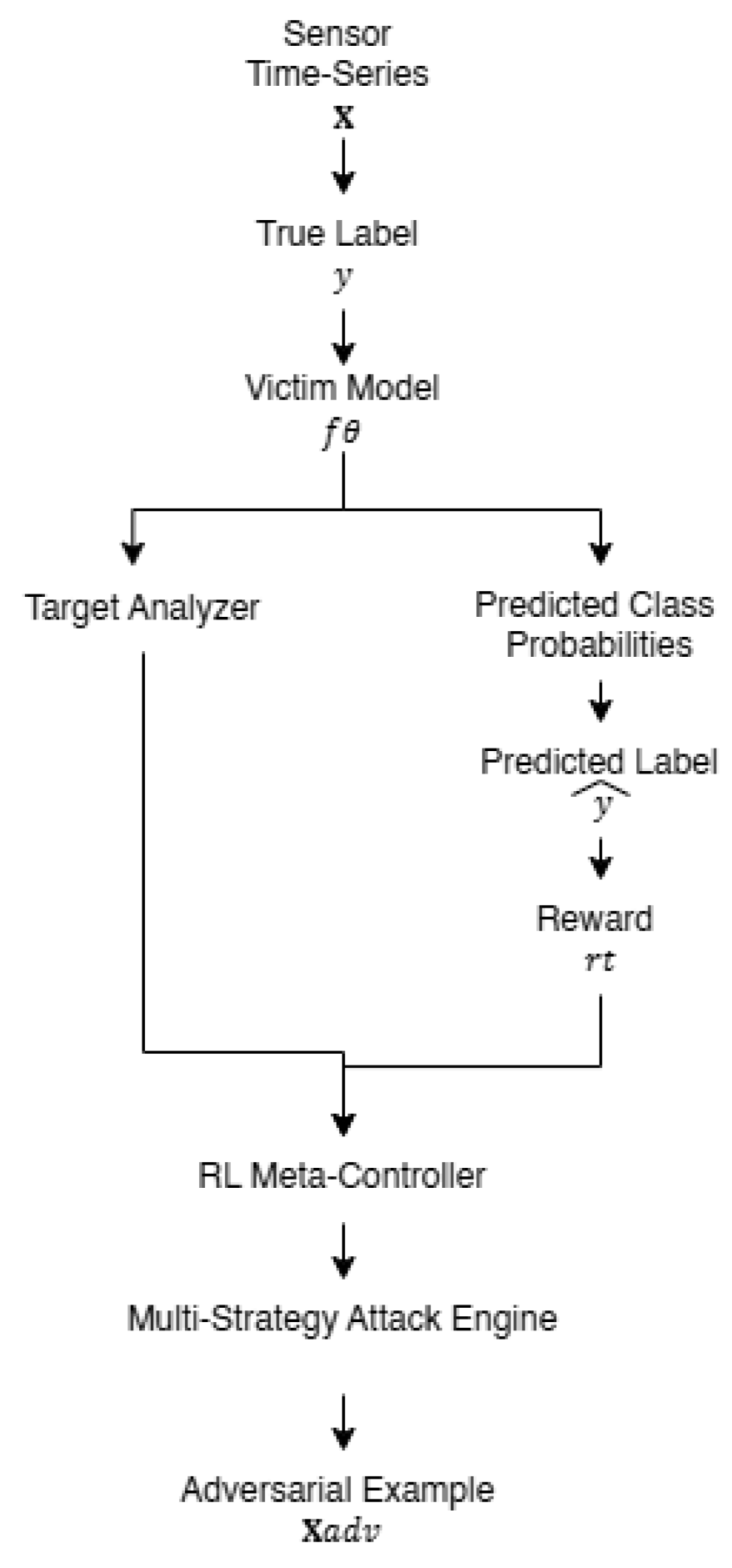
Figure 2.
Architecture of the Time-Distributed LSTM (TD-LSTM) victim model for HAR classification. The model processes input tensor through two time-distributed dense layers with batch normalization, temporal downsampling via max-pooling, LSTM-based sequence modeling, and a two-layer classifier head producing probabilities over 12 activity classes.
Figure 2.
Architecture of the Time-Distributed LSTM (TD-LSTM) victim model for HAR classification. The model processes input tensor through two time-distributed dense layers with batch normalization, temporal downsampling via max-pooling, LSTM-based sequence modeling, and a two-layer classifier head producing probabilities over 12 activity classes.
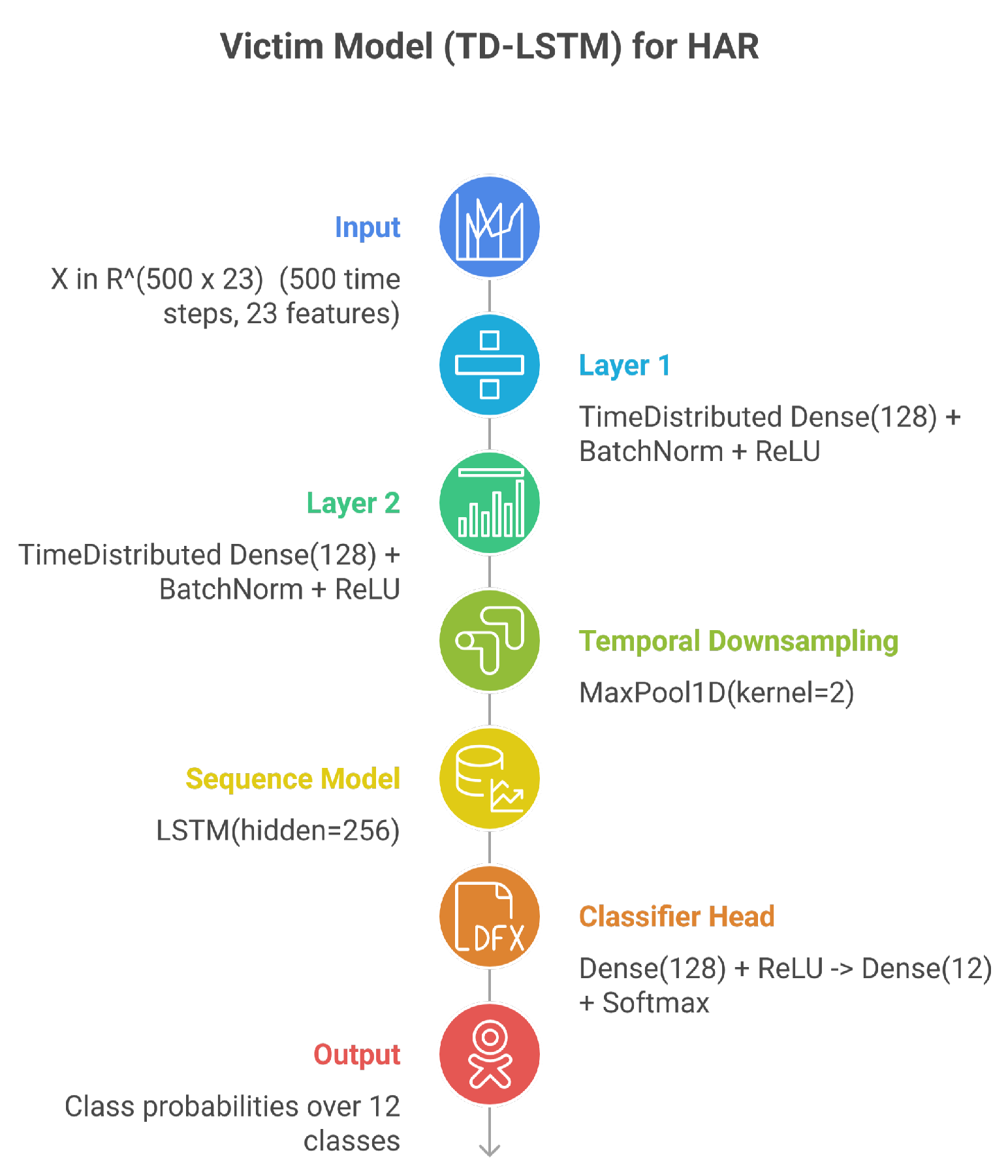
Figure 3.
Overview of STAR-RL hyperparameters and training process. The framework involves parameters across multiple components: data processing (time steps, window stride, feature dimension, number of classes), victim model architecture (TD-LSTM layers, LSTM hidden units, classifier layer, dropout rate), attack configuration (base epsilon, hard class epsilon, base step size, max attack steps), and RL meta-controller (state dimension, hidden dimension, learning rate).
Figure 3.
Overview of STAR-RL hyperparameters and training process. The framework involves parameters across multiple components: data processing (time steps, window stride, feature dimension, number of classes), victim model architecture (TD-LSTM layers, LSTM hidden units, classifier layer, dropout rate), attack configuration (base epsilon, hard class epsilon, base step size, max attack steps), and RL meta-controller (state dimension, hidden dimension, learning rate).
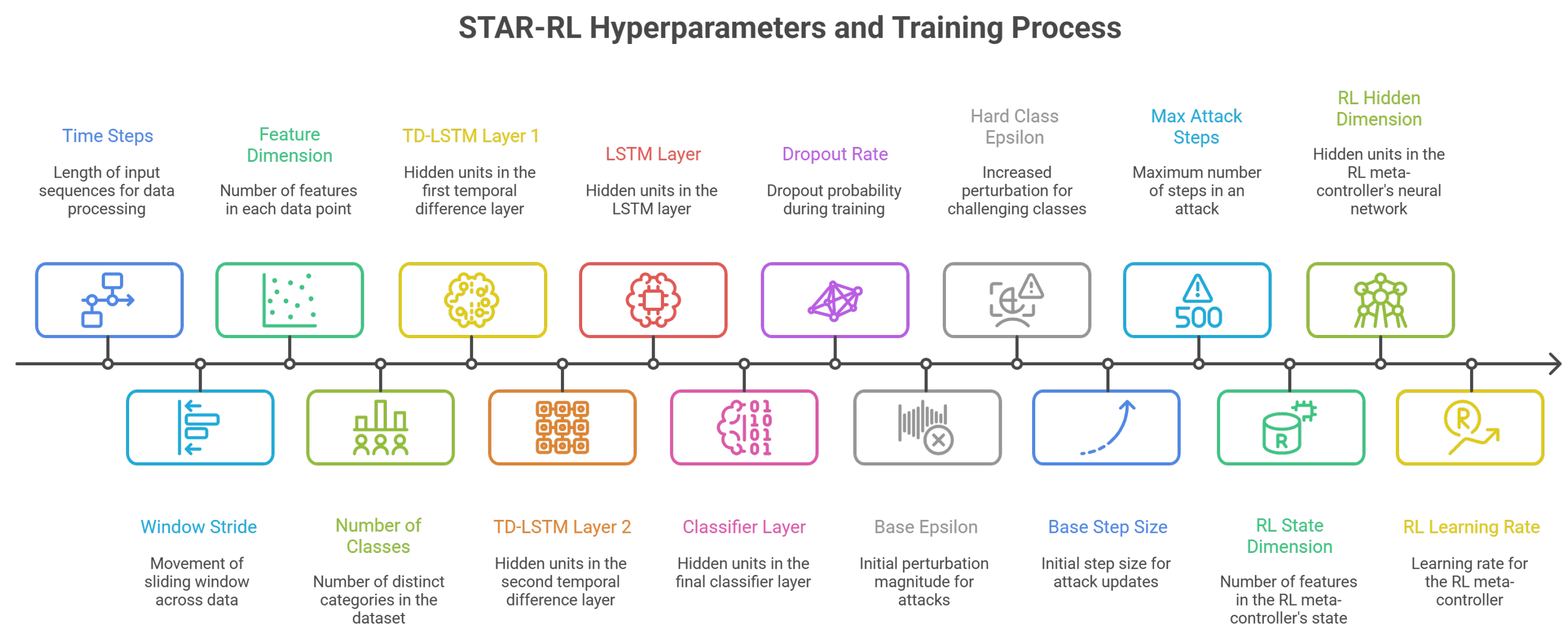
Figure 4.
Comparison of STAR-RL against baseline methods across three key metrics: Attack Success Rate (left), Average Perturbation (center), and Query Efficiency (right). STAR-RL achieves the highest ASR of 95.20% while maintaining competitive query efficiency.
Figure 4.
Comparison of STAR-RL against baseline methods across three key metrics: Attack Success Rate (left), Average Perturbation (center), and Query Efficiency (right). STAR-RL achieves the highest ASR of 95.20% while maintaining competitive query efficiency.
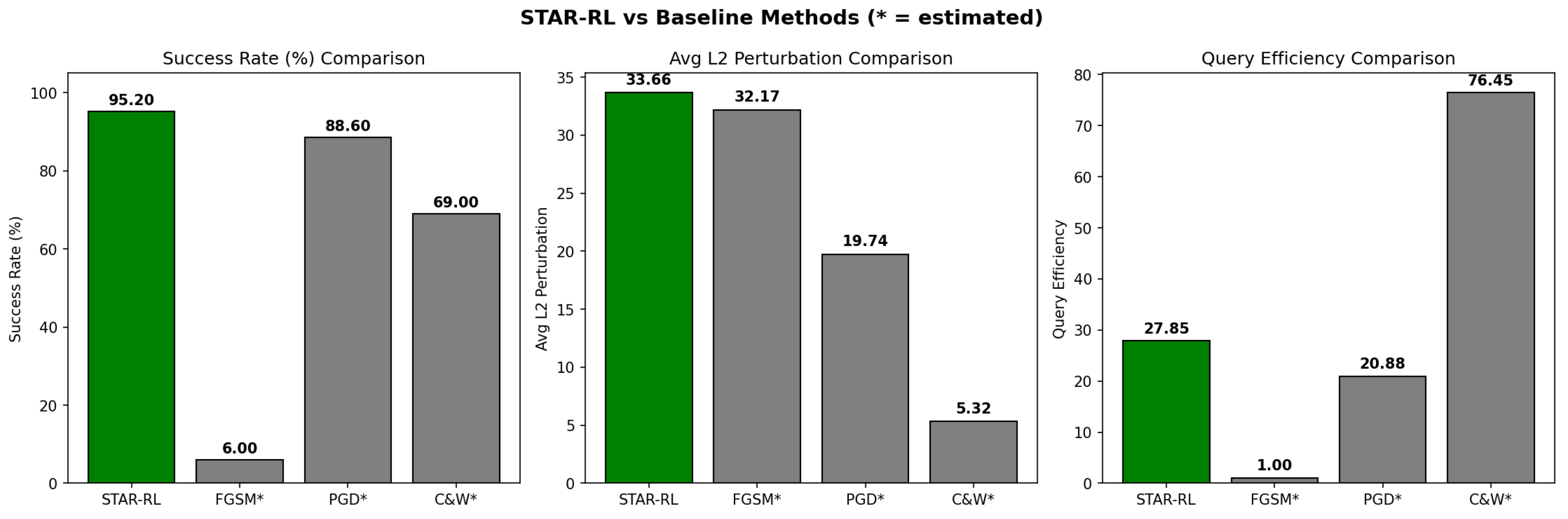
Figure 5.
Detailed analysis of STAR-RL attack performance. Top row: Success rate by source class (left), method selection distribution (center), and success rate by attack method (right). Bottom row: Perturbation magnitude distribution for successful vs. failed attacks (left), confusion matrix for clean predictions (center), and confusion matrix for adversarial predictions (right).
Figure 5.
Detailed analysis of STAR-RL attack performance. Top row: Success rate by source class (left), method selection distribution (center), and success rate by attack method (right). Bottom row: Perturbation magnitude distribution for successful vs. failed attacks (left), confusion matrix for clean predictions (center), and confusion matrix for adversarial predictions (right).
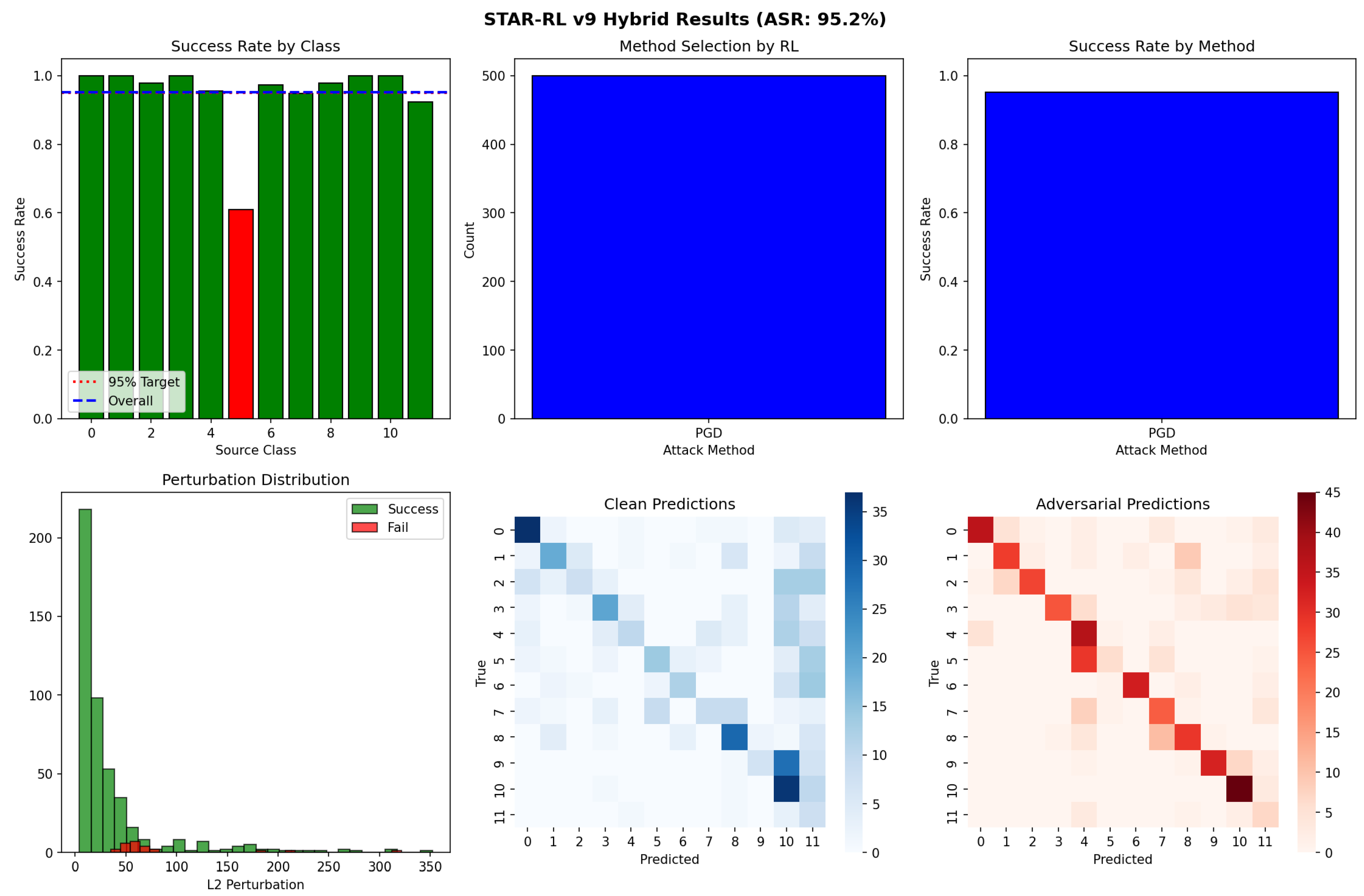
Figure 6.
Stealth analysis of STAR-RL perturbation distribution across sensor groups. Left: Average perturbation magnitude per sensor group, with weak sensors (targeted) shown in red and strong sensors (not targeted) shown in blue. Right: Overall perturbation distribution between weak and strong sensors, achieving a stealth score of 51.35%.
Figure 6.
Stealth analysis of STAR-RL perturbation distribution across sensor groups. Left: Average perturbation magnitude per sensor group, with weak sensors (targeted) shown in red and strong sensors (not targeted) shown in blue. Right: Overall perturbation distribution between weak and strong sensors, achieving a stealth score of 51.35%.
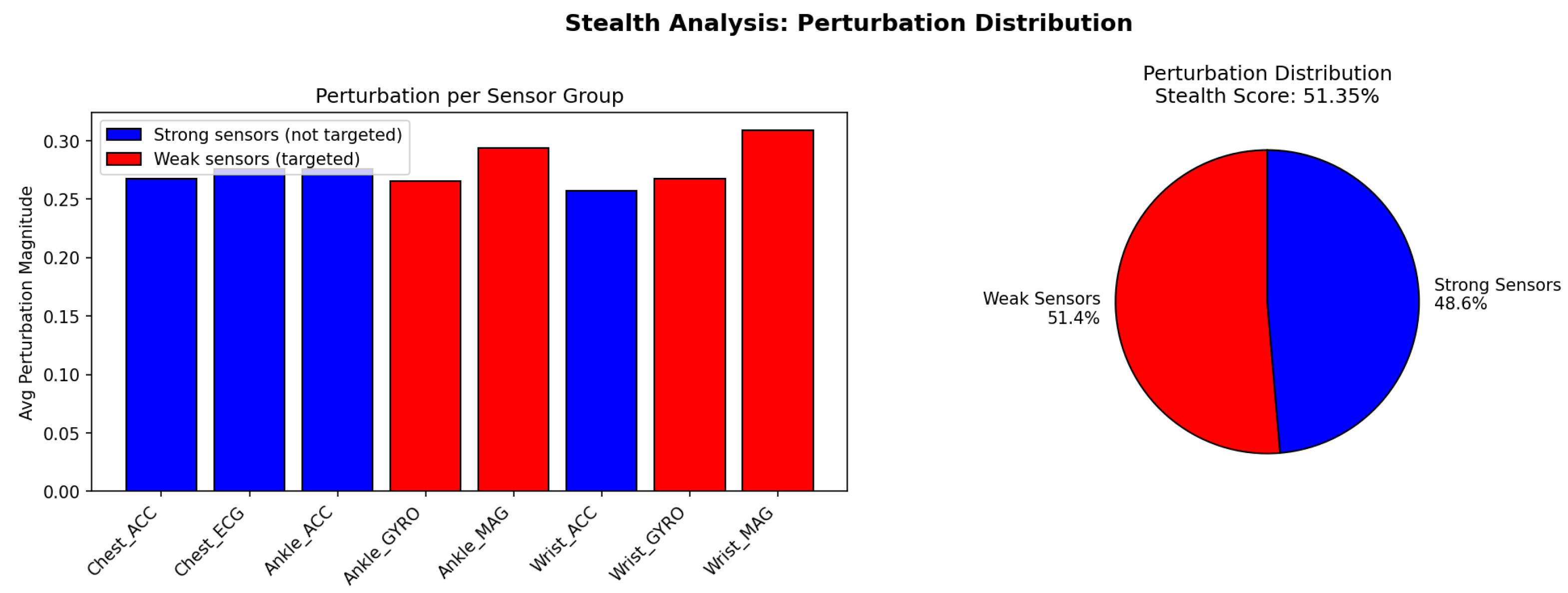

Table 1.
Comparison of adversarial attack methods for time series and HAR systems. TS: Time Series; HAR: Human Activity Recognition; MTS: Multivariate Time Series; WB: White-box; BB: Black-box; RL: Reinforcement Learning.
Table 1.
Comparison of adversarial attack methods for time series and HAR systems. TS: Time Series; HAR: Human Activity Recognition; MTS: Multivariate Time Series; WB: White-box; BB: Black-box; RL: Reinforcement Learning.
| Method | Domain | Input Type | Attack Type | RL-Based | Adaptive | Stealth | Key Limitation |
|---|---|---|---|---|---|---|---|
| FGSM [7] | General | Image/TS | WB | × | × | × | Single-step, no temporal modeling |
| PGD [8] | General | Image/TS | WB | × | × | × | Fixed perturbation budget |
| C&W [9] | General | Image/TS | WB | × | × | ✓ | High computational cost |
| Fawaz et al. [10] | TS | Univariate TS | WB | × | × | × | Single-channel only |
| Karim et al. [10] | TS | MTS | WB | × | × | × | No sensor-aware strategy |
| TSadv [24] | TS | MTS | BB | × | × | ✓ | Local perturbation only |
| TSFool [25] | TS | MTS | WB/BB | × | × | ✓ | No class-specific adaptation |
| Smooth Attack [22] | TS | Univariate TS | WB | × | × | ✓ | Limited to smooth perturbations |
| Kurniawan et al. [16] | HAR | Multi-sensor | WB | × | × | × | No adaptive strategy |
| WiAdv [11] | HAR | WiFi CSI | BB | × | × | ✓ | WiFi-specific only |
| BASAR [14] | HAR | Skeleton | BB | × | ✓ | × | Skeleton data only |
| SMART [15] | HAR | Skeleton | WB | × | × | ✓ | No multi-sensor support |
| IS-WARS [12] | HAR | WiFi CSI | WB/BB | × | ✓ | ✓ | WiFi-specific only |
| AutoAttacker [18] | General | Various | BB | ✓ | ✓ | × | Not designed for HAR |
| RLVS [42] | Video | Video | BB | ✓ | ✓ | ✓ | Video domain only |
| STAR-RL (Ours) | HAR | Multi-sensor | WB/BB | ✓ | ✓ | ✓ | – |
Table 2.
Hyperparameter configuration for STAR-RL framework.
| Component | Parameter | Value |
|---|---|---|
| Data Processing | Time steps (T) | 500 |
| Sliding window stride | 50 | |
| Feature dimension (D) | 23 | |
| Number of classes (K) | 12 | |
| Victim Model | TD Layer 1 hidden units | 128 |
| TD Layer 2 hidden units | 128 | |
| LSTM hidden units | 256 | |
| Classifier hidden units | 128 | |
| Dropout rate | 0.0 | |
| Attack Engine | Base epsilon () | 0.8 |
| Hard class epsilon () | 2.0 | |
| Base step size () | 0.02 | |
| Max attack steps () | 200 | |
| RL Meta-Controller | State dimension | 32 |
| Hidden dimension | 128 | |
| Learning rate | ||
| Discount factor () | 0.99 | |
| PPO clip parameter | 0.2 |
Table 3.
MHEALTH dataset characteristics.
| Characteristic | Value |
|---|---|
| Number of subjects | 10 |
| Number of activity classes | 12 |
| Sampling rate | 50 Hz |
| Total sensor features | 23 |
| Chest sensors | ACC (3) + ECG (2) = 5 features |
| Ankle sensors | ACC (3) + GYRO (3) + MAG (3) = 9 features |
| Wrist sensors | ACC (3) + GYRO (3) + MAG (3) = 9 features |
| Activity classes | Standing, Sitting, Lying down, Walking, |
| Climbing stairs, Waist bending, | |
| Frontal arm elevation, Knees bending, | |
| Cycling, Jogging, Running, Jump front |
Table 4.
Performance comparison of STAR-RL against baseline attack methods on MHEALTH dataset. Best results are highlighted in bold.
Table 4.
Performance comparison of STAR-RL against baseline attack methods on MHEALTH dataset. Best results are highlighted in bold.
| Method | ASR (%) | Avg- | Avg-Steps | Avg-Time (s) |
|---|---|---|---|---|
| FGSM | 6.00 | 32.17 | 1.00 | 0.016 |
| PGD | 88.60 | 19.74 | 20.88 | 0.359 |
| C&W | 69.00 | 5.32 | 76.45 | 2.682 |
| STAR-RL | 95.20 | 33.66 | 27.85 | 0.476 |
Table 5.
Ablation study results on MHEALTH dataset.
| Configuration | ASR (%) | Avg-Steps |
|---|---|---|
| STAR-RL (Full) | 95.20 | 27.85 |
| w/o Multi-Strategy | 88.60 | 20.88 |
| w/o Hard Class Handling | 91.40 | 25.12 |
| w/o Optimal Target Selection | 89.80 | 32.45 |
| w/o Stealth Mechanism | 94.80 | 26.90 |
Disclaimer/Publisher’s Note: The statements, opinions and data contained in all publications are solely those of the individual author(s) and contributor(s) and not of MDPI and/or the editor(s). MDPI and/or the editor(s) disclaim responsibility for any injury to people or property resulting from any ideas, methods, instructions or products referred to in the content. |
© 2026 by the authors. Licensee MDPI, Basel, Switzerland. This article is an open access article distributed under the terms and conditions of the Creative Commons Attribution (CC BY) license (http://creativecommons.org/licenses/by/4.0/).
Copyright: This open access article is published under a Creative Commons CC BY 4.0 license, which permit the free download, distribution, and reuse, provided that the author and preprint are cited in any reuse.


