
Submitted:
06 January 2026
Posted:
08 January 2026
You are already at the latest version
Abstract
Optical precision measurement is fundamental to space technology and physics. For over a century, the “ray-of-light” paradigm and the Equivalence Principle have underpinned both theoretical and applied optics. However, recent theoretical and experimental work demonstrates that these paradigms are fundamentally flawed when applied to photon-level phenomena. This manuscript synthesizes a trilogy of research—spanning theoretical falsification, experimental confirmation, and practical application—to show that photons do not inherit the velocity vector of their source, and that the Equivalence Principle does not hold for photon propagation. We introduce the Real Velocity Measuring Device (RVMD), a novel instrument enabling direct measurement of real velocity vectors in real space. The potential implications for spacecraft navigation and metrology (including our planet) are profound, necessitating a paradigm shift in optical science.
Keywords:
photons
; photon trajectories
; real space
; equivalence principle
; ray-of-light paradigm
; optical precision measurement
; space technology
; RVMD
; paradigm shift
1. Introduction
Optical precision measurement underpins a wide range of contemporary space technologies, including autonomous space craft navigation, ultra-precise attitude and position control and satellite formation flying. In all these applications, light is implicitly assumed to propagate according to the classical ray-of-light paradigm, whereby the collection of the emitted, already travelling and arriving photons in a “ray of light” are modeled as traveling along one straight line in an abstract three-dimensional coordinate space. The ray-of-light paradigm is deeply embedded in modern optical metrology and has historically guided the interpretation of seminal experiments in physics. Even foundational experiments such as the world-famous Michelson–Morley experiment [1], as depicted in Figure 1, relied on this simplified “ray-of-light”-paradigm that, while mathematically convenient, does not represent the true kinematic behavior of photons in real space.
While this “ray-of-light” approximation has certainly proven sufficient for many engineering applications, it becomes fundamentally inadequate when measurement accuracies approach regimes where systematic errors translate into mission-critical deviations. As optical systems evolve toward ever-higher precision, the limitations of these “ray-of-light” assumptions become increasingly consequential, particularly in space environments where high velocities and continuously varying real velocity vectors are unavoidable.
At the core of contemporary physical modeling lies the equivalence principle, which asserts that all physical phenomena, including the propagation of light, are locally indistinguishable under uniform motion or gravitational acceleration. While this principle has been extraordinarily successful for massive particles, its uncritical extension to photons has rarely been subjected to direct experimental scrutiny in the context of optical metrology. As a result, photon propagation is commonly modeled in a virtual mathematical space rather than in the true physical space in which measurements are performed.
This invited contribution presents a coherent synthesis of three interlinked studies [2,3,4] that collectively establish a new framework for optical precision measurement in space technology. The first study [2] provides a rigorous theoretical demonstration that photons propagate in real space with trajectories that are fundamentally incompatible with the classical ray-of-light approximation. It is shown that photons do not inherit any component of the velocity of their source, leading to predictable lateral trajectory deviations when observed from moving reference frames.
The second study [3] complements this theoretical framework with direct experimental verification. Using terrestrial motion as a natural very high velocity source, the predicted real-space trajectory deviations [2] could be experimentally observed and quantified. The measured results are in agreement with the theoretical predictions [2], thereby providing empirical falsification of the applicability of the equivalence principle to photon propagation. This experimental confirmation elevates the discussion from conceptual modeling to measurable physical reality.
Building upon these foundational results, the third study [4] introduces the Real Velocity Measuring Device (RVMD), a novel optical instrument designed to exploit real-space photon trajectory behavior for direct real velocity vector measurement. Rather than treating velocity-induced effects as errors to be mitigated, the RVMD leverages them as measurable quantities. This approach enables a new class of optical metrology instruments capable of correcting systematic errors in high-precision space-based measurements.
The present paper integrates these three contributions [2,3,4] into a unified framework tailored to the objectives of the Special Issue “New Progress in Optical Precision Measurement in the Field of Space Technology.” By explicitly addressing the limitations of classical photon trajectory models and demonstrating their impact on real-world measurements, this work establishes a direct link between fundamental photon behavior and applied space metrology. The implications extend to spacecraft travel, satellite formation flying, orbital velocity vector modulation, and ultra-precision alignment systems, where even small unmodeled effects can accumulate into significant operational deviations.
By positioning photon propagation explicitly in real physical space rather than in abstract coordinate constructs, this work provides a consistent and experimentally validated basis for next-generation optical precision measurement systems, in space but also on our planet (high end theodolites [4]). The results presented here do not merely refine existing models but necessitate a paradigm shift [5,6] in how light-based measurements are interpreted and implemented in advanced space technologies.
2. Materials and Methods
2.1. Theoretical Framework: Photon Trajectories in Real Space
Optical precision measurements are fundamentally dependent on an accurate physical description of photon propagation. In conventional optical metrology, photons are modeled using the ray-of-light paradigm, in which light is assumed to propagate along straight lines in an abstract three-dimensional coordinate space. This model by contemporary science (CS) implicitly presumes that photon trajectories are independent of the motion state of the emitting source and that all relevant kinematic effects can be fully captured within a virtual mathematical framework.
The model advocated by CS is graphically represented by the dynamic figures EMDR023_E_Brauns_Figure32.gif and EMDR006_E_Brauns_Fig09_CS_Obs1_Obs2.mp4, which can be viewed after downloading from the Mendeley Data Repository, respectively [7,8].
While adequate for many macroscopic engineering applications, this paradigm becomes insufficient when high accuracy is required since, under high-velocity conditions, such as those encountered in space technology, that accuracy is significantly influenced by such high-velocity conditions.
The theoretical framework employed in this work departs fundamentally from this approximation by explicitly modeling photon propagation in real physical space, rather than in an abstract coordinate system [2]. The central premise is that a photon, once emitted, propagates independently of the velocity state of its source and does not inherit any component of the source’s translational motion.
This is graphically represented in the dynamic figures EMDR022_E_Brauns_Figure04_B.gif and EMDR007_E_Brauns_Fig09_True_Obs1_Obs2.mp4, which can be viewed after downloading from the Mendeley Data Repository, respectively [9,10].
This assumption is not introduced as a postulate but is derived in [2] rigorously from kinematic consistency arguments applied in real space. The CS model [7,8] is irrefutably falsified in [2].
2.1.1. Real-Space Emission and Propagation Model
Consider a photon emitted from a source moving with a constant velocity v relative to an external inertial frame. In the ray-of-light model, the photon is assumed to propagate along a straight trajectory defined entirely within the coordinate system co-moving with the source. This leads to the implicit assumption that the photon’s trajectories remain collinear with the optical axis of the emitting device, irrespective of the real velocity of the system [7,8]. In that respect, it should be highlighted that Michelson and Morley [1] indeed used for their world famous, so-called null-result, fundamental research experiment a graphical representation, as illustrated in Figure 1, explicitly based on the “ray-of-light” paradigm. CS still considers Figure 1 to be a correct model and also the M&M null-result experimental result to be a paradigm. As proven however in an irrefutable manner in [2], the “ray-of-light” graphical representation as a mathematical model by Michelson and Morley in Figure 1 however does NOT save the real photon trajectory phenomena in real space, in their fundamental research experiment. The model in Figure 1 is simplistic and even flawed in the case of fundamental research, requiring a high accuracy.
In contrast, the real-space model [9,10], employed here, treats emission as a localized physical event occurring at a specific point in space and time. At the moment of emission, the photon acquires a propagation direction determined solely by the emission geometry, while its subsequent motion proceeds independently of the source. As a consequence, when observed from a reference frame in which the source is moving, the photon trajectory exhibits a predictable lateral displacement relative to the optical axis of the emitting system. This lateral displacement is not an aberration or perturbation but a direct geometric consequence of the independence between photon propagation and source motion.
2.1.2. Analytical Derivation of Lateral Trajectory Shift
The theoretical derivation proceeds by considering the relative positions of the emitting source and the propagating photon as functions of time in real space. Let the photon be emitted at time t = 0 from a source moving with velocity v. The photon propagates in real space at speed c along its emission direction, while the source continues its motion in real space.
After a propagation time Δt, the spatial separation between the photon and the optical axis of the source is given by a lateral displacement Δx, which depends on:
- the magnitude of the source velocity v,
- the propagation distance L = c · Δt,
- and the angular orientation α between v and the emission direction.
In the case of α = 90°: Δx = v . Δt = v . L / c
This displacement is proportional to L and the ratio v/c. For orbital velocities, the magnitude of the effect is non-negligible when optical paths extend over several meters or more. At e.g., the earth’s orbital velocities (~30 km/s), the lateral displacement the order of one millimeter can arise over laboratory-scale distance of 10 m, placing Δx squarely within the sensitivity range of modern optical metrology systems.
2.1.3. Implications for the Equivalence Principle
The equivalence principle asserts that physical phenomena observed in a uniformly moving reference frame are indistinguishable from those observed in an inertial frame at rest. Applied to photon propagation, this principle implies that optical experiments performed in uniform motion should yield identical results to those performed at rest. The real-space photon trajectory model directly contradicts this implication. Because the lateral displacement depends explicitly on the real velocity of the emitting system in real space, optical measurements become sensitive to uniform motion. This sensitivity is not an artifact of measurement error but a direct physical consequence of photon kinematics.
Figure 2 (as a copy of Figure 12, explained in detail in the theoretical study [2]) provides a decisive illustration of this result. It shows that the predicted lateral shift MF = Δx depends explicitly on the real velocity vector of the system, moving in real space. For α = 90°, L = 10 m, v = 30000 m/s and c = 300000000 m/s obviously one calculates MF = Δx = 0.001 m, thus MF = 1 mm! The existence of this dependency constitutes a theoretical falsification of the equivalence principle for photons. Unlike massive particles, photons do not conform to the equivalence principle when their trajectories are modeled in real space.
2.1.4. Relevance for Optical Precision Measurement
From a metrological perspective, the significance of this theoretical framework lies in its direct applicability to real measurement systems. Optical instruments implicitly assume collinearity between emitted, travelling and received photons. CS therefore has even still not yet realized, after more than a century, that the ray-of-light paradigm then in fact implies the (thus for/by CS hidden/unnoticed/overlooked) assumption that photons would need to travel at an infinitely high velocity to achieve such collinearity in a system, moving in real space. When this collinearity assumption fails, systematic errors are introduced that cannot be eliminated through averaging or calibration within the ray-of-light paradigm.
By explicitly accounting for real-space photon trajectories, the present framework establishes the physical basis for correcting such errors. It also enables the intentional exploitation of trajectory deviations as measurable quantities, forming the foundation for novel optical instruments such as the Real Velocity Measuring Device introduced later in this work.
2.2. Experimental Methodology: Verification of Real-Space Photon Trajectories
The experimental methodology [3] was designed to directly test the theoretical predictions [2] of real-space photon trajectory behavior derived in Section 2.1. In particular, the experiments aim to detect the predicted lateral displacement of photon trajectories resulting from the real velocity of the measurement system in real space. The guiding principle of the experimental design is to measure purely geometric effects observable within a laboratory environment.
A central advantage of the adopted methodology is that it exploits naturally occurring velocities rather than requiring artificially generated high-speed motion. Specifically, the very high translational velocity of the Earth through space is used as an inherent and stable velocity vector, providing a well-defined experimental parameter without the need for mechanically induced motion of the optical apparatus.
2.2.1. Experimental Principle
According to the real-space propagation model, a photon emitted along a nominal optical axis from a moving system will exhibit a lateral displacement relative to that axis after propagating over a finite distance. This displacement depends on the magnitude and the direction of the system’s real velocity vector (thus the angle between the direction of the real velocity vector and the direction of emission of the photons) and varies predictably with time due to the 24 hours Earth’s rotational time interval and the Earth’s orbital motion.
The experimental strategy consists of measuring the position of a laser (photon source) “beam dot on a measuring grid/sensor” after propagation over a fixed optical path length and detecting time-dependent lateral shifts correlated with the known orientation of the Earth’s orbit velocity vector in real space. Crucially, the experiment is configured such that all classical sources of beam displacement, such as thermal drift, mechanical instability, optical misalignment and atmospheric effects, are controlled to be negligibly small.
2.2.2. Optical Setup
The experimental setup comprises a low divergence laser, a well-defined free-space propagation path, and a position-sensitive detection system. The light source is rigidly mounted to the experimental platform to ensure that any observed displacement cannot be attributed to relative motion between source and detector. Laser and detector set-up are “at rest” relative to one another.
The propagation distance is chosen to be sufficiently long (on the order of 10 m or greater) to amplify the predicted lateral displacement into a measurable quantity, while remaining compatible with laboratory-scale constraints. The optical axis is carefully defined and stabilized to serve as a reference against which lateral deviations are measured. Laser dot position detection at the detector is performed using a sensor configuration capable of resolving a 1 mm displacement.
2.2.3. Reference Frame Considerations
A key methodological aspect is the explicit treatment of reference frames. Measurements are not interpreted within a co-moving frame in which the apparatus is assumed to be at rest, but rather are analyzed with respect to real physical space. The orientation of the experimental setup relative to the Earth’s orbit velocity vector is therefore a critical parameter.
The Earth’s rotation causes the direction of the laboratory velocity vector to change continuously over a 24-hour period. As a result, the predicted lateral displacement exhibits a periodic variation, tracing characteristic curves over time. This temporal modulation provides a powerful discriminant between genuine real-space effects and static or stochastic experimental noise.
2.2.4. Measurement Protocol
A measurement involves a 24 hours’ time interval, thus a full rotation of the Earth, to capture the full temporal evolution of the predicted displacement. Data acquisition is synchronized with time stamps to allow correlation with the known orientation of the Earth’s velocity vector. To ensure reproducibility, a series of 24 hours measurements are performed, thus on different days.
2.2.5. Experimental Observables
The primary observable is the lateral displacement of the photon beam centroid as a function of time. Secondary observables include the amplitude and phase of the displacement relative to the Earth’s rotational cycle. These quantities provide direct experimental access to the magnitude and orientation of the system’s velocity vector in real space.
The experimental methodology thus transforms the theoretical predictions into directly measurable quantities. By doing so, it enables an unambiguous test of the applicability of the equivalence principle to photon propagation and establishes a solid experimental foundation for the results presented in the following section.
2.3. RVMD Concept and Optical Configuration
The Real Velocity Measuring Device (RVMD) is an optical measurement instrument specifically designed to detect and quantify the real-space velocity vector of a measurement system by exploiting the experimentally verified asymmetry of photon trajectory propagation in real physical space. The RVMD is grounded entirely in geometric photon trajectory behavior as established in Section 2.1 and Section 2.2. The fundamental operating principle of the RVMD is that photons emitted within a moving system propagate independently of the translational velocity of that system. As a result, lateral trajectory deviations arise when photon propagation is analyzed with respect to the system’s geometric configuration. The RVMD converts these trajectory deviations into a measurable differential signal.
2.3.1. Measurement Principle
The RVMD operates by generating photon paths with well-defined geometric symmetry relative to the optical axis of the device, as illustrated very schematically in Figure 3 . In the absence of translational motion, these paths produce identical optical signals at the detection plane. When the system undergoes uniform translational motion in real space, symmetry is broken due to velocity-dependent photon trajectory deviations.
This symmetry breaking manifests as a differential lateral displacement between the photon paths. The magnitude and orientation of this displacement depend explicitly on the real velocity vector of the system in real space. By measuring this differential displacement, the RVMD directly accesses both the magnitude and direction of the real velocity vector projected onto the measurement plane. Basic schematics of a RVMD design concept for the RVMDy set-up, thus linked to the photon’s vertical y-direction emission and a velocity vx in the horizontal x-direction, is illustrated in Figure 4.
Different types of basic RVMD designs are discussed in some more detail within the downloadable patent document EMDR014_E_Brauns_RVMD_USPTO_Patent_20070222971.pdf [11] and in [13]. It should be noted that [2,3,4] originated respectively from chapters 9, 10 and 11 in [13].
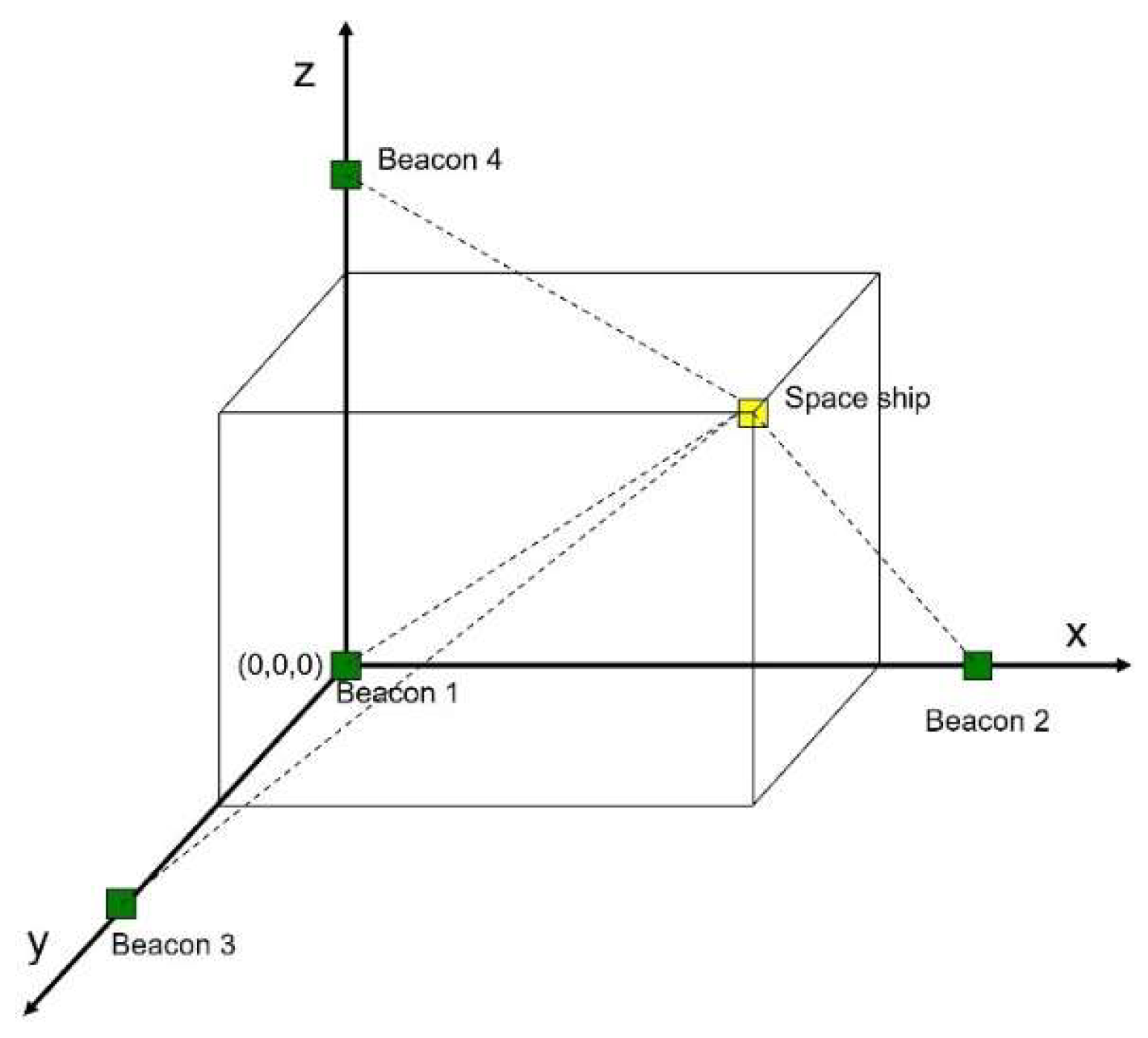
Evidently, a perpendicular configuration of a RVMDx’, RVMDy’ and RVMDz’ constructs, as illustrated schematically in Figure 5, will result in a 3D RVMD that enables to measure the full real velocity vector of an object, travelling in real space. See also section 3.6.3 with respect to the theoretical concept of a 3 to 4 satellite beacon configuration (each beacon has a built-in 3D RVMD), allowing for the measurement of also the 3D location of an object, travelling in real space, given the continuous reception of the signals from all beacons by the object.
The realization of a fully 3D RVMD will evidently require a substantial multinational, worldwide research and development effort. Such a project would necessarily involve close cooperation among researchers from multiple scientific and engineering domains. Expertise in laser physics, optics, precision instrument design, electronic hardware, software development, signal processing, experimental setup testing and optimization, applied mathematics, and related fields would be essential throughout both the development phase and the subsequent construction of a 3D RVMD prototype.
When viewed in comparison with the resulting highly sophisticated prototype, the experimental setup of the laser experiment described in [3] may appear “very basic.” However, this characterization would be misleading. That experiment relied on state-of-the-art laser technology, high-performance electronic instrumentation, an advanced digital imaging system, and sophisticated software for signal and digital image processing. The successful execution of this experiment therefore already required a considerable level of technical expertise and technological infrastructure.
Most importantly, this experimental effort led to the direct experimental confirmation of the rigorous theoretical findings presented in [2]. From a strictly scientific standpoint, the theoretical results in [2] are already sufficient as a proof of principle. Nevertheless, the accompanying experimental validation provided by the laser experiment in [3] constitutes a robust and fully adequate experimental verification of the theoretical predictions. In this context, the objective of developing and constructing a 3D RVMD prototype by a dedicated high-technology R&D team must be regarded as highly feasible. The successful realization of such a device represents a natural and realistic extension of the experimentally validated concepts already demonstrated.
Regarding the specifications of an RVMD prototype, the device fundamentally requires a dedicated photon source, a well-defined optical configuration (including mirrors or equivalent beam-directing elements), and a high-resolution photon detection system. Each of these components must be optimized to ensure that the expected velocity-induced photon trajectory shifts can be resolved with sufficient accuracy and stability.
One promising concept for the photon source in an RVMD could be based on Vertical Cavity Surface Emitting Laser (VCSEL) technology. VCSELs are particularly attractive due to their compactness, low power consumption, and wafer-level integrability. A VCSEL emits a quasi-cylindrical photon beam with inherently low divergence, which is advantageous for maintaining beam coherence over the propagation distances relevant to RVMD operation.
If required, the beam divergence of a VCSEL source can be further tailored through the integration of micro-optical elements directly at the source level. Micro-lens systems or integrated optical structures could be employed to finely adjust the beam profile, ensuring optimal sensitivity to the expected lateral photon displacement resulting from the real velocity of the RVMD system. Such optical tuning allows the photon beam geometry to be matched to the anticipated magnitude of the displacement signal.
On the detection side, a high-resolution photon sensor is essential. Charge-Coupled Device (CCD)-based sensors are well suited for this purpose, as they are mature, robust microelectronic devices offering pixel sizes down to approximately 1 µm. This resolution enables the precise detection of small lateral shifts in photon impact position.
An additional advantage of a VCSEL-based architecture is the potential for monolithic or hybrid integration of the photon source and the CCD-based sensor on a common substrate (in the case of the concept of Figure 4) or within a compact optical module. Such integration would improve mechanical stability, reduce alignment tolerances, and enhance long-term measurement reproducibility.
From a quantitative standpoint, lateral photon shifts of the order of 1000 µm for a propagation distance of 10m are well within the measurable range of modern CCD sensors. This indicates that, even with conservative optical designs, the detection of RVMD-induced photon trajectory shifts is technically feasible using existing high-precision optoelectronic components.
2.3.2. Optical Configuration
As illustrated very schematically in Figure 3 and Figure 4 the optical configuration of the RVMD should consist of a photon source and a detection system capable of resolving lateral displacements with high spatial resolution. The optical paths of the photons are arranged such that their nominal propagation directions are mirror-symmetric with respect to a central reference axis. The detection system is positioned at a fixed propagation distance and is aligned orthogonally to the nominal photon propagation direction. Position-sensitive detectors or equivalent imaging sensors are employed to resolve the relative displacement of the photon path centroids.
2.3.3. Sensitivity and Scaling Behavior
The sensitivity of the RVMD scales linearly with the optical path length and with the ratio of the system’s real velocity magnitude to the speed of light. As a result, the measurement sensitivity can be tailored through optical design choices without altering the fundamental operating principle. Translational motion allows the measurement, making the device uniquely suited for space-based applications where sustained high velocities are intrinsic.
2.3.4. Reference Frame Independence
A defining characteristic of the RVMD is its independence from co-moving reference frame assumptions. Measurements are interpreted directly in real physical space rather than within abstract coordinate systems tied to the instrument. This approach eliminates ambiguities associated with frame transformations and ensures that the measured signal corresponds to a physically meaningful real velocity vector.
The RVMD therefore functions as a direct real-space velocity sensor. Its output can be used either as a standalone velocity measurement or as an input for correcting velocity-induced systematic errors in photon-based measurements (e.g., high end theodolites [4]).
2.3.5. Suitability for Space Applications
The RVMD is inherently compatible with space technology requirements. Its operation does not depend on gravitational fields, external references, or environmental coupling. The absence of moving mechanical parts and the reliance on purely optical geometry make the device robust. When integrated into spacecraft optical metrology systems, the RVMD provides continuous access to the system’s real-space velocity vector. This capability enables dynamic correction of optical measurements affected by real-space photon trajectory deviations and supports ultra-precise alignment and ranging in formation-flying and other advanced space missions.
3. Results
3.1. Experimental Observation of Real-Space Photon Trajectory Deviations
The experimental measurements [3] reveal clear and reproducible lateral displacements of photon trajectories that are fully consistent with the theoretical predictions in [2], derived from the real-space propagation model. These displacements are observed as systematic shifts of the beam centroid relative to the nominal optical axis and cannot be accounted for within the classical ray-of-light paradigm.
For a fixed optical path length on the order of 10 m, lateral displacements with amplitudes in the millimeter range are consistently measured. Examples and dynamic images of such experimental observations are discussed in [3] and can also be downloaded from the Mendeley Data Repository [12] (EMDR010 and EMDR011).
3.2. Temporal Modulation of the Displacement Signal
A defining characteristic of the measured displacement is its real velocity vector direction dependence. Multiple series of measurements over 24 hours each and on different days reveal a reproducible periodic modulation of the lateral displacement, corresponding to the Earth’s 24 hours rotation. The displacement traces smooth, closed curves over time, reflecting the continuous change in orientation of the laboratory (Earth) velocity vector in real space, thus reflecting the effect of the, over 24 hours, modulating value of the angle α between the laboratory velocity vector direction and the photons travelling direction, both in real space.
The observed temporal patterns exhibit a well-defined phase and amplitude that remain stable over multiple measurement cycles. Importantly, these patterns are not static offsets but dynamic signatures that repeat with high fidelity, indicating that the effect is governed by an external, deterministic parameter rather than by random drift or noise.
3.3. Comparison with Theoretical Predictions
The experimentally measured displacement amplitudes and temporal signatures are quantitatively compared with the theoretical predictions obtained from the real-space photon trajectory model. Within experimental uncertainty, the agreement between theory and experiment is exact. Both the magnitude of the lateral displacement and its dependence on the orientation of the velocity vector match the predicted values. This agreement is not limited to a single measurement. Such consistency provides irrefutable evidence that the observed phenomenon is a genuine physical effect.
3.4. Central Experimental Result: Falsification of the Equivalence Principle
The experimental results provide direct empirical falsification of the applicability of the equivalence principle to photon propagation. According to the equivalence principle, optical experiments conducted in a uniformly moving system should yield identical results to those conducted at rest. However, the measured lateral displacement depends explicitly on the real velocity of the experimental system in real space. This dependency is summarized in Figure 2, which constitutes the central result of the present study. The existence of this velocity-dependent displacement directly contradicts the equivalence principle for photons. Unlike massive particles, photons exhibit propagation behavior that is sensitive to uniform translational motion when analyzed in real physical space.
3.5. Implications for Optical Measurement Accuracy
From a measurement perspective, the magnitude of the observed displacement is highly significant. Even at laboratory scales, millimeter-level deviations are detected. When extrapolated to space-based optical systems operating over longer baselines and at higher velocities, these effects can easily exceed acceptable error margins.
The experimental results thus demonstrate that classical photon trajectory models are insufficient for high-precision optical metrology in space technology. Correct modeling of real-space photon propagation is essential to avoid systematic errors and to enable the next generation of ultra-precise optical measurement systems. The basic mathematical modelling approach is discussed in some detail in [4] but must be elaborated by specialist mathematicians.
3.6. Applications
3.6.1. Planets, Moons and Cosmology: Determination of Full Three-Dimensional Real Velocity Vectors
A three-dimensional RVMD deployed on the surface of a planet or moon would enable direct measurement of the full real velocity vector of the celestial body in real space. Provided that environmental constraints such as temperature and radiation are compatible with optical instrumentation, such measurements would yield additional, independent kinematic information relevant to planetary science and cosmological research. Regarding the latter: it is likely that even detecting gravitational waves in space could be possible, provided the MF effect could be harnessed in a suitable way, e.g., in a steady formation of one or more pairs of satellites, at a suitable large distance from one satellite to the other satellite, in a pair. This should be evaluated by specialists.
3.6.2. Hazardous Asteroids and Planetary Defense
In principle, the deployment of a compact RVMD on the surface of a potentially hazardous asteroid would allow direct determination of both the magnitude and direction of its real velocity vector. Such information is of high relevance for planetary defense strategies, where precise trajectory prediction is essential. Missions such as NASA’s Double Asteroid Redirection Test (DART) illustrate the growing importance of accurate asteroid characterization. RVMD-based velocity measurements could complement existing tracking methods and improve impact-risk assessment.
3.6.3. Real-Space Location Determination and Autonomous Navigation
Consider a steady formation of three or more beacon satellites, at strategic (x,y,z) locations in real space and at sufficiently large inter-distances, as schematically depicted in Figure 6. When equipped with synchronized atomic clocks and RVMD systems such configuration could serve as a real-space positioning infrastructure. By broadcasting time-stamped signals, such a formation would allow spacecraft to determine their position and velocity vector directly in real space.
When combined with onboard RVMD measurements, a spacecraft could autonomously derive its full kinematic state. Artificial intelligence could be employed to fuse RVMD data with timing information, enabling adaptive navigation in space.
3.6.4. High-End Theodolites and Terrestrial Precision Surveying
A particularly direct terrestrial application of RVMD technology lies in high-end digital theodolites used for precision surveying [4,13]. These instruments rely fundamentally on photon-based angle measurements derived from scattered sunlight or artificial illumination. However, classical theodolite models implicitly assume that both the instrument and the surveyed object are at rest in space and that the ray-of-light paradigm applies.
As demonstrated by the experimentally verified lateral MF effect, Earth’s orbit velocity of approximately 30 km/s can introduce systematic lateral photon displacements on the order of 1 mm over a 10 m path length. This corresponds to an angular error of approximately 21 arcseconds, exceeding by more than an order of magnitude the specified accuracy of state-of-the-art 1 arcsecond theodolites.
Incorporating real velocity vector information—potentially provided by a centralized 3D RVMD reference laboratory—would allow such systematic errors to be corrected algorithmically. Artificial intelligence techniques could further assist by dynamically adapting correction models based on location, time, and measurement geometry, thereby substantially improving surveying accuracy.
3.6.5. Ultra-Precision Sports Measurements
In Olympic-level 10 m air rifle competitions, scoring sensitivity reaches the level of tenths of a millimeter. Given that photon travel time implies observation of a target’s past position rather than its instantaneous real-space location, lateral MF effects of approximately up to 1 mm over 10 m become non-negligible when the Earth’s velocity vector direction is not coinciding with the shooting direction.
Understanding and modeling these effects is therefore relevant for ultra-high-precision sports measurements, where systematic biases can influence competition outcomes. Although not addressed further here, this application highlights the broader relevance of real-space photon trajectory effects beyond traditional scientific instrumentation. This will be the subject of another specific publication, as planned by the author.
It should be noted that, in general, any observation of an object “at rest” on the surface of our planet, by an observer “at rest” and at a distance from the object, involves receiving the object’s visual information from the past t=t1, as a result of the finite travelling time of the photons as information carriers. This results in observing at t=t2 a past “ghost” image of the object, corresponding to the past location t=t1 of the object in real space. The observer thus is not observing the actual location of the object in real space (cfr Figures 2,9,10). During (Olympic) competition shooting the shooter thus in fact aims at the “ghost” image (thus the past “location” of the object in real space), resulting in a significant aiming error linked to the MF-effect, or alternatively the SL-effect in this case, in Figure 2.
4. Discussion
4.1. Consequences for Optical Precision Measurement
The experimental results presented in this work demonstrate that photon propagation in real space exhibits systematic deviations from the classical ray-of-light paradigm. These deviations are not random perturbations but deterministic effects directly linked to the real velocity of the measurement system. As such, they introduce a fundamentally new class of systematic errors into optical precision measurements.
Conventional optical metrology implicitly assumes that photon trajectories are invariant under uniform motion. Calibration procedures, error budgets, and uncertainty analyses are therefore constructed on the premise that any residual deviations can be treated as noise or eliminated through averaging. The present results invalidate this assumption for high-precision regimes. When photon propagation is sensitive to uniform translational motion, systematic errors arise that cannot be mitigated by classical calibration strategies.
This has immediate implications for any optical measurement system in which accuracy is required under high-velocity conditions, thus also on the surface of our planet. In such regimes, neglecting real-space photon trajectory effects leads not merely to reduced accuracy but to fundamentally incorrect measurement outcomes.
4.2. Implications for Space Technology Applications
Space-based optical systems operate in environments where high velocities and continuously varying velocity vectors directions are intrinsic. Spacecraft in low Earth orbit, for example, travel at velocities on the order of 7–8 km/s relative to the Earth, while the Earth’s orbit velocity itself corresponds to 30 km/s. Moreover, the direction of this velocity vector rotates continuously over each orbital cycle and/or 24 hours rotation of the Earth.
In formation-flying missions, multiple spacecraft must maintain precise relative positioning and alignment over distances ranging from tens to hundreds of meters. Optical ranging and alignment systems are commonly employed for this purpose, relying on light phenomena based measurements to determine relative positions and orientations. The results presented here show that measurements, based on photons, are inherently sensitive to the orientation of the velocity vector in real space.
As an illustrative example, consider two spacecraft separated by 150 m and moving at an orbital velocity of approximately 30 km/s. For such a configuration, real-space photon trajectory deviations can introduce relative position errors on the order of centimeters, depending on the angle between the photon propagation direction and the velocity vector. As the spacecraft complete an orbital cycle, this angle changes continuously, leading to periodic modulation of the measurement error.
These effects are not hypothetical; they arise directly from the experimentally verified behavior of photons in real space. Consequently, any high-precision, photons based, optical system used for spacecraft lateral formation control must either account for these effects explicitly or risk systematic alignment errors.
4.3. Orbital Velocity Vector Modulation
A particularly significant aspect of the real-space photon propagation model is its sensitivity to orbital motion. In an orbital environment, the velocity vector of a spacecraft traces a closed trajectory in real space over each orbit. This continuous modulation of the velocity vector orientation leads to correspondingly modulated photon trajectory deviations.
From a measurement standpoint, this modulation manifests as periodic biases in optical measurements that are synchronized with the orbital period. Such biases cannot be eliminated by static calibration or by assuming isotropic measurement uncertainty. Instead, they require dynamic correction based on real-time knowledge of the velocity vector.
The experimental confirmation of this modulation underscores the necessity of incorporating real-space kinematics into the design and interpretation of space-based optical metrology systems. Failure to do so risks misattributing systematic effects to instrument drift or environmental disturbances, thereby obscuring their true physical origin.
4.4. RVMD as an Instrumental Response to Real-Space Effects
Building on the optical configuration and measurement principle described in Section 2.3, the RVMD exploits real-space photon trajectory asymmetries as a direct and quantifiable measurement signal. Rather than treating real-space photon trajectory deviations as undesirable errors, the RVMD introduced in this work exploits these effects as measurable quantities. The RVMD is conceptually grounded in the asymmetry of photon propagation in real space and is designed to directly measure the real velocity vector of the measurement system.
By intentionally configuring optical paths to be sensitive to lateral trajectory shifts, the RVMD converts real-space photon behavior into a robust measurement signal. This approach represents a conceptual shift in optical metrology: velocity-dependent effects are no longer suppressed but harnessed to enhance measurement capability.
In the context of space technology, the RVMD provides a powerful tool for real-time velocity vector determination. When integrated into optical measurement systems, it enables dynamic correction of photon-based measurements, thereby eliminating systematic errors associated with real-space propagation effects.
4.5. Integration with Spacecraft Metrology Systems
The integration of RVMD functionality into spacecraft metrology systems offers several advantages. First, it provides direct access to the real velocity vector in real space, independent of inertial navigation systems or external references. Second, it enables continuous monitoring of velocity-induced measurement biases, allowing for real-time correction. The experimentally validated RVMD signal characteristics presented in Section 3 further demonstrate the feasibility of this integration under realistic operational conditions.
Such integration is particularly valuable for missions requiring long-duration formation stability, autonomous navigation, or ultra-precise alignment. By combining conventional optical metrology with RVMD-based velocity measurement, spacecraft systems can achieve levels of accuracy that are unattainable within the ray-of-light paradigm.
4.6. Broader Implications and Paradigm Shift
The findings presented in this work necessitate a reassessment of foundational assumptions in optical precision measurement. Modeling photon propagation exclusively within abstract coordinate spaces is insufficient when measurement accuracies approach the limits imposed by real-space kinematics.
The demonstrated falsification of the equivalence principle for photons does not undermine its broader applicability to massive particles but highlights the necessity of treating photon propagation as a distinct physical process. Recognizing this distinction is essential for advancing optical metrology in space technology.
Ultimately, the integration of real-space photon trajectory modeling and RVMD-based instrumentation represents a paradigm shift in how optical measurements are conceived, interpreted, and implemented. This shift is not merely theoretical but is driven by experimentally verified effects with direct and unavoidable consequences for next-generation space systems.
4.7. Patent
A USPTO patent application was filed by the author, as described in [11] (downloadable pdf file).
4.8. Mendeley Data Repository
An important part of the background information, linked to the research in [2,3,4,13], was archived in a Mendeley Data Repository for open access in the form of files of dynamic and static figures, as well as pdf files, with a total of 252 files [12].
The Data Set is labelled as “Book_RVMD_Flawed_CS_Paradigms_E_Brauns” and can be accessed through [12]. Each of the 252 files has a unique filename code “EMDRxyz_E_Brauns_filename” (001 ≤ xyz ≤ 252).
5. Conclusions
This invited contribution presents a comprehensive and experimentally validated revision of photon trajectory modeling and its implications for optical precision measurement in space technology. By synthesizing rigorous theoretical analysis, direct experimental verification, and an urgent call for applied instrument development, this work establishes a new and consistent framework for understanding photon propagation in real physical space.
It has been shown that the classical ray-of-light paradigm, while adequate for many conventional applications, fails to accurately describe photon behavior for measurement accuracies under high-velocity conditions. The theoretical framework [2] demonstrates that photons propagate independently of the velocity state of their source, leading to predictable lateral trajectory deviations when observed from a moving system.
The experimental results [3] provide unambiguous confirmation of these predictions. Systematic, reproducible lateral displacements of photon trajectories are directly observed and shown to depend explicitly on the real velocity vector of the measurement system. This dependence constitutes an empirical falsification of the applicability of the equivalence principle to photon propagation. Unlike massive particles, photons do not conform to equivalence-based invariance when their trajectories are modeled in real physical space. From a metrological perspective, these findings have immediate and far-reaching consequences.
Building on the theoretical and experimental foundations, this work introduces the Real Velocity Measuring Device (RVMD) [4] as a novel optical instrument that exploits real-space photon trajectory behavior rather than attempting to suppress it. By directly measuring velocity-dependent trajectory asymmetries, the RVMD enables real-time determination of real velocity vectors and provides a practical means to correct photon-based measurements in high-precision environments.
The integration of real-space photon propagation modeling and RVMD-based instrumentation represents a paradigm shift in optical precision measurement. This shift is not merely conceptual but is driven by experimentally verified physical effects that are unavoidable in advanced space systems. As optical metrology continues to push toward higher accuracy and autonomy, especially in space-based applications, the framework presented here offers a robust and physically consistent foundation for next-generation measurement technologies.
In conclusion, accurate optical precision measurement in space technology requires abandoning purely abstract trajectory models in favor of real-space photon kinematics. The results presented in this paper establish both the necessity and the feasibility of this transition and provide a clear pathway toward improved measurement accuracy through theory-driven instrumentation.
Author Contributions
The author conceived, developed, and validated the study.
Funding
This research received no external funding.
Institutional Review Board Statement
Not applicable.
Informed Consent Statement
Not applicable.
Data Availability Statement
Data and figures supporting this study are available via the Mendeley Data Repository.
Acknowledgments
The author thanks MDPI Photonics for the invitation to contribute to this Special Issue.
Conflicts of Interest
The author declares no conflict of interest.
GenAI Disclosure Statement
AI-assisted tools were used for language editing and structural organization under the full control of the author.
References
- Michelson, A.; Morley, E. On the relative motion of the Earth and the luminiferous ether. Am. J. Sci. 1887, 203, 333–345. Available online: https://history.aip.org/exhibits/gap/PDF/michelson.pdf. [CrossRef]
- Brauns, E. On two thought experiments revealing two massive theoretical anomalies, proving both the contemporary “ray of light” paradigm to be flawed and the impossibility of a photon to inherit any velocity vector component from its source. Optik 2021, 230 165858, 1–12. [Google Scholar] [CrossRef]
- Brauns, E. On a straightforward laser experiment, confirming the previously published irrevocable falsification of the Equivalence Principle paradigm for photon phenomena. Optik 2021, 242 167178, 1–15. [Google Scholar] [CrossRef]
- Brauns, E. On the concept and potential applications of a photons based device, measuring the velocity vector of an object, moving at high speed in space. Results in Optics 2023, 10 100349, 1–12. [Google Scholar] [CrossRef]
- Kuhn, T. The Structure of Scientific Revolutions; University of Chicago Press, 1996. [Google Scholar]
- Popper, K. The Logic of Scientific Discovery; Routledge, 2002. [Google Scholar]
- Brauns, E. Downloadable EMDR023_E_Brauns_Figure32. gif. Available online: https://data.mendeley.com/datasets/dv3bbhpb4h/1/files/981b3902-7e32-48ce-b10a-4a390c5db396.
- Brauns, E. Downloadable EMDR006_E_Brauns_Fig09_CS_Obs1_Obs2. Available online: https://data.mendeley.com/datasets/dv3bbhpb4h/1/files/6424057c-b1cb-4b61-a518-645a6e3bb279.
- Brauns, E. Downloadable EMDR022_E_Brauns_Figure04_B. gif. Available online: https://data.mendeley.com/datasets/dv3bbhpb4h/1/files/3651260b-aed1-4c68-be80-bc45e018f23e.
- Brauns, E. Downloadable EMDR007_E_Brauns_Fig09_True_Obs1_Obs2. Available online: https://data.mendeley.com/datasets/dv3bbhpb4h/1/files/3d63dcde-9cc3-4626-9e50-d541c0e39c42.
- Brauns, E. Downloadable EMDR014_E_Brauns_RVMD_USPTO_Patent_20070222971.pdf. Available online: https://data.mendeley.com/datasets/dv3bbhpb4h/1/files/7b247b36-b517-467b-9402-1d923601b449.
- Brauns, E. Mendeley Data Repository (252 files). Available online: https://data.mendeley.com/datasets/dv3bbhpb4h.
- Brauns, E. A Shattered Equivalence Principle for Photons; printed version by Ridero. 2024. Available online: https://www.researchgate.net/publication/383065789_A_Shattered_Equivalence_Principle_for_Photons.
Figure 1.
Michelson and Morley’s graphical representation model implementing the “ray-of-light” paradigm, which can be irrevocably falsified when reasoning with photons.
Figure 1.
Michelson and Morley’s graphical representation model implementing the “ray-of-light” paradigm, which can be irrevocably falsified when reasoning with photons.
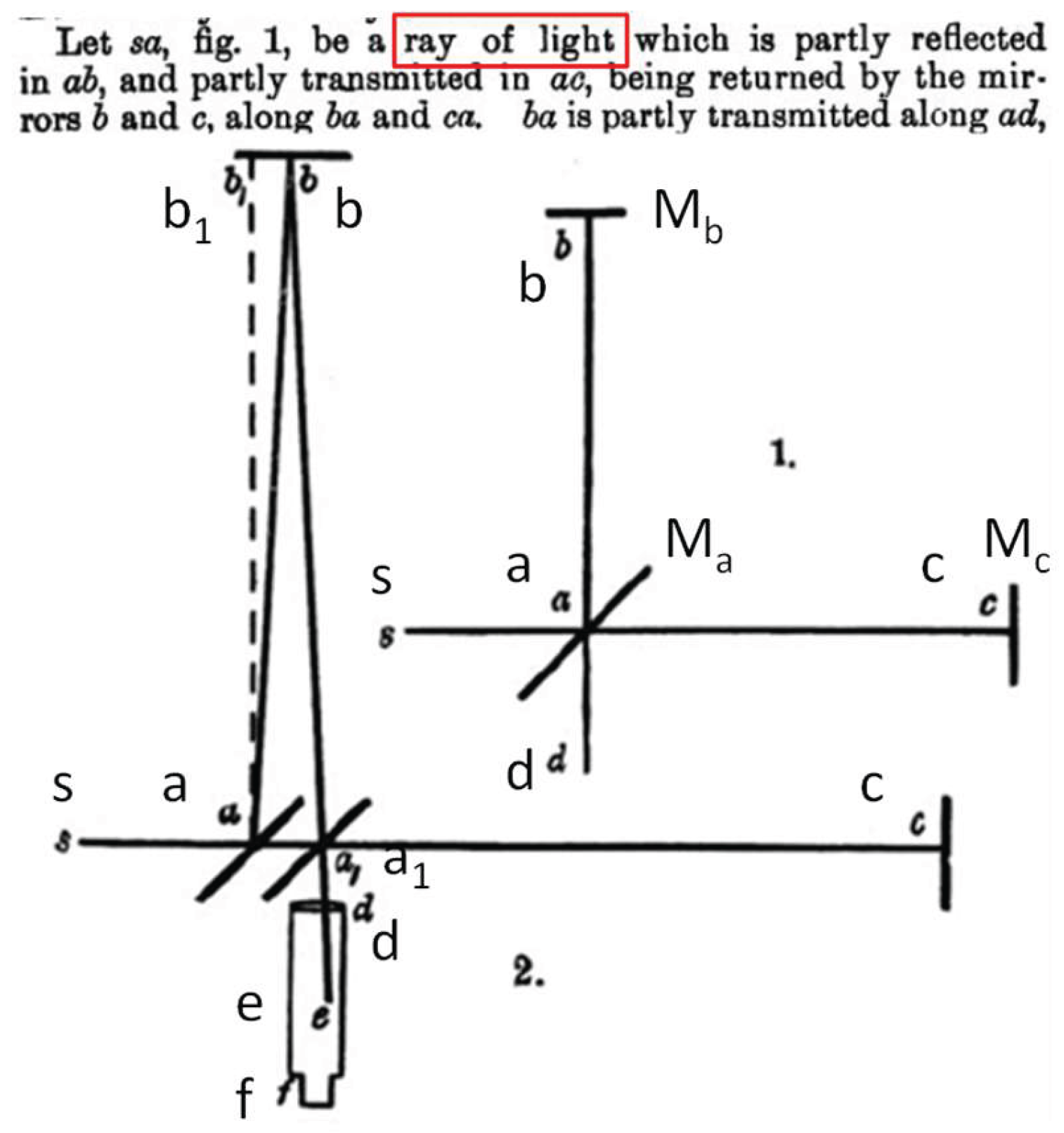
Figure 2.
the lateral shift MF depends explicitly on the real velocity vector of the system, as explained in detail in [2].
Figure 2.
the lateral shift MF depends explicitly on the real velocity vector of the system, as explained in detail in [2].
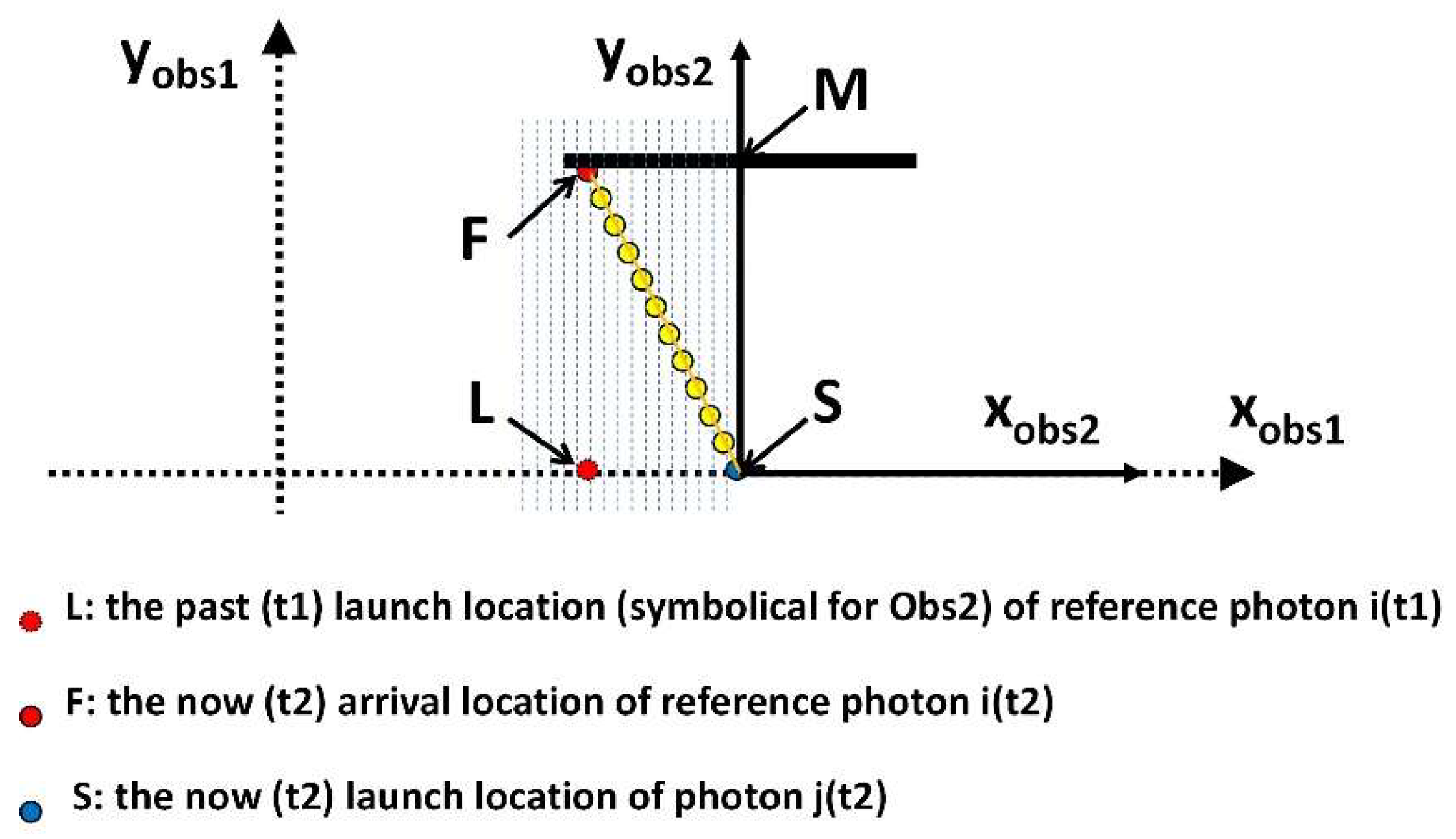
Figure 3.
Lateral photon displacement at a horizontal velocity vx for t1, t2, t3 and t4, illustrating the corresponding photon location (scale in the x-direction exaggerated for demonstration reasons) (EMDR078 in [12]).
Figure 3.
Lateral photon displacement at a horizontal velocity vx for t1, t2, t3 and t4, illustrating the corresponding photon location (scale in the x-direction exaggerated for demonstration reasons) (EMDR078 in [12]).
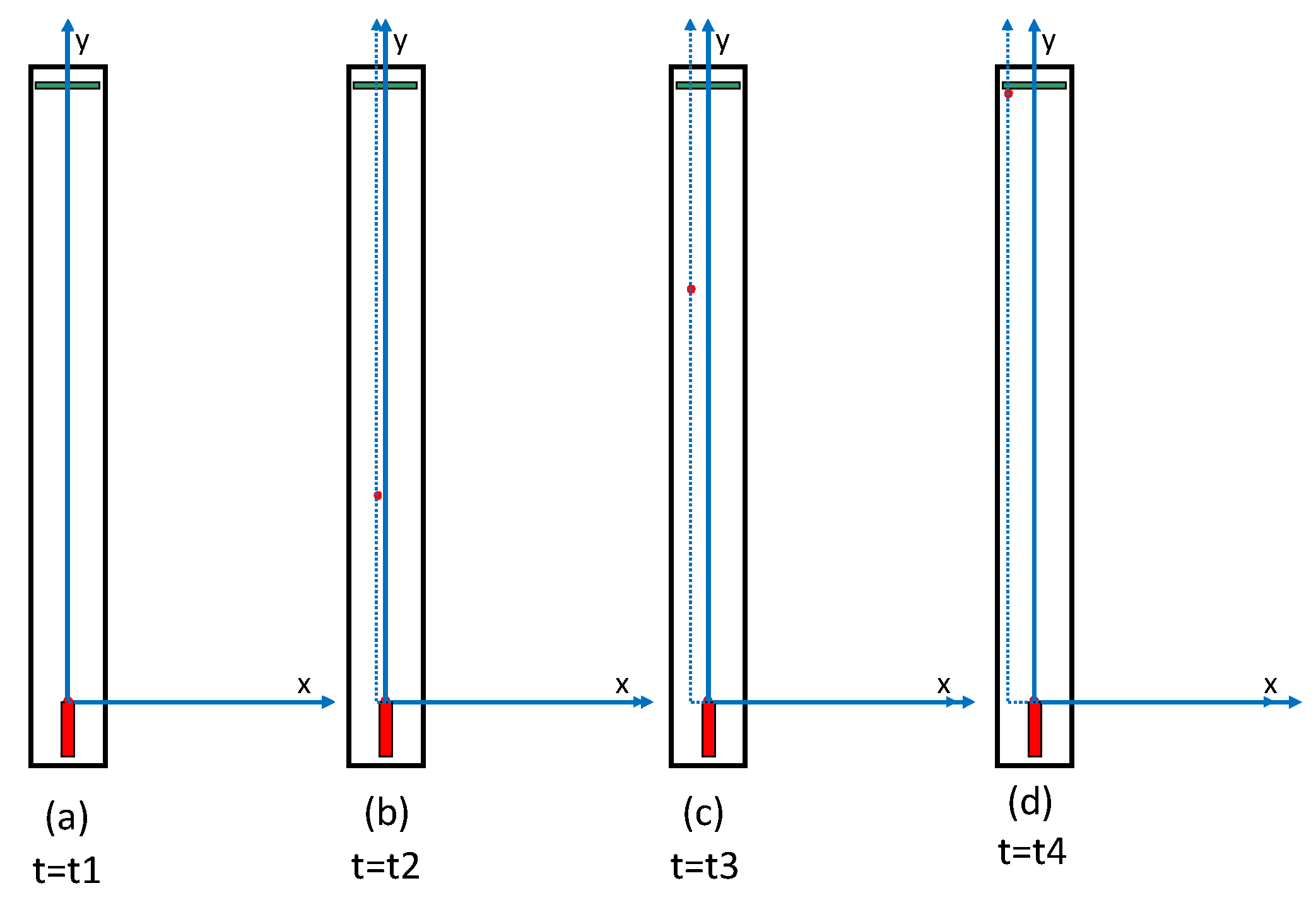
Figure 4.
Basic schematics of a RVMD design concept for the RVMDy set-up, linked to the y-direction, including a mirror for doubling the photon’s trajectory distance and thus the sensitivity (EMDR079 in [12]).
Figure 4.
Basic schematics of a RVMD design concept for the RVMDy set-up, linked to the y-direction, including a mirror for doubling the photon’s trajectory distance and thus the sensitivity (EMDR079 in [12]).
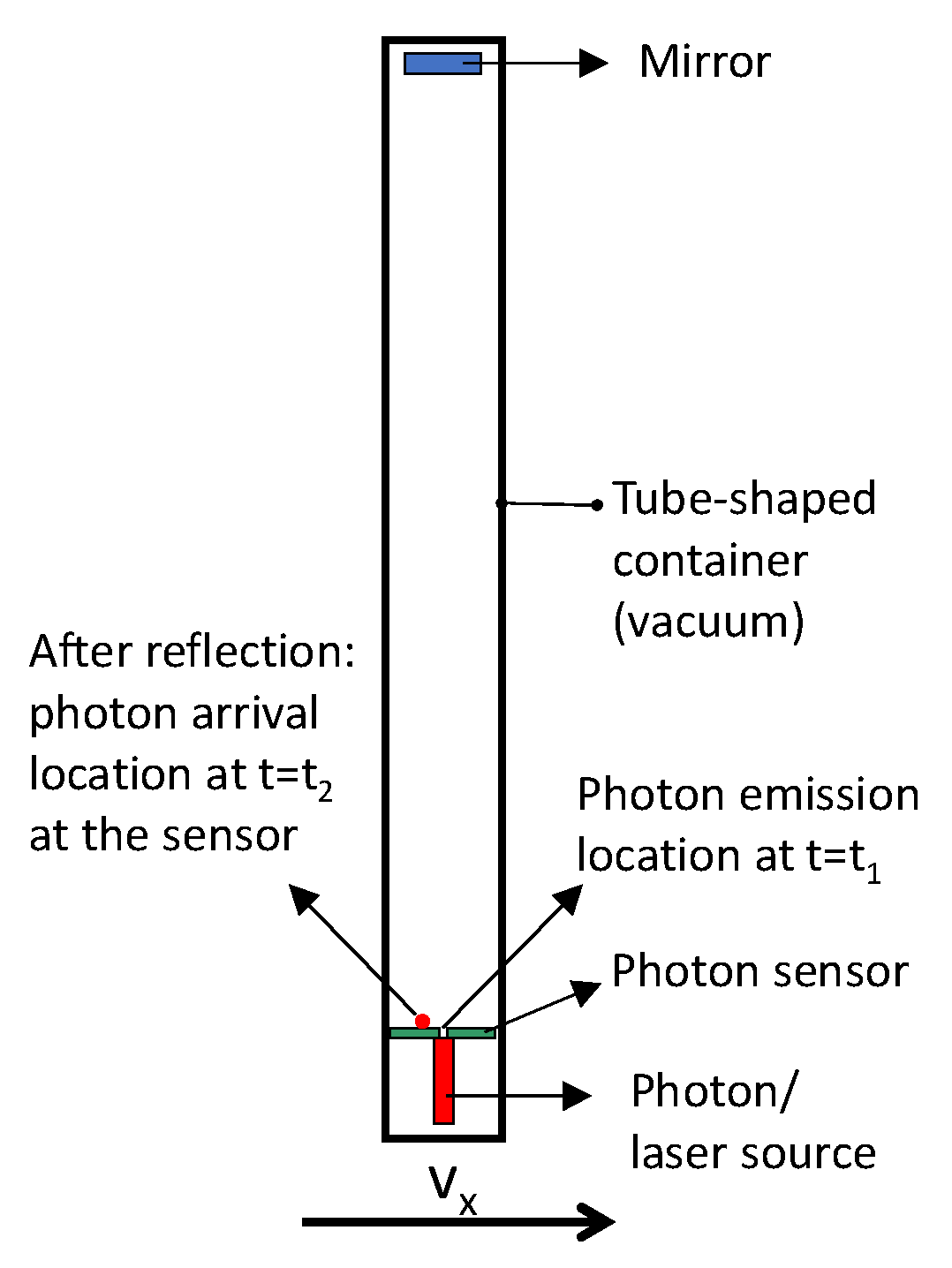
Figure 5.
Three dimensional RVMD set-up (EMDR031 in [12]).
Figure 5.
Three dimensional RVMD set-up (EMDR031 in [12]).
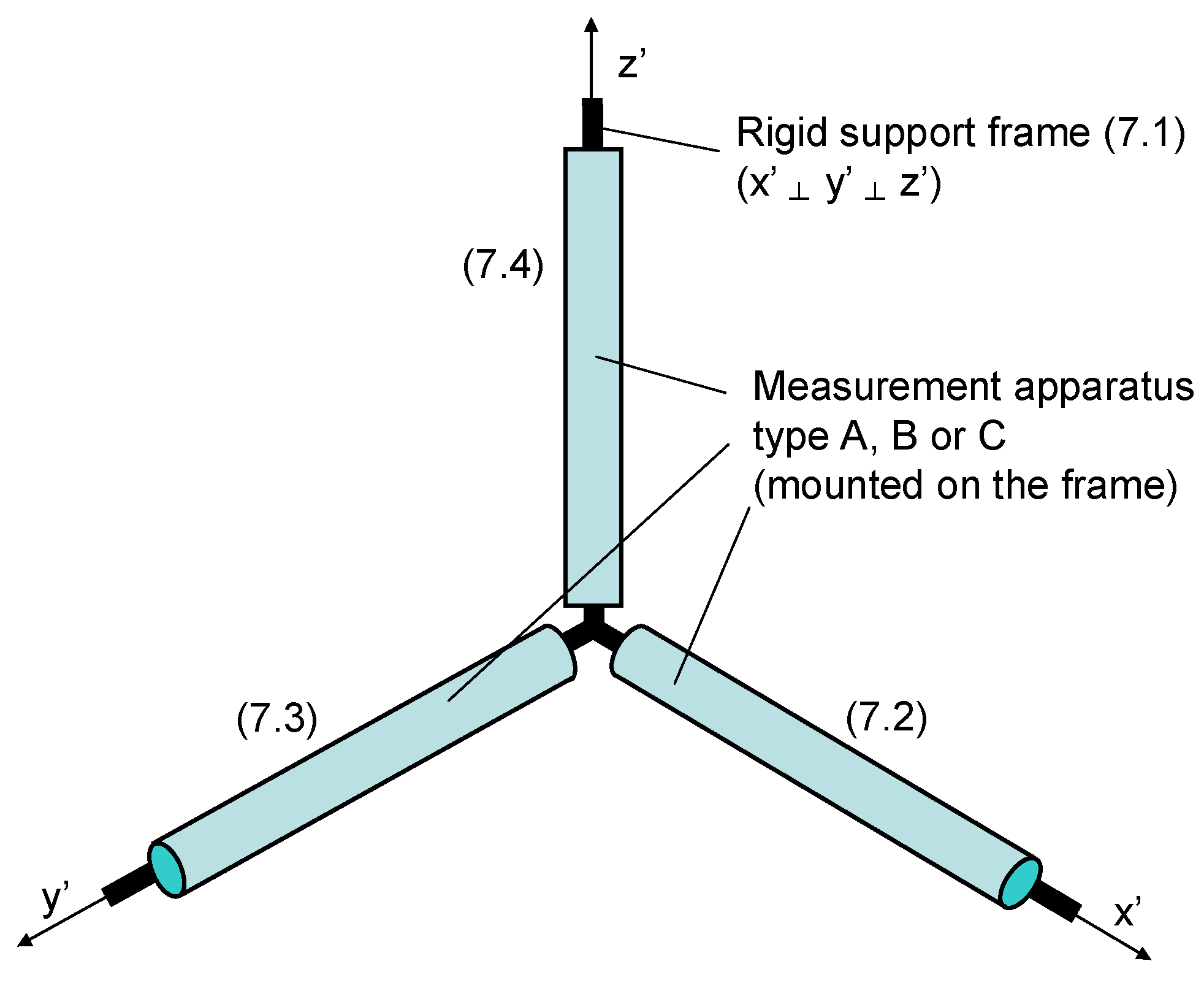
Figure 6.
Schematics of a configuration of beacons in real space for space vessel location determination.
Figure 6.
Schematics of a configuration of beacons in real space for space vessel location determination.
Disclaimer/Publisher’s Note: The statements, opinions and data contained in all publications are solely those of the individual author(s) and contributor(s) and not of MDPI and/or the editor(s). MDPI and/or the editor(s) disclaim responsibility for any injury to people or property resulting from any ideas, methods, instructions or products referred to in the content. |
© 2026 by the author. Licensee MDPI, Basel, Switzerland. This article is an open access article distributed under the terms and conditions of the Creative Commons Attribution (CC BY) license.
Copyright: This open access article is published under a Creative Commons CC BY 4.0 license, which permit the free download, distribution, and reuse, provided that the author and preprint are cited in any reuse.


