

Submitted:
30 April 2026
Posted:
02 May 2026
You are already at the latest version
Abstract
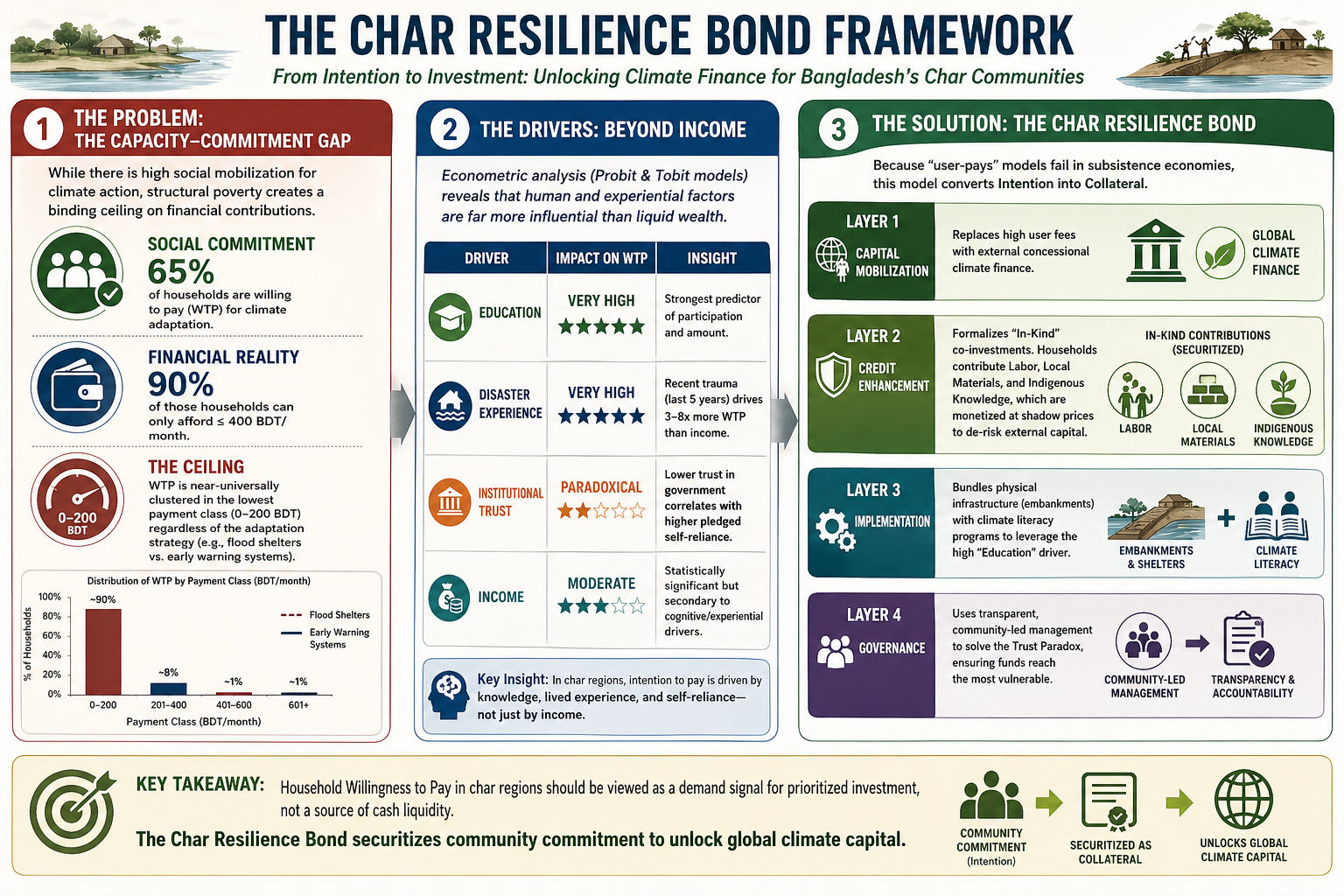
Background: The char regions of Bangladesh — temporary riverine islands — experience compound climate vulnerability intensified by chronic structural poverty, yet sustainable financing models for community-based adaptation remain underdeveloped. Aim: This study diagnoses the capacity–commitment gap between households’ expressed willingness to support climate adaptation and their actual financial capacity, and proposes an evidence-based blended finance instrument. Methods: Using the Contingent Valuation Method (CVM) with a payment-card format and an open-ended follow-up, we surveyed 400 households across two char sites (Bahadurpur and Vasarpara). Probit models estimate the binary decision to contribute; Tobit models estimate the determinants of the contribution amount conditional on willingness. Results: Willingness to pay is high (65% of households), but capacity is sharply constrained: 90% of willing households pledge ≤ 400 BDT/month (mean = 244.5 BDT, median = 220 BDT). Probit and Tobit estimates show that education (β = 1.46, p < 0.001; β = 101.39, p < 0.001) and direct disaster experience (β = 1.49, p < 0.001; β = 153.85, p < 0.001) are three-to-eight times more influential than income (β = 0.49, p < 0.001; β = 19.33, p = 0.034). An institutional-trust paradox emerges: lower trust in government effectiveness is weakly associated with higher stated contributions (Tobit β = −17.88, p = 0.066), consistent with compensatory self-reliance. Near-universal clustering of WTP in the lowest payment class across seven adaptation strategies (89.7–100%) indicates a binding affordability ceiling rather than strategy-specific variation in valuation. Conclusions: These findings invalidate user-pays models for char populations and reframe household WTP as a signal of prioritised demand under a structural affordability ceiling. We translate this diagnostic into the Char Resilience Bond — a blended-finance instrument that securitises formalised in-kind community co-investments (labour, local knowledge, materials) to credit-enhance and leverage external capital, offering a replicable template for financing adaptation public goods in subsistence economies.
Keywords:
climate adaptation finance
; willingness to pay (WTP)
; contingent valuation method (CVM)
; institutional trust
; char regions
; blended finance
; resilience bonds
; Bangladesh
; capacity-commitment gap
Copyright: This open access article is published under a Creative Commons CC BY 4.0 license, which permit the free download, distribution, and reuse, provided that the author and preprint are cited in any reuse.


