

Submitted:
05 January 2026
Posted:
06 January 2026
You are already at the latest version
Abstract
Inter-row mulching with reflective film (RF) has been increasingly adopted in cool-climate vineyards to improve light availability and promote grape ripening. This study investigated the effects of ground-reflected light on the flavoromic profiles of wine grape berries (Vitis vinifera L.) over two consecutive vintages (2020–2021) in the Beijing Fangshan region of Eastern China, an area characterized by high precipitation and limited sunlight during ripening. Physicochemical analyses showed that RF treatment significantly increased total soluble solids (TSS) and decreased titratable acidity (TA) at harvest. Targeted metabolomic analyses using HPLC–MS and GC–MS identified 21 flavonoids and 35 volatile compounds responsive to altered light conditions. RF treatment markedly enhanced the accumulation of anthocyanins and flavonols, especially malvidin-based derivatives, and increased terpene and norisoprenoid concentrations, while C6/C9 compounds were more abundant in control berries. Multivariate analysis revealed that PC1 was mainly associated with anthocyanin accumulation, clearly separating RF-treated samples, whereas PC2 reflected differences in flavonols and flavan-3-ols, with higher flavonols under RF and higher skin- and seed-derived flavan-3-ols in controls. Overall, these findings demonstrate that ground-reflected light plays a critical role in modulating grape flavor composition and provides practical guidance for improving fruit quality in suboptimal climatic regions.
Keywords:
reflective film
; grape
; flavonoids
; aromas
1. Introduction
Wine, prized for its distinctive flavor, is widely appreciated by consumers worldwide. The color, aroma, and taste of wines are largely determined by the secondary metabolites accumulated in grape berries during ripening, including flavonoids (e.g., anthocyanins, flavonols, flavan-3-ols) and volatile compounds (e.g., terpenes, norisoprenoids, C6/C9 compounds).
Among the flavonoids, anthocyanins were mainly accumulated in the red grape skins (apart from teinturier grapes which synthesis anthocyanins both in skins and flesh) and determined the colors of red grapes and wines [1]. Flavonols, located in the grape skins, played a crucial role in the color stability of red wines through their copigmentation effect with anthocyanins [2], and also offered bitterness taste for the wines. Flavanols, as the most abundant flavonoid compounds in grape berries, located in the skins and seeds, or even in the stems, played an important role in contributing to the bitterness and astringency of grapes and wines, as well as their participation in the copigmentation effect and synthesis of polymeric anthocyanins for the red wine color stability [3].
Although many of the aroma compounds in wines were produced by yeast during the fermentation or extracted from oak products during the wine aging, many others were already present in grapes and came through fermentation unaltered or with only minor modifications. These aroma compounds were mainly stored in the form of free state and glycoside-bound state in the grape skins and flesh, which determined the varietal aroma and characteristics of wines [4]. The grape-derived aroma compounds mainly included terpenes, norisoprenoids, and C6/C9 compounds [5]. Terpenes, the most important volatile compounds in grapes and wines, were largely responsible for the floral and fruity aromas, with some monoterpenes possessing the most odoriferous [6]. Norisoprenoids were present in grape fruits only at trace levels, but most of them had very low sensory thresholds and were important sources of floral and fruity aromas in grapes and wines [7]. The C6/C9 compounds, which mainly include C6/C9 aldehydes and alcohols, are characterized by a typical herbaceous aroma and are also referred to as green leaf volatiles [8].
The flavor compounds in grape berries were extremely sensitive to the changes of the environmental factors. Therefore, many studies were devoted to regulating the microclimate in the cluster zone through viticulture measures, so as to change the concentrations of flavor compounds in grape berries and wines [9]. Inter-row mulching treatment was a kind of ground management in viticulture. Depending on the mulch materials, it could regulate the temperature, humidity, and microbiome of the soil, as well as the microclimate in the cluster zone, thereby adjusting the quality of grapes and wines in a targeted manner [10]. Light-colored or reflective mulching materials such as white or silver reflective films, shells, gravels, and crushed glass could increase the photosynthetically active radiation reflected from the ground to the grape cluster zone [11,12,13]. Yuan et al. [14] found that covering reflective film on the ground significantly altered the berry weight and the sugar/acid ratio of ‘Shine Muscat’ grapes. However, Olejar et al. [15] reported that the white inter-row mulching had no significant impact on the grape yield, the number and weight of grape clusters, the TA and pH of berries. There was also no consistent conclusion in the researches regarding the impact of inter-row mulching treatment on flavonoid and aroma compounds. For flavonoid compounds, Tian et al. [13] indicated that light-colored gravel covering enhanced the flavonol concentrations of grape berries. While, Osrecak et al. [16] found that the inter-row red reflective film covering increased the concentrations of (-)-epicatechin and gallic acid in ‘Merlot’, ‘Teran’ and ‘Plavac Mali’ wines. Another relatively early study showed that the white or silver reflective film covering had almost no impact on the concentrations of total phenols, flavonols and anthocyanins in grape berries [11]. As for aroma compounds, Reynolds et al. [17] reported that inter-row mulching with reflective film could increase the concentrations of free and bound terpene compounds in ‘Riesling’ grape berries and reduce the herbaceous flavor of the wines. Tian et al. [13] found that light-colored gravel covering reduced the overall aroma of grapes. However, there were also some studies showed that the white inter-row mulching treatment had no impact on the aroma profile of ‘Malbec’ wines [15]. In a nutshell, there were still controversies and deficiencies in the researches on the impact of inter-row mulching with reflective materials on the concentrations of flavor compounds in grape berries and wines, which might be closely related to the terroir conditions of different experimental sites, especially the sunlight.
Optimal accumulation of the flavor-related metabolites in grape berries required sufficient light exposure, which could be limited in humid, cloudy regions. Thus, the inter-row mulching with reflective materials was mostly used in vineyards in cool regions, aiming to solve the problem that the berries could not reach the optimal maturity. The Fangshan region of Beijing, located in Eastern China, is one of the country’s major wine regions. During the grape growing season, this region usually faced significant environmental challenges of the stresses of high rainfall and low solar irradiance, often resulting in delayed or incomplete berry maturation [18]. To address this issue, in the present study, inter-row mulching with reflective films was adopted as a canopy management strategy to increase the light reflection from the soil surface into the fruit zone, thereby enhancing the photoregulation of secondary metabolism. The systemic effects of ground-reflected light on the grape flavoromics, especially the flavonoid and aroma compounds of commercially harvested grape berries between the treatment and control for two consecutive years were evaluated. We hypothesized that inter-row mulching with reflective film would accelerate grape ripening and improve fruit quality by modulating key flavor-associated pathways. This study aimed to elucidate how reflected light regulated the accumulation of flavonoid and volatile compounds in grape berries, providing both scientific insight and practical guidance for sustainable viticulture in light-limited regions.
2. Materials and Methods
2.1. Vineyard, Experimental Design and Sampling
The research was conducted in a commercial vineyard of Qianyuan Winery, Fangshan District, Beijing (39°78′ North, 116°06′ East) during the vintages of 2020 and 2021. The meteorological data of the vineyard during grape development were obtained from the nearest meteorological station of the China Meteorological Data Center (https://data.cma.cn/).
Uniform parcels of Vitis vinifera L. cv. ‘Cabernet Sauvignon’, ‘Cabernet Franc’, and ‘Marselan’ were selected. All grapevines were trained to the modified vertical shoot positioning (M-VSP) and managed with locally consistent viticulture. A complete block randomized design was used: reflective aluminum-coated polyethylene film (reflectivity >85%) was laid between rows immediately after fruit set as the treatment (RF), while the control (CK) plots remained uncovered. For each cultivar, three biological replicates per treatment were employed, and each replicate included at least 50 vines.
At local commercial harvest maturity, approximately 600 grape berries were randomly collected from each replicate. Fifty berries were subsampled randomly for the physicochemical analysis, while the remaining fruits were flash-frozen in liquid nitrogen and stored at -80 °C for the subsequent flavoromic determination.
2.2. Physicochemical Analysis of Grapes
The following methods were used to determine the physicochemical indicators of grape berries: The grape berries were weighed and then manually pressed to obtain the juice. The total soluble solids (TSS) and pH value were detected by using a digital refractometer (PAL-1, Atago, Japan) and a pH meter (Sartorius PB-10, Germany), respectively. The titratable acidity (TA) was determined by titration with 0.1 M NaOH to pH 8.2 and reported as g/L tartaric acid equivalent per liter.
2.3. The Extraction and Analysis of Flavonoids in Grapes
For each replicate, about 60.0 g mature berries were used for the flavonoid detection. Their skins and seeds were manually peeled off in liquid nitrogen, which were then pulverized into powder respectively, and freeze-dried at -40 °C. The extraction of flavonoids was consistent with the method described by Shi et al. [19]. All extracts were filtered through 0.22 μm nylon membrane (MEMBRANA, Germany) and analyzed using high-performance liquid chromatography/triple-quadrupole tandem mass spectrometry (HPLC-QqQ-MS/MS). An Agilent 1200 series HPLC system equipped with an Agilent 6410 QqQ instrument (Agilent Technologies Inc., Palo Alto, California, USA) was used. The detailed procedures of HPLC and MS conditions have been described previously (Shi et al., 2024). Quantification of flavonoid compounds was carried out by means of a calibration curve: Anthocyanins were quantified using malvidin-3-O-glucoside, flavonols with quercetin-3-O-glucoside, and flavanols with (+)-catechin, (-)-epicatechin, (-)-epicatechin-3-O-gallate, and (-)-epigallocatechin. All flavonoid compounds in grapes were expressed as mg/kg fresh weight (FW).
Enzyme activity related to flavonoid biosynthesis—such as flavonoid-3′-hydroxylase (F3′H) and flavonoid-3′,5′-hydroxylase (F3′5′H)—was inferred from product ratios and designated as A-F3′H (anthocyanin-derived), A-F3′5′H, F-F3′H (flavonol-derived), and F-F3′5′H.
2.4. The Extraction and Analysis of Volatiles in Grapes
For each replicate, about 60 g of berries were meticulously deseeded and ground into powder under liquid nitrogen with an addition of 1.0 g of polyvinylpyrrolidone and 0.5 g of D-gluconic acid lactone. This powder was melted at 4 °C for 4 h and then centrifuged at 8,000 × g for 10 min to get clear juice which could be used directly for the detection of free form volatiles. The extraction of bound volatile compounds of grapes was according to Lu et al. [20]. Next, the detection of volatile compounds was according to Tian et al. [5]. 5 mL of juice/solution was added into a 20 mL vial containing 1 g NaCl and 10 µL of internal standard (4-methyl-2-pentanol) and concentrated using HS-SPME. The volatile compounds in grapes were detected by an Agilent 6890 gas chromatography (GC) coupled with Agilent 5973 mass spectrometer (MS) with an HP-INNOWAX capillary column (60 m × 0.25 mm, 0.25 μm). The volatile compounds were identified by matching the retention indices (RI) and mass spectrum with reference standards in the NIST 14 MS library. Target analytes included C6/C9 compounds (e.g., hexanal, (Z)-3-hexenol), monoterpenes (e.g., linalool, geraniol), norisoprenoids (e.g., β-damascenone, TDN), and esters. Quantification of volatile compounds was based on the calibration curves of volatile standards. Semi-quantification was conducted for volatile compounds with no corresponding standards. These compounds were quantified by using internal standard curves of standards with similar chemical structures, functional groups and/or similar carbon numbers. All volatile compounds in grapes were expressed as μg/kg fresh weight (FW).
2.5. Statistical Analysis
The one-way and multi-way analysis of variance (ANOVA) was performed using SPSS 26.0 (IBM, USA) to confirm the significance of the differences between varieties at a significant level of p < 0.05. The figures were drawn using GraphPad Prism 8.0.2 (GraphPad Software, USA). The principal component analysis (PCA) and orthogonal partial least squares discriminant analysis (OPLS-DA) were performed using Simca 14.1 (Umetrics, Sweden).
3. Results
3.1. Meteorological Data
As shown in Table 1, the highest average monthly temperatures occurred from June to August in both 2020 and 2021, with values of 26.9 °C and 26.7 °C, respectively. The average monthly maximum temperature was recorded in June 2020 at 32.7 °C, while the average monthly minimum temperature was observed in May 2021 at 14.0 °C. Overall, temperatures during the growing season were slightly higher in 2020 compared to 2021. The total precipitation during the growing seasons was 430.0 mm in 2020 and 573.0 mm in 2021, with most of the rainfall concentrated between July and September. Notably, precipitation in July and September 2021 was significantly higher than in 2020, resulting in increased relative humidity. Meteorological factors had a critical influence on grape berry ripening and quality. While temperature variations between the two years were minimal, differences in precipitation and the associated changes in sunshine likely contributed to variations in flavor composition of grape berries.
3.2. Physicochemical Indicators of Grape Berries
The physicochemical indicators of grape berries were shown in Figure 1. Berry weight in the RF treatment was significantly higher than CK over the two years, except for ‘Cabernet Sauvignon’ in the year of 2020. The total soluble solids (TSS) of grapes showed that RF grapes had the significant higher TSS level in 2021, while in 2020, RF only significantly increased the TSS level of ‘Marselan’ grapes. Titratable acidity (TA) was consistently and significantly reduced by RF in all three grape cultivars over the two years. As for the pH, it was less affected by RF. The pH of ‘Marselan’ grapes was significantly increased by RF in 2020. However, the effect of RF on pH of ‘Cabernet Franc’ grapes was inconsistent between the two years, with RF significantly reducing pH in 2020 and the opposite in 2021. Overally, RF treatment significantly improved the grape maturity at harvest. Berries from RF-treated vines exhibited higher TSS and lower TA compared to CK samples, indicating accelerated sugar accumulation and acid degradation during ripening.
3.3. The Flavonoids of Grape Berries
The overall effect of RF treatment on flavonoid profiles in grape berries was shown in Figure 2. To better highlight the effects of RF treatment, log2 fold changes between RF and CK were used. In 2020, RF treatment significantly increased flavonol and skin-flavan-3-ol levels in ‘Cabernet Sauvignon’, as well as anthocyanin, flavonol, and skin-flavan-3-ol levels in ‘Cabernet Franc’, and anthocyanin levels in ‘Marselan’, while reducing seed-flavan-3-ol levels in ‘Cabernet Franc’. In 2021, RF treatment significantly increased anthocyanin and flavonol levels in ‘Cabernet Sauvignon’, anthocyanin and skin-flavan-3-ol levels in ‘Cabernet Franc’, and flavonol levels in ‘Marsela’n, but decreased skin- and seed-flavan-3-ol levels in ‘Cabernet Sauvignon’ and skin-flavan-3-ol levels in ‘Marselan’. Overall, RF treatment promoted anthocyanin and flavonol accumulation in grape berries, though the effects on flavan-3-ols were inconsistent across years.
F3′H and F3′5′H in the flavonoid pathway competitively regulate flavonoid biosynthesis F3′H was involved in producing cyanidin-based anthocyanins, quercetin- and isorhamnetin-based flavonols, while F3′5′H was responsible for synthesizing delphinidin-based anthocyanins and myricetin-, laricitrin-, and syringetin-based flavonols. In 2020, RF treatment significantly increased the proportions of A-F3′5′H and F-F3′5′H in ‘Cabernet Sauvignon’ and ‘Cabernet Franc’, as well as A-F3′5′H and F-F3′H in ‘Marselan’. Conversely, RF treatment decreased the proportions of A-F3′H and F-F3′H in ‘Cabernet Sauvignon’, A-F3′H in ‘Cabernet Franc’, and A-F3′H and F-F3′5′H in ‘Marselan’. In 2021, RF treatment again significantly increased the proportions of A-F3′5′H in ‘Cabernet Franc’ and both A-F3′5′H and F-F3′5′H in ‘Marselan’, while reducing the proportions of A-F3′H in both ‘Cabernet Franc’ and ‘Marselan’. Although the effects in 2021 were less pronounced than in 2020, the overall trends were consistent between the two years. These results suggested that RF treatment enhanced the flow through the F3′5′H pathway while reducing the flow through the F3′H pathway, highlighting the competitive relationship between these two pathways.
3.4. Photosensitive Flavonoids of Grape Berries
Totally, 37 flavonoid compounds were identified across all grape samples, comprising 20 anthocyanins, 11 flavonols, and 6 flavan-3-ols, as detailed in Supplementary Table S1. To eliminate the influence of year and cultivar differences, flavonoid concentrations were standardized for each cultivar and year. Principal component analysis (PCA) was then applied to distinguish samples from RF treatment and CK (as shown in Figure 3). The first principal component (PC1), accounting for 39.7% of the total variance, was primarily associated with anthocyanins. Most RF-treated samples clustered in the positive region of PC1, suggesting that RF treatment led to higher anthocyanin concentrations in grape berries. The second principal component (PC2), explaining 20.9% of the variance, was dominated by flavonols and flavan-3-ols. RF-treated samples generally showed higher flavonol concentrations and were positioned in the positive region of PC2, while CK samples, with higher concentrations of skin- and seed-flavan-3-ols, were found in the negative region of PC2. Further screening using orthogonal partial least squares discriminant analysis (OPLS-DA) identified flavonoids with a VIP score greater than 1.0. The results revealed that malvidin-based anthocyanins, most flavonols (excluding kaempferol), and seed-EGC and seed-EGCG contributed most significantly to the differences between RF and CK. Since the differences between RF and CK were mainly caused by light, indicating that these compounds were likely photosensitive flavonoids. Specifically, malvidin-based anthocyanins and most flavonols were upregulated in grape berries under higher light levels, whereas seed-EGC and seed-EGCG concentrations were reduced. Thus, a total of 21 photosensitive flavonoid compounds were identified, all of which responded to changes in light intensity. Overall, RF promoted the accumulation of anthocyanins and flavonols across cultivars. Malvidin-based anthocyanins and most flavonols were upregulated under higher light conditions, particularly in ‘Cabernet Sauvignon’ and ‘Marselan’. Although the magnitude of change was less pronounced in 2021 than in 2020, the overall trends remained consistent across years.
3.5. The Volatiles of Grape Berries
In this study, volatile compounds in grape berries were classified into seven categories based on their chemical structure: C6/C9 compounds, alcohols, benzenes, aldehydes, terpenes, esters, and norisoprenoids. Figure 4 illustrated the effect of RF treatment on the total concentrations of each type of volatile compound. For free volatile compounds, RF treatment significantly increased the concentrations of aldehydes and norisoprenoids in ‘Marselan’, as well as terpenes, esters, and norisoprenoids in’ Cabernet Sauvignon’ and ‘Cabernet Franc’ in 2020. In contrast, RF treatment notably reduced the concentrations of C6/C9 compounds in both ‘Cabernet Sauvignon’ and ‘Cabernet Fran’c in the same year. In 2021, RF treatment led to a significant increase in the concentrations of C6/C9 compounds, alcohols, benzenes, aldehydes, terpenes, and norisoprenoids in ‘Cabernet Sauvignon’, benzenes, esters, and norisoprenoids in ‘Cabernet Franc’, as well as norisoprenoids in Marselan. However, it reduced the concentrations of C6/C9 compounds in ‘Cabernet Franc’ and both C6/C9 compounds and esters in ‘Marselan’. For bound volatile compounds, RF treatment in 2020 significantly increased the concentrations of alcohols, benzenes, aldehydes, esters and norisoprenoids in ‘Cabernet Sauvignon’, benzenes, and esters in ‘Cabernet Franc’, and norisoprenoids in ‘Marselan’. Conversely, it decreased the concentrations of C6/C9 compounds, alcohols, benzenes, and esters in ‘Marselan’. In 2021, RF treatment significantly increased the concentrations of aldehydes, terpenes and norisoprenoids in ‘Cabernet Sauvignon’, esters and norisoprenoids in ‘Cabernet Franc’, terpenes and esters in Marselan, while reducing the concentrations of C6/C9 compounds and benzenes in ‘Cabernet Franc’, as well as alcohols and benzenes in ‘Marselan’. The results from the two-year study demonstrated that RF treatments effectively increased the concentrations of terpenes, esters, and norisoprenoids, while reducing the levels of C6/C9 compounds in grape berries.
3.6. Photosensitive Volatiles of Grape Berries
A total of 52 free volatile compounds were identified across all grape samples, as listed in Supplementary Table S2. The PCA and OPLS-DA were performed using their concentration data standardized for each cultivar and year (Figure 5). The PCA results clearly distinguished RF-treated grapes from the CK, with RF samples located in the negative part of PC1 and CK samples in the positive part. The PCA loading plot illustrated that the concentrations of C6/C9 compounds were higher in CK grapes, while the levels of other volatile compounds were higher in RF-treated grapes. Additionally, OPLS-DA was used to identify photosensitive free volatile compounds in grape berries. The results showed that 22 free volatile compounds, such as (Z)-β-damascenone, 1-octanol, (E)-2-decenal, were upregulated under higher light levels, while (E)-2-hexenal and (E, E)-2, 4-hexadienal were downregulated.
A total of 33 bound volatile compounds were identified across all grape samples, as detailed in Supplementary Table S3. The PCA and OPLS-DA were performed based on their concentration data which were standardized for each cultivar and year (Figure 6). The PCA results clearly distinguished RF treatment from CK, with RF located in the negative part of PC1 and CK in the positive part of PC1. The PCA loading plot illustrate that the concentrations of norisoprenoids, esters and terpenes were higher in RF treatment, whereas the concentrations of alcohols, C6/C9 compounds and benzenes were higher in CK. The OPLS-DA further identified 13 photosensitive bound volatile compounds. Among these, methyl salicylate, ethyl octanoate, p-cymenene, (Z)-2-hexen-1-ol, geranylacetone, linalool, α-terpineol, and 6-methyl-5-hepten-2-one were upregulated under higher light levels, while benzeneacetaldehyde, 1-octanol, 1-octen-3-ol, (E)-2-hexen-1-ol, and (E, E)-2,4-hexadienal were downregulated.
Thus, 35 compounds were found to be responsive to light modulation. RF treatment significantly enhanced the concentrations of terpenes and norisoprenoids—key contributors to floral and fruity aromas—in grape berries. In contrast, the levels of C6/C9 compounds—associated with green, grassy notes—were higher in control samples, indicating delayed senescence-related lipid oxidation in shaded conditions.
4. Discussion
The microclimate in the grape cluster zone, including factors such as temperature, humidity, and light, plays a crucial role in determining grape berry quality [21]. Inter-row mulching with reflective film could significantly increase the light intensity in cluster zone. Yuan et al. [14] showed that covering reflective film on the ground could double the amount of reflected light under grapevine canopy compared to Control. This study sought to explore the impact of reflective film on grape quality and establish a foundational framework for their application in viticulture.
In this study, grape physicochemical properties were significantly influenced by the application of reflective film (RF). The increased levels of reflected light accelerated berry ripening, enhanced the concentration of soluble solids, increased berry weight, and reduced the levels of titratable acid. The development of grape berries was closely related to the photosynthesis of leaves. The previous study had shown that covering reflective film promotes the photosynthetic rates of grapevine [14]. Similar findings on enhanced photosynthetic activity due to reflective film have been reported in various plants, such as in blueberry bushes [22], hot pepper [23], and cucumber [24]. As a result, the greater reflected light intensity facilitated the transport of photosynthetic products from leaves to berries, accelerating ripening. This process typically resulted in higher sugar accumulation and reduced titratable acidity in ripening grape berries [13]. Among various physicochemical parameters, organic acids appeared to be the most responsive to environmental conditions [25], which might explain the most significant reduction in TA observed with RF treatment in this study. In addition, a correlation between grape berry weight and light-environment were also reported [26]. Previous studies showed that grape berries exposed to higher light exhibit significantly higher weights [14,27], which were consistent with the current study.
Flavonoids were important flavor compounds in grapes and wines. RF treatment significantly increased the concentrations of anthocyanins and flavonols in grape berries. Anthocyanins were the primary compounds responsible for the color of red grapes and wines [28]. Many studies demonstrated that light promoted anthocyanin accumulation in grape berries [29]. In addition, temperature played a significant role in anthocyanin biosynthesis, with levels above 35 °C reportedly inhibiting their accumulation [30]. While RF treatment raised the temperature in the cluster zone, it did not negatively impact anthocyanin synthesis under the climatic conditions of this experiment (Table 1). Flavonols, which protected grape berries from UV-B damage and served as co-pigments enhancing wine coloration, were particularly sensitive to changes in light conditions [31]. Previous studies showed that increased light intensity significantly upregulated key genes in the flavonol biosynthesis pathway, leading to higher flavonol concentrations in berries [30]. Conversely, shading treatments downregulated the expression of these genes and significantly inhibited flavonol accumulation [32]. These findings aligned with the results of the present study. Flavan-3-ols, the most abundant flavonoids in grape skins and seeds, contribute to the bitterness and astringency of grapes and wines [33]. Although the total concentration of flavan-3-ols in the RF treatment and CK showed no consistent differences over two years, PCA analysis revealed that most flavan-3-ols were less concentrated in the RF treatment than in CK. The previous study indicated that temperature was a key factor influencing flavan-3-ol accumulation [34]. The light intensity in the cluster zone was closely linked to temperature and humidity. Tian et al. [13] reported that the reflected light enhanced by covering with white gravel could raise the temperature in the cluster zone by up to about 2 °C and reduce humidity levels. However, some studies showed that inter-row mulching with reflective materials had no significant impact on the average temperature in the cluster zone [35,36], which might be related to the climatic conditions of the vineyard. In this study, the climate was relatively cool with poor light conditions, so the reflected light might not be enough to change the temperature in the cluster zone, suggesting that changes in flavan-3-ol concentration might be related to berry volume, as RF treatment significantly reduced berry weight. Furthermore, seed-flavan-3-ols were more susceptible to environmental factors than skin-flavan-3-ols, consistent with the findings of Tian et al. [13]. The flavonoid compounds were synthesized mainly through the phenylpropane metabolic pathway. Previous study showed that the composition of anthocyanins and flavonols is linked to the expression levels of the F3′5′H and F3′H genes in this pathway [37]. Azuma et al. [30] reported that sufficient sunlight upregulates the F3′5′H gene, increasing the proportion of delphinidin-based anthocyanins in berries. Similarly, our study highlighted that light enhanced the synthesis of flavonoid compounds through the F3′5′H pathway, including malvidin-based anthocyanins and myricetin-, laricitrin-, and syringetin-based flavonols.
Volatile compounds played a crucial role in determining grape and wine quality due to their aromatic contributions. In this study, RF treatment significantly increased the levels of terpenes and norisoprenoids in grape berries, while reducing the concentrations of C6/C9 compounds. Similar findings were also reported in previous studies. Tian et al. [5] reported that light exposure promotes the accumulation of terpenes and norioprenoids while inhibiting the synthesis of C6/C9 compounds in grape berries. Reynolds et al. [17] reported that reflective mulch increased both free and bound terpenes in Riesling berries, while decreasing the herbaceous aroma. The concentrations of C6/C9 compounds were strongly correlated with grape ripening, and Gao et al. [38] reported a decrease in C6/C9 compound concentrations as grapes ripen. In this study, the higher TSS in RF-treated grape berries might have contributed to a higher concentration of C6/C9 compounds compared to the control, aligning with findings by Wang et al. [10]. Terpenes were one of the most important aroma compounds that contributed floral and fruity notes to grapes and wines [39]. High light exposure upregulated the expression of key genes involved in terpenoid metabolism, enhancing terpene accumulation in grape berries [40]. Song et al. [41] reported that sunlight exposure and ultraviolet resulted in increase of nerol, geraniol and citronellol in Pinot Noir grape. Similarly, Sasaki et al. [42] reported that Shade- and UV-block treatment significantly downregulated the expression levels of the representative genes in linalool biosynthesis, and significantly reduce the linalool content in grape. Norisoprenoids were breakdown products of carotenoids that give grape berries and wines a pleasant floral and fruity flavor [43]. Previous study showed that norisoprenoid concentrations positively correlated with sunlight exposure [44]. Carotenoids were precursors for the synthesis of norisoprenoids, and Young et al. [45] reported that high light contributes to the accumulation of norisoprenoids in grape berries due to elevated carotenoid concentrations. Joubert et al. [46] reported that berries employed carotenoids and the associated xanthophyll cycles to acclimate to high light exposure. These results indicated that light was conducive to the accumulation of terpenes and nerolidol in grape fruits, while it inhibited the accumulation of C6/C9 compounds. RF treatment was beneficial to improving the aroma quality of grape berries.
While year-to-year variation was observed, possibly due to weather fluctuations, the consistency in directional trends underscored the robustness of light-mediated metabolic responses.
5. Conclusions
Reflective film (RF) was powerful in vineyards to reflect sunlight from the ground back into the cluster zone, thereby accelerating berry ripening. This study examined the impact of reflective film applied to the ground on the flavor profiles of three grape cultivars (‘Cabernet Sauvignon’, ‘Cabernet Franc’, and ‘Marselan’) over two years (2020-2021). RF treatment significantly enhanced TSS, increased berry weight, and reduced TA. Meanwhile, RF treatment promoted the accumulations of anthocyanins, flavonols, terpenes, and norisoprenoids in grape berries, while reducing the concentrations of seed-flavan-3-ols and C6/C9 compounds. Differences in flavor compound concentrations between the RF treatment and CK highlighted the importance of the microclimate in the cluster zone, particularly light, in shaping grape quality. The OPLS-DA identified some photosensitive flavor compounds. The light-promoted compounds, such as malvidin-based anthocyanins, β-damascenone, and linalool, were found in higher concentrations under high light conditions. Conversely, light-inhibited compounds, such as seed-EGC, (E, E)-2, 4-hexadienal, and (E)-2-hexenal, showed reduced concentrations with high light exposure. Overall, RF treatments had a positive effect on grape berry quality. These findings provided valuable recommendations for viticulturists in low-light regions, and offered new insights into the role of light in shaping the flavor profiles of grapes. This practice offers a promising agronomic solution for overcoming light deficiency in humid, cloudy viticultural regions like Eastern China.
Supplementary Materials
The following supporting information can be downloaded at the website of this paper posted on Preprints.org, Table S1: The concentrations of flavonoid compounds in grape berries (mg/kg FW); Table S2: The concentrations of free volatile compounds in grape berries ((μg/kg FW); Table S3: The concentrations of bound volatile compounds in grape berries ((μg/kg FW).
Author Contributions
N.S., experiment, formal analysis, investigation, writing—original draft, and visualization. H.-C.L., investigation. M.-B.T., investigation. M.-Y.L., investigation. C.-Q.D., supervision. J.W., supervision. X.-F.S., resources. F.H., conceptualization, writing—review & editing, supervision, project administration, and funding acquisition.
Funding
This research was supported by China Agriculture Research System of MOF and MARA (CARS-29).
Institutional Review Board Statement
Not applicable.
Informed Consent Statement
Not applicable.
Data Availability Statement
The original contributions presented in this study are included in the article. Further inquiries can be directed to the corresponding authors.
Acknowledgments
The authors thank the staff from Qianyuan Winery for their assistance in field experiment.
Conflicts of Interest
The authors declare no conflicts of interest.
References
- Tian, M.B.; Yuan, L.; Zheng, M.Y.; Xi, Z.M. Differences in anthocyanin accumulation profiles between teinturier and non-teinturier cultivars during ripening. Foods 2021, 10. [Google Scholar] [CrossRef]
- Gutiérrez-Escobar, R.; Aliaño-González, M.J.; Cantos-Villar, E. Wine polyphenol content and its influence on wine quality and properties: A review. Molecules 2021, 26. [Google Scholar] [CrossRef]
- Lu, H.-C.; Tian, M.-B.; Shi, N.; Han, X.; Li, H.-Q.; Cheng, C.-F.; Chen, W.; Li, S.-D.; He, F.; Duan, C.-Q.; et al. Severe shoot topping slows down berry sugar accumulation rate, alters the vine growth and photosynthetic capacity, and influences the flavoromics of Cabernet Sauvignon grapes in a semi-arid region. European Journal of Agronomy 2023, 145. [Google Scholar] [CrossRef]
- González-Barreiro, C.; Rial-Otero, R.; Cancho-Grande, B.; Simal-Gándara, J. Wine aroma compounds in grapes: A critical review. Critical Reviews in Food Science and Nutrition 2015, 55, 202–218. [Google Scholar] [CrossRef]
- Tian, M.B.; Liu, Y.; Lu, H.C.; Hu, L.; Wang, Y.; Cheng, C.F.; Chen, W.; Li, S.D.; He, F.; Duan, C.Q.; et al. Volatomics of ‘Cabernet Sauvignon’ grapes and wines under the fan training system revealed the nexus of microclimate and volatile compounds. Food Chem 2023, 403, 134421. [Google Scholar] [CrossRef]
- Yang, Y.; Jin, G.J.; Wang, X.J.; Kong, C.L.; Liu, J.B.; Tao, Y.S. Chemical profiles and aroma contribution of terpene compounds in Meili (Vitis vinifera L.) grape and wine. Food Chemistry 2019, 284, 155–161. [Google Scholar] [CrossRef] [PubMed]
- Zhu, L.X.; Zhang, M.M.; Xiang, X.F.; Lan, Y.B.; Shi, Y.; Duan, C.Q.; Zhang, R.L. Aromatic characterization of traditional Chinese wine Msalais by partial least-square regression analysis based on sensory quantitative descriptive and odor active values, aroma extract dilution analysis, and aroma recombination and omission tests. Food Chemistry 2021, 361. [Google Scholar] [CrossRef] [PubMed]
- ul Hassan, M.N.; Zainal, Z.; Ismail, I. Green leaf volatiles: biosynthesis, biological functions and their applications in biotechnology. Plant Biotechnology Journal 2015, 13, 727–739. [Google Scholar] [CrossRef] [PubMed]
- Han, X.; Xue, T.T.; Liu, X.; Wang, Z.L.; Zhang, L.; Wang, Y.; Yao, F.; Wang, H.; Li, H. A sustainable viticulture method adapted to the cold climate zone in China. Horticulturae 2021, 7. [Google Scholar] [CrossRef]
- Wang, Y.; Li, H.Q.; Gao, X.T.; Lu, H.C.; Peng, W.T.; Chen, W.; Li, S.D.; Li, S.P.; Duan, C.Q.; Wang, J. Influence of attenuated reflected solar radiation from the vineyard floor on volatile compounds in Cabernet Sauvignon grapes and wines of the north foot of Mt. Tianshan. Food Research International 2020, 137. [Google Scholar] [CrossRef]
- Sandler, H.A.; Brock, P.E.; Heuvel, J.E.V. Effects of three reflective mulches on yield and fruit composition of coastal new England winegrapes. American Journal of Enology and Viticulture 2009, 60, 332–338. [Google Scholar] [CrossRef]
- Barrera, P.M. Effect of crushed glass, used as a reflective mulch, on Pinot noir performance. 2012. [Google Scholar]
- Tian, M.B.; Ma, W.H.; Xia, N.Y.; Peng, J.; Hu, R.Q.; Duan, C.Q.; He, F. Soil variables and reflected light revealed the plasticity of grape and wine composition: Regulation of the flavoromics under inner row gravel covering. Food Chem 2023, 414, 135659. [Google Scholar] [CrossRef]
- Yuan, Y.; Xie, Y.M.; Li, B.; Wei, X.Y.; Huang, R.T.; Liu, S.Q.; Ma, L.L. To improve grape photosynthesis, yield and fruit quality by covering reflective film on the ground of a protected facility. Scientia Horticulturae 2024, 327. [Google Scholar] [CrossRef]
- Olejar, K.J.; Vasconcelos, M.C.; King, P.D.; Smart, R.E.; Ball, K.; Field, S.K. Herbicide reduction through the use of weedmat undervine treatment and the lack of impact on the aromatic profile and volatile composition of Malbec wines. Food Chemistry 2021, 343. [Google Scholar] [CrossRef]
- Osrecak, M.; Karoglan, M.; Kozina, B. Influence of leaf removal and reflective mulch on phenolic composition and antioxidant activity of Merlot, Teran and Plavac mali wines (Vitis vinifera L.). Scientia Horticulturae 2016, 209, 261–269. [Google Scholar] [CrossRef]
- Reynolds, A.G.; Pearson, E.G.; Savigny, C.d.; Coventry, J.; Strommer, J. Interactions of vine age and reflective mulch upon berry, must, and wine composition of five Vitis vinifera cultivars. International Journal of Fruit Science 2008, 7, 85–119. [Google Scholar] [CrossRef]
- Han, X.; Lu, H.C.; Wang, Y.; Gao, X.T.; Li, H.Q.; Tian, M.B.; Shi, N.; Li, M.Y.; Yang, X.L.; He, F.; et al. Region, vintage, and grape maturity co-shaped the ionomic signatures of the Cabernet Sauvignon wines. Food Research International 2023, 163. [Google Scholar] [CrossRef]
- Shi, N.; Pei, X.-X.; Li, M.-Y.; Chen, W.-T.; Li, H.-Q.; Yang, G.-S.; Duan, C.-Q.; Wang, J. Metabolomics of Vitis davidii Foëx. grapes from southern China: Flavonoids and volatiles reveal the flavor profiles of five spine grape varieties. Food Chemistry 2024, 454. [Google Scholar] [CrossRef] [PubMed]
- Lu, H.C.; Tian, M.B.; Han, X.; Shi, N.; Li, H.Q.; Cheng, C.F.; Chen, W.; Li, S.D.; He, F.; Duan, C.Q.; et al. Vineyard soil heterogeneity and harvest date affect volatolomics and sensory attributes of Cabernet Sauvignon wines on a meso-terroir scale. Food Res Int 2023, 174, 113508. [Google Scholar] [CrossRef]
- Tian, M.B.; Liu, Y.; Lu, H.C.; Hu, L.; Wang, Y.; Cheng, C.F.; Chen, W.; Li, S.D.; He, F.; Duan, C.Q.; et al. Cluster spatial positions varied the phenolics profiles of ‘Cabernet Sauvignon’ grapes and wines under a fan training system with multiple trunks. Food Chem 2022, 387, 132930. [Google Scholar] [CrossRef]
- Muneer, S.; Kim, J.H.; Park, J.G.; Shin, M.H.; Cha, G.H.; Kim, H.L.; Ban, T.; Kumarihami, H.; Kim, S.H.; Jeong, G.; et al. Reflective plastic film mulches enhance light intensity, floral induction, and bioactive compounds in ‘O’Neal’ southern highbush blueberry. Scientia Horticulturae 2019, 246, 448–452. [Google Scholar] [CrossRef]
- Mu, L.; Fang, L. Effects of different mulching practices on the photosynthetic characteristics of hot pepper (Capsicum annuum L.) in a greenhouse in Northwest China. Acta Agriculturae Scandinavica Section B-Soil and Plant Science 2015, 65, 735–746. [Google Scholar] [CrossRef]
- Ibarra-Jiménez, L.; Zermeño-González, A.; Munguía-López, J.; Quezada-Martín, M.A.R.; De La Rosa-Ibarra, M. Photosynthesis, soil temperature and yield of cucumber as affected by colored plastic mulch. Acta Agriculturae Scandinavica Section B-Soil and Plant Science 2008, 58, 372–378. [Google Scholar] [CrossRef]
- Keller, M.; Mills, L.J.; Wample, R.L.; Spayd, S.E. Cluster thinning effects on three deficit-irrigated Vitis vinifera cultivars. American Journal of Enology and Viticulture 2005, 56, 91–103. [Google Scholar] [CrossRef]
- Dai, Z.W.; Ollat, N.; Gomès, E.; Decroocq, S.; Tandonnet, J.P.; Bordenave, L.; Pieri, P.; Hilbert, G.; Kappel, C.; van Leeuwen, C.; et al. Ecophysiological, genetic, and molecular causes of variation in grape berry weight and composition: A review. American Journal of Enology and Viticulture 2011, 62, 413–425. [Google Scholar] [CrossRef]
- DeBolt, S.; Ristic, R.; Iland, P.G.; Ford, C.M. Altered light interception reduces grape berry weight and modulates organic acid biosynthesis during development. Hortscience 2008, 43, 957–961. [Google Scholar] [CrossRef]
- Shi, N.; Li, H.-Q.; Lu, H.-C.; Tian, M.-B.; Han, X.; He, F.; Wang, J. Adjusting the pomace ratio during red wine fermentation: Effects of adding white grape pomace and juice runoff on wine flavoromics and sensory qualities. Food Chemistry: X 2023, 20. [Google Scholar] [CrossRef] [PubMed]
- Cook, M.G.; Zhang, Y.; Nelson, C.J.; Gambetta, G.; Kennedy, J.A.; Kurtural, S.K. Anthocyanin composition of merlot is ameliorated by light microclimate and irrigation in Central California. American Journal of Enology and Viticulture 2015, 66, 266–278. [Google Scholar] [CrossRef]
- Azuma, A.; Yakushiji, H.; Koshita, Y.; Kobayashi, S. Flavonoid biosynthesis-related genes in grape skin are differentially regulated by temperature and light conditions. Planta 2012, 236, 1067–1080. [Google Scholar] [CrossRef] [PubMed]
- Martinez-Lüscher, J.; Brillante, L.; Kurtural, S.K. Flavonol profile is a reliable indicator to assess canopy architecture and the exposure of red wine grapes to solar radiation. Frontiers in Plant Science 2019, 10. [Google Scholar] [CrossRef]
- Downey, M.O.; Harvey, J.S.; Robinson, S.P. The effect of bunch shading on berry development and flavonoid accumulation in Shiraz grapes. Australian Journal of Grape and Wine Research 2004, 10, 55–73. [Google Scholar] [CrossRef]
- Shi, N.; Wang, W.; Li, H.; Han, X.; Lu, H.; Tian, M.; He, F.; Wang, J. Modifications of Vitis vinifera L. cv. Petit Verdot grape flavonoids as affected by the different rootstocks in eastern China. Technology in Horticulture 2023, 3. [Google Scholar] [CrossRef]
- Wang, L.Y.; Wei, K.; Jiang, Y.W.; Cheng, H.; Zhou, J.; He, W.; Zhang, C.C. Seasonal climate effects on flavanols and purine alkaloids of tea (Camellia sinensis L.). European Food Research and Technology 2011, 233, 1049–1055. [Google Scholar] [CrossRef]
- Andreotti, C.; Ravaglia, D.; Costa, G. Effects of fruit load and reflective mulch on phenolic compounds accumulation in nectarine fruit. European Journal of Horticultural Science 2010, 75, 53–59. [Google Scholar] [CrossRef]
- Hostetler, G.L.; Merwin, I.A.; Brown, M.G.; Padilla-Zakour, O. Influence of geotextile mulches on canopy microclimate, yield, and fruit composition of Cabernet Franc. American Journal of Enology and Viticulture 2007, 58, 431–442. [Google Scholar] [CrossRef]
- Castellarin, S.D.; Matthews, M.A.; Di Gaspero, G.; Gambetta, G.A. Water deficits accelerate ripening and induce changes in gene expression regulating flavonoid biosynthesis in grape berries. Planta 2007, 227, 101–112. [Google Scholar] [CrossRef]
- Gao, X.T.; Li, H.Q.; Wang, Y.; Peng, W.T.; Chen, W.; Cai, X.D.; Li, S.D.; He, F.; Duan, C.Q.; Wang, J. Influence of the harvest date on berry compositions and wine profiles of Vitis vinifera L. cv. ‘Cabernet Sauvignon’ under a semiarid continental climate over two consecutive years. Food Chemistry 2019, 292, 237–246. [Google Scholar] [CrossRef]
- Wang, Y.; He, Y.N.; He, L.; He, F.; Chen, W.; Duan, C.Q.; Wang, J. Changes in global aroma profiles of Cabernet Sauvignon in response to cluster thinning. Food Res Int 2019, 122, 56–65. [Google Scholar] [CrossRef] [PubMed]
- Friedel, M.; Frotscher, J.; Nitsch, M.; Hofmann, M.; Bogs, J.; Stoll, M.; Dietrich, H. Light promotes expression of monoterpene and flavonol metabolic genes and enhances flavour of winegrape berries (Vitis vinifera L. cv. Riesling). Australian Journal of Grape and Wine Research 2016, 22, 409–421. [Google Scholar] [CrossRef]
- Song, J.Q.; Smart, R.; Wang, H.; Dambergs, B.; Sparrow, A.; Qian, M.C. Effect of grape bunch sunlight exposure and UV radiation on phenolics and volatile composition of Vitis vinifera L. cv. Pinot noir wine. Food Chemistry 2015, 173, 424–431. [Google Scholar] [CrossRef]
- Sasaki, K.; Takase, H.; Matsuyama, S.; Kobayashi, H.; Matsuo, H.; Ikoma, G.; Takata, R. Effect of light exposure on linalool biosynthesis and accumulation in grape berries. Bioscience Biotechnology and Biochemistry 2016, 80, 2376–2382. [Google Scholar] [CrossRef]
- Mendes-Pinto, M.M. Carotenoid breakdown products the-norisoprenoids-in wine aroma. Archives of Biochemistry and Biophysics 2009, 483, 236–245. [Google Scholar] [CrossRef] [PubMed]
- Lee, S.H.; Seo, M.J.; Riu, M.; Cotta, J.P.; Block, D.E.; Dokoozlian, N.K.; Ebeler, S.E. Vine microclimate and norisoprenoid concentration in Cabernet Sauvignon grapes and wines. American Journal of Enology and Viticulture 2007, 58, 291–301. [Google Scholar] [CrossRef]
- Young, P.R.; Eyeghe-Bickong, H.A.; du Plessis, K.; Alexandersson, E.; Jacobson, D.A.; Coetzee, Z.; Deloire, A.; Vivier, M.A. Grapevine plasticity in response to an altered microclimate: Sauvignon Blanc modulates specific metabolites in response to increased berry exposure. Plant Physiology 2016, 170, 1235–1254. [Google Scholar] [CrossRef]
- Joubert, C.; Young, P.R.; Eyéghé-Bickong, H.A.; Vivier, M.A. Field-grown grapevine berries use carotenoids and the associated xanthophyll cycles to acclimate to uv exposure differentially in high and low light (shade) conditions. Frontiers in Plant Science 2016, 7. [Google Scholar] [CrossRef] [PubMed]
Figure 1.
The physicochemical indicators of grape berries under RF treatment in two years. The * indicates significant differences between RF treatment and CK (student’s test, p < 0.5).
Figure 1.
The physicochemical indicators of grape berries under RF treatment in two years. The * indicates significant differences between RF treatment and CK (student’s test, p < 0.5).
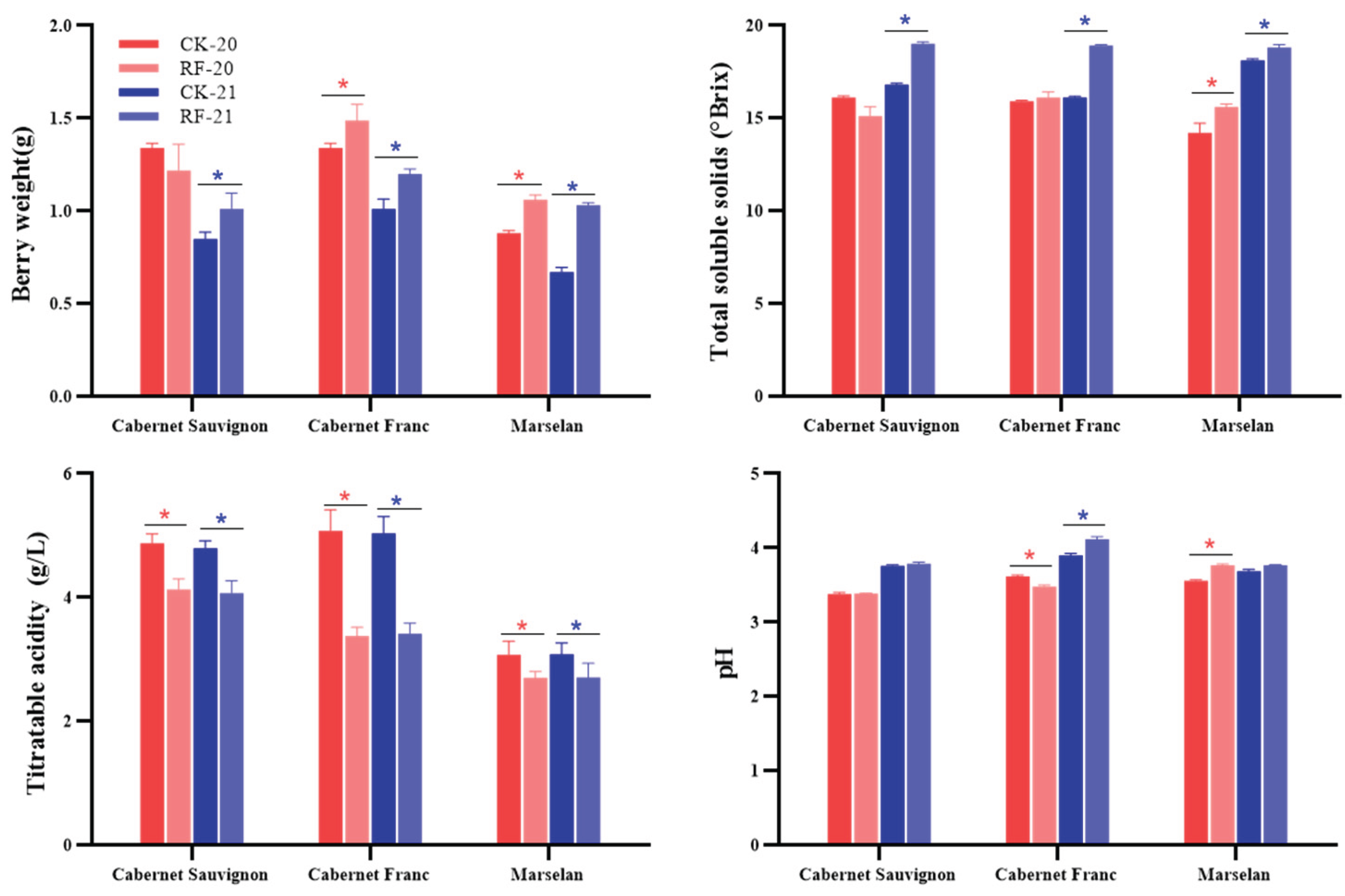
Figure 2.
Effect of RF treatment on the flavonoid composition and the proportion of metabolitics from different pathways. Log2 Fold Changes represented the changes in metabolite concentrations between RF treatment and CK. The proportion is the ratio of each classified anthocyanin or flavonol to the total anthocyanin or flavonol. The * indicates significant differences between RF treatment and CK (student’s test, p < 0.5).
Figure 2.
Effect of RF treatment on the flavonoid composition and the proportion of metabolitics from different pathways. Log2 Fold Changes represented the changes in metabolite concentrations between RF treatment and CK. The proportion is the ratio of each classified anthocyanin or flavonol to the total anthocyanin or flavonol. The * indicates significant differences between RF treatment and CK (student’s test, p < 0.5).
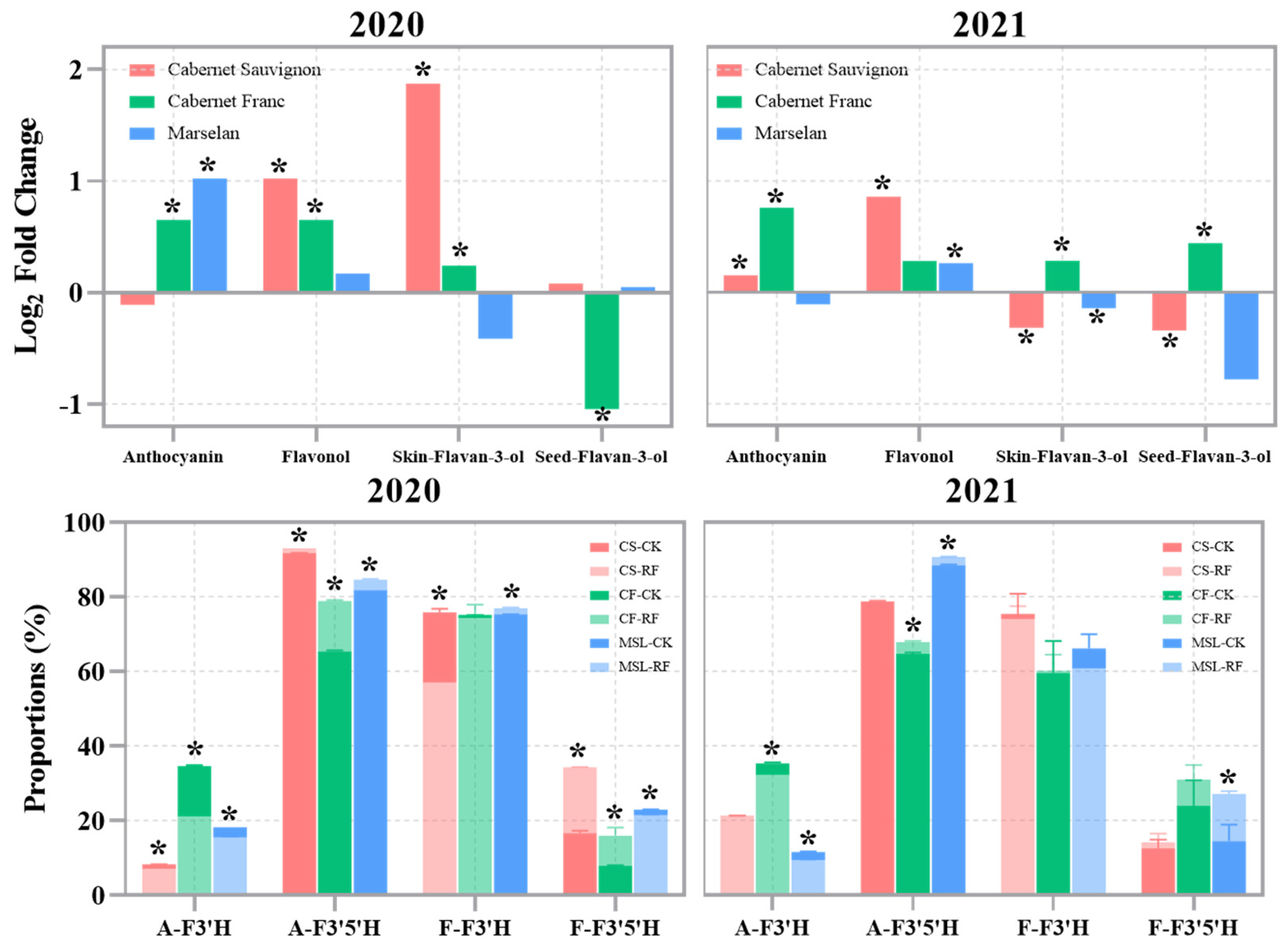
Figure 3.
PCA and OPLS-DA based on the flavonoid compounds of grape berries. The data of flavonoid concentrations was standardized for each cultivar and year. The loading plot of OPLS-DA hided the labels of flavonoids with VIP score less than 1.0. glu, glucoside; ac, acetylglucoside; co, coumaroylglucoside; caf, caffeoylglucoside; gla, galactoside; gluc, glucuronide; Cy, cyanidin; Dp, delphinidin; Pn, peonidin; Pt, petunidin; Mv, malvidin; My, myricetin; Qu, quercetin; Ka, kaempferol; Sy, syringetin; Is, isorhamnetin; La, laricitrin; C, catechin; EC, epicatechin; GC, gallic acid; EGC, epigallocatechin; ECG, epicatechin gallate; EGCG, epigallocatechin gallate.
Figure 3.
PCA and OPLS-DA based on the flavonoid compounds of grape berries. The data of flavonoid concentrations was standardized for each cultivar and year. The loading plot of OPLS-DA hided the labels of flavonoids with VIP score less than 1.0. glu, glucoside; ac, acetylglucoside; co, coumaroylglucoside; caf, caffeoylglucoside; gla, galactoside; gluc, glucuronide; Cy, cyanidin; Dp, delphinidin; Pn, peonidin; Pt, petunidin; Mv, malvidin; My, myricetin; Qu, quercetin; Ka, kaempferol; Sy, syringetin; Is, isorhamnetin; La, laricitrin; C, catechin; EC, epicatechin; GC, gallic acid; EGC, epigallocatechin; ECG, epicatechin gallate; EGCG, epigallocatechin gallate.
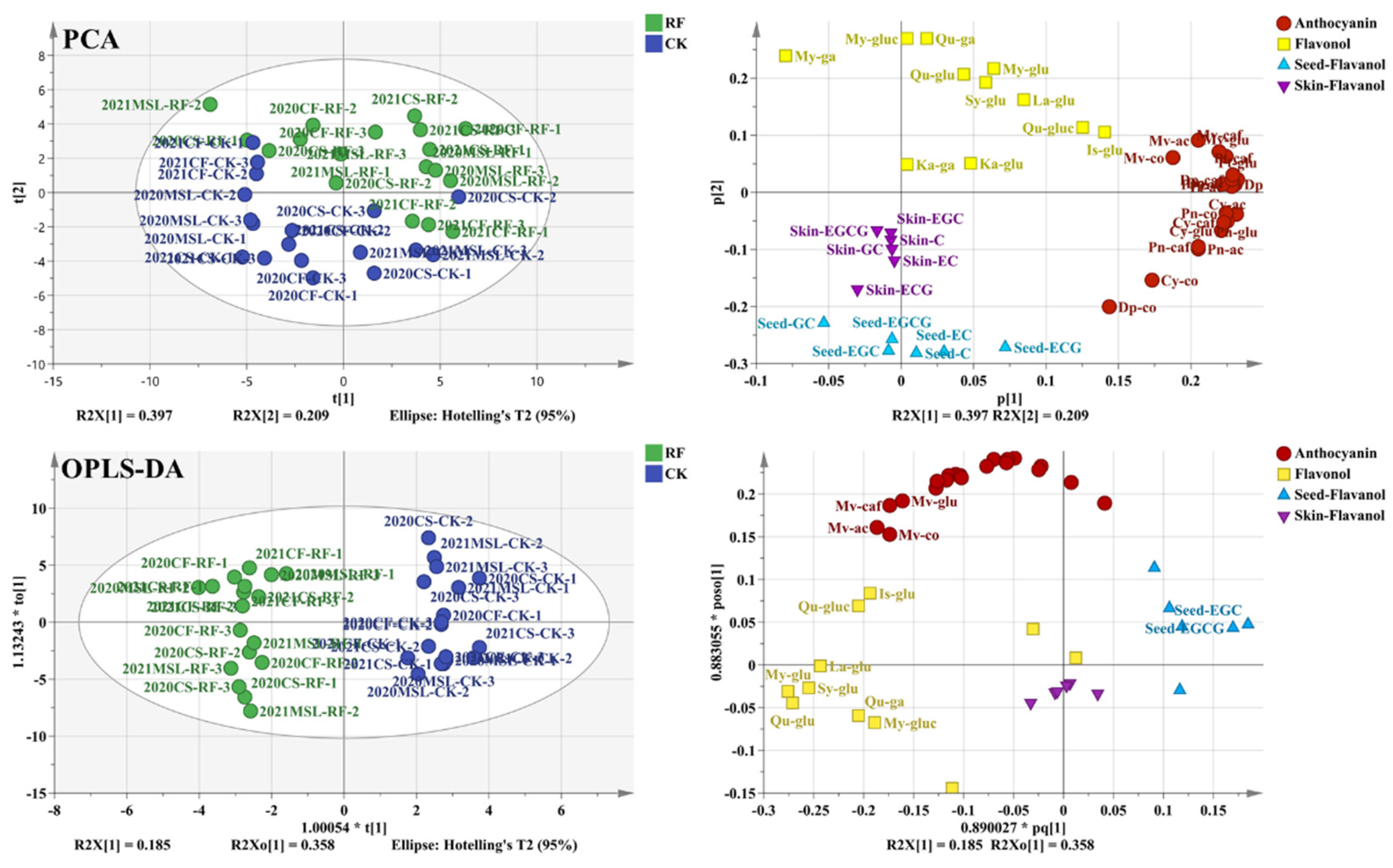
Figure 4.
Effect of RF treatment on the volatile compounds of grape berries in 2020 and 2021. Log2 Fold Changes represented the changes in metabolite concentrations between RF treatment and CK. The * indicates significant differences between RF treatment and CK (student’s test, p < 0.5).
Figure 4.
Effect of RF treatment on the volatile compounds of grape berries in 2020 and 2021. Log2 Fold Changes represented the changes in metabolite concentrations between RF treatment and CK. The * indicates significant differences between RF treatment and CK (student’s test, p < 0.5).
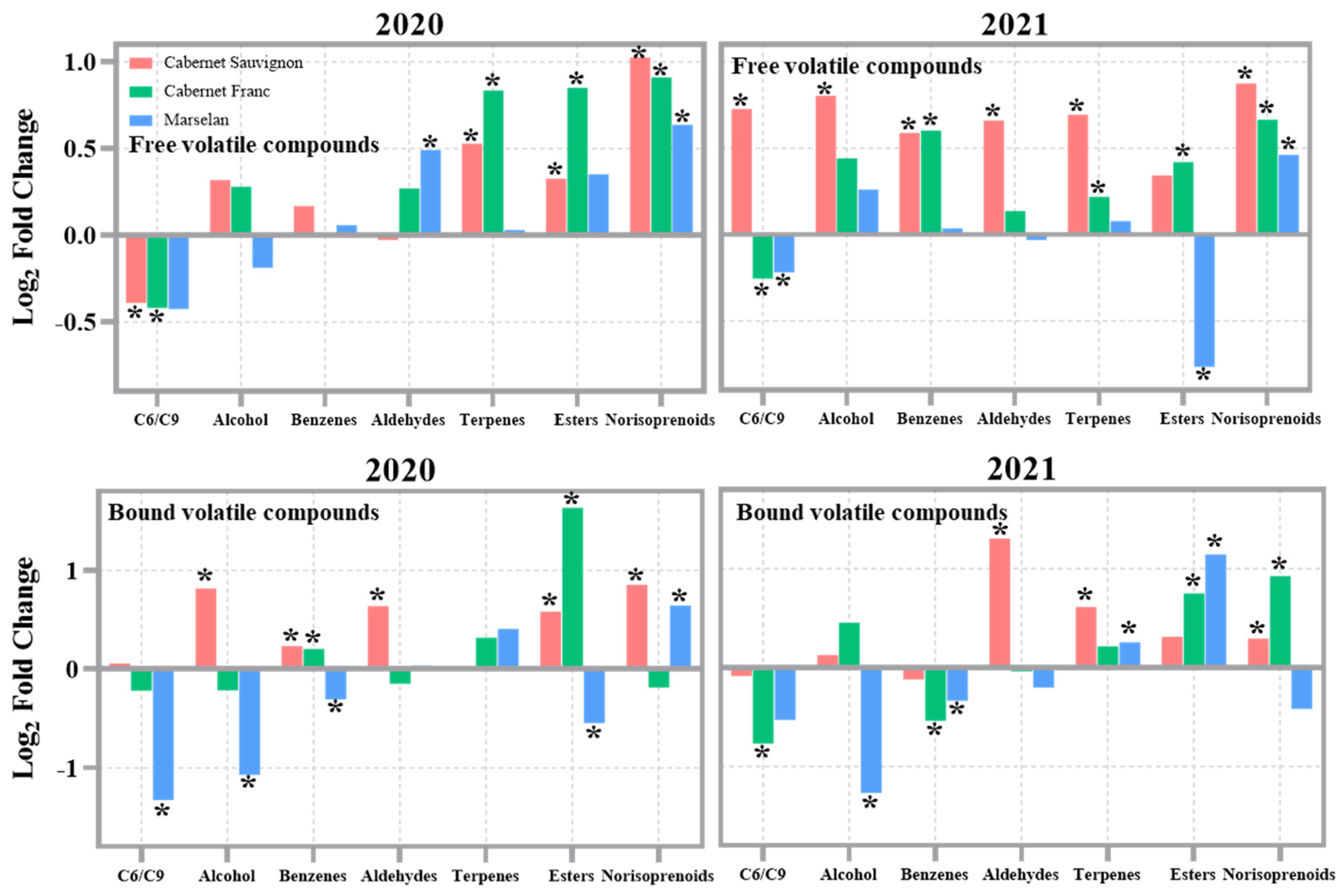
Figure 5.
The PCA and OPLS-DA based on the free volatile compounds of grape berries. The data of flavonoid concentrations was standardized for each cultivar and year. The loading plot of OPLS-DA hided the labels of flavonoids with VIP score less than 1.0.
Figure 5.
The PCA and OPLS-DA based on the free volatile compounds of grape berries. The data of flavonoid concentrations was standardized for each cultivar and year. The loading plot of OPLS-DA hided the labels of flavonoids with VIP score less than 1.0.
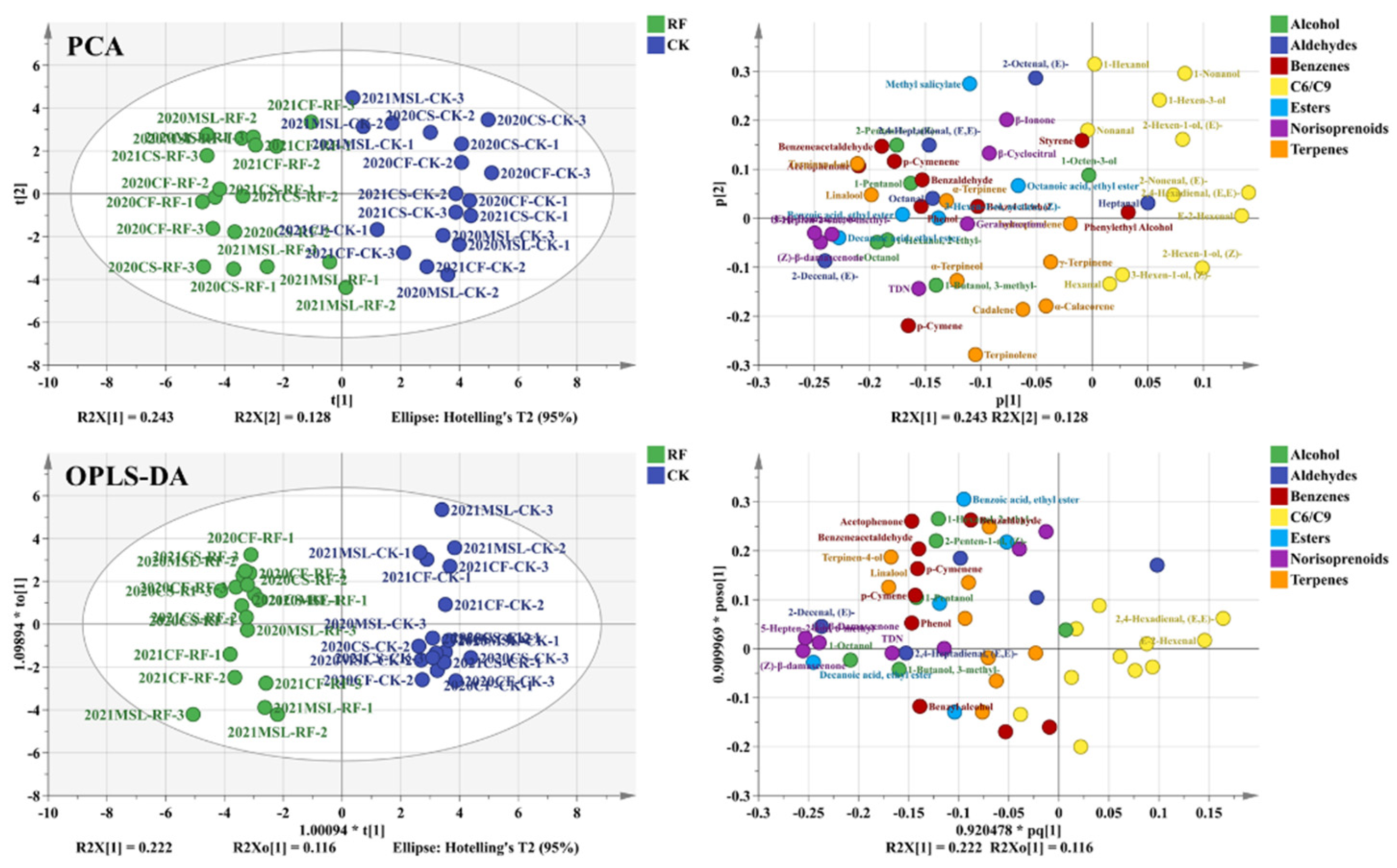
Figure 6.
The PCA and OPLS-DA based on the bound volatile compounds of grape berries. The data of flavonoid concentrations was standardized for each cultivar and year. The loading plot of OPLS-DA hided the labels of flavonoids with VIP score less than 1.0.
Figure 6.
The PCA and OPLS-DA based on the bound volatile compounds of grape berries. The data of flavonoid concentrations was standardized for each cultivar and year. The loading plot of OPLS-DA hided the labels of flavonoids with VIP score less than 1.0.
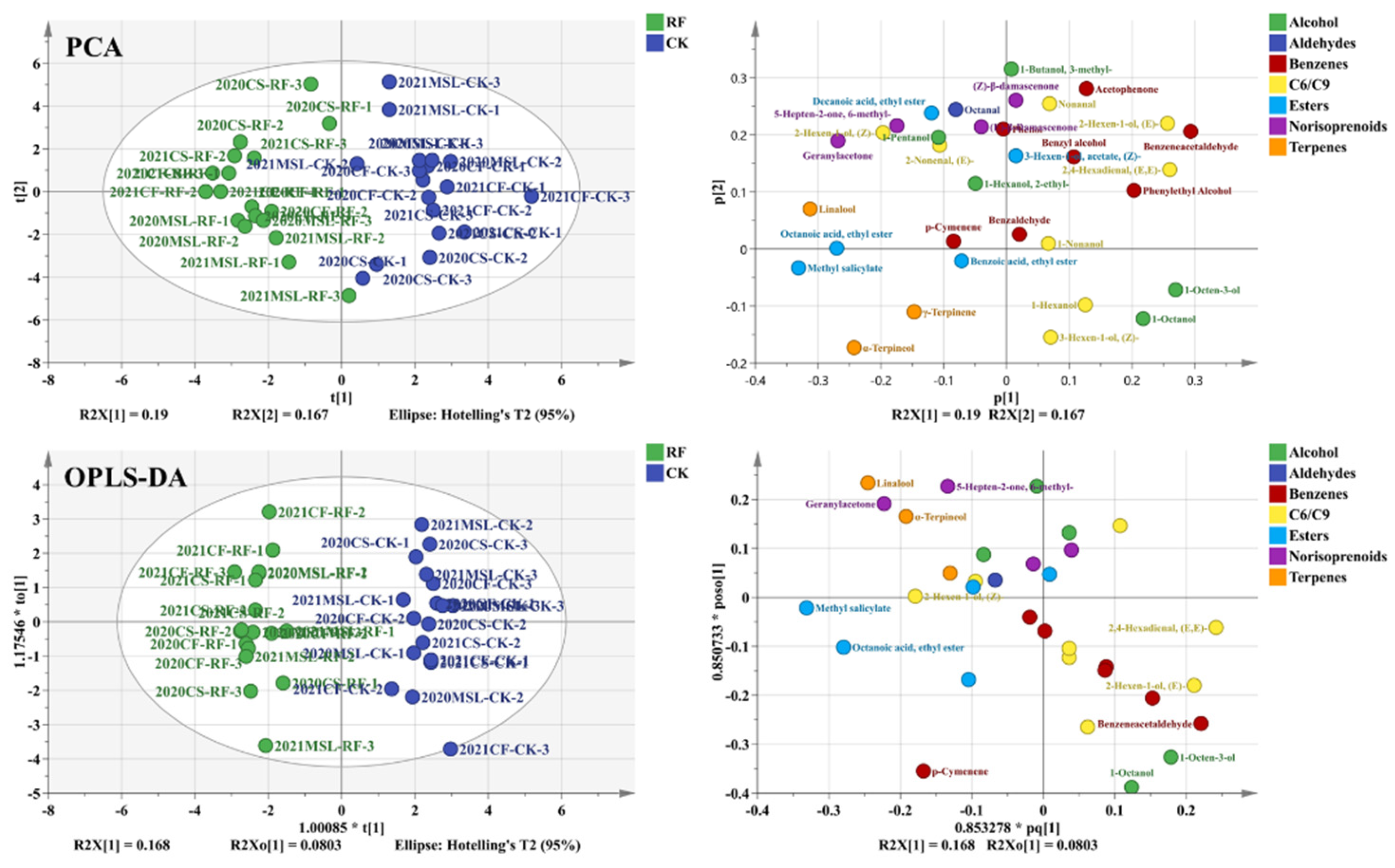

Table 1.
Meteorological data during the 2020 and 2021 growing seasons.
| Year/Month | T-Mean (°C) | T-Max (°C) | T-Min (°C) | RH (%) | PRCP (mm) |
| 2020 | |||||
| May | 21.1 | 27.0 | 15.5 | 53.1 | 49.3 |
| June | 26.9 | 32.7 | 21.2 | 49.8 | 33.7 |
| July | 26.7 | 31.5 | 22.2 | 66.5 | 108.5 |
| August | 26.7 | 31.2 | 22.5 | 72.0 | 167.4 |
| September | 21.8 | 27.2 | 17.0 | 62.5 | 71.1 |
| 2021 | |||||
| May | 20.6 | 26.6 | 14.0 | 43.0 | 16.3 |
| June | 25.7 | 31.4 | 19.7 | 54.0 | 36.5 |
| July | 26.7 | 31.0 | 23.3 | 78.2 | 238.9 |
| August | 25.7 | 30.3 | 21.5 | 70.4 | 141.5 |
| September | 21.9 | 26.4 | 18.4 | 78.1 | 139.8 |
Note: T-Mean, average monthly temperature; T-Max, average monthly maximum temperature; T-Min, average monthly minimum temperature; RH, relative humidity; PRCP, precipitation.
Disclaimer/Publisher’s Note: The statements, opinions and data contained in all publications are solely those of the individual author(s) and contributor(s) and not of MDPI and/or the editor(s). MDPI and/or the editor(s) disclaim responsibility for any injury to people or property resulting from any ideas, methods, instructions or products referred to in the content. |
© 2026 by the authors. Licensee MDPI, Basel, Switzerland. This article is an open access article distributed under the terms and conditions of the Creative Commons Attribution (CC BY) license (http://creativecommons.org/licenses/by/4.0/).
Copyright: This open access article is published under a Creative Commons CC BY 4.0 license, which permit the free download, distribution, and reuse, provided that the author and preprint are cited in any reuse.


