

Submitted:
03 January 2026
Posted:
05 January 2026
You are already at the latest version
Abstract
Background/Objectives: The clinical superiority of rotating-bearing (RB) versus fixed-bearing (FB) total knee arthroplasty (TKA) remains controversial despite the proposed biomechanical advantages of mobile-bearing designs. Objective gait assessment with inertial measurement units (IMUs) provides a measurable view of functional recovery that may complement patient-reported outcome measures (PROMs). This study compared spatiotemporal gait parameters between FB and RB TKA over 24 months. Methods: This prospective longitudinal comparative study enrolled 47 patients undergoing primary unilateral TKA for end-stage knee osteoarthritis. Spatiotemporal gait parameters (gait velocity, cadence, and stance-phase duration) were measured using wireless IMUs (G-WALK system) at 6, 12, and 24 months post-surgery. WOMAC and the 10-point Geriatric Locomotive Function Scale (GLFS-1) were assessed at 12 and 24 months. Group, time, and Group × Time effects were analyzed using linear mixed-effects models. Results: Both groups improved during follow-up, with performance largely plateauing between 12 and 24 months. At 24 months, there were no significant differences between groups in gait velocity (FB 1.17 vs. RB 1.16 m/s; p = 0.65), cadence (99.8 vs. 97.4 steps/min; p = 0.72), or stance-phase duration (59.3% vs. 59.0%; p = 0.82). Group × Time interactions were not significant across gait outcomes. WOMAC and GLFS-1 improved similarly in both groups (p > 0.05). Cadence was inversely correlated with the WOMAC function subscale at 24 months (rho = −0.563; p = 0.036). Conclusions: FB and RB bearing designs showed similar objective gait recovery trajectories and PROM improvements through 24 months after primary TKA, suggesting no intermediate-term functional advantage from bearing design.
Keywords:
1. Introduction
2. Methods
2.1. Study Design and Ethics
2.2. Participants
2.3. Surgical Technique and Rehabilitation
2.4. Gait Analysis Protocol
- Gait Velocity (m/s): The average speed of the subject during the gait cycle.
- Cadence (steps/min): The number of steps taken each minute.
- Stance Phase (%): The percentage of the gait cycle when the foot of the operated limb touches the ground.
2.5. Statistical Analysis
- Between-Group Comparisons: For normally distributed variables, Student’s t-test (assuming equal variances) or Welch’s t-test (assuming unequal variances) was used. For non-normally distributed variables, the non-parametric Mann-Whitney U test was employed. For categorical variables (e.g., sex, laterality), the Chi-square test or Fisher’s exact test was used as appropriate.
- Longitudinal Analysis: To evaluate changes over time within each group, the Wilcoxon signed-rank test was employed for paired comparisons between time points (e.g., 6 vs. 12 months, 12 vs. 24 months), since the data was not consistently normally distributed.
- Correlation Analysis: Spearman’s rank-order correlation was employed to evaluate the monotonic relationship between objective gait parameters (e.g., cadence, velocity) and PROM scores (WOMAC, GFLS-1) because some variables did not follow a normal distribution.
- Subgroup Analysis: The same comparison methods used between groups were applied to stratified subgroups based on age (<65 vs. ≥65 years), BMI (I-II vs. III-IV), and sex (Male vs. Female).
3. Results
3.1. Patient Demographics
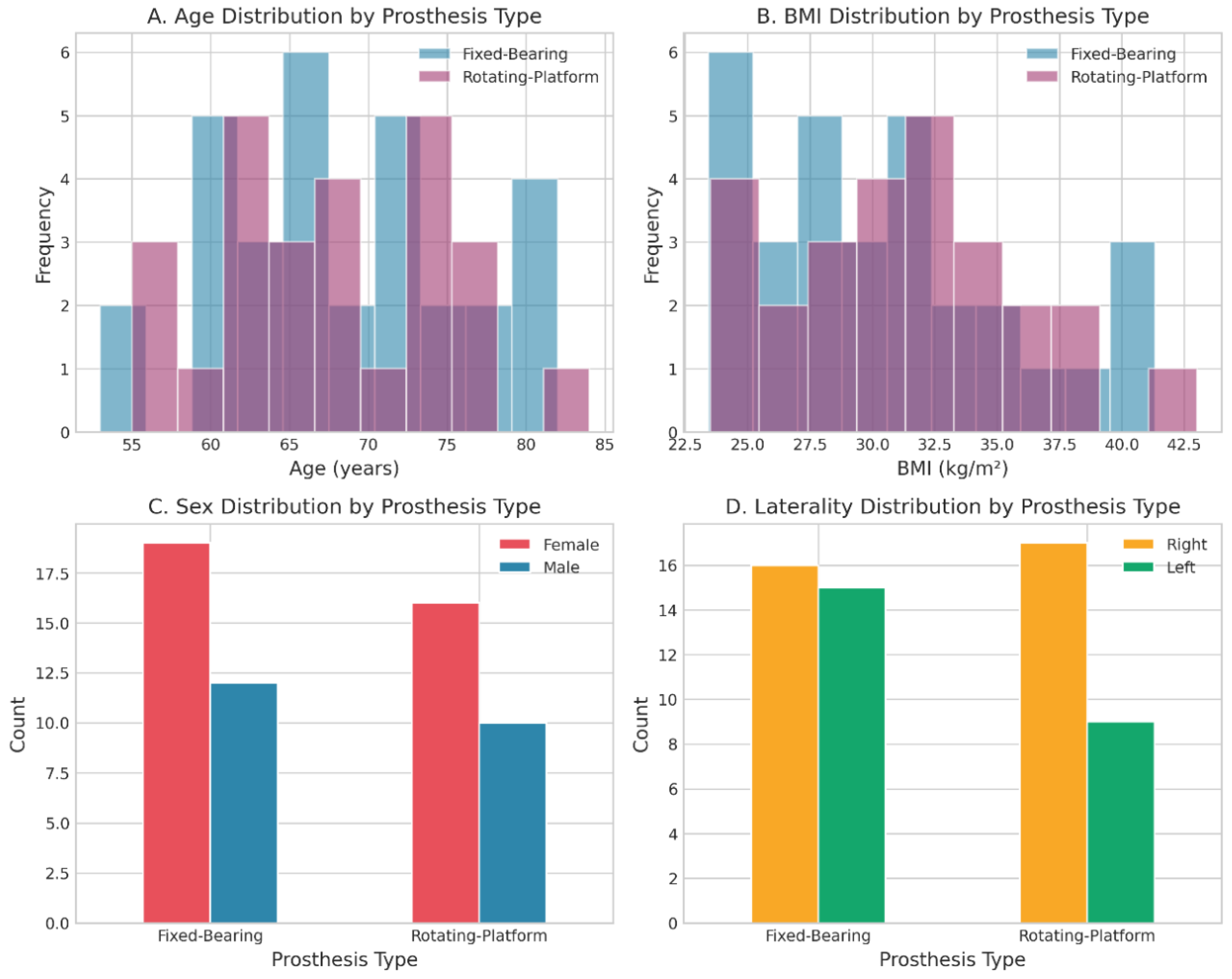

| Variable | Fixed-Bearing (n=31) | Rotating-Platform (n=26) | p-value | Test |
|---|---|---|---|---|
| Age (years) | 68.4 ± 8.2 | 68.0 ± 7.4 | 0.841 | Student’s t-test |
| BMI (kg/m²) | 30.3 ± 5.1 | 31.2 ± 4.8 | 0.498 | Student’s t-test |
| Weight (kg) | 78.9 ± 13.6 | 78.4 ± 13.8 | 0.754 | Mann-Whitney U |
| Height (m) | 1.61 ± 0.10 | 1.59 ± 0.09 | 0.286 | Mann-Whitney U |
| Sex (Female/Male) | 19/12 (61.3% / 38.7%) | 16/10 (61.5% / 38.5%) | 1.000 | Chi-square |
| Laterality (Right/Left) | 16/15 (51.6% / 48.4%) | 17/9 (65.4% / 34.6%) | 0.436 | Chi-square |
| Age group (<65/≥65 years) | 10/21 (32.3% / 67.7%) | 9/17 (34.6% / 65.4%) | 1.000 | Chi-square |
3.2. Between-Group Analysis of Gait Parameters (WALK Test)
- At 6 months, the Fixed-Bearing group showed a slightly longer stride length on the left side compared to the Rotating-Platform group (1.17 ± 0.12 m vs. 1.10 ± 0.12 m, p=0.049).
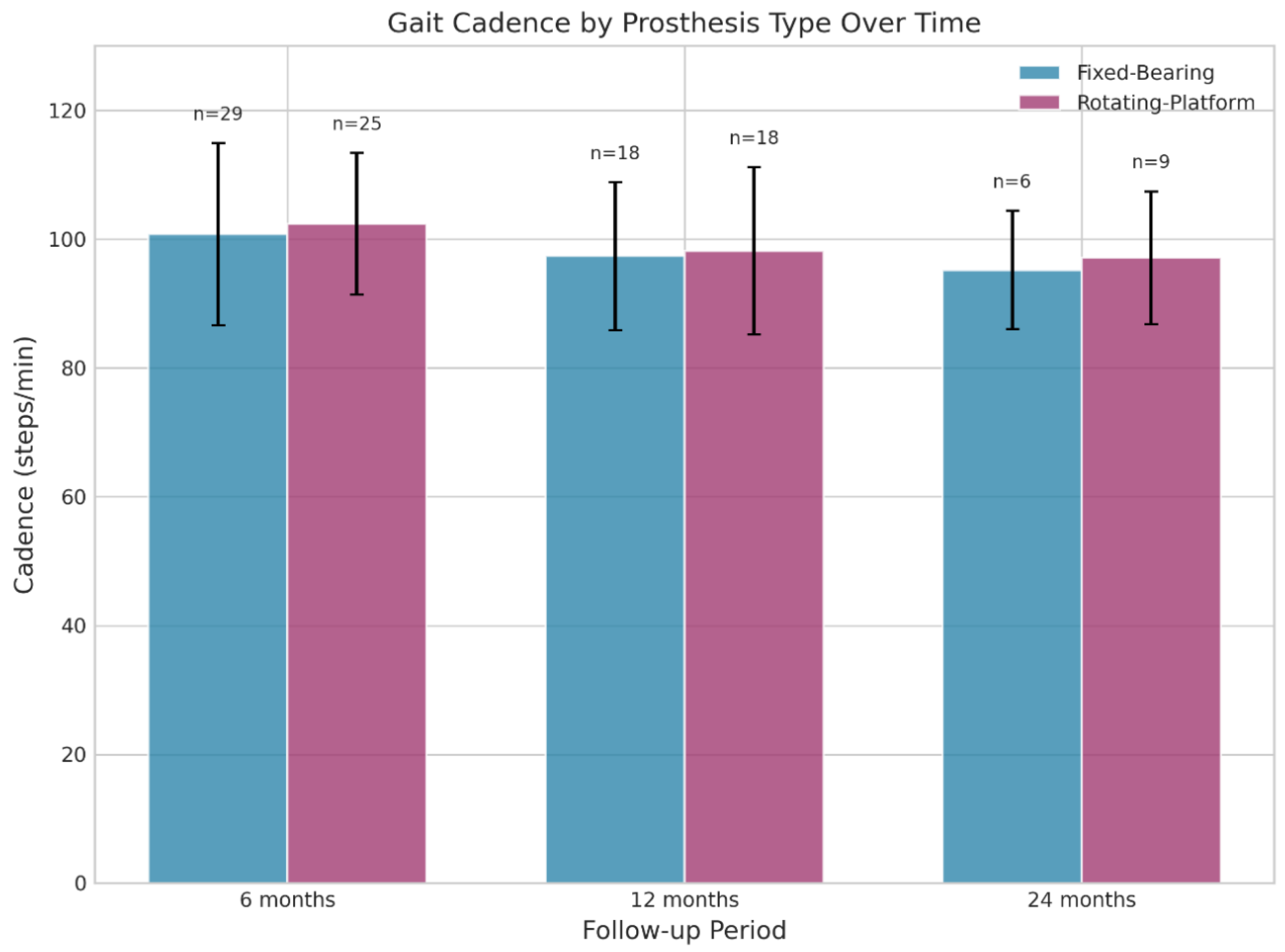
- At 24 months, the Fixed-Bearing group showed a significantly longer Step Length on the right side (52.16 ± 1.58 m vs. 33.18 ± 24.98 m, p=0.038). The high standard deviation in the rotating-platform group at this time point indicates considerable variability. Key parameters, such as gait velocity and cadence, showed no significant differences between the groups at any follow-up time point.
3.3. Between-Group Analysis of PROMs (WOMAC and GFLS-10)
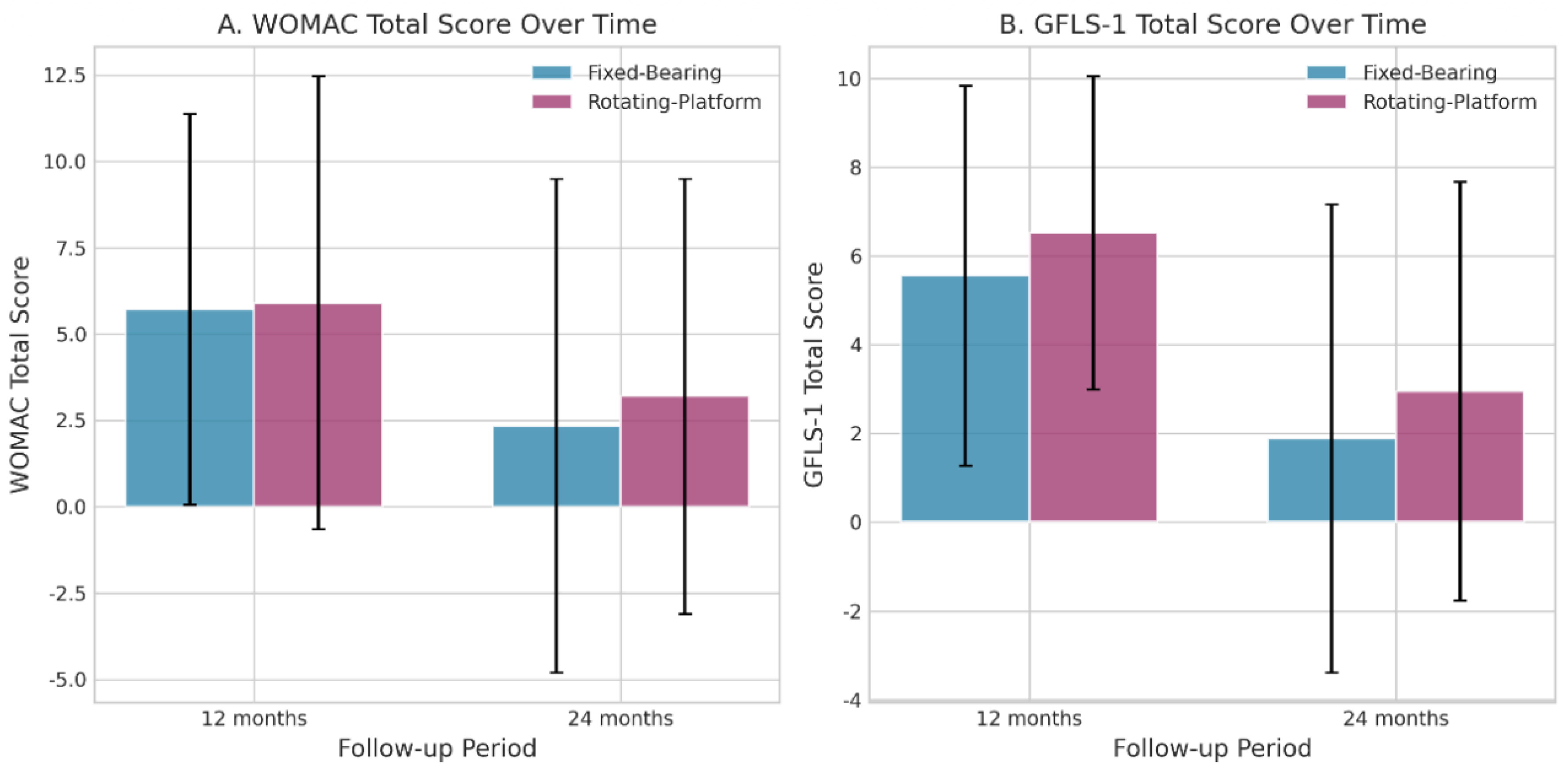
- WOMAC: At 12 months, there were no significant differences in WOMAC subscales (Pain, Stiffness, Function) or total score. At 24 months, a statistically significant difference was observed in the WOMAC Total score, with the Rotating-Platform group reporting slightly better outcomes (lower scores), although the absolute difference was small (Fixed-Bearing: 2.22 ± 7.17 vs. Rotating-Platform: 2.10 ± 4.77, p=0.044).
- GFLS-1: No significant differences in the GFLS-1 total score between the two groups at 12 or 24 months.
3.4. Longitudinal Analysis (Within-Group Changes)
- WALK Test: The Rotating-Platform group showed a significant decrease in cadence from 6 to 12 months (103.8 ± 12.2 vs. 98.2 ± 12.6 steps/min, p=0.038), which may indicate a shift to a more stable, less hurried gait pattern. No other significant long-term changes in key gait parameters were observed.
- PROMs: Both groups exhibited significant improvements in GFLS-1 scores between 12 and 24 months (p=0.030 for Fixed-Bearing, p=0.026 for Rotating-Platform), reflecting enhanced locomotive function. The Fixed-Bearing group also showed a trend toward better WOMAC Total scores from 12 to 24 months (p=0.053).
3.5. Correlation Between Gait Parameters and PROMs
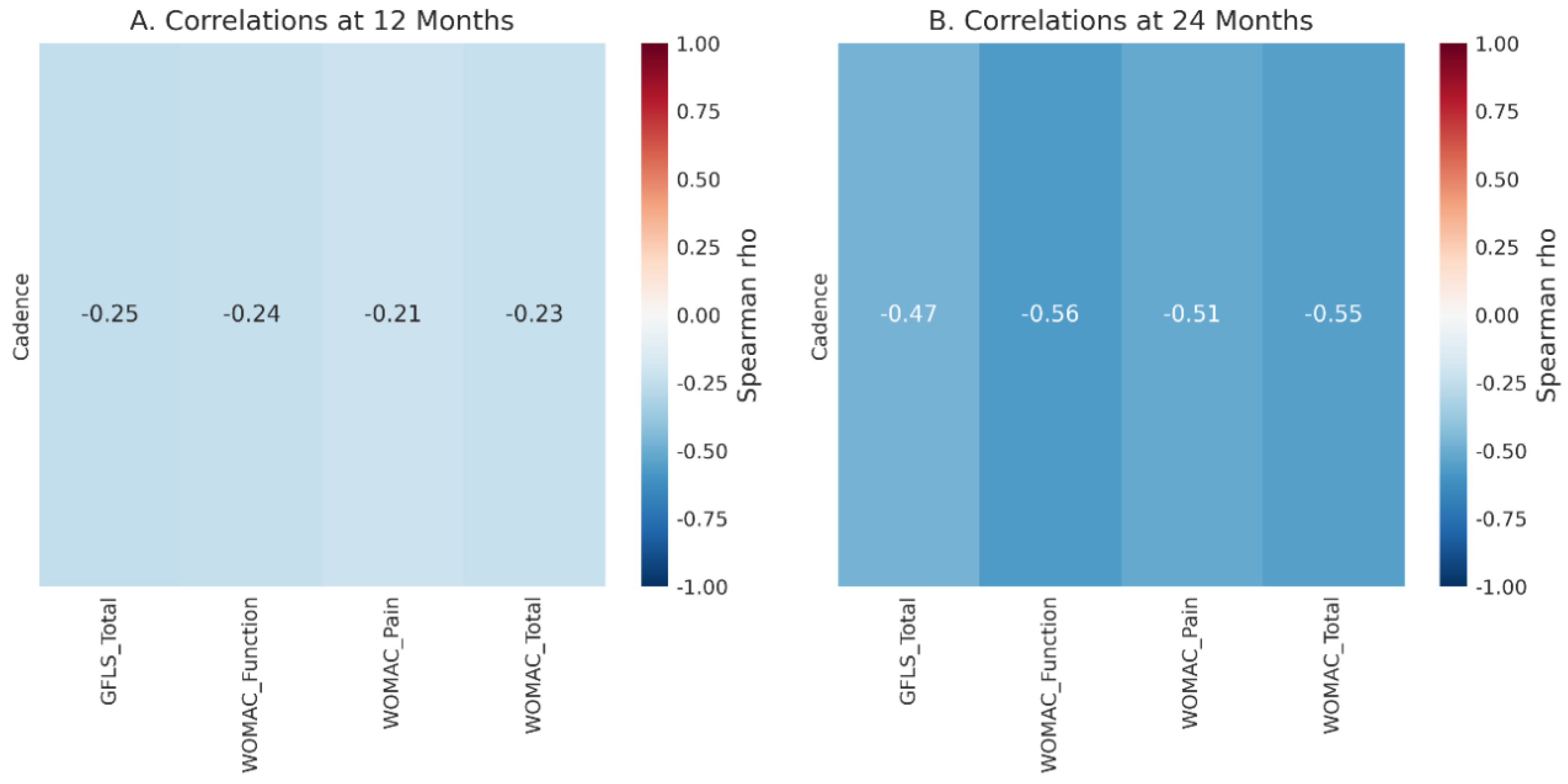
- At 12 months, no significant correlations were observed between key gait parameters (Cadence, Velocity) and PROM scores (WOMAC, GFLS-1).
- At 24 months, a significant moderate negative correlation was found between cadence and WOMAC function (rho = -0.563, p=0.036) and WOMAC total (rho = -0.551, p=0.041). This indicates that patients with better functional scores (lower WOMAC scores) tended to have a lower cadence (i.e., more normal).
3.6. Subgroup Analyses
4. Discussion
5. Conclusions
Author Contributions
Funding
Institutional Review Board Statement
Informed Consent Statement
Data Availability Statement
Acknowledgments
Conflicts of Interest
References
- Sivaram, J., Bothra, H., Kumar, P., Khalid, M. K., Panja, S., Shashank, C., & Satheesh, T. (2024). Long-term Assessment of Functional Outcomes and Quality of Life in Patients Undergoing Total Knee Arthroplasty. Journal of Pharmacy and Bioallied Sciences, 16(Suppl 3), S2552-S2554. [CrossRef]
- Healy, W. L., Della Valle, C. J., Iorio, R., Berend, K. R., Cushner, F. D., Dalury, D. F., & Lonner, J. H. (2013). Complications of total knee arthroplasty: standardized list and definitions of the Knee Society. Clinical orthopaedics and related research, 471(1), 215–220. [CrossRef]
- Killen, C. J., Bourne, R. B., Naudie, D. D., McCalden, R. W., & Howard, J. L. (2020). Minimum twelve-year follow-up of fixed- vs mobile-bearing total knee arthroplasty: Double blinded randomized trial. Journal of Clinical Orthopaedics and Trauma, 11(1), 154-159. [CrossRef]
- Hantouly, A. T., Askar, A. A., & Elsehely, W. (2021). Mobile-bearing versus fixed-bearing total knee arthroplasty: A meta-analysis. European Journal of Orthopaedic Surgery & Traumatology, 31(4), 657-670. [CrossRef]
- Okamoto, N., Nakamura, E., Nishioka, H., Karasugi, T., Okada, T., & Mizuta, H. (2014). In vivo kinematic comparison between mobile-bearing and fixed-bearing total knee arthroplasty during step-up activity. Journal of Arthroplasty, 29(4), 747-751. [CrossRef]
- Kang, K. T., Koh, Y . G., Son, J., Kwon, O. R., Lee, J. S., & Park, K. K. (2018). Comparison of kinematics in cruciate retaining and posterior stabilized total knee arthroplasty using finite element analysis. Journal of Orthopaedic Research, 36(8), 2255-2264. [CrossRef]
- Longo, U. G., Petrillo, S., Franceschetti, E., Scialdoni, A., Pagliai, G., Denaro, V ., & Maffulli, N. (2018). Outcomes of posterior-stabilized compared with cruciate-retaining total knee arthroplasty: A meta-analysis. The Knee, 25(3), 461 -473. Doi: 10.1055/s-0037-1603902.
- Namireddy, S. R., Gill, S. S., Yaqub, Y., & Ramkumar, P. (2024). Computerized Versus Traditional Approaches for Total Knee Arthroplasty: A Quantitative Analysis of Knee Society Score and Western Ontario and McMaster Universities Osteoarthritis Index. Orthopaedic surgery, 16(7), 1530–1537. [CrossRef]
- Ghaffari, A., Clasen, P. D., Kappel, A., Rasmussen, J., Gurchiek, R. D., Kold, S., & Rahbek, O. (2025). Monitoring Gait Recovery After Total Knee Arthroplasty Using Wearable Sensors: Responsiveness of Gait Accelerations. Journal of orthopaedic research: official publication of the Orthopaedic Research Society, 43(12), 2165–2177. [CrossRef]
- Kobsar, D., Charlton, J. M., Tse, C. T. F., Esculier, J. F., Graffos, A., Krowchuk, N. M., Thatcher, D., & Hunt, M. A. (2020). Validity and reliability of wearable inertial sensors in healthy adult walking: a systematic review and meta-analysis. Journal of neuroengineering and rehabilitation, 17(1), 62. [CrossRef]
- Bade, M. J., Zeni, J. A., & Snyder-Mackler, L. (2011). Early high-intensity rehabilitation following total knee arthroplasty improves outcomes. Journal of Orthopaedic & Sports Physical Therapy, 41(12), 932-941. [CrossRef]
- Thwin, L., Chee, B. R. K., Yap, Y. M., & Tan, K. G. (2024). Total knee arthroplasty: does ultra-early physical therapy improve functional outcomes and reduce length of stay? A retrospective cohort study. Journal of orthopaedic surgery and research, 19(1), 288. [CrossRef]
- Soulard, J., Vaillant, J., Balaguier, R., & Vuillerme, N. (2021). Spatio-temporal gait parameters obtained from foot-worn inertial sensors are reliable in healthy adults in single- and dual-task conditions. Scientific Reports, 11(1), 9156. [CrossRef]
- Lin, S., Evans, K., Hartley, D., Morrison, S., McDonald, S., Veidt, M., & Wang, G. (2025). A Review of Gait Analysis Using Gyroscopes and Inertial Measurement Units. Sensors, 25(11), 3481. [CrossRef]
- Szczypiór-Piasecka, K., Szpaderska, A., Zaborowska-Sapeta, K., Kiwerski, J. M., Szymczuk, J., & Banach, M. (2025). The temporal-spatial parameters of gait after total knee arthroplasty. Journal of Clinical Medicine, 14(13), 4548. [CrossRef]
- Yu, X., Zhuang, R., & Jin, P. (2024). Evaluation of the efficacy after Total Knee Arthroplasty by Gait analysis in patients with Knee Osteoarthritis: a meta-analysis. Journal of orthopaedic surgery and research, 19(1), 612. [CrossRef]
- White, D. K., & Master, H. (2016). Patient-Reported Measures of Physical Function in Knee Osteoarthritis. Rheumatic diseases clinics of North America, 42(2), 239–252. [CrossRef]
- Wylde, V., Beswick, A. D., Dennis, J., & Gooberman-Hill, R. (2017). Post-operative patient-related risk factors for chronic pain after total knee replacement: a systematic review. BMJ open, 7(11), e018105. [CrossRef]
- Seichi, A., Hoshino, Y., Doi, T., Akai, M., Tobimatsu, Y., & Iwaya, T. (2012). Development of a screening tool for risk of locomotive syndrome in the elderly: the 25-question Geriatric Locomotive Function Scale. Journal of orthopaedic science : official journal of the Japanese Orthopaedic Association, 17(2), 163–172. [CrossRef]
- Alves, J. A. P., Tavares, D. R. B., Okazaki, J. E. F., Arbex, M. C. F. B., Galiano, J. C., Carmo, S. N., & Santos, F. C. (2022). Algorithm for screening and management of locomotive syndrome in elderly individuals and development of a short version of the 25-question Geriatric Locomotive Function Scale-Portuguese. Einstein (São Paulo), 20, eAO6349. [CrossRef]
- Harvey, A., Kohli, S., Al-Nasser, S., & Noroozi, S. (2024). Gait analysis of a kinematic retaining implant for Total knee replacements during walking and running. Journal of orthopaedics, 56, 1–5. [CrossRef]
- Wu, X., Chu, L., Xiao, L., He, Y., Jiang, S., Yang, S., & Liu, Y. (2017). Early Spatiotemporal Patterns and Knee Kinematics during Level Walking in Individuals following Total Knee Arthroplasty. Journal of healthcare engineering, 2017, 7056469. [CrossRef]
- Wang, R. S., Lee, J. Y., Kanta, M. A., Liow, L. M. H., Chen, J. Y., Chang, P. C. C., & Yeo, S. J. (2025). Posterior-stabilized vs cruciate-retaining TKA in osteoarthritic patients with genu recurvatum: a 2-year comparative analysis. BMC Musculoskeletal Disorders, 26(1), 1029. [CrossRef]
- Warth, L. C., Ishmael, M. K., Deckard, E. R., Ziemba-Davis, M., & Meneghini, R. M. (2017). Do medial pivot kinematics correlate with patient-reported outcomes after total knee arthroplasty? The Journal of Arthroplasty, 32(8), 2411–2416. [CrossRef]
- Kendall, J., Pelt, C. E., Imlay, B., Yep, P., Mullen, K., & Kagan, R. (2022). Revision Risk for Total Knee Arthroplasty Polyethylene Designs in Patients 65 Years of Age or Older: An Analysis from the American Joint Replacement Registry. The Journal of bone and joint surgery. American volume, 104(17), 1548–1553. [CrossRef]
Disclaimer/Publisher’s Note: The statements, opinions and data contained in all publications are solely those of the individual author(s) and contributor(s) and not of MDPI and/or the editor(s). MDPI and/or the editor(s) disclaim responsibility for any injury to people or property resulting from any ideas, methods, instructions or products referred to in the content. |
© 2026 by the authors. Licensee MDPI, Basel, Switzerland. This article is an open access article distributed under the terms and conditions of the Creative Commons Attribution (CC BY) license (http://creativecommons.org/licenses/by/4.0/).