

Submitted:
31 December 2025
Posted:
02 January 2026
You are already at the latest version
Abstract
The aim of this study was to estimate the historical exposure to a selection of polybrominated diphenyl ethers (PBDEs) and Dechlorane Plus (DP) concentrations and the potential sociodemographic and lifestyle associated factors. Study population (n=134) was a subcohort of GraMo Study, recruited in 2003-04 in Granada (Spain). Information on potential exposure associated factors was collected by face-to-face interviews and clinical records review. Historical exposure was estimated by analyzing adipose tissue concentrations of 12 PBDEs and the 2 DPs, by means of gas chromatography coupled to mass spectrometer. Data analyses included multivariable linear regression analyses. Median (Interquartile Ranges) pollutant concentrations ranged from 0.13 (0.09, 0.23) ng/g lipid for BDE-99 to 1.34 (0.92, 2.43) ng/g lipid for BDE-153. The body mass index was inversely associated with anti- and syn-DP, BDE-153, -183, and -197 concentrations. Males exhibited higher levels of BDE-28, -47, -153 and -209 than females. Compared to non-manual workers, manual workers exhibited increased BDE-154, anti- and syn-DP concentrations, but lower BDE-28 levels. These findings highlight the elevated prevalence of PBDE/DP exposure and the heterogeneous exposure patterns observed across the study population. Further research is warranted to elucidate the long-term implications for human health.
Keywords:
adipose tissue
; persistent organic pollutants
; flame retardants
; polybrominated biphenyls
; dechlorane plus
; life style
; sociodemographic factors
1. Introduction
Persistent organic pollutants (POPs) are a myriad of chemicals that share a high resistance to degradation. As a result, they have a high potential for bioaccumulation in living organisms and biomagnification over the food chain [1,2]. Ingestion, dermal contact and inhalation are considered the main exposure routes in the general population [2,3,4]. Some POPs, such as Polybrominated diphenyl ethers (PBDEs) and Dechlorane plus (DP) are frequently used as flame retardants in a variety of products such as textiles, plastics, construction materials or electronics [5,6,7].
PBDEs are a group of 209 congeners (designated BDE-1 to BDE-209) that have been widely used since 1970s. PBDEs have been produced in different commercial mixtures, including Penta-BDE, Octa-BDE and Deca-BDE [8,9]. Penta-BDE is predominantly composed of lower-brominated BDE congeners, with BDE-47 and -99 accounting for 38% and 49%, respectively; Octa-BDE refers to a mixture of PBDEs with 6-10 bromine substitutions (e.g., BDE-183); and Deca-BDE is composed primarily of BDE-209 (90%) [10]. DP was introduced in the market in the 1960s and it was used as an alternative to PBDEs and organochlorine pesticide Mirex [6,11]. DP was commercialized as a mixture of their two stereoisomers, being predominant anti-over syn-DP [12,13].
Currently, most of the abovementioned chemicals have been listed for global elimination on different amendments of the annex A of the Stockholm Convention in 2009, 2017, and 2023, and regulated by the UE [14,15]. However, these pollutants are still frequently detected in the general populations [4,16,17], with some of them considered as endocrine disrupting chemicals (EDC), i.e., xenobiotics that can interfere with the endocrine system [18]. Frequent human exposure to low doses of EDCs has been linked to an elevated risk of developing several chronic non-communicable diseases, such as cancer, thyroid disease, as well as reproductive, neurobehavioral, and developmental disorders [19,20,21,22,23,24,25].
Considering the ubiquity of PBDEs/DP, human biomonitoring has emerged as a crucial tool to accurately evaluate individual chemical exposures, accounting for most exposure sources [26]. In addition, human biomonitoring allows the identification of trends in the exposure levels of the population [27]. In this regard, serum has been primarily used as the exposure matrix in most human biomonitoring studies [28,29,30,31,32,33]. Despite the challenges in the sample collection, adipose tissue has been demonstrated to provide relevant information related to long-term exposure to moderately-to-high lipophilic chemicals [3,34,35,36]. Thus, adipose tissue may help identify population groups with elevated accumulated exposure, thereby contributing to the adequate design of effective public health campaigns.
Based on the abovementioned, the aim of this study was to estimate historical exposure to a selection of PBDEs and DP in a subsample of a Spanish adult cohort by analyzing their residues in adipose tissue samples, as well as to identify the potential sociodemographic and lifestyle factors associated.
2. Materials and Methods
2.1. Study Design and Population
This cross-sectional study was conducted on a subcohort of the GraMo cohort (Granada province, Southern Spain), which aims to identifying environmental factors affecting the development of several chronic diseases. A thorough description of GraMo cohort has been performed elsewhere [4,5,6,7,8]. Briefly, participants were recruited between July 2003 and June 2004 from two public hospitals: the Clínico San Cecilio University Hospital in the city of Granada and the Santa Ana Hospital in the coastal town of Motril. Granada province includes rural, semirural and urban areas. The area of Granada city (238,292 inhabitants in 2004) and its suburbs are economically based in the service sector and light industry; while Motril (55,078 inhabitants in 2004) and its semirural area in the Mediterranean coast are surrounded by a great presence of greenhouses and other agricultural activities [37,38]. These two areas are separated by approximately 70 km. Participants were selected from patients who underwent non-cancer-related surgeries. The inclusion criteria were as follows: age older than 16 years, no cancer diagnosis, no hormonal disease related to the hypothalamic axis, no hormone therapy, and at least 10 years living in the referral areas of the recruiting hospitals. 387 of the 409 people contacted (94.6%) agreed to participate and provided biological samples. 179 participants provided sufficient biological sample for PBDEs/DP analysis, among them 134 (74.96%) had complete information about sociodemographic and lifestyle factors and constituted the study population in the present work (Figure 1).
Although the data collection for this cross-sectional study was conducted in 2003-04, the analysis of PBDEs and DP was carried out in 2024 following the subsequent funding received from the Instituto de Salud Carlos III, Spain (PI20/01568). The original study protocol and ethical aspects were approved by the Ethics Committee of each participating hospital in 2002, and the current study received approval from the Provincial Ethics Committee of Biomedical Research of Granada (Comité de Ética de Investigación Clínica de Granada, 8/2016). All participants included in this study were duly informed and signed the corresponding informed consent.
2.2. Laboratory Analyses
The concentrations of 12 brominated flame retardants [bromo diphenyl ether (BDE) -28, -47, -99, -100, -153, -154, -183, -196, -197, -203, -209 and 1,3,5-tribromo-2-[2-(2,4,6-tribromophenoxy) ethoxy] benzene (BTBPE)], and the 2 DP isomers (syn-DP and anti-DP) were analyzed in adipose tissue samples. 5-10g adipose tissue samples were collected during each participant´s surgery. The samples were immediately coded and frozen at -80°C until chemical analyses.
The sample preparation procedure was adapted from others previously described [39,40]. Briefly, Adipose tissue samples (in general, between 150-250 mg) were spiked internal standard (BDE 79 and BDE138) and after 30 min equilibration time, transferred to a 10 ml glass tube for extraction. In order to ensure complete disintegration of the sample and facilitate deeper penetration of the solvents [41], adipose tissue was in the first stage, crushed and homogenized with an Ultra-Turrax® (T25, IKA) using 4 mL of n-hexane:Acetone (1:1) as solvent extraction. Then ultrasound-assisted extraction was carried out in an ultrasonic bath for 15 min at 40 ºC. The extract obtained after centrifugation (4000 rpm, 4 °C, 10 min) was evaporated at 40 ºC with a gentle flow of nitrogen up to 0.5 mL. The extract was cleaned in a multilayer silica gel column, packed in a 6 mL empty glass column and formed by 0.8 g of activated silica gel, 3 g of silica modified with sulfuric acid (44%, w/w), and 0.3 g of anhydrous sodium sulphate. Analytes were eluted with 8 mL of n-hexane and 6 ml of dichloromethane (DCM) (1:1, v/v). The extract was evaporated to dryness and finally reconstituted with of 100 µL of 13C-labeled BDE-209 solution in isooctane.
Based on previous study [42], instrumental analysis was performance by gas chromatography (GC) (HP 7890A Series, Hewlett-Packard, Palo Alto, CA) equipped with a multimode inlet (MMI) and coupled to mass spectrometer operating in negative chemical ionization (NCI, 5975C Agilent). Thus, 5 µL were injected in large volume injection (LVI) and chromatography separation was carried out by DB-5MS column (15 m x 0.25 mm x 0.10 µm, Agilent). The GC oven temperature was programmed from 80 ºC (held for 2.6 min) to 200 ºC at 30 ºC/min, and then up to 275 ºC at 5 ºC/min, and finally to 315 ºC (6min) at 50ºC/min. Helium was used as the carrier gas, ramping the flow from 1.5 mL/min (19.8 min) up to 4.5 mL/min (9 min) to avoid BDE 209 column degradation. Mass spectrometer used methane as reagent gas and 70eV of electron energy. Transfer line, quadrupole, and ion source temperatures were set at 300, 150, and 150 ºC, respectively. Quantification was performed in selected ion monitoring (SIM).
Quantification based on nine-point calibration curves from 0.05 to 20.00 ng/mL, except to PBDE 209, i.e. 0.5–200 ng/mL, with satisfactory linearity (R2 > 0.996) was obtained. For internal quality control purposes, procedure blanks and quality controls at 0.1 ng/mL and 1 ng/mL (1 and 10 ng/mL for PBDE 209) processed in the same way as the samples were included in every analytical series i.e. twelve samples. As confirmation criteria, retention times and the maintenance of the two selected ions ratio within 15% of the standard value were used.
The lipid content in adipose tissue samples was quantified by gravimetry, as reported Rivas et al. [43], which was used for normalizing PBDE/DP concentrations, as reported by Phillips et al. [44]. The final concentrations were then expressed as nanograms per gram of lipid (ng/g lipid).
Limits of quantitation (LOQ) for the PBDE congeners, BTBPE and DPs ranged from 0.0029 to 0.0785 ng/g lipid (Supplementary Material, Table S1). The chromatography laboratory at the Centro Nacional de Sanidad Ambiental has participated in the HBM4EU QA/QC program, resulting in its qualification as EU laboratory for the analysis of PBDE and DPs in human serum.
2.3. Sociodemographic, Lifestyle and Clinical Information
Sociodemographic, dietary habits, occupation, perceived health status and chemical exposure information were gathered from face-to-face interviews by trained staff during the participants’ hospital stay at recruitment. Dietary habits were assessed using a semi-quantitative questionnaire of food consumption, including the following food groups: meat, cold meats, fats, fish, eggs, dairy products (excluding milk and cheese), milk, cheese, vegetables, legumes, fruits, bread, and pasta. A participant was considered as smoker at any level of daily tobacco consumption (≥ 1 cigarette/week), and alcohol consumer at any level of weekly alcohol consumption (≥ 1 glass/week). Body mass index (BMI) was expressed as weight/height squared (kg/m2). Participants’ area of residence was classified as urban (> 100,000 inhabitants), semi-rural (10,000-100,000 inhabitants), or rural (< 10,000 inhabitants). Following the Goldthorpe social class classification [45], participants were assigned to six occupational categories. Because of sample size limitations, social classes I–III were grouped as manual workers, and social classes IV–V as non-manual workers.
2.4. Statistical Analyses
Descriptive analyses included absolute values and percentages for categorical variables; mean, standard deviation (SD) and median and interquartile range (IQR, 25th and 75th percentiles) for continuous variables. Chemical concentrations were reported in ng/Kg lipid for clarity in the descriptive analysis, whereas these variables were entered as ng/g lipid in the regression models to improve the interpretability of the model´s coefficients.
For PBDEs and DP with quantification rates above 70%, values below the LOD were imputed by assigning a random number between 0 and the LOQ. BTBPE, BDE-196, and BDE-203 were excluded from analyses because their quantification rates were below 70%. Concentrations were natural log-transformed to relax the linearity assumption. Consequently, the beta coefficients (β) reflect the average change in the natural log-transformed pollutant concentration (ng/g lipid) associated to a 1-unit increase in continuous independent variables. For categorical variables, β indicates the average difference in the log-transformed concentrations between that category and the reference category. Associations of sociodemographic, lifestyle, occupation and perceived chemical exposure (independent variables) with PBDEs and both DP isomers (dependent variables) were identified using multivariable linear regression with manual step forward-backward model variable selection. First, variables were selected based on the available literature and biological plausibility as potential factors of PBDEs/DP exposure [46,47,48,49,50]. Then, in the forward stage, all new independent variables with a p-value ≤ 0.20 were included in the same multivariable model. Finally, in the backward stage, all independent variables with p-value ≥ 0.10 and/or reduction or no-significant increase of Bayesian information criterion (BIC) were excluded.
3. Results and Discussion
3.1. Description of the Study Population and Adipose Tissue Pollutant Concentrations
The main characteristics of the study population are summarized in Table 1. This subcohort included slightly fewer females than males. The mean BMI in our cohort was 27.9 kg/m²; with no relevant difference among sexes. This was higher than the average BMI reported for the Andalusian population in 2003 [55], likely because our hospital-based cohort included participants with obesity-related conditions. The main source of adipose tissue samples was hernia surgery, followed by other surgeries and gallbladder surgeries. In our population, approximately one third of the participants were smokers at recruitment, and 69.9% of males and 29.5% of females reported being alcohol consumers. These figures are similar to those reported for the Andalusian population [55]. In our study, manual workers were predominant, while a higher proportion of females (but not males) resided in semirural areas vs urban and rural areas.
Adipose tissue PBDE/DP concentrations are summarized in Table 1. Males showed consistently higher levels of PBDEs than females. PBDE/DP detection frequencies ranged from 82.8% (BDE-209) to 100.0% (BDE-99, -153, -154, -183 and anti-DP) (Supplementary material, Table S2). In accordance with previous studies, BDE-153 was the predominant congener [9,31,33,56,57,58,59,60,61,62]. This finding may be explained by the following: (i) increased relative exposure to BDE-153 compared to other PBDEs, and (ii) slower metabolism in humans [9,31]. In fact, lower brominated BDEs, such as BDE-153, have been found to have longer half-lives and are therefore more likely to accumulate at higher concentrations in human tissues. Congruently, in our study, DBE-209, with a relatively high degree of bromination, was found at the lowest detection rates [63].
No differences in bioaccumulation were observed between the two DP isomers. In our study, anti-DP was the predominant form with an average anti-DP fraction (anti-DP/total DP) of 0.75 ± 0.11 (data not shown), consistent with the reported proportions in commercial DP products ranging between (0.60-0.80) and in Brasseur et al observations [12].
3.2. Factors Associated with Adipose Tissue PBDEs and DP Concentrations
As described in the materials and methods section, we fitted a model for each individual pollutant by entering all the variables found relevant during its individual backward selection. For clarity purposes, each model`s data are split into 3 tables, corresponding to sociodemographic (Table 2), perceived exposures (Table 3) and dietary (Table 4) variables.
Regarding sociodemographic and anthropometric characteristics (Table 2), males showed higher BDE-28, -47, -153 and -209 adipose tissue concentrations than females. Our results are in agreement with those from previous studies [33,64,65,66,67,68,69], since the observed lower levels of PBDEs in females may be the result of a clearance process during pregnancy and breastfeeding, as Bramwell et al. hypothesized [33]. Concretely, internal flame retardants’ levels may be reduced during breastfeeding due to the high affinity of flame retardants for lipid-rich structures. In addition, PBDEs cross the placenta and can selectively accumulate in the fetus and the umbilical cord [70,71]. These processes are consistent with previous studies that have detected flame retardants in breast milk [9,72,73], and umbilical cord blood [71,74,75,76].
The higher PBDE concentrations in males vs. females in our study population may be related to lifestyle differences, as previously observed for other POPs in GraMo cohort [37,77,78]. Indeed, in our study, males reported an increased consumption of fatty food from animal origin, such as pork (23.3% vs. 6.6%), while chicken consumption was predominant in females (41.0% vs. 26.0%). Additionally, 20.55% of males, and 1.64% of females acknowledge involvement in industrial activities such as operators of installations, machinery and assemblers, craftsmen and, workers in industry construction and mining.
Interestingly, age was inversely linked to BDE-47 and -99. These findings are consistent with prior studies reporting inverse associations of age with BDE-47 and -99, with lower levels for middle-aged adults compared to younger or older adults [79,80]. The explanation may be the relatively recent manufacture and environmental release of PBDEs, and consequently, younger individuals have therefore spent most of their lives exposed to higher environmental concentrations, whereas older adults were largely unexposed for much of their lives [79,80].
BMI was negatively associated with BDE-153, -183, -197 and syn- and anti-DP (Table 2). A sensitivity analysis entering BMI categorized in three categories as < 25 kg/m2, 25-30 kg/m2 and ≥ 30 kg/m2, corroborated this negative trend (data not shown). Similar inverse associations for BDE-153 were described in previous studies using serum as the matrix for exposure assessment [30,33,67,81]. This negative trend may be attributable to a dilution effect of PBDEs in obese individuals as initially proposed by Wolff et al. [30,82]. This might be particularly relevant in our populations, with 39,6% of overweight and 27,6% of obese individuals.
Manual workers showed lower BDE-28 and higher BDE-154 and anti-DP and syn-DP concentrations compared to non-manual workers (Table 2). These findings are consistent with previous studies identifying specific manual activities such as industrial manufacturing industry worker, construction or e-waste recycling sites have been identified as sources of PBDEs [83,84].
Regarding perceived exposures (Table 3), higher BDE-28, -47, -99, -100 and -153 levels were associated with perceived exposure to paints. Furthermore, elevated BDE-154 and -183 concentrations were associated with perceived exposure to solvents. In addition, some paints, which often contain PBDEs in their composition [7,85,86], have shown positive correlations with these pollutants as reported in a Korean study that used umbilical cord blood as biological matrix [87].
Lower concentrations of BDE-47, -153, -154 were associated with perceived exposure to toxic metals (Table 3). Toxic metals can co-occur in the same PBDE sources such as recycling sites or industrial activities [88]. Thus, perceived exposure to toxic metals does not appear to be a useful indicator of highly PBDE/DP exposed individuals. The negative associations observed may be explained by greater implementation or adherence to safety measures among individuals who perceive themselves as being at risk.
Higher BDE-99 levels were observed in former smokers but not in current smokers (Table 3). Lower BDE-209 levels were associated with alcohol consumption. Both tobacco and alcohol can upregulate cytochrome P450 family [89,90,91,92], particularly tobacco consumption induces CYP2B6 [93], which is thought to be the main via of metabolization of BDE-99 [94,95,96]. Thus, smoking would be expected to enhance metabolic clearance of BDE-99. However, we did not observe reduced BDE-99 levels among current smokers. Additionally, BDE-209 metabolic pathways remain incompletely understood [94,97]. We cannot provide a definitive explanation and cannot exclude the possibility that this finding arose by chance.
Regarding dietary variables (Table 4), higher BDE-197 levels were associated with oily fish consumption and elevated BDE-183 and -197 with consumption ≥ 2 portions/week. This may be due to the fact that fish has previously been identified as the main dietary source of PBDEs [50,98,99]. BDE-28 was also linked to meat consumption frequency larger than 2 portions per week. This is consistent with previous epidemiological studies that have associated meat consumption with PBDE levels [50,100,101]. However, in our population, an inverse association was found for BDE-99 and eggs (Table 4). This finding is unexpected, since BDE-99 has been reported as the dominant congener in eggs [102]. We cannot offer a clear explanation for this inverse association, which can even be a chance finding caused by the exploratory design of this study.
Other fatty products from animal-origin, such as dairy products, have been established as source of organic pollutants [103]. In our study, higher BDE-153 concentrations were associated with cheese consumption and daily milk consumption.
In our study, lower BDE-153 levels were associated with vegetable consumption. This is consistent with prior research reporting lower PBDE levels among individuals following vegetarian versus omnivorous diets [100]. In addition, consumption of dietary fiber, characteristic of plant-based diets, may reduce the intestinal absorption of organic pollutants [104,105].
Nonetheless, higher BDE-197 concentrations were positively linked with fruit consumption. Other congeners have been related to fruit through industrial processes such as “hydro-cooling” which involves the use of BDE-209 coated pallets [7,106]. Nevertheless, we cannot exclude the possibility that this finding arose by chance.
This study has potential limitations to take into account in the interpretation of the results. Firstly, the study size, and especially the sex-stratified subsamples, was relatively small, although it was sufficient to detect trends that warrant confirmation in larger cohorts. Secondly, although our hospital-based design may limit generalizability; there is no clear that our participants’ characteristics differ substantially from those of the broader population. Of note, PBDEs and DP levels are unlikely to be influenced by our heterogeneous selection criteria (including conditions such as gallbladder disease, varicose veins, or hernias). The large number of analyses increases the risk of false positives a cause to multiple comparisons. Nevertheless, this study is exploratory and aims to identify population subgroups with higher PBDE/DP exposure; therefore, our findings will require confirmation in future studies.
This study has important strengths. As previously mentioned, the use of adipose tissue for exposure assessment provides a highly accurate measure of long-term PBDE accumulation. This matrix also reduces intra-sample variability compared to other biological specimens such serum, thereby minimizing random error and lowering the sample size needed to detect associations [34]. Furthermore, adipose tissue might be particularly relevant in hospital-based studies conducted in countries with universal public healthcare systems such as Spain, where routine clinical or surgical procedures provide opportunities to collect adipose tissue samples from large and heterogeneous population samples. In addition, this study was performed within the well-characterized GraMo cohort, which provides detailed sociodemographic, lifestyle, metabolic, and exposure information for participants. Notably, our study is among the largest to utilize adipose tissue for PBDE/DP exposure assessment in adults. Importantly, our chemical analyses covered a wide range of PBDE congeners and both stereoisomers of DP, with concentrations quantified using validated, and high-quality analytical methods that reduce exposure misclassification.
4. Conclusions
Our study revealed that exposure to PBDEs and DP in the GraMo cohort, as estimated by analysis of adipose tissue samples, was ubiquitous in the study population. Sex, BMI, occupational social class, self-reported exposure to paints and solvents, and dietary habits (particularly fatty food from animal origin) were found as the main factors of the exposure. These results might help further targeted public-health interventions to reduce exposure.
Supplementary Materials
The following supporting information can be downloaded at: https://www.mdpi.com/article/doi/s1, Table S1: Limit of quantification of PBDEs/DP; Table S2: Baseline detection of PBDEs/DP of study population.
Author Contributions
Eduardo Linares-Ruiz, formal analysis, investigation and Writing – original draft; Celia Pérez-Díaz, data curation and writing – review & editing; Francisco M. Pérez-Carrascosa, data curation and writing – review & editing; Sara Gonzalez, investigation, writing – review & editing; Juan José Ramos, investigation, writing – review & editing; Inmaculada Salcedo-Bellido, conceptualization, supervision and writing – review & editing; Juan P. Arrebola, conceptualization, funding acquisition, supervision and writing – review & editing.
Funding
Research was funded by research grants from the CIBER de Epidemiología y Salud Pública (CIBERESP), Instituto de Salud Carlos III, Spain (PI16/01858), co-funded by the European Union (FEDER). Celia Pérez-Díaz is under contract PFIS (FI21/00269, Predoctoral Health Research Training Contracts, Instituto de Salud Carlos III, Spain).
Institutional Review Board Statement
The study was conducted in accordance with the Declaration of Helsinki, and approved by ethics committee of each hospital and subsequently by ethics committee “the Provincial Ethics Committee of Biomedical Research of Granada (Comité de Ética de Investigación Clínica de Granada)”, (8/2016).
Informed Consent Statement
Informed consent was obtained from all subjects involved in the study.
Data Availability Statement
The data presented in this study are available on request from the corresponding author.
Acknowledgments
These findings would not have been possible without the generous support of the staff at Santa Ana and San Cecilio Hospitals and the participation of our study volunteers. This article will form part of the doctoral thesis developed by Eduardo Linares-Ruiz in the context of the “Programa de Doctorado de Medicina Clínica y Salud Pública” of the University of Granada (Spain).
Conflicts of Interest
The authors declare no conflicts of interest. The funders had no role in the design of the study; in the collection, analyses, or interpretation of data; in the writing of the manuscript; or in the decision to publish the results.
Abbreviations
The following abbreviations are used in this manuscript:
| BDE | Bromodiphenyl ether |
| BIC | Bayesian information criterion |
| BMI | Body mass index |
| BTBPE | 1,3,5-tribromo-2-[2-(2,4,6-tribromophenoxy) ethoxy] benzene |
| CI | Confidence interval |
| DMC | Dichloromethane |
| DP | Dechlorane plus |
| EDC | Endocrine disruptor chemical |
| IQR | Interquartile range |
| LOQ | Limit of quantification |
| LVI | Large volume injection |
| MMI | Multimode inlet |
| PBDEs | Polibromodiphenyl ethers |
| POPs | Persistent organic pollutants |
| SD | Standard deviation |
| SNHS | Spanish National Health Survey |
| SIM | Selected ion monitoring |
| β | Beta coefficient |
References
- González-Casanova, J.E.; Pertuz-Cruz, S.L.; Caicedo-Ortega, N.H.; Rojas-Gomez, D.M. Adipogenesis Regulation and Endocrine Disruptors: Emerging Insights in Obesity. BioMed Res. Int. 2020, 2020, 7453786. [CrossRef]
- Mrema, E.J.; Rubino, F.M.; Brambilla, G.; Moretto, A.; Tsatsakis, A.M.; Colosio, C. Persistent Organochlorinated Pesticides and Mechanisms of Their Toxicity. Toxicology 2013, 307, 74–88. [CrossRef]
- Yilmaz, B.; Terekeci, H.; Sandal, S.; Kelestimur, F. Endocrine Disrupting Chemicals: Exposure, Effects on Human Health, Mechanism of Action, Models for Testing and Strategies for Prevention. Rev. Endocr. Metab. Disord. 2020, 21, 127–147. [CrossRef]
- Chen, L.; Yin, Q.; Xu, L.; Hua, M.; Zhang, Z.; Xu, Y.; Xia, W.; Qian, H.; Hong, J.; Jin, J. Serum Polybrominated Diphenyl Ether Exposure and Influence Factors in Blood Donors of Wuxi Adults from 2013 to 2016. Environ. Sci. Pollut. Res. 2023, 30, 63932–63940. [CrossRef]
- Ding, G.; Yu, J.; Cui, C.; Chen, L.; Gao, Y.; Wang, C.; Zhou, Y.; Tian, Y. Association between Prenatal Exposure to Polybrominated Diphenyl Ethers and Young Children’s Neurodevelopment in China. Environ. Res. 2015, 142, 104–111. [CrossRef]
- Zafar, M.I.; Kali, S.; Ali, M.; Riaz, M.A.; Naz, T.; Iqbal, M.M.; Masood, N.; Munawar, K.; Jan, B.; Ahmed, S.; et al. Dechlorane Plus as an Emerging Environmental Pollutant in Asia: A Review. Environ. Sci. Pollut. Res. 2020, 27, 42369–42389. [CrossRef]
- Shaw, S.D.; Harris, J.H.; Berger, M.L.; Subedi, B.; Kannan, K. Brominated Flame Retardants and Their Replacements in Food Packaging and Household Products: Uses, Human Exposure, and Health Effects. In Toxicants in Food Packaging and Household Plastics; Snedeker, S.M., Ed.; Molecular and Integrative Toxicology; Springer London: London, 2014; pp. 61–93 ISBN 978-1-4471-6499-9.
- McGrath, T.J.; Morrison, P.D.; Ball, A.S.; Clarke, B.O. Concentrations of Legacy and Novel Brominated Flame Retardants in Indoor Dust in Melbourne, Australia: An Assessment of Human Exposure. Environ. Int. 2018, 113, 191–201. [CrossRef]
- Chain (CONTAM), E.P. on C. in the F. Scientific Opinion on Polybrominated Diphenyl Ethers (PBDEs) in Food. EFSA J. 2011, 9, 2156. [CrossRef]
- Yu, X.; Liu, B.; Yu, Y.; Li, H.; Li, Q.; Cui, Y.; Ma, Y. Polybrominated Diphenyl Ethers (PBDEs) in Household Dust: A Systematic Review on Spatio-Temporal Distribution, Sources, and Health Risk Assessment. Chemosphere 2023, 314, 137641. [CrossRef]
- Brasseur, C.; Pirard, C.; Scholl, G.; De Pauw, E.; Viel, J.-F.; Shen, L.; Reiner, E.J.; Focant, J.-F. Levels of Dechloranes and Polybrominated Diphenyl Ethers (PBDEs) in Human Serum from France. Environ. Int. 2014, 65, 33–40. [CrossRef]
- Brasseur, C.; Pirard, C.; Scholl, G.; De Pauw, E.; Viel, J.-F.; Shen, L.; Reiner, E.J.; Focant, J.-F. Levels of Dechloranes and Polybrominated Diphenyl Ethers (PBDEs) in Human Serum from France. Environ. Int. 2014, 65, 33–40. [CrossRef]
- Sverko, E.; Tomy, G.T.; Reiner, E.J.; Li, Y.-F.; McCarry, B.E.; Arnot, J.A.; Law, R.J.; Hites, R.A. Dechlorane Plus and Related Compounds in the Environment: A Review. Environ. Sci. Technol. 2011, 45, 5088–5098. [CrossRef]
- Regulation (EU) 2019/1021 of the European Parliament and of the Council of 20 June 2019 on Persistent Organic Pollutants; 2019; Vol. 169;.
- Stockholm Convention Stockholm Convention on Persistent Organic Pollutants (POPs) 2023.
- van Der Schyff, V.; Kalina, J.; Govarts, E.; Gilles, L.; Schoeters, G.; Castaño, A.; Esteban-López, M.; Kohoutek, J.; Kukucka, P.; Covaci, A.; et al. Exposure to Flame Retardants in European Children - Results from the HBM4EU Aligned Studies. Int. J. Hyg. Environ. Health 2023, 247. [CrossRef]
- Fromme, H.; Cequier, E.; Kim, J.-T.; Hanssen, L.; Hilger, B.; Thomsen, C.; Chang, Y.-S.; Völkel, W. Persistent and Emerging Pollutants in the Blood of German Adults: Occurrence of Dechloranes, Polychlorinated Naphthalenes, and Siloxanes. Environ. Int. 2015, 85, 292–298. [CrossRef]
- Gomes, J.; Begum, M.; Kumarathasan, P. Polybrominated Diphenyl Ether (PBDE) Exposure and Adverse Maternal and Infant Health Outcomes: Systematic Review. Chemosphere 2024, 347, 140367. [CrossRef]
- Zhu, J.; Zhao, L.; Guo, L. Dechloranes Exhibit Binding Potency and Activity to Thyroid Hormone Receptors. J. Environ. Sci. 2022, 112, 16–24. [CrossRef]
- Mortensen, Å.-K.; Verreault, J.; François, A.; Houde, M.; Giraudo, M.; Dam, M.; Jenssen, B.M. Flame Retardants and Their Associations with Thyroid Hormone-Related Variables in Northern Fulmars from the Faroe Islands. Sci. Total Environ. 2022, 806, 150506. [CrossRef]
- Gascon, M.; Vrijheid, M.; Martínez, D.; Forns, J.; Grimalt, J.O.; Torrent, M.; Sunyer, J. Effects of Pre and Postnatal Exposure to Low Levels of Polybromodiphenyl Ethers on Neurodevelopment and Thyroid Hormone Levels at 4 Years of Age. Environ. Int. 2011, 37, 605–611. [CrossRef]
- Byrne, S.C.; Miller, P.; Seguinot-Medina, S.; Waghiyi, V.; Buck, C.L.; Von Hippel, F.A.; Carpenter, D.O. Associations between Serum Polybrominated Diphenyl Ethers and Thyroid Hormones in a Cross Sectional Study of a Remote Alaska Native Population. Sci. Rep. 2018, 8. [CrossRef]
- Kim, Y.R.; Harden, F.A.; Toms, L.-M.L.; Norman, R.E. Health Consequences of Exposure to Brominated Flame Retardants: A Systematic Review. Chemosphere 2014, 106, 1–19. [CrossRef]
- Li, B.; Chen, J.; Du, Q.; Wang, B.; Qu, Y.; Chang, Z. Toxic Effects of Dechlorane plus on the Common Carp (Cyprinus Carpio) Embryonic Development. Chemosphere 2020, 249, 126481. [CrossRef]
- Chen, X.; Chen, Y.; Huang, C.; Dong, Q.; Roper, C.; Tanguay, R.L.; Zhu, Y.; Zhang, Y. Neurodevelopmental Toxicity Assessments of Alkyl Phenanthrene and Dechlorane Plus Co-Exposure in Zebrafish. Ecotoxicol. Environ. Saf. 2019, 180, 762–769. [CrossRef]
- Angerer, J.; Aylward, L.L.; Hays, S.M.; Heinzow, B.; Wilhelm, M. Human Biomonitoring Assessment Values: Approaches and Data Requirements. Int. J. Hyg. Environ. Health 2011, 214, 348–360. [CrossRef]
- Zota, A.R.; Adamkiewicz, G.; Morello-Frosch, R.A. Are PBDEs an Environmental Equity Concern? Exposure Disparities by Socioeconomic Status. Environ. Sci. Technol. 2010, 44, 5691–5692. [CrossRef]
- Gravel, S.; Aubin, S.; Labrèche, F. Assessment of Occupational Exposure to Organic Flame Retardants: A Systematic Review. Ann. Work Expo. Health 2019, 63, 386–406. [CrossRef]
- Horton, M.K.; Bousleiman, S.; Jones, R.; Sjodin, A.; Liu, X.; Whyatt, R.; Wapner, R.; Factor-Litvak, P. Predictors of Serum Concentrations of Polybrominated Flame Retardants among Healthy Pregnant Women in an Urban Environment: A Cross-Sectional Study. Environ. Health 2013, 12, 23. [CrossRef]
- Cequier, E.; Marcé, R.M.; Becher, G.; Thomsen, C. Comparing Human Exposure to Emerging and Legacy Flame Retardants from the Indoor Environment and Diet with Concentrations Measured in Serum. Environ. Int. 2015, 74, 54–59. [CrossRef]
- Fraser, A.J.; Webster, T.F.; McClean, M.D. Diet Contributes Significantly to the Body Burden of PBDEs in the General U.S. Population. Environ. Health Perspect. 2009, 117, 1520–1525. [CrossRef]
- Herbstman, J.B.; Sjödin, A.; Apelberg, B.J.; Witter, F.R.; Patterson, D.G.; Halden, R.U.; Jones, R.S.; Park, A.; Zhang, Y.; Heidler, J.; et al. Determinants of Prenatal Exposure to Polychlorinated Biphenyls (PCBs) and Polybrominated Diphenyl Ethers (PBDEs) in an Urban Population. Environ. Health Perspect. 2007, 115, 1794–1800. [CrossRef]
- Bramwell, L.; Harrad, S.; Abou-Elwafa Abdallah, M.; Rauert, C.; Rose, M.; Fernandes, A.; Pless-Mulloli, T. Predictors of Human PBDE Body Burdens for a UK Cohort. Chemosphere 2017, 189, 186–197. [CrossRef]
- Mustieles, V.; Arrebola, J.P. How Polluted Is Your Fat? What the Study of Adipose Tissue Can Contribute to Environmental Epidemiology. J. Epidemiol. Community Health 2020, 74, 401–407. [CrossRef]
- Xie, B.; Lin, X.; Wu, K.; Chen, J.; Qiu, S.; Luo, J.; Huang, Y.; Peng, L. Adipose Tissue Levels of Polybrominated Diphenyl Ethers in Relation to Prognostic Biomarkers and Progression-Free Survival Time of Breast Cancer Patients in Eastern Area of Southern China: A Hospital-Based Study. Environ. Res. 2023, 216, 114779. [CrossRef]
- Aaseth, J.; Javorac, D.; Djordjevic, A.B.; Bulat, Z.; Skalny, A.V.; Zaitseva, I.P.; Aschner, M.; Tinkov, A.A. The Role of Persistent Organic Pollutants in Obesity: A Review of Laboratory and Epidemiological Studies. Toxics 2022, 10, 65. [CrossRef]
- Arrebola, J.P.; Martin-Olmedo, P.; Fernandez, M.F.; Sanchez-Cantalejo, E.; Jimenez-Rios, J.A.; Torne, P.; Porta, M.; Olea, N. Predictors of Concentrations of Hexachlorobenzene in Human Adipose Tissue: A Multivariate Analysis by Gender in Southern Spain. Environ. Int. 2009, 35, 27–32. [CrossRef]
- Cifras oficiales de población de los municipios españoles en aplicación de la Ley de Bases del Régimen Local (Art. 17); Granada: Población por municipios y sexo. (2871) Available online: https://www.ine.es/jaxiT3/Datos.htm?t=2871#_tabs-tabla (accessed on 19 July 2024).
- Covaci, A.; Voorspoels, S.; Roosens, L.; Jacobs, W.; Blust, R.; Neels, H. Polybrominated Diphenyl Ethers (PBDEs) and Polychlorinated Biphenyls (PCBs) in Human Liver and Adipose Tissue Samples from Belgium. Chemosphere 2008, 73, 170–175. [CrossRef]
- Lipičar, E.; Fras, D.; Javernik, N.; Prosen, H. Simultaneous Method for Selected PBDEs and HBCDDs in Foodstuffs Using Gas Chromatography—Tandem Mass Spectrometry and Liquid Chromatography—Tandem Mass Spectrometry. Toxics 2023, 11, 15. [CrossRef]
- Saini, R.K.; Prasad, P.; Shang, X.; Keum, Y.-S. Advances in Lipid Extraction Methods—A Review. Int. J. Mol. Sci. 2021, 22, 13643. [CrossRef]
- Grande, C.; Castaño, A.; Ramos, J.J. Sensitive Instrumental Method for Quantitative Determination of High-Brominated Flame Retardants in Human Serum Samples. J. AOAC Int. 2023, 106, 880–885. [CrossRef]
- Rivas, A.; Fernandez, M.F.; Cerrillo, I.; Ibarluzea, J.; Olea-Serrano, M.F.; Pedraza, V.; Olea, N. Human Exposure to Endocrine Disrupters: Standardisation of a Marker of Estrogenic Exposure in Adipose Tissue. APMIS Acta Pathol. Microbiol. Immunol. Scand. 2001, 109, 185–197. [CrossRef]
- Phillips, D.L.; Pirkle, J.L.; Burse, V.W.; Bernert, J.T.; Henderson, L.O.; Needham, L.L. Chlorinated Hydrocarbon Levels in Human Serum: Effects of Fasting and Feeding. Arch. Environ. Contam. Toxicol. 1989, 18, 495–500. [CrossRef]
- Regidor, E. The Goldthorpe social class classification: Framework of reference for the proposal for the measure of social class by the Working Group of the Spanish Epidemiological Society. Rev. Esp. Salud Publica 2001, 75, 13–22.
- Linares, V.; Bellés, M.; Domingo, J.L. Human Exposure to PBDE and Critical Evaluation of Health Hazards. Arch. Toxicol. 2015, 89, 335–356. [CrossRef]
- Paliya, S.; Mandpe, A.; Kumar, M.S.; Kumar, S.; Kumar, R. Assessment of Polybrominated Diphenyl Ether Contamination and Associated Human Exposure Risk at Municipal Waste Dumping Sites. Environ. Geochem. Health 2022, 44, 4437–4453. [CrossRef]
- Pietron, W.J.; Malagocki, P.; Warenik-Bany, M. Feed as a Source of Polybrominated Diphenyl Ethers (PBDEs). Environ. Res. 2023, 231, 116257. [CrossRef]
- Arvaniti, O.S.; Kalantzi, O.-I. Determinants of Flame Retardants in Non-Occupationally Exposed Individuals – A Review. Chemosphere 2021, 263, 127923. [CrossRef]
- Wu, Z.; He, C.; Han, W.; Song, J.; Li, H.; Zhang, Y.; Jing, X.; Wu, W. Exposure Pathways, Levels and Toxicity of Polybrominated Diphenyl Ethers in Humans: A Review. Environ. Res. 2020, 187, 109531. [CrossRef]
- Thiese, M.S.; Ronna, B.; Ott, U. P Value Interpretations and Considerations. J. Thorac. Dis. 2016, 8, E928–E931. [CrossRef]
- Greenland, S. Modeling and Variable Selection in Epidemiologic Analysis. Am. J. Public Health 1989, 79, 340–349. [CrossRef]
- R Core Team R: The R Project for Statistical Computing. 4.5.0. 2025.
- Sjoberg, D.D.; Whiting, K.; Curry, M.; Lavery, J.A.; Larmarange, J. Reproducible Summary Tables with the Gtsummary Package. R J. 2021, 13, 570–580.
- Instituto nacional de estadística Encuesta nacional de salud de España Available online: https://www.sanidad.gob.es/estadEstudios/estadisticas/encuestaNacional/encuestaNac2003/home.htm (accessed on 7 September 2025).
- Bjermo, H.; Aune, M.; Cantillana, T.; Glynn, A.; Lind, P.M.; Ridefelt, P.; Darnerud, P.O. Serum Levels of Brominated Flame Retardants (BFRs: PBDE, HBCD) and Influence of Dietary Factors in a Population-Based Study on Swedish Adults. Chemosphere 2017, 167, 485–491. [CrossRef]
- Fernandez, M.F.; Araque, P.; Kiviranta, H.; Molina-Molina, J.M.; Rantakokko, P.; Laine, O.; Vartiainen, T.; Olea, N. PBDEs and PBBs in the Adipose Tissue of Women from Spain. Chemosphere 2007, 66, 377–383. [CrossRef]
- Ingelido, A.M.; Ballard, T.; Dellatte, E.; di Domenico, A.; Ferri, F.; Fulgenzi, A.R.; Herrmann, T.; Iacovella, N.; Miniero, R.; Päpke, O.; et al. Polychlorinated Biphenyls (PCBs) and Polybrominated Diphenyl Ethers (PBDEs) in Milk from Italian Women Living in Rome and Venice. Chemosphere 2007, 67, S301-306. [CrossRef]
- Wu, N.; Herrmann, T.; Paepke, O.; Tickner, J.; Hale, R.; Harvey, L.E.; La Guardia, M.; McClean, M.D.; Webster, T.F. Human Exposure to PBDEs: Associations of PBDE Body Burdens with Food Consumption and House Dust Concentrations. Environ. Sci. Technol. 2007, 41, 1584–1589. [CrossRef]
- Eljarrat, E.; de la Cal, A.; Raldua, D.; Duran, C.; Barcelo, D. Brominated Flame Retardants in Alburnus Alburnus from Cinca River Basin (Spain). Environ. Pollut. Barking Essex 1987 2005, 133, 501–508. [CrossRef]
- Fängström, B.; Hovander, L.; Bignert, A.; Athanassiadis, I.; Linderholm, L.; Grandjean, P.; Weihe, P.; Bergman, A. Concentrations of Polybrominated Diphenyl Ethers, Polychlonnated Biphenyls, and Polychlorobiphenylols in Serum from Pregnant Faroese Women and Their Children 7 Years Later. Environ. Sci. Technol. 2005, 39, 9457–9463. [CrossRef]
- Thomas, G.O.; Wilkinson, M.; Hodson, S.; Jones, K.C. Organohalogen Chemicals in Human Blood from the United Kingdom. Environ. Pollut. 2006, 141, 30–41. [CrossRef]
- Thuresson, K.; Höglund, P.; Hagmar, L.; Sjödin, A.; Bergman, Å.; Jakobsson, K. Apparent Half-Lives of Hepta- to Decabrominated Diphenyl Ethers in Human Serum as Determined in Occupationally Exposed Workers. Environ. Health Perspect. 2006, 114, 176–181. [CrossRef]
- Fraser, A.J.; Webster, T.F.; McClean, M.D. Diet Contributes Significantly to the Body Burden of PBDEs in the General U.S. Population. Environ. Health Perspect. 2009, 117, 1520–1525. [CrossRef]
- Bjermo, H.; Aune, M.; Cantillana, T.; Glynn, A.; Lind, P.M.; Ridefelt, P.; Darnerud, P.O. Serum Levels of Brominated Flame Retardants (BFRs: PBDE, HBCD) and Influence of Dietary Factors in a Population-Based Study on Swedish Adults. Chemosphere 2017, 167, 485–491. [CrossRef]
- Kuo, L.-J.; Cade, S.E.; Cullinan, V.; Schultz, I.R. Polybrominated Diphenyl Ethers (PBDEs) in Plasma from E-Waste Recyclers, Outdoor and Indoor Workers in the Puget Sound, WA Region. Chemosphere 2019, 219, 209–216. [CrossRef]
- Zhao, X.; Yang, X.; Du, Y.; Li, R.; Zhou, T.; Wang, Y.; Chen, T.; Wang, D.; Shi, Z. Polybrominated Diphenyl Ethers in Serum from Residents Living in a Brominated Flame Retardant Production Area: Occurrence, Influencing Factors, and Relationships with Thyroid and Liver Function. Environ. Pollut. Barking Essex 1987 2021, 270, 116046. [CrossRef]
- Sjödin, A.; Wong, L.-Y.; Jones, R.S.; Park, A.; Zhang, Y.; Hodge, C.; DiPietro, E.; McClure, C.; Turner, W.; Needham, L.L.; et al. Serum Concentrations of Polybrominated Diphenyl Ethers (PBDEs) and Polybrominated Biphenyl (PBB) in the United States Population: 2003–2004. Environ. Sci. Technol. 2008, 42, 1377–1384. [CrossRef]
- Sjödin, A.; Jones, R.S.; Wong, L.-Y.; Caudill, S.P.; Calafat, A.M. Polybrominated Diphenyl Ethers and Biphenyl in Serum: Time Trend Study from the National Health and Nutrition Examination Survey for Years 2005/06 through 2013/14. Environ. Sci. Technol. 2019, 53, 6018–6024. [CrossRef]
- Zhao, Y.; Song, Q.; Cao, Z.; Su, X.; Hua, J.; Zhang, Y.; He, X. Umbilical Cord Blood PBDEs Concentrations in Relation to Placental Size at Birth. Chemosphere 2018, 201, 20–24. [CrossRef]
- Vizcaino, E.; Grimalt, J.O.; Fernández-Somoano, A.; Tardon, A. Transport of Persistent Organic Pollutants across the Human Placenta. Environ. Int. 2014, 65, 107–115. [CrossRef]
- Zhang, J.G.; Sun, X.W.; Ai, H. Levels and Congener Profiles of Polybrominated Diphenyl Ethers (PBDEs) in Primipara Breast Milk from Shenzhen and Exposure Risk for Breast-Fed Infants. J. Environ. Monit. 2012, 14, 893–900. [CrossRef]
- Gómara, B.; Herrero, L.; Pacepavicius, G.; Ohta, S.; Alaee, M.; González, M.J. Occurrence of Co-Planar Polybrominated/Chlorinated Biphenyls (PXBs), Polybrominated Diphenyl Ethers (PBDEs) and Polychlorinated Biphenyls (PCBs) in Breast Milk of Women from Spain. Chemosphere 2011, 83, 799–805. [CrossRef]
- Kim, T.H.; Lee, Y.J.; Lee, E.; Patra, N.; Lee, J.; Kwack, S.J.; Kim, K.B.; Chung, K.K.; Han, S.Y.; Han, J.Y.; et al. Exposure Assessment of Polybrominated Diphenyl Ethers (PBDE) in Umbilical Cord Blood of Korean Infants. J. Toxicol. Environ. Health A 2009, 72, 1318–1326. [CrossRef]
- Arbuckle, T.E.; Kubwabo, C.; Walker, M.; Davis, K.; Lalonde, K.; Kosarac, I.; Wen, S.W.; Arnold, D.L. Umbilical Cord Blood Levels of Perfluoroalkyl Acids and Polybrominated Flame Retardants. Int. J. Hyg. Environ. Health 2013, 216, 184–194. [CrossRef]
- Foster, W.G.; Gregorovich, S.; Morrison, K.M.; Atkinson, S.A.; Kubwabo, C.; Stewart, B.; Teo, K. Human Maternal and Umbilical Cord Blood Concentrations of Polybrominated Diphenyl Ethers. Chemosphere 2011, 84, 1301–1309. [CrossRef]
- Arrebola, J.P.; Fernández, M.F.; Olea, N.; Ramos, R.; Martin-Olmedo, P. Human Exposure to p,P′-Dichlorodiphenyldichloroethylene (p,P′-DDE) in Urban and Semi-Rural Areas in Southeast Spain: A Gender Perspective. Sci. Total Environ. 2013, 458–460, 209–216. [CrossRef]
- Salcedo-Bellido, I.; Amaya, E.; Pérez-Díaz, C.; Soler, A.; Vela-Soria, F.; Requena, P.; Barrios-Rodríguez, R.; Echeverría, R.; Pérez-Carrascosa, F.M.; Quesada-Jiménez, R.; et al. Differential Bioaccumulation Patterns of α, β-Hexachlorobenzene and Dicofol in Adipose Tissue from the GraMo Cohort (Southern Spain). Int. J. Environ. Res. Public. Health 2022, 19. [CrossRef]
- Sjödin, A.; Wong, L.-Y.; Jones, R.S.; Park, A.; Zhang, Y.; Hodge, C.; DiPietro, E.; McClure, C.; Turner, W.; Needham, L.L.; et al. Serum Concentrations of Polybrominated Diphenyl Ethers (PBDEs) and Polybrominated Biphenyl (PBB) in the United States Population: 2003–2004. Environ. Sci. Technol. 2008, 42, 1377–1384. [CrossRef]
- Garí, M.; Grimalt, J.O. Inverse Age-Dependent Accumulation of Decabromodiphenyl Ether and Other PBDEs in Serum from a General Adult Population. Environ. Int. 2013, 54, 119–127. [CrossRef]
- Jain, R.B. Effect of Smoking and Caffeine Consumption on Polybrominated Diphenyl Ethers (PBDE) and Polybrominated Biphenyls (PBB). J. Toxicol. Environ. Health A 2013, 76, 515–532. [CrossRef]
- Wolff, M.S.; Britton, J.A.; Teitelbaum, S.L.; Eng, S.; Deych, E.; Ireland, K.; Liu, Z.; Neugut, A.I.; Santella, R.M.; Gammon, M.D. Improving Organochlorine Biomarker Models for Cancer Research. Cancer Epidemiol. Biomarkers Prev. 2005, 14, 2224–2236. [CrossRef]
- Estill, C.F.; Slone, J.; Mayer, A.; Chen, I.-C.; LaGuardia, M. Worker Exposure to Flame Retardants in Manufacturing, Construction and Service Industries. Environ. Int. 2020, 135, 105349. [CrossRef]
- Estill, C.F.; Mayer, A.C.; Chen, I.-C.; Slone, J.; LaGuardia, M.J.; Jayatilaka, N.; Ospina, M.; Sjodin, A.; Calafat, A.M. Biomarkers of Organophosphate and Polybrominated Diphenyl Ether (PBDE) Flame Retardants of American Workers and Associations with Inhalation and Dermal Exposures. Environ. Sci. Technol. 2024, 58, 8417–8431. [CrossRef]
- Wang, Y.; Feng, Y.; Chen, Y.; Li, T.; Tan, Y.; Ma, Y.; Zhang, Z. Annual Flux Estimation and Source Apportionment of PCBs and PBDEs in the Middle Reach of Yangtze River, China. Sci. Total Environ. 2023, 885, 163772. [CrossRef]
- Siddiqi, M.A.; Laessig, R.H.; Reed, K.D. Polybrominated Diphenyl Ethers (PBDEs): New Pollutants-Old Diseases. Clin. Med. Res. 2003, 1, 281–290. [CrossRef]
- Kim, U.-J.; Lee, I.-S.; Kim, H.S.; Oh, J.-E. Monitoring of PBDEs Concentration in Umbilical Cord Blood and Breast Milk from Korean Population and Estimating the Effects of Various Parameters on Accumulation in Humans. Chemosphere 2011, 85, 487–493. [CrossRef]
- Yin, H.; Ma, J.; Li, Z.; Li, Y.; Meng, T.; Tang, Z. Polybrominated Diphenyl Ethers and Heavy Metals in a Regulated E-Waste Recycling Site, Eastern China: Implications for Risk Management. Molecules 2021, 26, 2169. [CrossRef]
- Le Daré, B.; Lagente, V.; Gicquel, T. Ethanol and Its Metabolites: Update on Toxicity, Benefits, and Focus on Immunomodulatory Effects. Drug Metab. Rev. 2019, 51, 545–561. [CrossRef]
- Leung, T.M.; Lu, Y. Alcoholic Liver Disease: From CYP2E1 to CYP2A5. Curr. Mol. Pharmacol. 2017, 10, 172–178. [CrossRef]
- Guo, J.; Zhu, X.; Badawy, S.; Ihsan, A.; Liu, Z.; Xie, C.; Wang, X. Metabolism and Mechanism of Human Cytochrome P450 Enzyme 1A2. Curr. Drug Metab. 2021, 22, 40–49. [CrossRef]
- Hukkanen, J.; Jacob, P.; Peng, M.; Dempsey, D.; Benowitz, N.L. Effect of Nicotine on Cytochrome P450 1A2 Activity. Br. J. Clin. Pharmacol. 2011, 72, 836–838. [CrossRef]
- Washio, I.; Maeda, M.; Sugiura, C.; Shiga, R.; Yoshida, M.; Nonen, S.; Fujio, Y.; Azuma, J. Cigarette Smoke Extract Induces CYP2B6 through Constitutive Androstane Receptor in Hepatocytes. Drug Metab. Dispos. Biol. Fate Chem. 2011, 39, 1–3. [CrossRef]
- Stapleton, H.M.; Kelly, S.M.; Pei, R.; Letcher, R.J.; Gunsch, C. Metabolism of Polybrominated Diphenyl Ethers (PBDEs) by Human Hepatocytes in Vitro. Environ. Health Perspect. 2009, 117, 197–202. [CrossRef]
- Erratico, C.A.; Szeitz, A.; Bandiera, S.M. Oxidative Metabolism of BDE-99 by Human Liver Microsomes: Predominant Role of CYP2B6. Toxicol. Sci. 2012, 129, 280–292. [CrossRef]
- Feo, M.L.; Gross, M.S.; McGarrigle, B.P.; Eljarrat, E.; Barceló, D.; Aga, D.S.; Olson, J.R. Biotransformation of BDE-47 to Potentially Toxic Metabolites Is Predominantly Mediated by Human CYP2B6. Environ. Health Perspect. 2013, 121, 440–446. [CrossRef]
- Ma, S.; Ren, G.; Zheng, K.; Cui, J.; Li, P.; Huang, X.; Lin, M.; Liu, R.; Yuan, J.; Yin, W.; et al. New Insights into Human Biotransformation of BDE-209: Unique Occurrence of Metabolites of Ortho-Substituted Hydroxylated Higher Brominated Diphenyl Ethers in the Serum of e-Waste Dismantlers. Environ. Sci. Technol. 2022, 56, 10239–10248. [CrossRef]
- Ni, K.; Lu, Y.; Wang, T.; Kannan, K.; Gosens, J.; Xu, L.; Li, Q.; Wang, L.; Liu, S. A Review of Human Exposure to Polybrominated Diphenyl Ethers (PBDEs) in China. Int. J. Hyg. Environ. Health 2013, 216, 607–623. [CrossRef]
- Bocio, A.; Llobet, J.M.; Domingo, J.L.; Corbella, J.; Teixidó, A.; Casas, C. Polybrominated Diphenyl Ethers (PBDEs) in Foodstuffs: Human Exposure through the Diet. J. Agric. Food Chem. 2003, 51, 3191–3195. [CrossRef]
- Fraser, A.J.; Webster, T.F.; McClean, M.D. Diet Contributes Significantly to the Body Burden of PBDEs in the General U.S. Population. Environ. Health Perspect. 2009, 117, 1520–1525. [CrossRef]
- Wu, N.; Herrmann, T.; Paepke, O.; Tickner, J.; Hale, R.; Harvey, E.; La Guardia, M.; McClean, M.D.; Webster, T.F. Human Exposure to PBDEs: Associations of PBDE Body Burdens with Food Consumption and House Dust Concentrations. Environ. Sci. Technol. 2007, 41, 1584–1589. [CrossRef]
- Pardo, O.; Fernández, S.F.; Quijano, L.; Marín, S.; Villalba, P.; Corpas-Burgos, F.; Yusà, V. Polybrominated Diphenyl Ethers in Foods from the Region of Valencia: Dietary Exposure and Risk Assessment. Chemosphere 2020, 250, 126247. [CrossRef]
- Schecter, A.; Haffner, D.; Colacino, J.; Patel, K.; Päpke, O.; Opel, M.; Birnbaum, L. Polybrominated Diphenyl Ethers (PBDEs) and Hexabromocyclodecane (HBCD) in Composite U.S. Food Samples. Environ. Health Perspect. 2010, 118, 357–362. [CrossRef]
- Li, X.; Wang, M.; Yang, Y.; Lei, B.; Ma, S.; Yu, Y. Influence of Nutrients on the Bioaccessibility and Transepithelial Transport of Polybrominated Diphenyl Ethers Measured Using an in Vitro Method and Caco-2 Cell Monolayers. Ecotoxicol. Environ. Saf. 2021, 208, 111569. [CrossRef]
- Jin, W.; Otake, M.; Eguchi, A.; Sakurai, K.; Nakaoka, H.; Watanabe, M.; Todaka, E.; Mori, C. Dietary Habits and Cooking Methods Could Reduce Avoidable Exposure to PCBs in Maternal and Cord Sera. Sci. Rep. 2017, 7, 17357. [CrossRef]
- Horton, M.K.; Bousleiman, S.; Jones, R.; Sjodin, A.; Liu, X.; Whyatt, R.; Wapner, R.; Factor-Litvak, P. Predictors of Serum Concentrations of Polybrominated Flame Retardants among Healthy Pregnant Women in an Urban Environment: A Cross-Sectional Study. Environ. Health 2013, 12, 23. [CrossRef]
Figure 1.
Study population selection.
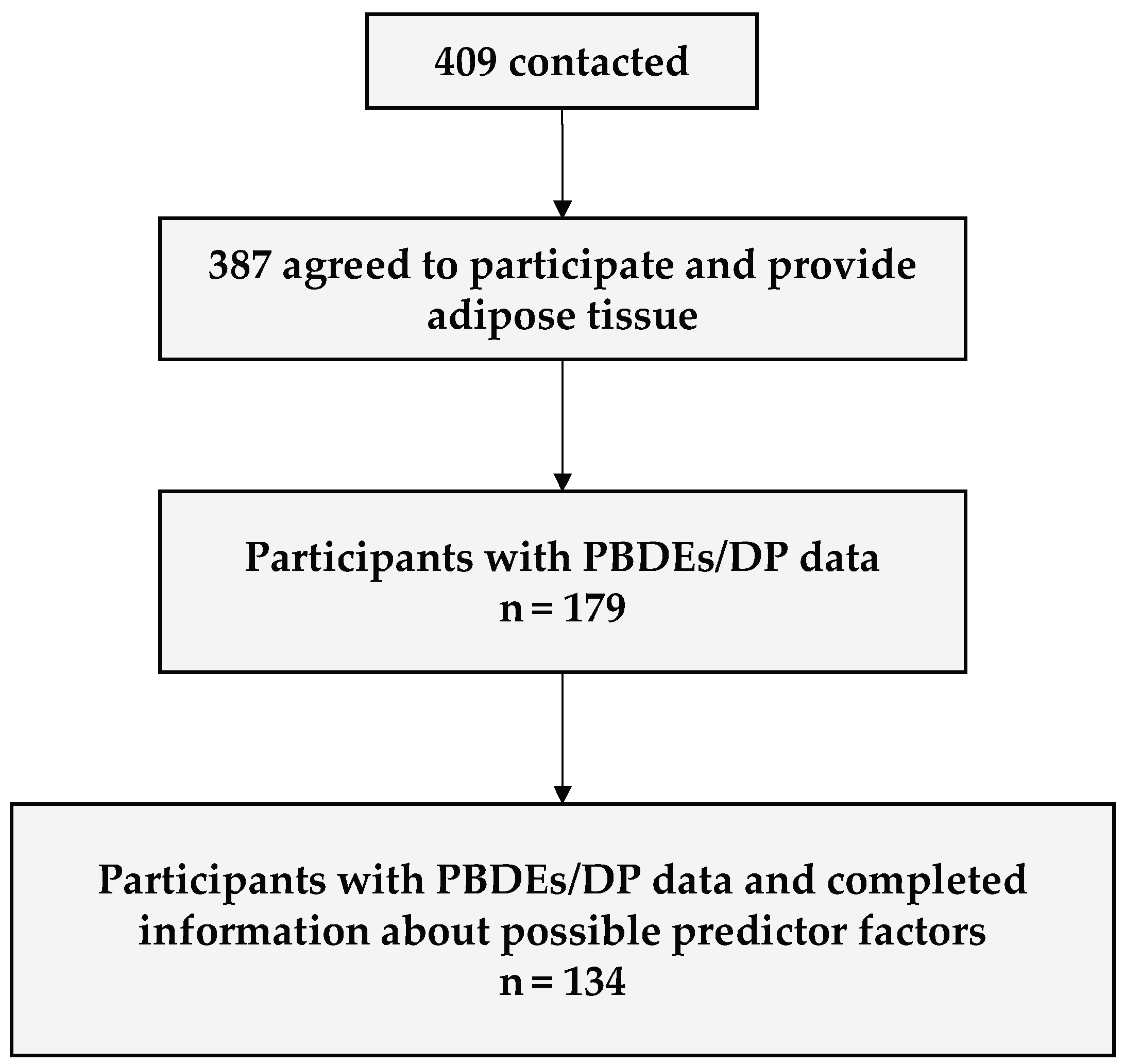

Table 1.
Baseline main characteristics of the study population with measures of PBDEs/DP (ng/Kg lipid).
Table 1.
Baseline main characteristics of the study population with measures of PBDEs/DP (ng/Kg lipid).
| Variable | All (n = 134) | Females (n = 61) | Males (n = 73) |
| n (%) | n (%) | n (%) | |
| Sex = Female | 61 (45.5%) | 61 (100.0%) | 0 (0.0%) |
| Residence | |||
| Urban | 24 (17.9%) | 6 (9.8%) | 18 (24.7%) |
| Semirural | 59 (44.0%) | 39 (63.9%) | 20 (27.4%) |
| Rural | 51 (38.1%) | 16 (26.2%) | 35 (47.9%) |
| Social occupational class = Manual workers | 104 (77.6%) | 48 (78.7%) | 56 (76.7%) |
| Alcohol consumers | 69 (51.5%) | 18 (29.5%) | 51 (69.9%) |
| Smoking habit | |||
| No smoker | 51 (38.1%) | 38 (62.3%) | 13 (17.8%) |
| Former smoker | 34 (25.4%) | 10 (16.4%) | 24 (32.9%) |
| Smoker | 49 (36.6%) | 13 (21.3%) | 36 (49.3%) |
| Sample collection’s surgery | |||
| Hernia | 63 (47.0%) | 16 (26.2%) | 47 (64.4%) |
| Gallbladder | 20 (14.9%) | 14 (23.0%) | 6 (8.2%) |
| Benign tumor/hyperplasia | 14 (10.4%) | 10 (16.4%) | 4 (5.5%) |
| Other | 37 (27.6%) | 21 (34.4%) | 16 (21.9%) |
| Mean (SD1) | Mean (SD1) | Mean (SD1) | |
| Age (years) | 50 (17.3) | 51 (17.3) | 50 (17.4) |
| BMI3 (kg/m2) | 27.9 (5.6) | 27.6 (5.7) | 28.0 (5.6) |
| Median (IQR2) | Median (IQR2) | Median (IQR2) | |
| BDE4-28 | 73.1 (35.0, 127.2) | 58.6 (31.8, 115.9) | 93.7 (41.5, 136.0) |
| BDE4-47 | 353.0 (203.5, 546.7) | 266.2 (179.4, 456.3) | 393.6 (276.8, 579.4) |
| BDE4-99 | 130.8 (89.9, 230.7) | 117.4 (81.4, 184.8) | 140.5 (102.0, 294.6) |
| BDE4-100 | 301.4 (173.0, 453.4) | 287.3 (159.3, 403.0) | 313.6 (194.6, 455.7) |
| BDE4-153 | 1,335.2 (918.2, 2,432.2) | 1,205.1 (842.7, 1,831.0) | 1,501.5 (994.5, 3,116.0) |
| BDE4-154 | 429.7 (306.6, 678.7) | 412.0 (277.8, 583.1) | 483.3 (325.6, 689.6) |
| BDE4-183 | 419.2 (247.2, 595.7) | 412.3 (248.5, 581.8) | 420.0 (242.2, 677.8) |
| BDE4-197 | 564.5 (338.5, 990.9) | 560.1 (342.7, 974.0) | 569.0 (321.0, 1,001.1) |
| BDE4-209 | 614.4 (308.2, 1,052.4) | 543.7 (190.9, 1,006.4) | 693.3 (342.0, 1,121.0) |
| Syn-DP5 | 82.9 (39.9, 163.9) | 79.7 (37.2, 147.4) | 84.4 (42.8, 182.1) |
| Anti-DP5 | 247.0 (157.7, 417.6) | 274.3 (179.6, 350.3) | 226.7 (148.5, 481.5) |
1 Standard deviation; 2 25th and 75th percentiles; 3 body mass index; 4 Brominated diphenyl ether; 5 Dechlorane plus. Pollutant concentrations were expressed as ng/Kg in order to improve readability. Participants were categorized as alcohol consumers if their intake exceeded one drink per week.
Table 2.
Summary of the multivariable linear regression models exploring factors associated with each PBDE and DP adipose tissue concentrations (n = 134). Sociodemographic and anthropometric variables.
Table 2.
Summary of the multivariable linear regression models exploring factors associated with each PBDE and DP adipose tissue concentrations (n = 134). Sociodemographic and anthropometric variables.
| BDE-281 | BDE-471 | BDE-991 | BDE-1001 | BDE-1531 | BDE-1541 | BDE-1831 | BDE-1971 | BDE-2091 | Syn-DP2 | Anti-DP2 | ||
| β3 (95% CI)4 | ||||||||||||
| Sex = male | 0.37 (0.02, 0.71) | 0.47 (0.12, 0.82) | 0.42 (0.05, 0.79) | 1.06 (0.27, 1.84) | ||||||||
| Age (years) | -0.01 (-0.02, 0.00) | -0.01 (-0.02, 0.00) | -0.01 (-0.02, 0.00) | |||||||||
| BMI5 (Kg/m2) | -0.04 (-0.07, -0.01) | -0.03 (-0.05, -0.01) | -0.05 (-0.07, -0.02) | -0.04 (-0.07, -0.01) | -0.04 (-0.06, -0.02) | |||||||
| Occupation = Manual worker | -0.54 (-0.95, -0.13) | 0.33 (0.01, 0.64) | 0.51 (0.07, 0.94) | 0.38 (0.06, 0.69) | ||||||||
| Residence | ||||||||||||
| Urban6 | Ref. | |||||||||||
| Semirural7 | -0.16 (-0.51, 0.20) | |||||||||||
| Rural8 | -0.36 (-0.72, 0.00) | |||||||||||
1 Bromodiphenyl ether; 2 Dechlorane Plus; 3 Beta; 4Confidence Interval; 5 Body Mass Index; 6(> 100,000 inhabitants); 7(100,000-10,000 inhabitants); 8(< 10,000 inhabitants); estimates in bold indicate p value < 0.05. Dependent variable pollutant concentrations (ng/g lipid) were natural log-transformed for the analyses. The coefficients displayed in the table represent models adjusted for the variables included in the other tables. For improving interpretability, the model coefficients are split into 3 tables, corresponding to sociodemographic (this table), perceived exposures (Table 3) and dietary (Table 4) variables.
Table 3.
Summary of the multivariable linear regression models exploring factors associated with each PBDE and DP adipose tissue concentrations (n = 134). Perceived exposures.
Table 3.
Summary of the multivariable linear regression models exploring factors associated with each PBDE and DP adipose tissue concentrations (n = 134). Perceived exposures.
| BDE-281 | BDE-471 | BDE-991 | BDE-1001 | BDE-1531 | BDE-1541 | BDE-1831 | BDE-1971 | BDE-2091 | Syn-DP2 | Anti-DP2 | |
| Perceived exposure to | β3 (95% CI)4 | ||||||||||
| Paints = Yes | 0.61 (0.16, 1.06) | 0.85 (0.40, 1.30)* | 0.80 (0.41, 1.19) | 0.56 (0.05, 1.08) | 0.67 (0.22, 1.13) | ||||||
| Solvents = Yes | 0.42 (0.02, 0.82) | 0.58 (0.18, 0.98) | 0.44 (-0.01, 0.89) | ||||||||
| Toxic Metals = Yes | -0.74 (-1.27, -0.22) | -0.38 (-0.82, 0.06) | -1.05 (-1.58, -0.52)* | -0.38 (-0.75, -0.01) | |||||||
| Alcohol consumption = Yes | -0.80 (-1.59, -0.02) | 0.32 (-0.04, 0.69) | |||||||||
| Smoking habit | |||||||||||
| No smoker | Ref. | ||||||||||
| Former smoker | 0.48 (0.11, 0.85) | ||||||||||
| Smoker | 0.16 (-0.19, 0.50) | ||||||||||
1 Bromodiphenyl ether; 2 dechlorane plus; 3 beta; 4confidence interval; estimates in bold indicate p value < 0.05. Dependent variable pollutant concentrations (ng/g lipid) were natural log transformed for the analyses. For improving interpretability, the model coefficients are split into 3 tables, corresponding to sociodemographic (Table 2), perceived exposures (this table) and dietary (Table 4) variables.
Table 4.
Summary of the multivariable linear regression models exploring factors associated with each PBDE and DP adipose tissue concentrations (n = 134). Dietary.
Table 4.
Summary of the multivariable linear regression models exploring factors associated with each PBDE and DP adipose tissue concentrations (n = 134). Dietary.
| BDE-281 | BDE-471 | BDE-991 | BDE-1001 | BDE-1531 | BDE-1541 | BDE-1831 | BDE-1971 | BDE-2091 | Syn-DP2 | Anti-DP2 | |
| β3 (95% CI)4 | |||||||||||
| Fish consumption ≥ 2 portions/week | 0.38 (0.11, 0.65) | 0.38 (0.08, 0.69) | |||||||||
| Oily fish consumption = Yes | 0.45 (0.14, 0.77) | ||||||||||
| Meat consumption > 2 portions/week | 0.45 (0.11, 0.80) | ||||||||||
| Vegetables consumption > 2 portions/week | 0.42 (-0.07, 0.91) | -0.54 (-0.96, -0.12) | -0.35 (-0.70, 0.00) | ||||||||
| Fruit consumption > 2 portions/week | 0.36 (-0.01, 0.74) | 0.46 (0.04, 0.88) | 0.50 (-0.01, 1.01) | ||||||||
| Bread consumption > 1 portions/week | 0.35 (-0.07, 0.77) | ||||||||||
| Cheese consumption > 2 portions/week | 0.49 (0.16, 0.82) | ||||||||||
| Number of glasses of milk per day | 0.20 (0.06, 0.35) | ||||||||||
| Egg consumption | |||||||||||
| ≤ 1 portion/week | Ref. | ||||||||||
| 2 portions/week | -0.35 (-0.70, -0.01) | ||||||||||
| > 2 portions/week | -0.34 (-0.72, 0.05) | ||||||||||
1 Bromodiphenyl ether; 2 dechlorane plus; 3 beta; 4confidence interval; estimates in bold indicate p value < 0.05. Dependent variable pollutant concentrations (ng/g lipid) were log transformed for the analyses. For improving interpretability, the model coefficients are split into 3 tables, corresponding to sociodemographic (Table 2), perceived exposures (Table 3) and dietary (this table) variables.
Disclaimer/Publisher’s Note: The statements, opinions and data contained in all publications are solely those of the individual author(s) and contributor(s) and not of MDPI and/or the editor(s). MDPI and/or the editor(s) disclaim responsibility for any injury to people or property resulting from any ideas, methods, instructions or products referred to in the content. |
© 2026 by the authors. Licensee MDPI, Basel, Switzerland. This article is an open access article distributed under the terms and conditions of the Creative Commons Attribution (CC BY) license.
Copyright: This open access article is published under a Creative Commons CC BY 4.0 license, which permit the free download, distribution, and reuse, provided that the author and preprint are cited in any reuse.


