
Submitted:
30 December 2025
Posted:
31 December 2025
You are already at the latest version
Abstract
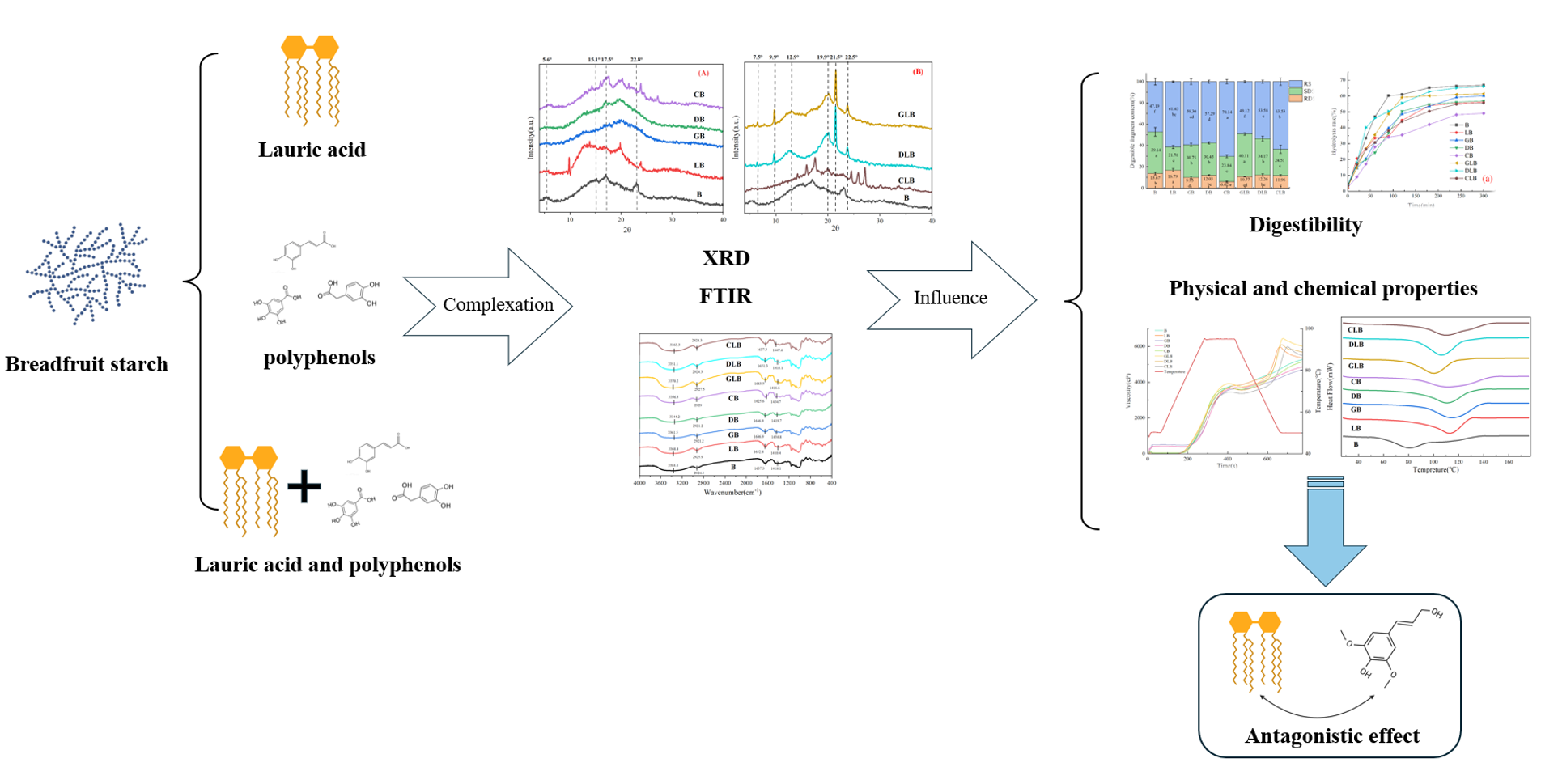
This study investigated how complexes formed by lauric acid (LA) and polyphenols (gallic acid, GA; 3,4-dihydroxyphenylacetic acid, DOPAC; caffeic acid, CA) with bread-fruit starch affect starch’s digestibility and properties. The digestibility resistance of ternary complexes was not superior to that of binary complexes but remained higher than native starch. Among them, the CA complex (CB) showed the highest RS and the lowest hydrolysis, indicating CA's prominent role in enhancing digestibility resistance. A decreased breakdown value and increased gelatinization temperatures were revealed, indicating inhibited gelatinization. During cooling phase, samples with LA showed viscosity peaks, confirming V-type complex formation, which was absent in polyphe-nol-only samples. R1047/1022 and Rc values were increased in complexes. Ternary complexes exhibited a lower R1047/1022 ratio but a higher Rc than binary complexes, suggesting LA mainly influenced long-range order, while polyphenols affected both short- and long-range order. This may explain the antagonistic effect on digestibility in ternary complexes.
Keywords:
breadfruit starch
; lauric acid
; phenolic acids
; complexes
; in vitro digestibility
Copyright: This open access article is published under a Creative Commons CC BY 4.0 license, which permit the free download, distribution, and reuse, provided that the author and preprint are cited in any reuse.


