

Submitted:
29 December 2025
Posted:
30 December 2025
You are already at the latest version
Abstract
The resummation of Stieltjes series remains a key challenge in mathematical physics, especially when Pad\'e approximants fail,
as in the case of superfactorially divergent series. Weniger’s $\delta$-transformation, which incorporates a priori structural information on Stieltjes series, namely the inverse factorial series representation of their converging factors, offers a superior framework with respect to Pad\'e.
Here, the problem of the pole distribution of the $\delta$-transformation is addressed. We show that the algebraic structure of the transformation, together with the intrinsic log-concavity of Stieltjes moments, satisfy the necessary conditions for having real poles. Moreover, by recasting the denominator of the $\delta$-transformation rational approximant as a high-order derivative of a log-concave polynomial and invoking the Gauss-Lucas theorem, a possible geometrical justification of the pole positioning along the negative real axis is proposed.
While a fully rigorous proof remains an open challenge, our conjecture is substantiated by a comprehensive numerical investigation across an extensive catalog of Stieltjes series. In particular, our results provide systematic evidence that the mandatory branch cut conditions are respected even in the more delicate case of superfactorial growth, recently addressed from a converging factor perspective.
Keywords:
mathematical physics
; divergent series
; stieltjes series
; converging factors
MSC: 40A05; 65B10
1. Introduction
The resummation of Stieltjes series remains a pivotal challenge in mathematical physics, from strongly divergent expansions [1,2,3], to centenary problems in Celestial Mechanics [4,5]. Conventionally, this task is entrusted to Padé approximants, customarily implemented via Wynn’s epsilon algorithm [6]. While a robust convergence theory exists for Padé approximants to Stieltjes series (see for instance Baker and Graves-Morris [7]), this supremacy is not absolute. In some important cases, such as the octic anharmonic oscillator, Padé-based methods fail to retrieve the correct energy spectrum. These limitations of Padé approximants stem from their inability to incorporate important a priori structural information regarding the character of the Stieltjes series. For example, Stieltjes functions truncation errors are governed by converging factors that must satisfy a linear first-order difference equation [8]. Since such equations are naturally solved by inverse factorial series, any resummation tool capable of integrating this structural feature possesses a decisive advantage. Weniger’s -transformation [9], was specifically engineered to exploit this property, by representing converging factors through inverse factorial expansions. Despite its computational superiority, a rigorous convergence theory for the -transformation to Stieltjes series has not yet been achieved. For such a convergence theory to be constructed, a fundamental preliminary problem has to be addressed. The convergence of rational approximants of Stieltjes series is fundamentally dictated by the requirement that their poles accumulate along the corresponding Stieltjes function branch cuts [7]. Accordingly, also the -transformation singularities must consistently reproduce the singularity pattern. This leads to the main question of the present paper:
is Weniger’s transformation able to simulate the Stieltjes function branch cut?
We show that the algebraic structure of the -transformation and the intrinsic log-concavity of Stieltjes moments (which is a direct consequence of Hankel’s determinant positivity) guarantee that the necessary condition for the poles to be real is satisfied. Unfortunately, such a condition is not sufficient. Then, a geometrical interpretation of the denominator of the rational approximant is here proposed, by recasting the latter as a high-order derivative of a simpler, still log-concave polynomial. This, in turn, allows us to invoke the Gauss-Lucas theorem to justify and visualize the geometric mapping of its (possibly complex) zeros onto the negative real axis. In order to substantiate our analytical approach, a comprehensive numerical investigation across an extensive catalog of Stieltjes series is offered to our readers. This catalog specifically targets also those Stieltjes series exhibiting a superfactorial growth recently explored in [10], for which traditional techniques based on Padé approximants are known to fail.
The paper is structured as follows: much of the material presented in Sec. Section 2 is drawn from my previous works, specifically the 2015 article that I have co-authored with Ernst Joachim Weniger [11] and those recently published between 2024 and 2025 about the converging factors of Stieltjes series [5,8,10]. It has been summarized and rearranged uniquely to give enough self-consistency to the present paper. Readers which are more interested in the history of Levin-type sequence transformations are encouraged to go through the original publications that will be cited in the rest of the paper. Section 3 represents the core of the paper, where the main analytical strategy to address the pole distribution problem is outlined, while in Sec. Section 4 a catalogue of different classes of Stieltjes series is offered to our readers to check the validity of the main conjecture of the present work. Finally, a few conclusive words are given in Sec. Section 5. A couple of appendices containing the most tedious mathematical steps accompanies the paper.
2. Why Should Weniger’s Transformation be Fit for Decoding Stieltjes Series?
Consider a nondecreasing, real-valued function defined for , possessing infinitely many points of increase. This ensures that the associated measure, say , is positive on . It will also assumed that all moments,
are finite and positive. Then, the formal power series
is called a Stieltjes series. Such series turns out to be asymptotic, in the sense of Poincaré, for , to the function defined as
which turns out to be analytic in the complex plane cut along the negative real axis (i.e., , and is called Stieltjes function. Another way to express the above link is that f and are linked by a Stieltjes transform [12].
The probably most known example of Stieltjes series is the Euler series [13], characterized by the moment sequence , and asymptotic to so-called Euler integral,
which has the form given in Eq. (3) with . Decoding the asymptotic series in Eq. (2) to retrieve the correct value of is known as the Stieltjes moment problem. A sufficient criterion to guarantee unicity to the solution of the moment problem is the so-called Carleman condition, which requires that the following series:
be divergent. An important necessary condition for a given sequence to represents the moment sequence of a Stieltjes series is the following: let be a sequence. The Hankel determinants of this sequence are defined as follows (see for example [pp. 78 and 80 [14]):
Hankel determinants play a very important role in the theory of Stieltjes series. A necessary condition, that a power series of the type of (2) is indeed a Stieltjes series, is that the Hankel determinants of the Stieltjes moments sequence are positive for all [Theorem 5.1.2 [7].
Any Stieltjes function can be expressed as the sum of the nth-order partial sum of the associated asympotic series (2) and of a truncation error which has itself the form of a Stieltjes integral (see for example [9]). More precisely, we have
where denotes the nth-order partial sum,
and the symbol denotes the nth-order reaminder, which is formally defined by
It is worh recasting the truncation error as follows:
where the quantity
will be called the mth-order converging factor [15,16].1 The search of techniques aimed at estimating convergence factors without resorting to the numerical evaluation of the integral in Eq. (11), played a role of pivotal importance in the development of Stieltjes asymptotic series decoding.
In particular, the modern era of sequence transformations started with two seminal articles by Shanks [17] and Wynn [6], respectively. Shanks introduced in [17] a powerful sequence transformation aimed at computing Padé approximants. Wynn showed in [6] that the Shanks transformation (thus also Padé approximants) can be computed effectively by means of a nonlinear recursive algorithm, the celebrated Wynn -algorithm [§3.9(iv) Shanks’ Transformation [18]. To obtain approximations of the function , the -algorithm needs only the input of the numerical values of a finite substring of the partial sum sequence . In the case of Stieltjes series, however, important a priori additional informations on the index dependence of the truncation error are available, as shown for example by Eq. (9). Such structural information could then be employed to improve the efficiency of the transformation process. From Eq. (11), it appears that the value of the Stieltjes function could be retrieved, in principle, from the knowledge of only a finite number of single terms of the associated Stieltjes series, provided that the corresponding converging factor could be estimated, in some way, starting from the knowledge of the sole moment sequence . Levin-type transformation theory [19] is ultimately based on the research of suitable approximation models for the converging factor .
In the following, we shall denote the kth-order approximation (with ) of , in such a way that, in some limiting sense, it could be possible to write
Converging factor approximants are built up in order to contain only k unspecified parameters, occurring linearly within them. Accordingly, a systematic approach for the construction of Levin-type sequence transformations boils down to find suitable linear operators, say , which are able to annihilate the approximant itself,
for fixed k but for all . In [Section 7 - 9 [9], E. J. Weniger showed how simple and powerful sequence transformations can sistematically be obtained on using annihilation operators based upon the finite difference operator . More precisely, the operator is written as follows:
where the symbol denotes a polynomial of degree with respect the integer variable n [Section II [20], while the iterated difference operator can be explicited through the help of [Eq. (25.1.1) [18], i.e.,
As a consequence, it should be clear that the functional form of the convergence factor approximant must be set in order for the product to reduce itself to a n-polynomial having degree less than k, and thus ready to be annihilated by .
Although it is not possible to establish general strategies aimed at guessing the mathematical structure of the converging factors, for the class of Stieltjes series it has been proved [8] that the converging factor in Eq. (11) can always be represented as an inverse factorial series. The proof was ultimately based on the fact that: (i) the converging factor defined in Eq. (11) must necessarily satisfy the following first-order difference equation [8]:
and that (ii) inverse factorial series constitute a natural tool for solving difference equations, similarly as inverse power series are customarily used to solve differential equations. For reader’s convenience, it is worth reminding that the basic definitions and properties of factorial series can be found, for instance, in recent extensive reviews, like for instance [8,11,21]. In particular, in [8] it was shown that the solution of Eq. (16) can always be set in the following form:
where and denotes a sequence which is independent of n. The series in the right side of Eq. (17) is the mathematical object known as inverse factorial expansion, with the symbol denoting Pochhammer symbol. From Eqs. (12) and (17), it would then be natural to conclude that a very suitable model for the kth-order approximant of the converging factor of a typical Stieltjes series should be written as follow:
for any . As a consequence, the annihilation operator in Eq. (14) would immediately follow on taking into account the fact that the following quantity:
represents itself a polynomial of degree in n, and thus can be annihilated simply by . Then, it is sufficient to let in Eq. (14) to have
On replacing the quantity with its kth-order approximant , it follows at once:
and on applying the annihilation operator to both sides of Eq. (23), we finally arrive to
or, equivalently,
More rigorously, the right side of Eq. (25) should be interpreted, once n and have been given, as the kth-order term of a new sequence, say , defined by
where use has been made of Eq. (20). Equation (26) defines the so-called Weniger, or delta transformation, of the original Stieltjes series partial sum sequence [Chapter 3.9(v) Levin’s and Weniger’s Transformations [18]. E. J. Weniger first employed his -transformation for the evaluation of auxiliary functions in molecular electronic structure calculations [22]. Later, it was successfully used for the evaluation of special functions [9,23,24,25,26,27,28,29,30,31,32], the summation of divergent perturbation expansions [20,26,27,28,33,34,35,36,37,38,39,40,41,42,43,44,45,46], as well as for the prediction of unknown perturbation series coefficients [1,38,39,44]. In the last fifteen years, -transformation has also been employed in optics in the study of nonparaxial free-space propagation of optical wavefields [47,48,49,50,51], as well as in the numerical evaluation of several types of stable and unstable diffraction catastrophes [52,53,54,55,56,57,58,59,60].
The relevance of Weniger’s transformation in the decoding process of divergent Stieltjes asymptotic series has been put into evidence about ten years ago in [11], where it was rigorously proved that the sequence in Eq. (26) evaluated at and , once applied to the partial sum sequence of the Euler series, does converge to the Euler integral (4), i.e.,
and that, in accomplishing such task, it turns out to be “exponentially faster” than Padé approximants.
E. J. Weniger and I thought that trying to conceive a general convergence theory for the resummation of Stieltjes series through Levin-type transformations, similar to that already existing for Padé approximants [7], could have been an ambitious scientific project, worthy of being pursued. On August 10th, 2022, sadly too soon, E. J. Weniger passed away. Since then, I am trying to carry on our joint project with particular care to his transformation which, differently from other Levin-type transformations, continues to reveal a precious source of interesting analytical as well as numerical results. Weniger’s transformation proved to be able to decode divergent Stieltjes series which do not satisfy Carleman’s condition in Eq. (5), as those arising from perturbative treatments of high-order anharmonic quantum oscillators, where Padé unavoidably failed. In [10], a deep analysis on the converging factors of an important class of superfactorially divergent Stieltjes series related to such problem, has been carried out on the basis of the theoretical results established in [8] about the solution of the difference equation recalled in Eq. (16). These results corroborate our feeling that -transformation in Eq. (26) could be able to potentially substitute Padé approximants as the principal Stieltjes series decoding tool. To this end, however, a preliminary fundamental approximation problem has to be addressed and solved. The next section (Sec. Section 3) which represents the core of the present paper, is devoted to present the problem and to delineate a possible strategy for its resolution. In Sec. Section 4, an important catalogue of Stieltjes series will be offered to check and validate the main conclusions drawn in Sec. Section 3.
3. Is Weniger’s Transformation Capable to Simulate the Stieltjes Function Branch Cut?
3.1. Preliminaries
Stieltjes functions (or transforms) in Eq. (3) are defined throughout the whole complex plane but a cut along the negative real axis . This, in turn, does imply that any rational approximant of a Stieltjes function, like Padé or , must necessarily behave coherently with such a prescription. For Padé approximants acting on Stieltjes series, a well established theory is available since several decades. It is worth reminding the following important quotation from the classical book by Baker and Graves-Morris [7]
Whether or not the formal asymptotic series of has a zero radius of convergence, the Padé approximants of the series are vital for its analysis and are useful for its numerical evaluation […]. We can prove convergence of the Padé approximants largely because we can prove that the poles of the Padé approximants lie on the cuts of the Stieltjes function.
Accordingly, it is beyond dispute the fact that a general convergence theory of Weniger’s transformation on Stieltjes series would necessarily stem on a similar ground. In other words,
is it true that all zeros of the denominator of Eq. (26) be confined to the sole negative real axis?
In the present section, a possibile strategy for addressing such problem will be proposed, while in the next section several numerical, as well as analytical evidences of the validity of this conjecture will be illustrated.
3.2. A Necessary Condition to Be Satisfied for Simulating the Branch Cut
It is worth introducing, at this point, the following auxiliary kth-degree polynomial:
First of all, we shall prove that, when the sequence contains the moments of a Stieltjes series, both polynomials and satisfy Newton’s necessary condition for all zeros to be real. To this end, it is sufficient to note that the sequence necessarily satisfies the following condition:
which follows from the positivity of the Hankel determinant defined in Eq. (Section 2). In other words, for a typical Stieltjes series, the sequence turns out to be log-concave, which is a necessary condition for the polynomial to have all real zeros. Similar considerations can be done for , for which the necessary condition becomes
which is automatically satisfied on taking Eq. (31) into account and the fact that
as it is trivial to prove. The condition in Eq. (32) is satisfied by any Stieltjes series, and guarantees that the necessary condition for all poles of the rational approximant into Eq. (26) to be real is fulfilled. Unfortunately, such condition is not sufficient.
3.3. An Alternative Expression of Polynomials
It should be noted how the factor appearing into the definition of can be recast as follows:
which, once substituted in Eq. (29), after simple algebra leads to
Henceforth, only for the sake of simplicity, it will be assumed and , which represents the choice customarily employed in most practical applications of Weniger’s transformation. In this way, we have
which represents a key relation for the scope of the present paper.
In Ref. [11] we proved that, for the Euler series, the polynomial turns out to be proportional to an hypergeometric polynomial, precisely
for which it was possible to prove the reality of all its zeros [11].
Thanks to the connection provided by Eq. (36), the exploration of the zero location of a typical polynomial could be done, in principle, on invoking the Gauss-Lucas theorem [61]. First of all, we note that the polynomial has one zero of multiplicity at and k additional zeros coincident with those of which, due to the positivity of its coefficients, are located within the open complex half-space . Also, we know that satisfies the log-concavity condition given in Eq. (31) which, as previously recalled, is only necessary. In this situation, an even number of zeros of , and thus of , could be in principle complex conjugated. This, in turn, implies that the convex hull of the zeros of must be symmetric with respect to the real axis, and is contained in the left half-space , with the inclusion of . By the Gauss-Lucas theorem, the zeros of each successive derivative in Eq. (36) must be located inside the convex hull of the zeros of the previous derivative of . Since all zeros of lie in the open left-plane , the same holds for . Furthermore, the multiplicity of the zeros at decreases by one at each differentiation step and, since by definition we have
cannot have zeros at the origin and all its zeros will be contained in as well. Accordingly, only two scenarios are possible: (i) all zeros or (ii) not all zeros of are real. In the first scenario, it is immediate to convince that all zeros of will be real and negative. As far as the second scenario is concerned, the problem of proving the reality of zeros of remains open. In the following section, the prescriptions of the Gauss-Lucas theorem will be analyzed on a large catalogue of Stieltjes series.
4. Madamina, il catalogo è questo
4.1. Preliminaries
In the present section, we present a catalogue of Stieltjes series for which the polynomial can often be expressed in closed form, allowing for a rigorous analysis of the distribution of its zeros. In most cases, we show that possessed only real zeros and, by virtue of the results of the previous section, that also the polynomial is stable. Moreover, a few numerical examples illustrating situations in which , and thus , admits some complex zeros, will also be presented, in which the repeated action of the differentiation operator progressively reduces their number until they are eventually eliminated altogether. The catalogue has mainly been taken from [12], with the addition of two important examples of Stieltjes series recently addressed [5,10].
4.2. A Class of Superfactorially Divergent Stieltjes Asymptotic Series
In Ref. [10], an important class of superfactorially divergent Stieltjes series has been studied as far as their converging factors were concerned. The elements of this class constitute natural generalizations of the Euler series. They are characterized by the following moment sequence :
where and . The Euler series corresponds to the pair . It should be noted that Carleman’s condition is not satisfied for , and also that Padé are not capable to decode the Stieltjes series to the corresponding Stieltjes function. The numerical analysis carried out in [10], has shown how the inverse factorial expansion of the converging factor in Eq. (17) provided excellent estimates also for values of . Now, on substituting from Eq. (39) in Eq. (30) we have
and in Appendix A it is proved that
where, for simplicity, we set and the -dimensional vector is defined by
Proving that the hypergeometric polynomial in Eq. (41) has only real zeros can be done by using similar arguments to those employed in [11], in particular the connection with the so-called Pólya frequency functions [62,63]. In particular, since in [Theorem 4.1 [62] it was shown that the generalized hypergeometric series
with , , and is a Pólya frequency function, according to [Lemma 5 [64], it follows at once that the associated terminating generalized hypergeometric series
with , has only real zeros. This, in turn, implies that also the polynomial in Eq. (41) has only real zeros.
4.3. Laguerre Distribution
Another generalization of the Euler series is the Stieltjes function whose moment sequence is given by
where denotes a positive real number [12]. The Euler series corresponds to the choice . Henrici called this distribution Laguerre distribution, with the measure being given by [12, Eq. (12.12-12)]
Again, on substituting from Eq. (45) in Eq. (30) it is found that
which is a particular case of what we have found in Sec. Section 4.2. We thus conclude that also for the Laguerre distribution, Weniger’s transformation is able to correctly simulate the cut.
4.4. The Modified Bessel Function of the Second Kind
In an important 1990 paper, E. J. Weniger and J. Čížek proved that the modified Bessel function of the second kind, , is a Stieltjes function [32]. More precisely, on limiting only to the interval [32], the associated moment sequence turns out to be [32]
with the associated measure [32]
In Appendix B it is proved that also in the present case the polynomial can be expressed in closed form terms via hypergeometric polynomials, precisely
Differently from the previous sections, we were not able to prove the reality of its zeros, and we did not find any proof about it in the past literature. However, several numerical simulations, carried out with the help of Wolfram Mathematica 14.3 for different values of and for different orders k, have confirmed our conjecture that the polynomial defined in Eq. (50) is stable and, accordingly, also . The rigorous proof remains an open question.
4.5. The Gamma Function
In the above quoted book of Henrici [12], the Binet formula for the natural logarithm of the Gamma function, , is recalled, together with its connection to the Stieltjes series whose moment sequence is [12]
where the symbol denotes the mth-order Bernoulli number, whose asymptotics gives at once
where denotes the Riemann zeta function. Accordingly, the moments asymptotically tend to grow with the superfactorially law studied in Sec. Section 4.2. Several numerical simulations carried out for different values of k have verified the stability of the corresponding polynomial and, consequently, also of .
4.6. Jacobi Distribution
An interesting example of Stieltjes function is offered by the so-called Jacobi distribution, characterized by the following moment sequence [12]:
where . In this case, both polynomials and can be evaluated in closed form by using Wolfram Mathematica 14.3, which gives at once
and
respectively. Now, if and differ by an integer number, the theorem quoted at the end of Sec. Section 4.2 guarantees that all zeros of are real and, consequently, also those of .
If not, it is worth giving a few numerical simulations aimed at confirming our conjecture about the action of the differential operator in Eq. (36). To this end, in Figure 1 the spatial distribution, across the complex plane, of the zeros of the polynomial are shown (open circles) for and for the pair . In the same figure, also the locations of ’s zeros are reported (dots), all of them being real.
It is worth monitoring, at least from a visual/numerical perspective, the action of the derivative operator in Eq. (36) in relation with the Gauss-Lucas theorem. To this end, consider the polynomial, say , defined as
in such a way . In Figure 2, the zero distributions of Figure 1 are plotted together with the distributions of the complex zeros of the polynomial defined in Eq. (56), obtained for (small open circles), (small black circles), (small open squares), and (small black squares).
As a further example, Figure 3 shows the same as in Figure 2 but for the couple and , and similarly for (small open circles), (small black circles), (small open squares), and (small black squares). Several other numerical simulations have been carried out, with the help of Wolfram Mathematica 14.3, for different values of k and , all of them confirming our conjecture that all zeros of in Eq. (55) are real.
4.7. The Bessel Solution of Kepler’s Equation
The last example we are going to deal with is purely numerical. In a recent paper [5], a very classical and old problem bas been tackled from a new original perspective. The problem consists in solving the following trascendental equation with respect the unknown :
where and are real positive parameters. Equation (57) is the celebrated elliptic Kepler Equation, which plays a central role in Celestial Mechanics [65]. Among hundreds of different methods that have been conceived along more than four centuries to solve Kepler’s equation [4], in Ref. [5] the following Fourier series solution, originally proposed by Friedrich Wilhelm Bessel, namely
where [4] (Ch. 3)
has been addressed under a new perspective. After introducing the complex function , defined through the Kapteyn series
in such a way that , it was shown that is a Stieltjes series [5]. In particular, on introducing the parameter , defined as
where , it was proved that the function defined in Eq. (60) is a Stieltjes series characterized by the following moment sequence [5] :
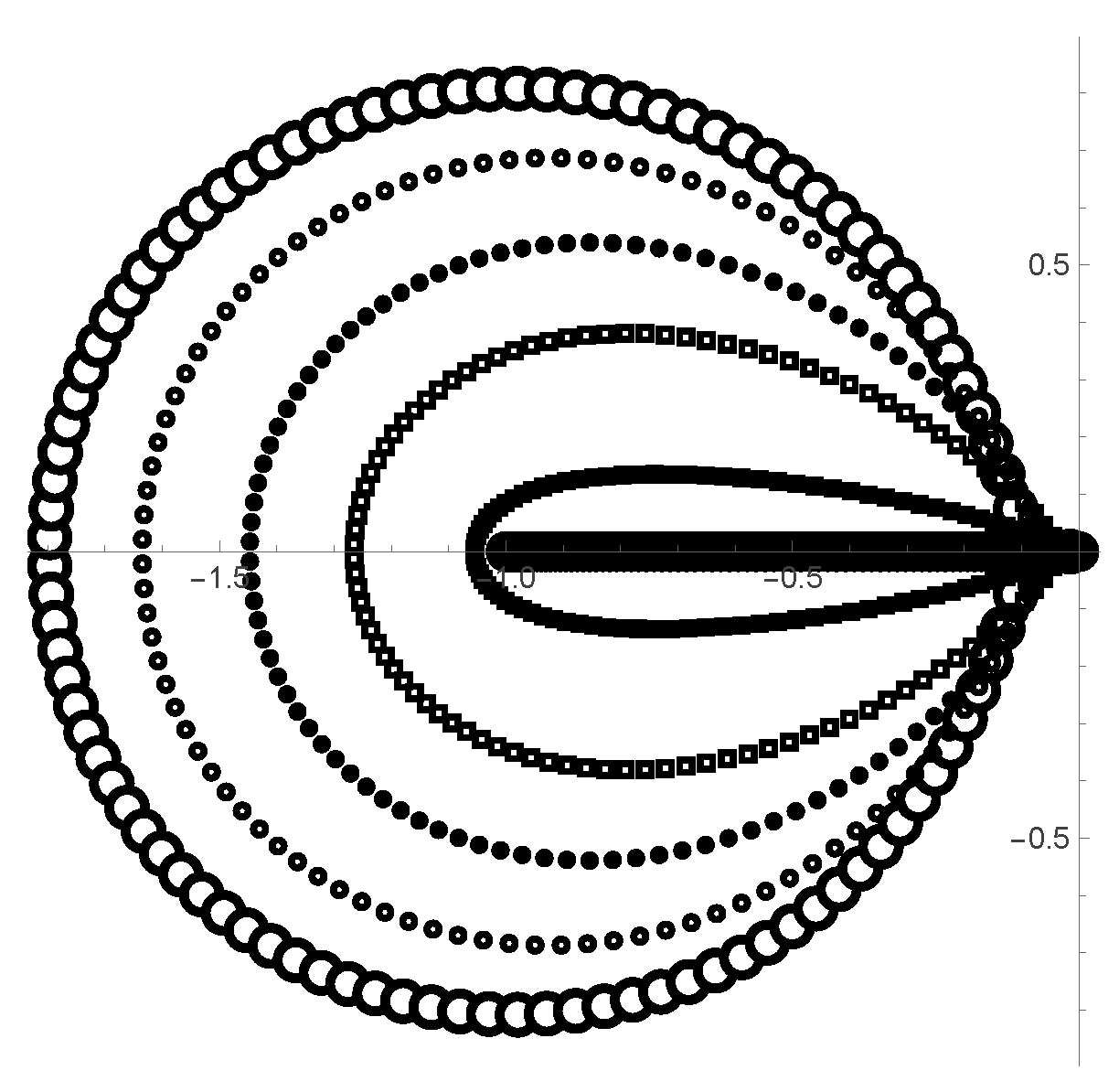
Differently from what happened for Jacobi’s distribution, in the present case it is not possible to express neither nor in closed form. Again, all subsequent experiments will be carried out with the help Wolfram Mathematica 14.3. In particular, only two parameters are involved, namely k and . To illustrate a single example, in Figure 2 the location of the zeros of (large open circles) and of (large dots) are reported for and for . Moreover, in order to show the action of the derivative operator in agreement with the Gauss-Lucas theorem, the same as in Figure 2 is also shown, for (small open circles), (small black circles), (small open squares), and (small black squares). Several other simulations, not shown here, have confirmed that, also for the Stieltjes series defined in Eq. (60), all poles of the Weniger rational approximants are real and negative.
5. Conclusions
Nonlinear sequence transformations in general, and Weniger’s -transformation in particular, are nowadays considered computational tools of great importance for the resummation of several divergent series occurring in applied mathematics and theoretical physics problems. Padé approximants remain a cornerstone for the resummation of Stieltjes series, but their effectiveness drops dramatically within specific contexts, such as for instance the perturbative treatment of the octic quantum anharmonic oscillator, where Carleman’s condition is violated. Converging factors of Stieltjes series are represented by inverse factorial series, a fact which poses Weniger’s -transformation as a superior alternative to Padé, which are not designed to incorporate such important a priori structural information.
In the present paper, we have addressed a fundamental problem to be solved for building a convergence theory of Weniger’s transformation to Stieltjes series. For any rational approximant of a Stieltjes function to be meaningful, its poles must necessarily be located along the branch cut of the function itself, on the real negative half-axis. This mandatory requirement must be satisfied by the kth-order -transformation denominator in Eq. (26). To this end, we have shown that the denominator can be recast in the form of the th-order derivative of the polynomial , where is the binomial sum of the inverse of the first k Stieltjes series moments. Due to the positivity of the Hankel determinants, is proven to be log-concave, as well as , which is a necessary (but not sufficient) condition for their zeros to be real. The Gauss-Lucas theorem has then used to visualize and justify the mapping of the (possibly complex) zeros of into the (real) zeros of . Although a formal proof that the -transformation simulates the branch cut of a general Stieltjes series remains an open problem, the empirical evidence provided in the present paper is compelling. All numerical/analytical results found in our extensive catalog, which includes the class of series with superfactorial growth studied in [10], as well as the Stieltjes series recently discovered in [5], confirm that all poles of the -transformation are restricted to the real axis, thus substantiate the robustness of the method proposed and validate our conjecture about the capability of -transformation of mimicking the branch cut of the corresponding Stieltjes functions.
Acknowledgments
I wish to thank Turi Maria Spinozzi for his useful comments and help. To Michele Plescia (1927-2025), in Memoriam
Conflicts of Interest
The author declares no conflicts of interest.
Appendix A. Proof of Eq. (41)
The polynomial in Eq. (40) can be expressed in terms of a terminating generalized hypergeometric series by recasting in terms of gamma functions depending not on but on on using Gauss’ multiplication formula, i.e.,
This, in particular, implies that
which, on letting , gives at once
Appendix B. Proof of Eq. (50)
References
- Bender, C.M.; Weniger, E.J. Numerical evidence that the perturbation expansion for a non-Hermitian PT-symmetric Hamiltonian is Stieltjes. J. Math. Phys. 2001, 42, 2167–2183. [Google Scholar] [CrossRef]
- Grecchi, V.; Maioli, M.; Martinez, A. Padé summability of the cubic oscillator. J. Phys. A 2009, 42, 425208–1 – 425208–17. [Google Scholar] [CrossRef]
- Grecchi, V.; Martinez, A. The spectrum of the cubic oscillator. Commun. Math. Phys. 2013, 319, 479–500. [Google Scholar] [CrossRef]
- Colwell, P. Solving Kepler’s Equation Over Three Centuries; Willmann-Bell: Richmond, 1993. [Google Scholar]
- Borghi, R. On the Bessel Solution of Kepler’s Equation. Mathematics 2024, 12, 154. [Google Scholar] [CrossRef]
- Wynn, P. On a device for computing the em(Sn) transformation. Math. Tables Aids Comput. 1956, 10, 91–96. [Google Scholar] [CrossRef]
- Baker, Jr., G.A.; Graves-Morris, P. Padé Approximants, 2 ed.; Cambridge U. P.: Cambridge, 1996. [Google Scholar]
- Borghi, R. Factorial Series Representation of Stieltjes Series Converging Factors. Mathematics 2024, 12, 2330. [Google Scholar] [CrossRef]
- Weniger, E.J. Nonlinear sequence transformations for the acceleration of convergence and the summation of divergent series. Comput. Phys. Rep. 1989, 10, 189–371. [Google Scholar] [CrossRef]
- Borghi, R. Converging Factors of a Class of Superfactorially Divergent Stieltjes Series. Mathematics 2025, 13, 2974. [Google Scholar] [CrossRef]
- Borghi, R.; Weniger, E.J. Convergence analysis of the summation of the factorially divergent Euler series by Padé approximants and the delta transformation. Appl. Numer. Math. 2015, 94, 149–178. [Google Scholar] [CrossRef]
- Henrici, P. Applied and Computational Complex Analysis II; Wiley: New York, 1977. [Google Scholar]
- Euler, L. Institutiones calculi differentialis cum eius usu in analysi finitorum ac doctrina serierum. Pars II.1. De transformatione serierum; Academia Imperialis Scientiarum Petropolitana: St. Petersburg, 1755. reprinted as vol. X of Leonardi Euleri Opera Omnia, Seria Prima; Teubner, Leipzig and Berlin, 1913. [Google Scholar]
- Brezinski, C.; Redivo Zaglia, M. Extrapolation Methods; North-Holland: Amsterdam, 1991. [Google Scholar]
- Airey, J.R. The “converging factor” in asymptotic series and the calculation of Bessel, Laguerre and other functions. Philos. Mag. 1937, 24, 521–552. [Google Scholar] [CrossRef]
- Dingle, R.B. Asymptotic Expansions: Their Derivation and Interpretation; Academic Press: London, 1973. [Google Scholar]
- Shanks, D. Non-linear transformations of divergent and slowly convergent sequences. J. Math. and Phys. (Cambridge, Mass.) 1955, 34, 1–42. [Google Scholar] [CrossRef]
- NIST Handbook of Mathematical Functions; Olver, F.W.J., Lozier, D.W., Boisvert, R.F., Clark, C.W., Eds.; Cambridge U. P.: Cambridge, 2010. [Google Scholar]
- Levin, D. Development of non-linear transformations for improving convergence of sequences. Int. J. Comput. Math. B 1973, 3, 371–388. [Google Scholar] [CrossRef]
- Weniger, E.J. Mathematical properties of a new Levin-type sequence transformation introduced by Čížek, Zamastil, and Skála. I. Algebraic theory. J. Math. Phys. 2004, 45, 1209–1246. [Google Scholar] [CrossRef]
- Weniger, E.J. Summation of divergent power series by means of factorial series. Applied Numerical Mathematics 2010, 60, 1429–1441. [Google Scholar] [CrossRef]
- Weniger, E.J.; Steinborn, E.O. Nonlinear sequence transformations for the efficient evaluation of auxiliary functions for GTO molecular integrals. In Proceedings of the Numerical Determination of the Electronic Structure of Atoms, Diatomic and Polyatomic Molecules Proceedings of the NATO Advanced Research Workshop; NATO ASI Series; Versailles, France, Defranceschi, M., Delhalle, J., Eds.; Dordrecht, 1989; pp. 341–346. [Google Scholar]
- Jentschura, U.D.; Gies, H.; Valluri, S.R.; Lamm, D.R.; Weniger, E.J. QED effective action revisited. Can. J. Phys. 2002, 80, 267–284. [Google Scholar] [CrossRef]
- Jentschura, U.D.; Lötstedt, E. Numerical calculation of Bessel, Hankel and Airy functions. Comput. Phys. Commun. 2012, 183, 506–519. [Google Scholar] [CrossRef]
- Jentschura, U.D.; Mohr, P.J.; Soff, G.; Weniger, E.J. Convergence acceleration via combined nonlinear-condensation transformations. Comput. Phys. Commun. 1999, 116, 28–54. [Google Scholar] [CrossRef]
- Weniger, E.J. On the summation of some divergent hypergeometric series and related perturbation expansions. J. Comput. Appl. Math. 1990, 32, 291–300. [Google Scholar] [CrossRef]
- Weniger, E.J. Interpolation between sequence transformations. Numer. Algor. 1992, 3, 477–486. [Google Scholar] [CrossRef]
- Weniger, E.J. On the efficiency of linear but nonregular sequence transformations. In Nonlinear Numerical Methods and Rational Approximation II; Cuyt, A., Ed.; Kluwer: Dordrecht, 1994; pp. 269–282. [Google Scholar]
- Weniger, E.J. Computation of the Whittaker function of the second kind by summing its divergent asymptotic series with the help of nonlinear sequence transformations. Comput. Phys. 1996, 10, 496–503. [Google Scholar] [CrossRef]
- Weniger, E.J. Irregular input data in convergence acceleration and summation processes: General considerations and some special Gaussian hypergeometric series as model problems. Comput. Phys. Commun. 2001, 133, 202–228. [Google Scholar] [CrossRef]
- Weniger, E.J. On the analyticity of Laguerre series. J. Phys. A 2008, 41, 425207–1 – 425207–43. [Google Scholar] [CrossRef]
- Weniger, E.J.; Čížek, J. Rational approximations for the modified Bessel function of the second kind. Comput. Phys. Commun. 1990, 59, 471–493. [Google Scholar] [CrossRef]
- Čížek, J.; Vinette, F.; Weniger, E.J. Examples on the use of symbolic computation in physics and chemistry: Applications of the inner projection technique and of a new summation method for divergent series. Int. J. Quantum Chem. Symp. 1991, 25, 209–223. [Google Scholar] [CrossRef]
- Čížek, J.; Vinette, F.; Weniger, E.J. On the use of the symbolic language Maple in physics and chemistry: Several examples. In Proceedings of the Proceedings of the Fourth International Conference on Computational Physics PHYSICS COMPUTING ’92; Singapore, de Groot, R.A., Nadrchal, J., Eds.; 1993; pp. 31–44. [Google Scholar]
- Čížek, J.; Vinette, F.; Weniger, E.J. On the use of the symbolic language Maple in physics and chemistry: Several examples. Int. J. Mod. Phys. C Reprint of [34]. 1993, 4, 257–270. [Google Scholar] [CrossRef]
- Caliceti, E.; Meyer-Hermann, M.; Ribeca, P.; Surzhykov, A.; Jentschura, U.D. From useful algorithms for slowly convergent series to physical predictions based on divergent perturbative expansions. Phys. Rep. 2007, 446, 1–96. [Google Scholar] [CrossRef]
- Čížek, J.; Zamastil, J.; Skála, L. New summation technique for rapidly divergent perturbation series. Hydrogen atom in magnetic field. J. Math. Phys. 2003, 44, 962–968. [Google Scholar] [CrossRef]
- Jentschura, U.D.; Becher, J.; Weniger, E.J.; Soff, G. Resummation of QED perturbation series by sequence transformations and the prediction of perturbative coefficients. Phys. Rev. Lett. 2000, 85, 2446–2449. [Google Scholar] [CrossRef]
- Jentschura, U.D.; Weniger, E.J.; Soff, G. Asymptotic improvement of resummations and perturbative predictions in quantum field theory. J. Phys. G 2000, 26, 1545–1568. [Google Scholar] [CrossRef]
- Weniger, E.J. Nonlinear sequence transformations: A computational tool for quantum mechanical and quantum chemical calculations. Int. J. Quantum Chem. 1996, 57, 265–280. [Google Scholar] [CrossRef]
- Weniger, E.J. Erratum: Nonlinear sequence transformations: A computational tool for quantum mechanical and quantum chemical calculations. Int. J. Quantum Chem. 1996, 58, 319–321. [Google Scholar] [CrossRef]
- Weniger, E.J. A convergent renormalized strong coupling perturbation expansion for the ground state energy of the quartic, sextic, and octic anharmonic oscillator. Ann. Phys. (NY) 1996, 246, 133–165. [Google Scholar] [CrossRef]
- Weniger, E.J. Construction of the strong coupling expansion for the ground state energy of the quartic, sextic and octic anharmonic oscillator via a renormalized strong coupling expansion. Phys. Rev. Lett. 1996, 77, 2859–2862. [Google Scholar] [CrossRef] [PubMed]
- Weniger, E.J. Performance of superconvergent perturbation theory. Phys. Rev. A 1997, 56, 5165–5168. [Google Scholar] [CrossRef]
- Weniger, E.J.; Čížek, J.; Vinette, F. Very accurate summation for the infinite coupling limit of the perturbation series expansions of anharmonic oscillators. Phys. Lett. A 1991, 156, 169–174. [Google Scholar] [CrossRef]
- Weniger, E.J.; Čížek, J.; Vinette, F. The summation of the ordinary and renormalized perturbation series for the ground state energy of the quartic, sextic, and octic anharmonic oscillators using nonlinear sequence transformations. J. Math. Phys. 1993, 34, 571–609. [Google Scholar] [CrossRef]
- Borghi, R.; Santarsiero, M. Summing Lax series for nonparaxial beam propagation. Opt. Lett. 2003, 28, 774–776. [Google Scholar] [CrossRef] [PubMed]
- Li, J.X.; Zang, W.; Li, Y.D.; Tian, J. Acceleration of electrons by a tightly focused intense laser beam. Opt. Expr. 2009, 17, 11850–11859. [Google Scholar] [CrossRef] [PubMed]
- Li, J.; Zang, W.; Tian, J. Simulation of Gaussian laser beams and electron dynamics by Weniger transformation method. Opt. Expr. 2009, 17, 4959–4969. [Google Scholar]
- Dai, L.; Li, J.X.; Zang, W.P.; Tian, J.G. Vacuum electron acceleration driven by a tightly focused radially polarized Gaussian beam. Opt. Expr. 2011, 19, 9303–9308. [Google Scholar] [CrossRef]
- Borghi, R.; Gori, F.; Guattari, G.; Santarsiero, M. Decoding divergent series in nonparaxial optics. Opt. Lett. 2011, 36, 963–965. [Google Scholar] [CrossRef]
- Borghi, R. Evaluation of diffraction catastrophes by using Weniger transformation. Opt. Lett. 2007, 32, 226–228. [Google Scholar] [CrossRef] [PubMed]
- Borghi, R. Summing Pauli asymptotic series to solve the wedge problem. J. Opt. Soc. Amer. A 2008, 25, 211–218. [Google Scholar] [CrossRef]
- Borghi, R. On the numerical evaluation of cuspoid diffraction catastrophes. J. Opt. Soc. Amer. A 2008, 25, 1682–1690. [Google Scholar] [CrossRef]
- Borghi, R. Joint use of the Weniger transformation and hyperasymptotics for accurate asymptotic evaluations of a class of saddle-point integrals. Phys. Rev. E 2008, 78, 026703–1 – 026703–11. [Google Scholar] [CrossRef]
- Borghi, R. Joint use of the Weniger transformation and hyperasymptotics for accurate asymptotic evaluations of a class of saddle-point integrals. II. Higher-order transformations. Phys. Rev. E 2009, 80, 016704–1 – 016704–15. [Google Scholar] [CrossRef]
- Borghi, R. On the numerical evaluation of umbilic diffraction catastrophes. J. Opt. Soc. Amer. A 2010, 27, 1661–1670. [Google Scholar] [CrossRef] [PubMed]
- Borghi, R. Evaluation of cuspoid and umbilic diffraction catastrophes of codimension four. J. Opt. Soc. Amer. A 2011, 28, 887–896. [Google Scholar] [CrossRef] [PubMed]
- Borghi, R. Optimizing diffraction catastrophe evaluation. Opt. Lett. 2011, 36, 4413–4415. [Google Scholar] [CrossRef]
- Borghi, R. Numerical computation of diffraction catastrophes with codimension eight. Phys. Rev. E 2012, 85, 046704–1 – 046704–14. [Google Scholar] [CrossRef]
- Rahman, Q.I.; Schmeisser, G. Analytic Theory of Polynomials; Clarendon Press: Oxford, U. K., 2003. [Google Scholar]
- Richards, D. Totally positive kernels, Polýa frequency functions, and generalized hypergeometric series. Lin. Alg. Applic. 1990, 137/138, 467–478. [Google Scholar] [CrossRef]
- Schoenberg, I.J. On Pólya frequency functions. I. The totally positive functions and their Laplace transforms. J. d’Anal. Math. 1951, 1, 331–374. [Google Scholar] [CrossRef]
- Driver, K.; Jordaan, K.; Martínez-Finkelshtein, A. Pólya frequency sequences and real zeros of some 3F2 polynomials. J. Math. Anal. Applic. 2007, 332, 1045–1055. [Google Scholar] [CrossRef]
- Orlando, F.; Farina, C.; Zarro, C.; Terra, P. Kepler’s equation and some of its pearls. American Journal of Physics 2018, 86, 11–11. [Google Scholar] [CrossRef]
| 1 | Actually, the definition of the converging factor used here differs by the classical definition by a factor z. This has been done for making the subsequent calculations easier. |
Figure 1.
Locations, on the complex plane, of the zeros of the polynomial (open circles) and of the polynomial (dots), for and for the pair .
Figure 1.
Locations, on the complex plane, of the zeros of the polynomial (open circles) and of the polynomial (dots), for and for the pair .
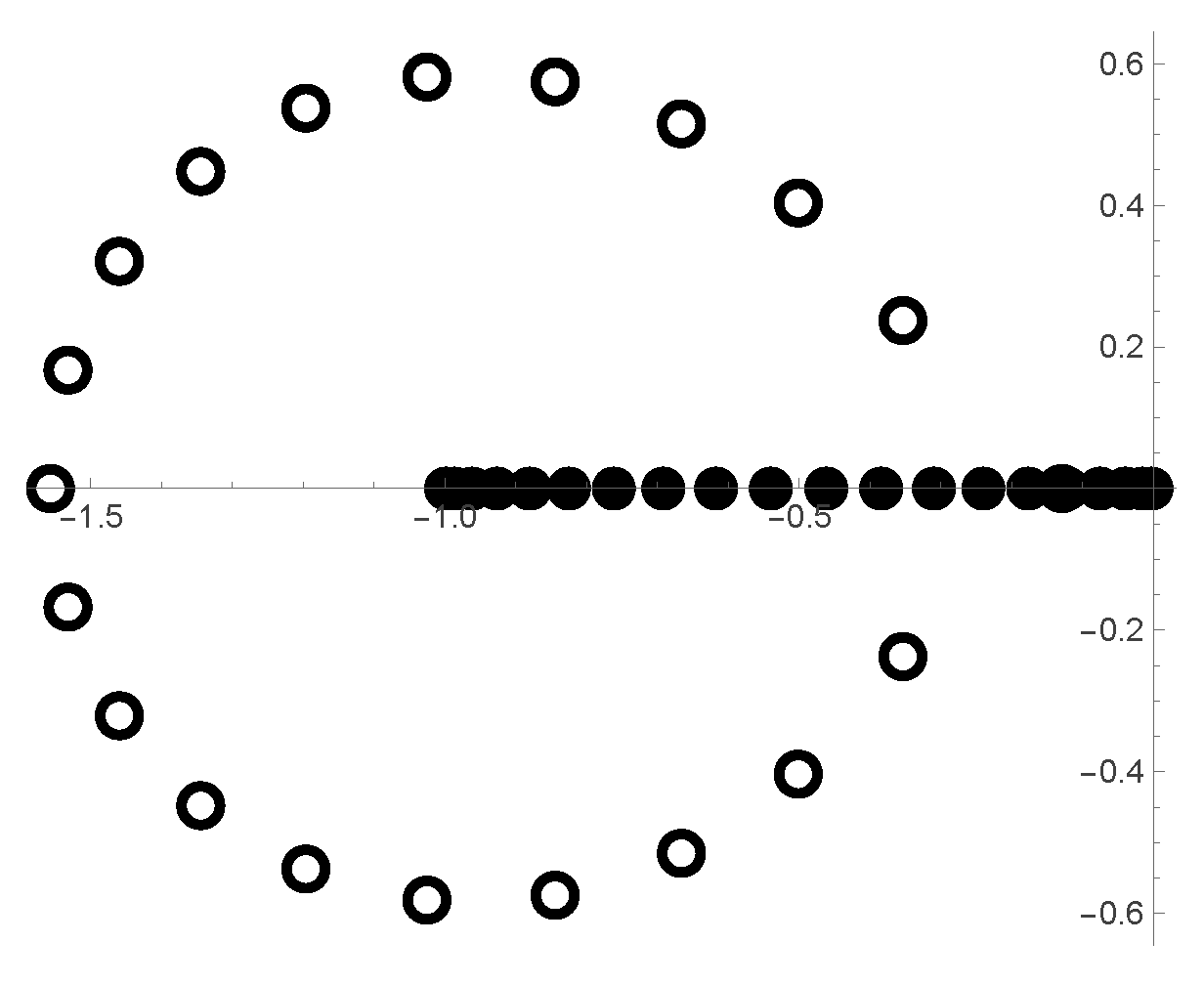
Figure 2.
The same as in Figure 1, together with the distributions of the complex zeros of the polynomial defined in Eq. (56), for (small open circles), (small black circles), (small open squares), and (small black squares).
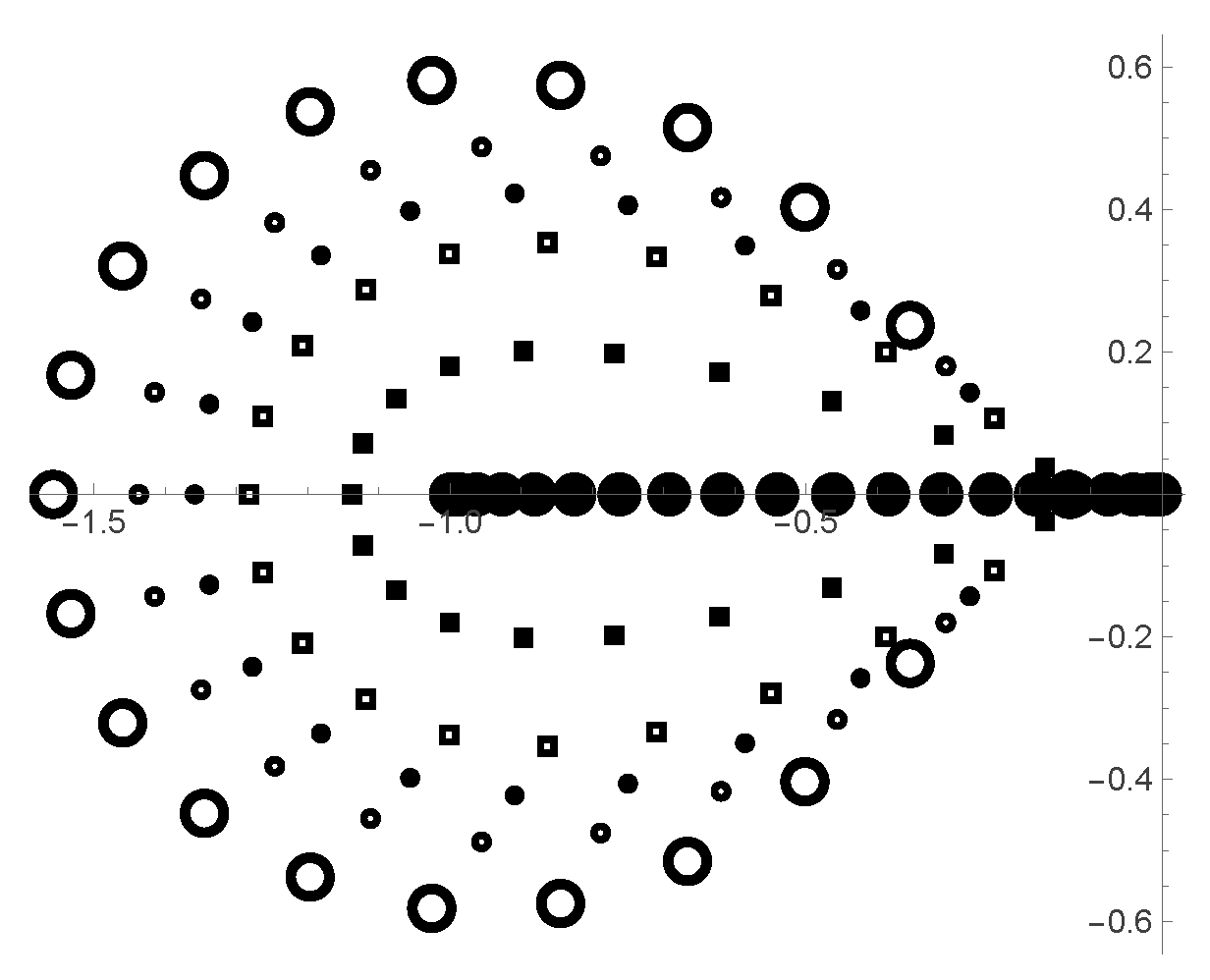
Figure 3.
The same as in Figure 2, but for the couple and , and for (small open circles), (small black circles), (small open squares), and (small black squares).
Figure 3.
The same as in Figure 2, but for the couple and , and for (small open circles), (small black circles), (small open squares), and (small black squares).
Disclaimer/Publisher’s Note: The statements, opinions and data contained in all publications are solely those of the individual author(s) and contributor(s) and not of MDPI and/or the editor(s). MDPI and/or the editor(s) disclaim responsibility for any injury to people or property resulting from any ideas, methods, instructions or products referred to in the content. |
© 2026 by the author. Licensee MDPI, Basel, Switzerland. This article is an open access article distributed under the terms and conditions of the Creative Commons Attribution (CC BY) license.
Copyright: This open access article is published under a Creative Commons CC BY 4.0 license, which permit the free download, distribution, and reuse, provided that the author and preprint are cited in any reuse.


