

Submitted:
29 December 2025
Posted:
30 December 2025
You are already at the latest version
Abstract
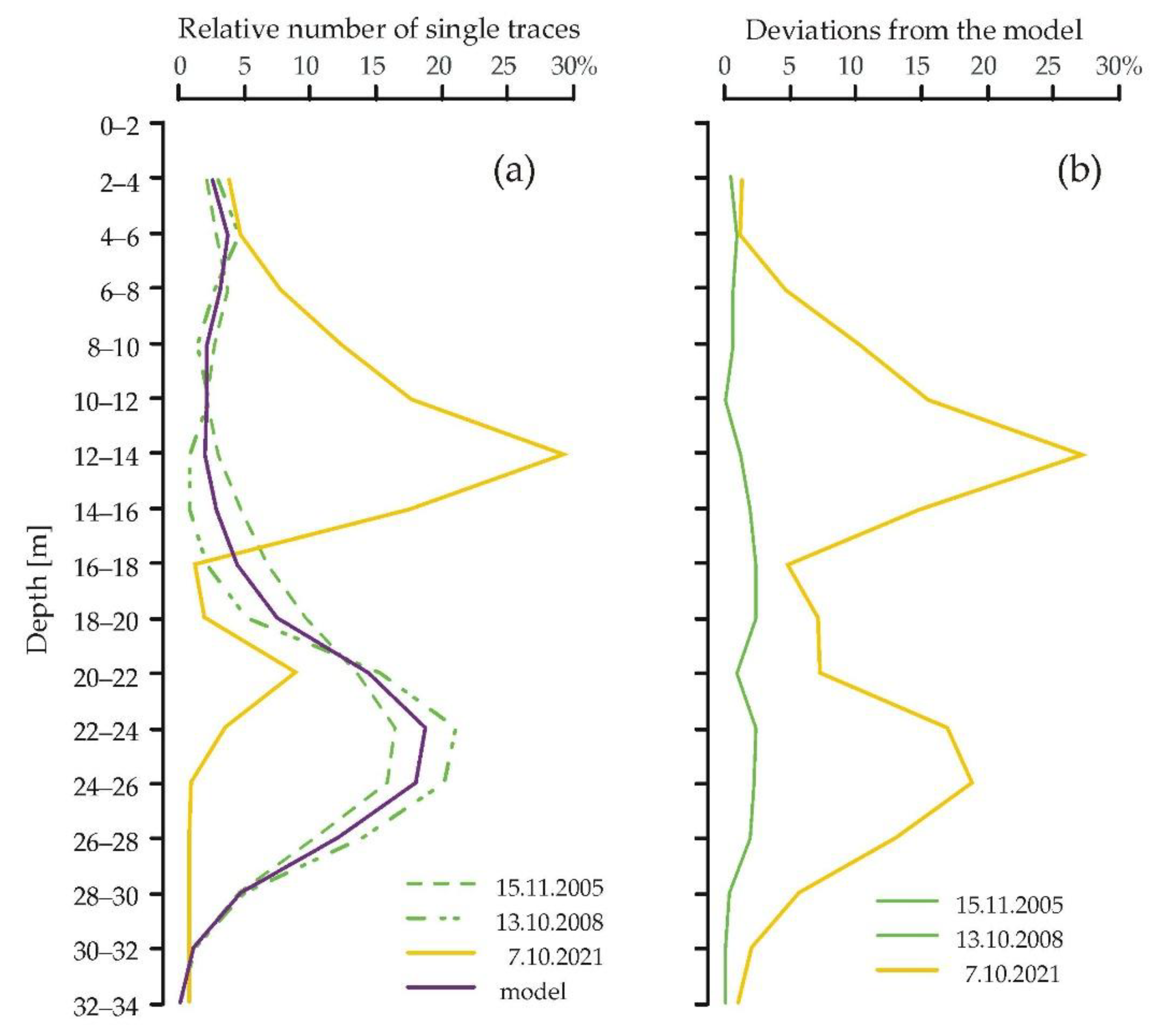
The ecological status of lakes based on ichthyofauna, as defined by the Water Framework Directive, is assessed using intercalibrated methods. However, the methods adopted (in Poland, the Lake Fish Index LFI-EN method, based on results of one-off fishing with multi-mesh gillnets) are labor-intensive and do not allow for frequent repeat testing. Therefore, the concept of a simple model describing changes in the relative number of single traces in the vertical profile (according to the TS target strength distribution) in a lake is presented, as well as an index (the sum of deviations from such a model), enabling quantification of the similarity of TS distributions in lakes with this model. Preliminary analyses were conducted on acoustic data collected in Lake Dejguny. This lake—the condition of which could be estimated based on historical data using the relationships between LFI and the degree of lake eutrophication (expressed by Carlson’s TSI)—was assessed as having a good status in 2006, whereas in 2021, (based on LFI-EN) it had a moderate status. The study tested the TS distribution model, calculated as the arithmetic mean of the relative number of single traces in 2 m-thick layers. It was also shown that the proposed indicator can effectively signal deterioration of ecological status—the sum of the absolute values of the TS distribution deviations in 2021 (moderate status) from the model was more than seven times greater than the sum of the deviations of the distributions from which the model was built (good status). The obtained results confirmed the hypothesis about the possibility of determining a characteristic distribution of single traces in the vertical profile when the lake was classified as being in good condition.
Keywords:
1. Introduction
2. Materials and Methods
2.1. Lake Description
2.2. Acoustic Data
2.3. Environmental Data
2.4. Data Analysis
3. Results and Discussion
3.1. Fish Size Structure
3.2. Ecological Condition of the Lake
3.3. Model
4. Conclusions
Funding
Data Availability Statement
Conflicts of Interest
References
- European Environment Agency. Directive 2000/60/EC of the European Parliament and of the Council of 23 October 2000 establishing a framework for Community action in the field of water policy. Official Journal of the European Communities, L 327, 22/12/2000 P. 0001 - 0073 .
- Szlachciak, J. Ocena stanu ekologicznego jezior z wykorzystaniem ichtiofauny. In Biologiczne Metody Oceny Stanu Środowiska. Tom 2. Ekosystemu Wodne; Ciecierska, H., Dynowska, M., Eds.; Uniwersytet Warmińsko-Mazurski w Olsztynie: Olsztyn, Poland, 2013; pp. 237–258.
- Belpaire, C.; Smolders, R.; Vanden Auweele, I.; Ercken, D.; Breine, J.; Van Thuyne, G.; Ollevier, F. An Index of Biotic Integrity characterizing fish populations and the ecological quality of Flandrian water bodies. Hydrobiologia 2000, 434, 17–33. [CrossRef]
- Adamczyk, M.; Prus, P. Ryby w jeziorach. In Podręcznik do Monitoringu Elementów Biologicznych i Klasyfikacji Stanu Ekologicznego Wód Powierzchniowycy. Aktualizacja Metod; Kolada, A., Ed.; Biblioteka Monitoringu Środowiska: Warszawa, Poland, 2020; pp. 297–324.
- Carlson, R.A. Trophic State Index for Lakes. Limnol. Oceanogr. 1977, 22, 361–369. [CrossRef]
- Algen, A. Random Errors of Acoustic Fish Abundance Estimates in Relation to the Survey Grid Density Applied. In FAO Fisheries Report; FAO: Rome, Italy, 1983; pp. 293–298.
- Doroszczyk, L.; Długoszewski, B.; Godlewska, M. Badania hydroakustyczne ichtiofauny jeziora Hańcza. In Środowisko i Ichtiofauna Jeziora Hańcza; Kozłowski, J., Poczyczyński, P., Zdanowski, B., Eds.; Wydawnictwo IRS: Olsztyn, Poland, 2008; pp. 191–201.
- Kubečka, J.; Duncan, A. Acoustic size vs. real size relationships for common species of riverine fish. Fish. Res. 1998, 35, 115–125. [CrossRef]
- Frouzová, J.; Kubečka, J.; Balk, H.; Frouz, J. Target strength of some European fish species and its dependence on fish body parameters. Fish. Res. 2005, 75, 86–96. [CrossRef]
- Godlewska, M.; Doroszczyk, L.; Długoszewski, B.; Kanogowska, E.; Pyka, J. Long-term decrease of the vendace population in Lake Pluszne (Poland)—Result of global warming, eutrophication or both? Ecohydrol. Hydrobiol. 2014, 14, 89–95. [CrossRef]
- Doroszczyk, L. Wykorzystanie Metod Hydroakustycznych do Oceny Populacji Sielawy na Przykładzie Jeziora Pluszne. Ph.D. Thesis, The St. Sakowicz Inland Fisheries Institute, Olsztyn, Poland, 2011; p. 81.
- Emmrich, M.; Winfield, I.J.; Guillard, J.; Rustadbakken, A.; Vergès, C.; Volta, P.; Jeppesen, E.; Lauridsen, T.L.; Brucet, S.; Holmgren, K.; et al. Strong correspondence between gillnet catch per unit effort and hydroacoustically derived fish biomass in stratified lakes. Freshw. Biol. 2012, 57, 2436–2448. [CrossRef]
- Guillard, J.; Lebourges-Dhaussy, A.; Balk, H.; Colon, M.; Jóźwik, A.; Godlewska, M. Comparing hydroacoustic fish stock estimates in the pelagic zone of temperate deep lakes using three sound frequencies (70, 120, 200 kHz). Inland Waters 2014, 4, 435–444. [CrossRef]
- Tušer, M.; Guillard, J.; Rustadbakken, A.; Mehner, T. Comparison of fish size spectra obtained from hydroacoustics and gillnets across seven European natural lakes. Can. J. Fish. Aquat. Sci. 2022, 79, 2179–2190. [CrossRef]
- Samedy, V.; Wach, M.; Lobry, J.; Selleslagh, J.; Pierre, M.; Josse, E.; Boët, P. Hydroacoustics as a relevant tool to monitor fish dynamics in large estuaries. Fish. Res. 2015, 172, 225–233. [CrossRef]
- Hutorowicz, A. Use of Hydroacoustic Methods to Assess Ecological Status Based on Fish: A Case Study of Lake Dejguny (Poland). Water 2024, 16, 282. [CrossRef]
- Godlewska, M.; Frouzová, J.; Kubečka, J.; Wiśniewolski, W.; Szlakowski, J. Comparison of hydroacoustic estimates with fish census in shallow Malta Reservoir—Which TS/L regression to use in horizontal beam applications? Fish. Res. 2012, 123–124, 90–97.
- Hutorowicz, A. Repeatability of Hydroacoustic Results versus Uncertainty in Assessing Changes in Ecological Status Based on Fish: A Case Study of Lake Widryńskie (Poland). Water 2024, 16, 1368. [CrossRef]
- Białokoz, W. Funkcjonowanie Mezotroficznego Jeziora z Liczną Populacją Sielawy, na Przykładzie Jeziora Dejguny (Północno-Wschodnia Polska); Unpublished Materials; Lake Fisheries Department of the Inland Fisheries Institute Named after St. Sakowicz: Giżycko, Poland, 2010; p. 9.
- Wróblewska, H. et al. Monitoring jezior. In Raport o Stanie Środowiska Województwa Warmińsko-Mazurskiego w 2008 roku [Report on the State of the Environment of the Warmia-Masuria Voivodship in 2008]; Kochańska, E. ., Ed.; Biblioteka Monitoringu Środowiska: Olsztyn, Poland, 2009; pp. 38-60.
- Ocena Stanu Jezior w Latach 2010–2015 [Assessment of the Condition of Lakes in the Years 2010–2015]. Tabela 4.8.4_Zbiorcza Ocena wód_dane zestawione.xlsx. Available online: https://wody.gios.gov.pl/pjwp/publication/LAKES/87 (accessed on 9 December 2023).
- Klasyfikacja Wskaźników i Grup Wskaźników w Jednolitych Częściach Wód Powierzchniowych Jezior za rok 2021 [Classification of Indicators and Groups of Indicators in Lake Surface Water Bodies for 2021]. Available online: https://wody.gios.gov.pl/pjwp/publication/LAKES/87 (accessed on 9 December 2023).
- Dembiński, W. Vertical distribution of vendance Coreginus albula L. and other pelagic fish species in some Polish lakes. J. Fish. Biol. 1971, 3, 341–357. [CrossRef]
- Dorosczyk, L.; Dlugoszewski, B. Rozmieszczenie, wielkość i biomasa ryb w jez. Dejguny w sierpniu 2005 r. [Distribution, Size and Biomass of Fish in Lake Dejguny in August 2005]; Unpublished Materials; Inland Fisheris Institute: Olsztyn, Poland, 2010; p. 22.
- Simrad EP 500, Echo processing system, 1997. Instruction Manual. [This is the manual that came with the EY 500 fishfinder. It was published in 1997 (version 5.3). SIMRAD A Kongsberg Company: Horten, Norway, pp. 1-69.
- Prchalová, M.; Kubečka, J.; Říha, M.; Mrkvička, T.; Vašeka, M.; Jůza, T.; Kratochvíl, M.; Peterka, J.; Draštíka, V.; Křížekd, J. Size selectivity of standardized multimesh gillnets in sampling coarse European species. Fish. Res. 2009, 96, 51–57. [CrossRef]
- Świerzowski, A.; Doroszczyk, L. Seasonal differences in in situ measurements of the target strength of vendance (Coregonus albula L.) in Lake Pluszne. Hydroaousstics 2004, 7, 217–226.
- Dorosczyk, L.; Dlugoszewski, B. Rozmieszczenie, Wielkość i Biomasa ryb w jez. Dejguny w listopadzie 2005 r. [Distribution, Size and Biomass of Fish in Lake Dejguny in November 2005]; Unpublished Materials; Inland Fisheris Institute: Olsztyn, Poland, 2010; p. 8.
- Pyka, J.P.; Zdanowski, B.; Stawecki, K.; Prusik, S. Trends in environmental changes in the selected lakes of the Mazury and Suwałki Lakelands. Limnol. Rev. 2007, 7, 101–109.
- Wilhelm, C.; Volkmar, P.; Lohmann, C.; Becker, A.; Meyer, M. The HPLC-aided pigment analysis of phytoplankton cells as a powerful tool in water quality control. J. Water SRT-Aqua 1995, 44, 132–141.
- Van Aswegen, A.S.; Engelbrecht, A.S. The relationship between transformational leadership, integrity and an ethical climate in organisations. SA J. Hum. Resour. Manag. 2009, 7, 1–9. Available online: https://sajhrm.co.za/index.php/sajhrm/article/view/175 (accessed on 24 February 2024).
- Białokoz, W.; Chybowski, Ł. Ichtiofauna. In Ecological Status Assessment of the Watres in the Wel River Catchment; Guidelines for Integrated Assessment of Ecological Status of Rivers and Lakes to Support River Baisn Management Plans; Soszka, H., Ed.; Wydawnictwo IRS: Olsztyn, Poland, 2011; pp. 217–234.
- Ritterbusch, D.; Blabolil, P.; Breine, J.; Erős, T.; Mehner, T.; Olin, M.; Peirson, G.; Volta, P.; Poikane, S. European fish-based assessment reveals high diversity of systems for determining ecological status of lakes. Sci. Total Environ. 2022, 802, 149620. [CrossRef]
- Poikane, S.; Ritterbusch, D.; Argillier, C.; Białokoz, W.; Blabolil, P.; Breine, J.; Jaarsma, N.G.; Krause, T.; Kubečka, J.; Lauridsen, T.L.; et al. Response of fish communities to multiple pressures: Development of a total anthropogenic pressure intensity index. Sci. Total Environ. 2017, 586, 502–511. [CrossRef]
- Monitoring Jezior [Lake Monitoring]. Available online: https://www.infish.com.pl/content/monitoring-jezior (accessed on 24 February 2025).

Disclaimer/Publisher’s Note: The statements, opinions and data contained in all publications are solely those of the individual author(s) and contributor(s) and not of MDPI and/or the editor(s). MDPI and/or the editor(s) disclaim responsibility for any injury to people or property resulting from any ideas, methods, instructions or products referred to in the content. |
© 2025 by the authors. Licensee MDPI, Basel, Switzerland. This article is an open access article distributed under the terms and conditions of the Creative Commons Attribution (CC BY) license (http://creativecommons.org/licenses/by/4.0/).


