
Preprint
Case Report

This version is not peer-reviewed.

Post-Streptococcal Glomerulonephritis Presenting with Acute Pulmonary Edema and Critical Hyperkalemia: A Rare Pediatric Case from Yemen

Submitted:

25 December 2025

Posted:

30 December 2025

You are already at the latest version

Abstract

Background: Post-streptococcal glomerulonephritis (PSGN) is a common cause of acute nephritic syndrome in children. Rarely, it may result in life-threatening complications, including acute pulmonary edema and critical hyperkalemia. Case Presentation: We report a 10-year-old Yemeni girl (25 kg) presenting with severe respiratory distress, irritability, and generalized pitting edema. Laboratory tests confirmed PSGN with markedly reduced complement C3 (42.2 mg/dL) and nephritic urine sediment containing numerous red blood cells and casts. The patient developed critical hyperkalemia (7.0 mmol/L) and acute pulmonary edema, requiring urgent intubation and mechanical ventilation using pressure-controlled mandatory ventilation (P-CMV). Management: Aggressive fluid mobilization and electrolyte stabilization were initiated. High-dose intravenous furosemide (4 mg/kg/day), renal-dose dopamine (5 μg/kg/min), and potassium-lowering interventions were applied. Morphine sedation (0.1 mg/kg/dose) was administered every 4 hours during the first 24 hours, then every 8 hours for 12 additional hours, followed by withdrawal prior to extubation. Morphine effectively controlled irritability and optimized patient–ventilator synchronization. The patient produced 1700 mL urine in 17 hours, demonstrating a strong diuretic response. Conclusion: Early recognition of severe extra-renal complications in PSGN is critical. Intensive supportive care—including mechanical ventilation, meticulous fluid and electrolyte management, and appropriate sedation—is essential for survival in cases of acute pulmonary edema and critical hyperkalemia.

Keywords: 
;  ;  ;  ;  ;  ;  ;  

1. Introduction

Post-streptococcal glomerulonephritis (PSGN) is an immune-mediated renal disorder triggered by nephritogenic Group A β-hemolytic streptococci. Clinical manifestations range from asymptomatic microscopic hematuria to severe acute kidney injury with systemic complications. In rare cases, children develop acute pulmonary edema and critical hyperkalemia, requiring intensive care management. This report illustrates such a high-acuity pediatric case, emphasizing the role of early recognition and comprehensive supportive care.

2. Case Presentation

Initial Assessment

A 10-year-old Yemeni girl (25 kg) was admitted to the Pediatric Intensive Care Unit (PICU) at Al-Mansoor Polyclinic with severe respiratory distress, irritability, and generalized pitting edema. Vital signs on admission: blood pressure 130/90 mmHg, heart rate 160 bpm, respiratory rate 56 bpm. Pulmonary auscultation revealed bilateral basal crackles. Urine initially appeared grossly hematuric, later turning smoky and tea-colored.

Diagnostic Investigations

Laboratory studies indicated acute kidney injury and critical electrolyte disturbance. Serum potassium reached 7.0 mmol/L. Serum creatinine was 1.5 mg/dL on admission, peaking at 2.5 mg/dL on day 2. Urinalysis showed numerous red blood cells throughout the microscopic field, urinary casts, and mild proteinuria (+1). Complement C3 was markedly reduced (42.2 mg/dL; reference >90 mg/dL), confirming PSGN. Chest radiography revealed bilateral diffuse pulmonary opacities consistent with pulmonary edema (Figure 1).

Management and Clinical Course

Due to respiratory compromise and pulmonary edema, the patient was intubated and mechanically ventilated using P-CMV.
Morphine sedation: 0.1 mg/kg/dose administered every 4 hours during the first 24 hours, then every 8 hours for 12 additional hours. Morphine was withdrawn prior to extubation. This regimen effectively controlled irritability and ensured optimal patient–ventilator synchronization, facilitating stable ventilation.
Additional management included:
  • Diuretics: High-dose IV furosemide (4 mg/kg/day)
  • Renal support: Renal-dose dopamine (5 μg/kg/min)
  • Electrolyte management: Salbutamol nebulization and strict potassium restriction
  • Fluid balance: Input calculated including insensible losses (400 mL/m²) plus prior urine output
  • Antimicrobials: IV ampicillin/sulbactam (100 mg/kg), followed by oral azithromycin
A robust diuretic response was observed: 1700 mL urine in 17 hours. By day 2, serum potassium normalized to 4.2 mmol/L and creatinine improved to 1.9 mg/dL. The patient was successfully extubated and transitioned to nasal cannula oxygen.

3. Discussion

PSGN is an immune-complex–mediated disorder triggered by nephritogenic Group A β-hemolytic streptococci, commonly after pharyngitis or impetigo [1,2]. Immune complexes deposit in glomeruli, activate complement, and trigger inflammation, reducing GFR [1,3,4,5]. Hypocomplementemia, particularly low C3, is a hallmark.
Severe pediatric cases may develop massive intravascular volume expansion, precipitating pulmonary edema [6]. Reduced GFR also impairs potassium excretion, causing critical hyperkalemia (≥7.0 mmol/L), a medical emergency.

Sedation and Ventilatory Support

Morphine sedation (0.1 mg/kg/dose) ensured control of agitation and patient–ventilator synchronization, reducing work of breathing and oxygen consumption during acute respiratory failure. The dosing schedule was crucial to allow safe extubation after stabilization.

Renal Hemodynamics and Diuresis

High-dose loop diuretics with renal-dose dopamine optimized renal perfusion and enhanced diuretic delivery, producing rapid diuresis (1700 mL/17 hours) and improved renal function.

Electrolyte Management

Critical hyperkalemia was addressed with salbutamol nebulization and diuresis, preventing cardiac arrhythmias.

Diagnostic Reliability and Prognosis

Despite unavailable ASO titers, the nephritic triad (hypertension, edema, hematuria), urinary casts, and low C3 strongly supported PSGN diagnosis. Early recognition and intensive supportive care ensured excellent outcomes [1,3,5,6].

4. Conclusion

PSGN may rarely present with life-threatening complications such as acute pulmonary edema and critical hyperkalemia. Prompt recognition and intensive supportive care—including diuretics, electrolyte correction, mechanical ventilation, and appropriate sedation—are essential. With timely intervention, full recovery is achievable in most pediatric patients.

5. Limitations

Serological confirmation (ASO, anti-DNase B) was unavailable. Quantitative proteinuria assessment was not performed. However, clinical presentation, nephritic urinary findings, hypocomplementemia, and disease course strongly support PSGN, consistent with pediatric literature [1,3,6].

6. Acknowledgments

We thank the nursing staff at Al-Mansoor Polyclinic (Haifa Al-Bahr, Karima Jallad, Kholoud Bahza, Zahraa Muawadah, Mahasin Saghir, Iman Hakami, Amat Al-Aleem Al-Wasabi, Samia Attia, Lamia Musaik, Abeer Riz, Wafaa Jazaz, Faiza Al-Bahr) for exceptional clinical care.

7. Author Contributions

  • Mansoor Khalid Mansoor Ayish: Conceptualization, clinical data collection, primary manuscript drafting
  • Hussein Mussa Muafa: Manuscript revision and critical review
  • Ali Abdu Abdelbaky Mohamed: Clinical supervision, final manuscript approval

8. Declarations

Ethics Approval: The study was conducted in accordance with the Declaration of Helsinki. Ethical approval was obtained from the Institutional Review Board of Al-Mansoor Polyclinic, Al-Hodaidah, Yemen (Approval Code: AlMansoor-CaseReport-2025, Date of Approval: 2 December 2024).
Consent to Publish: Written informed consent obtained from patient’s guardian
Conflict of Interest: None declared

Funding

Not applicable

References

  1. Hassanein, M; Gudsoorkar, P; Padala, SA; et al. Infection-Related Glomerulonephritis. [Updated 2025 Dec 13]. In StatPearls [Internet]; StatPearls Publishing: Treasure Island (FL), Jan 2025; Available online: https://www.ncbi.nlm.nih.gov/books/NBK538255/.
  2. Rodriguez-Iturbe, B; Haas, M. Post-Streptococcal Glomerulonephritis. In Streptococcus pyogenes: Basic Biology to Clinical Manifestations [Internet]; Ferretti, JJ, Stevens, DL, Fischetti, VA, Eds.; University of Oklahoma Health Sciences Center: Oklahoma City (OK), 10 Feb 2016. [Google Scholar] [PubMed]
  3. Alhamoud, MA; Salloot, IZ; Mohiuddin, SS; AlHarbi, TM; Batouq, F; Alfrayyan, NY; Alhashem, AI; Alaskar, M. A Comprehensive Review Study on Glomerulonephritis Associated With Post-streptococcal Infection. Cureus 2021, 13(12), e20212. [Google Scholar] [CrossRef] [PubMed] [PubMed Central]
  4. Munif, MR; Hart, RA; Rafeek, RAM; Mallawaarachchi, AC; Anderson, L; McMillan, DJ; Sriprakash, KS; Ketheesan, N. Mechanisms that potentially contribute to the development of post-streptococcal glomerulonephritis. Pathog Dis. 2024, 82, ftae024. [Google Scholar] [CrossRef] [PubMed] [PubMed Central]
  5. Geetha, Duvuru. Poststreptococcal Glomerulonephritis. Medscape. Updated 2023 sep 25. Available online: https://emedicine.medscape.com/article/240337-overview (accessed on 21 December 2025).
  6. Chiu, CY; Huang, YC; Wong, KS; Hsia, SH; Lin, CJ; Lin, TY. Poststreptococcal glomerulonephritis with pulmonary edema presenting as respiratory distress. Pediatr Nephrol 2004, 19(11), 1237–40. [Google Scholar] [CrossRef] [PubMed]
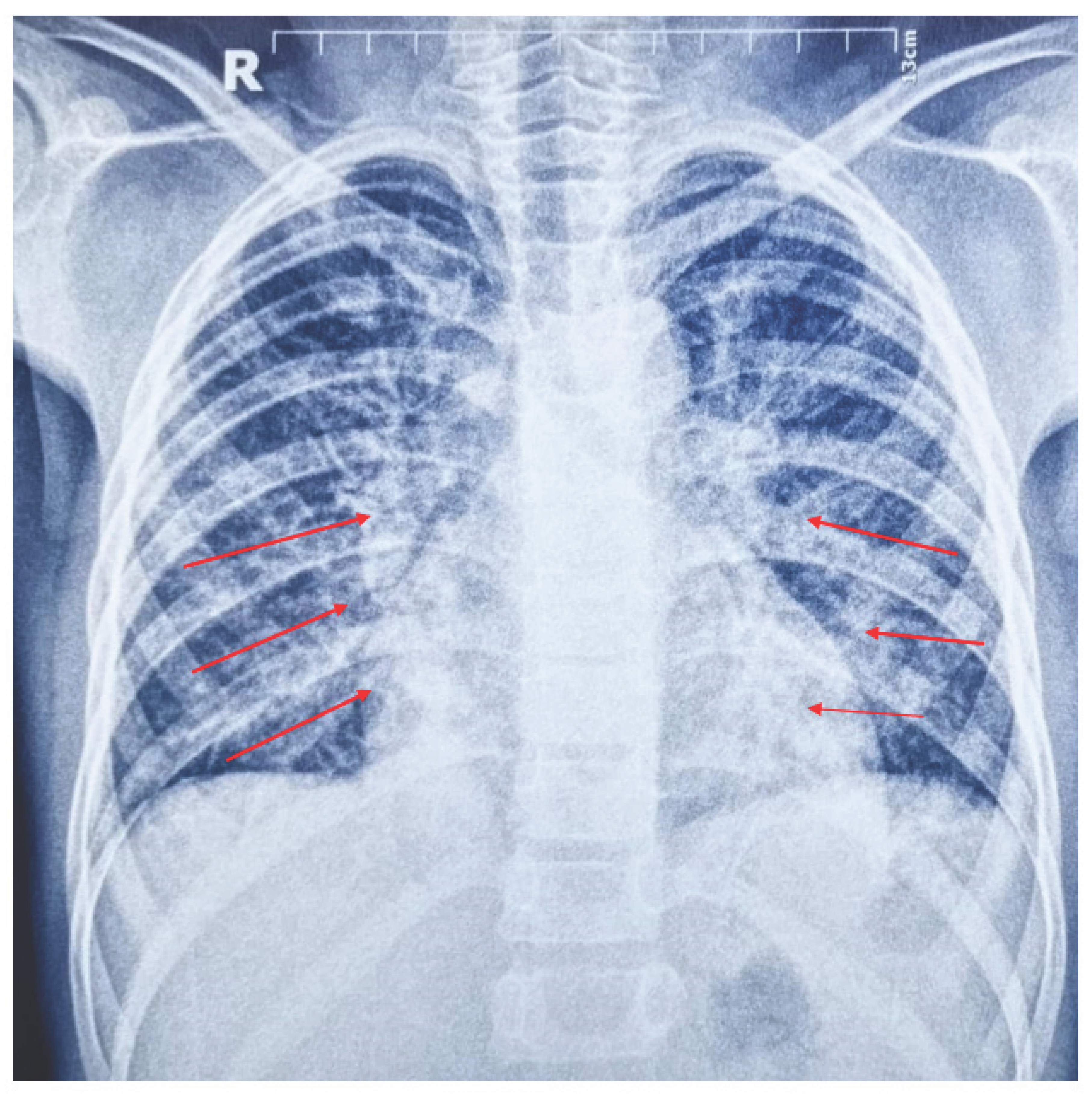
Figure 1. Chest radiograph (posteroanterior view) demonstrating bilateral diffuse pulmonary opacities (arrows), predominantly involving the perihilar and lower lung zones. Increased interstitial and alveolar markings with symmetric distribution are evident, consistent with pulmonary congestion or edema. No focal consolidation, pleural effusion, or pneumothorax is observed. The cardiac silhouette appears within normal limits.
Preprints 191536 g001
Disclaimer/Publisher’s Note: The statements, opinions and data contained in all publications are solely those of the individual author(s) and contributor(s) and not of MDPI and/or the editor(s). MDPI and/or the editor(s) disclaim responsibility for any injury to people or property resulting from any ideas, methods, instructions or products referred to in the content.
Copyright: This open access article is published under a Creative Commons CC BY 4.0 license, which permit the free download, distribution, and reuse, provided that the author and preprint are cited in any reuse.
Prerpints.org logo

Preprints.org is a free preprint server supported by MDPI in Basel, Switzerland.

Subscribe

Disclaimer

Terms of Use

Privacy Policy

Privacy Settings

© 2026 MDPI (Basel, Switzerland) unless otherwise stated