

Submitted:
25 December 2025
Posted:
26 December 2025
You are already at the latest version
Abstract
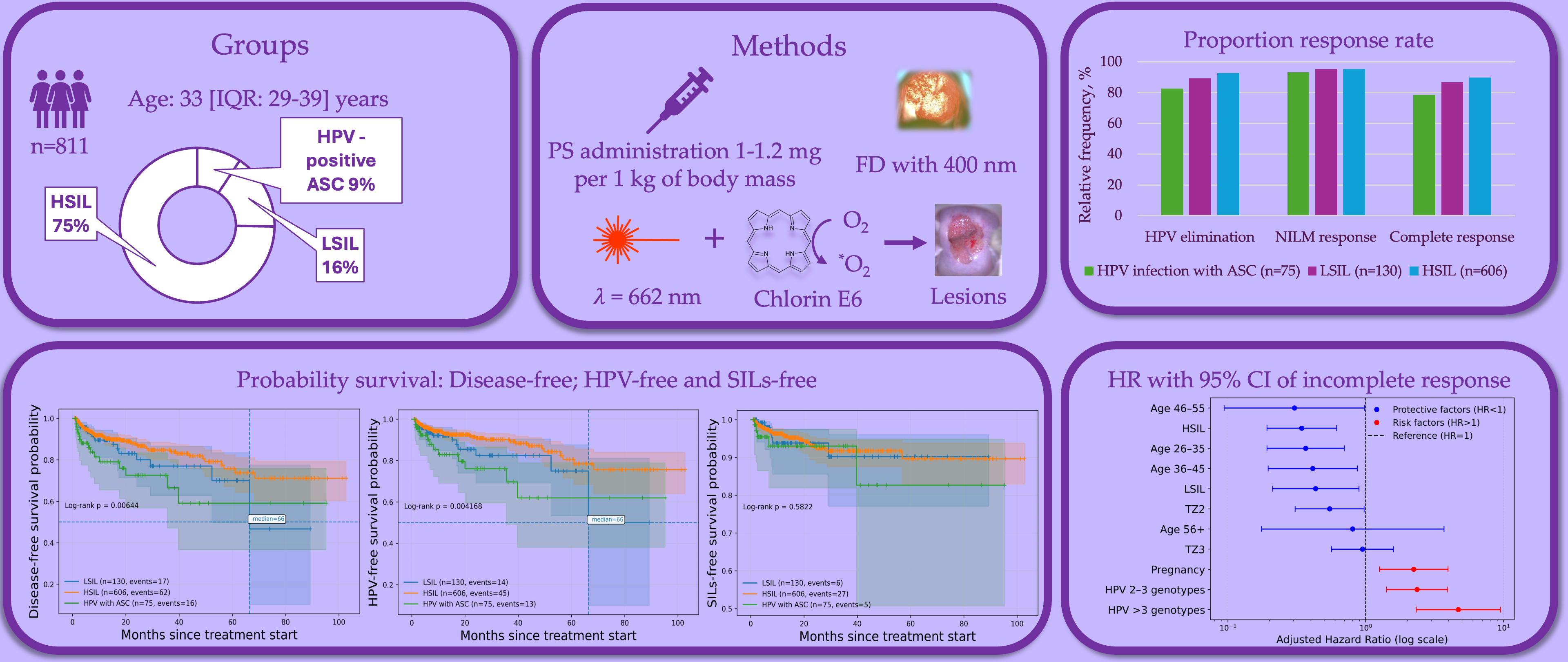
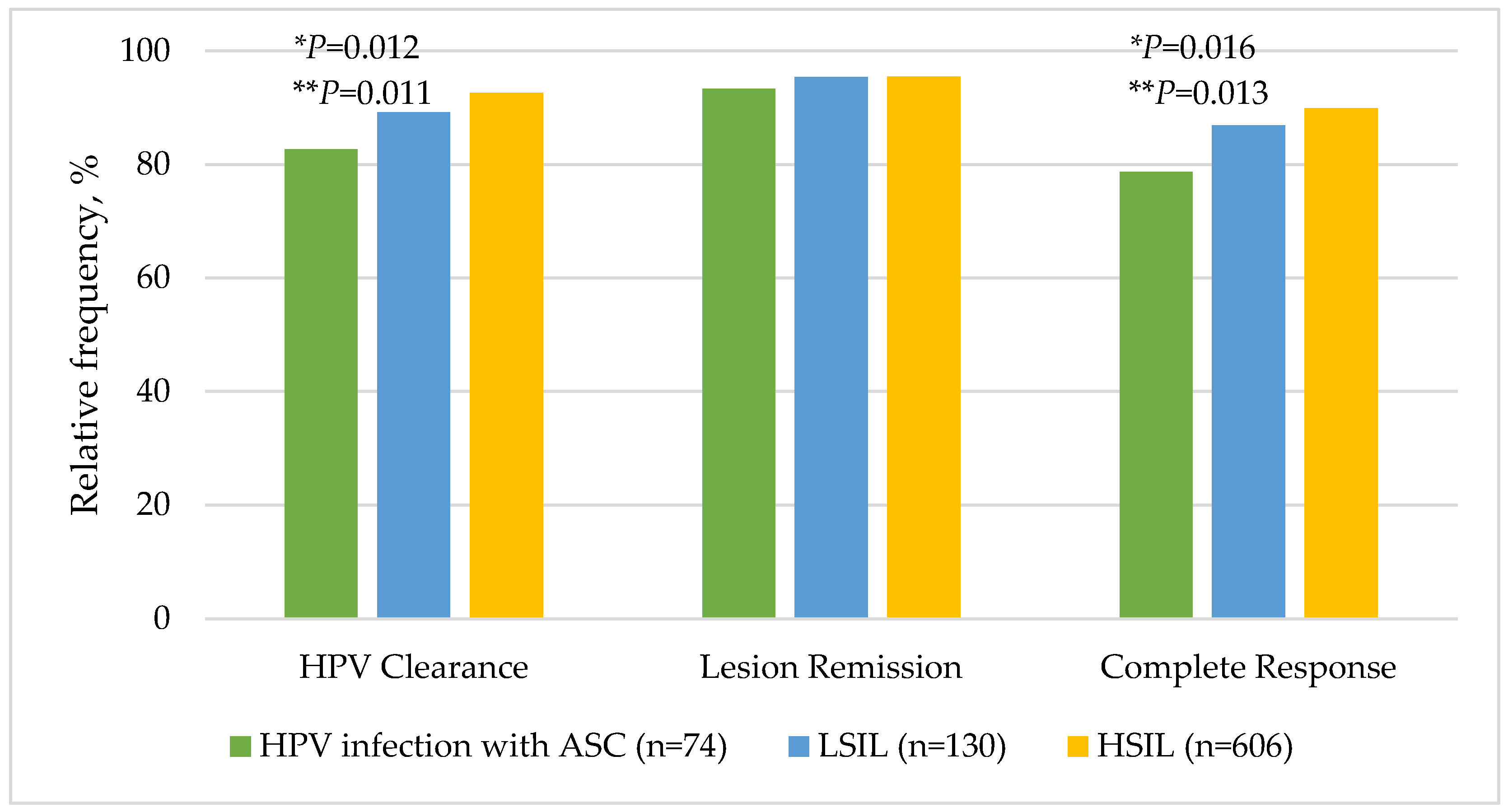
Background/Objectives: This study aims to fill certain knowledge gaps by assessing the clinical effectiveness of PDT in a large group of women with HPV-related cervical lesions and examining how different patient factors affect treatment results. Methods: 811 women aged from 19 to 76 were retrospectively analyzed who were treated by PDT of HPV infection with atypical squamous cells and HPV-related cervical lesions. PDT was performed using chlorin e6–based systemic photosensitizers. Irradiation was carried out at 662 nm. The endocervical dose was 334 J/cm² and the ectocervical dose was 291 J/cm². Results: Overall HPV clearance was 91.1%, lesion remission 95.3%, and complete response 88.3%, with the highest complete response observed in the HSIL group compared with HPV-positive ASC. Multivariable models showed that multiple HPV infection (especially >3 genotypes) and pregnancy history were associated with lower odds of complete response, while younger age (18–25 years) and TZ2 were associated with higher odds of complete response. Conclusions: PDT using chlorin e6–based photosensitizers demonstrated high clinical and virological effectiveness across HPV-related cervical abnormalities, including HSIL, supporting its role as an organ-preserving treatment option. Multiple HPV genotypes and pregnancy history may identify patients at increased risk of incomplete response and warrant closer follow-up or tailored treatment strategies.
Keywords:
1. Introduction
2. Materials and Methods
2.1. Study Design and Ethical Consideration
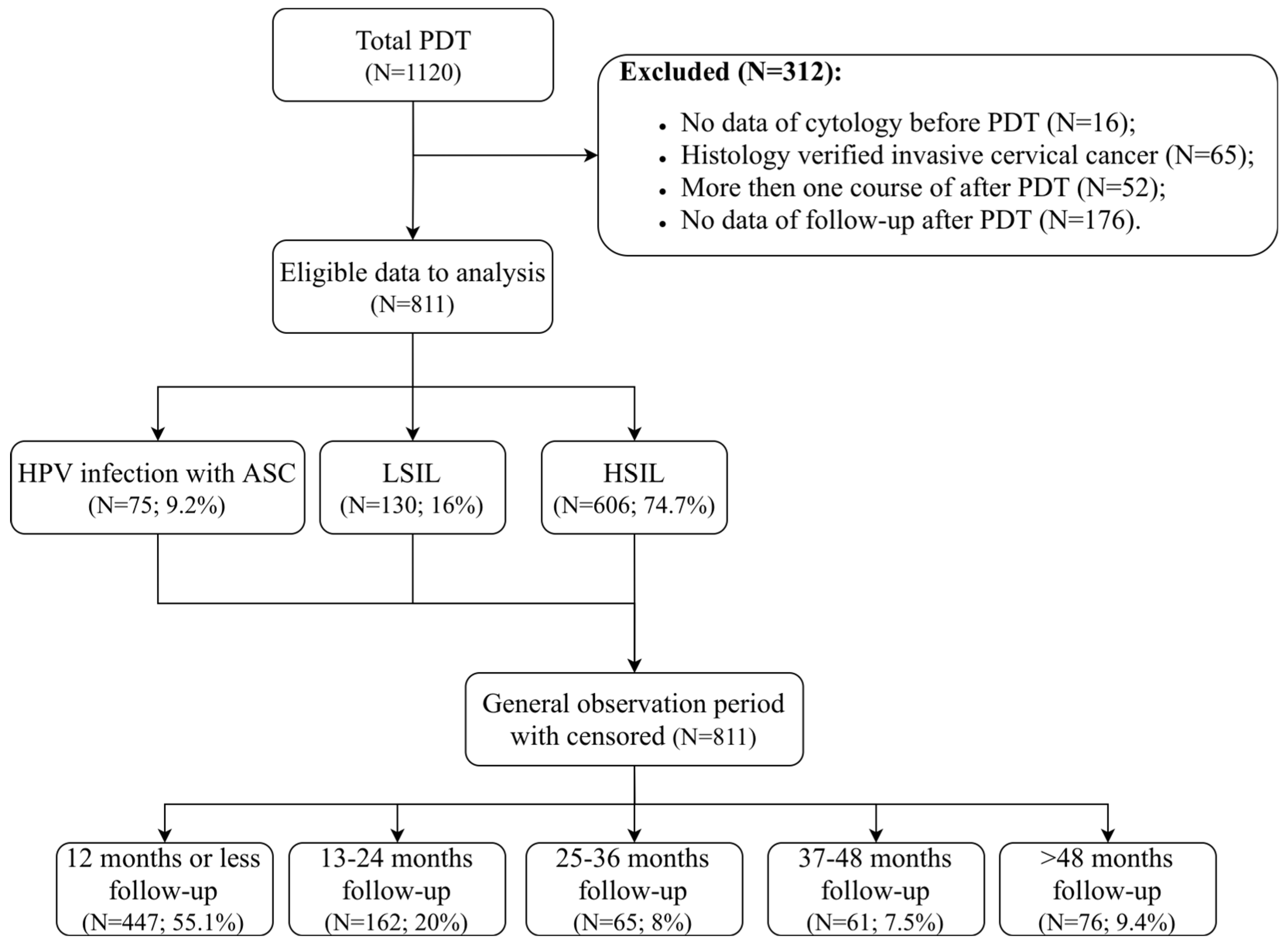
- 75 women with HPV infection and ASC;
- 130 women with low-grade squamous intraepithelial lesion (LSIL);
- 606 women with high-grade squamous intraepithelial lesion (HSIL);
2.2. PDT Protocol
2.3. Follow-Up and Outcome Assessment
2.4. Statistical Analysis
3. Results
3.1. Baseline Characteristics
3.2. Comparison of Complete Response, HPV Clearance and Lesion Remission
3.3. Multivariate Analysis of Factors for Complete Response, HPV Clearance and Lesion Remission
3.3.1. Complete Response
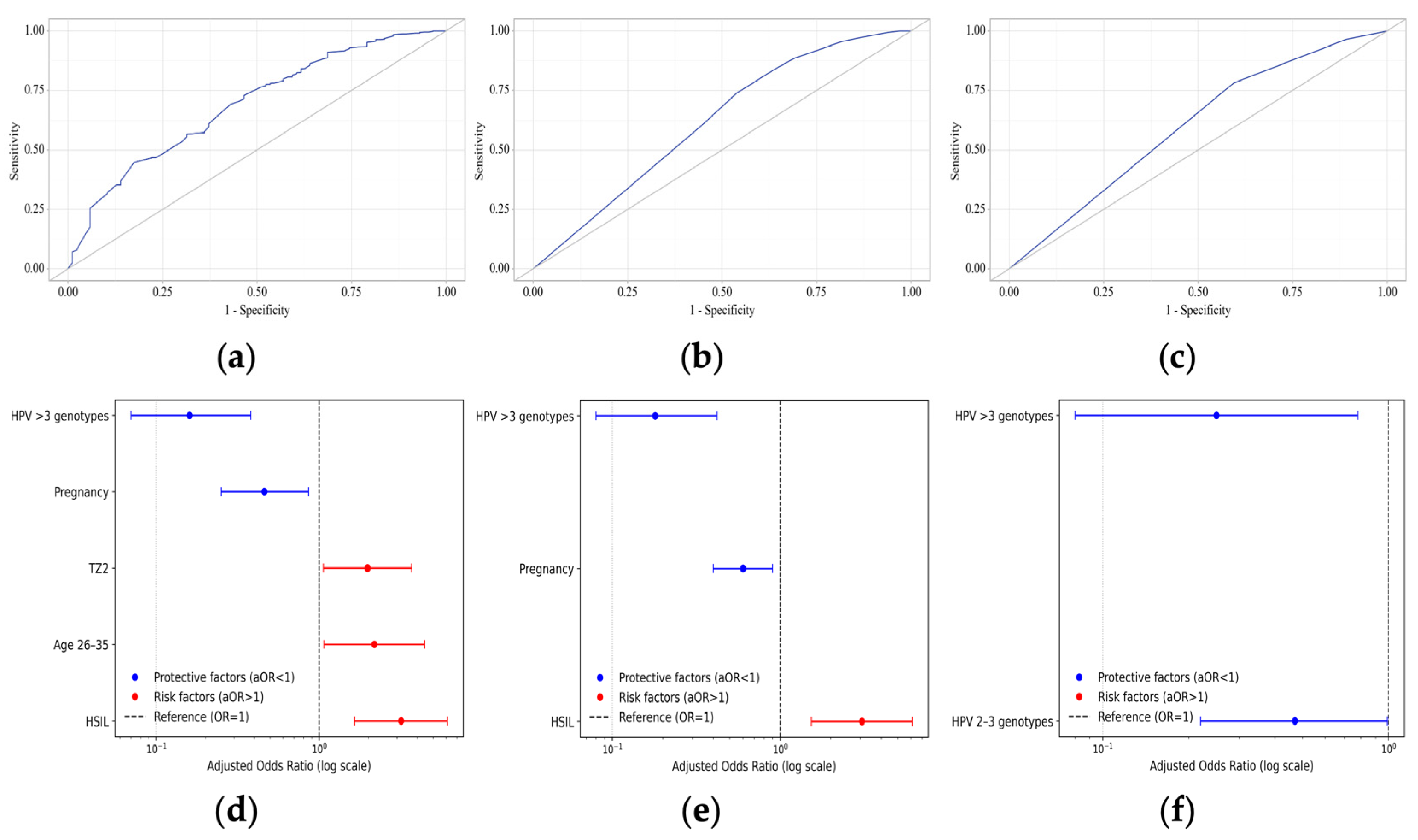
3.3.2. HPV Clearance

| Predictors | Unadjusted | Adjusted | ||
|---|---|---|---|---|
| COR; 95% CI | P value | AOR; 95% CI | P value | |
| SILs grade: LSIL HSIL |
1.94; 0.83 – 4.54 2.90; 1.47 – 5.74 |
0.125 0.002* |
2.13; 0.90 – 5.06 3.07; 1.53 – 6.13 |
0.087 0.002 |
| Multiple HPV infection: 2-3 genotypes >3 genotypes |
0.90; 0.46 – 1.75 0.18; 0.08 – 0.43 |
0.755 < 0.001* |
0.93; 0.47 – 1.82 0.18; 0.08 – 0.42 |
0.821 < 0.001 |
3.3.3. Lesion Remission
| Predictors | Unadjusted | Adjusted | ||
|---|---|---|---|---|
| cOR; 95% CI | P value | aOR; 95% CI | P value | |
| Multiple HPV infection: 2-3 genotypes >3 genotypes |
0.47; 0.22 – 0.99 0.25; 0.08 – 0.78 |
0.047 0.017 |
0.47; 0.22 – 0.99 0.25; 0.08 – 0.78 |
0.047 0.017 |
3.4. Time-to-Event for Incomplete Response, Persistent HPV Infection and Lesion Persistent
3.4.1. Incomplete Response
3.4.2. Persistent HPV Infection
3.4.3. Lesion Persistent
4. Discussion
5. Conclusions
Supplementary Materials
Author Contributions
Funding
Informed Consent Statement
Conflicts of Interest
Abbreviations
| ASC | Atypical squamous cell |
| CI | Confidential interval |
| CR | Complete response |
| HPV | Human papillomavirus |
| HR | Hazard ratio |
| HSIL | High-grade squamous intraepithelial lesion |
| LSIL | Low-grade squamous intraepithelial lesion |
| OR | Odds ratio |
| PDT | Photodynamic therapy |
| SIL | Squamous intraepithelial lesion |
| TZ | Transformation zone |
References
- Cancer TODAY | IARC. Available online: https://gco.iarc.who.int (accessed on 8 February 2024).
- McCredie, M.R.; Sharples, K.J.; Paul, C.; Baranyai, J.; Medley, G.; Jones, R.W.; Skegg, D.C. Natural History of Cervical Neoplasia and Risk of Invasive Cancer in Women with Cervical Intraepithelial Neoplasia 3: A Retrospective Cohort Study. Lancet Oncol 2008, 9, 425–434. [Google Scholar] [CrossRef] [PubMed]
- WHO Guidelines for Treatment of Cervical Intraepithelial Neoplasia 2–3 and Adenocarcinoma in Situ: Cryotherapy, Large Loop Excision of the Transformation Zone, and Cold Knife Conization; 2014; ISBN 9789241506779.
- Martin-Hirsch, P.L.; Paraskevaidis, E.; Kitchener, H. Surgery for Cervical Intraepithelial Neoplasia. Cochrane Database Syst Rev 2000, CD001318. [Google Scholar] [CrossRef]
- CRANE, J. Pregnancy Outcome after Loop Electrosurgical Excision Procedure: A Systematic Review. Obstetrics & Gynecology 2003, 102, 1058–1062. [Google Scholar] [CrossRef] [PubMed]
- Jin, G.; LanLan, Z.; Li, C.; Dan, Z. Pregnancy Outcome Following Loop Electrosurgical Excision Procedure (LEEP) a Systematic Review and Meta-Analysis. Arch Gynecol Obstet 2014, 289, 85–99. [Google Scholar] [CrossRef] [PubMed]
- Kyrgiou, M.; Athanasiou, A.; Paraskevaidi, M.; Mitra, A.; Kalliala, I.; Martin-Hirsch, P.; Arbyn, M.; Bennett, P.; Paraskevaidis, E. Adverse Obstetric Outcomes after Local Treatment for Cervical Preinvasive and Early Invasive Disease According to Cone Depth: Systematic Review and Meta-Analysis. BMJ 2016, i3633. [Google Scholar] [CrossRef] [PubMed]
- Rema, P.; Suchetha, S.; Thara, S.; Fayette, J.M.; Wesley, R.; Sankaranarayanan, R. Effectiveness and Safety of Loop Electrosurgical Excision Procedure in a Low-resource Setting. International Journal of Gynecology & Obstetrics 2008, 103, 105–110. [Google Scholar] [CrossRef]
- Cui, N.; Li, X.; Wen, X.; Xu, J.; Chen, L. Pathological Changes and Pregnancy Outcomes in Cervical Intraepithelial Neoplasia Patients After Cold Knife Conization. Int J Gen Med 2024, Volume 17, 3641–3648. [Google Scholar] [CrossRef] [PubMed]
- Qian, J.; Wang, Y.; Wu, G.; Lu, J.; Sun, L.; Xu, S. The Efficacy and Safety of Local 5-Aminolevulinic Acid-Based Photodynamic Therapy in the Treatment of Cervical High-Grade Squamous Intraepithelial Lesion: A Single Center Retrospective Observational Study. Front Oncol 2024, 14. [Google Scholar] [CrossRef] [PubMed]
- Li, Y.; Chen, J.; Hu, Y.; Xu, Q.; Jiang, R.; Teng, Y.; Xu, Y.; Ma, L. Effects of 5-Aminolevulinic Acid Photodynamic Therapy for Cervical Low-Grade Squamous Intraepithelial Lesions with HR-HPV Infections. Front Med (Lausanne) 2023, 10. [Google Scholar] [CrossRef] [PubMed]
- Kwiatkowski, S.; Knap, B.; Przystupski, D.; Saczko, J.; Kędzierska, E.; Knap-Czop, K.; Kotlińska, J.; Michel, O.; Kotowski, K.; Kulbacka, J. Photodynamic Therapy – Mechanisms, Photosensitizers and Combinations. Biomedicine & Pharmacotherapy 2018, 106, 1098–1107. [Google Scholar] [CrossRef] [PubMed]
- Ju, Y.; Zhou, Q. The Impact of Photodynamic Therapy on Cellular Immune Function in Patients with Cervical HPV Infection. Clinics 2025, 80, 100537. [Google Scholar] [CrossRef] [PubMed]
- Wang, X.; Chen, Y.; Huang, J.; He, Q.; Zhou, J. Comparative Efficacy of Photodynamic Therapy and Cold Knife Conization for Cervical High-Grade Squamous Intraepithelial Lesions. Current Oncology 2025, 32, 590. [Google Scholar] [CrossRef] [PubMed]
- Liu, Y.; Li, R.; Li, C.; Liu, Z.; Duan, L.; Huang, Q.; Geng, L.; Hou, J.; Wei, L.; Wu, R. Photodynamic Therapy Compared with Loop Electrosurgical Excision Procedure in Patients with Cervical High-Grade Squamous Intraepithelial Lesion. Sci Rep 2024, 14, 27090. [Google Scholar] [CrossRef] [PubMed]
- Hillemanns, P.; Garcia, F.; Petry, K.U.; Dvorak, V.; Sadovsky, O.; Iversen, O.-E.; Einstein, M.H. A Randomized Study of Hexaminolevulinate Photodynamic Therapy in Patients with Cervical Intraepithelial Neoplasia 1/2. Am J Obstet Gynecol 2015, 212, 465.e1–465.e7. [Google Scholar] [CrossRef] [PubMed]
- Inada, N.M.; Buzzá, H.H.; Leite, M.F.M.; Kurachi, C.; Trujillo, J.R.; de Castro, C.A.; Carbinatto, F.M.; Lombardi, W.; Bagnato, V.S. Long Term Effectiveness of Photodynamic Therapy for CIN Treatment. Pharmaceuticals 2019, 12, 107. [Google Scholar] [CrossRef] [PubMed]
- Owczarek, W.; Slowinska, M.; Walecka, I.; Ciazynska, M.; Nowicka, D.; Walczak, L.; Paluchowska, E. Correlation of the ALA-PDT Treatment Efficacy and the HPV Genotype Profile of Genital Warts after Cryotherapy Failure and Podophyllotoxin Therapy in Male Patients. Life 2021, 11, 146. [Google Scholar] [CrossRef] [PubMed]
| Characteristics | Groups | P value | ||
|---|---|---|---|---|
| HPV infection with ASC | LSIL | HSIL | ||
| Age, years M±SD Me [IQR] |
31.4±7.2 31 [27-36] |
31.4±8 31 [25-35] |
34.9±8.3 34 [29-39] |
<0.001 <0.001 |
| Age groups: 18-25, n (%) 26-35, n (%) 36-45, n (%) 46-55, n (%) 56+, n(%) |
14 (18,7%) 42 (56%) 16 (21,3%) 3 (4%) 0 (0%) |
33 (25,4%) 65 (50%) 25 (19,2%) 4 (3,1%) 3 (2,3%) |
59 (9,7%) 307 (50,7%) 183 (30,2%) 43 (7,1%) 14 (2,3%) |
<0.001 |
| Age at sexual debut, years M±SD Me [IQR] |
19±3.4 18 [17-20] |
18.5±2.7 18 [17-20] |
18.12.3 18 [17-19] |
0.047 0.21 |
| Age at sexual debut groups: <18, n (%) ±18, n (%) |
22 (30,1%) 51 (69,9%) |
51 (41,1%) 73 (58,9%) |
233 (40,0%) 350 (60,0%) |
0.24 |
| Number of sexual partners M±SD Me [IQR] |
4±4 3 [1-5] |
4±3 3 [2-5] |
5±5 4 [2-7] |
0.002 0.011 |
| Sexual partners: 1, n (%) 2-3, n (%) >3, n (%) |
19 (26,4%) 19 (26,4%) 34 (47,2%) |
24 (19,5%) 38 (30,9%) 61 (49,6%) |
87 (15,1%) 169 (29,3%) 321 (55,6%) |
0.13 |
| Pregnancy status, n (%) | 42 (58.3%) | 72 (57.6%) | 431 (72.9%) | <0.001 |
| No. of pregnancies, Me [IQR] | 1 [0-2] | 1 [0-2] | 1 [0-3] | <0.001 |
| Pregnancies: 1, n (%) 2-3, n (%) >3, n (%) |
48 (66,7%) 18 (25,0%) 6 (8,3%) |
79 (63,2%) 34 (27,2%) 12 (9,6%) |
323 (54,7%) 185 (31,3%) 83 (14,0%) |
0.15 |
| TZ types: TZ1, n (%) TZ2, n (%) TZ3, n (%) |
22 (29,3%) 20 (26,7%) 33 (44,0%) |
39 (31,0%) 37 (29,4%) 50 (39,7%) |
186 (31,6%) 183 (31,1%) 220 (37,4%) |
0.84 |
| Main HPV genotype: HPV16, n (%) HPV18, n (%) HPV31, n (%) HPV33, n (%) Other genotypes, n (%) |
25 (50,0%) 4 (8,0%) 3 (6,0%) 2 (4,0%) 16 (32,0%) |
46 (47,9%) 5 (5,2%) 7 (7,3%) 6 (6,2%) 32 (33,3%) |
297 (67,7%) 18 (4,1%) 34 (7,7%) 29 (6,6%) 61 (13,9%) |
<0.001 |
| HPV infection: Single, n (%) Multiple, n (%) Not detected, n (%) No data, n (%) |
33 (44,0%) 24 (32,0%) 14 (18,7%) 4 (5,3%) |
54 (41,5%) 54 (41,5%) 14 (10,8%) 8 (6,2%) |
310 (51,2%) 185 (30,5%) 34 (5,6%) 77 (12,7%) |
<0.001a |
| Multiple HPV infection: 2-3, n (%) >3, n (%) |
14 (87.5%) 2 (12.5%) |
33 (82.5%) 7 (17.5%) |
104 (81.9%) 23 (18.1%) |
0.86 |
| Viral load M±SD Me [IQR] |
27.8±133.3 5.4 [4.5-6.1] |
13.9±45.5 6.1 [5.4-7.1] |
15.8±62.6 6 [5.1-7] |
0.59 0.038 |
| LR models | Pseudo-R2 | ROC-AUC | 95% CI | P value | Se, % | Sp, % |
|---|---|---|---|---|---|---|
| Complete response | 0.104 | 0.69 | 0.62-0.75 | <0.001 | 61 | 62.8 |
| HPV clearance | 0.064 | 0.62 | 0.54-0.69 | <0.001 | 60.3 | 55.4 |
| Lesion remission | 0.029 | 0.60 | 0.50-0.70 | 0.006 | 78.2 | 40.5 |
| Predictors | Unadjusted | Adjusted | ||
|---|---|---|---|---|
| COR; 95% CI | P value | AOR; 95% CI | P value | |
| Age groups: 26-35 36-45 46-55 56+ |
1.73; 0.92 – 3.25 1.43; 0.73 – 2.82 2.07; 0.65 – 6.60 1.28; 0.26 – 6.25 |
0.088 0.302 0.217 0.757 |
2.18; 1.07 – 4.44 1.60; 0.69 – 3.69 2.64; 0.73 – 9.55 1.40; 0.26 – 7.44 |
0.032 0.270 0.138 0.697 |
| Pregnancy status | 0.70; 0.42 – 1.18 | 0.179 | 0.46; 0.25 – 0.86 | 0.014 |
| TZ types: TZ2 TZ3 |
1.80; 0.99 – 3.26 1.22; 0.73 – 2.04 |
0.054 0.443 |
1.98; 1.06 – 3.69 1.12; 0.64 – 1.97 |
0.033 0.686 |
| SILs grade: LSIL HSIL |
1.96; 0.90 – 4.26 2.66; 1.43 – 4.96 |
0.090 0.002 |
2.47; 1.10 – 5.54 3.18; 1.65 – 6.12 |
0.029 0.001 |
| Multiple HPV infection: 2-3 genotypes >3 genotypes |
0.53; 0.31 – 0.89 0.19; 0.09 – 0.44 |
0.017 < 0.001 |
0.44; 0.25 – 0.77 0.16; 0.07 – 0.38 |
0.004 < 0.001 |
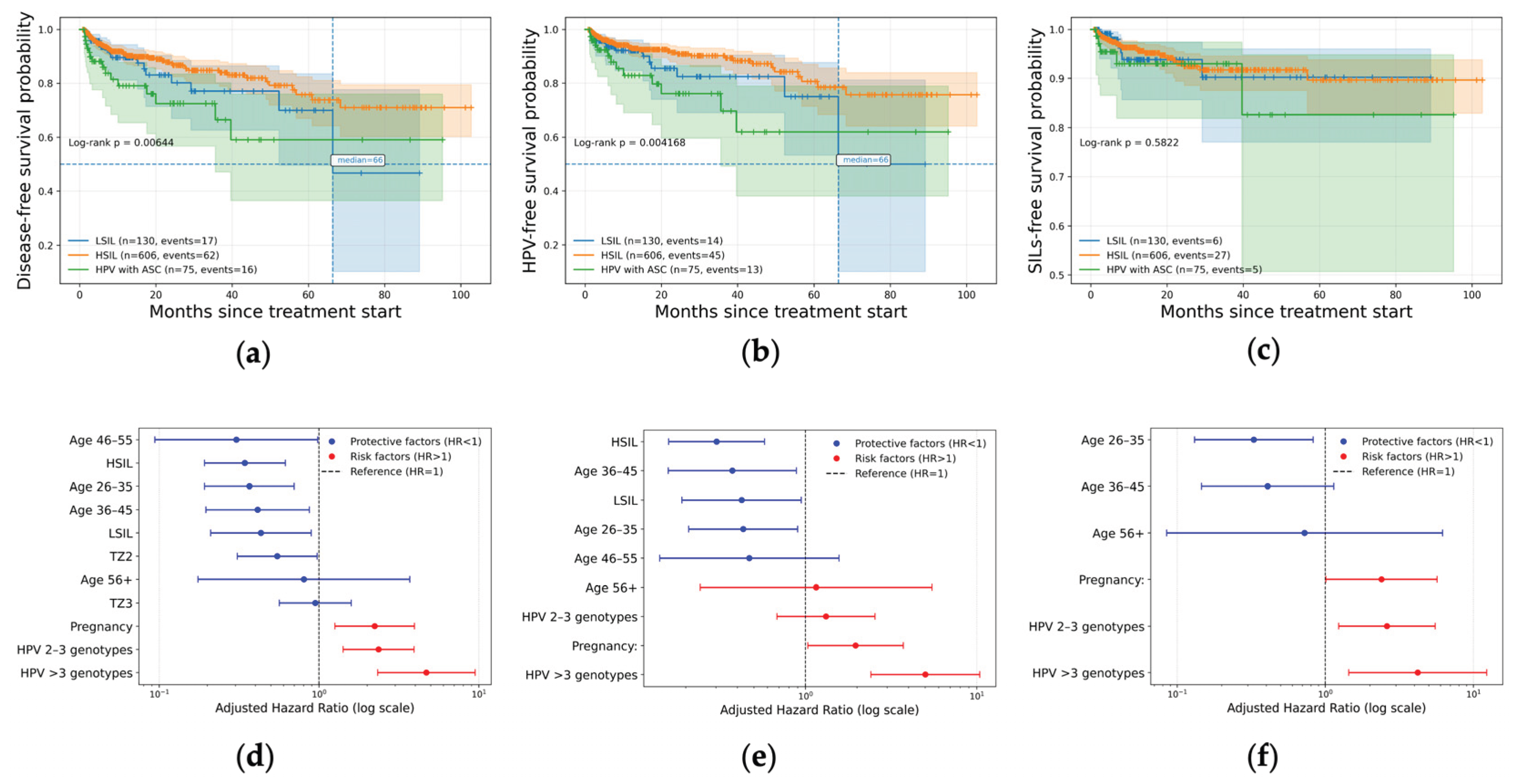
| Predictors | Unadjusted | Adjusted | ||
|---|---|---|---|---|
| HR; 95% CI | P value | HR; 95% CI | P value | |
| Age groups: 26-35 36-45 46-55 56+ |
0.55; 0.31 – 0.99 0.58; 0.31 – 1.09 0.43; 0.14 – 1.29 0.92; 0.21 – 4.01 |
0.047 0.090 0.131 0.913 |
0.37; 0.19 – 0.70 0.41; 0.20 – 0.87 0.30; 0.09 – 0.98 0.80; 0.16 – 3.70 |
0.002 0.020 0.046 0.780 |
| Pregnancy status | 1.36; 0.83 – 2.22 | 0.225 | 2.23; 1.26 – 3.95 | 0.006 |
| TZ types: TZ2 TZ3 |
0.57; 0.33 – 1.01 0.84; 0.52 – 1.36 |
0.052 0.477 |
0.55; 0.31 – 0.97 0.95; 0.56 – 1.59 |
0.040 0.837 |
| SILs grade: LSIL HSIL |
0.55; 0.27 – 1.12 0.39; 0.22 – 0.68 |
0.099 < 0.001 |
0.43; 0.21 – 0.89 0.34; 0.19 – 0.62 |
0.023 < 0.001 |
| Multiple HPV infection: 2-3 genotypes >3 genotypes |
2.12; 1.29 – 3.47 3.95; 2.01 – 7.76 |
0.003 < 0.001 |
2.36; 1.42 – 3.93 4.70; 2.33 – 9.48 |
< 0.001 < 0.001 |
| Predictors | Unadjusted | Adjusted | ||
|---|---|---|---|---|
| HR; 95% CI | P value | HR; 95% CI | P value | |
| Age groups: 26-35 36-45 46-55 56+ |
0.57; 0.29 – 1.12 0.48; 0.23 – 1.02 0.56; 0.18 – 1.75 1.25; 0.28 – 5.58 |
0.102 0.057 0.319 0.773 |
0.43; 0.21 – 0.90 0.37; 0.16 – 0.89 0.47; 0.14 – 1.57 1.15; 0.24 – 5.48 |
0.025 0.025 0.220 0.857 |
| Pregnancy status | 1.22; 0.70 – 2.13 | 0.481 | 1.96; 1.03 – 3.72 | 0.040 |
| SILs grade: LSIL HSIL |
0.55; 0.25 – 1.20 0.35; 0.19 – 0.65 |
0.130 < 0.001 |
0.42; 0.19 – 0.94 0.30; 0.16 – 0.58 |
0.036 < 0.001 |
| Multiple HPV infection: 2-3 genotypes >3 genotypes |
1.35; 0.71 – 2.57 4.30; 2.10 – 8.83 |
0.362 < 0.001 |
1.32; 0.68 – 2.54 5.01; 2.41 – 10.42 |
0.411 < 0.001 |
| Predictors | Unadjusted | Adjusted | ||
|---|---|---|---|---|
| HR; 95% CI | P value | HR; 95% CI | P value | |
| Age groups: 26-35 36-45 56+ |
0.48; 0.20 – 1.12 0.59; 0.24 – 1.43 0.92; 0.11 – 7.32 |
0.088 0.241 0.933 |
0.32; 0.13 – 0.83 0.41; 0.15 – 1.14 0.72; 0.09 – 6.20 |
0.018 0.088 0.768 |
| Pregnancy status | 1.40; 0.66 – 2.97 | 0.378 | 2.40; 1.01 – 5.70 | 0.048 |
| Multiple HPV infection: 2-3 genotypes >3 genotypes |
2.38; 1.15 – 4.93 3.76; 1.29 – 10.92 |
0.020 0.015 |
2.61; 1.23 – 5.52 4.21; 1.44 – 12.31 |
0.012 0.009 |
Disclaimer/Publisher’s Note: The statements, opinions and data contained in all publications are solely those of the individual author(s) and contributor(s) and not of MDPI and/or the editor(s). MDPI and/or the editor(s) disclaim responsibility for any injury to people or property resulting from any ideas, methods, instructions or products referred to in the content. |
© 2025 by the authors. Licensee MDPI, Basel, Switzerland. This article is an open access article distributed under the terms and conditions of the Creative Commons Attribution (CC BY) license (http://creativecommons.org/licenses/by/4.0/).