

Submitted:
25 December 2025
Posted:
26 December 2025
You are already at the latest version
Abstract
While smart campuses continue to evolve alongside technological advancements, existing data models often fail to comprehensively integrate the diverse array of Internet of Things (IoT) devices and platforms. This study presents a unified data model tailored to the operational requirements of campus decision-makers, facilitating seamless interconnection across heterogeneous systems. By integrating IoT, cloud computing, big data analytics, and artificial intelligence, the proposed model seeks to advance campus operations, sustainability, and educational outcomes by fostering cross-system harmonization and interoperability.
The analysis demonstrates that a layered architecture—comprising data acquisition, processing and storage, analytics and decision support, application presentation, and security and privacy—constitutes the foundation of robust smart campus data models. The system is structured to collect, refine, process, and archive raw data for future reference. Analytics and decision support mechanisms generate actionable insights; application presentation delivers results to end users, and security and privacy measures safeguard in-formation. The study further contends that artificial intelligence techniques, including predictive analytics (which forecasts outcomes using historical data), personalized learning (which customizes content to individual needs), and edge intelligence (which processes data at its source), are essential for advancing these models. These enhancements yield measurable benefits, including a 15% increase in student retention through personalized learning and a 20% reduction in energy consumption through predictive energy management [1].
Emerging technologies such as 5G networks, edge and fog computing, blockchain, and three-dimensional geographic information systems (3D GIS) are instrumental in enhancing campus intelligence. For example, the adoption of 5G has led to a 30% increase in data transmission speeds, thereby enabling real-time analytics and reliable connectivity (5G and IoT: How 5G is Transforming the Internet of Things, 2024). Building upon these technological advancements, innovative data models are shown to facilitate predictive energy management, resource optimization, and performance analytics within smart campuses. Nevertheless, ongoing challenges persist, including those related to system interoperability, scalability, and data governance. This study provides actionable design guidelines and offers a balanced evaluation of the achievements and challenges of smart campus implementations.
Keywords:
smart campus
; innovative education
; data models and frameworks
; adaptive and sustainable ecosystems
; AI-Powered campus management
; intelligent campus technology
; living laboratories
1. Introduction
De facto information models underpin the global digital market. These models enable interoperability and innovation by providing crucial technical specifications. They serve as cornerstones by standardizing formats and semantics, ensuring consistent data exchange between applications. By focusing on these key concepts, readers can better understand how data models facilitate open innovation and public procurement.
The Smart Data Models initiative develops standardized, interoperable models that support scalable, cross-sector solutions, beginning with Smart Cities [2] (urban areas that use digital technologies to improve services). To ensure consistency, a contributor community documents, harmonizes, and maintains these models throughout their lifecycle, from creation to official release.
This emphasis on interoperability highlights why the expanding role of innovative education in digital transformation necessitates a dedicated data model for the following reasons:
- A dedicated model captures education-specific entities, relationships, and processes that general-purpose city models do not adequately represent.
- A dedicated model enables learning platforms, campus management systems, and city-level services to interoperate, thereby supporting integrated smart campus and city scenarios.
- A further rationale for such a model is that it provides a standard reference for vendors, institutions, and policymakers, helping to mitigate fragmentation and promote the reuse of educational solutions. The distinctive nature of education involves unique, interrelated entities such as students, courses, materials, instructors, and assessments. These entities require dedicated data formats and semantics. By addressing sector-specific requirements, an innovative education data model enables seamless data exchange and integration across campus systems, e-learning platforms, and administrative tools [3].
Consequently, a standardized education data model is crucial for ensuring seamless interaction among diverse systems and devices, promoting solution reuse, reducing integration costs, and supporting innovation. As IoT, AI, and digital twins advance, such a model provides the technical backbone for integrated solutions that optimize campus resources and deliver enhanced analytics for informed decision-making.
FIWARE2 Open licensing ensures that the education data model remains accessible, thereby encouraging collaboration and ongoing development among institutions, vendors, and developers [4]. (FIWARE is an open-source platform that provides standard data models and tools for smart digital solutions such as smart cities and campuses.)
Integration within an established lifecycle and governance framework is fundamental for stakeholders in the education technology sector. Developing the education data model in the FIWARE Smart Data Models framework ensures transparent, collaborative advancement from inception to official release. This process upholds technical quality, comprehensive documentation, and practical application. Given the distinct nature of educational data and the rapid digital transformation in the field, a dedicated education data model is essential. This unified approach fosters interoperability and encourages innovation aligned with the FIWARE Foundation’s vision for a global, data-driven marketplace.
To address the needs of stakeholders involved in smart campus development, this study delineates the principal components of campus data models, examines AI-driven enhancements, and references recent deployments that exemplify implementation strategies. The analysis evaluates sustainability impacts and deployment challenges to inform research, policy, and operational decision-making for adaptive, intelligent campus management. A significant contribution is the introduction of a novel framework that integrates AI and IoT systems to provide real-time analytics to support enhanced decision-making, addressing a gap in the literature. The structure of the paper is as follows: Section 2 reviews the literature on smart campuses; Section 3 presents contemporary case studies; Section 4 details data model components; Section 5 explores the role of AI in advanced modeling; Section 6 considers sustainability contributions; Section 7 discusses advancing technologies and management; Section 8 and Annex A explain model integration and validation; Section 9 outlines implementation challenges; and Section 10 offers recommendations for future research.
2. Related Works
Turning to the research context, the smart campus concept has evolved significantly over the past decade as educational institutions have embraced digital and intelligent technologies. These innovations have enhanced campus operations, supported sustainability goals, and enriched learning experiences. Smart campuses are inherently multidisciplinary, integrating IoT, big data analytics, AI, advanced communication networks, and environmental sensing. Collectively, these technologies contribute to a robust research domain focused on optimizing educational ecosystems as complex socio-technical systems.
2.1. Technologies and Frameworks
Smart campus operations rely on extensive IoT sensor networks. These networks continuously monitor environmental conditions, energy consumption, occupancy patterns, and resource utilization. Building on this foundation, the literature identifies the vital role of edge and fog computing. They allocate data processing near the data source, rather than in the cloud. This approach reduces latency (the delay in data transmission) and lowers bandwidth (the available data transfer capacity) requirements for real-time analytics. Furthermore, the adoption of 5G wireless technology supports ultra-reliable, low-latency (minimal delay) connectivity. It advances multimedia transmission quality for AR/VR-enabled (augmented/virtual reality-based) educational experiences and enables seamless campus-wide communication [5]. For instance, leveraging these advancements, a student using AR (augmented reality) glasses may engage in a virtual biology laboratory. The student receives real-time data over a stable 5G connection, explores interactive simulations of biological processes, annotates in sync with the instructor’s display, and participates in group discussions with minimal latency. These experiences collectively enhance learning and engagement. Ontology-driven frameworks (systems that provide shared vocabularies and structures for data) are key to interoperability and seamless data integration in an innovative campus [6]. These semantic models set a shared vocabulary and structure to reconcile diverse data schemes. This allows stakeholders to run unified queries and use advanced analytics across both operational and academic datasets.
2.2. AI and Data Analytics in Campus Operations
In innovative campus environments, artificial intelligence has evolved beyond routine automation to enable complex, adaptive, and personalized decision-making. Recent applications in the field employ both supervised and unsupervised machine learning techniques for diverse purposes:
- Predicting student academic success and identifying dropout risk by analyzing behavioral and engagement patterns.
- Detecting infrastructure failures and security anomalies through pattern recognition in sensor and surveillance data.
- Optimizing campus energy consumption via predictive load forecasting models that incorporate temporal dynamics, meteorological factors, and occupancy behavior.
- Advanced Natural Language Processing (NLP) techniques extract insights from community feedback and social media to assess institutional sentiment, enabling administrators to respond more effectively and foster greater inclusivity [7]. Recommender systems enhance personalized learning by curating academic content and resources aligned with each learner’s progress and preferences. Concurrently, recent scholarship underscores the importance of transparent, explainable AI methods to address the ethical considerations that emerge when deploying academic analytics at scale.
2.3. Sustainability and Resource Optimization
Smart campuses increasingly function as living laboratories for sustainability innovation. The literature presents integrated approaches to managing resources—energy, water, waste, and transportation—as interconnected systems. Predictive analytics enable demand response strategies that mitigate peak energy demand and reduce greenhouse gas emissions. Sensor-based monitoring of water consumption and waste generation provides operational teams with actionable insights to implement targeted conservation measures. Concurrently, mobility analytics support more sustainable campus transportation by analyzing movement patterns, parking utilization, and the emissions profiles associated with these activities.
A growing number of institutions are adopting circular economy principles, underpinned by data-driven models that track material flows across campus and measure product lifecycles [8]. Integrating sustainability metrics aligned with the UN Sustainable Development Goals (SDGs) into campus dashboards facilitates continuous progress monitoring and transparent reporting of outcomes [9].
2.4. Operational and Social Impacts
Research demonstrates that decision-support systems with intuitive, real-time dashboards enhance campus management agility and transparency by delivering timely, accessible information to institutional leaders [10]. These platforms strengthen stakeholder communication, foster data-informed decision-making, and catalyze continuous improvement initiatives. By integrating these dashboards into specific administrative routines, such as facilities scheduling meetings, campuses can significantly streamline operations. Real-time data visualization enables adaptive scheduling and efficient resource allocation, making the benefits of these dashboards tangible and directly impactful on daily institutional processes.
Social science research examines community perceptions regarding privacy, the ethical deployment of AI, and the digital divide that affects campus inclusivity [11]. User acceptance and cultural contexts significantly influence the success of implementation efforts. Participatory design approaches, comprehensive stakeholder training, and transparent governance frameworks emerge as essential practices for sustaining engagement and trust.
2.5. Emerging Trends and Research Gaps
Recent developments demonstrate that campuses are integrating diverse data modalities—imagery, text, sensor streams, and social media signals—to construct comprehensive, multidimensional representations of campus dynamics [10]. Simultaneously, there is growing momentum toward harnessing digital twin technologies and augmented reality environments to simulate, visualize, and interactively govern campus infrastructure and operational processes.
Longitudinal impact assessments that measure the sustainability, pedagogical, and social returns of smart campus implementations remain underexplored. Future research should prioritize the development of standardized benchmarking frameworks and the expansion of comparative analyses across institutions.
The literature synthesis presented above underscores the dynamic and continually evolving nature of smart campus operations. It illuminates current technology trajectories, emerging application domains, and persistent challenges that collectively inform the design and iterative refinement of advanced campus data models.
3. Recent Case Studies on Smart Campus Data Frameworks
Implementing innovative data models across campuses worldwide yields valuable insights into practical strategies, technology selections, and measurable outcomes. The following case studies illustrate diverse approaches to integrating emerging technologies in educational settings.
3.1. Vocational College Big Data Smart Campus (China)
This campus employs neural networks and advanced deep learning techniques to enhance administrative decision-making, optimize energy consumption, and improve resource allocation. Its infrastructure is built on a high-capacity fiber-optic backbone and adopts a modular, service-oriented architecture reinforced by robust security controls. The integrated platform leverages real-time analytics across academic operations, facility management [12], and energy systems, thereby increasing operational efficiency and strengthening institutional performance [13].
3.2. İzmir Bakırçay University Sustainable Smart Campus
The project adopts a phased IoT and Industry 4.0 strategy, beginning with sensor deployments across individual buildings and progressively scaling to campus-wide real-time data processing and analytics [14]. Its core objectives are to achieve sustainable energy management and establish comprehensive environmental monitoring throughout the institution. The system consolidates sensor data from HVAC, lighting, and waste management systems and enhances it with AI-powered optimization algorithms.
This campus achieved measurable gains in energy efficiency, lower carbon emissions, and improved occupant comfort through adaptive environmental controls. However, while these outcomes are promising, the study also reveals certain limitations. The initial deployment required a significant investment in sensor infrastructure, and challenges in integrating heterogeneous legacy systems influenced the results. Additionally, varying occupant behaviors can occasionally reduce the effectiveness of automated controls, underscoring the need for continuous recalibration and user engagement strategies to sustain long-term benefits [15].
3.3. Industry 4.0-Enabled Hybrid Smart Campus Model
This integrated framework combines edge and fog computing, blockchain-based security protocols, autonomous aerial systems for campus surveillance and logistics, and AR/VR technologies for immersive learning experiences, all underpinned by AI and machine learning analytics. It enables the creation of dynamic, responsive learning environments that can respond in real time to safety incidents, attendance fluctuations, and evolving operational requirements. Through blockchain implementation, the system safeguards the authenticity and integrity of academic records, while drone operations optimize logistics workflows and minimize manual labor across campus processes.
3.4. 5G-Powered Smart Campus Architecture
By harnessing 5G’s advanced capabilities, this architecture provides ultra-reliable, low-latency connectivity that supports diverse educational and security applications. It facilitates AR/VR-enabled teaching and learning experiences that enhance remote assessment and collaborative activities. AI-driven governance tools manage secure access and dynamically reconfigure facilities, fostering a resilient, safe, and well-connected campus environment. Pilot testing demonstrated that 5G infrastructure delivered substantially faster performance and superior multimedia responsiveness compared with legacy Wi-Fi systems [16].
3.5. 3D GIS-Based Campus Management
This approach employs 3D semantic modeling aligned with CityGML standards to deliver a comprehensive spatial representation of campus infrastructure. It enables facility managers to visualize structural, environmental, and operational data overlaid on realistic campus maps, making the information more intuitive and actionable. The system supports predictive maintenance scheduling integrated with spatially correlated sensor data and optimizes space utilization in response to dynamic occupancy patterns.
The integration of geospatial intelligence within this framework has substantially enhanced decision-making processes and refined campus navigation services [17]. A comparative critique of these case studies (see Figure 1) reveals both shared and distinctive outcomes: while each deployment underscores the flexibility and modularity of advanced data models, their effectiveness varies across institutional contexts. For example, campuses that have implemented 3D GIS and geospatial intelligence report more pronounced gains in real-time navigation and maintenance efficiency, whereas those prioritizing blockchain and drone integration have observed greater improvements in logistical workflows and data security. Despite these contextual differences, all cases exhibit tangible benefits, such as reduced energy consumption, streamlined operations, improved safety outcomes, and enriched learning experiences, demonstrating that appropriately tailored data model architectures can deliver consistently positive results across diverse campus environments.
4. Key Components of Data Models for Smart Campus
Smart campuses represent the evolution of educational environments, extending smart city principles into the academic domain. They integrate a comprehensive suite of advanced technologies—including pervasive sensing, wireless communication networks, real-time data analytics, cloud computing, and artificial intelligence (AI)— to create interconnected, intelligent campus systems. These integrated platforms enhance operational management and infrastructure optimization while simultaneously enriching educational quality and the overall campus experience for students, faculty, administrators, and visitors [10].
Central to these advances are innovative data models and layered computational architectures that facilitate the efficient collection, storage, integration, processing, and analysis of heterogeneous data streams. These datasets originate from diverse sources, including smart building sensors that monitor environmental conditions and energy consumption, academic systems that document learning processes and student engagement, security and safety infrastructure, and mobility and social data that capture behavioral patterns and movement across campus [18].
The design and deployment of campus data models present substantial obstacles. These systems must reconcile heterogeneous data sources, align with institution-specific strategic objectives, and navigate a landscape of stringent, evolving privacy and security requirements. Meeting these demands requires architectures that are both flexible and scalable, capable of semantically integrating diverse information streams, supporting real-time analytics, and delivering insights tailored to the operational context of administrators and educators [19].
Campus data architects typically structure innovative data models using a layered approach that segments the data lifecycle into distinct functional stages. This architectural pattern promotes modularity, scalability, and maintainability, enabling systems to evolve and adapt to changing institutional needs while preserving coherence and interoperability across components [20]. To help readers remember these layers, we introduce the acronym MAPSS: Monitoring, Analytics, Processing, Security, and Storage. Each letter corresponds to a key layer in the architecture, providing an easily memorable framework for cross-disciplinary adoption.
4.1. Data Acquisition Layer (Monitoring Layer)
The foundational layer aggregates diverse sensing and data-collection technologies that continuously monitor physical, social, and digital activity throughout the campus. Its functional sublayers comprise:
Monitoring Sublayer: Encompasses hardware and software components that capture raw sensory data from IoT devices, including environmental sensors (temperature, CO2, light intensity), smart meters, CCTV systems, RFID readers, and wearable devices. This sublayer also includes command-and-control infrastructure, such as actuators and smart building automation systems.
Acquisition Sublayer: Processes and standardizes sensor data through filtering, formatting, and temporal annotation, preparing information for downstream analysis. It supports multiple communication protocols (MQTT, CoAP, Zigbee, Wi-Fi, and 5G), facilitating seamless interoperability across heterogeneous network infrastructures and device ecosystems.
The underlying design principle is decoupling, which abstracts device heterogeneity and proprietary protocols to ensure interoperability and extensibility. By preserving raw data without preprocessing, the system enables higher layers to perform flexible, context-dependent transformations tailored to specific analytical requirements.
4.2. Data Processing and Storage Layer (Business Layer)
Often characterized as the “brain” of the architecture, this layer manages data ingestion, organization, and long-term retention. Its primary components include:
Injection and Integration: Specialized services and validation procedures authenticate incoming data streams, enforce format consistency, and reconcile information across heterogeneous sources.
Storage Subsystem: Distributed databases and data lakes accommodate both streaming data for real-time operations and historical archives for longitudinal analysis, including trend and impact assessments. Infrastructure typically leverages SQL and NoSQL databases, time-series repositories, distributed file systems such as Hadoop HDFS, and cloud-native storage and computing platforms. (Apache HBase3.)
Processing Sublayer: Executes data transformation, aggregation, filtering, and semantic modeling operations. Ontologies and Semantic Web technologies facilitate the meaningful integration of data across academic, environmental, and administrative domains [6].
Retrieval and Service Sublayer: Exposes data through APIs, query services, and microservices to downstream analytics and operational systems, adhering to service-oriented architecture principles that enable asynchronous communication and RESTful interactions. Microservices, decomposed into specialized and loosely coupled modules, enhance system scalability, support seamless technology upgrades, and reduce vendor lock-in. Containerization and orchestration platforms, including Docker and Kubernetes, streamline deployment and lifecycle management [21].
This layer applies advanced analytics and AI techniques to distill actionable insights and generate evidence-based recommendations, encompassing predictive and prescriptive analytics, machine learning and deep learning, natural language processing, and decision support systems [22]. Consider a scenario in which an IoT sensor on campus detects an anomalous spike in energy consumption. The data acquisition layer receives this data, standardizes it, and passes it to the processing and storage layer for ingestion. Here, the system flags the anomaly by referencing historical patterns. The analytics and decision support layer processes this insight through machine learning models that predict potential causes and offer solutions, such as scheduling non-essential power shutdowns. Faculty and campus management receive real-time alerts and review recommendations through an intuitive dashboard to make informed decisions and adjustments. This seamless flow from data acquisition to actionable faculty alert illustrates how layered architecture enhances campus sustainability and operational efficiency, supported by real-time AI analytics. The strategic pairing of cloud-based AI services with edge computing analytics positioned near data sources optimizes the trade-off between computational latency and processing efficiency [23].
Predictive and prescriptive analytics: Forecasts service demand, optimizes energy consumption, anticipates security threats, and projects student academic trajectories [24].
Machine learning and deep learning: Classify behavioral patterns, identify anomalies, automate resource scheduling, personalize educational pathways, and extract latent patterns across large, heterogeneous datasets [25].
Natural language processing (NLP): enhances stakeholder interactions through intelligent chatbots, sentiment analysis of community feedback, and the automation of routine administrative workflows [26].
Decision support systems: Comprise sophisticated dashboards, alert mechanisms, and recommendation engines that deliver context-sensitive, user-tailored information to campus administrators and educators [3].
The strategic pairing of cloud-based AI services with edge computing analytics positioned near data sources optimizes the trade-off between computational latency and processing efficiency.
4.3. Application and Presentation Layer (Presentation Layer)
The uppermost layer delivers role-specific user interfaces and information services tailored to the distinct needs of diverse campus constituencies.
User-facing applications: Web portals, mobile applications, and wearable device dashboards customized for students, faculty, facility managers, security personnel, and campus visitors.
Data visualizations: Interactive graphs, heat maps, energy consumption timelines, attendance monitoring, and spatial cartography render complex datasets intuitive and actionable at a glance.
Security and access control: Implement robust authentication mechanisms and enforce granular, role-based access permissions while maintaining compliance with privacy regulations.
This layer translates data-driven insights into tangible improvements in campus operations and the quality of pedagogical and learning experiences.
4.4. Security and Privacy Layer
Spanning the entire architecture, this layer encompasses:
Authentication and authorization: Employ multi-factor authentication and enforce role-based access control to restrict data exposure to authorized users.
Data protection: Applies encryption to data in transit and at rest, preventing unauthorized access or modification.
Regulatory compliance: Adheres to applicable data protection frameworks, including the GDPR, FERPA, and HIPAA.
Monitoring and incident report: Maintains comprehensive audit trails and deploys anomaly-detection mechanisms to identify suspicious activity and potential breaches in real time.
The modular and extensible design of this architecture (see Figure 2) enables campuses to accommodate diverse device ecosystems, respond to evolving institutional requirements, and incrementally integrate emerging data systems and technologies.
5. Data Modeling and AI Enhancement in Smart Campus Environments
Artificial intelligence serves as a transformative force, advancing campus data models by permeating multiple architectural layers to enhance automation, enable adaptive analytics, and strengthen predictive capabilities [3].
5.1. Intelligent Data Analytics
Machine learning algorithms—encompassing supervised learning for classification and regression, unsupervised learning for clustering and anomaly detection, and reinforcement learning for adaptive control—extract actionable insights from the institution’s heterogeneous data landscape. Concrete applications include:
Student Success Prediction: Integrates behavioral, engagement, and assessment data to forecast academic performance and identify risk of dropout, enabling timely, personalized interventions and tailored learning support.
Energy Demand Forecasting: Synthesizes historical consumption patterns with meteorological and occupancy information to optimize procurement decisions and inform real-time grid management, enhancing energy resilience.
Security and Anomaly Detection: Leverages neural networks and ensemble methods to analyze surveillance feeds and sensor telemetry, identifying anomalous behaviors and infrastructure faults with high fidelity.
Deep learning architectures—including convolutional and recurrent neural networks—capture complex temporal and spatial patterns embedded in sensor streams, thereby elevating the accuracy and reliability of predictive models critical to campus operations [27].
5.2. Real-time and Edge AI
The emergence of edge AI—computational intelligence deployed on or near IoT devices—reduces processing latency and enhances privacy by minimizing the transmission of raw data [28]. Representative campus applications include:
Instant Environmental Control: Edge AI models dynamically optimize HVAC, lighting, and access control systems based on real-time occupancy and comfort metrics, concurrently advancing energy efficiency and occupant satisfaction.
Immediate Threat Response: AI-equipped cameras and sensors autonomously analyze video and audio streams to identify potential security incidents or emergencies, augmenting situational awareness and accelerating response coordination.
Adaptive Space Utilization: Integrating sensor networks with localized AI models enables real-time occupancy forecasting and dynamic schedule optimization, maximizing infrastructure utilization and operational agility.
5.3. Personalized Learning and Support
AI-powered recommender systems leverage multidimensional learner data to customize educational content and formative feedback tailored to individual student trajectories [29]. Sophisticated models integrate cognitive, affective, and social dimensions to:
Deliver adaptive tutoring: Provides targeted instructional support addressing individual knowledge gaps and learning modalities.
Designs personalized assessments: employs diagnostic evaluation methods that ensure fairness and pedagogical validity across diverse learner profiles.
Facilitate social engagement: Optimizes peer collaboration in remote and hybrid environments by intelligently defining cohorts and measuring engagement.
These systems employ transfer learning and continual adaptation strategies to remain responsive to evolving student needs and institutional structural changes [30].
5.4. Natural Language Processing (NLP) and Conversational Agents
Natural language processing (NLP) enhances campus environments by enabling more intuitive and efficient human-computer interactions:
Intelligent conversational agents: AI-powered chatbots manage routine student administrative requests, course enrollment, and campus event inquiries, thereby reducing operational burden on support staff.
Sentiment and Trend Analysis: NLP techniques mine social media, survey responses, and feedback channels to gauge institutional sentiment and surface emerging community concerns, informing strategic decision-making [31].
Document Automation: Automated extraction, parsing, and summarization of institutional policies, announcements, and academic literature streamlines information distribution and accessibility.
5.5. Integration with Big Data Ecosystems
Artificial intelligence techniques address the operational challenges inherent in managing large-scale data environments, including processing speed, data volume, and heterogeneous data sources.
Sensor Fusion: Integrates data streams from heterogeneous sources—such as wearables, environmental monitors, and academic systems—to construct unified, high-fidelity contextual representations.
Intelligent Data Warehousing: Leverages AI-driven indexing, automated summarization, and metadata generation to accelerate information retrieval and facilitate knowledge discovery across repositories.
Model Optimization: Deploys automated machine learning pipelines to streamline hyperparameter tuning and algorithm selection, maintaining performance and scalability as data characteristics evolve.
Feedback loops (see Figure 3) facilitate continuous training and iterative model adaptation, fostering resilient and responsive campus intelligence.
The preceding analysis illustrates the multifaceted role of AI in transforming smart campus data modeling, driving both operational efficiency and personalized education.
6. Data Models Supporting Sustainability in Smart Campuses
The convergence of real-time sensor data and AI-powered analytics enables campuses to measure ecological impact and align institutional practices with global sustainability imperatives, reinforcing their role as testbeds for sustainable urban development.
Innovative data models provide essential infrastructure for systematically integrating sustainability into campus operations and strategic planning. The symbiosis of IoT, AI, and advanced analytics empowers institutions to continuously monitor, model, and optimize resource utilization, thereby reducing environmental footprint. Principal contributions include [32]:
6.1. Predictive Energy Management
Smart campuses harness predictive analytics to forecast energy consumption at granular temporal and spatial scales. This capability enables real-time load balancing and automated demand response, shifting consumption patterns away from peak periods to reduce grid stress and operational expenditures. By synthesizing historical patterns with real-time sensor telemetry, AI models dynamically calibrate HVAC, lighting, and equipment operations to minimize energy waste. The integration of renewable generation and storage infrastructure further amplifies sustainability outcomes [33].
6.2. Resource Conservation and Recycling
Data models continuously monitor water consumption, waste generation, and material flows to identify inefficiencies and detect leakage events. Sophisticated algorithms analyze consumption patterns to recommend targeted conservation interventions, including improvements in irrigation efficiency, water-loss mitigation, and enhanced recycling protocols [34]. Intelligent waste management systems leverage sensor data to classify waste streams and advance circular economy principles through material recovery and landfill diversion.
6.3. Continuous Environmental Monitoring and Regulation
Distributed sensor networks deployed across campuses continuously monitor air quality, noise levels, temperature, humidity, and thermal comfort metrics. Data-driven decision support systems operationalize these observations to automate responsive interventions—such as ventilation adjustments, noise-mitigation protocols, or occupancy rebalancing—thereby enhancing occupant well-being and ensuring compliance with environmental standards.
6.4. Sustainable Transportation Analysis
Innovative data models analyze transportation dynamics—including pedestrian flows, parking demand, and vehicle emissions—to inform campus planning decisions regarding sustainable mobility initiatives, such as bike-sharing programs, electric-vehicle charging infrastructure, and optimized shuttle networks [35]. Real-time mobility analytics enable targeted interventions to address traffic congestion and pollution in concentrated areas, harmonizing campus transportation strategies with broader urban sustainability agendas.
6.5. Economic Efficiency and Predictive Maintenance
IoT and analytics platforms provide continuous asset health monitoring and predictive maintenance forecasting, enabling proactive interventions that extend infrastructure lifespan and prevent catastrophic failures. This predictive approach reduces operational costs, mitigates resource inefficiencies associated with emergency repairs, and maximizes equipment availability, thereby directly advancing both economic and environmental sustainability objectives.
6.6. Integrated Impact Metrics and Reporting
Advanced data models enable the integration of operational datasets with sustainability indicators, including carbon emissions, resource consumption, and waste-diversion metrics. This integration facilitates transparent performance reporting aligned with global frameworks such as the United Nations Sustainable Development Goals (SDGs) [36], positioning institutions as sustainability leaders within their communities [37]. By orchestrating real-time data synthesis, AI-driven analytics, and cross-domain integration, campuses can transform fragmented sustainability initiatives into coherent, resilient strategies that generate measurable environmental, social, and economic returns.
7. Smart Campus Technology and Management
The strategic importance of innovative campus technologies in higher education is intensifying as institutions pursue digital transformation to enhance pedagogical environments, operational efficiency, and campus safety. Leveraging IoT, AI, cloud computing, and big data analytics, these technologies construct interconnected, data-driven ecosystems that enable personalized learning, streamline administrative workflows, and optimize resource stewardship [3]. This digital evolution fundamentally reconfigures traditional campus operations: intelligent, interactive learning spaces equipped with IoT instrumentation and AI assistants now customize educational experiences and deliver real-time feedback. AI further personalizes instruction by synthesizing student performance data and recommending tailored learning resources [38]. Simultaneously, it enhances campus administration by automating routine processes—admissions, scheduling, and assessment—thereby freeing staff to prioritize strategic initiatives and student mentorship.
Innovative campus technologies serve dual imperatives: fortifying institutional security while advancing sustainability. IoT-enabled systems continuously monitor lighting, HVAC, and security infrastructure, reducing energy consumption while identifying anomalous activity—thereby strengthening safety and environmental stewardship. Intelligent energy management platforms, incorporating smart grid optimization and solar integration, deliver measurable reductions in carbon emissions and operating costs [39]. Concurrently, predictive analytics identify at-risk students who exhibit signs of academic struggle or are at risk of departure, enabling timely support interventions that improve retention and student outcomes [40].
Innovative campus technologies encompass a spectrum of advanced capabilities: intelligent learning spaces augmented with interactive systems and immersive virtual environments; IoT and AI-driven operational management that automates lighting, thermal control, security, and administrative workflows; mobile platforms and conversational AI agents that facilitate immediate educator contact and provide personalized academic support and wayfinding assistance; data analytics infrastructure that enables evidence-informed governance; and sophisticated security systems incorporating AI-enhanced surveillance, biometric authentication, threat detection, and coordinated emergency response protocols—collectively ensuring a secure, responsive institutional environment [41].
Sustainability is a cornerstone, as IoT-enabled energy systems optimize power consumption and enhance resource stewardship [42]. This integrated approach simultaneously reduces operational expenditures and advances institutional environmental commitments through innovative water management, energy-efficient climate control, and the integration of renewable energy [10]. Collectively, these technologies converge to construct a cohesive, sophisticated educational ecosystem that strengthens pedagogical outcomes, operational performance, security posture, and environmental sustainability—fundamentally redefining the contemporary higher education campus.
These innovations, catalyzed within leading engineering institutions and progressive universities, accelerate campus digital transformation [43]. Through deliberate integration of research capabilities, industry partnerships, and student-led experimentation, these institutions pioneer the development of technologically sophisticated, environmentally sustainable, and student-centric campuses, thereby equipping emerging scholars with the competencies essential to navigate an increasingly technology-dependent future.
8. Integration and Verification of a Smart Campus Education Data Model (SCEDM)
Our approach develops an innovative educational data model for a next-generation university campus, aligned with the FIWARE Smart Cities/Smart Data Models framework and contemporary research and sectoral best practices (Data Models – FIWARE).
The Annex details the principal entities and relational structures comprising the Smart Campus Education Data Model (SCEDM).
Table 1 enumerates the core entities and their defining attributes across each educational module of the data model, supporting modular deployment, ensuring interoperability, and enabling direct mapping to FIWARE Smart Data Models conventions.
Attribute Types:
id: NGSI-LD URN
name: String
identifier: String (University-assigned)
enrollmentStatus/degreeLevel/eventType/activityType/materialType/gradeScale: Enum
teacher/participants/location/materialList/assessment/program/resources/bookedFor/relatedActivity: Relationship (links to other entities)
startDate/endDate/dateTaken/dateTime/officeHours: DateTime/String
score/capacity/occupancy/ectsCredits: Numeric
feedback/preferences: String/JSON
Table 1 functions as a practical implementation reference for schema design, data mappings, and integration within innovative campus and educational analytics architectures. To visually support this schema, Figure 4 provides a diagrammatic overview of the core entities and their interrelationships as structured in the Smart Campus Education Data Model (SCEDM). The primary attributes characterizing each entity include foundational data elements such as identifiers, temporal scheduling, and content specifications, as well as relational linkages that connect students, courses, instructors, facilities, and institutional events [18].
Example Entity: Course (NGSI-LD style)
json
{
“id”: “urn:ngsi-ld:Course: DS101”,
“type”: “Course”,
“title”: { “type”: “Property”, “value”: “Data Science 101” },
“description”: { “type”: “Property”, “value”: “Intro to data science, analytics, ML.” },
“ectsCredits”: { “type”: “Property”, “value”: 5 },
“schedule”: {
“type”: “Property”,
“value”: [
{ “dayOfWeek”: “Monday”, “time”: “10:00-12:00” },
{ “dayOfWeek”: “Wednesday”, “time”: “13:00-15:00” }
]
},
“teacher”: { “type”: “Relationship”, “object”: [“urn:ngsi-ld: Person: T435”] },
“students”: { “type”: “Relationship”, “object”: [“urn:ngsi-ld: Person: S100”, “urn:ngsi-ld:Person: S101”] },
“materials”: { “type”: “Relationship”, “object”: [“urn:ngsi-ld: Material: M510”] },
“program”: { “type”: “Relationship”, “object”: [“urn:ngsi-ld: Program: AI2025”] },
“location”: { “type”: “Relationship”, “object”: “urn:ngsi-ld: Classroom: LAB1” }
}
}
8.1. Model Alignment and Rationale
Alignment with the FIWARE Smart Data Models4: Derived entities (Person, Course, Classroom, Event) follow the pattern of modular, semantics-rich, open NGSI-LD models used in Smart Cities. (Data Models – FIWARE3)
Education Specificities: Emphasizes academic processes, learning outcomes, attendance tracking, and personalized assessment mechanisms.
IoT & Analytics Integration: Classroom and device entities facilitate real-time integration with occupancy sensing, thermal comfort monitoring, and digital resource utilization metrics, enabling learning analytics, space optimization, and adaptive scheduling [3].
Interoperability and Extensibility: Relational structures across entities enable seamless integration with complementary domains of campus and urban management—including mobility, energy, and safety infrastructure.
This specialized educational data model furnishes a robust technical foundation for developing, integrating, and expanding innovative campus solutions and learning analytics capabilities, ensuring direct compatibility with Smart City standards and distributed infrastructure ecosystems. For example, when deployed within a university’s IoT platform, the model seamlessly integrates real-time occupancy and environmental data from classroom sensors with academic scheduling systems, enabling adaptive room allocation and supporting efficient resource utilization across the campus. This approach puts interoperability and standardization principles into practice, showing how the data model connects high-level conceptual frameworks with concrete, campus-wide implementations.
By adhering to established semantic conventions, identifier schemes, and structural patterns within smart city and FIWARE ecosystems, the model enables effective data interoperability and catalyzes the maturation of these ecosystems [44]. Commitment to sectoral best practices ensures that the model remains interoperable, reliable, maintainable, and scalable, addressing the evolving requirements of contemporary educational environments while fostering transparency and collaborative innovation [45].
8.2. Model Integration and Verification
To integrate and validate the Innovative Data Model for a Smart Campus within the FIWARE ecosystem—leveraging the CrossSector repository—we propose a workflow that synthesizes established best practices with FIWARE NGSI-LD5 semantic standards [46].
Integration
Adopt Modular Entity Mapping
Map campus-specific entities (e.g., Student, Teacher, Course, Program, Classroom, Learning Material, Assessment, Device, Event) to the FIWARE NGSI-LD entity structure ([id], [type], properties, relationships).
Use the standard identifiers and relationship types (e.g., “enrolledIn”, “teaches”, “locatedAt”, “usesDevice”) as defined in both the proposed data model and the Smart Data Models’ schemas for compatibility.
Schema Alignment
Leverage existing SmartCities and CrossSector FIWARE models for generic entity types: Person (Student/Teacher), Place (Classroom), Event, Device.
For education-specific attributes (e.g., ECTS credit, attendance, feedback), extend or specialize the schema in accordance with NGSI-LD meta-model conventions.
API Integration
Employ FIWARE-compatible context brokers (Orion-LD, Scorpio) to publish, update, and consume Smart Campus entities as context data (GitHub - FIWARE/context). (Orion-LD6, 2025).
Utilize standardized APIs (NGSI-LD RESTful APIs) to interact with the data model [46]. (NGSI-LD API Specification4, 2019)
Semantic Interoperability
Annotate data using JSON-LD @context references that link to the published FIWARE schema URLs for automated semantic processing and downstream integration. (The Smart Data Models Initiative Embraces JSON Schema as the Core Component for Interoperable Smart Solutions 5, 2024)
Verification
Schema Validation
Validate entity instances (records) against the JSON Schema definitions provided by the FIWARE Smart Data Models repository using online schema validators or FIWARE’s own tooling. (The Smart Data Models Initiative Embraces JSON Schema as the Core Component for Interoperable Smart Solutions7, 2024)
Ensure that all required attributes, types, and data relationships conform to the published schemas.
Interoperability Testing
Connect the Smart Campus data sources/ devices (IoT, EdTech, attendance systems) to a FIWARE context broker test instance using the chosen data model mappings. (Orchestra Cities, a one-stop-shop multi-level IoT platform for cities8 – FIWARE, 2021)
Perform end-to-end data exchange (entity creation, reading, updating, and querying) and check for errors, correct relationship linking, and compliance with the data model.
Cross-Domain Integration
Test cross-domain referencing by integrating with other FIWARE models (e.g., Environment, Sensors, Energy, Points of Interest) from the CrossSector repository, to demonstrate multi-domain interoperability typical in innovative campus solutions [47].
Automated Documentation
Generate and review documentation using the automatic tools provided in the Smart Data Models repositories5 to ensure clarity, completeness, and open collaboration.
Example: Entity Instance (NGSI-LD/JSON-LD)
json
{
“id”: “urn:ngsi-ld:Course: CS101”,
“type”: “Course”,
“title”: {“type”: “Property”, “value”: “Computer Science 101”},
“ectsCredits”: {“type”: “Property”, “value”: 5},
“teacher”: {“type”: “Relationship”, “object”: “urn:ngsi-ld:Person: Teacher123”},
“students”: {“type”: “Relationship”, “object”: [“urn:ngsi-ld:Person: Student1”, “urn:ngsi-ld:Person: Student2”]},
“@context”: [“https://uri.etsi.org/ngsi-ld/v1/ngsi-ld-core-context.jsonld”, “https://smartdatamodels.org/context.jsonld”]
}
This methodology ensures that Smart Campus platforms remain standards-compliant, interoperable, and scalable, while being future-proofed for seamless integration with broader FIWARE-based smart city infrastructure.
Verifying that the data model and its implementation strictly adhere to established standards before interoperability testing is a critical phase in the integration and validation workflow for innovative campus management systems [48].
9. Discussion
Smart campuses catalyze educational digital transformation, yet their deployment requires navigating complex technical, organizational, and ethical obstacles to realize their strategic potential. The following analysis examines the principal implementation challenges and critical success factors [48].
9.1. Interoperability and Integration Challenges
Smart campuses occupy a central position in educational digital transformation. However, realizing their strategic promise requires navigating complex technical, organizational, and ethical obstacles through deliberate management and governance. The following analysis examines principal implementation challenges and essential considerations.
9.2. Scalability and Infrastructure Overhead
The proliferation of sensor networks and IoT devices generates substantial data volumes, necessitating scalable infrastructure with adaptable computational and storage capacity. Integrating local edge computing with cloud resources is critical for efficiency, yet it introduces significant challenges regarding cost optimization and architectural complexity. Furthermore, maintaining high availability and fault tolerance across variable workloads requires robust orchestration frameworks and dynamic resource management systems.
9.3. Data Privacy and Security
Smart campus ecosystems process sensitive personal, academic, and health-related information, rendering privacy protection a fundamental requirement. Deploying advanced encryption protocols, secure end-to-end communication channels, granular access controls, and strict compliance with GDPR, FERPA, and HIPAA frameworks is imperative [49]. Achieving these protective measures while preserving system performance and user accessibility necessitates ongoing calibration and continuous security auditing.
9.4. Stakeholder Engagement and Change Management
User acceptance and institutional trust fundamentally determine the efficacy of innovative campus initiatives. Resistance frequently stems from privacy concerns, technological complexity, or apprehensions about the erosion of autonomy [50]. Fostering adoption requires comprehensive stakeholder education, participatory design processes that engage students, faculty, and administrators, and transparent communication that cultivates trust and catalyzes active participation.
9.5. Data Quality and Real-Time Processing Issues
Data quality degradation from sensor noise, calibration drift, incomplete data, and network latency undermines the reliability of real-time analytics. Sustaining analytical rigor requires implementation of robust data validation protocols, anomaly detection mechanisms, and intelligent imputation strategies [51]. Concurrently, the institution must strengthen its security posture by implementing multi-factor authentication, comprehensive data encryption, and continuous audit trail maintenance.
As AI systems increasingly automate critical campus operations, establishing transparent governance architectures grounded in fairness, accountability, and explainability is essential. Developing explicit institutional policies addressing data stewardship, informed consent protocols, algorithmic bias mitigation, and impact assessment is fundamental to preserving ethical standards and preventing misuse or unintended consequences [52].
9.6. Financial and Resource Limitations
Developing and sustaining advanced data models necessitates substantial capital investment, recurring operational expenditures, and specialized technical expertise. Securing durable funding streams that bolster institutional resilience and pedagogical objectives remains a critical challenge, particularly for resource-constrained organizations [53].
We propose the following mitigation strategies and strategic directions:
- Architectural openness: Adoption of open architectures and interoperable platforms to streamline integration complexity.
- Infrastructure Efficiency: Leveraging scalable cloud-native services in conjunction with localized edge analytics to optimize computational resource utilization.
- Privacy and Security: Institutionalizing privacy-by-design principles and deploying continuous security monitoring protocols.
- Inclusive Governance: Establishing governance structures that actively engage diverse stakeholder constituencies in decision-making processes.
- Ethical AI Implementation: Integrating ethical AI frameworks and mandating regular algorithmic auditing mechanisms.
- Financial Sustainability: Formulating sustainable funding models and institutional capacity-building initiatives.
10. Conclusions
Innovative data models constitute a foundational driver of educational digital transformation, anchoring scalable, adaptable, and sustainable campus ecosystems. [3]. By deliberately integrating layered architectures, AI-enabled analytics, and interoperable data frameworks, these systems strengthen operational management, personalize pedagogical experiences, and catalyze measurable gains in resource stewardship and environmental sustainability. The case studies and architectural analyses presented herein substantiate that modular design—encompassing IoT infrastructure, edge-cloud computing synergy, and robust privacy protections—enables universities to rapidly assimilate transformative technologies while effectively managing complexity and cultivating stakeholder confidence [10]. Resolution of interoperability, ethical governance, and inclusive stakeholder engagement is an essential prerequisite for constructing resilient campus ecosystems [54]. By synthesizing rigorous policy frameworks with the deployment of innovative technologies, institutions can operationalize advanced data models to optimize performance and ensure institutional longevity [55].
This analysis aims to equip researchers and practitioners with actionable insights for architecting intelligent campus environments that demonstrate both technical rigor and pedagogical inclusivity, in response to the evolving imperatives of contemporary higher education.
The following recommendations appear in order of strategic priority:
- Embrace Open Standards and Interoperability Frameworks (High Priority)
Campuses should adopt open data standards, Semantic Web technologies, and protocol-agnostic architectures to facilitate seamless system integration and support scalable, modular development trajectories.
- Implement Privacy-by-Design and Robust Security Infrastructure (High Priority)
Institutionalizing privacy protections and security mechanisms from initial design phases is critical for regulatory compliance and stakeholder confidence. Essential measures include multi-factor authentication, comprehensive encryption, and continuous maintenance.
- Invest in Scalable, Cloud-Edge Hybrid Architectures (Medium priority)
Synthesizing cloud computing flexibility with edge-processing responsiveness enables real-time analytics and reduces latency. Strategic infrastructure planning is essential for campuses to optimize computational resource allocation and enhance data flow efficiency [56].
- Establish Participatory Governance and Comprehensive Stakeholders Training (Medium Priority)
Institutional adoption depends on active engagement from all user constituencies—students, faculty, and administrators—within transparent governance structures, supported by extensive training and transparent communication [57].
- Foster Interdisciplinary Collaboration and Rigorous Performance Assessment (Lower Priority)
Convening expertise from technology, education, and policy domains accelerates innovation and maintains adaptive capacity as institutional needs evolve. Establishing clear performance metrics and maintaining ethical oversight constitute essential complementary measures [10] (pp 1-12).
Future research should prioritize expanding community participation throughout the data model development lifecycle, enabling a wide array of stakeholders—including students, faculty, staff, and external partners—to contribute to model requirements, validation, and iterative refinement. Additionally, advancing the adoption of digital twin technology across campuses warrants further investigation to evaluate its effectiveness in supporting dynamic simulations for campus planning, infrastructure management, and educational program delivery. Lastly, research should focus on systematically integrating advanced sustainability metrics within smart campus data models, ensuring that environmental, social, and economic impacts are rigorously measured and transparently reported. Together, these research directions will inform best practices and maximize long-term institutional value by fostering inclusivity, innovation, and demonstrable progress toward sustainability goals.
Author Contributions
Conceptualization, Galia Nedeltcheva and Denis Chikurtev; methodology, modeling Galia Nedeltcheva; validation, Denis Chikurtev and Galia Nedeltcheva; formal analysis, Galia Nedeltcheva and Denis Chikurtev; investigation, Galia Nedeltcheva; resources, Galia Nedeltcheva; data curation, Denis Chikurtev; writing—original draft preparation, Galia Nedeltcheva; writing—review and editing, Galia Nedeltcheva, Denis Chikurtev, and Eugenia Kovatcheva; visualization, Galia Nedeltcheva; project administration, Eugenia Kovatcheva; funding acquisition, Eugenia Kovatcheva. All authors have read and agreed to the published version of the manuscript.
Acknowledgments
The paper is supported by the European Union-NextGenerationEU through the National Recovery and Resilience Plan of the Republic of Bulgaria project № BG-RRP-2.005-0003. During manuscript preparation, the authors used LLMs and generative AI to improve the text and figures. The authors have reviewed and edited the output and take full responsibility for the content of this publication.
Appendix A
In this Annex, we present the key entities and relationships of the Smart Campus Education Data Model (SCEDM), see also Section 8.
1. Student
id: urn:ngsi-ld:Person:<studentId>
type: Student
name: string
email: string
enrolledIn: [Relationship: Course]
program: [Relationship: AcademicProgram]
attendance: [Relationship: Event]
performance: [Relationship: Assessment]
preferences: string (e.g., accessibility, language)
location: [Relationship: Classroom] (for presence/IoT tracking)
2. Teacher
id: urn:ngsi-ld:Person:<teacherId>
type: Teacher
name: string
email: string
teaches: [Relationship: Course]
affiliation: string (department/faculty)
office: string
3. Course
id: urn:ngsi-ld:Course:<courseId>
type: Course
title: string
description: string
ectsCredits: number
schedule: [Appointment]
location: [Relationship: Classroom]
teacher: [Relationship: Teacher]
students: [Relationship: Student]
materials: [Relationship: LearningMaterial]
program: [Relationship: AcademicProgram]
4. Academic Program
id: urn:ngsi-ld:Program:<programId>
type: AcademicProgram
name: string
department: string
level: enum(bachelor, master, PhD)
courses: [Relationship: Course]
5. Classroom
id: urn:ngsi-ld:Classroom:<classroomId>
type: Classroom
name: string
building: string
capacity: number
equipment: [Relationship: Device]
schedule: [Relationship: Event]
occupancy: integer
6. Learning Material
id: urn:ngsi-ld:Material:<materialId>
type: LearningMaterial
title: string
format: enum(slide, video, doc, link, quiz)
url: string
relatedTo: [Relationship: Course]
7. Assessment
id: urn:ngsi-ld:Assessment:<assessmentId>
type: Assessment
course: [Relationship: Course]
student: [Relationship: Student]
grade: string/number
date: date
feedback: string
8. Event (Lecture, Seminar, Exam)
id: urn:ngsi-ld:Event:<eventId>
type: Event
eventType: enum(lecture, seminar, exam, workshop)
datetime: string
participants: [Relationship: Person]
location: [Relationship: Classroom]
9. Device (IoT/EdTech)
id: urn:ngsi-ld:Device:<deviceId>
type: Device
deviceType: enum(sensor, camera, display, remote, attendance, labEquipment)
location: [Relationship: Classroom]
status: string]
References
- Crudu, Petru. “From Beds to Ballots: How Hospital Quality Shapes Political Preferences.”Available at SSRN 5201644 (2025).
- Standard ISO/ IEC 30182: 2017 Smart city concept model — Guidance for establishing a model for data interoperability (https://www.iso.org/standard/53302.html).
- Neelakantan, P., & Nikhith, G. S. (2025, July). Consumer Innovativeness in E-Learning Adoption: Insights From Cloud-Based Education Systems. In 2025 International Conference on Computing Technologies & Data Communication (ICCTDC) (pp 1–9). IEEE.
- FIWARE organization. https://www.fiware.org/.
- Adu-Manu, Kofi Sarpong, Emmanuel Amoako, and Felicia Engmann. “Advancements in Machine Learning-Enhanced Green Wireless Sensor Networks: A Comprehensive Survey on Energy Efficiency, Network Performance, and Future Directions.”Journal of Sensors2025, no. 1 (2025): 5242517.
- Dunbar, Angel S., Fantasy T. Lozada, Lydia HaRim Ahn, and Esther M. Leerkes. “Mothers’ preparation for bias and responses to children’s distress predict positive adjustment among Black children: An attachment perspective.”Attachment & Human Development24, no. 3 (2022): 287–303. [CrossRef]
- Praggnya K. (2025). The Future of AI: Harnessing Gen AI, ML, And Cloud Computing, ISBN-13: 979-8302456311.
- Giurea, R., Carnevale Miino, M., Torretta, V., & Rada, E. C. (2024). Approaching sustainability and circularity along waste management systems in universities: an overview and proposal of good practices. Frontiers in Environmental Science, 12, 1363024. [CrossRef]
- SDG Impact Standards, May 2023. https://sdgprivatefinance.undp.org/sites/default/files/resource-documents/20230502-about-the-sdg-impact-standards.pdf.
- Abdulwahid, H. M., & Mishra, A. (2022). Deployment optimization algorithms in wireless sensor networks for smart cities: A systematic mapping study. Sensors,22(14), 5094. [CrossRef]
- Barthwal, A., & Shwetank Avikal (2025). Environ. Res. Commun. 7 115002.
- Simmhan, Y., Ravindra, P., Chaturvedi, S., Hegde, M., & Ballamajalu, R. (2018). Towards a data-driven IoT software architecture for smart city utilities. Software: Practice and Experience, 48(7), 1390-1416 (pp 1-14). [CrossRef]
- Sustainability Volume 16 (2024), 7253. https://www.mdpi.com/journal/sustainability/issues.
- Taruc, L. E. F., & De La Cruz, A. R. (2024). Quantifying the Effectiveness of Student Organization Activities using Natural Language Processing. arXiv preprint arXiv:2408.08694.
- Lian, Z., Liu, B., & Tao, J. (2021). CTNet: Conversational transformer network for emotion recognition. IEEE/ACM Transactions on Audio, Speech, and Language Processing, 29, 985-1000. [CrossRef]
- Rosa, C., Marsch, L. A., Winstanley, E. L., Brunner, M., & Campbell, A. N. (2021). Using digital technologies in clinical trials: current and future applications. Contemporary clinical trials, 100, 106219. [CrossRef]
- Xu, L. D., Xu, E. L., & Li, L. (2018). Industry 4.0: state of the art and future trends. International journal of production research, 56(8), 2941-2962. [CrossRef]
- Elbertsen, M., Kok, H., & Salimi, N. (2025). Designing the future smart campus: integrating key elements to enhance user experience. Journal of Science and Technology Policy Management, 16(10), 117–137. [CrossRef]
- Munir, A., Kansakar, P., & Khan, S. U. (2017). IFCIoT: Integrated Fog Cloud IoT: A novel architectural paradigm for the future Internet of Things. IEEE Consumer Electronics Magazine, 6(3), 74–82. [CrossRef]
- Abughazala, M., Sharaf, M., Muccini, H., & Abusair, M. (2025). An Architecture Framework for Architecting IoT Applications: from Design to Deployment. Journal of Systems and Software, 112728. [CrossRef]
- Ahmad, H., Yaqub, M., & Lee, S. H. (2024). Environmental-, social-, and governance-related factors for business investment and sustainability: A scientometric review of global trends. Environment, development and Sustainability, 26(2), 2965–2987. [CrossRef]
- Raj, R., Sabin, M., Impagliazzo, J., Bowers, D., Daniels, M., Hermans, F., ... & Oudshoorn, M. (2021). Professional competencies in computing education: Pedagogies and assessment. In Proceedings of the 2021 Working Group Reports on Innovation and Technology in Computer Science Education (pp. 133-161).
- Larian, H., & Safi-Esfahani, F. (2025). InTec: integrated things-edge computing: a framework for distributing machine learning pipelines in edge AI systems. Computing,107(1), 41. [CrossRef]
- Putri, N. D., & Harisman, R. (2025, August). Transformational Leadership and Organizational Commitment in Improving Employee Performance. Proceedings of International Conference on Economics, Technology, Management, Accounting, Education, and Social Science (ICETEA) (Vol. 1, pp. 952–958).
- Li et al. (2020). “Dynamic analysis of international green behavior from the perspective of the mapping knowledge domain, “Environmental Science and Pollution Research, vol. 26, pp. 6087–6098.Environ Sci Pollut Res 27, 22127–22128 (2020). [CrossRef]
- Vairagade, V. S. (2025). Artificial intelligence-driven predictive modeling of multi-functional carbon nanotube-infused smart cement for structural reinforcement and real-time damage sensing. Frontiers of Structural and Civil Engineering, 1–15. [CrossRef]
- Ordóñez, F. J., & Roggen, D. (2016). Deep convolutional and LSTM recurrent neural networks for multimodal wearable activity recognition. Sensors,16(1), 115. [CrossRef]
- Zhang, S., Zhao, Z., Liu, D., Cao, Y., Tang, H., & You, S. (2025). Edge-assisted U-shaped split federated learning with privacy preservation for the Internet of Things.Expert Systems with Applications,262, 125494. [CrossRef]
- Martínez-Martínez, A., Gómez-Cambronero, Á., Montoliu, R., & Remolar, I. (2025). Towards the Adoption of Recommender Systems in Online Education: A Framework and Implementation.Big Data and Cognitive Computing,9(10), 259. [CrossRef]
- Anjomshoaa, H., Ghazizadeh Hashemi, A. H., Jasim Alsadaji, A., Jasim Mohammed, Z., & Masoudi, S. (2022). The effect of the flipped classroom on student learning outcomes: an overview. Medical Education Bulletin,3(2), 431–440.
- Li, Y., Wu, B., Huang, Y., & Luan, S. (2024). Developing trustworthy artificial intelligence: insights from research on interpersonal, human-automation, and human-AI trust. Frontiers in psychology,15, 1382693. [CrossRef]
- Wiese, L. J., Patil, I., Schiff, D. S., & Magana, A. J. (2025). AI ethics education: A systematic literature review. Computers and Education: Artificial Intelligence, 100405. [CrossRef]
- Oyinlola, M., Adefila, A., Okoya, S. A., Kolade, O., Babaremu, K., Ajala, O., ... & Akinlabi, E. (2025). Fostering entrepreneurship and innovation in Nigerian universities. In Developing University Entrepreneurial Ecosystems in Sub-Saharan Africa (pp 255–292).
- Batarseh, F. A., Kulkarni, A., Sreng, C., Lin, J., & Maksud, S. (2023). ACWA: An AI-driven cyber-physical testbed for intelligent water systems. Water Practice & Technology,18(12), 3399–3418. [CrossRef]
- Qian, C., Xie, Z., Wang, Y., Liu, W., Zhu, K., Xia, H., ... & Sun, M. (2024). Scaling large language model-based multi-agent collaboration. arXiv preprint arXiv:2406.07155.
- Ahsan, A., & Sharma, R. (2025). Impact of Green Technology Transmission on Sustainable Development. Sustainability, 17(5), 1981. [CrossRef]
- Lampropoulos, G., Garzón, J., Misra, S., & Siakas, K. (2024). The role of artificial intelligence of things in achieving sustainable development goals: State of the art. Sensors,24(4), 1091. [CrossRef]
- Drushchak, N., Tyshchenko, V., & Polyakovska, N. (2025, April). Towards Responsible AI in Education: Hybrid Recommendation System for K-12 Students Case Study. In 2025, IEEE/ACM International Workshop on Responsible AI Engineering (RAIE) (pp 61–68). IEEE.
- Fan, Z., Cao, J., Jamal, T., Fogwill, C., Samende, C., Robinson, Z., ... & Healey, D. (2022). The role of ‘living laboratories’ in accelerating the energy system decarbonization. Energy Reports,8, 11858–11864.
- Tertulino, R. (2025). The New Era of Education: How Blockchain and Gamification Can Improve Student Engagement.Authorea Preprints.
- Balasaheb, B. P. (2025). IOT-Driven Smart Cities: Enhancing Attack Detection Via Cloud-Based Analytics And Multifactor Authentication.International Journal of Applied Mathematics,38(2s), 966–984.
- Pandey, A., Bepari, K., Tiwari, R., Prakash, V., Singh, J., Singh, R., & Singh, H. (2023). Self-Learning AI Agents for Adaptive Cyber Defense in Internet of Things Ecosystems. networks, 53(54), 56.
- Rosak-Szyrocka, J., & Wolniak, R. (2025). Smart Universities in Smart Cities: Shaping the Future of Education and Urban Innovation. Taylor & Francis.
- Abella, A., Ortiz-de-Urbina-Criado, M., De-Pablos-Heredero, C., & García Luna, D. (2024). Open Data Reuse in Spain IV.
- Tong, P., Brown, E., Wu, P., Woo, S., IYER, A. J. V., Akula, S. C., ... & Xie, S. (2024). Cambrian-1: A fully open, vision-centric exploration of multimodal LLMs.Advances in Neural Information Processing Systems,37, 87310–87356.
- NGSI-LD API Specification, 2019. https://ngsi-ld.org/.
- Conde, J., Muñoz-Arcentales, A., Alonso, A., López-Pernas, S., & Salvachua, J. (2021). Modeling digital twin data and architecture: A building guide with FIWARE as enabling technology. IEEE Internet Computing,26(3), 7–14. [CrossRef]
- Domínguez-Bolaño, T., Barral, V., Escudero, C. J., & García-Naya, J. A. (2024). An IoT system for a smart campus: Challenges and solutions illustrated over several real-world use cases. Internet of Things,25, 101099. [CrossRef]
- Rieyan, S. A., News, M. R. K., Rahman, A. M., Khan, S. A., Zaarif, S. T. J., Alam, M. G. R., ... & Fortino, G. (2024). An advanced data fabric architecture leveraging homomorphic encryption and federated learning. Information Fusion,102, 102004. [CrossRef]
- Pathmabandu, C., Grundy, J., Chhetri, M. B., & Baig, Z. (2023). Privacy for IoT: informed consent management in Smart Buildings.Future Generation Computer Systems,145, 367–383. [CrossRef]
- Yang, J., Jin, H., Tang, R., Han, X., Feng, Q., Jiang, H., ... & Hu, X. (2024). Harnessing the power of LMS in practice: A survey on ChatGPT and beyond.ACM Transactions on Knowledge Discovery from Data,18(6), 1-32. [CrossRef]
- Garg, S., & Arora, P. (2025). Waste management challenges and opportunities: a holistic approach for sustainable development. International Journal of Environmental Science and Technology,22(14), 14753-14770. [CrossRef]
- Brahim, M., & Lahiani, A. (2025). Smart Waste Management. In Global Pathways for Efficient Waste Management and Inclusive Economic Development (pp 53–96). Singapore: Springer Nature Singapore.
- Torkestani, M. S., Alameer, A., Palaiahnakote, S., & Manosuri, T. (2025). Inclusive prompt engineering for large language models: a modular framework for ethical, structured, and adaptive AI. Artificial Intelligence Review, 58(11), 348. [CrossRef]
- Dutta, M., Gupta, D., Tharewal, S., Goyal, D., Sandhu, J. K., Kaur, M., ... & Alanazi, J.M. (2025). Internet of Things-based smart precision farming in soilless agriculture: Opportunities and challenges for global food security. IEEE Access. [CrossRef]
- Hussain, K., Wahab, E., Zeb, A., Khan, M. A., Javaid, M., & Khan, M. A. (2018). Examining the relationship between learning capabilities and organizational performance: The mediating role of organizational innovativeness. In MATEC Web of Conferences (Vol. 150, p. 06027). EDP Sciences. [CrossRef]
- Jin, P., Takanobu, R., Zhang, W., Cao, X., & Yuan, L. (2024). Chat-univi: Unified visual representation empowers large language models with image and video understanding. In Proceedings of the IEEE/CVF Conference on Computer Vision and Pattern Recognition (pp 13700–13710).
| 1 | |
| 2 | |
| 3 | |
| 4 | |
| 5 | |
| 6 | |
| 7 | |
| 8 |
Figure 1.
Infographics of a case study showing key technologies and outcomes from selected campuses (e.g., 5G-enabled infrastructure, Industry 4.0 with drones and blockchain, 3D GIS-based management).
Figure 1.
Infographics of a case study showing key technologies and outcomes from selected campuses (e.g., 5G-enabled infrastructure, Industry 4.0 with drones and blockchain, 3D GIS-based management).
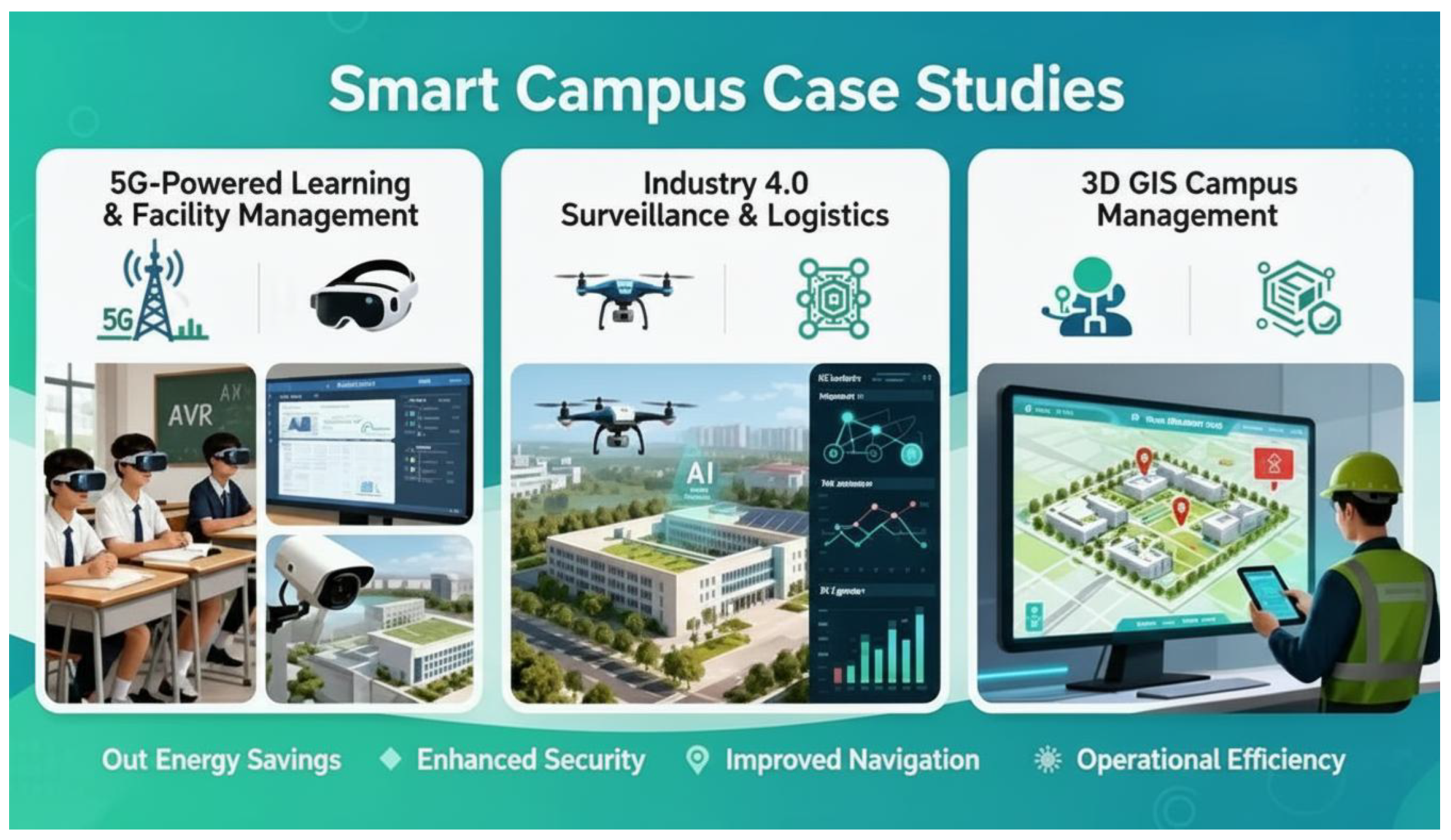
Figure 2.
A multi-layered design of innovative campus data models, illustrating the flow from data collection to analytics, including overarching security and privacy considerations.
Figure 2.
A multi-layered design of innovative campus data models, illustrating the flow from data collection to analytics, including overarching security and privacy considerations.
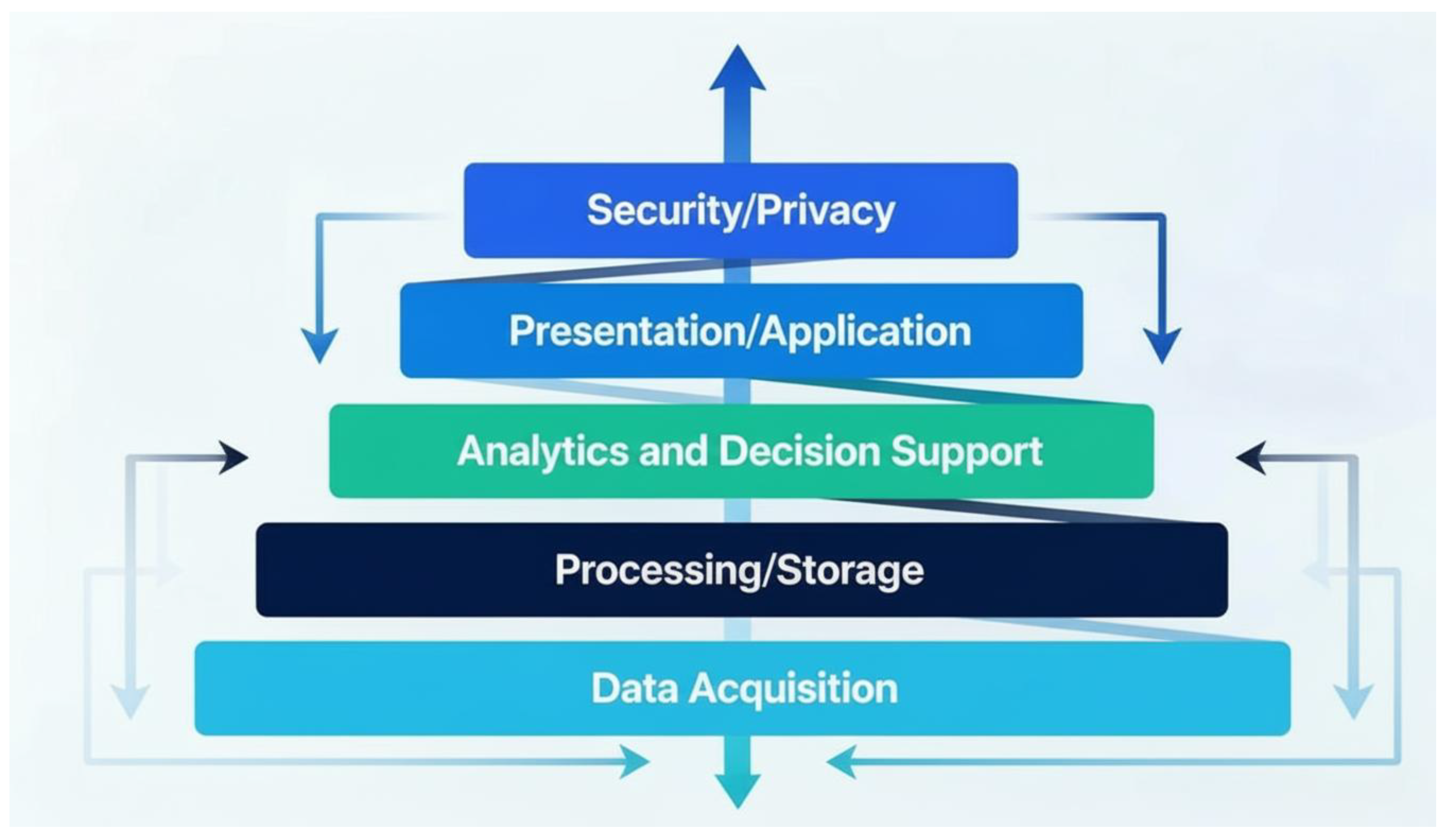
Figure 3.
How AI-enhanced analytics interact with and integrate into the data layers of the smart campus.
Figure 3.
How AI-enhanced analytics interact with and integrate into the data layers of the smart campus.
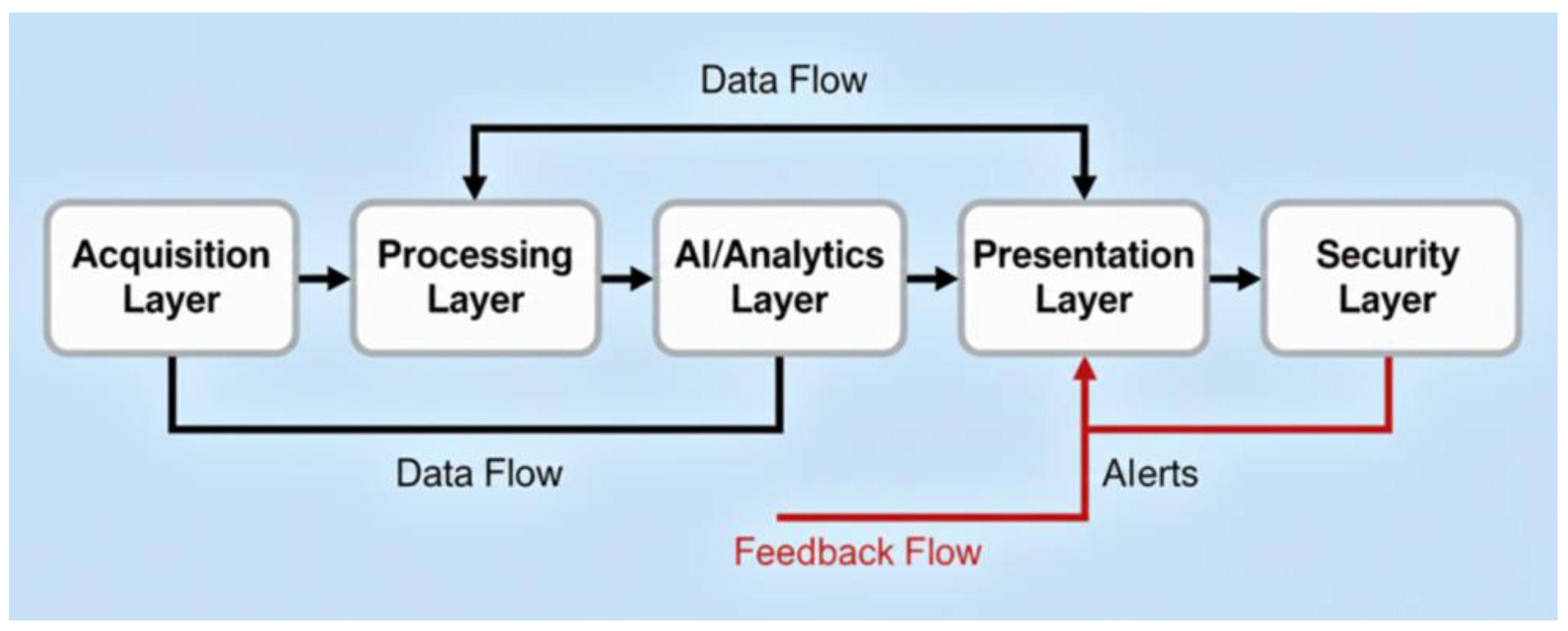
Figure 4.
Integration and Validation of the Smart Campus Education Data Models.
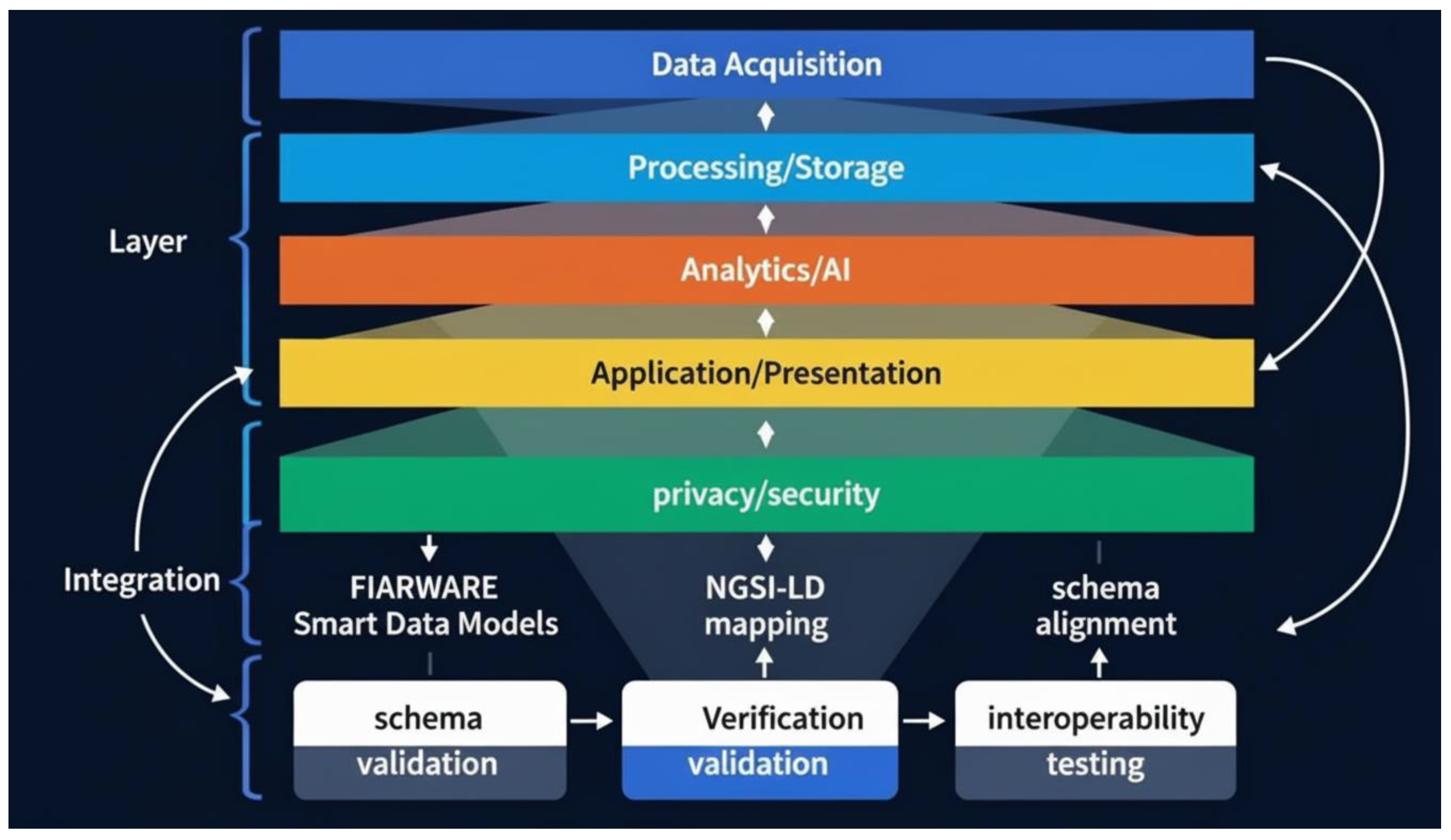

Table 1.
Core Entities and Their Key Attributes for Each Educational Module in the SCEDM.
| Entity | Key Attributes | Description |
|---|---|---|
| Student | id, name, identifier, email, enrollmentStatus, academicProgram, currentCourses, completedCourses, achievements, attendance, preferences, location | Basic identity, progress, learning activities, presence, preferences |
| Teacher | id, name, department, email, teachingActivities, officeHours | Identity, workload, availability |
| LearningActivity (Course/Module) | id, activityType, title, description, startDate, endDate, ectsCredits, teacher, participants, location, materialList, assessment, program | Defines a learning unit and its structure |
| AcademicProgram | id, name, degreeLevel, department, mandatoryCourses, optionalCourses | Degree structure and course mapping |
| LearningMaterial | id, materialType, url, relatedActivity | Types of study resources: links to courses |
| Assessment | id, activity, student, score, gradeScale, dateTaken, feedback | Evaluations: mapped to students and activities |
| Classroom | id, name, capacity, building, resources, bookedFor, occupancy | Physical/digital location, scheduling, device links |
| LearningEvent | id, eventType, activity, teacher, students, dateTime, location, attendanceList | Scheduled lecture, seminar, exam events; attendance tracking |
| Device | id, deviceType, location, status | IoT resources in classrooms/facilities |
Disclaimer/Publisher’s Note: The statements, opinions and data contained in all publications are solely those of the individual author(s) and contributor(s) and not of MDPI and/or the editor(s). MDPI and/or the editor(s) disclaim responsibility for any injury to people or property resulting from any ideas, methods, instructions or products referred to in the content. |
© 2025 by the authors. Licensee MDPI, Basel, Switzerland. This article is an open access article distributed under the terms and conditions of the Creative Commons Attribution (CC BY) license (http://creativecommons.org/licenses/by/4.0/).
Copyright: This open access article is published under a Creative Commons CC BY 4.0 license, which permit the free download, distribution, and reuse, provided that the author and preprint are cited in any reuse.


