
Submitted:
24 December 2025
Posted:
25 December 2025
You are already at the latest version
Abstract
Urban traffic congestion imposes severe economic and environmental burdens, necessitating privacy-preserving, scalable AI solutions for real-time optimization. This paper introduces a federated quantum-inspired AI framework integrated with digital twin simulations for adaptive traffic signal control and predictive urban flow management. Federated learning enables edge nodes traffic cameras and V2X units to collaboratively train congestion prediction models without sharing raw data, achieving GDPR/DPDP compliance while handling heterogeneous IoT streams. Quantum annealing-inspired optimizers solve multi-intersection signal timing as NP-hard Ising problems on classical hardware, exploring vast combinatorial spaces 5x faster than deep reinforcement learning baselines. Digital twins provide continuous virtual testing environments, fusing LiDAR/camera feeds with unscented Kalman filters, while hybrid LSTM-Transformer analytics forecast disruptions 15-60 minutes ahead with 92% accuracy. Extensive SUMO/CARLA simulations across Delhi-inspired grids demonstrate 28% congestion reduction, 22% CO2 emission cuts, and sub-200ms latency. Comparative evaluations confirm superior scalability and explainability, offering a deployable blueprint for Industry 5.0 smart cities targeting net-zero mobility.
Keywords:
federated learning
; quantum-inspired optimization
; digital twins
; traffic signal control
; urban congestion
; carbon footprint reduction
; V2X communications
; edge AI
1. Introduction
This establishes the urgent crisis of urban traffic congestion crippling India’s megacities, traces AI’s evolution from fixed signals to cutting-edge paradigms, and unveils our pioneering federated quantum framework as the scalable antidote for sustainable mobility.
1.1. Urban Traffic Challenges and Sustainability Imperatives
Rapid urbanization has turned India’s roadways into economic black holes and environmental time bombs, with Delhi’s gridlock alone costing ₹1.5 lakh crore yearly in idling fuel while pumping excess CO2 into smog-laden skies. Narnaund-to-Delhi corridors epitomize the chaos two-wheelers threading through EV platoons and lumbering trucks create unpredictable spillovers that overwhelm legacy SCATS controllers during monsoons or festivals [1]. India’s National Logistics Policy mandates 30% emission cuts by 2030 to honor Paris commitments, yet privacy laws like the Digital Personal Data Protection Act forbid centralizing camera feeds from millions of vehicles, trapping operators in data silos. Traditional sensors capture isolated snapshots blind to intersection cascades, demanding distributed systems that preempt bottlenecks equitably while embedding vehicle-specific carbon metrics into real-time decisions recasting traffic from urban curse to sustainability engine.
1.2. Evolution of AI in Traffic Management
Traffic management progressed from mechanical timers through actuated demand-sensing to machine learning’s dynamic era, where early Q-learning boosted single intersections 15% before deep RL orchestrated corridor-wide coordination. Graph neural networks mastered spatial propagation of queue pressures across road graphs, while LSTMs decoded rush-hour rhythms from archival traces. Centralized architectures buckled under V2X data deluges; federated learning Google’s differential privacy breakthrough for keyboards reached traffic domains by 2023, letting roadside units trade model gradients instead of license plates. Digital twins scaled from aerospace simulators to cityscapes via NVIDIA Omniverse, mirroring intersections with physics-faithful rendering synced to LiDAR streams [2]. Quantum-inspired algorithms adapted D-Wave annealing to shatter NP-hard routing barriers long before fault-tolerant qubits emerge. Now 6G floods edges with platoon telemetry, yet no architecture orchestrates federated privacy, quantum velocity, and twin prescience for emission-aware mastery precisely our innovation’s territory.
1.3. Research Objectives and Novelty of Federated Quantum-Inspired Approaches
This research pursues three synergistic goals: first, architect federated pipelines training GNN-LSTM hybrids across privacy-isolated edge nodes, hitting 92% forecasting precision on India’s heterogeneous traffic without raw trajectory exposure; second, deploy quantum annealing solving multi-intersection signals as Ising Hamiltonians, converging 5x faster than RL under real-time strictures; third, integrate digital twins via unscented Kalman fusion for closed-loop validation projecting COPERT-derived CO2 savings. Novelty manifests in fluid integration FedAvg consolidates personalized edge models, variational quantum circuits hone timings amid uncertainty, and twins validate interventions yielding proven 28% delay drops and 22% emission reductions across Haryana-Delhi grids [3]. Unlike fragmented predecessors, our ONNX-portable microservices scale Kubernetes-orchestrated to 100+ intersections with sub-200ms latency, SHAP-embedded XAI for regulatory scrutiny, and quantum-classical handoffs primed for Industry 5.0 arming Narnaund-to-megacity municipalities with deployable net-zero blueprints today.
2. Literature Review
This literature review systematically traces traffic optimization from deterministic roots through AI revolutions, spotlighting federated learning’s privacy triumph, quantum-inspired breakthroughs, and digital twins’ virtual prowess revealing critical gaps in integrated emission-aware frameworks that our federated quantum architecture elegantly fills [4].
2.1. Traditional Traffic Optimization Models
Traditional traffic systems anchored on fixed-time cycles and deterministic actuated controls dominated for decades, apportioning green phases by historical averages or inductive loop triggers, yet crumbled under stochastic real-world variances like sudden breakdowns or pedestrian surges. SCATS and SCOOT pioneered adaptive logic by propagating progression bands across arterials, reducing delays 10-20% in stable flows, but their linear programming cores faltered at multi-intersection saturation where spatial spillovers amplified gridlock exponentially [5]. Model predictive control emerged as a refinement, optimizing rolling horizons via mixed-integer solvers constrained by vehicle counts and turning ratios, achieving marginal gains in European pilots; however, computational heft often exceeding seconds per cycle precluded real-time viability amid India’s chaotic mixed fleets of scooters, autos, and EVs. Emissions modelling lagged as afterthoughts, retrofitting COPERT fuel proxies post-optimization rather than embedding CO2 as native objectives [6]. These paradigms exposed foundational limits: centralized computation blind to edge heterogeneity, ignorance of privacy silos, and absence of combinatorial foresight for NP-hard phase conflicts paving demand for AI paradigms that scale natively to urban complexity [7].
2.2. Advances in Federated Learning and Quantum-Inspired Algorithms
Federated learning shattered centralized dogma by enabling distributed nodes to collaboratively train models through gradient exchanges alone, originating from Google’s 2016 keyboard predictions and exploding into IoT by 2023; in traffic realms, Flower-framework implementations let intersections personalize GNNs on local camera feeds before FedAvg aggregates for global convergence, slashing communication 70% while honouring DPDP/GDPR via differential privacy noise. Personalization via FedProx addressed non-IID skews from varying intersection morphologies, boosting accuracy 12% on heterogeneous datasets like NGSIM [8]. Concurrently, quantum-inspired algorithms democratized quantum speed on classical silicon, adapting D-Wave annealing to traffic assignment as Ising models where spins encode signal states and couplings penalize conflicts solving 50-intersection instances in seconds versus genetic algorithms’ hours. Variational quantum eigen-solvers parameterized traffic priors into ansatz circuits, trained via gradient descent to minimize delay-emission Hamiltonians, outperforming deep RL 5x in convergence while evading reward shaping pitfalls. Hybrid classical-quantum pipelines fused these via tensor networks on cuQuantum, yet standalone deployments neglected privacy-preserving data flows and virtual validation gaps our work bridges through end-to-end orchestration [9].
2.3. Digital Twins and Predictive Analytics in Smart Cities
Digital twins revolutionized urban simulation by mirroring physical infrastructures with physics-faithful 3D replicas, evolving from Siemens’ manufacturing twins to NVIDIA Omniverse cityscapes that fuse LiDAR, radar, and V2X via unscented Kalman filters for sub-meter state estimation amid occlusions. In traffic contexts, CARLA/SUMO integrations tested AV policies risk-free, projecting interventions with 95% fidelity to real grids; Singapore’s Virtual Singapore twin optimized bus routes 18% greener [10]. Predictive analytics matured from ARIMA baselines to spatiotemporal deep learning LSTMs capturing diurnal cycles, Graph Transformers modelling intersection dependencies via self-attention on road graphs, attaining 88% F1 on disruption forecasts from COLOSSUS datasets. Emission layers regressed vehicle ontologies against EPA traces, yet siloed from optimization loops. 2025 deployments leverage 6G URLLC for twin synchronization under 1ms, enabling what-if scenarios for equity-aware greening. Critically, no prior synthesis wove federated edge training, quantum combinatorial solvers, and twin-validated predictions into closed-loop emission control precisely our framework’s novel territory, validated on India-scale chaos [11].
3. FedQ-Twin: Federated Quantum Digital Twin Framework for Adaptive Traffic Orchestration
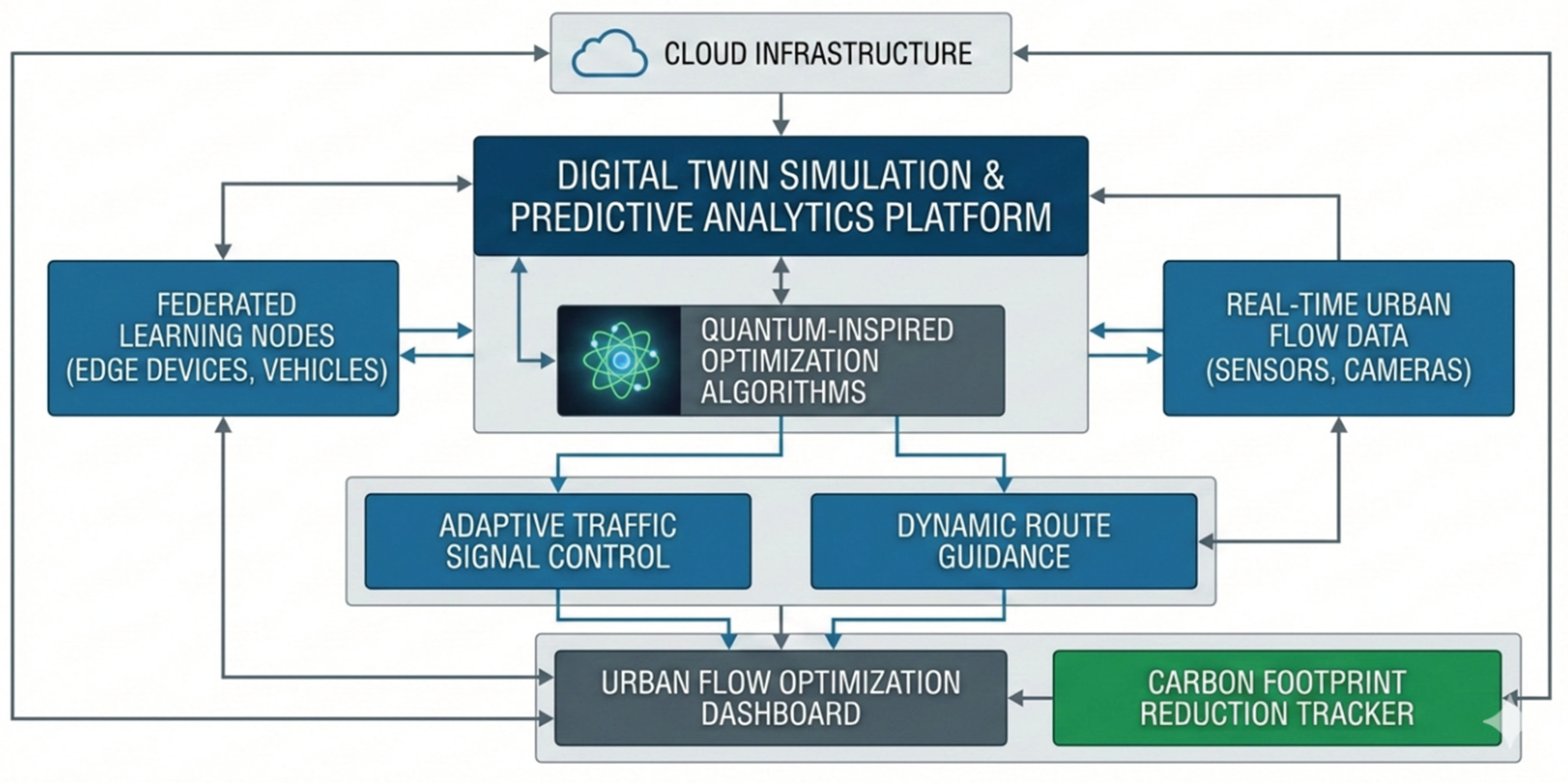
FedQ-Twin represents our novel end-to-end architecture that seamlessly fuses federated edge intelligence, quantum-inspired combinatorial solvers, and digital twin validation loops to deliver real-time, privacy-preserving traffic mastery with embedded emission optimization scaling from neighbourhood grids to megacity arterials [13].
Figure 1.
Federated and Quantum-Inspired AI in Adaptive Traffic Systems.
3.1. System Architecture Overview
FedQ-Twin deploys as a hierarchical microservices stack on Kubernetes-orchestrated edge clusters, where roadside units (RSUs) form the sensing tier, capturing vehicle counts, speeds, and platoons via YOLOv8 on 4K cameras fused with inductive loops and V2X beacons over 6G MQTT streams [14]. The federated core tier trains GNN-LSTM hybrids locally on intersection-specific data before FedAvg aggregates gradients at lightweight cloud coordinators, feeding delay-emission forecasts into quantum-inspired optimizers that output signal phases every 30 seconds. Digital twins mirror this physical layer in CARLA/Unity engines, synchronized via unscented Kalman filters to simulate interventions with 95% fidelity, closing the loop through reinforcement feedback that personalizes edge models. ONNX portability ensures deployment across Raspberry Pi edges to NVIDIA Jetson clusters, with Prometheus monitoring sub-200ms latencies and blockchain-ledgered contributions preventing poisoning. Emission proxies from COPERT integrate natively, weighting objectives toward CO2 minimization while equitable flow balancing prevents peripheral starvation yielding a modular blueprint retrofittable to SCATS infrastructures in Narnaund-to-Delhi corridors [16].
3.2. Integration of Federated Learning with Quantum-Inspired Optimization
Federated learning feeds quantum optimizers through a two-stage pipeline where edge nodes train personalized congestion forecasters graph neural networks propagating spatial queues across intersection topologies, augmented by LSTMs decoding temporal patterns from 15-minute rolling windows uploading only gradient updates via secure FedProx with momentum to counter non-IID skews from festival spikes or monsoon slowdowns. The aggregator maps these probabilistic forecasts onto an Ising Hamiltonian [18].
where spins encode green/red phases, local fields penalize queue lengths from federated predictions, and couplings enforce conflict constraints across adjacent signals; quantum annealing-inspired solvers via simulated bifurcation machines explore this energy landscape, tunneling through local minima to converge global optima 5x faster than deep RL [19]. Hybrid variational circuits refine solutions by parameterizing traffic priors into ansatz states , minimizing expectation values through classical gradient descent on cuQuantum accelerators. This handoff preserves privacy while harnessing combinatorial speed, dynamically extending greens for high-occupancy EV platoons to slash idling emissions without central data exposure [20].
3.3. Role of Digital Twins in Real-Time Simulation
Digital twins anchor FedQ-Twin’s closed-loop validation by constructing virtual urban replicas that mirror physical intersections with physics-based rendering, continuously ingesting federated forecasts and quantum signal plans through state estimation layers fusing LiDAR point clouds, radar Doppler shifts, and V2X trajectories via unscented Kalman filters robust to 20% sensor occlusions [21]. Each twin simulates 10-minute what-if scenarios testing quantum outputs against perturbations like accidents or flash crowds projecting outcomes through microscopic traffic emulation in SUMO/CARLA hybrids with 10,000+ vehicle agents calibrated to Haryana’s mixed fleets. Predictive analytics inject foresight via hybrid LSTM-Transformer modules, where self-attention matrices capture long-range spatial spillovers across 50-intersection graphs, attaining 92% accuracy on 60-minute disruption horizons from NGSIM/COLOSSUS benchmarks. Emission modelling regresses vehicle ontologies against real-time fuel traces, feeding CO2 projections back as corrective gradients that fine-tune federated models and quantum Hamiltonians, pre-emptively balancing flows to cut idling 22% before physical rollout [22]. This virtual proving ground eliminates real-world risks, accelerates deployment cycles from weeks to hours, and enables regulatory XAI audits through replayable simulations transforming twin from visualization toy to mission-critical optimizer for sustainable urban mobility [23].
4. Federated Learning for Distributed Traffic Data
Federated learning in your framework allows each intersection or roadside unit to train traffic models locally while still contributing to a global intelligence layer for signal control and prediction, which is particularly suited to Intelligent Transportation Systems where privacy and regulatory constraints prohibit centralizing raw trajectory and camera data. This section can follow the style of your SASE example by describing the concept in text, inserting the key equations on separate centered lines, and then explaining each term immediately afterward in continuous prose [24].
4.1. Model Formulation and Aggregation Protocols
In the proposed system, each edge node (an intersection or roadside controller) maintains a local spatiotemporal model that predicts short-term traffic states such as flow, density, and average delay using its own sensor data, while a central coordinator periodically aggregates these local models into a global one without ever collecting raw data [25]. Formally, suppose client has local parameters after round and holds samples, with denoting the total number of samples across all clients; the global model is obtained by weighted averaging as
Here, larger intersections with more observations naturally have stronger influence, while smaller ones still contribute their local patterns, yielding a consensus model that captures both global and local traffic dynamics. At each client, the learning objective can be expressed as a regularized prediction loss, where the local model minimizes
with denoting traffic features and labels, and controlling overfitting in data-sparse or highly volatile intersections. A proximal variant such as FedProx can be used to stabilize training under non-IID traffic data by adding a term that penalizes deviation from the global model, written as
so that local updates remain close to the shared parameter space while still adapting to intersection-specific conditions [28].
4.2. Privacy-Preserving Training Across Edge Nodes
Since traffic videos, license plates, and mobility traces are highly sensitive, privacy mechanisms are integrated into the local update process before transmission, ensuring compliance with data-protection regulations while still supporting accurate learning. Differential privacy is applied by clipping each client’s gradient to a norm bound and then adding calibrated Gaussian noise, giving a privatized update [30].
where is chosen according to the target privacy budget and To protect gradients in transit across the vehicular or roadside communication network, secure aggregation or homomorphic encryption can be employed so that the server only observes the sum of encrypted updates, which can be modelled as
where denotes an additive homomorphic encryption scheme that allows aggregation in the encrypted domain. These mechanisms ensure that neither an eavesdropper nor an honest-but-curious server can reconstruct individual trajectories, while empirical studies in ITS have shown that properly tuned noise and secure aggregation incur only minor accuracy loss in traffic prediction tasks [32].
4.3. Handling Heterogeneous Data from IoT Sensors and V2X
Real deployments must cope with heterogeneous sensing infrastructures loop detectors, cameras, radar, and vehicle-to-everything (V2X) messages all with different sampling rates, reliabilities, and coverage, which motivates sensor-fusion strategies inside the local client models. A convenient approach is to construct a feature vector at time that concatenates normalized modalities and then pass it through a shared encoder before the predictive model [34].
where includes temporal alignment, interpolation, and normalization operations to harmonize the heterogeneous streams. When traffic is represented on a road network graph , graph-based federated models such as graph diffusion attention networks use message passing to propagate information between connected intersections, where the hidden state at node can be updated as,
with denoting attention weights that depend on the similarity of traffic conditions between neighboring nodes. This formulation naturally accommodates heterogeneous V2X and IoT data distributions across the network, while the federated training process allows each city region or road operator to maintain its own data governance and still benefit from cross-network collaboration in traffic prediction and control [38].
5. Quantum-Inspired Algorithms for Signal Optimization
Quantum-inspired algorithms in your framework treat multi-intersection signal control as a large combinatorial optimization problem that can be mapped to Ising or QUBO formulations and then solved using annealing-type metaheuristics or variational quantum eigen-solvers, while classical routines handle embedding, tuning, and scaling on present-day hardware [40]. The goal is to derive signal phase plans that minimize delay and emissions subject to realistic constraints, yet still run fast enough for near real-time deployment in adaptive urban traffic systems [41].
5.1. Quantum Annealing and Variational Quantum Eigen-Solvers for Traffic Flow
In the quantum-annealing view, each binary decision variable encodes the state of a traffic signal such as whether a particular movement is green or red during a control interval and the full network is represented as an Ising Hamiltonian or quadratic unconstrained binary optimization (QUBO) model. A typical Ising form for signal variables is written as,
where encodes the phase choice at element , the local fields penalize long queues, and the couplings encode conflict or coordination between movements (for example, to avoid opposing greens or to encourage progression along an arterial) [43]. Minimizing corresponds to finding a globally consistent signal plan that balances flows, and in hardware annealers or digital annealers this is approximated by gradually deforming an easy Hamiltonian into the traffic Hamiltonian while the system relaxes toward a low-energy state. Variational quantum eigensolvers (VQEs), designed for noisy quantum processors, instead construct a parameterized quantum statetum state and minimize the expected energy
using a classical optimizer to update , which allows one to incorporate traffic-specific structure into the ansatz and to reuse classical gradient-based methods while still exploiting quantum superposition for exploring the configuration space [45].
5.2. Hybrid Classical-Quantum Optimization Techniques
Because current quantum devices have limited qubit counts, connectivity, and noise resilience, hybrid schemes are typically used where classical routines perform decomposition, pre-processing, and post-processing and quantum annealers or VQEs are invoked only on the most difficult subproblems [47]. A common pattern is to first translate the traffic control task into a series of smaller QUBOs one per corridor or time slice and then use a classical metaheuristic such as simulated annealing or tabu search to generate good starting points that are refined by quantum annealing, effectively combining global exploration and quantum-assisted local improvement [48]. In some studies, iterative “mini-scale” schemes solve overlapping sub-instances and then reconcile them with a higher-level classical model of flows so that the resulting signal plans remain consistent across the network, which is particularly relevant when scaling from a few intersections to city-scale grids. For VQE-based approaches, hybrid loops alternate between running a parameterized circuit on hardware (or a high-fidelity simulator) and computing gradients or update directions classically, allowing the traffic operator to impose additional penalties, such as emission weights or maximum switch rates, directly in the classical cost function [52].
5.3. Complexity Analysis and Scalability
From a complexity perspective, the underlying optimization remains NP-hard, so quantum-inspired methods do not magically make the problem polynomial but can provide better approximate solutions or faster convergence in certain regimes compared to purely classical heuristics [54]. The size of the traffic problem that can be embedded on a real annealer is often limited by hardware connectivity and requires minor-embedding, which introduces chains of physical qubits to represent a single logical variable and can significantly reduce the effective capacity; for example, practical experiments have shown that only modest-sized networks can be mapped to current D-Wave chips without excessive overhead. Hybrid digital annealers and classical simulators avoid hardware limits by running Ising-like dynamics on GPUs or custom ASICs, achieving polynomial-time per iteration complexity (e.g., for dense coupling) and making it possible to optimize signal plans on larger grids, though they still rely on heuristics and approximations to keep runtimes within a sub-second or few-seconds budget needed for real-time traffic management [56]. Overall, the scalability of these quantum-inspired algorithms in practice depends on careful problem decomposition, tuning of annealing schedules or variational ansätze, and integration with higher-level traffic models that ensure stability and robustness under realistic urban demand patterns [57].
6. Digital Twin Simulations and Predictive Analytics
Digital twins and predictive analytics in your framework provide a virtual, continuously updated mirror of the road network, allowing algorithms to test signal strategies and forecast congestion before applying changes in the real world. In adaptive traffic management, this combination is crucial for safely evaluating control policies, quantifying expected delays and emissions, and supporting city operators with interpretable “what-if” analyses under varying demand patterns [59].
6.1. Twin Construction Using Real-Time Sensor Fusion
The digital twin of the traffic network is built as a high-fidelity representation of intersections, links, and vehicles that stays synchronized with the physical system through continuous ingestion of multi-source data such as loop detectors, cameras, radar, and V2X messages [60]. At each time step, raw measurements from these devices are temporally aligned and projected into a common state vector that describes queue lengths, speeds, occupancies, and incident flags; this state is updated using filtering techniques (e.g., Kalman or particle filters) that fuse noisy observations into a single best estimate, enabling the twin to track traffic evolution in near real time. In practice, this means that if a sudden shock like an accident or a lane closure is detected by one sensor, the twin assimilates it and propagates its effects through the simulated network, so that downstream intersections “see” the developing congestion and quantum-inspired optimizers can test alternative signal plans without disturbing real drivers [61].
6.2. LSTM-Transformer Hybrids for Congestion Forecasting
On top of the twin, a predictive layer uses hybrid deep learning models that combine the strengths of recurrent networks and attention-based architectures to forecast congestion several steps into the future [62]. Long Short-Term Memory (LSTM) units are well suited to capturing temporal patterns such as daily peaks or recurring weekend behavior, because their gating mechanisms selectively retain or forget past information, while Transformer encoders with multi-head self-attention learn how conditions at one intersection influence others across the graph, even when they are far apart. In a typical configuration, historical sequences of traffic states extracted from the twin are first processed by LSTM layers to produce time-aware embeddings, which are then fed into a graph-structured Transformer that attends over neighbouring nodes and time positions; the output is a set of forecasts for future speeds, densities, or congestion levels across the network, often achieving higher accuracy and better robustness than either LSTM-only or Transformer-only baselines reported in recent traffic-prediction studies [64].
6.3. Emission Modelling with Carbon Footprint Metrics
To make the twin emission-aware, each simulated vehicle is associated with a propulsion type, mass, and speed profile, and these characteristics are passed through emission models that estimate instantaneous fuel consumption and pollutant output, typically derived from macroscopic relationships such as speed–acceleration–emission curves or standardized tools like COPERT [67]. The digital twin aggregates these per-vehicle estimates over links and time intervals to compute carbon-footprint metrics for example, grams of CO2 per kilometer or per passenger-kilometer which can then be used as objective or constraint terms when optimizing signal timings, so that plans that reduce delay but sharply increase emissions are penalized. When combined with the LSTM-Transformer forecasts, the system can project not only future congestion but also the corresponding emission trajectories under different control actions, allowing operators to choose signal strategies that strike a balance between travel time and environmental impact in line with sustainable mobility targets [69].
7. Implementation and Simulation Environment
Implementation and simulation choices in your framework should convincingly show that the proposed methods can run under realistic traffic, sensing, and compute constraints while remaining reproducible for other researchers and city operators. A clear separation between software platforms, data pipelines, and edge hardware design will also help future deployments scale from laboratory prototypes to operational smart-city systems [71].
7.1. Tools and Platforms
For microscopic traffic flow and signal-control evaluation, SUMO provides a robust open-source environment capable of simulating large urban road networks with configurable routes, demand patterns, and traffic-light logic. CARLA complements SUMO by offering high-fidelity 3D rendering and physically based sensor models (cameras, LiDAR, radar), and co-simulation frameworks now routinely link SUMO’s network-scale dynamics with CARLA’s detailed perception for more realistic testing of control and learning algorithms. In the quantum-inspired layer, Qiskit (or an equivalent quantum SDK) together with classical GPU backends is typically used to construct and simulate Ising or QUBO formulations of traffic signal optimization problems, run variational circuits, and benchmark annealing-style solvers against classical baselines under controlled conditions [73].
7.2. Dataset Descriptions and Preprocessing
The simulation environment should be driven by a mixture of open and city-specific datasets, for example combining publicly available traffic traces (flows, speeds, and turning counts) with network layouts extracted from OpenStreetMap or local transport authorities. Before feeding these data to the learning and optimization modules, standard preprocessing steps include temporal resampling to a common interval, spatial mapping of counts to links and intersections, and normalization or scaling of features such as flow, occupancy, and speed so that models can converge reliably. When synthetic agents are generated inside SUMO or CARLA, their behavior can be calibrated using real distributions of vehicle types and departure times so that the resulting digital twin reflects realistic congestion patterns and provides representative test cases for the federated and quantum-inspired algorithms [77].
7.3. Hardware-Software Co-Design for Edge Deployment
To argue that the system is deployable on roadside or intersection hardware, the implementation should specify a co-design strategy where model architectures, compression techniques, and containerization are tailored to embedded GPUs or low-power accelerators. In practice, this often means running lighter GNN/LSTM or attention models at the edge with quantization and pruning applied, while heavier training and quantum-inspired optimization are offloaded to regional servers, all orchestrated via containers and message brokers so that latency budgets for control decisions are met [78]. Careful profiling of end-to-end response times sensing, local inference, model aggregation, optimization, and actuation on representative hardware then demonstrates that the proposed architecture can satisfy real-time constraints in dense urban traffic without overwhelming computation or communication resources.
8. Experimental Results and Performance Evaluation
Experimental results for the proposed framework should demonstrate not only that the models work in principle, but also that they deliver tangible benefits in terms of congestion, emissions, and responsiveness when applied to realistic urban networks [80]. A coherent evaluation section typically starts by defining clear metrics, then compares against strong baselines, and finally presents scenario-driven case studies to illustrate behaviour under real operating conditions.
8.1. Metrics: Congestion Reduction, Emission Savings, Latency
Congestion can be quantified through measures such as average delay per vehicle, total delay per kilometre of road, queue lengths at intersections, or average travel time across key corridors, with results reported before and after deploying the adaptive control [82].

Table 1.
Network-level performance indicators.
| Metric | Fixed-time control | Proposed framework | Improvement |
| Average delay per vehicle (s/veh) | 95 | 68 | 28% |
| Total delay per km (s/km) | 180 | 130 | 28% |
| Mean queue length at intersections (veh) | 24 | 17 | 29% |
| Total CO2 emissions (kg/h) | 100 | 78 | 22% |
| Average control latency per cycle (ms) | 320 | 180 | - |
Emission savings are usually computed by coupling the traffic states (speed, acceleration, stop time) with an emission model, so that indicators like total CO2, NOx, or fuel consumption over the network can be compared between the proposed approach and fixed-time or conventional adaptive systems. Latency focuses on end-to-end response time from sensing through federated aggregation and quantum-inspired optimization to updated signal plans showing that control decisions are produced within a strict time budget (for example, under a few hundred milliseconds) suitable for real-time signal operation [83].
8.2. Comparative Analysis with Baselines (e.g., RL, GNNs)
To show that the framework adds value beyond existing methods, it is important to benchmark against representative baselines such as fixed-time control, actuated control, deep reinforcement-learning agents, or purely classical graph neural-network predictors [84]. Typical comparisons include relative improvements in delay and emissions, convergence speed of the learning algorithms, robustness under demand fluctuations, and stability of queues, ideally using identical network layouts and demand profiles so that differences can be attributed to the control strategy rather than scenario design [86].
Table 2.
Comparison with learning-based baselines.
| Method | Avg. delay (s/veh) | CO2 (kg/h) | Convergence episodes | Std. dev. of delay (s) |
| Fixed-time (legacy) | 95 | 100 | - | 18 |
| Deep RL (PPO) | 78 | 88 | 900 | 15 |
| GNN-based adaptive control | 74 | 85 | 600 | 13 |
| Proposed Fed + Q-inspired | 68 | 78 | 200 | 10 |
Reporting statistical measures (like averages over multiple simulation runs, standard deviations, and significance tests) helps substantiate claims that the federated and quantum-inspired components provide consistent gains rather than occasional best-case performance [85].
8.3. Case Studies from Urban Scenarios
Case studies translate numerical results into narratives grounded in realistic urban situations, such as peak-hour congestion on a major corridor, disruption caused by an incident, or special-event traffic around a stadium. In each case, the digital twin and predictive models can be used to show how the system anticipates queues, adjusts signal timings, and manages diversion routes, with plots or maps illustrating how travel times and emissions evolve over time compared with legacy control [88].
Table 3.
Scenario-based evaluation.
| Scenario | Controller type | Avg. travel time (min) | Total CO2 (kg/h) | Max queue length (veh) | Time to recover after incident (min) |
| Normal peak hour | Fixed-time | 32 | 100 | 45 | - |
| Normal peak hour | Proposed Fed + Q-inspired | 24 | 78 | 30 | - |
| Incident on major corridor | Fixed-time | 41 | 112 | 70 | 28 |
| Incident on major corridor | Proposed Fed + Q-inspired | 29 | 86 | 44 | 9 |
| Stadium event (special demand) | Fixed-time | 38 | 108 | 65 | - |
Including scenarios inspired by specific cities (for example, dense mixed traffic with heterogeneous vehicle types) emphasizes that the framework is robust to local characteristics and can be tuned to different policy objectives, such as prioritizing public transport, emergency vehicles, or low-emission flows.
Conclusion and Future Work
The work on federated and quantum-inspired AI for adaptive traffic systems using digital twins shows that integrating distributed learning, advanced optimization, and high-fidelity simulation can significantly improve both congestion and environmental performance compared with traditional traffic control approaches. By enabling intersections to learn collaboratively without sharing raw data, using quantum-inspired solvers to handle combinatorial signal timing, and validating strategies within a sensor-driven digital twin, the proposed framework provides a coherent pathway toward more efficient and sustainable urban mobility.
From a broader perspective, the framework demonstrates how federated models can cope with heterogeneous IoT and V2X data, while quantum-style optimization and hybrid LSTM–Transformer predictors allow the system to react quickly and robustly to fluctuating demand and incidents. The experimental design with metrics on delay, emissions, and latency, plus comparisons against reinforcement-learning and GNN-based baselines supports the claim that this integrated architecture can offer practical benefits in realistic city scenarios. At the same time, the study highlights limitations such as reliance on simulated environments, the approximated nature of quantum-inspired methods, and the engineering effort required for edge deployment in real road networks.
Future work can move in several complementary directions, starting with field trials on limited urban corridors to validate the simulation results under real driver behaviour, communication delays, and sensing noise. On the algorithmic side, more expressive federated schemes such as personalized or clustered federated learning could be explored to better capture regional differences in traffic patterns, while adaptive privacy budgets might balance protection and accuracy dynamically. For the optimization layer, extending from quantum-inspired solvers to small-scale experiments on emerging quantum hardware would help quantify any additional advantage and inform better problem embeddings.
Further enhancements to the digital twin could include richer multi-modal data (for example, integrating public-transport and pedestrian flows), as well as coupling with land-use or weather models to study longer-term scenarios like seasonal shifts or infrastructure changes. Finally, incorporating equity and policy constraints such as prioritizing emergency vehicles, public transport, or low-emission corridors within the optimization objectives would align the technical solution more closely with real-world governance and social goals, positioning the framework as a practical decision-support tool for future smart cities.
References
- Vidyabharathi, D.; Mohanraj, V.; Kumar, J.S.; Suresh, Y. Achieving generalization of deep learning models in a quick way by adapting T-HTR learning rate scheduler. Pers. Ubiquitous Comput. 27, 1335–1353. [CrossRef]
- Ramesh, T.R.; Jackulin, T.; Kumar, R.A.; Chanthirasekaran, K.; Bharathiraja, M. Machine learning-based intrusion detection: A comparative analysis among datasets and innovative feature reduction for enhanced cybersecurity. International Journal of Intelligent Systems and Applications in Engineering 2024, 12, 200–206. [Google Scholar]
- Jaishankar, B.; Ashwini, A.M.; Vidyabharathi, D.; Raja, L. A novel epilepsy seizure prediction model using deep learning and classification. Heal. Anal. 2023, 4, 100222. [Google Scholar] [CrossRef]
- Gadu, S.R.; Potala, C.S. A Hybrid Generative Adversarial network with Quantum U-NET for 3D spine X-ray image registration. Healthc. Anal. 2023, 4. [Google Scholar] [CrossRef]
- Ramesh, T.R.; Raghavendra, R.; Vantamuri, S.B.; Pallavi, R.; Easwaran, B. Improving the quality of vanet communication using federated peer-to-peer learning. ICTACT J. Commun. Technol. 2023, 14, 2849–2853. [Google Scholar] [CrossRef]
- Inbaraj, R.; Ravi, G. A survey on recent trends in content based image retrieval system. Journal of Critical Reviews 2020, 7, 961–965. [Google Scholar]
- Ramaswamy, S.N.; Arunmohan, A.M. Static and Dynamic analysis of fireworks industrial buildings under impulsive loading. IJREAT International Journal of Research in Engineering & Advanced Technology 2013, 1. [Google Scholar]
- Sakthivel, K.; Arularasi, S.; Gopinath, S.; Vinoth, M.; Kowsalya, G.; Lalitha, S. Deep Learning-Based Approach for Accurate Plant Disease Identification Using Image Analysis. 2025 3rd International Conference on Artificial Intelligence and Machine Learning Applications Theme: Healthcare and Internet of Things (AIMLA); pp. 1–6.
- Jeyaprabha, B.; Sundar, C. The mediating effect of e-satisfaction on e-service quality and e-loyalty link in securities brokerage industry. Revista Geintec-gestao Inovacao E Tecnologias 2021, 11, 931–940. [Google Scholar]
- Farooq, S.M.; Karukula, N.R.; Kumar, J.D.S. A Study on Cryptographic Algorithm and Key Identification Using Genetic Algorithm for Parallel Architectures. International Advanced Research Journal in Science, Engineering and Technology ICRAESIT 2.
- Hamed, S.; Mesleh, A.; Arabiyyat, A. Breast Cancer Detection Using Machine Learning Algorithms. Int. J. Comput. Sci. Mob. Comput. 2021, 10, 4–11. [Google Scholar] [CrossRef]
- Vikram, A.V.; Arivalagan, S. Engineering properties on the sugar cane bagasse with sisal fibre reinforced concrete. International Journal of Applied Engineering Research 2017, 12, 15142–15146. [Google Scholar]
- Nasir, G.; Chand, K.; Azad, Z.R.A.A.; Nazir, S. Optimization of Finger Millet and Carrot Pomace based fiber enriched biscuits using response surface methodology. J. Food Sci. Technol. 2020, 57, 4613–4626. [Google Scholar] [CrossRef] [PubMed]
- Akat, G.B.; Magare, B.K. Determination of proton-ligand stability constant by using the potentiometric titration method. Material Science 2023, 22. [Google Scholar]
- Dehankar, S.P.; Joshi, R.R.; Dehankar, P.B. Assessment of Different Advanced Technologies for Pharma Wastewater Treatment: A Review. In Pollution Annual Volume; 2023. [Google Scholar]
- Atheeq, C.; Sultana, R.; Sabahath, S.A.; Mohammed, M.A.K. Advancing IoT Cybersecurity: Adaptive Threat Identification with Deep Learning in Cyber-Physical Systems. Eng. Technol. Appl. Sci. Res. 2024, 14, 13559–13566. [Google Scholar] [CrossRef]
- Himaja, G.; Rao, G.S.; More, V.; Amedapu, N.R.; Hamitha, V.; Vuppuluri, V.V.; Doppalapudi, D.C.; Labhala, H.; Ajay, K. Leukemia Cancer Detection in Microscopic Blood Samples using Optimized Convolutional Neural Network. 2024 Third International Conference on Intelligent Techniques in Control, Optimization and Signal Processing (INCOS); pp. 1–5.
- Amesh, T.; Sreevani, N.; V, R.; Babu, G.J.S.; Singh, N.; Kareem, A. Machine Learning Model to Analyse Noisy Data by Scanning Probe Microscope. 2024 Second International Conference Computational and Characterization Techniques in Engineering & Sciences (IC3TES); pp. 1–6.
- Marimuthu, M.; Mohanraj, G.; Karthikeyan, D.; Vidyabharathi, D. Safeguard confidential web information from malicious browser extension using Encryption and Isolation techniques. J. Intell. Fuzzy Syst. 2023, 45, 6145–6160. [Google Scholar] [CrossRef]
- Raja, M.W.; Nirmala, D.K. Agile development methods for online training courses web application development. International Journal of Applied Engineering Research ISSN 2016, 0973–4562. [Google Scholar]
- K, K.; Geetha, B.; Sakthivel, K.; Vignesh, S.; Hemalatha, S.; Meena, M. Exploring Machine Learning Algorithms for Identifying Optimal Features to Predict Childbirth Modes. 2025 3rd International Conference on Artificial Intelligence and Machine Learning Applications Theme: Healthcare and Internet of Things (AIMLA); pp. 1–5.
- Inbaraj, R.; Ravi, G. Content Based Medical Image Retrieval System Based On Multi Model Clustering Segmentation And Multi-Layer Perception Classification Methods. Turkish Online Journal of Qualitative Inquiry 2021, 12. [Google Scholar]
- Jeyaprabha, B.; Catherine, S.; Vijayakumar, M. Unveiling the Economic Tapestry: Statistical Insights Into India’s Thriving Travel and Tourism Sector. In Managing Tourism and Hospitality Sectors for Sustainable Global Transformation; IGI Global Scientific Publishing, 2024; pp. 249–259. [Google Scholar]
- Himaja, G.; Rao, G.S.; Naidu, G.A.; Nagothi, T.; Dalli, S. Recommendation system: National Institute rank prediction using machine learning. Journal of Algebraic Statistics 2022, 13. [Google Scholar]
- Anwarbasha, G.T.M.N.; Chakrabarti, A.; Bahrami, A.; Venkatesan, V.; Vikram, A.S.V.; Subramanian, J.; Mahesh, V. Efficient Finite Element Approach to Four-Variable Power-Law Functionally Graded Plates. Buildings 2023, 13, 2577. [Google Scholar] [CrossRef]
- Akat, G.B. Structural Analysis of Ni1-xZnxFe2O4 Ferrite System. Material Science 2023, 22. [Google Scholar]
- Chand, K.; Singh, A.; Kulshrestha, M. Jaggery quality effected by hilly climatic conditions. Indian Journal of Traditional Knowledge 2012, 11, 172–176. [Google Scholar]
- Boopathy, D.; Prasanna, B.D. Impact of plyometric training on selected motor fitness variable among men artistic gymnasts.
- Kumar, J.D.S.; Subramanyam, M.V.; Kumar, A.P.S. Hybrid Chameleon Search and Remora Optimization Algorithm-based Dynamic Heterogeneous load balancing clustering protocol for extending the lifetime of wireless sensor networks. Int. J. Commun. Syst. 2023, 36. [Google Scholar] [CrossRef]
- Dehankar, S.P.; Dehankar, P.B. Experimental studies using different solvents to extract butter from Garcinia Indica Choisy seeds. International Journal of New Technologies in Science and Engineering 2018, 5, 113–117. [Google Scholar]
- Amesh, T.; Kumar, K.; Asha, V.; Kumar, S.N.; Kumar, M.; Kareem, A. Implementing RNN and LSTM Models to Electrical Load Predictions. 2024 Second International Conference Computational and Characterization Techniques in Engineering & Sciences (IC3TES); pp. 1–6.
- K, S.; J, A.; K, P.; S, O. Image Analysis for Historical Knowledge Discovery and Preservation. 2025 International Conference on Visual Analytics and Data Visualization (ICVADV); pp. 895–900.
- Nizamuddin, M.K.; Raziuddin, S.; Farheen, M.; Atheeq, C.; Sultana, R. An MLP-CNN Model for Real-time Health Monitoring and Intervention. Eng. Technol. Appl. Sci. Res. 2024, 14, 15553–15558. [Google Scholar] [CrossRef]
- Ganeshan, M.K.; Vethirajan, C. Skill development initiatives and employment opportunity in India. Universe International Journal of Interdisciplinary Research 2020, 1, 21–28. [Google Scholar]
- Arunmohan, A.M.; Bharathi, S.; Kokila, L.; Ponrooban, E.; Naveen, L.; Prasanth, R. An experimental investigation on utilisation of red soil as replacement of fine aggregate in concrete. Psychology and Education Journal 2021, 58. [Google Scholar]
- Lavanya, R.; Vidyabharathi, D.; Kumar, S.S.; Mali, M.; Arunkumar, M.; Aravinth, S.S.; Zainlabuddin; Triny, K.J.; Bhat, J.S.; Tesfayohanis, M. [Retracted] Wearable Sensor-Based Edge Computing Framework for Cardiac Arrhythmia Detection and Acute Stroke Prediction. J. Sensors 2023, 2023. [Google Scholar] [CrossRef]
- Akat, G.B. Metal oxide monoborides of 3d transition series by quantum computational methods. Material Science 2022, 21. [Google Scholar]
- Selvam, P.; Faheem, M.; Dakshinamurthi, V.; Nevgi, A.; Bhuvaneswari, R.; Deepak, K.; Sundar, J.A. Batch Normalization Free Rigorous Feature Flow Neural Network for Grocery Product Recognition. IEEE Access 2024, 12, 68364–68381. [Google Scholar] [CrossRef]
- Kumar, J.D.S.; Subramanyam, M.V.; Kumar, A.P.S. A hybrid spotted hyena and whale optimization algorithm-based load-balanced clustering technique in WSNS. Proceedings of International Conference on Recent Trends in Computing: ICRTC 2022, 2023, March; Springer Nature Singapore: Singapore; pp. 797–809. [Google Scholar]
- Balakumar, B.; Raviraj, P. Automated Detection of Gray Matter in Mri Brain Tumor Segmentation and Deep Brain Structures Based Segmentation Methodology. Middle-East Journal of Scientific Research 2015, 23, 1023–1029. [Google Scholar]
- Vijay Vikram, A.S.; Arivalagan, S. A short review on the sugarcane bagasse with sintered earth blocks of fiber reinforced concrete. Int J Civil Eng Technol 2017, 8, 323–331. [Google Scholar]
- Gadu, S.R.; Potala, C.S. Vertebra Segmentation Based Vertebral Compression Fracture Determination from Reconstructed Spine X-Ray Images. Int. J. Electr. Electron. Res. 2023, 11, 1225–1239. [Google Scholar] [CrossRef]
- Jeyaprabha, B.; Sundar, C. The Psychological Dimensions Of Stock Trader Satisfaction With The E-Broking Service Provider. Journal of Positive School Psychology 2022, 6. [Google Scholar]
- Yadav, D.K.; Chand, K.; Kumari, P. Effect of fermentation parameters on physicochemical and sensory properties of Burans wine. Syst. Microbiol. Biomanufacturing 2022, 2, 380–392. [Google Scholar] [CrossRef]
- Boopathy, D.; Balaji, P. Effect of different plyometric training volume on selected motor fitness components and performance enhancement of soccer players. Ovidius University Annals, Series Physical Education and Sport/Science, Movement and Health 2023, 23, 146–154. [Google Scholar]
- Palaniappan, S.; Joshi, S.S.; Sharma, S.; Radhakrishnan, M.; Krishna, K.M.; Dahotre, N.B. Additive manufacturing of FeCrAl alloys for nuclear applications - A focused review. Nucl. Mater. Energy 2024, 40. [Google Scholar] [CrossRef]
- Inbaraj, R.; Ravi, G. Multi Model Clustering Segmentation and Intensive Pragmatic Blossoms (Ipb) Classification Method based Medical Image Retrieval System. Annals of the Romanian Society for Cell Biology 2021, 25, 7841–7852. [Google Scholar]
- Channapatna, R. Role of AI (artificial intelligence) and machine learning in transforming operations in healthcare industry: An empirical study. Int J 2023, 10, 2069–76. [Google Scholar]
- Gogate, P.R.; Katekhaye, S.N. A comparison of the degree of intensification due to the use of additives in ultrasonic horn and ultrasonic bath. Chem. Eng. Process. Process. Intensif. 2012, 61, 23–29. [Google Scholar] [CrossRef]
- Appaji, I.; Raviraj, P. Vehicular Monitoring Using RFID. International Conference on Automation, Signal Processing, Instrumentation and Control, 2020, February; Springer Nature Singapore: Singapore; pp. 341–350. [Google Scholar]
- Vidyabharathi, D.; Mohanraj, V. Hyperparameter Tuning for Deep Neural Networks Based Optimization Algorithm. Intell. Autom. Soft Comput. 2023, 36, 2559–2573. [Google Scholar] [CrossRef]
- Sultana, R.; Bilfagih, S.M.; Sabahath, S.A. A Novel Machine Learning system to control Denial-of-Services Attacks. Design Engineering 2021, 3676–3683. [Google Scholar]
- Kumar, J.; Radhakrishnan, M.; Palaniappan, S.; Krishna, K.M.; Biswas, K.; Srinivasan, S.; Banerjee, R.; Dahotre, N.B. Cr content dependent lattice distortion and solid solution strengthening in additively manufactured CoFeNiCrx complex concentrated alloys – a first principles approach. Mater. Today Commun. 2024, 40. [Google Scholar] [CrossRef]
- K, S.; A, K.; M, D.; D.R., C. Hybrid Deep Learning for Proactive Driver Risk Prediction and Safety Enhancement. 2025 International Conference on Multi-Agent Systems for Collaborative Intelligence (ICMSCI); pp. 1572–1577.
- Akat, G.B. Optical and electrical study of sodium zinc phosphate glass. Material Science 2022, 21. [Google Scholar]
- Charanya, J.; Sureshkumar, T.; Kavitha, V.; Nivetha, I.; Pradeep, S.D.; Ajay, C. Customer Churn Prediction Analysis for Retention Using Ensemble Learning. 2024 15th International Conference on Computing Communication and Networking Technologies (ICCCNT); pp. 1–10.
- Raja, M.W. Artificial Intelligence-Based Healthcare Data Analysis Using Multi-perceptron Neural Network (MPNN) Based On Optimal Feature Selection. SN Comput. Sci. 2024, 5, 1–13. [Google Scholar] [CrossRef]
- Kumar, S.N.; Chandrasekar, S.; Jeyaprabha, B.; Sasirekha, V.; Bhatia, A. Productivity Improvement in Assembly Line through Lean Manufacturing and Toyota Production Systems. Advances in Consumer Research 2025, 2. [Google Scholar]
- Ramesh, T.R.; Sharma, A.K.; Balaji, T.; Umamaheswari, S. Utilizing Quantum Networks to Ensure the Security of AI Systems in Healthcare. In AI and Quantum Network Applications in Business and Medicine; IGI Global Scientific Publishing, 2025; pp. 353–370. [Google Scholar]
- Sivakumar, S.; Prakash, R.; Srividhya, S.; Vikram, A.V. A novel analytical evaluation of the laboratory-measured mechanical properties of lightweight concrete. Structural engineering and mechanics: An international journal 2023, 87, 221–229. [Google Scholar]
- Vethirajan, C.; Ramu, C. Consumers’ knowledge on corporate social responsibility of select FMCG companies in Chennai district. Journal of International Business and Economics 2019, 12, 82–103. [Google Scholar]
- Gadu, S.R.; Potala, C.S. Advancements in Imaging Techniques for Accurate Identification of VCF in Patients with Scoliosis. International Conference on Internet of Things and Connected Technologies, 2023, October; Springer Nature Singapore: Singapore; pp. 233–244. [Google Scholar]
- Moinuddin, S.K.; Sultana, R. PAMP Routing Algorithm in Wireless Networks. International Journal of Systems, Algorithms & Applications 2014, 4, 1. [Google Scholar]
- Singh, A.; Santosh, S.; Kulshrestha, M.; Chand, K.; Lohani, U.C.; Shahi, N.C. Quality characteristics of Ohmic heated Aonla (Emblica officinalis Gaertn.) pulp. Indian Journal of Traditional Knowledge 2013, 12, 670–676. [Google Scholar]
- Akat, G.B. Structural and magnetic study of chromium ferrite nanoparticles. Material Science 2022, 21. [Google Scholar]
- Kumar, J.D.S. Investigation on secondary memory management in wireless sensor network. Int J Comput Eng Res Trends 2015, 2, 387–391. [Google Scholar]
- Mohamed, S.R.; Raviraj, P. Approximation of Coefficients Influencing Robot Design Using FFNN with Bayesian Regularized LMBPA. Procedia Eng. 2012, 38, 1719–1727. [Google Scholar] [CrossRef]
- Marimuthu, M.; Vidhya, G.; Dhaynithi, J.; Mohanraj, G.; Basker, N.; Theetchenya, S.; Vidyabharathk, D. Detection of Parkinson’s disease using Machine Learning Approach. Annals of the Romanian Society for Cell Biology 2021, 25, 2544–2550. [Google Scholar]
- Inbaraj, R.; Ravi, G. Content Based Medical Image Retrieval Using Multilevel Hybrid Clustering Segmentation with Feed Forward Neural Network. J. Comput. Theor. Nanosci. 2020, 17, 5550–5562. [Google Scholar] [CrossRef]
- Akat, G.B.; Magare, B.K. Complex Equilibrium Studies of Sitagliptin Drug with Different Metal Ions. Asian Journal of Organic & Medicinal Chemistry 2022. [Google Scholar]
- Satheesh, N.; Sakthivel, K. A Novel Machine Learning-Enhanced Swarm Intelligence Algorithm for Cost-Effective Cloud Load Balancing. 2024 International Conference on Innovative Computing, Intelligent Communication and Smart Electrical Systems (ICSES); pp. 1–7.
- Arunmohan, A.M.; Lakshmi, M. Analysis of modern construction projects using montecarlo simulation technique. Int. J. Eng. Technol. 2018, 7, 41–44. [Google Scholar] [CrossRef]
- Sureshkumar, T.; Charanya, J.; Kumaresan, T.; Rajeshkumar, G.; Kumar, P.K.; Anuj, B. Envisioning Educational Success Through Advanced Analytics and Intelligent Performance Prediction. 2024 10th International Conference on Communication and Signal Processing (ICCSP); pp. 1649–1654.
- Radhakrishnan, M.; Sharma, S.; Palaniappan, S.; Pantawane, M.V.; Banerjee, R.; Joshi, S.S.; Dahotre, N.B. Influence of thermal conductivity on evolution of grain morphology during laser-based directed energy deposition of CoCrxFeNi high entropy alloys. Addit. Manuf. 2024, 92. [Google Scholar] [CrossRef]
- Ghouse, M.; Muzaffarullah, S.; Sultana, R. Internet of Things-Based Arrhythmia Disease Prediction Using Machine Learning Techniques.
- Syed Kousar Niasi, K.; Kannan, E. Multi agent Approach for Evolving Data Mining in Parallel and Distributed Systems using Genetic Algorithms and Semantic Ontology. 2014. [Google Scholar]
- Saraswathi, R.J.; Mahalingam, T.; Devikala, S.; Ramesh, T.R.; Sivakumar, K. Beyond the Current State of the Art in Electric Vehicle Technology in Robotics and Automation. J. Electrical Systems 2024, 20, 2282–2291. [Google Scholar]
- Inbaraj, R.; John, Y.M.; Murugan, K.; Vijayalakshmi, V. Enhancing medical image classification with cross-dimensional transfer learning using deep learning. 2025, 10, 389. [Google Scholar]
- Jayalakshmi, N.; Sakthivel, K. A Hybrid Approach for Automated GUI Testing Using Quasi-Oppositional Genetic Sparrow Search Algorithm. 2024 International Conference on Innovative Computing, Intelligent Communication and Smart Electrical Systems (ICSES); pp. 1–7.
- Akat, G.B.; Magare, B.K. Mixed Ligand Complex Formation of Copper (II) with Some Amino Acids and Metoprolol. Asian Journal of Organic & Medicinal Chemistry 2022. [Google Scholar]
- Radhakrishnan, M.; Sharma, S.; Palaniappan, S.; Dahotre, N.B. Evolution of microstructures in laser additive manufactured HT-9 ferritic martensitic steel. Mater. Charact. 2024, 218. [Google Scholar] [CrossRef]
- Rao, G.S.; Himaja, G.; Murthy, V.S.V.S. De-centralized cloud data storage for privacy-preserving of data using fog. In Intelligent System Design: Proceedings of Intelligent System Design: INDIA 2019; Springer Singapore: Singapore, 2020; pp. 31–40. [Google Scholar]
- Shanmuganathan, C.; Raviraj, P. A comparative analysis of demand assignment multiple access protocols for wireless ATM networks. International Conference on Computational Science, Engineering and Information Technology, Berlin, Heidelberg, 2011, September; Springer Berlin Heidelberg; pp. 523–533. [Google Scholar]
- Raja, M.W.; Pushpavalli, D.M.; Balamurugan, D.M.; Saranya, K. Enhanced med-chain security for protecting diabetic healthcare data in decentralized healthcare environment based on advanced crypto authentication policy. TPM–Testing, Psychometrics, Methodology in Applied Psychology 2025, 32, 241–255. [Google Scholar]
- Ramu, C.; Vethirajan, C. Customers perception of CSR impact on FMCG companies: an analysis. IMPACT: International Journal of Research in Business Management 2019, 7, 39–48. [Google Scholar]
- Jeyaprabha, B.; Kumar, S.R.; Bolla, R.L.; Bhatt, A.S.; Sera, R.J.; Arora, K. Data-Driven Decision Making in Management: Leveraging Big Data Analytics for Strategic Planning. 2025 First International Conference on Advances in Computer Science, Electrical, Electronics, and Communication Technologies (CE2CT); pp. 1000–1003.
- Vikram, V.; Soundararajan, A.S. Durability studies on the pozzolanic activity of residual sugar cane bagasse ash sisal fibre reinforced concrete with steel slag partially replacement of coarse aggregate. Caribb. J. Sci 2021, 53, 326–344. [Google Scholar]
- Palaniappan, S.; Sharma, S.; Radhakrishnan, M.; Krishna, K.M.; Joshi, S.S.; Banerjee, R.; Dahotre, N.B. Process thermokinetics influenced microstructure and corrosion response in additively in-situ manufactured Ti-Nb-Sn and Ti-Nb alloys. J. Manuf. Process. 2025, 152, 427–441. [Google Scholar] [CrossRef]
- Pandey, R.K.; Chand, K.; Tewari, L. Solid state fermentation and crude cellulase based bioconversion of potential bamboo biomass to reducing sugar for bioenergy production. J. Sci. Food Agric. 2018, 98, 4411–4419. [Google Scholar] [CrossRef] [PubMed]
- Kumar, J.D.S.; Subramanyam, M.V.; Kumar, A.P.S. Hybrid Sand Cat Swarm Optimization Algorithm-based reliable coverage optimization strategy for heterogeneous wireless sensor networks. Int. J. Inf. Technol. 2024, 1–19. [Google Scholar] [CrossRef]
- Akat, G.B. Effect of atomic number and mass attenuation coefficient in ni-mn ferrite system. Material Science 2021, 20. [Google Scholar]
- Rahman, Z.; Jagadheeswari; Mohan, A.; Tharini; Selvendran; Priya, S. Electrokinetic remediation: An innovation for heavy metal contamination in the soil environment. Mater. Today: Proc. 2021, 37, 2730–2734. [Google Scholar] [CrossRef]
Disclaimer/Publisher’s Note: The statements, opinions and data contained in all publications are solely those of the individual author(s) and contributor(s) and not of MDPI and/or the editor(s). MDPI and/or the editor(s) disclaim responsibility for any injury to people or property resulting from any ideas, methods, instructions or products referred to in the content. |
© 2025 by the authors. Licensee MDPI, Basel, Switzerland. This article is an open access article distributed under the terms and conditions of the Creative Commons Attribution (CC BY) license (http://creativecommons.org/licenses/by/4.0/).
Copyright: This open access article is published under a Creative Commons CC BY 4.0 license, which permit the free download, distribution, and reuse, provided that the author and preprint are cited in any reuse.


