

Submitted:
22 December 2025
Posted:
24 December 2025
You are already at the latest version
Abstract
2-Aryl-2-(3-indolyl)acetohydroxamic acids have emerged as promising antitumor agents; however, their poor pharmacokinetic profile remains a significant drawback. To address this limitation, we have synthesized homologs of such an acids—specifically 2-aryl-2-(3-indolyl)propionic acids—along with several other derivatives. The cytotoxicity of these compounds against glioblastoma cell lines was evaluated and compared to that of the parent acetohydroxamic acid derivatives.
Keywords:
indoles
; hydroxamic acids
; propionic acids
; anti-cancer
; activity
1. Introduction
In recent years, the treatment of tumor diseases has emerged as a critical global challenge. Given the high mortality from these diseases, the identification of novel pharmacophores and the structural modification of existing agents constitute primary objectives in organic and medicinal chemistry [1,2]. In particular, indole derivatives have established themselves as potent drug candidates; these moieties are ubiquitous in nature, appearing in a broad spectrum of alkaloids exhibiting diverse biological activities [3,4,5,6,7].
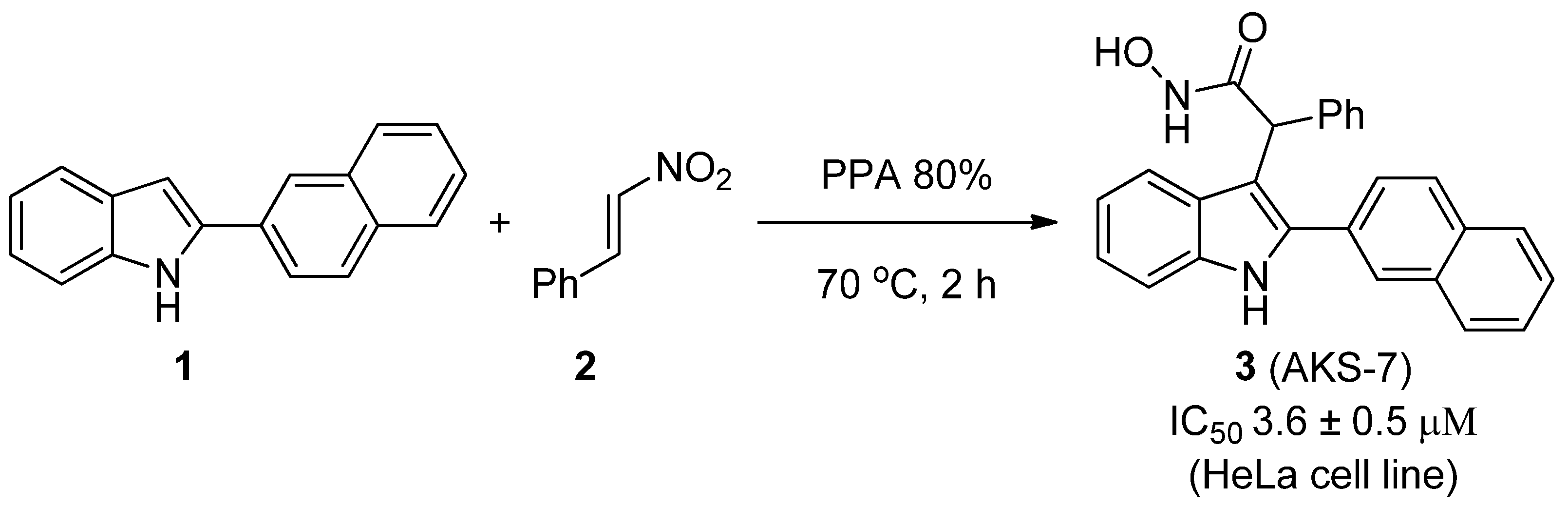
Notable examples include the 2-aryl-2-(3-indolyl)acetohydroxamic acids previously synthesized in our group (Scheme 1) [8], which demonstrated potent anticancer activity against apoptosis-resistant and multidrug-resistant cancer cells in vitro. However, despite promising preliminary data, in vivo mice studies revealed significantly reduced efficacy, attributed to rapid systemic clearance. To improve the pharmacokinetic profile, we initially attempted to protect the hydroxyl group, which is susceptible to glucuronidation. However, this strategy proved unsuccessful, as the O-protected derivatives exhibited significantly lower activity compared to the parent compounds [9]. To address this limitation, we synthesized a homolog of the most potent lead compound, AKS-7 (2-naphthyl-2-(3-indolyl)acetohydroxamic acid), along with some derivatives to evaluate their biological activity, including the corresponding ester and hydrazide.
2. Results and Discussion
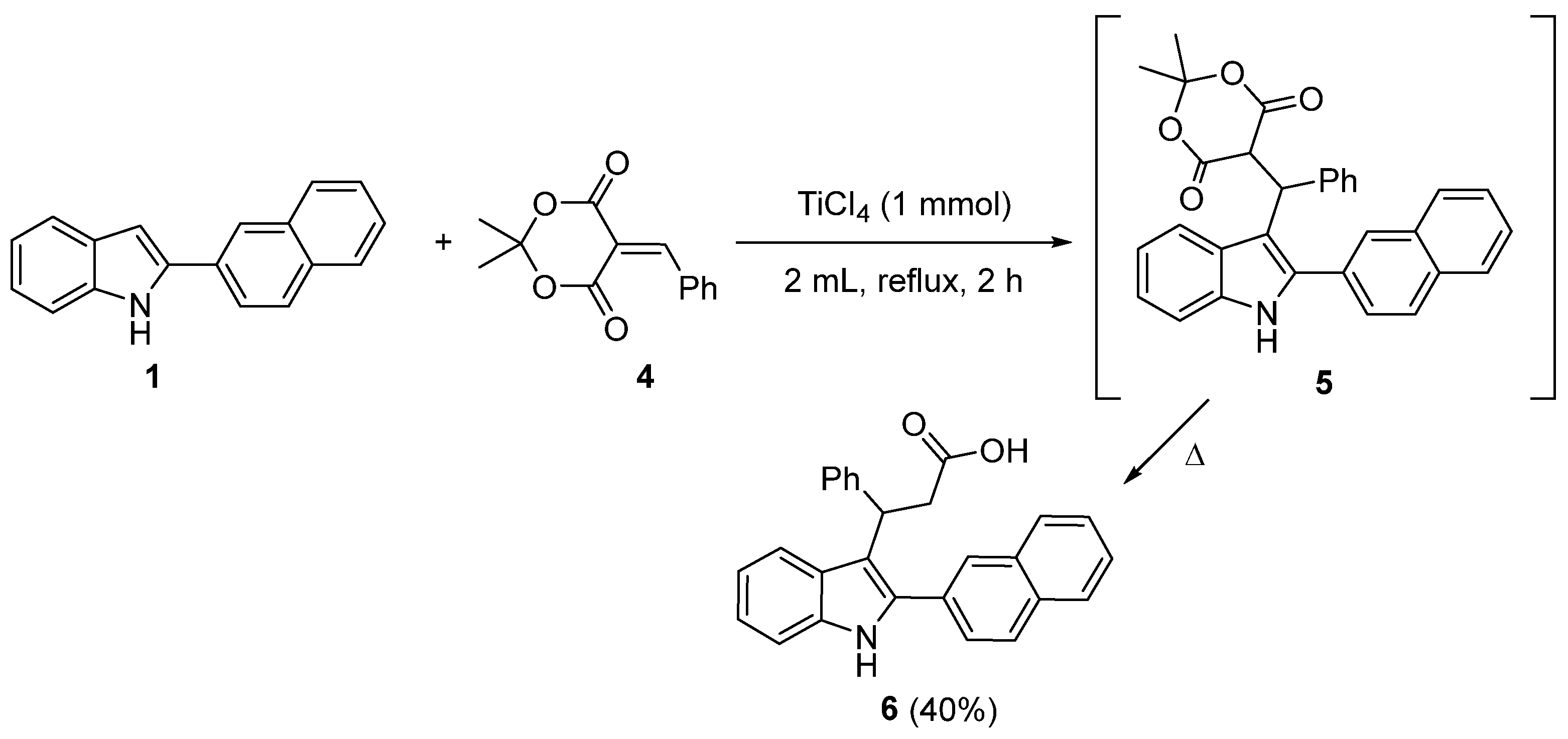
During the search of synthetic route to substituted indolylpropionic acids, we selected 5-benzylidene-Meldrum’s acid as the alkylating agent, capitalizing on the established versatility of Meldrum’s acid derivatives in carbonyl chemistry (Scheme 2). Mechanistically, we postulate that the initial step involves the addition of indole 1 to the Michael acceptor 4. The resulting intermediate 5 then undergoes thermal decomposition, accompanied by decarboxylation, to afford the indolylpropionic acid 6 in a 40% yield. Based on literature precedents, the reaction was performed in refluxing dimethylformamide (DMF) in the presence of 1 equivalent of titanium(IV) chloride (TiCl4) as a Lewis acid.
For subsequent transformations (Scheme 3), the ester 7 was synthesized via a classical procedure in alcohol using a catalytic amount of sulfuric acid. The resulting ester was then converted into hydroxamic acid 8 in 26% yield by reaction with hydroxylamine in the presence of 1,8-diazabicyclo[5.4.0]undec-7-ene (DBU) as a base under cooling. Furthermore, hydrazide 9 was obtained in 25% yield by heating the ester 7 with hydrazine hydrate in refluxing methanol.
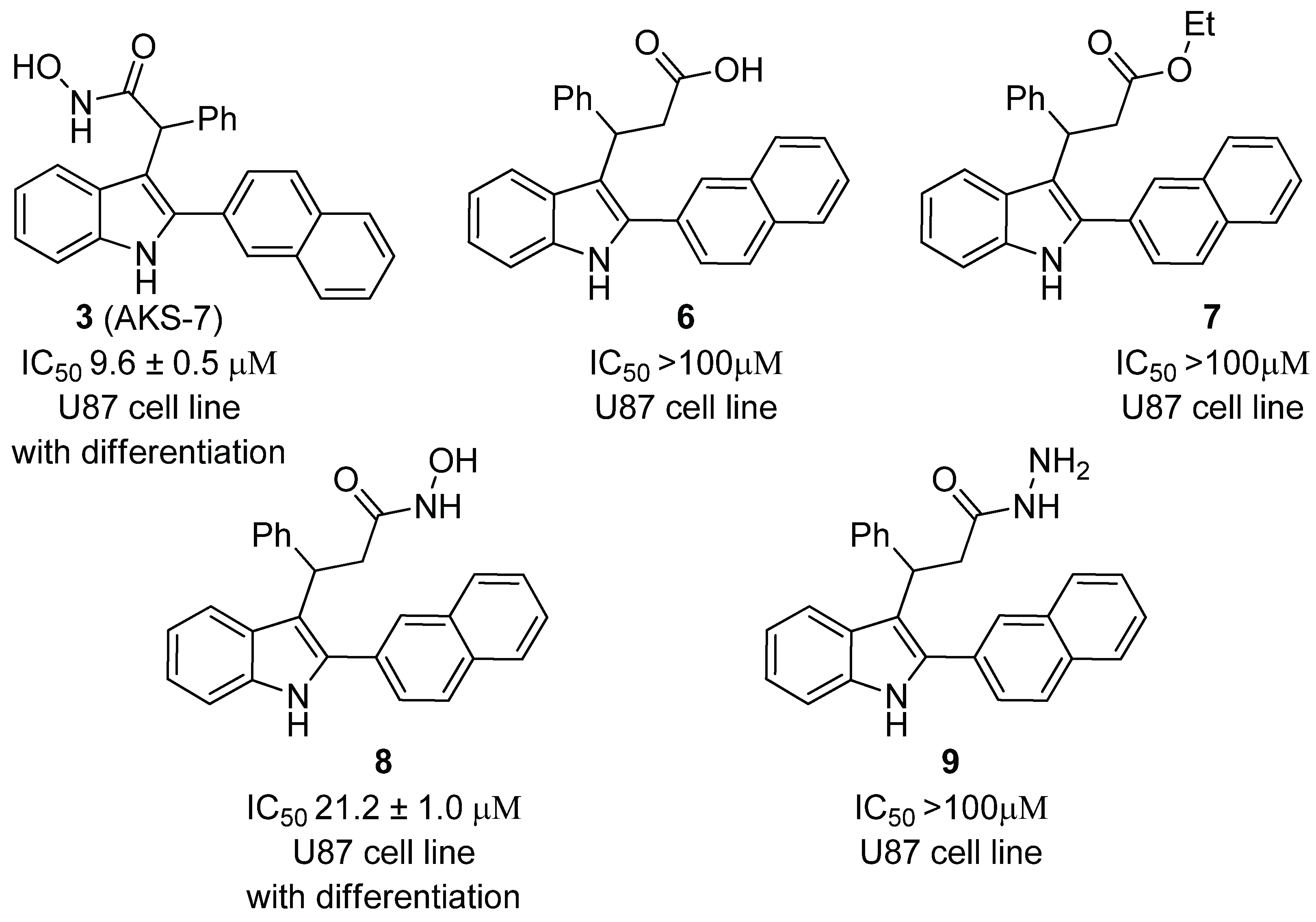
The evaluation of the anti-cancer activity of the synthesized compounds 6,7,8,9 was performed using U87 glioblastoma cell line. The results are presented in Figure 1, along with data obtained for the parent compounds 3. It should be noted that the homologous hydroxamic acid derivative 8 exhibited lower cytotoxic activity (half as much); however, it remained within the same order of magnitude as the lead compound. In contrast, the acid 6, ester 7, and hydrazide 9 did not showed significant inhibitory effects on the cancer cell lines.
3. Materials and Methods
U87 cell lines were purchased from the American Type Culture Collection (ATCC, Manassas, VA, USA), and cultured in DMEM supplemented with 10% fetal bovine serum (FBS). The antiproliferative properties of the synthesized compounds were evaluated using the MTT assay [10]. All compounds were dissolved in DMSO at a concentration of either 100 or 50 mM prior to cell treatment. The cells were trypsinized and seeded at 4 × 10³ cells per well into 96-well plates. The cells were grown for 24 h, treated with compounds at concentrations ranging from 0.001 to 100 μM, and incubated for 48 h in 200 μL of medium. Then, 20 μL of MTT reagent in serum-free medium (5 mg/mL) was added to each well, and the cells were incubated for a further 2 h. The medium was removed, and the resulting formazan crystals were resolubilized in 200 μL of DMSO. A490 was measured using a Molecular Devices THERMOmax plate reader. The experiments were performed in quadruplicate and repeated at least twice for each compound. Cells treated with 0.1% DMSO were used as a negative control; 1 μM phenyl arsine oxide (PAO) was used as a positive control.
Reagents, solvents, and catalysts were purchased from commercial sources (Acros Organics and Sigma-Aldrich) and used without purification. All reactions were performed in oven-dried flasks open to the atmosphere and monitored by thin layer chromatography on TLC precoated (250 μm) silica gel 60 F254 glass-backed plates (EMD Chemicals Inc.). Visualization was accomplished with UV light. Flash chromatography was performed using silica gel (32−63 μm, 60 Å pore size). 1H and 13C NMR spectra were recorded on Bruker DRX-400 and DRX-500 spectrometers. Chemical shifts (δ) are reported in ppm relative to the TMS internal standard. Abbreviations are as follows: s (singlet), d (doublet), t (triplet), q (quartet), m (multiplet), and br. (broad). See Supporting Information for 1H and 13C NMR spectral charts.
- 3-(2-(Naphthalen-2-yl)-1H-indol-3-yl)-3-phenylpropanoic acid (6). To a solution of titanium(IV) chloride (1.90 g, 1.0 eq.) in N,N-dimethylformamide (20.0 mL) was added 5-benzylidene-2,2-dimethyl-1,3-dioxane-4,6-dione (2.32 g, 1.0 eq.). Subsequently, 2-naphthylindole (2.43 g, 1.0 mmol) was added, and the reaction mixture was heated at reflux to 150 °C. The progress of the reaction was monitored by thin-layer chromatography (TLC). Upon completion, the mixture was quenched with water, and the resulting aqueous solution was extracted with ethyl acetate (3 × 50 mL). The combined organic layers were concentrated under reduced pressure using a rotary evaporator. The crude residue was purified by silica gel column chromatography (eluent: petroleum ether/acetone, 5:1) to afford the target compound. The title compound was obtained as ligh-brown powder, mp 131−134 °C (benzene/petroleum ether). The yield was 1.57 g (4.0 mmol, 40%). Rf = 0.28 (petroleum ether/acetone 2:1). 1H NMR (400 MHz, DMSO-d6) δ 12.15 (s, 1H), 11.41 (s, 1H), 8.14 (s, 1H), 8.06 (d, J = 8.3 Hz, 1H), 8.00 (d, J = 5.8 Hz, 1H), 7.93 (d, J = 6.2 Hz, 1H), 7.81 (d, J = 8.2 Hz, 1H), 7.62 – 7.52 (m, 3H), 7.40 (d, J = 7.9 Hz, 1H), 7.31 – 7.20 (m, 4H), 7.17 – 7.06 (m, 2H), 6.96 (t, J = 7.3 Hz, 1H), 5.00 (t, J = 7.2 Hz, 1H), 3.35 – 3.29 (m, 1H), 3.21 (dd, J = 15.5, 7.4 Hz, 1H). 13C NMR (101 MHz, DMSO-d6) δ 173.7, 144.9, 137.0, 135.5, 133.4, 132.7, 131.0, 128.8 (2C), 128.6, 128.4, 128.2, 128.0, 127.6 (2C), 127.4, 127.2, 127.1, 126.9, 126.3, 121.8, 120.6, 119.4, 114.2, 112.0, 41.8, 38.2. HRMS (ESI-TOF, m/z): Calculated for C27H21NNaO2 (M + Na)+ 414.1464; found 414.1469.
- Ethyl 3-(2-(naphthalen-2-yl)-1H-indol-3-yl)-3-phenylpropanoate (7). 3-Phenyl-3-(2-(naphthalen-2-yl)-1H-indol-3-yl)propionic acid (1.173 g, 1 mmol) was dissolved in ethanol (1.5 mL), followed by the addition of a catalytic amount of concentrated sulfuric acid (0.09 mL). The reaction mixture was heated at reflux for 8 h until the completion of the reaction, as monitored by thin-layer chromatography (TLC). Subsequently, water was added to the mixture, and the solution was neutralized with aqueous ammonia. The resulting mixture was extracted with ethyl acetate (3 × 30 mL). The organic layers were concentrated under reduced pressure using a rotary evaporator, and the crude residue was purified by silica gel column chromatography (eluent: petroleum ether/ethyl acetate, 8:1) to afford the title compound. The title compound was obtained as ligh-yellow oil. The yield was 0.93 g (2.22 mmol, 74%). Rf = 0.38 (petroleum ether/ethyl acetate 4:1). 1H NMR (400 MHz, CDCl3) δ 8.20 (s, 1H), 8.00 – 7.95 (m, 1H), 7.93 – 7.86 (m, 2H), 7.85 – 7.80 (m, 1H), 7.70 – 7.62 (m, 2H), 7.57 – 7.50 (m, 2H), 7.39 (t, J = 7.4 Hz, 3H), 7.32 – 7.24 (m, 3H), 7.24 – 7.16 (m, 2H), 7.13 – 7.06 (m, 1H), 5.15 (t, J = 7.8 Hz, 1H), 3.93 (qq, J = 10.8, 7.1 Hz, 2H), 3.42 – 3.18 (m, 2H). 13C NMR (101 MHz, CDCl3) δ 172.4, 144.2, 136.4, 135.7, 133.4, 132.9, 130.5, 128.60, 128.56 (2C), 128.3, 127.9, 127.9, 127.6 (2C), 126.7, 126.5, 126.5, 126.3, 122.3, 120.9, 119.9, 114.6, 111.2, 60.4, 40.5, 38.4, 29.8, 14.0. HRMS (ESI-TOF, m/z): Calculated for C29H25NNaO2 (M + Na)+ 442.1777; found 442.1778.
- N-Hydroxy-3-(2-(naphthalen-2-yl)-1H-indol-3-yl)-3-phenylpropanamide (8). To a stirred solution of ethyl 3-phenyl-3-(2-(naphthalen-2-yl)-1H-indol-3-yl)propionate (419 mg, 1.0 mmol) in methanol (4 mL) were added 1,8-diazabicyclo[5.4.0]undec-7-ene (DBU) (456 mg, 3 mmol) and hydroxylamine hydrochloride (NH2OH*HCl) (700 mg, 10 mmol) at 0 °C. The reaction mixture was then allowed to stir at room temperature, with the progress monitored by thin-layer chromatography (TLC). Upon completion, the mixture was diluted with water and neutralized by the addition of acetic acid. The resulting solution was extracted with ethyl acetate (3 × 30 mL). The combined organic phases were concentrated under reduced pressure, and the crude residue was purified by silica gel column chromatography (eluent: petroleum ether/ethyl acetate, 5:1) to yield the target hydroxamic acid. The title compound was obtained as dark-gray solid, mp 128−130 °C (benzene/petroleum ether). The yield was 0.053 g (0.26 mmol, 26%). Rf = 0.4 (petroleum ether/ethyl acetate 5:1). 1H NMR (400 MHz, DMSO-d6) δ 11.38 (s, 1H), 10.48 (s, 1H), 8.74 (s, 1H), 8.20 (s, 1H), 8.06 (d, J = 8.5 Hz, 1H), 7.99 (d, J = 7.8 Hz, 1H), 7.94 (d, J = 6.6 Hz, 1H), 7.87 (d, J = 8.4 Hz, 1H), 7.61 – 7.55 (m, 3H), 7.39 (d, J = 7.5 Hz, 1H), 7.24 – 7.18 (m, 4H), 7.12 – 7.07 (m, 2H), 7.00 – 6.94 (m, 1H), 5.09 (t, J = 7.5 Hz, 1H), 3.17 (dd, J = 14.6, 8.2 Hz, 1H), 2.94 (dd, J = 14.5, 7.1 Hz, 1H). 13C NMR (101 MHz, DMSO-d6) δ 167.7, 144.7, 136.6, 135.0, 133.0, 132.3, 130.5, 128.2 (2C), 128.1, 128.0, 127.7, 127.6, 127.3 (2C), 127.1, 126.8, 126.7, 126.4, 125.8, 121.3, 120.3, 118.8, 114.2, 111.6, 37.5, 37.4. HRMS (ESI-TOF, m/z): Calculated for C27H22N2NaO2 (M + Na)+ 429.1573; found 429.1576.
- 3-(2-(Naphthalen-2-yl)-1H-indol-3-yl)-3-phenylpropanehydrazide (9). To a stirred solution of ethyl 3-phenyl-3-(2-naphthyl-1H-indol-3-yl)propionate (419 mg, 1.0 mmol) in MeOH (2 mL), DBU (228 mg, 1.5 mmol) and hydrazine hydrate (N2H4*H2O) (150 mg) were added. The resulting mixture was heated at reflux for 8 h until the reaction reached completion, as monitored by TLC. Upon completion, the mixture was diluted with water and acidified with acetic acid to achieve a neutral pH. The aqueous phase was then extracted with ethyl acetate (3 × 10 mL). The organic solvent was removed under reduced pressure using a rotary evaporator, and the crude residue was purified by column chromatography (petroleum ether: ethyl acetate, 4:1). The title compound was obtained as light-brown solid, mp 140−142 °C (benzene/petroleum ether). The yield was 0.051 g (0.25 mmol, 25%). Rf = 0.2 (petroleum ether/ethyl acetate 2:1). 1H NMR (400 MHz, DMSO-d6) δ 11.37 (s, 1H), 9.09 (s, 1H), 8.19 (s, 1H), 8.06 (d, J = 8.5 Hz, 1H), 8.01 – 7.97 (m, 1H), 7.96 – 7.92 (m, 1H), 7.87 (d, J = 8.4 Hz, 1H), 7.60 – 7.55 (m, 3H), 7.39 (d, J = 8.0 Hz, 1H), 7.26 – 7.19 (m, 4H), 7.12 – 7.07 (m, 2H), 6.96 (t, J = 7.4 Hz, 1H), 5.10 (t, J = 7.5 Hz, 1H), 4.33 (br.s, 2H), 3.27 (dd, J = 14.8, 8.5 Hz, 1H), 2.96 (dd, J = 14.7, 6.8 Hz, 1H). 13C NMR (101 MHz, DMSO-d6) δ 170.2, 144.8, 136.6, 134.8, 132.9, 132.2, 130.5, 128.2 (2C), 128.1, 128.0, 127.7, 127.6, 127.3 (2C), 127.1, 126.8, 126.6, 126.4, 125.7, 121.3, 120.3, 118.8, 114.4, 111.5, 79.2, 37.5. HRMS (ESI-TOF, m/z): Calculated for C27H23N3NaO (M + Na)+ 428.1733; found 428.1729.
4. Conclusions
A convenient synthetic method for 3-(2-(naphthalen-2-yl)-1H-indol-3-yl)-3-phenylpropanoic acid and it derivatives was developed utilizing 5-benzylidene-Meldrum’s acid derivatives as alkylating agents. The homolog of 2-aryl-2-(3-indolyl)acetohydroxamic acid was synthesized, which will facilitate future pharmacokinetic investigations. Furthermore, the ester and hydrazide derivatives of this homolog were evaluated. This homologation approach opens new avenues for further SAR studies.
Supplementary Materials
The following supporting information can be downloaded at the website of this paper posted on Preprints.org. Figures S1-S8 of 1H and 13C NMR
Author Contributions
A.V.A.—conceptualization, supervision, and funding acquisition; N.A.Ak.—investigation, writing (original draft, review, and editing); N.A.Ar.—investigation, writing (original draft, review, and editing); D.A.A.—investigation; A.M.Z. —investigation; D.I.M. —investigation; M.O.S. —investigation, S.N.O. —investigation, formal analysis. All authors have read and agreed to the published version of the manuscript.
Funding
This study was supported by the state assignment of the Ministry of Science and Higher Education of the Russian Federation (theme #FSRN-2023-0005).
Data Availability Statement
Not applicable.
Acknowledgments
We are grateful to Prof. Snezna Rogelj from Department of Biology, New Mexico Tech for the help in the testing of antiproliferative properties of compounds.
Conflicts of Interest
The authors declare no conflict of interest.
References
- Gao, P.; Chen, Y.; Pan, W.; Li, N.; Liu, Z.; Tang, B. Antitumor Agents Based on Metal–Organic Frameworks. Angew. Chemie. 2021, 133, 16901–16914. [Google Scholar] [CrossRef]
- Cháirez-Ramírez, M.H.; de la Cruz-López, K.G.; García-Carrancá, A. Polyphenols as Antitumor Agents Targeting Key Players in Cancer-Driving Signaling Pathways. Front. Pharmacol. 2021, 12, 1–25. [Google Scholar] [CrossRef] [PubMed]
- Mehra, A.; Sharma, V.; Verma, A.; Venugopal, S.; Mittal, A.; Singh, G.; Kaur, B. Indole Derived Anticancer Agents. ChemistrySelect. 2022, 7. [Google Scholar] [CrossRef]
- Russo, E.; Grondona, C.; Brullo, C.; Spallarossa, A.; Villa, C.; Tasso, B. Indole Antitumor Agents in Nanotechnology Formulations: An Overview. Pharmaceutics. 2023, 15. [Google Scholar] [CrossRef] [PubMed]
- Salerno, S.; Barresi, E.; Baglini, E.; Poggetti, V.; Da Settimo, F.; Taliani, S. Target-Based Anticancer Indole Derivatives for the Development of Anti-Glioblastoma Agents. Molecules. 2023, 28, 2587. [Google Scholar] [CrossRef] [PubMed]
- Yan, J.; Xu, Y.; Jin, X.; Zhang, Q.; Ouyang, F.; Han, L.; Zhan, M.; Li, X.; Liang, B.; Huang, X. Structure Modification and Biological Evaluation of Indole-Chalcone Derivatives as Anti-Tumor Agents through Dual Targeting Tubulin and TrxR. Eur. J. Med. Chem. 2022, 227, 113897. [Google Scholar] [CrossRef] [PubMed]
- Devi, N.; Kaur, K.; Biharee, A.; Jaitak, V. Recent Development in Indole Derivatives as Anticancer Agent: A Mechanistic Approach. Anticancer. Agents Med. Chem. 2021, 21, 1802–1824. [Google Scholar] [CrossRef] [PubMed]
- Aksenov, A. V.; Smirnov, A.N.; Magedov, I. V.; Reisenauer, M.R.; Aksenov, N.A.; Aksenova, I. V.; Pendleton, A.L.; Nguyen, G.; Johnston, R.K.; Rubin, M.; et al. Activity of 2-Aryl-2-(3-Indolyl)Acetohydroxamates against Drug-Resistant Cancer Cells. J. Med. Chem. 2015, 58, 2206–2220. [Google Scholar] [CrossRef] [PubMed]
- Aksenov, D.A.; Aksenov, A. V.; Prityko, L.A.; Aksenov, N.A.; Frolova, L. V.; Rubin, M. Methylation of 2-Aryl-2-(3-Indolyl)Acetohydroxamic Acids and Evaluation of Cytotoxic Activity of the Products. Molbank. 2021, 2022, M1307. [Google Scholar] [CrossRef]
- Mosmann, T. Rapid colorimetric assay for cellular growth and survival: Application to proliferation and cytotoxicity assays. J. Immunol. Methods. 1983, 65, 55–63. [Google Scholar] [CrossRef] [PubMed]
Scheme 1.
Preparation of 2-aryl-2-(3-indolyl)acetohydroxamic acid (AKS-7).
Scheme 2.
Synthesis of 3-(2-(naphthalen-2-yl)-1H-indol-3-yl)-3-phenylpropanoic acid 6.
Scheme 3.
Synthesis of derivatives 8 and 9.
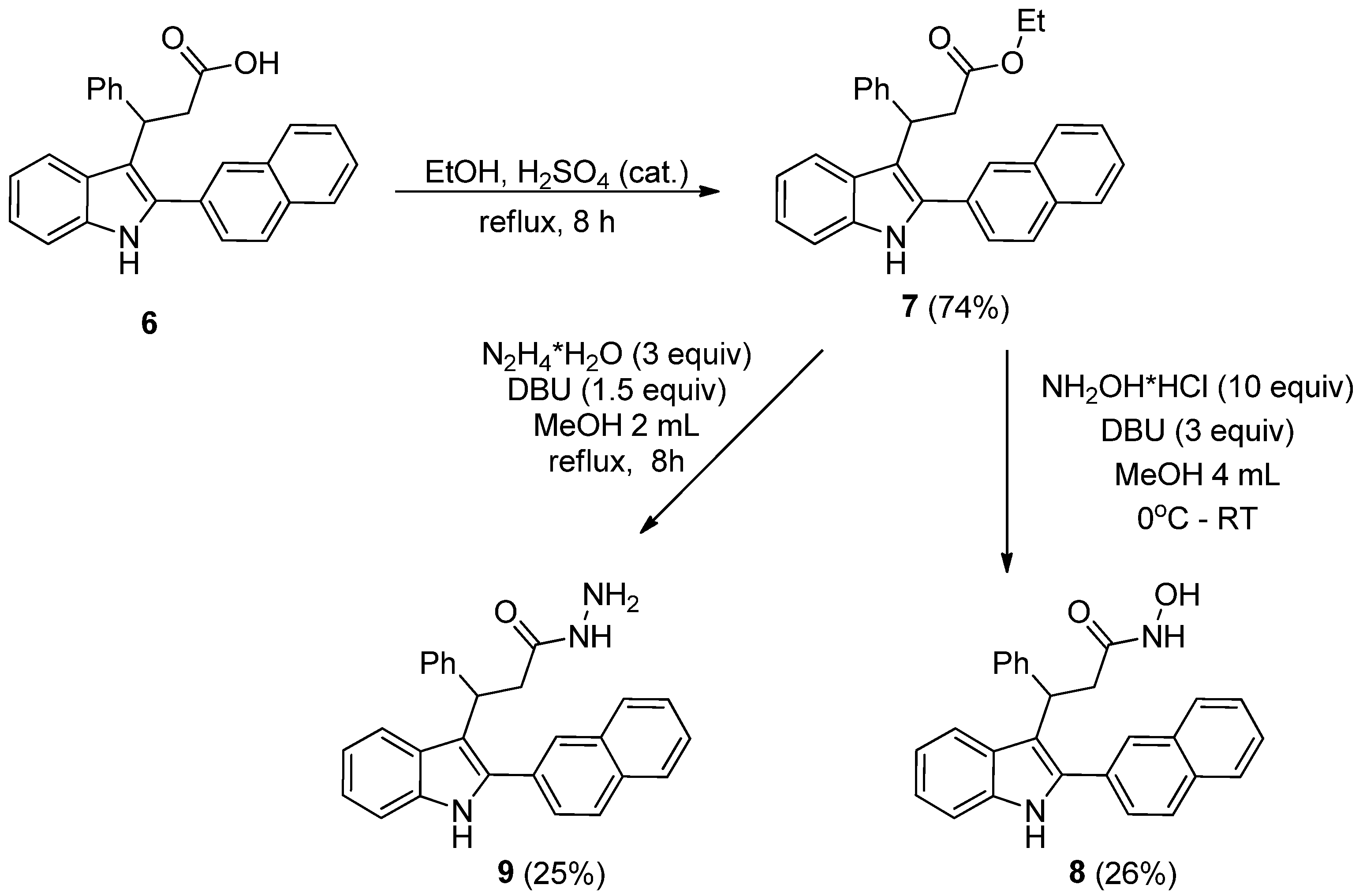
Figure 1.
The evaluation of the anti-cancer activity.
Disclaimer/Publisher’s Note: The statements, opinions and data contained in all publications are solely those of the individual author(s) and contributor(s) and not of MDPI and/or the editor(s). MDPI and/or the editor(s) disclaim responsibility for any injury to people or property resulting from any ideas, methods, instructions or products referred to in the content. |
© 2025 by the authors. Licensee MDPI, Basel, Switzerland. This article is an open access article distributed under the terms and conditions of the Creative Commons Attribution (CC BY) license (http://creativecommons.org/licenses/by/4.0/).
Copyright: This open access article is published under a Creative Commons CC BY 4.0 license, which permit the free download, distribution, and reuse, provided that the author and preprint are cited in any reuse.