
Submitted:
23 December 2025
Posted:
24 December 2025
You are already at the latest version
Abstract
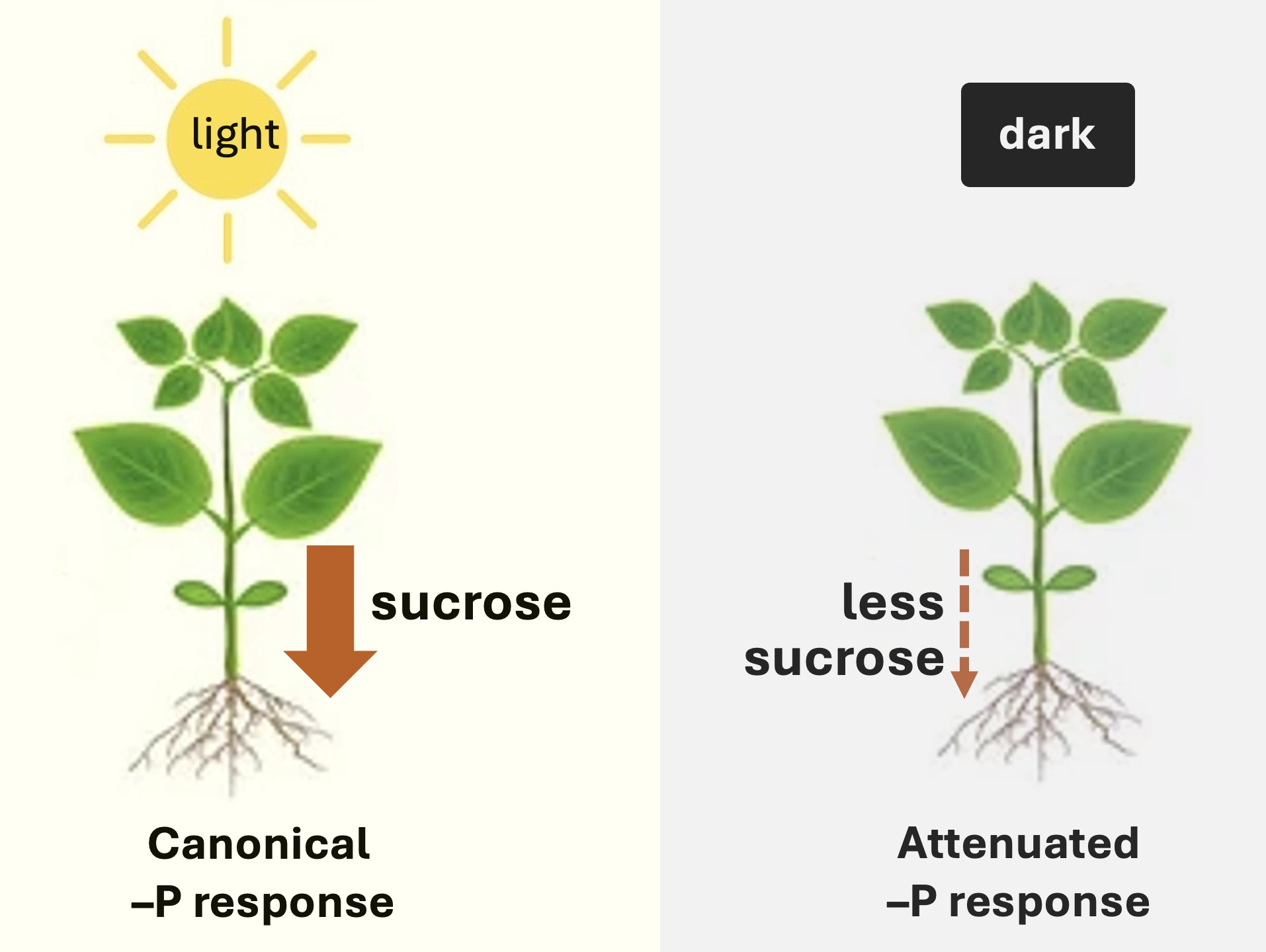
Phosphate (Pi) deficiency causes broad transcriptional changes that enhance Pi uptake and utilization. Because sucrose transport from shoot to root mediates long-distance Pi-deficiency signaling, we asked whether soybean can still respond to –P when sucrose supply is restricted. To limit sucrose availability, we exposed hydroponically grown soybean plants to +P or –P conditions for 30 h under light or darkness, with darkness suppressing photosynthetic carbon production. Root transcriptomes were profiled using Oxford Nanopore cDNA sequencing. Across four biological replicates per treatment, ~90 million reads were generated, with >90% mapping to ~25,300 expressed genes (~54% of annotated coding genes). Principal component analysis showed that light accounted for most of the variance, while Pi status contributed a smaller component. Under light, Pi deficiency activated a strong transcriptional program, including canonical phos-phate-starvation markers such as PHT1, PHO1 and PTEN2α. In darkness, however, only a small number of genes were induced, including a MYB-domain transcription factor, and none overlapped with the light-responsive set. Together, these findings suggest that light is required for broad transcriptional responses to Pi deficiency, whereas a local Pi-responsive program becomes detectable only when systemic sucrose signaling is suppressed.
Keywords:
carbon availability
; Glycine max
; local Pi signaling
; Nanopore sequencing
; phosphate starvation
; RNA-seq
; sucrose signaling
; systemic Pi signaling
; transcriptomics
Copyright: This open access article is published under a Creative Commons CC BY 4.0 license, which permit the free download, distribution, and reuse, provided that the author and preprint are cited in any reuse.


