

Submitted:
22 December 2025
Posted:
24 December 2025
You are already at the latest version
Abstract
This study analyzes the restitution process of the Sümela Monastery, located in the Maçka district of Trabzon, within the framework of documenting and interpreting multilayered heritage. The monastery’s architectural evolution from the Byzantine to the Ottoman and Republican periods is examined through its spatial dialogue with the topography, revealing restitution as not merely a formal reconstruction but as a process of knowledge production and representation. The research follows the methodological logic of Letellier and Eppich’s decision-making matrix model, integrating documentation, analysis, and interpretation in a multidisciplinary sequence. Based on extensive architectural surveys, material studies, and comparative analyses, six successive construction and transformation phases were identified. Each phase reflects a different synthesis of structural continuity, material innovation, and symbolic meaning, thereby illustrating the epistemic continuity of the site. The findings demonstrate that Sümela represents a “palimpsest architecture” where physical, documentary, and sociocultural layers coexist without erasing one another. By emphasizing the ethical and cognitive dimensions of restitution, the study reframes conservation as an interpretive act that mediates between historical accuracy and conceptual integrity. Comparative analysis with other Eastern Mediterranean rock monasteries—such as Meteora, Athos, Hosios Loukas, and Panagia Hozoviotissa—further clarifies Sümela’s unique spatial identity formed through its concave relationship with the mountain mass. Ultimately, the study proposes an epistemological restitution model grounded in transparency, reversibility, and interpretive coherence, suggesting that conservation should not only preserve material authenticity but also sustain the evolving meanings accumulated over time within the cultural landscape.
Keywords:
Sümela Monastery
; interpretive restitution
; multilayered heritage
; Eastern Mediterranean rock monasteries
; cultural landscape
; conservation theory
1. Introductıon
Historical monastic architecture represents not merely the spatial embodiment of a religious function but also a cultural discourse established through an intimate dialogue with the natural environment. From the Byzantine period onward, monasteries were conceived as integral components of mountainous and rocky landscapes, materializing the human quest to engage with the sacred (Norberg-Schulz, 1980; Mango, 1976). These complexes were typically constructed within liminal zones—where landscape transforms into architectural space—thus forming an “interface” between theology and built form. This spatial condition also situates monastic complexes within broader frameworks of cultural landscape and integrated conservation, where the protection of architectural heritage cannot be separated from environmental, legal, and socio-cultural contexts (Kamacı, 2014). Previous studies on cultural heritage conservation in Turkey have emphasized that increasing visitor pressure and tourism-oriented reuse strategies necessitate a careful balance between preservation, sustainability, and use, particularly in large-scale historical complexes (Durak, Tupal Yeke & Vural Arslan, 2016).
Within this framework, the Sümela Monastery stands as an exceptional example in which natural topography and architectural configuration are fused into a coherent spatial organism, revealing a multilayered continuum of historical transformation. Situated on the steep cliffs of the Altındere Valley, the complex embodies a dynamic interplay between geography, belief, and cultural representation (Beyhan & Ünügür, 2010). Accordingly, this study aims to document and analyze the interrelation of topography, faith, and spatial representation at Sümela, situating these elements within a framework of epistemological interpretation and measurable restitution. In a country characterized by high seismic activity, recent post-earthquake reconnaissance studies have underscored the vulnerability of the existing building stock, thereby reinforcing the necessity of risk-aware and context-sensitive conservation strategies in complex environments such as Sümela (Çağlar et al., 2024). Quantitative spatial-analytical approaches further demonstrate that spatial configuration can be examined through numerical and visual metrics, helping to operationalize ‘measurability’ when interpreting complex built environments (Şuta, 2024).
1.1. Historical and Topographical Context
Situated on the southern slopes of the Black Sea mountain range, within the boundaries of Maçka in Trabzon Province, the Sümela Monastery presents a multilayered narrative in which time and space converge. Its dramatic relationship with the natural environment, spatial configuration adapted to the rugged terrain, and successive formal transformations across different historical periods reveal an enduring synthesis between landscape and architecture. Carved into steep cliffs at an elevation of approximately 1,150 meters, the monastery embodies an unbroken continuity from the Byzantine era through the Ottoman period and into the modern Republic (Bryer & Winfield, 1985; Eastmond, 2017). Located within the Altındere Valley National Park, embedded in the eastern escarpment of the valley known as the Meryemana Stream, it stands as one of the most distinctive examples of cultural landscape integration and environmental preservation in the region (Figure 1).
According to the traditional narrative, the monastery was founded by two Athenian monks, Barnabas and Sophronios, who constructed the sanctuary upon witnessing the miraculous appearance of an icon of the Virgin Mary on the rock face (Eyice, 1966; Mango, 1976). This legend underscores that Sümela was conceived not merely as a physical structure but as a sacred locus imbued with layers of faith and symbolic representation. The site selection itself represents the transformation of natural landscape into ritual space: the direct contact between the built form and the mountain mass reinforces the monastery’s ascetic identity, while the valley’s humid vegetation and the continuous sound of flowing water define its contemplative atmosphere (Ricoeur, 1984; Bryer, 1985).
During the Komnenian period of Byzantium (12th century), the monastery came under imperial patronage and, in the era of the Empire of Trebizond, emerged as one of the region’s principal religious and political symbols (Eastmond, 2017). Following the Ottoman conquest, granted privileges ensured its survival, and through the Republican period it maintained its presence within collective memory—preserving both religious continuity and spatial identity as a central element of the region’s cultural consciousness (Eyice, 1966; Yerasimos, 1991).
For a structure whose topographical setting is so decisive, the architectural survey functions not merely as a dimensional record but as an analytical tool through which the interaction between topography and architecture can be interpreted. The primary mass resting upon the rock surface, the sequence of structures developing at different elevations on the sloping terrain, and the defining environmental boundaries constitute the principal components that shape the interpretive framework of restitution. Accordingly, the site plan and façade analyses do not only document the existing form; they also reveal the structural dialogue that the monastery establishes with its natural surroundings (Figure 2).
The site plan and façade analyses obtained during the survey process have revealed the fundamental principles governing the spatial relationship between the monastery and its topography. These data demonstrate that the settlement was conceived not merely as an architectural composition but as a sacred spatial configuration integrated with the surrounding landscape. The general view photographs presented below (Figure 3) confirm this spatial integrity in three dimensions, highlighting both the dominant position of the main mass overlooking the valley and the holistic character of the architectural ensemble embedded within the rock surface.
1.2. Sümela as a Multilayered Heritage
The Sümela Monastery is not merely a monastic complex shaped by successive repairs or architectural additions; rather, it constitutes a multilayered fabric of heritage in which time, memory, and devotional practices are interwoven. This stratification embodies the traces of each historical period not only in the physical structure but also in the evolving rituals of use and in the symbolic representations embedded within the site (De la Torre, 2013). The authenticity of Sümela, therefore, lies in its notion of continuity—one that cannot be confined to a single epoch. The structure preserves the imprints of the past while continuously acquiring new meanings through each intervention, thereby functioning as an ever-renewed historical narrative (Jokilehto, 2017).
The threefold dimension of multilayered heritage—physical, socio-cultural, and documentary—provides a fundamental framework for understanding the holistic value of Sümela:
- The physical layer is defined by variations in masonry, plaster, coloration, and craftsmanship. Each phase of restoration partially replaced original techniques with new materials, reinforcing the site’s character as a visual palimpsest (Feilden, 2007; Dimes & Ashurst, 2007).
- The socio-cultural layer encompasses the transformations that occurred through the monastery’s periods of abandonment and re-use, processes that have sustained its identity as a form of living heritage (ICCROM, 2003; Cassar, 2009).
- The documentary layer emerges through travelers’ accounts, archival records, and nineteenth-century engravings, reflecting the diverse meanings attributed to the site across different historical contexts (De la Torre, 2013; Matero, 2000).
1.3. Aim, Scope, and Research Questions
When these three dimensions are considered together, the Sümela Monastery may be defined as an instance of palimpsest architecture (Pérez et al., 2021). The term palimpsest refers to the superimposition of new interpretations without erasing the traces of the past. In this sense, each restoration constitutes not only a physical intervention but also the production of a new form of historical representation (Brandi, 1963; Carbonara, 2008).
The monastery’s restoration history confirms this multilayered nature. Interventions undertaken in different periods reflect distinct approaches conditioned by material decay and environmental humidity (Fitzner & Heinrichs, 2001; Price & Doehne, 2011). While early-twentieth-century plaster repairs reveal an aesthetic completionist attitude, contemporary works focus more on material authenticity and semantic integrity (Staniforth, 2000; Henry, 2015). This transformation indicates a paradigmatic shift in conservation history—from restoration as a purely technical procedure to restoration as an ethical act of representation (Feilden, 2007; Matero, 2000).
This multilayered character of Sümela can be traced not only within the material fabric of the structure but also in the surrounding landscape and the associated devotional practices. The geomorphology of the Altındere Valley has become a determinant of spatial experience. This situation echoes the Burra Charter (1979) principle of the “cultural significance of place,” which states that “Every cultural heritage site derives its value from the meaning of its setting and the relationship it sustains with human life.” The monastery’s embedded position within the rocky façade exemplifies this principle in its most literal form. Consequently, the complex represents a typical case of the restoration model based on the simultaneous coexistence of historical layers, as described by Carbonara (2008). Contemporary conservation practice seeks to enhance the legibility of these layers, transforming the monument into an open-ended narrative of accumulated meanings through time (Ashurst, 2007; Cassar, 2009).
The primary aim of this study is to document the restitution process of the Sümela Monastery and to analyze how its multilayered physical and historical data have been translated into conservation decisions. Rather than treating restitution as a merely formal act of reconstruction, the study approaches it as an evaluative tool grounded in documentary evidence, archaeological traces, and comparative analysis. The objective, therefore, is to employ restitution as a scientifically based methodology to construct a holistic understanding of Sümela’s spatial evolution and state of preservation.
The scope of the research encompasses the monastery’s historical-topographical context, construction phases, material characteristics, and typologies of deterioration. In addition, the restitution decisions are assessed in relation to the site’s interaction with its natural environment and its position within the monastic tradition of the Eastern Mediterranean. Within this framework, Sümela is interpreted as a multilayered cultural landscape in which the architectural strata of both Byzantine and Ottoman periods can be simultaneously read and understood.
The study seeks to address the following three principal research questions:
- How have the physical and historical data of the Sümela Monastery been documented and interpreted within the restitution process?
- In what ways have the site’s topography, materials, and spatial organization influenced the formulation of restitution decisions?
- When compared with similar rock monasteries of the Eastern Mediterranean, what distinctive characteristics emerge from Sümela’s restitution findings?
1.4. Topography and Spatial Analogies in Eastern Mediterranean Rock Monasteries
Guided by these questions, the research was conducted through a qualitative documentation and comparative-analysis methodology. Archival records, historical photographs, survey measurements, and restitution drawings were evaluated, and the knowledge hierarchy model proposed by Letellier and Eppich (2015) served as the primary framework for classifying these data. Through comparative analysis, the monasteries of Meteora, Athos, and Hosios Loukas in Greece were examined in terms of topographical setting, spatial organization, and construction techniques, allowing the study to determine Sümela’s distinctive position within the monastic tradition of the Eastern Mediterranean.
Based on the findings obtained through this methodology, the article discusses the restitution process of the Sümela Monastery as an applied conservation model and highlights the productivity of working within conditions of uncertainty in other multilayered monuments. In doing so, it contributes to the development of a restitution approach grounded in scientific documentation while proposing an interdisciplinary framework for cultural-heritage conservation.
Understanding the restitution process of Sümela, therefore, requires not only an analysis of the local context but also an examination of the morphological dynamics of the Eastern Mediterranean monastic tradition. For this reason, the study comparatively evaluates rock-cut monasteries in Greece that display similar topographical and structural characteristics to Sümela.
Comparable monastic complexes integrated into rock masses are also encountered throughout the Eastern Mediterranean region. These structures share a common morphological logic in the way sacred space interacts with its surrounding topography. Among them, the rock monasteries of Greece offer diverse interpretations of the relationship between landscape and architectural form. The Meteora Monasteries (14th century, Greece) are positioned atop towering monolithic pillars, embodying the themes of vertical isolation and “proximity to heaven” (Figure 4). This positioning transforms physical inaccessibility into a spatial metaphor of spiritual purification, forming a unique topography of faith expressed through architecture.
The monasteries of the Athos Peninsula—particularly Great Lavra and Vatopedi—continue the Hellenistic tradition of the “sacred mountain,” positioned within the transitional zone between sea and mountain. This type of settlement, established along steep rocky coastal bands, allowed the monasteries to evolve in a state of co-existence with nature (Karakatsanis, 1997). The Athonite examples embody a monastic philosophy that perceives topography not merely as a physical foundation but as a mystical component of the landscape. In this sense, they establish a direct analogy with Sümela’s concept of rock-embedded interiority (Figure 5).
Similarly, the Panagia Hozoviotissa Monastery (Amorgos Island, 11th century) exemplifies the typology of the “worship space concealed within the rock” through its position clinging to the steep coastal cliffs. In accordance with Brandi’s (1963) principle of “deriving meaning from the form of the place,” this architectural approach transforms the physical morphology of the landscape into a spiritual language. The Hosios Loukas Monastery (Greece, 11th century), on the other hand, was constructed on a gently sloping hillside, employing a terraced arrangement parallel to the topography; the architectural masses interlock with the natural incline, forming a horizontal sacred hierarchy (Facorellis & Mourelatos, 2017; Bouras, 2006). Together, these two examples represent the horizontal and terraced spatial order characteristic of the Mediterranean monastic tradition—standing in contrast to the vertical rock-mass relationship that defines Sümela (Figure 6).
In conclusion, when evaluated together with these four examples, Sümela represents the most extreme manifestation of the sacralization of nature within Byzantine–Greek monastic architecture in Anatolia. Compared to Athos, characterized by the coexistence of coast and mountain; Meteora, defined by its vertical isolation; Hosios Loukas, embodying horizontal balance; and Hozoviotissa, expressing the inwardness of the rock, Sümela’s spatial distinctiveness can be described as a synthesis between vertical seclusion and rock interiority (Table 1).
Among these examples, Sümela distinguishes itself through its concave spatial configuration: as a monastery carved into the rock surface, it exists within the protective shell of nature (Figure 7). This condition corresponds to Riegl’s (1982) notion of age value integrated with the natural environment. In contrast to the outward-oriented composition of Meteora and the horizontally balanced organization of Hosios Loukas, the spatial character of Sümela is introverted—shaped as a rhythmic sanctuary that embodies the idea of inward retreat (Norberg-Schulz, 1980).
2. Methodologıcal Framework and Documentatıon Approach
This study is grounded in a multidisciplinary methodological system developed to document, analyze, and define intervention strategies for the historical layers of the Sümela Monastery. The approach was structured as a five-stage process integrating the fields of architectural surveying, restitution, material science, and conservation theory.
2.1. Documentation Phase
A comprehensive survey was conducted to accurately determine the current physical condition of the monastic complex. Plans, sections, and elevations were prepared, and original structural components were systematically distinguished from later additions. The resulting documentation established the first analytical database for interpreting the chronological layers of the monument (Feilden, 2007; Jokilehto, 2017) (Figure 7).
Figure 7.
General plan of the Sümela Monastery showing the chronological analysis of construction phases (Author’s personal archive, 2014).
Figure 7.
General plan of the Sümela Monastery showing the chronological analysis of construction phases (Author’s personal archive, 2014).
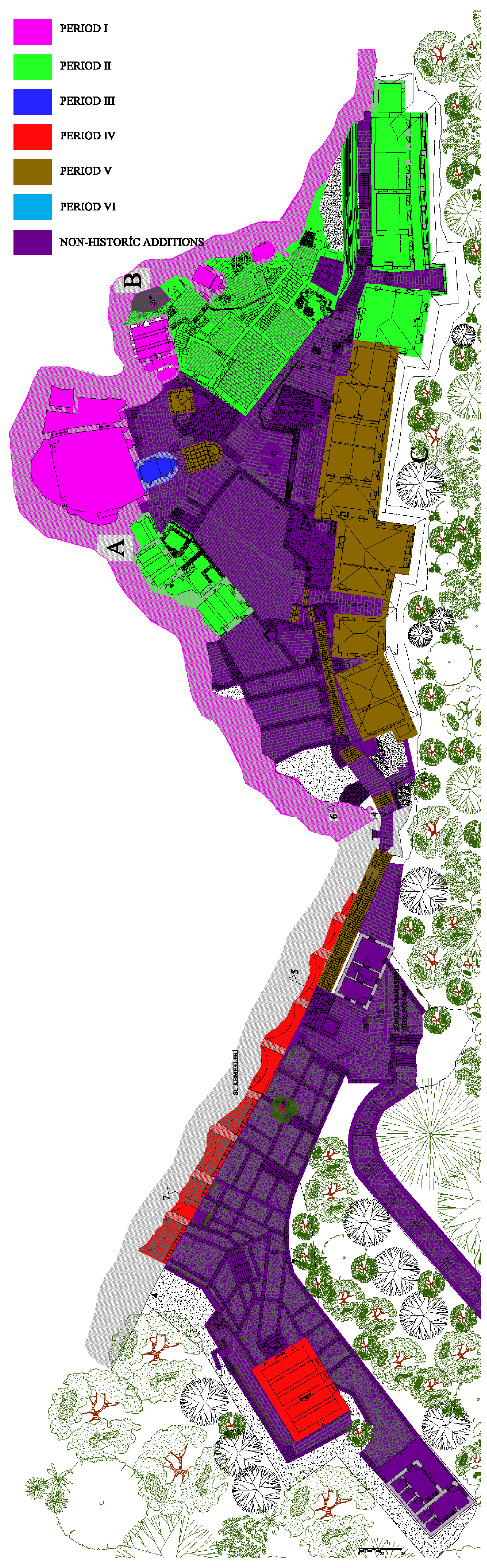
The stratification identified at the general-plan level reveals the temporal transformation of the monastery’s spatial integrity. This holistic reading is particularly significant for tracing the interventions along the eastern façade. The vertical relationship established with the rock mass demonstrates how the spaces are structurally and functionally interconnected. In the façade analysis presented below (Figure 8), the traces of each construction period can be distinctly observed through variations in stone texture, opening ratios, and surface repair patterns.
2.2. Restitution Analysis
The historical development of the structure was interpreted through a comparative evaluation of documented data. Archival sources, historical photographs, engravings, and travel accounts were examined to reassess the spatial organization, mass composition, and functional transformations of the monastery across different periods (Mora, Mora, & Philippot, 1984; Stanley-Price, 1995). In this way, restitution hypotheses concerning the missing parts were grounded on verifiable documents and established on a solid scientific basis.
The restitution study of the Sümela Monastery is based on the sequential documentation of six distinct periods and the comparative analysis of the structural transformations occurring between them. The primary aim of this process is not merely a formal reconstruction but the identification of the building’s temporal evolution, material continuity, and spatial transformation logic (Letellier et al., 2015; Feilden, 2007).
Each period sheet was evaluated through the integration of photographic documentation, drawing-based restitution analyses, and surface readings. The photographic restitutions analyze the relationship between stone texture, surface repair traces, and the structural embedding into the rock, thereby revealing the construction principles specific to each historical phase.
The documentation process followed the principle of “document–interpretation–decision,” defined as a progressive restitution methodology (Letellier et al., 2015). Through this method, each restitution sheet visualizes the probable limits of the original form while systematically exposing the stratification created by later interventions.
The resulting documents transformed the restitution process from a mere representation of the past into an analytical tool for interpreting historical data. Consequently, the architectural evolution of the monastery was defined in six main phases, each representing a distinct layer of spatial and technical transformation (Table 2).
The historical development of the structure has been examined across six principal phases: the Initial Formation (4th–7th centuries), Byzantine Consolidation (8th–13th centuries), Late Byzantine–Early Ottoman Interaction (14th–15th centuries), Ottoman Expansion Period (16th–19th centuries), Republican Period of Decay (20th century), and Modern Interventions (post-1970). Each phase is distinguished not only by its architectural style or plan scheme but also by its construction techniques, material compositions, spatial organization principles, and conservation approaches.
2.2.1. Initial Formation Phase (4th–7th Centuries)
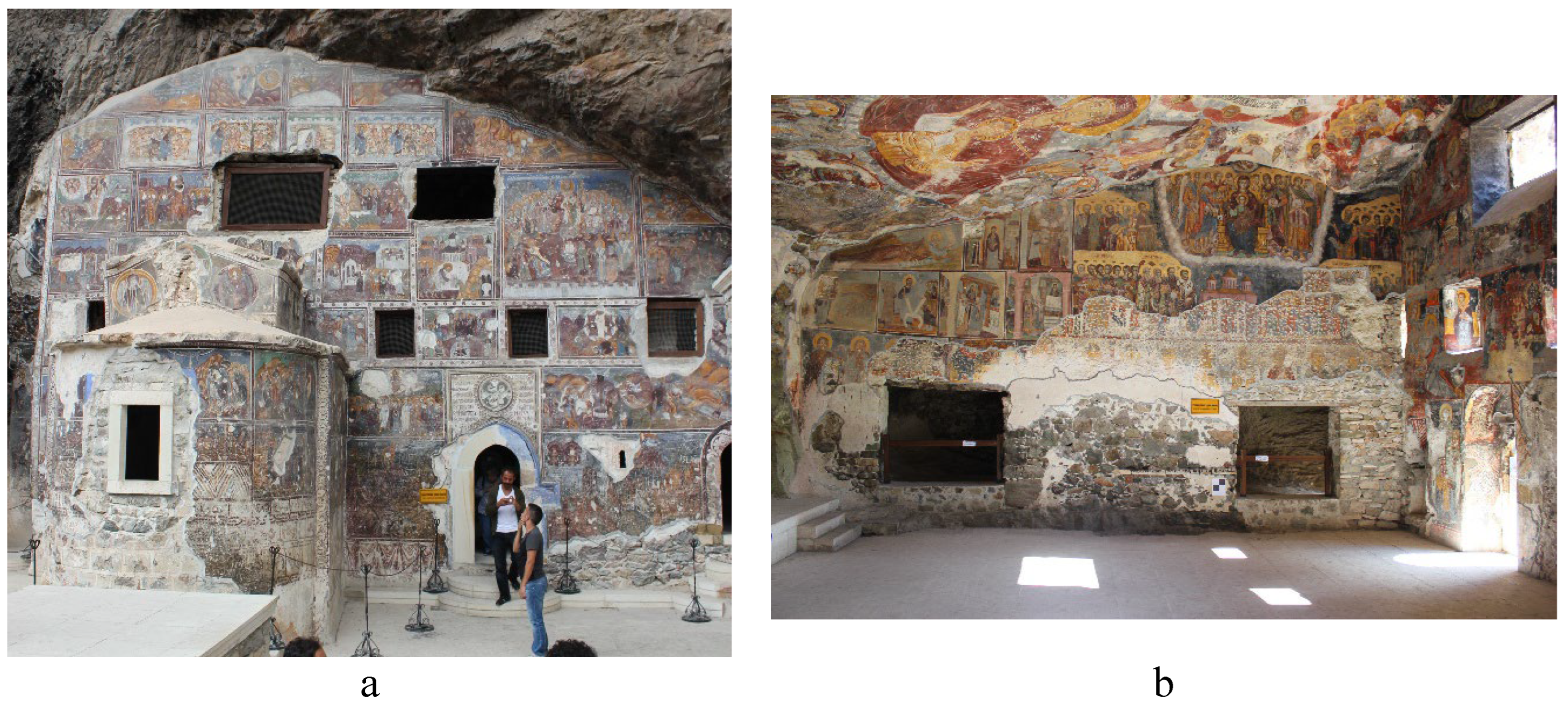
This phase represents the earliest stage of the monastery’s development, when the complex was directly carved into the natural rock mass, reflecting the simple spatial configuration of early monastic architecture. During this period, the monastery was conceived as a sacred space integrated with nature; irregular rubble masonry was employed for the walls, and weak lime mortars were used as binding material (Figure 9).
2.2.2. Byzantine Consolidation (8th–13th Centuries)
During the Byzantine Consolidation phase, the volumetric capacity of the sacred space increased; the masonry became more regular, and in some parts, the transition to ashlar construction was achieved. Traces of this period can be identified through the addition of small cells integrated into the rock wall and the differentiation of liturgical spaces within the complex.
Figure 9.
Example of a Rock-Cut Church from the Early Formation Period (Author’s personal archive, 2014): a) Exterior façade of the rock-cut church; b) Interior space of the rock-cut church.
Figure 9.
Example of a Rock-Cut Church from the Early Formation Period (Author’s personal archive, 2014): a) Exterior façade of the rock-cut church; b) Interior space of the rock-cut church.
2.2.3. Late Byzantine–Early Ottoman Interaction (14th–15th Centuries)
During this phase, the monastery underwent a transformation both architecturally and iconographically. The east-oriented spatial scheme of the complex was preserved; however, new cells and gallery units were added along the northern façade as part of structural reinforcements. The stone masonry began to approach a more refined, partly ashlar form, while the mortar composition reveals the use of lime mixed with volcanic aggregates.
2.2.4. Ottoman Expansion Period (16th–19th Centuries)
This period represents one of the most characteristic layers of the monastery’s architectural history. The finely cut stone masonry observed during this phase, together with the development of lime-based mortar formulations and the integrated use of timber and stone structures, indicates a marked technical advancement compared to the irregular rubble masonry of the earlier periods (Feilden, 2007; Price & Doehne, 2011). At the same time, this phase coincides with the expansion of the social fabric surrounding the monastery, during which religious functions were integrated with accommodation and production activities.
2.2.5. Republican Period (20th Century)
This phase represents the most fragile stage in terms of the building’s conservation conditions. Following the abandonment of the monastery after 1923, cracks appeared in the load-bearing walls, surface losses occurred on façades, and the frescoes exhibited pigment fading and detachment. In addition, water infiltration, microorganism growth, and biological colonization processes accelerated (Charola, 2000; Fitzner & Heinrichs, 2001). The limited interventions undertaken during this period consisted mainly of cement-based repairs and superficial plasters that were incompatible with the original materials of the structure.
2.2.6. Modern Interventions (Post-1970)
This phase represents a period in which both conservation awareness and engineering-based restoration practices were fully established. Within this framework, rock stabilization, improvement of drainage systems, surface water management, fresco conservation treatments, and architectural additions focused on visitor safety were implemented (Matero, 2000; ICCROM, 2003). These interventions redefined not only the physical integrity of the structure but also the balance between its sacred heritage and touristic use. Nevertheless, it must be acknowledged that certain modern interventions have inevitably altered the perception of the monument. In particular, some structural support systems introduced for safety purposes have partially modified the original atmosphere. However, these measures were deemed necessary to ensure structural stability and long-term preservation (Stanley-Price, 1995; Matero, 2000). Overall, this period represents a phase in which conservation awareness increased and modern restoration practices at Sümela began to be integrated with international standards (Figure 10).
In conclusion, the six-phase developmental process of the Sümela Monastery represents a holistic expression of construction, decay, and re-signification cycles. Each phase added a new interpretive layer without erasing the previous one, thus ensuring both the physical and epistemic continuity of the monument. This multilayered process reveals that restitution does not merely aim at historical representation but proposes an epistemic reading based on the dialectic of deterioration, repair, and reinterpretation.
These six periods are interpreted not as mutually exclusive, but as cumulative layers that have evolved over time. Accordingly, restitution was undertaken not solely to reconstruct what was lost, but to enhance the legibility of inter-period relationships (Brandi, 1963; Carbonara, 2008) (Figure 11).
2.3. Material Analyses
Petrographic, chemical, and physical tests conducted on stone, mortar, and plaster samples provided original data regarding the construction technologies employed at the Sümela Monastery. Petrographic examinations under a polarizing microscope, together with XRD and XRF analyses, identified the mineralogical compositions of the stones and mortars (Torraca, 1982; Price & Doehne, 2011; Charola, 2000). The microscopic images and XRD graphs presented in Figure 12 illustrate the material diversity and deterioration tendencies across different historical periods. These findings support the continuity of material use within the monastery and form a scientific basis for structural interpretation during the restitution process.
2.4. Deterioration Typology and Evaluation
By combining field observations with laboratory findings, a comprehensive deterioration typology of the structure was established. Surface losses, structural deformations, biological effects, and stone disintegration were analyzed in accordance with the classification proposed by Fitzner and Heinrichs (2001) and the criteria defined by ICOMOS (1990). This assessment served as a primary reference for determining the conservation priority of each architectural element within the monastery complex.
2.5. Intervention Strategies
Each historical layer was analyzed with respect to its structural condition and material characteristics. Decisions regarding conservation, repair, reinforcement, and partial reconstruction were developed within the framework of the principles established by the Venice Charter (1964) and the Burra Charter (1979), while maintaining an ethical balance based on the representational concepts of Brandi (1963) and Matero (2000). The fundamental principle was the preservation of historical continuity and the integrity among different chronological layers.
This multi-phase methodological system established a scientific, analytical, and interdisciplinary foundation for the conservation process of the Sümela Monastery. As a result, the legibility of its historical values was enhanced, and all intervention decisions were aligned with international conservation standards.
2.6. Application Model of the Method
This study approaches the restitution process of the Sümela Monastery as an applied framework in which historical documentation, spatial analysis, and conservation decision-making are integrated. The adopted methodology is based on a systematic integration of the documentation–analysis–interpretation stages, wherein the data obtained were comparatively tested and cross-evaluated (Letellier et al., 2015; Feilden, 2007).
The research was structured through an interdisciplinary methodology designed to document spatial layers, establish chronological phases, and substantiate restitution decisions. This approach consists of two main components:
2.6.1. Documentation and Restitution Process
Physical, photographic, and drawing-based data belonging to different historical periods of the structure were systematically classified. These records were integrated with architectural survey measurements, and restitution decisions were verified through historical sources and on-site observations. In this way, the spatial organization, material characteristics, and topographical relationships specific to each period were analyzed in detail.
2.6.2. Comparative Field Analysis
The spatial typology of Sümela and its relationship with the topography were compared with analogous examples of Byzantine and Greek monastic architecture—namely Meteora, Athos (Mount Athos), Hosios Loukas, and Panagia Hozoviotissa. This comparative approach revealed the shared principles underlying the transformation of natural landscapes into sacred spaces and defined Sümela’s distinctive position within the monastic tradition of the Eastern Mediterranean.
This application model aims to establish a balance between historical accuracy and interpretive coherence within the restitution process. Thus, restitution was not regarded merely as a formal act of reconstruction, but as a scientifically grounded analytical process guiding conservation decisions
3. The Epıstemıc and Ethıcal Framework of Restıtutıon: A Readıng on Sumela
Although restitution has traditionally been defined as the act of reconstructing a building’s original form, contemporary conservation theory transcends this definition by interpreting it as a process of knowledge production and representation. Especially after the Venice Charter (1964) and the Burra Charter (1979), restitution has come to be regarded not merely as a formal reconstruction but as an epistemic field in which historical knowledge is generated (Brandi, 1963; Letellier et al., 2015).
As Brandi emphasized in Teoria del Restauro (1963), every restitution effort is not a reconstruction of the past, but a reinterpretation of it through the consciousness of the present. In this sense, restitution becomes an intellectual act that represents the continuity of time rather than solely the material integrity of a monument. The decision-making matrix model defined by Letellier and Eppich (2015) materializes this process: the equilibrium between documentation, trace, and hypothesis determines both the informational and representational value of conservation decisions.
The restitution of the Sümela Monastery was thus shaped not by the pursuit of “rebuilding the correct form,” but by the quest to “reconstruct the correct meaning” (Feilden, 2007; Pérez et al., 2021). The transformations the monastery underwent across different historical periods—documented as well as fragmentary—have been interpreted together to construct a multilayered narrative field. In particular, restitution decisions regarding the rock-cut chapels, partially collapsed cells, and areas with uncertain plan data were grounded in the principles of probability, typological analogy, and morphological correspondence.
This approach demonstrates that what Pérez et al. (2021) term epistemological restitution has evolved, in the case of Sümela, into an applicable and context-specific model. Epistemic restitution is also an ethical domain. Arnóth (2019) and D’Ayala & Fodde (2008) emphasize that reconstruction decisions often carry value judgments masked by a veneer of scientific objectivity. Therefore, every act of restitution inevitably produces an interpretation. As Brandi asserted, the essence of restoration lies in maintaining a balance between aesthetic and historical consciousness.
In the case of Sümela, restitution decisions aimed not at completion but at clarification—not at rebuilding but at interpretation. Thus, restitution functions as a dialogical space between the past and the present. As Feilden (2007) aptly states, “conservation is the art of sustaining communication between people and time.”
3.1. Methodological Implementation System
ach restitution sheet was prepared through a three-stage methodological system:
A. Documentation: Correlation of photographic, laser-scanning, and architectural survey data (Letellier et al., 2015).
B. Analysis: Chronological classification of materials, deterioration patterns, and structural traces (Dimes & Ashurst, 2007; Fitzner & Heinrichs, 2001).
C. Interpretation: Reconstruction of missing components through typological analogy (Brandi, 1963; Pérez et al., 2021).
This system is based on the increasingly significant concept of visual memory production in conservation practice. The restitution drawings function not merely as tools for documenting the past but as representational surfaces that generate new knowledge. In this regard, the restitutions of Sümela directly correspond to the notion of “restoration as a cognitive act” proposed by Pérez et al. (2021). The spatial manifestation of this theoretical approach is concretized in the periodized restitution plans. The general plan presented below (Figure 13) reveals the structural and functional transformation of the monastery throughout its historical evolution.
The analysis of the eastern façade demonstrates the vertical stratification of the building and the differences created by successive interventions over time. This analysis is particularly significant for identifying the wall reconstructions and timber additions undertaken during the 18th–19th centuries. The data obtained through the façade study also played a decisive role in shaping the restitution plan. The plan analysis presented below (Figure 13) details the spatial revisions and functional transformations implemented in Section A during this period.
The restitution plan reveals the spatial organization of Section A during Phase V, particularly illustrating the relationships among service areas, circulation corridors, and monastic cells. The typological analysis conducted at this stage allowed the differentiation between the original construction techniques of the period and later structural additions. When evaluated together with the sectional and façade analyses, the relationships defined at the plan level enable a more holistic spatial interpretation. The restitution section presented below (Figure 14) clearly demonstrates the spatial continuity across different elevations and the evolution of the structural system.
The section–façade restitution reveals the spatial continuity of Section A across different levels and demonstrates the temporal transformation of its structural system. This analysis enables a reading of the building’s evolution not only in the vertical dimension but also in the horizontal plane. The repairs implemented during the fifth phase show that spatial transitions were redefined and that the thicknesses of the load-bearing walls varied according to functional requirements. The façade restitution from the preceding phase (Figure 15) documents the initial stage of this transformation, clearly illustrating the impact of the 18th–19th-century repair interventions on the façade character.
3.2. Comparative Typological Analysis
The architectural configuration of the Sümela Monastery cannot be explained merely through the formal analysis of a religious structure; its meaning lies in the reciprocal relationship it establishes with the surrounding topography. In this respect, Sümela stands as one of the most distinctive examples of rock monasteries when considered in the context of ritual space-making (Spieser, 1988; Mango, 1976).
To reveal this distinctiveness, the study proceeds along three comparative axes:
3.2.1. Plan Organization and Access System
The Sümela Monastery features a plan configuration that integrates natural rock cavities with gradually added artificial structures. The complex consists of three principal zones:
- the lower courtyard and entrance level,
- the main church and galleries,
- the monastic cells, kitchen, and water system.
This organization demonstrates the monastery’s adaptive development in harmony with its topography. In line with the examples examined in the previous section, the spatial organization of Sümela can be comparatively evaluated against different plan typologies found in post-Byzantine monastic complexes such as Meteora, Athos, and Hosios Loukas. This comparison reveals, in both formal and functional terms, the distinct ways in which each monastery engages with its surrounding landscape (Table 3).
The interwoven plan organization of Sümela directly translates the “meaning of place” into spatial experience (Burra Charter, 1979). The rock-cut corridors and monastic cells transform space from a merely functional domain into a setting for ritual experience. In this respect, the monastery stands as a distinctive example of the “sanctuary-space” typology.
The comparative analysis reveals the distinct material and technical characteristics employed in the monasteries of the Eastern Mediterranean. In Sümela, the primary material is the local limestone and tuff, carved directly from the rock mass. This feature ensures both structural and symbolic integration with the topography. In contrast, Meteora employs roughly hewn rubble stone and brick masonry, while Hosios Loukas demonstrates an alternating stone-and-brick arrangement (Dimes & Ashurst, 2007; Spieser, 1988). In the monasteries of Athos, the rhythmic juxtaposition of stone and brick emphasizes both structural continuity and aesthetic unity. This diversity reflects not only regional material availability but also the spatial manifestations of different monastic traditions.
The comparison clearly highlights the material–landscape relationship in Eastern Mediterranean monastic architecture. The rock-carved mass of Sümela eliminates the boundary between structure and ground, transforming the built environment into a direct extension of the natural form. This condition aligns with Brandi’s (1963) concept of the “historical value of matter” and Feilden’s (2007) principle of the “ethical conservation of original material.” Thus, the monastery becomes not only a physical entity but also a conservation object representing the historical continuity of its environment.
These comparative evaluations establish the conceptual framework for interpretive approaches concerning the representational dimension of restitution.
3.3. Visual Representation of Interpretive Restitution
The distinctive aspect of the Sümela restitution lies in its ability to move beyond the documentation of physical layers toward the visualization of the knowledge relationships that emerge among them. This approach positions restitution not merely as an act of reconstruction but as a mode of thinking and interpretation.
The diagram presented in Figure 16 illustrates this network of relationships by defining the conceptual framework of interpretive restitution through three primary layers — physical, documentary, and socio-cultural — and identifying the intersection where knowledge is generated. The diagram synthesizes Brandi’s notion of “historical consciousness” with Letellier’s principle of the “balance between documentation and interpretation,” thereby making visible the intellectual foundation underlying decision-making in the restitution process.
The diagram illustrates the intersection of the physical, documentary, and socio-cultural layers within the Sümela Monastery. This intersection represents both the intellectual and spatial embodiment of what Pérez (2021) defines as epistemological restitution. The primary aim of the diagram is to visualize and render transparent the processes of knowledge production underlying restitution decisions. Assumptions that often remain implicit in conventional restitution drawings are here visually disclosed. As Letellier (2007) notes, documentation is not merely a process of measurement but also one of decision-tracking. Accordingly, the Sümela restitution diagram was designed to associate each decision with the specific layer of knowledge upon which it is based.
This representational model offers a visual counterpart to Carbonara’s (2008) principle of “the simultaneous presence of layers.” None of the historical periods is suppressed by another; instead, all layers coexist legibly within the same interpretive field. In this sense, the diagram positions restitution not as a “pursuit of accuracy” but as an inquiry into meaning-making and representational ethics.
Epistemological restitution transforms uncertainty from a limitation into a productive field of interpretation. Rather than asserting a single truth, it foregrounds the notion of plural possibilities (Arnóth, 2019). This approach reinterprets Brandi’s principle of “critical choice” in a contemporary context: the conservation specialist seeks not to reconstruct the past itself, but to make its meanings visible.
In conclusion, the Sümela restitution diagram constitutes more than a technical document; it is a holistic representational tool that unites epistemological, ethical, and aesthetic dimensions. It provides a visual response to the central question of the conservation discipline — “How do we know and represent the past?”
This theoretical and visual framework forms the foundation for the evaluation of the physical and structural findings presented in the following section.
4. Fındıngs and Analysıs
In this section, the structural, material, and morphological data obtained during the conservation process of the Sümela Monastery are evaluated. The documents produced through the restitution study reveal not only the historical layers of the monument but also its current levels of deterioration. Within this context, the structural degradations were first identified, followed by a detailed examination of material and surface deteriorations under separate subheadings.
4.1. Structural Deteriorations
Structural deteriorations encompass the physical changes observed in the load-bearing elements of the Sümela Monastery, including deformations, cracks, separations, and losses of stability (Feilden, 2007) (Figure 17).
4.1.1. Major Types of Structural Deterioration
- Cracks and Separations:
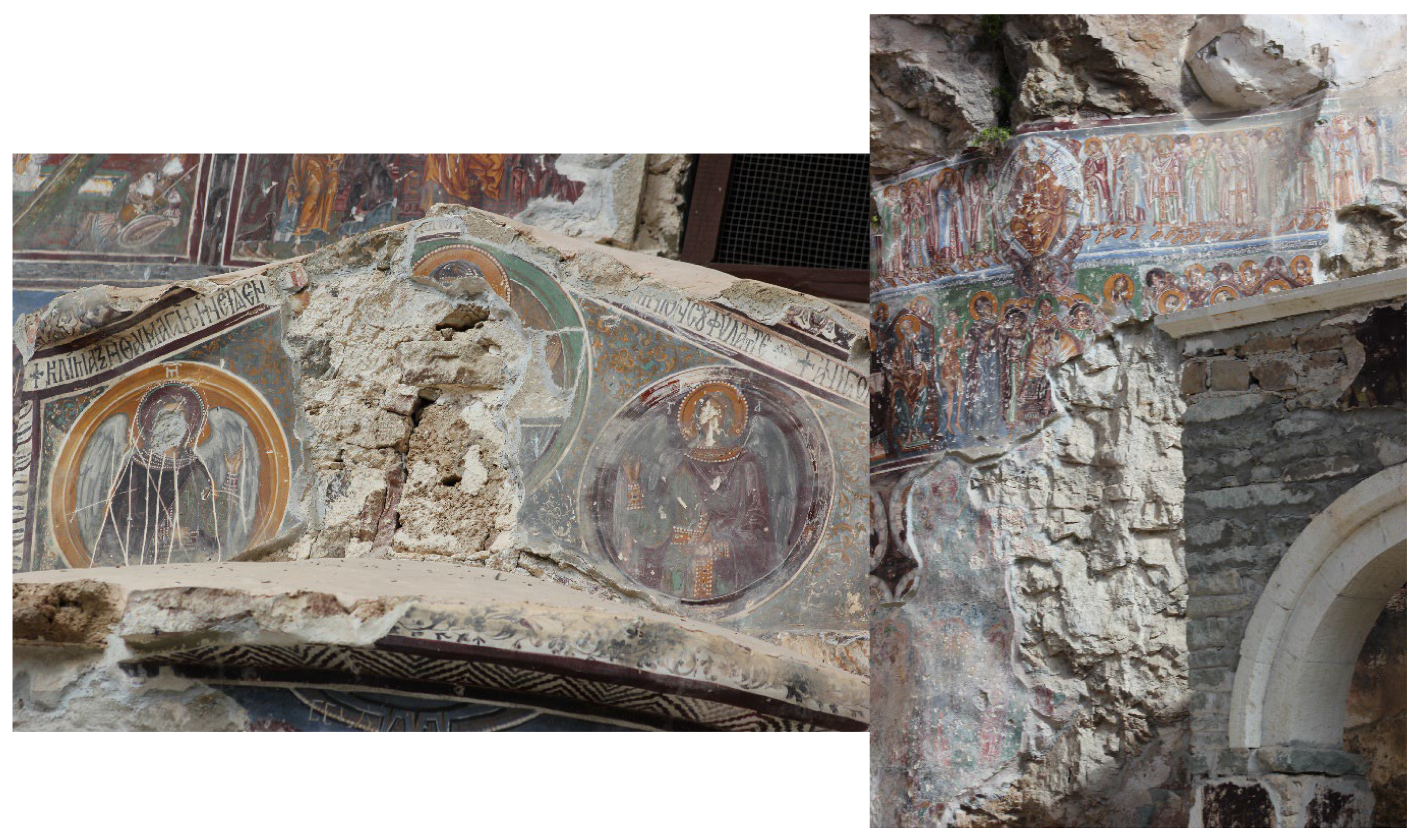
Pronounced cracks have been observed particularly in the main rock-cut church and in the monastic cells surrounding the courtyard. These cracks developed due to movements within the natural rock mass as well as prolonged water infiltration (Fitzner & Heinrichs, 2001).
- Deformations:
Settlements and distortions have been detected in the wooden floors and stone arches over time. Variations in humidity and biological deterioration have been identified as the principal factors accelerating these deformations (Stanley-Price, 1995).
- Weakening of Load-Bearing Elements:
A significant reduction in the structural performance of stone and mortar systems, especially in the Ottoman-period annexes, has been identified. Material aging and changes in structural load distribution constitute the main causes of this weakening (Ashurst, 2007).
Figure 17.
Field view of the cracks and deformations observed in the main rock-cut church of the Sümela Monastery (Author’s personal archive, 2014).
Figure 17.
Field view of the cracks and deformations observed in the main rock-cut church of the Sümela Monastery (Author’s personal archive, 2014).
4.1.2. Impact on Structural Layers
- Initial Formation and Early Byzantine Layers:
Since the structures of this period were directly integrated into the natural rock surface, existing rock fissures and surface detachments pose a direct threat to the early-phase spaces (Jokilehto, 1999).
- Late Byzantine and Ottoman Layers:
The stone masonry walls and multi-story living units constructed in the later periods have become more susceptible to deformation and weakening of their load-bearing systems. The risk of stability loss is particularly evident in the cell blocks surrounding the courtyard (Henry, 2015).
4.2. Material-Based Deteriorations
Material-based deteriorations in the Sümela Monastery arise from chemical, physical, and biological processes affecting the stone, mortar, plaster, and fresco layers used in the building components (Price & Doehne, 2011; Torraca, 1982).
4.2.1. Major Types of Material Deterioration
- Salt Efflorescence:
Significant salt deposits have been observed on the interior walls of the rock church and in the monastic cell rooms. This phenomenon occurs when dissolved salts migrate with moisture to the surface and crystallize upon evaporation (Charola, 2000) (Figure 18).
- Loss of Mortar and Plaster:
Severe detachment, flaking, and powdering have been detected in the infill walls and plaster layers of the Late Byzantine and Ottoman periods. These deteriorations are more concentrated in areas where low-quality mortars were used (Dimes & Ashurst, 2007).
- Biological Deteriorations:
Moss, lichen, and microorganism colonization have developed in the humid and shaded parts of the monastery. These biological formations cause both aesthetic degradation and physical weakening of surface materials (Fitzner & Heinrichs, 2001; Staniforth, 2000).
- Erosion on Stone Surfaces:
On exterior façades and water-exposed zones, erosion, surface scaling, and granular disintegration have been recorded, indicating long-term exposure to climatic and mechanical effects (Winkler, 2013).
4.2.2. Effects on Layers
- Byzantine Period Frescoes:
Salt efflorescence and biological deterioration have caused significant pigment loss and surface detachment in the early fresco layers (Mora, Mora, & Philippot, 1984).
- Ottoman Layers – Mortar and Stone Masonry:
In the Ottoman-period annexes, which were built with less durable materials, erosion of mortar and stone has been found to be more widespread (Henry, 2015).
- Initial Formation Layers:
On natural rock surfaces, biological colonization and surface erosion have led to the gradual loss of original rock texture and detailing (Torraca, 1982).
4.3. Surface Deteriorations
Although surface deteriorations do not directly threaten the structural stability of the building, they cause significant losses in aesthetic value, material integrity, and perceptual coherence (Matero, 2000; Avrami et al., 2019).
4.3.1. Main Types of Surface Deterioration
- Surface Darkening and Pollution:
Accumulations of soot and grime in interior spaces, and atmospheric pollution in exterior areas, have caused surface darkening. These changes have notably altered the color perception of frescoes and stone surfaces (Price & Doehne, 2011).
- Flaking of Frescoes:
Water infiltration and salt crystallization have caused the fresco surfaces to delaminate and flake off in layers. These deteriorations result in the detachment of pigment layers from their plaster substrate (Mora, Mora, & Philippot, 1984).
- Graffiti and Physical Damage:
During periods of neglect, visitors inscribed writings and carvings on wall surfaces, leading to direct damage to fragile painted and plastered areas (Staniforth, 2000).
- Surface Fracturing and Disintegration:
In exposed areas, freeze–thaw cycles have produced microcracks and gradual disintegration of the stone fabric (Fitzner & Heinrichs, 2001) (Figure 19).
The spatial distribution of these findings has been evaluated through analytical mapping that visualizes where specific deterioration types are most concentrated. The mapping study classified erosion, salt efflorescence, humidity impact, and microcracks by color codes to create a typological representation of deterioration. This visualization enables both quantitative and qualitative reading of the building’s current physical state, revealing comprehensive tendencies in material behavior and surface pathology (Figure 19).
4.3.2. Effects on Layers
- Surfaces of the Late Byzantine and Ottoman Layers:
Significant surface losses have occurred on both interior frescoes and stone wall surfaces due to atmospheric factors and human-induced damage (Dimes & Ashurst, 2007).
- Initial Formation and Early Period Surfaces:
On natural rock faces, biological effects and microclimatic variations have caused discolorations and surface wear that disrupt the perceptual integrity of the original setting (Winkler, 2013).
These findings form the foundational dataset for determining the intervention principles aimed at preserving the site’s original architectural and material character.
5. Conservatıon and Interventıon Prıncıples
The restoration project developed for the Sümela Monastery aimed to preserve its multilayered cultural identity and sustain the unique values of each historical phase. In this regard, international conservation principles (Venice Charter, 1964; Burra Charter, 1979), contemporary conservation theories (Jokilehto, 1999; Feilden, 2007), and authentic site data were evaluated collectively.
The core principle of the conservation approach was to preserve each historical layer with its intrinsic values and to intervene only when necessary and at a minimal scale. Reversibility, respect for original materials and techniques, continuity of historical authenticity, and full documentation were adopted as fundamental criteria in all conservation and intervention decisions (Matero, 2000; ICOMOS, 2008).
This section systematically presents the conservation and intervention strategies adopted for the Sümela Monastery, detailing the underlying philosophy and principles guiding their implementation.
5.1. General Conservation Approach
In multilayered cultural heritage sites, one of the primary challenges in conservation practice is determining how to sustain layers from different historical periods in coexistence (Jokilehto, 2017). At Sümela Monastery, this challenge was addressed through the principle of “integrated conservation.”
Within this framework, the following key principles were adopted:
- Documentation of Historical Layers:
Each structural phase was documented in detail, including its original position, material properties, construction techniques, and functional context. These records formed the essential data foundation for pre-intervention decision-making (Feilden, 2007; Matero, 2000).
- Respect for Original Materials and Techniques:
Interventions were carried out with full respect for the original material characteristics and construction methods of each period. New materials and techniques were selected to ensure compatibility with the original fabric (Dimes & Ashurst, 2007).
- Minimum Intervention and Reversibility:
Elements not posing a structural risk were left untouched, while necessary interventions were executed at the minimum possible level using fully reversible methods (Burra Charter, 1979; ICOMOS, 1964).
- Preservation of Historical Continuity:
The conservation strategy aimed to maintain the legibility of all historical layers, avoiding any radical restitution or reconstruction that would privilege one period over others (Avrami et al., 2019; De la Torre, 2013).
- Documentation and Transparency:
All interventions were thoroughly documented before and after implementation, with their rationale recorded in detailed technical reports (Price & Doehne, 2011).
Through this holistic conservation approach, not only the physical integrity but also the historical identity and cultural significance of the Sümela Monastery have been preserved, ensuring the coexistence of its material authenticity and historical narrative.
5.2. Types and Principles of Intervention
The conservation strategy at Sümela Monastery was diversified according to the specific needs of different historical layers and material types. In defining the types of interventions, the core principles emphasized in international conservation charters (Venice Charter, 1964; Burra Charter, 1979) were carefully considered, and a scientific rationale was established for each intervention category (Matero, 2000; ICOMOS, 2008).
A) Conservation (Preservation)
Conservation interventions were carried out to maintain the existing material and structural conditions of the building, to halt ongoing physical deterioration, and to extend the monument’s lifespan (Feilden, 2007).
Main conservation applications included:
- Surface Consolidation:
Micro-injection techniques and chemical consolidants were applied to fresco surfaces and stone claddings to stop microcracking and surface detachment (Mora, Mora, & Philippot, 1984).
- Biological Cleaning:
Layers of moss, lichens, and microorganisms were carefully removed from the surfaces using controlled, non-invasive methods that avoided damaging the building material (Fitzner & Heinrichs, 2001; Staniforth, 2000).
- Salt Control:
To prevent salt crystallization caused by moisture, capillary water movement was reduced, and appropriate drying techniques were applied in affected areas (Charola, 2000).
Through these conservation measures, fragile cultural layers—particularly frescoes, stone masonry, and plaster surfaces—were effectively stabilized and preserved for long-term integrity.
B) Structural Reinforcement
Due to natural rock movements, structural deformations, and pre-existing weaknesses from earlier interventions, specific areas of the monastery required structural reinforcement (Feilden, 2007; Price & Doehne, 2011).
Main structural interventions included:
- Anchoring Systems:
Deep cracks within the primary rock face were stabilized using stainless steel anchors. These anchors were designed to be fully reversible and positioned with minimal visual impact on the monument’s aesthetic integrity (Matero, 2000).
- Reinforcement Frames:
Lightweight support frames were installed at weakened arches, vaults, and entrance zones to redistribute loads and improve stability (Henry, 2015).
- Rock Safety Measures:
To reduce the risk of rockfalls from the steep cliff above the monastery, rock-bolting and stainless-steel mesh systems were implemented for stabilization (Stanley-Price, 1995).
These interventions significantly strengthened the structural integrity of the complex and enhanced its long-term stability and conservation.
C) Restoration and Reinstatement
In certain areas, limited restoration and partial reconstruction works were carried out for missing or severely damaged structural components (Avrami et al., 2019; De la Torre, 2013).
Main restoration practices included:
- Stone Replacements:
Lost masonry blocks, especially in courtyard walls, were replaced with stones matching the original in material, texture, and workmanship (Dimes & Ashurst, 2007).
- Mortar Repairs:
Damaged joints were refilled with new lime-based mortars formulated to replicate the original mixture and visual appearance (Dimes & Ashurst, 2007).
- Fresco Conservation and Reintegration:
Missing sections of frescoes were completed using neutral tones without interfering with the original pigments, ensuring visual continuity while maintaining historical authenticity (Mora, Mora, & Philippot, 1984).
These restoration interventions contributed both to the aesthetic coherence and to the continuity of the historical narrative of Sümela Monastery.
D) Modern Interventions and Visitor Safety
The reopening of the monastery for contemporary visitor access necessitated a series of modern interventions (ICOMOS, 2008).
Main modern applications included:
- Walkways and Platforms:
Temporary walkways and observation platforms were installed to regulate visitor circulation and reduce structural load on sensitive areas. These elements were designed to avoid any adverse impact on the original fabric (De la Torre, 2013).
- Guardrail Systems:
Transparent and minimally invasive guardrails were implemented along elevated passages to ensure visitor safety while maintaining the visual integrity of the monument (Henry, 2015).
- Informational Panels:
Non-intrusive information panels were placed strategically to provide visitors with contextual and historical knowledge without damaging or visually overwhelming the structure (Staniforth, 2000).
All modern interventions were executed with minimal interference to the original context, ensuring the preservation of the monastery’s cultural atmosphere and spatial authenticity.
5.3. Justification of Intervention Decisions
The intervention decisions developed within the scope of the Sümela Monastery restoration project were based not only on the building’s physical requirements but also on the principles of preserving its historical identity and maintaining its cultural values (Feilden, 2007; Jokilehto, 1999).
The justification for these interventions is grounded in the following key criteria:
A) Preservation of Material and Structural Integrity
Most of the deterioration observed in the monument stemmed from processes such as water infiltration, biological growth, and material aging (Fitzner & Heinrichs, 2001; Price & Doehne, 2011).
Accordingly, to ensure the structural stability and material coherence of the site, the following measures were deemed essential:
- Surface consolidation,
- Structural reinforcements,
- Preventive treatments against salt crystallization.
B) Ensuring the Legibility of Historical Layers
In multilayered cultural heritage structures, interventions must be designed not only to repair physical damage but also to enhance the legibility of historical continuity and the coexistence of multiple layers (Jokilehto, 1999; Avrami et al., 2019).
In this regard:
- The distinctive features of elements belonging to different historical periods were preserved,
- The principle of discernibility between layers was upheld (Burra Charter, 1979).
C) Principle of Minimum Intervention and Reversibility
All interventions were executed with the objective of minimizing intrusion into the original fabric and ensuring reversibility wherever possible (ICOMOS, 1964; Matero, 2000).
For instance:
- Anchoring systems were designed using stainless-steel components that are both durable and removable,
- Stone replacements were carried out using materials compatible with the original, yet intentionally distinguishable to ensure clarity between old and new.
D) Conservation Ethics and Scientific Documentation
Each intervention was grounded in scientific research and well-documented field data.
For every proposed solution:
- The rationale for intervention was prepared in advance,
- The post-intervention condition was documented, and
- The entire process was supported by academic reports (Stanley-Price, 1995; De la Torre, 2013).
This approach ensured a transparent conservation process, both ethically and scientifically.
6. Dıscussıon
This section discusses the findings related to the restitution of the Sümela Monastery from both theoretical and methodological perspectives. The aim is to reveal the relationship between the collected data and the processes of conservation theory, ethical principles, and knowledge production, thereby evaluating the approach developed throughout the study in a holistic manner.
6.1. The Conservation Problem in Multi-Layered Cultural Heritage Structures
Multi-layered cultural heritage structures are not merely physical entities but complex historical documents that bear the social, cultural, and technological traces of different periods (Jokilehto, 1999; Avrami et al., 2019). Each historical layer possesses its own intrinsic value and context, requiring an exceptionally sensitive approach in conservation practices.
The issue of preserving historical layers constitutes one of the most fundamental and debated topics in conservation science. Decisions regarding which layer to highlight, which to preserve, or which to restore in a limited manner pose complex ethical and methodological challenges (Brandi, 1963; Matero, 2000).
International conservation documents—particularly the Venice Charter (1964) and the Burra Charter (1979)—emphasize the principle of preserving the historical continuity of structures as a whole. However, when dealing with multi-layered monuments, interpretive differences often arise in practice (ICOMOS, 1964; Burra Charter, 1979). For example:
- In some interventions, the goal is to return to the earliest construction phase of the monument,
- While in others, all layers are preserved as equally valuable components (Feilden, 2007; Staniforth, 2000).
In this context, conservation in multi-layered structures should move beyond being a mere practice of value selection and instead be regarded as the art of balancing authenticity and historical continuity among all layers (Avrami et al., 2019; De la Torre, 2013).
6.2. Evaluation of the Conservation Approach in the Case of the Sümela Monastery
The conservation approach developed for the Sümela Monastery largely aligns with the theoretical frameworks proposed for multi-layered heritage structures. In the restoration project, each historical layer’s original materials, construction techniques, and spatial values were documented, while maintaining the principle of distinguishability among these layers (Feilden, 2007; Matero, 2000).
In particular:
- The stratified structure of the building was clearly identified through restitution studies and period analyses, and
- All intervention decisions were based on documented field data and international conservation principles.
These factors established a strong scientific and ethical foundation for the conservation process at Sümela Monastery (Jokilehto, 1999; ICOMOS, 2008).
6.2.1. Strengths
- Preservation of Layers:
No single historical period was emphasized in the interventions; instead, all layers were preserved within their own authentic contexts (Burra Charter, 1979; De la Torre, 2013).
- Use of Original Materials:
All restoration and completion works were carried out using solutions compatible with the original materials and construction techniques (Dimes & Ashurst, 2007).
- Documented Intervention Process:
Every stage of intervention was systematically documented, ensuring a transparent and traceable conservation process (Stanley-Price, 1995).
6.2.2. Points Open to Criticism
- Perceptual Impact of Modern Interventions:
Certain modern additions—such as pedestrian walkways and railing systems installed for visitor safety—have caused minor perceptual changes in the experience of the site (Henry, 2015; ICOMOS, 2008). Although these interventions were necessary to ensure structural stability and visitor safety, they have slightly altered the original atmospheric quality of the monument.
- Stone Consolidation Interventions:
In some areas, the long-term chemical compatibility between newly applied mortar types and the original stone surfaces remains uncertain, requiring continuous monitoring and assessment (Price, 2011; Fitzner & Heinrichs, 2001).
6.2.3. Evaluation
Overall, the conservation strategy developed for the Sümela Monastery can be regarded as an approach that is:
- Founded on a solid scientific basis,
- Aligned with international standards, and
- Able to preserve the authenticity and historical continuity of multi-layered cultural heritage sites.
This study effectively translates contemporary conservation theories into practice—particularly those emphasizing that interventions in multi-layered heritage structures should not only address physical repair but also the preservation of historical meaning (Avrami et al., 2019; De la Torre, 2013).
6.3. Epistemological and Ethical Evaluation
The restitution of the Sümela Monastery represents not a mere reconstruction but a multi-layered process of knowledge production. The six-period documentation system allows for a simultaneous reading of both the building’s physical evolution and the changing cultural contexts of each era. In this way, restitution transforms into a dynamic interpretive tool reflecting the interaction between past and present.
Comparative examples from the Eastern Mediterranean—such as Meteora, Hosios Loukas, Panagia Hozoviotissa, and Mount Athos—clarify Sümela’s unique position: its complete embedding within the rock mass and its commanding topography over the valley express the most introverted manifestation of the concept of a “sacred space identified with natural landscape.” Within this framework, visual representation transcends mere plan and section drawings, reconstructing the interrelations of time, material, and meaning.
The epistemological restitution diagram created in this study serves as a visual argument within the conservation practice by making the trace–interpretation–decision process transparent. Two primary axes define this system:
A. Physical continuity: the interperiodic persistence of construction techniques and material logic,
B. Semantic continuity: the redefinition of sacred functions and cultural representations.
These axes transform restitution from an act of “rebuilding the past” into an exploration of how knowledge about the past is produced, forming the theoretical foundation of the following sections.
6.3.1. Evaluation of Physical Findings
The documentation concerning the Sümela Monastery demonstrates that the structure has preserved not only its formal characteristics but also its structural and material continuity throughout history. This corresponds to Carbonara’s (2008) conception of a holistic historical structure formed by successive layers built upon one another without erasure.
A. Materials and Construction Techniques
The main materials are limestone and tuff, quarried from the surrounding cliffs and laid as roughly cut blocks on site. The mortar mixture consists of lime, pozzolan, and crushed brick (Fitzner & Heinrichs, 2001), a composition that ensures breathability under humid climatic conditions while mitigating biological decay (Dimes & Ashurst, 2007; Henry, 2015).
The wooden floors and roof systems, renewed between the 17th and 19th centuries, were anchored into the masonry walls using the stone-socket technique common in the Ottoman period. This intervention was carried out in accordance with Feilden’s (2007) principle of “reversibility,” ensuring structural stability without damaging the original fabric.
B. Deterioration and Material Behavior
Due to the monastery’s embedded topography, deterioration is closely related to natural factors. The main problems include erosion on the northern façade, capillary moisture at rock–wall junctions, salt crystallization on frescoes, and root intrusion in the courtyard pavement (Fitzner & Heinrichs, 2001; Charola, 2000).
According to the Damage Category Index, erosion was recorded at 45% in the narthex, salt efflorescence at 30% in interior spaces, and microcracks at 20% near the rock surface. Areas with high moisture content show matte discoloration and granular loss. Comparative observations indicate that stones used in 18th–19th-century repairs deteriorate faster than the original fabric. Consequently, material analysis not only assessed the current condition but also evaluated the performance of past interventions.
C. Spatial Continuity and Structural Assessment
Despite successive interventions, the spatial organization of the Sümela Monastery developed around a single structural core that has remained largely intact. The main chapel and surrounding cells rise directly upon the natural rock foundation, a layout that preserved the essential geometry of the complex through Byzantine and Ottoman restorations alike (Spieser, 1988).
Static analyses indicate 0.8–1.2% deformation in load-bearing walls and 3–4 cm deflection in wooden floors, corresponding to Feilden’s (2007) classification of a “stable but sensitive” structure. The natural rigidity of the rock mass minimizes the need for additional reinforcement.
During the 2001–2014 restorations, structural continuity was preserved; only drainage improvement, repointing, and surface consolidation were undertaken. No reconstructions were proposed. Following Brandi’s (1963) principle of “understanding rather than renewal,” the original load-bearing system was maintained—exemplifying a holistic practice that balances technical intervention and ethical responsibility.
6.3.2. Ethical Responsibility and the Limits of Interpretation
The restitution of the Sümela Monastery represents not only the recovery of its physical integrity but also the re-reading of meanings eroded by time. Every restitution decision constitutes an act of interpretation—and therefore, an ethical choice. According to Brandi (1963), restoration is the act of preserving both the aesthetic and historical values of a work of art; this principle finds tangible expression in the case of Sümela.
In the deteriorated sections, rather than reconstructing lost volumes, the meaning of the void was preserved. This choice aligns with Ricoeur’s (1984) concept of “narrative time,” where absence is not a deficiency but a representation of the limits of knowledge.
The ethical framework rests on two fundamental principles (Feilden, 2007):
A. Reversibility – every intervention must remain correctable in the future.
B. Discernibility – new additions must remain distinguishable from the original fabric.
These principles were applied at both the material and representational levels: wall additions were rendered with tonal differentiation, and surface injections were marked using semi-transparent hues. In this way, visual representation maintained ethical integrity while ensuring transparency in knowledge production (Letellier et al., 2015).
In this regard, the restitution of Sümela reinterprets Brandi’s notion of “critical choice” in a contemporary manner: the conservation specialist is not a restorer who reconstructs the past, but rather an interpreter who makes its meanings visible.
6.3.3. Aesthetic Integrity and the Representation of Absence
The aesthetic dimension of restitution concerns the question of how to represent what is missing. Brandi (1963) defines restoration as “the re-establishment of a compromised unity in a legible form,” a notion that guided the restitution drawings of Sümela.
Missing sections were intentionally left incomplete and made visible rather than reconstructed. In frescoes, tonal continuity was favored over chromatic restoration, while in collapsed façades, graphical transparency was applied. This method aligns with Arnóth’s (2019) concept of ethical aesthetics, wherein the beauty of loss is measured by fidelity to authenticity.
In accordance with Letellier’s (2007) principle of transparency of knowledge, the limits of reconstructed areas were explicitly marked, and the new elements were rendered distinguishable from the original surfaces. Thus, restitution becomes not an artistic completion but a scientific clarification. According to this approach, aesthetic value resides not in formal wholeness but in the legibility of meaning. Absence is rendered visible as part of the multilayered knowledge of the past—signifying, as Feilden (2007) emphasizes, that conservation is “an ongoing dialogue through time.”
6.3.4. Epistemological Contributions and Interpretive Inferences
The restitution of Sümela goes beyond reconstructing the historical form—it reveals the epistemic dimension of the conservation process. Within the “record–analyze–represent” chain defined by Letellier et al. (2015), restitution becomes not a mere reproduction of documentation but a cognitive tool for research.
Each restitution drawing represents not only physical data but also the process of knowledge production itself. Here, the drawing is not a conclusion but an investigative act where hypotheses and interpretations are visualized. This approach aligns with Pérez et al. (2021)’s concept of representational epistemology.
Knowledge in Sümela was processed at three interrelated levels:
- A.
- Physical knowledge: material, traces, and construction technique;
- B.
- Historical knowledge: documents and visual documentation;
- C.
- Semantic knowledge: sacred identity, memory, and ritual continuity.
These layers were integrated without being conflated, allowing restitution to explain not only the data but also the sources and representational modes of that data. This stance corresponds to Feilden’s (2007) notion of honesty in the act of conservation at the epistemic level.
Consistent with Arnóth’s (2019) idea of ethical knowledge, this approach contributes to the conservation discipline in two ways:
- Epistemic: it explains not the certainty of the past’s form but the process through which knowledge of the past is produced.
- Ethical: it embraces uncertainty as a productive component of interpretation.
Ultimately, the restitution of Sümela integrates the triad of knowledge, ethics, and representation—transforming conservation into an act of dialogue with the past rather than an attempt to immobilize it.
6.4. General Evaluation and Conclusion
The preservation of historical layers constitutes the foundation of a sustainable conservation approach in cultural heritage architecture. Each period represents not only a physical phase but also a layer of cultural memory. Therefore, conservation is not merely a technical act of repair but an endeavor to ensure the continuity of identity and meaning. Today, however, such sacred landscapes are also exposed to visitor pressure and tourism-driven functional demands, making the continuity of architectural identity a critical conservation concern (Tapkı, 2018).
The strategy developed for the Sümela Monastery addressed this multilayered structural and semantic fabric in an integrated manner. The distinctive values of each period were documented, the processes of deterioration were analyzed using scientific methods, and interventions were executed in accordance with international principles (Venice Charter, 1964; ICOMOS, 2008). The principles of minimal intervention, reversibility, and recognizability were applied meticulously, while contemporary additions were designed to ensure safety and integrity without disrupting the authentic atmosphere.
The restitution of Sümela contributes not only to physical conservation but also to the production of knowledge. Each restitution sheet explicitly presents both the document-based data and the interpretive process. This approach aligns with Letellier et al.’s (2015) concept of information transparency and Pérez et al.’s (2021) notion of representational epistemology. Thus, Sümela becomes a dynamic laboratory in which conservation is understood through the interaction of documentation, interpretation, and representation.
This study brings Brandi’s (1963) principle of “understanding, not renewal” into a contemporary context. Absences and uncertainties were not concealed but rather presented as integral components of knowledge production. This stance materializes Arnóth’s (2019) concept of ethical aesthetics and Feilden’s (2007) notion of honesty in the act of conservation.
The restitution of Sümela provides three principal contributions:
- A.
- Preservation of multilayeredness: Each historical phase was documented with equal importance, ensuring integrity in line with Carbonara’s (2008) principle of simultaneous conservation of layers.
- B.
- Ethical–aesthetic balance: Representation was preferred over reconstruction; graphical transparency was employed as a tool to preserve the meaning of loss.
- C.
- Transformation of knowledge: Restitution evolved from a technical record into a model for ethical and visual knowledge production.
Ultimately, the restitution of the Sümela Monastery presents a contemporary conservation model where knowledge, ethics, and representation converge. This model preserves not the form but the meaning of the past—transforming conservation into a living dialogue with history.
Acknowledgments
The author gratefully acknowledges the Turkish Ministry of Culture and Tourism, General Directorate of Cultural Heritage and Museums, for their formal approval to use documentation produced within the scope of the Sümela Monastery survey, restitution, and restoration projects, for scholarly publication.
References
- Arnóth, Á. (2019). The ethical problems of architectural reconstruction–Hungarian case studies. Ochrona Dziedzictwa Kulturowego, (8), 1-8. [CrossRef]
- Ashurst, J. (2007). Conservation of ruins. Routledge.
- Avrami, E., Macdonald, S., Mason, R., & Myers, D. (Eds.). (2019). Values in heritage management: Emerging approaches and research directions.
- Beyde, S. (2017). Yunanistan’da Yüzyıllardır Kadınların Giremediği Ada: Aynoroz. ListeList.
- https://listelist.com/aynoroz-adasi/ (accessed 22 December 2025).
- Beyhan, Ş. G., & Ünügür, S. M. (2010). Çağdaş gereksinmeler bağlamında sürdürülebilir turizm ve kimlik modeli. İTÜDERGİSİ/a, 4(2).
- Bouras, C. (2006). Byzantine and post-Byzantine architecture in Greece. Melissa publishing house.Brandi, C. (1963). Teoria del restauro. Edizioni di Storia e Letteratura.
- Brandi, C. (1963). Preventive Restoration (1963). Historical Perspectives on Preventive Conservation, 6, 9.
- Burra Charter. (1979). The Australia ICOMOS Charter for Places of Cultural Significance. Australia ICOMOS.
- Bryer, A., & Winfield, D. (1985). The Byzantine monuments and topography of the Pontos (Vol. 1) (Dumbarton Oaks Studies, 20). Dumbarton Oaks Research Library and Collection.
- Carbonara, G. (2008). Trattato di restauro architettonico. Terzo Aggiornamento. Grandi temi di restauro (pp. 1-407). Utet.
- Cassar, M. (2009). Sustainable heritage: Challenges and strategies for the twenty-first century, APT bulletin. Journal of preservation technology, 40(1), 3-11.
- Charola, A. E. (2000). Salts in the deterioration of porous materials: an overview. Journal of the American institute for conservation, 39(3), 327-343.
- D’Ayala, D., & Fodde, E. (2008). Lime mortar with natural pozzolana: Historical issues and mechanical behavior. In Structural Analysis of Historic Construction: Preserving Safety and Significance, Two Volume Set (pp. 997-1004). CRC Press.
- De la Torre, M. (2013). Values and heritage conservation. Heritage & society, 6(2), 155-166.
- Dimes, F. G., & Ashurst, J. (2007). Conservation of building and decorative stone. Routledge.
- Dionysiou Monastery, Mount Athos. All Over Greece.
- https://allovergreece.com/Agio-Oros-Monastery/Descr/5/en (accessed 22 December 2025).
- Durak, S., Yeke, S. T., & Arslan, T. V. (2016). Significance of cultural heritage preservation in sustainable cultural tourism: Muradiye complex in Bursa, Turkey. European Journal of Sustainable Development, 5(4), 1-1. [CrossRef]
- Eastmond, A. (2017). Art and identity in thirteenth-century Byzantium: Hagia Sophia and the Empire of Trebizond. Routledge.
- Eyice, S. (1966). Trabzon Yakınında Meryem Ana (Sumela) Manastırı. Belleten, 30(118), 243-264.
- Facorellis, Y., & Mourelatos, D. (2017). Radiocarbon Dating of the Architectural Parts of the Middle Byzantine Monastery of Hosios Loukas, Boeotia, Greece. Radiocarbon, 59(5), 1309-1319. [CrossRef]
- Feilden, B. (2007). Conservation of historic buildings. Routledge.
- Fitzner, B., & Heinrichs, K. (2001). Damage diagnosis at stone monuments-weathering forms, damage categories and damage indices. Acta-Universitatis Carolinae Geologica, 1, 12-13.
- Henry, A. (Ed.). (2015). Stone conservation: principles and practice. Routledge.
- ICCROM. (2003). Conservation of living religious heritage. ICCROM.
- ICOMOS. (1964). International Charter for the Conservation and Restoration of Monuments and Sites (The Venice Charter). ICOMOS.
- ICOMOS. (2008). Principles for the analysis, conservation and structural restoration of architectural heritage. ICOMOS.
- Jokilehto, J. (1999). A century of heritage conservation. Journal of Architectural conservation, 5(3), 14-33.
- Jokilehto, J. (2017). A history of architectural conservation. Routledge.Letellier, R. (2007). Recording, documentation, and information management for the conservation of heritage places. Getty Conservation Institute.
- Kamacı, E. (2014). 2863 sayılı Kültür ve Tabiat Varlıklarını Koruma Kanunu’nun uluslararası yasal düzenlemeler bağlamında değerlendirilmesi. METU Journal of the Faculty of Architecture, 31(2), 1–23. [CrossRef]
- Karakatsanis, A. A. (1997). Treasures of Mount Athos. (No Title).
- Letellier, R. (2007). Recording, documentation, and information management for the conservation of heritage places. Getty Conservation Institute.
- Letellier, R., & Eppich, R. (Eds.). (2015). Recording, documentation and information management for the conservation of heritage places. Routledge.
- Mango, C. A. (1976). Byzantine architecture. Harry N. Abrams.
- Matero, F. (2000). Ethics and policy in conservation. Conservation: The Getty Conservation Institute Newsletter, 15(1), 5-9.
- Mora, P., Mora, L., & Philippot, P. (1984). Conservation of wall paintings. (No Title). [CrossRef]
- Norberg-Schulz, C. (1980). Genius loci: Towards a phenomenology of architecture. (No Title).
- Pastor Pérez, A., Barreiro Martínez, D., Parga-Dans, E., & Alonso González, P. (2021). Democratising heritage values: A methodological review. Sustainability, 13(22), 12492. [CrossRef]
- Price, C. A., & Doehne, E. (2011). Stone conservation: an overview of current research.
- Riegl, A. (1982). The modern cult of monuments: its character and its origin. Oppositions, (25), 20-51.
- Ricoeur, P., & Ricoeur, P. (1984). Time and narrative, Volume 3 (Vol. 3). University of Chicago press.
- Sezgin, S. K., Sakcalı, G. B., Özen, S., Yıldırım, E., Avcı, E., Bayhan, B., & Çağlar, N. (2024). Reconnaissance report on damage caused by the February 6, 2023, Kahramanmaraş Earthquakes in reinforced-concrete structures. Journal of Building Engineering, 89, 109200.
- Spieser, J. M. (1988). A. Bryer and D. Winfield, The Byzantine Monuments and Topography of the Pontes. Byzantinische Zeitschrift, 81(2), 312-314.
- Staniforth, S. (2000). Conservation: significance, relevance and sustainability. IIC Bulletin, 6, 3-8.
- Stanley Price, N., & Sullivan, S. (1995). Conservation of archaeological sites in the Mediterranean region: A conference organized by the J. Paul Getty Trust. Conservation and Management of Archaeological Sites, 1(2), 127-131. [CrossRef]
- Şuta, O. (2024). Mimari tasarımın mekân organizasyonu üzerindeki etkisinin Kırklareli geleneksel konutları üzerinden incelenmesi. E-SCALA: Kırklareli University Journal of the Faculty of Architecture, 3(2), 15–34.
- Tapkı, S. (2018). Tarihi konut yapılarının turizm işlevine dönüşümünde kimliğin bilimsel açıdan izlenimi. Tarih Okulu Dergisi (TOD) / Journal of History School (JOHS), 11(XXXIV), 1109–1131. [CrossRef]
- The Top Delphi Greece Private Tour in Athens. Pelago.
- https://www.pelago.co/en/activity/ (accessed 22 December 2025).
- Torraca, G. (1982). Porous building materials: materials science for architectural conservation. [CrossRef]
- Wikimedia Commons contributors. Meteora – Agios Nikolaos Anapafsas. Wikimedia Commons.
- https://commons.wikimedia.org/wiki/File:Meteora_-_Agios_Nikolaos_Anapafsas_1.jpg (accessed 22 December 2025).
- Wikipedia contributors. Monastery of Great Meteoron. Wikipedia, The Free Encyclopedia.
- https://en.wikipedia.org/wiki/Monastery_of_Great_Meteoron (accessed 22 December 2025).
- Winkler, E. (2013). Stone in architecture: properties, durability. Springer Science & Business Media.
- Yerasimos, S. (1991). Les voyageurs dans l’Empire Ottoman, XIVe-XVIe siècles: bibliografie, itinéraires et inventaire des lieux habités (Vol. 117). Imprimerie de la société turque d’histoire.
Figure 1.
Location of the Sümela Monastery within Trabzon Province and its settlement pattern along the Altındere Valley.
Figure 1.
Location of the Sümela Monastery within Trabzon Province and its settlement pattern along the Altındere Valley.
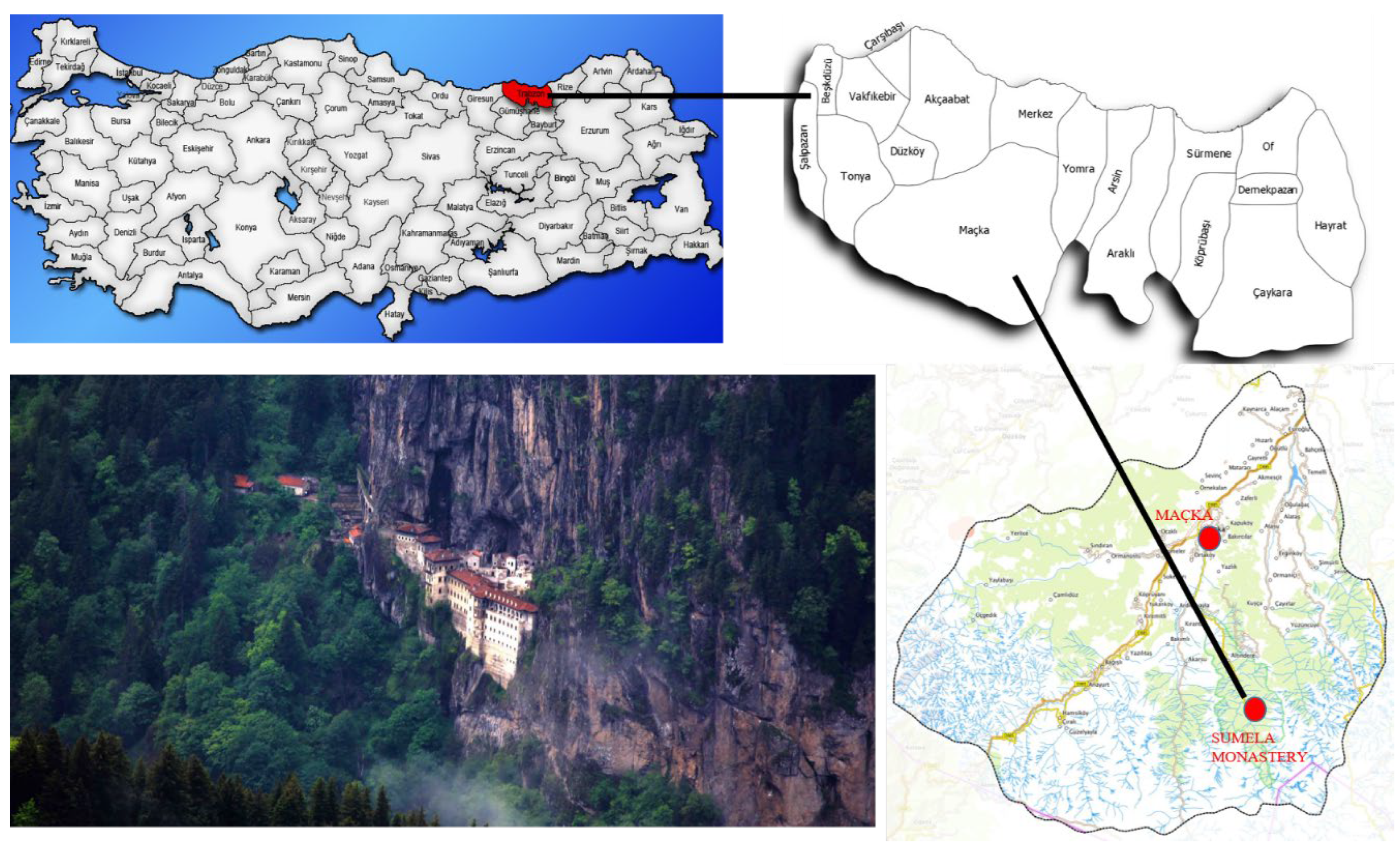
Figure 2.
Survey drawings of the Sümela Monastery: (a) General site plan; (b) Eastern façade of the Ottoman-period structures within the complex.
Figure 2.
Survey drawings of the Sümela Monastery: (a) General site plan; (b) Eastern façade of the Ottoman-period structures within the complex.
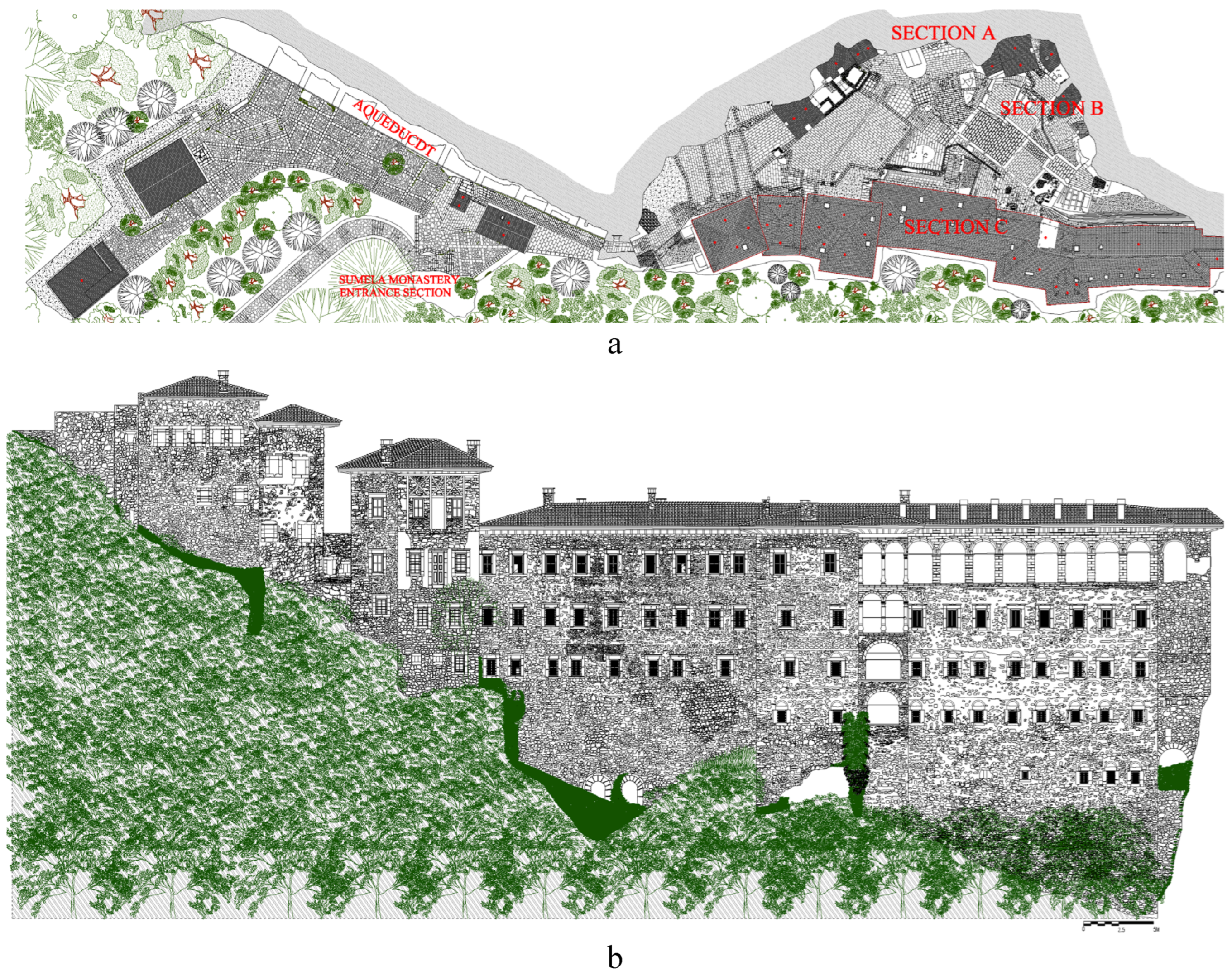
Figure 3.
General views of the Sümela Monastery (Author’s personal archive, 2014): (a) Eastern view of the monastic complex; (b) View from the entrance stairs toward the courtyard; (c) Inner courtyard; (d) Eastern façade of the Ottoman-period structure.
Figure 3.
General views of the Sümela Monastery (Author’s personal archive, 2014): (a) Eastern view of the monastic complex; (b) View from the entrance stairs toward the courtyard; (c) Inner courtyard; (d) Eastern façade of the Ottoman-period structure.
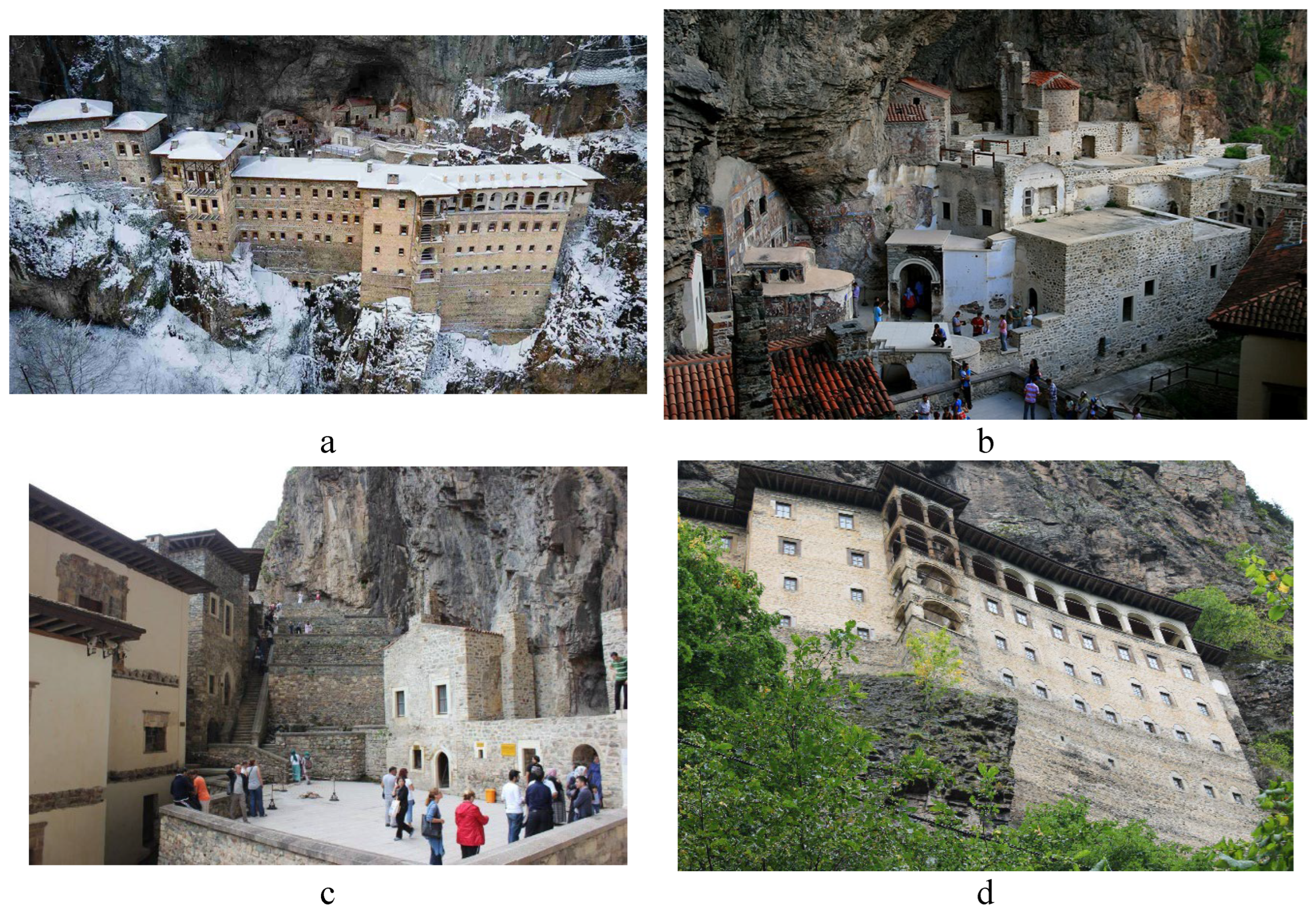
Figure 4.
The Meteora Monasteries (Greece, 14th century) – General view of the monastic complexes situated atop vertical rock pillars (Wikipedia, Monastery of Great Meteoron.- Wikimedia Commons, Meteora – Agios Nikolaos Anapafsas).
Figure 4.
The Meteora Monasteries (Greece, 14th century) – General view of the monastic complexes situated atop vertical rock pillars (Wikipedia, Monastery of Great Meteoron.- Wikimedia Commons, Meteora – Agios Nikolaos Anapafsas).
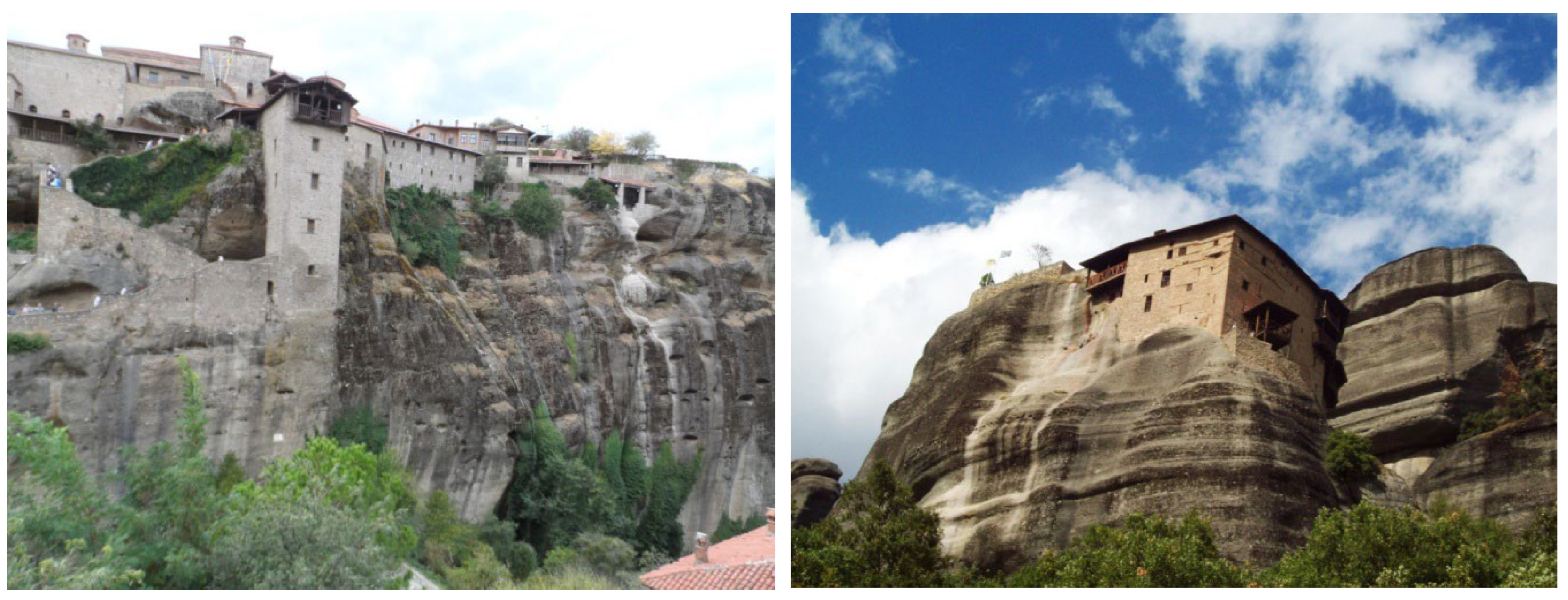
Figure 5.
The Monasteries of Mount Athos – The Great Lavra and Vatopedi complexes. Located within the transitional zone between sea and mountain, these structures represent spatial interpretations of the “sacred mountain” tradition (ListeList, 2017-All Over Greece).
Figure 5.
The Monasteries of Mount Athos – The Great Lavra and Vatopedi complexes. Located within the transitional zone between sea and mountain, these structures represent spatial interpretations of the “sacred mountain” tradition (ListeList, 2017-All Over Greece).
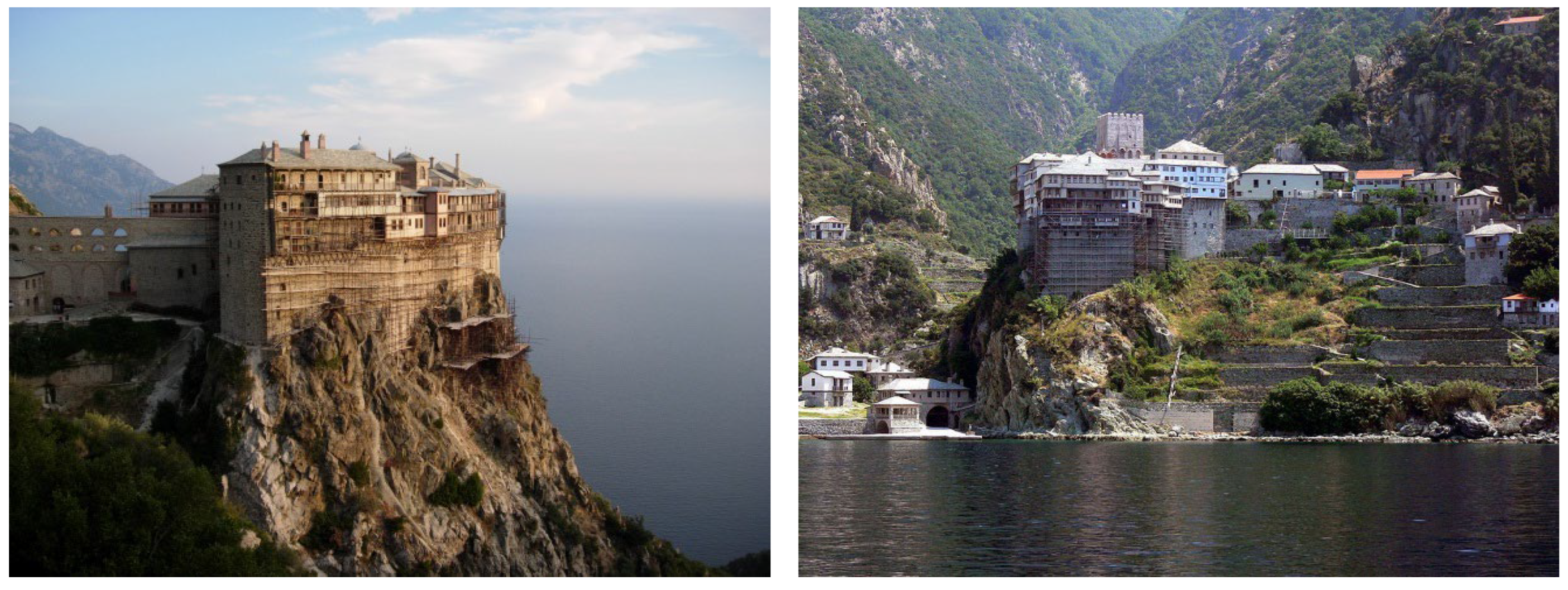
Figure 6.
Panagia Hozoviotissa (Amorgos Island, 11th century) and Hosios Loukas (Greece, 11th century). The two monasteries illustrate different spatial relationships between sacred architecture and natural topography within the Mediterranean monastic tradition: (a) Panagia Hozoviotissa, Amorgos Island (Wikipedia); (b) Hosios Loukas, Greece (Pelago).
Figure 6.
Panagia Hozoviotissa (Amorgos Island, 11th century) and Hosios Loukas (Greece, 11th century). The two monasteries illustrate different spatial relationships between sacred architecture and natural topography within the Mediterranean monastic tradition: (a) Panagia Hozoviotissa, Amorgos Island (Wikipedia); (b) Hosios Loukas, Greece (Pelago).
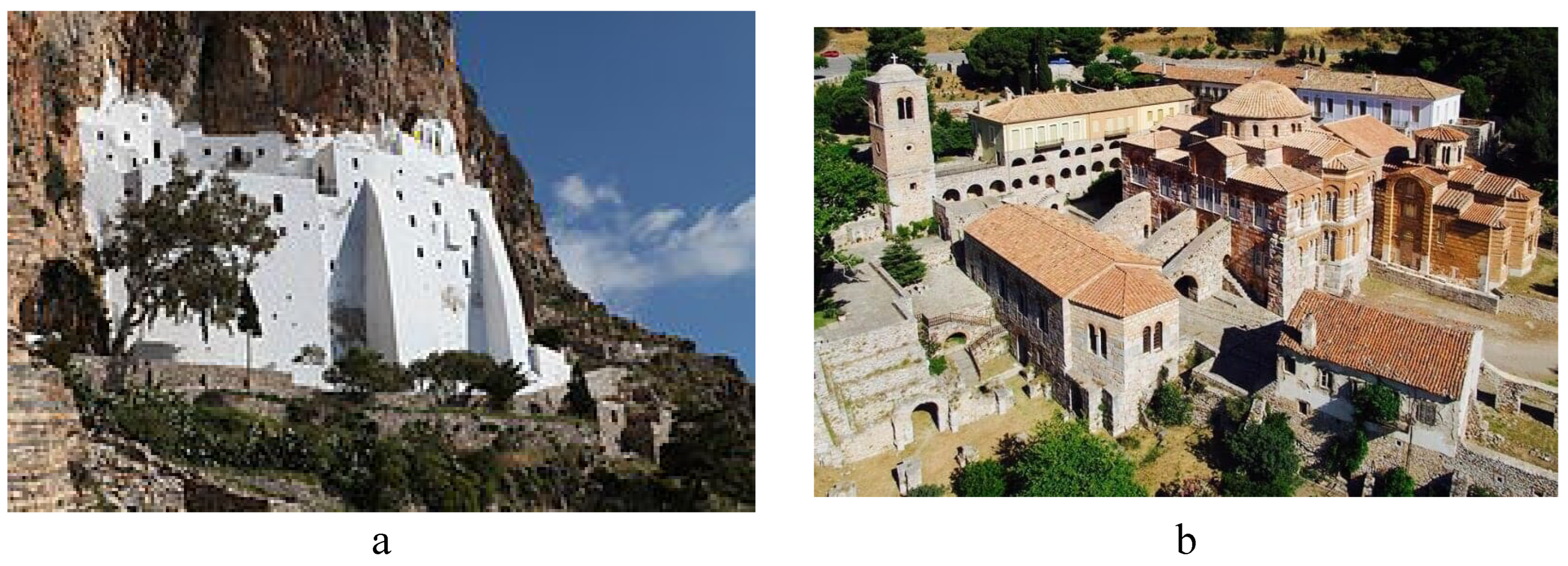
Figure 8.
Eastern façade of the Sümela Monastery showing the chronological analysis of construction phases (Author’s personal archive, 2014).
Figure 8.
Eastern façade of the Sümela Monastery showing the chronological analysis of construction phases (Author’s personal archive, 2014).
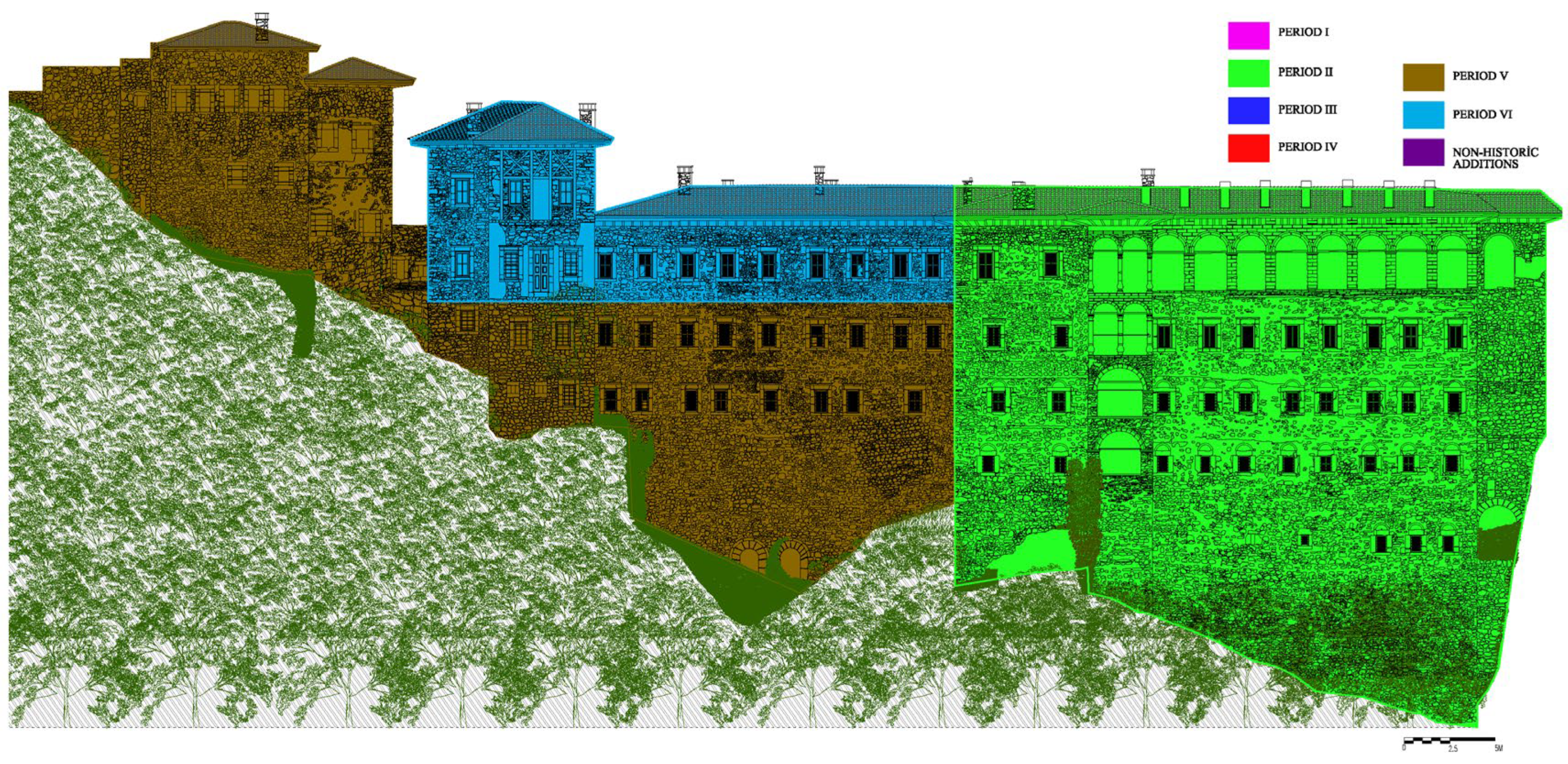
Figure 10.
Rock Stabilization and Structural Support Applications with Walkways: (a) Field view of rock stabilization and structural reinforcement works; (b) Comparison of the former and current conditions of pedestrian walkways.
Figure 10.
Rock Stabilization and Structural Support Applications with Walkways: (a) Field view of rock stabilization and structural reinforcement works; (b) Comparison of the former and current conditions of pedestrian walkways.
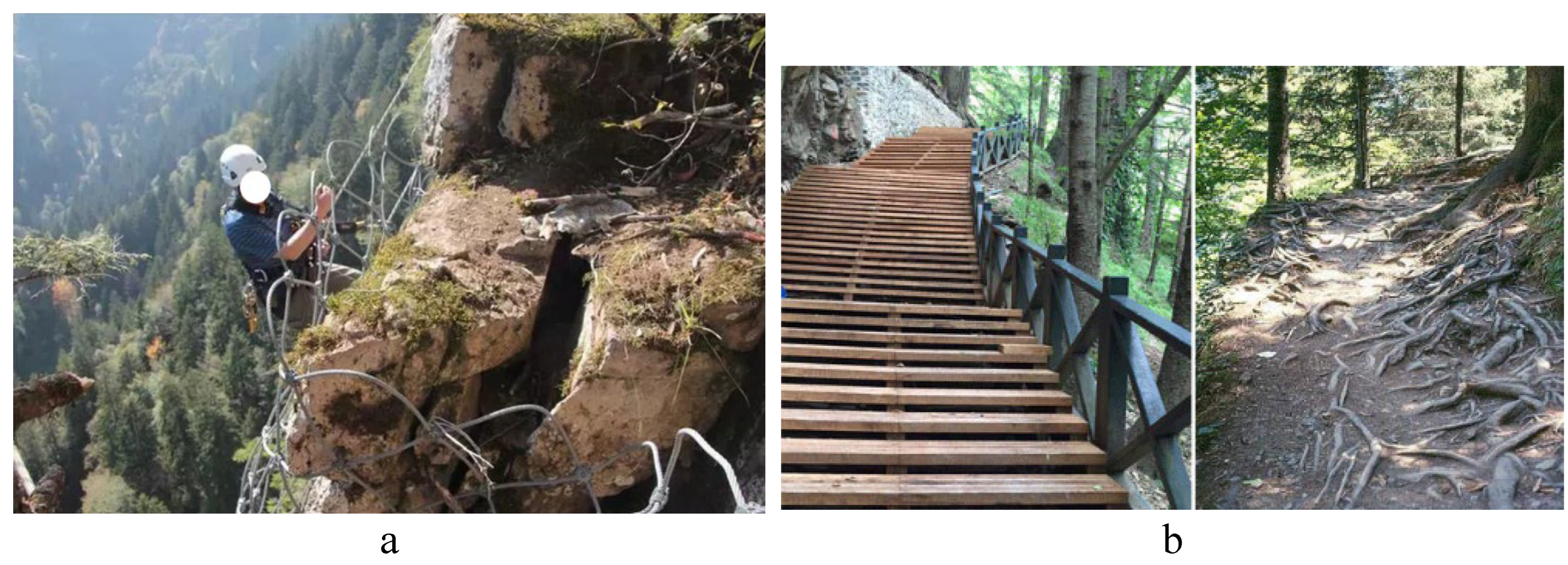
Figure 11.
Restitution proposal illustrating the Ottoman-period expansions of the Sümela Monastery (Author’s personal archive, 2014).
Figure 11.
Restitution proposal illustrating the Ottoman-period expansions of the Sümela Monastery (Author’s personal archive, 2014).
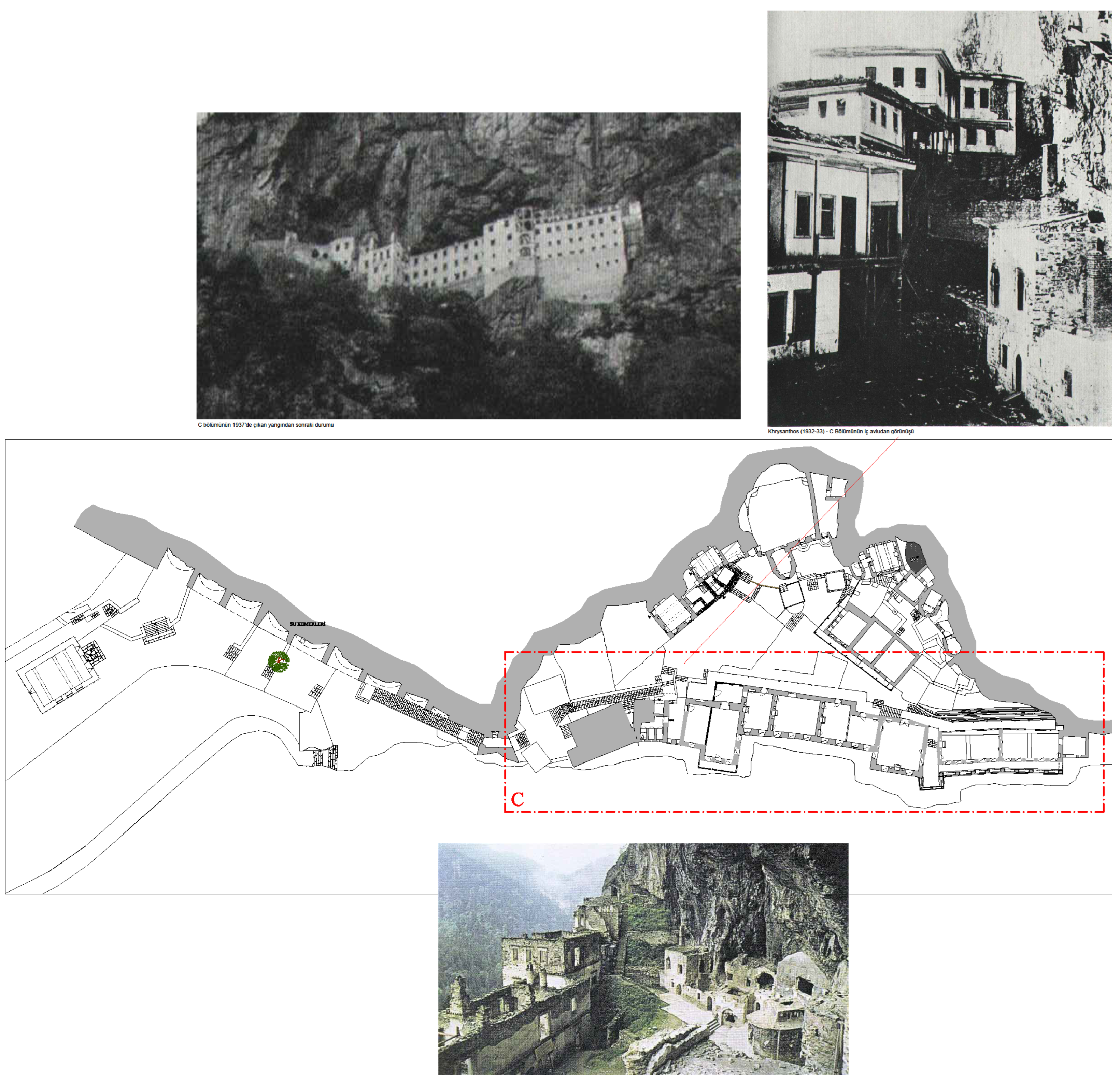
Figure 12.
Petrographic analysis image and XRD graph of a stone sample taken from the Sümela Monastery (Author’s personal archive, 2014).
Figure 12.
Petrographic analysis image and XRD graph of a stone sample taken from the Sümela Monastery (Author’s personal archive, 2014).
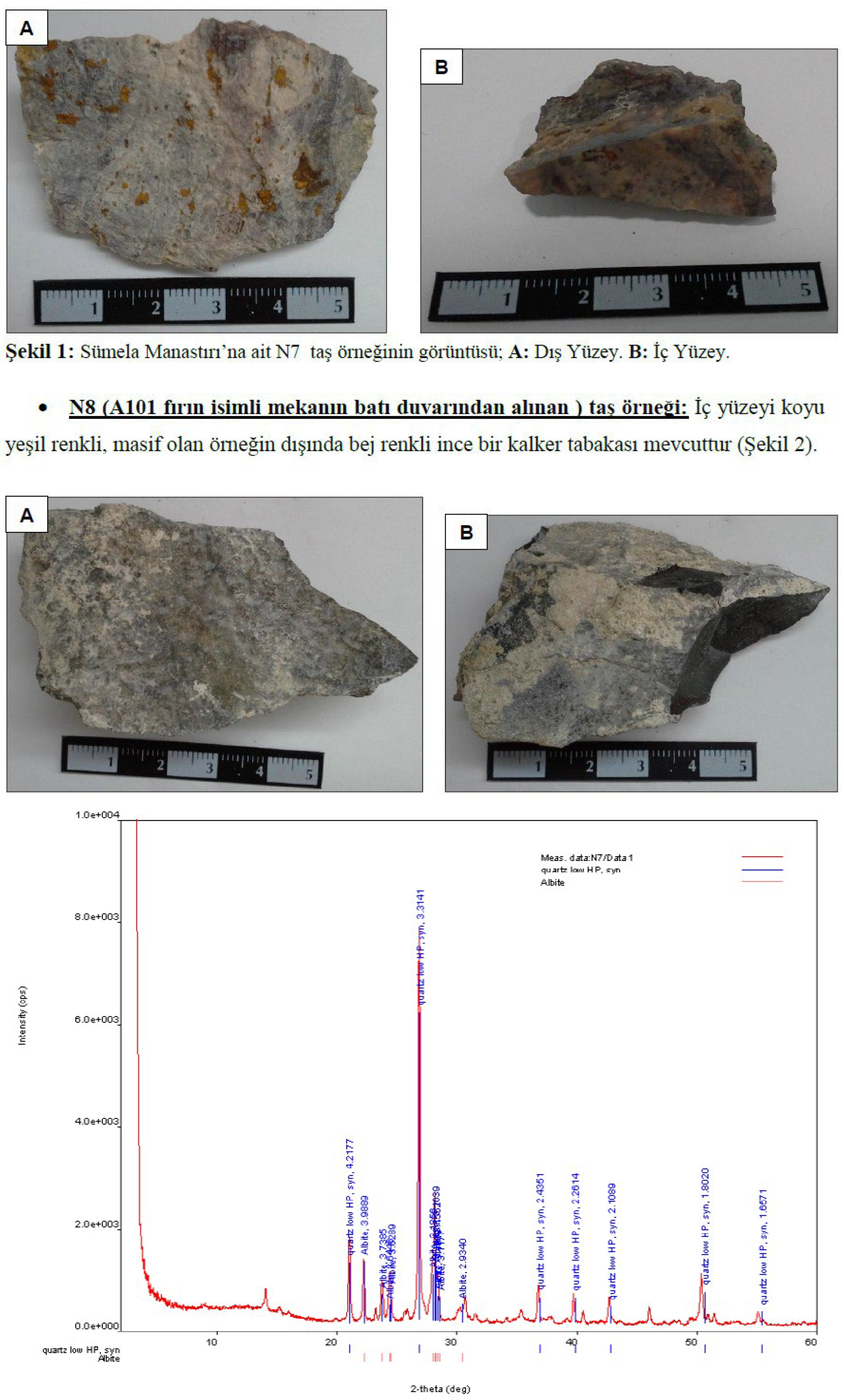
Figure 13.
Restitution plan of Section A – Phase V, representing the spatial configuration of the Sümela Monastery during the Republican period (Author’s personal archive, 2014).
Figure 13.
Restitution plan of Section A – Phase V, representing the spatial configuration of the Sümela Monastery during the Republican period (Author’s personal archive, 2014).
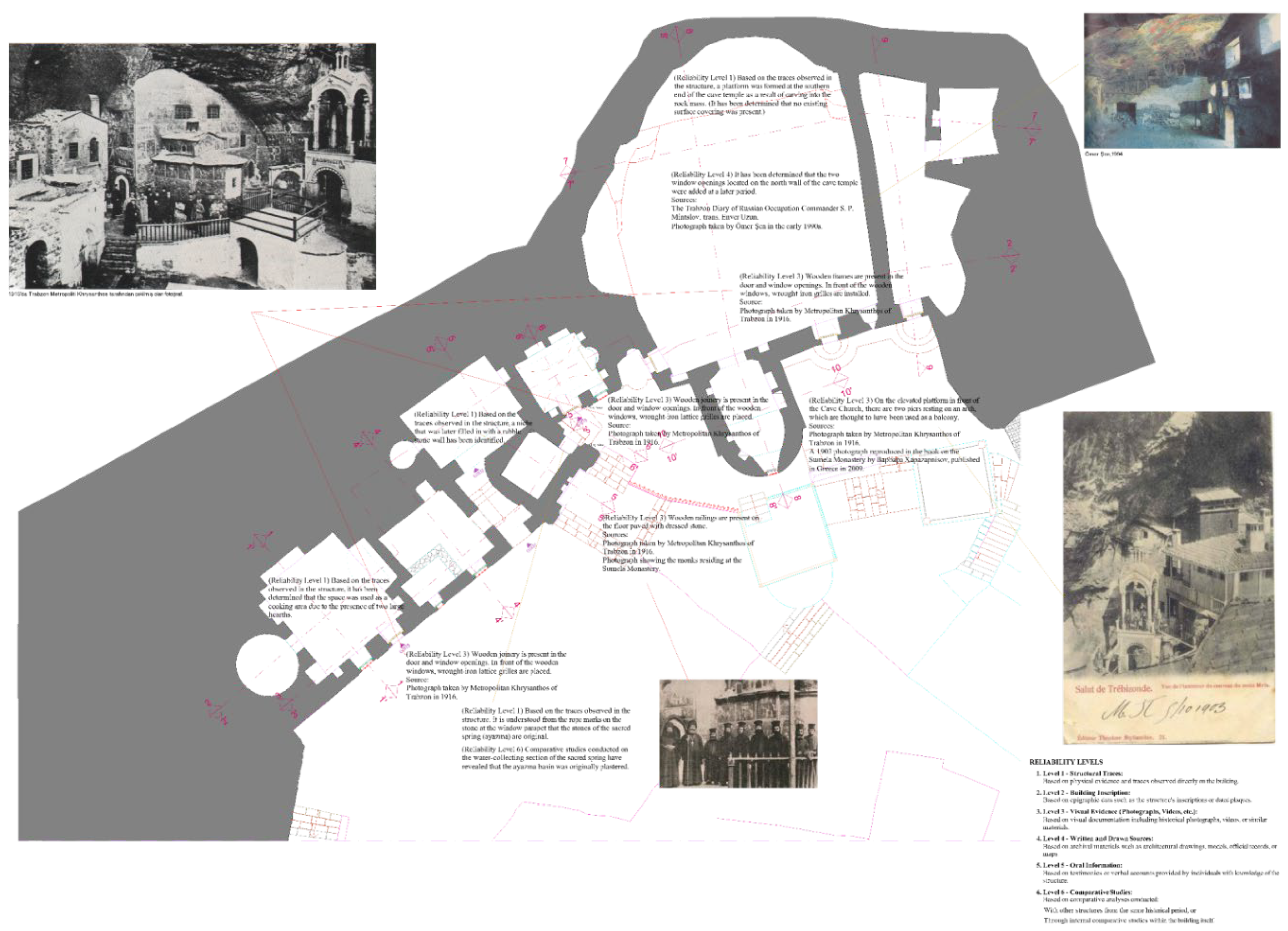
Figure 14.
Section and façade restitution of Section A – Phase V, illustrating the spatial continuity and structural evolution of the Sümela Monastery (Author’s personal archive, 2014).
Figure 14.
Section and façade restitution of Section A – Phase V, illustrating the spatial continuity and structural evolution of the Sümela Monastery (Author’s personal archive, 2014).
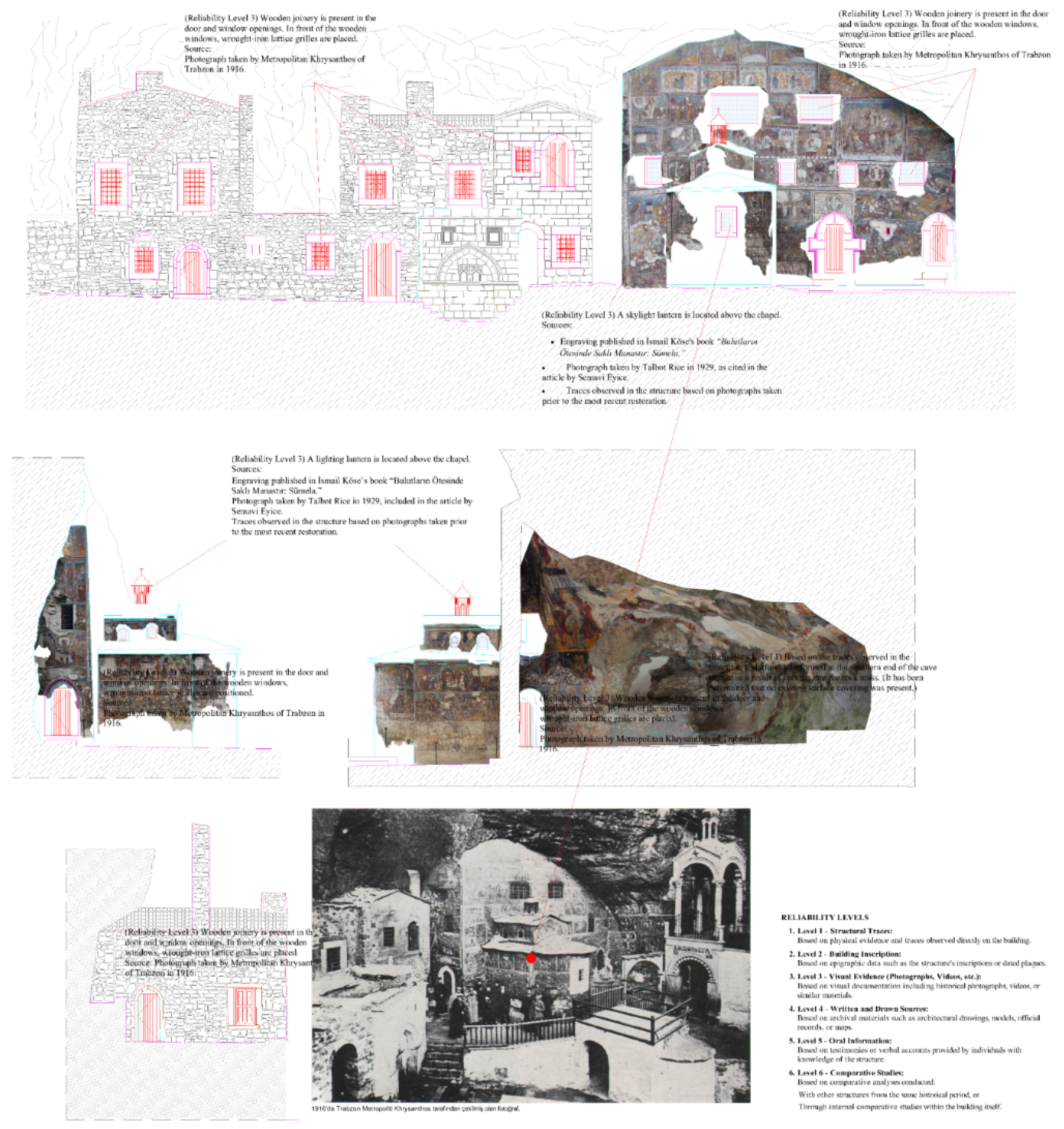
Figure 15.
Restitution of the façade – Phase IV, illustrating the architectural characteristics and repair interventions of the Ottoman expansion period (Author’s personal archive, 2014).
Figure 15.
Restitution of the façade – Phase IV, illustrating the architectural characteristics and repair interventions of the Ottoman expansion period (Author’s personal archive, 2014).
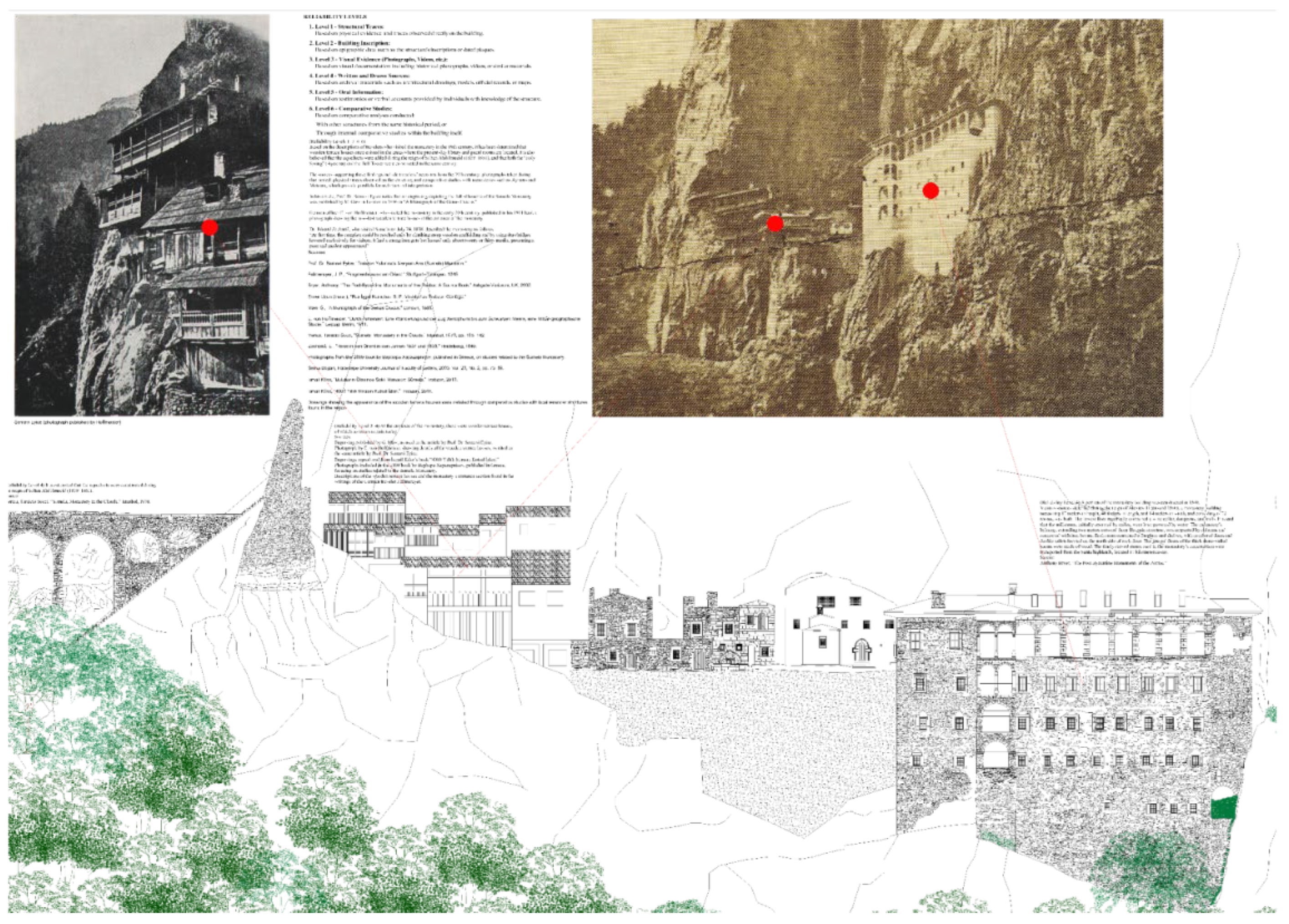
Figure 16.
Diagram of interpretive restitution – multilayered representation of the Sümela Monastery. Conceptual model developed by the author, synthesizing values-based conservation process logic and documentation-to-decision principles (after the Burra Charter process and RecorDIM framework).
Figure 16.
Diagram of interpretive restitution – multilayered representation of the Sümela Monastery. Conceptual model developed by the author, synthesizing values-based conservation process logic and documentation-to-decision principles (after the Burra Charter process and RecorDIM framework).
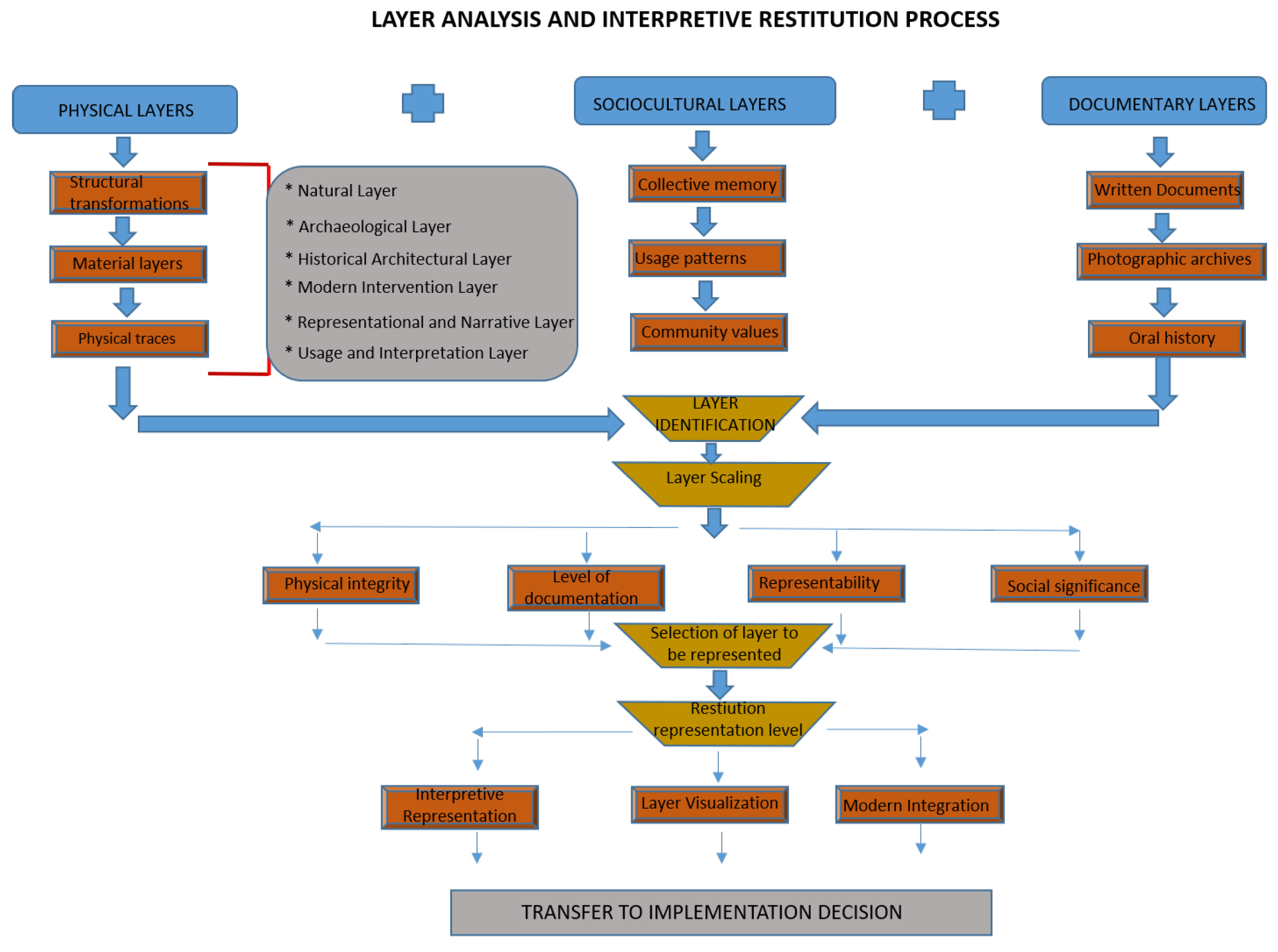
Figure 18.
Example of Salt Efflorescence and Pigment Loss in the Frescoes – Crystallized salt deposits and pigment fading observed on the interior surfaces of the main rock church at the Sümela Monastery (Author’s personal archive, 2014).
Figure 18.
Example of Salt Efflorescence and Pigment Loss in the Frescoes – Crystallized salt deposits and pigment fading observed on the interior surfaces of the main rock church at the Sümela Monastery (Author’s personal archive, 2014).
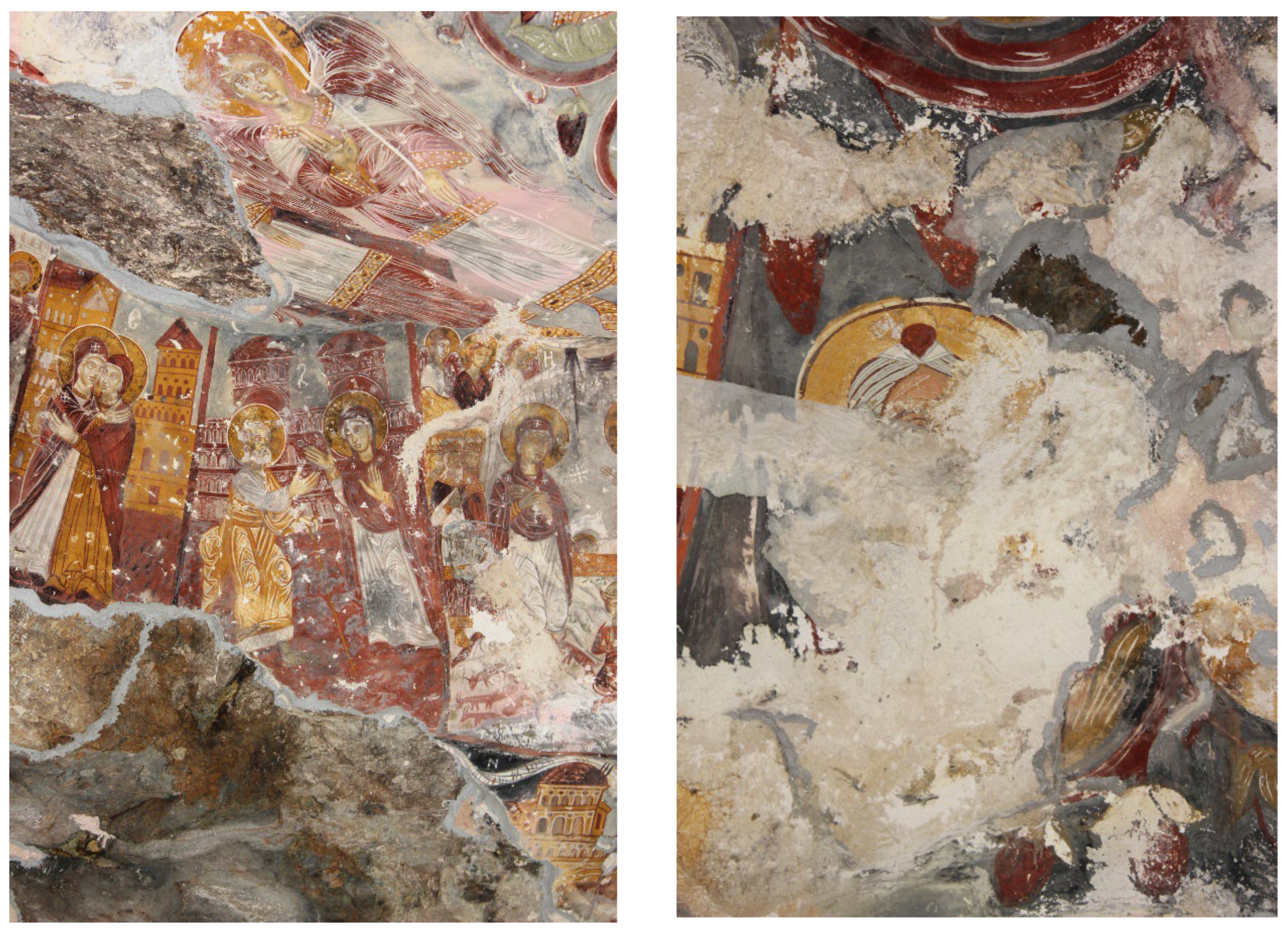
Figure 19.
Representation of Material and Surface Deterioration Typology on the Analytical Mapping of Sümela Monastery (Author’s personal archive, 2014).
Figure 19.
Representation of Material and Surface Deterioration Typology on the Analytical Mapping of Sümela Monastery (Author’s personal archive, 2014).
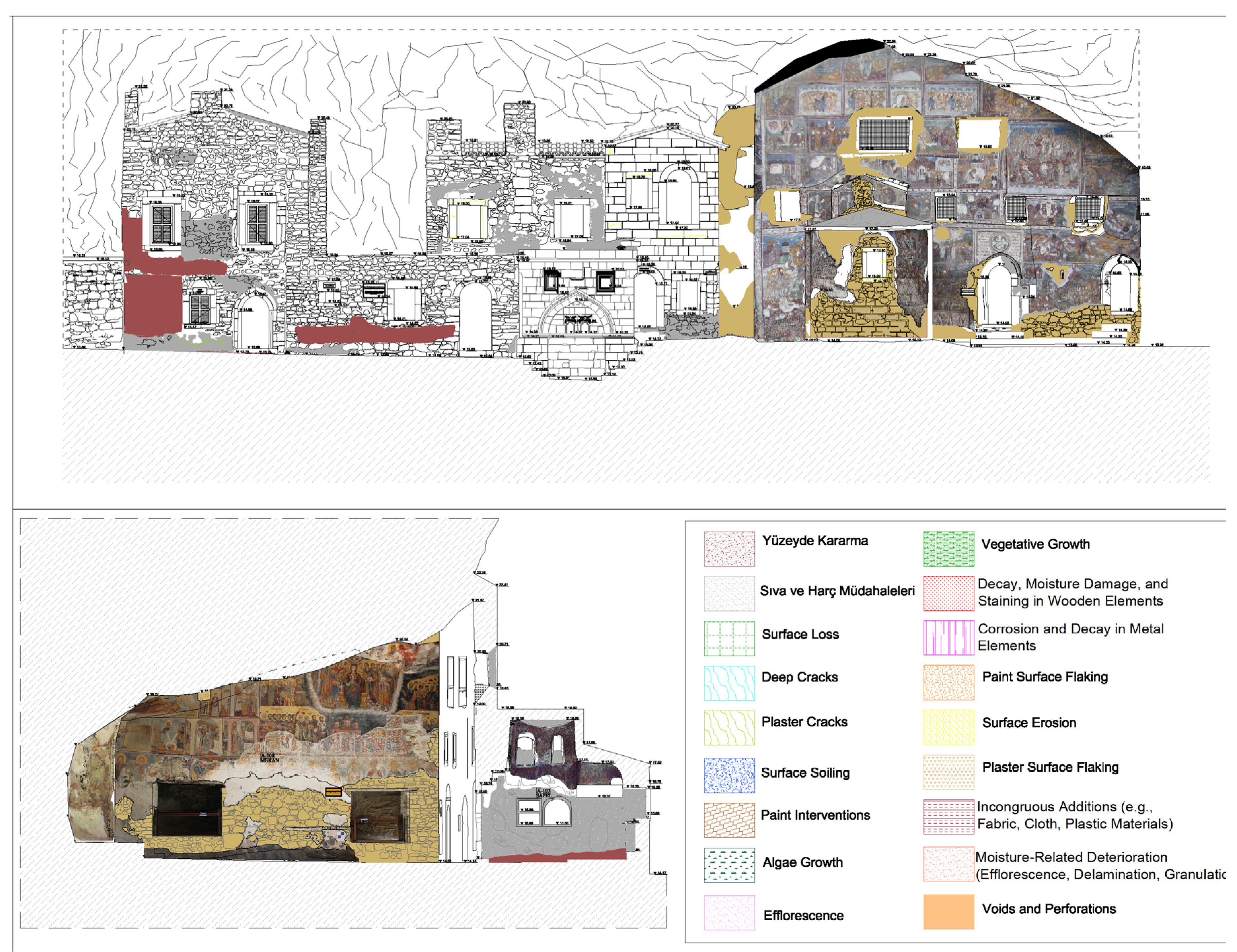

Table 1.
Eastern Mediterranean Rock Monasteries: Location and Topographical Relationship.
| Monastery / Site | Type of Location | Elevation (approx.) | Topographical Relationship | Ritual Meaning / Symbolic Effect |
|---|---|---|---|---|
| Sümela (Trabzon) | Horizontal spread within rock cavities | 1,150 m | Embedded in the rock surface | Inner seclusion (askesis) |
| Meteora (Kalambaka) | Vertical position atop rock pinnacles | 535 m | High isolation | Ascent toward the divine (anabasis) |
| Hosios Loukas (Phocis) | Constructed on terraces | 450 m | Stepped formation aligned with topography | Communal order |
| Panagia Hozoviotissa (Amorgos) | Integrated into rock façade | 300 m | Vertical interface between sea and cliff | Theophanic symbol |
| Athos (Mount Athos) | Transitional zone between sea and mountain | 0–400 m | Sacred threshold between land and sea (liminal space) | Mysticism and coexistence with nature (symbiosis) |
Table 2.
Restitution Phases of Sümela Monastery.
| Period | Historical Scope | Main Characteristics | Interpretive Focus | |
|---|---|---|---|---|
| Phase I – Initial Formation Period | 4th–7th centuries | Early chapel and monastic cells carved into the natural rock mass; irregular rubble masonry with weak lime mortar | Integration with nature and the spatial representation of early ascetic life | |
| Phase II – Byzantine Consolidation | 8th–13th centuries | Volumetric expansion; transition to regular ashlar masonry; differentiation of liturgical spaces | Architectural unification and the spatial projection of the institutionalized Byzantine monastic system | |
| Phase III – Late Byzantine–Early Ottoman Interaction | 14th–15th centuries | Additions of galleries and cells on the northern side; use of lime–volcanic aggregate mortars | Architectural manifestation of cultural transition accompanied by iconographic continuity | |
| Phase IV – Ottoman Expansion Period | 16th–19th centuries | Finely cut stone masonry, advanced lime mortars, and integrated timber–stone construction | A phase where multicultural continuity merged with technical advancement | |
| Phase V – Republican Period of Decay | 20th century (1930–1990) | Abandonment, structural weakening, loss of frescoes, biological colonization | Transformation of decay into a component of multilayered heritage and a period of historical silence | |
| Phase VI – Modern Interventions and Restoration Process | Post-1970 (especially 2001–2014) | Rock stabilization, drainage, surface repair, fresco conservation, and engineering-supported interventions | Redefinition of physical and symbolic integrity through contemporary conservation principles |
Table 3.
Plan Organization and Circulation System in Monastic Complexes.
| Monastery | Plan Type | Access System | Stratification | Circulation Direction |
|---|---|---|---|---|
| Sümela (Trabzon) | Multi-level courtyard system | Ramps and rock-cut stairways | Vertical + horizontal | From inside to outside |
| Meteora (Kalambaka) | Single-core block | Vertical elevator–stair system | Vertical | From bottom to top |
| Hosios Loukas (Phocis) | Double-church central plan | Central courtyard | Horizontal | Symmetrical |
| Panagia Hozoviotissa (Amorgos) | Linear gallery plan | Single corridor with niche cells | Vertical | From top to bottom |
| Athos (Mount Athos) | Enclosed inner courtyard plan | Peripheral circulation from main gate | Horizontal + peripheral | From center to periphery |
Disclaimer/Publisher’s Note: The statements, opinions and data contained in all publications are solely those of the individual author(s) and contributor(s) and not of MDPI and/or the editor(s). MDPI and/or the editor(s) disclaim responsibility for any injury to people or property resulting from any ideas, methods, instructions or products referred to in the content. |
© 2025 by the authors. Licensee MDPI, Basel, Switzerland. This article is an open access article distributed under the terms and conditions of the Creative Commons Attribution (CC BY) license (http://creativecommons.org/licenses/by/4.0/).
Copyright: This open access article is published under a Creative Commons CC BY 4.0 license, which permit the free download, distribution, and reuse, provided that the author and preprint are cited in any reuse.


