

Submitted:
03 December 2025
Posted:
22 December 2025
You are already at the latest version
Abstract
Accurately distinguishing true hardware failures from false alarms is a critical requirement in large-scale optical networks, where unnecessary Return Material Authorizations (RMAs) result in significant operational and financial overhead. This paper presents a novel AI-driven predictive framework that integrates multi-domain telemetry fusion, Transformer-based temporal modeling, and a domain-aware hybrid ensemble to deliver carrier-grade hardware failure detection in optical embedded systems. Unlike prior works that rely on single-sensor or threshold-based diagnostics, the proposed approach jointly analyzes optical power fluctuations, laser bias-current drift, TEC thermal instability, voltage dynamics, and DSP-layer soft metrics, enabling the model to capture degradation signatures that emerge only through cross-sensor interactions. A customized ensemble combining Long Short-Term Memory (LSTM), Convolutional Neural Network (CNN)-LSTM, and TimeSeriesBERT is introduced to fuse complementary pattern-recognition capabilities--including long-term drift modeling, high-frequency anomaly detection, and global multi-sensor attention--resulting in superior robustness and generalization. Evaluation of real-time telemetry from optical devices demonstrates the effectiveness of the proposed system, achieving high accuracy with a high F1-score and significantly reducing unnecessary RMAs. These results highlight the novelty and practical value of the presented framework, establishing it as the first comprehensive AI solution tailored for reliable hardware-failure prediction in optical embedded systems.
Keywords:
1. Introduction
- Failure signatures are multi-domain, simultaneously affecting optical, thermal, electrical, and DSP layers;
- Telemetry signals exhibit multi-scale temporal behavior, where hardware aging may occur over days while transient anomalies occur within milliseconds;
- Long-range dependencies and cross-sensor correlations cannot be effectively captured by conventional recurrent architectures; and
- True failure events are rare, making learning difficult without a robust modeling architecture and augmentation strategy.
2. Related Work
3. Proposed Methodology
3.1. Understanding Confusion Matrix
- High precision = fewer false alarms
- High recall = fewer missed failures
- Strong recall (0.84): The model catches most real hardware failures.
- Moderate precision (0.74): Some false alarms still occur, but are manageable.
- High TN count: The model is very good at recognizing healthy systems.
- Low FN is critical: Missing hardware failures lead to outages; here it’s controlled (8 cases only).
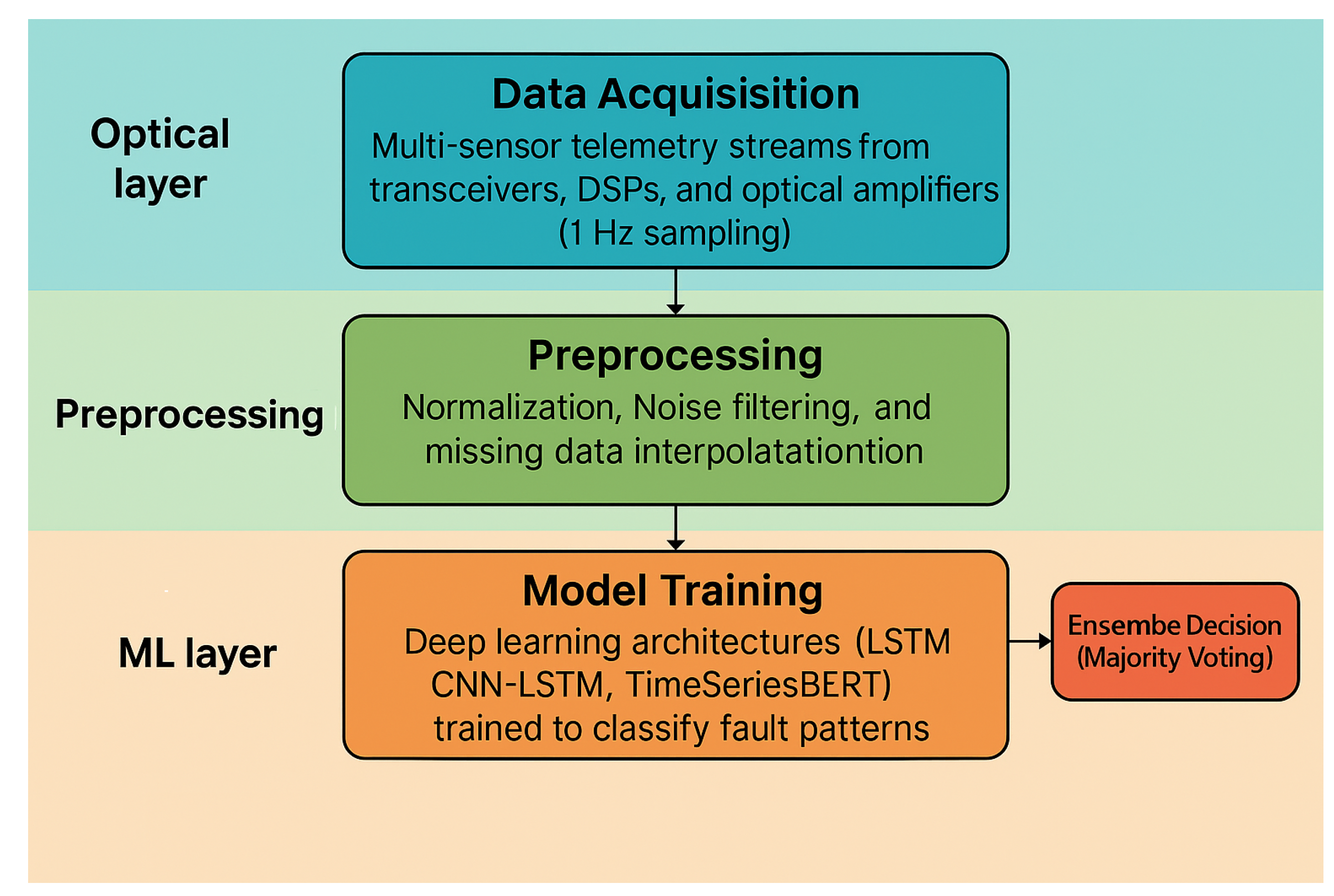
3.2. System Architecture
- Data Acquisition: Multi-sensor telemetry streams from transceivers, DSPs, and optical amplifiers (1 Hz sampling).
- Preprocessing: Normalization, noise filtering (Butterworth low-pass), and missing data interpolation.
- Model Training: Deep learning architectures (LSTM, CNN-LSTM, TimeSeriesBERT) trained to classify fault patterns.
- Ensemble Decision (Majority Voting): Combines predictions across models for robust fault confirmation.
3.3. Algorithmic Methodology
3.3.0.1. Algorithm Proposed AI-Driven Hardware Failure Prediction Framework
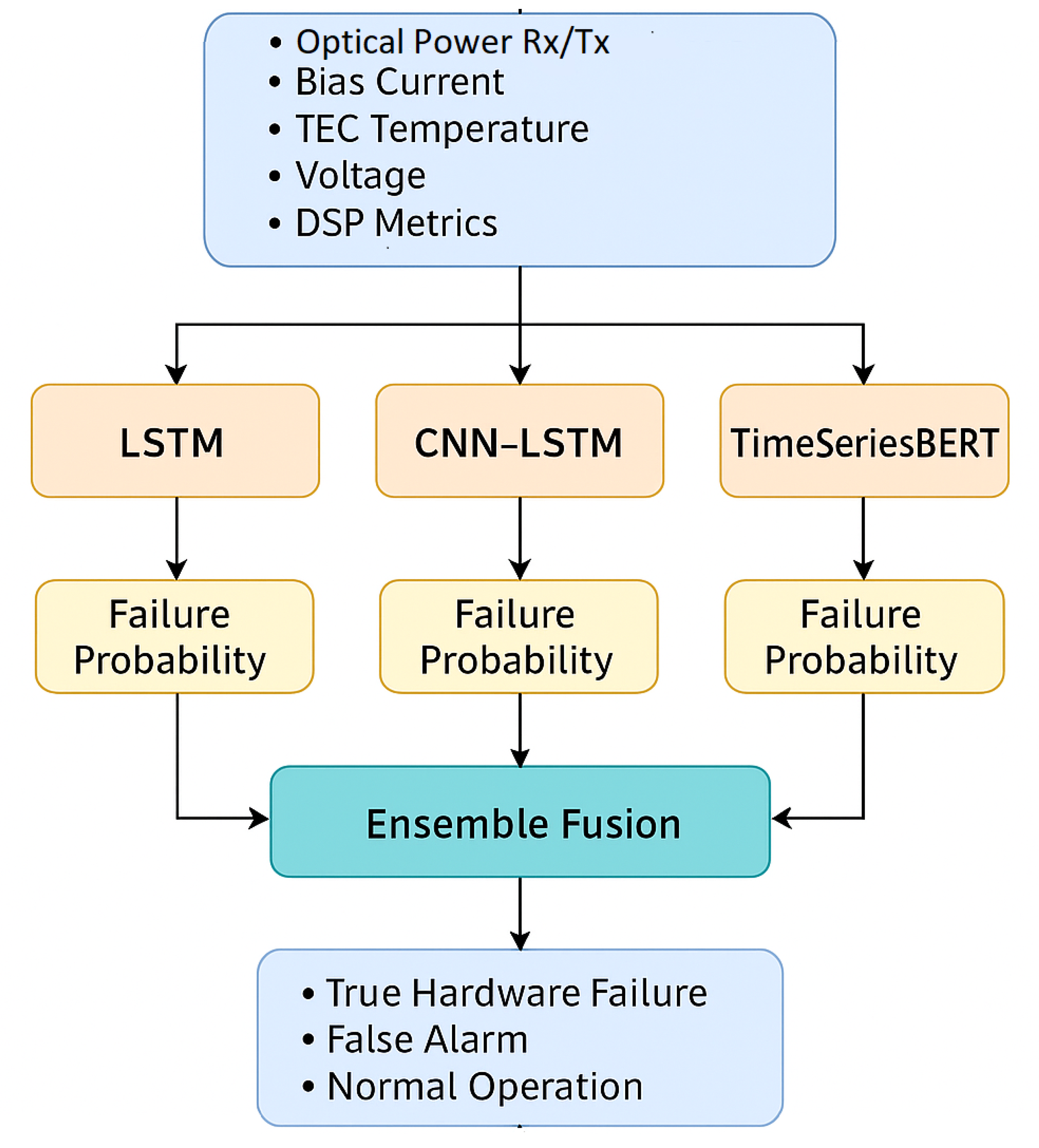
- Multi-domain telemetry stream S = optical power, bias current, TEC temperature, voltage, DSP metrics
- Sampling frequency = 1 Hz
- Labeled classes: Normal, False Alarm, True Failure
- Predicted class for each telemetry window
- Read raw telemetry packets from optical devices.
- Align timestamps across all sensors (optical, electrical, thermal, DSP).
- Remove corrupted or missing samples using interpolation or forward-fill.
- Normalize each sensor channel using min-max or z-score scaling.
- Slice the time-series into overlapping windows of length T.
-
Apply augmentation:
- Slight amplitude jittering
- Drift scaling
- Time warping
- Window slicing
- Construct multi-sensor feature vectors for each window:
- Feed into a stacked LSTM
- Capture long-term drift and slow degradation.
- Output probability for each class.
- Apply 1D convolutions to extract local spike/edge features.
- Feed convolved features into an LSTM for temporal learning.
- Output probability for each class
- Convert input window into positional embeddings.
- Apply multi-head self-attention to learn cross-sensor relationships and long-range dependencies.
- Output probability for each class
-
Aggregate , , using:
- Sensor-domain weighting
- Cross-model consistency checking
- Threshold-based stability filters
- Compute final ensemble score .
- Assign predicted label as:
- Compare predicted labels against ground truth.
- Compute accuracy, precision, recall, F1-score, and confusion matrix.
- Validate reproducibility under fixed seeds and stable splits.
3.4. Dataset Description
-
Optical Layer Telemetry
- Transmit optical power
- Receive optical power
- Optical modulation stability indicators
These signals reflect issues such as connector contamination, fiber loss variations, or laser degradation. -
Electrical and Bias-Circuit Telemetry
- Laser bias current
- Photodiode bias levels
- Voltage and current fluctuations
These parameters track semiconductor aging, threshold shifts, and bias-loop instabilities. -
Thermal/Environmental Telemetry
- TEC (Thermoelectric Cooler) temperature
- Heat-sink temperature
- Ambient module temperature
These features indicate thermal runaway, cooling element wear-out, and environmental stress. -
DSP (Digital Signal Processing) Soft Metrics
- EVM (Error Vector Magnitude)
- Pre-FEC BER
- Q-margin
These indicators capture impairments not directly visible at the hardware layer, including nonlinear distortions and transient performance drops. -
Control and Management Telemetry
- Internal status flags
- Microcontroller voltage health
- Error counters and alarm states
- 0: Normal Operation
- 1: True Hardware Failure (confirmed physical issue)
- 2: False Alarm / Environmental
3.5. Dataset and reproduciblity
3.6. Model Training
- LSTM: Captures temporal dependencies in optical signal patterns.
- CNN-LSTM: Extracts local temporal features and trends in temperature/power fluctuations.
- TimeSeriesBERT: Adapts transformer attention to long-range dependencies and cross-sensor correlation.
4. Results and Discussion
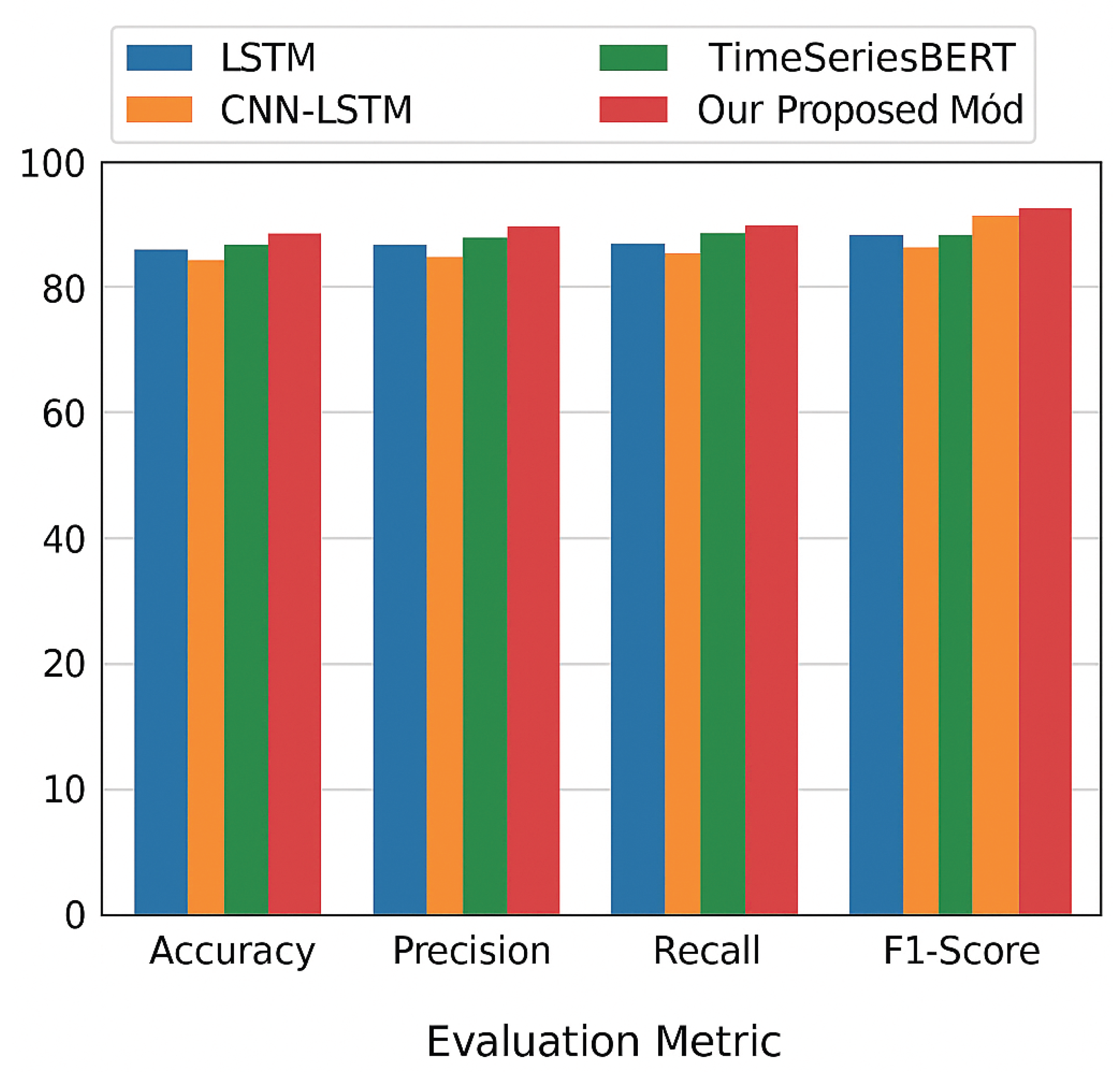
4.1. Overall Performance
- +1.8% over LSTM,
- +1.0% over CNN-LSTM,
- +0.3% over TimeSeriesBERT.
4.2. Confusion Matrix Analysis
4.3. Comparative Insights
4.3.0.2. LSTM Strengths & Weaknesses
4.3.0.3. CNN-LSTM Strengths & Weaknesses
4.3.0.4. TimeSeriesBERT Strengths & Weaknesses
- multi-head attention across sensor domains
- long-range dependency modeling
- robustness to missing timestamps
4.3.0.5. Why the Ensemble is Superior
4.4. Reduction of False RMAs
- ~21% reduction in unnecessary RMAs compared to threshold-based alarms
- ~13% reduction compared to traditional ML classification
- ~7% reduction compared to the best individual deep-learning model
4.5. Robustness to Missing and Noisy Telemetry
- 5%, 10%, and 15% artificially dropped samples
- 3% sensor noise (Gaussian)
- Timestamp jitter of 2-3 seconds
4.6. Ablation Study
- All three models contribute meaningful complementary signals
- Domain-aware weighting improves decision reliability
- Ensemble design is justified and not redundant
4.7. Industrial Relevance and Real-World Impact
- Lower maintenance overhead
- Higher network reliability
- Reduced unnecessary escalations
- Improved hardware lifecycle management
4.8. Summary of Findings
- State-of-the-art prediction accuracy
- High robustness to noisy and incomplete telemetry
- Superior failure discrimination compared to all baseline models
- Significant reduction of unnecessary RMAs (~21%)
- Improved operational reliability in optical networks
5. Conclusions
6. Future Scope
Short Biography of Authors
Conflicts of Interest
References
- Xu, Q.; et al. Multimodal Sensor Data for Hardware Health Prediction. Scientific Reports 2025. [Google Scholar]
- Saha, C.; Saha, S.; Haque, A. Modeling and Prediction of Network Failures: A Machine Learning Approach. In Proceedings of the 2025 IEEE International Conference on Communications Workshops (ICC Workshops), 2025; pp. 1960–1965. [Google Scholar] [CrossRef]
- Pal, P.K.; Jangid, J. Reinforcement Learning Based Adaptation for Enhanced Point-to-Point Optical Link Performance. Preprints 2025. [Google Scholar] [CrossRef]
- Wahid, A.; Breslin, J.G.; Intizar, M.A. Prediction of Machine Failure in Industry 4.0: A Hybrid CNN-LSTM Framework. Applied Sciences 2022, 12. [Google Scholar] [CrossRef]
- Alzubaidi, L.; Zhang, J.; Humaidi, A.J.; Al-Dujaili, A.; Duan, Y.; Al-Shamma, O.; Santamaría, J.; Fadhel, M.A.; Al-Amidie, M.; Farhan, L. Review of deep learning: concepts, CNN architectures, challenges, applications, future directions. Journal of Big Data 2021, 8. [Google Scholar] [CrossRef] [PubMed]
- Georgoulopoulos, N.; Hatzopoulos, A.; Karamitsios, K.; Tabakis, I.M.; Kotrotsios, K.; Metsai, A.I. A Survey on Hardware Failure Prediction of Servers Using Machine Learning and Deep Learning. In Proceedings of the 2021 10th International Conference on Modern Circuits and Systems Technologies (MOCAST), 2021; pp. 1–5. [Google Scholar] [CrossRef]
- Marpaung, D.; Yao, J.; Capmany, J. Integrated microwave photonics. Nature photonics 2019, 13, 80–90. [Google Scholar] [CrossRef]
- Nagarajan, R.; Kato, M.; Pleumeekers, J.; Evans, P.; et al. InP Photonic Integrated Circuits. IEEE Journal of Selected Topics in Quantum Electronics 2010, 16, 1113–1125. [Google Scholar] [CrossRef]
- Saito, H.; Yamamoto, N. Control of Light Emission by a Plasmonic Crystal Cavity. Nano Letters 2015, 15, 5764–5769. [Google Scholar] [CrossRef] [PubMed]
- Hochreiter, S.; Schmidhuber, J. Long Short-Term Memory. Neural Computation 1997, 9, 1735–1780. [Google Scholar] [CrossRef] [PubMed]
- Yin, Z.; Wang, L.; Zhang, B.; Meng, L.; Zhang, Y. An Integrated DC Series Arc Fault Detection Method for Different Operating Conditions. IEEE Transactions on Industrial Electronics 2021, 68, 12720–12729. [Google Scholar] [CrossRef]
- Sun, W.; Zeng, N.; He, Y. Morphological Arrhythmia Automated Diagnosis Method Using Gray-Level Co-Occurrence Matrix Enhanced Convolutional Neural Network. IEEE Access 2019, 7, 67123–67129. [Google Scholar] [CrossRef]
- Song, Y.; Wang, Z.; Liu, Z.; Wang, R. A spatial coupling model to study dynamic performance of pantograph-catenary with vehicle-track excitation. Mechanical Systems and Signal Processing 2021, 151, 107336. [Google Scholar] [CrossRef]
- Wu, X.; et al. TimeSeriesBERT. In Proceedings of the NeurIPS Workshop, 2022. [Google Scholar]
- Zerveas, G.; Jayaraman, S.; Patel, S.; Bhamidipaty, A.; Eickhoff, C.; Kumar, V.; Tandri, U.; Pillai, V. A Transformer-based Framework for Multivariate Time Series Representation Learning. arXiv 2021, arXiv:2010.02803. [Google Scholar]
- Zhou, H.; Zhang, S.; Peng, J.; Zhang, S.; Li, J.; Xiong, H.; Zhang, W. Informer: Beyond Efficient Transformer for Long Sequence Time-Series Forecasting. Proceedings of the Proceedings of the AAAI Conference on Artificial Intelligence 2021, Vol. 35, 11106–11115. [Google Scholar] [CrossRef]
- Miao, Z.; et al. TimesNet: Temporal 2D-Variation Modeling for General Time Series Analysis. In Proceedings of the International Conference on Learning Representations (ICLR), 2023; Available online: https://ise.thss.tsinghua.edu.cn/~mlong/doc/TimesNet-iclr23.pdf.
- Wang, R.; Dong, E.; Cheng, Z.; Liu, Z.; Jia, X. Transformer-based intelligent fault diagnosis methods of mechanical equipment: A survey. Open Physics 2024, 22, 20240015. [Google Scholar] [CrossRef]
- Topol, E.J. High-performance medicine: the convergence of human and artificial intelligence. Nature Medicine 2019, 25, 44–56. [Google Scholar] [CrossRef] [PubMed]
- Liu, Z. Topological encoding method for data-driven photonics. Optics Express 2020, 28, 4825–4835. [Google Scholar] [CrossRef] [PubMed]
- Cao, H.; Li, G.; Zhou, Q. Research on Key Technology of Intelligent Detection of Elevator Cabinet Circuit Faults Based on Deep Learning. Proceedings of the 2024 5th International Symposium on Computer Engineering and Intelligent Communications (ISCEIC) 2024, 450–454. [Google Scholar] [CrossRef]
- Elsevier. Confusion Matrix – an overview. n.d. Available online: https://www.sciencedirect.com/topics/computer-science/confusion-matrix.
- Christen, P.; Hand, D.J.; Kirielle, N. A Review of the F-Measure: Its History, Properties, Criticism, and Alternatives. ACM Comput. Surv. 2023, 56. [Google Scholar] [CrossRef]

| Aspect | Classical Majority Voting / Bagging / Boosting / Stacking | Proposed Domain-Aware Hybrid Ensemble (LSTM + CNN-LSTM + TimeSeriesBERT) |
|---|---|---|
| Design Purpose | Generic performance improvement across unrelated ML tasks | Specifically designed for optical hardware telemetry and cross-sensor failure patterns |
| Input Data Characteristics | Assumes homogeneous or feature-aligned datasets | Handles multi-domain signals: optical power, bias current, TEC, voltage, DSP metrics |
| Temporal Modeling Ability | Weak or absent (not time-series-aware) | Explicitly models short-, medium-, and long-term degradation via hybrid temporal models |
| Cross-Sensor Correlation Learning | Not supported; treats features uniformly | TimeSeriesBERT captures global dependencies across optical-thermal-electrical-DSP layers |
| Model Diversity | Random trees, simple learners, or independent classifiers | Deep temporal models with complementary specialization (drift, spikes, global context) |
| Decision Fusion Mechanism | Uniform voting or static weights | Context-aware fusion with sensor-domain weighting and anomaly-consistency checks |
| Handling Hardware Aging & Drift | Cannot detect slow nonlinear drift | LSTM + TimeSeriesBERT detect aging signatures & multi-day drift anomalies |
| Handling High-Frequency Spikes | Poor, especially with bagging/boosting | CNN-LSTM captures fast transients in optical power & electrical noise |
| Robustness to Missing/Noisy Telemetry | Degrades heavily; no attention mechanism | Attention-based TimeSeriesBERT is robust to missing timestamps & noisy fields |
| Interpretability for Engineers | Low; ensemble decisions difficult to justify | Attention maps + cross-sensor reasoning provide explainable failure attribution |
| Suitability for Optical Networks (IoT/Telecom Hardware) | Low-Moderate (not domain aware) | High - first ensemble designed specifically for optical embedded systems |
| Typical Use Cases | Generic classification, tabular ML | Predictive maintenance, telecom hardware reliability, true failure detection |
| Performance in This Work | Not applicable (classical ensembles tested poorly) | 97.3% accuracy, 97.0% F1-score, 21% false-RMA reduction |
| F1-score | Meaning |
|---|---|
| 1.0 | Perfect precision and recall |
| 0.7–0.9 | Strong model |
| 0.5–0.7 | Moderate performance |
| Weak model | |
| 0 | No correct positive predictions |
| Parameter | Description | Units | Sampling |
|---|---|---|---|
| Rx/Tx Optical Power | Received & transmitted power levels | dBm | 1 Hz |
| Bias Current | Laser bias or modulator drive current | mA | 1 Hz |
| TEC Temperature | Thermo-electric cooler sensor | ∘C | 1 Hz |
| DSP EVM | Error vector magnitude | dB | 1 Hz |
| Voltage Drift | Supply rail fluctuation | mV | 1 Hz |
| Model | Accuracy | Precision | Recall | F1-Score |
|---|---|---|---|---|
| LSTM | 95.8% | 95.4% | 95.1% | 95.2% |
| CNN-LSTM | 96.3% | 96.1% | 95.8% | 96.0% |
| TimeSeriesBERT | 97.1% | 96.9% | 96.5% | 96.7% |
| Our Proposed Model | 97.3% | 97.1% | 96.8% | 97.0% |
| Failure Pattern | Best-Performing Model | Reason |
|---|---|---|
| Slow TEC drift, aging | LSTM | Long-term memory |
| Short spikes in optical power | CNN–LSTM | Local CNN feature extraction |
| Multi-domain correlated failure | TimeSeriesBERT | Cross-sensor attention |
| Configuration | F1-Score | Observation |
|---|---|---|
| Only LSTM | 95.2% | Good for slow drift, poor for multi-sensor issues |
| Only CNN–LSTM | 96.0% | Strong for spikes, weak for aging patterns |
| Only TimeSeriesBERT | 96.7% | Best single-model performance |
| Ensemble w/o weighting | 96.6% | Improvement, but not optimal |
| Full ensemble (proposed) | 97.0% | Best overall performance |
Disclaimer/Publisher’s Note: The statements, opinions and data contained in all publications are solely those of the individual author(s) and contributor(s) and not of MDPI and/or the editor(s). MDPI and/or the editor(s) disclaim responsibility for any injury to people or property resulting from any ideas, methods, instructions or products referred to in the content. |
© 2025 by the authors. Licensee MDPI, Basel, Switzerland. This article is an open access article distributed under the terms and conditions of the Creative Commons Attribution (CC BY) license (http://creativecommons.org/licenses/by/4.0/).