
Submitted:
19 December 2025
Posted:
22 December 2025
You are already at the latest version
Abstract
This study investigates the impact of transactional leadership on organizational commitment through the mediating roles of organizational culture and employee motivation, and moderating effect of role ambiguity and work-life balance on the public universities in Somaliland. The methodology was cross-sectional research design from 278 employees from four public universities located in Somaliland. Data were analyzed using partial least squares structural equation modeling with Smart PLS 4 software. Transactional leadership has a positive effect on organizational commitment, supporting with existing literature and indicating operational efficiency, clear goals and accountability using reward contingencies in high education. Both organizational culture and employee motivation were found to be complementary partial mediation roles on the transactional leadership and organizational commitment relationship, reflecting key mechanisms of the relationship. In contract, role ambiguity and work life balance did not demonstrate a significant moderation effect on the transactional leadership and organizational commitment relationship. This study affirms that transactional leadership is key driver of organizational commitment through mechanisms of organizational culture and employee centered motivation practices. The findings of the study offer practical insights for leveraging leadership perspectives that can foster a committed and engaged workforce in academic settings.
Keywords:
transactional leadership
; organizational commitment
; organizational culture
; employee motivation
; role ambiguity
; work life balance
1. Introduction
Organizational commitment is a critically important factor for higher education institutions in day’s dynamic era of globalization. The modern organizations increasingly aim to ensure employee retention, by focus on the employees’ psychological attachments of the organization. However, organizational commitment is one way to find out their loyalty and performance (Cahyadi & Cahyadi, 2023). The psychological attachments of employees on their organization and involvement of the goals and values of their responsibilities to attain a certain extent is referred to as organizational commitment (Abu Orabi et al., 2024). Both public and private organizations require effective leaders with clear vision and leadership styles that align the organizational goals and employees’ commitment to achieve organizational commitment. Leadership is the one of the most important element of the organizational context as many studies have proven its capabilities to develop triangular relationship among organizations, employees, and customers are paramount. The leadership style refers to approach and methods used to guide, motivate, and manage teams in the organizations to attain organization’s a vision and goals (Yahaya & Ebrahim, 2016). Moreover, a various leadership paradigms including transactional leadership emphasized on clarity, direction, structured task, contingent rewards, and performance monitoring remain widely adopted across public institutions environment including higher education context (Bass & Avolio, 1994; Borde et al., 2022; Odumeru & Ogbonna, 2013). Although, transactional leadership traditionally profound for its clarity and efficiency, the global advancement with unlimited wants and needs, suffers for its effect on fostering deeper organizational commitment among the universities staff alone. It has raised doubt specifically in resource constrained and traditional governed institutions like sub-Sahara countries (Almutairi, 2020; Amtu et al., 2021).
In Somaliland, public universities face numerous challenges as reported Somaliland ministry of education and national higher education commission that include inadequate funding and resource constraint, weak internal governance structures and limited management capacity strategic direction (Ministry of education, 2022). In addition, low research output and limited research capacity exist in public universities context, where research is not institutionalized; academic staffs are often overloaded with teaching and administrative duties as reported Somaliland national development plan III 2023-2027. Furthermore, human capital limitations exist where still many lecturers work on part time and contractual bases, feeling job insecurity. These limit opportunity for academic development and international partnership. Therefore, this study addresses a unique intersection point that across leadership style, organizational commitment, and employee engagement, specifically focusing on Somaliland public universities. However, the study targets research gaps that remain uncovered in the literature. Although, exists groundwork regarding the impacts of leadership styles and organizational commitment, those research often focused predominantly direct relationships, than integrating mediation and moderation analysis such as organizational culture and work-life balance (Kahai et al., 2013, Bass et al., 2003). The effects of transformational versus transactional leadership may inadvertently downplay the nuanced interactions and implications of both styles within the same organizational context (Kahai et al., 2013). Furthermore, the study conducted Niţă and Guțu (2023) discussed the implications of transactional leadership on student work engagement but do not delve deeply into its broader impacts on faculty organizational commitment within higher education. Thus, a significant gap exists in exploring how transactional leadership influence employee commitment in public universities, when combined with cultural and motivational factors. Additionally, despite leadership styles as critical to employee outcomes, the context of public universities in Somaliland has remained largely unexamined. Many studies investigated correlations between leadership styles and organizational performance but often lack explicit investigation of the unique challenges faced by higher education institutions in developing countries (Borde et al., 2022; Cho et al., 2019; Lee, 2022).
Mediation role of employee motivation and organization culture are also less explored in the relationship of TL-OC. Although some research shows that organizational culture can significantly mediate the relationship between leadership styles and performance, but there is a lack of evidence specifically focusing on public universities in Somaliland (Khan et al., 2020; Abiddin et al., 2024). Additionally, TL positively impacts motivation, but little is addressed about how these motivational aspects specifically correlate to organizational commitment in structured educational institutions like those in Somaliland (Lazuardi et al., 2023). In moderation, the constructs of work life balance and role ambiguity are crucial moderating factors that can influence the effectiveness of leadership styles to OC. Current literature, including works by Halim et al., has pointed out the mediatory effects of job satisfaction in similar contexts, but not directly in public universities (Halim et al., 2021). Thus, understanding how role ambiguity and work life balance alter the relationship between TL-OC remains a seminal gap that could provide valuable insights into educational institutions atmosphere. Lastly, it is evident that there is a notable research gap regarding the comprehensive complex interplay of mediation-moderation roles of impact of relationship between TL-OC in public universities in Somaliland, particularly through the mechanisms of organizational culture, employee motivation as mediators and role ambiguity and work life balance as moderators. Therefore, this could enhance the understanding of leadership effectiveness in higher education and contribute to developing countries, tailored management strategies that foster higher levels of organizational commitment. The study is organized in sections that enhance readability; initiative introduction and the rest of the paper are literature review and hypothesis, research methodology, result and analysis part, and lastly, findings, conclusion and recommendation. The study should also provide the suggestion of further research and limitations of the paper
2. Literature Review
2.1. Transactional Leadership
As indicated, various studies transactional leadership (TL) is a leadership style that focuses to offer employee job description and duty, structures of activities, clear role, and procedure to do and apply positive and negative reward system to motivate and guide followers. The TL style is defined a leadership style that provide responsibility and duties for the employees to motivate with the expectance of reward in a specified standard of fulfillment (Wahyuni et al., 2020). It emphasize on the relationship between leaders/managers and their follower/employees. Burn’s theory of transactional leadership is based on ideology of leaders give something in exchange for something in return. Further, the theory highlights two different strategies that leaders can use, constructive and corrective transactions. The constructive happens when managers give stimulus to the employee to act in accordance with stated standards, the corrective or coercive strategy happens when the managers intimidates the workers if they do not demonstrate their responsibilities and duties or fail to do so (McGrath & Bates, 2017). Hence, the burns theory of transactional leadership does not limited to reward and sanctions rather it includes range of inducement and threats are limitless that leaders use influence employee behavior.
Thus, the paper is grounded the idea of James macGregor Burn’s theory of transactional leadership. This perspective revealed two dimension namely contingency rewards and management by exception (active management by exception and passive management by exception) (Lishandy et al., 2023; Umam, 2022; Wahyuni et al., 2020). The contingency rewards are expectations of physical and psychological compensation. From side of leader, contingency rewards provide direction and couching by clearly describing procedures, job roles and duties of how to fulfill tasks and policies to reach specified goals and objectives of work. Hence, on the other side, workers will gain incentives that comply with predetermined specifications in either material nor mental rewards or both. The management by exception is a management practice style that emphasis on monitoring employee performance and interfering when there are deviations from standard procedure. Always, this can manage by in two ways, active management by exception and passive management by exception. The active management by exception is a form of supervision that managers are closely monitoring and give directions intermittently during the process of tasks to prevent errors and we call in short proactive supervision. While the passive management by exception is a form of supervision that also managers are only if intervening when there is a deviation from standard procedure and we call this a distance supervision or reactive control.
2.2. Organizational Commitment
Commitment refers to a dedication that involves the loyalty to fulfill promise. Thus, organizational commitment is interplay between employee cognitive mentality attachments to the organization. Hassan, (2024) stated organizational commitment the percent of staffs are involved the goals and values of their organizational and willing to do to achieve it. Over the years, the organizational commitment has received prominent significance recognition among the scholars of wider disciplines in business management, sociology and anthropology in diverse organizations including private institutions and service providers of government owns as showed numerous studies (Abu Orabi et al., 2024; Acar, 2012; Allali & Allali, 2021; Retno, 2017). These studies highlight importance of staff commitments in organizational contemporary context. The model of Meyer and Allen (1991) consist of three interlaced components; affective commitment primarily based on emotional attachment and intrinsic voluntary retention. Continuance commitment is primarily involves cost benefit analysis decision of the employees. For instance, perceived cost of leaving outweighs the benefits of staying which increases continuance commitment of the organizational goals and aims. Normative commitment hold the employees sense of obligation from the responsibility that they belief staying is right option to choice. The studies conducted Abdul Halim et al., (2021 and Suong et al., (2019) on leadership styles and organizational commitment in teachers of public secondary schools in Malaysia and lecturers and staff of public universities in Vietnam respectively showed that transactional leadership has positive and significant effect on organizational commitment directly and indirectly through a mediation role. Therefore, these studies reflect the applicability of transactional leadership practices in high education institutions to boost the employee commitment by looking through the lenses of Burn’s transactional theory that believe range of inducements and threats do not limit financial incentive or sanctions but are unlimited constructive/corrective options. Therefore, authors of the study propositioned that transactional leadership influence for organizational commitment.
H1. Transactional leadership has a positive effect on employees organizational commitment in Somaliland public universities
2.3. Organizational Culture
Culture has primarily rooted from the notion of ethnic difference of individuals around the world, which then merges into groups and societies. It refers to shared beliefs, values, norms, and language that include both material and non-material culture. The culture has distinctive characters, which are, learned, shared, dynamic, integrated, and adaptive that shapes how individuals perceive, interact, and behave within the environment they are. In literature culture has many definitions, the prominent one include Cameron and Quin which defined “culture is a core values, assumptions, interpretations and approaches that characterize an organization” (Acar, 2012). The concept of organizational culture is not far from the culture notion except scope, focus, and purpose. The formation of organizational culture mainly comes from the leadership and organization’s policies and procedures. This reflects the culture is aligned with the organization’s values, goals and strategies. Organizational culture is group-shared assumptions that learned to mitigate external forces and adaptions and enhance internal integrations that teach any new members how they perceive, think and feel under the organizational environment (Dębski et al., 2020). A empirical study Simosi and Xenikou, (2010), showed that organizational culture has fully mediated the transactional leadership and organizational commitment. Furthermore, a study conducted private universities of Indonesia revealed its findings, organizational culture is key driver of lecturer’s organizational commitment (Yusuf, 2019). Therefore, these studies proved that a supportive organizational culture could enhance the commitment of the staff in higher education organizations. Thus, authors proposed these hypotheses.
H2. Transactional leadership has a positive direct effect on organizational culture in Somaliland public universities in Somaliland public universities.
H3. Organizational culture has a direct positive effect on organizational commitment in Somaliland public universities.
H4. Organizational culture mediates transactional leadership and organizational commitment relationship.
2.4. Employee Motivation
Motivation is a force that pushes individual effort to do something with desire of happens to reach and achieve the specific objectives. It is a concept of an employee working towards the organizational goals and objectives by achieving their initiatives (Shahzad et al., 2023). The motivation is a stimulus desire to exert a certainty extent of effort for individuals’ side to achieve organizational objectives to satisfy some other peoples’ need with the other side (Meirinhos et al., 2023). Further, Meirinhos et al’s study divided motivation in three aspects: (1) direction of the behavior (2) intensity strength of the effort (3) persistence of individuals’ behavior and duration. Thus, employee motivation refers to level of commitment, energy, and creativity that employees bring to their work to reach organizational goal. With regard to this, there are two motives that influence the employees performance (1) internal motives arise from the employee themselves, (2) external motives that arise from the environment they in (Meirinhos et al., 2023).
Motivation theories are very wide topic that looks the different angles of behavioral motives of the employees. George Patton’s belief of “you do not tell people how to do things, you tell them what you want to doing and let them surprise you will the result” (as cited McGrath & Bates, 2017). Further, McGrath & Bates highlight that individuals are more motivated to act when they see their needs, expectations, and their interests match what is being asked of them. The present study anchored Herzberg’s motivation theory, at the dimension of employee motivation. the Herzberg’s theory genuinely motivates employee of the organization (Thant & Chang, 2021). It focuses on primarily both intrinsic and extrinsic factors. Intrinsic factors include achievement, recognition, and responsibility, which are a source of job satisfaction. While extrinsic factors are hygiene factors such as salary, hob security, and working condition, which are essential factors to prevent dissatisfaction. The theory has a prominence strength to motivate the employees particularly education sector. The various studies indicated that employee motivation has direct and indirect impact on OC (Al-Bataineh et al., 2019; Toidze, 2024a). In addition, the employee motivation has mediated role of TL and OC (Lishandy et al., 2023; Muhammad Saqib Khan, 2022a). It reflect that a motivation concept is a good player in employee commitment in higher education institutions (Al-Bataineh et al., 2019; Lishandy et al., 2023; Muhammad Saqib Khan, 2022a; Toidze, 2024b). However, Authors posit mediation effect of employee motivation as follows.
H5. Transactional leadership has a direct effect on employee motivation in Somaliland public universities
H6. Employee motivation has a direct effect on organizational commitment in Somaliland public universities.
H7. Employee motivation mediates transactional leadership and organizational commitment relationship.
2.5. Role Ambiguity
Most studies agree that role ambiguity is difference between what a person knows and what is unknown about his job. Role ambiguity is a situation of an uncertainty or lack of clarity direction of the job. In subjectively is the discrepancy between available information to the employee and the required performance to fulfill (Arif Andriansyah et al., 2023). Then role ambiguity occurs in such condition and employee needs full information knowledge about their job responsibilities, expectations, and scope of their role within the organization (Arif Andriansyah et al., 2023). As a moderator variable, the role ambiguity effects depend on the nature of the job and leadership context, it may renders routine and highly standardized structured jobs where clarity is essential as academic duties. However, if the job role is discretionary, it leads inefficiency and poor performance (Zhang et al., 2020). In addition, clear role expectations and training may provide and motivate employee by giving adequate autonomy and support. The various studies indicated that low role ambiguity (when employee have fully informed job instructions and expectations), the greater the organizational commitment. Oppositely high role ambiguity (less informed job instructions and expectations) the lesser the organizational commitment (Arif Andriansyah et al., 2023; Azzahra et al., 2021; Zhang et al., 2020). However, it is evident the literature the magnitude effect of high and low role ambiguity in the relationship between transactional leadership style and employee commitment is absent especially higher education employees including lecturer and administrative (Homayed et al., 2024). Therefore, we assumed that role ambiguity (RA) moderates transactional leadership and employee motivation, we hypothesized as follows
H8. Role ambiguity moderates transactional leadership style and organizational commitment relationship.
2.6. Work-Life-Balance
“Work-life balance” is the harmonious integration of job responsibilities and personal life obligation by fostering equilibrium in time, engagement, and satisfaction across work duties and other personal obligation. It embodies the ability of individuals to manage time, energy, and attention effectively across work related duties and responsibility in one side and personal aspirations, including family obligations and leisure activities on the other side. Work-life balance (WLB) received great attention from academic and policy makers in recent throughout the globe, the potentiality of WLB increasingly attracted the interest of researchers, practitioners, and policy makers to study work-life balance as it viewed one of the best means of improving organizational commitment among the employee (Shabir & Gani, 2020). Work-life balance refers to means of employees in the organizations are achieving of satisfactory level of work, home, and other personal life duties (Chang et al., 2019). According to Handoyo and Kharismasyah (2024) showed their findings that WLB has become key driver of organizational citizenship behavior. As organization’s sacrifice of their employee increase, the organizational commitment increase also (Chang et al., 2019). However, in dynamic work environment characterized by rapid changes, increasing competition, and technological advancement, maintaining WLB is crucial for sustaining employee wellbeing and organizational commitment. In addition, higher education institutions, where academic and administrative role are demanding, poor work-life balance may lead to employee burnout, this diminishes employees’ sense of purpose and satisfaction and eventually adversely affects their loyalty and performance level (Tugsal, 2017). In empirical review, the study of Chang et al{2019) showed that moderation effect of WLB between TL and OC, highlights that high WLB enhances employees’ decision to be part of the organization and scarifies their profession to attain organizational goals. Therefore, this study uses WLB as moderation between TL and OC, thus the authors hypothesized as follows
H9. “Work life balance” moderates transactional leadership style and organizational commitment relationship.
Based on the research hypothesis of the study, the authors presented H1 to H9, the paper’s first conceptual framework as seen in Figure 1.
2. Methodology
This paper is quantitative research design for structural equation modeling (SEM) that employed cross-sectional design. The study aims to examine transactional leadership style (TL) as independent variable and organizational commitment (OC) as dependent variable, exploring mediating effects of employee motivation (EM), and organizational culture (OrC), and moderating effect of role ambiguity (RA) and work-life balance (WBL). The study conducted public universities of Republic of Somaliland, specifically four universities: University of Burao, University of Hargeisa, Burao Central University College, and Sanag University which are located in Togdher, Marodijeh, Togdher, and Sanag regions respectively. The target populations are all faculty members and administrative staff of the universities. The total employees of sampling frame were 1190 excluded all employees other than faculty members or administrative staff, such as securities, cleaners, guards, and drivers. The stratified random sampling techniques were used to ensure inclusivity of different institutions. The percent of each stratum depended on the proportion ratio for each number of strata followed by simple random selection within each institution employees for its proportionate sample. To determine the sample size the study utilized Adjusted Cochran’s formula (Cochran, 1977). This is essential for definite populations to ensure the population is statistically reliable, valid, and efficient. First, the infinite population sample was employed and then applied finite population adjusted formula, due to the total population of the study is less than 2000 and has finite population. The final total sample size is 291 plus 10% of non-response rate buffer, which are 320 total. After the data collection, 278 valid responses were received and included the analyses of the study, which approximate 86.9% response rate, when excluded all errors, incomplete, and non-responses.
Data collection instrument was survey questionnaire. The study used different measurement scales; multifactor leadership questionnaire developed by (Bass & Avolio, 2011) for transactional leadership, three model component questionnaire scale (OCQ) for organizational commitment (Meyer & Allen, 1997), organizational culture scale developed by Cameron and Quinn as cited to (Dębski et al., 2020), for organizational culture variable. The study also used customized questionnaire for employee motivation tailored to context and organization needs that aligned with Herzberg’s two-factor theory of motivation (Alshmemri et al., 2017). Further, Rizzo et al scale measurement for role ambiguity variable cited as (Bowling et al., 2017). In addition, work-life balance measurement scale for work-life balance (Fisher et al., 2009). (See Table 1). The authors customized some of the items in questionnaire based on context and cultural factors. However, these changes did not alter the main concept of each indicator and the theoretical frameworks underlying the measurements scale remained intact.
Moreover, the data collection procedure, first we received ethical approval by the Jimma universities’ ethics boards. After receiving approval, First we conducted a pilot testing for small group of participants to evaluate the reliability and validity test of the questionnaire, checking the clarity, by ensuring if it collects as intended followed by adjustments for misunderstanding, misinterpretations, inconsistent, and inappropriate data collection. Second, the final versions of the questionnaire were distributed as Google form electronically to all participants, and then we employed follow up technique for the distributed questionnaires. Lastly, the data was analyzed Smart PLS 4 software using Structural equation modeling (SEM) technique to test the research hypotheses. The data analysis process was conducted into two phases. Phase one, it is data entry in to excel sheet, then data underwent rigorous screening and cleaning to handle missing values, detect outliers, and checking accuracy entries. Phase two is statistical analysis, within this phase we performed two stages. First, for measurement model assessment focusing on factor loading, reliability, and validity of the latent constructs. Second stage is structural model assessment, aimed at testing the hypotheses relationships among the variables such as direct, mediation, and moderation effects. Hence, this systematic procedure were performed and ensured the robustness and validity of the final analytical result of the study.
2.1. Common Method Bias
We addressed common method bias for data collection, since exogenous and endogenous constructs were gathered from the same source at single point in time using similar instrument, the authors took steps to assess and mitigate CMB. Both techniques of procedural and statistical controls were performed. For procedural, we designed the questionnaire in a such way promotes and included clear wordings, anonymity assurance, and splitting of items into blocks for the different variables to decrease evaluation apprehension and scale effects (Podsakoff et al., 2003). This step minimizes respondents pattern bias. For statistical control, Harman’s test was applied in SPSS software version 23, for all original measurement items of main constructs into an unrotated explanatory factor analysis before deleting any item during validating measurement model assessment for PLS-SEM analysis. The result revealed that the first factor accounted for 21.5% of the total variance, which is well below the 50% threshold level, showing that CMB is not a serious issue in this study (Kock et al., 2021). Moreover, the full collinearity assessment method was conducted using variance inflation factor (VIF) value for smart PLS 4, indicated that all inner VIF value for the latent constructs are below the threshold level of 3.3, confirming that there is no a significant common method bias (Kock, N. 2015). Hence, we concluded that CMB is not a substantial concern for this study.
3. Data Analysis and Results
3.1. Participants’ Characteristics
The participants’ characteristics demonstrate the demographic profile of the research participants as seen (Table 2). The sex distribution of the respondents are 205 out of 278 were male (73.7%) and 73 were female (26.3%). This substantial disparity indicates ongoing gender inequality in workplace in public higher education institutions with clear male dominance in research related roles across government higher education’s institution in Somaliland. The age of the respondent’s data were only 3.6% which aged 18–24, indicating limited youth engagement in institutional research units or higher education institutions workplace. Next to that a significant portion of respondents were young professionals aged 25–34 (47.8%), followed by those aged 35–44 (31.3%). Further, the relatively balanced presences of middle-aged professionals were 45–54 (11.5%) and greater than or equal to 55 were (5.8%), suggests a moderate level of experience among research leaders are present in research and higher education institutions. However, these findings highlight the need for capacity-building pipelines that encourage younger professionals to participate in public sector universities. Further, the educational level reflects highly qualified participants, with 48.2% holding Master’s degrees, 43.9% Bachelor’s degrees, and 4.3% diploma level had. A smaller portion (3.6%) reported PhD-level education, while no respondents had only secondary or post-doctoral qualifications. This suggests that government institutions employ research staff with adequate formal education; however, continuous professional development opportunities remain substantial for maintaining quality and encouraging higher-level scholars. The experience levels of the respondents signify a range of work experiences, majority have a working experience between 4-6 years comprising 29.5%, suggesting a strong presence of mid-career professionals. followed by 23.0% of respondents with 1–3 years of experience, and 22.3% with more than 10 years, indicating the presence of both emerging and highly experienced personnel. Additionally, 20.1% had between 7–10 years, while 5.0% had less than 1 year of experience. This range reflects a healthy institutional ecosystem, but also highlights the importance of mentoring mechanisms to bridge generational knowledge gaps and sustain institutional capacity. Finally, employment type of the respondent shows that the employment structure is nearly or evenly split between that full-time is about 47.8% and part-time is 46.0%, with a small portion is 6.1% on contractual terms. The high share of part-time employees may indicate flexible staffing practices, but also raises questions about institutional commitment to long-term research/teaching investment and continuity. Establishing permanent employee roles may help retain talent and enhance institutional research and teaching capacity.
3.2. Measurement Model Assessment
A measurement model refers to a conceptual framework of the study used to delineate the relationship among the indicators and latent variables. Two prevalent types of measurement models are the reflective and formative models. In reflective models, observable variables are manifestations of a latent construct, whereas in formative models, observable variables comprise distinct dimensions contributing to the construct (Yunita & Nurdeni, 2023). First, we did the factor loadings of all items in the model that have a value greater than the minimum acceptable cut off value 0.50 (Hair et al., 2017). Although factor loading over 0.708 is more preferable (Hair et al., 2017), however, researchers in social sciences studies frequently obtain weaker outer loadings (<0.70). Rather than automatically eliminating indicators <0.70, the effects of the removal of the item on composite reliability, content, and convergent validity should be carefully (see Table 3).
Generally, items with outer loadings between 0.40 to 0.70 shall be considered for removal only if deletion results in an increase of composite reliability (CR) or average variance extracted (AVE) over the recommended value 0.50 (Hair et al., 2019a). In this study, as part of the measurement assessment, indicator reliability was examined by evaluating the outer loadings of individual items. Several items with low loadings were removed to improve construct reliability and convergent validity. Specifically, four items were removed from the transactional leadership constructs (TL2, TL4, TL6, and TL7), followed by four from Organizational Commitment (OC2, OC4, OC5, OC6), three from employee motivation (EM1, EM2, EM3), and four from Work-Life Balance (WLB1, WLB2, WLB3, WLB4) due to low loadings. After refinement, all retained items of each constructs demonstrated outer loadings indicating acceptable indicator reliability and composite reliability and average variance extracted (AVE) values for each construct met the recommended thresholds. In addition, removal of the items (TL5, OC1, and OC7, with loadings of 0.657, 0.697, and 0.587) respectively, would not have made a significant increase in composite reliability (CR) and average variance extracted (AVE) since the values for the constructs were already above the recommended threshold.
Alternatively, reliability was assessed using Cronbach’s apha, rho_a, and composite reliability that all were above the recommended value 0.70 (Hair et al., 2021). The rho_a value was derived from the difference between the Cronbach’s alpha and composite reliability (Haji-Othman & Yusuf, 2022), furthermore, convergent validity was also checked and it was acceptable range because the AVE was greater than the threshold value of 0.50. in addition the discriminant validity was assessed by comparing the correlations among the latent variable with the square root of AVE using fornell and larcker criterion (Fornell & Larcker, 1981) (see Table 4), and hetrotrait-monotrait ratio of correlations ( HTMT) (Henseler et al., 2015), with the values below the conservative threshold of 0.85. Therefore, discriminant validity is established (see Table 5). Finally, we assessed discriminant validity through cross-loadings by comparing the factor loadings of each indicator on its assigned construct versus other constructs. The results confirmed that all indicators loaded higher on their respective constructs than on any other constructs, indicating adequate discriminant validity (see Table 6).
3.3. Structural Model Assessment
We used two stage approach, the second stage is structural assessment model, the first step is the evaluation of structural paths for the evaluation of path coefficients, which are the relationships among study constructs and their statistical significance (Ho, 2006). The structural assessment model refers to the process of evaluating the framework of a model employed, which plays a crucial role in determining how well the model represents its underlying phenomena it is designed (Hair et al., 2021). It begins with the evaluation of the structural paths, focusing on the strength, and significance of path coefficients that represent the hypothesized relationships among the study constructs and it encompasses direct, indirect, and total effects. These coefficients are assessed using bootstrapping procedures, typically with 5,000 samples, to determine their statistical significance through t-values and p-values. This process confirms whether the hypothesized paths are supported or rejected based on empirical evidence. The detailed results, including the magnitude and significance of each path, are presented in Table 7. Specifically, we evaluated H1, H2, and H5 whether transactional leadership style significantly and positively effects organizational commitment, organization culture, and employee motivation. The results revealed that transactional leadership style (TL) has a significant and positive impact on organizational commitment (OC), organization culture (OrC), and Employee motivation (EM) TL-OC (β =0.260, T = 4.992, P value < 0.001), TL-OrC (β = 0.464, T = 10.084, and P-Value < 0.001), TL-EM (β = 0.372, T = 6.924, and P-value < 0.001). Hence, H1, H2, and H5 were supported respectively.
Furthermore, H5 and H6 evaluated that organizational culture and employee motivation has a direct positive significant effect on organizational commitment. The findings show that organizational culture and employee motivation has a direct significant and positive impact on organizational commitment. OrC-OC (β = 0.271, T = 4.250, and P-value < 0.001), EM-OC (β = 0.247, T = 4.184, and P-value <0.001), in addition, H5 and H6 were also supported. In summary, H1, H2, H3, H5, and H6 were accepted and Table 7 and Figure 3 are displaying the results in more detail.
3.3.1. Mediation Analysis
The mediation analyses were performed to assess the mediating role of organizational culture and employee motivation in the TL-OC relationship. The results in the (Table 8) reveal a significant indirect effect on TL-OC through the OrC (H4: β = 0.126, T = 3.762, and P-value < 0.001). The total effect of the TL –OC was significant (β = 0.478, T = 10.643, and P-value < 0.001), with inclusion of the mediator the effects of the TL on OC was still significant (β = 0.260, T = 4.992, and P-value < 0.001). However, this shows that a complementary partial mediation role of organizational culture was identified in the relationship between TL and OC. Moreover, the analyses also revealed that employee motivation significantly mediated the relationship between TL and OC (H7: β = 0.092, T = 3.555, and P-value < 0.001), and total effect of (β = 0.478, T = 10.643, and P-value < 0.001). Even after accounting with mediator variable (employee motivation) the effect of the TL on OC was remained significant, though the effect size reduced (β = 0.260, T = 4.992, and P-value < 0.001). Thus, both H4 and H7 were supported, confirming that complementary partial mediation roles of organizational culture and employee motivation. Therefore, H4 and H7 were accepted, (as displays Table 8).
3.3.2. Moderation Analysis
In moderation analysis as hypothesized H8 and H9, the authors conducted moderating effects of role ambiguity and “work life balance” in the relationship between TL on OC. The result of the structural model assessment revealed that both moderating variables of role ambiguity and work-life balance did not exhibit statically significant effects on the relationship between the TL and OC as presented in Table 9, Figure 4, and 5.
3.4. Model Explanatory Power
R2 statistics explains the variance in the independent variables explained by the independent variable(s). It describes how much changes in the dependent variable (s) can be accounted by the one or more independent variables. The R2 represents the variance explained in each of the exogenous variable and is a measure of the models explanatory power (Johannesson et al., 2024), also is referred to as in-sample predictive power (Shmueli et al., 2019). The R2 range from 0 to 1, higher values indicates a greater explanatory power. General guideline, according to (Cohen, 2013), suggested that R2 value of endogenous latent variables are assessed as substantial (0.26), moderate (0.13), and weak (0.02). However, acceptable R2 values are based the research content and in some disciplines, an R2 value of 0.10 is low and considered to satisfactory. In current study, the analysis of explanatory power results show that R2 for all endogenous constructs is equal to and greater than 0.13 as seen Table 10 and therefore, this model explanatory power is moderate to substantial.
The change in R2 is estimated if a given exogenous construct is removed from the model, this measure is referred to as effect size of (F2). In PLS path model when an independent variable is excluded from the model, it measures the variation in squared correlation values and assertions whether the excluded independent variable has a strong effect on the value of dependent variable. The impact of predictor variable is high at the structural level if F2 is 0.35, for medium in 0.15 and small for 0.02 (Cohen, 2013). In more detail the (see Table 10) that reveals F2 effect size of each endogenous variable and it ranges from 0.000 (negligible) to 0.275 (medium). Finally, Q2 values were also assessed. The Q2 is a predictive relevance indicator that measures whether a model has a predictive relevance or not, an Q2 value higher than 0, 0.25, and 0.50 reflects a weak, moderate, and strong degree of predictive relevance of the PLS path mode respectively (Hair et al., 2019). Therefore, the Q2 value for endogenous constructs were over 0, thus predictive relevance of this study was established.
3.5. Model Predictive Power Assessment
To evaluate the predictive power of the structural model, this study employed the PLS-Predict procedure by comparing the out-of-sample prediction performance of the Partial Least Squares Structural Equation Modeling (PLS-SEM) estimates with those of a linear regression benchmark model (LM). The main indicators used include the Q² predict values and Root Mean Square Error (RMSE) comparisons across the observed indicators of the latent constructs: employee motivation, organizational commitment, and organizational culture. All indicators showed Q2 predict value above 0, indicating that the PLS-SEM model has predictive relevance across all measurement items as seen in Table 11. In addition, RMSE comparison of the model’s predictive performance was further assessed by evaluating the difference in prediction error between PLS-SEM and the linear regression model (PLS–LM RMSE), a negative value in this metric suggests that the PLS-SEM model yields lower prediction errors than the LM benchmark, and is therefore preferable (Shmueli et al., 2019). In this paper, all except one item (OC1 = 0.027) reported negative PLS–LM RMSE values, indicating that PLS-SEM outperformed the linear benchmark in 95% of cases. This result provides higher evidence for the model’s superior predictive accuracy for the endogenous variables, employee motivation, organizational commitment, and organizational culture (Hair et al., 2019), as revealed in Table 11.
4. Discussion
This discussion interprets the findings of the study, by linking the research hypotheses and theoretical framework. The study examined transactional leadership and organizational commitment through mediation of organizational culture and employee motivation and moderation of role ambiguity and work-life balance. It is critically explores how the empirical results align with or different from the existing literature. The present study tested Hypothesis H1, which postulated that transactional leadership style (TL) significantly and positively affects organizational commitment (OC). They present a statistically significant and positive relationship between TL and OC. These finding add support literature evidence emphasizing the value of transactional leadership within structured public sector settings. the empirical findings of Ejere and Abasilim (2013), who demonstrated that transactional leadership improves organizational commitment by clarifying roles, reinforcing reward-based performance, and maintaining stability. Similarly, Suong et al. (2019) observed a positive enhancement of TL on OC within public universities, a context comparable environment of this present study, thus supporting the generalizability of the findings across public administrative systems.
Furthermore, comparative insights TL and OC are drawn from Muhammad Saqib Khan (2022), who reported his findings both direct and indirect effects of TL on OC, with employee motivation as a mediating factor. This suggests that while the current study identified a direct relationship, underlying motivational processes may further explain the strength of this link. The mediating role of internal drivers, such as perceived fairness and recognition, is suppoted in Siswatiningsih et al. (2016), who found that TL influences OC through employee motivation and organizational culture. This layered relationship between these constructs of this study and it underscores the possibility that transactional leadership influences are not isolated but operate within broader organizational dynamics. In addition to that, Abdul Halim et al. (2021) reported a positive indirect relationship between TL and OC via job satisfaction. Although their model emphasized indirect paths with different mediators of this study, their study affirms the potential of use of transactional mechanisms such as contingent rewards to foster stronger emotional bonds between staff and their institutions. Hence, the consistency between these findings in the theoretical literature and the current study reinforces the validity of transactional leadership as a catalyst for organizational commitment, specifically employee of public universities in Somaliland particularly when basic employee expectations are systematically addressed. On the other hand, the theoretical foundation laid by Burns (1978) offers valuable context to this study, affirming that transactional leadership is built upon an exchange process where compliance is secured through rewards and performance monitoring. This exchange logic appears to resonate with the empirical reality observed in this study, where clarity of expectations, consistent feedback, and reward systems contribute to employees’ sense of organizational attachment in Somaliland universities. However, the current findings corroborate prior research to offer local contextual insight into how transactional leadership functions in a public educations institutional setting.
Furthermore, the study hypothesized that transactional has direct effect on organizational culture (OrC) and employee motivation (EM) in H2 and H5; the findings of the study supported these hypotheses. TL has a statistically significant and positive impact on both OrC and EM. The findings of TL and OrC consistent with the empirical evidence presented by Siswatiningsih et al. (2016), who reported a positive and significant influence of TL on OrC. Siswatiningsih et al’s research paper noted that effective transactional leaders help reinforcement of shared norms, clear standards, articulating expectations, and strengthening discipline which in turn contributes to a cohesive and performance-oriented culture. The TL significantly shapes OrC by creating environments where rules, roles, and performance metrics are clearly defined and regularly monitored (Khan et al., 2021). The present study supported this notion by showing that TL contributes to the development of an orderly, responsibility-driven culture that aligns structured institutional goals in higher education environments. Additionally, the findings of this study also supported Wang et al. (2021) that emphasized the role of transactional leadership in cultivating organizational culture through feedback mechanisms and reward systems. Their findings suggest consistent enforcing expected behaviors and recognizing high performance, effective transactional leaders shape the underlying cultural dynamics of the organization as similarly conclusion of the present study.
Similarly, the relationship between TL and EM support recent empirical literature findings as Nielsen et al., (2016) study who reported that TL boosts employee motivation by providing structure, clear expectations, and performance-based rewards. Their study subsequently affirmed further research paper the TL contributes positively to EM by fostering a predictable and disciplined work environment where employees are given incentives to perform (Nielsen et al., 2019). Moreover, the work of Umam (2022) adds further empirical weight to the present findings by demonstrating that TL directly influences employee motivation in organizational settings that emphasize hierarchy and accountability institutions. Therefore, these empirical findings support the interpretation of the present study by strengthens that transactional style, when leaders use effective mechanisms such as contingent reward, clear goals, coaching, and corrective feedback that enhance motivational levels among staffs in bureaucratic, policy-driven, and functional structure organizations such as those in public education institutions Somaliland. We therefore quote that H2 and H5 substantiate the broad and consistent impact of transactional leadership on both organizational culture and employee motivation by demonstrating transactional leadership is not only influence in securing organizational commitment as seen in H1 but also a pivotal factor in shaping organizational culture and employee motivation as well.
The results of H3 and H6 for organizational culture (OrC) and employee motivation (EM), each has a significant and positive effect on organizational commitment (OC), these findings support various recent studies. The study of Al-Bataineh et al. (2019), established that motivation, empowerment, and culture significantly enhance OC, underscoring their collective influence on workforce stability. Similarly, Bytyqi (2020) demonstrated that motivated employees are more likely to develop strong organizational bonds, these conclusions directly consistent with current study’s evidence. However, focusing on specific organizations may be different from each other like each public university in Somaliland, since employee mentality attachment to the organization may shape organization’s central role of internal organization culture dynamics. Moreover, the employee motivation and organizational commitment have an indirect relationship through work engagement; the effects observed here suggest that motivation can independently sustain employee loyalty (Manalo et al., 2020). On the cultural dimension, H6 also supported that Aranki et al. (2019) study that reported a strong positive correlation between organizational culture and commitment, reaffirming that a well-aligned culture fosters employee identification with institutional goals. Additionally, Pathan (2022) demonstrated that cultures promoting trust, shared values, and support significantly reduce turnover intentions and enhance commitment, reflecting the same organizational climate characteristics identified in the present study findings. Collectively, these comparisons underline the conclusion that both motivation and culture are foundational drivers for enhancing organizational commitment, specifically in educational institutions settings where employee commitment and retention are critical for long-term effectiveness organizations.
For mediation the hypotheses of H4 and H7 organizational culture (OrC) and employee motivation (EM) served as significant complementary partial mediators in the relationship between TL and OC. The result validate with existing literature on the mediating roles of organizational culture and employee motivation in the relationship between transactional leadership (TL) and organizational commitment (OC). According to Asman et al. (2022) and Muhammad Saqib Khan (2022), the current results confirm that employee motivation plays a partial mediating role, strengthening the observed findings in literature; TL enhances OC partly by fostering motivation among employees. Similarly, the partial mediation effect of organizational culture found in this study is in line with Lee (2022), who also identified culture as a significant but not exclusive conduit between leadership and commitment. However, the results contrast with Shim et al. (2015), who found a full mediation effect of organizational culture; however, it might be contextual or sectoral differences in how leadership shapes organizational commitment in organizations. Overall, this study contributes to the growing body of evidence supporting complementary partial mediation pathways through which transactional leadership exerts its influence on organizational commitment in higher education specifically Somaliland public universities.
Finally, we performed mediation analysis of hypotheses H8 and H9; we examined the moderating effect of role ambiguity (RA) and work-life balance (WLB) in the relationship between transactional leadership (TL) and organizational commitment (OC). The results indicated that neither RA nor WLB had a statistically significant moderating effect on this relationship, signifying that the influence of TL on OC remains stable regardless of variations in employees’ perceptions of role clarity or work-life dynamics. This reflects it may be contextual factors, because in Somaliland public servant majority work apart time from 8:00am to 2:00pm for morning works and after noon is 2:00pm to 8:00pm, regarding the shift time all universities including private ones they work afternoon, this reflects employee of public university have enough time to manage working time universities and family life or other activities. Culturally people in Somaliland collectively if the person is household income, he/she is responsible for only family income majority, other family members do rest of the work in the family since they in live in compound. Additionally, the lack of significant moderation in our study suggests that transactional leadership may operate more independently, since we have seen in the literature and Burn’s theory phenomena, this leadership style promotes clear defined job roles, reward based mechanisms, performance expectations and procedural coaching and guidance compliance, which could override the moderation effect of these constructs (Muhammad Saqib Khan, 2022; Cahyadi & Willy Cahyadi, 2023). Notably, during the literature review phase, we did not identify any prior empirical studies or conceptual models that specifically examined the moderating effects of role ambiguity and work-life balance within the TL–OC framework. This absence of direct precedents in the existing literature highlights a potential knowledge gap and underlines the novelty of our approach, even though the tested moderation effects were not statistically supported. However, the findings of this study suggest that transactional leadership directly and indirectly through mediation variables contribute to organizational commitment. The role of individual moderators such as RA and WLB may be less influential than expected in this specific relationship between TL –OC or the context specific factors, cultural and sectoral influence may substantiate the effects of the constructs.
4.1. Research Implications
The study has offer significant practical implications that derived from findings of the study. The study demonstrated that transactional leadership is key drivers of organizational commitment through the mediating roles of organizational culture and employee motivation. First, top management and policymakers for public universities in Somaliland are encouraged to establish effective transactional leadership style inform all staffs including Deans, department heads, and administration employees practice to apply it. This enhances clarity, instructions, performance rewards, and accountability. Second, study suggests strengthen organizational culture through shared values. The university management or senate should invest in activities and policies that promote a cohesive and supportive organizational culture such regular communication forums, inclusive decision-making to strengthen shared values. Third, design and implement motivational programs that contribute and support with university objectives. For HR department should apply motivational schemes tailored opportunity development, recognition schemes, and performance incentives. Moreover, the absence of moderating effects from role ambiguity and work-life balance implies that leadership strategies should focus more on intrinsic organizational dynamics rather than individual-level external stressors. These insights are valuable for designing leadership training programs, developing HR policies, and building Somaliland public cultures that align leadership behavior.
4.2. Limitations and Future Research
Despite, the study findings has offered valuable insights; still the study has several limitations that questionable its warrant. First, the research was conducted to public universities in Somaliland, and all private universities are not included in the study, which are a significant portion of Somaliland academic institutions including systems, academic staffs, and administration which may limit the generalizability of the study findings to private or nationwide academic institutions with different governance structures and leadership dynamics. Second, the study is cross-sectional design for data collection; this design restricts the ability to draw causal inferences over time. Additionally, self-reported questionnaires and SEM techniques to examine complex relationships, may still persist potential biases related to desirability. Although the study tested common method bias before and after the data collection in procedural and statically controls. However, the study proposes future research agenda, the study suggest future researchers should consider longitudinal designs that capture the evolving nature of leadership influence on organizational commitment. Second, expanding the nature this study and include comparative analyses between different sectors and enriching qualitative methods such as interviews to deepen understanding of contextual factors and leadership behaviors that may lead to more explanation of why moderation of RA and WLB are insignificant. Moreover, since only one IV and DV were used, the model can be added more IVs such other leadership styles and for DV can be extended to affective, normative, and continuance commitment or adding other mediating and moderating to enriches model’s power across varies institutional environments.
5. Conclusion
This study examined the association of transactional leadership and organizational commitment in Somaliland public universities. The findings of the study highlighted a significant association between the transactional leadership style and organizational commitment through organizational culture and employee motivation playing important role of mediation in the relationship. The findings affirmed that transactional leadership plays a critical role in enhancing employee organizational commitment in through structured guidance, reward mechanisms, and clearly defined expectations in Somaliland public universities. Further, mediators confirming its strategic role in transforming transactional leadership style into meaningful organizational commitment. The result of the study suggests that universities top management transactional leadership style that establish a structured performance-based strengthen universities organizational culture and motivational rewards. However, the cross-sectional design of this study may limit the ability to draw causal inferences over time and the use of self-reported questionnaires and SEM techniques may introduce potential biases. Therefore, future studies should explore more nuanced methods for instance mixed and longitudinal. Moreover, incorporating other leadership styles and expanding organizational commitment or adding other mediation-moderation constructs. Despite the study has limitation and weaknesses, it contributes valuable insights in the relationship between leadership and commitment in Somaliland’s public universities offering evidence based universities institutions reforms.
Funding
No fund received from any agency, non-profit sector, profit or government.
Informed consent
The informed consent was obtained verbal form from the all participants. The participating institutions follow standard social science research practices that allow oral consent for non-invasive survey studies involving minimal risk; therefore, we used verbal consent form. All respondents were obtained anonymized responses. There is no identifiable personal information is included in this study.
Ethics approval
The study was conducted in accordance with the ethical principles of the American psychological associations (APA). The study was approved by ethics committee of Jimma University Ethical Review Board (ERB/136) dated on March/02/2025, with acceptance approval of institutions where the data was collected.
Availability of data and material
The datasets used and/or analyzed during the current study are available from the corresponding author upon reasonable request.
Competing interest
The authors declare that there are no conflicts of interest.
References
- Halim, N.A.; Hassan, A.; Basri, R.; Yusof, A.; Ahrari, S. Job Satisfaction as a Mediator between Leadership Styles and Organisational Commitment of Teachers in Malaysia. Asian J. Univ. Educ. 2021, 17, 61–71. [Google Scholar] [CrossRef]
- Abiddin, N.Z.; Ro’iS, I.; Abidin, Z.Z. The Impact of Leadership Styles and Motivation on Entrepreneurial Inclinations Among Higher Education Students: Implications for Policy Development in Malaysia. J. Lifestyle SDGs Rev. 2024, 4, e01825–e01825. [Google Scholar] [CrossRef]
- Abu Orabi, T.; Almasarweh, M.S.; Qteishat, M.K.; Qudah, H.A.; AlQudah, M.Z. Mapping Leadership and Organizational Commitment Trends: A Bibliometric Review. Adm. Sci. 2024, 14, 171. [Google Scholar] [CrossRef]
- Acar, A.Z. Organizational Culture, Leadership Styles and Organizational Commitment in Turkish Logistics Industry. Procedia - Soc. Behav. Sci. 2012, 58, 217–226. [Google Scholar] [CrossRef]
- Al-Bataineh, O.H.; Ibrahim, R.B.M.; Fadzil, A.F.M. The Effects of Motivation, Empowerment and Organizational Culture on Organizational Commitment of Municipalities in Jordan. Int. J. Acad. Res. Bus. Soc. Sci. 2019, 9, 101–117. [Google Scholar] [CrossRef] [PubMed]
- Allali, Z.; Allali, F. The Transformational Leadership Style And Its Impact On The Organizational Commitment:, Empirical Evidence From The National Employment Agency. Al Bashaer Economic Journal 2021, 7, 1088. [Google Scholar] [CrossRef]
- Almutairi, Y.M.N. Leadership Self-Efficacy and Organizational Commitment of Faculty Members: Higher Education. Adm. Sci. 2020, 10, 66. [Google Scholar] [CrossRef]
- Alshmemri, M.; Shahwan-Akl, L.; Maude, P. (. Herzberg’s two-factor theory. Life Science Journal 2017, 14, 12–16. Available online: https://www.academia.edu/download/79799334/03_32120lsj140517_12_16.pdf.
- Amtu, O.; Souisa, S.L.; Joseph, L.S.; Lumamuly, P.C. Contribution of leadership, organizational commitment and organizational culture to improve the quality of higher education. Int. J. Innov. 2021, 9, 131–157. [Google Scholar] [CrossRef]
- Aranki, D. H.; Suifan, T. S.; Sweis, R. J. The Relationship between Organizational Culture and Organizational Commitment. Modern Applied Science 2019, 13, 137–137. Available online: https://ideas.repec.org//a/ibn/masjnl/v13y2022i4p137.html. [CrossRef]
- Andriansyah, M.A.; Sudiro, A.; Juwita, H.A.J. Employee performance as mediated by organisational commitment between transactional leadership and role ambiguity. Int. J. Res. Bus. Soc. Sci. (2147- 4478) 2023, 12, 139–150. [Google Scholar] [CrossRef]
- Tayo, A.; Syafrina, M.; Wirawan, A. The effect of transformational and transactional leadership style on employee performance with work motivation as intervening variable. J. Appl. Bus. Adm. 2022, 6, 84–89. [Google Scholar] [CrossRef]
- Azzahra, S.; Ilmi, Z.; Wijaya, A. The Influence of Role Ambiguity, Job Stress and Leadership on Job Satisfaction and Employee Turnover at PT. Bank BRI Syariah Samarinda. Saudi J. Bus. Manag. Stud. 2021, 6, 15–23. [Google Scholar] [CrossRef]
- Bass, B. M.; Avolio, B. J. Improving organizational effectiveness through transformational leadership +Improving+organizational+effectiveness+through+transformational+leadership. In sage; +Sage+Publications, 1994; Available online: https://books.google.com/books?hl=en&lr=&id=_z3_BOVYK-IC&oi=fnd&pg=PP11&dq=Bass,+B.+M.,+%26+Avolio,+B.+J.+ &ots=aUvT2cBlQM&sig=NqNDDHKYsFVFgMl2ZJPqqIeakrg.
- Bass, B.M.; Avolio, B.J. Multifactor Leadership Questionnaire, 3rd ed.; Mind Garden, Inc.: Redwood City, CA, USA, 2004. [Google Scholar]
- Bass, B.M.; Avolio, B.J.; Jung, D.I.; Berson, Y. Predicting unit performance by assessing transformational and transactional leadership. J. Appl. Psychol. 2003, 88, 207–218. [Google Scholar] [CrossRef]
- Borde, P.S.; Arora, R.; Kakoty, S. Linkages of organizational commitment and leadership styles: a systematic review. Eur. J. Train. Dev. 2022, 48, 41–66. [Google Scholar] [CrossRef]
- Bowling, N.A.; Khazon, S.; Alarcon, G.M.; Blackmore, C.E.; Bragg, C.B.; Hoepf, M.R.; Barelka, A.; Kennedy, K.; Wang, Q.; Li, H. Building better measures of role ambiguity and role conflict: The validation of new role stressor scales. Work Stress 2017, 31, 1–23. [Google Scholar] [CrossRef]
- Burns, J. M. Leadership; Harper & Row: New York, 1978. [Google Scholar]
- Bytyqi, N. The Impact of Motivation on Organizational Commitment: An Empirical Study with Kosovar Employees. Prizren Social Science Journal 2020, 4, 24–32. Available online: https://www.ceeol.com/search/article-detail?id=919651. [CrossRef]
- Cahyadi, L.; Cahyadi, W. The Influence Of Transactional Leadership Style And Transportational Leadership On Organizational Commitment With Compensation As A Moderating Variable (Case Study On Employees Of The Stikes Banalita Sudama College Of Health Sciences Medan). JPPI (Jurnal Penelit. Pendidik. Indones. 2023, 9, 845. [Google Scholar] [CrossRef]
- Chang, H.-P.; Hsieh, C.-M.; Lan, M.-Y.; Chen, H.-S. Examining the Moderating Effects of Work–Life Balance between Human Resource Practices and Intention to Stay. Sustainability 2019, 11, 4585. [Google Scholar] [CrossRef]
- Cho, Y.; Shin, M.; Billing, T.K.; Bhagat, R.S. Transformational leadership, transactional leadership, and affective organizational commitment: a closer look at their relationships in two distinct national contexts. Asian Bus. Manag. 2019, 18, 187–210. [Google Scholar] [CrossRef]
- Cochran, W. G. Sampling techniques; john wiley & sons, 1977. [Google Scholar]
- Cohen, J. Statistical power analysis for the behavioral sciences. routledge. 2013. Available online: https://www.taylorfrancis.com/books/mono/10.4324/9780203771587/statistical-power-analysis-behavioral-sciences-jacob-cohen.
- Dębski, M.; Cieciora, M.; Pietrzak, P.; Bołkunow, W. Organizational culture in public and non-public higher education institutions in Poland: A study based on Cameron and Quinn’s model. Hum. Syst. Manag. 2020, 39, 345–355. [Google Scholar] [CrossRef]
- Ejere, D. E. I.; Abasilim, U. D. Impact of Transactional and Transformational Leadership Styles on Organisational Performance: Empirical Evidence from Nigeria. 2013, 5(1). [Google Scholar]
- Fisher, G.G.; Bulger, C.A.; Smith, C.S. Beyond work and family: A measure of work/nonwork interference and enhancement. J. Occup. Heal. Psychol. 2009, 14, 441–456. [Google Scholar] [CrossRef]
- Fornell, C.; Larcker, D.F. Evaluating structural equation models with unobservable variables and measurement error. J. Mark. Res. 1981, 18, 39–50. [Google Scholar] [CrossRef]
- Hair, J.F.; Hult, G.T.M.; Ringle, C.M.; Sarstedt, M.; Danks, N.P.; Ray, S. Partial Least Squares Structural Equation Modeling (PLS-SEM) Using R; Springer Nature: Dordrecht, The Netherlands, 2021. [Google Scholar] [CrossRef]
- Hair, J. F.; Matthews, L. M.; Matthews, R. L.; Sarstedt, M. PLS-SEM or CB-SEM: updated guidelines on which method to use. 2017. [Google Scholar]
- Hair, J.F.; Risher, J.J.; Sarstedt, M.; Ringle, C.M. When to use and how to report the results of PLS-SEM. Eur. Bus. Rev. 2019, 31, 2–24. [Google Scholar] [CrossRef]
- Haji-Othman, Y.; Yusuff, M.S.S. Assessing Reliability and Validity of Attitude Construct Using Partial Least Squares Structural Equation Modeling (PLS-SEM). Int. J. Acad. Res. Bus. Soc. Sci. 2022, 12, 378–385. [Google Scholar] [CrossRef]
- Halim, N.A.; Hassan, A.; Basri, R.; Yusof, A.; Ahrari, S. Job Satisfaction as a Mediator between Leadership Styles and Organisational Commitment of Teachers in Malaysia. Asian J. Univ. Educ. 2021, 17, 61–71. [Google Scholar] [CrossRef]
- Handoyo, P.; Kharismasyah, A. Y. Role of Leadership Style, Work Life Balance on Organizational Citizenship Behavior: Mediated by Perceived Organizational Support (SSRN Scholarly Paper 4762292). Social Science Research Network. 2024. Available online: https://papers.ssrn.com/abstract=4762292.
- Abokor, H. The Effect of Servant Leadership Style on Organizational Commitment: The Case Study of Ileys Enterprise Detergent Manufacturing Company in Burao, Somaliland. Eur. J. Bus. Strat. Manag. 2024, 9, 31–49. [Google Scholar] [CrossRef]
- Henseler, J.; Ringle, C.M.; Sarstedt, M. A new criterion for assessing discriminant validity in variance-based structural equation modeling. J. Acad. Mark. Sci. 2015, 43, 115–135. [Google Scholar] [CrossRef]
- Ho, R. Handbook of Univariate and Multivariate Data Analysis and Interpretation with SPSS; Taylor & Francis: London, United Kingdom; ISBN, 2006. [Google Scholar]
- Homayed, A.; Karkoulian, S.; Srour, F.J. Wait! What’s my job? Role ambiguity and role conflict as predictors of commitment among faculty. J. Appl. Res. High. Educ. 2024, 17, 706–718. [Google Scholar] [CrossRef]
- Johannesson, E.; Ohlson, J.A.; Zhai, S.W. The explanatory power of explanatory variables. Rev. Account. Stud. 2023, 29, 3053–3083. [Google Scholar] [CrossRef]
- Kahai, S.; Jestire, R.; Huang, R. Effects of transformational and transactional leadership on cognitive effort and outcomes during collaborative learning within a virtual world. Br. J. Educ. Technol. 2013, 44, 969–985. [Google Scholar] [CrossRef]
- Khan, I.U.; Khan, M.S.; Idris, M. Investigating the support of organizational culture for leadership styles (transformational & transactional). J. Hum. Behav. Soc. Environ. 2020, 31, 689–700. [Google Scholar] [CrossRef]
- Khan, M.A.; Ismail, F.B.; Hussain, A.; Alghazali, B. The Interplay of Leadership Styles, Innovative Work Behavior, Organizational Culture, and Organizational Citizenship Behavior. SAGE Open 2020, 10. [Google Scholar] [CrossRef]
- Kock, F.; Berbekova, A.; Assaf, A.G. Understanding and managing the threat of common method bias: Detection, prevention and control. Tour. Manag. 2021, 86. [Google Scholar] [CrossRef]
- Kock, N. Common Method Bias in PLS-SEM. Int. J. e-Collaboration 2015, 11, 1–10. [Google Scholar] [CrossRef]
- Lazuardi, R.; Arafah, W.; Suharjo, B. The Influence of Transformational Leadership, Transactional Leadership and Lecturers’ Competence on the Performance of Naval Staff and Command School Lecturers Mediated by Motivation. J. Soc. Res. 2023, 2, 2507–2522. [Google Scholar] [CrossRef]
- Lee, S.-N. The Mediating Influence of Organizational Culture on Leadership Style and Organizational Commitment. Int. J. Acad. Res. Bus. Soc. Sci. 2022, 12, 730–749. [Google Scholar] [CrossRef] [PubMed]
- Lishandy, N.P.; Al Musadieq, M.; Hutahayan, B. The Influence of Transformational Leadership and Transactional Leadership on Employee Performance with Work Motivation as an Intervening Variable. Wacana, J. Sos. dan Hum. 2023, 26. [Google Scholar] [CrossRef]
- Manalo, R. A.; de Castro, B.; Uy, C. The Mediating Role of Job Satisfaction on the Effect of Motivation to Organizational Commitment and Work Engagement of Private Secondary High School Teachers in Metro-Manila. 2020, 9(1). [Google Scholar]
- McGrath, J.; Bates, B. The little book of big management theories... And how to use them (Second edition); Pearson Education, 2017. [Google Scholar]
- Meirinhos, G.; Cardoso, A.; Neves, M.; Silva, R.; Rêgo, R. Leadership Styles, Motivation, Communication and Reward Systems in Business Performance. J. Risk Financial Manag. 2023, 16, 70. [Google Scholar] [CrossRef]
- Meyer, J.P.; Allen, N.J. A three-component conceptualization of organizational commitment. Hum. Resour. Manag. Rev. 1991, 1, 61–89. [Google Scholar] [CrossRef]
- Meyer, J.P.; Allen, N.J. Commitment in the Workplace: Theory, Research and; SAGE Publications: Thousand Oaks, CA, USA, 1997; p. 150p. [Google Scholar] [CrossRef]
- Ministry of eduction. Education sector plan 2022-2026. Somaliland | Documents | Global Partnership for Education. 2022. Available online: https://www.globalpartnership.org/content/education-sector-plan-2022-2026-somaliland.
- Khan, Muhammad Saqib. M. K. Exploring The Relationship Between Transactional Leadership And Organizational Commitment: Mediating Role of Intrinsic Motivation. 2022. [Google Scholar] [CrossRef]
- Nielsen, P.A.; Boye, S.; Holten, A.; Jacobsen, C.B.; Andersen, L.B. Are transformational and transactional types of leadership compatible? A two-wave study of employee motivation. Public Adm. 2018, 97, 413–428. [Google Scholar] [CrossRef]
- Nielsen, P. A.; Boye, S.; Holten, A.-L.; Jacobsen, C. B.; Andersen, L. B. Does Transformational and Transactional Leadership Affect Employee Intrinsic Motivation and Work Engagement? 2016. Available online: https://pure.au.dk/portal/en/publications/does-transformational-and-transactional-leadership-affect-employe.
- Niță, V.; Guțu, I. The Role of Leadership and Digital Transformation in Higher Education Students’ Work Engagement. Int. J. Environ. Res. Public Health 2023, 20, 5124. [Google Scholar] [CrossRef] [PubMed]
- Odumeru, J. A.; Ogbonna, I. G. (. Transformational vs. transactional leadership theories: Evidence in literature. International Review of Management and Business Research 2013, 2, 355. [Google Scholar]
- Pathan, D. M. S. K. The Influence of Organizational Culture on Employee Commitment and Turnover Intentions. International Research Journal of Management and Social Sciences 2022, 3, 4. Available online: http://irjmss.com/index.php/irjmss/article/view/57.
- Podsakoff, P.M.; MacKenzie, S.B.; Lee, J.-Y.; Podsakoff, N.P. Common method biases in behavioral research: A critical review of the literature and recommended remedies. J. Appl. Psychol. 2003, 88, 879–903. [Google Scholar] [CrossRef]
- Retno Relationship between Servant Leadership in Organizational Culture, Organizational Commitment, Organizational Citizenship Behaviour and Customer Satisfaction. Eur. Res. Stud. J. 2017, XX, 554–569. [CrossRef]
- Shabir, S.; Gani, A. Impact of work–life balance on organizational commitment of women health-care workers. Int. J. Organ. Anal. 2020, 28, 917–939. [Google Scholar] [CrossRef]
- Shahzad, K.; Khan, S.A.; Iqbal, A.; Shabbir, O. Effects of Motivational and Behavioral Factors on Job Productivity: An Empirical Investigation from Academic Librarians in Pakistan. Behav. Sci. 2023, 13, 41. [Google Scholar] [CrossRef] [PubMed]
- Shim, H.S.; Jo, Y.; Hoover, L.T. Police transformational leadership and organizational commitment. Policing: Int. J. 2015, 38, 754–774. [Google Scholar] [CrossRef]
- Shmueli, G.; Sarstedt, M.; Hair, J.F.; Cheah, J.-H.; Ting, H.; Vaithilingam, S.; Ringle, C.M. Predictive model assessment in PLS-SEM: guidelines for using PLSpredict. Eur. J. Mark. 2019, 53, 2322–2347. [Google Scholar] [CrossRef]
- Simosi, M.; Xenikou, A. The role of organizational culture in the relationship between leadership and organizational commitment: an empirical study in a Greek organization. Int. J. Hum. Resour. Manag. 2010, 21, 1598–1616. [Google Scholar] [CrossRef]
- Siswatiningsih, I.; Raharjo, K.; Prasetya, A. The Influence of Transformational and Transactional Leadership on Organizational Culture, Work Motivation, Organizational Commitment and Employee Performance. Journal of Business and Management 2016, 5. [Google Scholar]
- Suong, H.T.T.; Thanh, D.D.; Dao, T.T.X. The Impact of Leadership Styles on the Engagement of Cadres, Lecturers and Staff at Public Universities - Evidence from Vietnam. J. Asian Finance, Econ. Bus. 2019, 6, 273–280. [Google Scholar] [CrossRef]
- Thant, Z.M.; Chang, Y. Determinants of Public Employee Job Satisfaction in Myanmar: Focus on Herzberg’s Two Factor Theory. Public Organ. Rev. 2020, 21, 157–175. [Google Scholar] [CrossRef]
- Toidze, M. A STUDY OF STAFF MOTIVATION AND ORGANIZATIONAL COMMITMENT IN THE HOTEL INDUSTRY. ინოვაციური ეკონომიკა და მართვა 2024, 11, 99–110. [Google Scholar] [CrossRef]
- Tugsal, T. Work-Life Balance and Social Support as Predictors of Burnout: An Exploratory Analysis. Int. J. Acad. Res. Bus. Soc. Sci. 2017, 7. [Google Scholar] [CrossRef]
- Umam, A.R. The Influence of Transformational Leadership and Transactional Leadership on Motivation Moderated by Reward on Employee Performance (Study on Cv. Galaxy Mega Indah). Int. J. Rev. Manag. Bus. Entrep. (RMBE) 2022, 2, 36–46. [Google Scholar] [CrossRef]
- Wahyuni, N. P. D.; Purwandari, D. A.; Syah, T. Y. R. Transactional Leadership, Motivation and Employee Performance. Journal of Multidisciplinary Academic 2020, 3, 5. Available online: http://kemalapublisher.com/index.php/JoMA/article/view/413.
- Wang, Y.; Toseef, M.; Gong, Y. IT Process Alignment in Business Strategy: Examining the Role of Transactional Leadership and Organization Culture. Information 2021, 12, 237. [Google Scholar] [CrossRef]
- Yahaya, R.; Ebrahim, F. Leadership styles and organizational commitment: literature review. J. Manag. Dev. 2016, 35, 190–216. [Google Scholar] [CrossRef]
- Yunita, A.; Nurdeni, D.A. Research Review on Measuring Information Security Awareness. J. Sci. Informatics Soc. (JSIS) 2023, 1. [Google Scholar] [CrossRef]
- Yusuf, F.A. The Effect of Organizational Culture on Lecturers’ Organizational Commitment in Private Universities in Indonesia. Int. J. High. Educ. 2019, 9, 16. [Google Scholar] [CrossRef]
- Zhang, L.; Jiang, H.; Jin, T. Leader-member exchange and organisational citizenship behaviour: The mediating and moderating effects of role ambiguity. J. Psychol. Afr. 2020, 30, 17–22. [Google Scholar] [CrossRef]
Figure 1.
first conceptual framework Source: Authors’ own development.
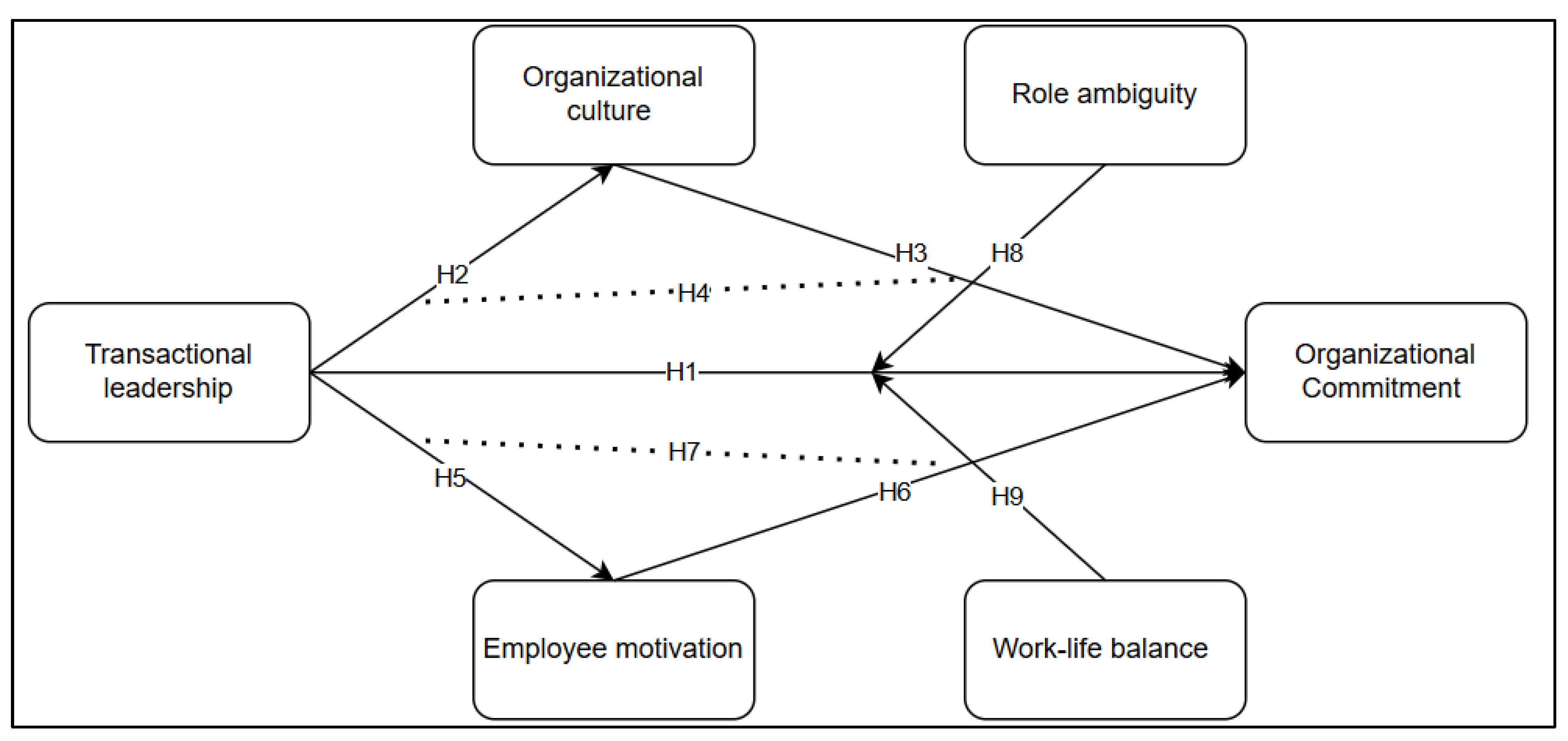
Figure 2.
Lower order constructs Author’s development.

Figure 3.
Structural model. Authors’ own development.
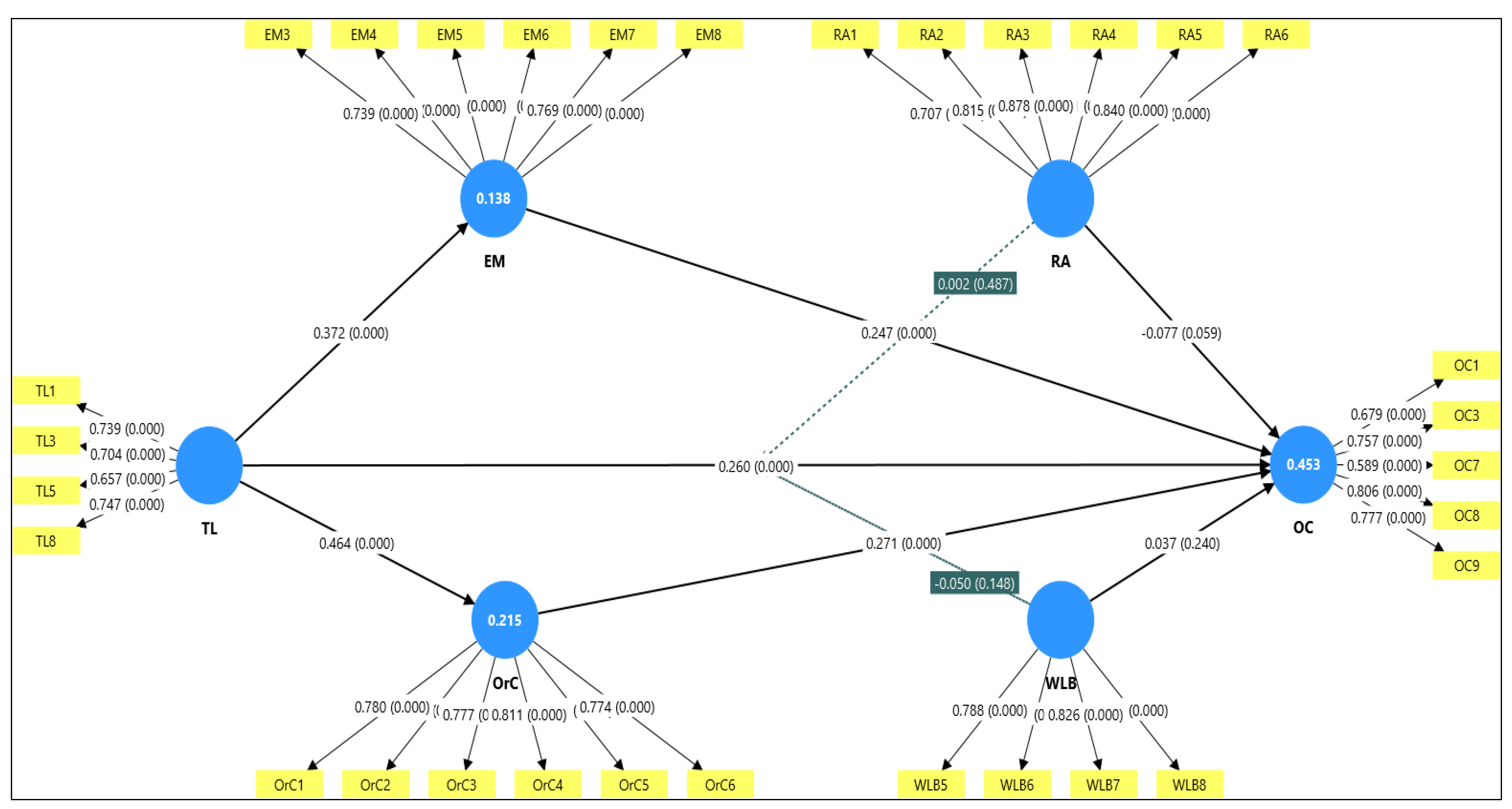
Figure 4.
Moderation effect on role ambiguity; Source: Authors own development.
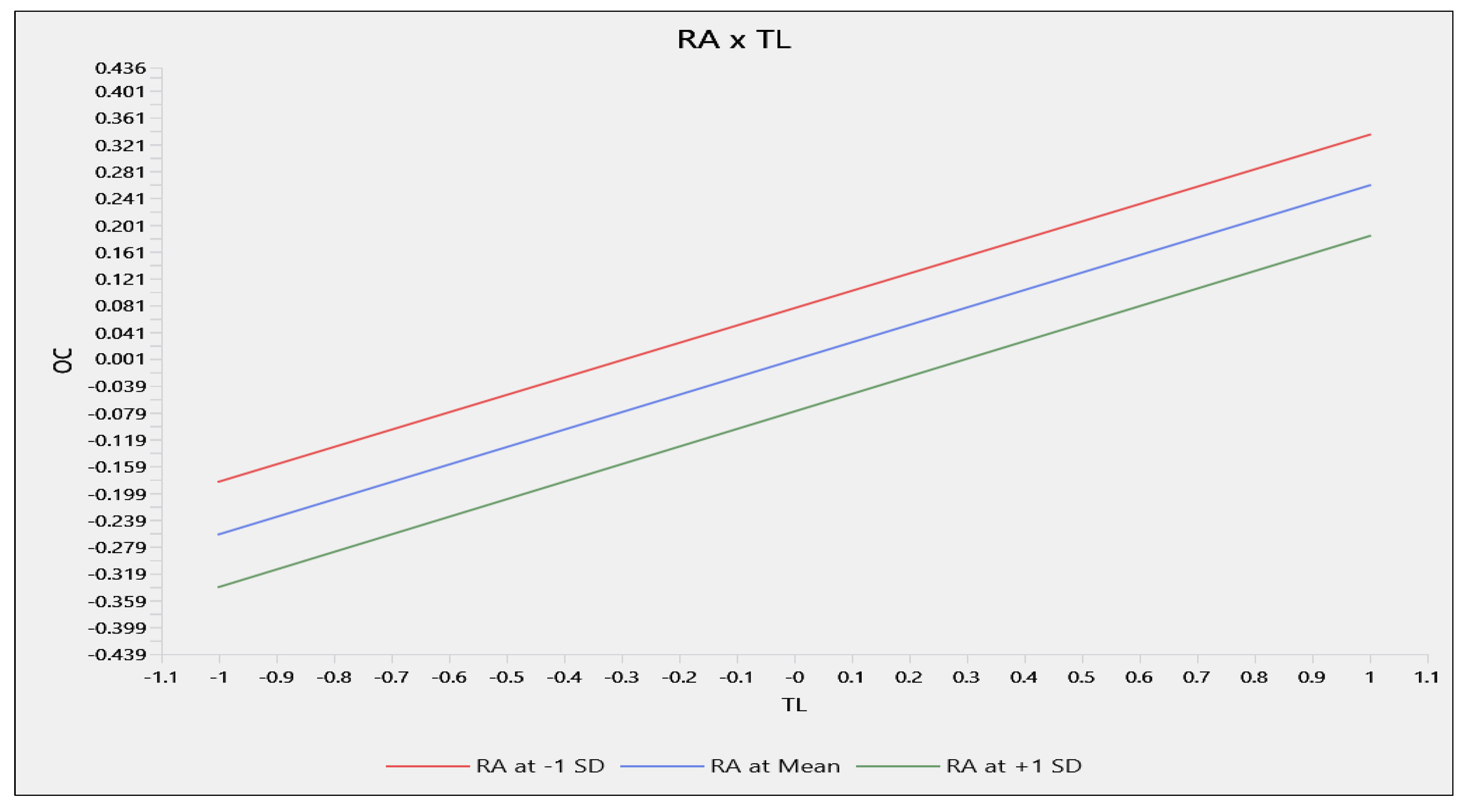
Figure 5.
Moderation effect on Work-life balance; Source: Authors own development.


Table 1.
constructs their source of measurement.
| Source | Instrument | Construct | No of items |
|---|---|---|---|
| Bass and Avolio, (2011) | Multifactor leadership questionnaire | Transactional leadership | 8 |
| Meyer and Allen, (1997) | Three model component questionnaire scale (OCQ) | Organizational commitment | 9 |
| Dębski et al., (2020) | Organizational culture scale | Organizational culture | 6 |
| Alshmemri et al., (2017) | Herzberg’s two-factor theory of motivation | Employee motivation | 8 |
| Bowling et al., (2017) | Rizzo et al scale measurement | Role ambiguity | 6 |
| Fisher et al., (2009) | Measurement scale of work-life balance | Work-life balance | 8 |
Source: authors’ own development.
Table 2.
demographics.
| Category | Character | Counts | Percentage% | |
|---|---|---|---|---|
| Respondents profile | Sex | male | 205 | 73.700% |
| Female | 73 | 26.300% | ||
| Age | 18–24 | 10 | 3.600% | |
| 25-34 | 133 | 47.800% | ||
| 35-44 | 87 | 31.300% | ||
| 45-54 | 32 | 11.500% | ||
| ≥55 | 16 | 5.800% | ||
| Education | Secondary level | 0 | 0.000% | |
| Diploma level | 12 | 4.300% | ||
| Bachelor’s Degree | 122 | 43.900% | ||
| Master’s Degree | 134 | 48.200% | ||
| PhD | 10 | 3.600% | ||
| Post-doctoral | 0 | 0.000% | ||
| Experience | Less than 1 year | 14 | 5.000% | |
| 1-3 years | 64 | 23.000% | ||
| 4-6 years | 82 | 29.500% | ||
| 7-10 years | 56 | 20.100% | ||
| more than 10 years | 62 | 22.300% | ||
| Employment type | Full-Time | 133 | 47.800% | |
| Part-Time | 128 | 46.000% | ||
| Contractual | 17 | 6.100% |
Source: Authors’ survey data, 2025.
Table 3.
reliability and validity analysis.
| Constructs | Items | Outer loadings | Cronbach’s alpha | rho_a | CR | AVE |
|---|---|---|---|---|---|---|
| Transactional leadership (TL) | TL1 | 0.739 | 0.68 | 0.686 | 0.804 | 0.508 |
| TL3 | 0.704 | |||||
| TL5 | 0.657 | |||||
| TL8 | 0.747 | |||||
| Organizational Commitment (OC) | OC1 | 0.679 | 0.774 | 0.794 | 0.846 | 0.527 |
| OC3 | 0.757 | |||||
| OC7 | 0.589 | |||||
| OC8 | 0.806 | |||||
| OC9 | 0.777 | |||||
| Organizational culture (OrC) | OrC1 | 0.78 | 0.879 | 0.88 | 0.908 | 0.623 |
| OrC2 | 0.773 | |||||
| OrC3 | 0.777 | |||||
| OrC4 | 0.811 | |||||
| OrC5 | 0.818 | |||||
| OrC6 | 0.774 | |||||
| Employee Motivation (EM) | EM3 | 0.739 | 0.849 | 0.853 | 0.888 | 0.568 |
| EM4 | 0.743 | |||||
| EM5 | 0.741 | |||||
| EM6 | 0.791 | |||||
| EM7 | 0.769 | |||||
| EM8 | 0.739 | |||||
| Role Ambiguity (RA) | RA1 | 0.707 | 0.908 | 0.946 | 0.928 | 0.683 |
| RA2 | 0.815 | |||||
| RA3 | 0.878 | |||||
| RA4 | 0.881 | |||||
| RA5 | 0.84 | |||||
| RA6 | 0.824 | |||||
| Work-life balance (WLB) | WLB5 | 0.788 | 0.821 | 0.822 | 0.882 | 0.651 |
| WLB6 | 0.779 | |||||
| WLB7 | 0.826 | |||||
| WLB8 | 0.832 |
Note: TL: transactional leadership, OC: organizational commitment, OrC: organizational culture, EM: employee motivation, RA: role ambiguity, WBL: work life balance, CR: composite reliability, AVE: Average variance extracted Source: authors’ survey data, 2025.
Table 4.
Discriminant validity-Fornell and larcker criterion.
| EM | OC | OrC | RA | TL | WLB | |
|---|---|---|---|---|---|---|
| EM | 0.754 | |||||
| OC | 0.552 | 0.726 | ||||
| OrC | 0.628 | 0.576 | 0.789 | |||
| RA | -0.214 | -0.206 | -0.175 | 0.826 | ||
| TL | 0.372 | 0.496 | 0.464 | -0.119 | 0.713 | |
| WLB | 0.400 | 0.238 | 0.276 | 0.096 | 0.142 | 0.807 |
Note: TL: transactional leadership, OC: organizational commitment, OrC: organizational culture, EM: employee motivation, RA: role ambiguity, WBL: work life balance Source: authors’ survey data, 2025.
Table 5.
Discriminant-Hetrotrait-monotrait ration (HTMT).
| EM | OC | OrC | RA | TL | WLB | |
|---|---|---|---|---|---|---|
| EM | ||||||
| OC | 0.658 | |||||
| OrC | 0.717 | 0.688 | ||||
| RA | 0.241 | 0.238 | 0.196 | |||
| TL | 0.476 | 0.651 | 0.59 | 0.154 | ||
| WLB | 0.478 | 0.292 | 0.321 | 0.123 | 0.199 |
Note: TL: transactional leadership, OC: organizational commitment, OrC: organizational culture, EM: employee motivation, RA: role ambiguity, WBL: work life balance. Source: authors’ survey data, 2025
Table 6.
Discriminant validity- Cross loadings.
| EM | OC | OrC | RA | TL | WLB | |
|---|---|---|---|---|---|---|
| EM3 | 0.739 | 0.366 | 0.428 | -0.175 | 0.256 | 0.272 |
| EM4 | 0.743 | 0.446 | 0.571 | -0.098 | 0.302 | 0.374 |
| EM5 | 0.741 | 0.436 | 0.369 | -0.170 | 0.238 | 0.316 |
| EM6 | 0.791 | 0.465 | 0.479 | -0.169 | 0.295 | 0.302 |
| EM7 | 0.769 | 0.414 | 0.577 | -0.161 | 0.370 | 0.278 |
| EM8 | 0.739 | 0.349 | 0.378 | -0.213 | 0.192 | 0.255 |
| OC1 | 0.378 | 0.679 | 0.395 | -0.175 | 0.376 | 0.165 |
| OC3 | 0.456 | 0.757 | 0.401 | -0.177 | 0.357 | 0.257 |
| OC7 | 0.238 | 0.589 | 0.313 | 0.038 | 0.206 | 0.111 |
| OC8 | 0.443 | 0.806 | 0.502 | -0.211 | 0.404 | 0.182 |
| OC9 | 0.442 | 0.777 | 0.454 | -0.151 | 0.411 | 0.136 |
| OrC1 | 0.502 | 0.500 | 0.780 | -0.122 | 0.429 | 0.248 |
| OrC2 | 0.465 | 0.452 | 0.773 | -0.059 | 0.356 | 0.235 |
| OrC3 | 0.456 | 0.434 | 0.777 | -0.123 | 0.395 | 0.205 |
| OrC4 | 0.483 | 0.433 | 0.811 | -0.139 | 0.343 | 0.256 |
| OrC5 | 0.536 | 0.446 | 0.818 | -0.146 | 0.320 | 0.205 |
| OrC6 | 0.531 | 0.453 | 0.774 | -0.242 | 0.340 | 0.151 |
| RA1 | -0.038 | -0.113 | -0.060 | 0.707 | -0.070 | 0.120 |
| RA2 | -0.191 | -0.110 | -0.146 | 0.815 | -0.129 | 0.130 |
| RA3 | -0.197 | -0.217 | -0.154 | 0.878 | -0.079 | 0.119 |
| RA4 | -0.196 | -0.219 | -0.157 | 0.881 | -0.134 | 0.041 |
| RA5 | -0.236 | -0.156 | -0.172 | 0.840 | -0.078 | 0.066 |
| RA6 | -0.168 | -0.150 | -0.158 | 0.824 | -0.106 | 0.032 |
| TL1 | 0.258 | 0.359 | 0.350 | -0.075 | 0.739 | 0.049 |
| TL3 | 0.260 | 0.393 | 0.347 | -0.064 | 0.704 | 0.168 |
| TL5 | 0.229 | 0.229 | 0.265 | -0.090 | 0.657 | 0.011 |
| TL8 | 0.306 | 0.401 | 0.348 | -0.113 | 0.747 | 0.147 |
| WLB5 | 0.308 | 0.207 | 0.265 | 0.093 | 0.176 | 0.788 |
| WLB6 | 0.243 | 0.195 | 0.196 | 0.076 | 0.079 | 0.779 |
| WLB7 | 0.368 | 0.170 | 0.208 | 0.092 | 0.086 | 0.826 |
| WLB8 | 0.379 | 0.190 | 0.214 | 0.050 | 0.107 | 0.832 |
Source: authors’ survey data, 2025.
Table 7.
Direct relationships.
| Hypothesis | Beta coefficient | Standard deviation | T statistics | P values |
|---|---|---|---|---|
| H1: TL -> OC | 0.260 | 0.052 | 4.992 | 0.000 |
| H2: TL -> OrC | 0.464 | 0.046 | 10.084 | 0.000 |
| H3: OrC -> OC | 0.271 | 0.064 | 4.250 | 0.000 |
| H5: TL -> EM | 0.372 | 0.054 | 6.924 | 0.000 |
| H6: EM -> OC | 0.247 | 0.059 | 4.184 | 0.000 |
Source(s): Authors’ own development.
Table 8.
Mediation analysis.
| Percentile bootstrap 95% confidence interval | ||||||||||||
|---|---|---|---|---|---|---|---|---|---|---|---|---|
| Total effect TL -> OC | Direct effects TL->OC | Indirect effects TL -> OC | ||||||||||
| β | T | P | β | T | P | Hypotheses | β | SD | T | P | Lower | Upper |
| 0.478 | 10.643 | 0.000 | 0.260 | 4.992 | 0.000 | H4: TL->OrC->OC | 0.126 | 0.033 | 3.762 | 0.000 | 0.072 | 0.184 |
| H7: TL->EM->OC | 0.092 | 0.026 | 3.555 | 0.000 | 0.052 | 0.136 | ||||||
Note: TL= Transactional leadership, OC= Organizational commitment, OrC= Organizational culture, EM = Employee motivation, β = Beta coefficients, T = T-statistics, SD, Standard deviation. Source(s): Authors own development.
Table 9.
Moderation analysis.
| Relationships | Beta coefficients | SE | T statistics | P values |
|---|---|---|---|---|
| Moderating effects (RA x TL) -> OC | 0.002 | 0.047 | 0.033 | 0.487 |
| RA -> OC | -0.077 | 0.049 | 1.567 | 0.059 |
| TL -> OC | 0.26 | 0.052 | 4.992 | 0.000 |
| Moderating effects (WLB x TL) -> OC | -0.05 | 0.048 | 1.045 | 0.148 |
| WLB -> OC | 0.037 | 0.052 | 0.705 | 0.240 |
Note: SE= Standard error, TL= Transactional leadership, OC= Organizational commitment, RA: role ambiguity, WBL: work life balance Source: Authors own Development.
Table 10.
explanatory power.
| Predictors | Outcome variables | R2 | F2 | Q2 |
|---|---|---|---|---|
| TL -> OC | OC | 0.453 | 0.096 | 0.250 |
| OrC -> OC | 0.073 | |||
| EM -> OC | 0.058 | |||
| RA -> OC | 0.010 | |||
| WLB -> OC | 0.002 | |||
| RA x TL -> OC | 0.000 | |||
| WLB x TL -> OC | 0.005 | |||
| TL -> OrC | OrC | 0.215 | 0.275 | 0.205 |
| TL -> EM | EM | 0.138 | 0.161 | 0.125 |
Source: Authors own development.
Table 11.
predictive relevance of endogenous variables.
| Constructs | Items | Q²predict | PLS-SEM RMSE | LM RMSE | PLS-LM RMSE |
|---|---|---|---|---|---|
| Employee motivation | EM3 | 0.058 | 1.543 | 1.545 | -0.002 |
| EM4 | 0.083 | 1.649 | 1.666 | -0.017 | |
| EM5 | 0.048 | 1.606 | 1.622 | -0.016 | |
| EM6 | 0.079 | 1.758 | 1.773 | -0.015 | |
| EM7 | 0.123 | 1.696 | 1.709 | -0.013 | |
| EM8 | 0.023 | 1.586 | 1.593 | -0.007 | |
| Organizational commitment | OC1 | 0.135 | 1.917 | 1.890 | 0.027 |
| OC3 | 0.122 | 1.641 | 1.651 | -0.010 | |
| OC7 | 0.030 | 2.067 | 2.075 | -0.008 | |
| OC8 | 0.157 | 1.703 | 1.707 | -0.004 | |
| OC9 | 0.164 | 1.504 | 1.518 | -0.014 | |
| Organizational culture | OrC1 | 0.174 | 1.721 | 1.722 | -0.001 |
| OrC2 | 0.120 | 1.642 | 1.658 | -0.016 | |
| OrC3 | 0.148 | 1.634 | 1.642 | -0.008 | |
| OrC4 | 0.109 | 1.551 | 1.562 | -0.011 | |
| OrC5 | 0.092 | 1.683 | 1.697 | -0.014 | |
| OrC6 | 0.108 | 1.550 | 1.568 | -0.018 |
Source: Authors’ own development.
Disclaimer/Publisher’s Note: The statements, opinions and data contained in all publications are solely those of the individual author(s) and contributor(s) and not of MDPI and/or the editor(s). MDPI and/or the editor(s) disclaim responsibility for any injury to people or property resulting from any ideas, methods, instructions or products referred to in the content. |
© 2025 by the authors. Licensee MDPI, Basel, Switzerland. This article is an open access article distributed under the terms and conditions of the Creative Commons Attribution (CC BY) license (http://creativecommons.org/licenses/by/4.0/).
Copyright: This open access article is published under a Creative Commons CC BY 4.0 license, which permit the free download, distribution, and reuse, provided that the author and preprint are cited in any reuse.


