

Submitted:
21 December 2025
Posted:
22 December 2025
You are already at the latest version
Abstract
Background: Children and adolescents with autism spectrum disorder (ASD) frequently receive antipsychotics and are considered at increased risk for weight gain. Few studies have compared longitudinal weight trajectories between youth with ASD and those with other psychiatric disorders. Methods: This naturalistic, registry-based study used data from the SENTIA cohort, which prospectively monitors antipsychotic safety in individuals under 18 years at a university hospital in Spain. Clinical characteristics were compared between participants with and without ASD. Longitudinal body mass index (BMI) z-score trajectories were analysed using linear mixed-effects models. Results: The sample included 266 participants, of whom 113 (42.5%) had ASD. Individuals with ASD were more often male and initiated antipsychotic treatment at a younger age. Of the 26 participants prescribed an antipsychotic before age 6, 88.5% had ASD. Comorbidity profiles were similar across groups. Risperidone and aripiprazole were the most frequently prescribed antipsychotics. BMI z-scores increased over time (β = 0.130, p = 0.017), and baseline BMI z-score was the strongest predictor. ASD diagnosis did not modify the average linear rate of BMI z-score change (time × ASD: p = 0.251); however, a significant quadratic time × ASD interaction (β = –0.016, p = 0.041) was consistent with a more pronounced early increase followed by earlier attenuation of BMI z-scores in the ASD group. Conclusions: Although antipsychotic treatment was initiated earlier in youth with ASD, no clear difference was observed in the rate of BMI z-score change. Differences in weight trajectories underscore the need for metabolic monitoring in antipsychotic-treated youth.
Keywords:
Introduction
Materials and Methods
Data
Participants
Ethics
Statistics
Results

| Baseline | Total N = 266 |
|---|---|
| Age, years – mean (SD) [range] | 11.1 (3.6) [3-17.9] |
| Male sex [n, (%)] | 204 (76.7) |
| Ethnicity: Caucasian [n, (%)] | 205 (91.1) |
| Main psychiatric diagnosis [n, (%)] | |
| ASD | 113 (42.5) |
| ADHD | 97 (36.5) |
| Conduct disorders1 | 70 (26.3) |
| Unspecified neurodevelopmental disorder | 17 (6.4) |
| Depressive disorders | 13 (4.9) |
| Anxiety disorders | 11 (4.1) |
| Tic spectrum disorders2 | 11 (4.1) |
| Eating disorders | 8 (3.0) |
| OCD | 8 (3.0) |
| Psychotic disorders | 5 (1.9) |
| Other | 8 (3.0) |
| Substance use [n, (%)] | 7 (2.6) |
| Somatic comorbidities [n, (%)] | |
| Neurological disorder | 21 (7.9) |
| Obesity | 10 (3.8) |
| Endocrine disease | 8 (3.0) |
| Hypercholesterolaemia | 6 (2.3) |
| Cardiovascular disease | 6 (2.3) |
| Diabetes | 2 (0.8) |
| Systemic disease | 3 (1.1) |
| Reproductive or sexual disorders | 1 (0.4) |
| Other | 109 (41.0) |
| Antipsychotic medication [n, (%)] | |
| Risperidone | 132 (54.1) |
| Aripiprazole | 69 (28.3) |
| Olanzapine | 17 (7.0) |
| Paliperidone | 7 (2.9) |
| Quetiapine | 5 (2.0) |
| Periciazine | 3 (1.2) |
| Pimozide | 3 (1.2) |
| Tiapride | 3 (1.2) |
| Clozapine | 2 (0.8) |
| Haloperidol | 1 (0.4) |
| Levomepromazine | 1 (0.4) |
| Ziprasidone | 1 (0.4) |
| Baseline | Total N = 266 |
|---|---|
| Family psychiatric history [n, (%)] | |
| Affective disorders | 37 (13.9) |
| Externalising disorders | 27 (10.2) |
| ASD | 25 (9.4) |
| Anxiety disorders | 20 (7.5) |
| Psychotic disorders | 13 (4.9) |
| Substance use disorders | 12 (4.5) |
| Other | 22 (8.3) |
| Family somatic history [n, (%)] | |
| Diabetes | 37 (13.9) |
| Neurological disorder | 29 (10.9) |
| Cardiovascular disease1 | 27 (10.2) |
| Endocrine disease | 21 (7.9) |
| Hypertension | 19 (7.1) |
| Obesity | 18 (6.8) |
| Hypercholesterolaemia | 15 (5.6) |
| Systemic disease | 6 (2.3) |
| Other | 76 (28.6) |
| ASD n = 113 |
Non-ASD n = 153 |
p-value | |
|---|---|---|---|
| Age, years – [mean (SD)] | 9.8 (3.9) | 12.0 (3.0) | <.001 |
| Sex,† male [n, (%)] | 99 (87.6) | 105 (68.6) | <.001 |
| Under 6 years old [n, (%)] | 23 (20.4) | 3 (2) | <.001 |
| Psychiatric comorbidity1 [n, (%)] | 37 (32.7) | 46 (30.1) | .740 |
| Somatic comorbidity2 [n, (%)] | 62 (54.9) | 70 (45.8) | .178 |
| Family psychiatric history3 [n, (%)] | 45 (39.8) | 59 (38.6) | .935 |
| Family somatic history3 [n, (%)] | 54 (47.8) | 88 (57.5) | .148 |
| Antipsychotics naïve [n, (%)] | 39 (40.6) | 59 (43.1) | .813 |
| Total visits – [mean (SD)] | 3.8 (4.2) | 4.4 (3.9) | .055 |
Prescribing Reasons
Anthropometrics
| Cut-off interpretations for BMI z-scores1 | n (%) |
| Thinness | 2 (0.8) |
| Normal weight | 201 (82.0) |
| Overweight | 25 (10.2) |
| Obesity | 17 (6.9) |
| ASD | Non-ASD | t(df) | p-value | |||
|---|---|---|---|---|---|---|
| n | mean (SD) | n | mean (SD) | |||
| z-Height | 102 | 0.1 (1.2) | 142 | -0.1 (1.1) | 1.15 (209.89) | 0.249 |
| z-Weight | 105 | 0.2 (1.4) | 144 | 0 (1.1) | 1.81 (200.84) | 0.071 |
| BMI | 103 | 19.3 (4.8) | 142 | 19.8 (4.4) | -0.79 (207.03) | 0.429 |
| z-BMI | 102 | 0.2 (1.4) | 143 | 0 (1.2) | 0.87 (199.28) | 0.388 |
| Term | Estimate | SE | df | t-value | p-value |
|---|---|---|---|---|---|
| (Intercept) | 0.205 | 0.113 | 345.3 | 1.82 | 0.070 |
| Time (centred) | 0.130 | 0.0536 | 96.8 | 2.42 | 0.017 |
| ASD (vs non-ASD) | 0.0459 | 0.119 | 121.3 | 0.39 | 0.700 |
| Time2 (centred) | -0.0030 | 0.00574 | 515.0 | -0.52 | 0.607 |
| Baseline BMI z-score | 0.973 | 0.0151 | 308.0 | 64.6 | <0.001 |
| Sex (female) | -0.0147 | 0.0435 | 300.0 | -0.34 | 0.735 |
| Age | 0.00043 | 0.00541 | 297.0 | 0.08 | 0.937 |
| Stimulant | 0.0400 | 0.0359 | 262.0 | 1.11 | 0.267 |
| AP naïve | 0.0548 | 0.0348 | 268.0 | 1.58 | 0.116 |
| AP group | 0.0427 | 0.0471 | 277.0 | 0.91 | 0.366 |
| Time (centred) × ASD | 0.0968 | 0.0838 | 96.0 | 1.16 | 0.251 |
| Time2 (centred) × ASD | -0.0155 | 0.00756 | 503.0 | -2.05 | 0.041 |
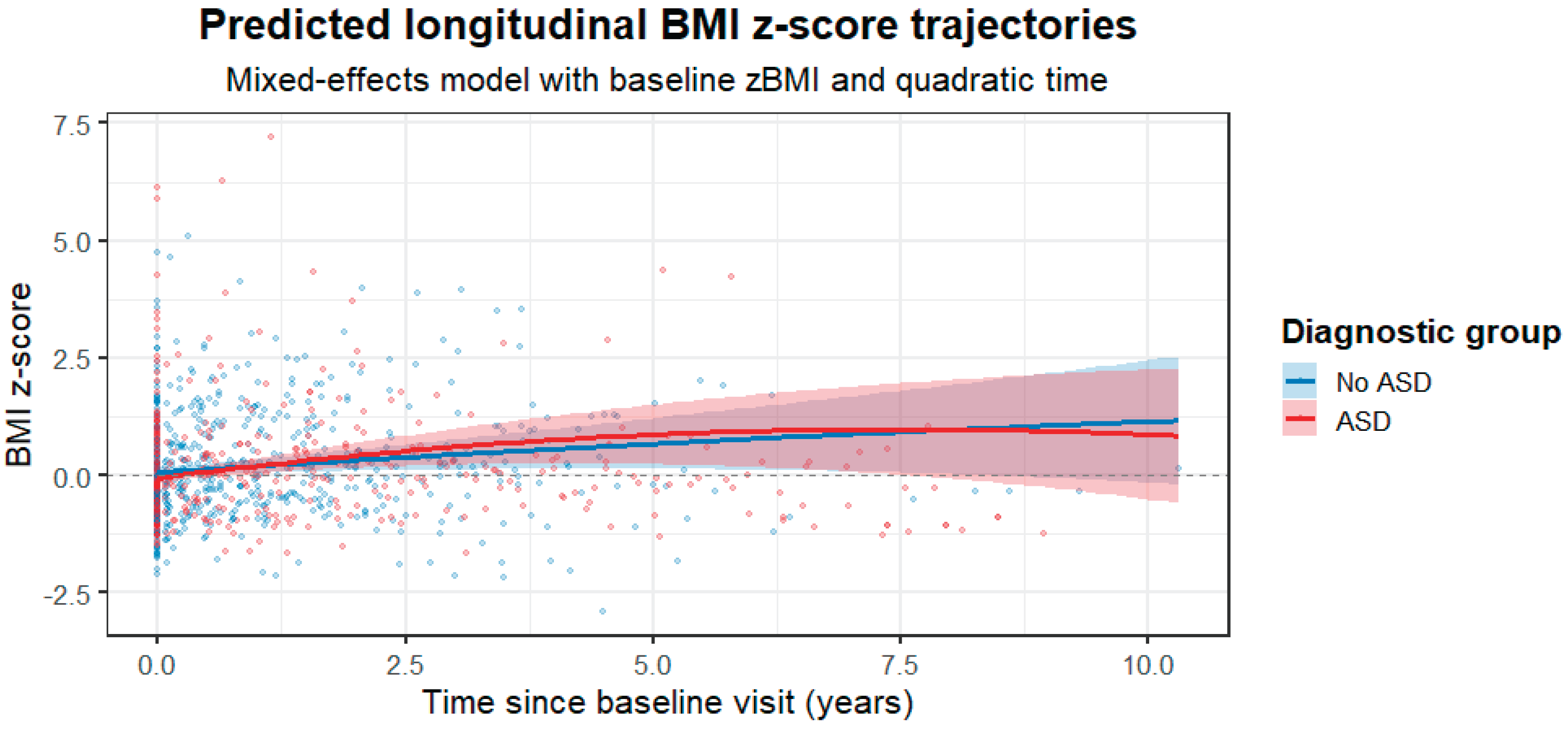
Sensitivity Analyses
Discussion
Conclusion
Author Contributions
Funding
Institutional Review Board Statement
Informed consent statement
Data availability statement
Acknowledgments
Conflicts of Interest
References
- American Psychiatric Association. Diagnostic And Statistical Manual Of Mental Disorders, 5th Ed.; Washington, Dc, 2013.
- Zeidan, J.; Fombonne, E.; Scorah, J.; Ibrahim, A.; Durkin, M.S.; Saxena, S.; Yusuf, A.; Shih, A.; Elsabbagh, M. Global Prevalence Of Autism: A Systematic Review Update. Autism Research 2022, 15, 778-790. [CrossRef]
- Loomes, R.; Hull, L.; Mandy, W.P.L. What Is The Male-To-Female Ratio In Autism Spectrum Disorder? A Systematic Review And Meta-Analysis. J Am Acad Child Adolesc Psychiatry 2017, 56, 466-474. [CrossRef]
- Farmer, C.; Thurm, A.; Grant, P. Pharmacotherapy For The Core Symptoms In Autistic Disorder: Current Status Of The Research. Drugs 2013, 73, 303-314. [CrossRef]
- Gaspar, J.M.; Ferreira, J.P.; Carvalho, H.M.; Toscano, C.V.A. Metabolic And Inflammatory Profiles In Children And Adolescents With Autism Spectrum Disorder: A Cross-Sectional Study. Brain Sciences 2024, 14, 1052.
- Davignon, M.N.; Qian, Y.; Massolo, M.; Croen, L.A. Psychiatric And Medical Conditions In Transition-Aged Individuals With Asd. Pediatrics 2018, 141, S335-S345. [CrossRef]
- Broder-Fingert, S.; Brazauskas, K.; Lindgren, K.; Iannuzzi, D.; Van Cleave, J. Prevalence Of Overweight And Obesity In A Large Clinical Sample Of Children With Autism. Acad Pediatr 2014, 14, 408-414. [CrossRef]
- Chen, M.-H.; Lan, W.-H.; Hsu, J.-W.; Huang, K.-L.; Su, T.-P.; Li, C.-T.; Lin, W.-C.; Tsai, C.-F.; Tsai, S.-J.; Lee, Y.-C.; Et Al. Risk Of Developing Type 2 Diabetes In Adolescents And Young Adults With Autism Spectrum Disorder: A Nationwide Longitudinal Study. Diabetes Care 2016, 39, 788-793. [CrossRef]
- Us Food And Drug Administration (Fda). Approval Package For Abilify,. Available Online: Http://Www.Accessdata.Fda.Gov/Drugsatfda_Docs/Nda/2009/021436orig1s027.Pdf (Accessed On July 2025).
- Us Food And Drug Administration (Fda). Approval Package For Risperdal,. Available Online: Https://Www.Accessdata.Fda.Gov/Drugsatfda_Docs/Label/2019/020272s082,020588s070,021444s056lbl.Pdf (Accessed On July 2025).
- European Medicines Agency. Haloperidol. Available Online: Https://Www.Ema.Europa.Eu/En/Medicines/Human/Referrals/Haldol-Associated-Names (Accessed On July 2025).
- Mason, J.; Pirmohamed, M.; Nunn, T. Off-Label And Unlicensed Medicine Use And Adverse Drug Reactions In Children: A Narrative Review Of The Literature. Eur J Clin Pharmacol 2012, 68, 21-28. [CrossRef]
- Steinhausen, H.C. Recent International Trends In Psychotropic Medication Prescriptions For Children And Adolescents. Eur Child Adolesc Psychiatry 2015, 24, 635-640. [CrossRef]
- Piovani, D.; Clavenna, A.; Bonati, M. Prescription Prevalence Of Psychotropic Drugs In Children And Adolescents: An Analysis Of International Data. Eur J Clin Pharmacol 2019, 75, 1333-1346. [CrossRef]
- Patten, S.B.; Waheed, W.; Bresee, L. A Review Of Pharmacoepidemiologic Studies Of Antipsychotic Use In Children And Adolescents. Can J Psychiatry 2012, 57, 717-721. [CrossRef]
- Carton, L.; Cottencin, O.; Lapeyre-Mestre, M.; Geoffroy, P.A.; Favre, J.; Simon, N.; Bordet, R.; Rolland, B. Off-Label Prescribing Of Antipsychotics In Adults, Children And Elderly Individuals: A Systematic Review Of Recent Prescription Trends. Curr Pharm Des 2015, 21, 3280-3297. [CrossRef]
- Vitiello, B.; Correll, C.; Van Zwieten-Boot, B.; Zuddas, A.; Parellada, M.; Arango, C. Antipsychotics In Children And Adolescents: Increasing Use, Evidence For Efficacy And Safety Concerns. Eur Neuropsychopharmacol 2009, 19, 629-635. [CrossRef]
- Jobski, K.; Höfer, J.; Hoffmann, F.; Bachmann, C. Use Of Psychotropic Drugs In Patients With Autism Spectrum Disorders: A Systematic Review. Acta Psychiatrica Scandinavica 2017, 135, 8-28. [CrossRef]
- Libowitz, M.R.; Nurmi, E.L. The Burden Of Antipsychotic-Induced Weight Gain And Metabolic Syndrome In Children. Frontiers In Psychiatry 2021, Volume 12 - 2021. [CrossRef]
- Yoon, Y.; Wink, L.K.; Pedapati, E.V.; Horn, P.S.; Erickson, C.A. Weight Gain Effects Of Second-Generation Antipsychotic Treatment In Autism Spectrum Disorder. Journal Of Child And Adolescent Psychopharmacology 2016, 26, 822-827. [CrossRef]
- Alsabhan, J.F.; Al Backer, N.B.; Hassan, F.M.; Albaker, A.B.; Assiry, G. Metabolic Side Effects Of Risperidone In Pediatric Patients With Neurological Disorders: A Prospective Cohort Study. Journal Of Clinical Medicine 2024, 13, 5565.
- Palanca-Maresca, I.; Ruiz-Antorán, B.; Centeno-Soto, G.; Jiménez-Fernandez, S.; García-Murillo, L.; Siles, A.; Villagrá, S.; Blasco-Fontecilla, H.; Iruela-Cuadrado, L.; Roman-Riechman, E.; Et Al. Sentia: A Systematic Online Monitoring Registry For Children And Adolescents Treated With Antipsychotics. Springerplus 2014, 3, 187. [CrossRef]
- Harris, P.A.; Taylor, R.; Thielke, R.; Payne, J.; Gonzalez, N.; Conde, J.G. Research Electronic Data Capture (Redcap)—A Metadata-Driven Methodology And Workflow Process For Providing Translational Research Informatics Support. Journal Of Biomedical Informatics 2009, 42, 377-381. [CrossRef]
- Kamp-Becker, I.; Albertowski, K.; Becker, J.; Ghahreman, M.; Langmann, A.; Mingebach, T.; Poustka, L.; Weber, L.; Schmidt, H.; Smidt, J.; Et Al. Diagnostic Accuracy Of The Ados And Ados-2 In Clinical Practice. Eur Child Adolesc Psychiatry 2018, 27, 1193-1207. [CrossRef]
- Lord, C.; Rutter, M.; Le Couteur, A. Autism Diagnostic Interview-Revised: A Revised Version Of A Diagnostic Interview For Caregivers Of Individuals With Possible Pervasive Developmental Disorders. J Autism Dev Disord 1994, 24, 659-685. [CrossRef]
- Carrascosa, A. [Secular Growth Acceleration In Spain. Spanish Growth Studies 2010. Spanish-Born Population And Immigrant Population]. Endocrinol Nutr 2014, 61, 229-233. [CrossRef]
- World Health Organization. Who Growth Reference Data For 5-19 Years,. Available Online: Https://Www.Who.Int/Toolkits/Growth-Reference-Data-For-5to19-Years/Indicators/Bmi-For-Age (Accessed On.
- Bushnell, G.A.; Crystal, S.; Olfson, M. Trends In Antipsychotic Medication Use In Young Privately Insured Children. J Am Acad Child Adolesc Psychiatry 2021, 60, 877-886. [CrossRef]
- Goltz, J.; Ivanov, I.; Rice, T.R. Second Generation Antipsychotic-Induced Weight Gain In Youth With Autism Spectrum Disorders: A Brief Review Of Mechanisms, Monitoring Practices, And Indicated Treatments. Int J Dev Disabil 2019, 67, 159-167. [CrossRef]
- De Hert, M.; Dobbelaere, M.; Sheridan, E.M.; Cohen, D.; Correll, C.U. Metabolic And Endocrine Adverse Effects Of Second-Generation Antipsychotics In Children And Adolescents: A Systematic Review Of Randomized, Placebo Controlled Trials And Guidelines For Clinical Practice. European Psychiatry 2011, 26, 144-158. [CrossRef]
- Taurines, R.; Gerlach, M.; Correll, C.U.; Plener, P.L.; Malzahn, U.; Heuschmann, P.; Scherf-Clavel, M.; Rock, H.; Briegel, W.; Fleischhaker, C.; Et Al. Off-Label Drug Use In Children And Adolescents Treated With Antidepressants And Antipsychotics: Results From A Prospective Multicenter Trial. Child Adolesc Psychiatry Ment Health 2025, 19, 110. [CrossRef]
- Nutt, D. How To Put Psychiatrists Back At The Centre Of Medicine's Innovation. Br J Psychiatry 2025, 227, 885-886. [CrossRef]
- Baeza, I.; Vigo, L.; De La Serna, E.; Calvo-Escalona, R.; Merchán-Naranjo, J.; Rodríguez-Latorre, P.; Arango, C.; Castro-Fornieles, J. The Effects Of Antipsychotics On Weight Gain, Weight-Related Hormones And Homocysteine In Children And Adolescents: A 1-Year Follow-Up Study. Eur Child Adolesc Psychiatry 2017, 26, 35-46. [CrossRef]
- Collares, S.F.; De Ávila Júnior, A.M.; Martins, T.C.; Rezende, V.H.M.; Romano-Silva, M.A.; Santos, R.M.S.; De Miranda, D.M. Systematic Review And Meta-Analysis Of Weight Gain And Metabolic Changes In Children And Adolescents Using Second-Generation Antipsychotics. Pharmacol Biochem Behav 2025, 251, 174012. [CrossRef]
- Lyu, N.; Lin, Y.; Rowan, P.J.; Abughosh, S.; Varisco, T.J.; Chen, H. Prediction Of Antipsychotic Associated Weight Gain In Children And Adolescents Taking Second Generation Antipsychotics: A Machine Learning Approach. Journal Of Psychiatric Research 2025, 191, 454-462. [CrossRef]
- Dhaliwal, K.K.; Orsso, C.E.; Richard, C.; Haqq, A.M.; Zwaigenbaum, L. Risk Factors For Unhealthy Weight Gain And Obesity Among Children With Autism Spectrum Disorder. International Journal Of Molecular Sciences 2019, 20, 3285.
- Correll, C.U.; Manu, P.; Olshanskiy, V.; Napolitano, B.; Kane, J.M.; Malhotra, A.K. Cardiometabolic Risk Of Second-Generation Antipsychotic Medications During First-Time Use In Children And Adolescents. Jama 2009, 302, 1765-1773. [CrossRef]
- Radha Krishnan, R.P.; Dzidowska, M.; Zheng, D.; Wong, Z.S.; Buckley, N.A.; Raubenheimer, J.E. Cardiometabolic Adverse Effects Of Long-Term Antipsychotic Treatment In Children And Adolescents With Non-Psychotic Disorders: A Systematic Review Of Available Evidence. Eur Child Adolesc Psychiatry 2025, 34, 3331-3343. [CrossRef]
Disclaimer/Publisher’s Note: The statements, opinions and data contained in all publications are solely those of the individual author(s) and contributor(s) and not of MDPI and/or the editor(s). MDPI and/or the editor(s) disclaim responsibility for any injury to people or property resulting from any ideas, methods, instructions or products referred to in the content. |
© 2025 by the authors. Licensee MDPI, Basel, Switzerland. This article is an open access article distributed under the terms and conditions of the Creative Commons Attribution (CC BY) license (http://creativecommons.org/licenses/by/4.0/).