1. Introduction
The evolution of Wi-Fi standards has culminated in IEEE 802.11ax, also known as Wi-Fi 6, which guarantees higher throughput, reduced latency, and performs better in dense environments. The standard incorporates advanced technologies such as Target Wake Time (TWT), Orthogonal Frequency-Division Multiple Access (OFDMA), and Basic Service Set (BSS) coloring [
1,
2]. Much of the existing literature has focused on measuring the playback delay of video transmission over a typical 802.11 network without considering network topology and receiving signal strength indicator (RSSI). A thorough literature review uncovers that minimal research has been conducted in determining the combined effect of network topology, RSSI, and bitrate on video playback delays of Gigabit Wi-Fi networks such as 802.11ax. This study seeks to address the following three research questions:
What impact do various RSSI values, codec bitrates, and network topology have on video playback delays of a typical 802.11ax network for 2.4- and 5 GHz frequency bands?
What impact do video QoS parameters (playback delays, throughput) have on the changes in the channel conditions linked to RSSI values?
What is the impact of scaling the number of video clients on QoS parameters in high-density Wi-Fi network scenarios?
To address these research questions, we conducted testbed experiments and simulation-based modelling. The 802.11ax network performance is evaluated in indoor settings and for dual-frequency band conditions. Two network topologies (i.e., ad hoc and infrastructure) are configured for an extensive testbed campaign. Further, OMNET++ simulations are employed to model network scalability and evaluate Quality of Services (QoS) for varying client densities.
Although IEEE 802.11be (Wi-Fi 7) has recently been standardized, 802.11ax (Wi-Fi 6) remains the dominant high-efficiency Wi-Fi technology currently deployed across enterprises, campus, and residential environments. Many of the architectural enhancements introduced in Wi-Fi 7, such as multi-link operation, enhanced scheduling, and improved spectral efficiency, build upon the core mechanisms first realized in 802.11ax, including OFDMA and multi-user transmissions. Consequently, a detailed understanding of 802.11ax performance under realistic operating conditions, such as varying RSSI, application bitrate, network topology, and client density, provides critical insight into the practical challenges and optimization strategies that are likely to persist in next-generation Wi-Fi deployments. In this context, 802.11ac is used as a baseline reference to quantify the relative performance improvements achieved by 802.11ax and to highlight the extent to which it addresses limitations observed in earlier standards.
This paper offers the following key contributions:
We examine the combined effect of RSSI, bitrate, and network topology on video playback delays over a typical 802.11ax client-server network. To achieve this, we develop two practical scenarios (ad-hoc and infrastructure networks) to conduct extensive testbed field experiments and validate the system performance.
We explore the effect of 802.11ax dual-band (2.4- and 5 GHz) on system performance. To this end, we measure the video playback delays and throughput for 2.4- and 5 GHz spectra for comparative analysis.
We develop an OMNET++-based simulation model to evaluate the effect of increasing the number of video clients on system performance. The simulation model captures key QoS metrics, including end-to-end delays, throughput, and packet losses across multiple network configurations and scenarios.
We conduct a baseline performance comparison of 802.11ac and 802.11ax to quantify the improvements and limitations of Wi-Fi 6 under varying RSSI, bitrate, and loading.
The rest of this paper is organized as follows:
Section 2 reviews related work on 802.11-based performance studies.
Section 3 details the testbed setup, simulation model, and methodology used in the evaluation.
Section 4 presents results for both testbed and simulation studies. The results are validated in
Section 5 and the practical system implications are discussed in
Section 6. Finally,
Section 7 concludes the paper with directions for future research.
2. Related Work
Recent studies on 802.11ax and its predecessor technologies have primarily emphasized theoretical modelling and simulation-based assessments. Kuang and Williamson [
2] explored the quality of streaming over legacy 802.11 networks, noting acceptable performance under ideal channel conditions but significant degradation with interference and weak signals. Mena and Heidemann [
3] conducted an empirical analysis of real audio traffic and reported challenges with TCP compatibility, which is critical for video streaming applications.
Shimakawa et al. [
4] examined video traffic performance over IEEE 802.11g using the Distributed Coordination Function (DCF) and Enhanced Distributed Channel Access (EDCA), highlighting the protocol’s limitations in supporting multimedia traffic. Sarkar et al. [
5,
6] modeled and tested 802.11g and 802.11ac networks, offering insights into the effects of access point (AP) configuration, signal strength, and spatial layout on network throughput and latency. While IEEE 802.11ax introduces advanced features such as OFDMA, MU-MIMO, and improved spectral efficiency, its real-world evaluation remains sparse. Another contribution by Linton-Price et al. [
7] extended this work by analyzing the role of IPv4/IPv6 and codec configurations under varying signal environments. Further IEEE publications [
8,
9,
10] have explored specific capabilities of 802.11ax, such as uplink MU transmission [
8], QoS-aware scheduling in dense deployments [
9], and comparative analyses of OFDMA performance [
10]. Park et al. [
11] provided a comprehensive technical overview of 802.11ax’s enhancements over earlier standards. Other works have employed simulation frameworks to assess performance metrics like latency, throughput, and reliability under controlled conditions, but have not complemented these with testbed validation.
More recently, research attention has begun shifting toward 802.11be (Wi-Fi 7), which aims to further enhance throughput, latency, and reliability through features such as multi-link operation, wider channel bandwidths, and improved scheduling mechanisms [
12]. However, much of the existing Wi-Fi 7 literature remains focused on standardization aspects and analytical or simulation-based evaluations, with limited empirical validation under realistic deployment conditions. As many of the efficiency mechanisms introduced in 802.11ax form the foundation for subsequent enhancements in 802.11be, empirical performance studies of Wi-Fi 6 continue to provide valuable insight into deployment challenges and optimization strategies relevant to next-generation Wi-Fi.
A summary of the most relevant related works is presented in
Table 1. The table outlines focus areas, evaluation methods, key findings and limitations. As the table shows, while prior studies have contributed to understanding specific aspects of wireless performance, few have combined field measurements with simulation modelling to assess 802.11ax across frequency bands, bitrate sensitivity, and the impact of RSSI. This study identifies research gap that a comprehensive performance study of 802.11ax using real hardware and credible simulation is worth considering.
3. Methodology
This section discusses the testbed setup and configurations, simulation environment, and performance metrics used in this study to evaluate 802.11ax in a range of realistic and controlled conditions. The combination of empirical and simulation-based methods enables a holistic understanding of network behavior under varying environmental and traffic loads.
3.1. Testbed Environment
The experimental evaluation was conducted at the Auckland University of Technology (AUT), covering both indoor and outdoor locations to simulate real-world scenarios. The indoor tests were carried out in a 40-meter corridor of the engineering building, which included typical obstacles such as walls, doors, and office equipment. The outdoor environment, in contrast, was an open garden area extending up to 80 meters, offering minimal obstruction and noise.
Two network topologies were deployed to reflect commonly encountered configurations. These are summarized in
Table 2 along with the simulation scenario.
In the ad hoc scenario, two Dell Latitude 5420 laptops, each equipped with an Intel AX201 Wi-Fi adapter, were configured in an ad hoc mode. One functioned as a RealPlayer-based media server and the other as a media client. The laptops communicated over 2.4- and 5 GHz bands. To measure the influence of RSSI, the client laptop was placed at various locations away from the server to get various RSSI values. The playback delay was captured using ICMP-based round-trip times and application logs.
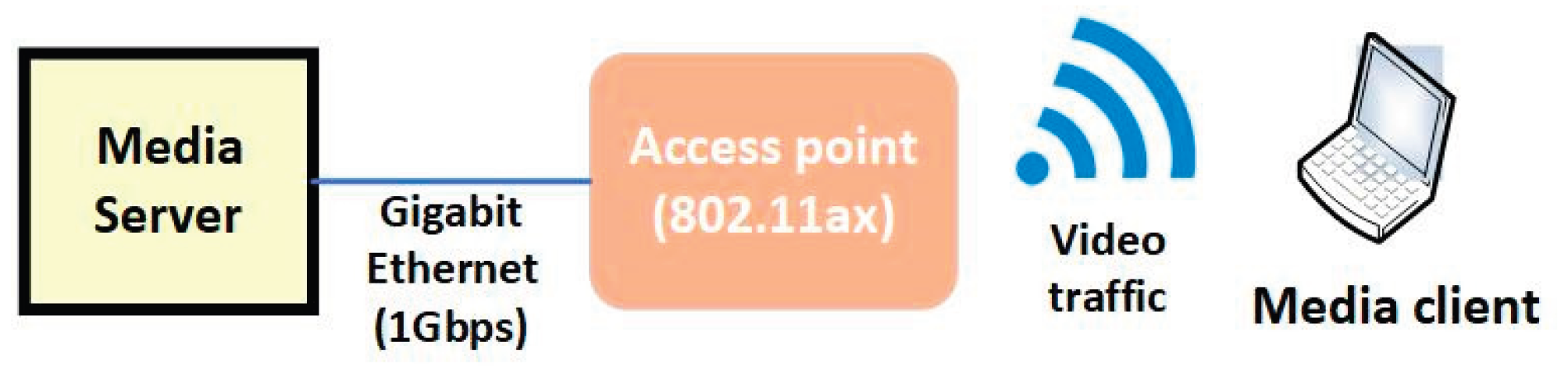
An infrastructure-mode setup featuring a wireless media client (laptop) is shown in
Figure 1. In the infrastructure setup, a TP-Link AC1200 802.11ax-compliant access point was used to simulate a typical enterprise or home wireless LAN. The AP was connected to the server laptop via Gigabit Ethernet, while the client accessed media over Wi-Fi. Both IPv4 and IPv6 were tested for protocol-specific impacts on performance.
This dual-topology design enabled comparative analysis of how centralized (infrastructure) vs. peer-to-peer (ad hoc) architectures influence user experience for various channel conditions.
3.2. Measurement Tools and Setup
To ensure accurate results, a combination of software and manual configuration are used. The following hardware and software tools are used in the study.
Client Device: Dell Latitude 5420 with Intel AX201 Wi-Fi 6 adapter.
Media Streaming: Video files were encoded at bitrates of 1.1 Mbps, 1.7 Mbps, and 5.1 Mbps using MP4 format and streamed using RealPlayer over real-time streaming protocol (RTSP).
RSSI Monitoring: RSSI levels were manually adjusted by relocating the client and recorded via system tools.
Throughput Measurement: iPerf3 was used to send controlled UDP traffic and compute effective throughput.
Playback Delay: Measured using timestamps from ICMP echo requests and RealPlayer application logs.
Each observation was repeated multiple times under the same environmental conditions (e.g., time of day, background traffic) to ensure consistency and account for potential fluctuations in wireless signal behavior. RSSI levels of −48 dBm, −56 dBm, −63 dBm, and −70 dBm were selected to represent excellent to poor channel quality.
3.3. Simulation Environment
To complement the physical testbed and explore high-density scenarios impractical to replicate manually, a simulation study was conducted using OMNET++ version 5.6 with the INET framework. Although OMNET++ does not yet offer native support for 802.11ax, the 802.11ac model serves as a close approximation for our objectives.
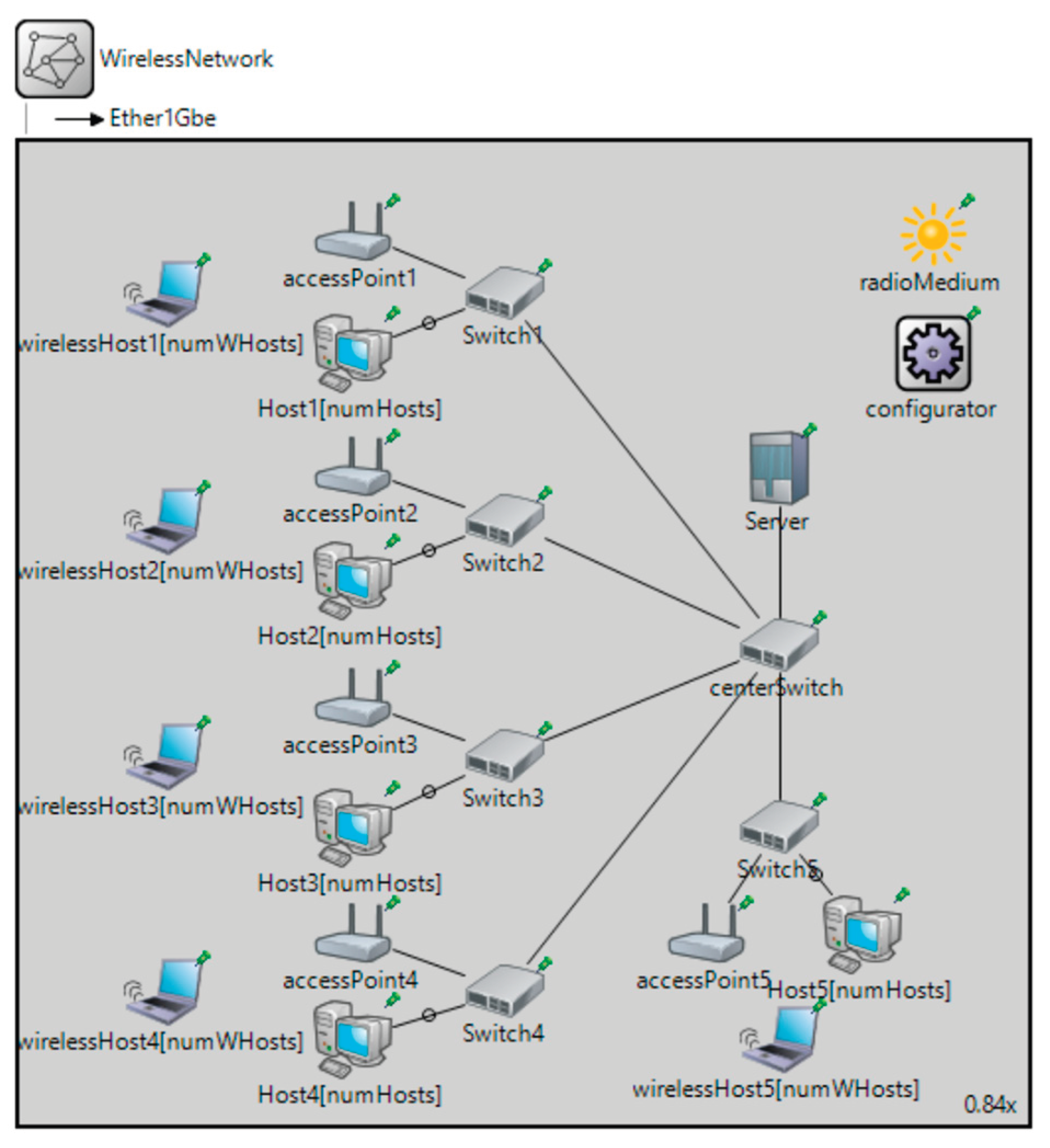
Figure 2 shows the OMNET++ illustration of the simulated architecture featuring a video server, five access points (APs) and video clients. The five wireless access points are connected through a 1 Gbps backbone to a video streaming server. Up to 50 clients were distributed evenly across the network, and their behavior was modelled using ‘UdpVideoStreamClient’, which mimics real-time video conferencing applications.
The simulation parameters are carefully defined to reflect the conditions of the testbed as closely as possible, as shown in
Table 3. The simulation allowed observation of network-wide impact of adding more video clients on system performance metrics.
3.4. Performance Metrics
To ensure comprehensive assessment, both quantitative and qualitative QoS performance metrics such as throughput, playback delay, and packet loss are used. These metrics are commonly used for QoS parameters and are appropriate for our study.
Throughput (bps): Defined as the average number of bits successfully delivered from the server to clients per second.
End-to-End Delay (s): This includes the total time for a packet to travel from source to destination, accounting for transmission, propagation, and queuing delays.
Packet Loss (%): Represents the percentage of packets that failed to reach their intended recipient, often due to congestion or poor link quality.
Playback Delay (s): This subjective QoS metric was inferred through video playback observations and RealPlayer log timestamps.
By integrating a controlled testbed approach and simulation modeling, this methodology facilitates an in-depth exploration of 802.11ax behavior across diverse operating conditions, thus providing a robust foundation for the performance evaluations presented in the following section.
4. Results and Analysis
This section presents the testbed and simulation results, organized by network topology, frequency band, and evaluation metric. It includes a comparative analysis of the IEEE 802.11ax performance in ad hoc and infrastructure setups across 2.4 GHz and 5 GHz frequencies, as well as the impact of increasing client density in the simulated environment.
4.1. Impact of RSSI on Playback Delay and Throughput
The results reveal a strong correlation between received signal strength (RSSI) and video playback delay. As RSSI degraded from −48 dBm to −70 dBm, playback delays increased significantly, particularly on the 2.4 GHz band. For instance, at −48 dBm, average playback delay was below 10 ms across all bitrates, whereas delays at −70 dBm often exceeded 100 ms. This finding is supported by the qualitative wireless channel characterization in
Table 4.
The channel quality gradation shown in
Table 4 was reflected in application-level video performance.
Table 5 links these conditions with observed video quality metrics.
This characterization supports the testbed findings that fair-to-bad RSSI values severely degrade playback experience and often result in wireless disconnections.
4.2. Baseline Performance Comparison: 802.11ac vs. 802.11ax
To contextualize the observed performance of 802.11ax, a baseline comparison was conducted against 802.11ac under varying received signal strength (RSSI) and application bitrate conditions. The baseline measurements were obtained using a comparable experimental setup and identical video workloads, allowing a consistent evaluation of playback delay behavior as signal conditions deteriorate.
The 802.11ac baseline results show that video playback delay remains negligible under strong signal conditions (e.g., RSSI ≥ −67 dBm) across all tested bitrates. However, as RSSI degrades, playback delay increases sharply, particularly for higher bitrates. At RSSI values around −85 dBm, playback delays escalate dramatically, ranging from approximately 116 s to over 550 s depending on the video bitrate—indicating severe buffering and instability. Beyond −87 dBm, wireless connection loss was frequently observed, rendering sustained video playback infeasible.
In contrast, 802.11ax demonstrates improved resilience under degraded RSSI conditions in infrastructure deployments, maintaining playable video streams at signal levels where 802.11ac experiences excessive delay or connection loss. While performance degradation is still evident at weak RSSI, the results indicate that the scheduling efficiency and enhanced medium access mechanisms of 802.11ax mitigate, but do not fully eliminate, the impact of poor channel conditions. This baseline comparison highlights both the performance gains of IEEE 802.11ax over 802.11ac and the persistent importance of RSSI-aware planning for video-centric Wi-Fi network deployments. The key differences in playback delay behavior, link robustness, and sensitivity to RSSI observed between 802.11ac and 802.11ax are summarized in
Table 6.
4.3. Comparison of Ad Hoc and Infrastructure Network Topologies
The infrastructure network consistently outperformed the ad hoc configuration. This was attributed to centralized coordination at the AP, better handling of interference, and support for QoS policies. The ad hoc setup experienced frequent signal drops beyond −63 dBm and demonstrated higher playback delays and jitter.
The effect of network topology and codec bitrate at various RSSI levels is shown in
Table 7. In ad hoc mode, wireless connection loss (WCL) occurred at −63 dBm and −70 dBm in all cases. Infrastructure mode-maintained playback with moderate delay even under poor RSSI. This table further reinforces the benefits of infrastructure topology, especially on the 5 GHz band, where playback remained uninterrupted even at weak signal conditions.
4.4. Simulation Results: Scalability and Client Density
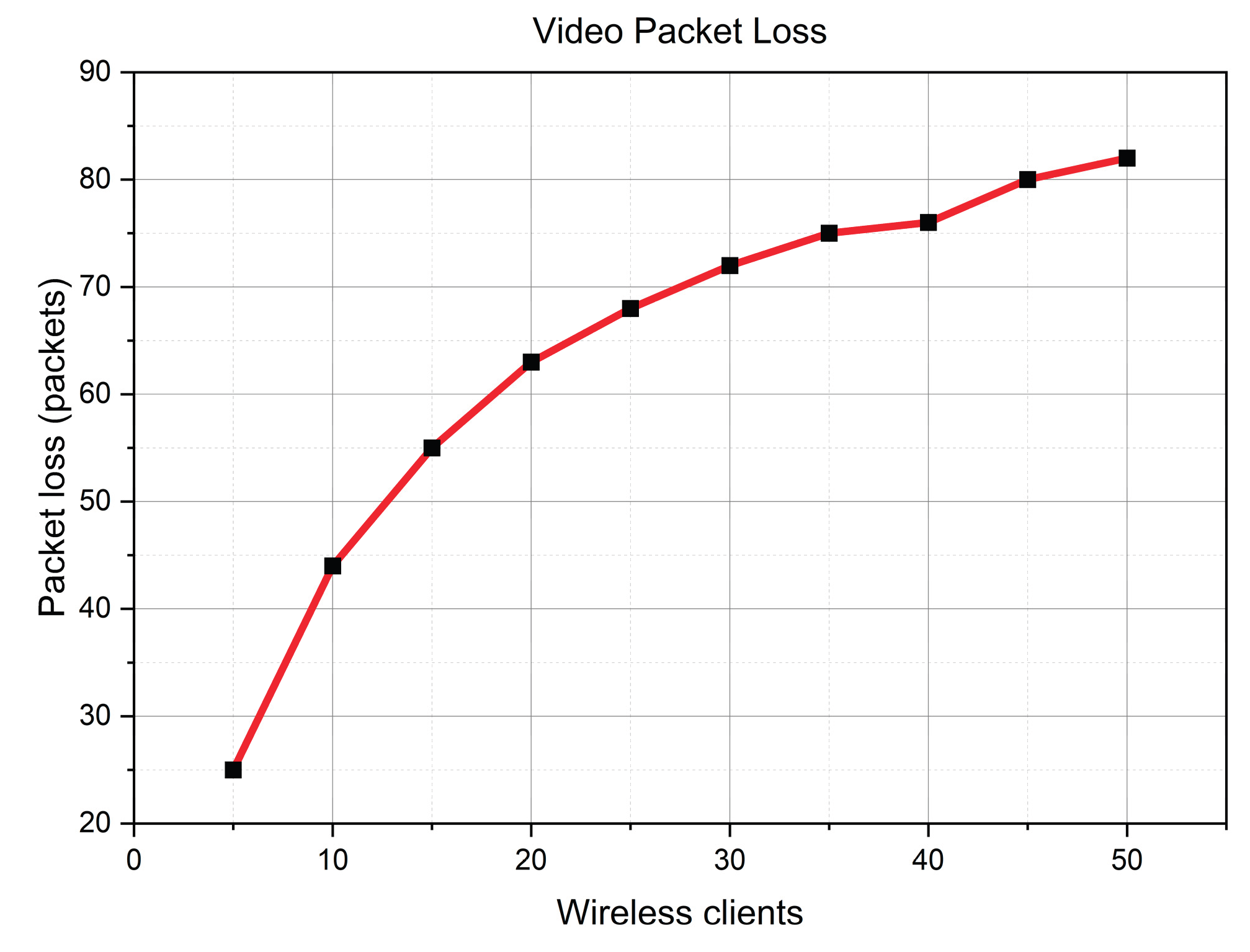
The OMNET++ simulations provided insight into the way network performs under increasing user load. With 5 clients, the average end-to-end delay was 0.05 s and the packet loss remained under 5%. As the number of video clients increased to 50, playback delays rose to 0.14 s and packet loss exceeded 80%, confirming the strain on available bandwidth and buffer limits.
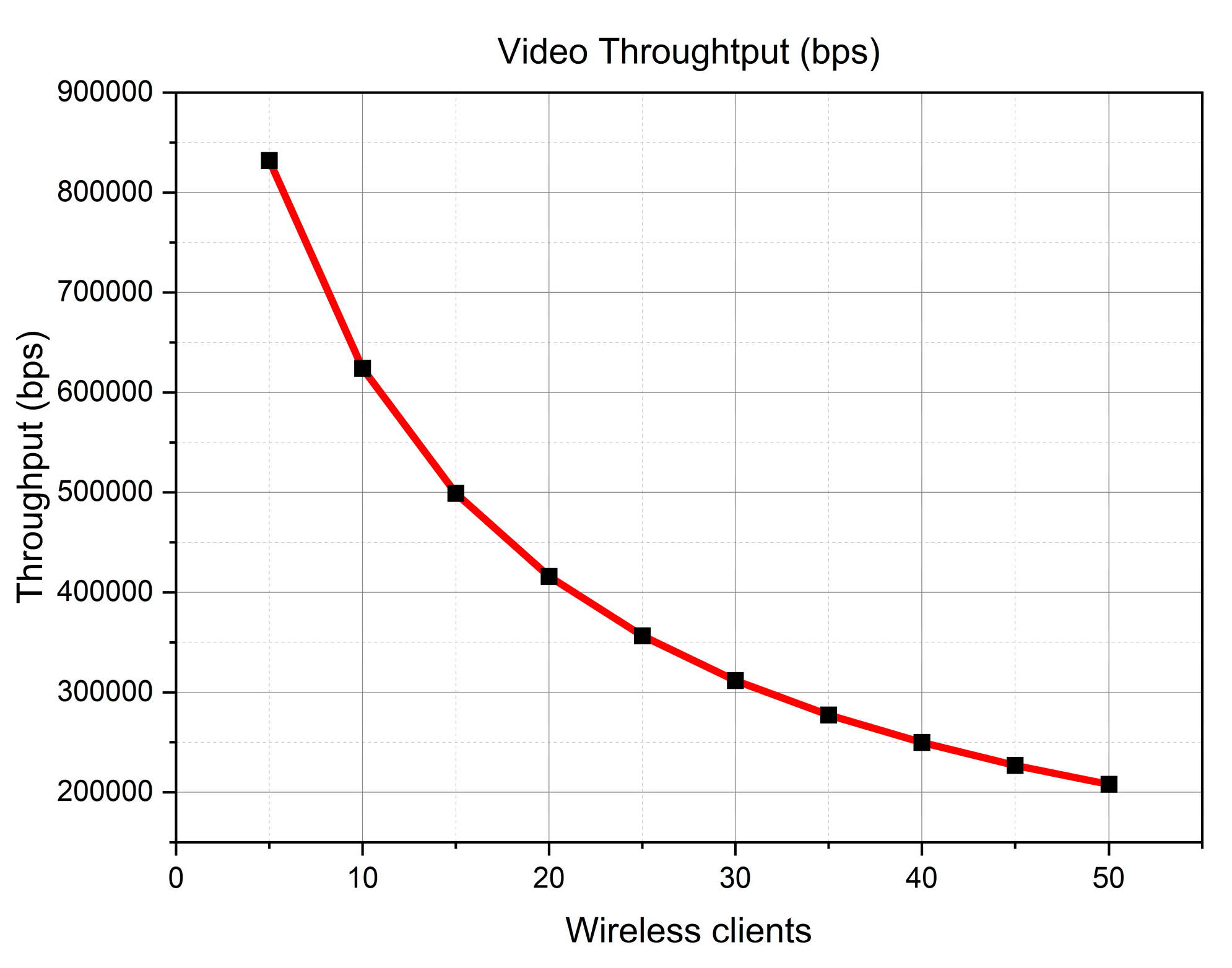
Figure 3 illustrates the significant decline in throughput as client density increases. The system’s ability to deliver data degrades linearly after 10 clients and drops by more than 75% to 50 clients. Throughput declines with the growth in client count, indicating limited capacity for concurrent transmissions in the 802.11ax network under test. Starting at over 830,000 bps for 5 clients, throughput drops steadily and falls below 210,000 bps with 50 clients. This downward trend highlights the challenge of maintaining high data rates in dense environments. Despite 802.11ax’s enhancements (e.g., OFDMA), channel contention and scheduling delays impair scalability.
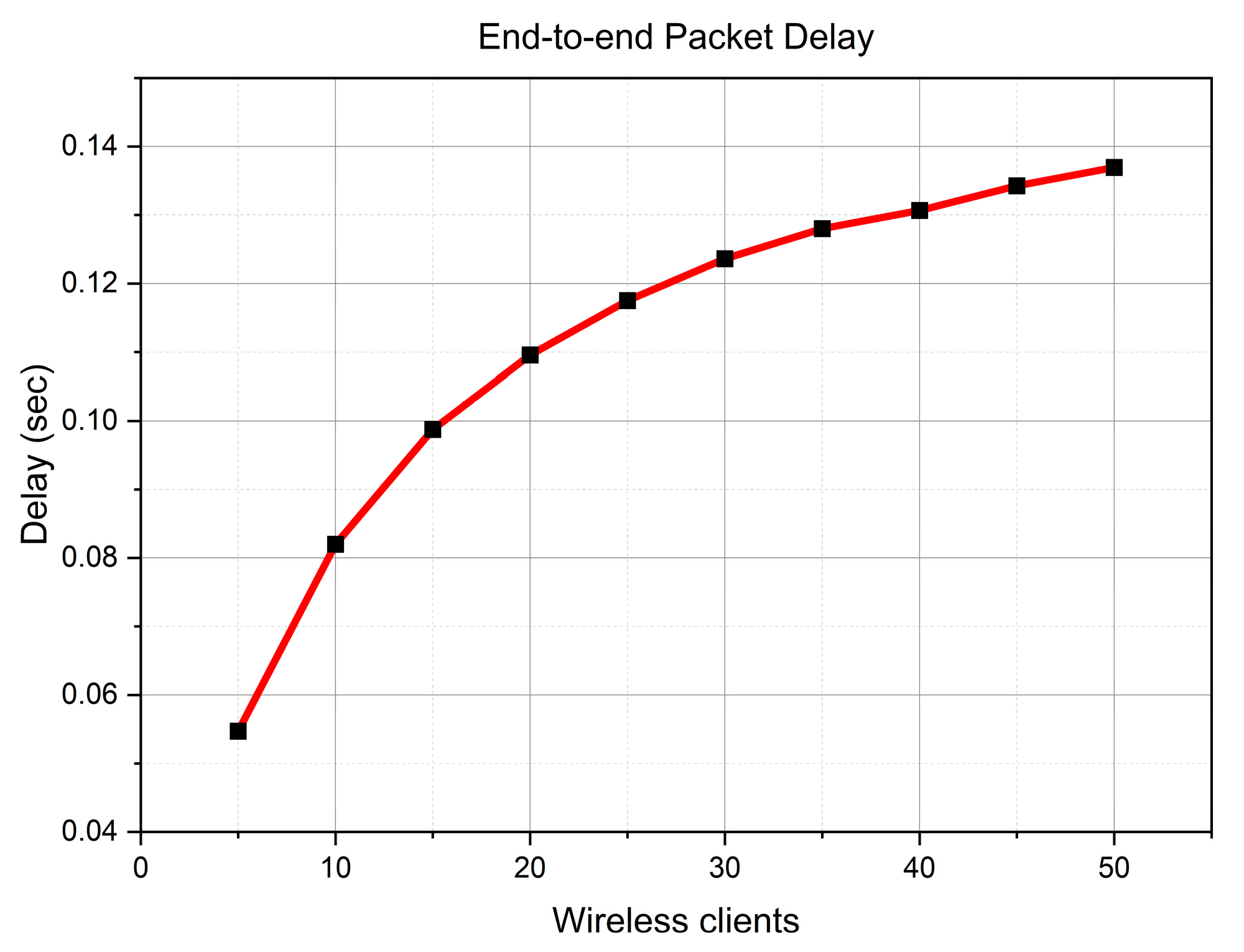
Figure 4 displays the corresponding increase in end-to-end delays, showing that latency becomes a critical concern beyond 20 clients. The delay grows non-linearly, with noticeable jumps around 15 and 30 clients. The end-to-end delays grow gradually but significantly as client count increases. It rises from approximately 55 milliseconds at 5 clients to nearly 137 milliseconds at 50 clients. This non-linear growth reflects queue buildup and increases medium access delays in saturated conditions. The observed delay beyond 20 clients suggests potential degradation in real-time application performance, especially for video traffic.
Packet loss, shown in
Figure 5, surges steeply after 25 clients. Starting from 25% loss at 5 clients, it exceeds 80% by the time 50 clients are active. This indicates that the network buffers and medium access control mechanisms are overwhelmed under high traffic conditions. The packet loss increases sharply with the number of clients, beginning at 25% with 5 clients and exceeding 80% with 50 clients. This trend demonstrates that the wireless medium becomes increasingly unreliable as more users contend for limited airtime. The rising packet drop rate indicates excessive retransmissions and congestion, rendering the network unsuitable for real-time services at higher loads without QoS or traffic shaping mechanisms.
These graphs demonstrate that while 802.11ax provides improved spectral efficiency, it struggles to sustain performance beyond moderate client loads without enhanced management techniques.
4.5. Frequency Band Analysis: 2.4 GHz vs. 5 GHz
The 5 GHz band demonstrated better performance at close range due to wider channel width and less interference. However, it was more sensitive to distance and obstacles, leading to connection losses in the ad hoc setup. Conversely, the 2.4 GHz band maintains connectivity over longer distances but with lower throughput. Overall, the findings support the importance of selecting the appropriate band and topology based on coverage requirements, expected client density, and application type (e.g., real-time video). The validation of results is discussed next.
5. Results Validation and Discussion
This section provides a detailed discussion on the results and revisits the research questions outlined in
Section 1 and maps them to the results obtained:
What impact do various received signal strength indicator (RSSI) values, codec bitrates, and network topology have on video playback delays of a typical 802.11ax network for 2.4 GHz and 5 GHz frequency bands?
The findings clearly show that weak RSSI values significantly increase playback delays and reduce throughput. Playback became jerky or failed (WCL) at −63 dBm and −70 dBm in ad hoc setups. Conversely, in infrastructure mode, especially on the 5 GHz band networks maintained acceptable performance across all RSSI conditions, though with increased delay at lower strengths.
The baseline comparison between 802.11ac and 802.11ax (
Table 6) strengthens the validation of these results by illustrating how video playback performance degrades across different Wi-Fi generations under weak RSSI conditions. While IEEE 802.11ax demonstrates improved delay stability and link robustness compared to 802.11ac, particularly in infrastructure deployments, the baseline findings confirm that degraded signal strength remains a dominant limiting factor for video-centric applications. This observation reinforces that advancements in medium access efficiency mitigate, but do not eliminate, the impact of poor channel conditions, underscoring the continued importance of RSSI-aware deployment and client management strategies.
- 2.
What impact do video QoS parameters (playback delays, throughput) have on the changes in the channel conditions linked to RSSI values?
Infrastructure networks consistently outperformed ad hoc setups in terms of stability, throughput, and delay. In ad hoc networks, wireless disconnections occurred frequently beyond −63 dBm, while infrastructure setups maintained playable video streams with only moderate delay increases. This highlights the robustness of centralized management for dynamic environments.
- 3.
What is the impact of scaling the number of video clients on QoS parameters in high-density Gigabit Wi-Fi network scenarios?
Simulation results obtained from OMNET++ reveal that as the number of clients increases, network performance deteriorates substantially. Throughput drops by over 75%, end-to-end delay nearly triples, and packet loss exceeds 80% with 50 video clients. These observations confirm that without traffic prioritization and congestion control mechanisms, 802.11ax performance is significantly impaired under high user loads.
These results align with prior studies that emphasize the superior spectral efficiency of 802.11ax under ideal laboratory conditions. However, this study reveals key real-world limitations that emerge under dynamic wireless conditions. The most pronounced issues arise under degraded RSSI and higher client densities, where packet loss, throughput degradation, and end-to-end delay severely compromise network performance.
Firstly, the infrastructure network consistently demonstrated better stability and reliability than the ad hoc network. This highlights the importance of centralized access point management, especially for real-time and video-centric applications. The infrastructure mode was able to withstand lower signal strength environments, particularly on the 5 GHz band, due to better resource scheduling and traffic control mechanisms. The 5 GHz band proved to be more effective for short-range, high-throughput scenarios, while the 2.4 GHz band was more resilient over longer distances. However, the results also indicate that selecting a band is insufficient, performance is equally dictated by channel conditions (RSSI/SNR), bitrate demands, and device capabilities. From the simulation results, it is evident that 802.11ax’s ability to handle dense environments, though superior to its predecessors, is still susceptible to performance bottlenecks. Beyond 20 clients, degradation in throughput and rise in latency and packet loss become exponential. The simulation effectively emulated realistic network congestion and buffer overflow scenarios, highlighting the need for intelligent traffic shaping and Quality of Service (QoS) provisioning in future deployments.
The qualitative analysis of channel conditions (
Table 4 and
Table 5) correlated well with quantitative playback delays (
Table 7). Excellent and good channel states maintained uninterrupted video delivery, while fair and bad channels led to visual degradation and even connection loss. This reinforces that signal strength and SNR should be integral parameters in Wi-Fi 6 deployment planning. In addition, subtle differences observed between IPv4 and IPv6 performance suggest the influence of protocol stack overhead, packet handling mechanisms, and device support. These protocol-related effects merit further study to optimize network-layer performance for emerging applications.
Overall, our study demonstrates that while 802.11ax introduces several technical advancements, practical implementation success hinges on holistic system design incorporating network topology, environmental factors, device density, frequency planning, and adaptive bitrate control. These insights are particularly valuable for campus, enterprise, and high-occupancy residential deployments where robust and reliable wireless connectivity is essential.
Testbed Results Validation: The reliability of the testbed measurements was enhanced by addressing several factors. First, field experiments were consistently conducted during the same weekly time windows to maintain stable environmental conditions, such as occupancy levels in the test area. Second, efforts were made to minimize co-channel interference from surrounding networks or devices by selecting the wireless channel with the least detected traffic. Lastly, each test scenario was executed multiple times to ensure the repeatability and consistency of the collected data.
Simulation Model Validation: OMNET++ is considered a dependable open-source simulation platform; however, improper parameter configuration can compromise result accuracy [
13,
14]. Initially, the simulation log files were reviewed to confirm error-free execution and smooth operation of the models. To obtain a representative dataset, the simulation was conducted over a duration of one hour. Following this, the setup was examined for network compatibility to ensure the absence of any technical discrepancies. Finally, OMNET++ simulation models were verified against field experiment data gathered from two wireless-enabled laptops and an 802.11ax access point. The close alignment between simulation outcomes and testbed observations confirms the accuracy of the models.
6. Practical Implications
The findings from this study translate directly into actionable guidelines for network planners and Wi-Fi network administrators aiming to deploy high-performance 802.11ax Gigabit Wi-Fi systems, particularly for video streaming applications. The practical implications are highlighted below.
Deploy an infrastructure-based network as it consistently outperforms ad hoc networks, offering better stability, throughput, and tolerance to low RSSI levels. The baseline comparison with 802.11ac indicates that while 802.11ax improves resilience to degraded RSSI and traffic load, network planning practices such as maintaining adequate signal strength, limiting client density per access point, and selecting appropriate bitrates remain critical for reliable video streaming.
Ensure better signal strength (e.g. above −63 dB as wireless performance deteriorates sharply below −63 dBm RSSI especially for HD streaming services. Use 5 GHz band for high-throughput indoor applications as it leverages the lower latency and higher capacity in controlled environments. The 2.4 GHz band can be used in broader coverage as it maintains better connectivity at range.
Limit concurrent video clients to fewer than 25 per access point to keep the packet delays and losses acceptable level. Use adaptive bitrate control to minimize video playback delays. The 1.1 Mbps bitrate can be used for fair and up to 5.1 Mbps for excellent RSSI conditions.
Enable QoS features like Enhanced Distributed Channel Access (EDCA) as they help to prioritize multimedia traffic and extend battery life in dense network scenarios.
The insights into the deployment considerations of 802.11ax are particularly relevant for high-demand scenarios, such as university campuses, enterprise video conferencing setups, public Wi-Fi installations, and residential smart home systems, where optimal video streaming performance is critical. The network administrator and planner can use the findings for system design and deployment.
7. Concluding Remarks
In this paper, the combined effect of RSSI, bitrate, and network topology on video playback delays of 802.11ax (Wi-Fi 6) is investigated using testbed and simulation approaches. While 802.11ax offers significant enhancements like OFDMA and MU-MIMO, its performance is still influenced by factors such as RSSI, frequency band, topology, and client density. Testbed results obtained have shown that the infrastructure network outperformed ad hoc ones, maintaining lower playback delays even under weak signal conditions. At −48 dBm, packet delays in infrastructure networks on 5 GHz remained under 10 ms, while ad hoc networks suffered over 260 ms delays and failed at weak RSSI values. Simulation results revealed that the network throughput drops by 75% and the packet loss exceeded 80% as video clients increased from 5 to 50. The comparison between 2.4 GHz and 5 GHz bands highlighted performance trade-offs i.e., 5 GHz offering better speed at close range, while 2.4 GHz ensured broader but slower coverage. This research provides the following deployment guidelines: (i) use infrastructure network for video-rich environments, maintain RSSI above −63 dBm; (ii) apply adaptive bitrate control; (iii) limit active video clients up to 20 per AP; and (iv) enable QoS features. These insights support Wi-Fi 6 planning across educational, enterprise, and residential settings. The inclusion of an 802.11ac baseline further contextualizes these findings, demonstrating that while 802.11ax offers measurable improvements in resilience to degraded RSSI and traffic load, careful network planning remains essential to achieve reliable video performance. Future work will address the impact of mobility on system performance. The performance evaluation of latest 802.11be (Wi-Fi 7) readiness for high-definition streaming and dynamic environments is suggested as future research work.
Acknowledgments
We thank our research and development students Dylan Linton-Price, Josaih Akesim, Kok Tham, Mike Mohan, and Zarik Mussa (Auckland University of Technology) for conducting the field study.
References
- IEEE, IEEE Standard for Information Technology—Telecommunications and Information Exchange Between Systems—Local and Metropolitan Area Networks—Specific Requirements. 2021.
- Kuang, K. and C. Williamson, RealMedia streaming over the best-effort service model of IEEE 802.11 wireless LANs, in Proc. IEEE GLOBECOM. 2003. p. 1348–1352.
- Mena, R. and J. Heidemann, An empirical study of real audio traffic, in Proc. IEEE INFOCOM. 2000. p. 101–110.
- Shimakawa, K., T. Okuda, and H. Kobayashi, A performance evaluation of video streaming over IEEE 802.11 WLAN, in Proc. IEEE PIMRC. 2004. p. 999–1003.
- Sarkar, N.I., O. Mussa, and S. Gul, Impact of people’s movement on Wi-Fi link throughput in indoor propagation environments: an empirical study. Electronics, 2021. 10(7): p. 856.
- Sarkar, N.I. and S. Gul. The impact of wireless nodes on the performance of video streaming over a gigabit backbone network. in 2022 International Conference on Information Networking (ICOIN). 2022. IEEE.
- Linton-Price, A., M. Abdel-Maguid, and R. Murphy, QoE analysis of H.264 and H.265 encoded video streaming in Wi-Fi environments using IPv4 and IPv6, in Proc. IEEE VTC. 2022.
- Bhattarai, S., G. Naik, and J.-M.J. Park. Uplink resource allocation in IEEE 802.11 ax. in ICC 2019-2019 IEEE international conference on communications (ICC). 2019. IEEE.
- Deng, D.-J., et al., On quality-of-service provisioning in IEEE 802.11 ax WLANs. IEEE Access, 2016. 4: p. 6086-6104.
- Naik, G., S. Bhattarai, and J.-M. Park. Performance analysis of uplink multi-user OFDMA in IEEE 802.11 ax. in 2018 IEEE international conference on communications (ICC). 2018. IEEE.
- Park, Y., et al., Overview of IEEE 802.11ax high efficiency WLAN, in Proc. IEEE WCNC. 2018.
- Khorov, E., I. Levitsky, and I.F. Akyildiz, Current status and directions of IEEE 802.11 be, the future Wi-Fi 7. IEEE access, 2020. 8: p. 88664-88688.
- Banks, J., Discrete event system simulation. 2005: Pearson Education India.
- Varga, A. Discrete event simulation system. in Proc. of the European Simulation Multiconference (ESM’2001). 2001.
|
Disclaimer/Publisher’s Note: The statements, opinions and data contained in all publications are solely those of the individual author(s) and contributor(s) and not of MDPI and/or the editor(s). MDPI and/or the editor(s) disclaim responsibility for any injury to people or property resulting from any ideas, methods, instructions or products referred to in the content. |
© 2025 by the authors. Licensee MDPI, Basel, Switzerland. This article is an open access article distributed under the terms and conditions of the Creative Commons Attribution (CC BY) license (http://creativecommons.org/licenses/by/4.0/).