

Submitted:
18 December 2025
Posted:
19 December 2025
You are already at the latest version
Abstract
Scientific progress is held back by the high cost of proprietary equipment and the restrictive nature of patents, which slow innovation and limit scientific novelty. Free and open-source hardware offers a proven alternative, reducing costs generally by more than 90% for equivalent or lesser proprietary hardware while accelerating technological development through collaborative design and distributed digital manufacturing as well as commercial pathways. Despite these benefits, funding for scientific hardware development predominantly follows the antiquated proprietary model, creating a gap between scientists’ ability to purchase proprietary equipment and their inability to finance lower-cost open source alternatives. This article analyzes four financial models for open hardware development: (1) philanthropy model, where funders (non-profits or governments) shoulder all design risks; (2) standard investor model, where investors assume risk for design and sales in order to earn a return on investment (ROI); (3) crowd-sourced model, where the scientific community funds development and shares risk; and (4) a new decoupled risk investor model, which separates open hardware design risk from risk of an ROI by introducing a guarantor. A case study demonstrates that the decoupled risk investor model provides success for conventional science funders at marginally higher cost while enabling global access to low-cost designs and healthy ROIs with lower risk for investors. Comparative analysis highlights advantages and limitations of each approach, providing actionable recommendations for science funders. This work aims to derisk open hardware design financing, expand adoption, and democratize access to scientific tools globally while fostering innovation and cost savings across research disciplines.
Keywords:
open hardware
; finance
; derisk
; business model
; open source
; funding
; open source economics
Introduction
Scientific progress is hampered by lack of resources. In financially constrained laboratories this is often due to lack of conventional proprietary scientific equipment, which can be prohibitively expensive [1]. Some of these cost barriers come from lack of innovation and now there is a significant amount of literature shows that patents slow innovation [2,3,4,5,6,7,8]. This is because the process is slow and restrictive as only the inventor and licensees may legally work with a technology. In contrast, the open-source model of technological development has been shown to be a powerful driver of technological progress first in the free and open-source software (FOSS) industry where FOSS is distributed under licenses that enable anyone to use, copy, study, and modify the source code [9]. Open source licenses include a "viral clause," requiring all adaptations be shared under the same license, which encourages a virtuous cycle of collaboration and improvement [10]. Open source licenses initiate a "gift economy" [11], that spurs rapid innovation [12,13]. This has driven commercial success and global scaling[14]: 100% of the top 500 supercomputers in the world run FOSS[15]; 90% of cloud servers run open-source operating systems, including those of household names Amazon, Facebook, Google, X, and Yahoo[16]; 90% of the Fortune Global 500, including non-tech firms like McDonalds and Wal-Mart use FOSS for operations [17]; over 70% of smartphones operate on open-source platforms[18] as well as over 70% of Internet of Things (IoT) devices and 97% of embedded systems run FOSS [16,19].
One way to reduce the cost of scientific equipment is to apply the same free and open source model that drives innovation in software to scientific hardware. The resultant, open hardware[20] is now well-established as a reliable way to reduce the capital costs of scientific hardware.[21,22] Open hardware has provided cost savings for scientists in biology[23], medicine[24,25,26], chemical handling[27,28], electronics [29,30,31], physics [32] and education [33,34,35]. In a review open hardware was found to reduce the costs of scientific equipment as a whole by 87% compared to equivalent or lesser proprietary tools (and up to 94% if open source electronics and digital manufacturing are incorporated). [36] Digital manufacturing of open hardware designs has proven particularly useful for lateral scaling of low cost solutions[37,38] as well as during the public health crisis.[39,40,41,42] The downloaded substitution value[43] as scientists download and manufacture hardware for themselves with digital replication tools like 3D printers, CNC mills, and laser cutters, provides extremely high returns on investment (ROIs) for scientific funders [44]. There is a very strong case to be made that all government funded hardware should be made open source by default [45], which is even supported at the EU level[46]. Even if distributed manufacturing is not used, open source does not limit commercialization as there are several viable open source hardware-based business models[47,48]. There are many companies that provide open hardware specifically to the scientific community (e.g., the OpenFlexure microscope[49], Jericho data loggers [50], OpenQCM open quartz crystal monitors[51], or the IoRodeo potentiostats [52]) as well as academic entrepreneurship[53]. There is now even a global network of local open science hardware vendors and manufacturers at the Open Science Shop [54].
Yet funding of scientific hardware development remains largely closed. The conventional closed model of development relies on patent monopolies, which slow innovation and raise costs. There is a distinct barrier in place now in that the people that use scientific equipment (scientists) have funds to purchase equipment but not to develop equipment. To overcome that barrier this article explores several models and proposes a new model to reduce the risks of developing open hardware for the scientific community. These models are critically analyzed for benefits and drawbacks, compared and conclusions are drawn for recommendations for different types of scientific funders.
Open Hardware Development Models
Philanthropy Model
The first model of open hardware development follows the standard science funding model as outlined in Figure 1. Philanthropists (whether private, not for profit or public) fund open hardware designers. For example the U.S. National Science Foundation has the Pathways to Enable Open-Source Ecosystems (POSE) program [55], which can be used to support open hardware. Designs funded by the philanthropist with an open hardware license can then be either manufactured by the scientists themselves for the cost of manufacture following lateral scaling or be purchased from one or several manufacturers using conventional open hardware business models. Manufacturers like SparkFun can make a profit the same as any standard business by selling FOSH for more money than it costs them to produce the open source scientific equipment [56].
In this model the philanthropist bears all the risk of design failure and funds the designer. The funds from the scientists are used to either purchase materials or the finished products from manufacturers. It should be noted that these funds for purchases often normally come from the same philanthropists. The major drawback on this model is that the philanthropist is not only fully funding the FOSH development but also takes all of the risk that the project fails. This form of funding FOSH development is relatively uncommon for a singular project as equipment development is rarely funded as a whole, but is often falls under the umbrella of performing a new scientific experiment that requires some customization of scientific hardware.
Standard Investor Model
In the standard investment model shown in Figure 2 investors put up the up-front capital for the FOSH design that is part of a company. When the FOSH design is complete, it is manufactured by the company and then it is sold to the scientific community with a profit, which provides a return of r% to the investors. There are several other business models for the company including: 1) kit suppliers (e.g., Adafruit that sells electronic kits)[57], 2) specialty components (e.g., Backyard Brains)[58], 3) validation services (e.g., MakerFab validation of IoT devices), 4) open hardware vendors (e.g., OpenTrons fluid handling robots), and 5) businesses using secondary supplier models (e.g., NECi Superior Enzymes selling open source photometers[59] to build additional markets for their enzymes). Open hardware businesses can also base drive profits using service business models including: 1) consulting services (e.g., AB consulting on embedded and wireless systems), 2) subscription model (e.g., Crowd Supply that launches open hardware products and offers services like fulfillment, marketing, and e-commerce to creators), 3) open hardware book publishers (e.g., No Starch Press) and 4) open hardware education via courses, certification, workshops, or training (e.g., Open Source Ecology[60] for building large faming equipment and now open source houses), 5) consulting to make more complicated open hardware or fulfil research grants (e.g., Jericho Labs), 6) manufacturing support open hardware firms (e.g., Seeed Studio) and 7) open hardware repositories[61] (e.g., Open Source Hardware Association Certification).
In this model the investors fund the design and take on the risk of design failure and sales failure. This model is common for proprietary hardware, but the lack of a monopoly to ward off competitors and copy-cats reduces some investors’ willingness to invest. Open hardware, however, enables a strong community, which can increase customer perceived value, speed product development while decreasing costs, cut sales cost and the need for advertising, and incubate startups with external expertise and resources.[62]
Crowd Source Model
In the crowd-sourced financing model shown in Figure 3, people from the scientific community that want the open hardware pay up front for the designer. If the design is successful normally the designer would provide manufactured tools to the same scientists (e.g., Crowd Supply, Kickstarter, Indiegogo or Fundable). As the designs are open source, scientists can manufacture them as well.
In this model the scientific community pays for the open hardware development and shoulders the risk. They also pay for the hardware. Crowd Supply and other crowdfunding websites do derisk this somewhat because many FOSH designers do preliminary work to provide assurances to the backers that they will perform. It should be noted that some crowd funded projects either fail to reach their funding requirements or completely fail to provide the finished designs.
Decoupled Risk Investor Model
In the derisked investment model shown in Figure 4 investors invest I to provide the initial capital for the FOSH designer to complete the design. A philanthropist guarantor, guarantees that the investors will enjoy a return, r, if the FOSH is successful. This guarantor can also act as the first point validation of the performance of the open hardware or determine success of the open hardware project[63]. The scientific community enjoys the open hardware either by making it themselves with lateral scaling or purchasing it from a manufacturer.
In this model the risk of the hardware design being successful is decoupled from the risk of earning a return through sales of the hardware. This model also enables conventional science funders labeled as philanthropists (whether private or public) to leverage their funding by taking on a relatively minor risk that the hardware is successful.
As this is both new and the most complicated model a case study is presented to illustrate how it works. If a scientific funder like the National Science Foundation (NSF) was considering purchasing 100 scientific bottle rollers to supply a new laboratory course rolling out at several partnered state universities. Thermoscientific offers a proprietary bottle roller (Figure 5a) for $2,439.25 [64], but the upfront cost of $234,925 is high enough that it would justify investigating the possibility of providing a $100,000 grant to make it open hardware under the assumption that they could be made for 1/10th the cost[36]. Then the total cost would be $100,000 FOSH development + 100x$244 =$124,400 and thus save over $100,000 using the Philanthropic model. There is a risk that the open hardware design process may not work, however and thus the initial $100,000 could result in nothing of value and the NSF would still need to pay $234,925 to purchase the bottle rollers for a total cost of $334,925. In the decoupled risk investor model, investors would put up the initial investment, I, of $100,000 under a contract that ensured if the design is successful and the investors would earn $110,000 from the NSF providing them with an r of 10% ($10,000). The NSF would then pay $110,000 for the guarantee of success of an open hardware bottle roller to the investors that costs $244 x100 to build. Thus, the total investment is slightly more ($10,000) than the conventional philanthropic model to pay for open hardware – but success is guaranteed. After the open source bottle roller’s designs are released then other scientists all over the world can get access to bottle rollers for 1/10th the costs as well.
As it were, in the real world an open source bottle roller shown in Figure 5b has been developed and only costs $150 in parts to manufacture [65] as it uses open source electronics and the mechanical parts are 3D printed (purple in Figure 5b). Thus, as the open source system already exists the NSF could purchase the bill of materials for over 1,500 units instead of only 100 units. The kits could be supplied to the schools with the open source directions so students could build the bottle roller they would use in subsequent labs.
Discussion
Funding remains one of the core challenges to scaling open hardware[66]. Funding can be provided for open hardware using four different mechanisms summarized in Table 1. Table 1 shows who pays for the FOSH design the FOSH hardware and who takes on the risk for design failure and ROI from sales. In all the models the scientific community pays for the hardware, but of course they can be funded for the purchases through private philanthropy or from government grants. In the philanthropic model the philanthropist pays for the design and shoulders all the risk for design failure. In the investor model, the investors not only pay, but they shoulder the risk for the design and the ROI. The crowd source model eliminates the second risk and partially mitigates the second by the means that crowd funding sites use. The new decoupled risk investor model, has the investors paying for the development and shouldering the risk of failure of the design but the philanthropists shoulder that risk for them. The new model has advantages over the three current models in that it separates the risk into potentially more palatable amounts for both investors and more conventional science funders.
This derisking can provide access to capital and help overcome some of the challenges to open hardware manufacturing [67]. Open hardware company founders have internal and external motivations[68]. They often feel a moral obligation, altruism and extrinsic motivations such as market obligation, faster time-to-market, a lowered research and development (R&D) and a reduced costs for customer support [69]. For conventional investors that are supportive of a given hardware technology but are concerned about the risks of investing without a monopoly, the new derisking model provides a greater assurance that an ROI will be realized. This could provide a new class of ethical investing in open hardware for science in general or specific sub-areas like the broad sustainability field or more focused regenerative agriculture. The core disadvantage of the new model is that is more complex. Not only is it necessary to identify funders but they must be coupled with a second organization willing to shoulder to vet the design and shoulder the risk of ensuring an ROI.
Finally, it is possible to combine the three conventional models with the decoupled risk model. First, non-profit organizations or the government could act as investors and earn a ROI for developing open hardware directly (in addition to indirect acceleration of science). Second, investors could also act as guarantors but could earn a return indirectly. This is perhaps easiest to observe with a secondary supplier model. Thus, investors in company “A”, that sells “a” goods, would be willing to act as the guarantor for open hardware “b” even if they were not selling it directly as company “B”, if a low-cost easily accessible “b” hardware were in wide use. Finally, a crowd source campaign can be used to fund the initial investment while still having a guarantor in a secondary organization to vet quality. This approach may help drive additional investment from the crowd to for example allow for scaling of manufacturing equipment. Similarly, crowd funding could be used for the guarantor to provide an ROI if successful. Again, it would lower risk for the crowd to see open hardware become reality.
Conclusions
Funding for scientific hardware development remains an impediment to the velocity of scientific progress because funders continue to follow obsolete proprietary models that raise costs and slow innovation. This counterproductive inertia stems largely from perceived risk of investors to fund open hardware development. This study analyzed four financial models for open hardware development: (1) philanthropy model, (2) standard investor model, (3) crowd-sourced model, and (4) a new decoupled risk investor model. The latter can derisk investment for models 1-3 by separating open hardware design risk from risk of an ROI by introducing a guarantor. A case study demonstrated that the decoupled risk investor model provides a means of reaching scientific goals for conventional science funders at marginally higher cost. The benefits, of enabling open hardware creation for science, enabling global access to low-cost designs and faster scientific progress. This also provides good ROIs with lower risk for investors interested in ethical investing in open hardware. Although the new model is more complex and requires two separate sources of funding, it splits the risk of making investments thus making them more palatable to both for-profit and not-for-profit organizations.
Acknowledgements
This work was supported by the Thompson Endowment and The Natural Sciences and Engineering Research Council of Canada.
References
- Chagas, A. M. Haves and Have Nots Must Find a Better Way: The Case for Open Scientific Hardware. PLOS Biology 16 e3000014. [CrossRef]
- Barton, J. H. Patents and Antitrust: A Rethinking in Light of Patent Breadth and Sequential Innovation. Antitrust L.J. 1996, 65, 449–466. [Google Scholar]
- Takalo, T.; Kanniainen, V. Do Patents Slow down Technological Progress?: Real Options in Research, Patenting, and Market Introduction. International Journal of Industrial Organization 2000, 18, 1105–1127. [Google Scholar] [CrossRef]
- Heller, M. A.; Eisenberg, R. S. Can Patents Deter Innovation? The Anticommons in Biomedical Research. Science 1998, 280, 698–701. [Google Scholar] [CrossRef] [PubMed]
- Kingston, W. Innovation Needs Patents Reform. Research Policy 2001, 30, 403–423. [Google Scholar] [CrossRef]
- Fabrizio, K. R. University Patenting and the Pace of Industrial Innovation. Industrial and Corporate Change 2007, 16, 505–534. [Google Scholar] [CrossRef]
- Jaffe, A. B.; Lerner, J. Innovation and Its Discontents: How Our Broken Patent System Is Endangering Innovation and Progress, and What to Do About It; Princeton University Press, 2011. [Google Scholar]
- Sweet, C.; Eterovic, D. Do Patent Rights Matter? 40 Years of Innovation, Complexity and Productivity. World Development 2019, 115, 78–93. [Google Scholar] [CrossRef]
- Comino, S.; Manenti, F. M.; Parisi, M. L. From Planning to Mature: On the Success of Open Source Projects. Research Policy 2007, 36, 1575–1586. [Google Scholar] [CrossRef]
- Lakhani, K. R.; von Hippel, E. How Open Source Software Works: “Free” User-to-User Assistance. Research Policy 2003, 32, 923–943. [Google Scholar] [CrossRef]
- Zeitlyn, D. Gift Economies in the Development of Open Source Software: Anthropological Reflections. Research Policy 2003, 32, 1287–1291. [Google Scholar] [CrossRef]
- Raymond, E. The Cathedral and the Bazaar. Know Techn Pol 1999, 12, 23–49. [Google Scholar] [CrossRef]
- Ehls, D. Open Source Innovation. In Joining Decisions in Open Collaborative Innovation Communities; Springer Fachmedien Wiesbaden: Wiesbaden, 2014; pp. pp 7–42. [Google Scholar] [CrossRef]
- Weber, S. The Success of Open Source. In The Success of Open Source; Harvard University Press, 2005. [Google Scholar] [CrossRef]
- Stackscale. The 500 most powerful supercomputers use Linux | Stackscale. Available online: https://www.stackscale.com/blog/most-powerful-supercomputers-linux/ (accessed on 2024-08-25).
- Eser, A. Linux User Statistics Statistics: Market Data Report 2024. World Metrics. Available online: https://worldmetrics.org/linux-user-statistics/ (accessed on 2024-08-25).
- Parloff, R. How Linux Conquered the Fortune 500. Fortune. Available online: https://fortune.com/2013/05/06/how-linux-conquered-the-fortune-500/ (accessed on 2024-08-25).
- StatCounter. Mobile Operating System Market Share Worldwide. StatCounter Global Stats. Available online: https://gs.statcounter.com/os-market-share/mobile/worldwide (accessed on 2024-08-25).
- Hall, C. Survey Shows Linux the Top OS for Internet of Things Devices. Available online: https://www.itprotoday.com/linux-os/survey-shows-linux-the-top-operating-system-for-internet-of-things-devices (accessed on 2024-08-25).
- OSHWA. Definition (English). Available online: https://www.oshwa.org/definition/ (accessed on 2024-10-11).
- Pearce, J. M. Open-Source Lab: How to Build Your Own Hardware and Reduce Research Costs; Elsevier, 2013. [Google Scholar]
- Pearce, J. M. Cut Costs with Open-Source Hardware. Nature 2014, 505, 618–618. [Google Scholar] [CrossRef] [PubMed]
- Wenzel, T. Open Hardware: From DIY Trend to Global Transformation in Access to Laboratory Equipment. PLOS Biology 2023, 21, e3001931. [Google Scholar] [CrossRef]
- Díaz Lantada, A.; Rodríguez-Rivero, R.; Moreno Romero, A.; Borge García, R.; Ballesteros Sánchez, L. I.; Di Pietro, L.; De Maria, C.; Ahluwalia, A. On the Sustainable Growth of the Biomedical Industry Reinvented Through Innovative Open-Source Medical Devices. In Engineering Open-Source Medical Devices: A Reliable Approach for Safe, Sustainable and Accessible Healthcare; Ahluwalia, A., De Maria, C., Díaz Lantada, A., Eds.; Springer International Publishing: Cham, 2022; pp. pp 243–266. [Google Scholar] [CrossRef]
- Otero, J.; Pearce, J. M.; Gozal, D.; Farré, R. Open-Source Design of Medical Devices. Nat Rev Bioeng 2024, 1–2. [Google Scholar] [CrossRef]
- Di Pietro, L.; Fortunato, G. M.; Botte, E.; Ahluwalia, A.; De Maria, C. Open-Source Medical Devices as Tools for Teaching Design, Standards and Regulations of Medical Technologies. In Engineering Open-Source Medical Devices: A Reliable Approach for Safe, Sustainable and Accessible Healthcare; Ahluwalia, A., De Maria, C., Díaz Lantada, A., Eds.; Springer International Publishing: Cham, 2022; pp. pp 219–242. [Google Scholar] [CrossRef]
- Antonini, G.; Rahman, M. M.; Brooks, C.; Santoro, D.; Muller, C.; Al-Omari, A.; Bell, K.; Pearce, J. M. Portable Solar-Integrated Open-Source Chemistry Lab for Water Treatment with Electrolysis. Technologies 2025, 13, 57. [Google Scholar] [CrossRef]
- Davis, J. J.; Foster, S. W.; Grinias, J. P. Low-Cost and Open-Source Strategies for Chemical Separations. Journal of Chromatography A 2021, 1638, 461820. [Google Scholar] [CrossRef] [PubMed]
- Aghenta, L. O.; Iqbal, M. T. Low-Cost, Open Source IoT-Based SCADA System Design Using Thinger.IO and ESP32 Thing. Electronics 2019, 8, 822. [Google Scholar] [CrossRef]
- Ngo, T. D. Open-Source Electronics Platforms: Development and Applications. Electronics 2019, 8, 428. [Google Scholar] [CrossRef]
- Oellermann, M.; Jolles, J. W.; Ortiz, D.; Seabra, R.; Wenzel, T.; Wilson, H.; Tanner, R. L. Open Hardware in Science: The Benefits of Open Electronics. Integrative and Comparative Biology 2022, 62, 1061–1075. [Google Scholar] [CrossRef]
- Zhang, C.; Anzalone, N. C.; Faria, R. P.; Pearce, J. M. Open-Source 3D-Printable Optics Equipment. PLOS ONE 2013, 8, e59840. [Google Scholar] [CrossRef]
- Balid, W.; Abdulwahed, M.; Alrouh, I. Development of an Educationally Oriented Open-Source Embedded Systems Laboratory Kit: A Hybrid Hands-on and Virtual Experimentation Approach. The International Journal of Electrical Engineering & Education 2014, 51, 340–353. [Google Scholar] [CrossRef]
- Díaz, S. R.; Rodriguez, D. B.; Gonzalez-Vargas, A. M. Low-Cost, Open Source Defibrillation Analyzer for Educational Purposes. 2021 IEEE 2nd International Congress of Biomedical Engineering and Bioengineering (CI-IB&BI), 2021; pp. pp 1–4. [Google Scholar] [CrossRef]
- Petrovič, P.; Vaško, J. An Open Solution for a Low-Cost Educational Toy. In Robotics in Education;Advances in Intelligent Systems and Computing; Merdan, M., Lepuschitz, W., Koppensteiner, G., Balogh, R., Obdržálek, D., Eds.; Springer International Publishing: Cham, 2020; pp. pp 196–208. [Google Scholar] [CrossRef]
- Pearce, J. M. Economic Savings for Scientific Free and Open Source Technology: A Review. HardwareX 2020, 8, e00139. [Google Scholar] [CrossRef] [PubMed]
- Bruno, R. D.; Reid, J.; Sachs, P. C. The Revolution Will Be Open-Source: How 3D Bioprinting Can Change 3D Cell Culture. Oncotarget 2019, 10, 4724–4726. [Google Scholar] [CrossRef]
- Coakley, M.; Hurt, D. E. 3D Printing in the Laboratory: Maximize Time and Funds with Customized and Open-Source Labware. J Lab Autom. 2016, 21, 489–495. [Google Scholar] [CrossRef] [PubMed]
- Chagas, A. M.; Molloy, J. C.; Prieto-Godino, L. L.; Baden, T. Leveraging Open Hardware to Alleviate the Burden of COVID-19 on Global Health Systems. PLOS Biology 2020, 18, e3000730. [Google Scholar] [CrossRef]
- Mora, S.; Duarte, F.; Ratti, C. Can Open Source Hardware Mechanical Ventilator (OSH-MVs) Initiatives Help Cope with the COVID-19 Health Crisis? Taxonomy and State of the Art. HardwareX 2020, 8, e00150. [Google Scholar] [CrossRef]
- Salmi, M.; Akmal, J. S.; Pei, E.; Wolff, J.; Jaribion, A.; Khajavi, S. H. 3D Printing in COVID-19: Productivity Estimation of the Most Promising Open Source Solutions in Emergency Situations. Applied Sciences 2020, 10, 4004. [Google Scholar] [CrossRef]
- Pearce, J. M. Distributed Manufacturing of Open Source Medical Hardware for Pandemics. Journal of Manufacturing and Materials Processing 2020, 4, 49. [Google Scholar] [CrossRef]
- Pearce, J. M. Quantifying the Value of Open Source Hard-Ware Development. Modern Economy 2015, 06, 1. [Google Scholar] [CrossRef]
- Pearce, J. M. Return on Investment for Open Source Scientific Hardware Development. Science and Public Policy 2016, 43, 192–195. [Google Scholar] [CrossRef]
- Weinberg, M. Make government-funded hardware open source by default. Federation of American Scientists. Available online: https://fas.org/publication/open-source-hardware/ (accessed on 2025-12-17).
- European Commission. Directorate General for Communications Networks, Content and Technology. The Impact of Open Source Software and Hardware on Technological Independence, Competitiveness and Innovation in the EU Economy: Final Study Report.; Publications Office: LU, 2021. [Google Scholar]
- Pearce, J. M. Emerging Business Models for Open Source Hardware. Journal of Open Hardware 2017, 1. [Google Scholar] [CrossRef]
- Thomas, L. Business Models for Open Source Hardware. phdthesis, Université Grenoble Alpes. 2019. Available online: https://theses.hal.science/tel-02504769 (accessed on 2023-11-22).
- Collins, J. T.; Knapper, J.; Stirling, J.; Mduda, J.; Mkindi, C.; Mayagaya, V.; Mwakajinga, G. A.; Nyakyi, P. T.; Sanga, V. L.; Carbery, D.; White, L.; Dale, S.; Jieh Lim, Z.; Baumberg, J. J.; Cicuta, P.; McDermott, S.; Vodenicharski, B.; Bowman, R. Robotic Microscopy for Everyone: The OpenFlexure Microscope. Biomed Opt Express 2020, 11, 2447–2460. [Google Scholar] [CrossRef]
- Hayibo, K. S.; Pearce, J. M. Jericho Open Resistive Data Logger: An Open-Source Modular Weather Station and Monitoring System for Long-Term Solar Photovoltaic Outdoor Experimentation. HardwareX 2025, 24, e00720. [Google Scholar] [CrossRef]
- Della Ventura, B.; Mauro, M.; Battaglia, R.; Velotta, R. Quartz Crystal Microbalance Sensors: New Tools for the Assessment of Organic Threats to the Quality of Water. In ICT for Smart Water Systems: Measurements and Data Science; Scozzari, A., Mounce, S., Han, D., Soldovieri, F., Solomatine, D., Eds.; Springer International Publishing: Cham, 2021; pp. pp 315–342. [Google Scholar] [CrossRef]
- Bullen, J. C.; Dworsky, L. N.; Eikelboom, M.; Carriere, M.; Alvarez, A.; Salaün, P. Low-Cost Electrochemical Detection of Arsenic in the Groundwater of Guanajuato State, Central Mexico Using an Open-Source Potentiostat. PLOS ONE 2022, 17, e0262124. [Google Scholar] [CrossRef] [PubMed]
- Cota, V. R.; Lopes Aguiar, C.; de Souza Neto, B.; Benegas, M. Open-Source Hardware as a Model of Technological Innovation and Academic Entrepreneurship: The Brazilian Landscape. Innovation & Management Review 2020, 17, 177–195. [Google Scholar] [CrossRef]
- Vendor Directory. Open Science Shop. Available online: https://www.openscienceshop.org/manufacturer-page/ (accessed on 2025-12-17).
- Pathways to Enable Open-Source Ecosystems (POSE) | NSF - U.S. National Science Foundation. Available online: https://www.nsf.gov/funding/opportunities/pose-pathways-enable-open-source-ecosystems (accessed on 2025-12-17).
- Case Study: Open-Source Hardware at SparkFun Electronics (English version) | Ivey Publishing. Available online: https://www.iveypublishing.ca/s/product/opensource-hardware-at-sparkfun-electronics/01tOF000004ShCbYAK (accessed on 2025-12-17).
- Gibb, A. Building Open Source Hardware: DIY Manufacturing for Hackers and Makers; Addison-Wesley Professional, 2014. [Google Scholar]
- Smith, K.; Pilger, A.; Amorim, M. L. M.; Mircic, S.; Reining, Z.; Ristow, N.; Miller, D.; Leonhardt, A.; Donovan, J. C.; Meier, M.; Marzullo, T. C.; Serbe-Kamp, E.; Steiner, Adam. P.; Gage, G. J. Low-Cost Classroom and Laboratory Exercises for Investigating Both Wave and Event-Related Electroencephalogram Potentials. J Undergrad Neurosci Educ 2024, 22, A197–A206. [Google Scholar] [CrossRef]
- Wittbrodt, B. T.; Squires, D. A.; Walbeck, J.; Campbell, E.; Campbell, W. H.; Pearce, J. M. Open-Source Photometric System for Enzymatic Nitrate Quantification. PLOS ONE 2015, 10, e0134989. [Google Scholar] [CrossRef]
- Moritz, M.; Redlich, T.; Grames, P. P.; Wulfsberg, J. P. Value Creation in Open-Source Hardware Communities: Case Study of Open Source Ecology. 2016 Portland International Conference on Management of Engineering and Technology (PICMET), 2016; pp. pp 2368–2375. [Google Scholar] [CrossRef]
- Pearce, J. Business Models for Open Source Hardware Repositories. Journal of Business Models 2023, 11. [Google Scholar] [CrossRef]
- Li, Z.; Seering, W. Does Open Source Hardware Have a Sustainable Business Model? An Analysis of Value Creation and Capture Mechanisms in Open Source Hardware Companies. Proceedings of the Design Society: International Conference on Engineering Design 2019, 1, 2239–2248. [Google Scholar] [CrossRef]
- Antoniou, R.; Bonvoisin, J.; Hsing, P.-Y.; Dekoninck, E.; Defazio, D. Defining Success in Open Source Hardware Development Projects: A Survey of Practitioners. Design Science 2022, 8, e8. [Google Scholar] [CrossRef]
- Thermo Scientific Bottle/Tube Roller - Digital Bottle/Tube Roller, 80 rpm | TEquipment. Available online: https://www.tequipment.net/Thermo-Scientific/Bottle/Tube-Roller/Tube-Roller-Mixers/ (accessed on 2025-12-17).
- Mottaghi, M.; Bai, Y.; Kulkarni, A.; Pearce, J. M. Open Source Scientific Bottle Roller. HardwareX 2023, 15, e00445. [Google Scholar] [CrossRef] [PubMed]
- Gibb Seidle, A.; Pearce, J. M. Overcoming Limitations of Proprietary Scientific Hardware Funding. J Knowl Econ 2025. [Google Scholar] [CrossRef]
- Stange, M.; Jäpel, N.; Reichelt, D.; Ihlenfeldt, S. Open Source Hardware in Manufacturing – Opportunities and Challenges. In Production Processes and Product Evolution in the Age of Disruption; Galizia, F. G., Bortolini, M., Eds.; Springer International Publishing: Cham, 2023; pp. pp 709–716. [Google Scholar] [CrossRef]
- Li, Z.; Seering, W.; Ramos, J. D.; Yang, M.; Wallace, D. R. Why Open Source?: Exploring the Motivations of Using an Open Model for Hardware Development; American Society of Mechanical Engineers Digital Collection, 2017. [Google Scholar] [CrossRef]
- Li, Z.; Seering, W.; Yang, M.; Eesley, C. Understanding the Motivations for Open-Source Hardware Entrepreneurship. Design Science 2021, 7, e19. [Google Scholar] [CrossRef]
Figure 1.
Philanthropic (private or state) funded FOSH development.
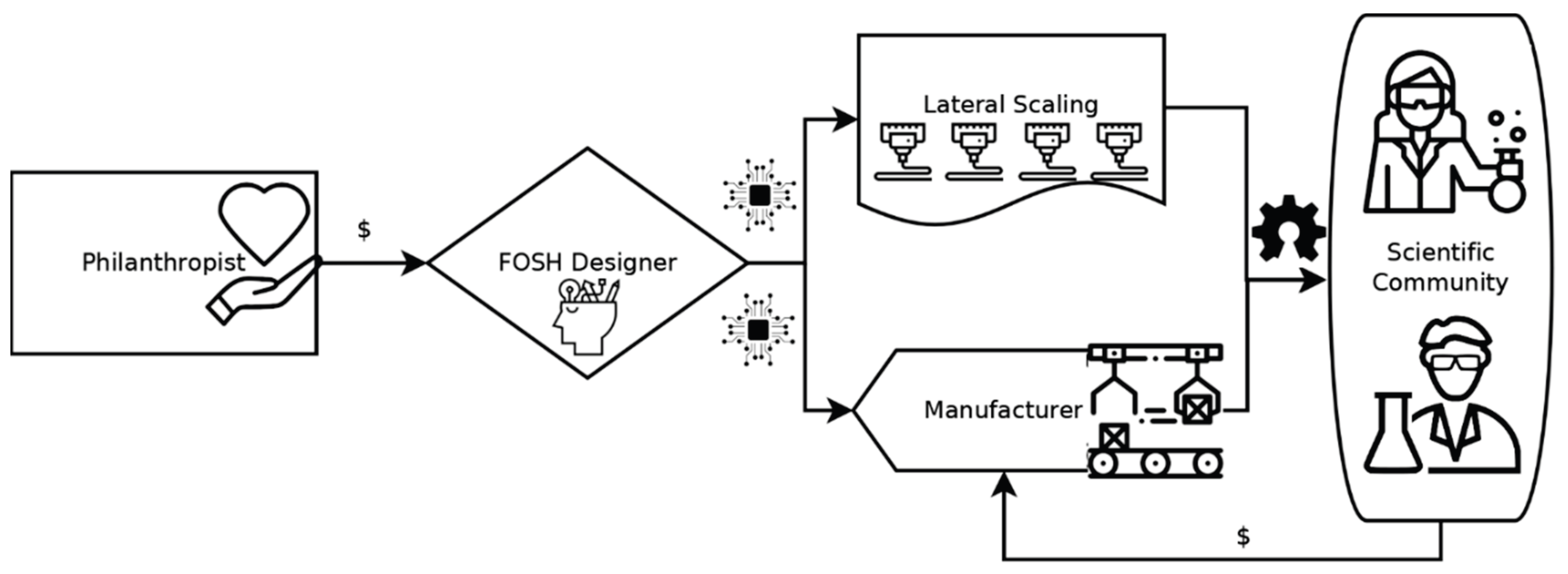
Figure 2.
Standard investor model for FOSH development.
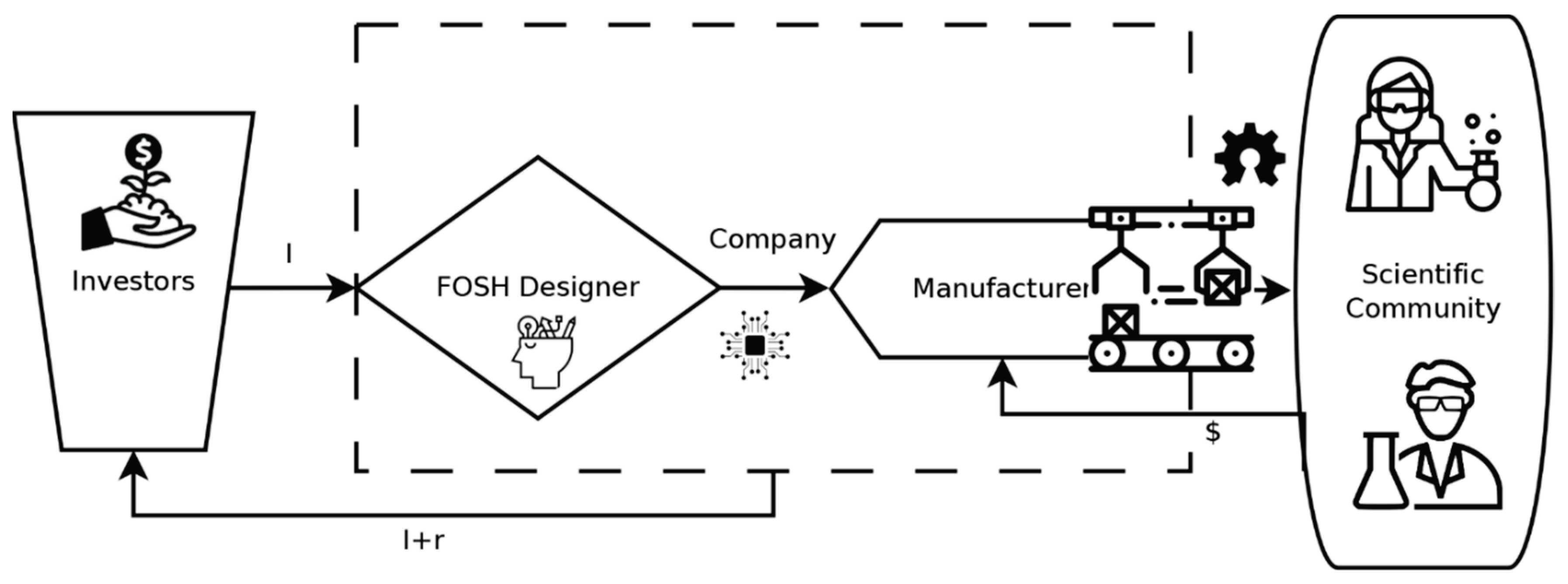
Figure 3.
Crowd-sourced FOSH design model.
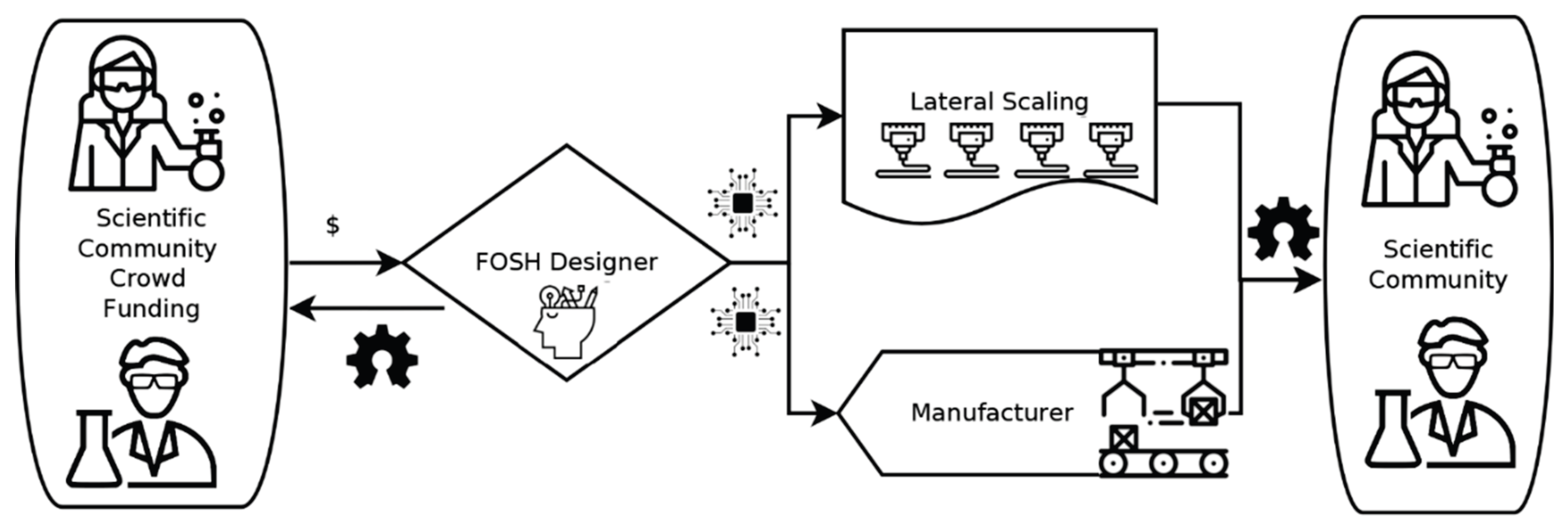
Figure 4.
Decoupled risk investor model for FOSH design.
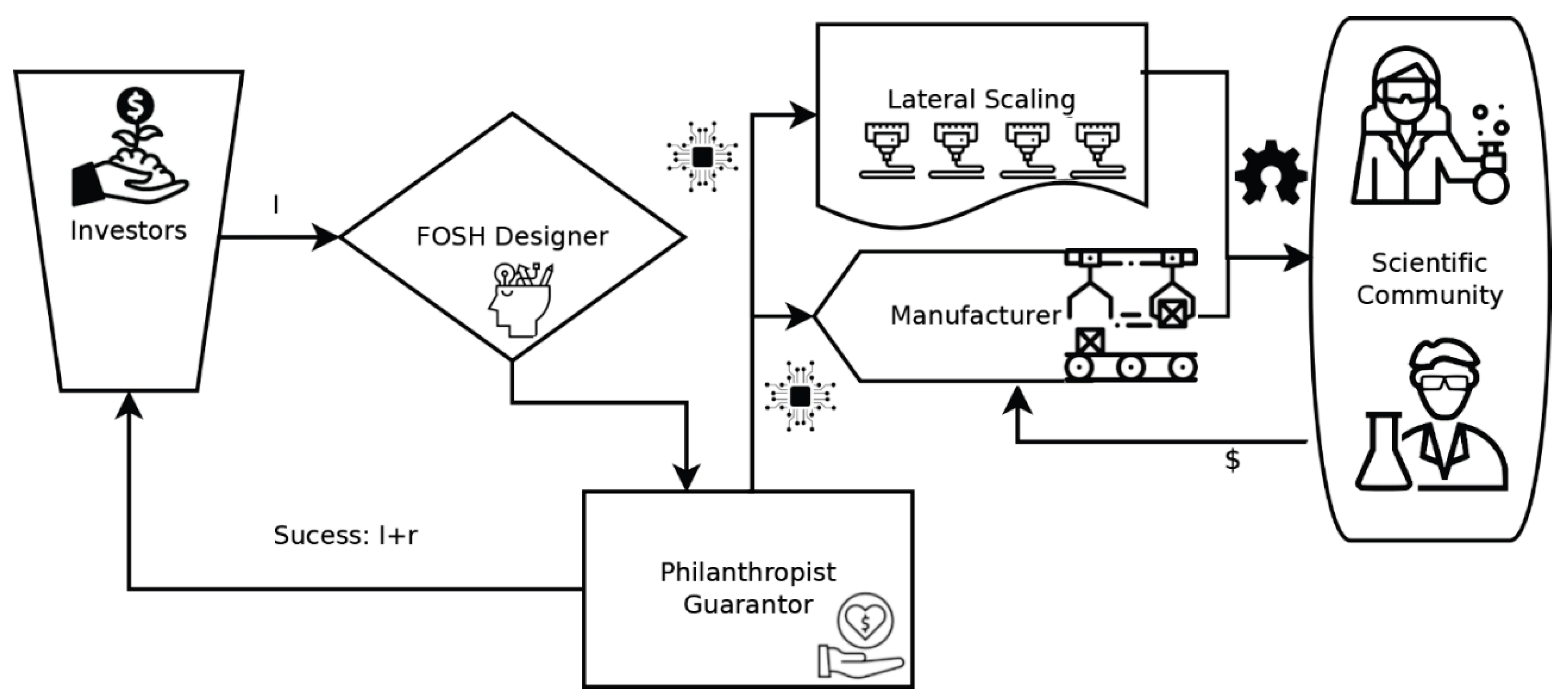
Figure 5.
(a) Proprietary bottle roller, (b) an open source bottle roller.
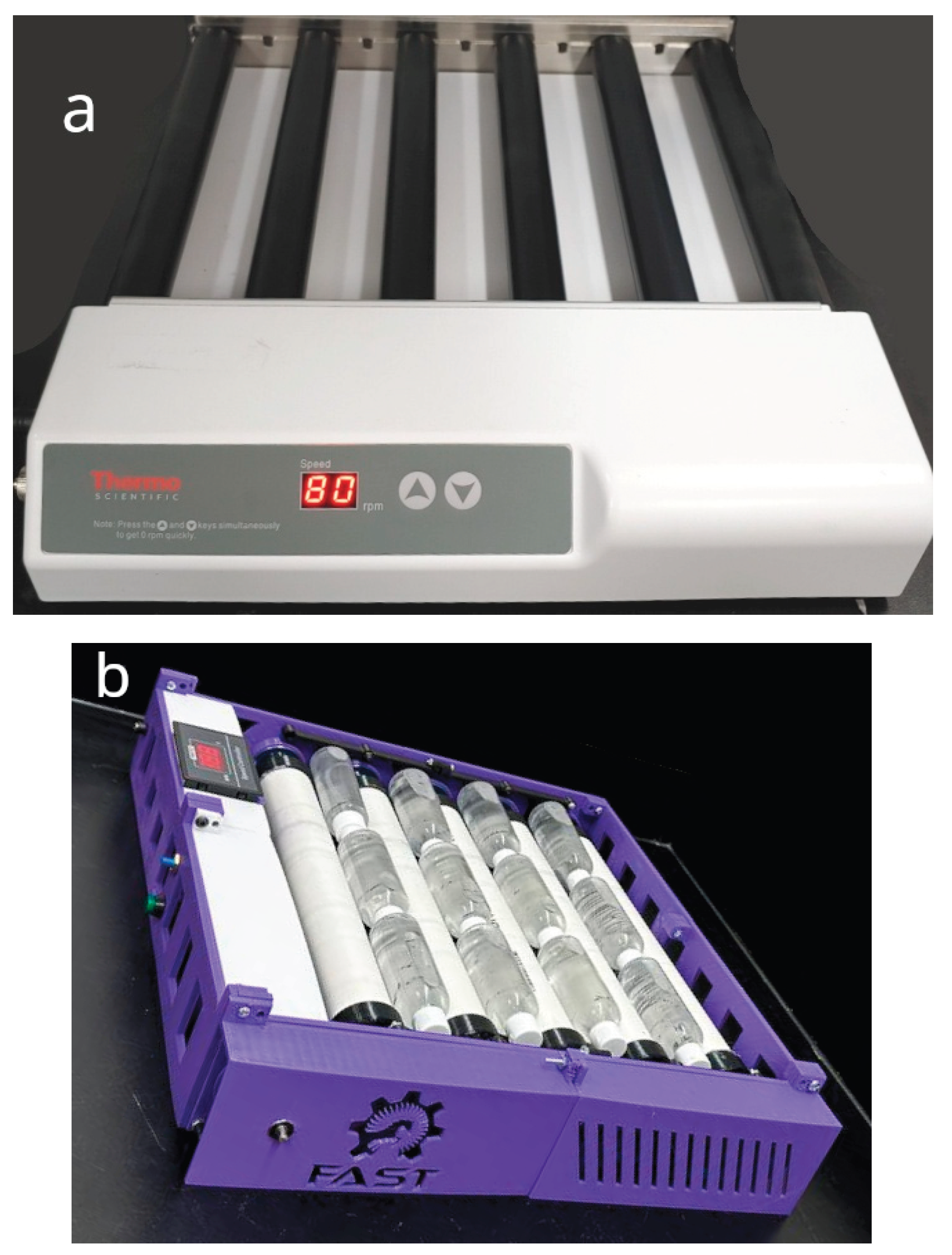

Table 1.
Who pays and who shoulders the risk in the various FOSH design models.
| Who Pays for the Design? | Who Shoulders the Risk of Design Failure? | Who Shoulders the Risk for ROI? | Who Pays for the Hardware? | |
|---|---|---|---|---|
| Philanthropy Model |  |
|
NA |  |
| Standard Investor Model |  |
|
|
|
| Crowd Sourced Model (external and internal) | |
|
NA | |
| Decoupled Risk Investor Model | |
|
|
|
Disclaimer/Publisher’s Note: The statements, opinions and data contained in all publications are solely those of the individual author(s) and contributor(s) and not of MDPI and/or the editor(s). MDPI and/or the editor(s) disclaim responsibility for any injury to people or property resulting from any ideas, methods, instructions or products referred to in the content. |
© 2025 by the authors. Licensee MDPI, Basel, Switzerland. This article is an open access article distributed under the terms and conditions of the Creative Commons Attribution (CC BY) license (http://creativecommons.org/licenses/by/4.0/).
Copyright: This open access article is published under a Creative Commons CC BY 4.0 license, which permit the free download, distribution, and reuse, provided that the author and preprint are cited in any reuse.


