

Submitted:
19 December 2025
Posted:
19 December 2025
You are already at the latest version
Abstract
Mining activities generate vast quantities of waste each year, including mine tailings, bauxite residue, waste rock, and various metallurgical slags. Although these materials have traditionally been regarded as environmental liabilities, many possess physical and chemical properties that make them promising candidates for use in construction. This review synthesizes recent research on the utilization of major mining waste streams, with particular emphasis on pavement applications and other construction materials. The findings indicate that bauxite residue exhibits both pozzolanic and filler characteristics, demonstrating potential in asphalt mastics, asphalt mixtures, and other construction products. Nonetheless, its widespread adoption is constrained by issues such as high alkalinity, leaching risks, and concerns related to naturally occurring radioactivity. Mine tailings can substitute for fine aggregates and cement in a range of mixtures, though challenges including pronounced material variability and environmental risks persist. Waste rock offers favourable geotechnical properties for use in road bases and embankments, while metallurgical slags (e.g., copper, nickel, and lithium slags) provide functional pozzolanic activity and suitable aggregate qualities. Across all waste types, their incorporation into construction materials can conserve natural resources, reduce material costs, and support circular-economy and low-carbon development objectives. However, progress remains contingent upon advancements in material standards, pretreatment technologies, environmental protection measures, and large-scale field validation. Overall, this review underscores both the significant potential and the practical challenges associated with transforming mining waste into valuable and sustainable construction resources.
Keywords:
bauxite residue
; circular economy
; Mine tailings
; mining waste
; pavement materials
; slags
; supplementary cementitious materials (SCMs)
; sustainable construction
; waste rock
1. Introduction
The global mining industry is one of the largest generators of industrial waste, producing an estimated over 100 billion tonnes of waste each year, including mine tailings, waste rock and overburden, bauxite residue, and slags [1]. As global demand for minerals continues to rise and ore grades decline, waste volumes are expected to grow, leading to a significant increase in waste generation and creating long-term challenges for health and safety, environmental protection, and land use. More than 90% of solid mine waste is disposed of in waste dumps or long-term storage facilities, with only a small percentage currently being reused [2]. These waste materials often pose complex environmental and social challenges, including tailings dam failures, groundwater contamination, dust pollution, and long-term landscape damage.
In response to these issues, there is a growing drive to reposition mining waste as a valuable secondary resource, particularly within the construction industry. This approach aligns with the concept of the circular economy [3] and global ambitions to achieve net-zero emissions. By incorporating mining waste into construction materials, industries can reduce the extraction of natural aggregates, reducing landfill burden, lowering carbon emissions, and decreasing the footprint of long-term waste storage [4,5]. Among these opportunities, pavement construction stands out because road bases, subgrades, and bitumen and asphalt mixes can accommodate large quantities of mining residues. Beyond pavement engineering, researchers are also investigating the use of these materials in concrete, geopolymers, bricks, and ceramic products, though suitability and performance vary depending on the type and characteristics of each waste.
This review examines four major mining waste streams—mine tailings, bauxite residue (red mud), waste rock and overburden, and metallurgical slags generated from copper, nickel, and lithium processing. Particular emphasis is placed on their emerging potential in pavement engineering, followed by an assessment of their wider applications in construction materials. Unlike previous reviews that typically address individual waste types or focus on isolated applications, this paper provides a comprehensive, comparative synthesis that integrates material properties, engineering performance, environmental considerations, and practical implementation challenges across all four waste categories. The novelty of this review lies in its multidisciplinary perspective: it consolidates scattered findings from materials science, pavement engineering, and environmental assessment to identify cross-cutting principles that govern the safe and effective utilization of mining waste in construction. By systematically evaluating both the shared and unique behaviours of these waste streams, the review highlights their respective advantages, limitations, and knowledge gaps. It also outlines the critical technical, regulatory, and environmental considerations necessary to enable large-scale, sustainable adoption within the construction industry. Overall, this work offers a unified framework that not only clarifies the state of current research but also advances understanding of how diverse mining wastes can be strategically repurposed to support resource efficiency, circular-economy transitions, and low-carbon construction pathways.
2. Methodology
This review used a structured literature review to evaluate the use of mining waste materials in the construction industry and their benefits and challenges. Relevant peer-reviewed journal articles, technical standards, and conference papers from 2015 to 2025 were sourced using the ECU online library and academic databases such as Scopus, Web of Science, Google Scholar, and ScienceDirect. Combination of keywords “ mining waste”, “bauxite residue”, pavement engineering”, “construction”, “mine tailing”, “waste rock”, “overburden”, “slags,”, “Lithium”, “Copper”, and “Nickel” were used to search, nearly 180 publications were selected based on their relevance, experimental detail, and applicability of assessing the performance, benefits, and challenges of mining waste utilization. The articles were manually screened to ensure authenticity and confirm their relevance to the selected mining waste topics, including global generation, properties of mining waste, asphalt and asphalt mixture modification and performance, applications in other construction industries, benefits and challenges, and to avoid duplication and non-peer-reviewed studies.
3. Mine Tailings
3.1. Mine Tailing Global Generation
Mine tailings are a type of mine waste produced during the mineral beneficiation process. They are typically produced from mills and may consist of aqueous solutions from slurries or cyaniding of finely ground particles, which contain dissolved heavy metals and hazardous chemical reagents [6]. In the tens of billions of tonnes annually, tailings form the finely ground material remaining after ore processing. While specific global numbers are less uniformly reported, much research indicates tailings volume is enormous and often poses storage and environmental risk due to fine particle size and chemical content [7]. The quantity of tailings generated is also dependent on the quality of ore, the type of material extracted, and the extraction process [8]. Hence, there is an increasing interest in recycling and utilizing mine tailings more effectively and sustainably. Its utilization as a construction material will contribute to eco-friendly production, resource conservation, economic design, improved durability of infrastructures, and reduced carbon footprint of the construction industry.
3.2. Properties of Mine Tailings
The properties of mine tailings reported across several studies are summarized in Table 1. A typical particle-size distribution of tailings shows that they can be categorized into silt-size, clay-size, and sand-size fractions, making them suitable for various construction applications. This particle size distribution is dependent on ore type and extraction process [9]. For instance, fine-grained tailings (such as copper or gold flotation) often have 80% of particles below 37 μm, while coarser tailings (such as iron ore) can have over 60% above 74 μm [9]. Tailings have a rather rough surface, as the grindability of the various mineral phases in the tailings is different [10]. They possess a density greater than 2 g/m3.
The chemical composition of several mine tailings studied across several research is depicted in Table 1. The Table depicts a considerable variation in chemical composition across the different tailing types. Nonetheless, they are characteristically rich in SiO2, Al2O3, CaO and Fe2O3, making them potential materials in construction industry [11]. The mineralogy composition of mine tailings mostly consists of Quartz, Kaolinite, Calcite, and Muscovite [8].
Generally, tailing properties such as physical, chemical, and mineralogical composition are important factors that greatly impact their performance as construction materials. These compositions also depend on the ore type, geographical location, and ore extraction process. Furthermore, their composition offers valuable insights necessary to evaluate them for different construction applications.

Table 1.
Chemical and Physical Properties of Mine Tailings.
| Properties | Tailings | ||||||||
|---|---|---|---|---|---|---|---|---|---|
| Manganese | Iron | Gold | Copper | Bauxite | Molybdenum | Tungsten | Graphite | Coal gangue | |
| CaO | 0.11 | 4.56 | 5.92 | 6.75 | 2.21 | 3.362 | - | - | 0.29 |
| SiO2 | 46.95 | 66.70 | 41.08 | 49.24 | 27.64 | 71.842 | 44.83 | 23.52 | 50.42 |
| Al2O3 | 34.10 | 8.06 | 14.76 | 21.19 | 32.61 | 11.472 | 18.39 | 2.28 | 46.11 |
| Fe2O3 | 7.33 | 9.52 | 13.04 | 6.63 | 20.65 | 1.853 | 11.85 | 55.30 | 0.56 |
| SO3 | 0.40 | - | 2.76 | 3.34 | 0.69 | - | 10.94 | - | 0.01 |
| P2O5 | 0.17 | 0.43 | - | - | 1.77 | - | - | - | 0.51 |
| MgO | - | 5.28 | 2.40 | 1.47 | - | - | - | - | 0.10 |
| MnO | 14.95 | - | 2.02 | 1.47 | 0.019 | 0.047 | - | - | - |
| K2O | 0.98 | 2.53 | 10.79 | 9.02 | 0.018 | 7.32 | 3.62 | - | 0.23 |
| Ref. | [12] | [13] | [14] | [15] | [16] | [17] | [18] | [19] | [20] |
| Density (g/m3) | 2.95 | 2.95 | 2.75 | 2.87 | 3.12 | 2.64 | 2.89 | 2.94 | 2.27 |
| Water absorption (%) | - | 1.2 | - | 0.3 | - | 0.24 | 0.18 | - | - |
| Ref. | [12] | [21] | [14] | [15] | [16] | [17] | [22] | [19] | |
3.3. Utilization and Potential Applications of Mine Tailings
3.3.1. Application in Pavement Engineering
Pavement is a superimposed layer of processed materials with hard surfaces made typically with asphalt mixtures or cement concrete, even though the asphalt mixture type is the most common. Specifically, about 90% road network globally is made of asphalt mixtures [18,23], implying that a considerable amount of non-renewable resources, such as aggregates and soils, are required for its construction. Hence, a strong dedication to affordable pavement construction with waste by-products is required.
Mine tailings possess remarkable potential as materials leading to sustainable pavement construction. Due to their properties, they have innovative applications in various layers (surfacing, base, subbase, and subgrade) of pavement. Due to tailings particle size, they are commonly used as both a fine aggregate and a mineral filler in asphalt mixtures. Its chemical composition (particularly SiO2, Fe2O3, and Al2O3) and angularity contribute to improved asphalt mixtures’ performance. Mine tailings are also suitable as pavement base and subbase material after stabilization with pozzolanic materials [24]. This stabilization aids in enhancing their engineering performance for construction purposes [25,26,27].
Table 2 summarizes the influence of tailings on pavement performance. The utilization of tailings in pavement construction will reduce the overreliance on non-renewable materials, reduce pavement construction costs, and minimize the adverse environmental impact associated with tailings disposal. In summary, at an appropriate substitution rate, tailings can effectively improve the performance of asphalt pavement. This improvement is due to the chemical and mineral composition and their physical properties, which are comparable to conventional materials utilized in pavement construction. Nonetheless, for enhanced performance in pavement, tailings should be pretreated.
Table 2.
Applications of Mine Tailings in Pavement Applications.
| Reference | Tailings | Application | Findings |
|---|---|---|---|
| [28] | Iron tailings | Road base | The iron tailings addition of 10% and 20% displayed a reduction in the compression resistance, with the mixtures satisfying the strength requirement for pavement base layer application. |
| [29] | Molybdenum tailings | Road base | At 15% molybdenum tailings stabilized with 7% cement are suitable for a heavy traffic base of expressways. |
| [30] | Graphite tailings | Fine aggregates | Graphite tailings’ optimal replacement rate of 50% effectively increases the asphalt mixtures’ high temperatures, bending performance, water damage, and frost resistance. |
| [31] | Iron tailings | Coarse aggregates and fine aggregates | Asphalt mixtures incorporating iron tailings as aggregates, used either to fully replace the coarse aggregate fraction (74%) or partially replace fine aggregates (12%), showed satisfactory high temperature performance, while exhibiting adverse effects on moisture stability and low-temperature performance. |
| [15] | Copper tailings | Filler | When copper tailings were used as mineral filler at filler-to-asphalt (F/A) ratios ranging from 0.3 to 1.2, the asphalt mastic exhibited enhanced high-temperature performance, while its moisture stability and low-temperature performance showed a slight decline but remained within acceptable limits. |
3.3.2. Mine Tailings in Cementitious and Construction Applications
The construction industry requires a huge number of non-renewable resources, such as stone and natural sand, creating a huge burden on natural resources. Stones and sand as coarse and fine aggregate are usually sourced through mining exploration, damaging the ecosystem. The construction industry also uses cement as a binder in its operations. Studies have quantified the negative environmental impact of construction using cement. This situation suggests the use of waste materials may present a sustainable alternative to minimize this environmental footprint and aid in the circular economy transition. This has inspired several studies [10,32,33,34,35,36,37,38,39,40,41,42,43,44,45,46,47,48,49,50,51] to investigate the use of mine tailings as sustainable alternatives and found they can be effectively used as partial replacements for cement and fine aggregates in construction applications.
The pozzolanic activity (based on the chemical content) of tailings makes them a promising supplementary cementitious material (SCM). As depicted in Table 1, the sum of tailing’s Al2O3, SiO2, and Fe2O3 contents is more than 70%, which is the SCM’s limit defined by international standards. A recommendation of 5 and 20% cement replacement with tailings has been established to avoid the adverse effects on mixture performance [10,33]. For instance, in Zaid et al. [34], 15% tailings as cement replacement in UHPC enhances the compressive strength by 12.49%, sulfate resistance with a residual compressive strength of 115.2 MPa, and a mass loss of 25.4% and significantly reduces shrinkage by 49.28%. However, the need for more cement replacement to reduce the environmental footprint of its production has resulted in treatment methods to increase the reactivity and replacement level of tailings [35]. Various treatment methods, such as alkali activation, mechanical, chemical, heat, and a combination of these methods, have emerged [36]. In Ramanathan et al. [33], tailing was mechanically activated for use as SCM, and a 30% replacement level in cementitious pastes was obtained without any negative effects.
The properties of the tailings are comparable to those of normal sand used in engineering construction [37]. This comparison offers tailings as a potential use in concrete mixtures as an alternative source of sand in sustainable concrete production. Studies have found that using tailings sand replacement significantly improves the mixture performance [38,39,40]. In a study conducted by Li et al. [38], it was found that replacing sand with 20% molybdenum tailings has a 10.9% and 14.9% increment in the concrete 28-day compressive strength and tensile strength, respectively. Liu et al. [32] investigated the effects of graphite tailings as sand in concrete production and found at 10% replacement, the compressive and split. While various studies confirmed the suitability of tailings as sustainable sand materials, undoubtedly, there is irregularity regarding its optimal proportion. The inconsistency may be a result of variations in tailings properties and mixture design. Nonetheless, tailings range of 10 and 40% are found suitable to be substituted as fine aggregate [10,41].
The construction application of tailings is depicted in Table 3. Tailings are suitable as fine aggregates and cement, making them a suitable material for various construction applications, such as concrete, mortar, bricks, and geopolymer productions. Hence, tailings can be regarded as a versatile and promising alternative material for construction applications. Nevertheless, the utilization of tailings as construction materials should be reasonably controlled in practical applications.
Table 3.
Applications of Tailings in Construction Applications.
| Tailings | Applications | |
|---|---|---|
| As Sand | As Cement | |
| Gold | • The concrete exhibits a satisfactory compressive and split tensile strength at replacement levels up to 25% and 50%, respectively [37]. | • Calcined gold tailings exhibit pozzolanic activity, with only a 9% strength reduction at 20% substitution [42]. |
| Magnetite | • Magnetite-rich iron ore tailings can be fully utilized (100%) as a sand-equivalent granular backfill in Mechanically Stabilized Earth (MSE) wall construction, resulting in approximately 70% reduction in horizontal facing displacement compared to conventional sand [52]. | • The pozzolanic activity of magnetite tailings enhances the rate at which the strength values increase with increasing curing age [43]. |
| Iron | • The iron tailings reduce slump and increase water absorption and pressure bleeding rate. A maximum compressive strength of 45.6 MPa was achieved at a tailings content of 40% [44]. | • Cement substitution by of 5% iron tailings achieved satisfactory mechanical properties at all curing ages [45]. |
| Copper | • A higher value of 51.1 MPa and 5.3 MPa for compressive and flexural strength was achieved at 35% sand replacement [46]. | • The 28-day compressive strength of the concrete sample made of cement-substituted copper tailings was 42 MPa, which was 9% lower than that of the control sample [47]. |
| Lead–zinc | • An optimum blending ratio of 40 – 60% lead-zinc tailings as sand replacement improved the concrete compressive strength [48]. | • Mechanically activated lead-zinc tailings, up to 40% is suitable substitute for cement in concrete production [49]. |
| Molybdenum | • At 50% sand replacement by molybdenum tailings, an increase of 14.4% was observed in the mechanical properties [50]. | • The concrete achieved the best compressive strength and splitting tensile strength of 45.6 MPa and 2.91 MPa at 10% molybdenum substitution [51]. |
3.4. Benefits and Challenges of Mine Tailings in Construction
Mining waste in form of tailings present both opportunity and challenge as construction material. When carefully characterized, processed, and applied, they can serve many constructions uses, particularly in pavement systems and concrete, offering benefits in sustainability, cost, and resource conservation. However, significant challenges remain such as variability of material properties, environmental risks (leaching, acid generation, heavy metals), lack of long-term performance data and insufficient regulatory and standardization frameworks.
4. Bauxite Residue (Red Mud)
4.1. Bauxite Residue Global Generation
The global aluminium production rate is pivotally increased with the increasing demand for aluminium products [53]. Aluminium is the most common metal and is found it makes 8% of the Earth’s crust. According to The international Aluminium Institute (AIA) [54],China is the leading aluminium producer in the world, and Figure 1. illustrates the world aluminium production from 2022 to 2024, which clearly shows the growth trend. Aluminium can only be found in its oxide form due to its pronounced chemical activity. Bauxite is the primary feed ore used to produce aluminium through a process called Bayer, and the residue produced during this process is called “Bauxite Residue (Red Mud)”[55]. With the development of the aluminium industry, the Bauxite residue production rate is also rapidly increasing.
Bauxite is available in many countries, and it is estimated that globally available bauxite resources range from 55 to 75 billion tonnes. Among the available countries, Africa has the most significant quantity with 32% of availability, and Oceania (23%), South America and the Caribbean (21%), Asia (18%), and elsewhere (6%)[56]. According to the U.S. Geological Survey [56] data, Figure 2. describes the world bauxite mine production in 2023 and 2024. Accordingly, Guinea and Australia dominate the top world production, and China and Indonesia also maintain higher production. Primarily, to produce 2 tonnes of alumina, it needs 4 tonnes of dried bauxite.
Bauxite is not a distinct mineral; it’s a combination of hydrated aluminium oxides and other gangue minerals like iron-bearing minerals (FeO(OH) and Fe2O3), clay minerals, and Titanium minerals. The most common aluminium bearing minerals are Gibbsite: Al(OH)3, Boehmite: AlO(OH),Diaspore: AlO(OH) [55].
During the Bayer process, 1 tonne of alumina production resulted in 1.5 to 2.5 tonnes of bauxite residue byproduct [53]. As described in Figure 3, the Bayer process consists of several steps, including milling, desilication, digestion, clarification, precipitation, and finally being fed into a calciner to remove the moisture and yield solid alumina (Al2O3). The leftover solid waste after the digestion and clarification processes is the bauxite residue [53].
The amount of bauxite residue production is primarily based on the aluminium content of the bauxite ore, the production rate of the alumina, and the processing conditions of the Bayer refinery. Figure 4 describes the global annual bauxite residue generation from 2005 to projected for 2050, which shows that the projected residue generation amount in 2050 will be more than 200 million tonnes per annum[57]. Accordingly, it is pivotal to review the production, physical and chemical composition, environmental impact, health and safety aspects, and utilization of bauxite residue in a sustainable manner, focusing on the circular economy.
4.2. Properties of Bauxite Residue
4.2.1. Physical Properties of Bauxite Residue
The properties of the bauxite residue primarily depend on the nature of the Bauxite ore and the production process. It is crucial to identify the characteristics of bauxite residue to investigate several utilization studies. Bauxite residue can be identified as a solid waste consisting of various radioactive materials, heavy metals, and high alkaline substances [58]. Table 4 describes the comparative analysis of the typical values of bauxite residue properties with those of the clay. Accordingly, the physical properties, including specific surface area, particle size, porosity, density, and moisture capacity, are noticeably higher than those of clay.
Bauxite residue has a high specific surface area, a higher density, and a higher void ratio [60]. The study [61], done a characterization of bauxite residue from Brazilian alumina refinery, and the results show 8.3 m2/g surface area, 2.8 g/cm2 of density, 4.8 g/cm3 of rigid voids, and 12.4 of PH value. Due to the high specific surface area of the bauxite residue, it exhibits a poor settling rate, low hydraulic conductivity, and also consists of high water holding[59].
The bauxite residue comprises particles with different shapes, such as angular and spherical. Numerous studies have evaluated the shape of the bauxite residue using scanning electron microscopy (SEM), and in most cases, bauxite residue shows uneven shapes, including flaky and round shapes [62,63]. Bauxite residue has low plasticity due to particle morphology with angular to sub-granular shape and absence of clay minerals. The bauxite residue has high angle of internal friction and low permeability compared with fine-grained soil [64].
Specific gravity (Gs) is another key property, and previous studies revealed that the specific gravity of the bauxite residue varies between 2.7 and 3.7, which is comparatively higher than that of natural soils. [63]. The high concentrations of particular minerals in the bauxite residue are responsible for the high specific gravities, particularly the iron-rich phase hematite and fine goethite [59]. When considering the particle size distribution, the researchers highlighted the importance of this factor as it affects the rheological properties of the bauxite residue and possible applications. However, the size of the particles may vary according to the nature of the bauxite. According Ram Kumar and Ramakrishna [62], the particle size of bauxite residue varies between 0.1µm and 90µm. Industries pay close attention to bauxite residue for replacing conventional powder elements like mortar, cement and bitumen due to the excellent particle size of the bauxite residue, which can easily blend with other materials. Despite that, the fine particles and porous structure enhance the water absorption rate of the bauxite residue, which can negatively affect the concrete modification when applied[65].
The high alkalinity of bauxite residue is a significant factor in classifying the bauxite residue as hazardous waste. Generally, the pH value of bauxite residue varies between 11 and 13. The residue slurries have high pH values due to residual soluble Na species, which are mostly a combination of sodium aluminate and sodium carbonate. The incomplete removal of residual Na species like hydroxide, bicarbonate, silicate, carbonate, and aluminate, from the undissolved material in the counter-current decantation washing process imparts significant alkalinity to the bauxite residue. Moreover, due to the addition of slaked lime during pre-desilication, pre- and post-digestion, solid-phase hydroxides, carbonates, and aluminates of calcium are formed, which contribute to the increased alkalinity of solid bauxite residue [59]. The pH value of bauxite residue is higher than that of other waste materials like fly ash. Recently disposed bauxite residue presents potential threats to the environment, such as leakage of alkaline compounds into groundwater, risk of caustic exposure to organisms, overflow of alkaline substances during storm events and the loss of alkaline dust and efflorescence forming at the surface of bauxite residue disposal areas, which require sustained and intensive resources to manage and transform their alkalinity [66]. The previous studies state that lowering the pH value of bauxite residue up to 9 or below significantly lowers the environmental impact [53].
4.2.2. Chemical Properties of Bauxite Residue
The chemical composition of the bauxite residue varies significantly based on the location of the bauxite ore. Generally, iron oxides (Fe2O3) and aluminium oxides (Al2O3) can be considered as major components of the bauxite residue; however, not in all cases. Oxides of titanium, silicon, sodium, and calcium are the other mineral oxides that are present in bauxite residue. Table 5 shows the variation of the chemical composition of bauxite residue in different countries. According to Table 5, Wang et al. [67] and Zhang et al. [68] both conducted their research based on bauxite residue supplied by China. The main chemical composition of Wang is Fe2O3, which is 59.37%, but the Zhang sample was only 17.54% Fe2O3, which has 44.64% of CaO as the major composition. The chemical composition of both samples has major differences, although they were obtained from the same country. Further, K, P, Mg, Cr, Mn, Cl, P, S, Zn, Sr, and Y are also identified as some of the other chemical contents in bauxite residue [62].
Table 2.
Variation of Chemical Composition of Bauxite Residue.
| Country | Composition % | Reference | |||||
|---|---|---|---|---|---|---|---|
| Fe2O3 | Al2O3 | TiO2 | CaO | SiO2 | Na2O | ||
| China | 59.37 | 16.16 | - | 2.17 | 9.11 | 2.78 | [67] |
| India | 53.75 | 16.07 | 4.24 | 1.48 | 8.25 | 3.82 | [69] |
| China | 17.54 | 8.03 | 4.81 | 44.64 | 18.19 | 3.21 | [68] |
| India | 44.3 | 18.2 | 10.5 | 1.11 | 14.5 | 9.29 | [70] |
| Turkey | 8.09 | 14.3 | 2.95 | - | 11.4 | 9.35 | [71] |
| Brazil | 31.45 | 35.47 | 5.84 | 1.81 | 12.68 | - | [72] |
| Australia | 36.48 | 23.53 | 6.84 | 1.83 | 14.88 | 9.41 | [73] |
| Iran | 32.67 | 11.64 | 4.92 | 20.09 | 13.17 | 3.89 | [74] |
There are several mineral compositions in the bauxite residue, and the different chemical oxide components make its mineralogy more complex. It has been evaluated that there are various mineral compositions in bauxite residue, and a typical range of some of the major mineralogical compositions is summarized in Table 6. Accordingly, Sodalite, Goethite, and Hematite show a higher value range. The mineralogy of bauxite residue varies depending on the nature of the Bauxite ore and the production process of the aluminium. Previous research shows that the bauxite residue obtained from the sintering process has a higher composition of Calcite, Dicalcium Silicate, and Pervskte, and bauxite residue from the Bayer process has more hematite, Gibbsite and goethite [75]. Overall, this variability in mineralogy plays a critical role in governing the reactivity, environmental behaviour, and suitability of bauxite residue for different construction applications.
Table 3.
Typical Range of Mineralogical Components of Bauxite Residue [76].
Table 3.
Typical Range of Mineralogical Components of Bauxite Residue [76].
| Mineralogical Component | Range (%) |
|---|---|
| Sodalite | 4–40 |
| Goethite | 10–30 |
| Hematite | 10–30 |
| Magnetite | 0–8 |
| Silica | 3-20 |
| Calcium Aluminate | 2–20 |
| Boehmite | 0–20 |
| Titanium dioxide | 2-15 |
| Muscovite | 0-15 |
| Diaspore | 0-5 |
| Calcite | 2-20 |
4.3. Environment and Disposal Challenges
The statistical and forecasting data of the global bauxite mining industry underscore the significance of addressing the management of bauxite residue proficiently, effectively, and sustainably. The high alkalinity (pH 10-12.5) and the complex chemical and mineralogical species of bauxite residue cause a major impact on the environment.[77]. The proper disposal of the bauxite residue is one of the key aspects in aluminium plants. The adopted bauxite residue deposition methods brought major environmental, safety, and economic burdens. The seawater disposal method is one of the disposal methods that directly discharges the bauxite residue into the sea. Currently, it is considered the least preferred method as it significantly affects the marine ecosystem by releasing toxic metals into the marine environment and poses a threat to the human food chain.
Lagooning is another method that involves pumping the bauxite residue after the Bayer process and requires a large amount of land area. The methods should be applied with high consideration to avoid the containment and spill of caustic waste and include a sealant layer for the bottom of the store area in order to prevent any liquid seeping into the soil. The lagooning method needs long-term planning and considerable cost to prevent failures [53,76]. The study Wang et al. [78], stated that the aluminium plant at Shandong cost nearly $15 million to construct the storage area, and the service life is only five years, with additional maintenance costs of $2 million exceeding. Further, various tragic industrial accidents have been reported due to failures in bauxite residue disposal areas. For instance, the accident at the Ajka Alumina Plant in Hungary in 2010, the failure of the HINDALCO plant at Muri in 2019, and an incident at the Xiangjiang Wanji Aluminium Plant in Luoyang in 2016, which threatened human life, the ecosystem, and livestock [63]. Due to the possibility of structural failures, leaks, and seepage into the ground during the lagooning method, the industry has recently developed the dry bauxite residue disposal method. The dry stacking technology consists of various methods, including thickening/flocculants, dry stacking slurry, and dry stacking cake. The process needs a dust mitigation strategy; otherwise, it could lead to serious environmental pollution from the toxic elements in bauxite residue. Also, the process is challenging to install in high rainfall and low evaporation areas[76]. However, when considering the transportation ability, dry bauxite residue can be easily transported elsewhere to use in applications.
The high alkalinity of bauxite residue is a major factor in the classification of its hazardousness. Sufficient neutralization of bauxite residue using various methods can lower its pH value to a considerable extent and decrease its negative effects on the environment, making it suitable for use in various applications. Acid treatment, seawater neutralization, Gypsum neutralization, CO2 neutralization, and microbial neutralization are some of the common neutralization methods utilized on an industrial scale. It is evident from previous research that neutralization is a successful method with several advantages. Among the above neutralizing processes, the most recommended method is seawater neutralization, which reduces the alkalinity of bauxite residue without losing acid-neutralizing capacity [79]. Treating the bauxite residue at temperatures ranging from 200 0C to 1000 0C is another approach that can enhance the physico-chemical properties of the bauxite residue by improving the adsorption capacity[77].
Table 7 summarizes the environmental effects associated with bauxite residue. These include soil and groundwater pollution, air pollution from alkaline dust, dam failures, ecosystem damage, and long-term health problems for people. While newer methods, such as dry stacking and residue neutralization, have reduced certain risks, they remain expensive, difficult to operate, and unsuitable for all sites. Given these ongoing problems, it is vital to adopt sustainable approaches to managing bauxite residue. Approaches that focus on safe reuse and the creation of value-added products can help reduce waste and avoid long-term environmental and economic harm.
4.4. Utilization and Potential Applications of Bauxite Residue
Bauxite residue has strong alkalinity and complex composition and properties. It is rich in metallic oxides, particularly iron. It also exhibits good particle dispersion, a large specific surface area, and other characteristics similar to those of porous materials, as well as good stability in solution. Herein, they have made many achievements in building materials, metallurgy, environmental protection, and other fields [78].
The utilization of bauxite residue can be processed in several different ways. First, the valuable metals in bauxite residue, such as Fe, Al, Na, Ti, Cr, Sc, V, and Ga, can be extracted from it. Secondly, it can be used as an environmental protection application, such as the management of wastewater treatment and waste gas. Also, due to the richness of the alkalinity, high adsorption, it can be applied for soil improvement in agricultural fields [60] . Finally, the previous studies evidently proved the susceptibility of utilization of bauxite residue in the construction industry.
4.4.1. Application in Pavement Engineering
In road construction, bauxite residue can be used in various applications, including as a filler, a modification for bitumen and asphalt mixture, or in pavement base layer. The application is still in an innovative stage, but with better prospects. The physical and chemical structure of the bauxite residue is suitable for interaction with bitumen, facilitating the potential modification of the performance of flexible pavements.
The mineral filler stiffens the bitumen, which requires bonding with aggregate properly to improve the performance of the asphalt mixture. Generally, limestone powder, fly ash, diatomite cement, and steel slag are the common powder materials used in industry. Recently, utilizing bauxite residue as a replacement material for mineral filler has also attracted the researchers’ attention. Researchers found that bauxite residue improves the softening point, penetration performance, complex modulus, and viscosity of the asphalt mastic, thereby enhancing the stiffness and indicating a positive effect on the rutting resistance of the asphalt mixture [75].
It is essential to understand the mechanism and modification behavior of bauxite residue in asphalt mixtures to comprehend its performance enhancement ability. According to the study by Fu et al. [82], Fourier transform infrared (FTIR) analysis reveals that there are no new peaks that appeared in asphalt with bauxite residue, which suggests that no chemical reaction occurs between bauxite residue and asphalt, but rather physical adsorption. Fe2O3, Al2O3, SiO2, CAO, and Na2O can be considered as the main components of the bauxite residue, and among those, Al2O3 provides a higher number of adsorption interfaces for asphaltene. Furthermore, bauxite residue has excellent fine particles, a large specific surface area, and high surface energy, which enable it to attract and adsorb molecules. During the bauxite residue with asphalt, the bauxite residue absorbs the oil in the asphalt and thereby increases the asphaltene and gum content, reducing the wax content in the asphalt. Oil in the asphalt is one of the main factors for the fluidity of asphalt. Softening during high temperatures and brittleness during low temperatures depend on the wax content of the asphalt. Hence, the decrease in wax content and increase in asphaltenes and gum content enhance the temperature performance of the asphalt [82]. The study Zhang et al. [83] Illustrates a clear trend of performance enhancement of softening points and penetration of asphalt mastic with increasing bauxite residue content. The softening point consistently rises with higher residue values, indicating that adding bauxite residue enhances the resistance to high-temperature deformation, creating a more rigid structure. At the same time, penetration values decrease, showing that with the increase in the bauxite residue, the binder becomes stiffer and more resistant to deformation. The study also highlights the difference in performance of asphalt mastic with bauxite residue with increasing bauxite residue content, which depends on the industrial processes used to produce alumina: Sintering and the Bayer process.
Many studies [61,82,84,85,86,87,88,89]that have engaged with bauxite residue in asphalt mastic have compared its performance with blending other typical fillers and minimizing the drawbacks, such as moisture resistance issues. Lima et al. [61] evaluated the performance of mastics with bauxite residue, fly ash, limestone, and dolomite at different proportions. The study performed several standard tests, including wettability and hydrophobic tests, and adhesion test. The results indicate that mastic composed with bauxite residue offers a high resistance against moisture permeation and acts as a better adhesion. The higher porosity of bauxite residue positively influences the penetration of bitumen and enhances the adhesiveness. Furthermore, a combination of different fillers yields different mastic properties, and bauxite residue performed well alongside the fly ash. Increasing the percentage of bauxite residue enhances the hydrophobicity of mastic, thereby improving its adhesive properties. The alkalinity of bauxite residue may cause a negative effect on the moisture resistance of the asphalt mastic.
The penetration index (PI), as per Equation 1, assesses the thermal susceptibility of bitumen mastic, where a higher PI value indicates low temperature susceptibility, and a lower value signifies high temperature susceptibility. Figure 5 illustrates the increase in temperature performance of bitumen with varying filler content, including bauxite residue. Binder content with low filler indicates higher negative values, which means it has higher temperature sensitivity. As the filler content increases, the PI index increases, showing reduced thermal susceptibility. Asphalt mastic with a high content of bauxite residue shows balanced thermal susceptibility.
where, P = penetration and SP = softening point values.
Zhang et al. [84] conducted an experimental study on the utilization of bauxite residue as an alternative mineral filler in asphalt mastic as a replacement for limestone powder. According to the previous studies, the moisture resistance of mastics prepared with bauxite residue has weaker performance; the study used an anti-stripping additive -hydrated lime to improve moisture resistance. The XRD results indicated that bauxite residue, composed of mineral phases CaCO3, Fe2O3, SiO2, and Al2O3, may influence the adhesive between bitumen and powder material. However, the replacement of the limestone by bauxite residue proved to be practicable using white mud as a modification agent. Similarly, Zhang et al. [85] engaged in a study to investigate the rheological behaviour and moisture resistance of asphalt mastic prepared with bauxite residue waste, comparing the performance with limestone, hydrated lime, and fly ash. The study shows that the mastic prepared with the bauxite residue obtained a higher complex modulus and a lower phase angle compared to the limestone. This can directly improve the rutting resistance and make the binder stiffer and more elastic. Recognizing the optimal content of bauxite residue is vital, as high bauxite residue content may lead to over-stiffness and fatigue cracking. According to the findings of the linear amplitude sweep (LAS) test conducted by Chaudhary et al. [86], at a 20% bauxite residue content, the particle reached its complete interlocked skeleton. It decreased its fatigue resistance beyond that point. Table 8 summarizes previous studies on asphalt mastic with bauxite residue. Most studies report increases in stiffness, viscosity, and softening point, thereby enhancing resistance to rutting. These improvements are linked to the fine particle size, rough surface texture, and mixing conditions used for bauxite residue, which enhance its interaction with bitumen. However, some studies also report reductions in ductility, fatigue resistance, and low-temperature cracking performance, particularly at higher replacement levels of bauxite residue.
4.4.2. Bauxite Residue in Cementitious and Construction Applications
Bauxite residue has excellent characteristics, positioning it as a potential sustainable construction material for reuse. It is gaining significant attention among researchers for reducing reliance on ordinary Portland cement (OPC) and natural aggregate. Bauxite residue is used to produce various construction materials, including mortar, bricks, concrete, and ceramics. Utilizing bauxite residue as a partial replacement for cement in concrete drives towards sustainable construction and reduces environmental impact. Venkatesh et al. [90] investigated the strength, durability, and microstructure of bauxite residue concrete and revealed that the material offers more resistance to chloride-iron penetration, water absorption, and crack resistance, as the finer particles of bauxite residue fill the pores in concrete. However, due to insufficient pozzolanic reaction between bauxite residue and other minerals in concrete, C-S-H gel formation was reduced, and only up to 12.5% replacement of cement with bauxite residue resulted in improved mechanical performance. Further, Wu et al. [91] Studied utilizing bauxite residue as a viscosity-modifying agent in self-compacting concrete (SCC). The study’s findings show a novel approach to utilizing bauxite residue, as the material decreased the bleeding rate of SCC while increasing the yield stress and plastic viscosity. Further, using 12% bauxite residue decreased segregation of SCC to 6.88%, compared with 17.12% in conventional SCC. Geopolymer concrete is a sustainable alternative to traditional concrete that is made by mixing industrial byproducts. Jothilingam and Preethi [92] Conducted a study about developing M30 material using 50% fly ash and varying percentages of ground granulated blast furnace slag and bauxite residue. Increasing bauxite residue to 15% increases both the compressive and split strengths of concrete. Water absorption increased with bauxite residue, and the carbonation depth also increased accordingly.
Nikbin et al. [93], have conducted a study to evaluate the performance of bauxite residue on light-weight concrete (LWC) by replacing up to 25% of the cement mass. The results indicated that bauxite residue in lightweight concrete reduced its mechanical properties, including compressive, flexural, and tensile strengths. Despite that decline, the study highlighted a decrease in CO2 emissions from 556.8 to 409.9 kg/m3 and a 31% reduction in cumulative energy demand. According to Qureshi et al. [94], bauxite residue enhances the mechanical properties at a lower replacement level, as high dosage levels tend to decrease the performance. The study recommended a 10-15% substitution of bauxite residue as the optimal dosage. Similarly, Zhang et al. [95] developed a high-performance, low-carbon, lightweight concrete using bauxite residue-based sulphur–aluminate cement and lightweight aggregates. This lightweight concrete achieved structural-grade compressive strengths (45.5–63.5 MPa), enhanced interface transition zone (ITZ) characteristics, lower thermal conductivity (0.47–1.13 W/m·K), and reductions of 21.5% in carbon emissions and 20.1% in production cost. Collectively, the evidence shows that bauxite residue in lightweight concrete exhibits both positive and negative mechanical performance, while all studies emphasize its environmental benefits.
In a cementitious binder, untreated bauxite residue accelerates the hydration kinetics and increases the initial stiffness, and treated bauxite residue that 10–30 wt.% can typically be incorporated into blended cements when the residue is suitably processed, improving sustainability while maintaining acceptable performance [55,96]. Further, Hertel et al. [97] explore the potential of using 100% bauxite residue-based inorganic polymer mortar. Unlike most studies that rely heavily on fly ash or slag, the study showed that bauxite residue can be used as a primary geopolymer precursor by heating it to 1100 0C, adding a minor amount of C and silica, and activating the resulting material with the K-silicate solution. The resulting material demonstrated a compressive strength exceeding 40 MPa, making it most suitable for non-structural construction materials, such as tiles for floors and roofs.
Utilizing industrial byproducts in construction raises concerns about heavy metals and radionuclides in construction materials, which may pose health risks. Arroyo et al. [98] Investigated the physical, mechanical, radiological, and heavy metal leaching properties of fired bricks with bauxite residue. When the firing temperature was higher than the sintering temperature, bricks achieved higher density, lower water absorption, and higher compressive strength. In heavy metal leaching test results, all the bricks sintered at 1373K showed leaching values below the Soil Quality Decree (SQD) limits, except for Vanadium (V). Utilizing bauxite residue in Ceramic material production is another significant application that could help conserve natural clay resources and reduce bauxite residue. The bauxite residue was modified by dewatering, and it was found that containing 30% of modified bauxite residue sintered at 1015 0C exhibits 64.9 MPa of higher compressive strength. Finally Li et al. [99] developed bauxite residue-based 3D printing mortar. Adding bauxite residue revealed benefits, including increases in packing density, flexural strength, compressive strength, and bond strength of 3.85%, 13.94%, 6.40%, and 16.82%, respectively. Also, reduce the cement content and carbon emission by 10% and 9.57% respectively. Table 9 shows the performance of bauxite residue in construction applications. The table shows that bauxite residue has been applied in a wide range of construction materials, including concrete, lightweight concrete, blended cement, mortars, bricks, ceramics, geopolymers, and 3D-printing mortars. The results indicate that bauxite residue often improves mechanical properties and durability of construction materials while also reducing CO₂ emissions and energy demand. However, higher replacement contents can lead to reductions in strength, increased water absorption, or changes in fresh properties, highlighting the importance of optimising dosage and processing conditions for each application.
4.5. Benefits and Challenges of Bauxite Residue in Construction
The valorisation of bauxite residue in the construction industry offers significant benefits in environmental and engineering terms. The major advantage is the potential to reduce the environmental burden associated with the long-term storage of highly alkaline waste and to support circular economy goals. As described above, depending on the application, bauxite residue can offer several advantages, including acting as a pozzolanic material when mixed with lime and cement, enhancing the strength of the construction materials and compressive strength of stabilized soil, and improving the durability of the material and further, utilizing bauxite residue as a partial replacement of cement, clay or aggregate lower the material cost and solution for the scarcity of the natural materials. Further reduce the cost of aluminum refineries in managing and originating the bauxite residue. As described, bauxite residue is not only suitable for one construction material but also has several applications, including pavement engineering, cement and clinker production, fire bricks, geopolymers, and lightweight materials. Overall, the reuse of bauxite residue transforms an environmentally challenging waste into a technically useful, cost-effective, and sustainability-enhancing construction resource.[55,90,91,92,93,94,95,96,97,98,99,100]
Despite the benefits of using bauxite residue in construction, several significant challenges remain. One of the major issues is its high alkalinity (pH > 13), which poses handling hazards and requires pre-treatment, such as thermal treatment, washing, carbonation, or neutralisation, before it can be safely incorporated into construction materials. Also, leaching toxicity (PHEs) of bauxite residue, such as As, Cr, V, and Pb, poses significant environmental concerns, as these elements may leach under certain conditions, thereby limiting their large-scale application in construction and requiring strict environmental assessment and stabilization measures. Furthermore, bauxite contains radioactive elements, classified as NORM (naturally occurring radioactive material), particularly U and Th. In bauxite residue, this concentration doubles, which requires extra consideration when used in construction materials. Although measured activity levels are generally low, public perception and regulatory caution around radioactivity have prevented several promising applications from advancing. In some countries, products such as red-mud-based bricks, ceramic insulation fibres, and other building materials were halted primarily due to these concerns, underscoring the importance of ensuring public safety [78,101]. Other challenges include sodium content, electrical conductivity, and smaller particle size distribution (<100 μm in 80% of particles), moisture levels, and transportation expenses also limiting the potential of volatilization [102]. These technical and environmental challenges remain significant barriers preventing widespread implementation of bauxite residue in the construction industry.
5. Waste Rock and Overburden
5.1. Waste Rock/Overburden Global Generation
Mining waste in the form of overburden and waste rock is one of the largest industrial waste streams globally, it is generated at all mining sites in spite of the ore targeted or extractive process taken [103]. It is the first waste generated during mining and excavation activities to access the ore. The quantity of waste rocks depends mainly on the local geology, shape of ore body and extraction technology [104]. Nonetheless, the rock-to-metal ratio (the mass of waste rock / overburden needed per unit mass of valuable metal produced) can be very large, especially for low-grade ores Nkuna et al. [105], presenting waste rock/overburden as the primary and most dominant waste generated in mining operations [6]. For example, rare earth mining and certain metal ores have very high ratios, meaning more waste rock per ton of metal. They often dominate bulk by mass of waste in mining operations. Waste rock and overburden quantities vary by mining type: open pit and surface mining produce large volumes compared to underground mining. Also, mineral grade, deposit geometry, and regulatory and economic practices influence how much overburden must be removed [106] . According to Ait-khouia et al. [107], about 50 billion tonnes of waste rock is generated annually during global mining operations. These wastes are usually deposited on the surface, close to the production site, in large structures called waste rock piles or dumps [108], constituting environmental concerns. One promising avenue is to reuse some of these wastes not as discard, but as raw materials for construction, thus contributing to circular economy goals, reducing demand for virgin materials, and mitigating environmental impacts [3].
5.2. Properties of Waste Rocks/Overburden
Physical properties: Waste rock/overburden typically ranges from large blocks to fines; particle size distribution is highly variable. Coarse fraction may consist of large boulders, gravels; finer fraction may include sands, silts. Porosity, permeability, compaction behaviour, influence strength and stability [109]. They are characterized by the large variability of their particle sizes, ranging from blocks (the diameter of which can exceed several meters) to clay-size particles.
The chemical composition depends on the parent rock type. Trace heavy metals such as Arsenic, Chromium, lead, and copper are present in waste rock [110,111]; hence, leachability may be a concern. The pH buffering capacity, presence of silicates, carbonates, etc., influence safety. The oxides composition in waste rocks includes varying proportions of SiO2, Al2O3, Fe2O3, CaO, SO3, P2O5 and small proportion of other oxides [110,111].
The mineral content of waste rock depends on geology; rock types may include quartz, feldspar, micas, clay minerals, iron oxides, and sometimes sulfides. The mineral composition of waste rock from different sources is shown in Table 10. As revealed in Table 10, the waste rock is composed of varying proportions of mineral content. Also, some waste rocks contain sulfide minerals (pyrite, arsenopyrite) that, upon oxidation, can generate acid mine drainage (AMD)[112]. The mineralogy affects mechanical strength, durability, weathering, potential expansion/shrinkage, and reaction to stabilizers. Mineralogical studies have shown that some overburden rock is sufficiently ‘clean’ to be used as aggregate; others require treatment [113].
5.3. Utilization and Potential Applications of Waste Rock/Overburden
5.3.1. Application in Pavement Engineering
The properties of waste rock/overburden, such as excellent mechanical strength and durability, confirm their ability for use as road construction materials [116]. The coarse fractions of waste rock/overburden have been used to form subbase and base layers in roads. When properly crushed and compacted, such materials can provide sufficient bearing capacity and drainage [4,116]. Also, waste rock/overburden can be used for embankments, fill for landform reshaping, or mine restoration [117]. Also, due to the fact that they are located at the site, transport distances are small, and their coarse particle size, they can be applied on mining sites for internal roads and haul routes [116]. In Amrani et al. [115], sustainable embankments and pavement layers using coal mine waste rock were investigated. observed that coal mine waste rock corresponds to very silty sands and gravels of medium hardness that can be used in the construction of pavements. The results from the CBR experiment further confirmed that waste rocks can be used as a sustainable alternative material for the embankment, and stabilized waste rock is suitable in road sub-base layers for high-traffic pavements. Amrani et al. [114] demonstrated the suitability of phosphate mine waste rock as a sustainable alternative material in the construction of dry compacted embankments. They obtained the specific density (ρs) of 26 kN/m3, organic matter of 1%, Los Angeles abrasion of 58%, plasticity index (PI) of 20% and methylene blue value (MBV) of 1 g/100g, confirming the waste rock possesses satisfying geotechnical characteristics to be used as embankment materials.
Studies have also found that mine waste rock can improve asphalt’s performance when incorporated as a substitute for conventional materials. In Alhomaidat et al. [118], feasibility of mine waste rocks as an aggregate replace natural aggregate in asphalt mixtures was conducted. It was reported that mine waste rock achieved a cantabro loss of 20% than the limestone aggregate. They attributed the high cantabro loss of the mine waste rock mixture to the aggregates’ high smoothness, low internal friction, and high susceptibility to abrasion. Nonetheless, the mine waste rock was still found suitable for use in asphalt mixtures.
Table 11 presents the various applications of mine waste rocks in pavement. In general, the studies presented in the Table have shown that the use of waste rocks is practical in pavement application, offering improved performance. The utilization of mine waste rock in pavement application is a promising option for the sustainable management of waste materials, reducing their environmental footprint and preserving non-renewable resources that are currently often overexploited for pavement construction. Despite the profitability of mine waste rock in pavement applications, its utilization can still be deemed emerging, and further studies are needed to fully understand its benefits in pavement applications. For instance, the Table clearly demonstrates that most studies on mine waste rock for pavement application have centered on its use as base/subbase materials, with its application as an asphalt mixture being limited, reflecting the need for more research in this area.
5.3.2. Waste Rocks in Cementitious and Construction Applications
Mine waste rocks have excellent characteristics, positioning them as potential for their reuse as sustainable construction material. This material has been found suitable in various forms for production of concrete, mortar and in production of bricks, making them the most versatile construction material. In [111], the feasibility of mine waste rock as cement replacement for mortar production was investigated. The mine waste rock was sieved through 75 um sieve and used to partially replace cement with 10%, 20% and 30%. The density, compressive strength, split tensile strength, water absorption and porosity was conducted on the prepared mortar. The results obtained showed about 20% increase in water absorption, 8.60% and 26% decrease in density and compressive strength, respectively. They attributed this phenomenon higher porosity, lower density of the waste rock and lower cement content in the waste rock-mortars. Despite the reduction in mortar strength, they assert that the waste rock-mortar is eco-efficient than the conventional mortar based on the binder intensity (bi) index, indicating the sustainability of waste rock mortar.
Nguyen et al. [123] investigated concrete performance containing waste rock for sustainable development. The waste rock was to substitute fine aggregate with 0 – 50% at 10% increment and its effects on the concrete mechanical properties, durability, and environmental impact were conducted. They obtained a decrease of about 10 – 25% in the mechanical performance of mine waste rock-concrete compared to the conventional concrete when waste rock content increased from 10 – 50%. Nonetheless, the waste rock-concrete meets the technical requirements for compressive strength of 35 MPa with reduced environmental impact, indicating the effectiveness of waste rock as fine aggregate in concrete for sustainable development.
The possibility of using mine waste rocks as alternative raw material for the manufacturing of fired bricks was conducted by Benahsina et al. [124]. The mine waste rocks were crushed and used to replace natural clay at substitution of 0 to 100%. The results showed a reduction in the mechanical resistance of the bricks and an increase in the porosity and water absorption rate of mine waste rock-bricks. Nonetheless, up to 80% mine waste rock substitution, the strength of the bricks was greater than 2.5 MPa, which satisfied the minimum requirements set by the applicable civil engineering and environmental standards.
Table 12 shows the performance of some waste rocks used as construction materials. It can be observed that waste rocks are relevant in different construction applications and can also be processed into different forms such as coarse aggregates, fine aggregates and as cement replacement according to their properties (physical and chemical properties). From studies, one can retain primarily that the technical requirements and the resulting products are specific to the properties of each individual mine waste rock [125].
5.4. Benefits and Challenges of Mine Waste Rock in Construction
The utilization of mine waste rock as construction materials will result in several benefits[132], such as:
- Resource conservation: Substantial reduction in the use of natural aggregates, preserving quarries and reducing extraction impacts.
- Environmental benefits: Less landfill, less waste storage; potentially reduced CO₂ emissions associated with the extraction & processing of virgin materials.
- Cost savings: Lower transport costs if local waste is used; savings from reduced raw material purchases.
- Circular economy and sustainability: Turning waste into value aligns with SDGs (Sustainable Development Goals).
The utilization of mine waste rock in construction applications is a promising option. However, to fully utilize their benefits as construction materials, the following challenges need to be addressed.
- Variability of material properties: Wide variation in physical, chemical, and mineralogical properties; site-by-site characterization required.
- Environmental risks: Potential for leaching of heavy metals, acid generation from sulfide-bearing waste. Must assess and mitigate.
- Regulatory and standardization issues: Lack of standard design guidelines, codes, and specifications for using waste rock/overburden in structural layers or concrete, particularly across different jurisdictions.
- Long-term performance concerns: Durability under cycles (freeze-thaw, wetting/drying), moisture sensitivity, shrink/swell behavior.
6. Slags (Lithium, Copper, Nickel)
6.1. Slags Global Generation
As demand for alkali and transition metals (in particular, lithium, copper, and nickel) has increased due to their tied to batteries, electronics, and green energy, the generation of slags from their extraction and metallurgical processing has also risen. Lithium extraction and processing (e.g., from spodumene / lithium-ion battery recycling) produce lithium slag as a by-product. It has been reported that for each ton of lithium carbonate produced, 8–10 tons of lithium slag (LS) may be generated [133]. The precise global tonnage of slags (especially non-ferrous metal smelting slags) is harder to pin down in open literature; estimates vary, but their cumulative global volume is substantial. Non-ferrous metal smelting — copper, nickel, zinc — is a major contributor. [134] indicate that industrial slags are among the residues of concern regarding waste volume and hazard potential. Furthermore, slag volumes are tied to the production of metals and energy transition demands, so scaling is dynamic.
6.2. Properties of Slags
The slags from copper, nickel, etc., often have a granular texture, can be glassy or crystalline depending on cooling, and may have irregular but often angular particles. The rough, angular, and microporous texture of slag aids strong mechanical interlock and moisture resistance when utilized as a construction material [4,135,136]. They may have high density, hardness [137], making them suitable potential as aggregate replacement. Also, their particle sizes can be ground to fine fractions for use as supplementary cementitious materials.
In accordance with their chemical composition, slags are rich in silicate, alumina, iron oxide, and sometimes magnesium oxide, indicating pozzolanic reactivity and potential application in construction. Slags are rich in SiO₂, Al₂O₃, Fe₂O₃, MgO, and may contain traces of heavy metals such as Cu, Zn, Pb; hence, pH, leachability, and hazard potential are concerns [138].
The mineralogical properties of slags depict presence of glass phases, crystalline phases such as spinels, fayalite, magnetite etc. For lithium slag, there may be phases of silicates, aluminosilicates; in copper and nickel slags, there are similar complexities. These affect their reactivity (e.g., pozzolanic behavior), durability, and stability [137].
6.3. Utilization and Potential Applications of Slags
6.3.1. Application in Pavement Engineering
Slag has excellent properties that qualify it as a sustainable alternative to natural aggregates in pavement construction. In asphalt mixtures, slags have been used as aggregate or filler replacements with the potential to improve some properties, such as abrasion resistance [139]. The suitability of slag as aggregate in asphalt mixtures is due to its high hardness and hydrophobic properties [140]. Technically, slags conform to the standard requirements as aggregate and are permitted to be used in asphalt pavement. Furthermore, the limited calcium content in the slags (lithium, nickel, and copper) eliminates the concerns about expansion issues commonly associated with calcium-rich slags [141]. For instance, the practicability of copper slag (CS) as aggregates in asphalt mixtures was conducted by Oreˇskovi’c et al. [142]. They observed that the addition of CS does not compromise the mechanical and chemical properties of the asphalt mixtures, suggesting CS as a good potential for utilization as an aggregate substitute in asphalt mixtures. Azizah et al. [143] also confirms that nickel slag improved the permanent deformation resistance of asphalt mixtures because of its interlocking properties, hardness, and the silica content that enhances its adhesion with bitumen. Furthermore, the engineering characteristics of slag can be improved through various methods for enhanced performance in asphalt mixtures. Slags can also be ground into powder and used as filler material in asphalt mixtures. Modarres and Bengar [144], studied asphalt mixture performance containing CS as filler, and they obtained 7.5, 8.5, 10.2, and 21.6% improvement in the mixture M r, TIit, ITS, and fatigue life compared to the control mix.
Similarly, slag’s physical hardness and chemical stability make it a viable material in high-stress pavement base or subbase layers [145]. Its use as a base/subbase material reduces the need to use natural materials, resulting in less exploitation of natural aggregate deposits. Raj and Rai [146] studied the suitability of stabilized copper slag as a pavement construction material. They found out that stabilization of copper slag with 9% cement achieved 10 MPa and 1.5 MPa at 28-day compressive and tensile strength, indicating its effectiveness as a base and subbase material in pavement. The suitability of copper slag as a base material in pavement, with a service life ratio as high as 1.78 and a cost efficiency of 17.4% was also confirmed by Pai et al. [147]. The load-bearing capacity performance of nickel slag in pavement was studied by Arifin et al. [148]. The slag attained a CBR value of 60%, suggesting the suitability of nickel slag as a subbase material for pavement construction. Yuan et al. [149] employed lithium slag in cement-stabilized macadam bases. The cement-stabilized macadam attained optimal performance at 3.0% and 10% of cement and lithium slag substitution, respectively.
Table 13 depicts the applications of slags from lithium, nickel, and copper in pavement construction. Slag’s engineering characteristics make it suitable for use in embankment, sub-grade, subbase, base, and bituminous layers of road pavement. They are viable and environmentally sustainable materials for pavement, as they provide benefits such as reducing industrial waste, conserving natural resources, improving road durability, and lowering production costs.
6.3.2. Slags in Cementitious and Construction Applications
An estimation of 70-75 billion tonnes of concrete with aggregate constitution of about 60-75% is consumed globally by the construction industry[155]. This massive resource requires significant energy and resource utilization, and is not sustainable for our environment, as it could lead to planetary depletion and limit the ability of future generations to meet their infrastructural needs. Hence, there is a need to shift to more sustainable resource utilization, such as the use of waste materials, such as slags, to promote resource conservation and consequently minimize the environmental footprint of the construction industry. Studies have shown that the utilization of slag as cement and aggregates in concrete improves material durability and enhances structural strength.
Slag’s silicon dioxide and aluminum oxide content makes it suitable for construction as a supplementary cementitious material (SCM) by partially replacing cement. The assessment of lithium slag as cement replacement in autoclaved aerated concrete (AAC) was conducted by [156]. Lithium slag (LS) was found to show acceptable properties; it can be used with AAC, with a favorable microstructure and strength when processed. A similar study by [157] also confirms LS contribution to AAC’s microstructure and hydration properties. [158] investigated concrete properties using LS as SCM. It was reported that 40% LS addition improved the 180-day compressive strength by 18.34% and reduction of 38.46%, 15.96%, 24.79% in the concrete’s sorptivity coefficient, volume of permeable voids, and water penetration depth, respectively. Several studies also confirmed the use of copper slag [159,160,161] and nickel slag [162,163] as SCMs. It is important to note that when used as SCMs, up to 20% replacement of cement is appropriate for balanced performance. Also, combining slags with other byproducts (fly ash, metakaolin) to form geopolymers or alkali-activated materials can serve as an improved binder for construction applications [164]; thereby leading to an increase in its substitution level.
Slags are also found suitable as aggregate replacements for construction applications with promising properties. Ernawan et al. [165] studied the concrete properties containing nickel slag (NS) as fine aggregate. Using NS up to 50% showed a 3.4% increase in density and a 21.1% increase in compressive strength of the concrete at 28 days. Similar studies also validated that replacing 50% of the natural aggregate with copper slag improved the properties of concrete [166,167].
Table 14 shows the various applications of slags in construction. The application of slag as construction material is a sustainable approach that will promote material circularity, reduce the carbon footprint of construction, and conserve non-renewable resources.
6.4. Benefits and Challenges of Slags in Construction
Based on several studies [168,178]the benefits of mine slags in construction applications can be illustrated as follows
- High performance potential: Some slags afford high mechanical strength, durability, chemical resistance, and low permeability, thus suited for demanding applications.
- Reduced carbon footprint: Using slags as SCMs (as a replacement for cement) can reduce the greenhouse gas emissions associated with producing OPC (Ordinary Portland Cement). Also reduces the extraction of virgin aggregates.
- Waste valorization: Instead of disposing of slags (which may be landfilled or pose environmental hazards), using them creates value while mitigating environmental burden.
- Potential for enhanced properties: Slags can improve certain properties like abrasion resistance, durability against chemical attack, or even high-temperature performance in pavements.
Challenges of utilization slags in construction applications,
- Heavy metal content and leachability: Some slags contain toxic metals (e.g., copper slag, lead, zinc), which may leach under certain environmental conditions. Requires rigorous testing, possibly treatment, or encapsulation.
- Variability in slag chemistry and mineralogy: Depending on source, smelting process, cooling rates etc., slag properties differ. This affects performance and reproducibility.
- Processing and cost: Grinding, screening, and cleaning slags (to remove deleterious phases) may require energy and cost. Transportation and handling may be more expensive than local conventional materials.
- Standardization, codes and regulations: Lack of universally accepted guidelines in many regions for safe use; environmental regulations must be met (e.g., leachate, stability).
- Long-term durability and performance: Limited long-term field data, especially under varying climatic and load conditions (freeze–thaw, wet cycles, etc.).
7. Comparative Analysis of Mining Wastes in Construction
Consolidating the insights discussed throughout this review, a comparative summary of the major mining waste types is provided below. Table 15 highlights their annual global production, material properties, potential construction applications, and the critical advantages and limitations associated with each waste stream.
8. Conclusions and Future Recommendations
This review examined the potential of four major mining waste streams, mine tailings, bauxite residue, waste rock/overburden, and slags, including Lithium, copper, and nickel, as sustainable construction materials, with particular focus on pavement engineering and other construction applications. As the mining waste poses environmental and human health risks, careful management and volatilization are significant. Upon reviewing the above waste types, the following key points can be identified.
- The findings consistently demonstrated that these materials possess valuable physical, chemical, and pozzolanic properties that can partially or fully replace traditional construction aggregates, fillers, and binders.
- Their use enhances the performance of construction materials while conserving resources, reducing pressure on natural aggregates, lowering material costs, and aligning with circular-economy and low-carbon infrastructure goals.
Despite these advantages, the following barriers still limit the large-scale adoption.
- Bauxite residue continues to face challenges related to extreme alkalinity, potential leaching of PHEs (As, Cr, V, Pb), NORM-related concerns, high sodium content, moisture, and transport limitations.
- Mine tailings exhibit high variability, environmental risks such as acid generation or heavy metal release, and lack long-term performance data and standardization.
- Waste rock displays strong geotechnical characteristics but varies widely in composition and may pose environmental risks where sulfide minerals are present.
- Slags, including copper, nickel, and lithium slags, are used less than they could be due to chemical variability, concerns about heavy-metal leachability, processing costs, lack of standards, and limited data from long-term field installations.
According to the identified challenges, several future directions can be recommended.
- Standardized classification and testing frameworks are needed to evaluate variability, leaching behavior, and engineering performance for each waste type.
- Consistency guidelines for pavement, concrete, and geopolymer applications would increase industry confidence in adoption.
- Future studies should also explore combining mining wastes with other industrial by-products, as hybrid mixtures may enhance material performance and help overcome individual drawbacks.
- Advanced pretreatment and beneficiation technologies, such as carbonation, mechanical activation, alkali activation, metal recovery, or hybrid chemical–thermal treatments, should be further developed to reduce alkalinity, immobilize contaminants, and enhance pozzolanic reactivity.
- Large-scale field trials and long-term monitoring programs are essential to validate laboratory findings, especially for pavement layers and structural applications, where durability under real environmental conditions must be demonstrated.
- Integrating life-cycle assessment (LCA) and carbon accounting into the evaluation of mining-waste-based materials will provide clear evidence of environmental benefits and help align construction practices with global commitments such as net-zero CO₂ by 2050.
- Digital tools, including AI-based material classification, geopedological modelling, and geospatial databases, offer promising pathways for optimizing waste stream selection and predicting performance.
- Finally, addressing regulatory frameworks, public perceptions of leaching and radiation concerns associated with waste and treatments, and market incentives will be crucial for achieving widespread adoption of waste-derived construction materials.
In summary, mining waste represents a substantial, largely untapped resource for sustainable construction. With coordinated advances in treatment technologies, environmental risk management, specification development, and field validation, these materials can transition from long-term liabilities into high-value assets that support resilient, low-carbon, and resource-efficient construction systems.
Author Contributions
Conceptualization, C.D., N.M. and D.O.; methodology, C.D., N.M. and D.O; validation, C.D., N.M. and D.O.; resources, C.D., N.M. and D.O.; data curation, C.D., N.M. and D.O.; writing—original draft preparation, C.D., N.M. and D.O.; writing—review and editing, C.D., N.M. and D.O.; visualization, C.D., N.M. and D.O.; supervision, N.M.; funding acquisition, N.M. All authors have read and agreed to the published version of the manuscript.
Funding
This research received no external funding.
Institutional Review Board Statement
Not applicable.
Informed Consent Statement
Not applicable.
Data Availability Statement
The data used for the study are included in the manuscript.
Acknowledgments
Guidance and support received from the School of Engineering at Edith Cowan University are highly acknowledged.
Conflicts of Interest
The authors declare no conflicts of interest.
References
- Tayebi-Khorami, M.; Edraki, M.; Corder, G.; Golev, A. Re-Thinking Mining Waste through an Integrative Approach Led by Circular Economy Aspirations. Minerals 2019, 9, 286. [Google Scholar] [CrossRef]
- Moyo, A.; Parbhakar-Fox, A.; Meffre, S.; Cooke, D.R. Geoenvironmental characterisation of legacy mine wastes from Tasmania – Environmental risks and opportunities for remediation and value recovery. Journal of Hazardous Materials 2023, 454, 131521. [Google Scholar] [CrossRef]
- Antony Jose, S.; Calhoun, J.; Renteria, O.B.; Mercado, P.; Nakajima, S.; Hope, C.N.; Sotelo, M.; Menezes, P.L. Promoting a Circular Economy in Mining Practices. Sustainability 2024, 16, 11016. [Google Scholar] [CrossRef]
- Mashaan, N.S.; Kibutu, S.; Dassanayake, C.; Ghodrati, A. Sustainable Utilisation of Mining Waste in Road Construction: A Review. Journal of Experimental and Theoretical Analyses 2025, 3, 19. [Google Scholar] [CrossRef]
- Mashaan, N. Roads of the Future: Mining Waste as a Sustainable Pavement Resource; 2025. [Google Scholar]
- Damoah, E.; Herat, S. A review of sustainable management of mining waste. International Journal of Environment and Waste Management 2022. [Google Scholar] [CrossRef]
- Islam, K.; Murakami, S. Global-scale impact analysis of mine tailings dam failures: 1915–2020. Global Environmental Change 2021, 70. [Google Scholar] [CrossRef]
- Maruthupandian, S.; Chaliasou, A.; Kanellopoulos, A. Recycling mine tailings as precursors for cementitious binders – Methods, challenges and future outlook. Construction and Building Materials 2021. [Google Scholar] [CrossRef]
- Li, Z.; Guo, L.; Zhao, Y.; Peng, X.; Kyegyenbai, K. A Particle Size Distribution Model for Tailings in Mine Backfill. Metals 2022, 12. [Google Scholar] [CrossRef]
- Adiguzel, D.; Tuylu, S.; Eker, H. Utilization of tailings in concrete products: A review. Construction and Building Materials 2022, 360. [Google Scholar] [CrossRef]
- Oguntayo, D.O.; Mashaan, N.S.; Shukla, S.K. Mine Tailings as a Sustainable Filler for Asphalt Binder–Mastics: A Review. Materials 2025, 18. [Google Scholar] [CrossRef]
- Calandra, P.; Quaranta, S.; Figueira, B.A.M.; Caputo, P.; Porto, M.; Rossi, C.O. Mining wastes to improve bitumen performances: An example of circular economy. Journal of Colloid and Interface Science 2022, 614. [Google Scholar] [CrossRef]
- Li, S.; Zhang, Z.; Si, C.; Shi, X.; Cui, Y.; Bao, B.; Zhang, Q. Evaluation of the rheological properties of asphalt mastic incorporating iron tailings filler as an alternative to limestone filler. Journal of Cleaner Production 2025, 486 C7–144444. [Google Scholar] [CrossRef]
- Zhang, N.; Hedayat, A.; Sosa, H.e.G.B.; Bernal, R.P.H.; Tupa, N.e.; Morales, I.Y.; Canahua, R.S. On the incorporation of class F fly-ash to enhance the geopolymerization effects and splitting tensile strength of the gold mine tailings-based geopolymer. Construction and Building Materials 2021, 308. [Google Scholar] [CrossRef]
- Lei, B.; Li, X.; Guo, Y.; Qu, F.; Zhao, C.; Tam, V.W.Y.; Wu, V.; Li, W. Recycling of copper tailing as filler material in asphalt paving mastic: A sustainable solution for mining waste recovery. Case Studies in Construction Materials 2024, 20, C7–e03237. [Google Scholar] [CrossRef]
- Choudhary, J.; Kumar, B.; Gupta, A. Performance evaluation of bauxite residue modified asphalt concrete mixes. In EUROPEAN JOURNAL OF ENVIRONMENTAL AND CIVIL ENGINEERING; 2019. [Google Scholar] [CrossRef]
- Gao, H.; An, B.; Lei, X.; Gao, Y.; Liu, H. Utilization of molybdenum tailings as an alternative mineral filler in asphalt mastic: Rheological performance and environmental aspects. Case Studies in Construction Materials 2024, 21 C7–e03639. [Google Scholar] [CrossRef]
- Cesare, S.; Piergiorgio, T.; Claudio, L.; Francesco, M. Application of Mining Waste Powder as filler in Hot Mix Asphalt. MATEC Web of Conferences 2019, 274. [Google Scholar] [CrossRef]
- Yang, X.; Fan, Z.; Xu, J.; Lin, J.; He, Y.; Wang, D.; Liu, P. Investigation of graphite tailings as a substitute for filler in asphalt mastics. International Journal of Pavement Engineering 2023, 24. [Google Scholar] [CrossRef]
- Xiong, R.; Wang, L.; Yang, X.; Yang, F.; Sheng, Y.; Guan, B.; Chen, H. Experimental investigation on related properties of asphalt mastic with activated coal gangue as alternative filler. International Journal of Pavement Research and Technology 2018, 11, 725–732. [Google Scholar] [CrossRef]
- Cui, Y.; Si, C.; Li, S.; Jia, Y.; Guo, B. Iron Tailings as Mineral Fillers and Their Effect on the Fatigue Performance of Asphalt Mastic. Materials 2024, 17. [Google Scholar] [CrossRef]
- Cesare, S.; Piergiorgio, T.; Claudio, L.; Francesco, M. Application of Mining Waste Powder as filler in Hot Mix Asphalt. MATEC Web Conf. 2019, 274, 04002. [Google Scholar] [CrossRef]
- Anupam, K.; Akinmade, D.; a, C.K.; a, S.E.; Adebiyi, F. A state-of-the-art review of Natural bitumen in pavement: Underlining challenges and the way forward. Journal of Cleaner Production 2023, 382. [Google Scholar] [CrossRef]
- Djellali, A.; Laouar, M.S.; Saghafi, B.; Houam, A. Evaluation of Cement-Stabilized Mine Tailings as Pavement Foundation Materials. Geotechnical Geology Engineering 2019, 37. [Google Scholar] [CrossRef]
- Khamseh, B.; Shourijeh, P.T.; Binesh, S.M. Strength and deformation characteristics of cement-stabilized Fe-rich fine iron ore tailings. Construction and Building Materials 2025, 463. [Google Scholar] [CrossRef]
- Jahanshahi, F.S.; Ghanizadeh, A.R. Compressive strength, durability, and resilient modulus of cement-treated magnetite and hematite iron ore tailings as pavement material. Construction and Building Materials 2024, 447. [Google Scholar] [CrossRef]
- Kong, Y.; Zhang, X.; Zhang, L.; Xu, J.; Ji, W.; Pan, L.; Lu, R.; Zuo, J.; Ma, X.; Ma, S. Investigation on utilization and microstructure of fine iron tailing slag in road subbase construction. Construction and Building Materials 2024, 447. [Google Scholar] [CrossRef]
- Sa, T.S.W.; Oda, S.; Balthar, V.K.C.B.L.M.; Filho, R.D.T. Use of iron ore tailings and sediments on pavement structure. Construction and Building Materials 2022, 342. [Google Scholar] [CrossRef]
- Li, Z.; Zhang, P.; Sun, M.; Li, Z.; Liu, H.; Wang, F. Experimental study on the road performance of molybdenum tailings sand stabilized with cement and fly ash. Case Studies in Construction Materials 2024, 21. [Google Scholar] [CrossRef]
- Gao, H.; An, B.; Dai, Y.; Fan, K.; Ding, J.; Liu, H. Utilizing of graphite tailings as fine aggregates in asphalt mixture: Road performance and economic environment assessments. Case Studies in Construction Materials 2025, 22, C7–e04807. [Google Scholar] [CrossRef]
- Cao, L.; Zhou, J.; Zhou, T.; Dong, Z.; Tian, Z. Utilization of iron tailings as aggregates in paving asphalt mixture: A sustainable and eco-friendly solution for mining waste. Journal of Cleaner Production 2022, 375, 134126. [Google Scholar] [CrossRef]
- Liu, H.; Xue, J.; Li, B.; Wang, J.; Lv, X.; Zhang, J. Effect of graphite tailings as substitute sand on mechanical properties of concrete. European Journal of Environmental and Civil Engineering 2022, 26. [Google Scholar] [CrossRef]
- Ramanathan, S.; Perumal, P.; Illikainen, M.; Suraneni, P. Mechanically activated mine tailings for use as supplementary cementitious materials. RILEM Technical Letters 2021, 6. [Google Scholar] [CrossRef]
- Zaid, O.; Ahmed, M.; Yosri, A.M.; Alshammari, T.O. Evaluating the impact of mine tailings wastes on the development of sustainable Ultra High Performance Fiber Reinforced concrete. Scientific Reports 2025, 15. [Google Scholar] [CrossRef] [PubMed]
- Mokhtari, P.; Lin, J.; Numkiatsakul, P.; Koohestani, B.; Kriven, W.M. Valorization of Mine Tailings for Sustainable Geopolymer Production. International Journal of Ceramic Engineering & Science 2025, 7. [Google Scholar] [CrossRef]
- Guo, Y.; Qu, F.; Li, W. Advancing circular economy and construction sustainability: transforming mine tailings into high-value cementitious and alkali-activated concrete. Materials Sustainability 2025, 3. [Google Scholar] [CrossRef]
- Ikotun, J.O.; Adeyeye, R.A.; Otieno, M. Experimental Investigation on the Effect of Gold Tailings as a Partial Replacement for Sand in Concrete. Sustainability (Switzerland) 2024, 16. [Google Scholar] [CrossRef]
- Li, Y.; Dang, F.; Zhou, M.; Zhou, J. Influence of molybdenum tailings replacing river sand on mechanical properties and concrete microstructure. Construction and Building Materials 2024, 435. [Google Scholar] [CrossRef]
- Andrews, A.; Nyarko, E.F.; Adjaottor, A.A.; Nsiah-Baafi, E.; Adom-Asamoah, M. Reuse and stabilization of sulphide mine tailings as fine aggregate for construction mortar. 2022, 357. [Google Scholar] [CrossRef]
- Ahmad, N.; Muthusamy, K.; Ruslan, H.N.; Yunus, M.Y.M.; Ismail, M.A. Effect of Tin Mining Waste as Sand Replacement on Flowability and Compressive Strength of Mortar. Journal of Physics: Conference Series 2024, 2928. [Google Scholar] [CrossRef]
- Song, Q.; Zou, Y.; Bao, J.; Zhang, P. Disposal of solid waste as building materials: A study on the mechanical and durability performance of concrete composed of gold tailings. Journal of Materials Research and Technology 2024, 30. [Google Scholar] [CrossRef]
- Zhao, Z.; Ji, C.; Wang, J.; Zhu, L.; Wang, D.; Tosic, N. Investigation of gold mine tailings as supplementary cementitious material: Performance and carbon footprint. Journal of Cleaner Production 2025, 518. [Google Scholar] [CrossRef]
- Wu, C.-R.; Hong, Z.-Q.; Yin, Y.-H.; Kou, S.-C. Mechanical activated waste magnetite tailing as pozzolanic material substitute for cement in the preparation of cement products. Construction and Building Materials 2020, 252. [Google Scholar] [CrossRef]
- Chen, L.; Tang, Y. Analysis of the influence of iron tailings sand on the properties of concrete mixtures and cyclic compressive behavior. Scientific Reports 2025, 15. [Google Scholar] [CrossRef]
- Bezerra, C.G.; Rocha, C.A.A.; Siqueira, I.S.d.; Filho, R.D.T. Feasibility of iron-rich ore tailing as supplementary cementitious material in cement pastes. Construction and Building Materials 2021, 303. [Google Scholar] [CrossRef]
- Chen, S.-C.; Gao, M.-Y.; Lin, W.-T.; Liu, L.-P.; Korniejenko, K. Study on the performance of highly doped copper tailings sand for concrete pavements using specific grading techniques. Minerals Engineering 2024, 216. [Google Scholar] [CrossRef]
- Ghazi, A.B.; Jamshidi-Zanjani, A.; Nejati, H. Utilization of copper mine tailings as a partial substitute for cement in concrete construction. Construction and Building Materials 2022, 317. [Google Scholar] [CrossRef]
- Chen, Z.; Xiao, L.; Tao, Q.; Xie, L. Study on Preparation and Shielding Effect of Lead-Zinc Tailings Sand Mortar. IOP Conference Series: Earth and Environmental Science 2019, 300. [Google Scholar] [CrossRef]
- Saedi, A.; Jamshidi-Zanjani, A.; Mohseni, M.; Darban, A.K.; Nejati, H. Mechanical activation of lead–zinc mine tailings as a substitution for cement in concrete construction. Construction and Building Materials 2023, 364. [Google Scholar] [CrossRef]
- Quan, X.; Wang, S.; Li, J.; Luo, J.; Liu, K.; Xu, J.; Zhao, N.; Liu, Y. Utilization of molybdenum tailings as fine aggregate in recycled aggregate concrete. Journal of Cleaner Production 2022, 372. [Google Scholar] [CrossRef]
- Luo, T.; Yi, Y.; Sun, Q.; Li, L.G.; Tang, L.; Hua, C. The effects of adding molybdenum tailings as cementitious paste replacement on the fluidity, mechanical properties and microstructure of concrete. Journal of Building Engineering 2022, 62. [Google Scholar] [CrossRef]
- Satheesh, A.; Gangaputhiran, S.; Packiam, S. Comprehensive Assessment on Utilization of Iron Ore Tailing as Backfill Material in Mechanically Stabilized Earth Wall. Indian Geotechnical Journal 2024, 55, 636–651. [Google Scholar] [CrossRef]
- Archambo, M.; Kawatra, S.K. Red Mud: Fundamentals and New Avenues for Utilization. Mineral Processing and Extractive Metallurgy Review 2020, 42, 427–450. [Google Scholar] [CrossRef]
- The international Aluminium Institute (AIA). Available online: https://international-aluminium.org/statistics-overview/.
- Silveira, N.C.G.; Martins, M.L.F.; Bezerra, A.C.S.; Araújo, F.G.S. Red Mud from the Aluminium Industry: Production, Characteristics, and Alternative Applications in Construction Materials—A Review. Sustainability 2021, 13. [Google Scholar] [CrossRef]
- U.S. Geological Survey. Mineral Commodity Summaries 2025; Reston, VA, January 31, 2025 2025.
- The international Aluminium Institute (AIA). SUSTAINABLE BAUXITE RESIDUE MANAGEMENT GUIDANCE. 2022, doi:https://international-aluminium.org/wp-content/uploads/2022/04/BRManagementGuidance.pdf.(accessed on 19 September 2025).
- Mi, H.; Yi, L.; Wu, Q.; Xia, J.; Zhang, B. A review of comprehensive utilization of red mud. Waste Manag Res 2022, 40, 1594–1607. [Google Scholar] [CrossRef]
- Kannan, P.; Banat, F.; Hasan, S.W.; Abu Haija, M. Neutralization of Bayer bauxite residue (red mud) by various brines: A review of chemistry and engineering processes. Hydrometallurgy 2021, 206. [Google Scholar] [CrossRef]
- Wang, S.; Jin, H.; Deng, Y.; Xiao, Y. Comprehensive utilization status of red mud in China: A critical review. Journal of Cleaner Production 2021, 289. [Google Scholar] [CrossRef]
- Lima, M.S.S.; Thives, L.P.; Haritonovs, V.; Gschosser, F. The Influence of Alternative Fillers on the Adhesive Properties of Mastics Fabricated with Red Mud. Materials (Basel) 2020, 13. [Google Scholar] [CrossRef]
- Ram Kumar, B.A.V.; Ramakrishna, G. Performance evaluation of red mud as a construction material – A review. Materials Today: Proceedings 2023. [Google Scholar] [CrossRef]
- Reddy, P.S.; Reddy, N.G.; Serjun, V.Z.; Mohanty, B.; Das, S.K.; Reddy, K.R.; Rao, B.H. Properties and Assessment of Applications of Red Mud (Bauxite Residue): Current Status and Research Needs. Waste and Biomass Valorization 2020, 12, 1185–1217. [Google Scholar] [CrossRef]
- Rout, S.; Sahoo, T.; Das, S. Design of tailing dam using red mud. Open Engineering 2013, 3, 316–328. [Google Scholar] [CrossRef]
- Liu, Y.; Zhuge, Y.; Chen, X.; Duan, W.; Fan, R.; Outhred, L.; Wang, L. Micro-chemomechanical properties of red mud binder and its effect on concrete. Composites Part B: Engineering 2023, 258, 110688. [Google Scholar] [CrossRef]
- Kong, X.; Guo, Y.; Xue, S.; Hartley, W.; Wu, C.; Ye, Y.; Cheng, Q. Natural evolution of alkaline characteristics in bauxite residue. Journal of Cleaner Production 2017, 143, 224–230. [Google Scholar] [CrossRef]
- Wang, L.; Chen, L.; Tsang, D.C.W.; Zhou, Y.; Rinklebe, J.; Song, H.; Kwon, E.E.; Baek, K.; Sik Ok, Y. Mechanistic insights into red mud, blast furnace slag, or metakaolin-assisted stabilization/solidification of arsenic-contaminated sediment. Environment International 2019, 133. [Google Scholar] [CrossRef]
- Zhang, J.; Li, P.; Wang, K.; Ma, C.; Liang, M.; Jiang, H.; Yao, K.; Su, C.; Yao, Z. Adhesive behavior and pavement performance of asphalt mixtures incorporating red mud as a filler substitute. Construction and Building Materials 2021a, 298. [Google Scholar] [CrossRef]
- Samantasinghar, S.; Singh, S.P. Red mud-slag blends as a sustainable road construction material. Construction and Building Materials 2023, 375. [Google Scholar] [CrossRef]
- Chandra, K.S.; Krishnaiah, S.; Reddy, N.G.; Hossiney, N.; Peng, L. Strength Development of Geopolymer Composites Made from Red Mud–Fly Ash as a Subgrade Material in Road Construction. Journal of Hazardous, Toxic, and Radioactive Waste 2021, 25. [Google Scholar] [CrossRef]
- Soğancı, A.S.; Yenginar, Y.; Özkan, İ.; Güzel, Y.; Özdemir, A. Waste Management of Red Mud and Fly Ash to Utilize in Road Subgrade Material. Sustainability 2024, 16. [Google Scholar] [CrossRef]
- Lima, M.S.S.; Thives, L.P. Evaluation of red mud as filler in Brazilian dense graded asphalt mixtures. Construction and Building Materials 2020, 260. [Google Scholar] [CrossRef]
- Tang, W.C.; Wang, Z.; Donne, S.W.; Forghani, M.; Liu, Y. Influence of red mud on mechanical and durability performance of self-compacting concrete. Journal of Hazardous Materials 2019, 379, 120802. [Google Scholar] [CrossRef]
- Ebrahiminejad, M.; Karimzadeh, R. Influence of phosphorus content on properties and performance of NiW nanocatalyst supported on activated red mud in atmospheric diesel hydrodesulfurization. Journal of Hazardous Materials 2020, 384, 121485. [Google Scholar] [CrossRef]
- Zhang, J.; Yao, Z.; Wang, K.; Wang, F.; Jiang, H.; Liang, M.; Wei, J.; Airey, G. Sustainable utilization of bauxite residue (Red Mud) as a road material in pavements: A critical review. Construction and Building Materials 2021b, 270. [Google Scholar] [CrossRef]
- Swain, B.; Akcil, A.; Lee, J.-c. Red mud valorization an industrial waste circular economy challenge; review over processes and their chemistry. Critical Reviews in Environmental Science and Technology 2020, 52, 520–570. [Google Scholar] [CrossRef]
- Joseph, C.G.; Taufiq-Yap, Y.H.; Krishnan, V.; Puma, G.L. Application of modified red mud in environmentally-benign applications: A review paper. Environmental Engineering Research 2019, 25, 795–806. [Google Scholar] [CrossRef]
- Wang, L.; Sun, N.; Tang, H.; Sun, W. A Review on Comprehensive Utilization of Red Mud and Prospect Analysis. Minerals 2019, 9. [Google Scholar] [CrossRef]
- Taneez, M.; Hurel, C. A review on the potential uses of red mud as amendment for pollution control in environmental media. Environ Sci Pollut Res Int 2019, 26, 22106–22125. [Google Scholar] [CrossRef]
- Yang, J.; Liu, X.; Cui, K.; Lyu, J.; Liu, H.; Qiu, J. Hazards and Dealkalization Technology of Red Mud—A Critical Review. Minerals 2025, 15, 343. [Google Scholar] [CrossRef]
- Cui, Y.; Chen, J.; Zhang, Y.; Peng, D.; Huang, T.; Sun, C. pH-Dependent Leaching Characteristics of Major and Toxic Elements from Red Mud. International Journal of Environmental Research and Public Health 2019, 16, 2046. [Google Scholar] [CrossRef]
- Fu, T.; Wei, J.; Bao, H.; Liang, J.; Zhang, Y. Multiscale Study on the Modification Mechanism of Red Mud Modified Asphalt. Advances in Materials Science and Engineering 2020, 2020. [Google Scholar] [CrossRef]
- Zhang, J.; Liu, S.; Yao, Z.; Wu, S.; Jiang, H.; Liang, M.; Qiao, Y. Environmental aspects and pavement properties of red mud waste as the replacement of mineral filler in asphalt mixture. Construction and Building Materials 2018, 180, 605–613. [Google Scholar] [CrossRef]
- Zhang, J.; Li, P.; Liang, M.; Jiang, H.; Yao, Z.; Zhang, X.; Yu, S. Utilization of red mud as an alternative mineral filler in asphalt mastics to replace natural limestone powder. Construction and Building Materials 2020, 237. [Google Scholar] [CrossRef]
- Zhang, J.; Sun, C.; Li, P.; Liang, M.; Jiang, H.; Yao, Z. Experimental study on rheological properties and moisture susceptibility of asphalt mastic containing red mud waste as a filler substitute. Construction and Building Materials 2019, 211, 159–166. [Google Scholar] [CrossRef]
- Chaudhary, M.; Saboo, N.; Gupta, A.; Miljković, M. Contribution of mineral filler to the fatigue damage behaviour of bituminous mastic. Construction and Building Materials 2022, 334. [Google Scholar] [CrossRef]
- Choudhary, R.; Kumar, A.; Rahman, G. Rheological and mechanical properties of bauxite residue as hot mix asphalt filler. International Journal of Pavement Research and Technology 2019, 12, 623–631. [Google Scholar] [CrossRef]
- Xiao, J.; Zhang, J.; Zhang, H.; Bi, Y.; Yue, H.; Xu, R. Preparation and characterization of organic red mud and its application in asphalt modification. Construction and Building Materials 2023, 367, 130269. [Google Scholar] [CrossRef]
- Liu, X.; Ye, S.; Zhang, H.; Luo, Y.; Zeng, Z. Synergistic effects of zinc oxide and red mud composite material on improving the anti-aging performance of asphalt. Construction and Building Materials 2025, 491. [Google Scholar] [CrossRef]
- Venkatesh, C.; Nerella, R.; Chand, M.S.R. Experimental investigation of strength, durability, and microstructure of red-mud concrete. Journal of the Korean Ceramic Society 2020, 57, 167–174. [Google Scholar] [CrossRef]
- Wu, C.-R.; Tang, W.; Zhan, B.-J.; Kou, S.-C. Feasibility study on using red mud as a viscosity-modifying agent for self-compacting concrete. Construction and Building Materials 2024, 445, 137871. [Google Scholar] [CrossRef]
- Jothilingam, M.; Preethi, V. Feasibility, compressive strength and utilization of redmud in geopolymer concrete for sustainable constructions. Materials Today: Proceedings 2021, 45, 7016–7022. [Google Scholar] [CrossRef]
- Nikbin, I.M.; Aliaghazadeh, M.; Sh, C.; Fathollahpour, A. Environmental impacts and mechanical properties of lightweight concrete containing bauxite residue (red mud). Journal of Cleaner Production 2018, 172, 2683–2694. [Google Scholar] [CrossRef]
- Qureshi, H.J.; Ahmad, J.; Majdi, A.; Saleem, M.U.; Al Fuhaid, A.F.; Arifuzzaman, M. A Study on Sustainable Concrete with Partial Substitution of Cement with Red Mud: A Review. Materials (Basel) 2022, 15. [Google Scholar] [CrossRef]
- Zhang, C.; Zhang, X.; Wu, C.; Yang, S.; Yu, T.; Wang, W.; Hu, Z. Development of high performance and low-carbon red mud based lightweight concrete: A novel strategy for transforming red mud into sustainable concrete. Construction and Building Materials 2025, 491. [Google Scholar] [CrossRef]
- Wenzel, M.; Georget, F.; Matschei, T. From bauxite residue mineralogy to reactivity and properties of blended cements. Cement and Concrete Research 2025, 192. [Google Scholar] [CrossRef]
- Hertel, T.; Blanpain, B.; Pontikes, Y. A Proposal for a 100% Use of Bauxite Residue Towards Inorganic Polymer Mortar. Journal of Sustainable Metallurgy 2016, 2, 394–404. [Google Scholar] [CrossRef]
- Arroyo, F.; Luna-Galiano, Y.; Leiva, C.; Vilches, L.F.; Fernández-Pereira, C. Environmental risks and mechanical evaluation of recycling red mud in bricks. Environmental Research 2020, 186. [Google Scholar] [CrossRef]
- Li, L.G.; Fei, Z.; Jiao, C.; Luo, T.; He, L.; Zheng, T. Bauxite residue-based 3D printing mortar: Enhancing performance and sustainability through the paste replacement approach. Construction and Building Materials 2025, 494. [Google Scholar] [CrossRef]
- Scribot, C.; Maherzi, W.; Benzerzour, M.; Mamindy-Pajany, Y.; Abriak, N.-E. A laboratory-scale experimental investigation on the reuse of a modified red mud in ceramic materials production. Construction and Building Materials 2018, 163, 21–31. [Google Scholar] [CrossRef]
- Evans, K. The history, challenges, and new developments in the management and use of bauxite residue. Journal of Sustainable Metallurgy 2016, 2, 316–331. [Google Scholar] [CrossRef]
- Svobodova-Sedlackova, A.; Calderón, A.; Fernandez, A.I.; Chimenos, J.M.; Berlanga, C.; Yücel, O.; Barreneche, C.; Rodriguez, R. Mapping the research landscape of bauxite by-products (red mud): An evolutionary perspective from 1995 to 2022. Heliyon 2024, 10, e24943. [Google Scholar] [CrossRef]
- Valenta, R.K.; L`ebre, E.e.; Antonio, C.; Franks, D.M.; Jokovic, V.; Micklethwaite, S.; Parbhakar-Fox, A.; Runge, K.; Savinova, E.; Segura-Salazar, J.; et al. Decarbonisation to drive dramatic increase in mining waste–Options for reduction. Resources, Conservation & Recycling 2023, 190. [Google Scholar] [CrossRef]
- Taha, Y.; Benarchid, Y.; Benzaazoua, M. Environmental behavior of waste rocks based concrete: Leaching performance assessment. Resources Policy 2021, 74. [Google Scholar] [CrossRef]
- Nkuna, R.; Ijoma, G.N.; Matambo, T.S.; Chimwani, N. Accessing Metals from Low-Grade Ores and the Environmental Impact Considerations: A Review of the Perspectives of Conventional versus Bioleaching Strategies. Minerals 2022, 12, 506. [Google Scholar] [CrossRef]
- Rybár, R.; Beer, M.; Bednárová, L. Mining and Processing of Mineral Resources: A Comparative Study of Simulated and Operational Processes. Processes 2025, 13, 2823. [Google Scholar] [CrossRef]
- Ait-khouia, Y.; Benzaazoua, M.; Taha, Y.; Demers, I. Mitigating contaminated mine drainage through mine waste rock decontamination: A strategy for promoting cleaner and sustainable management. Minerals Engineering 2025, 225. [Google Scholar] [CrossRef]
- Lim, J.; Sylvain, K.; Pabst, T.; Chung, E. Effect of waste rock particle size on acid mine drainage generation: Practical implications for reactive transport modeling. Journal of Contaminant Hydrology 2024, 267. [Google Scholar] [CrossRef]
- Houghton, J.E.; Nichols, T.E.; Worden, R.H. Simulating Compaction and Cementation of Clay Grain Coated Sands in a Modern Marginal Marine Sedimentary System. Geosciences 2024, 14, 268. [Google Scholar] [CrossRef]
- Beniddar, H.; Machi, A.E.; Abbassi, F.-E.E.; Taha, Y.; Benzaazoua, M.; Hakkou, R. Sustainable utilization of phosphate mine waste rocks as sand substitutes in cement mortar production. Construction and Building Materials 2024, 438. [Google Scholar] [CrossRef]
- Cezar, B.F.; Magalhaes, M.d.S.; Pimenta, A.R. Application of Iron Mine Waste Rock as an Innovative Cement Replacement Material in Mortar. Lecture Notes in Civil Engineering 2025, 237. [Google Scholar] [CrossRef]
- Cánovas, C.R.; Basallote, M.D.; Macías, F.; Olías, M.; Pérez-López, R.; Nieto, J.M. Thallium in environmental compartments affected by acid mine drainage (AMD) from the Iberian Pyrite Belt (IPB): From rocks to the ocean. Earth-Science Reviews 2022, 235, 104264. [Google Scholar] [CrossRef]
- Sirbu-Radasanu, D.S.; Huzum, R.; Dumitraş, D.-G.; Stan, C.O. Mineralogical and Geochemical Implications of Weathering Processes Responsible for Soil Generation in Mănăila Alpine Area (Tulgheş 3 Unit—Eastern Carpathians). Minerals 2022, 12, 1161. [Google Scholar] [CrossRef]
- Amrani, M.; Taha, Y.; Kchikach, A.; Benzaazoua, M.; Hakkou, R. Valorization of Phosphate Mine Waste Rocks as Materials for Road Construction. Minerals 2019, 9. [Google Scholar] [CrossRef]
- Amrani, M.; Taha, Y.; Haloui, Y.E.; Benzaazoua, M.; Hakkou, R. Sustainable Reuse of Coal Mine Waste: Experimental and Economic Assessments for Embankments and Pavement Layer Applications in Morocco. Minerals 2020, 10. [Google Scholar] [CrossRef]
- Segui, P.; Safhi, A.e.M.; Amrani, M.; Benzaazoua, M. Mining Wastes as Road Construction Material: A Review. Minerals 2023, 13, 90. [Google Scholar] [CrossRef]
- Rybak, J.; Kongar-Syuryun, C.; Tyulyaeva, Y.; Khayrutdinov, A.M. Creation of Backfill Materials Based on Industrial Waste. Minerals 2021, 11, 739. [Google Scholar] [CrossRef]
- Alhomaidat, F.; Al-Kheetan, M.J.; Alosifat, S.M. Recycling phosphate mine waste rocks in asphalt mixtures to fully replace natural aggregate: A preliminary study. Results in Engineering 2025, 25. [Google Scholar] [CrossRef]
- Mishra, A.; Das, S.K.; Reddy, K.R. Potential Use of Coal Mine Overburden Waste Rock as Sustainable Geomaterial: Review of Properties and Research Challenges. Journal of Hazardous, Toxic, and Radioactive Waste 2023, 28. [Google Scholar] [CrossRef]
- Mishra, A.; Das, S.K.; Reddy, K.R. Characterization and environmental sustainability of open pit coal mine overburden waste rock as pavement geomaterial. Transportation Geotechnics 2023, 42. [Google Scholar] [CrossRef]
- Gayana, B.C.; Chandar, K.R. A study on suitability of iron ore overburden waste rock for partial replacement of coarse aggregates in concrete pavements. IOP Conference Series: Materials Science and Engineering 2018, 431. [Google Scholar] [CrossRef]
- Seferoglu, M.T.; Acı, E.N. Chrome waste utilization in base layers: Mechanical strength and environmental risk assessment. Case Studies in Construction Materials 2025, 22. [Google Scholar] [CrossRef]
- Nguyen, V.L.; Nguyen, D.S.; Nguyen, T.H.; Le, T.L. Evaluation of the Possibility of Application of Porous Asphalt Concrete Containing Steel Slag to Road Construction. In Proceedings of the Environmental Science and Engineering, 2023; pp. 661–669. [Google Scholar]
- Benahsina, A.; Taha, Y.; Bouachera, R.; Elomari, M.; Bennouna, M.A. Manufacture and Characterization of Fired Bricks from Gold Mine Waste Rocks. Minerals 2021, 11. [Google Scholar] [CrossRef]
- Benarchid, Y.; Taha, Y.; Argane, R.; Tagnit-Hamou, A.; Benzaazoua, M. Concrete containing low-sulphide waste rocks as fine and coarse aggregates: Preliminary assessment of materials. Journal of Cleaner Production 2019, 221. [Google Scholar] [CrossRef]
- Machi, A.E.; Mabroum, S.; Taha, Y.; Tagnit-Hamou, A.; Benzaazoua, M.; Hakkou, R. Valorization of phosphate mine waste rocks as aggregates for concrete. Materials Today: Proceedings 2021, 37. [Google Scholar] [CrossRef]
- Tolstoy, A.; Lesovik, V.; Fediuk, R.; Amran, M.; Gunasekaran, M.; Vatin, N.; Vasilev, Y. Production of Greener High-Strength Concrete Using Russian Quartz Sandstone Mine Waste Aggregates. Materials 2020, 13. [Google Scholar] [CrossRef] [PubMed]
- Pires, M.; Fidelis, R.d.J.A.; Resende, D.S.d.; Bezerra, A.C.d.S. Phosphate rock waste in the production of cement tile. Results in Engineering 2022, 16. [Google Scholar] [CrossRef]
- Mishra, A.; Das, S.K.; Reddy, K.R. Life cycle assessment of processing alternate sands for sustainable construction: Coal mine overburden sand versus manufactured sand. Journal of Building Engineering 2023, 75. [Google Scholar] [CrossRef]
- Tian, Y.; Wang, Z.; Li, S.; Ji, C.; Gong, C.; Wahab, A.; Zhang, S.; Ao, Z. Mechanical behavior of waste rock-based geopolymer as a sustainable backfill material: Strength evolution and fracture mechanisms. Polymer Testing 2025, 147. [Google Scholar] [CrossRef]
- Eljufout, T.; Alhomaidat, F. Utilizing waste rocks from phosphate mining in Jordan as concrete aggregates. Results in Engineering 2024, 22. [Google Scholar] [CrossRef]
- Iqbal, A.; Mashaan, N.S.; Paraskeva, T. Mining Waste in Asphalt Pavements: A Critical Review of Waste Rock and Tailings Applications. Journal of Composites Science 2025, 9, 402. [Google Scholar] [CrossRef]
- Moreno-Virgen, M.d.R.; Escalera-Velasco, B.P.; Reynel-Ávila, H.E.; González-Ponce, H.A.; Videla-Leiva, A.R.; Morandé-Thompson, A.I.; Ludovico-Marques, M.; Sogari, N.; Bonilla-Petriciolet, A. An Overview of Applications, Toxicology and Separation Methods of Lithium. Minerals 2025, 15. [Google Scholar] [CrossRef]
- Keskin, T.; Yilmaz, E.; Kasap, T.; Sari, M.; Cao, S. Toward Viable Industrial Solid Residual Waste Recycling: A Review of Its Innovative Applications and Future Perspectives. Minerals 2024, 14. [Google Scholar] [CrossRef]
- Mashaan, N.; Yogi, B. Mining Waste Materials in Road Construction. Encyclopedia 2025, 5. [Google Scholar] [CrossRef]
- Mashaan, N.S.; Oguntayo, D.O.; Dassanayake, C. Waste By-Products in Asphalt Concrete Pavement Construction: A Review. Materials 2025, 18. [Google Scholar] [CrossRef]
- Dai, B.-B.; Zou, Y.; He, Y.; Lan, M.; Kang, Q. Solidification Experiment of Lithium-Slag and Fine-Tailings Based Geopolymers. Sustainability (Switzerland) 2023, 15. [Google Scholar] [CrossRef]
- Laniesse, P.; Dufourny, A.; Bourgeois, F.; Julcour, C.; Cyr, M. Characterization of Carbonated and Raw Ferronickel Slags as Cementing Materials. Construction Materials 2024, 4, 524–542. [Google Scholar] [CrossRef]
- Pasetto, M.; Baliello, A.; Giacomello, G.; Pasquini, E. The Use of Steel Slags in Asphalt Pavements: A State-of-the-Art Review. Sustainability 2023, 15, 8817. [Google Scholar] [CrossRef]
- Raposeiras, A.C.; Movilla-Quesada, D.; Munoz-Caceres, O.; Andr’es-Valeri, V.C.; Lagos-Varas, M.M. Production of asphalt mixes with copper industry wastes: Use of copper slag as raw material replacement. Journal of Environmental Management 2021, 293. [Google Scholar] [CrossRef]
- Guimarães, A.C.R.; Arêdes, M.L.A.D.; Castro, C.D.; Coelho, L.M.; Monteiro, S.N. Evaluation of the Mechanical Behavior of Asphaltic Mixtures Utilizing Waste of the Processing of Iron Ore. Mining 2024, 4, 889–903. [Google Scholar] [CrossRef]
- c, M.; Santos, J.; Mladenovi’c, G.; Rajakovi’c-Ognjanovi’c, V. The feasibility of using copper slag in asphalt mixtures for base and surface layers based on laboratory result. Construction and Building Materials 2023, 384. [Google Scholar] [CrossRef]
- Azizah, N.; Tjaronge, M.W.; Amiruddin, A.A.; Lando, A.T. Performance of Asphalt Concrete Mixtures Containing Nickel Slag. Engineering, Technology and Applied Science Research 2025, 15, 20565–20572. [Google Scholar] [CrossRef]
- Modarres, A.; Bengar, P.A. Investigating the indirect tensile stiffness, toughness and fatigue life of hot mix asphalt containing copper slag powder. International Journal of Pavement Engineering 2019, 20. [Google Scholar] [CrossRef]
- Coelho, L.M.; Guimarães, A.C.R.; Alves Moreira, C.R.C.L.; dos Santos, G.P.P.; Monteiro, S.N.; da Silveira, P.H.P.M. Feasibility of Using Ferronickel Slag as a Sustainable Alternative Aggregate in Hot Mix Asphalt. Sustainability 2024, 16, 8642. [Google Scholar] [CrossRef]
- Raj, S.; Rai, A.K. Suitability of stabilized copper slag and fly ash mix for road construction. World Journal of Engineering 2018, 15. [Google Scholar] [CrossRef]
- Pai, R.R.; Bakare, M.D.; Patel, S.; Shahu, J.T. Asserting the Applicability of Copper Slag and Fly As as Cemented Base Materials in Flexible Pavement from a Full-Scale Field Study. Journal of Materials in Civil Engineering 2022, 34. [Google Scholar] [CrossRef]
- Arifin, S.; Salakory, M.; Sundari, S.; Lestari, S.P.; Fadliah, I.; Efendi, M.N. Load-Bearing Capacity Performance of Road Construction using Nickel Slag Waste. Advances in Engineering Research 2025, 265. [Google Scholar] [CrossRef]
- Yuan, L.; Liu, L.; Sun, L.; Liu, Q.; Li, M.; Liu, N. Feasibility study of lithium slag as cementitious material with high-content application in cement stabilized macadam bases. Construction and Building Materials 2024, 457. [Google Scholar] [CrossRef]
- Cao, X.; Guan, B.; Yu, J.; Li, J.; Liu, W.; Zhao, H.; Nian, J.; Dai, L.; Huang, Z. Mechanical properties and heavy metals immobilization of lithium slag stabilized by magnesium slag as road subbase material. Journal of Cleaner Production 2025, 505. [Google Scholar] [CrossRef]
- Sreejith, C.; Jino, R.; Athiappan, K. Laboratory Performance Evaluation of Copper Slag in Semi-dense Bituminous Concrete. In Proceedings of the Lecture Notes in Civil Engineering, 2024; pp. 507–514. [Google Scholar]
- Patel, D.; Kumar, R.; Chauhan, K.; Patel, S. Using copper slag and fly ash stabilised with lime or cement as a road base material. Proceedings of the Institution of Civil Engineers-Construction Materials 2022. [Google Scholar] [CrossRef]
- Wang, G.; Thompson, R.G.; Wang, Y. Hot-Mix Asphalt That Contains Nickel Slag Aggregate. Transportation Research Record 2011, 2208. [Google Scholar] [CrossRef]
- Susanto, I.; Irawan, R.R.; Hamdani, D. Nickel slag waste utilization for road pavement material as strategy to reduce environmental pollution. E3S Web of Conferences 2020, 202. [Google Scholar] [CrossRef]
- Awolusi, T.F.; Sojobi, A.O.; Oguntayo, D.O. Production of durable mortar for aggressive environments using waste glass aggregates and metakaolin-based blended cement. Innovative Infrastructure Solutions 2025, 10, 486. [Google Scholar] [CrossRef]
- Wang, S.; Gu, X.; Liu, J.; Zhu, Z.; Wang, H.; Ge, X.; Hu, Z.; Xu, X.; Nehdi, M.L. Assessment of lithium slag as a supplementary siliceous material in autoclaved aerated concrete: Physical properties and hydration characteristics. Construction and Building Materials 2024, 442. [Google Scholar] [CrossRef]
- Zhong, D.; Wei, S.; Zhou, H.; He, X.; Qian, B.; Ma, B.; Hu, Y.; Ren, X. The Influence of Retreated Lithium Slag with a High Content of Alkali, Sulfate and Fluoride on the Composition and the Microstructure of Autoclaved Aerated Concrete. Materials 2024, 17. [Google Scholar] [CrossRef]
- Amin, M.T.E.; Sarker, P.K.; Shaikh, F.U.A. Transport properties of concrete containing lithium slag. Construction and Building Materials 2024, 416. [Google Scholar] [CrossRef]
- Silva, Y.F.; Burbano-Garcia, C.; Araya-Letelier, G.; Izquierdo, S. Sulfate attack performance of concrete mixtures with use of copper slag as supplementary cementitious material. Case Studies in Construction Materials 2025, 22. [Google Scholar] [CrossRef]
- Arredondo, P.W.C.; Silva, Y.F.; Araya-Letelier, G.; Hernández, H. Valorization of Recycled Aggregate and Copper Slag for Sustainable Concrete Mixtures: Mechanical, Physical, and Environmental Performance. Sustainability (Switzerland) 2024, 16. [Google Scholar] [CrossRef]
- Nieświec, M.; Chajec, A.; Šavija, B. Effect of ground copper slag on the fresh properties of 3d printed cementitious composites. Scientific Reports 2025, 15. [Google Scholar] [CrossRef]
- Oksri-Nelfia, L.; Nabillah, B.Y.; Astutiningsih, S. Analysis of High Magnesium Nickel Slag Powder as a Supplementary Cementitious Materials for High Strength Concrete. 2025. [Google Scholar] [CrossRef]
- Wu, Q.; Wang, S.; Yang, T.; Zhu, H.; Li, S. Effect of High-Magnesium Nickel Slag on Hydration Characteristics of Portland Cement. Journal of Materials in Civil Engineering 2019, 31. [Google Scholar] [CrossRef]
- Zarebska, K.; Szczurowski, J.; Muszynska, J.; Baran, P. Geopolymer Materials from Fly Ash—A Sustainable Approach to Hazardous Waste Management. Materials 2024, 17. [Google Scholar] [CrossRef]
- Ernawan, E.; Sjah, J.; Handika, N.; Astutiningsih, S.; Vincens, E. Mechanical Properties of Concrete Containing Ferronickel Slag as Fine Aggregate Substitute Using Digital Image Correlation Analysis. Buildings 2023, 13. [Google Scholar] [CrossRef]
- Velumani, M.; Gowtham, S.; Dhananjayan, M.P.; Eniyan, G.T. Strength assessment of concrete with copper slag as fine aggregates. Materials Today: Proceedings 2023. [Google Scholar] [CrossRef]
- Pushpakumara, B.H.J.; Bandara, P.M.K.N. Evaluating the effectiness of copper slag waste as a fine aggregate. Construction and Building Materials 2025, 475. [Google Scholar] [CrossRef]
- Wan, J.; Wang, C.; Liang, J.; Wang, Y. Study on the mechanical properties of lithium slag recycled fine aggregate concrete. PLoS ONE 2025, 20. [Google Scholar] [CrossRef]
- Zhou, X.; Dai, W.; Zhu, X.; Zhou, X. Study on the Impact of Lithium Slag as an Alternative to Washed Sand on Mortar Properties. Materials 2025, 18. [Google Scholar] [CrossRef] [PubMed]
- Guo, C.; Wang, R. Utilizing lithium slag to improve the physical-chemical properties of alkali-activated metakaolin-slag pastes: Cost and energy analysis. Construction and Building Materials 2023, 403. [Google Scholar] [CrossRef]
- Lori, A.R.; Hassani, A.; Sedghi, R. Investigating the mechanical and hydraulic characteristics of pervious concrete containing copper slag as coarse aggregate. Construction and Building Materials 2019, 197. [Google Scholar] [CrossRef]
- Silva, Y.F.; Burbano-Garcia, C.; Araya-Letelier, G.; Gonzalez, M. Short- and long-term experimental performance of concrete with copper slag: Mechanical and physical properties assessment. Case Studies in Construction Materials 2024, 20. [Google Scholar] [CrossRef]
- Turkane, S.D.; Chouksey, S.K.; Nawale, A.V.; Sahu, R.T.; Gayake, S.B.; Gunjal, S.M. Utilization of copper slag as fine sand replacement in concrete: a response surface methodology approach. Discover Civil Engineering 2024, 1. [Google Scholar] [CrossRef]
- You, N.; Chen, Z.; Gao, Z.; Song, X. The effect of copper slag as a precursor on the mechanical properties, shrinkage and pore structure of alkali-activated slag-copper slag mortar. Journal of Building Engineering 2024, 98. [Google Scholar] [CrossRef]
- Chen, S.-C.; Wang, M.-T.; Gu, L.-S.; Lin, W.-T.; Liang, J.-F.; Korniejenko, K. Effects of incorporating large quantities of nickel slag with various particle sizes on the strength and pore structure of cement-based materials. Construction and Building Materials 2023, 393. [Google Scholar] [CrossRef]
- Oksri-Nelfia, L.; Akbar, R.; Astutiningsih, S. A Study of the properties and microstructure of highmagnesium nickel slag powder used as a cement supplement. IOP Conference Series: Materials Science and Engineering 2020, 829. [Google Scholar] [CrossRef]
- Komnitsas, K.; Peys, A.; Tampouris, S.; Karmali, V.; Bartzas, G.; Vathi, D.; Kritikaki, A. Synthesis and Morphology of Slag-based Alkali-Activated Materials. Mining, Metallurgy & Exploration 2025, 42. [Google Scholar] [CrossRef]
- Razzazan, S.; Mashaan, N.S.; Paraskeva, T. Lithium Slag as a Supplementary Cementitious Material for Sustainable Concrete: A Review. Materials 2025, 18, 3641. [Google Scholar] [CrossRef]
- Lemougna, P.N.; Yliniemi, J.; Adesanya, E.; Tanskanen, P.; Kinnunen, P.; Roning, J.; Illikainen, M. Reuse of copper slag in high-strength building ceramics containing spodumene tailings as fluxing agent. Minerals Engineering 2020, 155, 106448. [Google Scholar] [CrossRef]
- Wang, X.; Peng, Z.; Li, X.; Sun, H.; Xu, L.; Wu, W. Tailoring mechanical properties of alkali activated slag-electric furnace nickel slag composite system through Ca/Si and Si/Al ratios. Case Studies in Construction Materials 2025, 22, e04635. [Google Scholar] [CrossRef]
- Sun, S.; Wang, K.; Yin, D.; Wang, K.; Zhu, Y. Beryllium and thallium environmental behavior in lithium slag: Smelting process-dependent mineralogical fate and risk assessment across industrial settings. Journal of Hazardous Materials 2025, 500, 140605. [Google Scholar] [CrossRef]
Figure 1.
Primary Aluminium Production 2022 to 2024 [54].
Figure 1.
Primary Aluminium Production 2022 to 2024 [54].
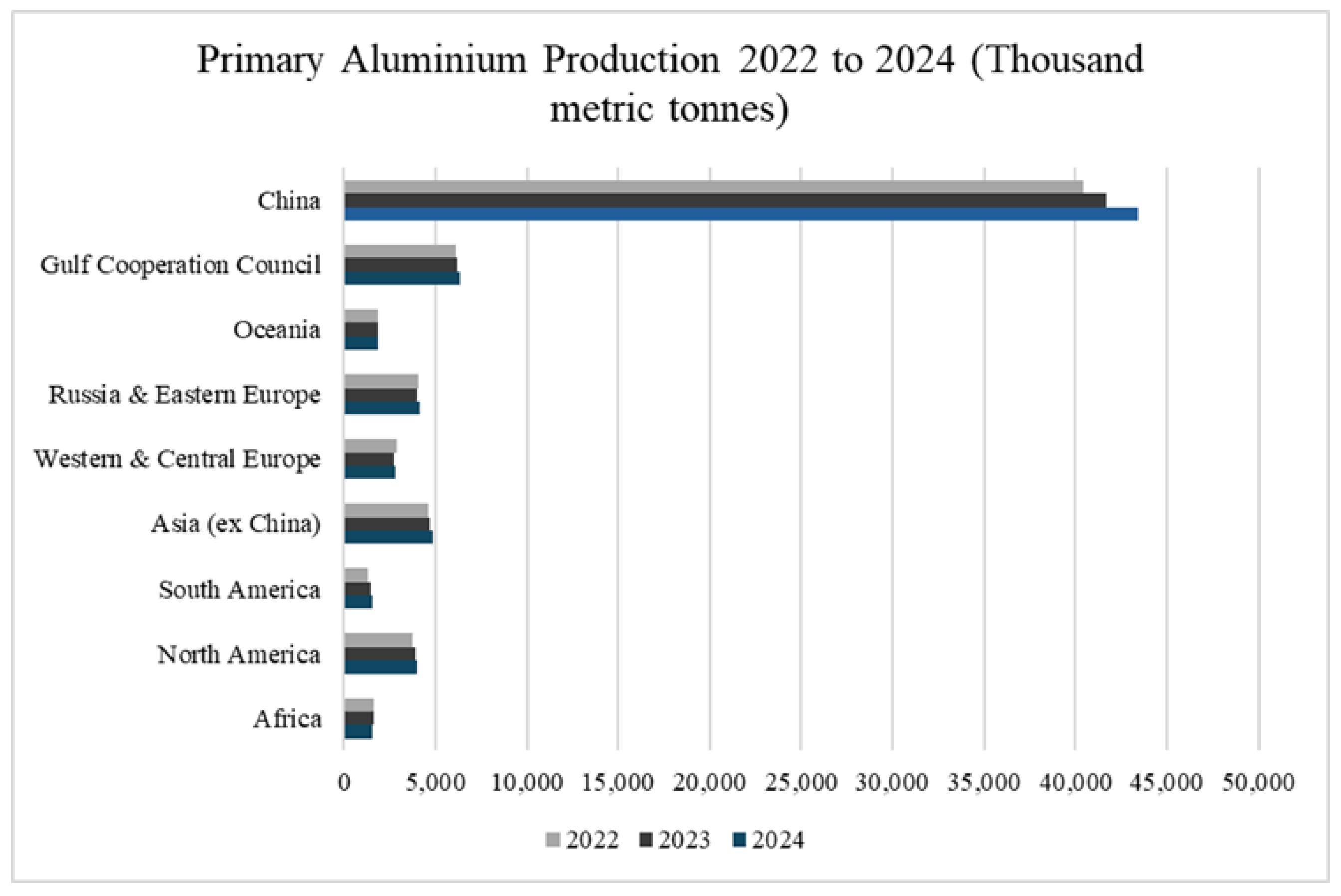
Figure 2.
World Bauxite Mine Production (2023-2024) [56].
Figure 2.
World Bauxite Mine Production (2023-2024) [56].
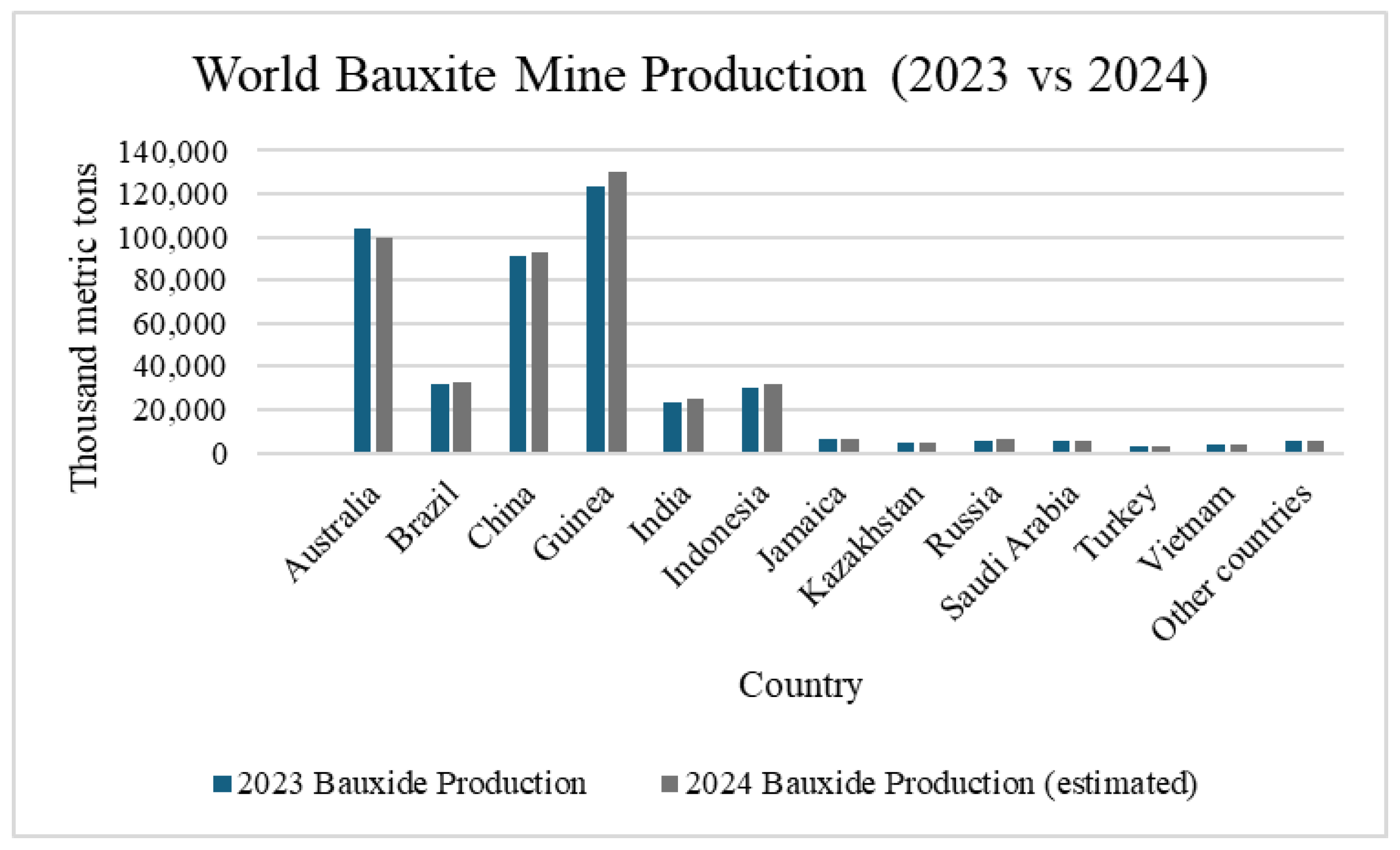
Figure 3.
Primary Steps in Bayer Process[53].
Figure 3.
Primary Steps in Bayer Process[53].
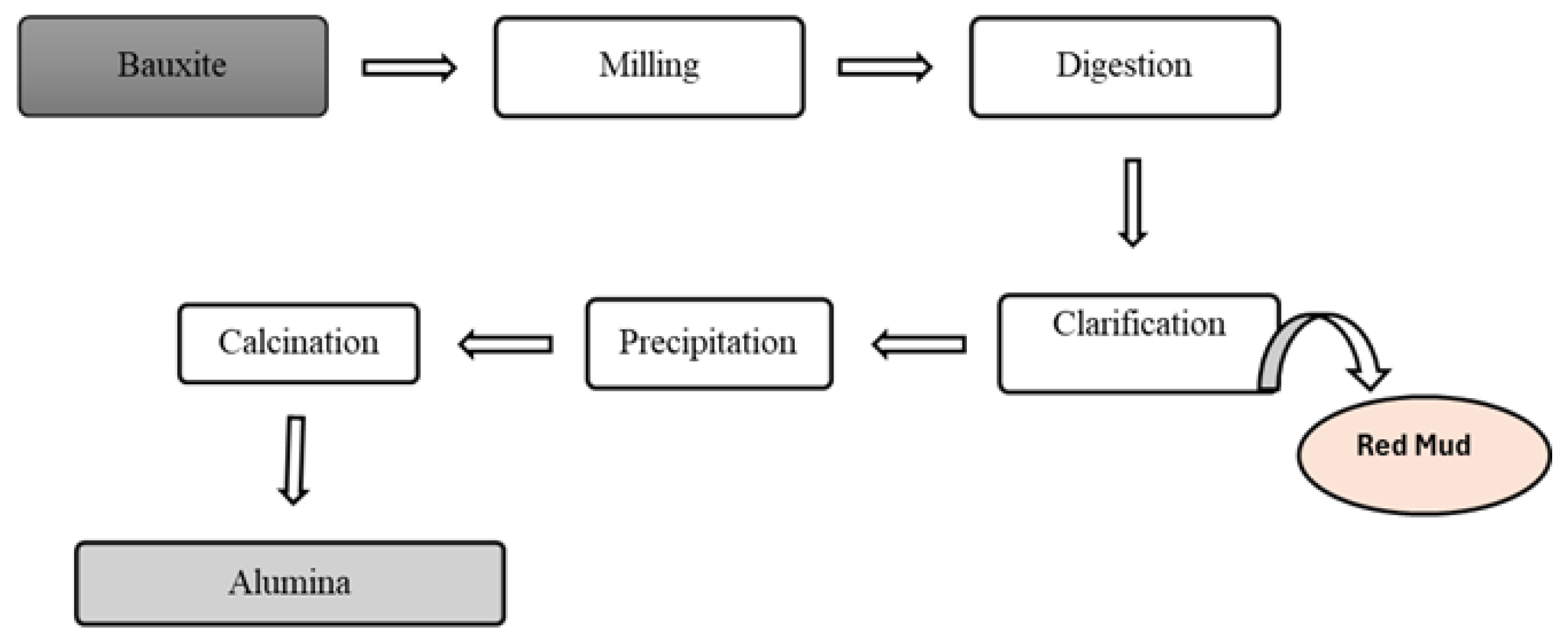
Figure 4.
Global Annual Bauxite Residue Generation (2005-2050)-History and Projection, Values approximated and figure redrawn based on[57].
Figure 4.
Global Annual Bauxite Residue Generation (2005-2050)-History and Projection, Values approximated and figure redrawn based on[57].
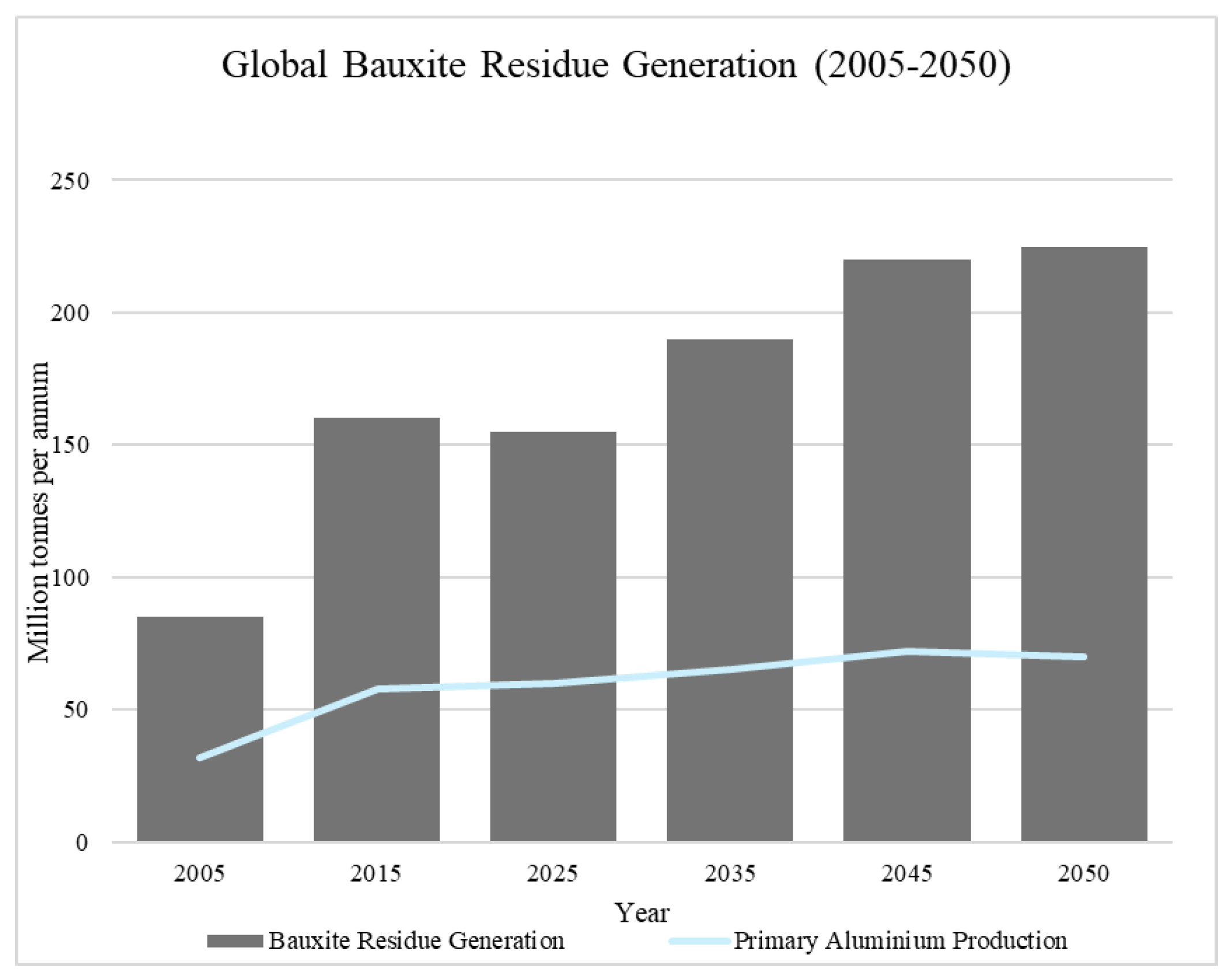
Figure 5.
Thermal Susceptibility Index of Asphalt Mastic with Bauxite Residue, Limestone, Dolomite, and Fly Ash. Reproduced from [61] © 2020 by the authors. Licensed under CC BY 4.0.
Figure 5.
Thermal Susceptibility Index of Asphalt Mastic with Bauxite Residue, Limestone, Dolomite, and Fly Ash. Reproduced from [61] © 2020 by the authors. Licensed under CC BY 4.0.
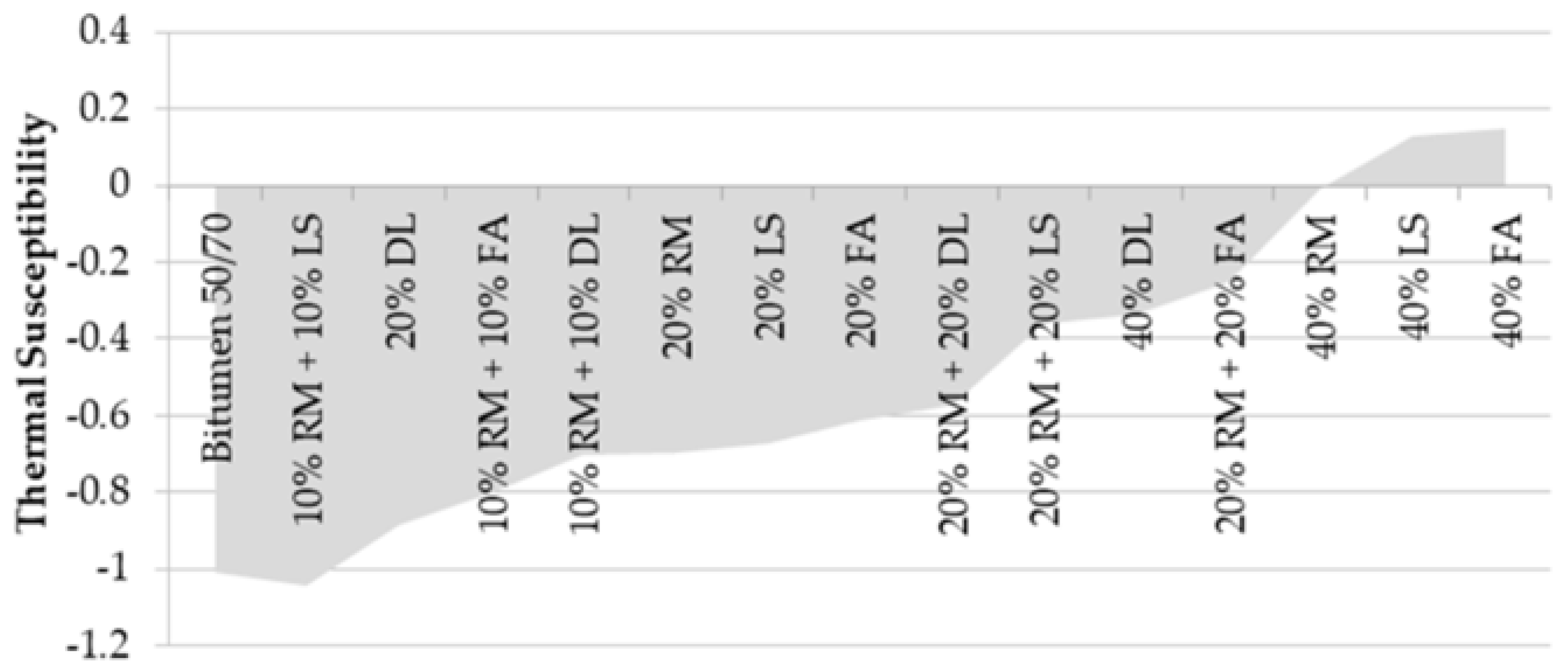
| Physical properties | Index value | Comparative evaluation with clay |
|---|---|---|
| Specific surface area (m2./g) | 15–58 | ≫Clay (10–25) |
| Particle size (mm) | 0.075–0.005 | ≫Clay (<0.002) |
| Porosity ratio (%) | 2.53–2.95 | >Clay (0.69–1.78) |
| Specific gravity (kNm−3) | 2.7-3.7 | >Clay |
| Moisture capacity (%) | 80 (82.3–105.9) | ≫Clay (<30) |
| Cation exchange capacity (mgg−1) | 25–35mg×10−2g | Destabilization |
| Density (kgm−3) | 2700–2900 | >Clay (1490–1900) |
Table 7.
Summary of the Environmental Effects of Bauxite Residue.
| Environmental Challenge | Description | Probable issues | Reference |
|---|---|---|---|
| alkalinity of bauxite residue | The incomplete washing of residue after digestion with caustic soda (NaOH) leads to the retention of Na2CO3 and NaAl (OH4), resulting in high alkalinity. | • Directly contributes to land and groundwater contamination. • The food chain and human health risk. • Accelerate dam corrosion and increase the risk of dam failure. |
[63,80] |
| Leaching of toxic elements | Leaching out of metal elements, including Al, Ca, Fe, Cr, Cu, Pb, Mg, Ba, and Mn | • Groundwater contamination and health and safety issues for livelihood. • Long-term ecological toxicity |
[76,81] |
| Pollution due to dust | Due to its small size, bauxite residue is able to easily cause dust under wind, Alkaline dust formed pollutes the air (Bauxite residue stored by the dry process) |
• Affecting the air quality and endangering the surrounding livelihood and vegetation. • Evaporation of high alkaline components can cause high alkaline rainfall |
[75,78] |
| Dam failure and leakage | Large slurry impoundments and weak dike structures tend to collapse (Tragic industry accidents, for instance, Ajak Alumina plant Hangary-2010, HINDALCO plant in Muri-2019, Xiangjiang Wanji Aluminium Plant in Luoyang, Henan Province of China-2016 |
• Contamination of the plant environment. • Increase in the caustic nature of native soils with the deposition of fine particles. • Release of potentially toxic elements (PTEs, viz., As, Ba, Ni, Zn, Cu, Zr, Pb, Cr, V, Hg, etc.), and formation of fine dust upon drying up of the surface. |
[63] |
| Impacts on marine disposal | Release toxic metals to the marine environment | • Destroy the marine ecosystem. • Formation of Mg and Al compounds increases the turbidity of seawater, • The food chain and human health risk. • Directly threatening sea animals with profound influence |
[76,78] |
| Land scarcity | Lagooning of bauxite residue requires a large amount of land area | • Loss of significant land area. • Need long-term maintenance with expensive engineering |
[53,76] |
| Salinity and sodicity of residue | High Na content | • Soil degradation, reduced fertility, restricted plant growth | [78] |
Table 8.
Summary of Previous Studies Related to Asphalt Mastic Vs Bauxite Residue.
| Ref | Country | Base Bitumen | Mixing Conditions | Content of bauxite residue | Major finding |
|---|---|---|---|---|---|
| [61] | Brazil | 50/70 | Hand mixing, Bitumen temperature 155 0C, Filler temperature 160 0C, Hand mix for 3-4 min | 20%,40% |
|
| [84] | China | 60/80 | high-speed stirrer, 150 0C at 1000 rpm for 30 min | Bitumen: Powder material=1:1 (Filler powder composition with different proportions of bauxite residue, limestone powder, white mud) |
|
| [85] | China | Grade 70 | high-speed stirrer,150 0C at 1000 rpm for 30 min | Bitumen: filler=50%:50% (filler consists of different compositions of bauxite residue, limestone filler, fly ash, hydrated lime) |
|
| [86] | India | VG-30 | manually operated mixer, 180 ◦C for 10min |
10%,20%,30% |
|
| [87] | India | VG-30 | Mechanical stirrer, 160 °C at 1000 rpm 20min | Filler/bitumen= 0.6,0.9,1.2 and 1.5 |
|
| [82] | China | AH-70 | High shear mixer, 170 °C, 4000 rpm, 30.min | 11% |
|
| [88] | China | 60/80 | High-speed shearing and mechanical stirring,150 °C,1 h high-speed shearing at 4000 rpm and 1.5 h mechanical stirring at 2000 rpm | 5% |
|
| [89] | China | 60/80 | 150 °C.,3000 r/min for 60 min and 2000 r/min for 60 min | ZnO/RM 1%,3%,5% and 7% |
|
Table 9.
Summary of Bauxite Residue in other Construction applications.
| Reference | Application | Major Findings |
|---|---|---|
| [93] | Lightweight concrete |
|
| [94] | Supplementary Cementitious material |
|
| [95] | Lightweight concrete |
|
| [55] | Supplementary Cementitious material |
|
| [96] | Blended cement |
|
| [97] | Polymer Mortar |
|
| [90] | Concrete |
|
| [91] | Self-compacting concrete |
|
| [98] | Bricks |
|
| [100] | Ceramic Material |
|
| [92] | Geopolymer Concrete |
|
| [99] | 3D Printing mortar |
|
Table 10.
Mineral Composition of Waste Rock.
| Mineral | Composition | ||||
|---|---|---|---|---|---|
| Quartz | 31.3 | 17.96 | 39.78 | 41.21 | 40.8 |
| Pyrite | 7.2 | 4.06 | - | - | 0.3 |
| Calcite | 2.8 | 4.97 | 13.40 | 6.04 | - |
| Albite | 8.7 | - | - | 5.06 | 3.7 |
| Anorthite | 18.9 | - | - | 0.38 | - |
| Muscovite | 8.3 | - | - | - | 34 |
| k-feldspar | 1.4 | - | - | - | - |
| Chlorite | 17.9 | 10.76 | - | - | 6.3 |
| Gypsum | 1.8 | - | - | - | 3.0 |
| Ferrihydrite | 0.4 | - | - | - | - |
| Jarosite | 1.3 | - | - | - | - |
| Clinochlore | - | 5.36 | - | - | - |
| Mica | - | 26.75 | - | - | - |
| Amphibole | - | 20.15 | - | - | - |
| Pyroxene | - | 3.45 | - | - | 7.7 |
| Fluorapatite | - | - | 42.25 | 6.42 | - |
| Dolomite | - | - | 4.57 | 40.89 | - |
| Goethite | - | - | - | - | 3.2 |
| References | [108] | [107] | [110] | [114] | [115] |
Table 11.
Various Applications of Mine Waste Rock in Pavement Applications.
| Reference | Application | Findings |
|---|---|---|
| [119] | pavement base/subbase |
|
| [118] | Aggregate in asphalt mixtures |
|
| [120] | Pavement base/subbase |
|
| [121] | Aggregate in concrete pavement |
|
| [122] | Pavement base |
|
Table 12.
Construction Applications of Mine Waste Rocks.
| Reference | Application | Findings |
|---|---|---|
| [104] | Aggregates (coarse and fine) in concrete |
|
| [126] | Aggregate in concrete |
|
| [127] | Aggregate in concrete |
|
| [128] | Cement in tile production |
|
| [129] | Fine aggregate |
|
| [130] | Geopolymer |
|
| [131] | Aggregate in Concrete |
|
Table 13.
Applications of Slags in Pavement Applications.
| Slag | Application | Findings | Reference |
|---|---|---|---|
| Lithium | Base/subbase |
|
[150] |
| Copper | Asphalt mixture |
|
[151] |
| Base/subbase |
|
[152] | |
| Nickel | Asphalt mixture |
|
[153] |
| Base/subbase |
|
[154] |
Table 14.
Applications of Slags in Construction.
| Slag | Application | Findings | Reference |
|---|---|---|---|
| Lithium | Cement |
|
[168] |
| Fine aggregate |
|
[169] | |
| Precursor |
|
[170] | |
| Copper | Coarse aggregate |
|
[171] |
| Cement |
|
[172] | |
| Fine aggregate |
|
[173] | |
| Precursor |
|
[174] | |
| Nickel | Fine aggregate |
|
[175] |
| Cement |
|
[176] | |
| Precursor |
|
[177] |
Table 15.
Summary and Comparative Analysis of Mining Waste in Construction.
| Waste | Global production per annum (Approx) | Key composition | Main applications | Benefits in construction | Challenges |
|---|---|---|---|---|---|
| Bauxite Residue | 150 million tonnes/year | Fe₂O₃, Al₂O₃, TiO₂, SiO₂, Na₂O, CaO | Asphalt mastic, asphalt mixture, Pavement base/subbase, bricks, geopolymers, cement replacement, aggregates |
|
|
| Mine Tailings | 10 billion tonnes/year | CaO, SiO2, Al2O3, Fe2O3, SO3, P2O5, MgO, MnO, K2O | Road base, Filler, concrete, mortar, bricks, and geopolymer productions, |
|
|
| Waste Rock / Overburden | 50 billion tonnes/year | SiO2, Al2O3, Fe2O3, CaO, SO3, P2O5 | Asphalt mixture, pavement base/subbase, coarse and fine aggregate in concrete, ceramic production, Geopolymer |
|
|
| Copper Slag | 70 million tonnes/year[179] | SiO₂,Al₂O₃, Fe₂O₃, MgO | Asphalt mixture, pavement base/subbase, Coarse and fine aggregate, Cement, Precursor |
|
|
| Nickel Slag | 30 million tonnes/year[180] | Asphalt mixture, pavement base/subbase, Fine aggregate, Cement, Precursor |
|
|
|
| Lithium Slag / Spodumene Tailings | 10 million tonnes/year [181] |
Pavement base and subbase, Cement, Fine aggregate, Precursor |
|
|
|
| Note: Information summarized from References [7,11,12,13,14,15,16,17,18,19,20,21,22,23,24,25,26,27,28,29,30,31,32,33,34,35,36,37,38,39,40,41,42,43,44,45,46,47,48,49,50,51,56,66,67,68,69,70,71,72,73,74,75,76,77,78,79,80,81,82,83,84,85,86,87,88,89,90,91,92,93,94,95,96,97,98,99,100,101,107,109,110,115,116,117,118,119,120,121,122,123,124,125,126,127,128,129,130,131,137,138,139,140,141,142,143,144,145,146,147,148,149,150,151,152,153,154,155,156,157,158,159,160,161,162,163,164,165,166,167,168,169,170,171,172,173,174,175,176,177,178,179,180,181]. | |||||
Disclaimer/Publisher’s Note: The statements, opinions and data contained in all publications are solely those of the individual author(s) and contributor(s) and not of MDPI and/or the editor(s). MDPI and/or the editor(s) disclaim responsibility for any injury to people or property resulting from any ideas, methods, instructions or products referred to in the content. |
© 2025 by the authors. Licensee MDPI, Basel, Switzerland. This article is an open access article distributed under the terms and conditions of the Creative Commons Attribution (CC BY) license (http://creativecommons.org/licenses/by/4.0/).
Copyright: This open access article is published under a Creative Commons CC BY 4.0 license, which permit the free download, distribution, and reuse, provided that the author and preprint are cited in any reuse.


