

Submitted:
16 December 2025
Posted:
18 December 2025
You are already at the latest version
Abstract
Despite significant global commitment to smart buildings and Digital Twin technologies within architecture research and practice, existing systems face fundamental challenges: they widely suffer from data silos, hindering comprehensive data integration; they are constrained by cognitive limitations, preventing deep learning from predicting complex behaviors and spatial intentions; their design goals are fundamentally device-centric, rather than human-centric; and they operate in a state of environmental isolation, lacking dynamic coordination with the external environment. To address these bottlenecks, this paper proposes the BLUE Building Paradigm, a novel and pioneering framework for next-generation spatial intelligence. BLUE represents four core pillars: Big-data (B), Learning (L), User (U), and Environment (E). The core contribution of the BLUE Building is the construction of a Spatio-Temporal Cognitive Operating System, which, through a unified Spatial Semantic Graph and Adaptive Reinforcement Learning, achieves a deep understanding of spatial states and user intentions, and forms a dynamic, continuously optimized closed-loop synergy with the external environment. This marks an epoch-making transition in spatial intelligence from passive automation to proactive cognition and continuous self-adaptation. This paper details the operational mechanism of the BLUE Paradigm, its key technical implementations, and cross-scale interaction strategies. Furthermore, it introduces the BLUE Building Rating and Evaluation Mechanism, including its potential for expansion, translating the paradigm's cognitive capabilities into quantifiable industry standards to drive adoption. The BLUE Building Paradigm not only sets a new benchmark for building energy efficiency and occupant well-being but also lays a solid theoretical foundation for the resilient, sustainable, and integrated development of future urban systems and the human experience.
Keywords:
BLUE Building
; spatial intelligence
; Cognitive Building
; Spatio-Temporal Cognitive System
; BLUE Paradigm
; reinforcement learning
; Digital Twin
; semantic graph
; occupant well-being
; energy efficiency
; resilience
; cross-scale interaction
1. Introduction
1.1. Limitations of Existing Spatial Intelligence
Since the turn of the twenty-first century, the construction industry has undergone a wave of digitalization, transitioning from Building Automation Systems (BAS) to the Internet of Things (IoT). In particular, the emergence of Digital Twin technology, which connects physical space with virtual models in real-time [1,2], has significantly improved building operation and maintenance efficiency. However, current "smart" practices remain at the level of fragmented and passive automation, far from achieving true spatial cognition. We observe the following fundamental deficiencies in the existing paradigm:
(1) Data Silos: The core pain point of current smart buildings lies in the fragmentation and physical isolation of data. Data from subsystems such as HVAC, lighting, security, and access control are logically and physically separated, forming insurmountable silos. A deeper flaw is the lack of a unified semantic model for this data [3]. This failure in data integration and semanticization severely limits the value realization of B (Big-data).
(2) Cognitive Constraints: Limited by insufficient data integration, existing intelligent systems lack true cross-modal deep learning capabilities, making them unable to achieve deep understanding and prediction of complex spatial events and human behaviors. Current AI models are largely confined to optimizing singular, explicit parameters (e.g., adjusting air supply based on outdoor temperature), but cannot utilize multimodal data (e.g., vision, audio, user interaction logs) to infer high-level user intentions. This cognitive limitation impedes the efficiency and accuracy of L (Learning).
(3) Device-Centricity: The design goals of intelligent systems have long revolved around equipment efficiency and maintenance costs, essentially reflecting a "device-centric" approach [4]. Optimization strategies often prioritize extending equipment lifespan and lowering baseline energy consumption, relegating user experience, health, and well-being to secondary constraints or tolerance variables. This deviation in goal setting prevents the system from offering proactive, personalized services tailored to individual physiological or emotional needs, thus failing to realize the true human-centric U (User) value.
(4) Environmental Isolation: Most existing smart buildings are isolated optimization units that lack the capacity for dynamic coordination and elastic interaction with the external environment. Buildings cannot participate in real-time flexible scheduling with the urban power grid, nor can they integrate external data such as community microclimate changes and traffic conditions into their energy optimization strategies. This functional environmental isolation results in a lack of cross-scale self-adaptation and resilience when facing extreme events, failing to ensure energy security and the sustainability goals of E (Environment).
These limitations indicate that what is needed is no longer a gradual technological upgrade, but a paradigm shift in foundational theory and system architecture [5].
1.2. Paradigm Shift: From Smart to Cognitive
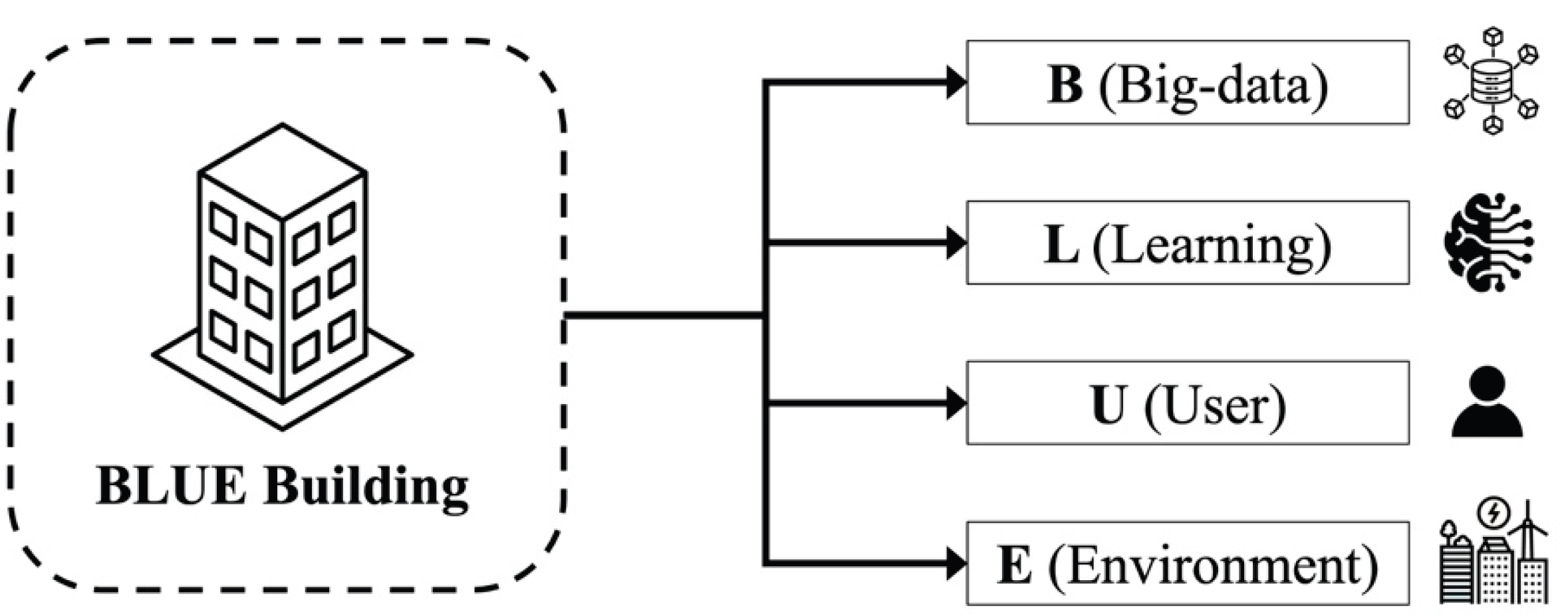
To break through these bottlenecks, this paper formally proposes the BLUE Building Paradigm, a novel framework designed to lead spatial intelligence into the cognitive era. The core proposition of the BLUE Building is that a building must evolve from an efficient operational container into a cognitive entity capable of deep understanding, proactive learning, and continuous adaptation. We define BLUE as the four core pillars of next-generation spatial intelligence:
B (Big-data): Construction of a spatial panoramic data lake and integration of multi-source semantic graphs, laying a solid foundation for the system's deep cognition and intelligent inference.
L (Learning): Adaptive, generative AI and predictive models, enabling a deep understanding of spatio-temporal patterns.
U (User): A human-centric experience layer and intention recognition, establishing the goals for intelligent services.
E (Environment): Cross-scale (building-city) dynamic interaction and sustainability, ensuring global optimization and resilience.
Figure 1.
BLUE Building Framework.
The core contributions of this paper are:
(1) Proposing the BLUE Building Paradigm, which defines the four decisive elements of next-generation spatial intelligence.
(2) Establishing the Spatio-Temporal Cognitive Operating System, detailing how data, learning, user, and environment form a closed-loop mechanism under the BLUE framework.
(3) Outlining the vision and future impact, designing the BLUE Building Rating and Evaluation Mechanism and its expanded research, translating the paradigm's cognitive capabilities into quantifiable industry standards to drive adoption.
2. The BLUE Paradigm
2.1. The Operational Cycle
The operation of the BLUE Building is founded upon a continuous, adaptive spatio-temporal cognitive closed-loop. This cycle begins with data acquisition (B), which involves real-time collection of spatial, user, and external environmental information through high-dimensional sensors and IoT networks, integrating it into a unified semantic graph. Subsequently, the cognitive learning (L) module utilizes multimodal fusion technology and deep learning models to perform pattern recognition and intention prediction, thereby achieving a deep understanding of current and future spatial states.
Based on the results of learning and prediction, the system performs intention matching (U), translating recognized user needs (e.g., "the user is about to start a presentation" or "the user is under high stress") into optimal environmental response strategies. Finally, the environmental feedback (E) layer executes cross-system and cross-scale control commands, adjusting the building environment (e.g., temperature, lighting, air quality, or energy exchange with the urban power grid). This process is not merely simple automated response; rather, it feeds the feedback data back into the Big-data (B) layer, forming a dynamic, continuously optimizing Spatio-Temporal Cognitive Operating System that ensures the BLUE Building can constantly evolve and adapt to changing spatial needs and external environments.
2.2. Spatio-Temporal Cognition of BLUE Building
The most fundamental pioneering aspect of the BLUE Building Paradigm lies in achieving a transition in spatial intelligence from traditional 3D static or quasi-real-time monitoring to 4D Spatio-Temporal Cognition. Analogously, conventional smart buildings and Digital Twins remain at the level of precise mapping and passive control of physical space (3D), with their intelligent behavior being a "snapshot-based" response to the current state. The BLUE Building introduces Time as the core cognitive dimension, essentially adding a time axis to the 3D physical space to form a continuously evolving spatio-temporal state flow. This 4D cognitive form is closely linked to the four pillars of BLUE: B (Big-data) provides deep historical and real-time time-series data; the L (Learning) module utilizes these data, through sequence models and reinforcement learning, to achieve future state prediction and the generation of optimal action strategies; U (User) not only matches current intentions but also predicts the user's behavioral trajectory and emotional changes over a future time horizon; and E (Environment) can formulate cross-temporal elastic synergy strategies based on weather forecasts and urban grid signals. Consequently, the BLUE Building realizes a paradigm shift from "passive response" to "proactive foresight," representing a true Spatio-Temporal Cognitive Operating System that evolves progressively over time.
3. Spatio-Temporal Cognitive Operating System: Technical Implementation of BLUE Framework and Core Mechanisms
The practical embodiment of the BLUE Building is the Spatio-Temporal Cognitive Operating System. This system serves as the crucial bridge for the BLUE Paradigm from theory to practice, designed to construct a bottom-up, data-driven, and complete technology stack to fully realize its cognitive capabilities. This technical framework encompasses unified data acquisition (B), high-dimensional intelligent learning (L), human-centric experience design (U), and cross-scale environmental synergy (E), all of which comprehensively support the adaptive operational cycle of the BLUE Paradigm.
3.1. B: Big-data and Spatial Semantic Graph
The core strategy for the BLUE Building to overcome traditional data silos is to construct a unified Spatial Data Model [6,7]. This model seamlessly integrates CAD/BIM structural data, real-time IoT sensor stream data, and user interaction data, forming a Spatial Semantic Graph with complete semantic information. This graph structure is the bedrock of the BLUE Building's deep cognition, allowing the system to understand the complex correlations between various elements in space, transcending mere multi-variate spatio-temporal data. The core mechanism is to effectively construct and query the spatio-temporal semantic relationships within the building using Graph Neural Networks (GNNs) or similar topological structure learning methods [8,9].
3.2. L: Adaptive Learning and Behavior Prediction
The realization of the BLUE Building's "cognitive" capability relies on a range of advanced AI techniques. The system employs Multimodal Fusion Learning, combining data streams from visual, audio, and environmental sensors to achieve a comprehensive understanding of complex spatial states. By introducing Machine Learning (ML) or Reinforcement Learning (RL), the system can self-optimize HVAC and energy systems, autonomously generating optimal control strategies while satisfying dual objectives of user comfort and energy efficiency [10,11]. More importantly, Intention Recognition, through analysis of user behavioral patterns and time-series data, predicts the user's next needs and actions in space, thereby achieving true "proactive foresight" and serving as the key core mechanism for proactive optimization [12].
3.3. U: User-Centricity and Affective Intelligence
The BLUE Paradigm prioritizes user well-being, designing a dedicated User Experience Layer (UX Layer) for this purpose. This layer translates user physiological comfort, work efficiency, and emotional state into quantifiable optimization metrics (such as comfort index, efficiency index). Technically, the system employs non-intrusive methods to gather user feedback, combining it with environmental and behavioral data to achieve Affective Perception and Proactive Service. This affective intelligence can not only adjust lighting color based on user stress levels but also predictively tune ventilation and temperature according to fatigue levels, thereby providing refined and humanized customized services.
3.4. E: Cross-Scale Interaction and Resilience
To overcome the environmental isolation of traditional smart buildings, the BLUE Building must possess Cross-Scale Interaction capabilities [13]. This involves detailing how to engage in real-time data sharing and collaborative optimization with external systems such as the urban power grid, community microclimate monitoring networks, and regional transportation systems to balance macroscopic and microscopic energy demands. Furthermore, the paradigm proposes powerful Adaptive Strategies, ensuring the system can achieve energy self-sufficiency and rapid response when faced with extreme events (e.g., power grid failures, sudden high temperatures), significantly enhancing the building's Resilience in terms of energy security and confronting environmental challenges.
4. Vision and Future Impact
4.1. BLUE Building Application Scenarios
The present and future application scenarios envisioned by the BLUE Building Paradigm will fundamentally revolutionize how humans interact with space. This cognitive upgrade is first manifested in Personalized Health and Well-being, where the building can dynamically adjust environmental parameters based on real-time user physiological data (such as sleep quality, heart rate variation), shifting from passive environmental control to proactive health support. Second, in Maximizing Energy Efficiency, the system can combine predictive maintenance with net-zero targets to perform high-precision, cross-temporal dynamic energy scheduling, achieving nearly perfect energy management. Additionally, the BLUE Building supports Flexible Spatial Function Remodeling, allowing physical and digital configurations to adapt to changing needs in real-time, substantially enhancing space utilization and adaptability.
In fact, practical research in some application areas is already underway. For instance, in the field of Building Comfort, scholars have worked on developing personalized thermal comfort models based on deep learning; in Energy Consumption Prediction, research has explored the use of reinforcement learning for HVAC system optimization. However, these practices are mostly confined to solving local, singular application problems, lacking a pioneering paradigm that unifies the four core dimensions: data foundation, cognitive learning, user demand, and environmental synergy. The BLUE Building fills this theoretical gap by integrating scattered application research into a cohesive cognitive framework, providing a foundational blueprint for the comprehensive development of future spatial intelligence [14].
4.2. BLUE Building Rating and Evaluation Mechanism
To ensure the widespread adoption and market-driven implementation of the BLUE Paradigm, it is imperative to establish an authoritative, quantifiable, and scalable BLUE Building Rating and Evaluation Mechanism. This mechanism is designed to translate the high-level cognitive capabilities of the BLUE Building into measurable and certifiable standards, thereby promoting industry adoption. We propose the BLUE Rating Model as its quantitative core:
In this model, represents a comprehensive function that integrates the four core dimensions, where stands for the Big-data dimension (data completeness and semanticization level), for the Learning dimension (system self-adaptation and prediction accuracy), for the User dimension (experience and well-being improvement), and for the Environment dimension (cross-scale synergy and sustainability contribution). It is worth noting that the BLUE Score is a function of these four core factors, and its specific form and weights will be dynamically adjusted based on the building type and application goals to ensure flexibility and impartiality in assessment. Looking ahead, we suggest establishing a multi-tiered rating system, progressing from BLUE Ready to BLUE Certified, and ultimately to BLUE Cognitive, to guide the construction industry toward generational upgrades in intelligence. Furthermore, the BLUE rating system is merely a starting point, and its theoretical foundation offers vast possibilities for future research. Analogous to how green building has expanded in practice to areas like finance, social equity, and policy-making, future research directions for the BLUE Building can similarly delve into: Cognitive Building Life Cycle Carbon Footprint Assessment, building occupant environmental comfort, Social Equity and Inclusive Design, and Next-Generation Building Policy and Regulatory Frameworks. These will be key areas for pushing the BLUE Paradigm beyond technical theory towards comprehensive societal application.
4.3. Challenges, Ethics and Standards
Any transformative technological paradigm is inevitably accompanied by significant Challenges and Ethical Dilemmas. The powerful cognitive and predictive abilities of the BLUE Building are built upon the collection of a vast amount of highly sensitive data, particularly user behavioral trajectories, physiological states, and potential intentions, making Data Privacy and Security the foremost challenges. The system must be designed with multi-layer encryption and anonymization mechanisms to ensure the absolute security of personal data, while also establishing transparent data usage protocols to prevent misuse. Secondly, the issue of Algorithmic Bias and Fairness cannot be ignored. If training data is biased, the AI model's optimization strategy could systematically discriminate against specific user groups or compromise comfort in certain areas. This necessitates that the BLUE Paradigm establishes strict auditing and Explainability frameworks to guarantee the impartiality of its decisions.
To ensure the healthy development and widespread application of BLUE Building technology, unified interfaces and open standards are critical issues that the industry must address immediately. The current smart building market is severely fragmented, with various vendors using proprietary protocols, which impedes the seamless integration and data interoperability between different BLUE components. Therefore, we call for the establishment of unified API interfaces and open data models for the BLUE Paradigm (e.g., standards based on Semantic Web or Graph Database) to lower technical barriers, foster innovation, and provide a standardized foundation for global deployment and certification.
4.4. Towards the 'Living Building'
The BLUE Building represents the ultimate stage of building intelligence development, the transition towards the "Living Building." It surpasses passive automation and static Digital Twins to become a cognitive infrastructure capable of sensing the environment, deeply learning user intentions, and continuously evolving. Through the four pillars of the BLUE framework (B, L, U, E), the BLUE Building can understand and adapt to complex internal and external changes in real-time, achieving true Spatio-Temporal Cognition. Ultimately, this paradigm shift will transform the building into an organic, self-adaptive component of the urban ecosystem, fundamentally reshaping our perception of buildings from simple physical structures to living entities serving human well-being and global sustainability.
5. Conclusion
In conclusion, this paper proposes the BLUE Building Paradigm, designed to lead spatial intelligence into the cognitive era. This represents a fundamental solution to core pain points widely prevalent in the current smart building sector, including data silos, cognitive limitations, device-centricity, and environmental isolation. The pioneering contribution of the BLUE Building lies in its novel integration of Big-data (B), Learning (L), User-centricity (U), and Environmental interaction (E) into a closed-loop Spatio-Temporal Cognitive Operating System, achieving an epochal transition from "passive response" to "proactive foresight." We reiterate that the BLUE Building is not merely a tool for enhancing building energy efficiency and user well-being; it is a critical cornerstone for resolving the complex challenges of future urbanization, climate change, and the integrated development of the human experience. Building upon this, in addition to the proposed BLUE evaluation mechanism, future research directions will extend into broader social and economic domains such as Cognitive Building Life Cycle Carbon Footprint Assessment, building occupant environmental comfort, Social Equity and Inclusive Design, and Next-Generation Building Policy and Regulatory Frameworks, ensuring the paradigm transitions from technical theory to global sustainable application [15].
References
- Grieves, M.; Vickers, J. Digital Twin: Mitigating Unpredictable, Undesirable Emergent Behavior in Complex Systems. In Transdisciplinary Perspectives on Complex Systems; Kahlen, F.-J., Flumerfelt, S., Alves, A., Eds.; Springer International Publishing: Cham, 2017; pp. 85–113. ISBN 978-3-319-38754-3. [Google Scholar]
- Boschert, S.; Rosen, R. Digital Twin—The Simulation Aspect. In Mechatronic Futures; Hehenberger, P., Bradley, D., Eds.; Springer International Publishing: Cham, 2016; pp. 59–74. ISBN 978-3-319-32154-7. [Google Scholar]
- Fuller, A.; Fan, Z.; Day, C.; Barlow, C. Digital Twin: Enabling Technologies, Challenges and Open Research. IEEE Access 2020, 8, 108952–108971. [Google Scholar] [CrossRef]
- Fanger, P.O. Thermal Comfort. Analysis and Applications in Environmental Engineering. 1970. [Google Scholar]
- Tao, F.; Qi, Q.; Wang, L.; Nee, A.Y.C. Digital Twins and Cyber–Physical Systems toward Smart Manufacturing and Industry 4.0: Correlation and Comparison. Engineering 2019, 5, 653–661. [Google Scholar] [CrossRef]
- Pauwels, P.; Zhang, S.; Lee, Y.-C. Semantic Web Technologies in AEC Industry: A Literature Overview. Automation in construction 2017, 73, 145–165. [Google Scholar] [CrossRef]
- Zhong, B.; Gan, C.; Luo, H.; Xing, X. Ontology-Based Framework for Building Environmental Monitoring and Compliance Checking under BIM Environment. Building and Environment 2018, 141, 127–142. [Google Scholar] [CrossRef]
- Battaglia, P.W.; Hamrick, J.B.; Bapst, V.; Sanchez-Gonzalez, A.; Zambaldi, V.; Malinowski, M.; Tacchetti, A.; Raposo, D.; Santoro, A.; Faulkner, R.; et al. Relational Inductive Biases, Deep Learning, and Graph Networks 2018.
- Kipf, T.N. Semi-Supervised Classification with Graph Convolutional Networks. arXiv 2016, arXiv:1609.02907. [Google Scholar]
- Wei, T.; Wang, Y.; Zhu, Q. Deep Reinforcement Learning for Building HVAC Control. In Proceedings of the Proceedings of the 54th Annual Design Automation Conference 2017, June 18 2017; ACM: Austin TX USA; pp. 1–6. [Google Scholar]
- Vázquez-Canteli, J.R.; Nagy, Z. Reinforcement Learning for Demand Response: A Review of Algorithms and Modeling Techniques. Applied energy 2019, 235, 1072–1089. [Google Scholar] [CrossRef]
- Drgoňa, J.; Arroyo, J.; Figueroa, I.C.; Blum, D.; Arendt, K.; Kim, D.; Ollé, E.P.; Oravec, J.; Wetter, M.; Vrabie, D.L. All You Need to Know about Model Predictive Control for Buildings. Annual reviews in control 2020, 50, 190–232. [Google Scholar] [CrossRef]
- Meerow, S.; Newell, J.P.; Stults, M. Defining Urban Resilience: A Review. Landscape and urban planning 2016, 147, 38–49. [Google Scholar] [CrossRef]
- Agency, I.E. Buildings: A Source of Enormous Untapped Efficiency Potential 2021.
- Kuhn, T.S. The Structure of Scientific Revolutions, 2nd Enl. ed.; University of Chicago Press, 1970. [Google Scholar]
Disclaimer/Publisher’s Note: The statements, opinions and data contained in all publications are solely those of the individual author(s) and contributor(s) and not of MDPI and/or the editor(s). MDPI and/or the editor(s) disclaim responsibility for any injury to people or property resulting from any ideas, methods, instructions or products referred to in the content. |
© 2025 by the authors. Licensee MDPI, Basel, Switzerland. This article is an open access article distributed under the terms and conditions of the Creative Commons Attribution (CC BY) license (http://creativecommons.org/licenses/by/4.0/).
Copyright: This open access article is published under a Creative Commons CC BY 4.0 license, which permit the free download, distribution, and reuse, provided that the author and preprint are cited in any reuse.


