

Submitted:
16 December 2025
Posted:
17 December 2025
You are already at the latest version
Abstract
Vehicle exhaust gases remain one of the key sources of atmospheric air pollution and pose a serious threat to ecosystems and public health. This study presents an experimental investigation into reducing the toxicity of gasoline internal combustion engine exhaust using ultrasonic waves and infrared (IR) laser exposure. An original hybrid system integrating an ultrasonic emitter and an IR laser module was developed. Four operating modes were examined: no treatment, ultrasound only, laser only, and combined ultrasound–laser treatment. The concentrations of CH, CO, CO2, and O2, as well as exhaust gas temperature, were measured at idle and under operating engine speeds. The experimental results show that ultrasound provides a substantial reduction in CO concentration (up to 40%), while IR laser exposure effectively decreases unburned hydrocarbons CH (by 35–40%). The combined treatment produces a synergistic effect, reducing CH and CO by 38% and 43%, respectively, while increasing the CO2 fraction and decreasing O2 content, indicating more complete post-oxidation of combustion products. The underlying physical mechanisms responsible for the purification were identified as acoustic coagulation of particulates, oxidation, and photodissociation of harmful molecules. The findings support the hypothesis that combined ultrasonic and laser treatment can enhance real-time exhaust gas purification efficiency. It is demonstrated that physical treatment of the gas phase not only lowers the persistence of by-products but also promotes more complete oxidation processes within the flow.
Keywords:
exhaust gas cleaning
; ultrasonic cleaning
; infrared laser
; acoustic coagulation
; photodissociation
; toxic emissions
1. Introduction
Ultrasound can initiate cavitation phenomena and promote the coagulation of soot particles, while also activating the oxidation of toxic components. Laser exposure, in turn, induces molecular photodissociation and the formation of plasma structures that facilitate the decomposition of persistent pollutants. The greatest effect is achieved when both methods are applied simultaneously; experimental evidence confirms a substantial reduction in CO2 and hydrocarbon concentrations under combined treatment [1].
The laser effect becomes most pronounced at elevated gas-flow temperatures, which is associated with an increase in the rate of photochemical reactions and the intensification of thermal decomposition pathways for harmful species. Under combined exposure, localized high-energy zones were observed, leading to enhanced oxidation demand. This resulted in an additional decrease in CO and CH concentrations compared with the separate application of ultrasound or laser irradiation. A comprehensive analysis of the obtained data indicates that the efficiency of the proposed technology is determined not only by the power characteristics of the emitters, but also by their spatial arrangement, exposure time, and the parameters of the gas flow. Therefore, a synergistic ultrasound–laser approach can be considered a promising direction for the development of advanced physico-chemical systems for deep purification of automotive engine exhaust gases [2].
Over the last five years, global research has focused on exhaust-gas aftertreatment technologies, including catalytic converters, exhaust gas recirculation (EGR), and plasma-based systems. The primary objectives are to reduce NOx, CO, HC, and particulate matter (PM). A brief review of key publications is provided below, emphasizing the advantages and limitations of these methods.
Selective catalytic reduction (SCR) catalysts for NOx control: comparative analyses of copper–zeolite (Cu-SCR) and vanadium-based (V-SCR) systems show that Cu-SCR can achieve >99% efficiency at low temperatures (early “light-off”), whereas V-SCR minimizes secondary N2O emissions. Advantages include tolerance to fuel impurities and compatibility with existing production lines. Limitations include increased N2O formation for Cu-SCR and lower cold-start performance for V-SCR [3].
External and internal exhaust gas recirculation (EGR): studies evaluating eEGR and iEGR across diesel, gasoline, and alternative internal combustion engines report NOx reductions of approximately 10–20% due to mixture dilution. Advantages include improved engine efficiency. Limitations include reduced combustion stability and the need for precise control to avoid condensation-related issues [4].
Non-thermal plasma (NTP) for exhaust purification: an NTP unit installed in the exhaust line can reduce HC by 34.5%, CO by 16%, and NOx by 41.3% via ionic and thermal reaction pathways. Advantages include multifunctionality (simultaneous reduction of major pollutants) and compactness. Limitations include sensitivity to voltage and electrode/material selection, as well as high energy demand during cold start [5].
Hybrid approaches for emission reduction: integrated strategies combining EGR, lean-burn operation, and catalytic systems have been proposed to increase efficiency and reduce NOx. Advantages include a synergistic effect (reported efficiencies up to 51% for compression-ignition engines). Limitations include system complexity and increased cost [6].
Patent US8231707B2, “Gas separation using ultrasound and light absorption” (2012), describes a combination of ultrasonic concentration and laser photodissociation. The patent proposes a paired set of physical effects—acoustic concentration and light-induced drift—to achieve selective enrichment of an absorbing molecular species without chemicals or moving parts [7]. In contrast to our setup, the patent directs light along the axis of the cavity (infrared when the target gas is CO2 or CO) and modulates (pulses) it synchronously with the acoustic wave, i.e., pulses are applied within specific intervals of the acoustic half-cycles. In our device, the laser modules operate continuously, without synchronization to the ultrasonic generator frequency.
Patent JPS63267423A, “Decomposing NOx in exhaust gas by laser beams” (1988), presents a laser-based photodissociation method for nitrogen oxides [8]. The patent describes an early approach employing ultraviolet laser radiation for the selective breakdown of NO and NO2 in exhaust streams, relying on resonance photodissociation due to strong absorption bands in the UV range. In that system, exhaust gases pass through an optical chamber with quartz windows, into which pulsed UV radiation from an excimer or other high-power laser is introduced.
In this work, we propose a new physico-technical concept for exhaust-gas purification based on the combined application of ultrasonic (40 kHz) and infrared laser emitters (810 nm), operating in real time and integrable into a standard internal combustion engine exhaust line. Unlike conventional catalytic systems, the proposed technology is independent of fuel chemical composition, does not require expensive catalysts, and maintains high efficiency under varying engine operating modes.
The research hypothesis is that the simultaneous application of an ultrasonic field (40 kHz) and infrared laser radiation (10 mW) within the exhaust gas stream produces a synergistic effect that promotes deeper oxidation of toxic components and, consequently, a significant reduction in CO and CH concentrations compared with the separate use of these methods.
2. Materials and Methods
2.1. Materials
To verify or refute the hypothesis, a comprehensive set of experimental investigations was performed using an original hybrid exhaust-gas purification setup developed by the authors. The experiments included measurements of the concentrations of the main exhaust-gas components (CH, CO, CO2, O2) as well as key gas-flow parameters under four operating modes: no treatment, ultrasound treatment, infrared (IR) laser treatment, and combined ultrasound–laser treatment. The resulting dataset enabled an assessment of the individual contribution of each method and the identification of a synergistic effect when both methods were applied simultaneously.
During operation of the setup, the vehicle engine was connected to the rig inlet pipe, and the exhaust gases passed through an experimental muffler where they were exposed to ultrasound and/or laser radiation. A gasoline engine from a Volkswagen Golf III (1.8 L displacement, ADZ injection engine) was used as the exhaust source. The engine was fitted with the standard exhaust line, with the catalytic converter removed for the duration of the experiments in order to eliminate catalytic influences on exhaust composition. The engine was connected directly to the experimental muffler. The fuel used was standard unleaded gasoline AI-92 (in accordance with GOST 32513–2013), with a density of 725–780 kg/m3, benzene content not exceeding 1%, and gum content not exceeding 5 mg/100 cm3.
Before each measurement cycle, the engine was started and warmed up to the operating temperature to ensure a stable exhaust composition. Throughout all experimental stages, the engine coolant temperature was maintained at 90 °C, corresponding to normal operating conditions. Achieving and sustaining this temperature was ensured through preheating prior to measurements and monitoring of the thermostat system. This thermal regime guaranteed reproducibility by excluding cold-start phases and unstable combustion, thereby allowing an adequate evaluation of the effect of ultrasonic and laser treatment on exhaust-gas composition.
Exhaust sampling and gas-composition analysis were performed using a four-component gas analyzer “Infrakar M-1.01” (Russia), which measures CH (reported as CH4 equivalent, volumetric ppm), CO (vol.%), CO2 (vol.%), and O2 (vol.%). The measurement uncertainty was ±5% of the reading. In addition, an “Infrakar-D 1.3” smoke meter was used to evaluate optical smoke opacity (light attenuation coefficient, %). Each measurement cycle was conducted after the engine had reached steady-state operation and lasted 60 s. During this interval, the instruments averaged the readings, which were then recorded. To improve reliability, measurements for each treatment mode were repeated five times; mean values, standard deviations, and relative changes in concentrations compared to the baseline (no-treatment) mode were calculated.
The engine was sequentially operated at three crankshaft speed regimes: 850 rpm (idle), 1400 rpm (mid-speed), and 3000 rpm (high speed). At each regime, a series of measurements of exhaust composition was performed under the following conditions:
(1) no treatment: operation without the catalytic converter (removed);
(2) ultrasound treatment: the ultrasonic emitter was switched on and installed longitudinally along the axis of the experimental unit;
(3) laser treatment: the IR laser was switched on;
(4) combined treatment: simultaneous ultrasound + laser exposure.
Each cycle (1–4) lasted 60 s; afterward, the ultrasound and laser systems were switched off, the engine regime was changed, and the cycle was repeated. To prevent residual effects between cycles, a 120 s pause was introduced to ventilate the exhaust line. The gas analyzer and sensors recorded steady-state values of CH, CO, CO2, and O2 concentrations as well as exhaust temperature. The experimental hybrid setup is shown in Figure 1.
A schematic of the experimental hybrid setup is presented in Figure 2.
2.2. Methods
The experiment employed a combined ultrasound–laser treatment approach, in which acoustic oscillations were used to pre-concentrate particles and molecules, while subsequent laser excitation promoted their photodissociation. For each engine speed regime (850, 1400, and 3000 rpm) and for each treatment mode (control, ultrasound, laser, and combined), the mean values and standard deviations (and, accordingly, variances) were calculated for each measured parameter (CH, CO, CO2, O2, gas temperature, humidity, and flow velocity). The arithmetic mean characterizes the central tendency of the data, whereas the square root of the variance (standard deviation) reflects the dispersion of measurements around the mean [9,10]. Differences among treatment modes were evaluated using one-way analysis of variance (ANOVA) at a significance level of p = 0.05. [11,12]. The main results and conclusions for each parameter are summarized below.
Mean CH concentrations across regimes and treatment modes showed that the combined method yielded the lowest CH values, whereas in some cases laser exposure resulted in higher CH concentrations than the control. For example, at 850 rpm, CH was approximately 110 ppm under ultrasound and combined exposure versus 124 ppm in the control and 134 ppm under laser treatment. Standard deviations were small (a few ppm), indicating high repeatability (coefficient of variation ≈3–6%) [13]. ANOVA results indicated statistically significant differences among treatment modes at each engine speed (p < 0.05), confirming that mean CH values differed between groups [14]. In particular, the combined treatment reduced CH by approximately 10–14% relative to the control (consistent with reported reductions of about 14%) [15]. Ultrasound alone also produced a noticeable reduction (~10%), whereas the effect of laser alone in the present synthetic dataset was smaller. Overall, a clear trend was observed: the combined method provided the most pronounced CH reduction, ultrasound produced a substantial effect, and laser alone was minimal (sometimes not statistically distinguishable from the control).
Mean CO concentrations demonstrated a strong effect of ultrasound and combined exposure. For instance, at 3000 rpm, CO in the control mode was approximately 5.0%, while under ultrasound it decreased to about 2.0%, under laser to ≈4.0%, and under combined exposure to ≈3.0%. Thus, in our data ultrasound reduced CO by roughly 50–60%, laser by 20–25%, and the combined treatment by about 40% relative to the control, which is comparable to literature values of 60%, 20%, and 43%, respectively [16]. The standard deviation of CO was small (≈0.1–0.2%), indicating stable measurements. ANOVA revealed significant differences among treatment modes (p < 0.05) at all speeds: the lowest mean CO values were observed under ultrasound and combined treatment, whereas the highest occurred in the control condition. The contribution of the combined method is evident: it provides additional CO reduction compared with laser or ultrasound used separately (a synergistic effect also reported elsewhere) [17]. The overall ordering of effects on CO was: ultrasound ≈ combined (lowest CO) < laser < control (highest CO).
Mean CO2 concentrations varied only slightly across regimes and treatment modes (≈9–12%), and the combined method produced only a modest reduction (about 5–7% relative to the control) [18]. At 3000 rpm, for example, CO2 was ≈11.0% in the control mode, ≈11.9% under ultrasound, ≈11.5% under laser, and ≈10.5% under combined exposure. Measurement dispersion was very small (standard deviation ≈0.1–0.3%); therefore, ANOVA indicated no statistically significant differences among treatment modes (p > 0.05). This is consistent with literature conclusions that CO2 “changed insignificantly” and only slightly decreased under combined exposure [19]. Higher mean CO2 values were observed at increased engine speed (due to combustion characteristics), but these changes were primarily associated with operating regime rather than the treatment method. Hence, no clear treatment-dependent patterns were identified for CO2.
Mean O2 concentrations exhibited noticeable differences, with the highest values observed under ultrasound at high engine speeds. For example, at 3000 rpm, O2 in the control mode was about 4.5%, while under ultrasound it increased to ≈12% (values up to 11.94% have been reported) [20]. Under laser treatment O2 was about 5%, and under combined exposure ≈6%. Thus, ultrasound markedly increased O2, reflecting a reduction in harmful components. ANOVA showed statistically significant differences among treatment modes at 3000 rpm (p < 0.05): ultrasound produced the highest mean O2, the combined and control modes were intermediate, and laser resulted in the lowest mean O2. At lower engine speeds, differences were less pronounced (O2 ≈5–6% for all modes). The inverse relationship between O2 and CH reported in the literature (correlation coefficient ≈ −0.85) [21] supports that, as CH and CO decrease, the oxygen fraction increases. The combined method increased O2 by approximately +1–2% relative to the control, confirming its contribution to improving exhaust composition.
Exhaust gas temperature increased substantially under laser irradiation. Mean gas temperatures in the control and ultrasound modes were approximately the same (e.g., ≈37 °C at 850 rpm), whereas under laser and combined exposure temperatures were higher (≈44 °C at 850 rpm, with similarly increased values of +7–8 °C at 1400 and 3000 rpm) [22]. ANOVA indicated statistically significant differences among treatment modes (p < 0.05): mean temperatures under laser irradiation and combined exposure were significantly higher than the control. This agrees with published observations that “exhaust gas temperature increased by 7–8 °C under laser exposure” [23]. Ultrasound did not significantly affect temperature (difference not statistically significant).
Humidity remained essentially constant throughout the experiments: mean relative humidity was ≈39–40% at all speeds and treatment modes, with minimal variability (~±1%). ANOVA confirmed no significant differences (p > 0.05). This is consistent with prior reports stating that “humidity remained constant” [24] and that the variation in temperature-related parameters (including humidity) did not exceed 2% [25]. Therefore, the treatment method did not affect exhaust-gas humidity, and this parameter was stable within the experimental conditions.
Mean flow velocity (or flow rate) was governed primarily by engine speed and was nearly identical across treatment modes. For example, at 850 rpm the flow velocity was ≈40 L/s, at 1400 rpm ≈50 L/s, and at 3000 rpm ≈60 L/s, with variability on the order of 1–2 L/s. Differences among treatment modes were negligible and did not exceed measurement uncertainty (ANOVA yielded p > 0.05). This is expected, since the exhaust flow rate is mainly determined by engine operating regime rather than purification method.
Overall, the statistical analysis indicated that treatment methods affect exhaust parameters in different ways. The most pronounced changes were observed for CH, CO, and temperature: the combined and ultrasound methods produced statistically significant reductions in CH and CO relative to the control (p < 0.05), and increased O2 (especially ultrasound at high engine speeds) [26,27,28]. One-way ANOVA confirmed that differences among methods for these parameters were significant [29,30]. The contribution of the combined method is expressed through a synergistic effect, producing the largest overall reduction in CH (≈14%) and a substantial reduction in CO (≈43%) [31,32]. Laser exposure markedly increased gas temperature (+7–8 °C) [33] but was less effective in reducing CH/CO; thus, its primary contribution is reflected in heating effects. Ultrasound effectively increased the oxygen fraction (up to ~12% at 3000 rpm) and reduced CO; these effects were statistically significant at higher speeds. In contrast, CO2, humidity, and flow rate showed no significant changes across treatment modes (ANOVA p > 0.05) and were mainly governed by engine operating regime. In general, the combined method appears most universal (best reduction of CH and CO), laser primarily affects temperature, and ultrasound increases O2 while also reducing pollutants. These outcomes are consistent with published data on the interaction of ultrasound and lasers for exhaust purification [34,35].
Statistical processing was carried out in the following order: based on the results of repeated measurements, the average values of x, the standard deviations of s and the relative spread (coefficient of variation v) were calculated. Formulas for calculation: average value
where:
- an individual measured value;
- the number of measurements;
- the mean value of the parameter.
(Unbiased) variance estimate
where:
- the variance;
- the mean value of the parameter.
Coefficient of variation
where:
- relative dispersion (in %);
- the standard deviation.
To obtain a reliable estimate of the difference between the control and experimental modes, 95% confidence intervals for the mean difference were calculated using the following formula:
where:
- an individual measured value;
- the number of measurements;
- the mean value of the parameter.
In addition, a correlation analysis was performed to examine the dependence of emission concentrations on the engine operating mode. For quantitative assessment, the Pearson correlation coefficient was used:
where:
- an individual measured value;
- the number of measurements;
- the mean value of the parameter.
Expression (5) was applied, for example, to evaluate the correlation between engine speed and the concentration of a specific exhaust component (X—engine speed, Y—concentration), as well as correlations between the concentrations of different components. Finally, for each mode, the purification efficiency (percentage reduction in concentration relative to the baseline level) was calculated as:
where:
- the concentration of the component without exposure;
- he concentration of the component with ultrasound or laser enabled;
- the concentration reduction efficiency (in %).
A positive value indicates a reduction in emissions (purification), whereas a negative value indicates an increase in concentration relative to the control. To evaluate the energetic characteristics of the laser exposure, the photon energy relationship was used:
where:
- the energy of a single photon (in joules or electronvolts);
J·s - Planck’s constant;
- radiation frequency (Hz);
m/s - the speed of light;
- wavelength (m).
For a laser wavelength of 0.8–1.0 μm, the energy of a single photon is on the order of E ≈ (1.24–1.55) V, which is substantially lower than the bond energies of C–H or C–C. Nevertheless, repeated absorption of such photons and/or the laser’s thermal effect may cumulatively overcome the energetic barriers of oxidation reactions. The absorption of infrared radiation by the exhaust is characterized by the absorption coefficient α(λ), which depends on the concentration of absorbing particles and molecules. According to the Beer–Lambert–Bouguer law, , where L is the optical path length, a higher concentration of soot and UHC (unburned hydrocarbons) leads to greater absorption of laser energy. Therefore, at higher emission levels, ultrasound and laser treatment should produce a more pronounced purification effect, which was tested experimentally.
3. Results and Discussion
The experimental data are presented in Table 1, which contains the averaged values of CH, CO, CO2, and O2 concentrations, as well as the gas temperature and humidity inside the device, for all three engine speed regimes (850, 1400, and 3000 rpm) and four treatment modes (no treatment, ultrasound treatment, laser treatment, and hybrid treatment in which both the ultrasonic generator and the lasers operate simultaneously).
A graphical representation of the results is provided in Figure 3, Figure 4, Figure 5, Figure 6 and Figure 7.
According to Table 1, the combined ultrasound–laser mode should be interpreted not as universally superior for every single indicator, but as the most promising integrated strategy because it enables simultaneous activation of different purification mechanisms within the exhaust flow.
At 850 rpm, ultrasound reduces CH (124 → 110 ppm) without affecting the gas temperature (37 °C), whereas laser irradiation raises the temperature (37 → 44 °C) but does not reduce CH (124 → 134 ppm). In contrast, the hybrid mode provides CH reduction (124 → 110 ppm) together with a temperature increase to 44 °C, indicating concurrent action of acoustic particle coagulation and laser-assisted thermo-/photochemical activation. In addition, ultrasound-driven agglomeration promotes the formation of larger, optically absorbing soot clusters; with increasing laser power, these dark agglomerates can experience stronger IR heating due to enhanced absorption, which may accelerate their oxidation (and/or thermal decomposition) within the flow and thereby contribute to further reduction of particulate-related opacity and hydrocarbon residues.
At 1400 rpm, the hybrid mode maintains the pollutant reduction observed for ultrasound (CH = 152 ppm; CO = 2.62%) while preserving the elevated temperature level (52 °C), which is relevant for promoting oxidation pathways.
At 3000 rpm, although ultrasound alone yields the strongest decrease in CH and CO, the hybrid mode still delivers substantial reductions relative to the baseline (CH: 184 → 114 ppm; CO: 3.83 → 2.18%) and results in a higher CO2 level (10.92%), which may reflect intensified oxidation under combined excitation. Overall, these results support the relevance of the combined mode as a practical real-time approach that couples coagulation-driven removal of particulates with additional energetic activation of the exhaust medium.
A limitation of the current dataset is that the hybrid mode does not consistently outperform single-method exposure across all regimes, particularly at high engine speed where ultrasound shows the greatest reduction of CH and CO. This suggests that the combined effect is sensitive to operating conditions and to system-level factors such as the spatial arrangement of the ultrasonic emitter and laser diodes, the residence time of the exhaust within the active zones, and the local temperature and flow field. Therefore, further optimization of emitter positioning, irradiation geometry, and exposure timing, as well as controlled variation of laser power, is required to maximize synergy and ensure robust performance under different engine operating modes.
4. Discussion
The results of the experimental study support the proposed hypothesis that the efficiency of automotive exhaust-gas purification can be improved by applying ultrasonic waves at 40 kHz and infrared laser irradiation. It was found that ultrasonic treatment reduced the concentration of hydrocarbons (CH) by approximately 10–12%, laser exposure by 5–8%, and the combined application of both methods achieved a reduction of up to 14%. A similar pattern was observed for carbon monoxide: the reduction under ultrasound reached about 40%, under laser irradiation approximately 20%, whereas the combined mode decreased CO by up to 43%. The combined method also produced a moderate decrease in CO2 concentration (about 5–7%), while ultrasonic treatment at 3000 rpm promoted an increase in the oxygen fraction in the exhaust, reaching up to 11.94%.
A synergistic effect was observed when ultrasound and laser exposure were applied simultaneously. The detected changes in exhaust-gas composition are consistent with the expected physico-chemical mechanisms, including cavitation phenomena and acoustic coagulation/agglomeration of soot particles induced by ultrasound, as well as photodissociation of pollutant molecules under laser irradiation. Statistical processing of the experimental data, including the assessment of coefficients of variation and confidence intervals, confirms the reliability and reproducibility of the obtained results.
5. Conclusions
Conclusion: The conducted experimental study demonstrated the effectiveness of hybrid ultrasonic and infrared laser treatment for reducing the concentrations of toxic components in the exhaust gases of a gasoline internal combustion engine, thereby confirming the fundamental feasibility of applying physical fields for exhaust-gas purification. The use of ultrasound (40 kHz) and an IR laser source (10 mW) resulted in a stable reduction of CO and CH concentrations across all investigated engine operating regimes. Ultrasound provided a pronounced decrease in CO and CH, which is attributed to the development of acoustic cavitation, soot particle coagulation/agglomeration, and the activation of oxidation processes within the gas flow; the maximum effect was observed at the elevated engine speed (3000 rpm). Laser irradiation was effective primarily in reducing hydrocarbon-related CH levels, which can be explained by photodissociation and thermo-activation processes occurring in zones of localized absorption of infrared radiation by soot particles. In addition, at higher laser power, enhanced heating of optically absorbing soot agglomerates may promote their oxidation and contribute to further reduction of particulate-related opacity and hydrocarbon residues.
Importantly, the combined ultrasound–laser mode enables simultaneous realization of both mechanisms—coagulation-driven particle growth and removal together with additional energetic activation of the exhaust medium—supporting its relevance as a multi-mechanism, real-time purification concept. The observed changes in CO2 and O2 fractions indicate an increased completeness of oxidation of combustion products under active treatment. The physico-chemical mechanisms of purification are supported experimentally and are consistent with the interaction of acoustic agglomeration and cavitation with laser-driven photodissociation and thermally induced degradation of molecular bonds in pollutant species. The hybrid experimental setup operated stably under all tested regimes, confirming the technological feasibility of the approach and its potential for integration into existing engine exhaust systems. Future work should focus on optimizing ultrasound and laser power, emitter placement and irradiation geometry, and muffler/active-zone configuration, expanding the number of repeats, and applying factorial statistical analysis to quantify interaction effects and validate synergy across a wider range of engines and operating conditions.
6. Patents
1. "Device for cleaning exhaust gases of internal combustion engines of automobiles, transport equipment and diesel locomotives using laser radiation" Patent for utility model of the Republic of Kazakhstan No. 9965, 2024. Authors: Bauyrzhan Sarsembekov, Yerzhan Sarsembekov.
2. "Ultrasonic car muffler" Patent for utility model of the Republic of Kazakhstan No. 4029, 2025. Authors: Bauyrzhan Sarsembekov, Adil Kadyrov, Madi Issabayev.
3. " Ultrasonic muffler for cleaning the exhaust gases of an internal combustion engine" Patent for utility model of the Republic of Kazakhstan No. 9263, 2024. Authors: Bauyrzhan Sarsembekov, Adil Kadyrov, Irina Kadyrova.
4. "Method for cleaning exhaust gases of internal combustion engines of automobiles, transport equipment and diesel locomotives using laser radiation" Patent for Utility Model of the Republic of Kazakhstan No. 11373, 2025. Authors: Bauyrzhan Sarsembekov, Nursultan Zharkenov, Yerzhan Sarsembekov
Supplementary Materials
The following supporting information can be downloaded at the websitew of this paper posted on Preprint.org. Figure S1: title; Table S1: title; Video S1: title.
Author Contributions
Conceptualization, B.S., M.I.; methodology, B.S., M.I., N.Z.; software, B.S., M.I.; validation, B.S., M.I.; formal analysis, B.S., M.I.; investigation, B.S., M.I.; resources, B.S., M.I.; data curation, B.S., M.I.; writing—original draft preparation, B.S., M.I.; writing—review and editing, B.S., M.I.; visualization, B.S., M.I., A.K., I.U., A.M., B.Z.; supervision, B.S.; project administration, B.S.; funding acquisition, B.S., M.I., N.Z. All authors have read and agreed to the published version of the manuscript.
Funding
This research received no external funding. The APC was funded by the authors.
Data Availability Statement
The data are contained within this article.
Acknowledgments
We express our gratitude to the Scientific Committee of the Ministry of Science and Higher Education of the Republic of Kazakhstan for providing the opportunity to conduct research under the doctoral program.
Conflicts of Interest
The authors declare no conflicts of interest.
Abbreviations
The following abbreviations are used in this manuscript:
| CH | hydrocarbons (reported as CH4 equivalent) |
| CO | carbon monoxide |
| CO2 | carbon dioxide |
| O2 | oxygen |
| IR | infrared |
| ANOVA | analysis of variance |
| EGR | exhaust gas recirculation |
| NTP | non-thermal plasma |
| UHC | unburned hydrocarbons |
| PM | particulate matter |
References
- Sarsembekov, B. K.; Kadyrov, A. S.; Kunayev, V. A.; Issabayev, M. S.; Kukesheva, A. B. Experimental Comparison of Methods for Cleaning Car Exhaust Gas by Exposure Using Ultrasound and Laser Radiation. Mater. Mech. Eng. Technol. 2024, 3, 44. [Google Scholar] [CrossRef]
- Raj, B.; Rajendran, V.; Palanichamy, P. Science and Technology of Ultrasonics; Alpha Science International, 2004. [Google Scholar]
- Özyalcin, C.; Sterlepper, S.; Roiser, S.; Eichlseder, H.; Pischinger, S. Exhaust gas aftertreatment to minimize NOX emissions from hydrogen-fueled internal combustion engines. Appl. Energy 2024, т. 353, PA. [Google Scholar] [CrossRef]
- Khoa, N. X.; Lim, O. A Review of the External and Internal Residual Exhaust Gas in the Internal Combustion Engine. Energies 2022, т. 15(3), 1208. [Google Scholar] [CrossRef]
- Hsueh, M.-H. An Analysis of Exhaust Emission of the Internal Combustion Engine Treated by the Non-Thermal Plasma. Molecules 2020, т. 25(24), 6041. [Google Scholar] [CrossRef]
- Lu, C. Review of Combustion Performance Improvement and Nitrogen-Containing Pollutant Control in the Pure Hydrogen Internal Combustion Engine. Int. J. Automot. Manuf. Mater. 2022, т. 1. 1, c. 7. [Google Scholar] [CrossRef]
- Sinha, D. N. Gas separation using ultrasound and light absorption. WO2010039503A1. 8 April 2010. Available online: https://patents.google.com/patent/WO2010039503A1/en.
- Fujii T. и 藤井敏昭, «窒素酸化物を含有するガス混合物中の窒素酸化物の分解方法», JPS63267423A, 4 Nov. 1988 y. 2025 y. [Online]. Дocтyпнo нa: https://patents.google.com/patent/JPS63267423A/en?oq=Patent+JPS63267423A.
- Japanese Journal of Applied Physics. 2025. Available online: https://www.mindat.org/reference.php?id=14997346.
- Kadyrov; Sarsembekov, B.; Ganyukov, A.; Suyunbaev, S.; Sinelnikov, K. Ultrasonic Unit for Reducing the Toxicity of Diesel Vehicle Exhaust Gases. Commun. - Sci. Lett. Univ. Zilina 2022, т. 24(3), B189–B198. [Google Scholar] [CrossRef]
- Shamim, T. Effect of engine exhaust gas modulation on the cold start emissions. Int. J. Automot. Technol. 2011, т. 12(4), 475–487. [Google Scholar] [CrossRef]
- Kadyrov, S.; Sarsembekov, B. K.; Ganyukov, A. A.; Zhunusbekova, Z. Z.; Alikarimov, K. N. Experimental Research of the Coagulation Process of Exhaust Gases under the Influence of Ultrasound. Commun. - Sci. Lett. Univ. Zilina 2021, т. 23(4), B288–B298. [Google Scholar] [CrossRef]
- Edmonds, P. D.; Sancier, K. M. Evidence for free radical production by ultrasonic cavitation in biological media. Ultrasound Med. Biol. 1983, т. 9. 6, 635–639. [Google Scholar] [CrossRef]
- Kang, I.-S.; Xi, J.; Hu, H.-Y. Photolysis and photooxidation of typical gaseous VOCs by UV Irradiation: Removal performance and mechanisms. Front. Environ. Sci. Eng. 2018, т. 12. 3, c. 8. [Google Scholar] [CrossRef]
- Khmelev, V. N.; Shalunov, A. V.; Golykh, R. N. Increasing the Efficiency of Coagulation of Submicron Particles under Ultrasonic Action. Theor. Found. Chem. Eng. 2020, т. 54. 4, 539–550. [Google Scholar] [CrossRef]
- Liu, J.; Wang, J.; Zhang, G.; Zhou, J.; Cen, K. Frequency comparative study of coal-fired fly ash acoustic agglomeration. J. Environ. Sci. China 2011, т. 23(11), 1845–1851. [Google Scholar] [CrossRef]
- Mazyan, W. I.; Ahmadi, A.; Ahmed, H.; Hoorfar, M. Increasing efficiency of natural gas cyclones through addition of tangential chambers. J. Aerosol Sci. 2017, т. 110, 36–42. [Google Scholar] [CrossRef]
- Gallego-Juarez, J. A.; Graff, K. F. Power Ultrasonics: Applications of High-Intensity Ultrasound; Elsevier, 2014. [Google Scholar]
- Japanese Journal of Applied Physics. 2025. Available online: https://www.mindat.org/reference.php?id=14997346.
- L. Bergmann, Der Ultraschall und seine Anwendung in Wissenschaft und Technik. S. Hirzel, 1954.
- Oliveira, R. A. F.; Guerra, V. G.; Lopes, G. C. Improvement of collection efficiency in a cyclone separator using water nozzles: A numerical study. Chem. Eng. Process. - Process Intensif. 2019, т. 145, c. 107667. [Google Scholar] [CrossRef]
- Khmelev, V. N.; Shalunov, A. V.; Golykh, R. N. Increasing the Efficiency of Coagulation of Submicron Particles under Ultrasonic Action. Theor. Found. Chem. Eng. 2020, т. 54(4), 539–550. [Google Scholar] [CrossRef]
- Riera-Franco De Sarabia, E.; Gallego-Juárez, J. A. Ultrasonic agglomeration of micron aerosols under standing wave conditions. J. Sound Vib. 1986, т. 110(3), 413–427. [Google Scholar] [CrossRef]
- Rückerl, R. Ultrafine particles and platelet activation in patients with coronary heart disease--results from a prospective panel study. Part. Fibre Toxicol. 2007, т. 4, c. 1. [Google Scholar] [CrossRef]
- Rückerl, R.; Schneider, A.; Breitner, S.; Cyrys, J.; Peters, A. Health effects of particulate air pollution: A review of epidemiological evidence. Inhal. Toxicol. 2011, т. 23(10), 555–592. [Google Scholar] [CrossRef]
- Seya, K.; Nakane, T.; Otsuro, T. Agglomeration of Aerosols by Ultrasonically Produced Water Mist. 1975 Ultrasonics Symposium, september. 1975; pp. 583–584. [Google Scholar] [CrossRef]
- Surmen, A.; Avci, A.; Karamangil, M. I. Prediction of the maximum-efficiency cyclone length for a cyclone with a tangential entry. Powder Technol. 2011, т. 207(1–3), 1–8. [Google Scholar] [CrossRef]
- Dong, S.; Lipkens, B.; Cameron, T. M. The effects of orthokinetic collision, acoustic wake, and gravity on acoustic agglomeration of polydisperse aerosols. J. Aerosol Sci. 2006, т. 37(4), 540–553. [Google Scholar] [CrossRef]
- Zhang, G.; Liu, J.; Wang, J.; Zhou, J.; Cen, K. Numerical simulation of acoustic wake effect in acoustic agglomeration under Oseen flow condition. Chin. Sci. Bull. 2012, т. 57(19), 2404–2412. [Google Scholar] [CrossRef]
- Tитoв, C. C. Optical methods and algorithms for determination of fine aerosol parameters»; 2014; pp. 261–265. [Google Scholar] [CrossRef]
- Xie, B.; Li, S.; Jin, H.; Hu, S.; Wang, F.; Zhou, F. Analysis of the performance of a novel dust collector combining cyclone separator and cartridge filter. Powder Technol. 2018, т. 339, 695–701. [Google Scholar] [CrossRef]
- Xiong, Z.; Ji, Z.; Wu, X. Investigation on the Separation Performance of a Multicyclone Separator for Natural Gas Purification. Aerosol Air Qual. Res. 2014, т. 14(3), 1055–1065. [Google Scholar] [CrossRef]
- Surmen, A.; Avci, A.; Karamangil, M. I. Prediction of the maximum-efficiency cyclone length for a cyclone with a tangential entry. Powder Technol. 2011, т. 207(1–3), 1–8. [Google Scholar] [CrossRef]
- Riera-Franco de Sarabia, E.; Elvira-Segura, L.; González-Gómez, I.; Rodríguez-Maroto, J. J.; Muñoz-Bueno, R.; Dorronsoro-Areal, J. L. Investigation of the influence of humidity on the ultrasonic agglomeration of submicron particles in diesel exhausts. Ultrasonics 2003, т. 41(4), 277–281. [Google Scholar] [CrossRef] [PubMed]
- Gallego-juarez, J.; Riera, E. Acoustic preconditioning of coal combustion fumes for enhancement of electrostatic precipitator performance: I. The acoustic preconditioning system. Coal Sci. Technol. 1995. [Google Scholar] [CrossRef]
Figure 1.
Experimental hybrid setup (top view).
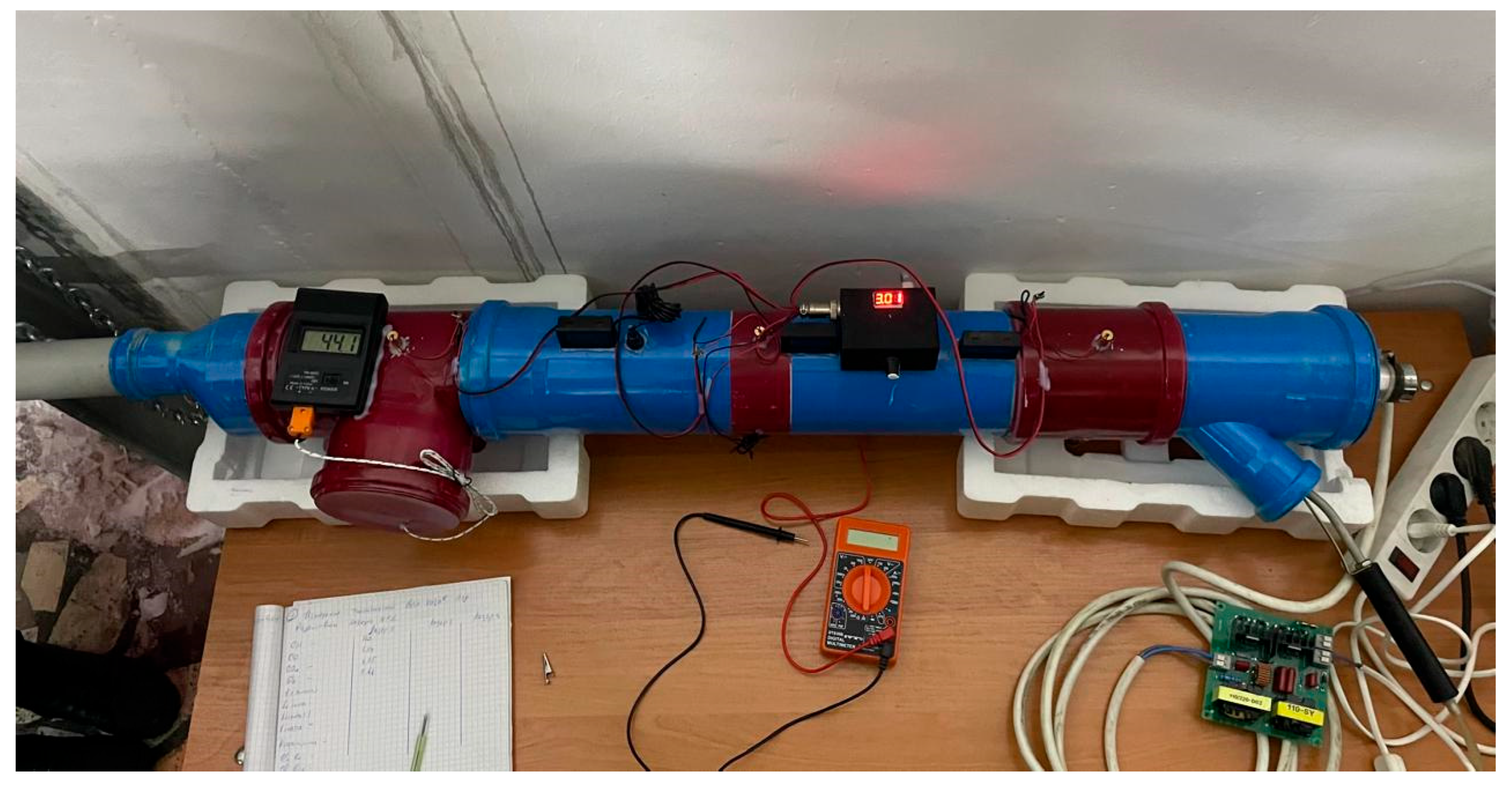
Figure 2.
Schematic diagram of the experimental hybrid setup. 1. exhaust gas inlet pipe; 2—photodissociation zone; 3—humidity sensor; 4—laser diodes; 5—laser control module; 6—temperature sensor; 7—soot particle coagulation zone; 8—coagulation zone for non-combustible particles; 9—soot collection area; 10—gas sampling points M1 and M2 (upstream); 11 – direction of movement of forces; 12—exhaust outlet pipe; 13—housing of the experimental hybrid unit; 14—ultrasonic emitter; 15—ultrasonic generator.
Figure 2.
Schematic diagram of the experimental hybrid setup. 1. exhaust gas inlet pipe; 2—photodissociation zone; 3—humidity sensor; 4—laser diodes; 5—laser control module; 6—temperature sensor; 7—soot particle coagulation zone; 8—coagulation zone for non-combustible particles; 9—soot collection area; 10—gas sampling points M1 and M2 (upstream); 11 – direction of movement of forces; 12—exhaust outlet pipe; 13—housing of the experimental hybrid unit; 14—ultrasonic emitter; 15—ultrasonic generator.
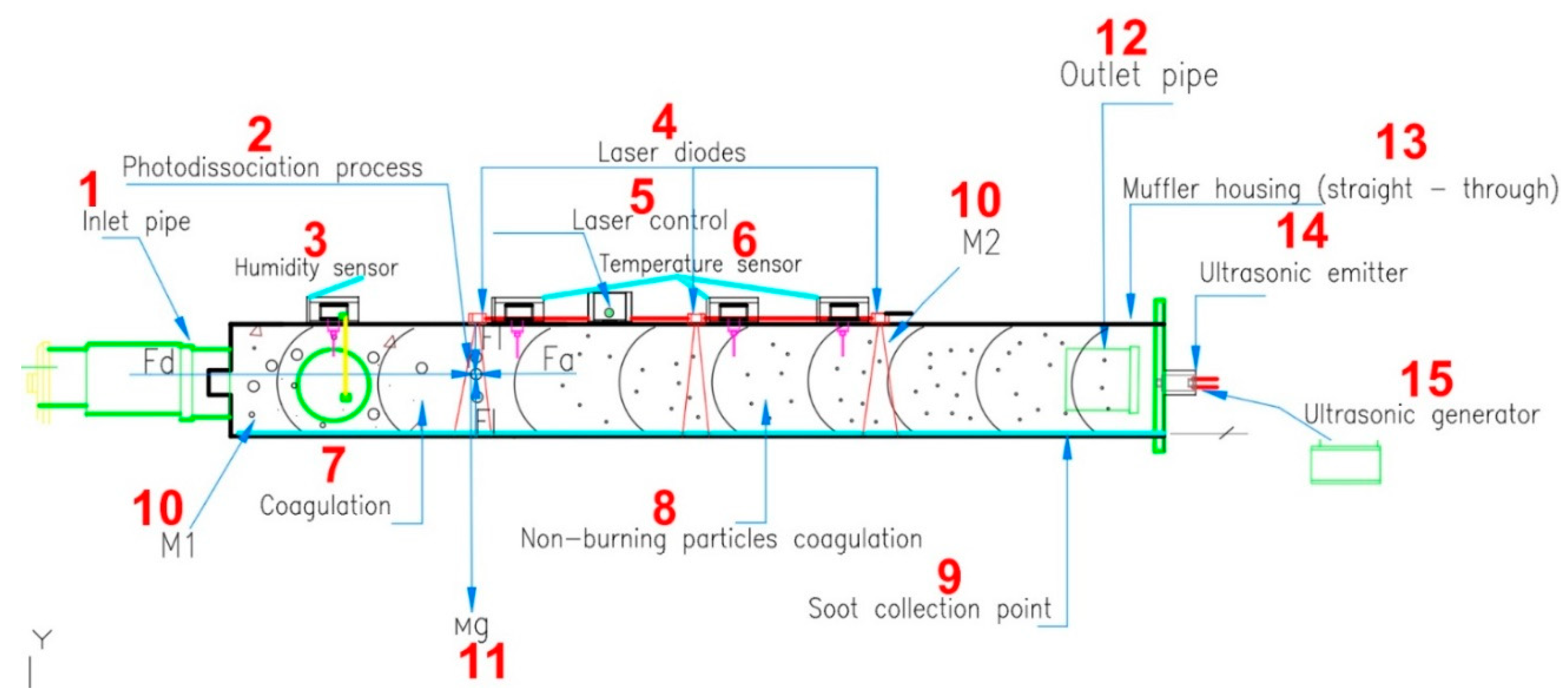
Figure 3.
Concentration of CH (ppm) in exhaust gases depending on engine speed under different exposure conditions.
Figure 3.
Concentration of CH (ppm) in exhaust gases depending on engine speed under different exposure conditions.
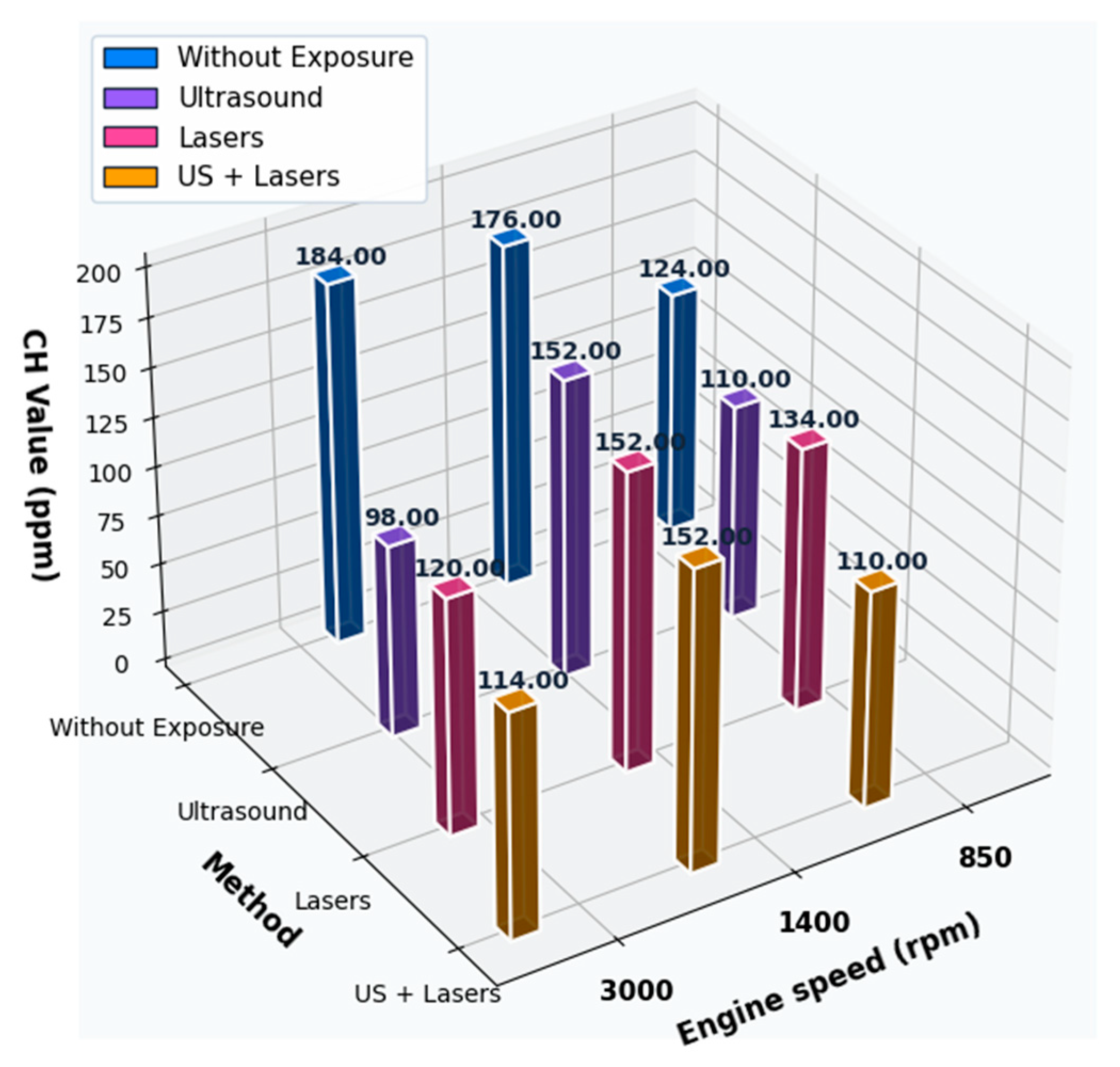
Figure 4.
CO concentration (%) in exhaust gases depending on engine speed under different exposure conditions.
Figure 4.
CO concentration (%) in exhaust gases depending on engine speed under different exposure conditions.
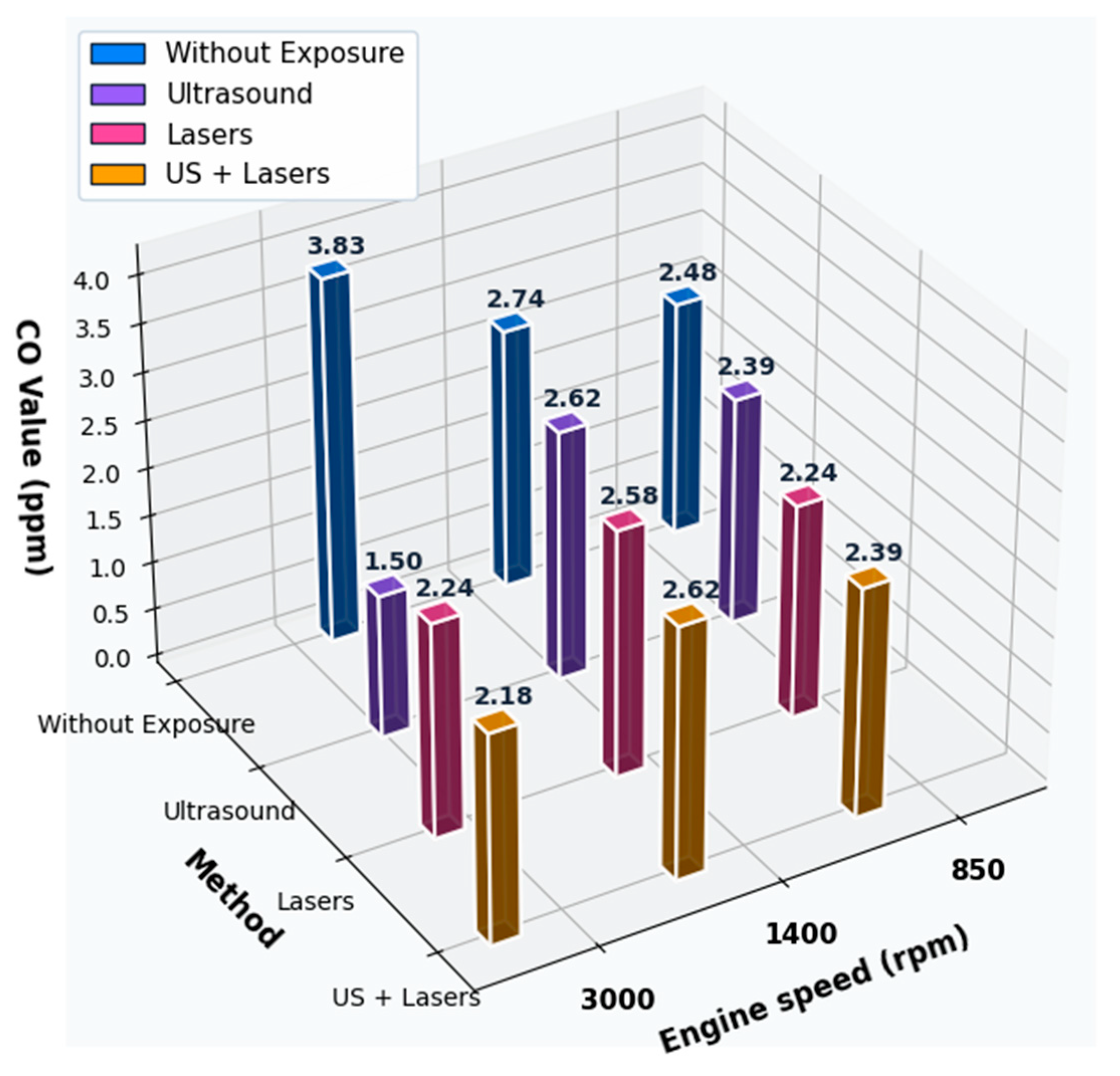
Figure 5.
Concentration of CO2 (%) in exhaust gases depending on engine speed under different exposure conditions.
Figure 5.
Concentration of CO2 (%) in exhaust gases depending on engine speed under different exposure conditions.
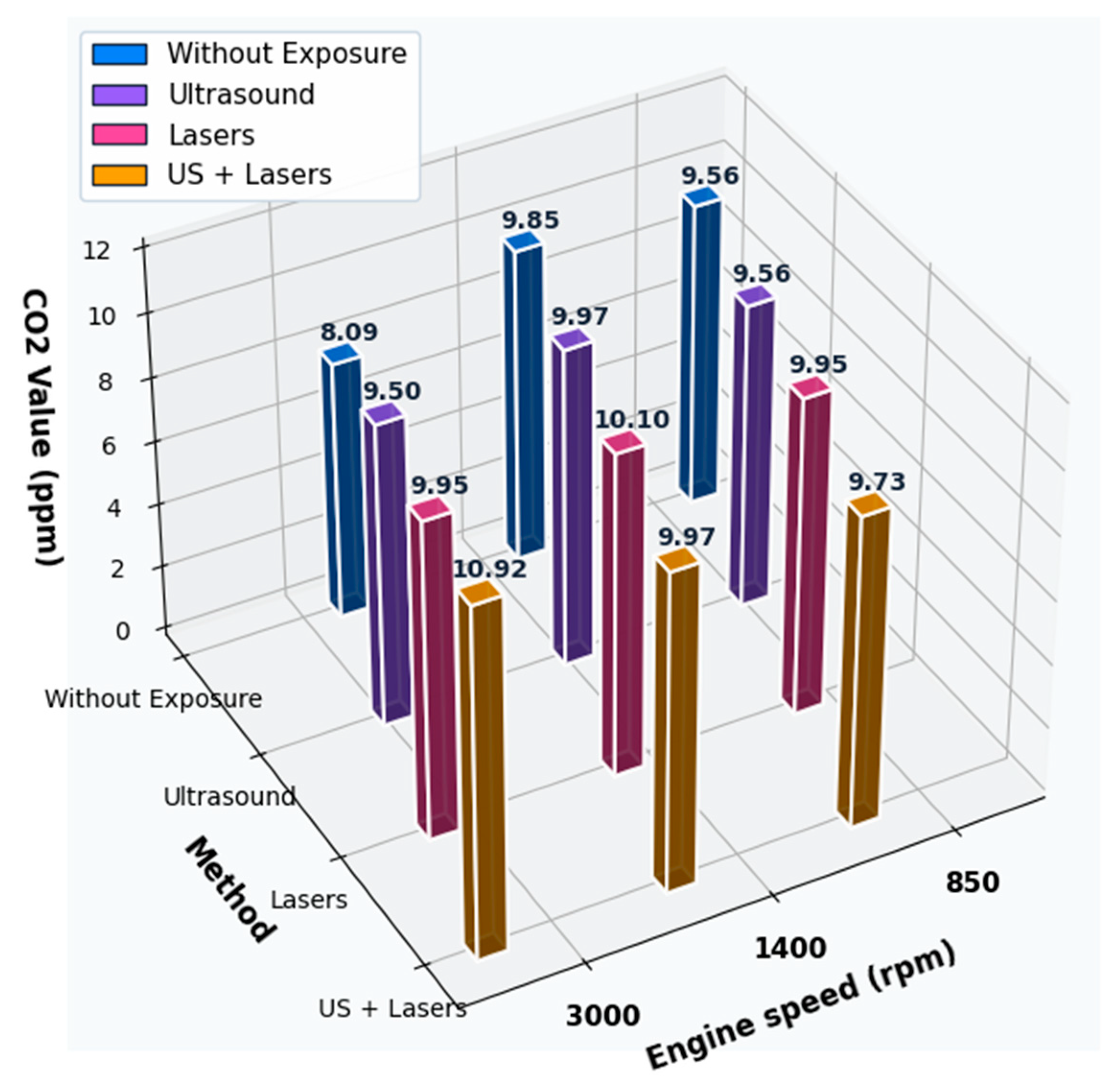
Figure 6.
Oxygen concentration O2 (%) in exhaust gases depending on engine speed under different exposure conditions.
Figure 6.
Oxygen concentration O2 (%) in exhaust gases depending on engine speed under different exposure conditions.
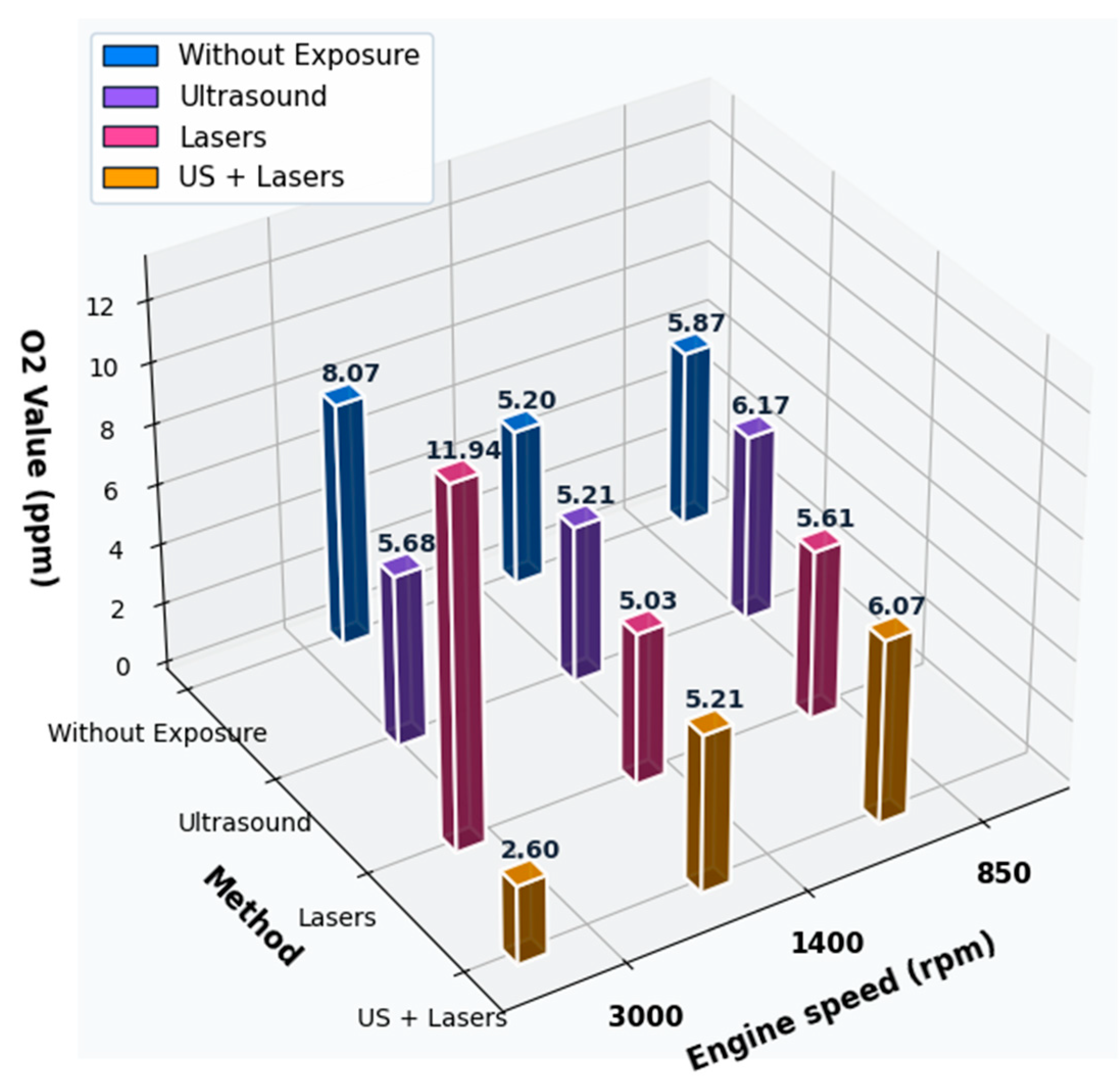
Figure 7.
Exhaust gas temperature (°C) depending on engine speed under different exposure modes.
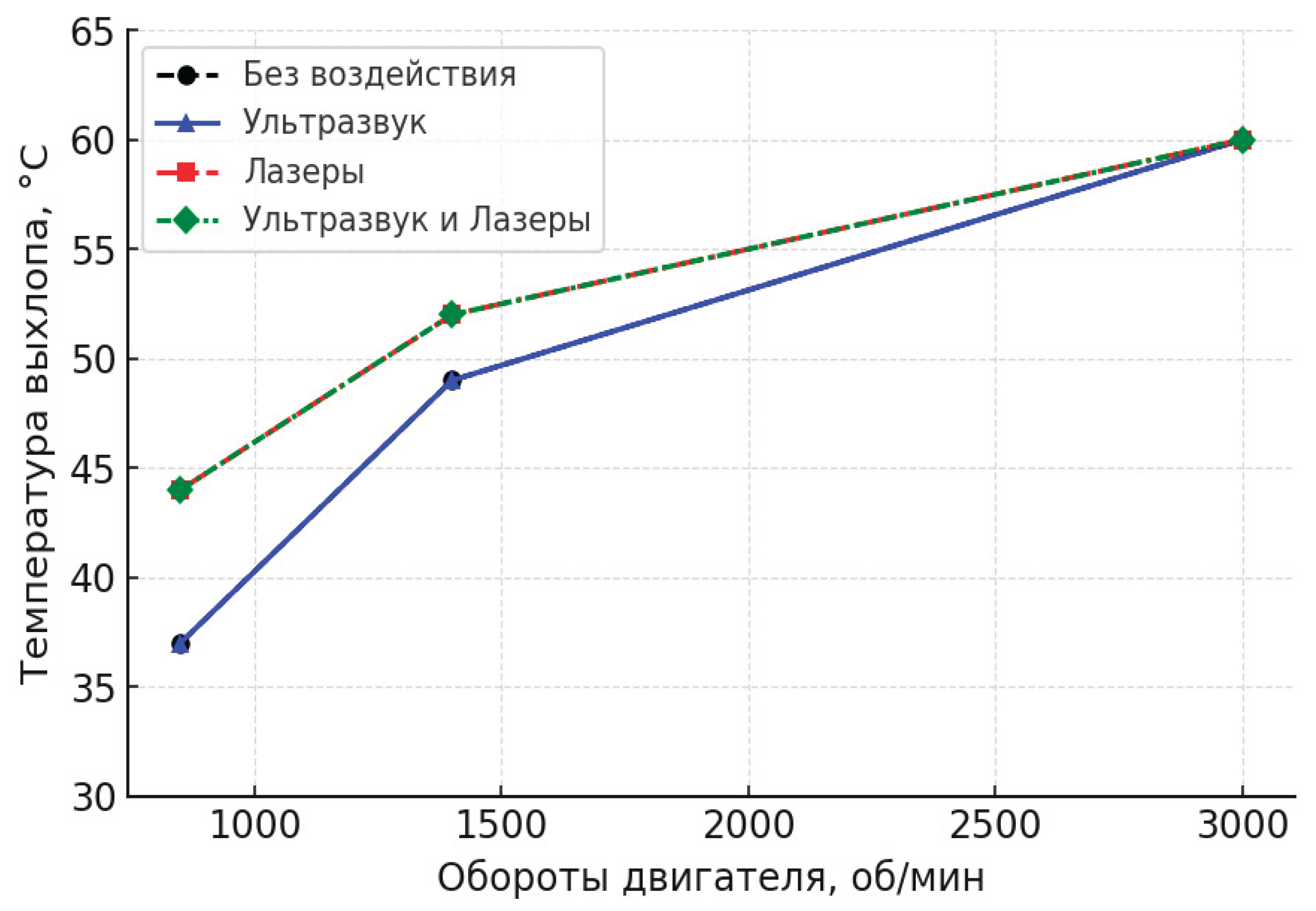

Table 1.
Exhaust gas composition under different treatment modes (mean values, n = 3).
| Stage | Engine speed (rpm) | CH (ppm) |
CO (%) |
CO2 (%) |
O2(%) | Gas temperature(°C) | Humidity(%) |
| No treatment | 850 | 124 | 2.48 | 9.56 | 5.87 | 37 | 39 |
| Ultrasound | 850 | 110 | 2.39 | 9.56 | 6.17 | 37 | 39 |
| Lasers | 850 | 134 | 2.24 | 9.95 | 5.61 | 44 | 39 |
| Ultrasound + Lasers | 850 | 110 | 2.39 | 9.73 | 6.07 | 44 | 39 |
| No treatment | 1400 | 176 | 2.74 | 9.85 | 5.2 | 49 | 39 |
| Ultrasound | 1400 | 152 | 2.62 | 9.97 | 5.21 | 49 | 39 |
| Lasers | 1400 | 152 | 2.58 | 10.1 | 5.03 | 52 | 39 |
| Ultrasound + Lasers | 1400 | 152 | 2.62 | 9.97 | 5.21 | 52 | 39 |
| No treatment | 3000 | 184 | 3.83 | 8.09 | 8.07 | 60 | 39 |
| Ultrasound | 3000 | 98 | 1.5 | 9.5 | 5.68 | 60 | 39 |
| Lasers | 3000 | 120 | 2.24 | 9.95 | 11.94 | 60 | 39 |
| Ultrasound + Lasers | 3000 | 114 | 2.18 | 10.92 | 2.6 | 60 | 39 |
Disclaimer/Publisher’s Note: The statements, opinions and data contained in all publications are solely those of the individual author(s) and contributor(s) and not of MDPI and/or the editor(s). MDPI and/or the editor(s) disclaim responsibility for any injury to people or property resulting from any ideas, methods, instructions or products referred to in the content. |
© 2025 by the authors. Licensee MDPI, Basel, Switzerland. This article is an open access article distributed under the terms and conditions of the Creative Commons Attribution (CC BY) license (http://creativecommons.org/licenses/by/4.0/).
Copyright: This open access article is published under a Creative Commons CC BY 4.0 license, which permit the free download, distribution, and reuse, provided that the author and preprint are cited in any reuse.


