

Submitted:
15 December 2025
Posted:
16 December 2025
You are already at the latest version
Abstract
Background/Objectives: Capric acid–based therapeutic deep eutectic systems (THEDES) 18 are emerging as a distinct class of biofunctional matrices capable of reshaping drug solubilization, permeability, and bioactivity. Methods: Relevant studies on capric acid–based therapeutic deep eutectic systems (THEDES) were identified through targeted database searches and screened for evidence on their design, mechanisms, and pharmaceutical performance. Results: This review synthesizes current evidence on their structural design, mechanistic behavior, and pharmaceutical performance, revealing several unifying principles. Across multiple drug classes, capric acid consistently drives strong, directional hydrogen bonding and drug amorphization, enabling exceptional solubility enhancements and stabilized supersaturation. Its amphiphilic C10 chain further contributes to membrane fluidization, which explains the improved transdermal and transmucosal permeation repeatedly observed in capric acid-based THEDES. Additionally, synergistic antimicrobial and anticancer effects reported in several systems confirm that capric acid acts not only as a solvent component but as a bioactive co-therapeutic. Collectively, the reviewed data show that capric acid serves as a structurally determinant element whose dual hydrogen-bonding and membrane-interacting roles underpin the high pharmaceutical performance of these systems. However, gaps remain in long-term stability, toxicological profiling, and regulatory classification. Emerging Artificial Intelligence (AI) and Machine Learning (ML)-guided predictive approaches offer promising solutions by enabling rational selection of eutectic partners, optimal ratios, and property optimization through computational screening. Conclusion: Overall, capric acid-based THEDES represent a rationally designable platform for next-generation drug delivery, where solvent functionality and therapeutic activity converge within a single, green formulation system.
Keywords:
therapeutic deep eutectic systems (THEDES)
; capric acid
; deep eutectic solvents (DES)
; fatty acid-based eutectic systems
; hydrogen bond interactions
; artificial intelligence
1. Introduction
The growing demand for environmentally responsible and pharmaceutically acceptable alternatives to conventional organic solvents has driven significant interest in the development of advanced solvent systems. Traditional organic solvents are widely used in pharmaceutical processes; however, their volatility, toxicity, and poor biodegradability pose risks to both human health and the environment [1,2]. These concerns have accelerated the investigation of alternative solvent systems that combine functional performance with improved safety and environmental profiles. Among the alternatives investigated, deep eutectic solvents (DESs) have emerged as attractive candidates due to their ease of preparation, low cost, and potential for biocompatibility [3,4]. In recent years, a subclass known as therapeutic deep eutectic systems (THEDESs) has gained prominence. These systems incorporate at least one component with inherent pharmacological activity, enabling them to function simultaneously as solvent and therapeutic agent [5]. This dual role offers distinct advantages in drug formulation, particularly for compounds with poor aqueous solubility, low permeability, or instability in conventional vehicles [6,7,8]. Among fatty acids explored in THEDES development, capric acid (decanoic acid, C10:0) is especially attractive because of its natural origin, safety, and ability to form eutectic mixtures with various active ingredients [9,10,11,12].
Despite increasing reports on fatty acid-based DESs, a comprehensive evaluation of capric acid-based THEDESs remains lacking. The present review addresses this gap by providing a critical and focused analysis of capric acid-based THEDESs, with emphasis on their design principles, preparation methods, physicochemical characteristics, and pharmaceutical relevance. Particular attention is given to their role in enhancing drug solubility and bioavailability, modulating release kinetics, and supporting novel drug delivery strategies. This review also discusses the underlying mechanisms of drug–solvent interactions, safety considerations, and regulatory challenges, with the aim of supporting further research and translation into clinical and industrial applications.
2. Background on DES and THEDES
The development of non-toxic, biodegradable, and functionally versatile solvent systems has become a central theme in green chemistry and pharmaceutical formulation. Among the solvent systems under active investigation, ionic liquids (ILs) and DESs have gained substantial attention. ILs consist entirely of organic cations and inorganic or organic anions and are typically liquid at or near room temperature [13]. While they exhibit attractive physicochemical properties—such as negligible vapor pressure, tunable polarity, and high solvation capacity—their limited biodegradability, cytotoxicity concerns, and relatively high cost have restricted their widespread application in biomedicine [14].
DESs, by contrast, are formed through the association of a hydrogen bond donor (HBD) and a hydrogen bond acceptor (HBA), resulting in an eutectic mixture with a melting point significantly lower than that of the individual components [12]. DESs can be readily prepared from a range of naturally derived components, including choline chloride, sugars, organic acids, and fatty acids, many of which are classified as Generally Recognized as Safe (GRAS) [15,16]. Due to their biocompatibility, low toxicity, and high solubilization potential, DESs are increasingly being explored in drug solubilization, extraction of bioactive compounds, biocatalysis, and pharmaceutical formulations [17,18,19].
An emerging extension of this field is the concept of deep eutectic systems (DESy). Unlike traditional DESs, which are prepared prior to application, DESy are formed in situ during the process of solubilization or formulation, with the target compound itself (e.g., an active pharmaceutical ingredient or bioactive molecule) actively participating in the eutectic interaction [20]. This innovation eliminates the need for pre-formed DESs, simplifying processing, reducing energy input, and enhancing formulation efficiency. DESy have already shown promise in areas such as prebiotic extraction and are increasingly being considered for pharmaceutical applications where solvent–drug synergy is desired [21].
A particularly significant advancement within this family is the development of THEDESs, which are defined as eutectic systems in which one or more components possess intrinsic pharmacological activity [22]. THEDESs represent a novel class of multifunctional systems capable of acting simultaneously as drug carriers and therapeutic agents. Their dual functionality allows for improved drug solubility, controlled release profiles, enhanced membrane permeability, and the potential for synergistic therapeutic effects [6,7,8]. THEDESs also offer formulation advantages by reducing the need for conventional excipients and enabling novel routes of administration, including transdermal and mucosal delivery. As summarized in Figure 1, ILs, DESs, DESy, and THEDESs differ in their composition, method of formation, and pharmaceutical role, reflecting a clear progression from structurally defined solvents to multifunctional, therapeutically active systems.
To facilitate a clearer comparison of these solvent systems, Table 1 summarizes the fundamental differences between them, highlighting their respective compositions, interaction mechanisms, physicochemical properties, and pharmaceutical relevance.
3. Capric Acid as a Functional Component in Multicomponent Therapeutic Deep Eutectic Systems
Capric acid is increasingly utilized as a hydrogen bond donor (HBD) in the design of THEDES. As illustrated in Figure 2, its chemical structure—characterized by a terminal carboxylic acid and a saturated 10-carbon alkyl chain—enables core structural contributions that support its functional integration in THEDES: hydrogen bonding capacity [11], membrane-modulating hydrophobicity [26], and biocompatible matrix formation [27].
The carboxyl group forms extensive hydrogen bonding networks with various HBAs, including drugs and amino acids, thus facilitating eutectic formation, enhancing thermal stability, and significantly improving the solubility and amorphization of poorly water-soluble active pharmaceutical ingredients (APIs) such as ibuprofen, rasagiline, and lidocaine [6,12]. Additionally, its long alkyl chain imparts amphiphilic characteristics that enhance membrane interaction and lipid fluidization, which in turn promote transdermal and mucosal drug permeation and contribute to antimicrobial efficacy by disrupting microbial membranes [28,29]. These biophysical effects extend to antifungal applications, where capric acid inhibits Candida albicans virulence mechanisms, including hyphal formation and biofilm development [30], and induces lipid membrane remodeling such as tubulation [26]. From a formulation standpoint, capric acid’s GRAS classification and established biocompatibility make it an attractive choice for topical and oral routes, with in vivo studies confirming its low irritation and systemic safety in THEDES applications [12,31]. Notably, these properties are modulated by the physicochemical nature of the accompanying HBA, which plays a co-determinant role in defining viscosity, solubility, permeability, and biological performance of the final eutectic system. Therefore, capric acid’s performance as a THEDES component should be interpreted within the broader context of eutectic pair selection and structural complementarity—factors that are essential for tailoring systems to therapeutic and delivery-specific needs.
4. Preparation and Characterization of Capric Acid-Based THEDES
Capric acid-based THEDES are typically prepared through a simple, green synthesis route that relies on precise molar mixing of the hydrogen bond donor (HBD) and hydrogen bond acceptor (HBA) components under gentle heating and stirring [10,32]. Ratios are optimized based on phase diagrams to achieve eutectic formation, with systems becoming fully liquid at room temperature upon reaching the eutectic point [11].
Characterization of the eutectic nature and molecular interactions is routinely performed using thermal techniques such as Differential Scanning Calorimetry (DSC) and Thermogravimetric Analysis (TGA), revealing clear endothermic transitions and phase stability of the eutectic systems. In the Gefitinib/Capric acid system, DSC confirmed a homogeneous liquid phase at the eutectic ratio, and TGA demonstrated thermal stability within acceptable pharmaceutical handling ranges [7]. FTIR spectroscopy consistently shows red-shifts in O–H and C=O vibrational bands, supporting extensive hydrogen bonding between carboxyl and hydroxyl groups of the HBD and HBA respectively [11]. In addition, 1H and13C NMR confirm structural integration through chemical shift perturbations, particularly at the hydrogen bonding sites of active pharmaceutical ingredients like Gefitinib and risperidone [7,32]. Phase behavior analyses indicate polymorphic transitions and suppressed crystallinity, a crucial factor in enhancing drug solubility. Morphological studies using microscopy further corroborate the homogeneity of THEDES formulations at room temperature [11]. Rheological assessments demonstrate that viscosity is highly tunable depending on molar ratio, temperature, and water content. Lower viscosity is generally favored to enhance drug diffusion and spreadability, and capric acid-based systems have shown viscosity reductions of up to 70% compared to conventional solvents [10]. Overall, capric acid-based THEDES offers a highly tunable, biocompatible, and efficient platform for drug solubilization and delivery, provided that rigorous preparation and analytical characterization protocols are followed.
5. Role of CA in Promoting Real DES Formation: Insights from Solid–Liquid Phase Diagrams
A pivotal step in validating CA–based THEDES is the comparison of theoretical and experimental solid–liquid phase diagrams. This analysis not only determines the eutectic composition but also reveals the extent to which CA drives systems toward genuine DES behavior rather than simple ideal eutectic mixing—a recurring concern among experts in the DES field. Across the investigated systems, CA consistently induces strong negative deviations from ideality, a defining thermodynamic signature of real DES formation and a performance level rarely achieved by many commonly used conformers.
In both the ketoconazole–CA (KCZ–CA) and clotrimazole–CA (CLOT–CA) systems, CA demonstrated a remarkable capacity to disrupt the ideal melting behavior predicted by theoretical models, leading to pronounced shifts in eutectic composition and substantial depressions in eutectic temperature. The KCZ–CA mixture exhibited a eutectic point at a KCZ molar fraction of 0.16, while the CLOT–CA mixture reached its eutectic composition at a CLOT molar fraction of 0.25. In each case, the experimental melting curves deviated significantly from ideal predictions, and the resulting mixtures readily transitioned into stable liquids at their eutectic ratios. These pronounced non-idealities reflect CA’s exceptional hydrogen-bond-donating ability, hydrophobic compatibility with lipophilic drugs, and its unique capacity to dramatically reduce crystallinity—features that surpass the behavior commonly observed with other fatty acids or conventional DES coformers.
In conclusion, the consistent negative deviations, marked melting-point depressions, and substantial eutectic shifts observed across drug–CA combinations clearly establish CA as a superior and highly effective coformer for generating real DESs. Its ability to reliably enforce non-ideality positions CA as an outstanding hydrogen bond donor for the development of pharmaceutical THEDES with enhanced functional performance.
6. Pharmaceutical Applications
Capric acid-based THEDES have shown remarkable potential in addressing key formulation challenges such as poor drug solubility, low bioavailability, and suboptimal stability. By incorporating active pharmaceutical ingredients (APIs) into a eutectic matrix with capric acid, these systems can dramatically improve the dissolution of hydrophobic drugs. Notably, BCS Class II drugs like risperidone and gefitinib have exhibited solubility enhancements on the order of 104–105-fold when formulated with capric acid [6,29].
For example, a eutectic of risperidone with capric acid achieved a 70,000-fold increase in solubility compared to water [29], while a gefitinib–capric acid THEDES (optimal 80:20 molar ratio) yielded a 30,000-fold solubility boost over aqueous media [7]. Such massive solubilization stems from strong hydrogen-bond interactions and amorphization of the drug within the fatty-acid matrix, effectively overcoming crystalline lattice energy.
This improved thermodynamic solubility translates into faster dissolution rates and can significantly enhance oral or topical bioavailability of poorly water-soluble compounds [33]. Furthermore, the microenvironment of the THEDES can stabilize labile drugs, as the hydrogen-bonded network and low water activity help prevent degradation pathways (e.g., hydrolysis or oxidation) [34]. The viscous, non-volatile nature of capric acid eutectics limits API exposure to oxygen, thereby reducing oxidative instability of sensitive molecules [34]. Overall, the capric-acid THEDES serves as a solvating and protective matrix that maintains drug molecules in a supersaturated yet stabilized state until administration.
Beyond solubility benefits, capric acid-based THEDES have been shown to improve drug permeability and pharmacokinetic profiles. The amphiphilic capric acid moiety can fluidize biological membranes and act as a penetration enhancer, which is especially useful for transdermal and transmucosal delivery [34]. Likewise, risperidone-capric acid THEDES showed markedly higher skin permeation (with melting-point depression to ~17 °C at a 40:60 w/w ratio) and caused no irritation on rat skin [29]. In the case of droperidol (a sedative with low oral bioavailability), forming a THEDES with capric acid enabled a solvent-free liquid formulation that demonstrated superior intestinal absorption in ex vivo gut models [12]. The droperidol–CA system exhibited significantly higher flux across everted intestinal sacs compared to solid drug, highlighting how THEDES can enhance transmucosal delivery and potentially replace injectable administration with oral dosing.
Similarly, aripiprazole (an antipsychotic) was converted into a capric acid eutectic at certain ratios, yielding a clear, H-bond-stabilized liquid that avoids crystalline precipitation and is expected to improve oral uptake and onset of action [12]. These examples underscore that capric acid THEDES can tackle multiple biopharmaceutical hurdles simultaneously – increasing drug solubility, maintaining supersaturation, and facilitating membrane permeation – thereby boosting overall drug bioavailability.
Another important application of capric acid-based eutectics is in topical and transdermal drug delivery. Many active agents suffer from poor skin penetration or require high solvent content in creams. THEDES offers a way to combine the drug with a fatty acid that both solubilizes the API and enhances its diffusion through skin. A striking case is the capric acid–ketoconazole (KCZ) THEDES developed for fungal infections. Ketoconazole, an antifungal that is poorly water-soluble and limited in skin uptake, formed a room-temperature eutectic with capric acid (optimized at 1:5 molar ratio) that showed dramatic improvements in therapeutic performance [6]. The KCZ–CA eutectic exhibited a 6.2-fold higher transdermal flux in Franz cell studies compared to a commercial ketoconazole cream, and it halved the minimum inhibitory concentration (MIC) against Candida albicans (indicating enhanced antifungal potency).
This dual enhancement – increased permeation and a 2× stronger antifungal effect – is attributed to the intimate hydrogen bonding between ketoconazole’s imidazole ring and capric acid’s carboxyl, which creates a stable liquid complex that both delivers more drug into the skin and leverages capric acid’s inherent antimicrobial activity.
In general, capric acid and other medium-chain fatty acids are known to disrupt microbial membranes; when used as part of a THEDES, they can synergize with antimicrobial drugs. For example, eutectic mixtures of capric with lauric or myristic acid show significant activity against Gram-positive bacteria (S. aureus, MRSA, C. albicans), including the ability to dissolve and remove biofilms by ~80–90% within minutes [35].
When combined with conventional antibiotics, such as in a capric acid–levofloxacin DES, the fatty acid can provide a complementary antibacterial effect and improve drug solubility, potentially overcoming resistance mechanisms [36]. This highlights the multifunctional role of capric acid in THEDES: it acts as a solvent, an absorption enhancer, and an active adjuvant (antimicrobial or anti-inflammatory) that can augment the pharmacodynamics of the co-formulated API.
Indeed, a gefitinib–capric acid eutectic not only increased drug solubility enormously but also produced a synergistic cytotoxic effect on EGFR-positive cancer cells in vitro, lowering the IC_50 by significantly more than gefitinib alone [7]. Such synergism suggests that capric acid’s bioactivity (e.g., mild anticancer or permeation-facilitating properties) can enhance the therapeutic outcome of the primary drug.
Capric acid-based THEDES are also versatile in terms of dosage form design. Being liquids or low-melting semi-solids, they can be directly incorporated into various formulation types without traditional organic solvents [12]. Topical gels and ointments can be formulated by simply mixing a capric acid eutectic with gelling agents or emulsifiers, yielding drug-loaded gels that maintain high API solubility at skin temperature [5]. Transdermal patches and films have been developed by impregnating polymer matrices with drug–capric acid DES: for instance, incorporating a deep eutectic solution of a drug into an ethylcellulose film led to improved drug permeation and antifungal efficacy in a skin model [6]. Because THEDES can dissolve a large drug payload in a small volume, patch reservoirs or dissolvable films can deliver higher doses through the skin compared to conventional formulations.
Additionally, injectable depots represent an emerging application of DES technology. While capric acid-based systems have mostly been explored for oral and topical routes so far, the concept of using a biocompatible eutectic as a long-acting injectable is highly promising [12]. Deep eutectic formulations can be designed to be biodegradable, low-toxicity liquid implants that solidify or form microemulsions upon injection, thus slowing drug release [37]. A recent proof-of-concept in this arena employed a choline geranate-based deep eutectic mixture to create a subcutaneous depot for apomorphine, converting a thrice-daily injection therapy into an every-other-day regimen [38]. The depot, which self-emulsified in situ, entrapped the drug and extended its release over ~48 hours. The inherent low volatility and mild melting point of capric acid eutectics make them stable under physiological conditions, and their Generally Recognized as Safe (GRAS) status suggests good biocompatibility [34]. Any residual fatty acid would be metabolized via normal lipid pathways. This approach could be transformative for depot delivery of drugs like antipsychotics or analgesics, reducing dosing frequency and improving patient compliance.
Collectively, capric acid-based therapeutic deep eutectic systems represent a novel and highly adaptable platform in pharmaceutics. They enable unprecedented solubility increases for poorly soluble drugs, stabilize and protect actives within a green solvent matrix, and concurrently enhance drug release kinetics and absorption across biological barriers, as shown in Table 2.
7. Mechanisms of Drug–Solvent Interactions
The molecular structure of capric acid, characterized by a terminal carboxylic acid group and a long hydrophobic alkyl chain, confers versatility in its interactions with both hydrophilic and hydrophobic moieties. As mentioned earlier, DESs are primarily formed through strong hydrogen bonding between a HBD and a HBA, which leads to lattice disruption and a marked decrease in the melting point of the resulting mixture. The carboxylic acid group in capric acid can function as both a hydrogen bond donor, through its hydroxyl hydrogen, and as a hydrogen bond acceptor, through carbonyl oxygen, facilitating extensive hydrogen-bonding networks within deep eutectic systems.
Some of us also reported the successful fabrication of capric acid and menthol DES further enhancing the drug solubility of hydrophobic model drugs fluconazole and mometasone furoate. FTIR analysis suggested the contribution of CA carboxylic acid group as HBD and HBA Another notable structural change in the capric acid–menthol system was the disruption of the hydrocarbon side chains, indicating the presence of hydrophobic interactions, such as van der Waals forces [10,50].
Building on this work, Al-Akayleh et al. have fabricated capric acid–gefitinib DES, enhancing gefitinib aqueous solubility by 30,000-fold and confirmed CA hydrogen bond interactions through hydroxyl hydrogen and carbonyl oxygen as confirmed by FT-IR and NMR [7] Furthermore, Alkhawaja et al. reported the fabrication CA aripiprazole and CA droperidol DESs reporting enhanced permeability, and NMR revelated CA interacts only via its –OH group of the carboxylic acid, acting exclusively as a hydrogen bond donor[12]. Understanding the nature of interactions between CA and other components of DES is vital, as it allows monitoring their impact on the characteristics of the final formulation.
8. Safety, Toxicity, and Regulatory Considerations
The safety and biocompatibility of pharmaceutical excipients — both alone and in combination with APIs are critical determinants for whether a formulation can progress from the laboratory into clinical development and regulatory approval [51]. The safety of pharmaceutical excipients is highly dependent on the intended route of administration. Decanoic acid (capric acid) is recognized by the U.S. FDA as Generally Recognized As Safe (GRAS) when used in food product manufacturing or as a food additive under 21 CFR §§ 172.210, 172.860, 173.340, and 178.1010 [52].
When the API is combined with capric acid to form a DES, the molecular interactions between the components may modify their physicochemical and biological behavior. Consequently, each DES formulation is expected to exhibit a distinct safety profile that requires independent evaluation. However, the overall safety and toxicity of DESs have not yet been fully characterized, and the potential formation of degradation products from the API–capric acid system represents an additional concern that must be addressed [53]. Previous evaluations of the risperidone–capric acid DES demonstrated favorable dermal compatibility, with no observable irritation or tissue damage. Histological analysis further confirmed the absence of inflammatory or structural alterations in the treated skin, supporting the formulation’s safety for topical application [29].
9. Challenges and Future Perspectives
Despite their promising advantages, capric acid-based THEDES still face major challenges in achieving pharmaceutical viability. Stability remains a central concern — these eutectic mixtures are often hygroscopic, and uncontrolled moisture absorption can disrupt their hydrogen bonding balance and alter physicochemical behavior, affecting drug solubility and shelf-life. For instance, hydrophobic THEDES demonstrate improved stability compared to hydrophilic DESs, but their long-term stability under humidity fluctuations remains insufficiently characterized [5,37]. Although certain formulations show thermal stability up to 200 °C, oxidative degradation or compositional drift may still occur over time, warranting thorough shelf-life testing [54].
Viscosity also poses a technical bottleneck. Capric acid-based THEDES generally display higher viscosities than conventional solvents, limiting mass transfer and process scalability [29]. Experimental and modeling data show that viscosity in these eutectic systems is strongly temperature-dependent and can be mitigated via mild heating or the incorporation of small fractions of co-solvents like water or polyols [55,56]. However, such modifications risk altering the eutectic structure or drug solubility profile, underscoring the need for careful balance between viscosity control and formulation integrity [40].
From a manufacturing and scale-up perspective, translating laboratory-scale THEDES formulations to industrial production presents nontrivial difficulties. Large-batch synthesis demands strict process controls, optimized mixing protocols, and consistent sourcing of pharmaceutical-grade components like capric acid and co-formers [12]. Moreover, rheological complexity and temperature sensitivity make scaling viscosity-dependent operations (e.g., blending or spray-drying) challenging without pilot-scale optimization [57]. Addressing these interrelated issues—moisture sensitivity, viscosity control, and scalability—through formulation engineering and robust process design is thus essential to unlock the full pharmaceutical potential of capric acid-based THEDES.
In addition to these formulation and process challenges, significant knowledge gaps persist regarding the toxicological and pharmacokinetic behavior of THEDES. Although many individual components used in eutectic systems (e.g., capric acid, menthol, amino acids) are Generally Recognized as Safe (GRAS), their combination can give rise to novel physicochemical interactions that alter biological performance and toxicity profiles. Recent studies demonstrate that THEDES may exhibit distinct cytotoxicity or biocompatibility behaviors compared to their isolated components, emphasizing the need for formulation-specific safety evaluation [37,58].
From a regulatory standpoint, the lack of a defined classification framework continues to impede industrial and clinical translation. As noted by Abdelquader et al., 2023, current guidelines do not specify how THEDES should be regulated within the pharmaceutical context, and their distinction from related systems such as co-crystals or ionic liquids remains conceptually and terminologically unclear [59]. This definitional ambiguity complicates safety testing and regulatory approval, underscoring the need for harmonized evaluation standards and classification criteria.
Furthermore, the lack of standardized assays for biodegradability, cytotoxicity, and irritation prevents reliable cross-study comparisons and complicates regulatory evaluation. Harmonizing these protocols within existing EMA excipient frameworks, as proposed in recent green chemistry studies [60], will be essential to build regulatory confidence and facilitate THEDES qualification as safe, bioactive pharmaceutical matrices.
Looking forward, emerging research directions are exploring multi-drug and multifunctional THEDES as next-generation drug delivery systems. The principle underlying the well-known lidocaine–prilocaine eutectic (melting point ≈18 °C) is now being extended to capric acid-based eutectics capable of co-delivering synergistic drug combinations. Notably, levofloxacin–capric acid THEDES exhibited superior antibacterial efficacy against resistant strains, owing to capric acid’s intrinsic membrane-disruptive activity coupled with enhanced drug solubility [36]. Such systems exemplify the potential of THEDES as dual-function platforms that integrate solvent functionality with therapeutic bioactivity, opening avenues for fixed-dose, biocompatible liquid formulations in transdermal, oral, or parenteral delivery routes.
Addressing these toxicological, pharmacokinetic, and regulatory gaps, alongside continued innovation in multi-component formulation design, will be key to advancing capric acid-based THEDES from laboratory concept to clinical reality.
Crucially, the integration of Artificial Intelligence (AI) and Machine Learning (ML) is emerging as a transformative force in the rational design of DES and THEDES. Traditional experimental screening of eutectic systems is slow and resource-intensive due to the near-limitless combinations of hydrogen bond donors and acceptors. Recent AI-based methodologies now enable predictive and generative exploration of this vast formulation space, significantly reducing reliance on trial-and-error synthesis [61].
Among the most impactful advances is the use of ML models combined with COSMO-RS molecular descriptors to predict drug solubility in DES. For example, Cysewski et al., 2024 demonstrated that ML algorithms could accurately forecast the solubility of poorly water-soluble drugs (ibuprofen, ketoprofen) across multiple DES compositions, eliminating the need for extensive experimental screening [62]. This predictive capability holds particular relevance for capric acid-based THEDES, where AI could rapidly identify the optimal co-former type and molar ratio to maximize drug solubility and minimize formulation time.
Beyond solubility, ML models have been successfully applied to predict key physicochemical properties such as viscosity, melting point, and miscibility. A recent study achieved R² ≈ 0.99 in predicting DES viscosities across 670 systems using CatBoost regression and COSMO-RS-derived σ-profiles [63].
Similarly, XGBoost-based models accurately predicted DES melting points within ±2 K of experimental data, offering powerful tools for screening stable, low-melting eutectic mixtures [64]. Neural-network approaches have also shown promise in modeling viscosity and density across diverse DES compositions and temperature ranges [65,66].
Beyond prediction, generative AI is now being explored for inverse design—creating entirely new eutectic systems optimized for multiple objectives such as low viscosity, high thermal stability, and enhanced solvation capacity. The combination of transformer-based and explainable AI (XAI) frameworks has been proposed to design DES formulations meeting automatically specified property targets [67]. In the context of capric acid-based THEDES, such approaches could enable computational pre-selection of formulations that remain liquid at physiological temperatures, dissolve target drugs at therapeutic levels, and exhibit low cytotoxicity and manageable viscosity—all before physical synthesis.
While AI/ML offers tremendous promise in streamlining THEDES innovation, it also introduces new considerations [68]. One is the importance of model interpretability and regulatory acceptance [69,70]. Especially in pharmaceuticals, “black-box” models that cannot explain their decisions may face skepticism from regulators who demand understanding of how a formulation works and assurance of its safety. To address this, researchers have begun employing explainable AI techniques (e.g., SHAP analysis) to identify which molecular features drive desirable properties [71]. Ensuring transparency in AI-driven formulation design will likely be necessary for it to gain trust in a highly regulated field [72,73,74]. Furthermore, the quality and representativeness of training data directly affect AI model outputs [75,76,77,78]. If certain chemical spaces (say, choline chloride-based DES) are over-represented, the model might be biased and less accurate for others like fatty-acid-based systems [79]. Therefore, expanding high-quality experimental datasets – including those specifically featuring capric acid and other natural components – is critical to improve model generalizability.
Equally important is the issue of reproducibility [80,81]. Because THEDES properties can be sensitive to raw-material variability (e.g., purity, water content, fatty-acid isomer distribution) and to procedural details (such as mixing order, equilibration time, or storage conditions), AI predictions and supporting experiments must be consistent and verifiable across laboratories. Finally, issues of accessibility and equity should not be overlooked [82]. High-performance AI tools, along with large proprietary datasets, may be available only to well-funded institutions or countries, potentially widening the gap in global green chemistry research. Promoting open-source algorithms, publicly accessible data repositories, and collaborative international initiatives will be essential to ensure that AI-driven THEDES innovation advances sustainability equitably worldwide.
10. Conclusions
Capric acid–based THEDES represent a distinct and rapidly evolving class of biofunctional eutectic systems whose value extends far beyond conventional solvent replacement. This review demonstrates that capric acid introduces a unique synergy of strong, directional hydrogen bonding, membrane-modulating amphiphilicity, and intrinsic bioactivity, enabling it to serve simultaneously as a solubilizer, permeability enhancer, and therapeutic co-agent. This multifunctionality underpins several unprecedented outcomes reported across recent studies—including 10⁴–10⁵-fold solubility enhancement for BCS II drugs, synergistic antimicrobial and anticancer effects, and transdermal fluxes surpassing commercial formulations—all achieved without reliance on volatile organic solvents. Critically, the role of capric acid is not generic but structurally determinant: its carboxyl group governs eutectic formation and drug amorphization, while its C10 chain drives membrane interactions and microbial disruption. These mechanisms collectively establish capric acid-based THEDES as purpose-built therapeutic matrices, capable of reshaping pharmacokinetics and enabling alternative administration routes, including solvent-free oral, transmucosal, and transdermal delivery. Despite these advances, gaps persist in long-term stability, viscosity control, toxicological profiling, and regulatory classification. The emerging integration of AI-guided formulation offers transformative potential to address these challenges by predicting optimal compositions, accelerating discovery, and providing mechanistic interpretability. Overall, capric acid-based THEDES stand at the forefront of next-generation green pharmaceutical technologies—systems in which the solvent is no longer passive but an active determinant of therapeutic performance. Their continued development may redefine how poorly soluble or permeation-limited drugs are formulated, delivered, and clinically optimized.
Author Contributions
Conceptualization, Faisal Al-Akayleh and Giuseppe Biagini; methodology, Faisal Al-Akayleh; software, Ahmed S.A. Ali Agha; formal analysis, Faisal Al-Akayleh and Ahmed S.A. Ali Agha; investigation, Faisal Al-Akayleh and Ahmed S.A. Ali Agha; resources, Faisal Al-Akayleh; data curation, Faisal Al-Akayleh; writing—original draft preparation, Faisal Al-Akayleh; writing—review and editing, Ahmed S.A. Ali Agha, Ali R. Olaimat and Giuseppe Biagini; visualization, Faisal Al-Akayleh; supervision, Giuseppe Biagini; project administration, Giuseppe Biagini; funding acquisition, Giuseppe Biagini.
Funding
This research was funded by University of Petra, grant number 23/4/2024.
Conflicts of Interest
The authors declare no conflicts of interest.
Abbreviations
The following abbreviations are used in this manuscript:
| CA | Capric Acid |
| ILs | Ionic Liquids |
| THEDES | Therapeutic Deep Eutectic Systems |
| DES | Dee Eutectic Solvent |
| DESy | Deep Eutectic System |
References
- Endluri Dharmik Chandu, Sakhinamma Chejerla, Chandra Yadala Prapurna. Unmasking the purity: reviewingsources and detection methods of organic volatile impurities. International Journal of Clinical Pharmacokinetics and Medical Sciences 2023.
- Kerton Francesca M. Solvent Systems for Sustainable Chemistry. 2016.
- Adwan Samer, Qasmieh Madeiha, Al-Akayleh Faisal, Ali Agha Ahmed S. Recent Advances in Ocular Drug Delivery: Insights into Lyotropic Liquid Crystals. Pharmaceuticals 2024. [Epub ahead of print]. [CrossRef]
- Nakaweh Abdeh, Al-Akayleh Faisal, Al-Remawi Mayyas, Abdallah Qasem, Agha Ahmed SA Ali. Deep eutectic system-based liquisolid nanoparticles as drug delivery system of curcumin for in-vitro colon cancer cells. J Pharm Innov 2024; 19 (2): 18.
- Al-Mawla Layaly, Al-Akayleh Faisal, Daadoue Saifeddin, Mahyoob Waseem, Al-Tameemi Badralbdoor, Al-Remawi Mayyas, Adwan Samer, Agha Ahmed S. A. Ali. Development, Characterization, and Ex Vivo Permeation Assessment of Diclofenac Diethylamine Deep Eutectic Systems Across Human Skin. J Pharm Innov 2023; 18 (4): 2196-2209. [CrossRef]
- Al-Akayleh Faisal, Alkhawaja Bayan, Al-Zoubi Nizar, Abdelmalek Suzanne M. A., Daadoue Saifeddin, AlAbbasi Diala, Al-Masri Shoroq, Ali Agha Ahmed S. A., Olaimat Ali R., Woodman Tim. Novel therapeutic deep eutectic system for the enhancement of ketoconazole antifungal activity and transdermal permeability. J Mol Liq 2024; 413: 125975. [CrossRef]
- Al-Akayleh Faisal, Alkhawaja Bayan, Al-Remawi Mayyas, Al-Zoubi Nizar, Nasereddin Jehad, Woodman Tim, Nisrein Jaber, Ahmad Mohammad I. A., AbuQatouseh Luay, Omari Derar, Agha Ahmed S. A. Ali. An Investigation into the Preparation, Characterization, and Therapeutic Applications of Novel Gefitinib/Capric Acid Deep Eutectic Systems. J Pharm Innov 2024; 19 (6): 79. [CrossRef]
- Rifai Alaa, Bayan Alkhawaja, Faisal Al-Akayleh, Mayyas Al-Remawi, Jehad Nasereddin, Safwan Abdel Rahim, Tim Woodman, and Ali Agha Ahmed Saad Abdulbari. Eutectic-based self-emulsifying drug delivery system for enhanced oral delivery of risperidone. J Dispersion Sci Technol: 1-12. [CrossRef]
- Silva Joana M., Pereira Carolina V., Mano Francisca, Silva Eduardo, Castro Vânia I. B., Sá-Nogueira Isabel, Reis Rui Luís, Paiva Alexandre, Matias Ana A., Duarte Ana Rita Cruz. Therapeutic Role of Deep Eutectic Solvents Based on Menthol and Saturated Fatty Acids on Wound Healing. ACS Applied Bio Materials 2019; 2: 4346 - 4355.
- Al-Akayleh Faisal, Mohammed Ali Hiba Hani, Ghareeb Mowafaq M., Al-Remawi Mayyas. Therapeutic deep eutectic system of capric acid and menthol: Characterization and pharmaceutical application. J Drug Deliv Sci Technol 2019; 53. [CrossRef]
- Ali Hiba Hani Mohammed, Ghareeb Mowafaq Mohammed, Al-Remawi Mayyas, Al-Akayleh Faisal. New insight into single phase formation of capric acid/menthol eutectic mixtures by Fourier-transform infrared spectroscopy and differential scanning calorimetry. Tropical Journal of Pharmaceutical Research 2020; 19: 361-369.
- Alkhawaja Bayan, Al-Akayleh Faisal, Nasereddin Jehad, Kamran Muhammad, Woodman Tim, Al-Rubaye Zaid, Qinna Nidal, Al-Remawi Mayyas, Olaimat Ali R. Structural insights into novel therapeutic deep eutectic systems with capric acid using 1D, 2D NMR and DSC techniques with superior gut permeability. RSC advances 2024; 14 (21): 14793-14806.
- Alkhawaja Bayan, Al-Akayleh Faisal, Al-Rubaye Zaid, AlDabet Ghayda, Bustami Muna, Smairat Maisa’a, Agha Ahmed S. A. A., Nasereddin Jehad, Qinna Nidal, Michael Andreas, Watts Andrew G. Dissecting the stability of Atezolizumab with renewable amino acid-based ionic liquids: Colloidal stability and anticancer activity under thermal stress. Int J Biol Macromol 2024; 270: 132208. [CrossRef]
- Al-Akayleh Faisal, Al-Remawi Mayyas, Agha Ahmed, Abu-Nameh Eyad. Applications and risk assessments of ionic liquids in chemical and pharmaceutical domains: an updated overview. Jordan Journal of Chemistry (JJC) 2023; 18 (2): 53-76.
- Paiva Alexandre, Craveiro Rita, Aroso Ivo M., Martins Marta, Reis Rui Luís, Duarte Ana Rita Cruz. Natural Deep Eutectic Solvents – Solvents for the 21st Century. ACS Sustainable Chemistry & Engineering 2014; 2: 1063-1071.
- Pitacco W., Samorì C., Pezzolesi L., Gori V., Grillo A., Tiecco M., Vagnoni M., Galletti P. Extraction of astaxanthin from Haematococcus pluvialis with hydrophobic deep eutectic solvents based on oleic acid. Food Chem 2022; 379: 132156. [CrossRef]
- Liu Yiwen, Wu Yujing, Liu Jinming, Wang Wenxi, Yang Qingliang, Yang Gensheng. Deep eutectic solvents: recent advances in fabrication approaches and pharmaceutical applications. Int J Pharm 2022: 121811.
- Lomba Laura, García Cristina Belén, Ribate María Pilar, Giner Beatriz, Zuriaga Estefanía. Applications of Deep Eutectic Solvents Related to Health, Synthesis, and Extraction of Natural Based Chemicals. Applied Sciences 2021.
- Gotor-Fernández Vicente, Paul Caroline E. Deep eutectic solvents for redox biocatalysis. J Biotechnol 2019; 293: 24-35.
- Wang Zhaoyang, Wang Simin, Zhang Yuan, Bi Wentao. Switching from deep eutectic solvents to deep eutectic systems for natural product extraction. Green Chemical Engineering 2025; 6 (1): 36-53. [CrossRef]
- Al-Akayleh Faisal, Al-Remawi Mayyas, Abdel-Rahem Rami A, Al-Adham Ibrahim SI, Aburub Faisal, Agha Ahmed SA Ali. AI-Driven Strategies in Prebiotic Research: Addressing Challenges and Advancing Human Health. 2025 1st International Conference on Computational Intelligence Approaches and Applications (ICCIAA). IEEE; 2025:1-5.
- Aroso Ivo M., Silva João Carlos, Mano Francisca, Ferreira Ana S.D., Dionísio Madalena, Sá-Nogueira Isabel, Barreiros Susana, Reis Rui Luís, Paiva Alexandre, Duarte Ana Rita Cruz. Dissolution enhancement of active pharmaceutical ingredients by therapeutic deep eutectic systems. European journal of pharmaceutics and biopharmaceutics : official journal of Arbeitsgemeinschaft fur Pharmazeutische Verfahrenstechnik eV 2016; 98: 57-66.
- Hložek Tomáš, Bosáková Tereza, Bosáková Zuzana, Tůma Petr. Hydrophobic eutectic solvents for endocrine disruptors purification from water: Natural and synthetic estrogens study. Sep Purif Technol 2022; 303: 122310. [CrossRef]
- van den Bruinhorst Adriaan, Costa Gomes Margarida. Is there depth to eutectic solvents? Current Opinion in Green and Sustainable Chemistry 2022; 37: 100659. [CrossRef]
- Toxicity studies of select ionic liquids (1-ethyl-3-methylimidazolium chloride, 1-butyl-3-methylimidazolium chloride, 1-butyl-1-methylpyrrolidinium chloride, and n-butylpyridinium chloride) administered in drinking water to Sprague Dawley (Hsd:Sprague Dawley SD) rats and B6C3F1/N mice. Toxic Rep Ser 2022; 103.
- Yoon Bo Kyeong, Jackman Joshua A., Kim Min Chul, Sut Tun Naw, Cho Nam-Joon. Correlating Membrane Morphological Responses with Micellar Aggregation Behavior of Capric Acid and Monocaprin. Langmuir : the ACS journal of surfaces and colloids 2017; 33 11: 2750-2759.
- Trenzado Jose L., Benito Cristina, Atilhan Mert, Aparicio Santiago. Hydrophobic Deep eutectic Solvents based on cineole and organic acids. J Mol Liq 2023; 377: 121322. [CrossRef]
- Tan Sue Woon, Yoon Bo Kyeong, Jackman Joshua A. Membrane-Disruptive Effects of Fatty Acid and Monoglyceride Mitigants on E. coli Bacteria-Derived Tethered Lipid Bilayers. Molecules 2024; 29.
- Al-Akayleh Faisal, Adwan Samer, Khanfar Mai S., Idkaidek Nasir M, Al-Remawi Mayyas. A Novel Eutectic-Based Transdermal Delivery System for Risperidone. AAPS PharmSciTech 2020; 22.
- Suchodolski Jakub, Derkacz Daria, Bernat Przemysław, Krasowska Anna. Capric acid secreted by Saccharomyces boulardii influences the susceptibility of Candida albicans to fluconazole and amphotericin B. Sci Rep 2021; 11.
- Bakr El-Nassan Hala. Applications of therapeutic deep eutectic solvents (THEDESs) as antimicrobial and anticancer agents. Pharmaceutical Development and Technology 2024; 29: 1084 - 1092.
- Daadoue Saifeddin, Al-Remawi Mayyas, Al-Mawla Layaly, Idkaidek Nasir M, Khalid Ruwaida M., Al-Akayleh Faisal. Deep Eutectic Liquid as Transdermal Delivery Vehicle of Risperidone. J Mol Liq 2021.
- Trombino Sonia, Siciliano Carlo, Procopio Debora, Curcio Federica, Laganà Annarita S., Di Gioia Maria L., Cassano Roberta. Deep Eutectic Solvents for Improving the Solubilization and Delivery of Dapsone. Pharmaceutics 2022. [Epub ahead of print]. [CrossRef]
- Swebocki Tomasz, Barras Alexandre, Abderrahmani Amar, Haddadi Kamel, Boukherroub Rabah. Deep Eutectic Solvents Comprising Organic Acids and Their Application in (Bio)Medicine. Int J Mol Sci 2023. [Epub ahead of print]. [CrossRef]
- Silva Joana M., Silva Eduardo, Reis Rui L., Duarte Ana Rita C. A closer look in the antimicrobial properties of deep eutectic solvents based on fatty acids. Sustainable Chemistry and Pharmacy 2019; 14: 100192. [CrossRef]
- Alkhawaja Bayan, Al-Akayleh Faisal, Nasereddin Jehad, Malek Suzanne Abdel, Alkhawaja Nour, Kamran Muhammad, Al-Rubaye Zaid, Smairat Maisa’a, Al-Remawi Mayyas, Aburayyan Walid Salem. Levofloxacin–fatty acid systems: dual enhancement through deep eutectic formation and solubilization for pharmaceutical potential and antibacterial activity. AAPS PharmSciTech 2023; 24 (8): 244.
- Li Menghan, Yuan Jing, Yang Qinghua, Liu Zhuoni, Meng Shengxi, Wang Xiaoyong, Peng Changjun, Yin Tianxiang. Therapeutic deep eutectic solvents based on natural product matrine and caprylic acid: Physical properties, cytotoxicity and formation of surfactant free microemulsion. J Drug Deliv Sci Technol 2023; 90: 105177.
- Kim J., Gao Y., Zhao Z., Rodrigues D., Tanner E. E. L., Ibsen K., Sasmal P. K., Jaladi R., Alikunju S., Mitragotri S. A deep eutectic-based, self-emulsifying subcutaneous depot system for apomorphine therapy in Parkinson’s disease. Proc Natl Acad Sci U S A 2022; 119 (9). [CrossRef]
- Kahwaji Samer, Johnson Michel B., Kheirabadi Ali C., Groulx Dominic, White Mary Anne. Stable, low-cost phase change material for building applications: The eutectic mixture of decanoic acid and tetradecanoic acid. Applied Energy 2016; 168: 457-464. [CrossRef]
- Deepika, Juneja Shreya, Pandey Siddharth. Water Miscibility, Surface Tension, Density, and Dynamic Viscosity of Hydrophobic Deep Eutectic Solvents Composed of Capric Acid, Menthol, and Thymol. J Chem Eng Data 2022; 67 (11): 3400-3413. [CrossRef]
- Li Zhuocheng, Zhang Enhui, Li Weimin, Liu Haichao. Tribological study of two ammonium chloride-decanoic acid deep eutectic solvents (DESs) as high-performance lubricants. Friction 2024; 12 (11): 2441-2457. [CrossRef]
- Kyriakoudi Anastasia, Tsiouras Alexandros, Mourtzinos Ioannis. Extraction of Lycopene from Tomato Using Hydrophobic Natural Deep Eutectic Solvents Based on Terpenes and Fatty Acids. Foods 2022. [Epub ahead of print]. [CrossRef]
- Majidi Elham, Bakhshi Hamid. Hydrophobic deep eutectic solvents characterization and performance for efficient removal of heavy metals from aqueous media. Journal of Water Process Engineering 2024; 57: 104680.
- Wu Jieyu, Yin Tianxiang. Insight into the physicochemical properties and bioactivities of therapeutic deep eutectic solvents based on matrine and fatty acids. J Mol Liq 2022; 360: 119560.
- Yu Kunyang, Jia Minjie, Liu Yushi, Yang Yingzi. Binary decanoic acid/polyethylene glycol as a novel phase change material for thermal energy storage: Eutectic behaviors and energy conservation evaluation. Journal of Energy Storage 2023; 68: 107663.
- He Hongdou, Li Xinmei, Yuan Dan, Huang Xinyu, Qiu Zhenpeng, Hong Yi, He Jianhua, Guo Yujie, Lu Shan. Novel therapeutic deep eutectic solvents based on mirtazapine and medium-chain fatty acids for enhancing the transdermal delivery of mirtazapine. Int J Pharm 2025; 670: 125133.
- Li Bin, Xiao Ting, Guo Shiqi, Wu Yan, Lai Rongrong, Liu Ziyi, Luo Weixuan, Xu Yuehong. Oxymatrine-fatty acid deep eutectic solvents as novel penetration enhancers for transdermal drug delivery: Formation mechanism and enhancing effect. Int J Pharm 2023; 637: 122880.
- Panbachi Shaida, Beranek Josef, Kuentz Martin. Abiraterone acetate fixed-dosed combinations with ibuprofen-based therapeutic eutectic and deep eutectic solvents. Int J Pharm 2025; 671: 125279. [CrossRef]
- Al-Akayleh Faisal, Alkhawaja Bayan, Al-Zoubi Nizar, Abdelmalek Suzanne M. A., Daadoue Saifeddin, AlAbbasi Diala, Al-Masri Shoroq, Ali Agha Ahmed S. A., Rifai Alaa, Olaimat Ali R., Habashneh Lubna, Al-Remawi Mayyas, Woodman Tim. Optimized ethylcellulose films incorporating a novel clotrimazole deep eutectic system for enhanced permeation and antifungal activity. Int J Pharm 2025; 685: 126207. [CrossRef]
- Fan Chen, Sebbah Tarik, Liu Yang, Cao Xueli. Terpenoid-capric acid based natural deep eutectic solvent: Insight into the nature of low viscosity. Cleaner engineering and technology 2021; 3: 100116.
- fda.gov. Nonclinical Studies for the Safety Evaluation of Pharmaceutical Excipients. 2018.
- https://www.fda.gov/. Substances Added to Food (formerly EAFUS). 2025.
- García Cristina B., Concha Julia, Culleré Laura, Lomba Laura, Sangüesa Estela, Ribate Mª P. Has the Toxicity of Therapeutic Deep Eutectic Systems Been Assessed? Applied Sciences 2023. [Epub ahead of print]. [CrossRef]
- Mohammed Taghreed Hassanin Ibrahim, Zainal-Abidin Mohamad Hamdi, El Enshasy Hesham Ali, Tan Li Ting, Kristianto Sonny, Putri Rury Eryna. Development of therapeutic deep eutectic solvent with anti-oxidant and anti-microbial properties for potential pharmaceutical applications. J Mol Struct 2025; 1329: 141397.
- Patel Dhruv, Suthar Krunal J, Balsora Hemant Kumar, Patel Dhara, Panda Swapna Rekha, Bhavsar Nirav. Estimation of density and viscosity of deep eutectic solvents: Experimental and machine learning approach. Asia-Pacific Journal of Chemical Engineering 2024; 19 (6): e3151.
- Subba Navin, Das Nilimesh, Sen Pratik. Partial viscosity decoupling of solute solvation, rotation, and translation dynamics in lauric acid/menthol deep eutectic solvent: modulation of dynamic heterogeneity with length scale. The Journal of Physical Chemistry B 2020; 124 (31): 6875-6884.
- Abel Grace, Amobonye Ayodeji, Bhagwat Prashant, Mohite Sachin Balaso, Karpoormath Rajshekhar, Permaul Kugen, Pillai Santhosh. Structural and physicochemical characterisation of binary glutamine-based deep eutectic solvents. J Mol Liq 2024; 414: 126065.
- Lomba Laura, Ribate Mª Pilar, Sangüesa Estela, Concha Julia, Garralaga M ª Pilar, Errazquin Diego, García Cristina B, Giner Beatriz. Deep eutectic solvents: are they safe? Applied Sciences 2021; 11 (21): 10061.
- Abdelquader Magdy M., Li Shu, Andrews Gavin P., Jones David S. Therapeutic deep eutectic solvents: A comprehensive review of their thermodynamics, microstructure and drug delivery applications. Eur J Pharm Biopharm 2023; 186: 85-104. [CrossRef]
- Oyoun Feras, Toncheva Antoniya, Henríquez Luis Castillo, Grougnet Raphael, Laoutid Fouad, Mignet Nathalie, Alhareth Khair, Corvis Yohann. Deep eutectic solvents: an eco-friendly design for drug engineering. ChemSusChem 2023; 16 (20): e202300669.
- López-Flores Francisco Javier, Ramirez-Marquez Cesar, González-Campos J Betzabe, Ponce-Ortega José María. Machine learning for predicting and optimizing physicochemical properties of deep eutectic solvents: review and perspectives. Ind Eng Chem Res 2024; 64 (6): 3103-3117.
- Cysewski Piotr, Jeliński Tomasz, Przybyłek Maciej, Mai Anna, Kułak Julia. Experimental and machine-learning-assisted design of pharmaceutically acceptable deep eutectic solvents for the solubility improvement of non-selective COX inhibitors ibuprofen and ketoprofen. Molecules 2024; 29 (10): 2296.
- Mohan Mood, Jetti Karuna Devi, Smith Micholas Dean, Demerdash Omar N, Kidder Michelle K, Smith Jeremy C. Accurate machine learning for predicting the viscosities of deep eutectic solvents. J Chem Theory Comput 2024; 20 (9): 3911-3926.
- Ayres Lucas B, Bandara Madhushi, McMillen Colin D, Pennington William T, Garcia Carlos D. eutXG: A Machine-Learning Model to Understand and Predict the Melting Point of Novel X-Bonded Deep Eutectic Solvents. ACS Sustainable Chemistry & Engineering 2024; 12 (30): 11260-11273.
- Tavares Duarte de Alencar Luan Vittor, Rodríguez-Reartes Sabrina Belén, Tavares Frederico Wanderley, Llovell Fèlix. Assessing viscosity in sustainable deep eutectic solvents and cosolvent mixtures: an artificial neural network-based molecular approach. ACS Sustainable Chemistry & Engineering 2024; 12 (21): 7987-8000.
- Hosseini SM, Pierantozzi M. Density, viscosity and CO2 solubility modeling of deep eutectic solvents from various neural network approaches. Journal of the Taiwan Institute of Chemical Engineers 2025; 169: 105988.
- Christodoulou Stella, Cousseau Camille, Limanton Emmanuelle, Toucouere Lorris, Gauffre Fabienne, Legouin Béatrice, Maron Laurent, Paquin Ludovic, Poteau Romuald. Efficient machine-learning-based new tools to design eutectic mixtures and predict their viscosity. ACS Sustainable Chemistry & Engineering 2024; 12 (52): 18537-18554.
- Al-Akayleh Faisal, Ali Agha Ahmed S. A., Olaimat Ali R., Qinna Nidal A. Rationalizing Polysaccharide Extraction with Deep Eutectic Solvents: From Supramolecular Architecture to Emerging AI-Guided Solvent Design. Polysaccharides 2025. [Epub ahead of print]. [CrossRef]
- Al-Remawi Mayyas, Aburub Faisal, Al-Akayleh Faisal, Abdel-Rahem Rami A, Agha Ahmed SA Ali. Artificial Intelligence in Lipidomics: Advancing Biomarker Discovery, Pathway Analysis, and Precision Medicine. 2025 1st International Conference on Computational Intelligence Approaches and Applications (ICCIAA). IEEE; 2025:01-05.
- Al-Akayleh Faisal, Ali Agha Ahmed SA, Abdel Rahem Rami A, Al-Remawi Mayyas. A mini review on the applications of artificial intelligence (AI) in surface chemistry and catalysis. Tenside Surfactants Detergents 2024; 61 (4): 285-296.
- Al-Akayleh Faisal, Agha Ahmed SA Ali. Trust, ethics, and user-centric design in AI-integrated genomics. 2024 2nd International Conference on Cyber Resilience (ICCR). IEEE; 2024:1-6.
- Al-Remawi Mayyas, Abdel-Rahem Rami A, Al-Akayleh Faisal, Aburub Faisal, Agha Ahmed SA Ali. Transforming Obesity Care Through Artificial Intelligence: Real-Case Implementations and Personalized Solutions. 2025 1st International Conference on Computational Intelligence Approaches and Applications (ICCIAA). IEEE; 2025:1-5.
- Aburub Faisal, Al-Remawi Mayyas, Abdel-Rahem Rami A, Al-Akayleh Faisal, Agha Ahmed SA Ali. AI-Driven Whole-Exome Sequencing: Advancing Variant Interpretation and Precision Medicine. 2025 1st International Conference on Computational Intelligence Approaches and Applications (ICCIAA). IEEE; 2025:1-5.
- Al-Adham Ibrahim SI, Agha Ahmed SA Ali, Al-Akayleh Faisal, Al-Remawi Mayyas, Jaber Nisrein, Al Manasur Manar, Collier Phillip J. Prebiotics Beyond the Gut: Omics Insights, Artificial Intelligence, and Clinical Trials in Organ-Specific Applications. Probiotics Antimicrob 2025: 1-22.
- Al-Remawi Mayyas, Agha Ahmed SA Ali, Al-Akayleh Faisal, Aburub Faisal, Abdel-Rahem Rami A. Artificial intelligence and machine learning techniques for suicide prediction: Integrating dietary patterns and environmental contaminants. Heliyon 2024; 10 (24).
- Ghunaim Lama, Agha Ahmed Saad Abdulbari Ali, Aburjai Talal. Integrating artificial intelligence and advanced genomic technologies in unraveling autism spectrum disorder and gastrointestinal comorbidities: a multidisciplinary approach to precision medicine. Jordan Journal of Pharmaceutical Sciences 2024; 17 (3): 567-581.
- Al-Akayleh Faisal, Al-Remawi Mayyas, Agha Ahmed SA Ali. AI-driven physical rehabilitation strategies in post-cancer care. 2024 2nd International Conference on Cyber Resilience (ICCR). IEEE; 2024:1-6.
- Aburub Faisal, Agha Ahmed SA Ali. AI-driven psychological support and cognitive rehabilitation strategies in post-cancer care. 2024 2nd international conference on cyber resilience (ICCR). IEEE; 2024:1-6.
- Liu Yang, Kashima Hisashi. Chemical property prediction under experimental biases. Sci Rep 2022; 12 (1): 8206.
- Al-Akayleh Faisal, Abdel-Rahem Rami A, Al-Remawi Mayyas, Aburub Faisal, Al-Adham Ibrahim SI, Agha Ahmed SA Ali. AI-Driven Tools and Methods for Wound Healing: Towards Precision Wound Care and Optimized Outcomes. 2025 1st International Conference on Computational Intelligence Approaches and Applications (ICCIAA). IEEE; 2025:01-05.
- Aburub Faisal, Al-Akayleh Faisal, Abdel-Rahem Rami A, Al-Remawi Mayyas, Agha Ahmed SA Ali. AI-Driven Transcriptomics: Advancing Gene Expression Analysis and Precision Medicine. 2025 1st International Conference on Computational Intelligence Approaches and Applications (ICCIAA). IEEE; 2025:1-5.
- Ghunaim Lama, Agha Ahmed SA Ali, Al-Samydai Ali, Aburjai Talal. The future of pediatric care: AI and ML as catalysts for change in genetic syndrome management. Jordan Medical Journal 2024; 58 (4).
Figure 1.
Comparison of ILs, DESs, DESy, and THEDESs based on composition, formation, and pharmaceutical function.
Figure 1.
Comparison of ILs, DESs, DESy, and THEDESs based on composition, formation, and pharmaceutical function.
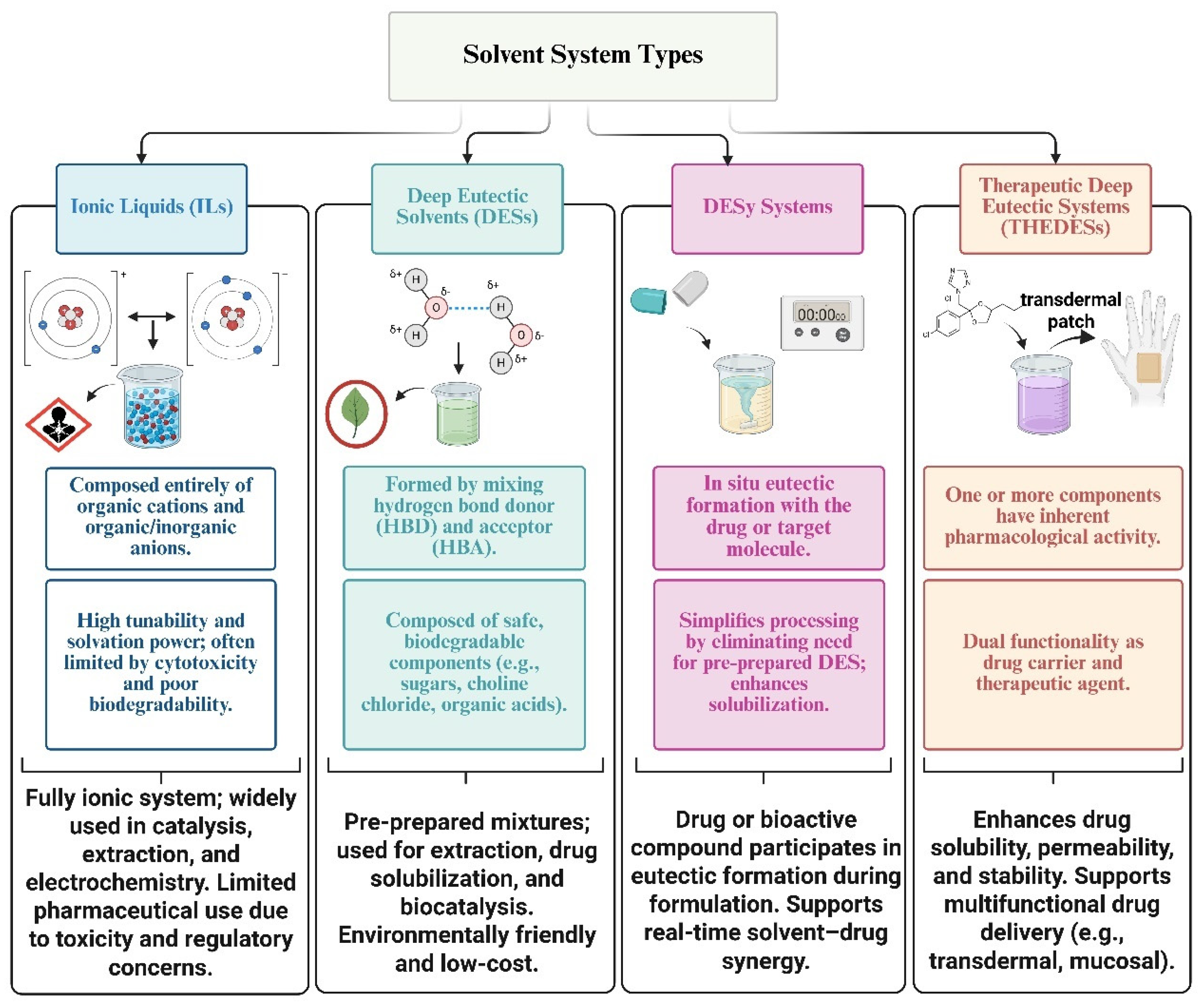
Figure 2.
Schematic summary of the multifunctional roles of capric acid in THEDES.
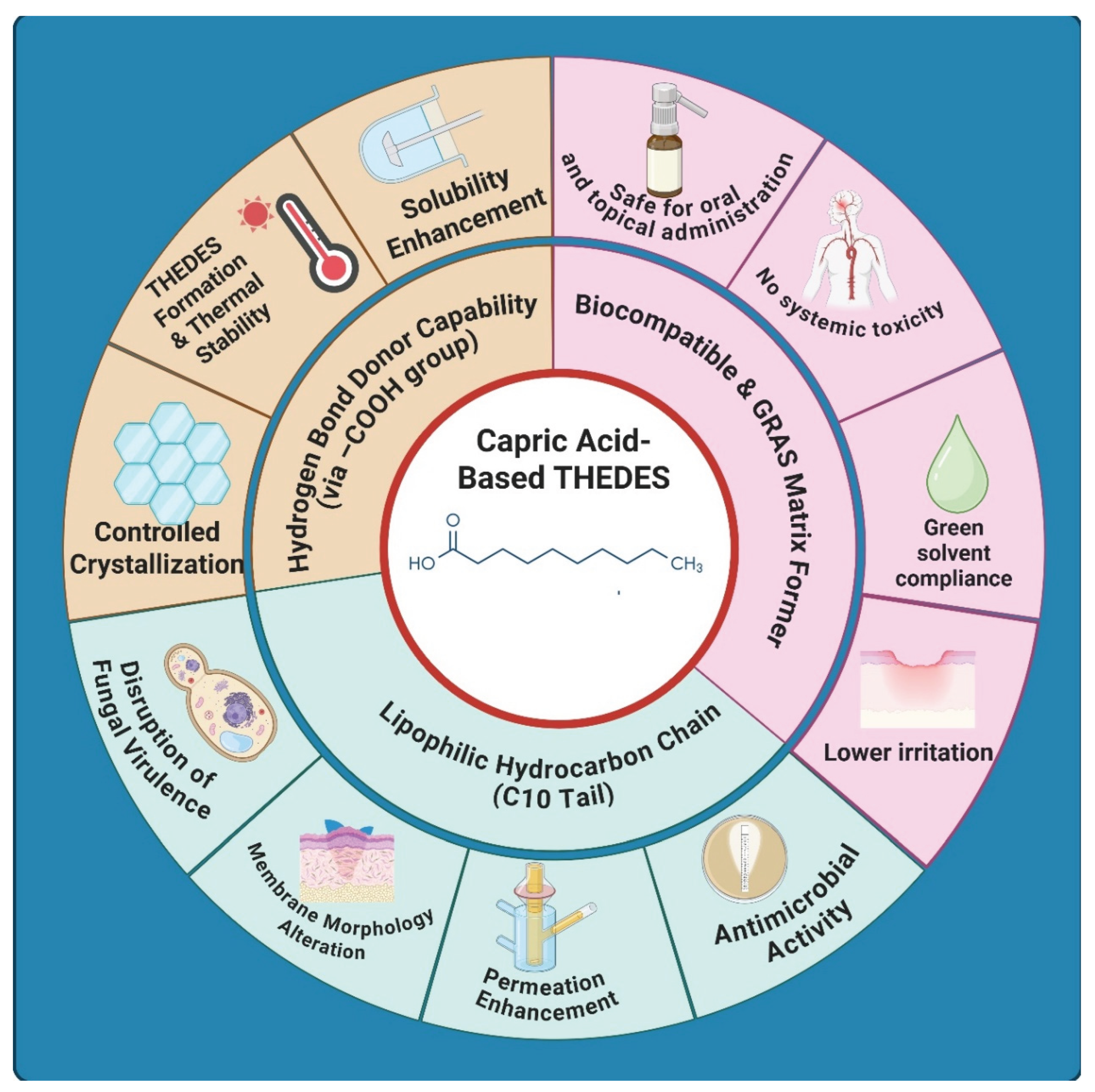

Table 1.
Comparative overview of eutectic systems (ES), deep eutectic solvents (DES), ionic liquids (ILs), and in situ deep eutectic systems (DESy).
Table 1.
Comparative overview of eutectic systems (ES), deep eutectic solvents (DES), ionic liquids (ILs), and in situ deep eutectic systems (DESy).
| Feature | ES | DES | ILs | DESy |
|---|---|---|---|---|
| Composition | Organic/inorganic blends of solid compounds | Mixtures of H-bond donors and acceptors (ionic or non-ionic) | Pure salts: discrete organic cations and inorganic/organic anions | In situ mixtures formed with the active compound as part of the eutectic system |
| Melting Behavior | Sharp melting point at eutectic composition (solid or semisolid at RT) | Depressed melting point; liquid at or near room temperature | Liquid at room temperature due to bulky asymmetric ions | Formed dynamically during application; liquid under process conditions |
| Type of Interactions | Weak van der Waals and minimal hydrogen bonding | Extensive hydrogen bonding network | Electrostatic (ionic) interactions | Hydrogen bonding and solvation driven by target molecule–solvent synergy |
| Polarity and Solubility | Moderate; limited to polar solutes | Polar; excellent for solubilizing poorly soluble APIs | Broad—dissolves both polar and non-polar compounds | Typically polar; designed to improve solubility of target APIs |
| Tunable Properties | Limited | Highly tunable via component selection and ratio adjustments | Highly tunable via cation/anion selection | Moderately tunable via selection of in situ interacting components and formulation conditions (e.g., temperature, water content). |
| Therapeutic Functionality | Typically absent | Possible if one or more components have inherent biological activity (THEDES) | Generally inert in drug delivery unless functionalized | Yes; active compound contributes to both therapeutic and solvent function |
| Toxicity and Biocompatibility | Depends on components | Often low (especially with natural components like fatty acids, amino acids, sugars) | Variable; some ILs have cytotoxicity and environmental concerns | Generally favorable if composed of GRAS or natural components |
| Environmental Impact | Moderate to high (based on solvents used) | Low (especially for NaDES and THEDES based on natural compounds) | Often high; requires careful design for biodegradability | Low; reduced processing steps and mild preparation conditions |
| Example Systems | Benzoic acid–urea | Choline chloride–urea, choline chloride–capric acid, menthol–ibuprofen | 1-butyl-3-methylimidazolium chloride ([Bmim]Cl), [EtPy][BF₄] | In situ systems formed with kiwifruit or date seed polysaccharides |
| Applications | Melting point depression, food, metallurgy | Green extraction, pharmaceutical formulation, topical/transdermal delivery (THEDES) | Organic synthesis, catalysis, electrochemistry, solubilization | Prebiotic extraction, drug solubilization, biocompatible formulations |
| Reference | [23] | [24] | [25] | [20] |
| Components with CA | Ratio | Observation | Application | Reference |
|---|---|---|---|---|
| Tetradecanoic acid (myristic acid) | CA: Myristic acid = 82:18 (mol%) or 78:22 (wt%) | Smooth, homogeneous, congruent melt; no phase separation | As a phase change material (PCM) of potential interest for passive temperature control in buildings | [39] |
| Myristic acid, Lauric acid, Steric acid | Molar Ratio (CA: Myristic acid) 3:1 Molar Ratio (CA: Lauric acid) 2:1 Molar Ratio (CA: Stearic acid) 4:1 |
Pasty-like solid Transparent liquid White solid |
Synergistic antimicrobial activity | [35] |
| Thymol, Menthol |
(Thymol: CA) 0.33: 0.67 0.50: 0.50 0.67: 0.33 (Menthol: CA) 0.33: 0.67 0.50: 0.50 0.67: 0.33 |
Homogeneous liquid Homogeneous liquid Homogeneous liquid Homogeneous liquid Homogeneous liquid Homogeneous liquid |
Reported physical properties and their dependence on constituents/composition of the NADESs will enhance their utility and help establish them as novel alternate media in science and technology. | [40] |
| Gefitinib | (Gefitinib: CA) 80: 20 ≤70: 30 Extreme ratios |
Clear liquid Pasty Powder/solid |
Enhance Gefitinib solubility and exhibit a synergistic cytotoxic effect against EGFR-expressing cell lines | [7] |
| Tetrabutylammonium chloride (TBAC), methyl tricaprylmethylammonium chloride (TOMAC) | (TBAC:CA) 1:2 (TOMAC:CA) 1:2 |
Clear, viscous fluid Clear, viscous fluid |
Have the potential to be a novel class of lubricants | [41] |
| Cineole | (Cineole: CA) 1: 1 |
Clear, low-viscosity liquid |
Very low viscous and dense fluid, with suitable properties for several solubilization technologies. its suitability to penetrate and stabilize cell membranes may lead to adverse outcomes when living organisms are exposed to this hydrophobic deep eutectic solvent.
|
[27] |
|
Droperidol |
(Droperidol: CA) 0.9:0.1 (D1) 0.8:0.2 (D2) 0.7:0.3 (D3) ≤0.6:0.4 (D4–D8) |
Clear eutectic liquid; ¹H NMR showed Δδ = +0.08–0.09 ppm at protons adjacent to piperidine N; DOSY confirmed reduced CA diffusion; DSC showed no melting peaks; highest intestinal flux (1.182 mg cm⁻² s⁻¹ at 15 min). Homogeneous liquid; similar NMR shifts; DSC revealed CA recrystallization on cooling (−8.1 °C); slightly lower flux than D1. Partial melting; depressed CA melting at 17.7 °C in DSC; signs of phase separation. Pasty mixtures; recrystallization and Tg observed in DSC; weak interaction. |
Solvent-free THEDES platform for enhancing droperidol solubility and intestinal permeability; suitable for green pharmaceutical formulation. |
[12] |
| Aripiprazole | (Aripiprazole: CA) 0.9:0.1 (A1) 0.8:0.2 (A2) ≤0.7:0.3 (A3–A8) |
Clear eutectic liquid; downfield shifts in amide (Δδ = +0.62 ppm) and piperazine CH₂ (Δδ = +0.10 ppm); strong H-bonding confirmed. Similar spectral shifts: eutectic liquid maintained; no residual crystallinity. Heterogeneous pastes; DSC showed unincorporated CA (e.g., CA melting at 18.7 °C in A3); weak or absent interactions. |
Hydrogen-bond-stabilized eutectic systems enabling improved solubility and biopharmaceutical performance of aripiprazole. | [12] |
| Lauric acid | (Lauric acid: CA) 1:2 |
Clear, homogeneous liquid; lowest density (0.859 g/cm³); Newtonian flow; visually stable. Lycopene yield 7.51 mg/100 g FW, total carotenoids 8.04 mg/100 g. | Green solvent for lycopene extraction; practical operating window established. | [42] |
| Lauric acid |
(CA : Lauric Acid) 1:1 2:1 |
Transparent liquid; thicker flow (shear-thickening). Lycopene 2.98 mg/100 g. Transparent liquid; more viscous feel; Lycopene 3.19 mg/100 g. |
Alternative HNADES with moderate performance. Lower-performing variant. |
[42] |
| Dodecanoic acid |
(Dodecanoic cid:CA) 1:2 |
Clear, uniform liquid; noticeably viscous; stable hydrophobic phase. Effective for Cu²⁺, Co²⁺, Ni²⁺ extraction |
Green solvent for metal recovery; applicable in wastewater treatment. | [43] |
| Matrine | (Matrine:CA) 1:1 |
Slightly yellowish homogeneous liquid; density and viscosity decrease with temperature; moderate thermal stability |
better antibacterial activity on S. aureus as compared with matrine | [44] |
| Polyethylene glycol |
Weigh% Mass Ratio (polyethylene glycol:CA) 1:1 |
Congruent eutectic at ~22.9 °C with high latent heat (173.9 J g⁻¹); reduced supercooling, faster crystallization, stable after 200 cycles, negligible corrosion. |
Thermal energy storage for solar passive buildings; energy saving (≈4.9 kWh·kg⁻¹·yr⁻¹), cost-effective, and carbon neutral within ~3 years. | [45] |
| Mirtazapine |
(Mirtazapine:CA) 1:2 |
Light-yellow transparent viscous liquid; no crystals (polarized microscopy) |
Transdermal delivery of MTZ to bypass first-pass metabolism; promising topical antidepressant THEDES. | [46] |
| Levofloxacine: |
(CA:Levofloxacin) 9:1, 8:2, 7:3 (DES liquids formed at these ranges; eutectic ~80:20–70:30 |
Clear liquids (THDES); DES formation confirmed by ¹H NMR & ATR-FTIR (H-bonding) and DSC (melting point depression; excess CA signal decreases with more LEV). |
Green THDES to enhance LEV performance: solubilization + antibacterial synergy; potential to combat resistance. | [36] |
| Ketoconazole: | Molar Ratio (Ketoconazole: CA) 1:5 |
Clear, stable liquid at room temperature for ≥5 months. |
Enhanced antifungal efficacy, solubility, and transdermal permeability using a green, stable THEDES system. | [6] |
| Oxymatrine: | (Oxymatrine: CA) 1: 1 |
Stable transparent DES. |
Biocompatible, low-toxicity enhancer; suitable when high safety is prioritized. | [47] |
| Ibuprofen: | (Ibuprofen: CA) 1:3 |
Clear, stable liquid at 37 °C. |
Effective transient eutectic solubilizer; excellent for dual-drug oral systems when combined with surfactant; balances high solubility and moderate release. | [48] |
|
Clotrimazole
|
(Clotrimazole:CA) 1:1 1:2 1:3 1:4 1:5 |
Solid at RT (not a DES) Transparent liquid; physically stable ≥1 year (DES candidate) Eutectic point; transparent liquid Transparent liquid; physically stable (DES candidate) Solid at RT (not a DES) |
Therapeutic DES (THEDES) for enhanced antifungal potency and skin permeation | [49] |
Disclaimer/Publisher’s Note: The statements, opinions and data contained in all publications are solely those of the individual author(s) and contributor(s) and not of MDPI and/or the editor(s). MDPI and/or the editor(s) disclaim responsibility for any injury to people or property resulting from any ideas, methods, instructions or products referred to in the content. |
© 2025 by the authors. Licensee MDPI, Basel, Switzerland. This article is an open access article distributed under the terms and conditions of the Creative Commons Attribution (CC BY) license (http://creativecommons.org/licenses/by/4.0/).
Copyright: This open access article is published under a Creative Commons CC BY 4.0 license, which permit the free download, distribution, and reuse, provided that the author and preprint are cited in any reuse.


