

Submitted:
16 December 2025
Posted:
16 December 2025
You are already at the latest version
Abstract
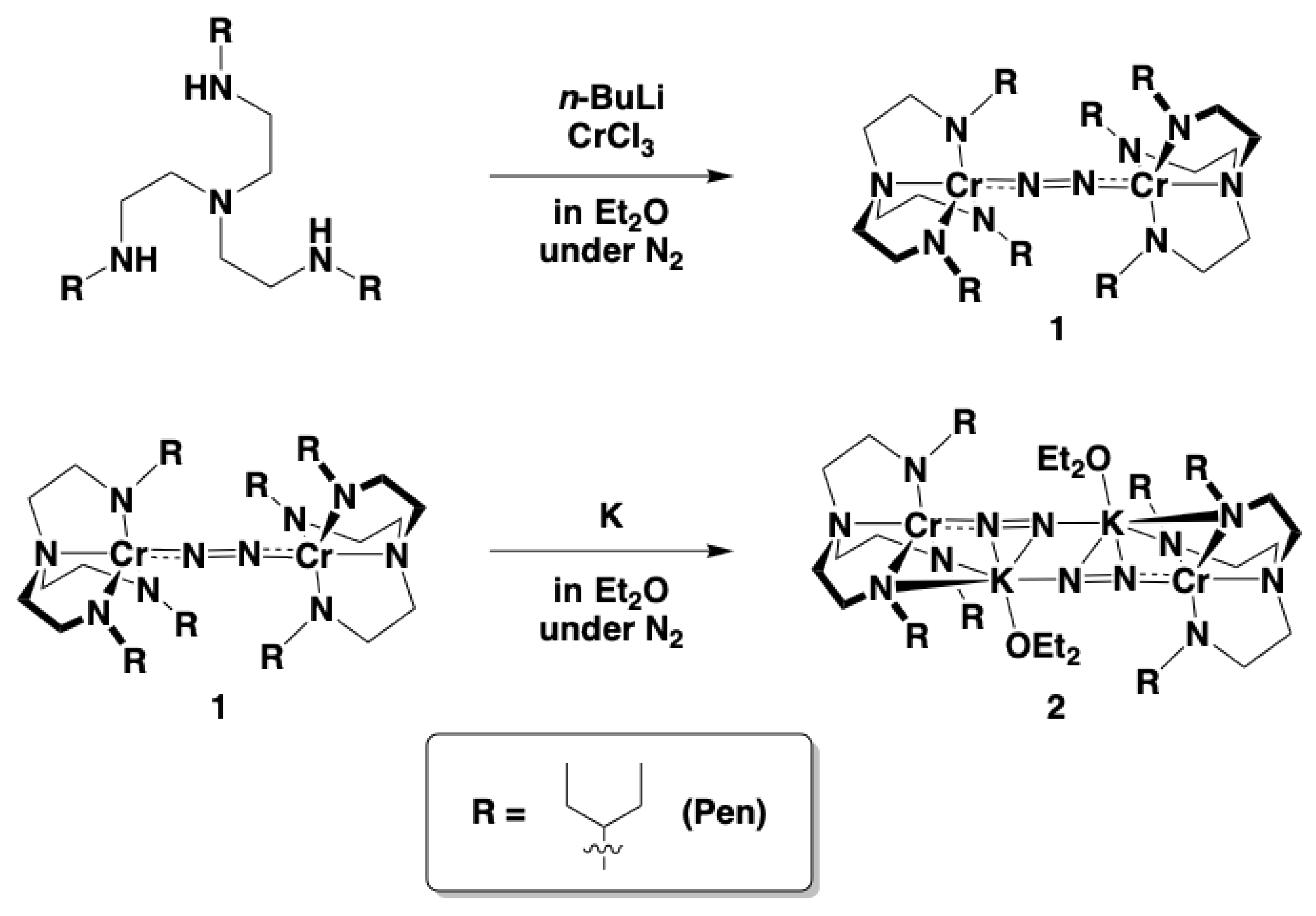
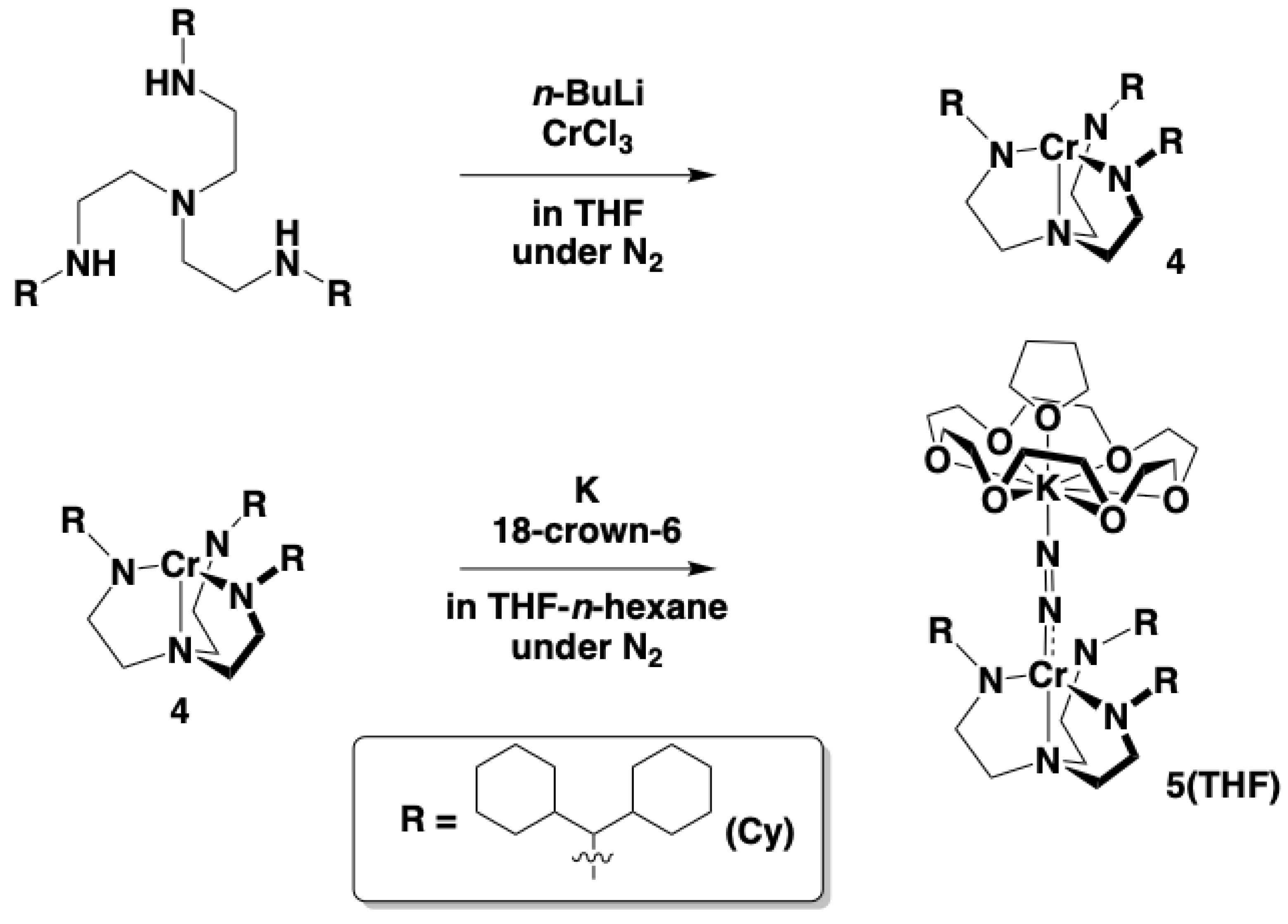
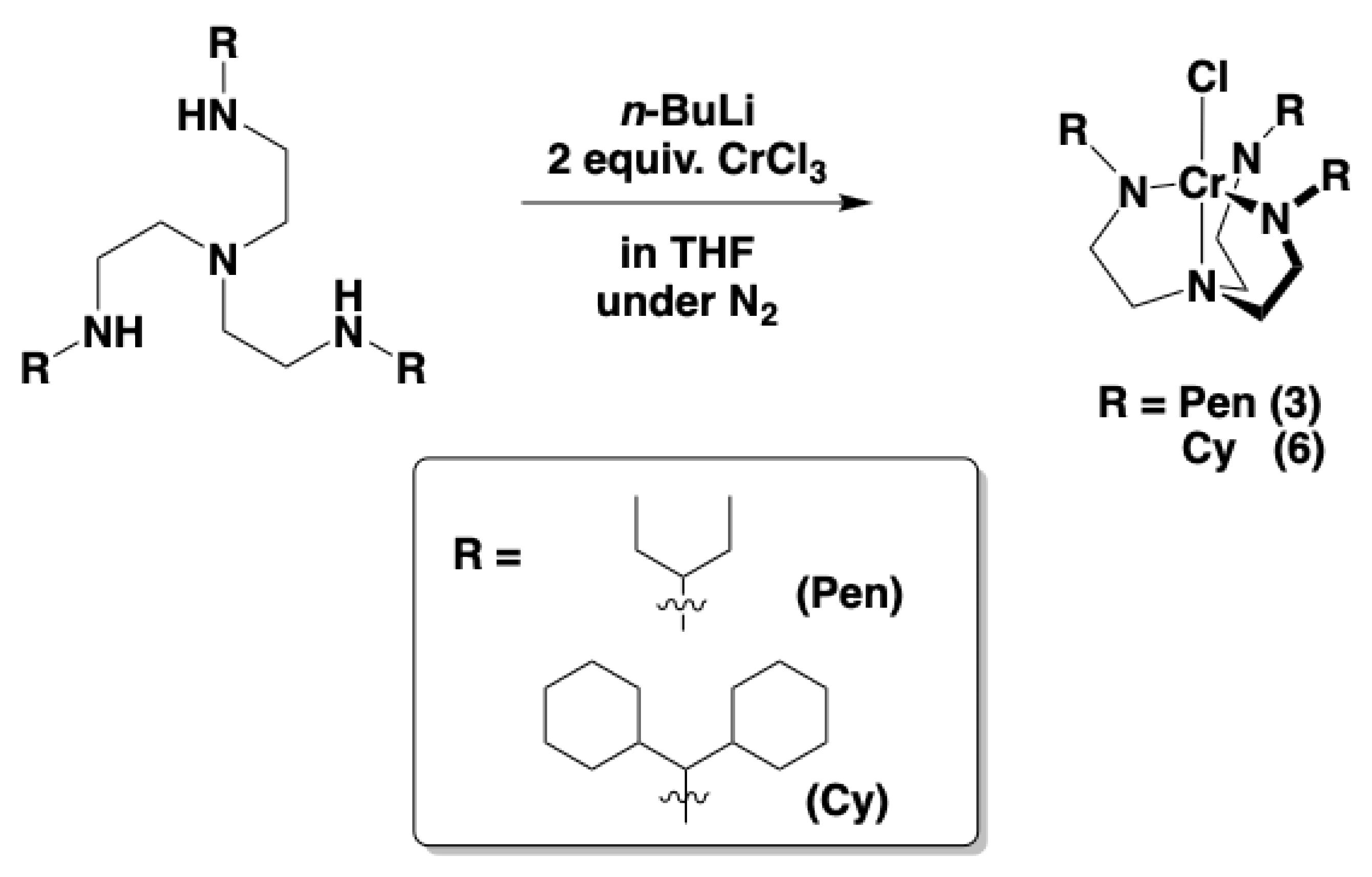
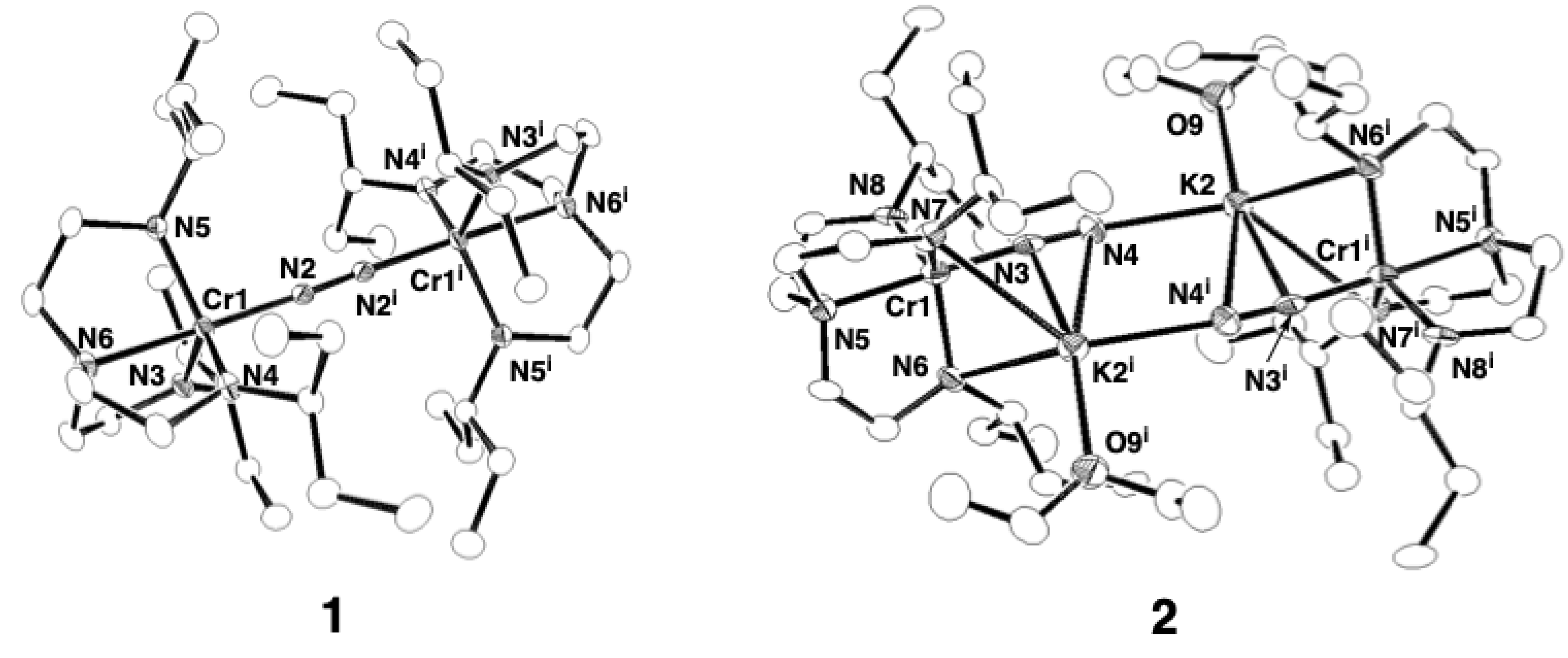
Chromium complexes with triamidoamine derivatives bearing bulky substituents at the terminal positions of the ligands, tris(2-(3-pentylamino)ethyl)amine (H3LPen) and tris(3-dicyclohexylmethylaminoethyl)amine (H3LCy), have been prepared: [{Cr(LPen)}2(m-N2)] (1), [{CrK(LPen)(m-N2)(Et2O)}2] (2), [CrCl(LPen)] (3), [Cr(LCy)] (4), [CrK(LCy)(m-N2)(18–crown–6)(THF)] (5(THF)), and [CrCl(LCy)] (6)). The preparation of these complexes has been confirmed by X-ray diffraction analysis. Complexes 1, 2, and 5(THF) have coordinated dinitrogen molecules, with N–N bond lengths of 1.185(3), 1.174(9), and 1.162(3) Å, respectively. These lengths are significantly elongated compared to that of free dinitrogen molecule (1.10 Å), indicating that the N₂ ligands are activated. The n(14N–14N) values of 1, 2, and 5(THF) are 1715 cm-1 (n(15N–15N): 1651 cm-1) for 1 (Raman, in solution), 1787, 1743 cm-1 (n(15N–15N) 1728, 1687 cm-1) for 2 (IR, in solid), and 1824 cm-1 (n(15N–15N) 1757 cm-1) for 5(THF) (IR, in solid), respectively. These values are markedly smaller than free nitrogen (2331 cm-1), confirming that the dinitrogen is interacting with the metal ions and activated. The structures of 2 and 5(THF) in solution have also been studied by 1H NMR and solution IR spectroscopies. 1H NMR spectra of these complexes have revealed that the peaks of 2 and 5(THF) have been observed in the diamagnetic region, whereas those for the other complexes (1, 3, 4, and 6) have exhibited paramagnetic shifts. The reactions of these complexes with K[C10H8] and HOTf under N2 in THF have yielded hydrazine and a small amount of ammonia, however, they have not been catalytic. The ¹H NMR and IR spectra of the products obtained by reacting 1 or 3 with reductant K in THF under N2 atmosphere have indicated that 2 has been formed based on spectral agreement. Similarly, upon examining for 4 or 6, it has been confirmed that a species similar to 5(THF) has been generated.
Keywords:
1. Introduction
2. Results and Discussion
2.1. Preparation of Bulky Tren Ligands and Their Chromium Complexes, 1, 2, 3, 4, 5(THF), and 6
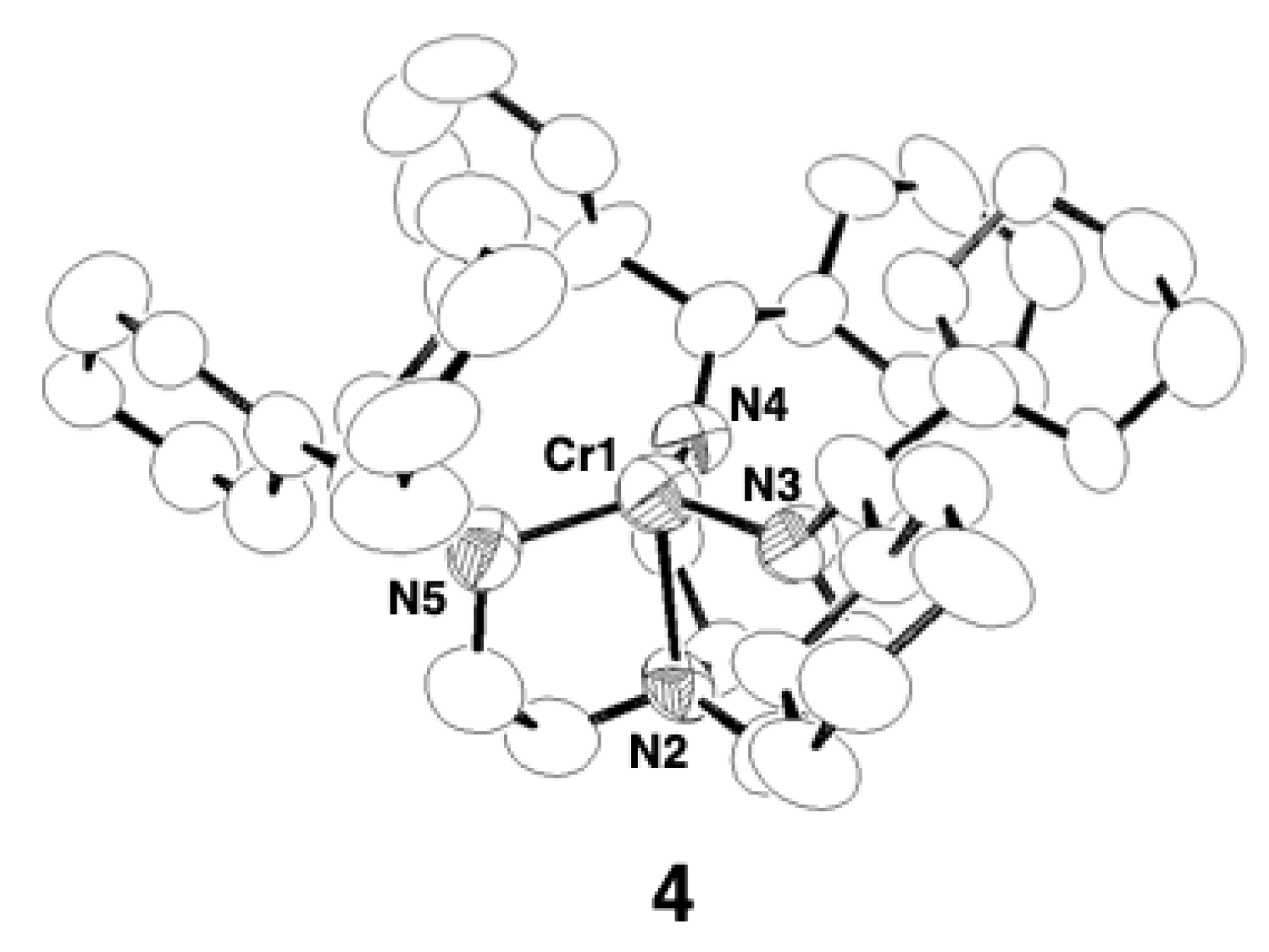
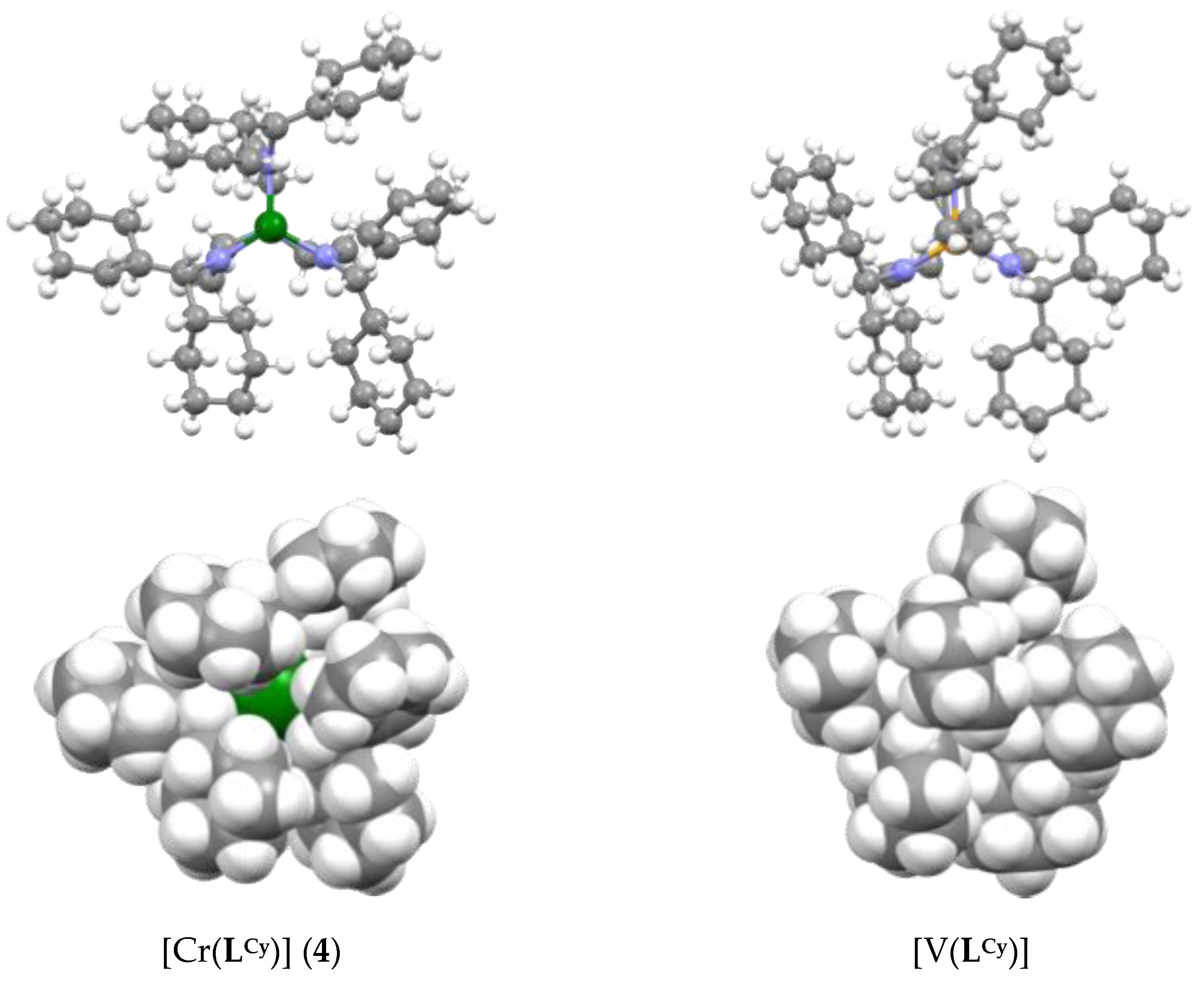
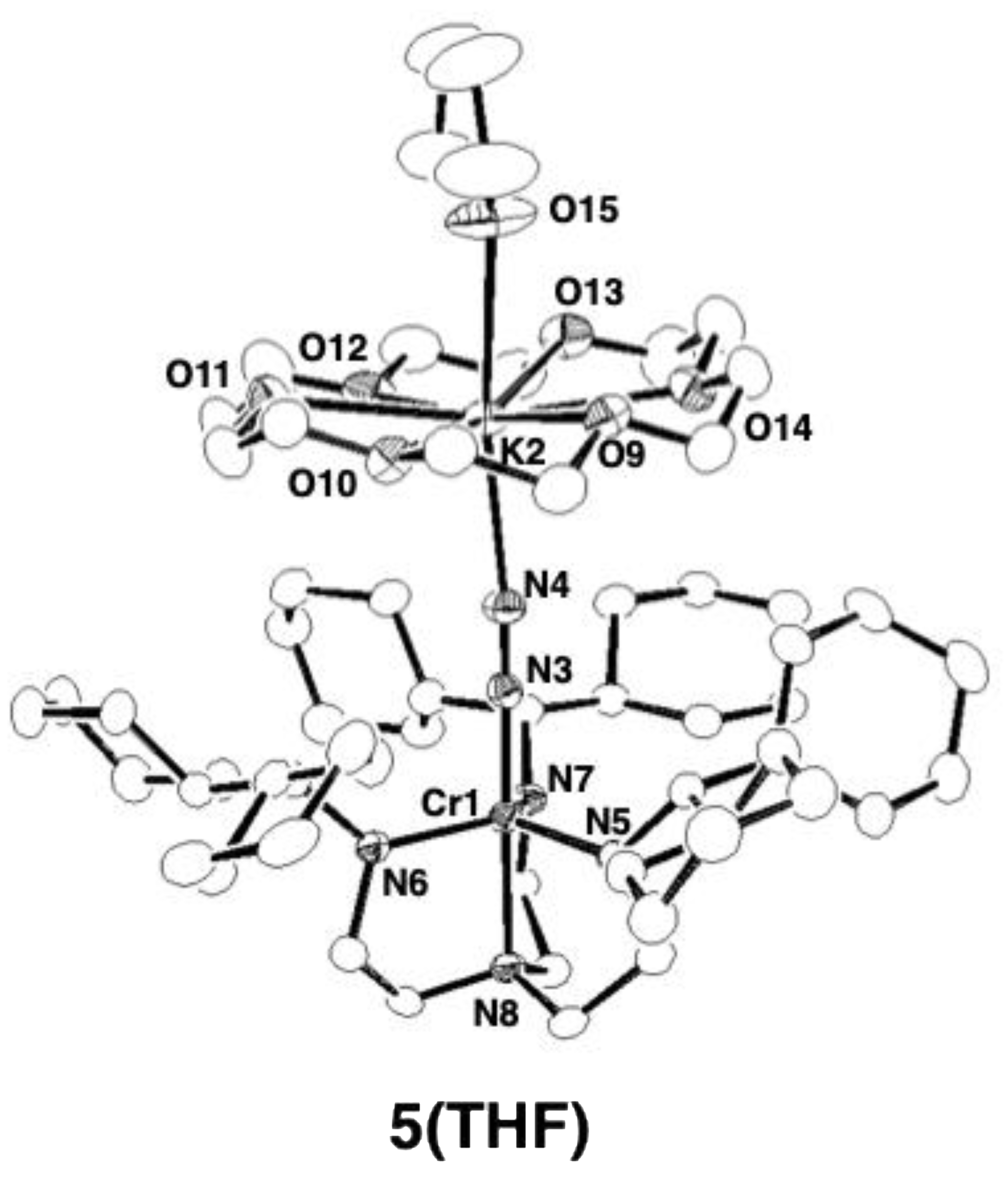
2.2. Crystal Structures of Complexes 1, 2, 4, and 5(THF)

| 1 | ||||||||||
| Cr1–N2 | 1.8468(15) | Cr1–N3 | 1.8965(16) | Cr1–N4 | 1.8906(18) | |||||
| Cr1–N5 | 1.8876(17) | Cr1–N6 | 2.1110(17) | N2–N2i | 1.185(3) | |||||
| Cr•••Cri | 4.8774(7) | |||||||||
| N2–Cr1–N3 | 98.11(7) | N2–Cr1–N4 | 99.76(7) | N2–Cr1–N5 | 97.25(7) | |||||
| N2–Cr1–N6 | 177.95(7) | N3–Cr1–N4 | 117.87(7) | N3–Cr1–N5 | 118.37(7) | |||||
| N3–Cr1–N6 | 80.89(7) | N4–Cr1–N5 | 117.51(7) | N4–Cr1–N6 | 82.29(7) | |||||
| N5–Cr1–N6 | 81.71(7) | N2i–N2–Cr1 | 177.1(2) | |||||||
| 2 | ||||||||||
| Cr1–N3 | 1.762(8) | Cr1–N5 | 2.096(7) | Cr1–N6 | 1.931(7) | |||||
| Cr1–N7 | 1.901(8) | Cr1–N8 | 1.857(8) | N3–N4 | 1.174(9) | |||||
| N3–K2i | 2.870(8) | N4–K2i | 3.101(8) | N6–K2i | 2.983(8) | |||||
| N7–K2i | 3.108(7) | N4–K2 | 2.658(8) | K2–O9 | 2.722(7) | |||||
| Cr1•••K2i | 3.252(3) | Cr•••K2 | 5.551(3) | |||||||
| N3–Cr1–N5 | 179.0(3) | N3–Cr1–N6 | 96.7(3) | N3–Cr1–N7 | 96.9(3) | |||||
| N3–Cr1–N8 | 97.2(3) | N5–Cr1–N6 | 82.5(3) | N5–Cr1–N7 | 83.0(3) | |||||
| N5–Cr1–N8 | 83.8(3) | N6–Cr1–N7 | 115.9(3) | N6–Cr1–N8 | 121.4(3) | |||||
| N7–Cr1–N8 | 118.4(3) | N3–K2i–N4 | 22.25(18) | N3–K2i–N4i | 100.7(2) | |||||
| N3–K2i–N6 | 56.3(2) | N3–K2i–N7 | 54.4(2) | N3–K2i–O9i | 167.0(2) | |||||
| N4–K2i–N4i | 78.5(2) | N4–K2i–N6 | 74.1(2) | N4–K2i–N7 | 132.5(2) | |||||
| N4–K2i–O9i | 166.4(2) | N4i–K2i–N6 | 139.9(2) | N4i–K2i–N7 | 132.5(2) | |||||
| N4i–K2i–O9i | 90.7(2) | N6–K2i–N7 | 64.4(2) | N6–K2i–O9i | 110.7(2) | |||||
| N7–K2i–O9i | 121.2(2) | N4–N3–Cr1 | 175.6(7) | N3–N4–K2 | 168.5(7) | |||||
| 5(THF) | |||||
| Cr1–N3 | 1.761(2) | Cr1–N5 | 1.912(2) | Cr1–N6 | 1.911(2) |
| Cr1–N7 | 1.907(2) | Cr1–N8 | 2.125(2) | K2–N4 | 2.647(2) |
| K2–O9 | 2.867(2) | K2–O10 | 2.775(2) | K2–O11 | 2.866(2) |
| K2–O12 | 2.767(2) | K2–O13 | 2.852(2) | K2–O14 | 2.774(2) |
| K2–O15 | 2.707(2) | N3–N4 | 1.162(3) | Cr1•••K2 | 5.5547(8) |
| N3–Cr1–N5 | 97.44(10) | N3–Cr1–N6 | 97.40(9) | N3–Cr1–N7 | 96.46(10) |
| N3–Cr1–N8 | 179.24(9) | N5–Cr1–N6 | 118.77(9) | N5–Cr1–N7 | 119.16(9) |
| N5–Cr1–N8 | 82.52(9) | N6–Cr1–N7 | 117.56(10) | N6–Cr1–N8 | 83.27(9) |
| N7–Cr1–N8 | 82.91(9) | N4–N3–Cr1 | 179.6(3) | N4–K2–O9 | 100.44(7) |
| N4–K2–O10 | 95.50(7) | N4–K2–O11 | 101.65(7) | N4–K2–O12 | 87.16(7) |
| N4–K2–O13 | 96.66(7) | N4–K2–O14 | 91.30(7) | N4–K2–O15 | 172.33(9) |
| N3–N4–K2 | 171.8(2) | ||||
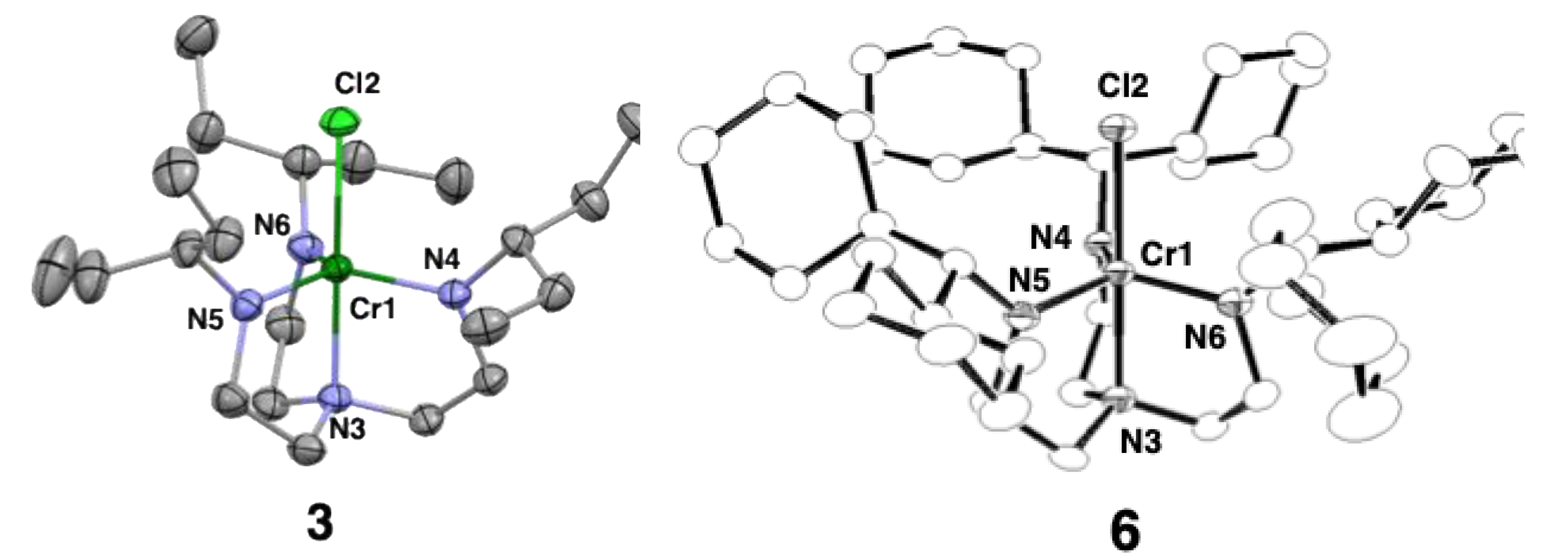
2.3. Crystal Structures of Complexes 3 and 6
| 3[a] | |||||
| Cr1–Cl2 | 2.3145(6) | Cr1–N3 | 2.0446(16) | Cr1–N4 | 1.8661(16) |
| Cr1–N5 | 1.8680(17) | Cr1–N6 | 1.8650(17) | ||
| Cl2–Cr1–N3 | 179.51(5) | Cl2–Cr1–N4 | 96.55(5) | Cl2–Cr1–N5 | 97.03(5) |
| Cl2–Cr1–N6 | 97.09(6) | N3–Cr1–N4 | 82.98(7) | N3–Cr1–N5 | 83.08(7) |
| N3–Cr1–N6 | 83.28(7) | N4–Cr1–N5 | 119.03(8) | N4–Cr1–N6 | 119.39(7) |
| N5–Cr1–N6 | 117.32(8) | ||||
| 6 | |||||
| Cr1–Cl2 | 2.3147(7) | Cr1–N3 | 2.088(2) | Cr1–N4 | 1.883(2) |
| Cr1–N5 | 1.8874(19) | Cr1–N6 | 1.878(2) | ||
| Cl2–Cr1–N3 | 179.50(6) | Cl2–Cr1–N4 | 96.80(6) | Cl2–Cr1–N5 | 96.44(6) |
| Cl2–Cr1–N6 | 97.20(7) | N3–Cr1–N4 | 83.05(8) | N3–Cr1–N5 | 83.23(8) |
| N3–Cr1–N6 | 83.29(9) | N4–Cr1–N5 | 119.49(9) | N4–Cr1–N6 | 117.96(9) |
| N5–Cr1–N6 | 118.39(9) | ||||
2.4. Raman and IR Spectra of 1, 2, and 5(THF)
2.5. IR Spectra of 2 and 5(THF) in Solution
15. N NMR Spectra of 2 and 5(THF)
2.6.1. H NMR Spectra of 1 – 6
2.7. Comparison of Physico-chemical Properties (X-ray, Raman, IR, NMR) of 1, 2 and 5(THF) with Previously Reported Chromium Dinitrogen Complexes
2.8. Reactions of Chromium Complexes with K[C10H8] and HOTf Under N2
3. Materials and Methods
3.1. General Procedures
3.2. Physical Measurements
3.3. X-ray Crystallography Procedures
3.4. Synthesis of [{Cr(Lpen)}2(μ-14N2)] (1)
3.5. Synthesis of [{Cr(Lpen)}2(μ-15N2)] (1’)
3.6. Synthesis of [{CrK(Lpen)(μ-14N2)(Et2O)}2] (2)
3.7. Synthesis of [{CrK(Lpen)(μ-15N2)(Et2O)}2] (2’)
3.8. Synthesis of [Cr(LCy)] (4)
3.9. Synthesis of [CrK(LCy)(μ-14N2)(18-crown-6)(THF)] (5(THF))
3.10. Synthesis of [CrK(LCy)(μ-15N2)(18-crown-6)(THF)] (5’(THF))
3.11. Synthesis of [CrK(LCy)(μ-14N2)(18-crown-6)] (5)
3.12. Synthesis of [CrK(LCy)(μ-15N2)(18-crown-6)] (5’)
3.13. Synthesis of [CrCl(LCy)] (6)
3.14. Reactions of 1, 2, 3, 4, 5(THF), and 6 with K[C10H8] and HOTf
3.15. NH3 Quantification Procedure
3.16. N2H4 Quantification Procedure
4. Conclusions
Supplementary Materials
Author Contributions
Funding
Institutional Review Board Statement
Informed Consent Statement
Acknowledgments
Conflicts of Interest
Abbreviations
| THF | Tetrahydrofuran |
| HOTf | Trifluoromethanesilfonic Acid |
| IR | Infrared |
| tren | Tris(2-aminoethyl)amine |
| n-BuLi | n-Butyllithium |
| Et2O | Diethylether |
| ORTEP | Oak Ridge Thermal-Ellipsoid Plot |
| NMR | Nuclear Magnetic Resonance |
References
- Schlögl, R. Catalytic Synthesis of Ammonia–A “Never-Ending Story”? Angew. Chem. Ent. Ed. 2003, 42, 2004–2008.
- Zhang, X.; Ward, B. B.; Sigman, D. M. Global Nitrogen Cycle: Critical Enzymes, Organisms, and Processes for Nitrogen Budgets and Dynamics. Chem. Rev. 2020, 120, 5308–5351.
- Elishav, O.; Lis, B. M.; Miller, E. M.; Arent, D. J.; Valera-Medina, A.; Dana, A. G.; Shter, G. E.; Grader, G. S. Progress and Prospective of Nitrogen-Based Alternative Fuels. Chem. Rev. 2020, 120, 5352–5436.
- Yandulov, D. V.; Schrock, R. R. Catalytic Reduction of Dinitrogen to Ammonia at a Single Molybdenum Center. Science 2003, 301, 76–78.
- Schrock, R. R. Catalytic Reduction of Dinitrogen to Ammonia t a Single Molybdenum Center. Acc. Chem. Res. 2005, 38, 955–962.
- Schrock, R. R. Catalytic Reduction of Dinitrogen to Ammonia by Molybdenum: Theory versus Experiment. Angew. Chem. Int. Ed. 2008, 47, 5512–5522.
- Mitsumoto, T.; Ashida, Y.; Arashiba, K.; Kuriyama, S.; Egi, A.; Tanaka, H.; Yoshizawa, K.; Nishibayashi, Y. Catalytic Activity of Molybdenum Complexes Bearing PNP-Type Pincer Ligand toward Ammonia Formation. Angew. Chem. Int. Ed. 2023, 62, e202306631.
- Tanabe, Y.; Nishibayashi, Y. Catalytic Nitrogen Fixation Using Well-Defined Molecular Catalysts under Ambient or Mild Reaction Conditions. Angew. Chem. Int. Ed. 2024, 63, e202406404.
- Mitsumoto, T.; Nakamura, T.; Tanaka, H.; Yoshizawa, K.; Nishibayashi, Y. Cooperative Ammonia Formation Catalyzed by Molybdenum and Samarium Complexes. Angew. Chem. Int. Ed. 2025, 64, e202507061.
- Mitsumoto, T.; Nishibayashi, Y. Molybdenum-Catalyzed Ammonia Synthesis by Using Zero-Valent Metal Powder with Alcohols or Water, Angew. Chem. Int. Ed. 2025, 64, e202423858.
- McWilliams, S. F.; Holland, P. L. Dinitrogen Binding and Cleavage by Multinuclear Iron Complexes. Acc. Chem. Res. 2015, 48, 2059–2065.
- Tanaka, H.; Nishibayashi, Y.; Yoshizawa, K. Interplay between Theory and Experiment for Ammonia Synthesis Catalyzed by Transition Metal Complexes. Acc. Chem. Res. 2016, 49, 987–995.
- Ashida, Y.; Nishibayashi, Y. Catalytic Conversion of Nitrogen Molecule into Ammonia Using Molybdenum Complexes under Ambient Reaction Conditions. Chem. Commun. 2021, 57, 1176–1189.
- Tanabe, Y.; Nishibayashi, Y. Comprehensive insights into synthetic nitrogen fixation assisted by molecular catalysts under ambient or mild conditions. Chem. Soc. Rev. 2021, 50, 5201–5242.
- Tanabe, Y.; Nishibayashi, Y. Recent advances in catalytic silylation of dinitrogen using transition metal complexes. Coord. Chem. Rev. 2019, 389, 73–93.
- Tanabe, Y.; Nishibayashi, Y. Recent advances in catalytic nitrogen fixation using transition metal-dinitrogen complexes under mild reaction conditions. Coord. Chem. Rev. 2022, 472, 214783.
- Tanifuji, K.; Ohki, Y. Metal-Sulfur Compounds in N2 Reduction and Nitrogenase-Related Chemistry. Chem. Rev. 2020, 120, 5194–5251.
- Singh, D.; Buratto, W. R.; Torres, J. F.; Murray, L. J. Activation of Dinitrogen by Polynuclear Metal Complexes. Chem. Rev. 2020, 120, 5517–5581.
- Chalkley, M. J.; Drover, M. W.; Peters, J. C. Catalytic N2-to-NH3 (or -N2H4) Conversion by Well-Defined Molecular Coordination Complexes. Chem. Rev. 2020, 120, 5582–5636.
- Kim, S.; Loose, F.; Chirik, P. J. Beyond Ammonia: Nitrogen -Element Bond Forming Reactions with Coordinated Dinitrogen. Chem. Rev. 2020, 120, 5637–5681.
- Khoenkhoen, N.; de Bruin, B.; Reek, J. N. H.; Dzik, W. I. Reactivity of Dinitrogen Bound to Mid- and Late-Transition-Metal Centers. Eur. J. Inorg. Chem. 2015, 567–598.
- Stucke, N.; Flöser, B. M.; Weyrich, T.; Tuczek, F. Catalytic Ammonia Synthesis with Transition Metal Complexes: Recent Developments. Eur. J. Inorg. Chem. 2017, 1337–1355.
- Bhutto, S. M.; Holland, P. L. Dinitrogen Activation and Functionalization Using β-Diketiminate Iron Complexes. Eur. J. Inorg. Chem. 2019, 1861–1869.
- Kendall, A. J.; Mock, M. T. Dinitrogen Activation and Functionalization with Chromium. Eur. J. Inorg. Chem. 2020, 1358–1375.
- Nishibayashi, Y. Recent Progress in Transition-Metal-Catalyzed Reduction of Molecular Dinitrogen under Ambient Reaction Conditions. Inorg. Chem. 2015, 54, 9234–9247.
- Foster, S. L.; Perez Bakovic, S. I.; Duda, R. D.; Maheshwari, S.; Milton, R. D.; Minteer, S. D.; Janik, M. J.; Renner, J. N.; Greenlee, L. F. Catalysts for nitrogen reduction to ammonia. Nat. Cat. 2018, 1, 490–500.
- Burford, R. J.; Fryzuk, M. D. Examining the relationship between coordination mode and reactivity of dinitrogen. Nat. Rev. Chem. 2017, 1, 0026.
- Kuriyama, S.; Nishibayashi, Y. Development of catalytic nitrogen fixation using transition metal complexes not relevant to nitrogenases. Tetrahedron 2021, 83, 131986.
- Kireev, N. V.; Filippov, O. A.; Epstein, L. M.; Shubina, E. S.; Belkova, N. V. Activation of dinitrogen by group 6 metal complexes. Russ. Chem. Bull. 2023, 72, 83–102.
- Itabashi, T.; Arashiba, K.; Egi, A.; Tanaka, H.; Sugiyama, K.; Suginome, S.; Kuriyama, S.; Yoshizawa, K.; Nishibayashi, Y. Direct synthesis of cyanate anion from dinitrogen catalysed by molybdenum complexes bearing pincer-type ligand. Nat. Commun. 2022, 13, 6161.
- Ashida, Y.; Onozuka, Y.; Arashiba, K.; Konomi, A.; Tanaka, H.; Kuriyama, S.; Yamazaki, Y.; Yoshizawa, K.; Nishibayashi, Y. Catalytic nitrogen fixation using visible light energy. Nat. Commun. 2022, 13, 7263.
- Yamazaki, Y.; Endo, Y.; Nishibayashi, Y. Catalytic ammonia formation from dinitrogen, water, and visible light energy. Nat. Commun. 2025, 16, 4540.
- Ashida, Y.; Mizushima, T.; Arashiba, K.; Egi, A.; Tanaka, H.; Yoshizawa, K.; Nishibayashi, Y. Catalytic production of ammonia from dinitrogen employing molybdenum complexes bearing N-heterocyclic carbene-based PCP-type pincer ligands. Nat. Synth. 2023, 2, 635–644.
- Suginome, S.; Murota, K.; Yamamoto, A.; Yoshida, H.; Nishibayashi, Y. Mechanochemical nitrogen fixation catalysed by molybdenum complexes. Nat. Synth. 2025, 4, 243–251.
- Suginome, S.; Nishibayashi, Y. Direct Synthesis of Organonitrogen Compounds from Dinitrogen Using Transition Metal Complexes: Leap from Stoichiometric Reactions to Catalytic Reactions. ChemCatChem 2023, 15, e202300850.
- Eizawa, A.; Arashiba, K.; Tanaka, H.; Konomi, A.; Yoshizawa, K.; Nishibayashi, Y. Design, synthesis and reactivity of dimolybdenum complex bearing quaterphenylene-bridged pyridine-based PNP-type pincer ligand. Dalton Trans. 2023, 52, 14012–14016.
- Feng, D.; Zhou, L.; Liu, C.; Li, H.; Zhang, Y.; Yao, Y.; Ma, T. Enhanced electrochemical reduction of N2 to NH3 by interfacial engineering of biomass-derived Fe, Mo-bimetallic composite. Electrochim. Acta 2024, 484, 144096.
- Escomel, L.; Martins, F. F.; Vendier, L.; Coffinet, A.; Queyriaux, N.; Krewald, V.; Simonneau, A. Coordination of Al(C6F5)3 vs. B(C6F5)3 on group 6 end-on dinitrogen complexes: chemical and structural divergences. Chem. Sci. 2024, 15, 11321–11336.
- Zhang, G.; Li, Q.; Wang, X.; Jin, L.; Liao, Q. Diverse Behaviors of N2 on Mo Centers Bearing POCOP-Pincer Ligands and the Role of π-Electron Configuration in Regulating the Pathway of N2 Activation. J. Am. Chem. Soc. 2025, 147, 3747–3757.
- Suginome, S.; Okochi, A.; Nakamura, T.; Konomi, A.; Tanaka, H.; Yoshizawa, K.; Nishibayashi, Y. Catalytic Reduction of Dinitrogen via Hydroboration. J. Am. Chem. Soc. 2025, 147, 26684–26692.
- Yamazaki, Y.; Nakaya, K.; Nishibayashi, Y. Synthesis of Molybdenum Complexes Bearing Pyridine-Based PNP-Type Pincer Ligands with Pendent Pyridyl Unit and Their Catalytic Activity for Ammonia Formation. Organometallics 2024, 43, 2747–2754.
- Mock, M. T.; Chen, S.; Rousseau, R.; O’Hagan, M. J.; Dougherty, W. G.; Scott Kassel, W.; DuBois, D. L.; Bullock, R. M. A rare terminal dinitrogen complex of chromium. Chem. Commun. 2011, 47, 12212–12214.
- Akturk, E. A.; Yap, G. P. A.; Theopold, K. H. Mechanism-based designed of labile precursors for chromium(I) chemistry. Chem. Commun. 2015, 51, 15402–15405.
- Egbert, J. D.; O’Hagan, M.; Wiedner, E. S.; Morris Bullock, R.; Piro, N. A.; Scott Kassel, W.; Mock, M. T. Putting chromium on the map for N2 reduction: production of hydrazine and ammonia. A study of cis-M(N2)2 (M = Cr, Mo, W) bis(diphosphine) complexes. Chem. Commun. 2016, 52, 9343–9346.
- Li, J.; Yin, J.; Wang, G.-X.; Yin, Z.-B.; Zhang, W.-X.; Xi, Z. Synthesis and reactivity of asymmetric Cr(I) dinitrogen complexes supported by cyclopentadienyl-phosphine ligands. Chem. Commun. 2019, 55, 9641–9644.
- Duletski, O. L.; Platz, D.; Pollock, C. J.; Mosquera, M. A.; Arulsamy, N.; Mock, M. T. Dinitrogen activation at chromium by photochemically induced CrII-C bond homolysis. Chem. Commun. 2024, 60, 7029–7032.
- Ashida, Y.; Egi, A.; Arashiba, K.; Tanaka, H.; Mitsumoto, T.; Kuriyama, S.; Yoshizawa, K.; Nishibayashi, Y. Catalytic Reduction of Dinitrogen into Ammonia and Hydrazine Using Chromium Complexes Bearing PCP-Pincer Ligand. Chem. – Eur. J. 2022, 28, e202200557.
- Eaton, M. C.; Knight, B. J.; Catalano, V. J.; Murray, L. J. Evaluating Metal Ion Identity on Catalytic Silylation of Dinitrogen Using a Series of Trimetallic Complexes. Eur. J. Inorg. Chem. 2020, 1519–1524.
- Vidyaratne, I.; Scott, J.; Gambarotta, S.; Budzelaar, P. H. M. Dinitrogen Activation, Partial Reduction, and Formation of Coordinated Imide Promoted by a Chromium Diiminepyridine Complex. Inorg. Chem. 2007, 46, 7040–7049.
- Berben, L. A.; Kozimor, S. A. Dinitrogen and Acetylide Complexes of Low-Valent Chromium. Inorg. Chem. 2008, 47, 4639–4647.
- Hoffert, W. A.; Rappé, A. K.; Shores, M. P. Unusual Electronic Effects Imparted by Bridging Dinitrogen: Experimental and Theoretical Investigation. Inorg. Chem. 2010, 49, 9497–9507.
- Mock, M. T.; Pierpont, A. W.; Egbert, J. D.; O’Hagan, M.; Chen, S.; Morris Bullock, R.; Dougherty, W. G.; Scott Kassel, W.; Rousseau, R. Protonation Studies of a Mono-Dinitrogen Complex of Chromium Supported by a 12-Membered Phosphorus Macrocycle Containing Pendant Amines. Inorg. Chem. 2015, 54, 4827–4839.
- Salt, J. E.; Girolami, G. S.; Wilkinson, G.; Motevalli, M.; Thornton-Pett, M.; Hursthouse, M. B. Synthesis and Characterisation of 1,2-Bis(dimethylphosphino)ethane (dmpe) Complexes of Chromium-(0) and -(IV): X-Ray Crystal Structures of trans-Cr(N2)2(dmpe)2, cis-Cr(CO)2(dmpe)2, Cr(C2Ph2)2(dmpe), and CrH4(dmpe)2. J. Chem. Soc., Dalton Trans. 1985, 685–692.
- Denholm, S.; Hunter, G.; Weakley, T. J. R. Dinitrogen Complexes derived from Tricarbonyl(η6-hexaethylbenzene)chromium(0): Crustal and Molecular Structure of μ-dinitrogen-bis[dicarbonyl(η6-hexaethylbenzene)chromium(0)]-Toluene (1/1). J. Chem. Soc., Dalton Trans. 1987, 2789–2791.
- Sobota, P.; Jeżowska- Trzebiatowska, B. FIXATION OF DINITROGEN AND ACETYLENE BY THE SYSTEM CrCl2-Mg. ISOLATION AND PROPERTIES OF CHROMIUM COMPLEXES WITH FIXED N2 AND C2H2. J. Organomet. Chem. 1977, 131, 341–345.
- Wang, G.-X.; Yin, Z.-B.; Wei, J.; Xi, Z. Dinitrogen Activation and Functionalization Affording Chromium Diazenido and Hydrazido Complexes. Acc. Chem. Res. 2023, 56, 3211–3222.
- Monillas, W. H.; Yap, G. P. A.; MacAdams, L. A.; Theopold, K. H. Binding and Activation of Small Molecules by Three-Coordinate Cr(I). J. Am. Chem. Soc. 2007, 129, 8090–8091.
- Mock, M. T.; Chen, S.; O’Hagan, M.; Rousseau, R.; Dougherty, W. G.; Scott Kassel, W.; Morris Bullock, R. Dinitrogen Reduction by a Chromium(0) Complex Supported by a 16-Membered Phosphorus Macrocycle. J. Am. Chem. Soc. 2013, 135, 11493–11496.
- Kendall, A. J.; Johnson, S. I.; Morris Bullock, R.; Mock, M. T. Catalytic Silylation of N2 and Synthesis of NH3 and N2H4 by Net Hydrogen Atom Transfer Reactions Using a Chromium P4 Macrocycle. J. Am. Chem. Soc. 2018, 140, 2528–2536.
- Yin, J.; Li, J.; Wang, G.-X.; Yin, Z.-B.; Zhang, W.-X.; Xi, Z. Dinitrogen Functionalization Affording Chromium hydrazido Complex. J. Am. Chem. Soc. 2019, 141, 4241–4247.
- Yin, Z.-B.; Wu, B.; Wang, G.-X.; Wei, J.; Xi, Z. Dinitrogen Functionalization Affording Chromium Diazenido and Side-on η2-Hydrazido Complexes. J. Am. Chem. Soc. 2023, 145, 7065–7070.
- Wang, G.-X.; Wang, X.; Jiang, Y.; Chen, W.; Shan, C.; Zhang, P.; Wei, J.;Ye, S.; Xi, Z. Snapshots of Early-Stage Quantitative N2 Electrophilic Functionalization. J. Am. Chem. Soc. 2023, 145, 9746–9754.
- Wu, B.; Chen, W.; Yan, H.; Zhang, X.; Wei, J.; Xi, Z.; Wang, G.-X.; Ye, S. Trisilylation of a Formal Cr(-I) Bis-dinitrogen Complex. J. Am. Chem. Soc. 2025, 147, 32480–32493.
- Wang, X.; Wu, Y.; Wang, Y.; Sun, R.; Wei, J.; Xi, Z. Harnessing Chromium(V) Hydrazido Intermediates for N2 Functionalization to Multisubstituted Hydrazines through Ligand Migration. J. Am. Chem. Soc. 2025, 147, 35413–35421.
- Wang, X.; Wang, Y.; Wu, Y.; Wang, G.-X.; Wei, J.; Xi, Z. Syntheses and Characterizations of Hetero-Bimetallic Chromium-Dinitrogen Transition-Metal Complexes. Inorg. Chem. 2023, 62, 18641–18648.
- Hao, M.-T.; Zhang, B.; Li, D.; Wujieti, B.; Li, X.; Chen, B.-Z. Theoretical Studies on the Reduction of N2 to NH3/N2H4 Catalyzed by Chromium Complexes. Inorg. Chem. 2025, 64, 7311–7324.
- Li, Z.; Liu, X.-X.; Wang, X.; Peng, L.-Y.; Liu, C.; Yuan, Z.; Liu, Y.; Cui, G.; Hu, S. Catalytic Silylation of Dinitrogen by PCP-Ligated Chromium Complexes. ACS Cat. 2025, 15, 13337–13345.
- Yin, Z.-B.; Wang, G.-X.; Yan, X.; Wei, J.; Xi, Z. Construction of N-E bonds via Lewis acid-promoted functionalization of chromium-dinitrogen complexes. Nat. Commun. 2025, 16, 674.
- Darani, F. A.; Yap, G. P. A.; Theopold, K. H. The Intrinsic Barrier for N≡N Bond Cleavage or Formation Mediated by the Cp*Cr(dmpe) Fragment Is Insurmountable. Organometallics 2023, 42, 1324–1330.
- Uchida, K.; Kitayama, T.; Tanaka, S.; Adachi, S.; Iguchi, H.; Sakamoto, R.; Takaishi, S. High-Pressure Synthesis and Post-synthetic Elimination of N2 Molecule of the Chromium Dinitrogen Complex, [Cr(PCy3)2(CO)3(N2)]. Organometallics 2025, 44, 459–463.
- Kokubo, Y.; Tsuzuki, K.; Sugiura, H.; Yomura, S.; Wasada-Tsutsui, Y.; Ozawa, T.; Yanagisawa, S.; Kubo, M.; Takeyama, T.; Yamaguchi, T.; Shimazaki, Y.; Kugimiya, S.; Masuda, H.; Kajita, Y. Syntheses, Characterizations, Crystal Structures, and Protonation Reactions of Dinitrogen Chromium Complexes Supported with Triamidoamine Ligands. Inorg. Chem. 2023, 62, 5320–5333.
- Kokubo, Y.; Igarashi, I.; Nakao, K.; Hachiya, W.; Kugimiya, S.; Ozawa, T.; Masuda, H.; Kajita, Y. The Steric Effect in Preparations of Vanadium(II)/(III) Dinitrogen Complexes of Triamidoamine Ligands Bearing Bulky Substituents. Molecules 2022, 27, 5864.
- Haynes, W. M.; Lide, D. R.; Bruno, T. J. CRC HANDBOOK OF CHEMISTRY and PHYSICS, 97th ed.; CRC Press, U.S., 2016.
- Schneider, S.; Filippou, A. C. Triamidoamine Complexes of Chromium(III) and Chromium(IV). Inorg. Chem. 2001, 40, 4674–4677.
- Evans, D. F. The Determination of the Paramagnetic Susceptibility of Substances in Solution by Nuclear Magnetic Resonance. J. Chem. Soc. 1959, 2003–2005.
- Sur, S. K. Measurement of Magnetic Susceptibility and Magnetic Moment of Paramagnetic Molecules in Solution by High-Field Fourier Transform NMR Spectroscopy. J. Magn. Reson. 1989, 82, 169–173.
- Dolomanov, O.V.; Bourhis, L.J.; Gildea, R.J.; Howard, J.A.K.; Puschmann, H. OLEX2: A complete structure solution, refinement and analysis program. J. Appl. Crystallogr. 2009, 42, 339–341.
- Sheldrick, G.M. SHELXT–Integrated space-group and crystal-structure determination. Acta Crystallogr. Sect. A Found. Adv. 2015, 71, 3–8.
- Sheldrick, G.M. A short history of SHELX. Acta Crystallogr. Sect. A Found. Crystallogr. 2008, 64, 112–122.
- Hill, P.J.; Doyle, L.R.; Crawford, A.D.; Myers, W.K.; Ashley, A.E. Selective Catalytic Reduction of N2 to N2H4 by a Simple Fe Complex. J. Am. Chem. Soc. 2016, 138, 13521–13524.
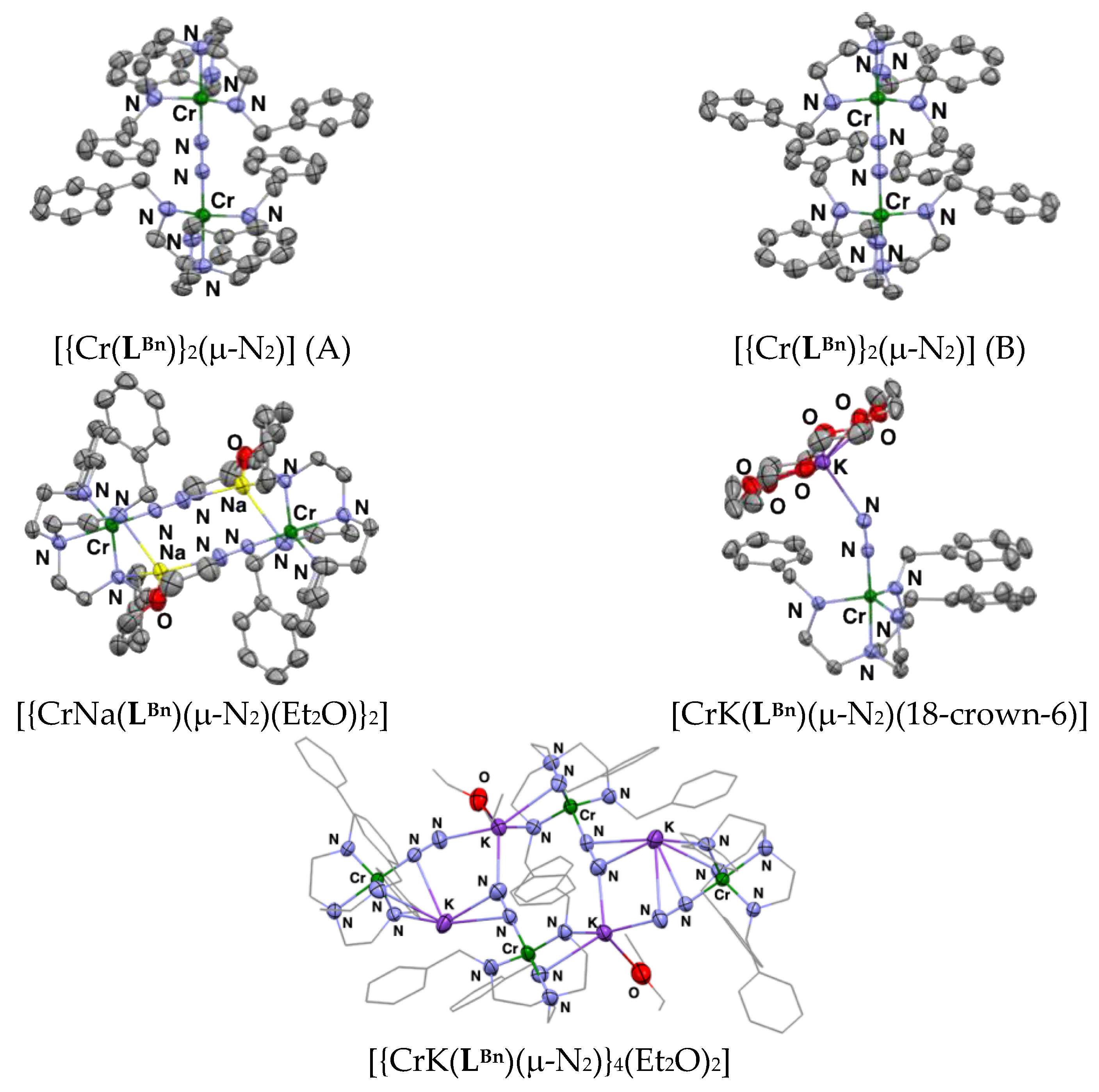
| complex | Cr–NN2/Å | N–N/Å | n(N–N)/cm-1 | 15N NMR/ppm | ref. |
|
1 {Cr(LPen)}2(m–N2)] |
1.8468(15) | 1.185(3) | 1715 | – a) | this work |
|
2 [{CrK(LPen)(m–N2)(Et2O)}2] |
1.762(8) | 1.174(9) | 1787 1743 |
–1.9 –32 |
this work |
|
5(THF) [CrK(LCy)(m–N2)(18-crown-6)(THF)] |
1.762(3) | 1.162(3) | 1824 1757 |
8.8 –27.5 |
this work |
| [{Cr(LBn)}2(m–N2)] | 1.804(4) 1.805(2) |
1.188(4) 1.185(7) |
1772 | – a) | 71 |
| [{CrNa(LBn)(m–N2)(Et2O)}2] | 1.755(3) | 1.1624(19) | 1813 | – a) | 71 |
| [{CrK(LBn)(m–N2)}4(Et2O)2] | 1.757(4) 1.751(4) 1.752(4) 1.758(4) |
1.169(4) 1.182(4) 1.177(5) 1.166(4) |
1804 1774 |
1.79 –71.26 |
71 |
| [CrK(LBn)(m–N2)(18-crown-6)] | 1.7678(15) | 1.167(2) | 1807 | 4.79 –25.22 |
71 |
| complex | Yield (%) [b, c] | ref. | |
| NH3 | N2H4 | ||
| 1 | 1.1 | 12.1 | this work |
| 2 | 1.5 | 11.1 | this work |
| 3 | 0.4 | 8.8 | this work |
| 4 | 0.3 | 22.8 | this work |
| 5(THF) | 0.7 | 44.8 | this work |
| 6 | 1.3 | 6.4 | this work |
| [Cr2(LBn)2(N2)] | 19.3 | 15.4 | 71 |
| [{CrK(LBn)(N2)}4(Et2O)2] | 26.7 | 15.2 | 71 |
| [CrK(LBn)(N2)(18-crown-6)] | 29.0 | 12.8 | 71 |
Disclaimer/Publisher’s Note: The statements, opinions and data contained in all publications are solely those of the individual author(s) and contributor(s) and not of MDPI and/or the editor(s). MDPI and/or the editor(s) disclaim responsibility for any injury to people or property resulting from any ideas, methods, instructions or products referred to in the content. |
© 2025 by the authors. Licensee MDPI, Basel, Switzerland. This article is an open access article distributed under the terms and conditions of the Creative Commons Attribution (CC BY) license (http://creativecommons.org/licenses/by/4.0/).