Preprint
Article

This version is not peer-reviewed.

Synergistic Role of ZrO2 Promoter and Ni–NiO– ZrO2 Networks in Improving Ni Catalysts for Dry Methane Reforming at Low Temperature

Submitted:

15 December 2025

Posted:

17 December 2025

You are already at the latest version

Abstract

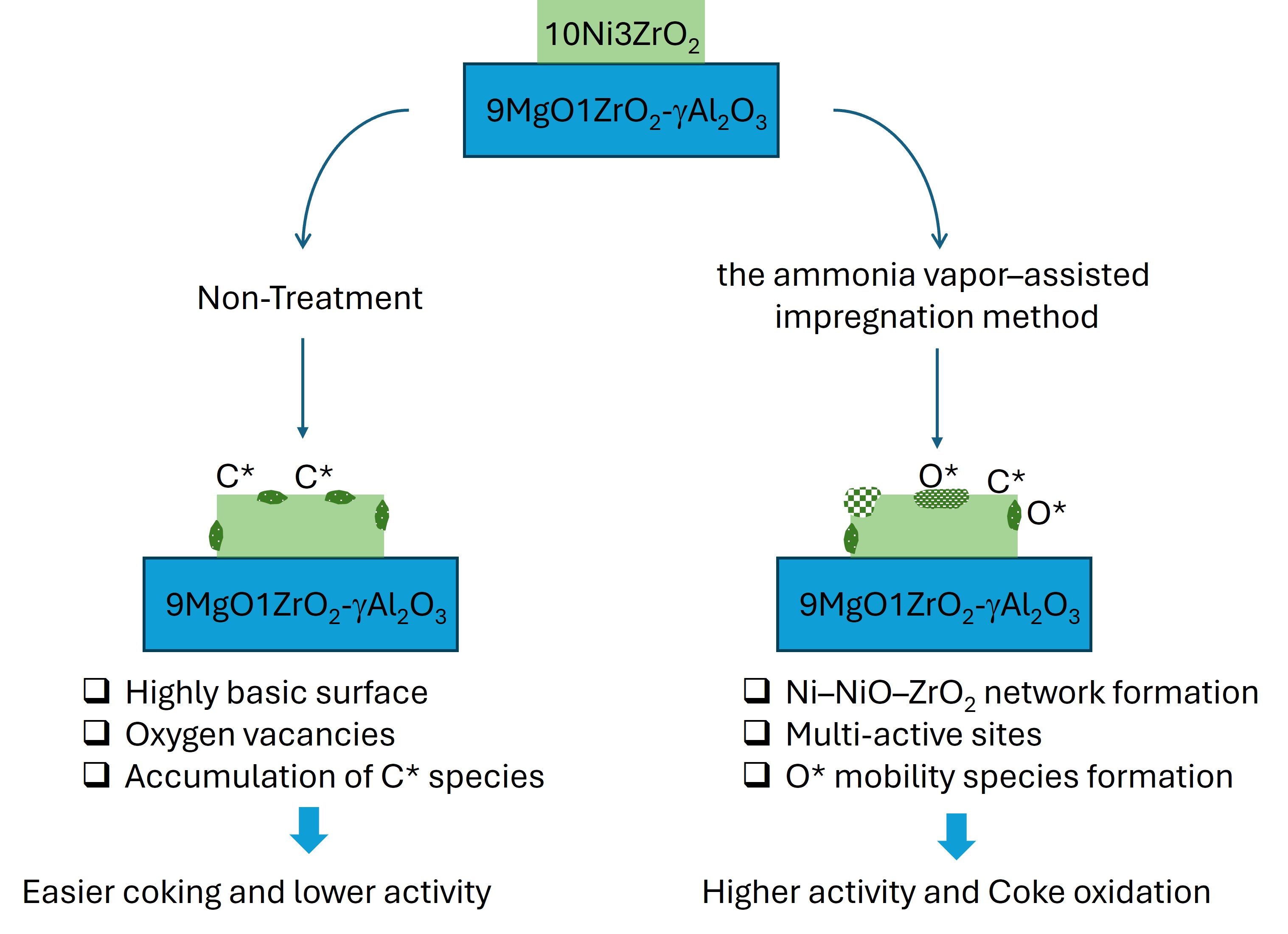
This study investigates the development of Ni-based catalysts for low-temperature dry methane reforming (DMR) at 550 °C. The catalysts were prepared by dispersing Ni on γ-Al2O3 modified with 9 wt% MgO and 1 wt% ZrO2, while 10 wt% Ni–x wt% ZrO2 promoters (0, 1, and 3 wt%) were introduced using the incipient wetness impregnation method. A Ni–NiO–ZrO2 surface network was generated on the 10 wt% Ni–3 wt% ZrO2 catalyst via an ammonia vapor–assisted impregnation route. The ZrO2 promoter strengthened the metal–support interaction, which increased the total amount of reducible Ni while shifting the reduction to higher temperatures. This modification also promoted CO2 activation relative to CH4, thereby enhancing the RWGS pathway and lowering the H2/CO ratio. In contrast, the Ni–NiO–ZrO2 network formed through the ammonia-assisted method increased the concentration of surface-accessible Ni, reduced excessive coverage by ZrO2, and significantly improved oxygen mobility. These features facilitated continuous oxygen transfer, enhanced coke oxidation, and ensured a more balanced activation of both reactants. Overall, the combined structural and functional synergies achieved through promoter optimization and the ammonia vapor–assisted preparation method resulted in superior catalytic activity and selectivity for DMR at 550 °C.
Keywords: 
;  ;  ;  ;  

1. Introduction

Net zero emissions in energy production is defined as a process wherein the cumulative greenhouse gas (GHG) emissions across both the production and utilization stages of energy or derived products are effectively neutralized [1]. Within this conceptual framework, the dry methane reforming (DMR) process exemplifies an approach that aligns with the net-zero paradigm [2,3,4]. The overall DMR reaction consumes two of the most prevalent atmospheric greenhouse gases (methane (CH4) and carbon dioxide (CO2)) to yield synthesis gas (syngas), composed primarily of hydrogen (H2) and carbon monoxide (CO) (Equation 1). Hydrogen, as a product, may be directly employed as a clean energy carrier, while syngas serves as a valuable intermediate for the synthesis of sulfur-free and nitrogen-free hydrocarbons or other chemical products [5,6]. Consequently, when assessed on a system-wide basis, DMR does not result in a net increase in atmospheric GHG concentrations.
Typically, the dry methane reforming (DMR) process relies on efficient catalysts to moderate the severe reaction conditions; however, it still operates at temperatures of 650–800 °C under atmospheric or higher pressures [7,8]. Among various catalytic systems, nickel-supported catalysts are the most widely employed owing to their favorable balance of activity, stability, and cost-effectiveness, in which metallic Ni particles are primarily dispersed on suitable supports to facilitate the reforming reactions [2,5]. Nonetheless, high operating temperatures promote Ni particle sintering, which along with side reactions like the Boudouard reaction (Equation 2) and methane decomposition (Equation 3), leads to carbon deposition that remains unoxidized on the catalyst surface [7,9,10,11]. Additionally, the reverse water–gas shift (RWGS) side reaction may occur as CO2 is a reactant and water may form via reduction by hydrogen (Equation 4), the H2/CO ratio in the syngas product is consequently diminished [12,13].
CH4 + CO2 → 2CO + 2H2              ΔH°298K = + 248 kJ.mol−1
2CO → CO2 + C                              △°298 K = + 173 kJ.mol−1
CH4 → 2H2 + C                               △H°298 K = + 75 kJ.mol−1                   
CO2 + H2 → CO + H2O                  ΔH°298 K= + 41 kJ.mol−1
The key to mitigating these three issues lies in the rational design of Ni-based catalysts with synergistic physicochemical properties, including inside interactions that may be reinforced by the formation of structural networks, which facilitate efficient adsorption and dissociation of CH4 and CO2, as well as the transfer of their intermediates to drive the desired DMR pathway [14,15,16,17]. Furthermore, catalytic performance is significantly enhanced when the support promotes water dissociation and provides active oxygen species, thereby suppressing carbon accumulation and Ni sintering [10,18]
Based on these properties, several studies have developed Ni catalysts with high dispersion and strong interaction with high–surface area supports such as γ-Al2O3. Although such systems demonstrated improved resistance against sintering, the role of support extends beyond mere metal dispersion. Specifically, the acidic nature of Al2O3 facilitates CH4 activation but does not sufficiently promote CO2 adsorption, thereby leading to carbon deposition. To address this limitation, mixed metal oxide supports such as MgAl2O4, Mg2ZrxAl1−x, and CeO2–Al2O3 have been introduced, which enhance basicity and surface oxidation capacity [19,20,21,22,23]. However, their preparation is often complex and typically yields limited quantities. More recently, a surface modification strategy for commercially available γ-Al2O3 has been proposed, whereby incorporation of 9 wt% MgO and 1 wt% ZrO2 provides the optimal oxygen mobility. This modification significantly reduces both the quantity and severity of carbon deposition, producing carbon species that are more easily removed, owing to the enhanced carbon oxidation capability of the supported Ni catalyst surface. Moreover, this approach allows for large-scale improvement of γ-Al2O3 while remaining cost-effective, thereby offering a practical pathway for catalyst development [24].
Promoters are often incorporated into Ni-based catalysts to improve their activity and stability in DMR. Oxides of alkali and alkaline earth metals such as K Mg or Ca increase catalyst basicity, thereby enhancing CO2 adsorption and facilitating the conversion of carbon species formed from CH4 decomposition into CO [25,26,27]. Meanwhile, CeO2 and ZrO2 act as redox promoters, providing high oxygen storage and transfer capacities that suppress carbon deposition by promoting oxygen mobility across the catalyst surface [28,29,30]. In addition, hierarchical surface modification can be achieved by forming layered hydroxides (LH) or layered double hydroxides (LDH) through the ammonia vapor diffusion impregnation method. These sheet-like layers create interconnected structures that enhance oxygen transfer between active metals and their oxides. Furthermore, the LH/LDH-derived structures exhibit a memory effect, enabling hydroxide regeneration and promoting the formation of hydroxide intermediates, thereby preventing the condensation of surface intermediates into water [31,32,33].
This study reports the development of Ni-based catalysts supported on γ-Al2O3 modified with 9 wt% MgO–1 wt% ZrO2 (9M1ZA) for low-temperature DMR at 550 °C. Beyond enhancing the basicity and oxygen mobility of the support [24], additional interactions at the active phase–support interface were introduced through the incorporation of ZrO2 promoters. ZrO2 was incorporated either as dispersed species within the Ni phase via incipient wetness impregnation or as a Ni–NiO– ZrO2 surface morphology formed through an ammonia vapor–assisted impregnation route. Catalysts containing 10 wt% Ni with varying ZrO2 loadings (0, 1, and 3 wt%) were synthesized by incipient wetness impregnation, denoted as 10N/9M1ZA, 10N1Z/9M1ZA, and 10N3Z/9M1ZA, respectively. An additional catalyst prepared using ammonia vapor diffusion, containing 10 wt% Ni and 3 wt% ZrO2, was denoted as 10N3Z(T)/9M1ZA. The catalysts were comprehensively characterized by FESEM, TPR, O₂-TPD, and XPS, and their catalytic performance was assessed. Coke deposition on selected spent catalysts was characterized by TPO. The results reveal that both ZrO2 incorporation and synthesis methodology profoundly influence interfacial interactions, surface basicity, and oxygen mobility. These insights provide a foundation for the rational design of efficient DMR catalysts that support CO2 utilization and advance net-zero emission strategies.

2. Results and Discussion

2.1. Catalyst Characterization

The surface morphology of the catalysts was examined by FESEM, as presented in Figure 1. Calcined catalysts prepared via conventional impregnation (Figure 1(a)–(c)) exhibited dispersed particles with relatively isolated distribution and limited connectivity, whereas ZrO2-promoted samples displayed finer particles than the unpromoted catalyst, suggesting improved dispersion of the active species. In contrast, the catalyst synthesized through the ammonia-assisted impregnation method (Figure 1(d)) exhibited a rough and interconnected surface morphology within the active phase layer, which is indicative of the formation of a NiO–ZrO2 network during preparation [31,34,35].
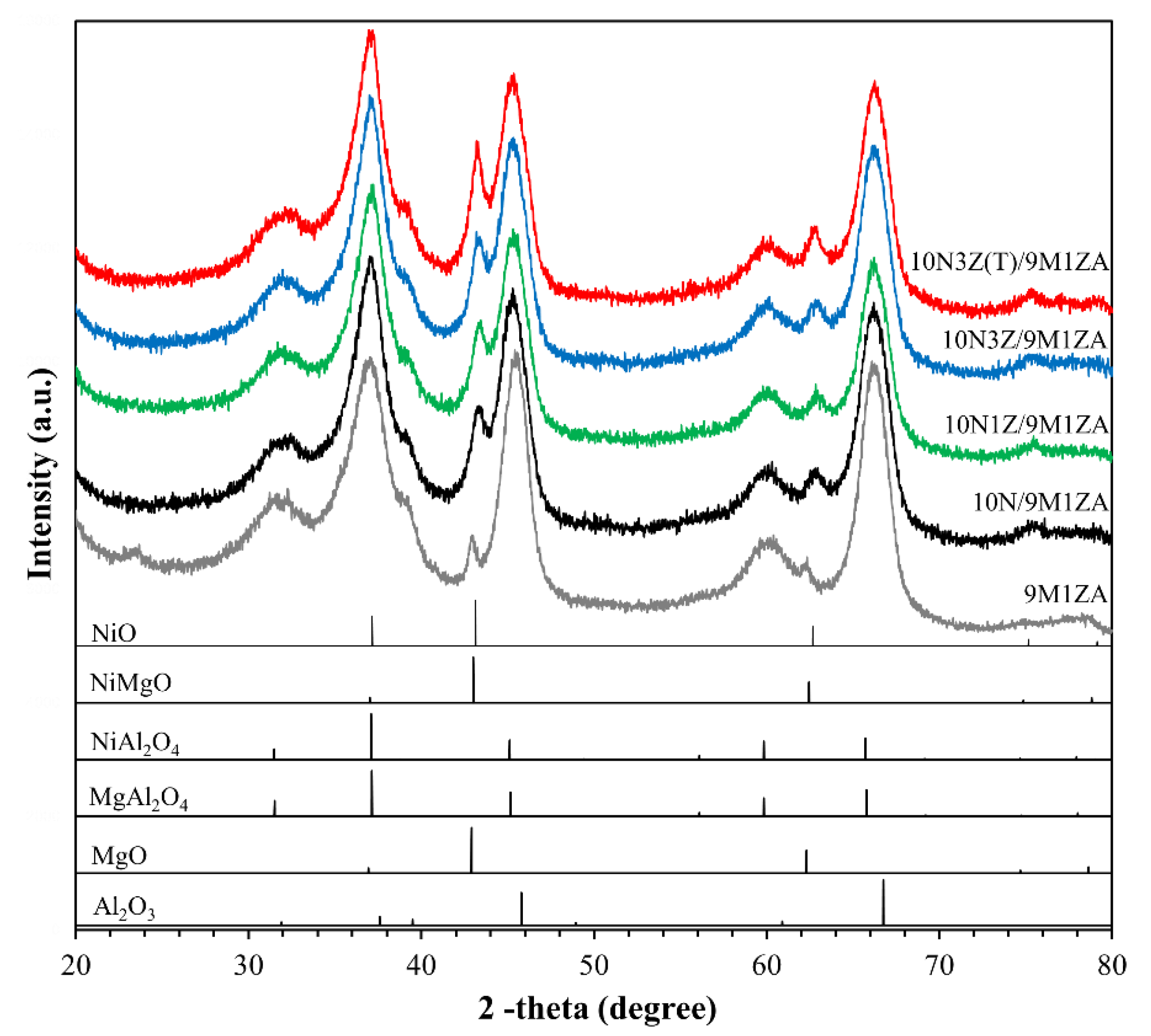
Crystalline phases of modified Al2O3 support and catalysts were investigated through the XRD patterns (Figure 2). The diffraction patterns of all samples exhibit the γ-Al2O3 phase, with peaks observed at 2-theta of 31.9°, 37.6°, 39.5°, 45.8°, 60.9°, and 66.8° (JCPDS No. 00-010-0425) [35,36], and MgO at 2-theta of 43° and 62.3° (JCPDS No. 01-075-0447) [37]. The peak patterns of the NiO phase at 2-theta of 37°, 43°, and 62.5° (JCPDS No. 01-078-4374) [38] are observed in all diffractogram of catalyst samples.
The diffraction peaks observed at 2-theta of 31°, 37°, 45.7°, 59°, and 66° can be attributed to the presence of spinel-type phases, specifically NiAl2O4 (JCPDS No. 01-078-695) and MgAl2O4 (JCPDS No. 01-084-0377) [39,40]. These phases are likely formed through the incorporation of Ni2+ or Mg2+ ions into the γ-Al2O3 crystal lattice, indicating the formation of a thermodynamically stable structure via isomorphous substitution within the Al2O3 framework [41,42]. This structural transformation enhances the dispersion of metal species on the catalyst surface. However, no diffraction peaks corresponding to ZrO2 are observed in the support diffractogram due to the low ZrO2 content relative to the overall composition.
The crystalline size of NiO (reporting in Table 1) revealed that ammonia vapor-assisted impregnation produced larger NiO than conventional impregnation. The growth of such larger crystallites is plausibly linked to the formation of network-like on the surface observed in the FESEM results.
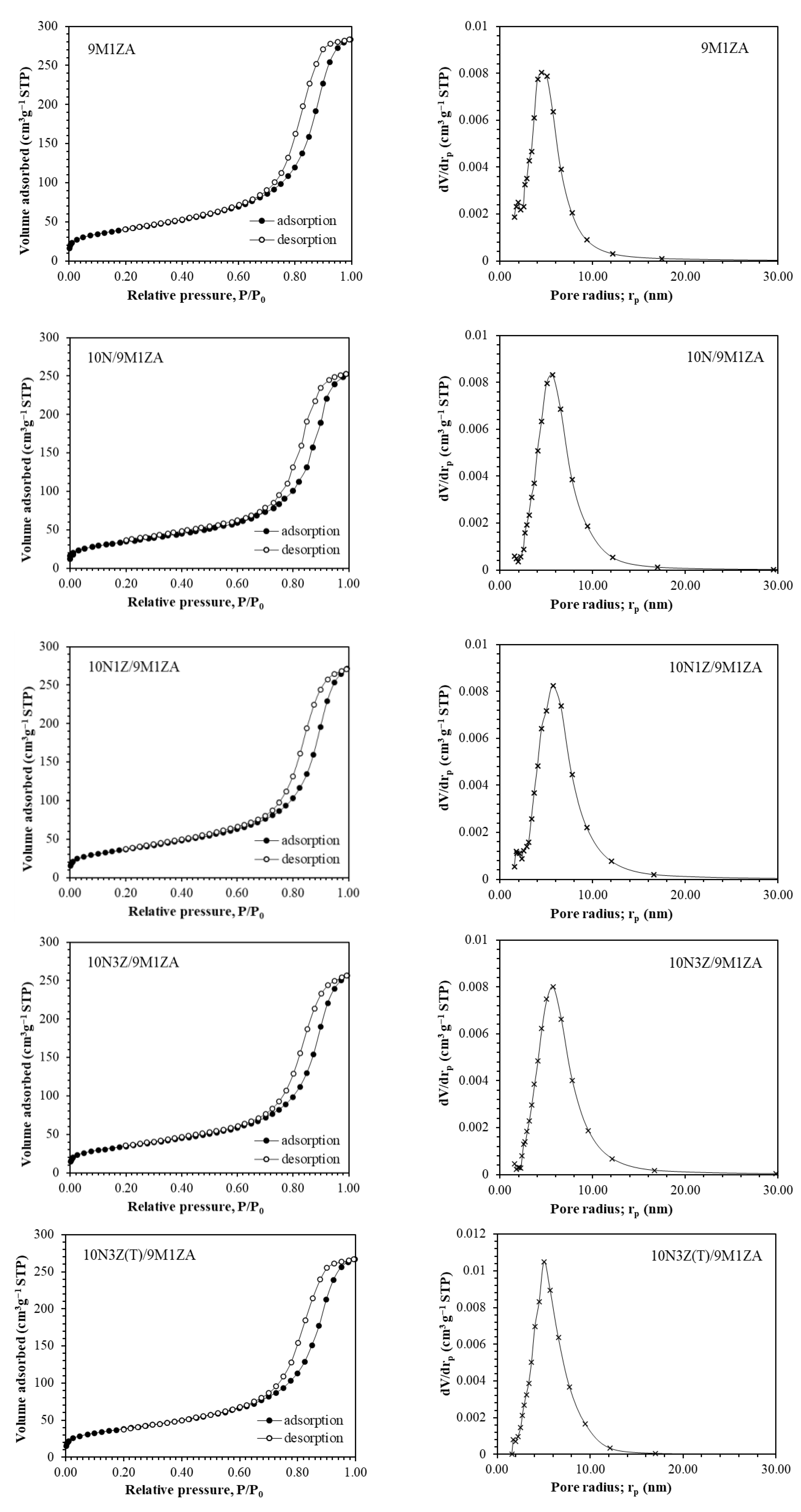
The nitrogen adsorption–desorption isotherms and the pore size distribution curves of the sample surface are shown in Figure 3, while the specific surface area, average pore radius, and pore volume are summarized in Table 1. According to the results, the support and catalysts exhibit type IV isotherms, characteristic of mesoporous materials, with H1-type hysteresis loops associated with uniform and interconnected cylindrical pores [35,43]. Pore size distribution analysis reveals that the support possesses slightly smaller pores than the catalysts. This observation is consistent with the BET analysis, where the support possesses the highest specific surface area (145 m2g−1) and the highest pore volume (0.44 cm3g−1), as well as the almost smallest average pore radius (6.06 nm). Upon incorporation of the active species via the impregnation method, both the surface area and pore volume of the catalyst were reduced, whereas the average pore radius increased compared to the support. This phenomenon can be attributed to a pore blocking effect, wherein the impregnated species partially occlude the smaller pores, thereby limiting access to the internal surface area [24,34,44].
A comparison among the catalysts prepared via incipient wetness impregnation revealed that the catalyst containing 1 wt% ZrO2 exhibited a higher specific surface area and pore volume than both the undoped catalyst and the one containing 3 wt% ZrO2. This observation suggests that the incorporation of 1 wt% ZrO2 enhances the dispersion of NiO [45]. However, further increasing the ZrO2 content to 3 wt% likely induces pore blocking effects, thereby reducing the accessible surface area and pore volume [28]. In contrast, for the catalyst incorporating 3 wt% ZrO2 within the active phase and prepared via the ammonia-assisted impregnation method, the formation of a network-like surface morphology led to an overall increase in surface area.
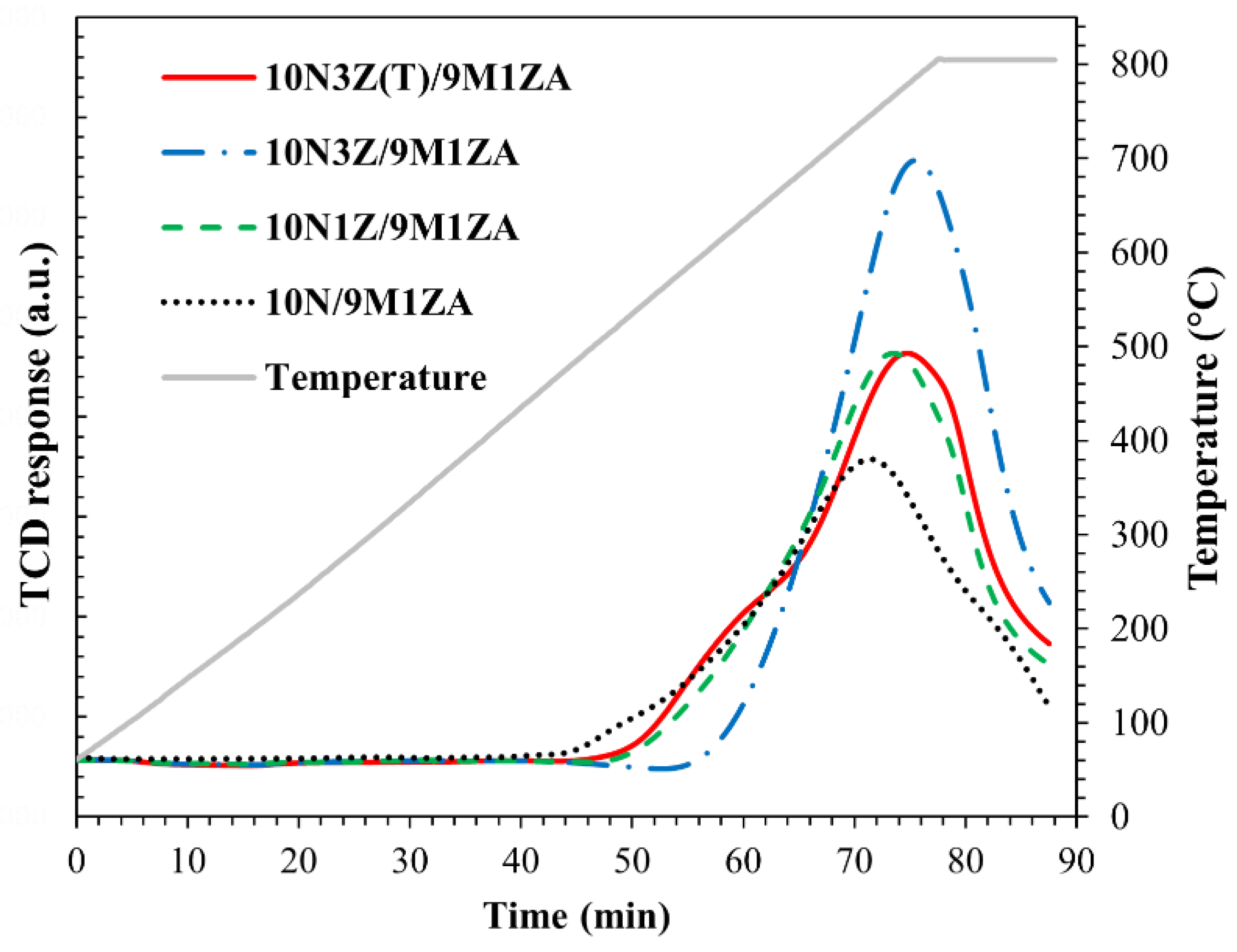
The reducibility influenced by metal–support interactions of the prepared catalysts was evaluated through H2-TPR. As shown in Figure 4, all catalysts exhibited reduction starting above 500 °C, with major peaks centered above 600 °C, characteristic of strong metal–support interactions (SMSI) [46,47,48,49]. Nevertheless, the reducibility varied with ZrO2 content and surface morphology. The undoped catalyst (10N/9M1ZA) showed the easiest reduction, with the peak center appearing at the lowest temperature, indicating relatively weaker metal–support interactions compared to the ZrO2-promoted catalysts.
The incorporation of ZrO2 into the active layer matrix of the catalyst (10N1Z/9M1ZA and 10N3Z/9M1ZA) significantly increased the quantity of reduction. The reduction onset occurred at higher temperatures and proceeded more readily, indicating that the presence of ZrO2 facilitated the reduction of NiO. This enhancement is likely due to the formation of oxygen vacancies within the ZrO2 lattice, which promotes hydrogen spillover and increases the mobility of lattice oxygen, resulting in the presence of more active sites [50,51]. When comparing the two ZrO2-doped samples prepared by incipient wetness impregnation, the catalyst with 1 wt% ZrO2 showed lower reduction temperature, implying weaker metal–support interactions [28,52]. On the other hand, the 3 wt% ZrO2 sample exhibited a higher overall hydrogen uptake and more uniform reduction profile, reflecting stronger and more homogeneous metal–support interaction. This behavior can be attributed to the increased generation of oxygen vacancies and the incorporation of ZrO₂ into the active phase, coupled with its intimate interaction with the MgO-ZrO2-modified support surface [53,54]. Such structural evolution is expected to strengthen metal–support interactions and may affect catalytic performance.
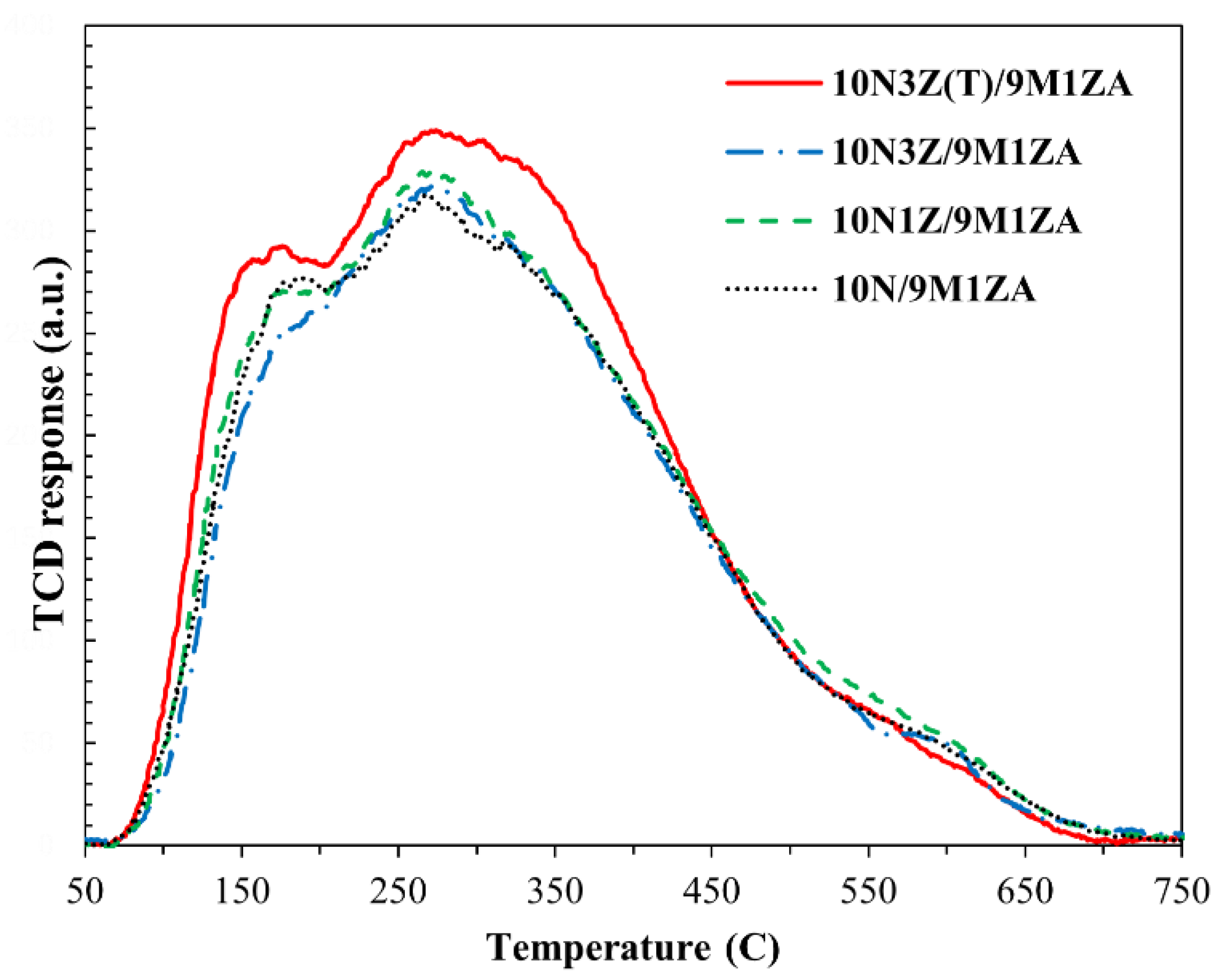
A comparative H2-TPR analysis between 10N3Z(T)/9M1ZA and 10N3Z/9M1ZA reveals that the ammonia vapor-assisted impregnation (10N3Z(T)/9M1ZA) induced an LDH intermediate prior to calcination, which enhanced active-site integration [55,56]. The TPR profile of 10N3Z(T)/9M1ZA shows two resolved peaks at 620 °C and 777 °C, compared with a single peak centered at 782 °C for 10N3Z/9M1ZA. The O2-TPD profile (Figure 5) of 10N3Z(T)/9M1ZA suggests that the active sites generated on 10N3Z(T)/9M1ZA enhance oxygen mobility in the surface region, likely arising from improved connectivity within the active layer [24,57,58]. These changes are evidenced by the shift in the temperatures of reduction and the increase in oxygen desorption relative to 10N3Z/9M1ZA, underscoring the crucial role of precursor chemistry and atmosphere in governing reducibility (interaction strength) and oxygen mobility.
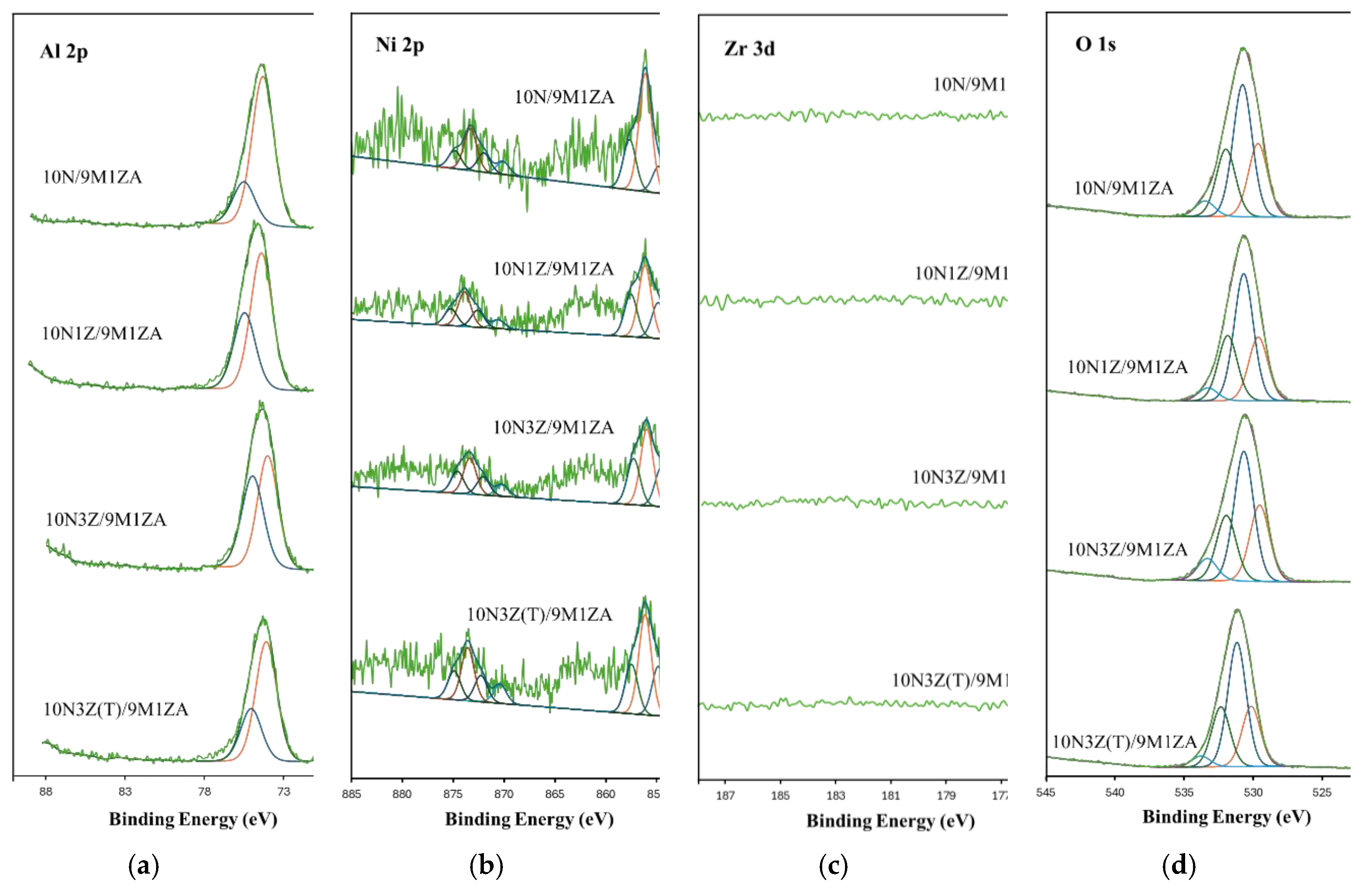
X-ray photoelectron spectroscopy (XPS) was employed to investigate the surface chemical states of the reduced catalysts with varying ZrO2 contents. The mass concentrations of the constituent elements (Mg, Ni, O and Al) on the catalyst surfaces are summarized in Table 2. The core-level spectra of Al 2p, Ni 2p, Zr 3d and O 1s were deconvoluted and analyzed for all catalysts as shown in Figure 6.
The unpromoted catalyst, 10N/9M1ZA, exhibited a surface nickel concentration of 7.89%. Upon introducing 1 wt% ZrO2 as a promoter, the surface Ni content of 10N1Z/9M1ZA decreased to 6.54%, and it further declined to 5.25% for 10N3Z/9M1ZA with 3 wt% ZrO2 loading. This inverse correlation between promoter loading and surface Ni concentration suggests that the zirconia species are deposited in close proximity to, or partially covering, the nickel oxide particles. This phenomenon, often referred to as decoration or shielding, is typical in promoted catalyst systems and can affect the accessibility of active sites [59,60].
Concurrently, the surface concentration of oxygen increased from 49.52% to 52.05%, which is consistent with the addition of another oxide component (ZrO2) to the system. The aluminum concentration remained relatively stable, indicating that the bulk support was not significantly masked [61].
In contrast, the 10N3Z(T)/9M1ZA catalyst prepared using ammonia vapor exhibits a markedly higher surface nickel concentration of 6.85% and a lower surface oxygen concentration of 49.86%, representing more than a 30% increase in exposed nickel relative to the conventional catalyst. This enhancement originated from the formation of LDH complexes during impregnation, which alters the precipitation into impregnation pathway. Upon calcination, a larger amount of nickel oxide remains exposed, forming a more integrated Ni-NiO-ZrO2 network derived from LDH growth. This structure not only facilitates more efficient oxygen transfer but is also less susceptible to coverage by the zirconia promoter, resulting in a catalyst that can be reduced at a lower temperature.

2.2. Catalytic Performance in the DMR Reaction

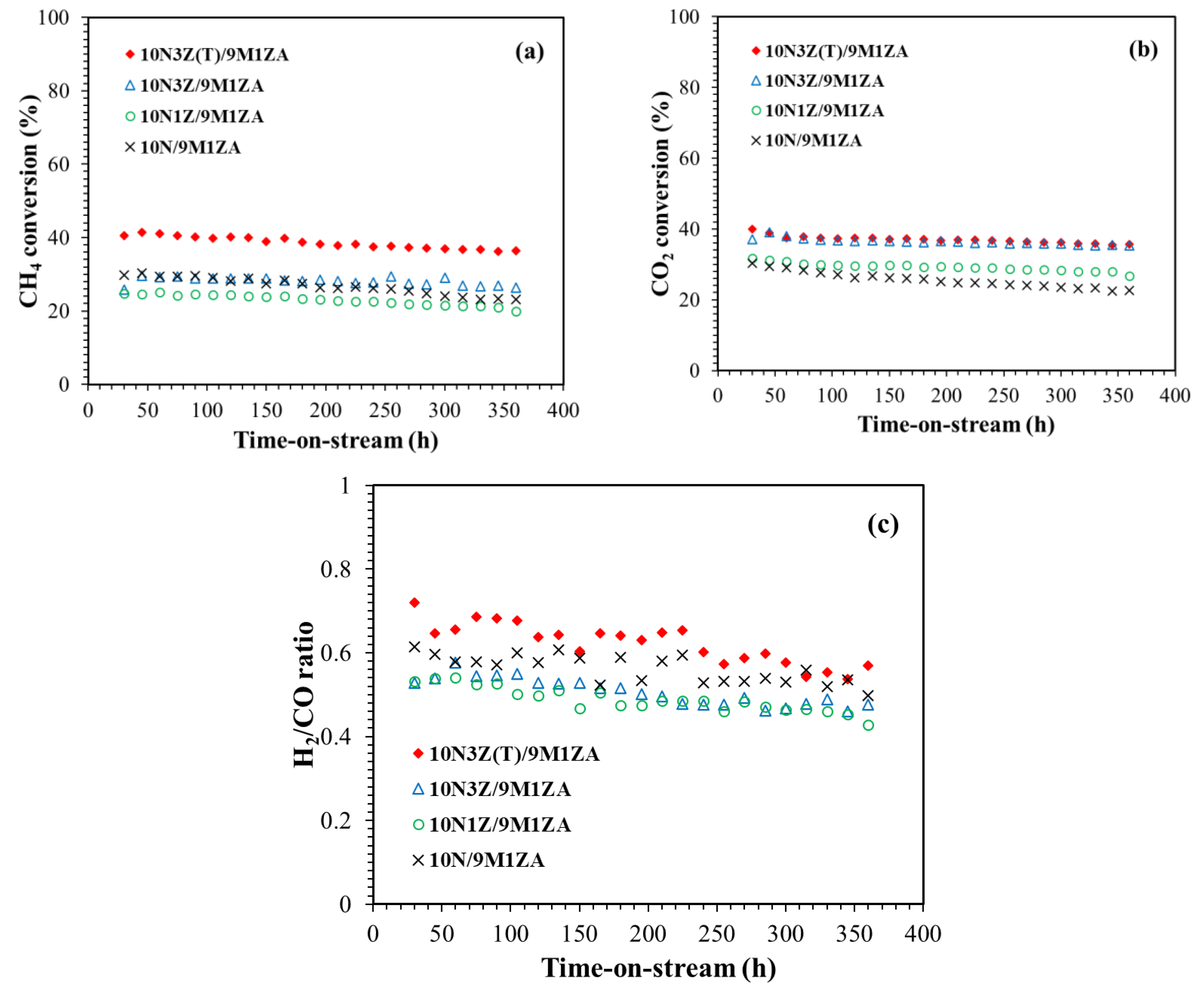
The catalytic performance of the prepared catalysts in the dry reforming of methane (CH4: CO2: N2 = 1:1:1, 550 °C, 360 min) was evaluated in terms of CH4 conversion, CO2 conversion, and H2/CO ratio (Figure 7(a)–(c)). Ni on modified alumina (10N/9M1ZA) achieved average CH4 and CO2 conversions of 27% and 26%, respectively (CH4 conversion/CO2 conversion ~ 1.0) with an H2/CO ratio of 0.56. Addition of 1% ZrO2 promoter into the active phase decreased CH4 conversion to 23% but increased CO2 conversion to 30% (CH4 conversion/CO2 conversion ~ 0.77; H2/CO ratio = 0.49). With 3% ZrO2 promoter, CH4 conversion rose to 28% and CO2 conversion to 37% (CH4 conversion/CO2 conversion ~ 0.76; H2/CO ratio = 0.51).
The Ni/modified alumina catalyst exhibited a CH4-to-CO2 activity ratio and H2/CO ratio closer to theoretical values than ZrO2-promoted catalysts. This behavior is attributed to the basic surface of Ni and CO2 active of the modified alumina support, which enables comparable activation of CH4 and CO2. ZrO2 promotion increased oxygen vacancy content but cover Ni active site area, favoring CO2 activation and the reverse water–gas shift (RWGS) reaction, thereby lowering H2/CO. At higher ZrO2 loading (3%), improved the number of reducible active sites from both Ni and oxygen vacancies enhanced overall activity but the surface coverage still affects. When the 3% ZrO2-promoted catalyst was prepared via ammonia vapor-assisted impregnation, a Ni–NiO–ZrO2 network layer formed on the surface. This catalyst achieved CH4 and CO2 conversions of 39% and 37%, respectively (CH4 conversion/CO2 conversion ~1; H2/CO ratio of 0.62), indicating a stronger driving of the reaction toward the DRM pathway. The enhanced performance is attributed to improved oxygen mobility facilitated by better delocalized electron distribution resulting from the redox property within the network associated with the deduction of the surface coverage of ZrO2. In this structure, nickel oxide sites serve as active centers for oxygen-containing reactants, while metallic Ni provides active sites for CH4 activation. Efficient transfer of oxygen intermediates to CHx species facilitates the DMR mechanism, resulting in simultaneous gains in activity and selectivity When the 3% ZrO2-promoted catalyst was prepared via incipient wetness impregnation under a basic vapor atmosphere, a hierarchical Ni–NiO–ZrO2 network layer formed on the surface.

2.3. Carbon Deposits on Spent Catalysts

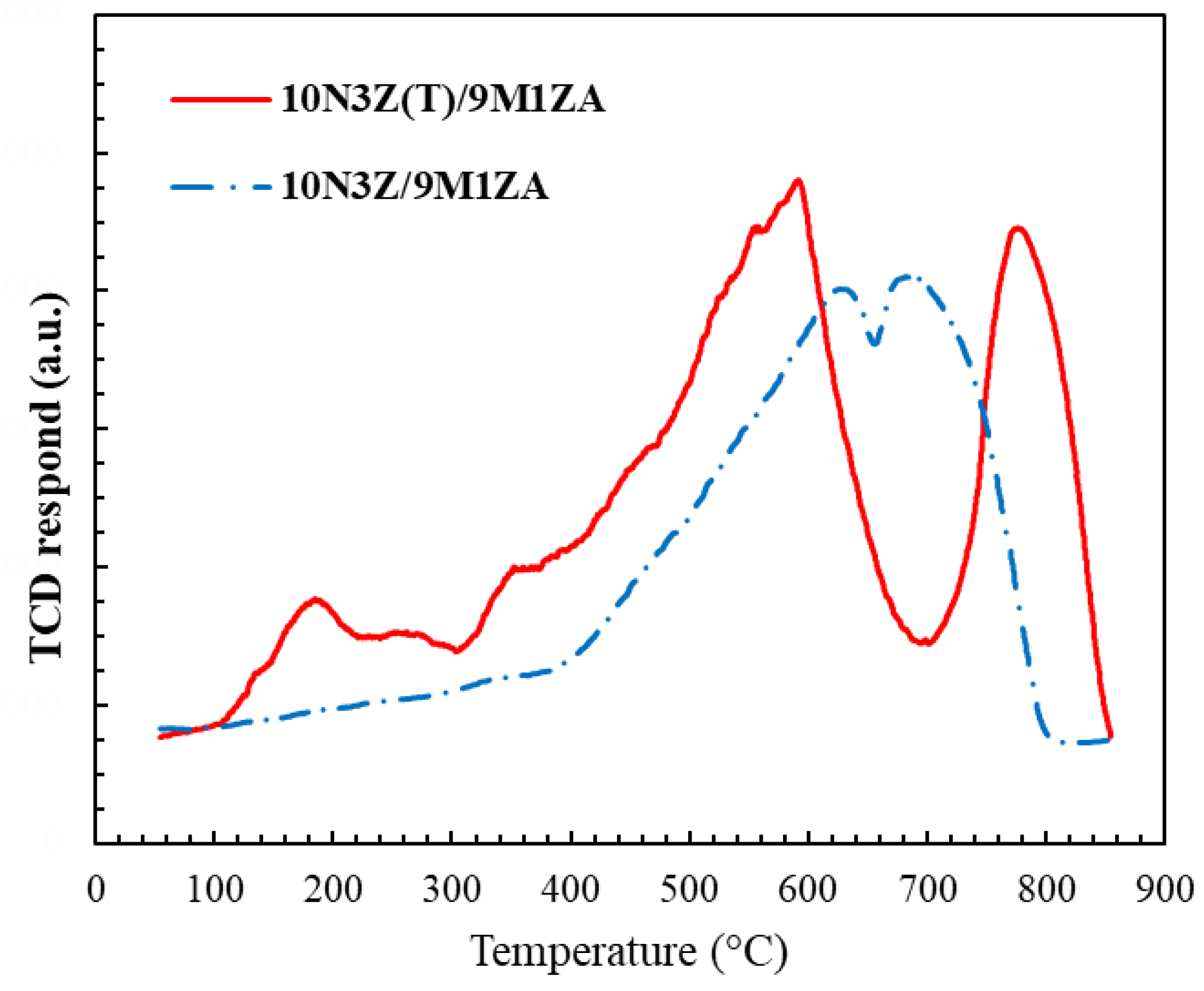
The spent catalysts 10N3Z/9M1ZA and 10N3Z(T)/9M1ZA after 360 min of DMR reaction were analyzed for the types and quantities of carbon deposits using TPO. The TPO profiles (Figure 8), together with the amount of oxygen consumed during oxidation expressed as the percentage of carbon deposits relative to the carbon fed from the reactants (Table 3), indicate that although both catalysts possess identical compositions, the distinct surface structures resulting from different synthesis routes significantly affect both the nature and amount of carbon formed. The carbon deposits observed on 10N3Z/9M1ZA are primarily composed of species ranging from medium-to-hard to oxidize, which results in a broad, continuous signal spanning 400–800 °C. This thermal profile suggests a dense, uniform accumulation of carbon on the nickel surfaces, a morphology consistent with the relatively uniform surface species and interactions generated by the incipient wetness impregnation method used in its preparation.
In contrast, 10N3Z(T)/9M1ZA, which was synthesized using the ammonia vapor–assisted impregnation method to create a distinct Ni–NiO–ZrO₂ interfacial network, displays a diverse range of carbon deposits. This variety is evident in the clearly separated oxidation peaks corresponding to different species including easy-to-oxidize (120–300 °C, amorphous carbon), medium-to-oxidize (300–700 °C, graphitic carbon) and hard-to-oxidize (700–850 °C, filamentous carbon) [24,31]. This behavior suggests that the network structure significantly increases the diversity of active sites available for reaction. This diverse environment enhances the efficiency of oxygen transfer to intermediate carbon species, which in turn favors the formation of easily oxidized, amorphous carbon. Furthermore, the peak oxidation temperatures for both the easy- and medium-oxidized carbon species found in 10N3Z(T)/9M1ZA are notably lower than those observed for the 10N3Z/9M1ZA catalyst, indicating that the new network facilitates easier removal of most deposits. Despite this overall improvement in coke manageability, 10N3Z(T)/9M1ZA exhibits a 1.4-fold higher rate of methane activation. This increased reactivity means that carbon accumulation still occurs to some extent, resulting in the formation of some persistent, hard-to-oxidize carbon species, likely due to the sheer volume of material being processed more quickly.

3. Materials and Methods

3.1. Catalyst Preparation

The catalytic synthesis utilizes various chemicals, including deionized water, gamma aluminum oxide (γ-Al2O3, 98% Sigma-Aldrich), magnesium nitrate hexahydrate (Mg(NO3)2·6H2O, 98%, Sigma-Aldrich), zirconyl nitrate (ZrO(NO3)2·H2O, 98%, Acros Organics), nickel (II) nitrate hexahydrate (Ni(NO3)2·6H2O, 98%, Acros OrganicsTM).
The modified alumina support with 9 wt.% MgO and 1 wt.% ZrO2 (denoted as 9M1ZA) was prepared using the incipient wetness impregnation method similarly to our previous study [24]. Nickel-based catalysts with The 10 wt% Ni —with varying Ni:ZrO2 weight ratios (10:0, 10:1, and 10:3) were synthesized by impregnating Ni(NO₃)₂·6H₂O and Zr(NO3)2·xH2O mixed solution onto the prepared support before powder samples were dried at 60 °C overnight and calcined at 650 °C for 5 h. Finally, each sample was pelletized and collected for the particle between 355-710 micrometer range (denoted as 10N/9M1ZA, 10N1Z/9M1ZA, and 10N3Z/9M1ZA, respectively). The catalyst comprising 3 wt% ZrO2 as a promoter within the active phase was synthesized via an ammonia vapor-assisted impregnation method. The impregnated powder was placed in a sealed vessel containing an aqueous NH4OH solution and maintained under these conditions for 20 hours, thereby facilitating the formation of a layered double hydroxide (LDH) intermediate [31,32]. Subsequently, the material was subjected to drying and calcination to yield the corresponding oxide phase, following the thermal treatment protocol previously described.

3.2. Catalyst Characterization

Field emission scanning electron microscopy (FESEM) with a JEOL JSM-7600F microscope (JEOL Ltd., Welwyn Garden City, UK), operated at 5.00 kV, was used to examine the morphologies of the catalyst samples. Each sample was sputter-coated with a thin layer of platinum (Pt) using a JEOL JFC-1600 coater (JEOL Ltd., Welwyn Garden City, UK) prior to imaging.
X-ray Diffraction (XRD) was applied to determine crystallinity and phase composition for fresh and spent catalysts through non-destructive diffraction analysis on the Bruker AXS Model D8 Discover using Cu-Kα radiation at 40 kV and 40 mA scanning from 20-80° with the rate of 0.02° min−1. The average NiO crystallite size (d) was determined from the full width at half maximum (FWHM) of the most intense NiO diffraction peak at 2-theta about 43°, using the Debye–Scherrer equation (Equation 5), where K is the shape factor (0.94), λ is the X-ray wavelength (0.15406 nm), β is the line broadening in radians, and θ is the Bragg angle [34,62].
d = K λ β cos θ
The N2 physisorption measurement at constant temperature of -196 °C was conducted on a BET surface area analyzer (BELSORP-mini, Microtrac BEL Corp., Japan) to investigate the textural properties of fresh catalysts. Each sample surface was degassed in a vacuum at 350 °C for 4 h before. Then, the equilibrium adsorption-desorption isotherms were obtained at varying pressures ranging from 0.01 to 1.0 P/P₀ (relative pressure). Multipoint Brunauer–Emmett–Teller (BET) analysis was employed to calculate the specific surface area, pore volume, and average pore diameter, whereas the pore size distribution was evaluated using the Barrett–Joyner–Halenda (BJH) method.
Temperature-programmed reduction of H2 (H2-TPR) was conducted on a BELCAT-basic system (BEL JAPAN, INC., Osaka, Japan) equipped with thermal conductivity detector (TCD). This technique examines reducibility and elucidates the interaction between metal and support of fresh catalysts. Prior to the H2-TPR analysis, each catalyst sample was pretreated in an argon (Ar) flow at 200 °C for 1 hour, then cooled to 50 °C. The TPR measurement was subsequently carried out under a 5 vol% H2/Ar mixture, with the temperature ramped up to 800 °C at a rate of 10 °C/min, followed by holding at this temperature for 0.5 hour.
Temperature-programmed desorption of O2 (O2-TPD), employing the same apparatus as for the H2-TPR measurements, was conducted to investigate the oxygen mobility in fresh catalysts, which is related to the presence of oxygen vacancies. Before the measurement, the sample was pre-reduced in at 600 °C for 1.5 hours following by cooling to 200 °C under Ar flow. The isothermal chemisorption of O2 was carried out at 200 °C for 1.0 hour under O2 flow. Non-chemisorbed O2 species on the catalyst surface were purged by an Ar flow at an ambient temperature for 30 minutes. Then, the amount of O2 desorption was monitored in the temperature range from an ambient temperature to 750 °C with the heating rate of 10 °C/min under an Ar flow.
X-ray photoelectron spectroscopy (XPS) was performed using an AXIS Ultra DLD, Kratos Analytical spectrometer, equipped with a monochromatic Al Kα (1486 eV) X-ray source. The system was operated under ultra-high vacuum conditions (pressure < 10⁻⁸ Torr). This technique was employed to investigate the surface elemental composition and oxidation states of the catalysts. High-resolution spectra were collected for Ni 2p, Al 2p, O 1s, and Zr 3d using a pass energy of 20 eV with an energy resolution of 0.1 eV. The binding energy scale was calibrated with the C 1s signal at 284.8 eV. Data analysis was performed using CasaXPS software, with background subtraction using the Shirley method and peak fitting using Gaussian-Lorentzian functions. The atomic compositions were determined based on the peak areas and sensitivity factors of each element.
To investigate species and quantity of carbon deposited on 10N3Z/9M1ZA and 10N3Z(T)/9M1ZA during the reaction, temperature-programmed oxidation (TPO) was performed using the same instrument as for H2-TPR. Prior to the measurement, the spent catalyst was degassed at 200 °C for 1 hour and then cooled to 40 °C under an Ar flow. Subsequently, the sample was oxidized from 40 °C to 850 °C at the heating rate of 10 °C/min in a 5 vol% O2/Ar stream. The amount of oxygen uptake was calculated using equation (6). The percentage of carbon deposition (DC, %) relative to catalyst weight calculated according to equation (7).
N O 2 ( TPO ) = V O 2 24 , 400
% D c = N O 2 ( TPO ) × SF 1 × MW C × 100  
where N O 2 ( TPO )   is oxygen uptake in TPO measurements (mmol gcat−1), V O 2 is the amount of oxygen consumed during in TPO (cm3 gcat−1), SF1 is a stoichiometry factor for O₂ in the oxidation step (C mol:O2 mol in the oxidation = 1), and MWC is an atomic weight of carbon (g mol−1).

3.3. Catalytic Test

The catalytic activity for the DMR reaction was assessed in a tubular fixed-bed reactor containing about 0.30 g of catalyst. Initially, the catalyst sample was subjected to in-situ reduction at 600 °C for 3 hours under a H2 flow to activate the Ni metal phase [24]. During the DMR reaction, the feed gas mixture (comprising CH4, CO2, and N2 in an equal molar ratio) was introduced into the reactor at a total flow rate of 60 mL/min. The reaction was maintained at 550 °C for a duration of 6 hours. The composition of the outlet gas stream was analyzed using an on-line gas chromatograph (Agilent GC7890A, Agilent Technologies, Santa Clara, CA, USA) equipped with a TCD. The performance of the DMR reaction was assessed based on methane conversion (Equation 8), carbon dioxide conversion (Equation 9), and the H2/CO product ratio (Equation 10).
C H 4   conversion   ( % ) = Flow   rate   C H 4 , in - Flow   rate   C H 4 , out Flow   rate   C H 4 , in   × 100
CO 2   conversion   ( % ) = Flow   rate   C O 2 , in - Flow   rate   C O 2 , out Flow   rate   C O 2 , in   × 100  
H 2   CO   ratio = Flow   rate   of   H 2 ,   out Flow   rate   of   C O out

4. Conclusions

This work highlights the synergistic effects of employing a γ-Al2O3 support modified with 9 wt% MgO and 1 wt% ZrO2, together with ZrO2 promotion and the ammonia vapor–assisted impregnation method, for the development of Ni-based catalysts for low-temperature DMR (550 °C). The MgO–ZrO2–modified support provides a highly basic surface and generates a substantial concentration of oxygen vacancies, both of which facilitate CO2 adsorption and activation while mitigating carbon deposition, consistent with previous findings for Ni catalysts operated at 600 °C [24]. The incorporation of 3 wt% ZrO2 as a promoter further strengthens the metal-support interaction. The uniformly dispersed zirconia species enhance the CO2 activation capability of the surface, but may partially cover Ni sites, thereby increasing the contribution of the RWGS pathway.
Importantly, the ammonia vapor–assisted impregnation technique induces the formation of LDH-derived intermediates, which upon calcination evolve into a well-integrated Ni–NiO–ZrO2 surface network. This structural arrangement results in a higher concentration of surface-accessible Ni species and the formation of additional active phases, which enhance the oxygen mobility while reducing excessive masking by the ZrO2 promoter. The resulting catalyst therefore provides improved Ni accessibility and more favorable surface environment for DMR, while concurrently suppressing RWGS side reactions and promoting more efficient coke oxidation.

Author Contributions

Conceptualization, M.P. and T.R.; methodology, M.P., T.R., S.T. S.S. and O.S.; validation, M.P., T.R. and S.T.; formal analysis, M.P., T.R., S.S., and O.S.; investigation, M.P.; resources, M.P.; data curation, M.P. and T.R.; writing—original draft preparation, M.P., T.R. and S.T.; writing—review and editing, M.P. and T.R.; visualization, M.P.; supervision, M.P.; project administration, M.P.; funding acquisition, M.P. All authors have read and agreed to the published version of the manuscript.

Data Availability Statement

Not applicable.

Acknowledgments

This work was supported by King Mongkut’s University of Technology North Bangkok under Research Grant No. KMUTNB-67-KNOW-04, and by the Faculty of Applied Science, King Mongkut’s University of Technology North Bangkok under Grant No. 673186.

Conflicts of Interest

The authors declared no potential conflicts of interest with respect to the research, authorship, and/or publication of this article.

References

  1. Elegbeleye, I.; Oguntona, O.; Elegbeleye, F. Green Hydrogen: Pathway to Net Zero Green House Gas Emission and Global Climate Change Mitigation. Hydrogen (Switzerland) 2025, 6. [Google Scholar] [CrossRef]
  2. Abdulrasheed, A.; Jalil, A.A.; Gambo, Y.; Ibrahim, M.; Hambali, H.U.; Shahul Hamid, M.Y. A Review on Catalyst Development for Dry Reforming of Methane to Syngas: Recent Advances. Renewable and Sustainable Energy Reviews 2019, 108, 175–193. [Google Scholar] [CrossRef]
  3. Fakeeha, A.; Kurdi, A.; Al-Baqmaa, Y.; Ibrahim, A.; Abasaeed, A.; Al-Fatesh, A. Performance Study of Methane Dry Reforming on Ni/ZrO2 Catalyst. Energies (Basel) 2022, 15, 3841. [Google Scholar] [CrossRef]
  4. Zhao, W.; Mei, X.; Zhang, Y.; Zhang, Z.; Chen, K.; Xie, W.; Xin, Y.; Zhang, Z.; Zhang, J. Electrified Dry Reforming of Methane on Ni-La 2 O 3-Loaded Activated Carbon: A Net CO2-Negative Reaction 2025, Vol. 11.
  5. Ranjekar, A.M.; Yadav, G.D. Dry Reforming of Methane for Syngas Production: A Review and Assessment of Catalyst Development and Efficacy. Journal of the Indian Chemical Society 2021, 98, 100002. [Google Scholar] [CrossRef]
  6. Mondal, K.; Sasmal, S.; Badgandi, S.; Chowdhury, D.R.; Nair, V. Dry Reforming of Methane to Syngas: A Potential Alternative Process for Value Added Chemicals—a Techno-Economic Perspective. Environmental Science and Pollution Research 2016, 23, 22267–22273. [Google Scholar] [CrossRef]
  7. Alhassan, A.M.; Hussain, I.; Taialla, O.A.; Awad, M.M.; Tanimu, A.; Alhooshani, K.; Ganiyu, S.A. Advances in Catalytic Dry Reforming of Methane (DRM): Emerging Trends, Current Challenges, and Future Perspectives. J Clean Prod 2023, 423, 138638. [Google Scholar] [CrossRef]
  8. Zhang, M.; Gao, Y.; Mao, Y.; Wang, W.; Sun, J.; Song, Z.; Sun, J.; Zhao, X. Enhanced Dry Reforming of Methane by Microwave-Mediated Confined Catalysis over Ni-La/AC Catalyst. Chemical Engineering Journal 2023, 451, 138616. [Google Scholar] [CrossRef]
  9. Zhong, Y.; Peng, Y.; Gu, H.; Zhang, S.; Wang, F.R.; Xiao, W.; Yu, H.; Gu, D. Enhanced Dry Reforming of Methane over Nickel Catalysts Supported on Zirconia Coated Mesoporous Silica. iScience 2025, 28, 112582. [Google Scholar] [CrossRef]
  10. Ren, Y.; Ma, Y.-Y.; Mo, W.-L.; Guo, J.; Liu, Q.; Fan, X.; Zhang, S.-P. Research Progress of Carbon Deposition on Ni-Based Catalyst for CO2-CH4 Reforming. Catalysts 2023, 13, 647. [Google Scholar] [CrossRef]
  11. Bian, Z.; Das, S.; Wai, M.H.; Hongmanorom, P.; Kawi, S. A Review on Bimetallic Nickel-Based Catalysts for CO2 Reforming of Methane. ChemPhysChem 2017, 18, 3117–3134. [Google Scholar] [CrossRef] [PubMed]
  12. Hussien, A.G.S.; Polychronopoulou, K. A Review on the Different Aspects and Challenges of the Dry Reforming of Methane (DRM) Reaction. Nanomaterials 2022, 12, 3400. [Google Scholar] [CrossRef]
  13. Tsuchida, R.; Kurokawa, H.; Yamamoto, T.; Ogihara, H. Dry Reforming of Methane on Low-Loading Rh Catalysts. ChemCatChem 2025, 17. [Google Scholar] [CrossRef]
  14. Lou, Y.; Xu, J.; Zhang, Y.; Pan, C.; Dong, Y.; Zhu, Y. Metal-Support Interaction for Heterogeneous Catalysis: From Nanoparticles to Single Atoms. Mater Today Nano 2020, 12, 100093. [Google Scholar] [CrossRef]
  15. Li, Y.; Li, Z.; Wang, N.; Zha, Y.; Zheng, K.; Xu, Y.; Liu, B.; Liu, X. Strong Activity-Based Volcano-Type Relationship for Dry Reforming of Methane through Modulating Ni-CeO2 Interaction over Ni/CeO2-SiO2 Catalysts. Chem Catalysis 2025, 5, 101189. [Google Scholar] [CrossRef]
  16. Zhang, J.; Li, Y.; Song, H.; Zhang, L.; Wu, Y.; He, Y.; Ma, L.; Hong, J.; Tayal, A.; Marinkovic, N.; et al. Tuning Metal-Support Interactions in Nickel–Zeolite Catalysts Leads to Enhanced Stability during Dry Reforming of Methane. Nat Commun 2024, 15, 8566. [Google Scholar] [CrossRef]
  17. SUN, K.; JIANG, J.; LIU, Z.; GENG, S.; LIU, Z.; YANG, J.; LI, S. Research Progress on Metal-Support Interactions over Ni-Based Catalysts for CH4-CO2 Reforming Reaction. Journal of Fuel Chemistry and Technology 2025, 53, 434–451. [Google Scholar] [CrossRef]
  18. Xu, J.; Xia, P.; Zhang, Q.; Guo, F.; Xia, Y.; Tian, H. Coke Resistance of Ni-Based Catalysts Enhanced by Cold Plasma Treatment for CH4–CO2 Reforming: Review. Int J Hydrogen Energy 2021, 46, 23174–23189. [Google Scholar] [CrossRef]
  19. Li, Z.; Leng, J.; Yan, H.; Zhang, D.; Ren, D.; Li, F.; Liu, Y.; Chen, X.; Yang, C. Enhanced Activity and Stability for Combined Steam and CO2 Reforming of Methane over NiLa/MgAl2O4 Catalyst. Appl Surf Sci 2023, 638, 158059. [Google Scholar] [CrossRef]
  20. De Coster, V.; Srinath, N.V.; Theofanidis, S.A.; Pirro, L.; Van Alboom, A.; Poelman, H.; Sabbe, M.K.; Marin, G.B.; Galvita, V. V. Looking inside a Ni-Fe/MgAl2O4 Catalyst for Methane Dry Reforming via Mössbauer Spectroscopy and in Situ QXAS. Appl Catal B 2022, 300, 120720. [Google Scholar] [CrossRef]
  21. Yan, T.; Bing, W.; Xu, M.; Li, Y.; Yang, Y.; Cui, G.; Yang, L.; Wei, M. Acid–Base Sites Synergistic Catalysis over Mg–Zr–Al Mixed Metal Oxide toward Synthesis of Diethyl Carbonate†. RSC Adv 2018, 8, 4695–4702. [Google Scholar] [CrossRef] [PubMed]
  22. Marinho, A.L.A.; Toniolo, F.S.; Noronha, F.B.; Epron, F.; Duprez, D.; Bion, N. Highly Active and Stable Ni Dispersed on Mesoporous CeO2-Al2O3 Catalysts for Production of Syngas by Dry Reforming of Methane. Appl Catal B 2021, 281, 119459. [Google Scholar] [CrossRef]
  23. Lin, Y.; Wang, Z.; Tang, L.; Jiang, S.; Guo, Y.; Liu, X. Support Effect in Ni-Based Catalysts for Methane Steam Reforming: Role of MxOy-Al2O3 (M = Ni, Mg, Co) Supports for Enhanced Catalyst Stability. Fuel Processing Technology 2025, 278, 108325. [Google Scholar] [CrossRef]
  24. Tungkamani, S.; Ratana, T.; Jadsadajerm, S.; Sumarasingha, W.; Phongaksorn, M. Enhancement of CO2 Adsorption and Oxygen Transfer Properties on γ-Al2O3 Support through Surface Modification with MgO-ZrO2 for Coke Suppression over Ni Catalyst in CO2 Reforming of Methane. Results in Engineering 2024, 24. [Google Scholar] [CrossRef]
  25. Zeng, Y.X.; Wang, L.; Wu, C.F.; Wang, J.Q.; Shen, B.X.; Tu, X. Low Temperature Reforming of Biogas over K-, Mg- and Ce-Promoted Ni/Al2O3 Catalysts for the Production of Hydrogen Rich Syngas: Understanding the Plasma-Catalytic Synergy. Appl Catal B 2018, 224, 469–478. [Google Scholar] [CrossRef]
  26. Zeng, Y.; Chen, G.; Wang, J.; Zhou, R.; Sun, Y.; Weidenkaff, A.; Shen, B.; Tu, X. Plasma-Catalytic Biogas Reforming for Hydrogen Production over K-Promoted Ni/Al2O3 Catalysts: Effect of K-Loading. Journal of the Energy Institute 2022, 104, 12–21. [Google Scholar] [CrossRef]
  27. Sajjadi, S.M.; Haghighi, M.; Fard, S.G.; Eshghi, J. Various Calcium Loading and Plasma-Treatment Leading to Controlled Surface Segregation of High Coke-Resistant Ca-Promoted NiCo–NiAl2O4 Nanocatalysts Employed in CH4/CO2/O2 Reforming to H2. Int J Hydrogen Energy 2022, 47, 24708–24727. [Google Scholar] [CrossRef]
  28. Sumarasingha, W.; Supasitmongkol, S.; Phongaksorn, M. The Effect of ZrO2 as Different Components of Ni-Based Catalysts for CO2 Reforming of Methane and Combined Steam and CO2 Reforming of Methane on Catalytic Performance with Coke Formation. Catalysts 2021, 11, 984. [Google Scholar] [CrossRef]
  29. Dharmasaroja, N.; Ratana, T.; Tungkamani, S.; Sornchamni, T.; Simakov, D.S.A.; Phongaksorn, M. The Effects of CeO2 and Co Doping on the Properties and the Performance of the Ni/Al2O3-MgO Catalyst for the Combined Steam and CO2 Reforming of Methane Using Ultra-Low Steam to Carbon Ratio. Catalysts 2020, 10, 1450. [Google Scholar] [CrossRef]
  30. Doğan Özcan, M.; Akın, A.N. Sustainable Syngas Production by Oxy-Steam Reforming of Simulated Biogas over NiCe/MgAl Hydrotalcite-Derived Catalysts: Role of Support Preparation Methods on Activity. Sustain Chem Pharm 2023, 35, 101165. [Google Scholar] [CrossRef]
  31. Tungkamani, S.; Intarasiri, S.; Sumarasingha, W.; Ratana, T.; Phongaksorn, M. Enhancement of Ni-NiO-CeO2 Interaction on Ni-CeO2/Al2O3-MgO Catalyst by Ammonia Vapor Diffusion Impregnation for CO2 Reforming of CH4. Molecules 2024, 29. [Google Scholar] [CrossRef]
  32. Dharmasaroja, N.; Ratana, T.; Tungkamani, S.; Sornchamni, T.; Simakov, D.S.A.; Phongaksorn, M. CO2 Reforming of Methane over the Growth of Hierarchical Ni Nanosheets/Al2O3-MgO Synthesized via the Ammonia Vapour Diffusion Impregnation. Canadian Journal of Chemical Engineering 2021, 99, S585–S595. [Google Scholar] [CrossRef]
  33. Kim, K.Y.; Lee, J.H.; Lee, H.; Noh, W.Y.; Kim, E.H.; Ra, E.C.; Kim, S.K.; An, K.; Lee, J.S. Layered Double Hydroxide-Derived Intermetallic Ni3GaC0.25Catalysts for Dry Reforming of Methane. ACS Catal 2021, 11, 11091–11102. [Google Scholar] [CrossRef]
  34. Sumarasingha, W.; Tungkamani, S.; Ratana, T.; Supasitmongkol, S.; Phongaksorn, M. Combined Steam and CO2 Reforming of Methane over the Hierarchical Ni-ZrO2 Nanosheets/Al2O3 Catalysts at Ultralow Temperature and under Low Steam. ACS Omega 2023, 8, 46425–46437. [Google Scholar] [CrossRef]
  35. Ratana, T.; Jadsadajerm, S.; Tungkamani, S.; Sumarasingha, W.; Phongaksorn, M. Effect of Modified Surface of Co/Al2O3 on Properties and Catalytic Performance for CO2 Reforming of Methane. Journal of Physics and Chemistry of Solids 2024, 191 . [Google Scholar] [CrossRef]
  36. Pedroarena, I.; Grande, L.; Torrez-Herera, J.J.; Korili, S.A.; Gil, A. Analysis by Temperature-Programmed Reduction of the Catalytic System Ni-Mo-Pd/Al2O3. Fuel 2023, 334 . [Google Scholar] [CrossRef]
  37. Shu, X.; Xu, Y.; Li, Y.; Yan, W.; Wang, Q.; Liang, X. Preparation of Closed-Pore MgO-MgFe2O4 Aggregates with Low Thermal Conductivity and High Mechanical Properties. J Eur Ceram Soc 2023, 43, 7178–7188. [Google Scholar] [CrossRef]
  38. Beletskii, E.; Pinchuk, M.; Snetov, V.; Dyachenko, A.; Volkov, A.; Savelev, E.; Romanovski, V. Simple Solution Plasma Synthesis of Ni@NiO as High-Performance Anode Material for Lithium-Ion Batteries Application. Chempluschem 2024, 89 . [Google Scholar] [CrossRef]
  39. High, M.; Patzschke, C.F.; Zheng, L.; Zeng, D.; Gavalda-Diaz, O.; Ding, N.; Chien, K.H.H.; Zhang, Z.; Wilson, G.E.; Berenov, A. V.; et al. Precursor Engineering of Hydrotalcite-Derived Redox Sorbents for Reversible and Stable Thermochemical Oxygen Storage. Nat Commun 2022, 13, 5109. [Google Scholar] [CrossRef]
  40. Abd Ghani, N.A.; Azapour, A.; Syed Muhammad, S.A.F.; Mohamed Ramli, N.; Vo, D.-V.N.; Abdullah, B. Dry Reforming of Methane for Syngas Production over Ni–Co-Supported Al2O3–MgO Catalysts. Appl Petrochem Res 2018, 8, 263–270. [Google Scholar] [CrossRef]
  41. Li, H.; Shi, L.; Jin, C.; Ye, R.; Zhang, R. Co and Ni Incorporated γ-Al2O3 (110) Surface: A Density Functional Theory Study. Catalysts 2022, 12, 111. [Google Scholar] [CrossRef]
  42. Gallagher, J.R.; Boldrin, P.; Combes, G.B.; Ozkaya, D.; Enache, D.I.; Ellis, P.R.; Kelly, G.; Claridge, J.B.; Rosseinsky, M.J. The Effect of Mg Location on Co-Mg-Ru/γ-Al2O3 Fischer–Tropsch Catalysts. Philosophical Transactions of the Royal Society A: Mathematical, Physical and Engineering Sciences 2016, 374, 20150087. [Google Scholar] [CrossRef]
  43. Wang, Z.; Jiang, X.; Pan, M.; Shi, Y. Nano-Scale Pore Structure and Its Multi-Fractal Characteristics of Tight Sandstone by N2 Adsorption/Desorption Analyses: A Case Study of Shihezi Formation from the Sulige Gas Filed, Ordos Basin, China. Minerals 2020, 10, 377. [Google Scholar] [CrossRef]
  44. Ghampson, I.T.; Newman, C.; Kong, L.; Pier, E.; Hurley, K.D.; Pollock, R.A.; Walsh, B.R.; Goundie, B.; Wright, J.; Wheeler, M.C.; et al. Effects of Pore Diameter on Particle Size, Phase, and Turnover Frequency in Mesoporous Silica Supported Cobalt Fischer-Tropsch Catalysts. Appl Catal A Gen 2010, 388, 57–67. [Google Scholar] [CrossRef]
  45. Zhang, Z.; Shen, C.; Sun, K.; Liu, C.J. Improvement in the Activity of Ni/In2O3 with the Addition of ZrO2 for CO2 Hydrogenation to Methanol. Catal Commun 2022, 162 . [Google Scholar] [CrossRef]
  46. Khani, Y.; Pyo, S.; Bahadoran, F.; Cho, K.; Jeong, K.E.; Park, Y.K. Synthesis of Coke-Resistant Catalyst Using NiAl2O4 Support for Hydrogen Production via Autothermal Dry Reforming of Methane. ChemCatChem 2025, 17 . [Google Scholar] [CrossRef]
  47. He, L.; Ren, Y.; Yue, B.; Tsang, S.C.E.; He, H. Tuning Metal–Support Interactions on Ni/Al2O3 Catalysts to Improve Catalytic Activity and Stability for Dry Reforming of Methane. Processes 2021, 9, 706. [Google Scholar] [CrossRef]
  48. Ewbank, J.L.; Kovarik, L.; Diallo, F.Z.; Sievers, C. Effect of Metal–Support Interactions in Ni/Al2O3 Catalysts with Low Metal Loading for Methane Dry Reforming. Appl Catal A Gen 2015, 494, 57–67. [Google Scholar] [CrossRef]
  49. Wang, R.; Li, Y.; Shi, R.; Yang, M. Effect of Metal–Support Interaction on the Catalytic Performance of Ni/Al2O3 for Selective Hydrogenation of Isoprene. J Mol Catal A Chem 2011, 344, 122–127. [Google Scholar] [CrossRef]
  50. Niu, J.; Duan, H.; Sun, T.; Zhi, Z.; Li, D.; Fan, X.; Zhang, L.; Yang, D. Amorphous/Crystalline ZrO2 with Oxygen Vacancies Anchored Nano-Ru Enhance Reverse Hydrogen Spillover in Alkaline Hydrogen Evolution. Small 2025. [Google Scholar] [CrossRef]
  51. Xie, L.; Liang, J.; Jiang, L.; Huang, W. Effects of Oxygen Vacancies on Hydrogenation Efficiency by Spillover in Catalysts. Chem Sci 2025, 16, 3408–3429. [Google Scholar] [CrossRef] [PubMed]
  52. Jin, B.; Li, S.; Liu, Y.; Liang, X. Engineering Metal-Oxide Interface by Depositing ZrO2 Overcoating on Ni/Al2O3 for Dry Reforming of Methane. Chemical Engineering Journal 2022, 436, 135195. [Google Scholar] [CrossRef]
  53. Zhao, L.; Zhao, J.; Wu, T.; Zhao, M.; Yan, W.; Zhang, Y.; Li, H.; Wang, Y.; Xiao, T.; Zhao, Y. Synergistic Effect of Oxygen Vacancies and Ni Species on Tuning Selectivity of Ni/ZrO2 Catalyst for Hydrogenation of Maleic Anhydride into Succinic Anhydride and γ-Butyrolacetone. Nanomaterials 2019, 9, 406. [Google Scholar] [CrossRef] [PubMed]
  54. Tang, Q.; Ma, M.; Duan, Z.; Yan, H.; Liu, X. Synergistic Effect of Oxygen Vacancies and Ni0 Species on the Full Hydrogenation of 5-Hydroxymethylfurfural to Non-Furanic Cyclic Diol. ACS Sustain Chem Eng 2025, 13, 13297–13308. [Google Scholar] [CrossRef]
  55. Lv, C.; Xu, L.; Chen, M.; Cui, Y.; Wen, X.; Li, Y.; Wu, C.; Yang, B.; Miao, Z.; Hu, X.; et al. Recent Progresses in Constructing the Highly Efficient Ni Based Catalysts With Advanced Low-Temperature Activity Toward CO2 Methanation. Front Chem 2020, 8. [Google Scholar] [CrossRef]
  56. Wang, J.; Kayode, G.O.; Hirayama, Y.; Shpasser, D.; Ogino, I.; Montemore, M.M.; Gazit, O.M. Enhanced Dry Reforming of Methane Catalysis by Ni at Heterointerfaces between Thin MgAlOx and Bulk ZrO2. ChemCatChem 2023, 15. [Google Scholar] [CrossRef]
  57. Piyapaka, K.; Tungkamani, S.; Phongaksorn, M. Effect of Strong Metal Support Interactions of Supported Ni and Ni-Co Catalyst on Metal Dispersion and Catalytic Activity toward Dry Methane Reforming Reaction. King Mongkut’s University of Technology North Bangkok International Journal of Applied Science and Technology 2016. [Google Scholar] [CrossRef]
  58. Lu, J.; Lei, Y.; Wan, G.; Mei, Z.; Yu, J.; Zhao, Y.; He, S.; Luo, Y. Weakening the Metal-Support Strong Interaction to Enhance Catalytic Performances of Alumina Supported Ni-Based Catalysts for Producing Hydrogen. Appl Catal B 2020, 263, 118177. [Google Scholar] [CrossRef]
  59. Dębek, R.; Motak, M.; Galvez, M.E.; Grzybek, T.; Da Costa, P. Promotion Effect of Zirconia on Mg(Ni,Al)O Mixed Oxides Derived from Hydrotalcites in CO2 Methane Reforming. Appl Catal B 2018, 223, 36–46. [Google Scholar] [CrossRef]
  60. Zhang, X.; Zhang, Q.; Tsubaki, N.; Tan, Y.; Han, Y. Influence of Zirconia Phase on the Performance of Ni/ZrO2 for Carbon Dioxide Reforming of Methane; 2015; pp. 135–153. [Google Scholar]
  61. Zhao, J.; Song, Y.; Li, D.; Xie, Z.; Ren, Y.; Kong, L.; Fan, X.; Xiao, X.; Li, J.; Zhao, Z. Strong NiOx and ZrO2 Interactions to Eliminate the Inhibiting Effect of Trace Oxygen for Propane Dehydrogenation by Accelerating Lattice Oxygen Releasing. Appl Catal A Gen 2023, 661, 119246. [Google Scholar] [CrossRef]
  62. Phogat, P.; Shreya; Jha, R.; Singh, S. Design and Performance Evaluation of 2D Nickel Oxide Nanosheet Thin Film Electrodes in Energy Storage Devices. Indian Journal of Physics 2025, 99, 1679–1690. [Google Scholar] [CrossRef]
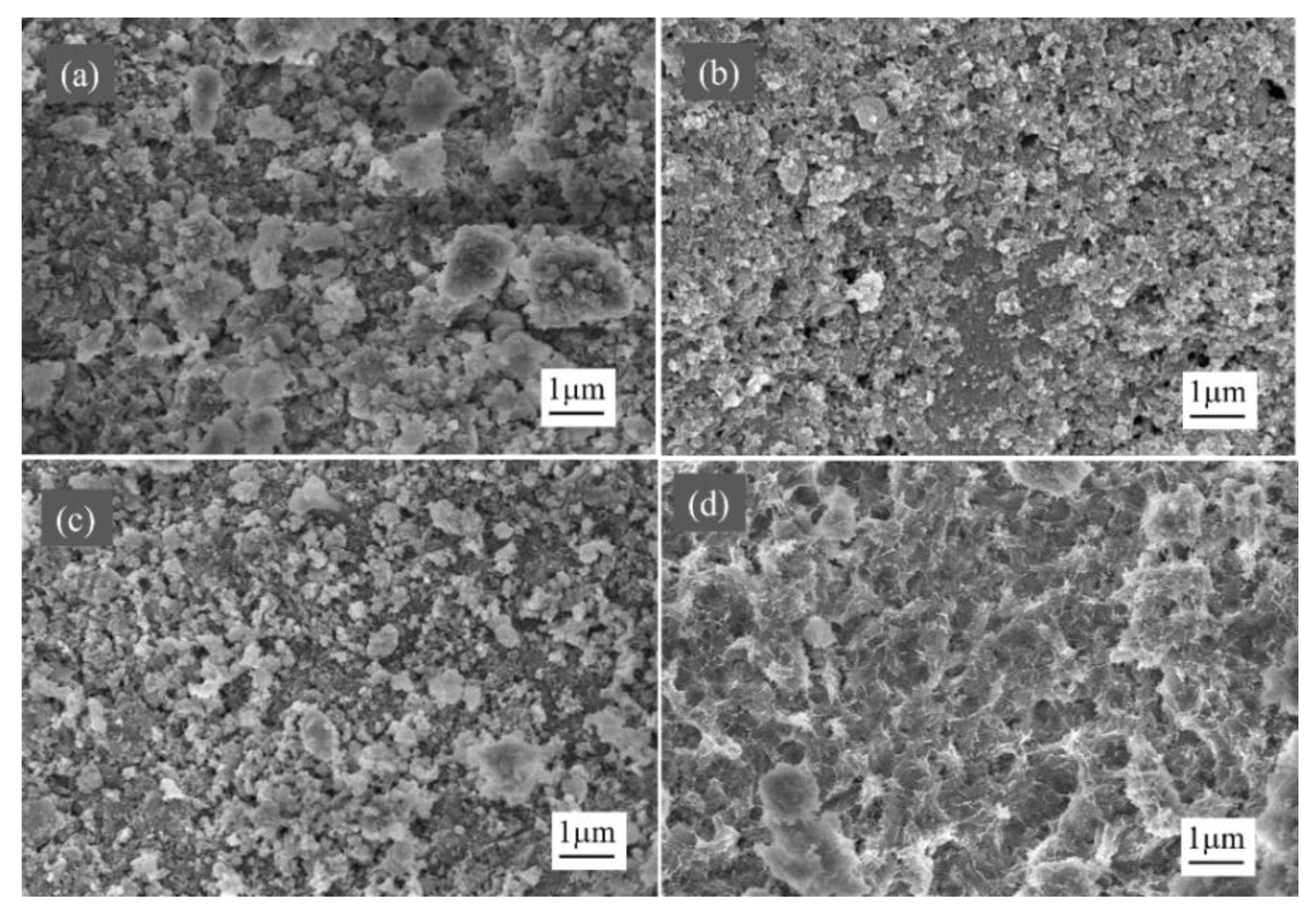
Figure 1. FESEM micrographs of calcined (a) 10N/9M1ZA, (b) 10N1Z/9M1ZA, (c) 10N3Z/9M1ZA, and (d) 10N3Z(T)/9M1ZA catalysts.
Preprints 189817 g001
Figure 2. XRD patterns of all catalysts and the modified alumina support.
Preprints 189817 g002
Figure 3. N2 adsorption-desorption isotherms and pore size distributions of the modified alumina support and all catalysts.
Preprints 189817 g003
Figure 4. H2 -TPR profiles of all catalysts.
Preprints 189817 g004
Figure 5. O2 -TPD profiles of all catalysts.
Preprints 189817 g005
Figure 6. (a) Al 2p, (b) Ni 2p, (c) Zr 3d and (d) O 1s XPS spectra of all catalysts.
Preprints 189817 g006
Figure 7. (a) CH4 conversion, (b) CO2 conversion, and (c) O 1s XPS spectra of all catalysts.
Preprints 189817 g007
Figure 8. TPO profiles of spent 10N3Z/9M1ZA and 10N3Z(T)/9M1ZA catalysts.
Preprints 189817 g008
Table 1. The textural properties of all samples.
Samples Surface Areaa
(m2·g−1)
Average
pore radiusa
(nm)
Pore volumea
(cm3·g−1)
Size of NiO crystallineb
(nm)
9M1ZA support 145 6.06 0.44 -
10N/9M1ZA 125 6.24 0.40 8.59
10N1Z/9M1ZA 132 6.37 0.42 8.63
10N3Z/9M1ZA 124 6.39 0.40 8.67
10N3Z(T)/9M1ZA 137 6.04 0.41 9.71
1 Calculated from BET method. 2 Determined from XRD results.
Table 2. XPS quantitative analysis of the prepared catalysts.
Catalysts Mass concentration (%)
Mg 1s Ni 2p O 1s Al 2p
10N/9M1ZA 1.34 7.89 49.52 41.25
10N1Z/9M1ZA 1.67 6.54 50.87 40.92
10N3Z/9M1ZA 1.90 5.25 52.05 40.79
10N3Z(T)/9M1ZA 1.01 6.85 49.86 42.27
Table 3. Oxygen uptake and coke deposition determined from TPO profiles for spent 10N3Z/9M1ZA and 10N3Z(T)/9M1ZA catalysts.
Spent catalyst Oxygen uptake in TPO (mmol/g) Carbon deposition
(%Dc)
10N3Z/9M1ZA 3.825 4.59
10N3Z(T)/9M1ZA 6.747 8.09
Disclaimer/Publisher’s Note: The statements, opinions and data contained in all publications are solely those of the individual author(s) and contributor(s) and not of MDPI and/or the editor(s). MDPI and/or the editor(s) disclaim responsibility for any injury to people or property resulting from any ideas, methods, instructions or products referred to in the content.
Copyright: This open access article is published under a Creative Commons CC BY 4.0 license, which permit the free download, distribution, and reuse, provided that the author and preprint are cited in any reuse.
Prerpints.org logo

Preprints.org is a free preprint server supported by MDPI in Basel, Switzerland.

Subscribe

Disclaimer

Terms of Use

Privacy Policy

Privacy Settings

© 2026 MDPI (Basel, Switzerland) unless otherwise stated