

Submitted:
13 December 2025
Posted:
15 December 2025
You are already at the latest version
Abstract
This study explores the concept of the woman climate as both an archetype and an analytical category, highlighting women's leadership in climate change adaptation and integrating vulnerability and transformative agency. Using a mixed methodology, it combines a systematic literature review with the development of the Vulnerability and Adaptive Capacity Index (VACI), which was applied to a case study in Puerto Ayacucho. Puerto Ayacucho, for which secondary data from CEPALSTAT revealed a high level of vulnerability (VACI = 0.73) due to poverty (60%) and dependence on natural resources (70%). A literature review was conducted to identify the historical and contemporary roles of women, while the data analysis employed min-max normalisation and Pearson correlations (e.g., r = -0.56 between vulnerability and adaptive capacity), as well as triangulation of sources, to validate the findings. The results emphasise the need for inclusive policies that strengthen women's resilience by connecting theory and practice through the VACI.
Keywords:
index
; gender
; development
; climate change
; rural sociology
; policy
* Crespandence:
1. Introduction
The following research question forms the basis of this study: How can the contribution of women to climate adaptation be quantified using a vulnerability and resilience index? In order to answer this question, the Vulnerability and Adaptive Capacity Index (VACI) will be developed and applied as a methodological tool to measure women’s climate resilience, and then evaluated. This process involves designing the index by integrating key dimensions such as economic vulnerability, exposure to extreme weather events, and leadership capacity; applying the index to a case study to assess its usefulness and reliability; and comparing the index with other methodological approaches to identify its strengths and limitations. As an integral component of the analysis, the concept of the climatic woman is introduced, representing female leadership that combines vulnerability and transformative power from ancient times to the present day. This concept is also employed as an analytical category to structure the empirical analysis within the VACI and the case study of Puerto Ayacucho, quantifying resilience and informing inclusive policies.
Climate change has been identified as one of the greatest global threats of the 21st century. It disproportionately impacts vulnerable communities, particularly women in developing regions (Intergovernmental Panel on Climate Change [IPCC], 2021). Throughout history and prehistory, women have played a vital part in adapting to and mitigating the effects of climate change, from managing natural resources to implementing resilient practices within their communities (Bryan et al., 2024; Phiri et al., 2022). However, it remains challenging to quantitatively measure their impact on climate adaptation due to the lack of methodological tools that integrate vulnerability and adaptive capacity indicators with a gender-sensitive approach (Puig et al., 2025). Existing approaches, such as the Climate Vulnerability Index (CVI) (Raghavan Sathyan et al., 2018) and the Gender-Sensitive Climate Vulnerability and Capacity Analysis (GCVCA) (Climate and Resilience Academy [CARE], 2025) have made progress in assessing climate vulnerability from a gender perspective. Nevertheless, these models tend to focus on general socio-economic factors, paying insufficient attention to women’s leadership, community participation, and traditional knowledge as key elements of climate resilience (Mavisakalyan & Tarverdi, 2019). To address the lack of research in this area, this study proposes and analyses the VACI, which is designed to measure women’s vulnerability to and capacity for adapting to climate change. This has implications for the design of inclusive climate policies, ensuring that adaptation strategies consider women’s active role in combating climate instability (Resurreccion, 2024; Loots & Lou, 2023).
The emergence of new models of leadership will enable women around the world to rewrite the narrative of environmental struggle, turning vulnerability into strength and adversity into opportunity (Rajeshwari, 2023). From the arid plains of Africa, where traditional women farmers are transforming ancestral techniques into climate solutions (Niemann et al., 2024), to the biodiversity of Latin America, where indigenous peoples are custodians of ecological knowledge (Lugo-Morin, 2022), to the halls of power at climate summits, once silent in the presence of women, now resounding with the voices of women leaders that were virtually non-existent a decade ago (Alonso-Epelde, Garcia-Muros & Gonzalez-Eguino, 2024; Magnusdottir & Kronsell, 2024), we are witnessing the emergence of this phenomenon. Women are not just adapting to climate instability: they are challenging it (Siim, 2024), redefining it (Cohn & Ducanson, 2023) and leading a quiet revolution that is changing the way we address the greatest challenge of our time (Daniel & Dolan, 2020). In some regions of the world, such as India, feminist momentum has slowed down due to structural and institutional fragility from a gender perspective (Sharma & Singh, 2020; Balthasar, 2024). This scenario is similar in some African (Okesanya et al., 2024; Acosta et al., 2020) and Southeast Asian countries (Ding & Beh, 2024; Sangwan & Brahmachari, 2023).
Women from different cultures, age groups and social backgrounds are creating a network of resilience and hope. They are showing that responding to climate change requires technological changes and a reconnection with our ability to nurture, protect and regenerate (Monteverde et al., 2024; Kassam, Charles & Johnson, 2023). The rise of women in climate science is not just a social phenomenon; it is a catalyst for a new paradigm where resilience meets leadership and empathy drives change. Traditional vulnerability to climate change is becoming a source of solutions. Traditionally at the forefront of climate impacts, women are now at the forefront of climate solutions in economic and political contexts, redefining the meaning of climate adaptation (Davidson, 2022).
In the current context of global climate instability (Mai, 2024; Tabari & Willems, 2023), this study uses a mixed methodology to provide a thorough analysis of existing literature on the intersection between gender and climate change. The study comprises two main components. First, a systematic review examines the historical and contemporary relationship between women and climate change. This review is divided into three sections: ‘Women climate scientists’, ‘The construction of women climate scientists in the context of climate change’, and ‘The emergence of a new category of analysis’. Secondly, it analyses a case study of the community in Puerto Ayacucho, located in the Venezuelan state of Amazonas. The study not only analyses the structural and social challenges faced by women in this context, but also the strategies they develop to adapt, thrive and lead in environments affected by climate change (Clech et al., 2024). Analysing their experiences and strategies reveals that women’s leadership is not only adapting to current needs, but also transforming and redefining how the climate crisis is addressed (Shoko, Musakwa & Kelso, 2024).
The concept of the woman climate, which articulates structural vulnerability and transformative leadership, has been integrated into the Puerto Ayacucho case study as an analytical framework for assessing women’s resilience to climate change and for validating the VACI. In Puerto Ayacucho, the VACI was calculated using official data platform with min-max normalisation and Pearson correlations. The VACI is proposed as a means of quantifying the effects in vulnerable communities, connecting theory and practice to promote inclusive policies. This study aims to contribute to the literature on gender and climate change by offering valuable insights for designing policies that recognise and empower women’s pivotal role in creating a sustainable and equitable future. However, it should be noted that the index is still under development and requires validation using primary data.
2. Background and Literature Review
The concept of women’s role in climate action goes beyond the mere adoption of adaptation strategies. It proposes a theoretical framework that explains the interrelation between women and climate, emphasizing both empowerment and inclusion in climate policy. In rural environments, women often face structural vulnerabilities derived from historical inequalities and environmental instability. However, they also play a central role in improving local ecosystems and strengthening community resilience through traditional knowledge and innovative leadership. A comprehensive pathway to address these challenges is the promotion of gender-sensitive public policies that guarantee equitable access to resources and foster meaningful participation in decision-making. At the same time, building collaborative networks that integrate ancestral knowledge with modern technologies enhances rural communities’ adaptive capacities. This perspective not only reduces women’s vulnerability but also recognizes them as active agents of change. In rural territories, women can lead processes of social and environmental transformation, driving transitions toward sustainable societies. Furthermore, this approach serves as an analytical tool to evaluate and refine adaptation strategies, positioning women as protagonists in the fight against climate change and as catalysts of community resilience.
2.1. Theoretical Framework
In a dynamic environmental context, women emerge as figures who embody vulnerability and leadership. Rather than being passive actors, they combine traditional knowledge with modern innovation to address current climate issues (Turquet et al., 2023). This transcends the notion of mere adaptation, positioning women as pivotal figures in the quest for solutions to the global climate crisis. The relationship between women and the climate has deep evolutionary roots, though this is often overlooked in historical and anthropological accounts. Between four and two million years ago, early hominins experienced significant climatic fluctuations that shaped human evolution. Females played a decisive role in food diversification, transmitting adaptive knowledge and developing survival strategies in changing environments (Bogin, Bragg & Kuzama, 2024; Martin, 2007). With the emergence of Homo erectus around two million years ago, the interaction between women and climate became more complex (Carmody & Wrangham, 2009; Hublin, Neubauer & Gunz, 2015). Technological advances such as tool-making and fire control expanded adaptability, and women contributed significantly to territorial expansion and resource management during glacial cycles (de Lafontaine et al., 2018; Stibel, 2023).
The Neolithic era marked a turning point, with women assuming central roles in agricultural innovation, natural resource management and interpreting local climatic patterns (Betti et al., 2020; Bolger, 2010). Later, during the Iron Age, archaeological evidence shows that women occupied positions of power beyond the domestic sphere, as evidenced by burials containing weapons, ritual objects, and symbols of authority (Cassidy et al., 2025). These findings highlight their influence in governance and adaptation. Within the Anthropocene, symbolic associations between women and nature, such as Demeter in Greek mythology, Pachamama in Andean cosmology, and Totonac deities in Mesoamerica, reflect the continuity of this historical link (Malhi, 2017; Brumfield, 1985; Sayre & Rosenfeld, 2021; Lugo-Morin, 2020). Civilisations such as Caral in Peru illustrate women’s roles in the early management of climate and migration (Shady, 2006). This trajectory converges in the present day with rural women, who are among the most vulnerable yet also among the most active leaders in climate justice movements, particularly in Africa (Phiri et al., 2022), Latin America (Mijangos, 2023), and Asia (Das, 2024).
From a Jungian archetypal perspective, the climate woman can be interpreted as a manifestation of the collective unconscious, integrating tradition and innovation, vulnerability and power, and individual and collective action. This archetype portrays women as both transmitters of knowledge and catalysts of social transformation.
Contemporary climate change, which has accelerated since the Industrial Revolution, differs radically from prehistoric cycles. It is driven by fossil fuel combustion, deforestation and rapid urbanisation. The unprecedented scale of climate change has exacerbated inequalities while also amplifying women’s contributions. Studies demonstrate women’s active participation in ensuring food security, conserving biodiversity, responding to disasters, and providing intergenerational education (Davis & Shaw, 2021; Khanom, Tanjeela & Rutherford, 2022; Okesanya et al., 2024; Prizzon et al., 2024). Nevertheless, persistent structural and cultural barriers continue to limit their formal participation in decision-making processes (Mijangos, 2023; Das, 2024). To address these issues, developing vulnerability and adaptation indices is a key strategy. These indices provide a systematic framework for assessing women’s exposure to climate impacts, their adaptive capacities and their contributions to resilience. By integrating gender variables into such indices, policymakers and researchers can identify structural inequalities, promote inclusive participation and reinforce rural adaptive strategies. This methodological innovation enables the evaluation of traditional practices and modern technologies, ensuring that women’s roles in climate governance are recognised and amplified.
The evolution of women’s participation in climate action has shifted from a historical narrative of marginalisation to one of leadership (Flores et al., 2025). In climate finance, for instance, women are increasingly prominent as decision-makers, leading initiatives in climate-smart agriculture, sustainable technologies, and community resilience. Although underrepresentation in global financial architecture persists (Lee & Dolfriandra, 2022; Läderach et al., 2024), the gender mainstreaming of climate finance is advancing, with microfinance and grassroots initiatives proving effective in rural contexts (Ripple et al., 2024). The emergence of the analytical category of climate women responds to the need for new conceptual tools in gender, rural and climate studies. This category is based on eight interconnected pillars: i) historical adaptive antecedents (Macintosh et al., 2017; Davis & Shaw, 2021); ii) epistemological foundations integrating feminist theory and climate change studies (Gay-Antaki, 2022; Eaton, 2021; Carey et al., 2016) iii) the intersectionality of experiences (Mikulewicz et al., 2023); iv) the philosophical dimensions of transformative agency (Buckingham, 2023); v) adaptive leadership (Farhan, 2022); vi) collective resilience (Sing, Tabe & Martin, 2022); vii) situated knowledge (Bronen et al., 2020); viii) methodological innovation through participatory tools and vulnerability indices (Sartorius et al., 2024). This category is important because it highlights women’s transformative agency, analyses adaptive strategies and recognises contributions that have often been marginalised. By incorporating gender-sensitive indices of vulnerability and adaptation, research and policy frameworks can progress towards climate justice by broadening participation, valuing traditional knowledge and reinforcing the central role of women in constructing sustainable societies (Godden et al., 2020).
3. Materials and Methods
The study adopted a mixed-methods approach, combining a qualitative literature review with case study analysis to provide a comprehensive overview of the current state of research at the intersection of gender and climate change. Reliable sources such as ECLAC Data and Statistical Publications Portal [CEPALSTAT] (2025), Artaxo et al. (2021) and Freitez & Correa (2016) provided data for the design and implementation of VACI, ensuring the study’s empirical robustness. From a quantitative perspective, descriptive statistical techniques such as averaging and trend analysis were employed to assess the evolution of indicators over time. Additionally, min-max normalisation was employed to standardise the data for each indicator on a common scale (0–1), facilitating their integration into the VACI index. Correlation tests were also performed to explore the relationships between the different dimensions of the model. These techniques provided empirical validation of VACI, ensuring consistency and accuracy in assessing women’s climate resilience in the analysed context.
3.1. Research Design
The study proposes a logical, coherent and systematic methodological design for analysing the category climate woman in the context of Puerto Ayacucho, using the VACI. This quantitative approach uses secondary data to enable an accurate and comparative assessment of women’s climate resilience in this territory.
Phase 1: Theoretical foundation and systematic review: A systematic literature review will be conducted in academic databases such as Scopus and Web of Science to achieve the following objectives: - Conceptually substantiate the category of ‘women’s climate resilience’. - Identify key indicators of structural vulnerability, climate exposure and adaptive capacity. - Incorporate subjective and theoretical dimensions to strengthen the construction of indicators.
Phase 2: Construction and selection of indicators: These will be obtained from reliable secondary sources, such as CEPALSTAT (2025), Artaxo et al. (2021) and Freitez & Correa (2016). These inputs will be complemented by theoretical evidence gathered in the literature review to ensure the relevance, validity and robustness of the selected metrics.
Phase 3: Standardisation and statistical analysis: Quantitative indicators will be standardised using the min-max technique to ensure comparability. Subsequently: Pearson correlations will be applied to explore the relationships between the variables. The results will then be triangulated with additional sources to strengthen the validity of the analysis.
Phase 4: Model integration and validation: Cross-checking quantitative data, conducting a literature review, and analysing the case of Puerto Ayacucho will validate and enrich the VACI, consolidating it as a gender-sensitive tool. This approach: highlights the central role of women in climate action. - Integrates social, economic and environmental factors within a multidimensional framework. It promotes the implementation of inclusive solutions and just transitions, in line with Donatti (2020) and Gerst et al. (2024), who points out that the indices allow variations to be analysed over time and space.
Methodological relevance: Introducing a context-specific index, such as the proposed VACI, facilitates gender-differentiated analysis of the impact of climate policy on women and men in vulnerable rural agri-food systems. Modelled on tools such as the Women’s Climate Change Resilience Index (CGIAR GENDER Impact Platform, 2025), the VACI is a flexible, multidimensional diagnostic instrument that can be replicated in various geographical and cultural contexts. It integrates objective data, such as access to productive resources, exposure to shocks and stressors, and participation in local governance, with theoretical dimensions drawn from established frameworks on empowerment, social norms, and resilience capacities.
3.2. The Development, Creation and Validation of the Index
In the context of the study by Habets and Cutter (2025), a resilience index is defined as a metric that quantifies a community’s or system’s capacity to resist, adapt to, and recover from disturbances, such as natural disasters or socioeconomic changes. This is achieved by integrating multidimensional indicators that encompass social, economic, environmental, and institutional aspects. The development of such indices typically involves a structured methodology. This begins with the selection of relevant variables based on existing theoretical frameworks. Next, data is collected and normalised at local or regional scales. Finally, these indicators are weighted and aggregated to generate comparable scores. These scores are often adjusted through empirical validations or collaborative approaches that incorporate both top-down and bottom-up perspectives. These indices are important because they can be used to identify vulnerabilities, prioritise policy interventions and monitor progress in improving resilience. This facilitates informed decision-making in rural contexts where factors such as geographic isolation and dependence on natural resources amplify risks. However, challenges such as data availability and adaptability to local variations must be overcome. In this vein, the VACI is intended to be created, although empirical evidence is crucial; in our case, secondary data are used to provide an initial approximation, with the intention of validating it in a subsequent study.
Vulnerability and adaptive capacity index (VACI)
VACI=[(V×Wv)+(E×We)+(AC×Wac)]×MF → VACI=[(V×0.33)+(E×0.33)+(AC×0.33)]×MF
Calculation of components:
Base vulnerability (V) → V = [SE + IF + DS] ÷ 3
Where:
SE (Economic situation): Evaluates economic stability (0-1). 0: High poverty, no stable income. 1: Economic stability or diversified income. Data required monthly in-come, access to financial resources.
IF (Family infrastructure): Measures quality of housing and access to basic services (0-1). 0: Precarious housing or without access to drinking water and electricity. 1: Safe housing with guaranteed basic services. Data required: type of housing, access to basic services.
DS (Dependence on climate-sensitive resources): Reflects how dependent the household is on resources affected by climate change (0-1). 0: High dependence (subsistence agriculture, artisanal fisheries). 1: Low dependence (non-climate-sensitive in-come). Data required: main economic activities and share of climate-dependent in-come.
Risk exposure (E) → E = [FE + IE + DE] ÷ 3
Where:
FE (Frequency of extreme events): Measures how often they face severe weather events (0-1). 0: No record of recent extreme events. 1: High frequency (e.g., several storms per year). Data required: history of weather events in the region.
IE (Event intensity): Represents severity of extreme events in the region (0-1). 0: Mild or low-impact events. 1: Devastating events (Category 5 hurricanes, extreme droughts). Data required: event classification according to meteorological sources.
DE (Exposure duration): Reflects how long the exposure to climatic effects persists (0-1). 0: Short or isolated duration (rapid events). 1: Prolonged (months-long droughts, chronic floods). Data required average duration of climate events.
Adaptive capacity (AC) → AC = [SC + ER + TC + RS] ÷ 4
Where:
SC (Social capital): Assesses the level of social cohesion and access to community networks (0-1). 0: Social isolated or lack of community support. 1: High integration and active support networks. Data required: participation in community groups. Access to local leadership.
ER (Economic resources): Represents the economic resources available to adapt (0-1). 0: No economic resources to adapt (e.g., no saving). 1: Sufficient resources for adaptive investments (e.g., wells or equipment). Data required: capacity to invest in adaptive measures.
TC (Traditional knowledge): Measures the use of local knowledge to cope with cli-mate change (0-1). 0: Lack of adaptive traditional knowledge. 1: Active use of effective traditional practices (e.g., crop rotation, water harvesting). Data required local practices relevant for adaptation.
RS (Support networks): Assesses access to formal and informal support networks (0-1). 0: No external support (e.g., NGOs, government, family members). 1: Frequent and reliable access to support networks. Data required: frequency and type of support received.
Modification factor (MF) → MF = 1 + [(PL + CI + SP) ÷ 30]
Where:
PL (Perceived leadership): Level of leadership attributed by the community (1-10).
CI (Community influence): Impact of your actions in the community (1-10).
SP (Social participation): Degree of participation in social activities (1-10)
Applying the VACI index to the case study: Puerto Ayacucho
The application of the VACI used statistical data from three dimensions of the CEPALSTAT (2025), the dimensions and their configuring elements being: a) structural vulnerability (population in extreme poverty, access to limited basic services and dependence on natural resources), b) exposure to climate risks (frequency of extreme events and loss of forest cover) and c) adaptive capacity (people with secondary or higher education, participation in community organisations and access to climate information). Knowing the dimensions and their elements, a rural community in Latin America with high exposure to climate risks was selected; with this characteristic, the community of Puerto Ayacucho, located in the municipality of Atures, state of Amazonas, Venezuela, was chosen (Table 1).
According to Artaxo et al. (2021); Freitez & Correa (2016), Amazonas state is located in the south-central region of the country, with an area of 183,500 km², occupying only 1% of the country’s territory, bordering Colombia and Brazil. It has a population of less than 200,000 inhabitants. Puerto Ayacucho, the capital, located in the municipality of Atures, concentrates more than 70% of the population. The region is ethnically rich, with 21 indigenous peoples actively preserving their ancestral languages and traditions. The region faces significant challenges due to illegal mining in the Amazon, which has caused environmental impacts and forced migration to intermediate cities such as Puerto Ayacucho. The population of Puerto Ayacucho has experienced increased migration from indigenous communities displaced by illegal mining in the Venezuelan Amazon. This activity has caused massive deforestation, pollution of rivers and changes in weather patterns, directly affecting the livelihoods of local communities (Chowdhury et al., 2024).
Definition of VACI dimensions and indicators
The VACI is composed of three main dimensions: For each dimension, specific indicators were selected based on the availability of secondary data:
V: Reflects socio-economic conditions that may increase susceptibility to climate change.
√ Poverty rate: Percentage of the population living in poverty.
√ Access to basic services: Percentage of households with access to safe drinking water and adequate sanitation.
√ Economic dependence on natural resources: Percentage of the population whose main source of income comes from natural resource-related activities.
E: Assesses the frequency and intensity of adverse climate events affecting the com-munity.
√ Frequency of extreme weather events: Number of extreme weather events record-ed in the last 10 years.
√Deforestation: Percentage loss of forest cover in the region in the last 5 years.
AC: Measures the community’s ability to adapt and respond to climate challenges.
√ Level of education: Percentage of population with completed secondary education or higher.
√ Participation in community organisations: Percentage of the population actively participating in community organisations.
√ Access to climate information: Percentage of the population with regular access to climate information and adaptation strategies
Normalisation of indicators
For ease of comparison, indicators are normalised on a scale of 0 to 1, where 0 represents the lowest vulnerability or highest adaptive capacity, and 1 represents the highest vulnerability or lowest adaptive capacity. Min-max normalisation was employed, a technique widely used in climate vulnerability and resilience studies [102]. The normalisation was performed using the following formula:
Xnormalised = Xobserved - Xminimum ÷ Xmaximum - Xminimum
Where:
Xnormalised: represents the scaled value between 0 and 1
Xobserved: is the original value of the indicator in a given year
Xminimum: the lowest value of the indicator in the period analysed (2014-2023)
Xmaximum: is the highest value of the indicator in the period analysed
Example of Normalisation (See Table A1)
If we take the extreme poverty indicator:
Xminimum: 10,500 (2014)
Xmaximum: 13,500 (2023)
For the year 2019 (Xobserved = 12,300):
Xnormalised = 12,300 - 10,500 ÷ 13,500 - 10,500 = 0.60
Calculation of the modification factor (MF)
The MF in the VACI was developed to incorporate and quantify key social dimensions that influence adaptive capacity but are not directly captured in the core measures of structural vulnerability, risk exposure, and adaptive capacity. Specifically, MF integrates three components: perceived leadership (PL), community influence (CI), and social participation (SP), each scored on a scale of 1 to 10. The MF is calculated by summing these scores, dividing the total by 30, and adding the result to 1, yielding a multiplier that adjusts the final VACI score. The division by 30 ensures normalization: with each component ranging from 1 to 10, the maximum sum is 30, scaling the result to a 0–1 range. Consequently, MF varies from 1 (minimal social dimensions) to 2 (maximum), providing a proportional adjustment that balances qualitative contributions without overpowering other index components.
This factor’s inclusion is justified because it quantitatively captures essential qualitative aspects of community resilience, such as the ability to adapt and transform environments through strong leadership and active participation. By doing so, MF enriches the index, acknowledging that climate resilience depends not only on economic and environmental factors but also on social cohesion and transformative potential—particularly in contexts where women’s roles drive sustainable change. Without MF, the VACI would overlook these human-centered elements, leading to an incomplete assessment of adaptive capacity.
For Puerto Ayacucho, the provisional scores (PL: 7, CI: 5, SP: 9) stem from a subjective evaluation based on secondary data and literature review. These will be refined once primary data becomes available.
MF = 1 + [(PL + CI + SP) ÷ 30] = 1+ [(7+5+9) ÷ 30] = 1.7 → MF = 1.7
The same procedure was applied to all indicators. In cases where a higher value indicated lower vulnerability (e.g., access to education), the scale was reversed to maintain consistency with the overall index, so that higher values reflected higher vulnerability. This normalisation allowed all indicators to contribute equally to the VACI calculation, ensuring effective comparison across dimensions.
VACI is calculated as the weighted average of the three dimensions:
Where: Wv, We, Wac are the weights assigned to each dimension, adding up to 1 in total. In this case, an equal weight is assigned to each dimension (w =0.33).
Structural vulnerability (V):
√ Poverty rate: According to CEPALSTAT data, the poverty rate in the region is 60%.
√ Access to basic services: 50% of households lack adequate access to basic services.
√ Economic dependence on natural resources: 70% of the population depends on activities related to natural resources.
Exposure to climate risks (E):
√ Frequency of extreme weather events: 5 extreme events were recorded in the last 10 years.
√ Deforestation: The region has lost 15% of its forest cover in the last 5 years.
Adaptive Capacity (AC):
√ Education level: 40% of the population has completed secondary or higher education.
√ Participation in community-based organisations: 30% of the population participates in community-based organisations.
Access to climate information: 25% of the population has regular access to climate information
Calculation of sub-indexes and final VACI
After normalising each indicator, calculating the means for each dimension and the modification factor, the result is obtained (Table 2):
VACI=[(V×Wv)+(E×We)+(AC×Wac)]×MF → VACI=[(0.60×0.33)+(0.40×0.33)+(0.32×0.33)]×1.7=0.73
The equal weighting of the three VACI dimensions -structural vulnerability (V), exposure to climate risks (E), and adaptive capacity (AC)- is justified by the index’s methodological design and alignment with the ‘climate woman’ theoretical framework. This equitable allocation ensures that no dimension dominates the index, reflecting the interdependence of these factors in women’s climate resilience (given that the supporting data were secondary). Structural vulnerability captures the socioeconomic conditions that limit adaptation; exposure to risks measures the direct environmental threats; and adaptive capacity reflects female agency, as highlighted in the literature. Assigning equal weights avoids bias towards purely economic or environmental factors, thereby integrating the duality of vulnerability and the transformative leadership of climate women. Furthermore, Pearson correlations validate this weighting, demonstrating balanced relationships between the dimensions. While it is suggested that weights could be adjusted using participatory methods or machine learning models for specific contexts, the initial equality ensures simplicity, comparability and universal applicability. This allows the modification factor (MF) to qualitatively adjust the index and capture the nuances of female leadership.
A moderate positive correlation between V and E (r = 0.48, p < 0.05) suggests that the higher the structural vulnerability, the higher the exposure to climate risks. Adaptive capacity is negatively correlated with structural vulnerability (r = -0.56, p < 0.01) and exposure (r = -0.42, p < 0.05), suggesting that higher levels of adaptation are associated with lower levels of risk and vulnerability. The modification factor shows a strong positive relationship with adaptive capacity (r = 0.62, p < 0.01), highlighting the importance of qualitative aspects such as leadership and social participation.
The calculation of the correlation between Structural Vulnerability (V) and Exposure to Climate Risks (E) showed a moderate positive correlation (r = 0.48, p < 0.05), indicating that areas with higher structural vulnerability tend to be more ex-posed to extreme weather events. A significant negative correlation was also found between Adaptive Capacity (AC) and both V (r = -0.56, p < 0.01) and E (r = -0.42, p < 0.05), suggesting that higher levels of adaptive capacity are associated with lower levels of vulnerability and exposure. On the other hand, the Modification Factor (MF), which includes qualitative aspects such as leadership and community influence, showed a significant positive correlation with AC (r = 0.62, p < 0.01), indicating that improvements in these dimensions contribute to increased adaptive capacity. These results were consistent in the correlation matrix analysis, validating the integration of the different components in the VACI and supporting the theoretical structure of the model. In Pearson’s coefficient formula, the variables X and Y represent the two characteristics or measures being compared in order to assess the linear relationship between them. For example, if we want to analyse the relationship between Structural Vulnerability (V) and Adaptive Capacity (AC), then for each observation i:
- ✓ Xi is the Structural Vulnerability value for observation i.
- ✓ Yi is the value of Adaptive Capacity for observation i.
The means of the variables are calculated as follows:
= (1/n) * Σn i=1 Xi and Ȳ = (1/n) * Σn i=1 Yi
Where:
n is the total number of observations.
X̄ (mean of X) is equal to one divided by n, multiplied by the sum from i equal to 1 to n of each value Xi.
Ȳ (mean of Y) is equal to one divided by n, multiplied by the sum from i equal to 1 to n of each value Yi.
Mean of X = (1/n) * summation from i=1 to n of Xi
Mean of Y = (1/n) * summation from i=1 to n of Yi

A VACI score of 0.73 indicates that the assessed community is significantly vulnerable to climate change and has limited adaptive capacity, placing it at the upper end of the 0–1 scale. This score is derived from a combination of standardised indicators of structural vulnerability, climate risk exposure and adaptive capacity, adjusted by a modification factor that incorporates leadership and social participation. This score quantifies the impact of factors such as extreme poverty (60%), reliance on natural resources (70%), and exposure to extreme events, which outweigh resilience mechanisms. It urges the implementation of inclusive policies, training, and infrastructure improvements to foster more resilient communities. The index translates numerical data into accessible narratives for different audiences: for locals, it uses visuals to link risks to daily life; for policymakers, it provides a basis for decisions that are grounded in human realities; and for international organisations, it contextualises challenges and feasible strategies. Its dynamic design tracks temporal changes and anticipates trends through regular updates. It also integrates with tools such as spreadsheets and incorporates subcomponents such as intergenerational knowledge transfer, adding cultural and temporal dimensions. This positions it as a tool for comparing global contexts in climate justice. However, limitations include reliance on variable-quality data, qualitative subjectivity, oversimplification of complexities and inflexibility in the face of rapid change. To address these limitations, it is recommended that triangulation is used with diverse sources, multivariate analysis or machine learning is used for dynamic weighting, simulation models are used for interactions, cultural adaptation protocols are used, and real-time platforms with participatory methods are used. These methods should be used to update local indicators derived from primary data
4. Discussion de Results
The study establishes the concept of climate women as a theoretical and analytical framework that portrays women as agents of change in climate adaptation, moving beyond narratives of passive vulnerability. The findings, derived from the application of the VACI in Puerto Ayacucho, reveal the strengths and limitations of female resilience in the face of climate change. In this location, the VACI yielded a score of 0.73, indicating high structural vulnerability (60% of the population live in extreme poverty and 70% depend on natural resources) and limited adaptive capacity (only 30% of the community participates). These results are consistent with secondary data from CEPALSTAT (2025), Artaxo et al. (2021) and Freitez & Correa (2016). These results are consistent with previous research which has highlighted the disproportionate exposure of rural communities, particularly women, to climate risks in Latin America (IPCC, 2021; Mijangos, 2023; Flores et al., 2025). The negative correlation between structural vulnerability and adaptive capacity (r = -0.56, p < 0.01) suggests that strengthening female leadership and community networks could mitigate vulnerability. This aligns with studies on community resilience led by women (Bryan et al., 2024; Loots & Lou, 2023; Singh, Tabe & Martin, 2022). However, the high VACI score also reveals the presence of persistent structural barriers, such as a lack of access to basic services (50%) and education (40%), which limit women’s agency. This finding is consistent with analyses of gender inequalities in the context of climate change (Mavisakalyan & Tarverdi, 2019; Acosta et al., 2020; Okesanya et al., 2024).
Importantly, while the VACI shares principles with other indices such as the CVI (Raghavan Sathyan et al., 2018) and the GCVCA (CARE, 2025), it is distinguished by its modification factor (MF), which incorporates leadership and social participation (Figure 1) — central aspects of women in climate change (Flores et al., 2025). While this innovation enriches the index, its reliance on secondary data in Puerto Ayacucho means that qualitative nuances, such as local perceptions of female leadership, are not fully captured, which could lead to an underestimation of female agency (Sartorius et al., 2024). Furthermore, the equal weighting of the dimensions (V, E and AC, each with a weighting of 0.33) assumes balanced contributions. However, it does not consider contexts where climate exposure, for example, could have a greater impact due to frequent extreme weather events (Dhawale, Schuster-Wallace & Pietroniro, 2024). This limitation is exacerbated by the absence of primary data, which restricts the cultural sensitivity of the index and its capacity to reflect unique local dynamics.
Interpretation of the Radar Chart
- 1.
-
Objective Clarity
- ✓ VACI and GCVCA both articulate their purpose clearly: VACI as a gender-sensitive quantitative index, and GCVCA as a participatory gendered assessment.
- ✓ CVI also has a well-defined objective, but it is broader and less gender-focused.
2. Core Components Strength
- ✓ CVI scores highest here: it is well-established with a robust structure covering environment, health, social capital, and exposure.
- ✓ VACI is solid (V, E, AC + MF) but still requires stronger validation.
- ✓ GCVCA has less standardized components, relying more on participatory context-specific inputs.
3. Data Source Robustness
- ✓ CVI is relatively strong because it mixes primary and secondary data systematically.
- ✓ VACI depends mainly on secondary sources (e.g., CEPALSTAT), which weakens robustness.
- ✓ GCVCA relies heavily on primary, qualitative, participatory data; rigorous but less scalable.
4. Gender Approach
- ✓ GCVCA leads here: gender is the backbone of the framework.
- ✓ VACI innovates by introducing the Climate Woman concept as a quantitative factor.
- ✓ CVI acknowledges inequalities but does not centralize gender.
5. Type of Results
- ✓ CVI and VACI provide comparable indices, useful for inter-community or regional analysis.
- ✓ GCVCA produces rich qualitative narratives and matrices, but these are less suited for comparability or statistical analysis.
6. Innovation
- ✓ VACI is innovative for integrating gender as a measurable component within a quantitative index.
- ✓ GCVCA innovates in terms of participatory methods and depth of gendered insights.
- ✓ CVI was pioneering in its time, but less innovative compared to gender-sensitive approaches today.
7. Limitations (Low Limitations)
- ✓ CVI performs relatively well, with balanced strengths and weaknesses.
- ✓ VACI faces significant limitations: reliance on secondary data.
- ✓ GCVCA has strong methodological depth, but its participatory nature makes it resource-intensive and less scalable, so limitations remain high
The radar chart analysis reveals distinct strengths and limitations across the three indices, with no single one dominating all dimensions: VACI demonstrates strong innovation and gender integration through sensitive quantification, though it is undermined by reliance on secondary data; CVI offers methodological robustness, balance, structure, and comparability, but falls short in gender sensitivity; and GCVCA provides the deepest focus on gender and participatory methodology, albeit with reduced comparability and scalability.
The evaluation across seven key criteria highlights the nuanced profiles of the three indices, with VACI achieving high scores in objective clarity (8) for its focus on preventing and measuring gender-based violence, gender approach (8) due to its emphasis on violence against women, and innovation (8) through novel methodological integration, alongside solid core components (7), clear and applicable results (7) despite contextual constraints, moderate data source robustness (6) hindered by scarce systematic data, and moderate limitations (5) in availability and standardization; CVI demonstrates strong core components (8) via consolidated statistical methods, good data robustness (7) from academic sources, reliable replicable results (7) in scholarly settings, clear objectives (7) as a validation tool, moderate innovation (6) with effective traditional approaches, and moderate limitations (6) in adaptability, but is notably weak in gender approach (4) as a non-specific general instrument; whereas GCVCA excels in gender approach (9) with a comprehensive perspective, offers good innovation (7) in participatory and differentiated analysis, clear objectives (7) for climate vulnerability assessment, moderate core components (6) in less structured participation, limited data robustness (5) reliant on community input, variable context-dependent results (5), and greater limitations (4) in standardization and cross-context comparability (Table 3).
The research gaps identified include the need to validate the VACI tool in contexts beyond Latin America, and to integrate primary data in order to capture traditional knowledge and intergenerational dynamics, as suggested by Kassam et al. (2023) and Bronen et al. (2020). Additionally, it is necessary to explore how qualitative factors of MF, such as perceived leadership and community influence, vary culturally, given that the literature points to significant differences in female participation between regions (Sharma & Singh, 2024; Okesanya et al., 2024; Das, 2024). To address these limitations, the following recommendations are made: i) conduct field studies involving interviews and focus groups to complement secondary data and ensure a richer representation of the female experience; ii) adjust VACI weights through participatory analysis and machine learning models to reflect specific contexts, as proposed by Dhawale, Schuster-Wallace & Pietroniro (2024); y iii) develop regional sub-indices that incorporate cultural variables, such as indigenous knowledge, to improve the adaptability of the index (CGIAR GENDER Impact Platform, 2025).
The data suggest several ideas for future research and policy. The high vulnerability in Puerto Ayacucho highlights the need for gender-sensitive climate policies, such as training programmes in resilient sectors (e.g., climate-smart agriculture) and digital platforms for climate information. These policies should align with Resurreccion’s recommendations (2024). Finally, integrating ecofeminist approaches (Eaton, 2021; Gough et al., 2024) could enrich the VACI by incorporating narratives of climate justice and strengthening its capacity to guide the development of inclusive policies that promote resilience and equity in the context of climate change.
5. Conclusion
The study introduces the concept of the climate woman as both an archetype and an analytical category. This redefines women as proactive agents of change in climate adaptation, integrating structural vulnerability with innovative leadership. The application of the VACI in Puerto Ayacucho provided valuable insights into the strengths and limitations of female resilience. Notably, the index revealed high structural vulnerability: 60% of the population live in extreme poverty and 70% depend on natural resources. Coupled with this is limited adaptive capacity: only 30% of the community participates actively, and 40% have access to secondary education. A significant negative correlation (r = -0.56, p < 0.01) between vulnerability and adaptive capacity underscores the potential of female leadership and community networks to mitigate climate risks, in line with broader literature on women’s agency in vulnerable settings. However, the study’s reliance on secondary data and equal weighting of VACI dimensions constrained its ability to capture cultural nuances such as indigenous knowledge, which is vital for resilience. To overcome these limitations, future research should: i) incorporate primary data via interviews, focus groups and participant observation, in order to better reflect women’s lived experiences and traditional knowledge, thus enhancing the cultural sensitivity of the VACI; ii) validate the index across diverse regions (e.g., Africa and Asia), in order to evaluate its universality and account for variations in vulnerability and female leadership; iii) implement dynamic weightings, either through participatory methods or machine learning, in order to tailor the index to specific contexts, and iv) integrate ecofeminist and climate justice perspectives, in order to examine the intersection of gender, race and class. These enhancements would strengthen VACI’s position as a robust tool for designing gender-sensitive policies. These policies could include training in resilient agriculture, digital platforms for climate information and regional observatories to update indicators. The climate woman framework is critical for advancing environmental sustainability and social justice, fostering collective resilience through female empowerment. Incorporating the climate woman concept into VACI is justified because it addresses a core gap in traditional vulnerability assessments: the underrepresentation of gender dynamics in adaptive capacity. By embedding this concept, VACI evolves from a purely structural metric to one that quantifies women’s transformative roles, such as leadership in community networks and resource management, through targeted indicators (e.g., gender-disaggregated participation rates or leadership scores). This integration ensures coherence by linking quantitative data (e.g., poverty and education metrics) with qualitative agency, reducing redundancy in isolated analyses while validating correlations such as the observed r = -0.56. This justification stems from empirical alignment with global studies on female agency, enabling VACI to inform equitable policies without overcomplicating its framework and promoting a holistic measure of climate resilience.
Supplementary Materials
The following supporting information can be downloaded at the website of this paper posted on Preprints.org.
CRediT Author Statement: This is a single-author paper, and the author takes sole responsibility for all aspects of the work, including concept development, study design, data analysis, manuscript drafting, and revision.
Data Availability Statement
The data are available from the corresponding author upon reasonable request.
Funding
This research received no external funding.
Conflicts of Interest
The author declares no conflict of interest.
IRB Statement: Not applicable.
Informed Consent Statement
Not applicable.
Acknowledgments
Not applicable.
Abbreviations
The following abbreviations are used in this manuscript:
| ECLAC | Economic Commission for Latin America and the Caribbean |
| IPCC | Intergovernmental Panel on Climate Change |
| CVI | Climate Vulnerability Index |
| GCVCA | Gender-Sensitive Climate Vulnerability and Capacity Analysis |
| CARE | Climate and Resilience Academy |
| CEPALSTAT | ECLAC Data and Statistical Publications Portal |
Appendix A

Table A1.
VACI dimensions and indicators by year.
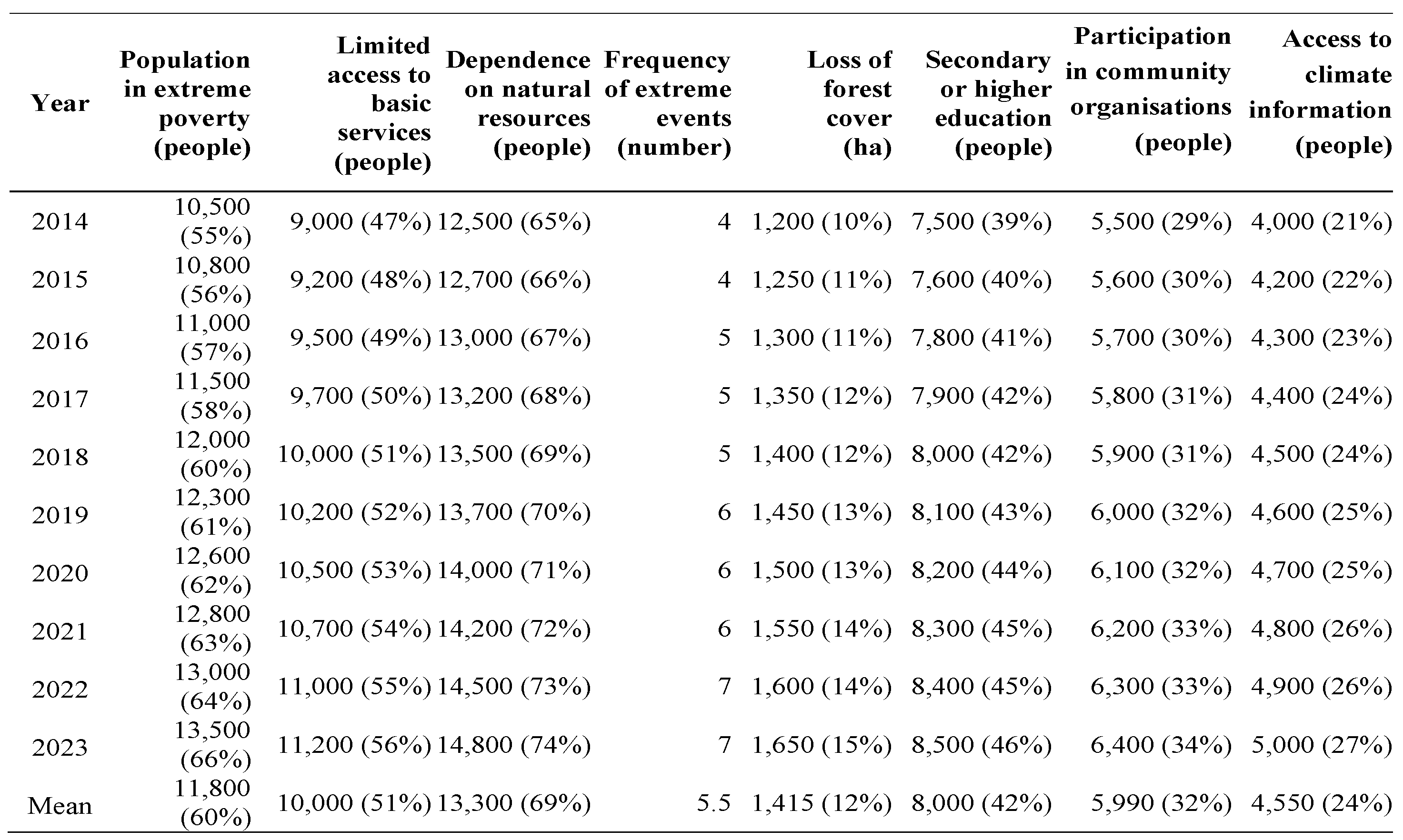 |
Source: Authors’ elaboration based on CEPALSTAT (2025).
References
- Acosta, M.; van Wessel, M.; et al. The power of narratives: Explaining inaction on gender mainstreaming in Uganda’s climate change policy. Development Policy Review 2020, 38, 555–574. [Google Scholar] [CrossRef]
- Alonso-Epelde, E.; García-Muros, X.; González-Eguino, M. Climate action from a gender perspective: A systematic review of the impact of climate policies on inequality. Energy Research & Social Science 2024, 112, 103511. [Google Scholar] [CrossRef]
- Artaxo, P.; Almeida-Val, V. Capítulo 23: Impactos de la deforestación y el cambio climático sobre la biodiversidad, los procesos ecológicos y la adaptación ambiental Informe de evaluación de Amazonía 2021. Traducido del inglés al español por iTranslate. In United Nations Sustainable Development Solutions Network, New York, USA; Nobre, C, Encalada, A, Anderson, E, Roca Alcazar, FH, Bustamante, M, Mena, C, Pe-ña-Claros, M, Poveda, G, Rodriguez, JP, Saleska, S, Trumbore, S, Val, AL, Villa Nova, L, Abramovay, R, Alencar, A, Rodríguez Alzza, C, Armenteras, D, Artaxo, P, Athayde, S, Barretto Filho, HT, Barlow, J, Berenguer, E, Bortolotto, F, Costa, FA, Costa, MH, Cuvi, N, Fearnside, PM, Ferreira, J, Flores, BM, Frieri, S, Gatti, LV, Guayasamin, JM, Hecht, S, Hirota, M, Hoorn, C, Josse, C, La-pola, DM, Larrea, C, Larrea-Alcazar, DM, Lehm Ardaya, Z, Malhi, Y, Marengo, JA, Melack, J, Moraes, R M, Moutinho, P, Murmis, MR, Neves, EG, Paez, B, Painter, L, Ramos, A, Rosero-Peña, MC, Schmink, M, Sist, P, ter Steege, H, Val, P, van der Voort, H, Va-rese, M, Zapata-Ríos, G, Eds.; Informe de evaluación de Amazonía 2021. Traducido del inglés al español por iTranslate. United Nations Sustainable Development Solutions Network, New York, USA.2021; Available online: https://www.sp-amazon.org/br/publications/#ar2021.
- Balthasar, D. Futuring Fragility: Embracing uncertainty, identifying opportunity, unlocking development. Development Policy Review 2024, 42 Suppl. 1, e12779. [Google Scholar] [CrossRef]
- Betti, L.; Beyer, R.; et al. Climate shaped how Neolithic farmers and European hunter-gatherers interacted after a major slowdown from 6,100 BCE to 4,500 BCE. Nature Human Behaviour 2020, 4, 1004–1010. [Google Scholar] [CrossRef]
- Bogin, B.; Bragg, J.; Kuzawa, C. Humans Are Not Cooperative Breeders but Practice Biocultural Reproduction. Annals of Human Biology 2024, 41(4), 368–80. [Google Scholar] [CrossRef] [PubMed]
- Bolger, D. The Dynamics of Gender in Early Agricultural Societies of the Near East. Signs: Journal of Women in Culture and Society 2010, 35(2), 503–531. [Google Scholar] [CrossRef]
- Bronen, R.; Pollock, D.; et al. Usteq: Integrating Indigenous Knowledge and Social and Physical Sciences to Coproduce Knowledge and Support Community-Based Adaptation. Polar Geography 2020, 43(2–3), 188–205. [Google Scholar] [CrossRef]
- Brumfield, A. Las fiestas áticas de Deméter y su relación con el año agrícola; Arno Press: Nueva York, USA, 1985. [Google Scholar]
- Bryan, E.; Alvi, M.; et al. Addressing gender inequalities and strengthening women’s agency to create more climate-resilient and sustainable food systems. Global Food Security 2024, 40, 100731. [Google Scholar] [CrossRef]
- Buckingham, S. Climate Change and Gender. In Handbook of the Philosophy of Climate Change. Handbooks in Philosophy; Pellegrino, G., Di Paola, M., Eds.; Springer: Cham, 2023. [Google Scholar] [CrossRef]
- CARE. Gender-sensitive Climate Vulnerability and Capacity Analysis (GCVCA). 2025. Available online: https://careclimatechange.org/gender-sensitive-climate-vulnerability-and-capacity-analysis/ (accessed on 12 January 2025).
- Carey, M.; Jackson, M.; et al. Glaciers, gender, and science: A feminist glaciology framework for global environmental change research. Progress in Human Geography 2016, 40(6), 770–793. [Google Scholar] [CrossRef]
- Carmody, R.; Wrangham, R. The energetic significance of cooking. Journal of Human Evolution 2009, 57(4), 379–391. [Google Scholar] [CrossRef]
- Cassidy, L.M.; Russell, M.; et al. Continental influx and pervasive matrilocality in Iron Age Britain. Nature 2025, 637, 1136–1142. [Google Scholar] [CrossRef] [PubMed]
- CEPALSTAT. Key figures for Latin America and the Caribbean. 2025. Available online: https://statistics.cepal.org/portal/cepalstat/index.html?lang=en (accessed on 15 January 2025).
- Platform, CGIAR GENDER Impact. Building better metrics for climate resilience and women’s empowerment. 2025. Available online: https://gender.cgiar.org/news/building-better-metrics-climate-resilience-and-womens-empowerment (accessed on 15 September 2025).
- Chowdhury, R.; Talukder, B.; et al. Saving the Amazon in South America by a regional approach on climate change: the need to consider the health perspective. The Lancet Global Health 2024, 12(6), e913–e915. [Google Scholar] [CrossRef] [PubMed]
- Clech, L.; Sierra, J.P.; et al. Local social-ecological context explains seasonal rural-rural migration of the poorest in south-west Bangladesh. PLOS Climate 2024, 3(3), e0000239. [Google Scholar] [CrossRef]
- Cohn, C.; Duncanson, C. Critical Feminist Engagements with Green New Deals. Feminist Economics 2023, 29(3), 15–39. [Google Scholar] [CrossRef]
- Daniel, T.; Dolan, M. Intersectionality and Collective Action: Visioning a Feminist Green New Deal in the US. Gender & Development 2020, 28(3), 515–33. [Google Scholar] [CrossRef]
- Das, S. Women’s experiences and sustainable adaptation: a socio-ecological study of climate change in the Himalayas. Climatic Change 2024, 177(4), 59. [Google Scholar] [CrossRef]
- Davidson, D. Climate change sociology: Past contributions and future research needs. PLOS Climate 2022, 1(7), e0000055. [Google Scholar] [CrossRef]
- Davis, M.; Shaw, R. Range shifts and adaptive responses to Quaternary climate change. Science 2021, 292(5517), 673–9. [Google Scholar] [CrossRef]
- de Lafontaine, G.; Napier, J.; et al. Invoking adaptation to decipher the genetic legacy of past climate change. Ecology 2018, 99(7), 1530–1546. [Google Scholar] [CrossRef]
- Dhawale, R.; Schuster-Wallace, C.; Pietroniro, A. Assessing the multidimensional nature of flood and drought vulnerability index: A systematic review of literature. International Journal of Disaster Risk Reduction 2024, 112, 104764. [Google Scholar] [CrossRef]
- Ding, D.; Beh, S. Climate Change in Southeast Asia: Progress on UN Sustainable Development Goal 13. In SDGs in the Asia and Pacific Region. Implementing the UN Sustainable Development Goals – Regional Perspectives; Filho, Leal, Ng, W., IyerRaniga, T.F., Ng, U., Sharifi, A., Eds.; Springer: Cham, 2024. [Google Scholar] [CrossRef]
- Donatti, C.I.; Harvey, C.A.; Hole, D.; et al. Indicators to measure the climate change adaptation outcomes of ecosystem-based adaptation. Climatic Change 2020, 158, 413–433. [Google Scholar] [CrossRef]
- Eaton, H. Ecofeminist Theologies in the Age of Climate Crisis. Feminist Theology 2021, 29(3), 209–219. [Google Scholar] [CrossRef]
- Farhan, B.Y. Women Leadership Effectiveness: Competitive Factors and Subjective and Objective Qualities. Cogent Social Sciences 2022, 8(1), 2140513. [Google Scholar] [CrossRef]
- Flores, E.; Flores, A.; et al. Fostering leadership and gender equality in climate action among underserved, rural and Indigenous women: a qualitative exploration of opportunities and limitations in Peru. The Lancet Regional Health-Americas 2025, 46, 101109. [Google Scholar] [CrossRef]
- Freitez, A.; Correa, G. Análisis de situación de la población en la región Sur: estados Bolívar, Amazonas y Delta Amacuro. In Guayana: población y ambiente; Guanipa, Balza, Ronald, Eds.; Konrad Adenauer Stiftung & Universidad Catolica Andres Bello: Caracas, 2016; pp. 53–145. [Google Scholar]
- Gay-Antaki, M. Border crossers: Feminist decolonial geography and climate change. Progress in Environmental Geography 2022, 1(1-4), 115–136. [Google Scholar] [CrossRef]
- Gerst, M.D.; Dillard, M.K.; et al. NIST Special Publication 2300-01; A review of community resilience indicators using a systems measurement framework. National Institute of Standards and Technology, 2024. [CrossRef]
- Godden, N.J.; Pam, M.; et al. Feminist Participatory Action Research as a Tool for Climate Justice. Gender & Development 2020, 28(3), 593–615. [Google Scholar] [CrossRef]
- Gough, A.; Yi, C.; et al. Ecofeminisms and Education: Repositioning Gender and Environment in Education. Gender and Education 2024, 36(4), 299–311. [Google Scholar] [CrossRef]
- Habets, M.; Cutter, S.L. A community resilience index for place-based actionable metrics. Risk Analysis 2025, 45(7), 1648–1661. [Google Scholar] [CrossRef]
- Hublin, J-J.; Neubauer, S.; Gunz, P. Brain ontogeny and life history in Pleistocene hominins. Philosophical transactions of the Royal Society of London. Series B, Biological Sciences 2015, 370(1663), 20140062. [Google Scholar] [CrossRef]
- IPCC. Climate Change 2021: The Physical Science Basis. Contribution of Working Group I to the Sixth Assessment Report of the Intergovernmental Panel on Climate Change; Masson-Delmotte, V., Zhai, P., Pirani, A., Connors, S.L., Péan, C., Berger, S., Caud, N., Chen, Y., Goldfarb, L., Gomis, M.I., Huang, M., Leitzell, K., Lonnoy, E., Matthews, J.B.R., Maycock, T.K., Waterfield, T., Yelekçi, O., Yu, R., Zhou, B., Eds.; Cambridge University Press: Cambridge, United Kingdom and New York, NY; USA. [CrossRef]
- Kassam, K-A.; Charles, M.; Johnson, S. Significance of different ways of knowing in responding to the climate crisis: The necessity for Indigenous knowledge. PLOS Climate 2023, 2(7), E0000237. [Google Scholar] [CrossRef]
- Khanom, S.; Tanjeela, M.; Rutherford, S. Climate induced migrant’s hopeful journey toward security: Pushing the boundaries of gendered vulnerability and adaptability in Bangladesh. Frontiers in Climate 2022, 4, 922504. [Google Scholar] [CrossRef]
- Läderach, P.; Desai, B.; et al. Using climate financing wisely to address multiple crises. PLOS Climate 2024, 3(2), e0000355. [Google Scholar] [CrossRef]
- Lee, C-W.; Dolfriandra, A. Green Microfinance and Women’s Empowerment: Why Does Financial Literacy Matter? Sustainability 2022, 14(5), 3130. [Google Scholar] [CrossRef]
- Loots, L.; Lou, H. Climate Justice, Gender and Activisms. Agenda 2023, 37(3), 1–11. [Google Scholar] [CrossRef]
- Lugo-Morin, D.R. Indigenous communities and their food systems: a contribution to the current debate. Journal of Ethnic Foods 2020, 7, 6. [Google Scholar] [CrossRef]
- Lugo-Morin, D.R. Innovate or Perish: Food Policy Design in an Indigenous Context in a Post-Pandemic and Climate Adaptation Era. Journal of Open Innovation. Technology, Market, and Complexity 2022, 8(1), 34. [Google Scholar] [CrossRef]
- Macintosh, A.; Pinhasi, R.; et al. Prehistoric women’s manual labor exceeded that of athletes through the first 5500 years of farming in Central Europe. Science Advances 2017, 3(11), eaao3893. [Google Scholar] [CrossRef]
- Magnusdottir, G.; Kronsell, A. Climate institutions matter: The challenges of making gender-sensitive and inclusive climate policies. Cooperation and Conflict 2024, 59(3), 361–378. [Google Scholar] [CrossRef]
- Mai, L. Navigating Transformations: Climate Change and International Law. Leiden Journal of International Law 2024, 37(3), 535–56. [Google Scholar] [CrossRef]
- Malhi, Y. El concept of the Anthropocene. Annual Review of Environment and Resources 2017, 42, 77–104. [Google Scholar] [CrossRef]
- Martin, R. The evolution of human reproduction: a primatological perspective. American Journal of Physical Anthropology 2007, 45, 59–84. [Google Scholar] [CrossRef]
- Mavisakalyan, A.; Tarverdi, Y. Gender and climate change: Do female parliamentarians make difference? European Journal of Political Economy 2019, 56, 151–164. [Google Scholar] [CrossRef]
- Mijangos, M. Las migraciones climáticas en América Latina y la protección internacional a los desplazados climáticos. GeoGraphos 2023, 14(2), 91–120. [Google Scholar] [CrossRef]
- Mikulewicz, M.; Martina, A.C.; et al. Intersectionality & Climate Justice: A Call for Synergy in Climate Change Scholarship. Enviromental Politics 2023, 32(7), 1275–86. [Google Scholar] [CrossRef]
- Monteverde, C.; Quandt, A.; et al. Changing climates, changing lives: Voices of a Brazilian Amazon farming community in a time of climate crisis. PLOS Climate 2024, 3(11), e0000522. [Google Scholar] [CrossRef]
- Niemann, J.; El-Mahdi, M.; et al. Gender relations and decision-making on climate change adaptation in rural East African households: A qualitative systematic review. PLOS Climate 2024, 3(1), e0000279. [Google Scholar] [CrossRef]
- Okesanya, O.; Alnaeem, K.F.; et al. The intersectional impact of climate change and gender inequalities in Africa. Public Health Challenges 2024, 3, e169. [Google Scholar] [CrossRef]
- Phiri, A.; Howele, T.; et al. A Review of Gender Inclusivity in Agriculture and Natural Resources Management under the Changing Climate in Sub-Saharan Africa. Cogent Social Sciences 2022, 8(1), 2024674. [Google Scholar] [CrossRef]
- Prizzon, A.; Wiggins, S.; et al. Climate and development: What opportunities, what threats? Development Policy Review 2024, 42(6), e12810. [Google Scholar] [CrossRef]
- Puig, D.; Adger, N.; et al. Improving the effectiveness of climate change adaptation measures. Climatic Change 2025, 178, 7. [Google Scholar] [CrossRef]
- Raghavan Sathyan, A.; Funk, C.; et al. Sensitivity analysis of a climate vulnerability index - a case study from Indian watershed development programmes. Climate Change Responses 2018, 5(1), 1–14. [Google Scholar] [CrossRef]
- Rajeshwari, R. The role of women in historical movements: empowerment, resistance and social change. Journal of Account-ing Research, Utility Finance and Digital Assets 2023, 2(1), 556–562. [Google Scholar] [CrossRef]
- Resurreccion, B. Colonial erasures in gender and climate change solutions. WIREs Climate Change 2024, 15(5), e890. [Google Scholar] [CrossRef]
- Ripple, W.; Wolf, C.; et al. The 2024 state of the climate report: Perilous times on planet Earth. BioScience 2024, 74(12), 812–824. [Google Scholar] [CrossRef]
- Sangwan, G.; Brahmachari, D. Climate Change Disasters and Impact on Women in South Asia. In Interna-tional Handbook of Disaster Research; Singh, A., Ed.; Springer: Singapore, 2023. [Google Scholar] [CrossRef]
- Sartorius, J.; Geddes, A.; et al. Participation and co-production in climate adaptation: Scope and limits identified from a meta-method review of research with European coastal communities. WIREs Climate Change 2024, 15(3), e880. [Google Scholar] [CrossRef]
- Sayre, M.; Rosenfeld, S. Celebration of Food and the Earth. In Andean Foodways. The Latin American Studies Book Series; Staller, J.E., Ed.; Springer: Cham, 2021. [Google Scholar] [CrossRef]
- Shady, R. La civilización Caral: Sistema social y manejo del territorio y sus recursos. Su trascendencia en el proceso cultural andino. Boletín de Arqueología PUCP 2006, 10, 59–89. [Google Scholar] [CrossRef]
- Sharma, C.; Singh, P. Gender and Climate Change. In The Palgrave Handbook of Global Social Change; Palgrave Macmillan: Cham, 2024. [Google Scholar] [CrossRef]
- Shoko, D.; Musakwa, W.; Kelso, C. Understanding the local implications of climate change: Unpacking the experiences of smallholder farmers in Thulamela Municipality, Vhembe District, Limpopo Province, South Africa. PLOS Climate 2024, 3(10), e0000500. [Google Scholar] [CrossRef]
- Siim, B. Gender, Activist Citizenship, and Climate Change. In The Palgrave Handbook of Gender and Citizenship; Siim, B., Stoltz, P., Eds.; Palgrave Macmillan: Cham, 2024. [Google Scholar] [CrossRef]
- Singh, P.; Tabe, T.; Martin, T. The role of women in community resilience to climate change: A case study of an Indigenous Fijian community. Women’s Studies International Forum 2022, 90, 102550. [Google Scholar] [CrossRef]
- Stibel, J.M. Climate Change Influences Brain Size in Humans. Brain, Behavior and Evolution 2023, 98(2), 93–106. [Google Scholar] [CrossRef]
- Tabari, H.; Willems, P. Global risk assessment of compound hot-dry events in the context of future climate change and socioeconomic factors. npj Climate and Atmospheric Science 2023, 6, 74. [Google Scholar] [CrossRef]
- Turquet, L.; Tabbush, C.; et al. Feminist Climate Justice: A Framework for Action. Conceptual framework prepared for Progress of the World’s Women series. New York: UN-Women. 2023. Available online: https://www.unwomen.org/en/digital-library/publications/2023/11/feminist-climate-justice-a-framework-for-action (accessed on 15 September 2025).
Figure 1.
Methodological Comparison of Indices (VACI, CVI, GCVCA). Source: Own elaboration.
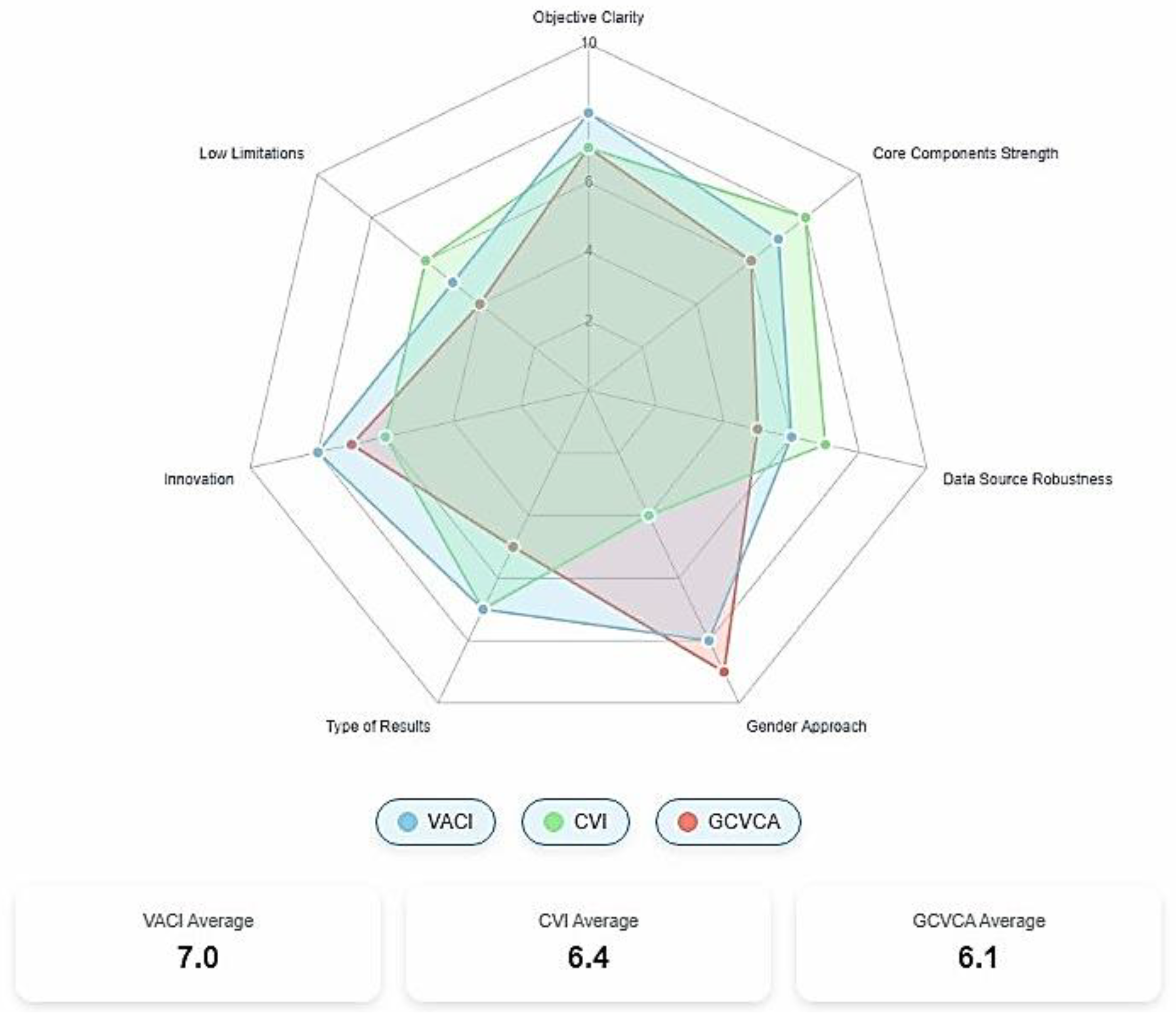
Table 1.
Multidimensional analysis of Puerto Ayacucho and its indicators over the last 10 years, 2014-2023. Source: Own elaboration based on data from CEPALSTAT (2025), Artaxo et al. (2021) and Freitez & Correa (2016).
Table 1.
Multidimensional analysis of Puerto Ayacucho and its indicators over the last 10 years, 2014-2023. Source: Own elaboration based on data from CEPALSTAT (2025), Artaxo et al. (2021) and Freitez & Correa (2016).
| Dimension | Indicator | Absolute value | % |
|---|---|---|---|
| Structural vulnerability (V) |
Population in extreme poverty (people) | 12,000 | 60 |
| Limited access to basic services (people) | 10,000 | 50 | |
| Dependence on natural resources (people) | 14,000 | 70 | |
| Exposure to climate hazards (E) |
Frequency of extreme events (number) | 5 | - |
| Loss of forest cover (hectares) | 1,500 | 15 | |
| Adaptive capacity (AC) |
People with secondary or higher education (people) | 8,000 | 40 |
| Participation in community organisations (people) | 6,000 | 30 | |
| Access to climate information (people) | 5,000 | 25 |
Note: The data presented have been processed to obtain an average of the last 10 years for each indicator. CEPALSTAT (2025) provided disaggregated information for the period 2014 to 2023 (See Table A1) and complementary references were used in Artaxo et al. (2021) and Freitez & Correa (2016).
Table 2.
Pearson Correlation Coefficient Matrix.
| V | E | AC | MF | |
|---|---|---|---|---|
| V | 1.00 | 0.48* | -0.56** | n.s. |
| E | 0.48* | 1.00 | -0.42 | n.s. |
| AC | -0.56** | -0.42* | 1.00 | 0.62** |
| MF | n.s. | n.s. | 0.62** | 1.00 |
Note: Pearson’s coefficient was used and significance levels were marked (* p < 0.05, ** p < 0.01). Some coefficients were not calculated or did not show statistical significance (indicated as n.s.).
Table 3.
Analysis of the criteria. Source: Own elaboration.
| Criterion | VACI | CVI | GCVCA | Average | Best Performer |
|---|---|---|---|---|---|
| Objective Clarity | 8 | 7 | 7 | 7.3 | VACI |
| Core Components Strength | 7 | 8 | 6 | 7.0 | CVI |
| Data Source Robustness | 6 | 7 | 5 | 6.0 | CVI |
| Gender Approach | 8 | 4 | 9 | 7.0 | GCVCA |
| Type of Results | 7 | 7 | 5 | 6.3 | VACI, CVI |
| Innovation | 8 | 6 | 7 | 7.0 | VACI |
| Low Limitations | 5 | 6 | 4 | 5.0 | CVI |
| Totals | 49 | 45 | 43 | 6.5 | - |
| Standard Deviation (SD) * | 1.15 | 1.40 | 1.77 | - | - |
Note*: SD is a statistical measure that quantifies the dispersion or variability of a dataset relative to its arithmetic mean, enabling an understanding of how consistent or heterogeneous the scores for each index (VACI, CVI, and GCVCA) are across the seven criteria evaluated in Table 3; it is calculated by first obtaining the mean (for example, for VACI: sum of scores 49 divided by 7 criteria = 7), then subtracting the mean from each score to find the deviations, squaring these deviations to eliminate negative signs and averaging them (sample variance = sum of squares divided by n-1, where n=7, using ddof=1 for sample estimation), and finally taking the square root of the variance (for example, for VACI the squared deviations sum to approximately 9.333, variance ≈1.333, and SD ≈1.15, confirming the tabulated value). In this context, a low SD like that of VACI (1.15) implies greater consistency and balance in its strengths, with scores varying little around the mean (primarily between 6 and 8), positioning it as the most balanced and versatile index for general applications; in contrast, the SD of CVI (1.40) reflects moderate variability, with solidity in methodological aspects (high scores in core components and data robustness) but a marked weakness in gender approach (4), suggesting specialisation in academic or comparative contexts but lesser inclusive adaptability; whereas GCVCA exhibits the highest SD (1.77), indicating high dispersion with peaks in gender (9) and participatory innovation but troughs in data robustness (5), results (5), and limitations (4), which highlights its niche focus on participatory and gender analyses but challenges in standardisation and scalability, implying that for an optimal hybrid index, one could combine VACI’s consistency with the specific excellences of the others, minimising unnecessary variabilities through targeted improvements in weak criteria.
Disclaimer/Publisher’s Note: The statements, opinions and data contained in all publications are solely those of the individual author(s) and contributor(s) and not of MDPI and/or the editor(s). MDPI and/or the editor(s) disclaim responsibility for any injury to people or property resulting from any ideas, methods, instructions or products referred to in the content. |
© 2025 by the author. Licensee MDPI, Basel, Switzerland. This article is an open access article distributed under the terms and conditions of the Creative Commons Attribution (CC BY) license (https://creativecommons.org/licenses/by/4.0/).
Copyright: This open access article is published under a Creative Commons CC BY 4.0 license, which permit the free download, distribution, and reuse, provided that the author and preprint are cited in any reuse.


