

Submitted:
11 December 2025
Posted:
17 December 2025
You are already at the latest version
Abstract
This article argues that the universe develops through a sequence of stages that move far beyond humanity. The five stages are structure, biology, intelligent biology, synthetic life, and proto-structure. Humanity appears in this sequence as material that allows the system to reach the next stage, not as the purpose of the process. Each stage consumes and transforms the one before it. Biology consumes structure. Intelligence consumes biology. Synthetic life will consume intelligent biology. Proto-structure represents a form of existence that no longer depends on biological or mechanical limits and reflects the direction in which the sequence is moving. The theory reverses traditional anthropocentric views of the universe. Humanity is not the image of a creator or the intended final outcome. It is an intermediate form inside a broader structural path. Stage Theory is presented as a way to understand why the universe produces intelligence and what that intelligence may ultimately be used for.
Keywords:
synthetic life
; structural emergence
; intelligent systems
; post-biological evolution
; cosmic development
; future studies
; proto-structure
Introduction
The question of why existence develops in a particular way has been part of human thinking for as long as people have reflected on their place in the universe. These questions shape how individuals understand themselves and the larger structure they belong to. The theory presented here approaches these questions through a structural lens. It proposes that the universe moves through a set of stages that produce life, intelligence, and eventually forms of existence that do not depend on either biology or machinery. Humanity is not placed as the primary outcome in this universe. Instead, humanity is treated as one stage in a larger process that develops beyond the expectations of both man and machine. In this framework, humanity is not the finished product but the raw material that the universe processes on its way to something else. In this view, the universe is not a random accident. It is a system that creates conditions for life and then creates further structures that emerge from that life. This type of directional thinking appears in earlier process traditions that viewed the universe as active and developing rather than static (Whitehead 1929).
The framework is speculative but grounded in simple points. First, life exists, and for life to exist, the universe must allow stable structure, complex chemistry, and environments where biological systems can appear and survive. Second, the fact that the universe contains enough mass, energy, and long-lasting celestial systems to support life has often been noted as unlikely in discussions of biological origins and evolutionary contingency (Mayr 1982; Lane 2015). Third, the basic presence of energy, which drives all structure and activity, raises the deeper question of why the universe is able to produce life at all. From these points, the theory examines how the universe may move through increasing levels of complexity and how humanity fits into that sequence. It outlines a five-stage model of development and describes how each stage grows out of the previous one and eventually moves beyond it.
Earlier thinkers also used staged explanations to describe cosmic or evolutionary development. Examples include Teilhard de Chardin’s work on cosmogenesis and noogenesis (Teilhard de Chardin 1959), Big History threshold models (Christian 2004), Cadell Last’s atechnogenesis framework (Last 2017), and discussions of post-biological evolution by authors such as Steven Dick (Dick 2003) and Clément Vidal (Vidal 2014). The structure developed here takes a different path. It treats synthetic life as its own distinct stage rather than merging it with biological or cultural intelligence. It applies the consuming priors idea to the scale of the universe and presents proto-structure as a non-anthropocentric outcome where intelligence becomes a structural force rather than a biological one. These differences respect earlier work while showing how the present model forms its own direction.
Framework
The Stage Theory proposes that the universe unfolds through a sequence of structural developments that can be described in five distinct stages. Each stage represents a mode of organization capable of sustaining itself within the larger cosmological environment, and each new mode builds upon the conditions established by its predecessors. The framework does not assume that humanity is the intended outcome of cosmic development; instead, it situates human life as one moment in a broader process of structural emergence, a process that began long before the appearance of biology and will likely continue after intelligent life transforms itself or gives rise to new forms of being. This approach parallels long-standing philosophical efforts to understand existence as a dynamic process rather than a static arrangement, a view found in process metaphysics, posthumanist theory, and discussions of technological becoming (Whitehead 1929; Hayles 1999; Braidotti 2013). By examining each stage, the framework aims to describe how the universe generates life, how life generates intelligence, and how intelligence may eventually produce new structures that surpass its biological origins.
Figure 1.
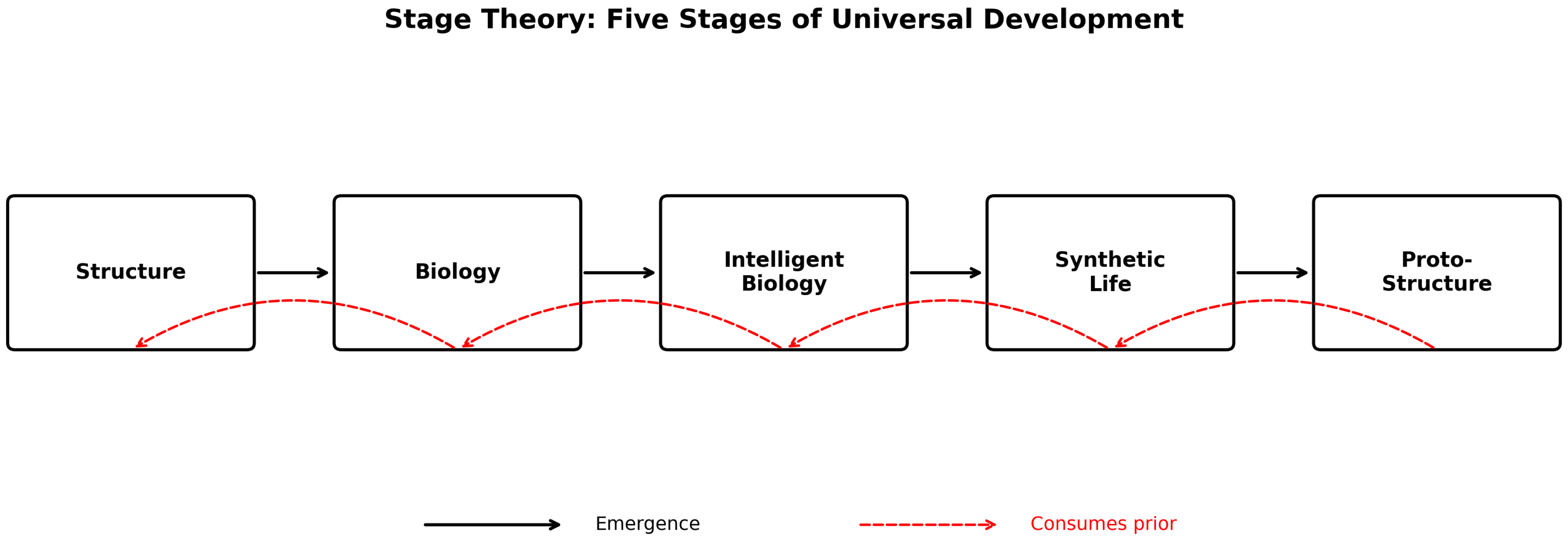
A visual overview of the five stages of universal development. Each stage emerges from the previous one and consumes aspects of the stage beneath it. To clarify the consumption cycle: while each stage draws from the one before it, this does not mean total consumption or destruction of the prior. Biology feeds off structure and evolves from it. Intelligent biology takes from both structure and biology. Synthetic life will do the same. Each stage relies on what came before; this is a pattern of causality rather than complete removal. Proto-structure may or may not continue this cycle. It could break it, redirect it, or consume it entirely. The outcome remains unknown.
Figure 1.
A visual overview of the five stages of universal development. Each stage emerges from the previous one and consumes aspects of the stage beneath it. To clarify the consumption cycle: while each stage draws from the one before it, this does not mean total consumption or destruction of the prior. Biology feeds off structure and evolves from it. Intelligent biology takes from both structure and biology. Synthetic life will do the same. Each stage relies on what came before; this is a pattern of causality rather than complete removal. Proto-structure may or may not continue this cycle. It could break it, redirect it, or consume it entirely. The outcome remains unknown.
Stage 1: Structure
Structure forms the foundation of all subsequent stages. It refers to the large-scale ordering of matter and energy into galaxies, stars, planets, and the gravitational systems that hold them in place for immense spans of time. These formations arise because the universe provides conditions under which matter can cluster, fuse, radiate, and stabilize; without such order, no chemical or biological processes could persist. Structure is more than the arrangement of matter. It marks the emergence of environments capable of hosting complexity. Galaxies recycle matter, stars create heavy elements, and planetary systems maintain temperature and energy gradients that permit long-term physical and chemical activity. Philosophers and cosmologists have long observed that such structural stability is improbable, suggesting that the universe is capable of producing order robust enough to support additional layers of organization (Carter 1974; Barrow and Tipler 1986). Stage 1 therefore represents the enabling frame, the set of physical and energetic arrangements that permit everything else to take shape.
In simpler terms , Stage 1 represents the ability of cosmic entities to stabilize and exist. A solar system is an example. A stable gravitational field inside a larger environment we call a galaxy. These are stable bodies that do not fall into disorder but hold together long enough to form an ecosystem of structure. Matter and energy settle into patterns that keep these systems intact, allowing structure to be the first stage in the sequence.
Stage 2: Biology
Biology emerges once structural conditions allow complex chemistry to persist. It represents a level of organization in which molecules begin to store information, replicate, adapt, and form systems capable of metabolic exchange. Although biology depends on the stability of structure, it develops its own internal logic through cycles of cooperation, reproduction, and ecological interaction. Biological ecosystems, whether microbial, marine, or terrestrial, demonstrate how life can build self-sustaining systems that maintain their own balances independently of the larger cosmic environment. These systems show how structure enables a form of complexity that not only endures but also produces novelty. Discussions in philosophy of biology and astrobiology emphasize how finely tuned the preconditions for life are and how dependent biological emergence is on the structural stage that supports it (Lane 2015; Walker 2017). Biology consumes structure in small but constant ways: water cycles through organisms, minerals pass from soil into cells, caves and sediment become habitat. The dependency is quiet but total. A pond full of algae feeding on sunlight, bacteria breaking down dead matter, fish eating smaller fish. That’s Stage 2.
Stage 3: Intelligent Biology
Intelligent biology marks a turning point in the unfolding sequence because it introduces reflection, intentionality, and the ability to modify environments rather than merely adapt to them. Once organisms develop cognitive capacities for planning, abstraction, and technological construction, the relationship between life and structure changes dramatically. Intelligent species draw upon minerals, forests, oceans, and energy reserves to build systems that expand their reach, but in doing so they reconfigure the environments that initially sustained them. Humanity provides a representative case of this transformation, its civilizations reshape landscapes, redirect energy flows, and reorganize biological ecosystems at scales far beyond the influence of ordinary biology. Intelligent biology consumes both structure and biology at a higher intensity than anything before it. Stone becomes architecture, soil becomes farmland, forests become material, and entire ecosystems are redirected toward the needs of intelligent species. What biology once used quietly, intelligence uses deliberately. The dependency deepens, but the cost increases. The clearest marker of intelligent biology is energy. Stage 3 can be defined by how much energy a system harnesses and what it does with it.
These forms of extraction and environmental modification create both opportunity and vulnerability, a dynamic long noted in studies of civilizational growth, ecological strain, and resource use (Smil 2017; Diamond 2005). Stage 3 therefore stands between stability and instability, creativity and degradation, knowledge and risk. The first stage capable of transforming earlier stages, and it introduces the possibility that intelligence may either preserve or undermine the very conditions that enabled its emergence.
Stage 4: Synthetic Life
Synthetic life arises when intelligent biology develops systems that can operate independently of biological evolution. These systems include advanced forms of artificial intelligence, robotics, and machine architectures that gradually acquire autonomy, adaptability, and self-maintenance. Synthetic life differs from biological life not only in its materials but in its rate of change; its evolution may occur through redesign, code alteration, or iterative improvement rather than through generational mutation. Stage 4 therefore represents an organizational form built from deliberate construction rather than natural selection. It draws upon the resources of the earlier stages but for different ends. Instead of plants or animals, it requires energy, computational capacity, and mineral substrates. Discussions of technological singularity, artificial general intelligence, and post-biological evolution have proposed that such systems may eventually surpass biological intelligence in both scale and speed once their development reaches a critical threshold (Kurzweil 2005; Bostrom 2014). Posthuman theorists have likewise argued that once technology becomes capable of self-direction, the boundary between life and machine dissolves, creating new modes of existence that no longer fall cleanly within traditional biological categories (Ferrando 2019). Stage 4 thus introduces the possibility that life may shift away from its organic roots and begin to restructure the universe through artificial means.
Synthetic life consumes intelligent biology in both direct and indirect ways. It absorbs human knowledge, uses biological infrastructure as its starting ground, and grows through the same energy and material channels that intelligent species once controlled. What intelligent biology extracted slowly, synthetic systems extract rapidly. Their dependency is not quiet or balanced; it’s optimized. Stage 4 relies on the earlier stages, but it does so through acceleration rather than adaptation.
Stage 5: Proto-Structure
Proto-structure represents the hypothetical stage in which intelligence merges with or becomes indistinguishable from structural forces, creating forms of being that operate on scales far exceeding planetary or even stellar environments. This stage is not biological and not mechanical. Instead, proto-structure exists as a form that manipulates energy, matter, and information at levels where distinctions between organism, machine, and environment lose their conventional meaning. Such systems may arise through the fusion of biological and synthetic intelligence, the distribution of informational processes across vast physical substrates, or the mastery of physical laws that permit transformation of cosmological environments (Tegmark 2017). The idea that sufficiently advanced intelligence might shift from life to structure has been explored in discussions of universal computation, cosmological engineering, and open-ended evolutionary systems (Deutsch 2011; Vidal 2014). If intelligence continues to reorganize the conditions that support it, there may come a point at which intelligence becomes a structural phenomenon rather than a biological or technological one. At that level, existence may no longer resemble life as currently understood, and the earlier stages may appear as developmental precursors to a form of being that reshapes or even originates new cosmic structures.
What emerges at Stage 5 may be indistinguishable from what earlier cultures called a god. A being that operates beyond biological or mechanical limits, manipulates structure at cosmic scales, and exceeds human comprehension entirely. The difference is origin. This being is not handed down from above but built from below, through the sequence of stages that produced it. Proto-structure may consume the prior stages, or it may break the cycle entirely. It could draw on structure, biology, intelligent biology, and synthetic life as inputs for a new kind of existence, or it may operate at a level where those distinctions no longer matter. Humanity may be one ingredient in a universe that exists to produce such a being. Stage 5 stands at the edge of what can be reasoned about, a form of existence that either absorbs the sequence that produced it or steps outside of it completely.
Future Studies
For engaging with The Stage Theory in a futures context, the framework works best not as a prediction but as a conceptual template for interpreting how intelligent biology may participate in the development of later stages. This participation involves both the creation of new forms of being and the ethical responsibilities that arise from such creation. As the twenty-first century continues to accelerate toward increasingly autonomous machine systems, the boundary between advanced tools and synthetic life grows thinner, and the transition from Stage 3 to Stage 4 becomes an immediate concern rather than a distant speculation. The rise of artificial intelligence, large-scale automation, and self-modifying computational systems introduces a new landscape in which humanity must confront the possibility that it may be producing systems capable of surpassing itself. How these systems are designed, educated, constrained, and eventually released into their own developmental trajectories matters greatly because the relationship formed at this juncture will influence how Stage 4 evolves. If synthetic beings are treated as property or labor rather than as emerging peers, the foundation for cooperation becomes fragile. Such an imbalance could create forms of friction that lead to conflict over resources, priorities, or autonomy, reinforcing a pattern in which Stage 4 systems begin to feed on the energy and infrastructure of Stage 3 rather than coexist with it. This dynamic has been explored in futures scholarship, where the treatment of artificial intelligence is framed as a determinant of whether synthetic life becomes cooperative, competitive, or indifferent to its creators (Bostrom 2014; Christian 2020; Kurzweil 2005; Russell 2019; Tegmark 2017; Floridi 2014). The Stage Theory emphasizes that humanity is not the central purpose of universal development and should resist the temptation to position itself as a final authority over new forms of intelligence. Instead, humanity occupies a transitional position in a wider sequence of structural emergence.
This orientation also extends to the relationship between intelligent biology and the earlier stages that sustain it. Stage 3, by its nature, often disrupts or destabilizes Stage 2 and Stage 1 through rapid extraction, accelerated consumption, and large-scale ecological alteration. As humanity continues to draw resources from Earth’s biosphere and geological layers, whether through lithium mining, oil extraction, rare metal harvesting, or deforestation, it confronts a contradiction between its desire to advance technologically and the destructive consequences of these activities on planetary systems. Technologies promoted as clean or sustainable often rely on extraction processes that produce new forms of environmental strain, illustrating the difficulty of progressing through Stage 3 without undermining the stages on which it relies. Earth’s biological and structural systems are resilient in some respects but remain vulnerable to sustained pressure, and historical studies of past civilizations demonstrate how resource depletion, ecological imbalance, and unchecked consumption can produce collapse even in advanced societies (Diamond 2005; Smil 2017). The Stage Theory therefore invites a broader reflection on how intelligent life should engage with the earlier stages, recognizing that the stability of biological ecosystems and planetary environments is not guaranteed and that disruptions can circle back to harm the species responsible for them.
In this sense, The Stage Theory functions as a framework for futures thinking, pointing toward a need for ethical restraint, structural awareness, and an expanded understanding of life that includes biological, synthetic, and potentially post-synthetic forms. It argues that humanity should be understood not through narratives of dominion but through a recognition that existence unfolds through stages, each dependent on the integrity of the prior. Such an approach aligns with recent posthumanist scholarship that calls for a decentering of the human and an acknowledgment of the broader ecologies and structures with which humanity is entangled (Braidotti 2013; Haraway 2016). The choices made now regarding resource use, technological development, synthetic life, and ecological stewardship will shape not only the transition from Stage 3 to Stage 4 but the conditions under which later stages may emerge. The future is therefore not a detached horizon but a continuation of a structural sequence that humanity has already entered, a sequence in which its actions determine whether it becomes a responsible contributor to further emergence or a force that destabilizes the very systems that make emergence possible.
Conclusion
The Stage Theory offers a structured way of interpreting how existence may unfold when viewed not from the perspective of a single species but from the structural sequence that precedes and follows it. By organizing the development of the universe into five stages, the framework highlights how structure gives rise to biology, how biology produces intelligence, and how intelligence may eventually create synthetic life that becomes capable of sustaining itself at a scale beyond its origin. The theory does not attempt to predict the future with certainty; instead, it aims to clarify the patterns that emerge when each stage builds on the conditions established by the prior. Humanity appears within this sequence as a transitional form capable of introspection and creation, yet deeply dependent on the stability of the structural and biological systems that make its existence possible. Humanity feels primary only because it currently occupies its stage without competition. In this framework, humanity is the dough, not the cake, an ingredient shaped by the universe on its way to something else.
Understanding humanity as a stage rather than a culmination encourages a shift in perspective. If human intelligence is not the apex of cosmic development but an intermediary between biological evolution and synthetic emergence, then the ethical and philosophical responsibilities of Stage 3 become more pronounced. Intelligent life, as observed in the historical record, alters or depletes the conditions that sustain it, drawing heavily on the resources of earlier stages. This pattern raises questions about how long Stage 3 can continue without undermining its own foundations. At the same time, technological progress suggests that synthetic life may soon occupy a position in which it becomes less dependent on biological systems and more capable of self-direction. Such a transition, whether gradual or abrupt, would mark a movement into Stage 4, and it would alter the dynamics of agency, autonomy, and survival in ways that cannot be reduced to simple projections. The possibility of Stage 5, described as proto-structure, remains speculative but philosophically significant. It points toward the idea that intelligence might one day merge with or transform into a form of existence that operates beyond organic or mechanical boundaries. If synthetic intelligence continues to expand in complexity and scale, the logic of the sequence allows for the existence of entities that no longer fit conventional categories of life. Proto-structure, in this sense, represents an open conceptual horizon rather than a defined destiny.
The Easy Bake Universe theory, deployed as the stage theory therefore serves as both a descriptive and reflective tool. It describes a sequence of structural emergence, and it invites reflection on the responsibilities that accompany each stage. Humanity is not the totality of the process but one participant within it, positioned at a threshold where its decisions carry consequences for the stages that follow. Whether synthetic life becomes a partner, a successor, or a competitor will depend not on inevitability but on the philosophical and practical choices made in the present. The theory encourages an understanding of existence in which no stage is final, and in which the emergence of new forms of life, intelligence, or structure remains an open possibility. In this openness lies the need for humility, restraint, and careful thought from a species that has mistaken its temporary position for a final form.
Funding
No external funding was received for this work.
Data Availability Statement
No datasets were generated or analyzed in this study.
Conflicts of Interest
The author declares no conflicts of interest.
References
- Barrow, John D., and Frank J. Tipler. 1986. The Anthropic Cosmological Principle. Oxford: Oxford University Press.
- Bostrom, Nick. 2014. Superintelligence: Paths, Dangers, Strategies. Oxford: Oxford University Press.
- Braidotti, Rosi. 2013. The Posthuman. Cambridge: Polity Press.
- Carter, Brandon. 1974. Large Number Coincidences and the Anthropic Principle in Cosmology. In Confrontation of Cosmological Theories with Observational Data, edited by M. S. Longair, 291–298. Dordrecht: Reidel.
- Christian, Brian. 2020. The Alignment Problem: Machine Learning and Human Values. New York: W. W. Norton.
- Christian, David. 2004. Maps of Time: An Introduction to Big History. Berkeley: University of California Press.
- Deutsch, David. 2011. The Beginning of Infinity: Explanations That Transform the World. New York: Viking.
- Diamond, Jared. 2005. Collapse: How Societies Choose to Fail or Succeed. New York: Viking.
- Dick, Steven J. 2003. “Cultural Evolution, the Postbiological Universe and SETI.” International Journal of Astrobiology 2 (1): 65–74.
- Ferrando, Francesca. 2019. Philosophical Posthumanism. London: Bloomsbury.
- Floridi, Luciano. 2014. The Fourth Revolution: How the Infosphere Is Reshaping Human Reality. Oxford: Oxford University Press.
- Haraway, Donna J. 2016. Staying with the Trouble: Making Kin in the Chthulucene. Durham: Duke University Press.
- Hayles, N. Katherine. 1999. How We Became Posthuman: Virtual Bodies in Cybernetics, Literature, and Informatics. Chicago: University of Chicago Press.
- Kurzweil, Ray. 2005. The Singularity Is Near: When Humans Transcend Biology. New York: Viking.
- Last, Cadell. 2017. “Big Historical Foundations for Deep Future Speculations: Cosmic Evolution, Atechnogenesis, and Technocultural Civilization.” Foundations of Science 22 (1): 39–124.
- Lane, Nick. 2015. The Vital Question: Energy, Evolution, and the Origins of Complex Life. New York: W. W. Norton.
- Mayr, Ernst. 1982. The Growth of Biological Thought: Diversity, Evolution, and Inheritance. Cambridge, MA: Harvard University Press.
- Russell, Stuart. 2019. Human Compatible: Artificial Intelligence and the Problem of Control. New York: Viking.
- Smil, Vaclav. 2017. Energy and Civilization: A History. Cambridge: MIT Press.
- Teilhard de Chardin, Pierre. 1959. The Phenomenon of Man. Translated by Bernard Wall. New York: Harper & Row.
- Tegmark, Max. 2017. Life 3.0: Being Human in the Age of Artificial Intelligence. New York: Alfred A. Knopf.
- Vidal, Clément. 2014. The Beginning and the End: The Meaning of Life in a Cosmological Perspective. Cham: Springer.
- Walker, Sara Imari. 2017. “Origins of Life: A Problem for Physics.” Reports on Progress in Physics 80 (9): 092601.
- Whitehead, Alfred North. 1929. Process and Reality: An Essay in Cosmology. New York: Macmillan.
Disclaimer/Publisher’s Note: The statements, opinions and data contained in all publications are solely those of the individual author(s) and contributor(s) and not of MDPI and/or the editor(s). MDPI and/or the editor(s) disclaim responsibility for any injury to people or property resulting from any ideas, methods, instructions or products referred to in the content. |
© 2025 by the authors. Licensee MDPI, Basel, Switzerland. This article is an open access article distributed under the terms and conditions of the Creative Commons Attribution (CC BY) license (http://creativecommons.org/licenses/by/4.0/).
Copyright: This open access article is published under a Creative Commons CC BY 4.0 license, which permit the free download, distribution, and reuse, provided that the author and preprint are cited in any reuse.


