

Submitted:
11 December 2025
Posted:
12 December 2025
You are already at the latest version
Abstract
Visual impairment during adolescence can affect educational outcomes and psychosocial development, particularly in settings with limited access to comprehensive eye care. This study aimed to assess the prevalence of refractive errors and the adequacy of spectacle correction among secondary school students in Da Nang, Vietnam. A school-based cross-sectional survey was conducted among 8th-grade students at Le Do Secondary School in the Son Tra District. Visual acuity, refractive status, and spectacle use were evaluated using standard clinical procedures. Verbal consent was obtained from students, with teachers acting as guardians, and retrospective ethical approval was granted (IRB No. P01-202410-01-039). Of 350 eligible students, 315 were included in the analysis. Based on the better-seeing eye, 15.9% of students had myopia, and refractive errors were identified in 40.3% when either eye was considered. At the time of assessment, 24.8% wore spectacles; however, 41.6% required refractive correction, including 29.8% with uncorrected refractive error and 11.8% whose spectacles did not adequately correct their vision. These findings indicate gaps in both access to refractive services and the quality of provided corrections. Although limited to a single school, the results highlight the need for routine school-based vision screening and affordable, accurate spectacle provision. Larger, population-based studies are warranted to clarify the broader burden of refractive error among Vietnamese adolescents.
Keywords:
refractive errors
; visual acuity
; adolescent vision
; uncorrected refractive error
; Vietnam
1. Introduction
Refractive errors—including myopia, hyperopia, and astigmatism—are among the most common causes of visual impairment worldwide and frequently emerge during childhood and adolescence. Adequate vision is essential for learning, social interaction, and general well-being, and uncorrected refractive errors have been linked to reduced academic performance [1], limited participation in daily and extracurricular activities [2], and lower self-esteem among adolescents [3]. Globally, the burden of uncorrected refractive errors remains substantial, despite the fact that most conditions can be effectively corrected with simple, low-cost interventions such as spectacles [4].
The prevalence of refractive errors varies across regions and is influenced by genetic, environmental, and behavioral factors. East Asia, in particular, has experienced a rapid rise in myopia, with prevalence exceeding 70% among adolescents in countries such as China, Japan, and South Korea [5]. This trend has raised concerns about long-term visual health and the growing socioeconomic impact of uncorrected refractive error. In many low- and middle-income countries, including Vietnam, access to comprehensive vision screening and accurate spectacle correction remains limited, leading to unmet needs that may hinder educational and developmental outcomes [6].
Given these challenges, this study aimed to examine the visual status of secondary school adolescents in Vietnam by assessing the prevalence of refractive errors, identifying inadequate spectacle correction, and quantifying the unmet need for appropriate vision correction.
2. Materials and Methods
2.1. Study Design, Setting, and Sample
This cross-sectional, school-based study was conducted at Le Do Secondary School in Sơn Trà District, Da Nang City. The school was selected for its large 8th-grade population and strong community collaboration, which facilitated efficient data collection. The study focused on 8th-grade students (aged 12–13 years), a critical period for the development of myopia.
Among 450 eligible students, 350 (78%) participated. After excluding 32 students with incomplete data and 3 outside the target age range, 315 students were included in the final analysis. The population of 12–13-year-olds in Sơn Trà was estimated at 4,500 in 2023, making the sample approximately 7% of this age group. Applying finite population correction, the margin of error was ±5.3%, providing reasonable precision for assessing this adolescent population.
The survey, supported by LabSD, Inc. and World Vision Korea, collected demographic information, visual acuity, refractive status, spectacle use, and instances of inadequate correction. The district’s socioeconomic context—with nearly 20% of households living on less than USD 2 per day—provides important background for interpreting barriers to eye-care access.
2.2. Study Procedures
Data were collected over two days (10–11 October 2023) using a standardized five-step protocol implemented by LabSD, Inc., HYSK, PH, and World Vision Korea/Vietnam. Measurements were performed by one ophthalmologist and two licensed optometrists. Verbal informed consent was obtained from students, with teachers acting as guardians. Ethical approval was granted retrospectively by the Institutional Review Board (IRB No. P01-202410-01-039).
The five-step protocol (Figure 1) included:
Step 1. Visual Acuity Assessment: VA was measured using a Landolt C chart (decimal notation, 0/10–10/10). Students wearing spectacles were tested with their habitual correction.
Step 2. Objective Refraction: Autorefractometer (Tomey TR 4000) was used to measure refractive error. Cycloplegia was not applied, and astigmatism was not evaluated.
Step 3. Trial Lens Selection: Lenses were selected based on VA and objective refraction.
Step 4. Subjective Refraction: Optimal corrective prescription was confirmed using the Landolt C chart.
Step 5. Data Collation and Spectacle Provision: Demographic and clinical data, current spectacle use, and related issues were recorded. Spectacles were provided to students needing correction to address visual impairment and evaluate barriers to use.
2.3. Statistical Analysis
Data were analyzed using Stata 17.0 (StataCorp LLC, College Station, TX, USA). Frequencies and proportions summarized student characteristics. Prevalence estimates were calculated for visual impairment, refractive errors, and gaps between spectacle need and use.
Visual impairment categories were based on WHO criteria (2019) [5] using the better-seeing eye:
- No VI: VA ≥ 0.50
- Mild VI: 0.33 ≤ VA < 0.50
- Moderate VI: 0.10 ≤ VA < 0.33
- Severe VI/Blindness: VA < 0.10
Refractive error analysis used spherical equivalent values [6]:
- Emmetropia: +0.25 D to –0.25 D
- Myopia: ≤ –0.50 D
- Hyperopia: ≥ +0.50 D
These cutoffs align with standard definitions to facilitate comparison with previous studies.
3. Results
3.1. Characteristics of the Study Population
The study sample included 315 students, predominantly 13 years old (78.7%, 95% CI: 73.8–83.0%), compared with 21.3% (95% CI: 17.0–26.2%) for 12-year-olds (p = 0.023). Gender distribution was nearly equal, with males representing 49.5% (95% CI: 44.0–55.0%) and females 50.5% (95% CI: 45.0–56.0%) (p = 0.910) (Table 1).
Visual acuity assessment of the better-seeing eye revealed that 84.1% of students had no impairment, 3.2% had mild impairment, and 12.7% had moderate impairment (p < 0.001). Refractive error evaluation showed that emmetropia was most prevalent (59.7%, 95% CI: 54.1–65.1%), followed by myopia (30.5%, 95% CI: 25.5–36.0%) and anisometropia (9.8%, 95% CI: 6.9–13.8%; p < 0.001). Only 24.8% (95% CI: 20.2–30.1%) of students reported wearing spectacles, while 75.2% did not (p < 0.001). Confidence intervals were calculated using the Wilson score method, and categorical comparisons were performed with chi-square tests (α = 0.05).
3.2. Visual Functioning
3.2.1. Visual Acuity
Assessment in either eye indicated that 67.9% of students had no visual impairment, while mild and moderate impairment were observed in 6.0% and 18.7%, respectively. Bilateral moderate visual impairment was present in 12.4%, and 0.6% had mild impairment in both eyes. Only one student (0.3%) presented with severe impairment in one eye, resulting in approximately 25% of students experiencing some degree of visual limitation in at least one eye (Table 2).
3.2.2. Refractive Errors
Emmetropia in both eyes was observed in 59.7% of students, while myopia in at least one eye was present in 37.5%, including 30.5% with bilateral myopia. Hyperopia was uncommon, affecting only 1.3% of students. Overall, 37.5% of students exhibited refractive errors in at least one eye, with myopia being the most frequent type (Table 3).
3.2.3. Spectacle Use and Need
At the time of assessment, 78 students (24.8%) were wearing spectacles, while 131 students (41.6%) were identified as needing spectacles—either due to uncorrected visual impairment or inadequate correction with existing spectacles. Only 37 students (11.8%) belonged to both groups, indicating that they wore spectacles but still required improved correction. Among current spectacle users, 41 students (13.0%) had adequate correction and did not require new spectacles, whereas 94 students (29.8%) were not wearing spectacles despite needing correction (Table 4).
Among students with visual impairment, blindness, or refractive error, 131 were classified as needing spectacles, including 50 with visual impairment or blindness and 127 with refractive error, with some overlap. All 37 students wearing spectacles in this subgroup were also included among those needing improved correction. These findings highlight substantial unmet needs for both initial and optimal spectacle correction (Table 5).
4. Discussion
4.1. Prevalence and Comparison of Refractive Errors
This study revealed a myopia prevalence of 30.5% among secondary school students, with 37.5% affected in the right eye and 33.3% in the left eye. Hyperopia was uncommon (1.3%), and 59.7% of students were emmetropic. Compared with East Asian countries such as China, where adolescent myopia prevalence can exceed 90% [7], our rates are considerably lower. These differences likely reflect variations in genetic predisposition, educational intensity, outdoor activity, and urbanization. The results are more comparable to data from Mexico [8], suggesting that lifestyle and environmental factors contribute substantially to regional variation. However, comparisons should be interpreted cautiously due to differences in age groups, sampling methods, study settings, and measurement techniques, including cycloplegic versus non-cycloplegic refraction.
4.2. Visual Acuity and Spectacle Needs
Our findings indicate a greater need for spectacles than would be suggested by visual acuity alone. Over 40% of existing prescriptions did not provide adequate correction, highlighting gaps in refraction accuracy and prescription quality. Adolescents often continue to use outdated prescriptions, sometimes for over two years, leading to compromised visual function and comfort. These findings emphasize the importance of comprehensive eye examinations that assess both visual acuity and refractive status, rather than relying solely on visual acuity screening.
4.3. Structural and Systemic Challenges
Vietnam lacks a legally regulated optometrist licensing system, and optometry is not formally integrated into the healthcare system [9]. This gap results in unqualified individuals performing refractions and dispensing spectacles, particularly in rural and low-resource areas [10]. Although training programs have begun producing optometrists [11], broader systemic support and quality assurance for refractive services remain insufficient, limiting accurate diagnosis and management.
4.4. Public Health Implications
Early detection and correction of refractive errors during adolescence are crucial to prevent long-term complications, such as amblyopia and strabismus, which can affect vision and overall well-being [12]. School-based vision programs, standardized refractive assessments, and public awareness campaigns could substantially improve detection and management [13,14,15,16]. International experiences, such as Singapore’s nationwide school-based screening program, demonstrate the effectiveness of systematic approaches in timely spectacle provision and myopia control [17,18]. Adopting similar standardized protocols in Vietnam could enhance equity and coverage.
4.5. Study Limitations
Several limitations should be noted. Verbal consent and retrospective IRB approval limit adherence to conventional ethical standards. Technical limitations include the absence of cycloplegia and assessment of astigmatism, which may have underestimated hyperopia and limited refractive error characterization. The single-school, single-grade design restricts generalizability, and the lack of multivariate analysis limits exploration of associated factors. Despite these constraints, the study provides a descriptive overview of refractive error prevalence and spectacle needs, serving as a foundation for future research.
5. Conclusions
This study identified a substantial unmet need for refractive correction among secondary school adolescents in an urban district of Da Nang, Vietnam. Many students either did not wear spectacles or used inadequate prescriptions, reflecting gaps in refraction accuracy and access to eye care. These findings provide baseline data for adolescent eye health in this setting and underscore the importance of comprehensive eye examinations that assess both visual acuity and refractive status. Larger, representative studies are warranted to better understand prevalence, determinants, and unmet needs for spectacle correction in Vietnam
Author Contributions
Conceptualization: JWK, HYSK, Methodology: PH, HYSK, Investigation: PH, HYSK, Data Curation: JWK, Formal Analysis: JWK, Writing – Original Draft: JWK, Writing – Review & Editing: JWK, HYSK, Visualization: JWK, Supervision: JWK, HYSK, Project Administration: PH, Funding Acquisition: HYSK.
Funding
This research was funded by the Orange Puzzle Program (Grand Prize, 2023 Social Innovation Grant Competition) implemented by World Vision Korea. All authors are affiliated with and receive salary support from LabSD, Inc.A total of VND 50,280,000 was spent on 136 pairs of spectacles. Honoraria totaling VND 4,000,000 were provided to three local medical professionals. Additional costs—including compensation for a local staff member (Ms. Loan), the research team’s time, and minor logistical expenses such as stationery and refreshments—were not included in the above estimates. APC was paid by LabSD, Inc.
Institutional Review Board Statement
The study was conducted in accordance with the Declaration of Helsinki and approved by the Public Institutional Bioethics Committee under the Ministry of Health and Welfare in South Korea (protocol code P01-202410-01-039, approved on 21 October 2024). Verbal informed consent was obtained from all participating students and their teachers acting as guardians. The use of verbal consent and retrospective ethical approval represents a limitation of this study.
Informed Consent Statement
Verbal informed consent was obtained from all participating students and their teachers acting as guardians prior to data collection. Written informed consent for publication was not required, as no individual participants can be identified from the data presented.
Data Availability Statement
The data supporting this study are not publicly available. However, they can be shared upon reasonable request to LabSD, Inc.
Acknowledgments
The authors express their sincere gratitude to the staff of World Vision Korea (Ms. Eunsil Park), World Vision Vietnam (Mr. Ngô Công Thành and Ms. Lê Nguyễn Hoàng Vy), Sơn Trà District Health Center, and Le Do Secondary School for their valuable support in the implementation of this study. Special thanks are extended to Dr. Dang Thi Giang (ophthalmologist, Sơn Trà District Health Center), Dr. Luu Thi Thanh Tam, and Dr. Huynh Xuan Hai (optometrists, Haiha Optical Shop) for their assistance with visual acuity and refractive error assessments. The last but not the least, the authors appreciate all the hard work and dedication of Kahlen Kyeongmin Kim, a former Project Manager of LabSD, Inc. for her contribution. This manuscript was edited for language clarity using an AI-based tool (ChatGPT), and the authors take full responsibility for its content.
Conflicts of Interest
The authors declare no conflicts of interest.
Abbreviations
The following abbreviations are used in this manuscript:
| WVV | World Vision – Vietnam |
| LabSD | Laboratory for Sustainable Development |
References
- Pirindhavellie, G.; Govender-Poonsamy, P.; et al. The impact of spectacle correction on the well-being of children with vision impairment due to uncorrected refractive error: a systematic review. BMC Public Health 2023, 23, 1575. Available online: https://bmcpublichealth.biomedcentral.com/articles/10.1186/s12889-023-16484-z. [CrossRef] [PubMed]
- Latif, M.Z.; et al. Impact of refractive errors on the academic performance of high school children of Lahore. Front Public Health 2022, 10, 869294. [Google Scholar] [CrossRef] [PubMed]
- Congdon, N.; Burnett, A.; Frick, K. The impact of uncorrected myopia on individuals and society. Community Eye Health 2019, 32, 7. Available online: https://www.cehjournal.org/article/the-impact-of-uncorrected-myopia-on-individuals-and-society/. [PubMed]
- Cao, H.; Cao, X.; Cao, Z.; Zhang, L.; Han, Y.; Guo, C. The prevalence and causes of pediatric uncorrected refractive error: pooled data from population studies for Global Burden of Disease (GBD) sub-regions. PLoS One 2022, 17, e0268800. [Google Scholar] [CrossRef] [PubMed]
- World Health Organization. World report on vision; WHO: Geneva, 2019. [Google Scholar]
- Jobke, S.; Kasten, E.; Vorwerk, C. The prevalence rates of refractive errors among children, adolescents, and adults in Germany. Clin Ophthalmol. 2008, 2, 601–607. Available online: https://www.ncbi.nlm.nih.gov/pmc/articles/PMC2694012/. [CrossRef] [PubMed]
- Zhou, Y.; Chen, X.; Huang, X.; et al. Prevalence and association of uncorrected refractive error among Chinese adolescents: a cross-sectional study. BMC Public Health 2024, 24, 2904. [Google Scholar] [CrossRef] [PubMed]
- Teran, E.; Felix, M.; Ramirez-Jaimes, R.; et al. Refractive errors of teenager students from Sinaloa, Mexico. Invest Ophthalmol Vis Sci. 2022, 63, 4462–A0172. [Google Scholar]
- International Agency for the Prevention of Blindness (IAPB). But where are the ophthalmologists/doctors? 2025. Available online: https://www.iapb.org/blog/but-where-are-the-ophthalmologists-doctors/ (accessed on 13 June 2025).
- Rao, P.; Ramchandran, R.; Baldonado, K.; et al. Patient perspectives on accessing eye-related healthcare from rural communities. Eye (Lond) 2024, 38, 3389–3391. [Google Scholar] [CrossRef] [PubMed]
- International Agency for the Prevention of Blindness (IAPB). Vietnam’s first optometry school. 2025. Available online: https://www.iapb.org/news/vietnams-first-optometry-school (accessed on 13 June 2025).
- Wu, J.; Wang, N. Prevalence and characteristics of amblyopia, strabismus, and refractive errors among patients aged 3–16 years in Shanghai, China: a hospital-based population study. BMC Ophthalmol. 2024, 24, 239. [Google Scholar] [CrossRef] [PubMed]
- International Agency for the Prevention of Blindness (IAPB). Sharing the perspective: The School Eye Health Programme in Viet Nam. 2022. Available online: https://www.iapb.org/news/sharing-the-perspective-the-school-eye-health-programme-in-viet-nam (accessed on 13 June 2025).
- Alliance, Philanthropy Asia. Social Impact Guarantee for School Eye Health in Vietnam. 2023. Available online: https://philanthropyasiaalliance.org/our-impact/global—public-health/calls-to-action/social-impact-guarantee-for-school-eye-health-in-vietnam (accessed on 13 June 2025).
- Thư viện Pháp luật. Quyết định 56/QĐ-BGDĐT: Hướng dẫn nhân viên y tế trường học chăm sóc mắt cho trẻ em. 2023. Available online: https://thuvienphapluat.vn/van-ban/Giao-duc/Quyet-dinh-56-QD-BGDDT-2023-huong-dan-nhan-vien-y-te-truong-hoc-cham-soc-mat-cho-tre-em-550044.aspx (accessed on 9 June 2025).
- Thư viện Pháp luật. Quyết định 85/QĐ-TTg: Chương trình y tế trường học trong các cơ sở giáo dục mầm non và phổ thông. 2022. Available online: https://thuvienphapluat.vn/van-ban/Giao-duc/Quyet-dinh-85-QD-TTg-2022-Chuong-trinh-y-te-truong-hoc-trong-cac-co-so-giao-duc-mam-non-500959.aspx (accessed on 9 June 2025).
- Health Promotion Board. Singapore achieves breakthrough in reducing prevalence of myopia by almost 5%. Singapore: Health Promotion Board. 2011. Available online: https://www.hpb.gov.sg/newsroom/article/singapore-achieves-breakthrough-in-reducing-prevalence-of-myopia-by-almost-5.
- Ministry of Health; Singapore. Effectiveness of National Myopia Prevention Programme’s Strategies for Primary School Students; MOH: Singapore, 2023. Available online: https://www.moh.gov.sg/newsroom/effectiveness-of-national-myopia-prevention-programme-s-strategies-for-primary-school-student.
Figure 1.
Steps for Refraction Error Measurement and Data Collection.
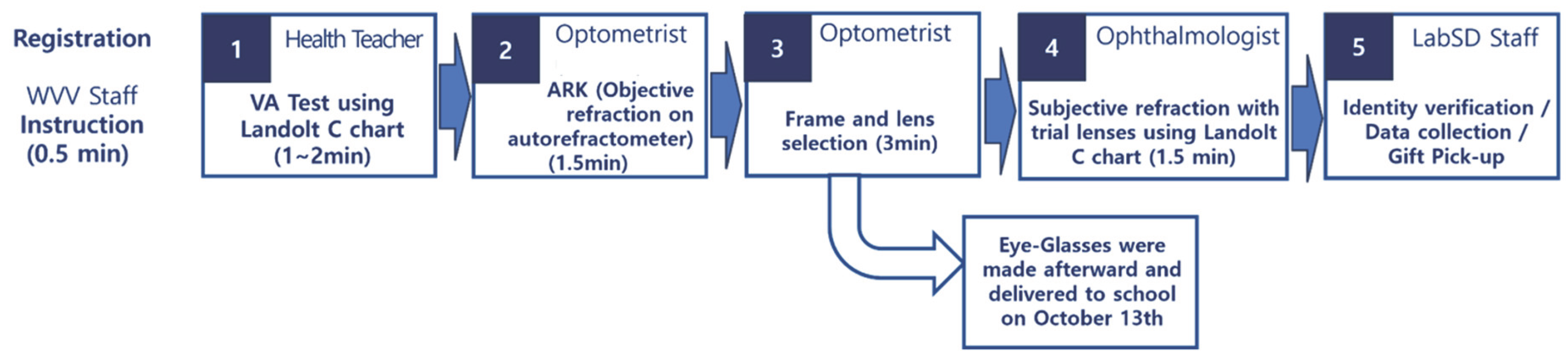

Table 1.
Students’ characteristics (n=315).
| Variables | Number of Students (%) | 95% Confidence Intervals | P-value |
|---|---|---|---|
| Age (Calculated in completed years as of October 11, 2023) | |||
| 12-year-old | 67 (21.3) | 17.0 – 26.2 | 0.023 |
| 13-year-old | 248 (78.7) | 73.8 – 83.0 | |
| Sex | |||
| Male | 156 (49.5) | 44.0 – 55.0 | 0.910 |
| Female | 159 (50.5) | 45.0 – 56.0 | |
| Visual Acuity (in the better eye) | |||
| No VI | 265 (84.1) | 80.0 – 88.0 | <0.001 |
| Mild VI | 10 (3.2) | 1.6 – 5.9 | |
| Moderate VI | 40 (12.7) | 9.3 – 16.8 | |
| Refraction Error (RightorLeft)* | |||
| Emmetropia | 188 (59.7) | 54.1 – 65.1 | <0.001 |
| Myopia | 96 (30.5) | 25.5 – 36.0 | |
| Anisometropia (Myopia – Emmetropia, Emmetropia – Myopia, Myopia – Hyperopia) | 31 (9.8) | 6.9 – 13.8 | |
| Wearing Spectacles | |||
| Yes | 78 (24.8) | 20.2 – 30.1 | <0.001 |
| No | 237 (75.2) | 79.9 – 79.8 | |
* For refractive error, only the spherical component (SPH) of the right eye was considered, given its primary relevance to myopia and hyperopia.
Table 2.
Cross-tabulation of Visual Acuity Categories between right and left eye (n = 315).
| Left eye (%) | |||||
| Mild VI (≥0.33 and <0.5) | Moderate VI (≥ 0.1 and < 0.33) | No VI (≥0.5) | Total | ||
| Right eye (%) |
Mild VI (≥0.33 and <0.5) | 2 (0.6) | 6 (1.9) | 11 (3.5) | 19 (6.0) |
| Moderate VI (≥ 0.1 and < 0.33) |
2 (0.6) | 39 (12.4) | 18 (5.7) | 59 (18.7) | |
| Severe VI or Blindness (<0.1) | 0 (0.0) | 1 (0.3) | 0 (0.0) | 1 (0.3) | |
| No VI (≥0.5) | 11 (3.5) | 11 (3.5) | 214 (67.9) | 236 (74.9) | |
| Total | 15 (4.8) | 57 (18.1) | 243 (77.1) | 315 (100.0) | |
Table 3.
Cross-tabulation of refractive status by right and left eye (n = 315).
| Left eye (%) | |||||
| Myopia | Hyperopia |
Emmetropia (in normal range) |
Total | ||
| Right eye (%) | Myopia | 96 (30.5) | 4 (1.3) | 18 (5.7) | 118 (37.5) |
| Emmetropia (in normal range) | 9 (2.9) | 0 (0.0) | 188 (59.7) | 197 (62.5) | |
| Total | 105 (33.3) | 4 (1.3) | 206 (65.4) | 315 (100.0) | |
Table 4.
Need for spectacles and current spectacle use (n=315).
| Number of students (%) | |
|---|---|
| Using spectacles (A) Children who are currently wearing spectacles. |
78 (24.8) |
| Needs for (new) spectacles (B) Children who need new spectacles (due to inadequate vision correction or change in refractive error). |
131 (41.6) |
| Using spectacles but need new spectacles (A ∩ B) Children who are currently wearing spectacles but require new spectacles because their current ones do not adequately correct their vision. |
37 (11.8) |
| Using proper spectacles (A – B) Children who are currently wearing spectacles and whose current spectacles adequately correct their vision, so they do not need new spectacles. |
41 (13.0) |
| Unmet need for spectacles (B – A) Children who need spectacles but are not currently wearing them. |
94 (29.8) |
Table 5.
Distribution of Spectacle Use and Need among Students with Visual Acuity (VA) and Refractive Error (RE) Issues (n=131).
Table 5.
Distribution of Spectacle Use and Need among Students with Visual Acuity (VA) and Refractive Error (RE) Issues (n=131).
| VI or Blindness | Refractive Error | Total (VI or Blindness or RE) |
|
|---|---|---|---|
| Using spectacles (C) | 19 | 33 | 37 |
| In need of (new) spectacles (D) | 50 | 127 | 131 |
| Using spectacles but need new spectacles (C ∩ D) | 19 | 33 | 37 |
| Total (C ∪ D) | 50 | 127 | 131 |
Disclaimer/Publisher’s Note: The statements, opinions and data contained in all publications are solely those of the individual author(s) and contributor(s) and not of MDPI and/or the editor(s). MDPI and/or the editor(s) disclaim responsibility for any injury to people or property resulting from any ideas, methods, instructions or products referred to in the content. |
© 2025 by the authors. Licensee MDPI, Basel, Switzerland. This article is an open access article distributed under the terms and conditions of the Creative Commons Attribution (CC BY) license (http://creativecommons.org/licenses/by/4.0/).
Copyright: This open access article is published under a Creative Commons CC BY 4.0 license, which permit the free download, distribution, and reuse, provided that the author and preprint are cited in any reuse.


