

Submitted:
10 December 2025
Posted:
11 December 2025
You are already at the latest version
Abstract
Driving rain or ‘wind-driven rain’ (WDR) arrives at the ground on an oblique trajectory, and drops may strike at a speed greater than their still-air terminal velocity. Oblique rain can affect a range of geomorphic processes including the splash dislodgment and transport of soil particles, and hydrological processes including overland flow, canopy interception and the generation of stemflow. The mean rain inclination angle at which WDR strikes the ground has been estimated from the catch of paired gauges, one with a conventional horizontal orifice, and one with a vertical orifice. Such data allow the resolution of rain vectors to find the rain inclination. This can only be carried out over periods sufficiently long for a measurable rain depth to be measured, and does not permit the real-time recording of rain inclination. Here, a new acoustic method for measuring rain inclination is introduced that provides an inexpensive tool for the continuous, real-time monitoring of WDR. Furthermore, the method also permits the simultaneous recording of rainfall duration and intermittency at high temporal resolution, with no additional apparatus. Data on rain inclinations collected during showers on a tropical coast exposed to strong trade-winds are presented to illustrate the operation of the acoustic measurement system. However, the focus of this paper is the presentation of the new method itself, and not on the climatology of WDR.
Keywords:
1. Introduction
1.1. The Behaviour of Rainfall Affected by Wind
1.2. What Effects Arise at the Soil Surface During WDR?
1.3. WDR Is Typically Not Targeted in Field Experiments Using Rainfall Simulation
1.4. Some Hydrologic Effects of WDR
2. Approaches to the Measurement of Rain Inclination
3. Materials and Methods
3.1. Designing a New Instrument for the Acoustic Recording of Rain Inclination
3.2. The Acoustic Sensors
3.3. Effect of Wind Obstruction by the Vertical Acoustic Sensor on Droplet Deflection
3.4. Field Deployment and Data Collection
3.5. A Note on Data Processing
4. Results
4.1. Noise Levels in The absence of Rain But Under Windy Conditions
4.2. Sample Rain Inclination Data from Continuous Field Monitoring
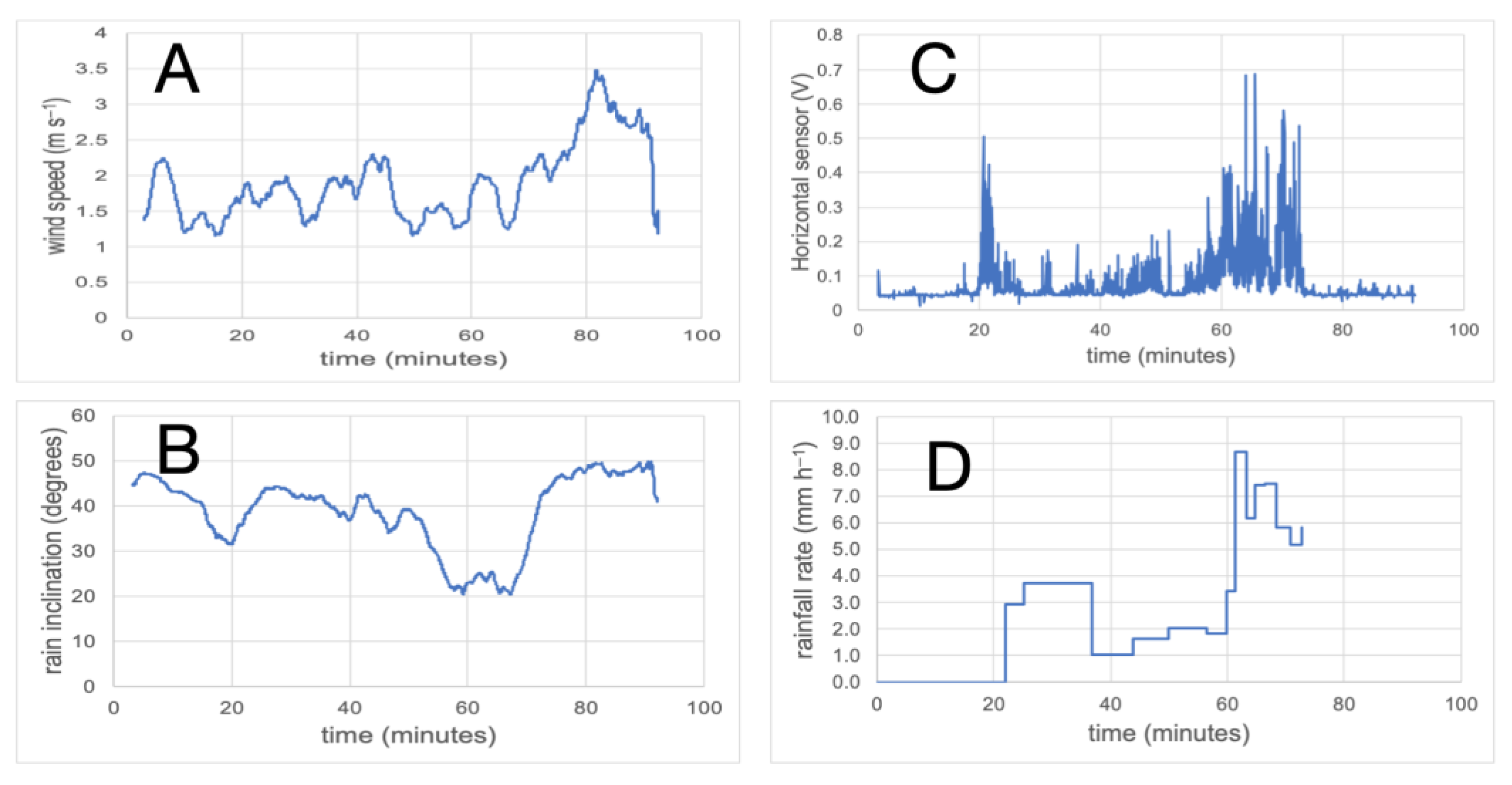
4.3. Rain Inclination and Related Data from 13 August 2025
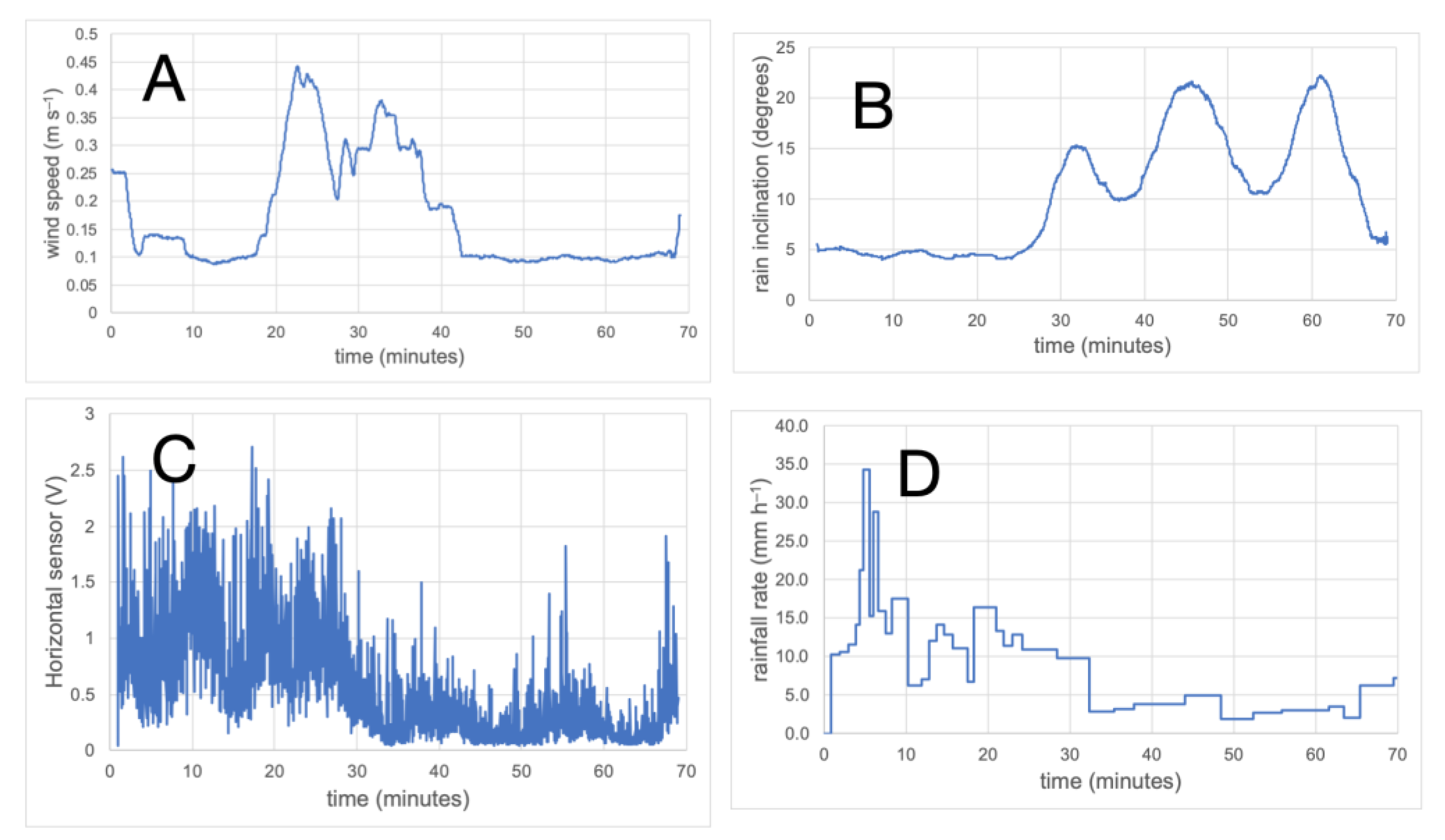
4.3. Rain Inclination and Related Data from 1 August 2025
5. Discussion
6. Conclusions
Funding
Data Availability Statement
Conflicts of Interest
References
- An, M.; Han, Y.; Zhao, C.; Qu, Z.; Xu, P.; Wang, X.; He, X. Effects of different wind directions on soil erosion and nitrogen loss processes under simulated wind-driven rain. CATENA 2022, 217, 106423. [Google Scholar] [CrossRef]
- Gunn, R.; Kinzer, G.D. The terminal velocity of fall for water droplets in stagnant air. Journal of Meteorology 1949, 6, 243–248. [Google Scholar] [CrossRef]
- O’Grady, J.; Ramsay, H.; McInnes, K.; Gregory, R. Evaluation of Parametric Tropical Cyclone Surface Winds over the Eastern Australian Region. Monthly Weather Review 2024, 152, 345–361. [Google Scholar] [CrossRef]
- Fu, X.; Li, H.-N.; Yi, T.-H. Research on motion of wind-driven rain and rain load acting on transmission tower. Journal of Wind Engineering and Industrial Aerodynamics 2015, 139, 27–36. [Google Scholar] [CrossRef]
- Lu, H.; Jia, N.; Jiang, J.; Qi, H. Effects of Wind Speed on Shape and Fall Velocity of Raindrops. Proceedings of 2019 International Conference on Meteorology Observations (ICMO), 28-31 Dec. 2019; 2019; pp. 1–4. [Google Scholar]
- Van Heerden, W.M. The direction of rain and its measurement. South African Journal of Agricultural Science 1961, 4, 51–61. [Google Scholar] [CrossRef]
- Australia, B.o.M. Climate data online. Available online: http://www.bom.gov.au/climate/averages/tables/cw_031011.shtml (accessed on 1 August 2025).
- Belcher, B.N.; DeGaetano, A.T.; Masters, F.J.; Crandell, J.; Morrison, M.J. Development of an Extreme Wind-Driven Rain Climatology for the Southeastern United States Using 1-Min Rainfall and Peak Wind Speed Data. Journal of Applied Meteorology and Climatology 2023, 62, 887–900. [Google Scholar] [CrossRef]
- Testik, F.Y.; Bolek, A. Wind and Turbulence Effects on Raindrop Fall Speed. Journal of the Atmospheric Sciences 2023, 80, 1065–1086. [Google Scholar] [CrossRef]
- Testik, F.Y.; Barros, A.P. Toward elucidating the microstructure of warm rainfall: A survey. Reviews of Geophysics 2007, 45. [Google Scholar] [CrossRef]
- Testik, F.Y.; Pei, B. Wind Effects on the Shape of Raindrop Size Distribution. Journal of Hydrometeorology 2017, 18, 1285–1303. [Google Scholar] [CrossRef]
- Montero-Martínez, G.; García-García, F. On the behaviour of raindrop fall speed due to wind. Quarterly Journal of the Royal Meteorological Society 2016, 142, 2013–2020. [Google Scholar] [CrossRef]
- Herwitz, S.R.; Slye, R.E. SPATIAL VARIABILITY IN THE INTERCEPTION OF INCLINED RAINFALL BY A TROPICAL RAINFOREST CANOPY. Selbyana 1992, 13, 62–71. [Google Scholar]
- Hamilton, E.L. Rainfall sampling on rugged terrain.; Washington D.C., 1954; p. 41pp. [Google Scholar]
- Sharon, D. The distribution of hydrologically effective rainfall incident on sloping ground. Journal of Hydrology 1980, 46, 165–188. [Google Scholar] [CrossRef]
- Mao, W.; Zhang, W.; Kou, M. Statistical characteristics of raindrop size distribution during rainy seasons in complicated mountain terrain. Hydrol. Earth Syst. Sci. 2023, 27, 3895–3910. [Google Scholar] [CrossRef]
- Marsico, A.; De Santis, V.; Capolongo, D. Erosion Rate of the Aliano Biancana Badlands Based on a 3D Multi-Temporal High-Resolution Survey and Implications for Wind-Driven Rain. In Land 2021, Vol. 10. [Google Scholar] [CrossRef]
- Beullens, J.; Van de Velde, D.; Nyssen, J. Impact of slope aspect on hydrological rainfall and on the magnitude of rill erosion in Belgium and northern France. CATENA 2014, 114, 129–139. [Google Scholar] [CrossRef]
- Pedersen, H.S.; Hasholt, B. Influence of wind speed on rainsplash erosion. CATENA 1995, 24, 39–54. [Google Scholar] [CrossRef]
- Helming, K. Wind speed effects on rain erosivity. In Sustaining the global farm. Papers from the 10th International Soil Conservation Organisation Meeting, Purdue University, May 1999., D.E. Scott, R.H.M., G.C. Steinhardt, Ed. 2001; pp. 771-776.
- Schmidt, J.; Werner, M.v.; Schindewolf, M. Wind effects on soil erosion by water — A sensitivity analysis using model simulations on catchment scale. CATENA 2017, 148, 168–175. [Google Scholar] [CrossRef]
- An, M.; Xie, Y.; Han, Y.; Wang, X.; Zhang, B. Response of particle detachment and hydrological processes on windward slope in laboratory flume experiments at different wind velocities and rainfall intensities. CATENA 2023, 228, 107155. [Google Scholar] [CrossRef]
- Lyles, L.; Disrud, L.A.; Woodruff, N.P. Effects of Soil Physical Properties, Rainfall Characteristics, and Wind Velocity on Clod Disintegration by Simulated Rainfall. Soil Science Society of America Journal 1969, 33, 302–306. [Google Scholar] [CrossRef]
- Lyles, L. Soil detachment and aggregate disintegration by wind-driven rain. In Soil Erosion: prediction and control.; Foster, G.R., Ed.; Soil Conservation Society of America: Ankeny, Iowa, USA, 1976; pp. 152–159. [Google Scholar]
- Erpul, G.; D. Norton, L.; Gabriels, D. THE EFFECT OF WIND ON RAINDROP IMPACT AND RAINSPLASH DETACHMENT. Transactions of the ASAE 2003, 46, 51. [Google Scholar] [CrossRef]
- Erpul, G.; Norton, L.D.; Gabriels, D. Splash-saltation trajectories of soil particles under wind-driven rain. Geomorphology 2004, 59, 31–42. [Google Scholar] [CrossRef]
- Kalehhouei, M.; Sadeghi, S.H.; Khaledi Darvishan, A. Changeability of runoff and soil loss from inclined mid-sized plots under simulated upward wind-driven rain. CATENA 2023, 232, 107453. [Google Scholar] [CrossRef]
- Fidari, J.S.; Zahira, N.A.; Hadiansyah, M.S.N.; Fitria, R.R.; Hartoyo, R.P. Experimental effect of wind and heavy rain on increased splash erosion using rainfall simulator. IOP Conference Series: Earth and Environmental Science 2024, 1311, 012070. [Google Scholar] [CrossRef]
- Ries, J.B.; Marzen, M.; Iserloh, T.; Fister, W. Soil erosion in Mediterranean landscapes—Experimental investigation on crusted surfaces by means of the Portable Wind and Rainfall Simulator. Journal of Arid Environments 2014, 100-101, 42–51. [Google Scholar] [CrossRef]
- Kuhn, N.J.; Greenwood, P.; Fister, W. Chapter 5.1—Use of Field Experiments in Soil Erosion Research. In Developments in Earth Surface Processes; Thornbush, M.J., Allen, C.D., Fitzpatrick, F.A., Eds.; Elsevier, 2014; Vol. 18, pp. 175–200. [Google Scholar]
- Marzen, M.; Iserloh, T.; Fister, W.; Seeger, M.; Rodrigo-Comino, J.; Ries, J.B. On-Site Water and Wind Erosion Experiments Reveal Relative Impact on Total Soil Erosion. Geosciences 2019, Vol. 9. [Google Scholar] [CrossRef]
- Choi, E.C.C. Wind-driven rain and driving rain coefficient during thunderstorms and non-thunderstorms. Journal of Wind Engineering and Industrial Aerodynamics 2001, 89, 293–308. [Google Scholar] [CrossRef]
- Dunkerley, D.L. Rainfall intensity bursts and the erosion of soils: an analysis highlighting the need for high temporal resolution rainfall data for research under current and future climates. Earth Surf. Dynam 2019, 7, 345–360. [Google Scholar] [CrossRef]
- Zambon, N.; Johannsen, L.L.; Strauss, P.; Dostal, T.; Zumr, D.; Neumann, M.; Cochrane, T.A.; Klik, A. Rainfall Parameters Affecting Splash Erosion under Natural Conditions. Applied Sciences 2020, 10. [Google Scholar] [CrossRef]
- Liu, J.; Liang, Y.; Gao, G.; Dunkerley, D.; Fu, B. Quantifying the effects of rainfall intensity fluctuation on runoff and soil loss: From indicators to models. Journal of Hydrology 2022, 607, 127494. [Google Scholar] [CrossRef]
- Williams, J.D.; Wilkins, D.E.; McCool, D.K.; Baarstad, L.L.; Klepper, B.L.; Papendick, R.I. A NEW RAINFALL SIMULATOR FOR USE IN LOW-ENERGY RAINFALL AREAS. Applied Engineering in Agriculture 1998, 14, 243–247. [Google Scholar] [CrossRef]
- Humphry, J.B.; Daniel, T.C.; Edwards, D.R.; Sharpley, A.N. A portable rainfall simulator for plot-scale runoff studies. Applied Engineering in Agriculture 2002, 18, 199. [Google Scholar] [CrossRef]
- Sangüesa, C.; Arumi, J.; Pizarro, R.; Link, Ó. A rainfall simulator for the in situ stidy of superficial runoff and soil erosion. Chilean Journal of Agricultural Research 2010, 70, 178–182. [Google Scholar] [CrossRef]
- Lascano, R.; Stout, J.; Goebel, T.; Gitz, D.C. A Portable and Mobile Rainfall Simulator. Open Journal of Soil Science 2019, 9, 207–218. [Google Scholar] [CrossRef]
- Lazarus, R.R.; Wan Jaafar, W.Z.; Alengaram, U.J.; Hin, L.S. Overview of the research gaps in the rainfall simulator study. Soil Science Society of America Journal 2023, n/a. [Google Scholar] [CrossRef]
- Vieira, G.; Mora, C.; Gouveia, M.M. Oblique rainfall and contemporary geomorphological dynamics (Serra da Estrela, Portugal). Hydrological Processes 2004, 18, 807–824. [Google Scholar] [CrossRef]
- Nouhou Bako, A.; Darboux, F.; James, F.; Josserand, C.; Lucas, C. Pressure and shear stress caused by raindrop impact at the soil surface: Scaling laws depending on the water depth. Earth Surface Processes and Landforms 2016, 41, 1199–1210. [Google Scholar] [CrossRef]
- Nouhou Bako, A.; Darboux, F.; James, F.; Lucas, C. Raindrop interaction in interrill erosion for steady rainfalls: A probabilistic approach. Water Resources Research 2017, 53, 4361–4375. [Google Scholar] [CrossRef]
- Giráldez, J.V.; Castro-Orgaz, O.; Gómez, J.A.; Laguna, A.M. Chapter 15—Rainfall and erosion/sediment transport. In Rainfall; Morbidelli, R., Ed.; Elsevier, 2022; pp. 397–426. [Google Scholar] [CrossRef]
- Panagos, P.; Borrelli, P.; Matthews, F.; Liakos, L.; Bezak, N.; Diodato, N.; Ballabio, C. Global rainfall erosivity projections for 2050 and 2070. Journal of Hydrology 2022, 610, 127865. [Google Scholar] [CrossRef]
- Zeng, Z.; Ziegler, A.D.; Searchinger, T.; Yang, L.; Chen, A.; Ju, K.; Piao, S.; Li, L.Z.X.; Ciais, P.; Chen, D.; et al. A reversal in global terrestrial stilling and its implications for wind energy production. Nature Climate Change 2019, 9, 979–985. [Google Scholar] [CrossRef]
- Zha, J.; Shen, C.; Li, Z.; Wu, J.; Zhao, D.; Fan, W.; Sun, M.; Azorin-Molina, C.; Deng, K. Projected changes in global terrestrial near-surface wind speed in 1.5 °C–4.0 °C global warming levels. Environmental Research Letters 2021, 16, 114016. [Google Scholar] [CrossRef]
- Van Stan, J.T.; Siegert, C.M.; Levia, D.F.; Scheick, C.E. Effects of wind-driven rainfall on stemflow generation between codominant tree species with differing crown characteristics. Agricultural and Forest Meteorology 2011, 151, 1277–1286. [Google Scholar] [CrossRef]
- de Lima, J.L.M.P. The effect of oblique rain on inclined surfaces: A nomograph for the rain-gauge correction factor. Journal of Hydrology 1990, 115, 407–412. [Google Scholar] [CrossRef]
- Koschmieder, H. METHODS AND RESULTS OF DEFINITE RAIN MEASUREMENTS: III. Danzig Report (1). Monthly Weather Review 1934, 62, 5–7. [Google Scholar] [CrossRef]
- Pagliuca, S. The measurement of precipitation on a windy mountain summit (Results of experiments on Mount Washington, New Hampshire). Eos, Transactions American Geophysical Union 1934, 15, 385–393. [Google Scholar] [CrossRef]
- Riesbol, H.S. Results From Experimental Rain-Gages At Coshocton, Ohio. Eos, Transactions American Geophysical Union 1938, 19, 542–550. [Google Scholar] [CrossRef]
- Hayes, G.L. A method of measuring rainfall on windy slopes. Monthly Weather Review 1944, 72, 111–114. [Google Scholar] [CrossRef]
- Helmers, A.E. Precipitation measurements on wind-swept slopes. Transactions of the American Geophysical Union 1954, 35, 471–474å. [Google Scholar]
- Poreh, M.; Mechrez, E. The combined effect of wind and topography on rainfall distribution. Journal of Hydrology 1984, 72, 1–23. [Google Scholar] [CrossRef]
- Storey, H.C.; Hamilton, E.L. A comparative study of rain-gages. Eos, Transactions American Geophysical Union 1943, 24, 133–142. [Google Scholar] [CrossRef]
- Aldridge, R. THE RESULTANT DIRECTION AND INCLINATION OF RAINFALL AT TAITA EXPERIMENTAL STATION, NEW ZEALAND. Journal of Hydrology (New Zealand) 1975, 14, 42–54. [Google Scholar]
- Crockford, R.H.; Richardson, D.P.; Fleming, P.M.; Kalma, J.D. A comparison of methods for measuring the angle and direction of rainfall. Agricultural and Forest Meteorology 1991, 55, 213–231. [Google Scholar] [CrossRef]
- Lacy, R.E. Observations with a directional raingauge. Quarterly Journal of the Royal Meteorological Society 1951, 77, 283–292. [Google Scholar] [CrossRef]
- Rose, C.W.; Farbrother, H.G. A method of obtaining average bearing and incidence of rainfall. Quarterly Journal of the Royal Meteorological Society 1960, 86, 408–411. [Google Scholar] [CrossRef]
- Frumau, K.F.A.; Bruijnzeel, L.A.; Tobón, C. Precipitation measurement and derivation of precipitation inclination in a windy mountainous area in northern Costa Rica. Hydrological Processes 2011, 25, 499–509. [Google Scholar] [CrossRef]
- Camuffo, D.; Becherini, F.; della Valle, A. How the rain-gauge threshold affects the precipitation frequency and amount. Climatic Change 2022, 170, 7. [Google Scholar] [CrossRef]
- Laws, J.; Parsons, DA. The relation of raindrop-size to intensity. Eos, Transactions American Geophysical Union 1943, 24, 452–460. [Google Scholar] [CrossRef]
- Trono, E.M.; Guico, M.L.; Libatique, N.J.C.; Tangonan, G.L.; Baluyot, D.N.B.; Cordero, T.K.R.; Geronimo, F.A.P.; Parrenas, A.P.F. Rainfall monitoring using acoustic sensors. Proceedings of TENCON 2012 IEEE Region 10 Conference, 19-22 Nov. 2012; pp. 1–6. [Google Scholar]
- Ferroudj, M.; Truskinger, A.; Towsey, M.; Zhang, L.; Zhang, J.; Roe, P. Detection of Rain in Acoustic Recordings of the Environment. Proceedings of PRICAI 2014: Trends in Artificial Intelligence, Cham, 2014//; pp. 104–116. [Google Scholar]
- Guico, M.L.; Abrajano, G.; Domer, P.A.; Talusan, J.P. Design and development of a novel acoustic rain sensor with automated telemetry. MATEC Web Conf. 2018, 201, 03003. [Google Scholar] [CrossRef]
- Avanzato, R.; Beritelli, F. An Innovative Acoustic Rain Gauge Based on Convolutional Neural Networks. Information 2020, 11, 183. [Google Scholar] [CrossRef]
- Dunkerley, D. Acquiring unbiased rainfall duration and intensity data from tipping-bucket rain gauges: A new approach using synchronised acoustic recordings. Atmospheric Research 2020, 244, 105055. [Google Scholar] [CrossRef]
- Dunkerley, D. Acoustic methods in physical geography: Applications and future development. Progress in Physical Geography: Earth and Environment 2022. [Google Scholar] [CrossRef]
- Dunkerley, D. Rainfall intensity and intermittency over timescales of minutes: Measurement using low sampling-rate acoustic recording. Atmospheric Research 2023, 106814. [Google Scholar] [CrossRef]
- Chen, M.; Wang, X.; Wang, M.; Liu, X.; Wu, Y.; Wang, X. Estimating Rainfall from Surveillance Audio Based on Parallel Network with Multi-Scale Fusion and Attention Mechanism. Remote Sensing 2022, 14, 5750. [Google Scholar] [CrossRef]
- Wang, X.; Wang, M.; Liu, X.; Glade, T.; Chen, M.; Xie, Y.; Yuan, H.; Chen, Y. Rainfall observation using surveillance audio. Applied Acoustics 2022, 186, 108478. [Google Scholar] [CrossRef]
- Wang, M.; Chen, M.; Wang, Z.; Guo, Y.; Wu, Y.; Zhao, W.; Liu, X. Estimating Rainfall Intensity Based on Surveillance Audio and Deep-Learning. Environmental Science and Ecotechnology 2024. [Google Scholar] [CrossRef]
- Emmanuel, A.; Guda, B.; Hailemariam, N.D.; Meshach, M.S.; Barnabas, I.T. Machine Learning Based Rain Gauge Using Acoustic Data. Proceedings of 2023 IEEE AFRICON, 20-22 Sept. 2023; pp. 1–4. [Google Scholar]
- Alkhatib, M.I.I.; Talei, A.; Chang, T.K.; Hermawan, A.A.; Pauwels, V.R.N. Towards the development of a citizens’ science-based acoustic rainfall sensing system. Journal of Hydrology 2024, 633, 130973. [Google Scholar] [CrossRef]
- Xavier, R.S.; Gosset, M.; Maciel, T.F.; Bicudo, T.; Nascimento, L.A.d.; Ramalho, E.; Fleischmann, A. Measuring Amazon Rainfall Intensity With Sound Recorders. Geophysical Research Letters 2024, 51, e2024GL108210. [Google Scholar] [CrossRef]
- Dunkerley, D. Rainfall drop arrival rate at the ground: A potentially informative parameter in the experimental study of infiltration, soil erosion, and related land surface processes. CATENA 2021, 206, 105552. [Google Scholar] [CrossRef]
- Dunkerley, D. Judging Rainfall Intensity from Inter-Tip Times: Comparing ‘Straight-Through’ and Syphon-Equipped Tipping-Bucket Rain Gauge Performance. In Water 2024, Vol. 16. [Google Scholar] [CrossRef]
- Yu, H.; Zhang, H. A new method for predicting wind-driven rain catch ratios on building facades in urban residential areas using machine learning models. Building and Environment 2025, 270, 112467. [Google Scholar] [CrossRef]
- Karagiozis, A.; Hadjisophocleous, G.; Cao, S. Wind-driven rain distributions on two buildings. Journal of Wind Engineering and Industrial Aerodynamics 1997, 67-68, 559–572. [Google Scholar] [CrossRef]
- Blocken, B.; Carmeliet, J. On the accuracy of wind-driven rain measurements on buildings. Building and Environment 2006, 41, 1798–1810. [Google Scholar] [CrossRef]
- Marshall, J.S.; Palmer, W.M.K. THE DISTRIBUTION OF RAINDROPS WITH SIZE. Journal of Atmospheric Sciences 1948, 5, 165–166. [Google Scholar] [CrossRef]
- Snaiki, R.; Wu, T. Hurricane Hazard Assessment Along the United States Northeastern Coast: Surface Wind and Rain Fields Under Changing Climate. Frontiers in Built Environment 2020, 6–2020. [Google Scholar] [CrossRef]
- Pakkala, T.A.; Lahdensivu, J. Wind-driven rain load in Finland in present and future projected climates. Journal of Physics: Conference Series 2023, 2654, 012012. [Google Scholar] [CrossRef]
- Pu, S.; Zhang, H.; Feng, C.; Qian, T. Analyzing exposure risk and change characteristics of wind-driven rain in China under future climate scenarios. Journal of Wind Engineering and Industrial Aerodynamics 2023, 241, 105544. [Google Scholar] [CrossRef]
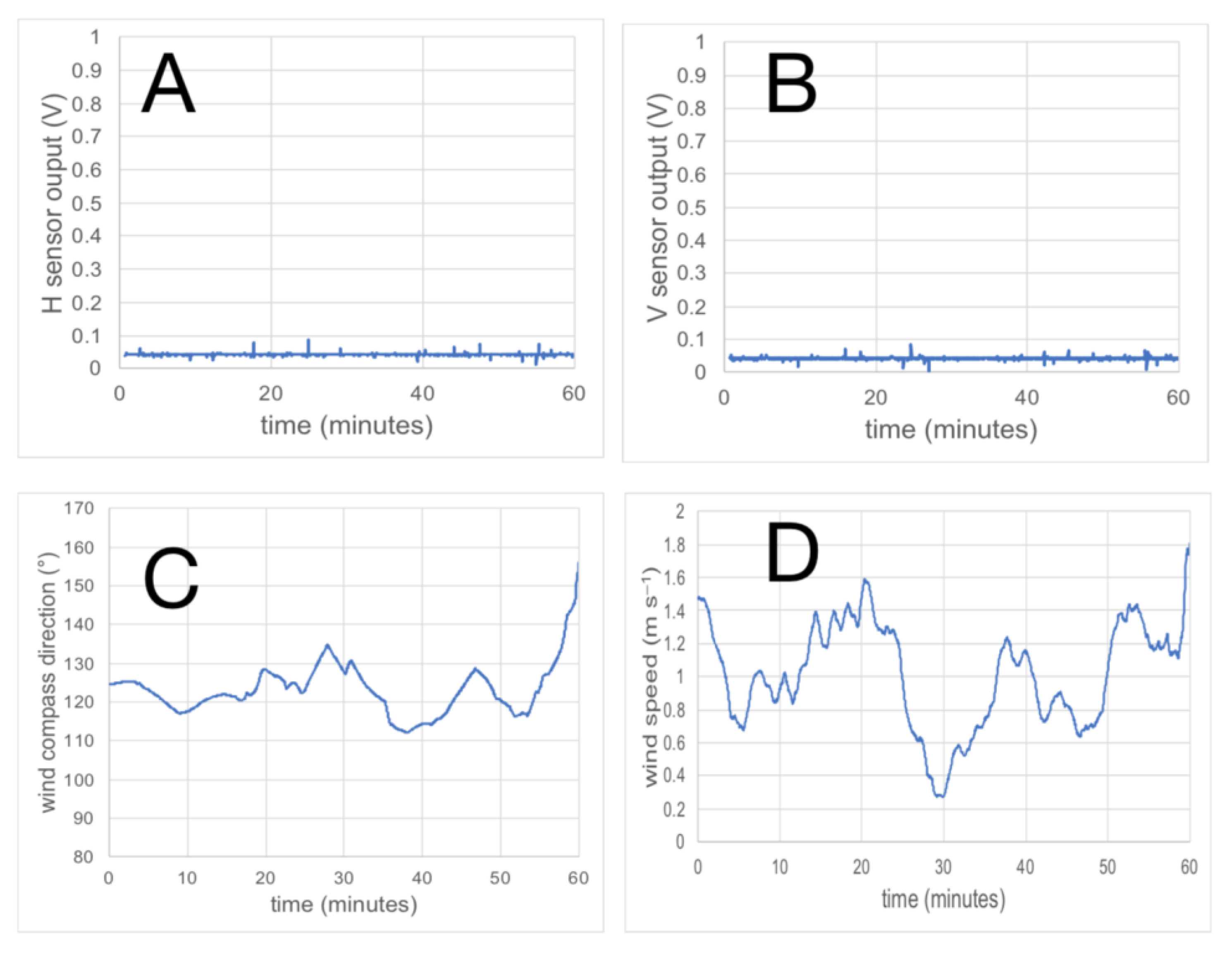

| statistical parameter | Horizontal acoustic sensor (Volt) |
Vertical acoustic sensor (Volt) |
wind speed (m s–1) |
wind direction (°) |
| mean | 0.042 | 0.041 | 1.0 | 122.6 |
| maximum | 0.085 | 0.082 | 1.85 | 179.4 |
| minimum | 0.27 | 85.5 | ||
| standard deviation | 0.003 | 0.003 | 0.32 | 10.4 |
| measured parameters | |||||||||
| rain inclination (°) | wind speed (m s-1) | rainfall rate (mm h-1) | |||||||
| statistical parameter | mean | max. | std. dev. | mean | max. | std. dev. | mean | max. | std. dev. |
| 1 August 2025 | 10.5 | 22.2 | 5.9 | 0.17 | 0.44 | 0.1 | 10.6 | 34.3 | 6.9 |
| 13 August 2025 | 38.7 | 49.9 | 8.3 | 1.89 | 3.48 | 0.5 | 4.5 | 8.7 | 2.5 |
Disclaimer/Publisher’s Note: The statements, opinions and data contained in all publications are solely those of the individual author(s) and contributor(s) and not of MDPI and/or the editor(s). MDPI and/or the editor(s) disclaim responsibility for any injury to people or property resulting from any ideas, methods, instructions or products referred to in the content. |
© 2025 by the authors. Licensee MDPI, Basel, Switzerland. This article is an open access article distributed under the terms and conditions of the Creative Commons Attribution (CC BY) license (http://creativecommons.org/licenses/by/4.0/).