

Submitted:
09 December 2025
Posted:
10 December 2025
You are already at the latest version
Abstract
There has been substantial debate regarding the consequences of overtourism in cities. Scholars have also examined variables that are directly and indirectly related to tour-ism, including demography, urban rehabilitation and requalification, gentrification, speculation in the real estate market, the influence of digital booking platforms, and the expansion of short-term rental (STR) accommodation. This research seeks to de-velop a clearer spatial understanding of this last one.
By analysing their distribution, density (maximum occupancy), and clustering and by employing Geographic Information Systems (GIS), this article will propose methodol-ogies to better visualise spatial patterns, providing different perspectives of the city of Lisbon and its most tourism-intensive parishes.
The article finds that STR in Lisbon have expanded rapidly, concentrating over-whelmingly in six historic parishes where STR supply and maximum occupancy now exceed resident populations and housing availability. GIS analysis reveals intense clustering in central neighbourhoods—especially Alfama—indicating significant tour-ism pressure and signs of overtourism. These spatial patterns correlate with depopula-tion and rising housing costs.
The study concludes that STR are now a decisive factor in urban imbalance and that detailed spatial analysis is essential for regulating tour-ism, defining carrying-capacity thresholds, and developing more sustainable, socially just urban planning policies.
Keywords:
tourism
; overtourism
; short-term rental
; geographic information system (GIS)
; Lisbon
1. Tourism and Development: A Positive Balance with Consequences
According to the World Travel and Tourism Council, the tourism industry contributes about 10.4% to global GDP and supports over 319 million jobs worldwide [1]. Portugal is no exception, and tourism has been a constantly evolving industry and a primary driver of economic growth over the past two decades. Portugal has been one of the most sought-after countries by foreign tourists due to its rich history, pleasant climate, stunning landscapes, cuisine, and hospitality. Over the last 20 years, tourism in Portugal has been growing consistently, especially after the 2008 financial crisis, which had a significant impact on the Portuguese economy [2].
Since the early 2000s, Portugal has been a popular destination for low-cost airlines, with carriers such as Ryanair, EasyJet, and Transavia expanding their operations there. The low cost of flights and the possibility of buying cheap last-minute flights were attractions for European tourists. According to INE [2], the number of tourists arriving in Portugal through low-cost airlines increased from around 1.5 million in 2004 to more than 10 million in 2019 [3]. The emergence of low-cost airlines in Europe has enabled more people to access flights, making travel cheaper and expanding the number of destinations [4].
Portuguese statistics [5] show that the number of tourists visiting Portugal in 2021 was around 9.6 million, corresponding to a growth of 48.4% compared to the previous year, but a 61% drop from the previous year due to the COVID-19 pandemic. However, even with this drop and the COVID-19 pandemic, the number of tourists who visited Portugal in 2021 is still higher than the 9.1 million who visited in 2010. In addition, tourism revenue in Portugal has increased significantly in recent years, rising from 11.8 billion euros in 2010 to 17.9 billion euros in 2019. According to ‘Tourism in Numbers 2022’ [2], Lisbon was visited by more than 7.5 million tourists, with more or less 18 million overnight stays, 30% of all the 26.5 million tourists that visited Portugal and 31% from national revenue, including all the islands (Azores and Madeira). 78% were foreign, and only 22% were Portuguese. 161€ million euros of revenue from a total of 1.530€ billion came from STR. Portugal and Lisbon are now recovering from the COVID-19 pandemic.
In March 2023, according to INE [2], the tourist accommodation sector registered 2.1 million guests (+30.8%) and 5.1 million overnight stays (+26.7%), corresponding to 338 million euros in total income (+45.1%) and 250.9 million euros in income from accommodation (+49.0%). Compared with March 2019, total revenue increased by 36.2% and revenue from accommodation by 40.1%. The average yield per available room (RevPAR) stood at 43.5 euros, and the average yield per occupied room (ADR) reached 87.7 euros (+39.7% and +18.6% compared to March 2022, respectively). Compared to March 2019, RevPAR increased by 28.9% and ADR grew by 23.2%. Among the municipalities with the highest representation in total overnight stays, Albufeira, in the Algarve, in the south of Portugal, continued to stand out, with a 15.1% reduction compared to 2019 (-14.0% among residents and -15.3% among non-residents).
In the same publication, numbers show that in the 1st quarter of 2023, total overnight stays grew by 40.9% (+22.5% in residents and +51.6% in non-residents), which corresponded to increases of 61.0% in total income and 64.0% regarding accommodation (+35.5% and +39.9%, respectively, compared to the 1st quarter of 2019). Considering most types of accommodation (tourist accommodation establishments, camping and holiday camps, and youth hostels), in the 1st quarter of 2023, there were 5.4 million guests and 13.5 million overnight stays, corresponding to growth of 40.1% and 39.6%, respectively. Compared to the 1st quarter of 2019, overnight stays increased by 14.2% (+17.0% in residents and +12.9% in non-residents).
Online booking platforms such as Booking, Airbnb, and TripAdvisor have also contributed significantly to the increase in tourism in Portugal. The ease of use, the wide range of accommodation, and the transparency of information were factors that attracted many tourists. In 2019, Airbnb announced that Portugal was its second-most-important market in Europe, with more than 6 million guests staying in the country since 2008. In 2019, 53.9% of overnight stays in Portugal were booked online. Additionally, using these platforms can negatively impact the local economy, as they often operate outside of traditional regulations and may not pay the same taxes as conventional hotels [6].
The power of social media has also significantly boosted Portugal's status as a tourist destination. Social media allows tourists to share their travel experiences and promote their favourite destinations, reaching a global audience. The photogenic nature of Portugal, especially Lisbon and the Algarve, has been an essential factor in attracting tourists through social networks. In addition to the economic benefits, tourism can also have social and cultural benefits. It promotes cross-cultural understanding, enhances social cohesion, and fosters community development. Cultural tourism, in particular, can offer visitors opportunities to experience local cultures and heritage, fostering pride and appreciation among locals and helping preserve cultural sites and traditions.
Despite its benefits, tourism can also negatively impact society, such as overtourism, environmental degradation, and social and cultural changes. Overtourism is a term used to describe the situation in which many tourists visit a particular attraction, resulting in negative consequences for the destination. It can also be defined as a situation in which the number of visitors to a destination exceeds the destination's carrying capacity, negatively impacting the local environment, economy, and residents' quality of life. Several authors have provided definitions of overtourism, each emphasizing different aspects of the phenomenon.
Overtourism occurs when the scale of visitor numbers starts to have a detrimental effect on the quality of life of residents and/or the quality of the experience in the destination and the environment [7]. Destinations experience congestion and overcrowding due to unmanaged influxes of visitors, leading to negative impacts on the host community and tourists [8]. UNWTO [9] mention overtourism to situations when there are too many visitors to a particular destination. It manifests itself through congestion, overcrowding, and pressure on local resources, amenities, and infrastructure. So, overtourism is a state of excessive tourism in which the host community and/or the integrity of the natural and cultural environment are negatively affected by the presence and/or activities of tourists. In the end, all of them, in different ways, characterize the term by overcrowding, strain on infrastructure, increased prices, degradation of cultural heritage, environmental damage, cultural commodification, and a decline in the overall visitor experience.
Historic cities, particularly their centres, are vulnerable to overtourism because of their cultural and historical significance. The effects can be seen in many historic cities worldwide. For instance, Venice, Italy, has been grappling with overtourism for years, with an estimated 30 million tourists visiting the city annually despite its population of just 50,000 [10] Similarly, Barcelona, Spain, has been struggling with overtourism, with an estimated 32 million tourists visiting each year, leading to rising rental prices and the displacement of locals.
To mitigate the negative impacts of overtourism, historic cities are increasingly investing in rehabilitation and requalification projects. These projects aim to restore and preserve historic sites while also enhancing the quality of life for locals. For instance, in Venice, the city has embarked on a rehabilitation project that involves renovating historic buildings and repurposing them as affordable housing for locals. Rehabilitation and requalification projects can also lead to gentrification, a process in which urban renewal displaces low-income residents. Gentrification can be a concern in historic cities, as the renovation of old buildings can raise property values and rents, making it unaffordable for low-income residents to live there. Gentrification can also lead to a loss of cultural diversity, as the renewal of historic buildings often attracts affluent residents who may not share the same cultural background as the original residents. Foreign investment can also contribute to overtourism and its negative impacts, such as overpriced and speculative real estate markets. In some historic cities, foreign investors have been buying properties for STR, such as Airbnb, leading to a shortage of long-term rental properties and driving up rental prices for locals. This has led to an increase in vacant properties in some areas, which can hurt the local economy and community [11].
2. Lisbon City and Its Metropolitan Area. Tourism and Demographic Changes
2.1. Demography and Tourism
Lisbon, Portugal's capital city, has experienced significant demographic changes since the 1960s. In the past few decades, Lisbon has transformed from a declining industrial town into a modern and vibrant metropolis [12]. These changes had a significant impact on the city's population, its composition, and its distribution. One of the most visible changes was an enormous decrease in residents. Between the 1960s and 2021, the city of Lisbon's resident population decreased from 802.230 in 1960 to 545.796 (-46,98 %). In general, this negative variation shows the departure of a considerable part of the population from Lisbon. Between the 1970s and 1990s, this was mainly due to demand for higher housing quality, reflecting an aging housing stock and low levels of urban rehabilitation, in part because of a rent freeze that lasted for decades [13].
From the mid-1990s onwards, this decline in the city's population began to reflect the enormous price rise in the city's housing market. The middle class "flees" to the outskirts [14], leaving the municipality of Lisbon for peripheral municipalities in the metropolitan area, where prices are lower, and housing areas and quality are more attractive. Another reason for this change (or decline) in Lisbon's demography, accentuated at the end of the 90s, is its growing appeal to tourists. The city has become a popular tourist destination, with its historical sites, rich culture, and mild climate. This influx of tourists has driven up demand for accommodation and services, pushing up house prices. The rising cost of living in the city centre has forced many residents to move to the suburbs, leading to a decline in the city centre's population.
Another significant factor influencing Lisbon's population and demographic structure is the increase in immigration. Lisbon's foreign population grew from 38,000 in 1998 to 148,000 in 2019. The arrival of immigrants was concentrated in some parishes near the centre, but, traditionally, they were less well regarded from the real estate market perspective.
Looking at the evolution of numbers between 2001 and 2021 (Figure 1), it is possible to observe two parishes (‘Misericordia’ and ‘Santa Maria Maior’) whose numbers decreased much more than the average for the 24 parishes of the city. A little further ahead, it will be possible to analyze the evolution of short-term rentals in the city of Lisbon and, in particular, the numbers in those two parishes.
A detailed demographic analysis of Lisbon from 1981 to 2021 showed a 48% decrease in its population, from 807937 to 545796 residents. The most significant decrease was between 1981 and 1991 with a -17.9%. The decrease in the population between 2011 and 2021 occurred in 12 of the 24 parishes of Lisbon (Table 1). Four of them belong to the six most pressured by the number of registered STRs. Misericórdia, Santa Maria Maior, São Vicente, and Santo António with decreases in population higher than 6,5% with two of them coincident with decreases over 20%.
Several authors have written about demography and its relations with tourism in Lisbon. The book, "Tourism and Development in the Developing World” [15] explores the impact of tourism on the economic and social development of cities such as Lisbon. In "The Routledge Handbook of Tourism Cities” [16], several chapters focus on tourism in Lisbon, exploring urban regeneration, cultural heritage, and sustainability. "The Global City: New York, London, Tokyo" [17] discusses how cities like Lisbon have transformed from industrial towns to global cities, attracting worldwide capital and new social groups. In the book "Lisbon: From Industrial City to Global City" [18], the author explores Lisbon's transformation from a declining industrial city to a global city. Lisbon has indeed experienced significant demographic changes over the past few decades [19]. All these authors also argue that changes have been driven by factors such as international migration, an aging population, and urban regeneration projects. They emphasize the need to comprehensively understand the city's demographic shifts to inform effective urban planning strategies.
In their study “International migration and the changing face of Lisbon“ [20] and its impact on Lisbon's population, authors highlight the growing presence of immigrant communities in the city. They note that these communities have contributed to the diversification of the urban landscape and have played a vital role in shaping the city's cultural fabric.
Examining the effects of an aging population in “Aging population in Lisbon: Challenges and opportunities” [21], stresses concerns about additional demands on healthcare and social welfare systems, requiring adequate provisions to ensure the well-being of elderly residents. However, the authors also highlight the potential for intergenerational collaboration and for developing age-friendly urban environments that cater to the needs of older citizens. In the context of urban regeneration projects. The impact of these initiatives on Lisbon's demographics suggests that while urban renewal can bring positive changes to neighbourhoods, such as improved infrastructure and increased economic activity, it may also result in gentrification and displacement of specific population groups [22].
Overall, these authors shed light on demographic changes in Lisbon and underscore the importance of understanding these dynamics for urban planning and policymaking. Their research also highlights the multifaceted nature of demographic shifts in the city (including the role of international migration, the challenge of an aging population, and the impacts of urban regeneration projects). Incorporating their findings into urban development strategies can create a more inclusive and sustainable future for Lisbon, helping overcome problems and achieve higher standards of quality of life across its social, cultural, and economic dimensions.
2.2. Lisbon: An Average Growth Rate or a Case of Overtourism?
Tourism has become one of the most significant economic drivers worldwide, contributing to job creation, economic growth, and development [23]. However, rapid tourism growth can also have negative consequences, including environmental degradation, cultural erosion, and social conflicts, leading to overtourism in some destinations. Therefore, it is essential to have effective tourism policies that balance tourism promotion with the preservation of a destination's natural and cultural heritage. In this chapter, we will discuss a set of positive and negative variables arising from tourism, as well as ideas to prevent overtourism and achieve balance through tourism policies.
Tourism is a complex industry that involves multiple stakeholders, including governments, local communities, tourism businesses, and tourists themselves. The primary goal of tourism policies is to promote sustainable tourism that maximizes the positive economic, social, and environmental impacts of tourism while minimizing its negative consequences. Sustainable tourism policies should balance economic development, social well-being, and environmental protection [24]. One of the critical debates in tourism policy is how to boost tourism and prevent overtourism.
Europe has lately experienced mass tourism. Amsterdam, Rome, Venice, Prague, Dubrovnik, Barcelona, and Lisbon are just some of the destinations that have recently been dealing with overtourism, and whose authorities have also taken measures to mitigate the issue. Eurostat [25] estimates that Spain, Italy, and France accounted for approximately half of all international tourists' overnight stays in the EU in 2019. Furthermore, 65 % of EU residents made at least one personal tourism trip in 2019.
Lisbon has experienced a surge in tourism over the past decade, making it an increasingly popular destination that attracts millions of visitors annually. However, this rapid growth in tourism has also raised concerns about overtourism in Lisbon.
In their work, Seraphin et al. [26] discussed the negative consequences of overtourism. He emphasizes that it not only affects the local community but can also harm the destination's natural and cultural assets, erode the authenticity of the experience, and reduce visitor satisfaction. These issues are particularly relevant to cities like Lisbon, where historical and cultural preservation are vital to the city's identity. Overtourism can lead to crowding, congestion, pollution, increased prices, local resentment, and loss of character. These effects resonate with concerns raised by locals and experts about the impacts of tourism in Lisbon. Goodwin [27] states that overtourism occurs when the number of visitors exceeds a destination's carrying capacity. He argues that this can lead to social and environmental problems and affect residents' quality of life. In Lisbon, some locals and experts have expressed concerns about the impact of tourism on the city. Gössling et al. [7] argue that tourism can lead to resource depletion, environmental degradation, and cultural homogenization. They call for more sustainable tourism policies that prioritize environmental protection and social justice. Similarly, they also argue that tourism policies should focus on the quality rather than the quantity of tourism and aim to balance economic development, environmental protection, and social well-being. In several articles, The Guardian journal [28] reports that historic areas like Alfama and Mouraria have experienced these effects due to the concentration of tourism.
Lisbon has indeed faced challenges associated with overtourism. But the city has also taken steps to mitigate its negative impacts. Despite these challenges, many argue that tourism has also brought economic benefits to the town. The sector has created thousands of jobs and stimulated the local economy, allowing businesses to thrive.
Acknowledging and leveraging these positive aspects while addressing the negative consequences is essential. It is important to note that efforts have been made to address the challenges of overtourism in Lisbon. The city government has implemented measures to manage visitor flows, promote sustainable tourism practices, and protect residents' interests. For instance, restrictions have been placed on STRs in certain areas to alleviate the housing crisis, but these measures arrived too late, once hundreds, and in some neighbourhoods, thousands of STRs had already been established, leading to a different and extensive rental housing model. Additionally, initiatives have been undertaken to encourage tourists to explore alternative neighbourhoods and experiences, reducing pressure on heavily frequented areas.
Although Lisbon is experiencing some of the challenges associated with overtourism, it is not yet as severe as in other cities in Europe, such as Venice, Barcelona, or Dubrovnik. However, essential to work together to find solutions that balance the needs of tourists with those of the local community and the environment. Infrastructure strain is another issue associated with overtourism. Increased tourism puts pressure on public transportation, roadways, and other amenities. Lisbon's mayor, Fernando Medina, recognizes the need to reduce tensions between tourism development and residents [29] and to strike a balance between catering to tourists and meeting residents' needs, suggesting that managing the challenges of tourism growth is a priority for the city.
Some experts suggest that managing tourism more effectively, through measures such as promoting sustainable tourism, regulating accommodation platforms like Airbnb, Booking, Homeaway, and investing more effectively in social housing, could help mitigate the negative impacts of overtourism [30].
The strain on housing is a major concern nowadays. As tourism increases, demand for STRs continues to rise, which has a direct impact on house prices and rents. If we add to this problem the lack of supply in the housing market, the continuously rising interest rates on home purchase loans, and the economic crisis stemming from the war in Ukraine, the combined factors create a problematic scenario for the middle-class Portuguese family who wants to live in their city.
While Lisbon may face particular challenges related to tourism, it is not currently experiencing severe overtourism. Those were the words of Lisbon´s mayor, Fernando Medina, back in 2017 during an interview on a television channel. But nowadays we might be facing another reality. And that’s one of the primary goals of this research: to find out more about the tourism pressure that Lisbon is now subjected to. It’s crucial for local authorities and the tourism industry to work together to implement sustainable practices, manage accommodation platforms effectively, and improve infrastructure to prevent the situation from escalating into a more serious issue. By adopting a balanced approach, Lisbon can continue to benefit from tourism while safeguarding the well-being of its residents and preserving its unique cultural and natural heritage. To achieve a balance between promoting tourism and preventing overtourism, policies should adopt a holistic approach that considers all stakeholders' needs and interests. This can be achieved by adopting tourism policies that prioritize social well-being and environmental protection. As Liu and Pratt [31] suggest, sustainable tourism policies can create a win-win situation for all stakeholders, including local communities, tourists, and the environment. UNWTO [9] signals that tourism policies should be based on a participatory approach involving all stakeholders in the tourism development process, including local communities, tourism businesses, and tourists themselves. Tourism policies should aim to achieve a balance among the pillars of a sustainable city: demography, economy, society, environment, and history, heritage, and culture.
Over the next chapter, STR will be addressed in its several city dimensions. As discussed before, STR is just one of many variables in tourism, with both positive and negative consequences. Now, it is not just a question of “pressure,” but also of justice and sustainability. What kind of city do people want? What kind of city do decision makers and politicians want? The right answer probably should be a city capable of balancing both in a real sustainable model, a city for those who live there, but also an interesting and captivating city to visit and with a sustainable economy where tourism is one of the several economic pillars.
3. Short-Term Rental in the City of Lisbon
3.1. Positive and Negative Aspects that Drive Tourism Sustainability
In recent years, the tourism industry has witnessed a significant shift in travellers' accommodation preferences. STR, facilitated by platforms such as Airbnb, have emerged as a popular alternative to traditional hotels. This new tourist trend has been driven by evolving tourist motivations and has both positive and negative consequences for cities, historical centres, and residents. One of the key reasons tourists choose short-term rentals over traditional hotels is the desire for a more authentic, immersive travel experience. Travellers today seek to connect with local culture and communities, and staying in a residential neighbourhood allows them to do so. By renting a room or an entire apartment, tourists can experience daily life as a local, shop at neighbourhood markets, and interact with residents. This desire for authenticity and local immersion sets STR apart from the standardized hotel experience.
Moreover, STRs often offer greater flexibility and cost savings than hotels. Many tourists prefer the convenience of having a fully equipped kitchen, enabling them to cook their meals and save on dining expenses. The availability of larger living spaces is also appealing to families or groups travelling together, as it allows them to stay together and enjoy communal areas. The evolution of numbers over the past few years has been remarkable. The rise of platforms like Airbnb has democratized the rental market, enabling individuals to monetize their properties and provide accommodation options to tourists. This has led to a significant increase in the availability of short-term rentals, expanding the accommodation choices for travellers worldwide. As a result, STR has grown considerably in the historical city centres of Portugal’s main cities. This scenario creates new urban challenges and several economic and social externalities [32,33,34,35,36,37,38]. Lisbon, like other world cities, has experienced significant growth in STR, but it is not an isolated example of tourism supply, as traditional hotels have also been growing rapidly in number.
However, STR's growth has both positive and negative effects. Some cities have experienced positive consequences, for example, urban rehabilitation. These processes could only be achieved with income from STR. But this phenomenon has also negatively affected housing markets, older urban social tissue, and local communities.
Scientific studies have also undiminished several negative impacts of STR in Portuguese urban areas, mainly in the Lisbon municipality. These studies emphasize major concerns about subjects like touristification, financialization of housing, and urban gentrification on historical city centre [39,40,41,42,43,44].
The availability of STR has contributed to increased demand for housing, which can drive up rental and property prices, leading to gentrification. Numerous authors have extensively studied the positive and negative consequences of STR on cities, historical centres, and residents, and their analyses have been crucial for better understanding its dynamics and for promoting discussion on how to address this growing sector.
On the positive side, STR contributes to the diversification of accommodation options, allowing tourists to experience different environments and locations [7]. Short-term rentals provide homeowners with opportunities to generate additional income and contribute to local economies [45]. It is also positive because it relies on a sharing-economy model that allows for greater consumer choice and promotes community engagement [46]. Also, because they enhance the tourism experience, such accommodations enable tourists to have more personal and intimate experiences and to interact with local hosts [47].
On the negative side, authors also extensively discussed several aspects, such as how the rapid growth of short-term rentals can contribute to overcrowding, strain infrastructure, and degrade residents' quality of life [48]. The impact of short-term rentals on housing affordability and gentrification, with the rise of short-term rentals that can drive up housing prices and reduce the availability of affordable housing for residents [49]. The increasing prevalence of short-term rentals can contribute to rising housing costs, making it challenging for locals to afford housing in desirable areas [50]. Or that the commercialization of residential properties through short-term rentals can contribute to the displacement of long-term residents and the transformation of neighbourhoods into tourist hubs [51]. With those ideas and an extensive analysis of supporters and critics of STR, it is possible to summarize the positive and negative aspects in the next table (Table 2).
In the end, it is important to stress that the issue of excessive concentration on STRs does not necessarily arise from the increase in the number of tourists, but rather from a new and profitable business model on the Portuguese residential market [39].
3.2. A Geographical Approach to Short-Term Rental Patterns
By December 2022, Portugal had officially registered 100.751 STR accommodations on RNAL (Registo Nacional de Alojamento Local). This official National Register of STR database contains all the STR registers and it is the most complete and accurate existing database. Nevertheless, it has its limitations. It is a cumulative database, which means it may contain STR records that may have already closed. It could also contain units that have been registered but are not open to a real commercial activity, such as STR accommodations, and are now being used as long-term rental houses. Or even closed apartments that due to new restrictions on STR activity, were registered for a probable later opening with STR use. On the same date, Lisbon had 20,069 registered STR accommodations (20% of all Portuguese territory) and a maximum occupation (guests) of 115,756 (17% of total STR occupancy). These are the numbers that will be used for all research and analysis. These numbers also indicate that, in this small and fragile area, the intensification of short-term rentals is a new urban challenge with multidimensional impacts [39].
The boom in short-term rentals in Lisbon is thus one more case of a major European city that is having to cope with the excessive concentration of this activity [52]. It should be noted that, until recently, the city of Lisbon had no tradition of tourist accommodation beyond hotels [35]. The number of 20,069 short-term rental units in the municipality of Lisbon (Figure 2) thus testifies to a violent social, economic, cultural and urban transformation that has occurred in a short space of time, mainly in the period 2014-2019 [39]. This data, when analyzed alongside population data, could yield a much more detailed understanding of some of the causes of STR and its patterns. The first important data to analyze is the distribution of these STR accommodations in the 24 parishes of Lisbon.
The analysis shows a very big concentration of STR on the 6 more historical and central parishes of Lisbon, all of them with more than 1000 accommodations: Santa Maria Maior (4682), Misericórdia (3542), Arroios (2326), Santo António (1682), São Vicente (1609) and Estrela (1328). The distribution is far from being homogeneous, and it's very different between the river Tagus front, mainly in the centre, and the rest of the city in peripheral parishes. To better understand the difference, 6 parishes (Figure 3) host 15.169 accommodations and account for 75.5% of the city's STR infrastructure. The parishes are Santa Maria Maior, Misericórdia, Arroios, Santo António, São Vicente and Estrela.
The difference is obvious between the total of the 24 parishes and these 6 in particular, as well as in the maximum occupation rate, as they concentrate 86139, approximately 74,5% of all STR occupation in the city (Figure 4).
Using a clustering analysis tool (binning) makes it even more obvious and easy to visualize the density and the historical city centre contiguous to the River Tagus (Figure 5). Feature binning is an ArcGis Pro® tool that aggregates large amounts of features into dynamic polygons called bins. A single bin represents all features within its boundaries and appears wherever at least one feature lies within it. The label value on top of each bin most commonly represents the total number of features within each bin, but can represent other statistics or calculated results. As a method of feature reduction, feature binning vastly improves drawing performance when layers contain thousands or millions of features.
The parishes of Alcantara, Belém and Parque das Nações also show a certain degree of density. The only areas that continue to show a resistance to this evolution on STR numbers are Beato and Marvila parishes, on the Oriental side of the city, and also along the riverside. The main reason is that they remain as remnants of the abandoned industrial area. There are still a lot of properties that belong to APL (Administration of the Port of Lisbon) and it continues to be used as a maritime container unloading zone, and it is also occupied by two factories linked to the food industry. Nevertheless, this stretch of terrain is being renovated with residential rehabilitation projects, new residential areas (Braço de Prata), and the new Hub Creativo do Beato, an innovation centre for creative and technological companies in a complex of decommissioned factories. This former industrial area of the Portuguese Army, known as the Manutenção Militar (Military Maintenance), is preparing to host over 3.000 people involved in startup projects and new companies.
When used at a more detailed scale, this clustering analysis is very accurate for network analysis to identify where the highest STR densities are concentrated. This type of analysis is also simpler than queries by attribute or by location, allowing an overall visualization of certain city areas and is extremely important for urban planning in terms of traffic, mobility and transport (Figure 6).
The map shows part of Santa Maria Maior parish and details the density near the big square Praça do Comercio (on the left side) and the streets of downtown centre on surrounding area and also the extreme density of Alfama neighbourhood and Rua dos Remédios (on the right side of the map), a street that will be analysed a little further ahead in even greater detail.
It is also possible to see the heat map of STR and the patterns drawn in the city show the large areas where this type of accommodation has been increasing (Figure 7). Once more, the historical centre appears quite prominent when compared to all other parishes. The figure also shows the cut in the aforementioned continuity in the eastern part of the city, before Parque das Nações parish (Beato and Marvila parishes), and another, less dense, parish on the west side, more peripheral and far from the city centre (Belém).
Looking at the number of STR is not the same as looking at its maximum capacity, since the number of beds and their occupancy may vary. As it is easy to interpret, there may be STR with more or fewer beds, which means that the density of this type of accommodation is very variable and can be even more evident in certain areas of the city. Sometimes the number of STR may not be indicative of overtourism. On the contrary, a smaller number of STRs, but with more beds and higher occupancy, could be problematic. Density is even higher when the heat map shows the maximum occupation of STR (Figure 8). In the historical centre of Lisbon, STR numbers show a strong correlation with their maximum occupancy. Alfama is once again the example. Although the occupation ratio is low because houses in this old part of town have small areas, there are many STR, so the situation is correlated.
Indeed, the patterns of STR maximum occupation show an even greater concentration in the parishes of Misericórdia, Santa Maria Maior, Arroios, Santo António and São Vicente. This can also be confirmed by looking at some of the numbers for these 6 parishes, such as resident population, number of existing buildings, number of houses, and the area of the parish. These indicators, when combined, could suggest an overtourism situation in some parts of cities, typically in historical neighbourhoods, and could be used as important ratios or indices to calculate tourism carrying capacities.
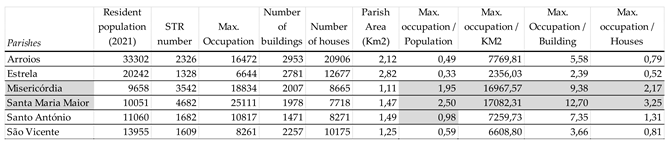
By performing simple calculations (Table 3), it is possible to observe (marked in gray) that some numbers are very impressive, or, to say the least, demonstrate the pressure that the STR phenomenon exerts on certain areas of the city, causing overtourism.
In Misericordia, the number of available STR accommodations doubles the residents, but in Santa Maria Maior, the number is higher. The maximum number of accommodations is 12 times the number of Buildings in Santa Maria Maior, which means, on average, there are 12.7 accommodation places per building. By house, the average number of STR is 3.25. In the same parish, there are approximately 17000 places to sleep per square kilometre. Looking at the other parishes, the situation is more prevalent in 3 of the 6 parishes, but some variables vary. Estrela is the parish with the lowest STR pressure, but it is the largest in area, which makes the feeling of overtourism less perceptible in terms of accommodation infrastructure density in STR.
Besides residents, the number of houses and buildings in each of the 6 analyzed parishes can also be addressed (Figure 9). Once again, Santa Maria Maior and Misericórdia show that the resident population is almost residual, having reached very low numbers in the 2021 census. In those 2 parishes, the resident population is half the maximum occupation rate, and in Santa Maria Maior and the number of available houses is more or less one third. This means that in Misericórdia parish, there are 2.49 accommodation places per resident and an average of 3.25 accommodations per house.
There are no studies on carrying capacity for STR, but Lisbon, like other European capitals, shows considerable differentiation across its parishes. Measuring carrying capacity is complex and depends on the context of each territory [53,54]. Not very common in research on STR (or at least in the form of a quantified index), but crucial to carrying capacity studies aimed at overtourism, is the detailed analysis within each parish. It is important to note that patterns also differ within each parish and can vary substantially depending on the number of buildings, available houses, volumetry, and the neighbourhood's centrality. It would be impossible to visualize all the parishes of Lisbon and its statistical subsections, but by looking at the concentration on the central area around “Baixa de Lisboa”, the downtown and historical centre (represented inside the blue elipse) and its main streets and avenues, is once again obvious (Figure 10). Those 6 more central parishes account for 75,6% of all Lisbon STRs and 74,4% of their total maximum capacity.
Even a more detailed analysis was conducted around certain streets in Lisbon, well known for their location in traditional and historical areas, some of them related to Fado, our traditional music, which is UNESCO-recognized intangible cultural heritage. One of the most interesting and also STR-saturated streets of Lisbon is Rua dos Remédios in the Alfama neighbourhood (Figure 11). The choice of this street is also based on empirical knowledge of the area near the Tagus River, which is very accessible and close to other Lisbon city historical sites. This street has changed dramatically over the last 10 to 15 years. From a traditional street teeming with inhabitants and traditional commerce, it is now a street of restaurants, gift shops, and small businesses, totally turned to tourist activity. Having lost almost all its traditional social fabric, today it concentrates a huge number of STRs and rehabilitated houses, owned by foreigners.
In the buffer area of 150 meters from Remédios Street, 1.010 STR are located, representing more than 5% of STR in the municipality of Lisbon. In terms of occupancy, this 5% corresponds to a maximum occupancy capacity of 4331 or around 3.7% of the total capacity. On a 500-meter buffer from the street, there are 2338 STR, which means that 11.6% of Lisbon’s STR are located in the surrounding area of this street and the maximum occupancy capacity of 10.635 or around 9.2% of Lisbon's total (maximum) capacity. These numbers confirm that the parish of Santa Maria Maior is now subject to considerable overtourism pressure, sustained only by recent constraints on new STR licences in the so-called contained areas, created by new municipal legislation.
4. Conclusions
Short-term rentals are now an unavoidable factor in the planning and management of territories, particularly in urban areas. Their rapid proliferation, sometimes accompanied by insufficient regulation, creates an imbalance in the housing supply available to regular residents. This imbalance, aggravated by other economic factors, whether linked to household income or to the economic structure of the urban fabric itself (which evolves over time, based on urban development models that are not always difficult to predict in the short term), makes urban management complex.
The city, with its social, cultural, environmental, professional, touristic and mobility dynamics, among others, often struggles between the splendour of booming tourism and the history, culture and experiences of the people who want to live in their city but are unable to do so due to the speculation created around the real estate phenomenon. Obviously, the STR is not the only cause of gentrification and the abandonment of cities by the people who will come to develop them and live in them, but it does play a major role.
This research could enable a more refined spatial analysis, detailing areas with higher STR densities. It could also show trends and patterns of growth in certain streets, neighbourhoods or even areas of the city where planning action is imperative. The use of subsectional detailed analysis is crucial for quantifying limits and for adapting different numbers to different urban scenarios or scales.
These assessments could suggest the creation of ratios to address tourism carrying capacity for urban planning. The analysis could also open new research opportunities to redefine parameters for regulating tourism activities, such as STR, tertiary and service supply, or others, which could bring even more pressure on the property market, both in terms of renting and buying, mainly in city centres.
Acknowledgments
No GENAI tools were used to carry out this investigation, either for the research or for writing this article.. The authors have reviewed and edited the output and take full responsibility for the content of this publication.
Conflicts of Interest
The authors declare no conflicts of interest of any kind related to this research work.
References
- WTTC. Travel & Tourism. Global Economic Impact & Trends; WTTC Publications, 2020. [Google Scholar]
- INE. Atividade turística. Estatísticas rápidas. 2023. Available online: https://www.ine.pt/ngt_server/attachfileu.jsp?look_parentBoui=644479036&att_display=n&att_download=y.
- Publituris. Transportes. 2023. Available online: https://www.publituris.pt/2023/05/12/movimentacao-de-passageiros-nos-aeroportos-nacionais-no-1-o-trimestre-aumenta-15-face-2019.
- Almeida, A. M.; Ribeiro, J. F.; Silva, S. G. Turismo, sustentabilidade e qualidade de vida: O caso de Portugal. In Turismo e Desenvolvimento; Silva, C. M., Monteiro, J. M. S., Mota, P. R., Eds.; Escolar Editora, 2017; pp. 29–43. [Google Scholar]
- INE. Estatísticas do Turismo. 2021. Available online: https://www.gee.gov.pt/pt/indicadores-diarios/ultimos-indicadores/32171-estatisticas-do-turismo-ine.
- Guttentag, D. Progress on Airbnb: a literature review. J. Hosp. Tour. Technol. 2019, 10, 814–844. [Google Scholar] [CrossRef]
- Gössling, S.; Scott, D.; Hall, C. M. Tourism and Water; Channel View Publications, 2020. [Google Scholar]
- Joppe, M.; Dodds, R. Urban Green Tourism – Applying Ecotourism Principles to the City. In Exploring New Territories in the New Millennium: Making Research Count (pp. xx-xx) Paper presented at the TTRA-Canada Conference; Whitehorse, Yukon, Joppe, M., Ed.; 2000. [Google Scholar]
- UNWTO. International Tourism Highlights 2019 Edition. In UNWTO publications; 2019. [Google Scholar]
- Coccia, E. La vita delle piante. Metafisica della mescolanza; Riccardo Venturi, intervista con Emanuele Coccia. Recuperado de www.doppiozero.com/materiali/la-vita-delle-piante-metafisica-della-mescolanza (consulted October 2023).
- Wang, J.; Li, Y.; Wu, B.; Wang, Y. Tourism destination image based on tourism user generated content on internet. Tour. Rev. 2020, 76, 125–137. [Google Scholar] [CrossRef]
- Seixas, J. Lisboa em Metamorfose [Lisbon in Metamorphosis; Fundação Francisco Manuel dos Santos, 2021. [Google Scholar]
- APL. Retrato da Habitação em Portugal: Características e Recomendações. 2011. Available online: https://observatorio-lisboa.eapn.pt/ficheiro/habitacaoportugal.pdf.
- Santos, B. S. O Estado, as relações salariais e o bem-estar social na periferia: O caso português. In B. S. Santos (Org.), Portugal, um retrato singular (Portugal, a unique portrait); Afrontamento: Porto, 1993; pp. xx–xx. [Google Scholar]
- Telfer, D. J.; Sharpley, R. Tourism and Development in the Developing World, 2nd edition; Routledge, 2016. [Google Scholar]
- Morrison, A.M.; Coca-Stefaniak, J.A. Routledge Handbook of Tourism Cities; Taylor & Francis: London, United Kingdom; ISBN, 2020. [Google Scholar]
- Sassen, S. The Global City: New York, London, Tokyo; Princeton University Press, 1991. [Google Scholar]
- Nunes da Silva, F. Lisbon: From Industrial City to Global City. Urban Studies 2003, 40(9), 1793–1813. [Google Scholar]
- Santos, A. M.; Cardoso, J. L. Demographic dynamics and urban development: Lisbon metropolitan area (1981-2011). In Cities of the future: Towards integrated sustainable urban development; Bolay, D., Rabinovich, G., Eds.; Springer, 2018; pp. 199–216. [Google Scholar]
- Ferreira, P.; Marques, J. International migration and the changing face of Lisbon: A demographic perspective. European Urban and Regional Studies 2016, 23(1), 33–50. [Google Scholar]
- Silva, J. M.; Ramos, R. A. Aging population in Lisbon: Challenges and opportunities. In Aging in European cities: Social exclusion and the generation gap; Maas, M., Lacovides, E., Eds.; Palgrave Macmillan, 2020; pp. 137–155. [Google Scholar]
- Alves, S.; Silva, J. A. Urban regeneration and demographic changes in Lisbon. In Urban regeneration: A handbook; Coelho, R., Valera, S., Eds.; Routledge, 2019; pp. 123–140. [Google Scholar]
- OECD. Tourism trends and policies. In OECD publications; 2020. [Google Scholar]
- Weaver, D.; Lawton, L. Tourism Management: Fifth Edition (E-Book); John Wiley & Sons Australia, Ltd: Australia, 2014. [Google Scholar]
- Eurostat. Tourism halved in 2020. may 2023. Available online: https://ec.europa.eu/eurostat/web/products-eurostat-news/-/ddn-20210315-2.
- Seraphin, H. Overtourism: Excesses, Discontents and Measures in Travel and Tourism. J. Tour. Futur. 2019, 5, 295–296. [Google Scholar] [CrossRef]
- Goodwin, H. Overtourism: Issues, realities and solutions. Responsible Tourism Partnership Working Paper (Not published). 2017, 4. [Google Scholar]
- The Guardian. Lisbon's back-alley fado legends. 2022. Available online: https://www.theguardian.com/artanddesign/2020/jul/17/lisbon-back-alley-fado-legends-photo-essay.
- Expresso. Turismo em Lisboa vale 6 Autoeuropas. 2020. Available online: https://expresso.pt/economia/2020-02-10-Turismo-em-Lisboa-vale-6-Autoeuropas.-Medina-diz-que-e-urgente-dar-o-salto-para-a-Caparica-e-outras-zonas-da-margem-sul-2.
- Koens, K.; Postma, A.; Papp, B. Is Overtourism Overused? Understanding the Impact of Tourism in a City Context. Sustainability 2018, 10, 4384. [Google Scholar] [CrossRef]
- Liu, A.; Pratt, S. Tourism's vulnerability and resilience to terrorism. Tour. Manag. 2017, 60, 404–417. [Google Scholar] [CrossRef]
- Barata-Salgueiro, T.; Mendes, L.; Guimarães, P. Tourism and urban changes: Lessons from Lisbon. In Tourism and Gentrification in Contemporary Metropolises: International Perspectives; Gravary-Barbas, M., Guinand, S., Eds.; Routledge, 2017; pp. 255–275. [Google Scholar] [CrossRef]
- Carvalho, L.; Chamusca, P.; Fernandes, J.; Pinto, J. Gentrification in Porto: floating city users and internationally-driven urban change. Urban Geogr. 2019, 40, 565–572. [Google Scholar] [CrossRef]
- Rio Fernandes, J.; Carvalho, L.; Chamusca, P.; Mendes, T. O Porto e a Airbnb [Porto and Airbnb]; Book Cover: Porto, 2018. [Google Scholar]
- Rio Fernandes, J.; Carvalho, L.; Chamusca, P.; Mendes, T. A Airbnb em Portugal [Airbnb in Portugal]; Book Cover: Porto, 2019. [Google Scholar]
- Seixas, J. Área Metropolitana de Lisboa [Lisbon Metropolitan Area]. In A Airbnb in Portugal [Airbnb in Portugal]; Rio Fernandes, J., Carvalho, L., Chamusca, P., Mendes, T., Eds.; Book Cover: Porto, 2019a. [Google Scholar]
- Seixas, J. Habitação e Alojamento Local em Lisboa [Housing and Local Accommodation in Lisbon]. In Lisboa e a Airbnb [Lisbon and Airbnb]; Rio Fernandes, J., Carvalho, L., Chamusca, P., Gago, A., Mendes, T., Eds.; Book Cover: Porto, 2019b. [Google Scholar]
- Seixas, J.; Antunes, G. Tendências recentes de segregação habitacional na Área Metropolitana de Lisboa. 2019. [Google Scholar] [CrossRef]
- Antunes, G.; Ferreira, J. SHORT-TERM RENTALS: HOW MUCH IS TOO MUCH – SPATIAL PATTERNS IN PORTUGAL AND LISBON. Tour. Hosp. Manag. 2021, 27, 581–603. [Google Scholar] [CrossRef]
- Cocola-Gant, A. “Tourism gentrification”. In Handbook of Gentrification Studies; Lees, L, Phillips, M., Eds.; Edward Elgar Publishing: Northampton, 2018. [Google Scholar] [CrossRef]
- Mendes, L. “Tourism Gentrification in Lisbon: The Panacea Of Touristification As A Scenario Of A Post-Capitalist Crisis”. In Crisis, Austerity and Transformation: How Disciplinary Neoliberalism is Changing Portugal; David, I., Ed.; Lexington, London, 2018. [Google Scholar]
- Mendes, L. “Airbnb, gentrificação turística e injustiça espacial”. In Lisboa e a Airbnb; Fernandes, Rio, Carvalho, J., Chamusca, L., Mendes, P., Gago, T.A., Eds.; Book Cover: Porto, 2019. [Google Scholar]
- Sequera, J.; Nofre, J. Touristification, transnational gentrification and urban change in Lisbon: The neighbourhood of Alfama. Urban Stud. 2019, 57, 3169–3189. [Google Scholar] [CrossRef]
- Tulumello, S.; Allegretti, G. Articulating urban change in Southern Europe: Gentrification, touristification and financialisation in Mouraria, Lisbon. Eur. Urban Reg. Stud. 2020, 28, 111–132. [Google Scholar] [CrossRef]
- Gurran, N.; Phibbs, P. When Tourists Move In: How Should Urban Planners Respond to Airbnb? J. Am. Plan. Assoc. 2017, 83, 80–92. [Google Scholar] [CrossRef]
- Law, R.; Qi, S.; Buhalis, D. Progress in tourism management: A review of website evaluation in tourism research. Tour. Manag. 2010, 31, 297–313. [Google Scholar] [CrossRef]
- Sigala, M. Information and Communication Technologies in Tourism 2020; Springer, 2020. [Google Scholar]
- Oskam, J.; Boswijk, A.; Bakker, M. Overtourism: Excesses, Discontents, and Measures in Travel and Tourism. Journal of Policy Research in Tourism, Leisure and Events 2016, 8(3), 317–320. [Google Scholar]
- Neuts, B.; Naudé, W.; Saayman, M. The Airbnb Effect: A Global Analysis. In Journal of Travel Research. Advance online publication; 2021. [Google Scholar] [CrossRef]
- Zhang, W.; Hong, J. I.; Suh, B. The Impact of Airbnb on Housing Rents: Evidence from Major U.S. Cities. International Journal of Contemporary Hospitality Management 2017, 29(9), 2312–2330. [Google Scholar]
- Novy, J.; Colomb, C.; Neumayer, E. Is Airbnb a driver of local economic development? The case of London. Journal of Economic Geography 2018, 18(6), 1191–1216. [Google Scholar]
- Adamiak, C. Mapping Airbnb supply in European cities. Ann. Tour. Res. 2018, 71, 67–71. [Google Scholar] [CrossRef]
- McCool, S.F.; Lime, D.W. Tourism Carrying Capacity: Tempting Fantasy or Useful Reality? J. Sustain. Tour. 2001, 9, 372–388. [Google Scholar] [CrossRef]
- Kennell, J. Carrying Capacity, Tourism. In Encyclopedia of Tourism; Jafari, J., Xiao, H., Eds.; Springer, 2014. [Google Scholar] [CrossRef]
Figure 1.
Number of residents in the 24 parishes for 2001, 2011, and 2021.
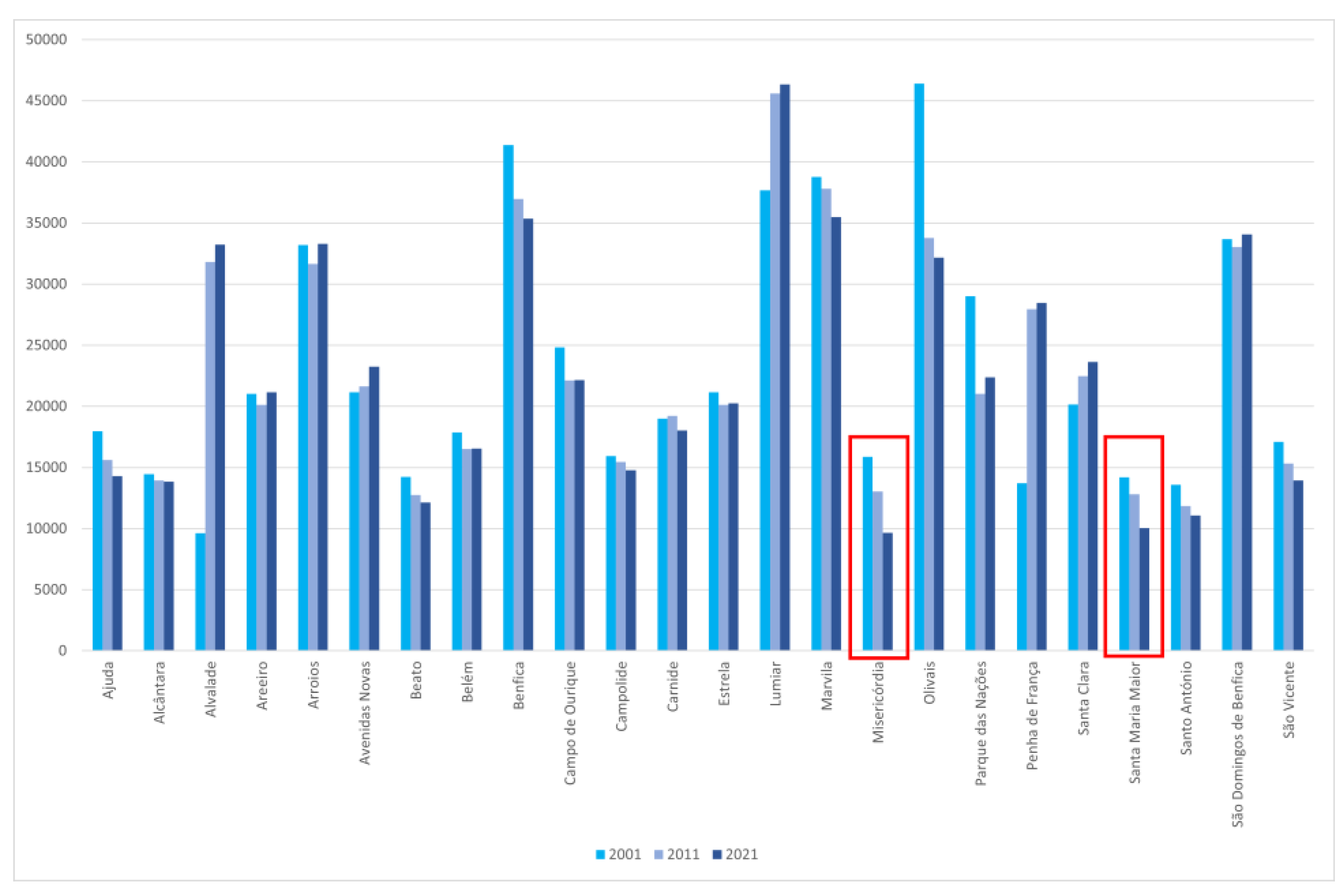
Figure 2.
Distribution of STR accommodations in Lisbon. (RNAL, 2023).
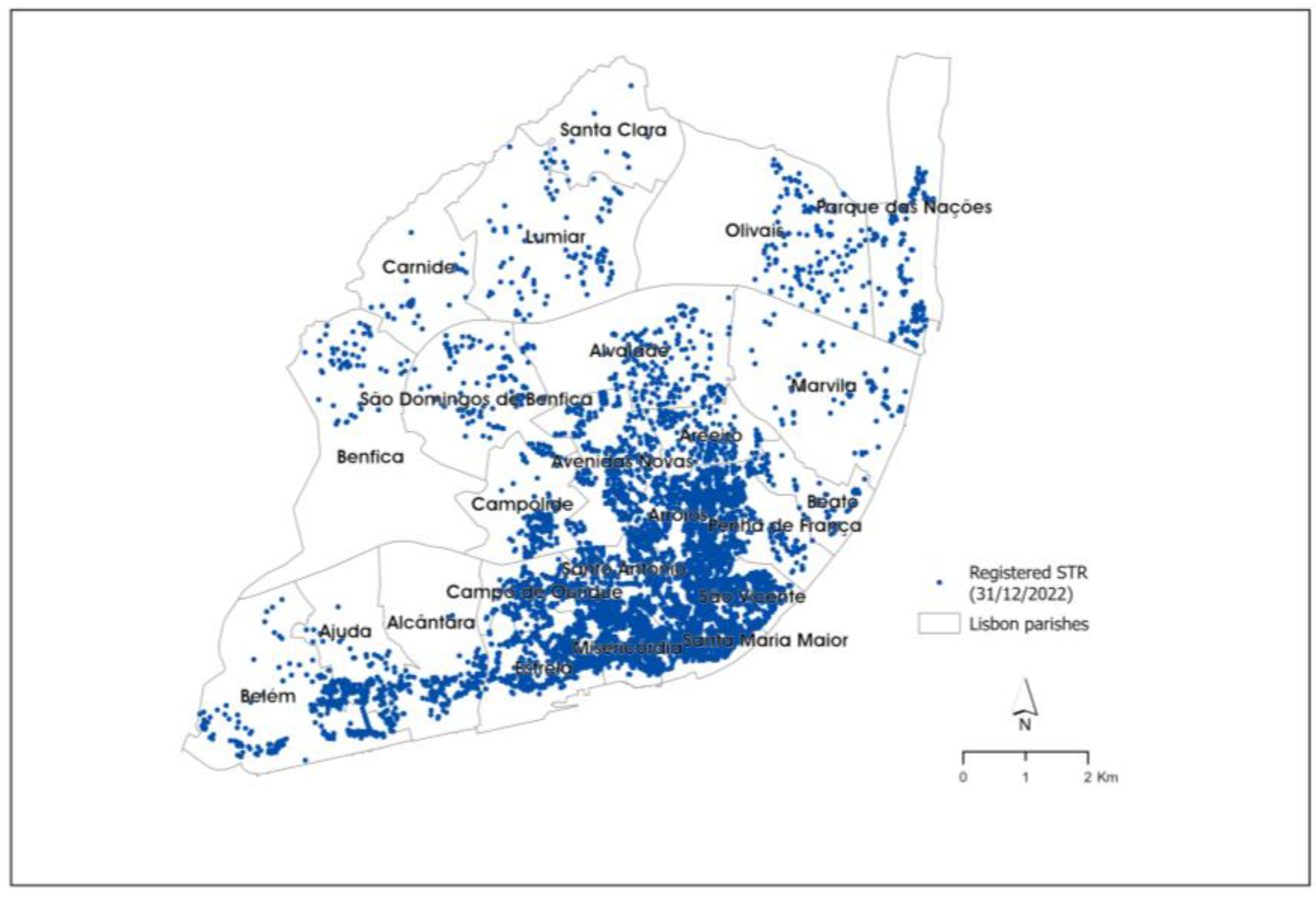
Figure 3.
Number of short-term rental accommodations in Lisbon. (RNAL, 2023).
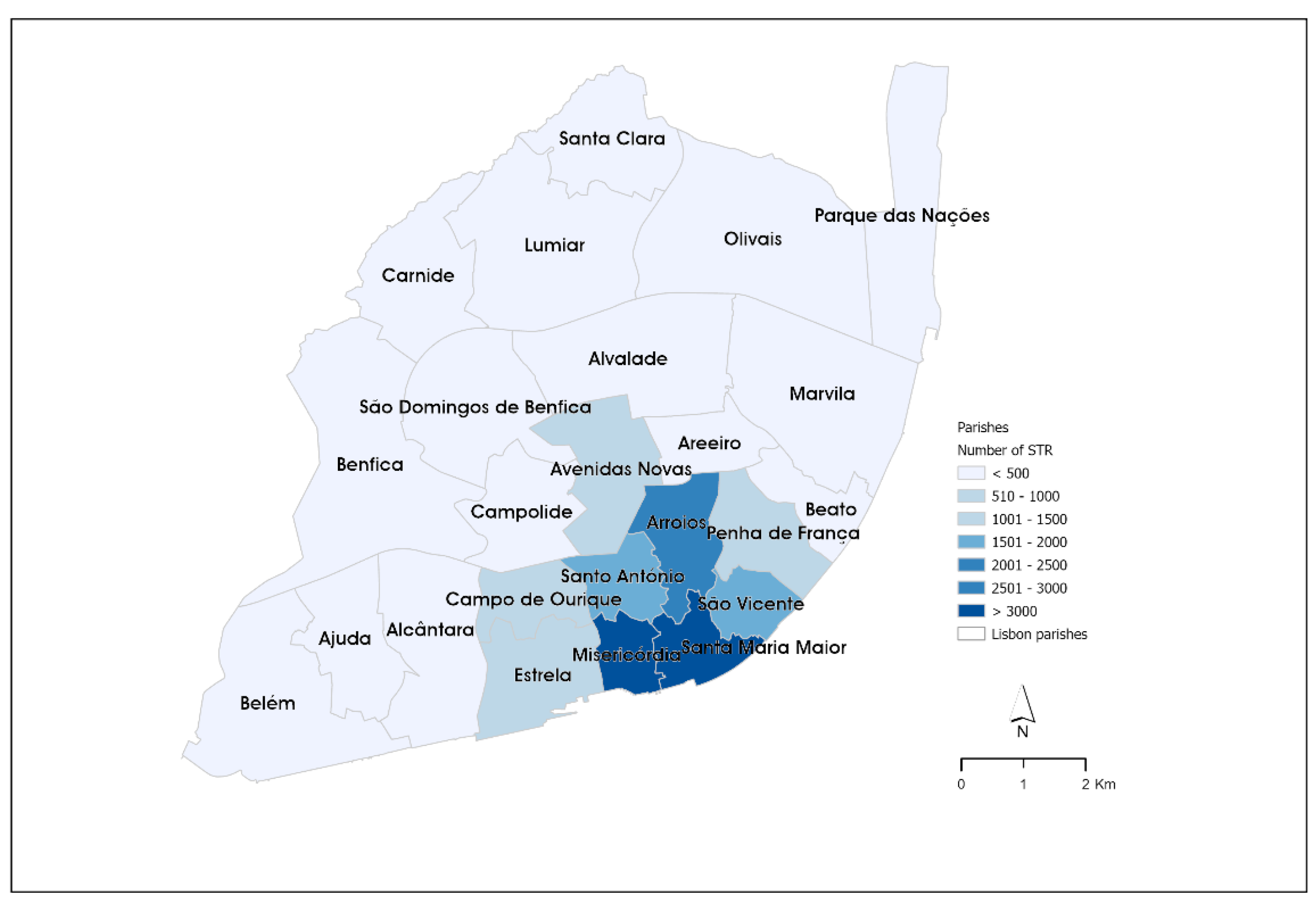
Figure 4.
Number of STR beds in Lisbon - maximum occupation rate. (RNAL, 2023).
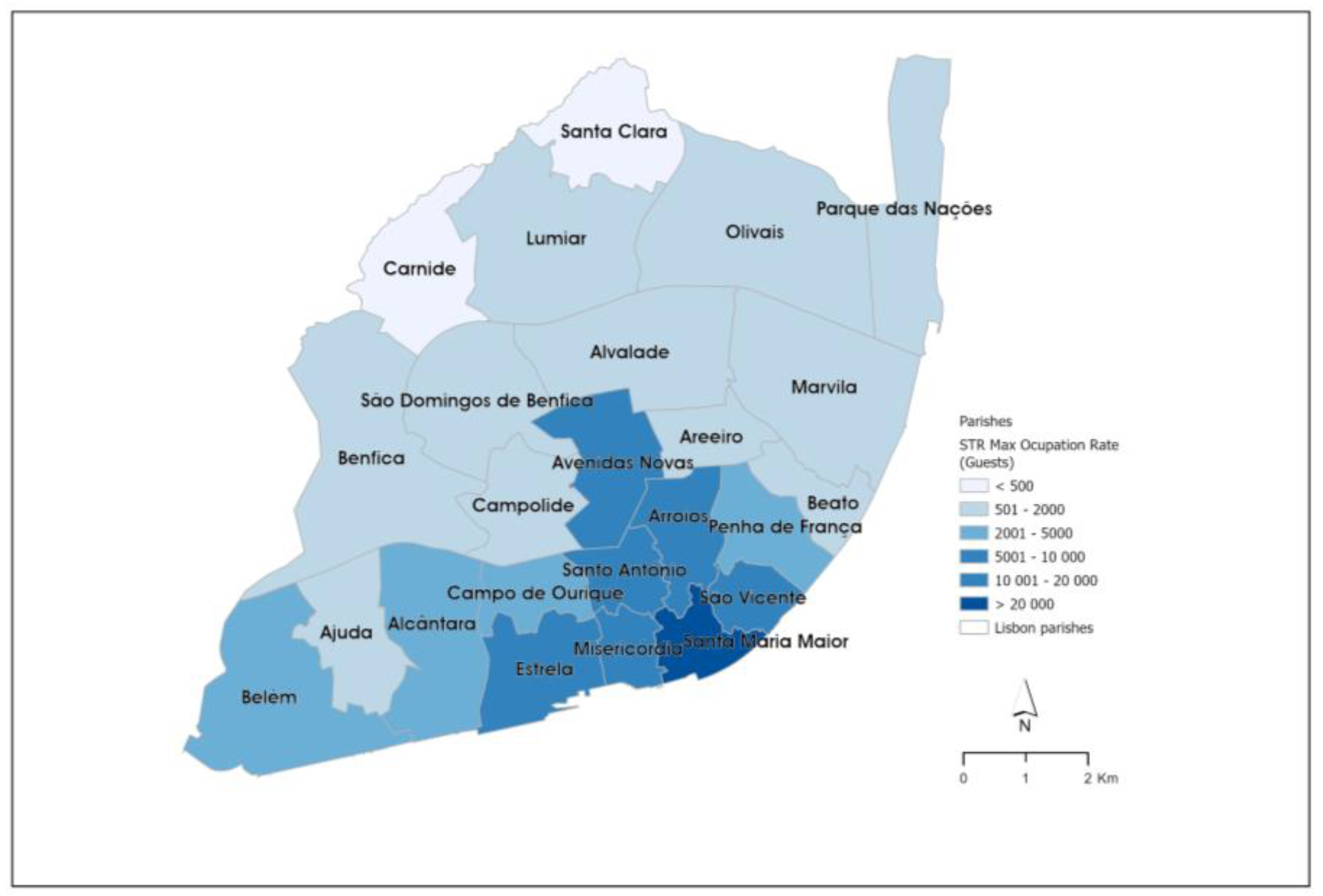
Figure 5.
Clustering of STR (binning) on the 24 parishes of Lisbon. (RNAL, 2023).
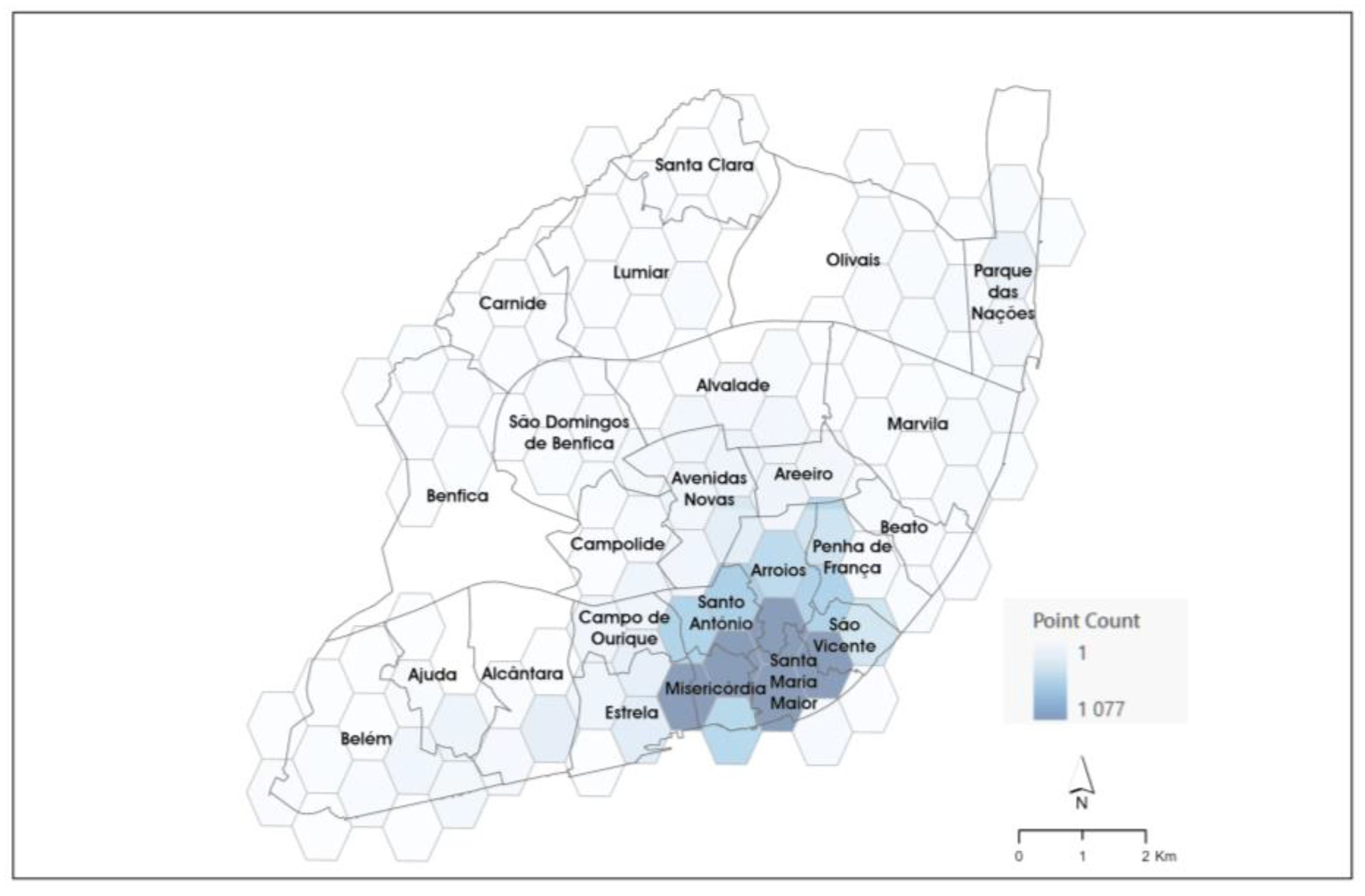
Figure 6.
Clustering analysis (binning) based on the number of STR establishments per cell on part of city centre.
Figure 6.
Clustering analysis (binning) based on the number of STR establishments per cell on part of city centre.
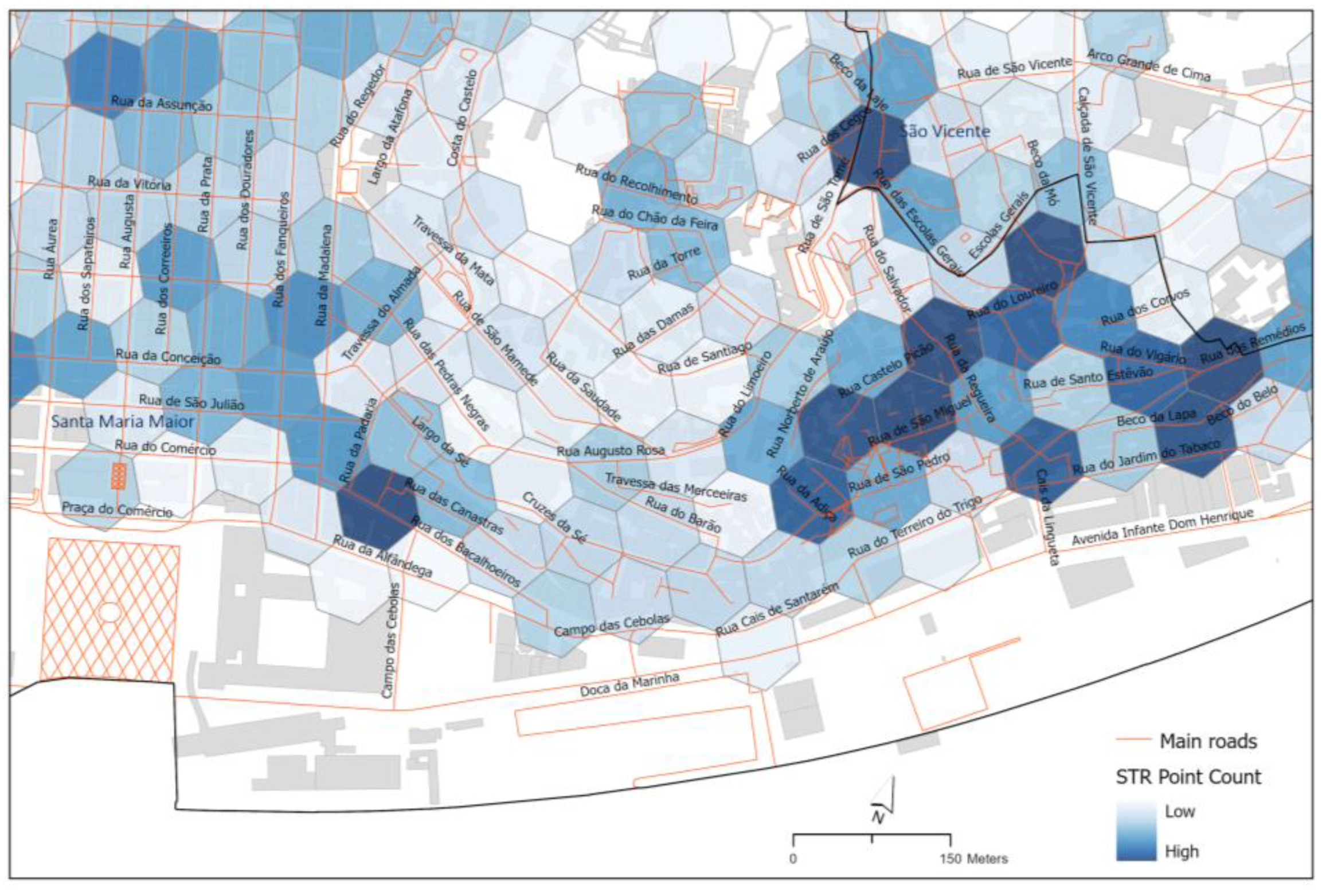
Figure 7.
Heat map based on the number of STR accomodations. (RNAL, 2024).
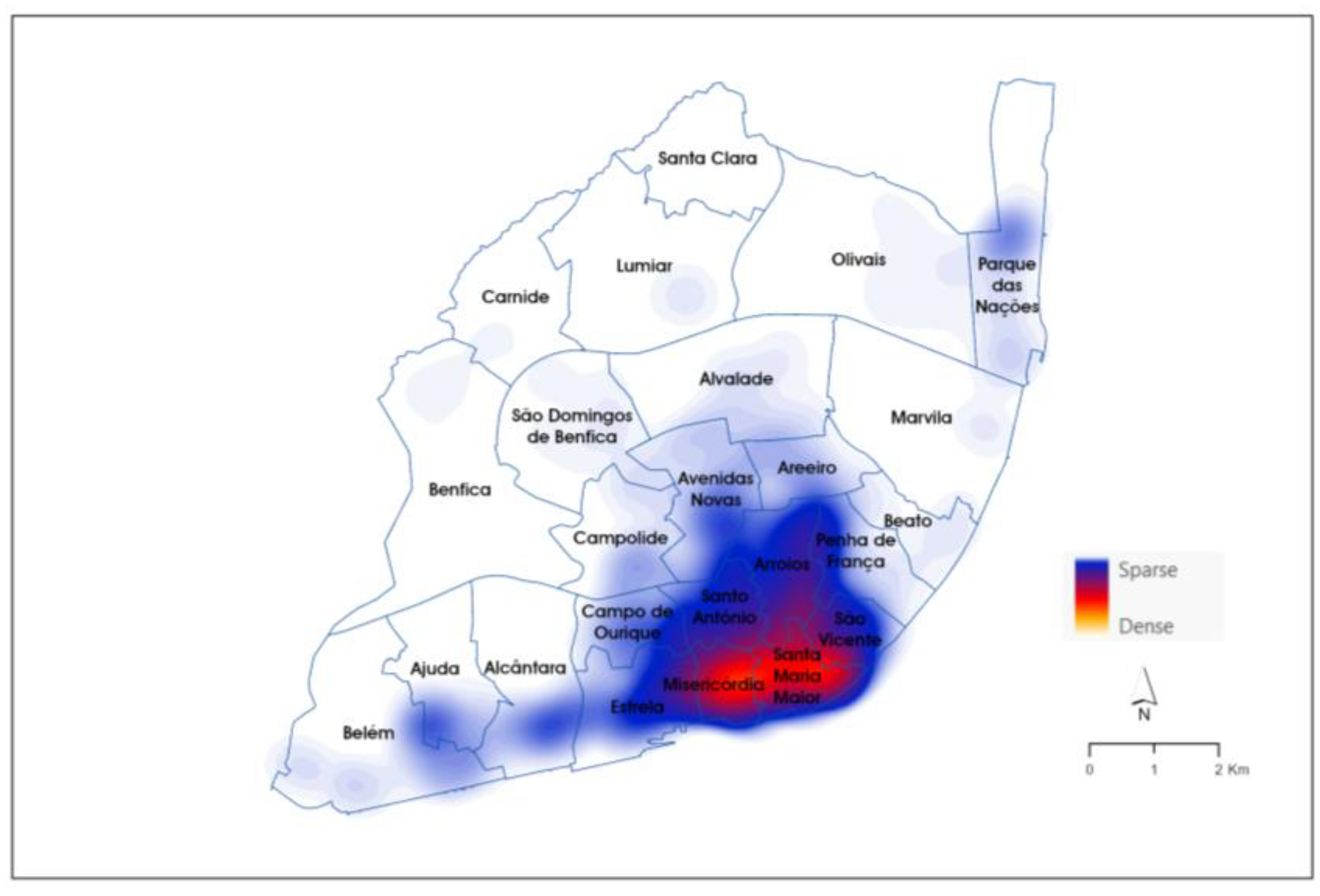
Figure 8.
Heat map based on the number of STR beds - maximum occupation rate. (RNAL, 2023).
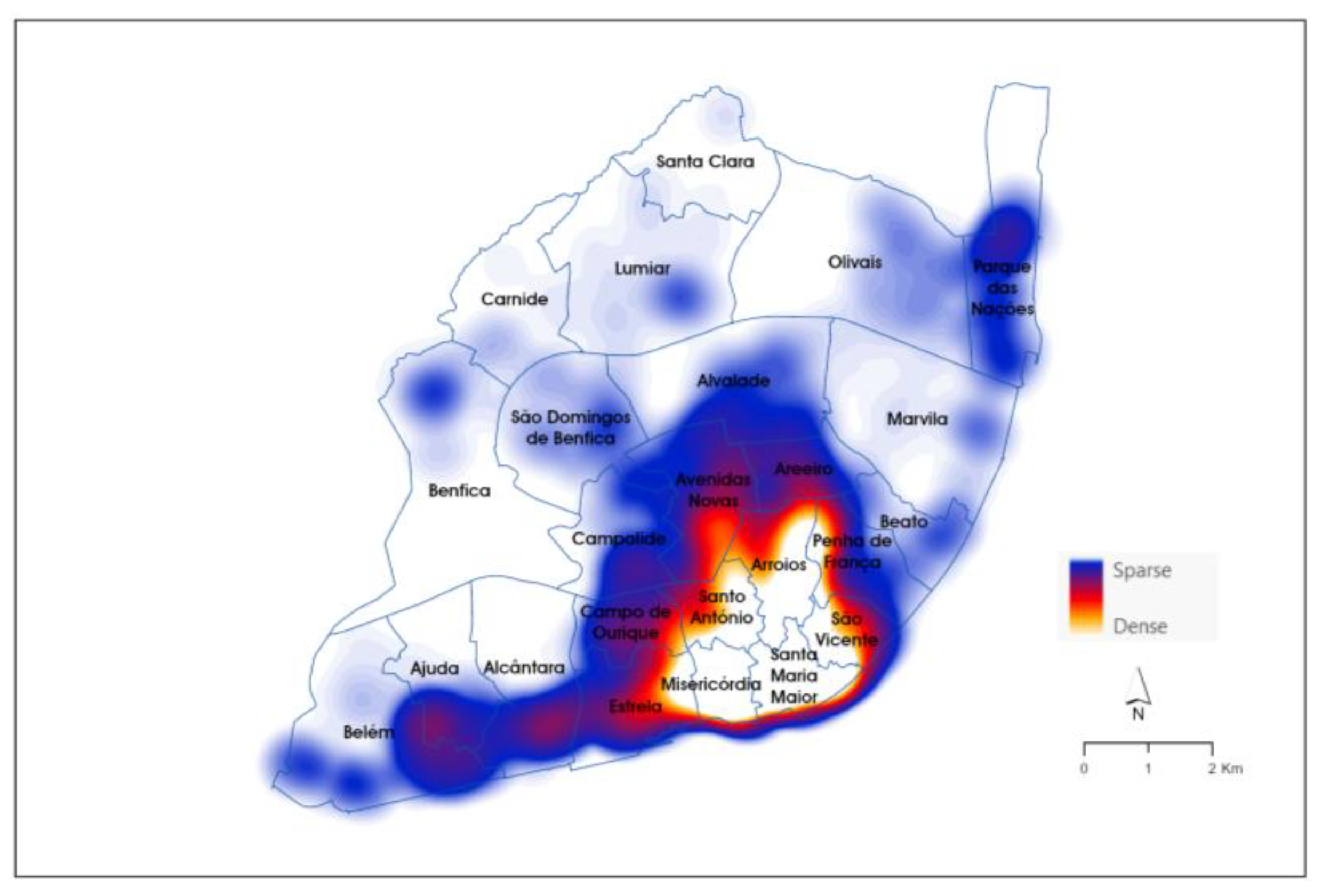
Figure 9.
Combined data observed by parish. (Census, INE, 2021).
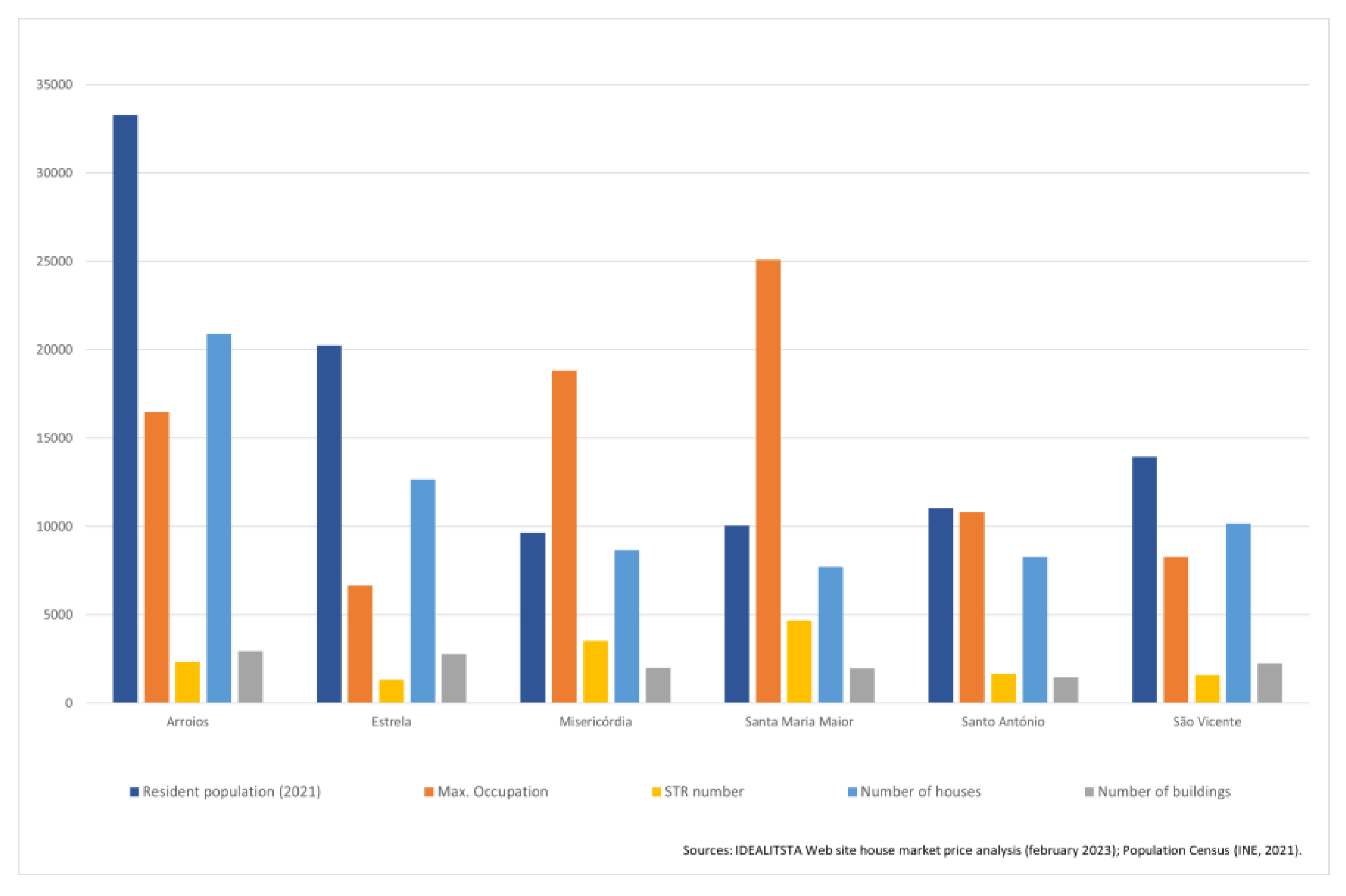
Figure 10.
Location of maximum concentration ellipse by subsection. (RNAL, 2023).
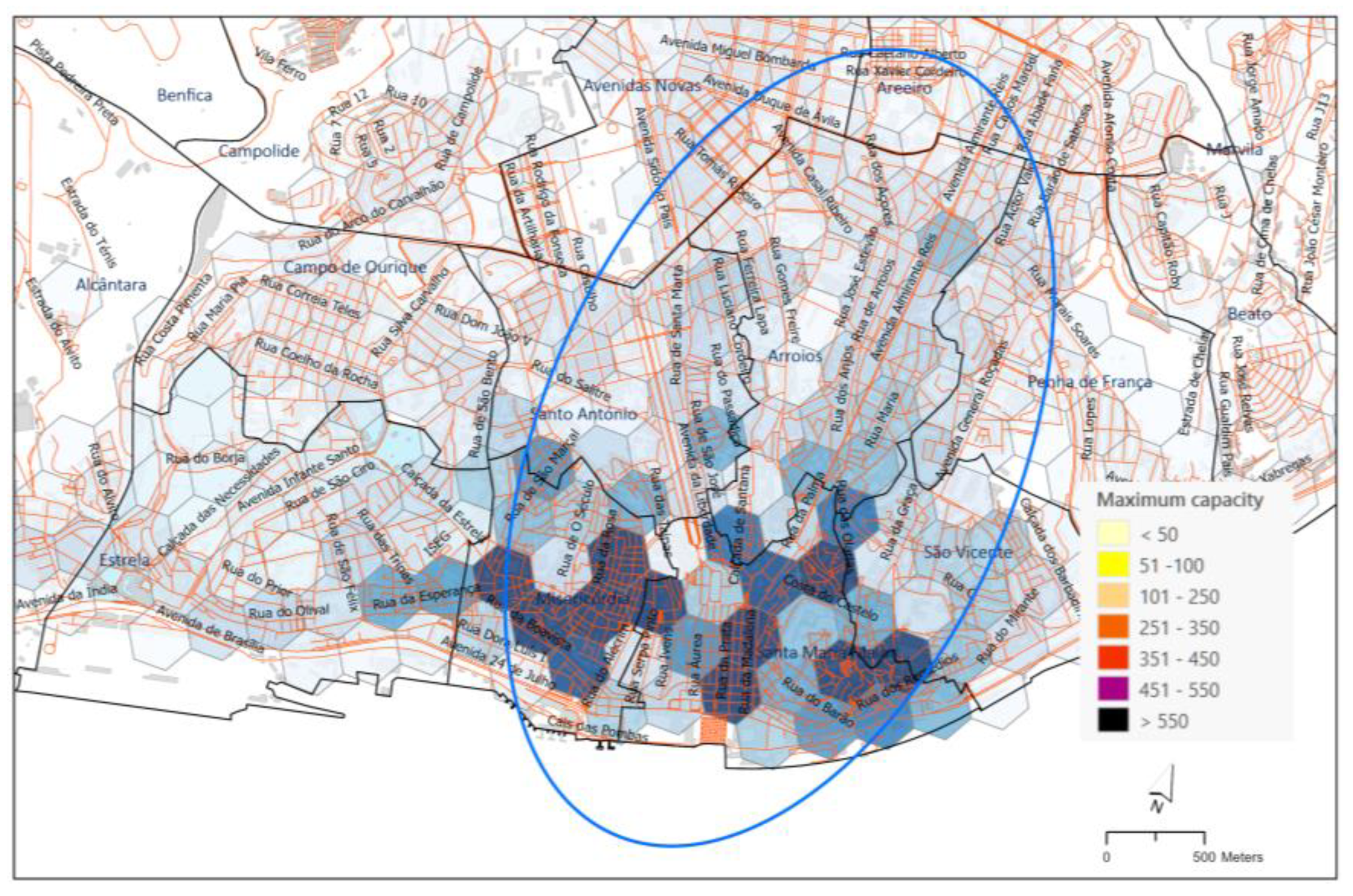
Figure 11.
Buffers around Remédios Street located on Alfama historical neighbourhood. (RNAL, 2022).
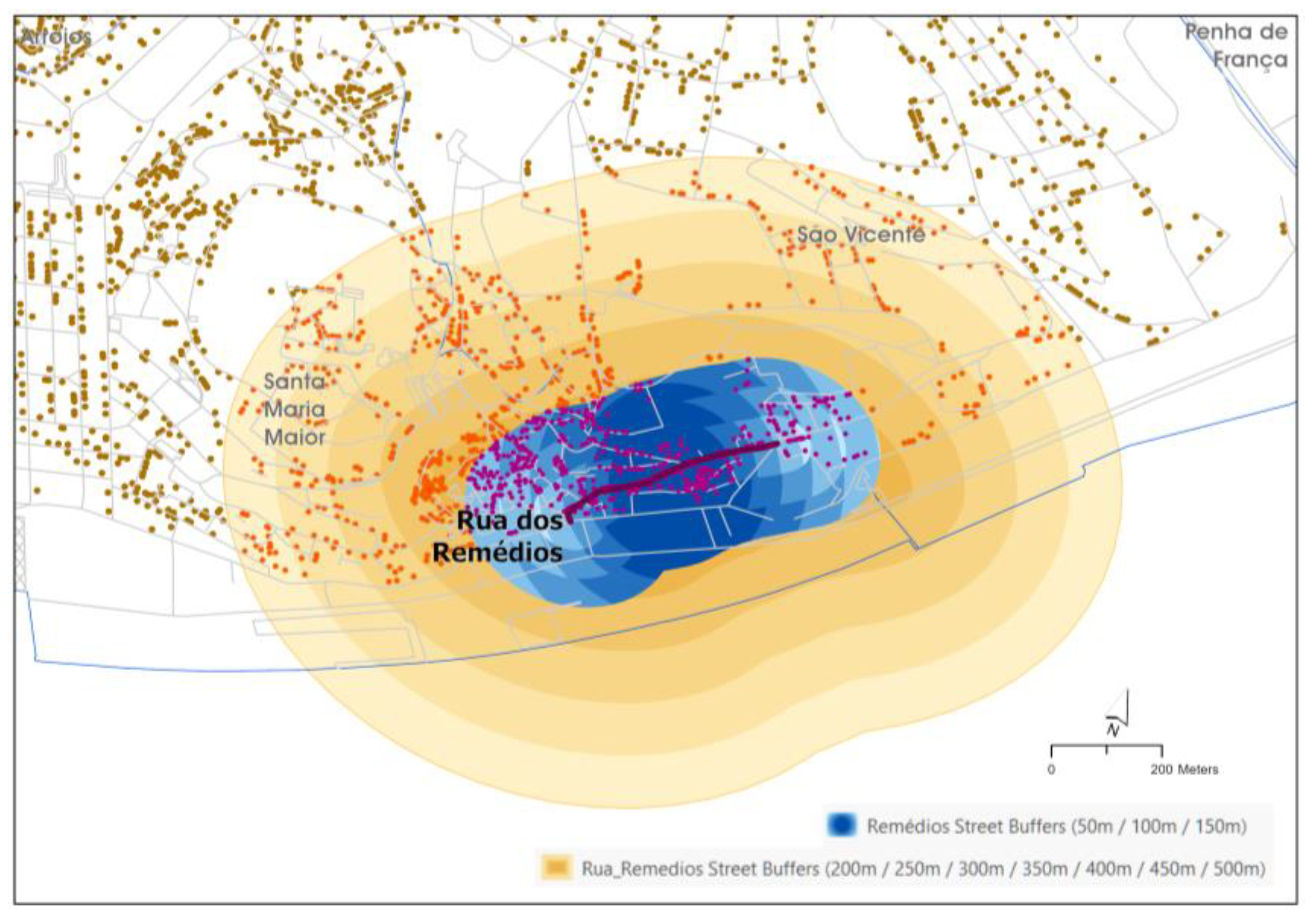

Table 1.
Variation of resident population between 2011 and 2021. (Census, 2001, 2011, 2021, Instituto Nacional de Estatística - INE).
Table 1.
Variation of resident population between 2011 and 2021. (Census, 2001, 2011, 2021, Instituto Nacional de Estatística - INE).
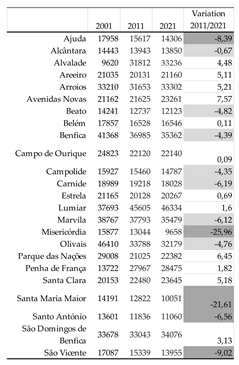
Table 2.
Positive and negative aspects of STR for tourism and economy on supply and demand (author’s resume).
Table 2.
Positive and negative aspects of STR for tourism and economy on supply and demand (author’s resume).
| Positive: |
| Variety of Options: Short-term rentals provide tourists with a diverse range of accommodation options. Travelers can choose from a wide selection of apartments, houses, lofts, or even unique properties such as villas, treehouses, or houseboats. This variety allows tourists to find accommodations that suit their preferences, budgets, and group sizes, providing a more personalized and customized experience. |
| Local Immersion: Staying in a short-term rental allows tourists to immerse themselves in the local culture and lifestyle. Unlike hotels, which are often located in tourist zones, short-term rentals are typically situated in residential neighbourhoods, enabling visitors to interact with locals, explore the community, and experience the daily life of the destination. This authenticity fosters a deeper connection with the local culture and creates memorable experiences for travellers. |
| Cost Savings: Short-term rentals can offer cost savings compared to traditional hotels, particularly for longer stays or when traveling with a group. By having access to a kitchen, tourists can prepare their meals instead of dining out for every meal, reducing expenses. Additionally, the ability to share accommodations with multiple people can help distribute the costs, making it more affordable for families or groups. |
| Enhanced Amenities: Short-term rentals often provide additional amenities that can enhance the overall travel experience. These amenities can include fully equipped kitchens, laundry facilities, spacious living areas, private gardens, and even amenities specific to the location, such as beach access or mountain views. Such facilities can make tourists feel more at home and provide convenience and comfort during their stay. |
| Flexibility and Privacy: Short-term rentals offer a level of flexibility and privacy that may be preferred by some tourists. Guests have the freedom to come and go as they please without the constraints of hotel policies. Moreover, short-term rentals provide a more private and intimate setting compared to hotels, which can be particularly appealing for couples or families seeking a more secluded and personal experience. |
|
Economic Benefits: Short-term rentals have the potential to generate economic benefits for both homeowners and local communities. Homeowners can earn extra income by renting out their properties, which can contribute to the local economy. Additionally, short-term rentals can stimulate local businesses and services, as tourists staying in residential neighbourhoods often frequent local shops, restaurants, and attractions, benefiting the local economy. |
| Negative: |
| Increased Tourist Numbers: Short-term rentals, especially in popular tourist destinations, can lead to an influx of tourists beyond the carrying capacity of the area. As these rentals offer additional accommodation options outside of traditional hotels, they can attract a larger number of visitors to a destination. The cumulative effect of increased tourist numbers can strain local resources, infrastructure, and public services, leading to overcrowding and inconvenience for both residents and tourists. |
| Disruption of Local Communities: The concentration of short-term rentals in residential neighbourhoods can disrupt the social fabric of communities. The constant turnover of tourists can lead to a transient population that lacks a sense of community and can disrupt the daily lives of permanent residents. Noise, disturbance, and a changing neighbourhood dynamic can create tensions between tourists and locals, eroding the quality of life for residents. |
| Housing Affordability and Availability: The popularity of short-term rentals can exacerbate housing affordability issues in cities, making it harder for locals to find affordable housing. Property owners may choose to convert residential properties into short-term rentals to capitalize on the lucrative tourism market, reducing the housing supply for long-term residents. This can lead to gentrification, increased housing prices, and a shortage of affordable housing options for locals, contributing to the displacement of residents from city centres. |
| Loss of Cultural Identity: The excessive concentration of short-term rentals in certain neighbourhoods can result in the loss of local character and cultural identity. As these areas become dominated by tourists, businesses and services catering to the local community may be replaced by tourist-oriented establishments. This commercialization can erode the authenticity and uniqueness of a destination, making it less appealing to those seeking an authentic travel experience. |
| Strain on Infrastructure and Resources: Short-term rentals can place a strain on local infrastructure, such as transportation networks, waste management systems, and public amenities. Residential neighbourhoods may not be designed or equipped to handle the increased tourist traffic, resulting in congestion, overburdened utilities, and a decline in the quality of public spaces. |
Table 3.
Data by parish. (Census, INE, 2021; RNAL, 2023).
Disclaimer/Publisher’s Note: The statements, opinions and data contained in all publications are solely those of the individual author(s) and contributor(s) and not of MDPI and/or the editor(s). MDPI and/or the editor(s) disclaim responsibility for any injury to people or property resulting from any ideas, methods, instructions or products referred to in the content. |
© 2025 by the authors. Licensee MDPI, Basel, Switzerland. This article is an open access article distributed under the terms and conditions of the Creative Commons Attribution (CC BY) license (https://creativecommons.org/licenses/by/4.0/).
Copyright: This open access article is published under a Creative Commons CC BY 4.0 license, which permit the free download, distribution, and reuse, provided that the author and preprint are cited in any reuse.


