
Preprint
Article

This version is not peer-reviewed.

Enhancing Quality of Life in Ostomized Patients Through Smart-Glasses-Supported Health Education: A Pre-Post Study

A peer-reviewed article of this preprint also exists.

Submitted:

07 December 2025

Posted:

09 December 2025

You are already at the latest version

Abstract

Background: Ostomy care consultations are essential for promoting patient autonomy and quality-of-life. The integration of innovative technologies may enhance health education and support effective self-care among ostomized patients. Objective: To analyze the impact of health education supported by smart-glasses on the quality of life of ostomized patients. Methods: This is a Pre—post study. A single 60-minute intervention was conducted with 14 ostomized patients (mean age: 57.6±12.6 years; 50% male). The session comprised three phases: (1) assessment of patient knowledge on ostomy management; (2) personalized feedback addressing individual needs; and (3) a hands-on workshop using Vuzix smart-glasses to provide a first-person perspective of ostomy care techniques. Four instructional videos were recorded and made available via a digital platform. Results: At baseline, patients reported moderate limitations in physical function and physical role. General health and vitality indicated fair-to-good perception, while mental health was adequate in 57.1% of participants. Following the intervention, SF-36 score improved significantly, with 53.8% reporting a very good quality of life. Physical function increased with 84.6% rating it as good or excellent. Emotional role improved markedly, and mental health reached 76.9% reporting optimal scores. A strong correlation was observed between baseline and post-intervention SF-36 scores. Conclusion: The integration of smart glasses into health education within nursing-led ostomy consultations significantly improved the quality of life of ostomized patients following digestive surgery.

Keywords: 
;  ;  ;  ;  ;  

1. Introduction

Early support and health education during ostomy care consultations are emphasized in the Nursing Best Practice Guidelines as essential for promoting patient independence and quality of life. [1] Health education addresses these needs, but resource access remains limited. [2,3]
From an epidemiological perspective, longer life expectancy, cancer screening programs, and the rising prevalence of chronic conditions such as Inflammatory Bowel Disease have led to an increase in invasive surgeries. [4]
Although specialized ostomy care is widely recognized, access remains limited, increasing healthcare costs. Enterostomal therapy nurses improve outcomes through personalized assessments, education, and follow-ups. [5] Advanced technologies like smart glasses provide immersive learning experiences, improving skills and reducing anxiety.
Aranda-García et al. [6] demonstrated that smart-glasses significantly improve technical accuracy during cardiopulmonary resuscitation simulations, achieving a 90% effective chest compression rate compared to 68% in the control group. They may enhance accuracy in ostomy care.
Aspiotis et al. [7] found that immersive technologies reduce stress in complex scenarios. Araújo et al. [8] and Kim et al. [9] noted high satisfaction, improving adherence.
The aim of this project is to analyze the impact of health education supported by smart-glasses on the quality of life of ostomized patients.

2. Materials and Methods

Study design, population and sample
This is a quasi-experimental, longitudinal, and prospective pilot study conducted with patients who have undergone ostomy surgery.
The target population for this pilot study included patients requiring elimination ostomies treated within the Santiago de Compostela and Barbanza Health Area.
Patients from University Hospital Complex of Santiago de Compostela (CHUS) who underwent digestive surgery with ostomy creation were recruited.
The inclusion criteria were adults; patients with digestive surgery resulting in an ostomy (permanent or temporary for more than 6 months); attendees of the ostomy consultation, and informed consent. Exclusion criteria included terminal illness or cognitive impairment.

2.1. Variables

Independent variables
Data were collected using a categorized data table. Sociodemographic data included age, sex, gender, marital status, educational level, and employment status.
Another section included clinical data related to the ostomy such as type of surgery, ostomy duration, and ostomy age.
Dependent variables
Data on quality of life included: physical function and role, bodily pain, general health, vitality, social function, emotional role, mental health, and health transition.
Short Form Health Survey (SF-36)
The SF-36 is a self-administered questionnaire measuring quality of life across eight domains and a health transition item. Scores range from 0 to 100, reflecting quality across domains. The validated Spanish version was used.10
Outcome measures
A score of ≥ 75 points on the SF-36.
Intervention
The intervention consisted of a single 60-minute session divided into three phases. The first phase focused on reviewing the patient’s knowledge of ostomy management, including diet, device handling, and stoma complication detection.
The second phase provided personalized feedback based on prior consultations, reinforcing concepts and fostering confidence.
The third phase included a practical workshop using Vuzix© smart glasses to enhance learning. Patients viewed techniques from a first-person perspective, replicating their own angle during ostomy management. Four educational videos—covering bag removal, stoma cleaning, bag application, and bag emptying—were accessible online.
This intervention aimed to improve patients’ confidence, self-efficacy, autonomy, and quality of life while reducing anxiety in ostomy care.

2.2. Data Collect

Data were collected confidentially. The STROBE checklist and flow diagram was used to describe the sample.

2.3. Ethical Considerations

The inclusion period extended from the approval resolution of the Santiago-Lugo Ethics-Research Committee (registration code 2024/389) and the granting of the Biomedical Research Study Contract by IDIS until May 1, 2025. It complied with Good Clinical Practice Guidelines, the Declaration of Helsinki, the Oviedo Convention, and current data protection and medical record regulations. Data anonymity was maintained in compliance with applicable laws.

2.4. Data Analysis

A descriptive analysis was performed using measures of central tendency (mean, M) and dispersion (standard deviation, SD) for quantitative variables, and absolute frequencies and percentages for qualitative variables. Spearman's correlation and Chi-square tests were used. Statistical analysis was conducted using PASW Statistics (version 23.0; SPSS Inc., Chicago, Illinois), with a significance level set at p<0.05 (two-tailed).

3. Results

Fourteen patients participated, with a mean age of 57±12.61 years. Most were married and had primary or vocational education. Clinically, 64.3% had permanent ostomies, and a 50% had lived with an ostomy for over two years. At baseline, the mean quality of life score was 70.86±21.30, with 50% reporting a very good quality of life. Following the interventions, the score rose to 76.73±12.04, with 53.8% reporting a very good quality of life. (Table 1).
Moderate limitations were observed in physical function, physical role, and general health perception. Vitality, social function, emotional role, and mental health showed mild impairments but were generally adequate. Health transition showed no change for most patients, although some reported deterioration. (Table 2).
Follow-up revealed improvements in physical function, physical role, and social function, and significant gains in general health, vitality, emotional role, and mental health. Health transition improved, with nearly half reporting better or much better health.
Statistically significant improvements were observed in quality of life, educational level, and employment status correlations with social function (Figure 1).
There was a strong direct correlation between baseline and post-intervention quality of life scores (ρ=0.923, p=0.001).
The results from the SF-36 questionnaire domains demonstrate consistently high effect sizes (Cohen's d), highlighting the practical significance of the observed differences. The "Emotional Role" domain exhibited the largest effect size (d=10.54), followed by "Mental Health" (d=6.27) and "Vitality" (d=4.19). The "Physical Function" domain showed a substantial effect size (d=3.18), while "Bodily Pain" (d=2.46), "General Health" (d=2.66), and "Health Transition" (d=2.61) also demonstrated significant effect sizes. All tt values were statistically significant (p<0.001), underscoring the robustness of the findings and their clinical relevance (Table 3).

4. Discussion

This pre-post study evaluated health education using smart-glasses as a nursing intervention, suggesting a positive impact on the quality of life of ostomized patients. Quality of life scores appeared to improve consistently with similar studies.
Recent research indicates the effectiveness of smart-glasses in enhancing technical skills and user confidence. These devices may contribute to reduce errors and improve safety in ostomy care. [6]
Smart-glasses seem to enhance learning and self-care adherence. Araújo et al.8 reported increased motivation and confidence, applicable to ostomy care education. Immersive technologies, like virtual reality, have shown potential in reduce stress in high-complexity scenarios, offering potential in ostomy education. [7,11]
Smart-glasses also appear to enable effective remote training, providing real-time feedback during ostomy care [12]. Muroi et al. [13] observed that 85% of students using smart-glass-recorded videos improved their understanding of technical procedures, suggesting this approach might enhance ostomized patients' ability to learn and practice care techniques effectively [14].
Emotional and educational support further seems to contribute to improved outcomes. Krouse et al. [15] observed better follow-up levels in patients who received such interventions, with Stoma-QOL scores rising from 6.3±1.8 to 7.1±1.7 (n=25). However, Krouse et al. [16] later noted more limited results in telematic interventions, showing no significant differences in overall quality of life except for the physical domain (6.52±1.74; p<0.05; n=54).
Coca et al. [17] highlighted the link between self-care and quality of life, noting that patients receiving adequate health education adapted better to their condition. Their study reported HRQOL Montreux scores improving from 68.7±14.2 to 74.8±12.8 (n=402; p<0.001), consistent with this study's findings, where quality of life scores appeared to improve from 70.86±21.30 (n=14) to 76.73±12.04 (n=13) after interventions. Other studies have reported improvements in SF-36 dimensions, showing a positive impact on patients' quality of life, aligning with this study. [18,19]
Social function scores remained relatively high throughout the study (82.68±19.15 to 84.04±21.45), suggesting activation of the social role dimension and minimal disruption in patients' social interactions. This finding underscores the importance of fostering social connectivity in ostomy care education. The physical role domain showed marginal improvement (73.21±42.14 to 76.92±36.03), contrasting with more pronounced changes observed in other studies18. These results highlight the need for extended follow-up periods to capture long-term effects on physical functionality.
In the bodily pain dimension, this study observed initial values of 66.96±23.72, which worsened slightly to 64.42±26.14 points in the second interview. These results were lower than those reported by Indrebø et al. [18], who noted progressive improvement in bodily pain, starting at 73.07±6.87 at 3 months, reaching 80.86±6.35 at 6 months, and declining slightly to 74.67±6.00 points at 12 months.
While most dimensions appeared to show consistent improvement, bodily pain exhibited a slight decline (66.96±23.72 to 64.42±26.14), contrasting with findings by Indrebø et al., [18] who reported progressive relief in pain scores over time. This discrepancy may reflect variations in intervention duration or sample characteristics. The general health domain showed moderate improvement (58.57±23.16 to 62.31±23.42), partially aligning with Wang et al. [19], who observed significant increases in satisfaction within this dimension. Vitality scores improved slightly (69.29±20.56 to 71.15±16.98), suggesting potential for further enhancement with tailored interventions focused on energy levels and motivation.
In the vitality dimension, this study observed initial values of 69.29±20.56 improving to 71.15±16.98 in the follow-up. Wang et al. [19] reported greater improvement, starting with a lower baseline (37.04±5.28) and achieving higher post-intervention values (75.08±4.86).
In the social function dimension, this study reported higher initial values (82.68±19.15), which improved to 84.04±21.45 points in the second interview. These results reflect transitions from moderate to slightly or not affected categories, suggesting activation of the social role dimension within the framework of quality of life.
Building upon the findings of this study, the observed improvements in quality of life across SF-36 dimensions further support the potential effectiveness of health education interventions using smart-glasses for ostomized people. Specifically, the emotional role dimension demonstrated the most significant enhancement, with scores increasing from 78.57±36.06 to 97.44±9.25 points. Similarly, substantial improvements were noted in the mental health domain, with values rising from 79.14±20.10 to 87.38±13.94 points post-intervention. These results align with previous studies that highlight the positive impact of immersive technologies on emotional and psychological well-being. [7,11,20]
In the mental health dimension, this study observed an improvement from initial values of 79.14±20.10 (n=14) to 87.38±13.94 points post-intervention (n=13).
Anxiety is common among ostomized patients, particularly when learning new tasks. Hosseini et al.11 demonstrated virtual reality's effectiveness in reducing anxiety before surgical procedures (p<0.01). Similarly, smart glasses could provide immersive instructional videos to help patients safely learn stoma management techniques, potentially reducing stress while improving technical skills. [7,20,21,22]
However, smart glasses face limitations such as battery life, connectivity issues, device weight, lens fogging, and small screen size, which may affect user experience. [9,23,24,25] Additionally, patients unfamiliar with advanced technologies may require orientation and practice sessions to maximize benefits. Addressing these challenges is essential for successful implementation in health education for ostomized patients. [8,12,13,26]
Overall, the findings emphasize the preliminary clinical relevance of smart-glasses as a tool for enhancing self-care adherence, emotional resilience, and technical skills among ostomized patients. Future research should explore the integration of immersive technologies into personalized educational interventions to address specific challenges in bodily pain and physical functionality, while assessing their long-term impact on health-related quality of life. [27]

Limitations

This study has several limitations: (1) the quasi-experimental design without a control group, constrained by ethical restrictions, limited the ability to establish causal relationships; (2) the brief follow-up period, small sample size, and participant heterogeneity may have introduced biases, affecting the generalizability of the results; (3) external contextual variables and specific intervention components were not analyzed; and (4) the lack of objective measures and a cost-effectiveness analysis reduced the clinical applicability of the findings, (5) While this design allows for the exploration of the intervention’s effects, establishing causality and conducting group comparisons would require controlled designs, such as randomized controlled trials or stepped-wedge models.

5. Conclusions

The use of smart glasses in health education as a nursing intervention in ostomy consultations improved the quality of life of ostomized patients after digestive surgery. The influence of factors such as educational level and employment status on social functioning was confirmed. These results highlighted the effectiveness of educational interventions and nursing care in addressing the physical, emotional, social, and psychological needs of ostomized patients, reinforcing their applicability in clinical practice.

Author Contributions

For research articles with several authors, a short paragraph specifying their individual contributions must be provided. The following statements should be used “Conceptualization, E.R.P.P., T.M.C., M.G.C., R.R.G., N.M.L. and N.G.G.; methodology, E.R.P.P., T.M.C., D.R.B.; software, E.R.P.P., N.M.L., R.R.G.; validation, M.G.C., E.R.P.P. and N.G.G.; formal analysis, E.R.P.P.; T.M.C., R.R.G., M.G.C., investigation, T.M.C., N.G.D., D.R.B.; resources, E.R.P.P., T.M.C.; data curation, T.M.C., N.M.L.; writing—original draft preparation, T.M.C., D.R.B., N.G.G.; writing—review and editing, E.R.P.P., M.G.C., R.R.G., N.M.L.; visualization, R.R.G., M.G.C. E.R.P.P.; supervision, E.R.P.P., R.R.G., M.G.C.; project administration, E.R.P.P., M.G.C.; funding acquisition, E.R.P.P. All authors have read and agreed to the published version of the manuscript.

Funding

This research was funded by Ilustre Colegio Oficial de Enfermería de Lugo and University of Santiago de Compostela, grant number 2025-PO022” and “The APC was funded by the related proyect”. https://investigacion.usc.gal/proyectos/1482677/detalle

Institutional Review Board Statement

The inclusion period extended from the approval resolution of the Santiago-Lugo Ethics-Research Committee (registration code 2024/389) and the granting of the Bio-medical Research Study Contract by IDIS until May 1, 2025. It complied with Good Clinical Practice Guidelines, the Declaration of Helsinki, the Oviedo Convention, and current data protection and medical record regulations. Data anonymity was maintained in compliance with applicable laws.

Informed Consent Statement

All participants provided informed consent prior to enrollment in the study, in compliance with ethical standards.

Data Availability Statement

The datasets generated and/or analyzed during the current study are not publicly available but can be obtained from the corresponding author upon request, subject to privacy and ethical restrictions.

Conflicts of Interest

The authors declare no conflicts of interest.

References

  1. Álvarez González D, Crespo Fontán B, Fabeiro Mouriño MJ, García Sánchez RM, Louzao Méndez S, Pardo Roda P, et al. Grupo Gallego de Proctología. Santiago de Compostela: SOCIGA; ©2016. Guía de enfermería para el cuidado del paciente ostomizado. Available in: https://sociga.net/wp-content/uploads/2018/06/GU%C3%8DA-DE-ENFERMER%C3%8DA-PARA-EL-CUIDADO-DEL-PACIENTE-OSTOMIZADO.docx.
  2. Ketterer SN, Leach MJ, Fraser C. Factors Associated with Quality of Life Among People Living With a Stoma in Nonmetropolitan Areas. Nurs Res. 2021 Jul-Aug;70(4):281-288. [CrossRef]
  3. Artola Etxeberría M, García Manzanares ME, García Moreno V, Martín Fernández M. Instituto Español de Investigación Enfermera. Madrid: IM&C; 2023. Guía de recomendaciones prácticas. Ostomía en Atención Primaria. Available in: https://www.ieinstituto.es/publicaciones/documentos-de-elaboracion-propia/guias-clinicas/descargar-archivo?path=GRP%2BOstomi%2Ba_2023.pdf.
  4. Cobos Serrano JL. Coloplast Professional. Madrid: Coloplast Productos Médicos; 2018. Libro blanco de la ostomía en España. Available in: https://www.coloplast.es/Global/Spain/Ostomia/Otros/PDF/Libro%20blanco%20de%20la%20Ostom%C3%ADa.pdf.
  5. Nizum N, Jacob G, Bamford M, Gittens G, White V, Wang D, et al. Registered Nurses’ Association of Ontario. Toronto (ON): RNAO; ©2025. Supporting adults who anticipate or live with an ostomy. 2nd ed. Available in: https://rnao.ca/bpg/guidelines/ostomy.
  6. Aranda-García S, Barrio-Cortes J, Fernández-Méndez F, Otero-Agra M, Darné M, Herrera-Pedroviejo E, et al. Dispatcher-assisted BLS for lay bystanders: A pilot study comparing video streaming via smart glasses and telephone instructions. The American Journal of Emergency Medicine. 2023;71:163-168. [CrossRef]
  7. Aspiotis V, Miltiadous A, Kalafatakis K, Tzimourta KD, Giannakeas N, Tsipouras MG,et al. Assessing electroencephalography as a stress indicator: a VR high-altitude scenario monitored through EEG and ECG. Sensors. 2022;22(15):5792. [CrossRef]
  8. Araújo AC, Gardim L, Salma J, Stephen T, Dos Santos SS, Silva ÍR, et al. Advancing Nursing Education through Wearable Electronic Devices: A Scoping. Nurse Education in Practice. 2024;79:104032. [CrossRef]
  9. Kim SK, Lee Y, Yoon H, Choi J. Adaptation of extended reality smart glasses for core nursing skill training among undergraduate nursing students: Usability and feasibility study. Journal of medical Internet research. 2021;23(3):e24313. [CrossRef]
  10. Molina-Barea R, Slim M, Calandre EP. Health-Related Quality of Life and Psychosocial Variables in Women with Colorectal Pelvic Floor Dysfunction: A Cross-Sectional Study. Healthcare. 2024 Mar;12(6):668. [CrossRef]
  11. Hosseini T, Hooshmandja M, Noaparast M, Mojtahedzadeh R, Mohammadi A. Virtual reality exposure therapy to decrease anxiety before surgical invasive procedures in hemodialysis patients: an interventional study. BMC nephrology. 2024;25(1):30. [CrossRef]
  12. Barcala-Furelos R, Aranda-García S, Otero-Agra M, Fernández-Méndez F, Alonso-Calvete A, Martínez-Isasi S, et al. Are smart glasses feasible for dispatch prehospital assistance during on-boat cardiac arrest? A pilot simulation study with fishermen. Internal and emergency medicine. 2023;18(5):1551-1559. [CrossRef]
  13. Muroi K, Kyogoku S, Sakano Y, Sakamoto H, Nakazeko K, Koyama K, et al. An analysis of the effectiveness of reflective learning through watching videos recorded with smart glasses—With multiple views (student, patient, and overall) in radiography education. Plos one. 2024;19(1):e0296417. [CrossRef]
  14. Sato T, Sandars J, Brown J, Rogers SN. Usefulness of smart glasses and point of view for suturing skills training in medical students: pilot study. BMJ Simulation & Technology Enhanced Learning. 2020;7(3):173. [CrossRef]
  15. Krouse RS, Grant M, McCorkle R, Wendel CS, Cobb MD, Tallman NJ, et al. A chronic care ostomy self-management program for cancer survivors. Psychooncology. 2016 May;25(5):574-81. [CrossRef]
  16. Krouse RS, Zhang S, Wendel CS, Sun V, Grant M, Ercolano E, et al. A randomized prospective trial of an ostomy telehealth intervention for cancer survivors. Cancer. 2024 Feb;130(4):618-35. [CrossRef]
  17. Coca C, Fernández de Larrinoa I, Serrano R, García-Llana H. The impact of specialty practice nursing care on health-related quality of life in persons with ostomies. J Wound Ostomy Continence Nurs. 2015 May-Jun;42(3):257-63. [CrossRef]
  18. Indrebø KL, Aasprang A, Olsen TE, Andersen JR. Experiences and results from using a novel clinical feedback system in routine stoma care nurse follow-up of patients with an ostomy: a longitudinal study. J Patient Rep Outcomes. 2023 Mar;7(1):27. [CrossRef]
  19. Wang S, Tian H, Xue R. Using psychological interventions in the nursing care of rectal cancer patients. Am J Transl Res. 2021 Jun;13(6):7282-7. Available in: https://pmc.ncbi.nlm.nih.gov/articles/PMC8290720/pdf/ajtr0013-7282.pdf.
  20. Balsam P, Borodzicz S, Malesa K, Puchta D, Tymińska A, Ozierański K, et al. OCULUS study: Virtual reality-based education in daily clinical practice. Cardiology journal. 2019;26(3):260-264. [CrossRef]
  21. Southworth MK, Silva JR, Silva JNA. Use of extended realities in cardiology. Trends in cardiovascular medicine. 2020;30(3):143-148. [CrossRef]
  22. Reece R, Bornioli A, Bray I, Newbutt N, Satenstein D, Alford C. Exposure to green, blue and historic environments and mental well-being: a comparison between virtual reality head-mounted display and flat screen exposure. International journal of environmental research and public health. 2022;19(15):9457. [CrossRef]
  23. Baashar Y, Alkawsi G, Wan Ahmad WN, Alomari MA, Alhussian H, Tiong SK. Towards wearable augmented reality in healthcare: a comparative survey and analysis of head-mounted displays. International journal of environmental research and public health. 2023;20(5):3940. [CrossRef]
  24. Fang JR, Pahwa R, Lyons KE, Zanotto T, Sosnoff JJ. Examining the validity of smart glasses in measuring spatiotemporal parameters of gait among people with Parkinson’s disease. Gait & Posture. 2024;113:139-144. [CrossRef]
  25. Marschollek M, Barthel C, Behrends M, Schmeer R, Meyenburg-Altwarg I, Becker M. Smart Glasses in Nursing Training–Redundant Gadget or Precious Tool? A Pilot Study. In Nursing Informatics. 2016:377-381. [CrossRef]
  26. Sekiguchi A, Cao R, Umemori S, Noritake K, Sunaga M, Kinoshita A, et al. Educational effectiveness of remote training with smart glasses for impression-taking. Journal of Dental Education. 2024;1-8. [CrossRef]
  27. Capilla Díaz C, Moya Muñoz N, Matas Terrón JM, Pérez Morente MA, Álvarez Serrano MA, Montoya Juárez R, et al. Evaluation of interventions in people with digestive stoma through the Nursing Interventions Classification. Int J Nurs Knowl. 2022 Jan;33(1):40-8. [CrossRef]
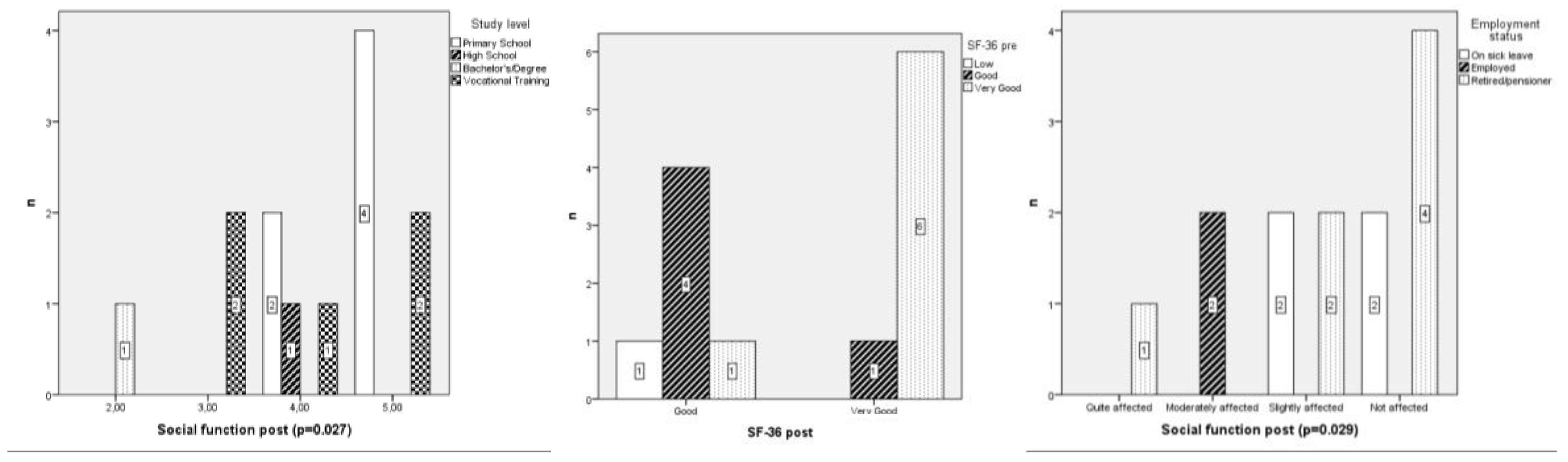
Figure 1. Chi-square test between study level, employment status and social function at second interview; and between Quality of Life (SF-36) pre and post.
Preprints 188516 g001
Table 1. Central and dispersion measures.
n % M SD Q1 Q2 Q3 IL SL
Age 14 57 12.61 48 57.5 67 32 80
Sex
Man 7 50
Woman 7 50
Marital status
Single 1 7.1
Married 11 78.6
Divorces 2 14.3
Educational level
Primary education 6 42.9
Secondary education 1 7.1
University or higher education 2 14.3
Vocational training 5 35.7
Employment status
Employed 2 14.3
On sick leave 5 35.7
Retired/pensioner 7 50
Type of surgery
Scheduled 8 57.1
Emergency 6 42.9
Duration of ostomy
Temporary (superior a 6 meses) 5 35.7
Permanent 9 64.3
Ostomy age
< 1 year 2 14.3
1-2 years 5 35.7
> 2 years 7 50
Quality of Life – 1st Interview 70.86 21.30 59.67 75.56 87.51 27 98
Low quality of life 2 14.3
Good quality of life 5 35.7
Very good quality of life 7 50
Quality of Life – 2nd Interview 76.73 12.04 70.18 76.61 85.08 55 97
Good quality of life 6 46.2
Very good quality of life 7 53.8
M: mean; SD: standard desviation; Q1: first quartile; Q2: second quartile; Q3: third quartile; IL: inferior limit; SL: superior limit.
Table 2. (A) Quality-of-life dimensions at first interview. (B) Quality-of-life dimensions at second interview.
(A) Quality-of-Life Dimensions at First Interview
n % M SD Q1 Q2 Q3 IL SL
Physical Function 72.14 27.65 51.25 87.50 90 20 100
Very limited 3 21.4
Slightly limited 10 71.5
Not limited 1 7.1
Physical Role 73.21 42.14 37.50 100 100 0 100
Limited 3 21.4
Not limited 11 78.6
Bodily Pain 66.96 23.72 51.25 68.75 90 23 100
Extreme 1 7.1
Severe 2 14.3
Moderate 6 42.9
Mild 4 28.6
None 1 7.1
General Health 58.57 23.16 35 60 76.25 25 100
Excellent 1 7.1
Very good 4 28.6
Good 4 28.6
Fair 5 35.7
Vitality 69.29 20.56 53.75 70 90 35 100
Low 1 7.1
Moderate 4 28.6
Good 5 35.7
High 2 14.3
Very high 2 14.3
Social Function 82.68 19.15 57.50 87.50 100 55 100
Moderately affected 5 35.7
Slightly affected 3 21.4
Not affected 6 42.9
Emotional Role 78.57 36.06 66.67 100 100 0 100
Affected 2 14.3
Not affected 12 85.7
Mental Health 79.14 20.10 60 82 100 40 100
Moderately affected 2 14.29
Moderate 4 28.57
Adequate 4 28.57
Optimal 4 28.57
Health Transition 57.14 28.47 50 50 81.25 0 100
Much worse 1 7.14
Worse 1 7.14
No change 8 57.15
Better 1 7.14
Much better 3 21.43
(B) Quality-of-Life Areas at 2nd Interview
n % M SD Q1 Q2 Q3 IL SL
Physical Function 79.62 25.04 60 95 97.50 20 100
Very limited 1 7.7
Slightly limited 9 69.2
Not limited 3 23.1
Physical Role 76.92 36.03 50 100 100 0 100
Limited 3 23.1
Not limited 10 76.9
Bodily Pain 64.42 26.14 38.75 70 80 22.50 100
Extreme 2 15.4
Severe 2 15.4
Moderate 4 30.8
Mild 3 23.0
None 2 15.4
General Health 62.31 23.42 50 65 77.50 10 100
Excellent 1 7.7
Very good 2 15.4
Good 8 61.5
Fair 1 7.7
Poor 1 7.7
Vitality 71.15 16.98 57.50 70 82.50 45 100
Moderate 3 23.1
Good 7 53.8
High 1 7.7
Very high 2 15.4
Social Function 84.04 21.45 67.50 90 100 37.5 100
Quite affected 1 7.7
Moderately affected 2 15.4
Slightly affected 4 30.8
Not affected 6 46.1
Emotional Role 97.44 9.25 100 100 100 67 100
Not affected 13 100
Mental Health 87.38 13.94 76 92 100 60 100
Moderate 3 23.1
Adequate 5 38.45
Optimal 5 38.45
Health Transition 67.31 25.79 50 50 100 25 100
Worse 1 7.7
No change 6 46.1
Better 2 15.4
Much better 4 30.8
Table 3. t-student results.
Domain Mean±SD Mean Difference 95% CI (Lower, Upper) t df Sig. (two-tailed) Effect Size (d)
Quality of Life 76.73±12.04 5.87 (69.46-84.01) 22.975 12 0.001 6.37
Physical Function 79.615±25.04 7.48 (64- 94.75) 11.465 12 0.001 3.18
Physical Role 76.92±36.029 3.71 (55.15-98.70) 7.698 12 0.001 2.14
Bodily Pain 64.423±26.1437 -2.54 (48.625-80.222) 8.885 12 0.001 2.46
General Health 62.31±23.418 3.74 (48.16-76.46) 9.593 12 0.001 2.66
Vitality 71.15±16.975 1.86 (60.90-81.41) 15.114 12 0.001 4.19
Social Function 84.038±21.4461 1.358 (71.079-96.998) 14.129 12 0.001 3.92
Emotional Role 97.44±9.245 18.87 (91.85-103.02) 38 12 0.001 10.54
Mental Health 87.38±13.938 8.24 (78.96-95.81) 22,606 12 0.001 6.27
Health Transition 67,31±25.789 10.17 (51.72-82.89) 9,410 12 0.001 2.61
Disclaimer/Publisher’s Note: The statements, opinions and data contained in all publications are solely those of the individual author(s) and contributor(s) and not of MDPI and/or the editor(s). MDPI and/or the editor(s) disclaim responsibility for any injury to people or property resulting from any ideas, methods, instructions or products referred to in the content.
Copyright: This open access article is published under a Creative Commons CC BY 4.0 license, which permit the free download, distribution, and reuse, provided that the author and preprint are cited in any reuse.
Prerpints.org logo

Preprints.org is a free preprint server supported by MDPI in Basel, Switzerland.

Subscribe

Disclaimer

Terms of Use

Privacy Policy

Privacy Settings

© 2026 MDPI (Basel, Switzerland) unless otherwise stated
