

Submitted:
05 December 2025
Posted:
09 December 2025
You are already at the latest version
Abstract
Melanoma survival has improved markedly in the past decade with new systemic agents. A key molecular hallmark is aberrant telomerase activation, largely driven by telomerase reverse transcriptase (TERT) promoter mutations (which are present in 50–82% of cases). These mutations represent the most frequent noncoding alteration in melanoma. Telomerase activation results in replicative immortality by maintaining telomere length, so cancer cells bypass senescence and apoptosis. However, the relationship between telomerase activity and melanoma cell population doubling time remains poorly defined. Pathways linking telomerase expression to accelerated cell cycle progression require further study. While telomerase inhibitors show preclinical promise, clinical application is limited by delayed cytotoxicity and resistance mechanisms. No review has yet mapped evidence connecting telomerase activity with melanoma proliferation kinetics and doubling time. Materials and Methods: A scoping review was conducted using Scopus, ScienceDirect, MEDLINE/PubMed, and CINAHL (Cumulative Index to Nursing and Allied Health Literature). Keywords included “telomerase,” “melanoma,” “cancer,” “cell proliferation,” and “doubling time.” The PRISMA framework guided our analysis of published studies. Results: Telomerase is clinically relevant for diagnosis, prognosis, and therapy. Biomarkers such as telomere length, telomerase activity, and TERRA expression correlate with disease stage and survival. Therapeutic strategies include enzyme inhibitors (e.g., Imetelstat), cytotoxic nucleotide incorporation, telomere destabilization, and immunotherapies such as peptide or dendritic cell vaccines, DNA vaccines, and CAR-T cells. Resistance often arises through alternative telomere maintenance mechanisms. Targeting extratelomeric TERT functions offers promise but remains complex. Conclusions: Telomerase drives melanoma progression through telomere-dependent and independent mechanisms, influencing proliferation, survival, metabolism, and genome stability. Clarifying these processes is essential for developing biomarkers and therapies that effectively target telomerase, overcome resistance, limit cancer progression and potentially provide another useful therapeutic option against melanoma.
Keywords:
cell proliferation
; doubling time
; telomerase
; scoping review
; survival
; prognosis
; outcome
; resistance
; target
; melanoma
1. Introduction
Melanoma remains a significant global health challenge, with incidence rates steadily rising worldwide [1]. Recent epidemiology data indicate that melanoma accounts for approximately 1.5% of all newly diagnosed cancer, with age-adjusted incidence rates increasing from 15.1 per 100,000 in 1999 to 23.0 per 100,000 in 2021 [1]. As of 2025, melanoma represents one of the most prevalent cancers, with over 816,580 individuals living with a melanoma diagnosis in the United States alone [2]. A defining molecular characteristic of melanoma is the aberrant activation of telomerase, with 69-82% of cutaneous melanoma exhibiting detectable telomerase activity [3,4]. This activation is predominantly mediated by telomerase reverse transcriptase (TERT) promoter mutations [5,6] which occur at frequencies ranging from 50% to 82% in melanoma cases, representing the most common noncoding mutation in this malignancy [7,8].
Telomerase activation represents a critical mechanism enabling replicative immortality in melanoma cells, directly facilitating sustained cancer cell proliferation and tumor progression [9,10]. The enzyme complex maintains telomere length at chromosomal ends, thereby bypassing cellular senescence and apoptosis pathways that normally limit cell division [3,4,11]. The most prevalent TERT promoter mutations (C228T and C250T, located at 124 and 146 pb from the ATG start site) generate de novo binding sites for ETS (Erythroblast Transformation Specific) transcription factors, resulting in 2- to 4-fold increases in TERT mRNA expression and telomerase activity [6,7,8]. This heightened telomerase activity correlates strongly with cancer cell proliferation rates, telomere length maintenance, and population doubling capacity [12,13,14,15]. Importantly, telomerase activity levels in melanocytic lesions demonstrate progressive elevation from benign nevi to primary melanomas and metastatic disease [4], suggesting a direct relationship with disease progression. Furthermore, telomerase activation has been implicated in therapeutic resistance to BRAF and MEK inhibitors [16], contributing to treatment failure and poor clinical outcomes [17].
Despite the well-established prevalence of telomerase activation in melanoma, several critical knowledge gaps persist regarding the relationship between telomerase activity levels and cancer cell population doubling time in melanoma [18,19]. Additionally, although telomerase inhibitors have demonstrated preclinical efficacy, their clinical translation has been limited by delayed cytotoxic effects and therapeutic resistance mechanisms that remain poorly understood [18,19,20]. Currently no scoping review has systematically mapped the evidence linking telomerase activity to melanoma cell proliferation kinetics and doubling time. More literature about immunity and telomerase will be included in the results section.
This scoping review aims to identify key studies by comprehensively synthesizing current knowledge and highlighting existing gaps. In doing so, the review will provide a foundation for future research directions and inform the development of telomerase-based strategies. The research team is notable for its international representation, comprising experts in oncology, basic science, nursing, and pharmacy. This work will serve as a valuable reference for clinicians and researchers in the future. Drawing from the example of arsenic, when it was first submitted for publication, few believed that such an apparently irrelevant emerging drug would one day become the cornerstone of leukemia treatment. Time will tell whether telomerase can become a useful target for refractory cases of melanoma once current well-known treatments have been exhausted.
2. Materials and Methods
A comprehensive search was conducted across four major electronic databases: Scopus, ScienceDirect, MEDLINE/PubMed, and CINHAL (Cumulated Index to Nursing and Allied Health Literature). It utilized a combination of keywords, including “telomerase”, “melanoma”, “cancer”, “cell proliferation” and “doubling time”. We used the preferred reporting items for systematic reviews and meta-analyses (PRISMA) methodology.
2.1. Inclusion Criteria and Exclusion Criteria
Inclusion criteria are: quantitative, qualitative, or mixed methods research on telomerase activity in melanoma and its role cancer cell proliferation and doubling time, published in English between 2020 to 2025. Exclusion criteria are: unrelated to telomerase or not meeting inclusion criteria. Two authors (O.A. and P.T.) independently reviewed eligible study of title and abstract screening, followed by full-text assessment. Any discrepancies or disagreements were resolved through discussion and re-examination of the articles. A third researcher (D.A.) was available to arbitrate if consensus could not be reached.
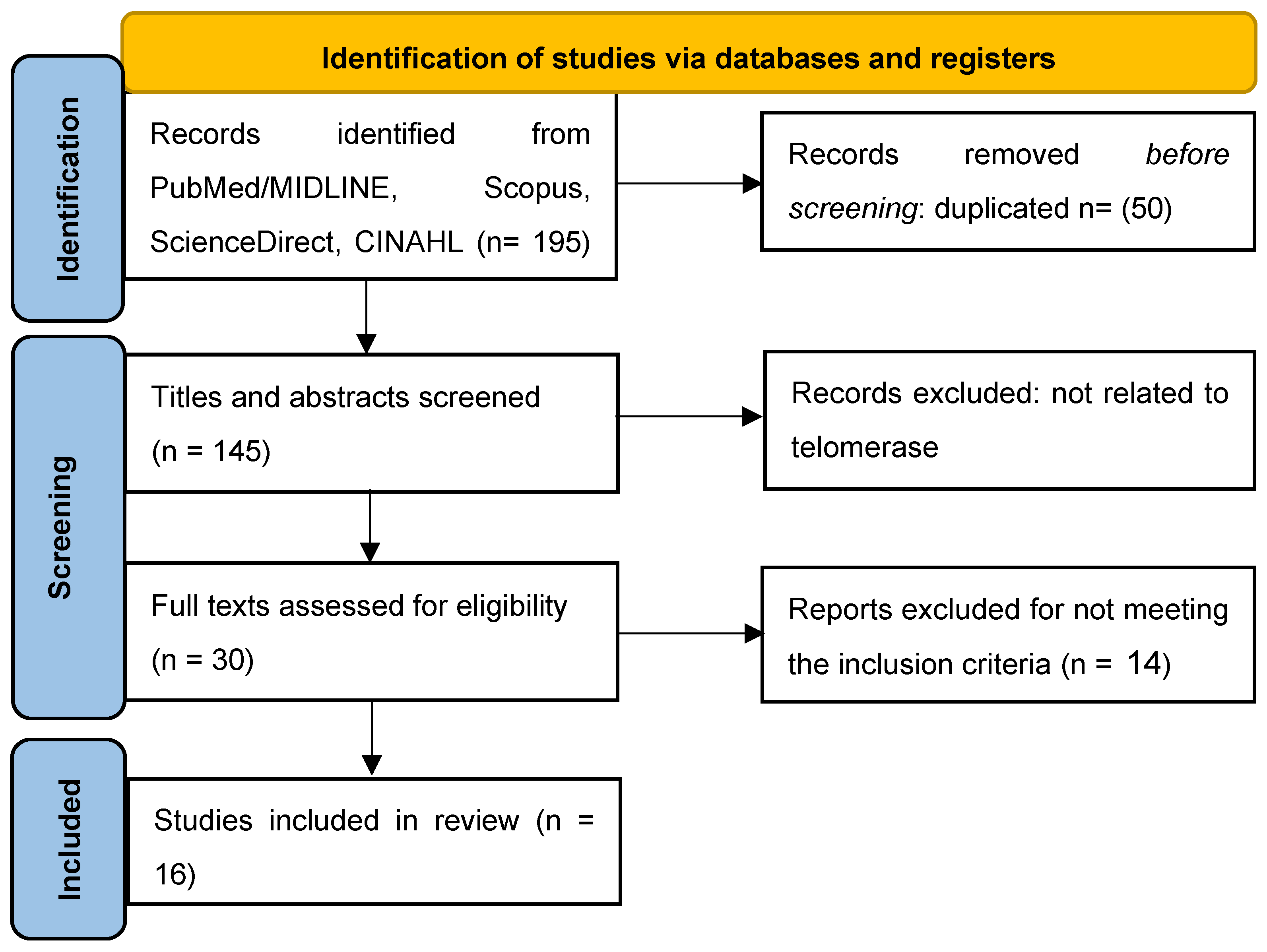
2.2. Quality Assessment and Data Analysis (Figure 1 and Table S1-S3)
While a formal quality assessment (e.g., MMAT or ROBIS) is typically reserved for systematic reviews, this scoping review evaluated sources credibility based on study design rigor and peer-review status. Data were synthesized using a thematic analysis approach, grouping findings into three core categories: (1) TERT prompter mutations and proliferation markers, (2) therapeutic targeting of telomerase, and (3) clinical prognostic correlations. These approaches allowed for identifying critical knowledge gaps regarding specific cell proliferation doubling times.
Figure 1.
Flow diagram for Prisma: preferred reporting items for systematic review and meta-analysis.
Figure 1.
Flow diagram for Prisma: preferred reporting items for systematic review and meta-analysis.
3. Results
3.1. TERT Promoter Mutations as Drivers of Proliferation
From Table 1, TERTp (TERT promoter) is important for diagnosis and prognosis and may serve as a therapeutic target through telomerase inhibition, or TERT-directed immunotherapies [28]. It supports a two-step model of telomere-driven carcinogenesis: TERT promoter mutations extend proliferative lifespan (first hit), while TPP1 promoter variants enhance telomerase activity and telomere lengthening (second hit). Both show UV mutation signatures, underscoring sunlight’s role in melanoma progression[25]. Sanford concludes that dual promoter mutations in TERT and TPP1 remove “telomeric guardrails,” driving immortalization and tumor growth, while offering novel targets for telomerase- or ETS-based therapies [25].
Chun-On et al. identified somatic promoter variants in the TPP1 gene (shelterin complex) [31], present in 5–6% of cutaneous melanomas and frequently co-occurring with TERT promoter mutations [31]. These variants alter ETS transcription factor binding sites, increasing TPP1 expression. TPP1 promoter mutations thus represent a critical “second hit” cooperating with TERT activation to sustain telomere maintenance and drive melanoma progression. The findings highlight the importance of non-coding regulatory mutations and suggest new therapeutic targets[31]. Table S1 shows summary of molecular mechanism and mutation frequencies.
In summary across multiple studies, TERT promoter mutations are a hallmark of cutaneous melanoma, representing high-frequency (70–80%) noncoding driver mutations, functional upregulation of telomerase, cooperation with MAPK signaling, and outcomes such as telomere stabilization, senescence bypass, and tumor persistence [7,8,16] (Figure 2). These alterations act as a molecular signature of UV-induced carcinogenesis, offering diagnostic and prognostic value in tumor biology and therapeutic resistance.
3.2. diagnostic Algorithms and Telomere Maintenance Mechanism (TMM)
Telomerase is essential for telomere maintenance in stem cells and most cancers, but measuring its activity has been difficult [32]. EXTEND (EXpression-based Telomerase ENzymatic activity Detection) is a computational method that estimates activity from a 13-gene signature including TERT and TERC[15]. Validated across cancer cell lines, patient tumors, and non-neoplastic tissues, EXTEND outperformed TERT expression alone in predicting telomerase activity[15]. Applied to over 9,000 tumors, it showed that telomerase activity varies by cancer type and correlates with stage, molecular subtype, oncogenic pathways, and prognosis[15].
Telomeres protect chromosome ends and regulate cell lifespan, but in cancer telomere maintenance mechanisms (TMMs) become dysregulated, enabling unlimited division[32]. Two main pathways exist: telomerase-dependent (TEL) and alternative lengthening of telomeres (ALT) [33]. Hakobyan et al. analyzed RNA sequencing from 33 TCGA cancer types, categorizing tumors into five TMM phenotypes [24]. Normal tissues showed low activity, while cancers had higher TEL and ALT, with ALT varying more widely[24]. Clinically, MSI-H tumors exhibited higher TMM activity, particularly in TEL and ALT branches. Survival analyses linked ALT high/TEL high and ALT high/TEL low phenotypes to poorer outcomes, suggesting TMM activity drives tumor aggressiveness[24].
3.3. Therapeutic Targeting of Telomerase in Melanoma
Zhang et al. (2018) investigated 6-thio-2’-deoxyguanosine (6-thio-dG), a telomerase-directed nucleoside, as a treatment for therapy-resistant melanoma [26]. In pre-clinical models, 6-thio-dG selectively impaired telomerase-positive cancer cells while sparing normal skin cells[26]. In BRAF-mutated melanoma lines, it showed strong anti-proliferative effects, inducing telomere dysfunction, apoptosis, and senescence. In vivo, 6-thio-dG reduced tumor growth in xenografts without toxicity. Molecular analyses revealed suppression of telomere maintenance, cell cycle, DNA damage response, and resistance markers such as AXL (AXL Receptor Tyrosine Kinase). Its efficacy depended on telomerase activity, as TERT depletion reduced sensitivity [26].
Patient biopsies showed enrichment of telomere pathways in tumors progressing on targeted or immune therapies, implicating telomere reactivation in resistance [26]. The telomerase-directed agent 6-thio-dG impaired growth of resistant melanoma cells and down-regulated proteins such as AXL, BRD4 (Bromodomain Containing 4), and ATM, (Ataxia-Telangiectasia Mutated) highlighting its potential to overcome therapy resistance[26]. In BRAF-mutated melanoma, most patients carried TERT promoter mutations, with shorter progression-free survival than wild-type cases[16]. Resistant cell lines exhibited high TERT expression, driving MAPK reactivation independent of telomere lengthening[16]. Inhibiting TERT with 6-thio-dG reduced proliferation and, when combined with vemurafenib, suppressed resistant growth by up to 90%, in 3D models [16]. Therefore, TERT serves as both a biomarker and therapeutic target, and combining MAPK inhibitors with TERT-directed agents may improve outcomes. Telomerase inhibition remains attractive given its cancer specificity and minimal effects on normal cells [18].
Telomerase-targeted approaches include antisense oligonucleotides (e.g., imetelstat) that block telomerase RNA, inducing telomere shortening and apoptosis, and small-molecule inhibitors such as BIBR1532 or G-quadruplex stabilizers (telomestatin, BRACO-19, RHPS4) that disrupt telomerase binding[34]. Immunotherapies (hTERT vaccines, adoptive T-cell therapies) and gene therapy using telomerase promoters to drive cytotoxic proteins or oncolytic viruses (OBP-301) show promise, though immune tolerance and variability remain challenges [35]. Based on recent studies on immunity in melanoma, there is a relationship between immunity and telomerase [43], it will lead to more telomerase-based cancer vaccine development. One such trial is combination therapy with ipilimumab in metastatic melanoma patients [44].
Additional strategies include alternative splicing modulation to shift hTERT toward inactive isoforms, natural products (curcumin, resveratrol, EGCG) and off-target drugs (aspirin, rapamycin) with telomerase-inhibiting activity, and shelterin complex targeting (TRF1/TRF2 disruption) to induce telomere dysfunction[36]. CRISPR/Cas9 can edit hTERT or engineer immune cells, while ALT-positive tumors may respond to ATR inhibitors, G4 ligands, or ALT-specific oncolytic viruses [22].
Combination therapies enhance efficacy by pairing telomerase inhibition with chemotherapy, CRISPR, or dual-target molecules, while personalized therapy tailors treatment using biomarkers such as telomere length, ALT status, and tumor mutations[18]. The TICCA framework (Transient, Immediate, Complete, Combinatory Attack) integrates short-term inhibition, rapid telomere disruption, multi-pronged strategies, and combination regimens to overcome resistance[18].
Since 2010, multiple agents have entered clinical trials, including hTERT vaccines (GV1001, UV1, GX301, INVAC-1), telomerase inhibitors (imetelstat, KML-001), oncolytic viruses (OBP-301, KH901), and nucleoside analogues (6-thio-dG) [36]. Notably, 6-thio-dG induces telomere dysfunction, suppresses resistance markers, and enhances checkpoint blockade efficacy, while imetelstat has improved survival in NSCLC patients, supporting telomerase inhibition as a viable cancer therapy[29].
Clinically, C250T mutation was linked to poor prognosis, with shorter progression-free survival (5 months) and overall survival (36 months) compared to C228T (23 and 106 months) and wild-type tumors (55 and 223 months). High TERT mRNA also predicted worse outcomes, but C250T remained the strongest biomarker [17]. Telomerase, particularly hTERT, contributes to chemo-resistance by maintaining telomeres and enhancing DNA repair[17]. Vault complexes and ABC transporters further support drug resistance, often regulated alongside hTERT by STAT5. Cancer stem cells, with high telomerase and ABC activity, are especially resistant, but telomerase inhibition (e.g., Imetelstat, BIBR1532, G-quadruplex stabilizers) can sensitize tumors to therapy [20]. Imetelstat is a first-in-class telomerase inhibitor, a lipid-conjugated oligonucleotide that targets the RNA template of telomerase (hTERC), thereby blocking telomere elongation.
In summary, telomerase activity drives resistance via telomere maintenance, mitochondrial protection, CSC survival, and transporter modulation, making it a critical therapeutic target[20].
4. Discussion
Telomerase has become central in cancer research, linking tumor biology with therapeutic innovation. Frequent TERT promoter mutations in melanoma, glioblastoma, and other cancers are among the most common noncoding mutations, providing a genetic mechanism for telomerase reactivation [6]. Once viewed only as a telomere-maintaining enzyme, telomerase is now recognized as a driver of immortality and regulator of pathways such as Wnt/β-catenin and NF-κB [9,36]. It is increasingly considered a prognostic marker, though predictive value varies by tumor type [29]. While Hakobyan links high activity to poor outcomes, Mishra argues telomerase does not always predict prognosis [24,37].
In melanoma, TERT promoter mutations occur in 70–80% of cases, strongly increasing telomerase activity and stabilizing short telomeres [6,7]. The model includes GABPα/β recruitment to ETS motifs and MAPK amplification, especially in BRAF V600E melanoma [38,39]. Yet Heidenreich notes promoter mutations alone do not guarantee activity, as transcription factor dynamics, structural variants, and chromatin context also play roles[40]. In bladder cancer, TERT activation can occur via THOR hypermethylation without mutations [41], while breast and colorectal cancers often rely on gene amplification [37].
Understanding these pathways is vital for targeted therapies, as telomerase is a near-universal hallmark of advanced malignancy [42]. Resistance to BRAF and MEK inhibitors in melanoma is increasingly linked to TERT overexpression and promoter mutations, with patients showing shorter progression-free survival compared to wild-type [16]. Preclinical studies demonstrate that 6-thio-dG reduces growth in resistant models [16,26], supporting combined telomerase-targeted and MAPK inhibitor therapy. Future research should examine mutation-specific effects, as Blanco García (2023) showed C250T variants predict worse survival than C228T or wild-type, underscoring the need for variant-level biomarker analysis in guiding treatment strategies[17].
This scoping review highlights a critical paradox in melanoma research while telomerase activation via TERT promoter mutations is a well-established driver of immortality, precise quantitative data linking enzymatic activity levels directly to population doubling time remains scarce. most studies rely on surrogate markers of proliferations, such as ki-67 index or tumor volume growth, rather than calculating specific doubling times.
The scarcity of direct doubling time correlations suggests that telomerase activity may function as a “permissive “factor rather than a direct accelerator of cell cycle speed. A noted by Hakobyan, the co-activation of ALT and telomerase pathways complicates this relationship [24]. Tumors may maintain high proliferative protentional without necessarily exhibiting a linear reduction in doubling time, possibly due to metabolic constraints or microenvironmental factors.
The findings regarding 6-thio-dG and TERT -directed immunotherapies underscore the potential of targeting this pathway. However, the resistance mechanisms described by Delyon, particularly MAPK pathway reactivation, suggest that telomerase inhibitors (e.g., imetelstat) will likely require combination with BRAF/MEK inhibitors to be clinically effective[16]. The “TICCA” framework proposed by ALI and Walter represents a logical evolution of this strategy, moving from monotherapy to combinatorial attacks[18].
Limitations of This Study
The review included only studies published between 2020 and 2025 in English, potentially excluding relevant foundational work and non-English publications that could provide valuable historical context on telomerase biology in melanoma. The heterogeneity of included study designs ranging from narrative reviews to preclinical experimental studies and retrospective cohort analyses limited formal quality assessment using standardized instruments such as MMAT or ROBIS, making direct comparisons challenging. While included studies demonstrated telomerase activity role in telomere dependent proliferation and therapy resistance, precise quantitively correlations between telomerase enzymatic activity levels and measured cell populations doubling times were sparse and inconsistently reported. Clinical outcomes data and patients level survival l analyses were limited, restricting conclusion about direct therapeutic relevance. The review didn’t systematically examine tissue specific variations across melanoma subtypes (cutaneous, acral, mucosal), which may influence applicability to diverse populations
Future research should focus on:
Prospective clinical trial directly measuring telomerase enzymatic activity alongside quantified cell population doubling times are essential to establish correlations between telomerase expression, telomere dynamics, and proliferation kinetics in vivo, research should examine mutation specific effects of TERT promoter variants (C250T versus C228T) in influencing telomerase activity and cellular phenotypes, as variant level biomarkers may better predict therapeutic response, investigations should characterized extratelomeric functions of telomerase including roles in mitochondrial metabolism, NF -kB signaling, and drug efflux transporters to identify synergistic opportunities for combined inhibition strategies, comparative efficacy studies should evaluating emerging telomerase directed strategies including 6-thio-dG,imetelstat,G-quadruplex stabilizers, and the TICCA framework within controlled clinical settings, research should clarify the interplay between telomerase dependant and ALT pathways in determining progression and resistance, future studies should explore biomarker driven approaches integrating telomere length, TERT mutation analysis, and immune checkpoint expression to guide personalized intervention strategies.
5. Conclusions
Telomerase is increasingly recognized as a central driver of melanoma progression through both telomere-dependent and independent mechanisms. By maintaining telomere length, it enables unlimited proliferation and genomic stability, while its non-canonical roles influence signaling pathways, metabolism, and resistance to apoptosis. Frequent TERT promoter mutations, particularly C250T, highlight its prognostic significance and link telomerase activity to poor patient outcomes. Moreover, telomerase overexpression contributes to resistance against BRAF and MEK inhibitors, underscoring its role in treatment failure. Emerging therapies such as 6-thio-dG demonstrate the potential to disrupt telomere function and overcome resistance, especially when combined with MAPK inhibitors. The review identifies a significant gap in the literature regarding direct quantification of doubling times. Future studies should prioritize calculating specific kinetics parameters alongside enzymatic activity to move beyond static biomarkers toward dynamic model of tumor growth.
Supplementary Materials
The following supporting information can be downloaded at the website of this paper posted on Preprints.org. Table S1 to S3 are equivalent to the tables 2-4 in the older version. Please type according to the following.
Author Contributions
Conceptualization, O.A. and P.T.; methodology, O.A. and P.T.; software, D.A.; validation, O.A., P.T., D.A., M.D., L.S., S.A, and L.G.; formal analysis, O.A. and P.T.; investigation, O.A. and P.T; resources, M.D. and P.T.; data curation, O.A. and P.T; writing—original draft preparation, O.A.; writing—review and editing, P.T, S.A., M.D., L.S, G.S., E.Y., and L.G; visualization O.A.,S.A. and .D.A; supervision, P.T.; project administration, O.A. All authors have read and agreed to the published version of the manuscript.
Funding
This research received no external funding.
Institutional Review Board Statement
Not applicable since this is a review, not involving humans or animals.
Informed Consent Statement
Not applicable since this study does not involve humans.
Data Availability Statement
No new data were created.
Conflicts of Interest
Authors declare no conflicts of interest”.
Abbreviations
| ABC | ATP-binding cassette |
| ALT | Alternative lengthening of telomeres |
| BRAF | v-Raf murine sarcoma viral oncogene homolog B |
| BRAF V600E | A common activating mutation in the BRAF gene that leads to constitutive activation of the MAPK pathway |
| CRISPR | Clustered regularly interspaced short palindromic repeats |
| EGFR | epidermal growth factors receptor |
| EXTEND | Expression based telomerase enzymatic activity detection |
| ETS | E26 transformation specific (Erythroblast transformation specific) |
| G1-S/G2-M phases | Cell cycle phases |
| GABP | GA-binding protein |
| GO | Gene ontology |
| hTERT | Human telomerase reverse transcriptase |
| MAPK | Mitogen-activated protein kinase |
| MEK | Mitogen-activated protein kinase |
| miRNA | Micro-ribonucleic acid |
| mRNA | Messenger ribonucleic acid |
| MSI-H | Microsatellite instability-high |
| N/A | Not available |
| NF-kB | Nuclear factor kappa -light-chain- enhancer of activated B cells |
| NF1 | Neurofibromin |
| NRAS | Neuroblastoma RAS viral oncogene homolog |
| PMCA4 | Plasma membrane calcium ATpase4 |
| PSF | Pathway signal flow |
| RNA-seq | RNA sequencing |
| ROS | Reactive oxygen species |
| SEER | Surveillance, epidemiology and end results |
| TCGA | The cancer Genome atlas |
| TEL | Telomerase dependent pathway (telomerase positive phenotype) |
| TERT | Telomerase reverse transcriptase |
| TF | Transcription factor |
| TICCA | Transient, immediate, complete and combinatory attack |
| TME | Tumor microenvironment |
| TMM | Telomere maintenance mechanism |
| TPP1 | Telomerase processivity protein 1 |
| UV | Ultraviolet |
| VEGF | Vascular endothelial growth factor |
| WT | Wild type |
References
- Okobi, O.E., et al., Trends in melanoma incidence, prevalence, stage at diagnosis, and survival: an analysis of the United States Cancer Statistics (USCS) Database. Cureus, 2024. 16(10). [CrossRef]
- Wagle, N.S., et al., Cancer treatment and survivorship statistics, 2025. CA: A Cancer Journal for Clinicians, 2025. [CrossRef]
- Rudolph, P., et al., Telomerase activity in melanocytic lesions: a potential marker of tumor biology. The American journal of pathology, 2000. 156(4): p. 1425-1432.
- Ramirez, R.D., et al., Progressive increase in telomerase activity from benign melanocytic conditions to malignant melanoma. Neoplasia, 1999. 1(1): p. 42-49. [CrossRef]
- Parris, C., et al., Telomerase activity in melanoma and non-melanoma skin cancer. British journal of cancer, 1999. 79(1): p. 47-53. [CrossRef]
- Horn, S., et al., TERT promoter mutations in familial and sporadic melanoma. Science, 2013. 339(6122): p. 959-961. [CrossRef]
- Huang, F.W., et al., Highly recurrent TERT promoter mutations in human melanoma. Science, 2013. 339(6122): p. 957-959. [CrossRef]
- Guo, Y., et al., TERT promoter mutations and telomerase in melanoma. Journal of oncology, 2022. 2022(1): p. 6300329. [CrossRef]
- Kim, N.W., et al., Specific association of human telomerase activity with immortal cells and cancer. Science, 1994. 266(5193): p. 2011-2015. [CrossRef]
- Blackburn, E.H., E.S. Epel, and J. Lin, Human telomere biology: a contributory and interactive factor in aging, disease risks, and protection. Science, 2015. 350(6265): p. 1193-1198. [CrossRef]
- Shay, J.W., et al., Telomerase and cancer. Human molecular genetics, 2001. 10(7): p. 677-685.
- Lincz, L.F., et al., Quantification of hTERT splice variants in melanoma by SYBR green real-time polymerase chain reaction indicates a negative regulatory role for the β deletion variant. Neoplasia, 2008. 10(10): p. 1131-1137. [CrossRef]
- Blagoev, K.B., Cell proliferation in the presence of telomerase. PLoS One, 2009. 4(2): p. e4622. [CrossRef]
- Cristofari, G. and J. Lingner, Telomere length homeostasis requires that telomerase levels are limiting. The EMBO journal, 2006. 25(3): p. 565-574. [CrossRef]
- Noureen, N., et al., Integrated analysis of telomerase enzymatic activity unravels an association with cancer stemness and proliferation. Nature communications, 2021. 12(1): p. 139. [CrossRef]
- Delyon, J., et al., TERT expression induces resistance to BRAF and MEK inhibitors in BRAF-mutated melanoma in vitro. Cancers, 2023. 15(11): p. 2888. [CrossRef]
- Blanco-García, L., et al., pTERT C250T mutation: A potential biomarker of poor prognosis in metastatic melanoma. Heliyon, 2023. 9(8). [CrossRef]
- Ali, J.H. and M. Walter, Combining old and new concepts in targeting telomerase for cancer therapy: transient, immediate, complete and combinatory attack (TICCA). Cancer Cell International, 2023. 23(1): p. 197. [CrossRef]
- Guterres, A.N. and J. Villanueva, Targeting telomerase for cancer therapy. Oncogene, 2020. 39(36): p. 5811-5824.
- Lipinska, N., et al., Telomerase and drug resistance in cancer. Cellular and Molecular Life Sciences, 2017. 74(22): p. 4121-4132.
- Boccardi, V. and L. Marano, Aging, cancer, and inflammation: the telomerase connection. International Journal of Molecular Sciences, 2024. 25(15): p. 8542. [CrossRef]
- Tao, H.-y., et al., Targeting telomere dynamics as an effective approach for the development of cancer therapeutics. International Journal of Nanomedicine, 2024: p. 3805-3825. [CrossRef]
- Welfer, G.A. and B.D. Freudenthal, Recent advancements in the structural biology of human telomerase and their implications for improved design of cancer therapeutics. NAR cancer, 2023. 5(1): p. zcad010. [CrossRef]
- Hakobyan, M., H. Binder, and A. Arakelyan, Pan-cancer analysis of telomere maintenance mechanisms. Journal of Biological Chemistry, 2024. 300(6). [CrossRef]
- Sanford, S.L. and P.L. Opresko, UV light-induced dual promoter mutations dismantle the telomeric guardrails in melanoma. DNA repair, 2023. 122: p. 103446. [CrossRef]
- Zhang, G., et al., Induction of telomere dysfunction prolongs disease control of therapy-resistant melanoma. Clinical Cancer Research, 2018. 24(19): p. 4771-4784. [CrossRef]
- Robinson, N.J. and W.P. Schiemann, Telomerase in cancer: function, regulation, and clinical translation. Cancers, 2022. 14(3): p. 808. [CrossRef]
- Sharma, S. and S. Chowdhury, Emerging mechanisms of telomerase reactivation in cancer. Trends in cancer, 2022. 8(8): p. 632-641. [CrossRef]
- Baylie, T., et al., The role of telomere and telomerase in cancer and novel therapeutic target: narrative review. Frontiers in Oncology, 2025. 15: p. 1542930. [CrossRef]
- Kozyra, P., D. Krasowska, and M. Pitucha, New potential agents for malignant melanoma treatment—most recent studies 2020–2022. International Journal of Molecular Sciences, 2022. 23(11): p. 6084.
- Chun-On, P., et al., TPP1 promoter mutations cooperate with TERT promoter mutations to lengthen telomeres in melanoma. Science, 2022. 378(6620): p. 664-668. [CrossRef]
- Shay, J.W. and W.E. Wright, Telomeres and telomerase: three decades of progress. Nature Reviews Genetics, 2019. 20(5): p. 299-309. [CrossRef]
- Cesare, A.J. and R.R. Reddel, Alternative lengthening of telomeres: models, mechanisms and implications. Nature reviews genetics, 2010. 11(5): p. 319-330. [CrossRef]
- Jafri, M.A., et al., Roles of telomeres and telomerase in cancer, and advances in telomerase-targeted therapies. Genome medicine, 2016. 8(1): p. 69. [CrossRef]
- Mizukoshi, E. and S. Kaneko, Telomerase-targeted cancer immunotherapy. International journal of molecular sciences, 2019. 20(8): p. 1823.
- Satyanarayana, A., M.P. Manns, and K.L. Rudolph, Telomeres, telomerase and cancer: an endless search to target the ends. Cell Cycle, 2004. 3(9): p. 1136-1148. [CrossRef]
- Barthel, F.P., et al., Systematic analysis of telomere length and somatic alterations in 31 cancer types. Nature genetics, 2017. 49(3): p. 349-357. [CrossRef]
- Bell, R.J., et al., The transcription factor GABP selectively binds and activates the mutant TERT promoter in cancer. Science, 2015. 348(6238): p. 1036-1039. [CrossRef]
- Vallarelli, A.F., et al., TERT promoter mutations in melanoma render TERT expression dependent on MAPK pathway activation. Oncotarget, 2016. 7(33): p. 53127. [CrossRef]
- Heidenreich, B., et al., TERT promoter mutations and telomere length in adult malignant gliomas and recurrences. Oncotarget, 2015. 6(12): p. 10617. [CrossRef]
- Leão, R., et al., Combined genetic and epigenetic alterations of the TERT promoter affect clinical and biological behavior of bladder cancer. International journal of cancer, 2019. 144(7): p. 1676-1684. [CrossRef]
- Shay, J.W., Role of telomeres and telomerase in aging and cancer. Cancer discovery, 2016. 6(6): p. 584-593. [CrossRef]
- Nardin C, Laheurte C, Puzenat E, Boullerot L, Ramseyer M, Marguier A, Jacquin M, Godet Y, Aubin F, Adotevi O. Naturally Occurring Telomerase-Specific CD4 T-Cell Immunity in Melanoma. J Invest Dermatol. 2022 Feb;142(2):435-444. Epub 2021 Aug 2. PMID: 34352265. [CrossRef]
- Aamdal E, Inderberg EM, Ellingsen EB, Rasch W, Brunsvig PF, Aamdal S, Heintz KM, Vodák D, Nakken S, Hovig E, Nyakas M, Guren TK, Gaudernack G. Combining a Universal Telomerase Based Cancer Vaccine With Ipilimumab in Patients With Metastatic Melanoma—Five-Year Follow Up of a Phase I/IIa Trial. Front Immunol. 2021 May 11;12:663865. PMID: 34046035; PMCID: PMC8147687. [CrossRef]
Figure 2.
Telomerase reverse transcriptase promoter (TERTp) mutations in melanoma.
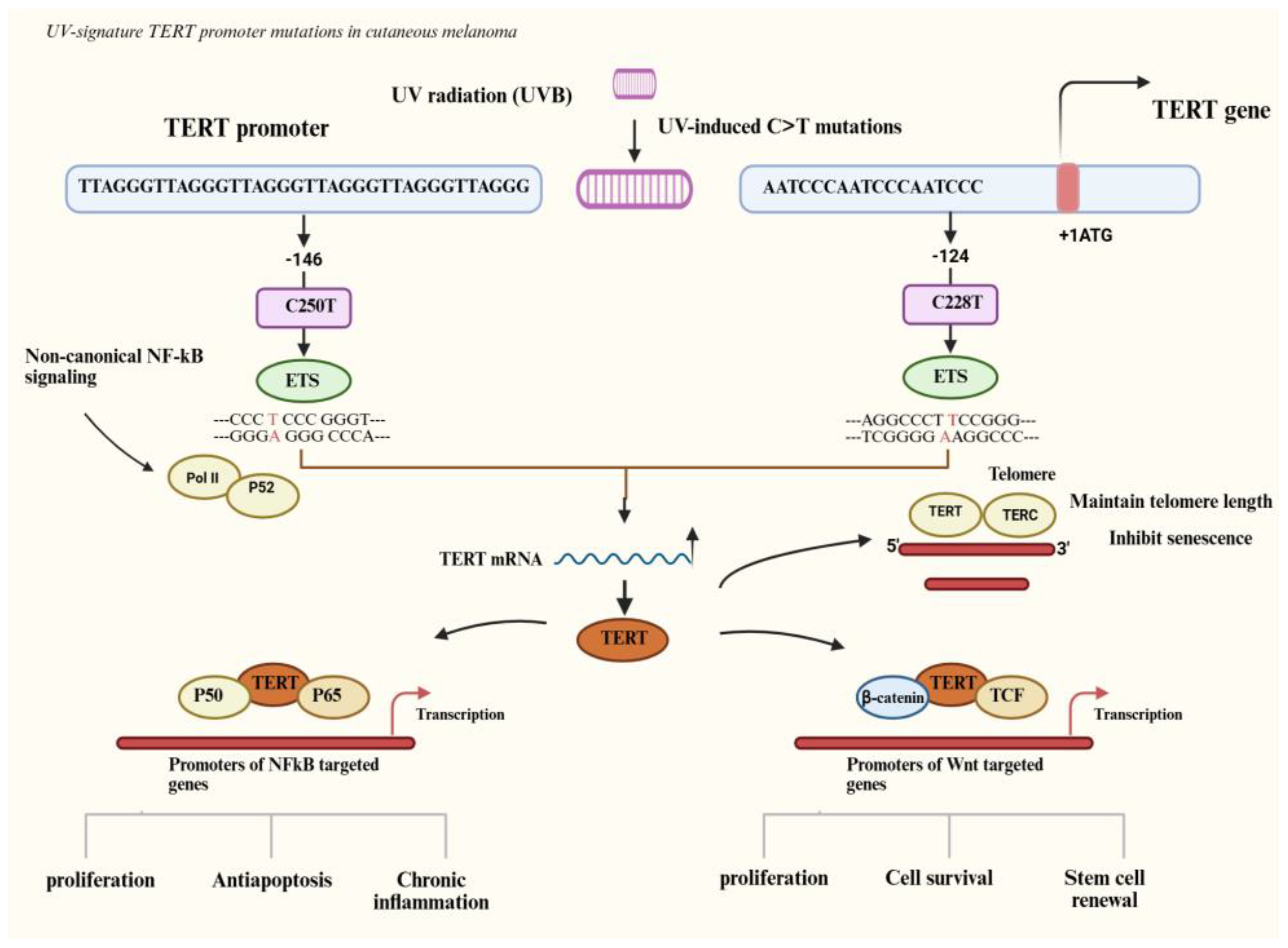

Table 1.
The final 16 studies included in this scoping review to reflect on the current knowledge.
| Author/years/ Reference |
Purpose | Settings | Sample size | Study design | Main findings |
|---|---|---|---|---|---|
| Boccardi V (2024) [21] | To review the relationship between telomeres/telomerase, aging, inflammation and cancer. | Division of Gerontology & Geriatrics, U. Perugia (Italy) & affiliated medical/surgical depts, Poland. | N/A | Narrative review. | Describes how telomere shortening and telomerase dysregulation link chronic inflammation, aging and cancer, & summarizes telomerase-targeted therapies. |
| Guo Y (2022) [8] |
To review the role of TERT promoter mutations and telomerase in melanoma biology, prognosis and treatment. | Dept of Oncology/Plastic & Burns Surgery, 1st Affiliated Hospital of Nanjing Medical U., China. | N/A | Narrative review. | Describes how hotspot TERT RT promoter mutations increase TERT/telomerase activity, link to aggressive disease and poor prognosis, Outlines emerging telomerase-targeted and combina-tion therapies in melanoma. |
| Lipinska (2017) [20] | To review the mechanisms linking telomerase activity with drug resistance in cancer. | Dept of Clinical Chemistry and Molecular Diagnostics, Poznan U. of Medical Sciences, Poland. | N/A | Narrative review. | Describes how hTERT activation, mitochondrial translocation and vault/ABC transporter pathways contribute to chemoresistance and cancer cell survival. |
| Haj Ali (2023) [18] |
To summarize classical and novel approaches in telomerase-targeted cancer therapy and propose the TICCA concept. | Institute of Laboratory Medicine, Charité Berlin & University of Rostock, Germany. | N/A | Narrative review. | Reviews mechanisms of telomerase inhibition and introduces the TICCA strategy (Transient, Immediate, Complete, and Combinatory Attack) as a combined therapeutic model integrating CRISPR/Cas9, telomere deprotection, and hybrid inhibitors for improved long-term cancer control. |
| Tao H (2024) [22] |
To review the therapeutic potential of targeting telomere dynamics in cancer. | Institute of Medicinal Biotechnology, Chinese Academy of Medical Sciences, Beijing. | N/A | Narrative review. | Summarizes telomere- and telomerase-targeted drugs in clinical and preclinical stages, highlighting their chemotherapeutic and immunotherapeutic potential and integration into nanomedicine systems. |
| Welfer GA (2023) [23] | To summarize recent advances in human telomerase structural biology and implications for drug design. | U. Kansas Medical Center, Kansas City, USA. | N/A | Narrative review. | Reviews new cryo-EM structures of human telomerase, elucidating mechanisms of recruitment, telomere synthesis, and structural targets for rational inhibitor development. |
| Hakobyan M (2024) [24] | To perform a pan-cancer analysis of telomere maintenance mechanisms (TMM) across 33 cancer types. | Institute of Molecular Biology NAS RA, Armenia; U. Leipzig, Germany. | 11,123 TCGA samples. | Bioinformatics-based pan-cancer analysis. | Identified five distinct TMM phenotypes integrating telomerase (TEL) and ALT pathways; ALT and TEL coactivation correlated with worse survival and higher activity in MSI-H tumors. |
| Sanford SL (2022)[25] | To discuss how UV-induced promoter mutations in TERT and TPP1 cooperate to bypass telomere-based barriers in carcinogenesis. | U. Pittsburgh, USA. | N/A | Commentary/mechanistic review. | Highlights TERT and TPP1 promoter mutations as sequential UV-driven “hits” that cooperate to sustain telomere maintenance and melanoma progression. |
| Blanco-García L, 2023 [17] | To assess pTERT mutations/methylation in tissue & plasma of advanced melanoma and relate them to TERT expression and prognosis. | Hospital 12 de Octubre, Madrid, Spain. | 53 pts (88 tumors; 25 plasma). | Retrospective cohort. | C250T mutation linked to higher TERT expression and poor survival; pTERT hypermethylation enriched in WT tumors. |
| Zhang (2018) [26] |
To test telomerase-targeted nucleoside 6-thio-dG in therapy-resistant melanoma. | The Wistar Institute, Philadelphia, USA. | Several human melanoma cell lines and xenografts). | Preclinical experimental study. | 6-thio-dG induces telomere dysfunction, apoptosis, and tumor control in therapy-resistant melanoma. |
| Robinson N (2022) [27] | To review telomerase functions, regulation, and clinical applications in cancer. | Case Comprehensive Cancer Center, Case Western Reserve U., USA. | N/A | Comprehensive review. | Summarizes telomerase’s telomeric and extratelomeric roles, regulatory mechanisms, and its translational potential as a biomarker and therapeutic target. |
| Delyon J (2023) [16] |
To assess how TERT expression influences resistance to BRAF and MEK inhibitors in BRAF-mutated melanoma. | INSERM U976 and Hospital Saint Louis, U. Paris Cité, France. | 48 patients + in vitro cell lines. | Translational and in vitro study. | High TERT expression correlated with reduced response to BRAF/MEK inhibitors; TERT overexpression reactivated MAPK pathway independently of telomere maintenance. |
| Sharma S (2022) [28] |
To summarize emerging molecular mechanisms underlying hTERT promoter–driven telomerase reactivation in cancer. | CSIR-Institute of Genomics and Integrative Biology, New Delhi, India. | N/A | Narrative review. | Describes how hTERT promoter mutations, chromatin looping, and G-quadruplex destabilization cooperatively reactivate telomerase across cancers. |
| Baylie T (2025) [29] |
To review telomere and telomerase structure, function, and their role as therapeutic targets in cancer. | Debre Markos U., Ethiopia. | N/A | Narrative review. | Summarizes telomerase biology and emerging therapeutic strategies, including antisense oligonucleotides, G-quadruplex stabilizers, and telomerase-targeted immunotherapies. |
| Kozyra P (2022) [30] Chun-on P (2022)[31] Noureen N (2021) [15] |
To review newly synthesized anti-melanoma agents and their molecular targets (2020–2022). | Medical U. Lublin, Poland. | N/A | Systematic literature review. | Summarizes recent compounds targeting MAPK, PI3K–AKT, and ion-channel pathways; highlights benzimidazole-based telomerase inhibitors among emerging therapeutic candidates. |
| To investigate whether TPP1 promoter mutations cooperate with TERT promoter mutations in melanoma. | U. Pittsburgh & UC Santa Cruz, USA. | 749 melanoma samples. | Genomic and functional analysis. | TPP1 promoter variants co-occur with TERT mutations, enhancing TPP1 expression and synergistically lengthening telomeres in melanoma cells. | |
| To quantify telomerase enzymatic activity and explore its link with cancer stemness and proliferation. | UT Health San Antonio & MD Anderson Cancer Center, USA. | >9,000 tumors from TCGA & multiple validation cell lines. | Computational and experimental validation study. | Developed the EXTEND algorithm; showed telomerase activity strongly correlates with cancer stemness and proliferation, outperforming TERT expression as a biomarker. |
ABC transporter pathway: ATP binding cassette transporter pathway; ALT pathway: alternative lengthening of telomerase pathway CRISPER: clustered regularly interspaced short palindromic repeats; cryo-EM: Cryo electron microscopy; EXTEND algorithm: expression-based telomerase enzymatic activity detection ; hTERT: human telomerase reverse transcriptase ; N/A: not available ; NAS RA: national academy of sciences republic of Armenia; TNM: tumor, node, metastasis classification TPPPI: telomerase processivity protein 1; U.: university; USA: united states of America ; UT health San Antonio: university of Texas health San Antonio .
Disclaimer/Publisher’s Note: The statements, opinions and data contained in all publications are solely those of the individual author(s) and contributor(s) and not of MDPI and/or the editor(s). MDPI and/or the editor(s) disclaim responsibility for any injury to people or property resulting from any ideas, methods, instructions or products referred to in the content. |
© 2025 by the authors. Licensee MDPI, Basel, Switzerland. This article is an open access article distributed under the terms and conditions of the Creative Commons Attribution (CC BY) license (http://creativecommons.org/licenses/by/4.0/).
Copyright: This open access article is published under a Creative Commons CC BY 4.0 license, which permit the free download, distribution, and reuse, provided that the author and preprint are cited in any reuse.