

Submitted:
01 December 2025
Posted:
03 December 2025
You are already at the latest version
Abstract
Background: During social foraging, individuals typically adopt one of two mutually exclusive strategies: (1) producing, which involves searching for, discovering, and acquiring resources, or (2) scrounging, which entails exploiting resources previously discovered by others. The distribution of these strategies within a group is referred to as the Producer–Scrounger (P–S) Game. Although the influence of personality on the Producer–Scrounger Game has been examined in non-human species through measures of individual differences such as behavioral flexibility and exploratory tendencies, few studies have yet explored this relationship in humans. Objective: The present study aimed to examine the association between social foraging strategies and personality traits in human participants, using the Big Five dimensions, their higher-order metatraits, and psychopathy traits from the Antisocial Process Screening Device (APSD). Methods: Forty-five participants completed the Guaymas Foraging Task (GFT), designed to simulate a social foraging scenario under two conditions lasting four minutes each: one in which the cost of producing was 0 seconds, and another in which it was 8 seconds. Participants also completed the Big Five Inventory and the APSD. Results: The openness, agreeableness, extraversion, stability, and plasticity traits were associated with higher producer indexes. However, these correlations emerged only under the low-cost condition. Similarly, participants above the APSD’s cutoff score scrounged more but only in the low-cost condition. Conclusions: Individual differences such as personality seem to be correlated with different foraging strategies, nonetheless, the behavioral expression of these traits seems to diminish when the environment isn’t favorable for their preferred strategy.
Keywords:
foraging
; big five
; metatraits
; psychopathy
; producer-scrounger
1. Introduction
Foraging refers to the search for resources and represents the most fundamental aspect of animal behavior, as it underlies functions as essential as reproduction, survival, and the development of every living organism. [1]. In social foraging situations, where two or more organisms search for resources, the members of a group can choose between two mutually exclusive yet coexisting strategies: 1) producing, where they invest time on the search, discovery, and acquisition of resources, and 2) scrounging, where they look for opportunities to join a previous discovery and exploit the resources found by a producer [2,3]. The distribution of the use of these strategies among the members of a group is referred to as the producer-scrounger (P-S) game [2].
In 1991, Vickery et al. [4] developed the Rate Maximization Model (RMM), a mathematical model (Equation 1) that predicts the proportion of producers (P) in a group based on the amount of food a producer consumes before a scrounger joins the patch, known as the finder’s share (a), quantity of food in the patch (F) and group size (G) [5,6]. In this model, as the finder’s share decreases, the proportion of producers in the group also declines. Calculating the net gain of the finder’s share, considering the time invested (t) in producing the resource, could explain the effect of increasing production costs on the decrease in the proportion of producing responses (Equation 2).
Afshar and Giraldeau’s [7] agent-based model (ABM) shows that as the cost of producing increases, the proportion of producers decreases. This prediction is consistent with results reported in studies with humans [8] and birds, specifically spice finches (Lonchura punctulata) [9] and Carib grackles (Quiscalus lugubris) [10]. Results also indicated a positive correlation between the richness of patch zones and the proportion of scroungers, consistent with previous findings by Vickery et al. [4], Beauchamp and Giraldeau [11], and Beauchamp [12].
A substantial body of research on the P-S game has focused on examining the effects of ecological variables predicted by the Rate Maximization Model (RMM), such as group size and patch richness, in non-human participants. However, in recent years, growing attention has been directed toward understanding the relationship between personality traits and foraging strategies. For instance, individual differences, such as behavioral plasticity [13], which indicates the ability of an individual to adjust their behavior to match or avoid another group’s niche [14], and exploratory tendencies [15], measured by the number of movements an individual makes during its search for resources [15], have been investigated as potential predictors of variation in bird’s social foraging behavior. To our knowledge, there aren’t many studies exploring the relationship between personality traits and performance in the P–S in human participants, even though there is evidence supporting a potential association between these variables in animal behavior [13,15].
Personality is a key element for understanding the adaptive nature of animal behavior. From an evolutionary perspective, it can be defined as consistent individual differences in behavior over time, determined by both genetic factors and environmental influences. These differences arise from phenotypic interactions between socio-ecological contexts and the individual’s developmental and behavioral mechanisms [16]. The study of human personality has focused on the search for the most important individual differences in social interactions, for which there have been a multitude of factorial analysis and lexical approaches over the years to reduce the dimensions and redundant terms observed in different societies, resulting in fewer factor models, commonly five or six, that more effectively describe the variance found throughout different populations [17].
The Big Five model of personality describes the covariation between cognitive, affective and motivational traits of an individual through five factors [17]: 1) extraversion, characterized by sociability, assertiveness and energy, reflects an energetic approach to their environment, 2) agreeableness, distinguished by trust, compassion and respect, describes the use of prosocial and communal behavior even towards antagonistic or hostile individuals, 3) conscientiousness, which exhibits productivity and organization while showing a socially imposed impulse control in order to facilitate behavior towards goal achievement, 4) neuroticism, better represented by anxiety, volatility and depression, describes negative emotionality towards concepts such as emotional stability, satisfaction and frustration tolerance, and finally 5) openness, identified by originality and open mindedness, refers to the depth and complexity of the experiential life of an individual [18].
Despite being initially conceptualized as independent factors, the Big Five personality traits are often correlated between themselves and grouped in two dimensions, opening the possibility of a higher hierarchy inside of the model: stability and plasticity [19,20,21,22]. Stability, composed of the shared variance of the conscientiousness, agreeableness and emotional stability (inverse neuroticism) traits, reflects the individual’s ability to maintain relationships and stable emotional states [21], as well as their tendency to evade emotional, motivational and social disruptions [19]. Plasticity, made by the shared variance of the extraversion and openness traits, represents a tendency for exploration as well as a level of cognitive and behavioral flexibility shown by an individual when approaching situations of their environment [19,21].
Psychopathy is a personality disorder characterized by affective, interpersonal, and behavioral dysfunctions, a callous–unemotional indifference toward others, and impulsive behavior that leads individuals to disregard social norms without guilt or remorse [23,24,25]. These individuals are unemotional or show very little affect, are completely rational, and consistently act in their own self-interest, disregarding any consequences their behavior may have for others [26].
This study aimed to evaluate the correlation between the choice of social foraging strategies (producing or scrounging), the personality traits of the Big Five model, their metatraits, and the psychopathy traits measured by the Antisocial Process Screening Device (APSD). Additionally, the study pursued: (a) to evaluate the effect of the producer response cost and to compare the results with the predictions of Afshar and Giraldeau’s [7] ABM and the RMM [4]; and (b) to assess whether the correlation between the social foraging strategies employed and personality traits remains consistent regardless of increases in the producer response cost.
2. Materials and Methods
2.1. Participants
This study included 60 participants of ages ranging from 17 to 46 years old (M = 23.27, SD = 4.98) from the south of the state of Sonora, México. However, 10 participants were excluded from the data analysis because they did not complete the personality and psychopathy scales.. Of the remaining sample, 72% (n = 36) were female, 26% (n = 13) were male and 2% (n = 1) were non-binary. As inclusion criteria, the participants were strictly required to not have any previous experience with the behavioral task in order to ensure no subject had a learning advantage over the others.
All participants involved provided their informed consent after letting them know that their participation was completely voluntary and anonymous, reminding them they could leave the experiment at any time and assuring them of their safety from any psychological or physical harm in its duration. In addition, they were informed of there being monetary prizes for the three best scores of the whole experiment. These research protocols were approved by the Sonora Institute of Technology’s Institutional Review Board (ID 84) to guarantee that the study’s design and procedures carefully followed the ethic principles detailed in the Declaration of Helsinki.
2.2. Instruments
Big Five Inventory (BFI). The BFI [27] is a 44-item self-report scale that measures the Big Five personality traits: Openness, Conscientiousness, Extraversion, Agreeableness and Neuroticism. These items are presented as descriptive sentences that are rated on a 5-point Likert scale (1 = Strongly Disagree; 5 = Strongly Agree). For this study, we used a Spanish translation validated on a Mexican sample by Zamorano et al. [28] with an internal consistency of α = .72.
Antisocial Process Screening Device (APSD). The APSD [29] is a 20-item self-report scale that assesses three different dimensions of psychopathic behavior: Callous-Unemotional, Impulsivity and Narcissism. Each item is rated on a 3-point Likert scale (0 = Not At All True, 1 = Sometimes True, 2 = Definitely True). In this study, we used a Spanish translated three-factor model version validated on a Mexican sample by Mejía et al. [30] with an internal consistency of α = .79.
2.3. Behavioral Task
Guaymas Foraging Task (GFT). The GFT [6,31] is a direct interaction task in the form of a computer program that allows the control of the ecological variables of a simulated social foraging episode in which 4 players participate inside a 800 x 800 px virtual 3D environment. This environment is composed of four 200 x 200 px brown-colored patch zones distributed in the corners of the map at an equal distance from each other, while the rest of the space was filled with green transition zones (Figure 1a). Inside of the task, players are able to move freely through the virtual space (Figure 1b) with the objective of collecting the most amount of food units possible. To do this, they can opt to use one of two strategies: a) producing, which requires the player to press a button for a certain amount of time inside of a patch zone (Figure 1c) in order to find food and ultimately collect it (Figure 1d), or b) scrounge, which consists in the player joining another group member’s discovery inside of a patch zone (Figure 1e) and collecting part of those resources (Figure 1f).
2.4. Procedure
Participants were divided into 15 groups of 4 people, with each group being scheduled a separate session taking into account their time availability. Every session took place inside of a 4 x 4 meters office inside of the facilities of the Sonora Institute of Technology, in which they were shown the behavioral task on a TV Screen that projected the image provided by a laptop equipped with the GFT only accessible to the experimenter. The participants were given a rectangular USB controller to interact with the task. The controller has a directional pad that can be used to move the player character, as well as two buttons on the other side of the controller, even though only the upper one has a functionality inside of the game, which is searching for food.
Participants were exposed to two different conditions presented to them in a random order, each one with a duration of 4 minutes: F5-0s and F5-8s. Both conditions were named after two ecological variables: the amount of food units that appear after a successful search (expressed within the first half of the condition’s name with the letter F), and the cost of searching (expressed in the second half in seconds). In the condition F5-0s searching took 0.01 seconds, while in F5-8s it took 8 seconds. In both of them, each search had a 50% chance of success in making the food units appear within the patch zone. Participants were allowed and encouraged to communicate with each other during the experiment.
Prior to the first condition, participants were presented with a pre-training session in which they were placed in separate spaces with a single patch zone, meant to let the participants familiarize themselves with the controls and the mechanics of how to produce and collect food units. The cost of production was set to be the same as the starting condition, but they were only given one food unit after a successful search. This brief pre-training ended after every participant had collected five food units.
After the experiment, participants were instructed to fill a Google Form that contained sociodemographic data, as well as the BFI and APSD measures. Because of the participants’ personal time restraints, they were asked to answer the form in their free time.
2.5. Data Analysis
For this study, we used the producer’s index made by Harten et al. [32] to describe the individual’s foraging behavior during the task, the producer’s index can take values between 1 and -1, where individuals that produce more get scores closer to 1, while the ones that scrounge more get scores closer to -1 (Equation 3):
For the analysis of the Big Five personality traits, we used their average scores rather than their natural scores for every trait, including the metatraits. To measure the stability metatrait, we averaged each participant’s conscientiousness, agreeableness and emotional stability (inverse neuroticism) scores. To measure the plasticity metatrait, we averaged each participant’s extraversion and openness scores. We used the Shapiro-Wilk normality test to determine the appropriate statistical tests for the comparative analysis between conditions for which we employed a Wilcoxon signed-rank test. Finally, we used the Pearson correlation coefficient to measure relations between the producer’s index and the Big Five factors of personality, the metatraits and the APSD factors, as well as the relationship between the factors of both self-report measures.
We used the 12 point cutoff score for the APSD suggested by Pechorro et al. [33] to identify psychopathic individuals. The comparative analysis was done using a Mann-Whitney U test after previously testing for normality with the Shapiro-Wilk test and finding the data to be non-parametric.
Seventeen datasets were excluded from the analysis owing to file-saving errors in the GFT. The supplementary material includes the datasets analyzed in this study, the scripts used for data processing and statistical analysis, as well as the executable version of the behavioral task (Guaymas Foraging Task, GFT) available for download.
3. Results
The comparative analysis showed statistically significant differences in the producer’s index (z (38) = 2.391, p = .017, rpb = .517) and the number of producer’s responses (z (38) = 5.315, p < .001, rpb = .989) between conditions. Both variables had a decrease in their medians, in the case of the producer’s index there was a decrease from .920 in F5-0s to .833 in F5-8s (Table 1, Figure 2a), while the producer’s responses decreased from 18 in F5-0s to 3 in F5-8s (Table 1, Figure 2b). There were no statistically significant differences shown in the scrounger’s responses (z (38) = 1.229, p = .211, rpb = .229) (Table 1, Figure 2c).
The results showed statistically significant differences between participants under and above the APSD’s 12 point cutoff score in their producer’s index (Table 2, U (38) = 158, p = .010) and scrounger’s responses (Table 2, U (38) = 20.5, p = .001) in F5-0s. The median for the producer’s index was lower in participants above the cutoff score (MDN = .434) than those under (MDN = 1) (Table 2, Figure 3a), while the scrounger’s responses median was higher for those above the cutoff score (MDN = 5) than those under (MDN = 0) (Table 2, Figure 3c). There weren’t significant differences between groups regarding producer’s responses (Table 2, U (38) = 120, p = .238) in F5-0s, as well as producer’s index (Table 2, U (38) = 124, p = .238), producer’s responses (Table 2, U (38) = 99.5, p = .902) and scrounger responses (Table 2, U (38) = 63.5, p = .166) in F5-8s.
The results of the F5-0s condition’s regression analysis regarding the Big Five showed statistically significant correlations between the producer’s index and openness (Figure 4a, p = .018, R² = 0.124), extraversion (Figure 4c, p = .019, R² = .121) and agreeableness (Figure 4d, p = .002, R² = .209). In the regard to the metatraits or high-order factors of the Big Five, there were statistically significant correlations between the producer’s index and stability (Figure 4f, p = .022, R² = .117), as well plasticity (Figure 4g, p = .007, R² = .160). There were no statistically significant correlations found between the producer’s index and the five personality traits, metatraits nor psychopathy in the F5-8s condition (Figure 5).
Finally, there were statistically significant correlations between the conscientiousness trait and the callous-unemotional (Table 3, p = .001, R² = -.440) and impulsivity (Table 3, p = .036, R² = .297) factors of the APSD, the agreeableness trait and narcissism (Table 3, p = .026, R² = .314); and between plasticity and the callous-unemotional factor (Table 3, p = .040, R² = -.292).
4. Discussion
The purpose of this study was to evaluate the relation between the producer’s index and personality in human participants using the Big Five, its metatraits and the APSD factors. As well as evaluate the producer cost’s effect and contrast the results with the predictions made by the RMM [4] and Afshar and Giraldeau’s [7] ABM.
The predictions made by the RMM adjusted to take into account the time invested in producing (Equation 2) and the ABM made by Afshar and Giraldeau [7] state that as the cost of producing increases, the proportion of producers decreases. The results of this study match with these models’ predictions, showing that the median of both the producer’s index and the producer’s responses were significantly lower in the F5-8s condition than in F5-0s. Additionally, these findings are consistent with studies conducted on non-human participants where this phenomenon can be observed [9,10]. These results suggest that the GFT is a valid task to measure the strategies used by individuals during a social foraging situation.
The Big Five model has one of the most extensive literatures in personality psychology and has been used in a wide variety of contexts such as academic and work settings, psychopathology, parenting styles, interpersonal relationships and addictions [17,34]. However, even though the effect of personality on the P-S game has been explored in animals through the measurement of individual differences such as behavioral plasticity [13] and exploratory tendencies [15]. To our knowledge there has been little approximation towards the study of personality’s influence on human social foraging, much less one using the Big Five and its metatraits.
The experiment’s results showed positive statistically significant correlations between the producer’s index and many personality traits, specifically openness, agreeableness and extraversion, as well as both metatraits: stability and plasticity. Nevertheless, said correlations only appeared in F5-0s but not F5-8s, suggesting that personality correlates better with the strategy chosen by an individual inside of a social foraging situation when the cost of producing is less. This could be because a high cost of production decreases the individual’s opportunities to either produce or scrounge, since the more time they invest into searching for resources, the less available said resources become, especially considering that there’s a 50% chance that said effort ends in a failed search. This means that they ultimately get less chances to express their preferred strategy, which can be backed up with the data obtained in this study showing that the absolute frequency of producer’s responses changes way more than absolute frequency of scrounger’s responses between conditions. That is to say, if high openness, agreeableness, extraversion, stability and plasticity scores are related to higher producer’s indexes, the influence of personality decreases when the environment, in this case dictated by the condition, limits the individual’s chance of producing by giving them less occasions to make decisions during social foraging.
The strongest correlation between the producer’s index and the Big Five was found with agreeableness, a trait characterized by a tendency to cooperation, prosocial behavior and altruism [18,34], which would explain its association with higher producer’s indexes since these people could be more prone to produce in benefit of the group. The trait with the second highest correlation is openness, described as individual differences in cognitive exploration, the willingness to consider new ideas, creativity, and the tendency to search, understand and utilize sensory and abstract information [34,35], factors that may reflect the individual’s initiative to explore new strategies throughout the search process to find the most effective one, that being producing in the case of a condition with a low production cost. This concept is similar to behavioral flexibility as it’s studied in birds [14], a variable that has shown to have an influence on the use of alternative strategies inside of social foraging [13]. Finally, the last correlation in the five factor model is extraversion, related to behavioral exploration, sociability, positive emotions, gregarious behavior and assertiveness [19,34,35], qualities that could allow these individuals to perform better inside of social situations as the P-S game, choosing to be cooperative and producing in order to contribute to the group.
Additionally, we found statistically significant correlations between the producer’s index and both of the Big Five’s metatraits. The strongest association being with plasticity, a metatrait that reflects the person’s flexibility on how they engage with their environment when presented with novel situations [19,21], taking into account that plasticity has shown to have an influence on non-human participant decision making during social foraging [13], this association may extend to human decision making. The cybernetic function attributed to plasticity as a metatrait by DeYoung [35] relates it to exploration and the creation of new goals, strategies and interpretations, all of those being core abilities in the P-S game, allowing these individuals to adapt to the ecological conditions presented to them. Our findings also showed a statistically significant correlation with stability, which reflects the person’s ability and tendency to stay stable and avoid deregulations in emotional, social and motivational domains [19,20,21], as with plasticity, it’s important to mention its cybernetic function given by DeYoung [35], that being protecting interpretations, goals and strategies from being altered by impulses, a function that could translate into the maintenance of a functioning strategy despite of situations perceived as adverse by the individual.
In contrast to the Big Five, the APSD measures psychopathic traits of personality such as callous-unemotional, impulsivity and narcissism [30]. Considering that these traits are characterized by a lack of empathy, antisocial behavior, impulsive and reckless behavior and inability to make long-term plans [36], it seems rather possible that they could relate to scrounging as it involves taking advantage of the effort made by others for their own benefit, without taking part in the producer’s search for resources. However, the results don’t show any statistically significant correlations between these traits and the producer’s index, but they consistently associate negatively over both conditions.
Through a comparative analysis made after grouping participants by their APSD score being under or above the test’s cutoff score [33] made with the intention to differentiate psychopaths from nonpsychopaths [36], we found statistically significant differences between groups regarding their producer’s index and scrounger’s responses during F5-0s which show that participants above the cutoff score have a lower producer’s index and higher scrounger’s responses than those under, suggesting that psychopathic individuals scrounge more than nonpsychopaths. Nonetheless, similar to the correlations found between the producer’s index and the Big Five, this distinction only seems to appear when the cost of producing is low. This could be due to the participants under the cutoff score also producing less and scrounging more in F5-8s as shown by the overall decrease of their producer’s index, diluting the effect.
We also analysed the correlation of the Big Five and its metatraits with APSD’s factors, regarding the five personality traits, the results match previous studies by showing that conscientiousness and agreeableness correlated significantly with psychopathic personality traits [37,38]. In the case of this study, responsibility had a negative correlation with callous-unemotional and impulsivity, while agreeableness correlated positively with narcissism. In regard to the metatraits, we found a negative correlation between plasticity and the callous-unemotional factor, however to our knowledge the association between metatraits and APSD’s factors has yet to be explored.
Differences in previous gaming experience between participants may be a reason for bias of the results since it could have not only influenced their performance throughout the task, but even the strategies they chose. In addition, a few participants expressed to be annoyed or bored to some extent during the GFT, which might mean their behavior inside of the task might not have been a real representation of their producing or scrounging tendencies, but rather a consequence of a lack of motivation.
The findings presented in this study not only serve as empirical evidence for a possible influence of individual differences on social foraging in human participants, but they also offer a different perspective regarding the influence of personality in social situations like the P-S game. Producer and scrounger behaviors in human participants are not reduced only to the search for food, shelter or partner, but take part in much larger-scale phenomena as social hierarchies, politics, academic systems and health disparities [29]. One of the key concepts to understand this relation is exploitation, an important part of the scrounger strategy in the P-S game, which describes the scrounger as an individual that exploits a producer’s obtained resources [2]. In this regard, Wells [29] provides several examples of how said exploitation takes part inside of societies creating social disparities, beginning with how people of higher socioeconomic levels benefit from the labour of those with less resources, how because of gender norms women are traditionally expected to be the ones to contribute the most to the parenting and maintaining of their children in comparison to men, who after scrounging these activities’ energetic costs are able to spend that saved energy into other activities of their choice, and by far the clearest example, the slavery of people from other races or ethnic origins throughout history. In relation to this, personality offers a unique perspective on how these exploitative tendencies can be tracked up to certain individual traits, or alternatively, like in the case of this study, show which of these traits are less prone to exploitation or more prone to production.
Furthermore, in addition to the opening of new lines of research to comprehend the basis of these inequalities present in human societies, these findings may provide information about which aspects of people’s personality it’s important to appeal to when creating campaigns and organizing movements looking for a change oriented to social and health equity.
Supplementary Materials
The following supporting information can be downloaded at the website of this paper posted on Preprints.org.
Author Contributions
Conceptualization, I.U. and D.M.; methodology, L.A-C.; software, L.A-C.; validation, L.A-C and D.M.; formal analysis, I.U. and L.A-C..; investigation, I.U..; resources, L.A-C. and D.M.; data curation, I.U.; writing—original draft preparation, I.U..; writing—review and editing, L.A-C. and D.M.; visualization, I.U.; supervision, L.A-C.; project administration, I.U.; funding acquisition, D.M..
Funding
This research was funded by the Secretary of Science, Humanities, Technology, and Innovation (SECIHTI), grant number CF-2023-I-2522.
Institutional Review Board Statement
These research protocols were approved by the Sonora Institute of Technology’s Institutional Review Board (ID 84) to guarantee that the study’s design and procedures carefully followed the ethic principles detailed in the Declaration of Helsinki.
Informed Consent Statement
All participants involved provided their informed consent after letting them know that their participation was completely voluntary and anonymous, reminding them they could leave the experiment at any time and assuring them of their safety from any psychological or physical harm in its duration.
Data Availability Statement
The original data presented in the study is openly available at https://docs.google.com/spreadsheets/d/10RApRLCjrP5Xqj1_KKJLZ8yhYrFcPQCnucLTorN_1cE/edit?usp=drive_link
Acknowledgments
In this section I want to thank my colleagues in the Laboratorio de Comportamiento Social e Inteligencia Artificial (LCSIA); Ramón Varela, Liliana Álvarez, Martín Encinas and Yubritza Serrano for their incessant help on conducting this experiment. As well as Dr. Agustín Robles for his continuous support and for providing his lab for the experimental sessions.
Conflicts of Interest
The authors declare no conflicts of interest.
Abbreviations
The following abbreviations are used in this manuscript:
| MDPI | Multidisciplinary Digital Publishing Institute |
| P-S | Producer-Scrounger |
| RMM | Rate Maximization Model |
| ABM | Agent-based model |
| APSD | Antisocial Process Screening Device |
| BFI | Big Five Inventory |
| GFT | Guaymas Foraging Task |
References
- Pyke, G. H. Foraging: A Fundamental Activity for All Life. Encyclopedia of Animal Behavior 2019, 75–79. [CrossRef]
- Barnard, C. J.; Sibly, R. M. Producers and scroungers: A general model and its application to captive flocks of house sparrows. Animal Behaviour 1981, 29(2), 543–550. [CrossRef]
- Cabrera, R.; Lopez, M. E.; Alfaro, L. Pre-exposure effect in social foraging: A study with groups of pigeons (Columba livia). Learning and Motivation 2025, 89, 102088. [CrossRef]
- Vickery, W. L.; Giraldeau, L.A.; Templeton, J. J.; Kramer, D. L.; Chapmant, C. A. Producers, scroungers, and group foraging. The American Naturalist 1991, 137(6), 847-863. [CrossRef]
- Alfaro, L.; Cabrera, R. Can the setup of a patch modulate finder’s advantage?. Behavioural Processes 2021, 192, 104488. [CrossRef]
- Avila-Chauvet, L.; Mejía Cruz, D.; García-Leal, Ó.; Kluwe-Schiavon, B. To produce or not to produce? Contrasting the effect of substance abuse in social decision-making situations. Heliyon 2023, 9(9), e19714. [CrossRef]
- Afshar, M.; Giraldeau, L.A. A unified modelling approach for producer–scrounger games in complex ecological conditions. Animal Behaviour 2014, 96, 167–176. [CrossRef]
- Kameda, T.; Nakanishi, D. Cost-benefit analysis of social/cultural learning in a nonstationary uncertain environment: an evolutionary simulation and an experiment with human subjects. Evolution and Human Behavior 2002, 23, 373-393. [CrossRef]
- Giraldeau, L.A.; Soos, C.; Beauchamp, G. A test of the producer-scrounger foraging game in captive flocks of spice finches, Lonchura punctulata. Behavioral Ecology and Sociobiology 1994, 34, 251-256. [CrossRef]
- Morand-Ferron, J.; Giraldeau, L. A.; Lefebvre, L. Wild carib grackles play a producer-scrounger game. Behavioral Ecology 2007, 18, 916-921. [CrossRef]
- Beauchamp, G.; Giraldeau, L.A. Group foraging revisited: information sharing or producer-scrounger game? American Naturalist 1996, 148, 738-743. [CrossRef]
- Beauchamp, G. A. spatial model of producing and scrounging. Animal Behaviour 2008, 76, 1935-1942. [CrossRef]
- Reichert, M.; Morand-Ferron, J.; Kulahci, I.; Firth, J.; Davidson, G.; Croft, S.; Quinn, J. Cognition and covariance in the producer-scrounger game. Journal of Animal Ecology 2021, 90(11), 2497-2509. [CrossRef]
- Vander Meiden, L.; Hoppe, I. R.; Shizuka, D.; Johnson, A. E. Ecological flexibility and selectivity in mixed-species flock participation in birds. Animal Behaviour 2022, 217, 1–11. [CrossRef]
- David, M.; Cézilly, F.; Giraldeau, L. A. Personality affects zebra finch feeding success in a producer-scrounger game. Animal Behaviour 2011, 82(1), 61–67. [CrossRef]
- Lewis, D. M. G.; Buss, D. M. The evolution of human personality. In Handbook of Personality: Theory and Research, 4th ed.; John, O. P., Robins, R. W., Eds.; The Guilford Press: New York, USA, 2021; pp. 3–34.
- Martin, J. S.; Jaeggi, A.; Koski, S. E. The social evolution of individual differences: Future directions for a comparative science of personality in social behavior. Neuroscience and Biobehavioral Reviews 2023, 144, 104980. [CrossRef]
- John, O. P. History, measurement, and conceptual elaboration of the Big-Five trait taxonomy: The paradigm matures. In Handbook of Personality: Theory and Research, 4th ed.; John, O. P., Robins, R. W., Eds.; The Guilford Press: New York, USA, 2021; pp. 35–82.
- Deyoung, C. G.; Peterson, J. B.; Higgins, D. M. Higher-order factors of the Big Five predict conformity: Are there neuroses of health? Personality and Individual Differences 2002, 33, 533–552. [CrossRef]
- Deyoung, C. G. Higher-order factors of the big five in a multi-informant sample. Journal of Personality and Social Psychology 2006, 91(6), 1138–1151. [CrossRef]
- Young, E. S.; Simpson, J. A.; Griskevicius, V.; Huelsnitz, C. O.; Fleck, C. Childhood attachment and adult personality: A life history perspective. Self and Identity 2019, 18(1), 22–38. [CrossRef]
- DeYoung, C. G.; Grazioplene, R. G.; Allen, T. A. The neurobiology of personality. In Handbook of Personality: Theory and Research, 4th ed.; John, O. P., Robins, R. W., Eds.; The Guilford Press: New York, USA, 2021; pp. 193–216.
- Hare, R. D. The Hare Psychopathy Checklist-Revised. Toronto: MultiHealth Systems 1991.
- Maurer, J. M.; Steele, V. R.; Fink, B. C.; Vincent, G. M.; Calhoun, V. D.; Kiehl, K. A. Investigating error-related processing in incarcerated adolescents with self-report psychopathy measures. Biological Psychology 2018, 132, 96–105. [CrossRef]
- Pink, J.; Snowden, R. J.; Gray, N. S. The implicit measurement of psychopathy. Journal of Research in Personality 2023, 103, 104339. [CrossRef]
- Boddy, C. R.; Freeman, C.; Karpacheva-Hock, E. Fraud and corporate psychopaths: The proposition for reintroducing personality traits of the economic crime offender. Journal of Economic Criminology 2024, 5, 100081. [CrossRef]
- John, O. P.; Donahue, E. M.; Kentle, R. L. The Big-Five Inventory-Version 4a and 54. Berkeley, CA: Berkeley Institute of Personality and Social Research, University of California 1991.
- Zamorano, E. R.; Carrillo, C. Á.; Silva, A. P.; Sandoval, A. M.; Pastrana, I. M. Psychometric properties of the big five inventory in a Mexican sample. Salud mental 2014, 37(6), 491-497. [CrossRef]
- Frick, P. J.; Hare, R. D. Antisocial Process Screening Device. Toronto: Multi-Health Systems 2001.
- Mejía, D.; Morales-Chainé, S.; García-Flores, R.; Acosta-Quiroz, C. O. Substance use and antisocial behavior: Criterion-related validity of the Antisocial Process Screening Device in Mexican adolescents. Salud Mental 2019, 42(6), 275–279. [CrossRef]
- Avila Chauvet, L.; Segura, A.; García-Leal, Ó.; Mejia-Cruz, D. An Agent-Based Approach to Study the Producer-Scrounger Game in Humans. International Journal of Comparative Psychology 2025, 38. [CrossRef]
- Harten, L.; Matalon, Y.; Galli, N.; Navon, H.; Dor, R.; Yovel, Y. Persistent producer-scrounger relationships in bats. Science Advances 2018, 4(2), e1603293. [CrossRef]
- Pechorro, P.; Maroco, J.; Poiares, C.; Vieira, R. X. Validation of the Portuguese Version of the Antisocial Process Screening Device–Self-Report With a Focus on Delinquent Behavior and Behavior Problems. International Journal of Offender Therapy and Comparative Criminology 2011, 57(1), 112-126. [CrossRef]
- Zell, E.; Lesick, T. L. Big five personality traits and performance: A quantitative synthesis of 50+ meta-analyses. Journal of Personality 2022, 90(4), 559–573. [CrossRef]
- DeYoung, C. G. Cybernetic Big Five Theory. Journal of Research in Personality 2015, 56, 33–58. [CrossRef]
- Vitacco, M. J.; Rogers, R.; Neumann, C. S. The Antisocial Process Screening Device An Examination of Its Construct and Criterion-Related Validity. Assessment 2003, 10(2), 143–150. [CrossRef]
- Lilienfeld, S. O.; Watts, A. L.; Francis Smith, S.; Berg, J. M.; Latzman, R. D. Psychopathy Deconstructed and Reconstructed: Identifying and Assembling the Personality Building Blocks of Cleckley’s Chimera. Journal of Personality 2015, 83(6), 593–610. [CrossRef]
- Poore, H. E.; Watts, A. L.; Lilienfeld, S. O.; Waldman, I. D. Construct validity of youth psychopathic traits as assessed by the Antisocial Process Screening Device. Psychological Assessment 2020, 32(6), 527–540. [CrossRef]
- Wells, J. C. K. An evolutionary perspective on social inequality and health disparities. Evolution, Medicine and Public Health 2023, 11(1), 294–308. [CrossRef]
Figure 1.
Images of the Guaymas Foraging Task: (a) The map where the patch zones and transition zones are located; (b) A player inside of a patch zone; (c) A producer’s response; (d) The player collecting their self-produced food; (e) A player joining another player’s discovery,; (f) The player collecting the food discovered by someone else (scrounger’s response).
Figure 1.
Images of the Guaymas Foraging Task: (a) The map where the patch zones and transition zones are located; (b) A player inside of a patch zone; (c) A producer’s response; (d) The player collecting their self-produced food; (e) A player joining another player’s discovery,; (f) The player collecting the food discovered by someone else (scrounger’s response).
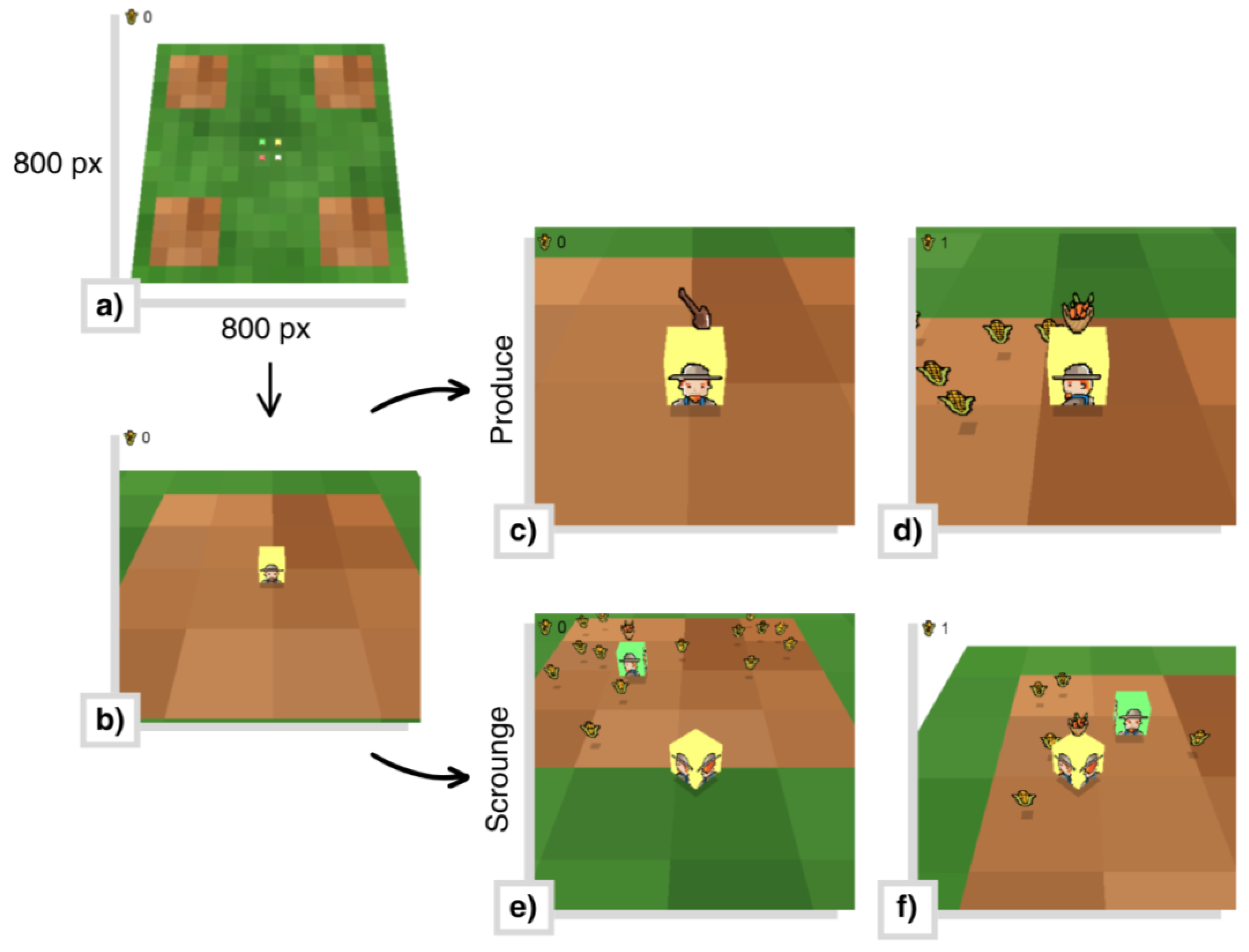
Figure 2.
Wilcoxon signed-rank test’s results between conditions F5-0s and F5-8s: (a) producer’s index between conditions; (b) producer’s responses between conditions; (c) scrounger’s responses between conditions.
Figure 2.
Wilcoxon signed-rank test’s results between conditions F5-0s and F5-8s: (a) producer’s index between conditions; (b) producer’s responses between conditions; (c) scrounger’s responses between conditions.
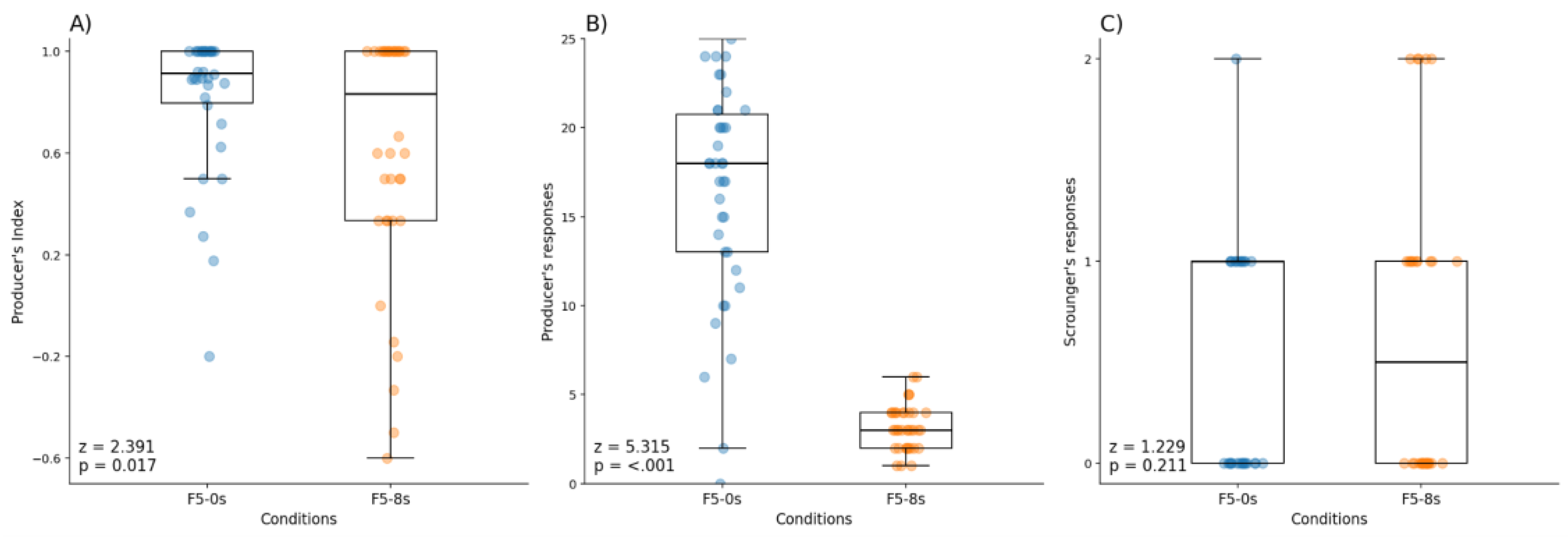
Figure 3.
Mann-Whitney U Test’s results between participants under and above the APSD’s cutoff score: (a) producer’s index comparison between groups in F5-0s; (b) producer’s responses comparison between groups in F5-0s; (c) scrounger’s responses comparison between groups in F5-0s; (d) producer’s index comparison between groups in F5-8s (e) producer’s responses comparison between groups in F5-8s; (f) scrounger’s responses comparison between groups in F5-8s.
Figure 3.
Mann-Whitney U Test’s results between participants under and above the APSD’s cutoff score: (a) producer’s index comparison between groups in F5-0s; (b) producer’s responses comparison between groups in F5-0s; (c) scrounger’s responses comparison between groups in F5-0s; (d) producer’s index comparison between groups in F5-8s (e) producer’s responses comparison between groups in F5-8s; (f) scrounger’s responses comparison between groups in F5-8s.
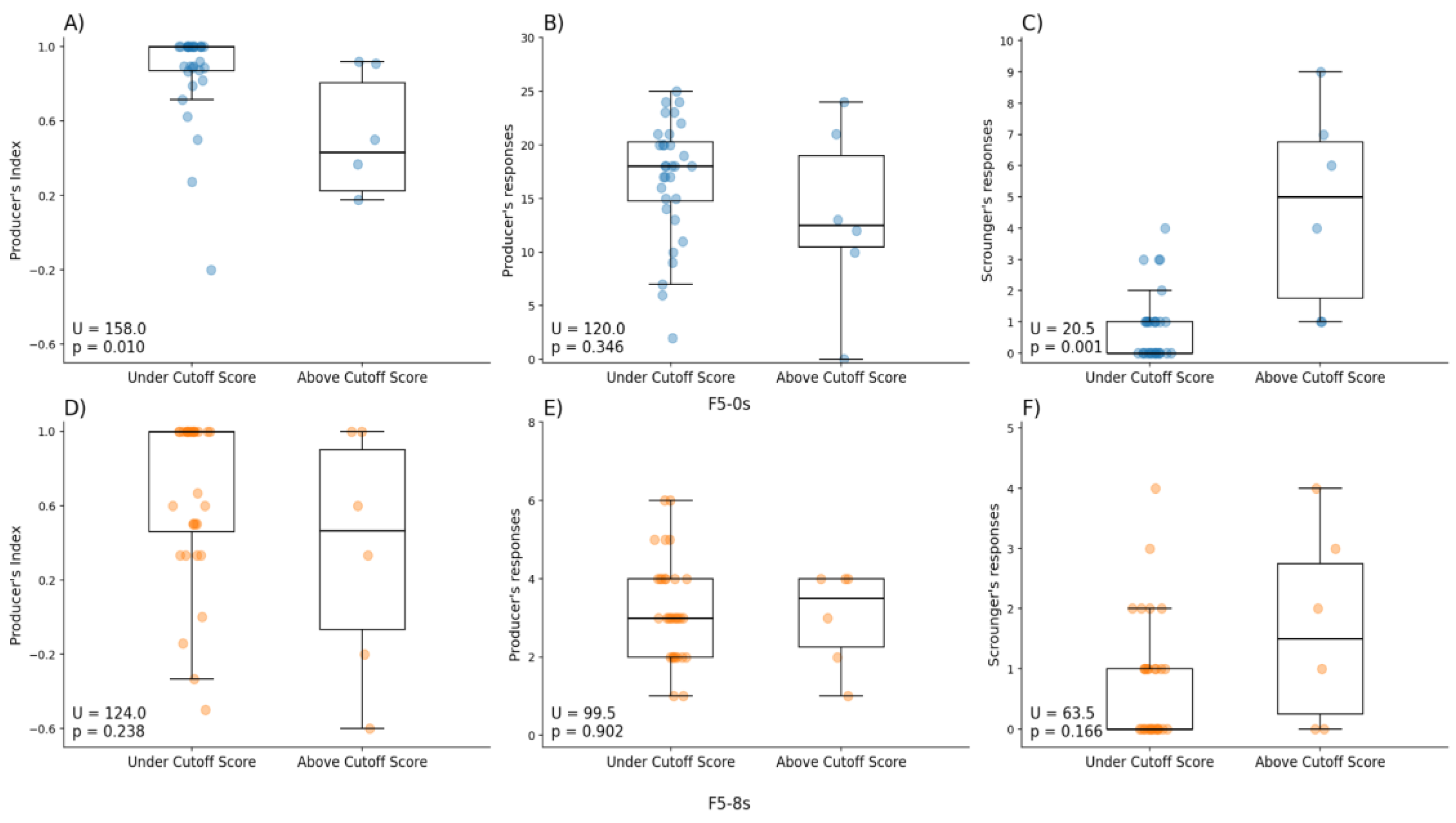
Figure 4.
Correlation matrix between the Big Five, metatraits and the APSD with the producer’s index in F5-0s: Each subsection represents a variable; (a), (b), (c), (d) and (e) are the five personality traits, (f) and (g) are the metatraits, (h), (i), (j) and (k) are the APSD’s factors. Thicker linear functions represent statistically significant differences.
Figure 4.
Correlation matrix between the Big Five, metatraits and the APSD with the producer’s index in F5-0s: Each subsection represents a variable; (a), (b), (c), (d) and (e) are the five personality traits, (f) and (g) are the metatraits, (h), (i), (j) and (k) are the APSD’s factors. Thicker linear functions represent statistically significant differences.
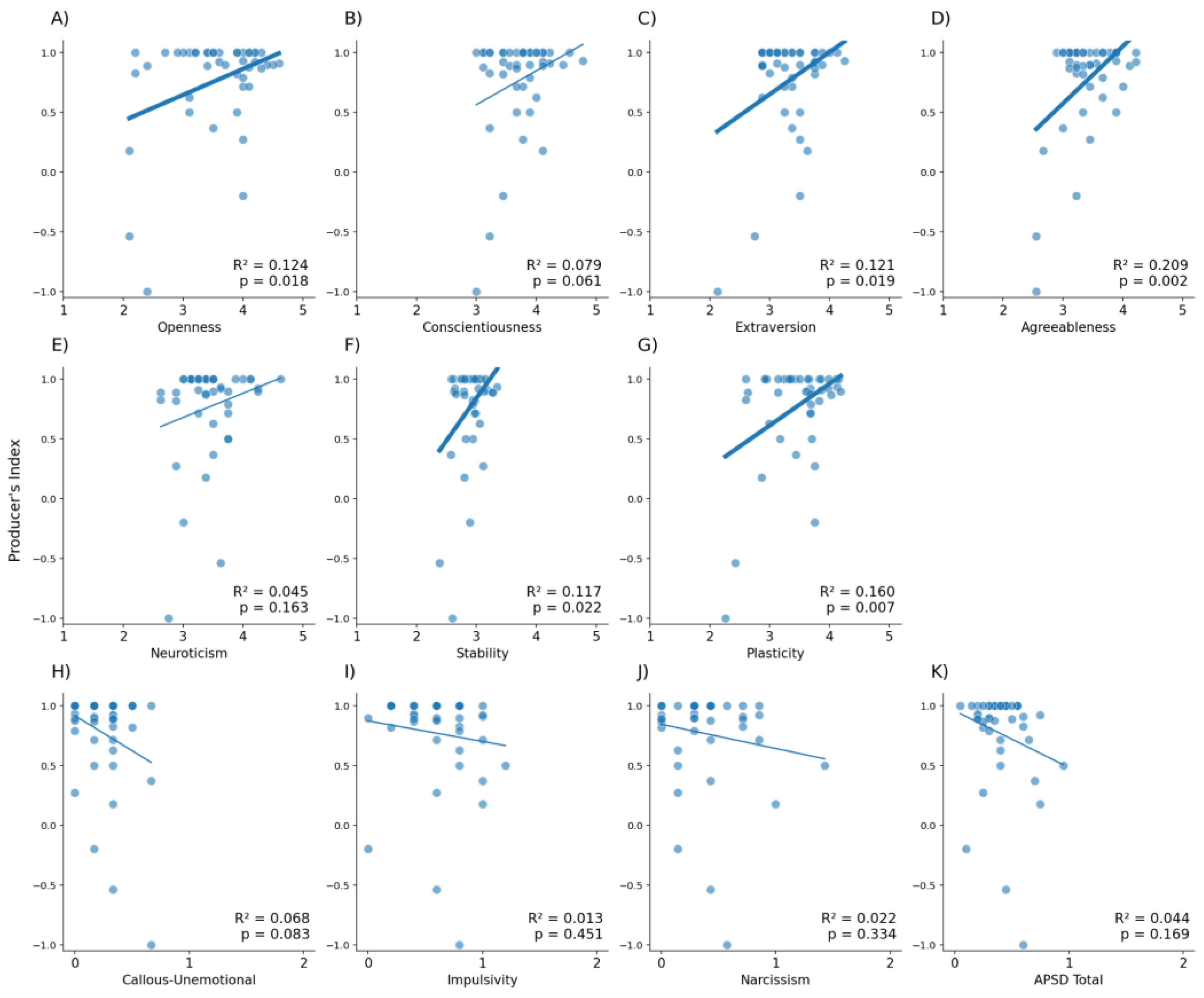
Figure 5.
Correlation matrix between the Big Five, metatraits and the APSD with the producer’s index in F5-8s: Each subsection represents a variable; (a), (b), (c), (d) and (e) are the five personality traits, (f) and (g) are the metatraits, (h), (i), (j) and (k) are the APSD’s factors.
Figure 5.
Correlation matrix between the Big Five, metatraits and the APSD with the producer’s index in F5-8s: Each subsection represents a variable; (a), (b), (c), (d) and (e) are the five personality traits, (f) and (g) are the metatraits, (h), (i), (j) and (k) are the APSD’s factors.
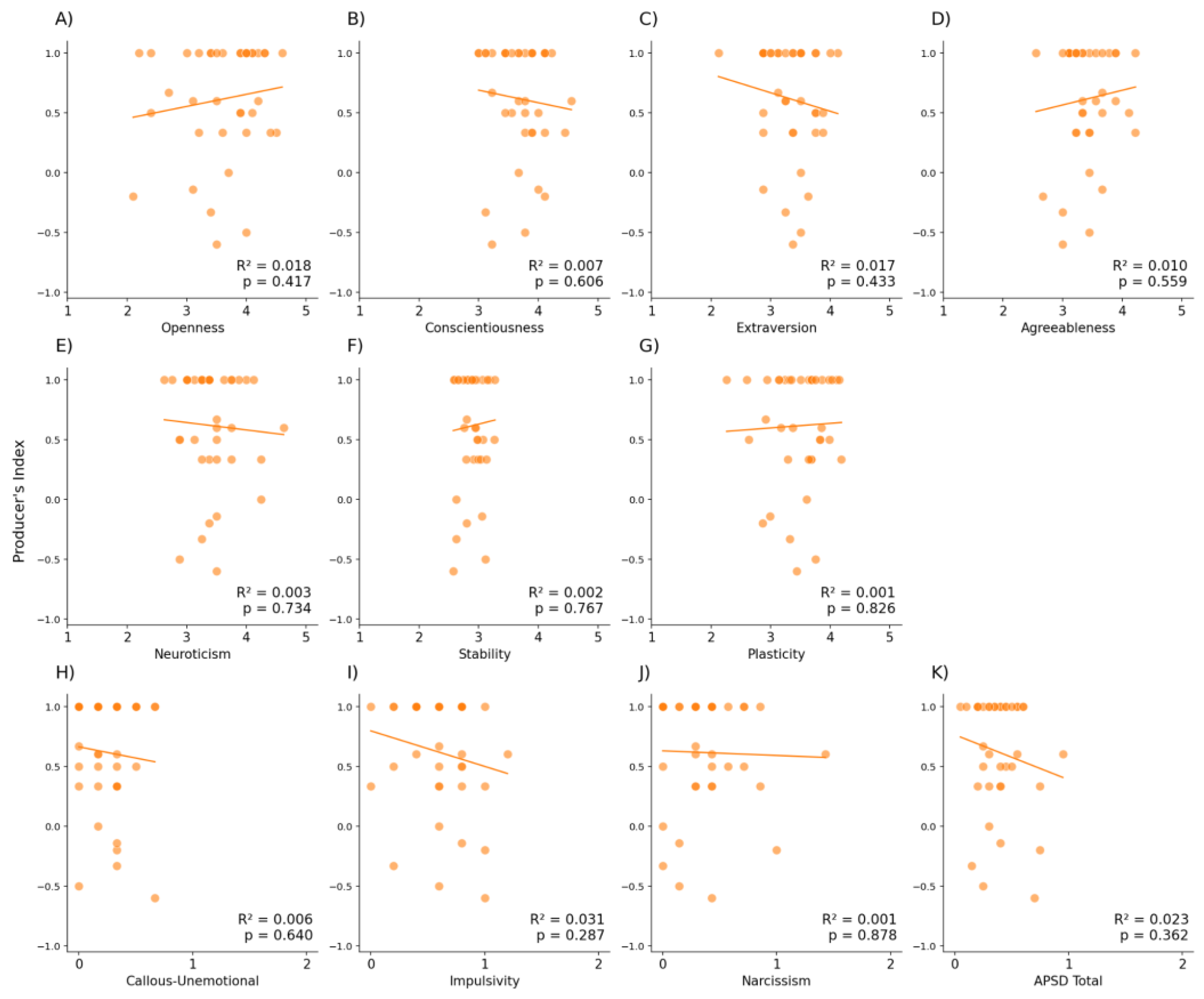

Table 1.
Comparative analysis between conditions F5-0s and F5-8s.
| F5 - 0s | F5 - 8s | z | p | rpb | |||||
| M | SD | MDN | M | SD | MDN | ||||
| Producer’s index | .766 | .426 | .920 | .615 | .479 | .833 | 2.391 | .017 | .517 |
| Producer’s responses | 16.667 | 6.762 | 18 | 3.184 | 1.270 | 3 | 5.315 | <.001 | .989 |
| Scrounger’s responses | 1.489 | 2.370 | 1 | .895 | 1.158 | 0.500 | 1.229 | .211 | .229 |
Table 2.
Comparative analysis between participants under and above the APSD’s cutoff score.
| Condition | Under Cutoff Score (N=32) | Above Cutoff Score (N=6) | U | p | |||||
| M | SD | MDN | M | SD | MDN | ||||
| Producer’s index | F5-0s | .864 | .255 | 1 | .312 | .708 | .434 | 158 | .010 |
| F5-8s | .663 | .437 | 1 | .356 | .650 | .467 | 124 | .238 | |
| Producer’s responses | F5-0s | 16.906 | 5.579 | 18 | 13.333 | 8.527 | 12.5 | 120 | .346 |
| F5-8s | 3.219 | 1.289 | 3 | 3 | 1.265 | 3.5 | 99.5 | .902 | |
| Scrounger’s responses | F5-0s | .781 | 1.099 | 0 | 4.667 | 3.266 | 5 | 20.5 | .001 |
| F5-8s | .750 | 1.016 | 0 | 1.667 | 1.633 | 1.5 | 63.5 | .166 | |
Table 3.
Correlation matrix.
| 1 | 2 | 3 | 4 | 5 | 6 | 7 | 8 | 9 | 10 | 11 | 12 | |
| 1. Producer’s index F5-0s | ||||||||||||
| 2. Producer’s index F5-8s | .151 | |||||||||||
| 3. Openness | .352* | .136 | ||||||||||
| 4. Conscientiousness | .281 | -.087 | .348* | |||||||||
| 5. Extraversion | .348* | -.131 | .492*** | .390** | ||||||||
| 6. Agreeableness | .457** | .098 | .275 | .335* | .384** | |||||||
| 7. Neuroticism | .212 | -.057 | .303* | .434** | .301* | .373** | ||||||
| 8. Stability | .342* | .050 | .201 | .613*** | .303* | .610*** | -.206 | |||||
| 9. Plasticity | .400** | .037 | .924*** | .418** | .788*** | .364** | .347* | .275 | ||||
| 10. Callous-Unemotional | -.261 | -.078 | -.265 | -.440** | -.238 | -.136 | -.239 | -.226 | -.292* | |||
| 11. Impulsivity | -.115 | -.177 | -.117 | .297* | -.079 | .129 | .152 | .184 | -.117 | -.206 | ||
| 12. Narcissism | -.147 | -.026 | .175 | .093 | -.107 | .314* | .236 | .092 | -.171 | .044 | .520*** | |
| 13. APSD Total | -.209 | -.152 | -.238 | .061 | -.144 | .219 | .180 | .050 | -.231 | .276 | .720*** | .869*** |
* p < .05, ** p < .01, *** p < .001.
Disclaimer/Publisher’s Note: The statements, opinions and data contained in all publications are solely those of the individual author(s) and contributor(s) and not of MDPI and/or the editor(s). MDPI and/or the editor(s) disclaim responsibility for any injury to people or property resulting from any ideas, methods, instructions or products referred to in the content. |
© 2025 by the authors. Licensee MDPI, Basel, Switzerland. This article is an open access article distributed under the terms and conditions of the Creative Commons Attribution (CC BY) license (http://creativecommons.org/licenses/by/4.0/).
Copyright: This open access article is published under a Creative Commons CC BY 4.0 license, which permit the free download, distribution, and reuse, provided that the author and preprint are cited in any reuse.