
Submitted:
26 November 2025
Posted:
28 November 2025
You are already at the latest version
Abstract
The deployment of Zero Trust security models in hybrid cloud infrastructures represents a transformative approach to cybersecurity, shifting away from traditional perimeter-based defenses to a model of "never trust, always verify." By continuously authenticating and authorizing all users and devices regardless of their location, Zero Trust minimizes lateral movement of threats within distributed environments. This framework leverages robust identity verification, micro-segmentation, and least privilege access to establish secure, granular control over access to resources. Continuous monitoring and dynamic verification mechanisms ensure that access privileges adapt in real time based on evolving risk profiles, enhancing resistance to sophisticated cyber threats. Implementation in hybrid clouds requires integration of cloud-native and on-premises controls, automated policy enforcement, and strong data protection measures, addressing the complexity and diversity of hybrid environments. Collectively, these strategies strengthen access control while significantly reducing the attack surface, thereby improving overall organizational security posture.
Keywords:
Zero Trust
; Hybrid Cloud
; Lateral Movement
; Access Control
; Continuous Verification
; Identity and Access Management (IAM)
; Micro-segmentation
; Cybersecurity
; Cloud Security
; Security Automation
1. Introduction
Hybrid cloud infrastructures combine private, on-premises resources with public cloud services to provide flexible, scalable computing environments. This growing trend offers organizations the best of both worlds control over critical data and workloads locally, alongside the agility and cost-effectiveness of the cloud. However, this hybrid model introduces complex security challenges as data and applications move seamlessly between disparate environments. Effective protection requires innovative security models that transcend traditional perimeter-based defenses and adapt to the dynamic nature of hybrid setups.
1.1. Evolution of Hybrid Cloud Security Challenges
Security challenges in hybrid clouds have evolved significantly as enterprises increasingly adopt diverse cloud platforms alongside legacy systems. The increased complexity of managing workloads across multiple environments results in vulnerabilities like misconfigurations, expanded attack surfaces, and inconsistent policy enforcement. Threat actors exploit these weaknesses to gain unauthorized access or move laterally across networks. Additionally, compliance demands intensify with data distributed across geographic and regulatory boundaries. Visibility gaps and fragmented security toolsets also hinder rapid threat detection and response, making hybrid cloud security a pressing concern for modern organizations.
1.2. Limitations of Perimeter-Based Security Models
Traditional perimeter-based security approaches are built on the assumption that threats primarily come from outside the network boundary, focusing on fortifying the perimeter with firewalls and gateways. While effective in isolated on-premises environments, this model proves inadequate in hybrid clouds where users, devices, and workloads operate across multiple networks and locations. The perimeter blurs, and once inside the network, attackers can move laterally with relative ease. This limitation exposes organizations to risks such as privilege escalation and insider threats, as perimeter defenses do not continuously verify trust or dynamically adjust access controls based on context or behavior.
1.3. Need for Zero Trust in Hybrid Cloud Environments
Zero Trust security models address the shortcomings of perimeter-based strategies by enforcing the principle of "never trust, always verify." In a hybrid cloud context, Zero Trust requires strict identity verification for every access request, regardless of origin, combined with least privilege policies and micro-segmentation to limit lateral movement. Continuous monitoring and adaptive policy enforcement help detect anomalies and dynamically adjust privileges in real time. Deploying Zero Trust in hybrid clouds strengthens access control, reduces attack surfaces, and enhances resilience against increasingly sophisticated cyber threats. Its approach aligns well with the distributed, dynamic nature of hybrid environments and evolving compliance requirements, making it a critical strategy for securing modern infrastructure.
2. Literature Review

Table 1.
Comparison of Zero Trust Security Methodologies in Hybrid Cloud Environments.
| Study/Article | Methodology | Key Features | Advantages | Limitations |
|---|---|---|---|---|
| "Implementing a Zero Trust Architecture in Hybrid Cloud Environments" (2024) | Case study and literature review | Focus on micro-segmentation, continuous monitoring, and policy enforcement in hybrid clouds | Enhanced security posture, operational efficiencies | Technical complexity, organizational resistance |
| "Advanced cloud security framework based on Zero Trust and Adaptive Deep Learning" (2025) | Integration of ZTA with adaptive deep learning (ADL) | Real-time anomaly detection, predictive threat analysis, adaptive response | Superior threat detection and adaptive control | Requires advanced ML infrastructure, integration challenges |
| "Roadmap to Zero Trust Implementation in Hybrid Clouds" (2025) | Conceptual framework and best practices | Continuous verification, least privilege access, risk assessment | Addresses compliance complexity, consistent policy enforcement | Implementation costs, learning curve for teams |
| "Zero Trust Architecture: A Systematic Literature Review" (2024) | Systematic review of ZTA research | Emphasis on "never trust, always verify," microservice architecture integration | Demonstrated security improvements in healthcare and other sectors | Performance trade-offs in some use cases |
3. Foundational Concepts of Zero Trust Security
Zero Trust security is a cybersecurity paradigm emphasizing that no entity, whether internal or external, should be trusted by default. Every access request must be continuously verified, and trust must be established through identity and contextual factors rather than network location. This model replaces traditional perimeter-based defenses by applying rigorous verification at every layer of the infrastructure.
3.1. Principle of Least Privilege
The Principle of Least Privilege restricts users and devices to the minimal levels of access necessary to perform their roles. This limits potential damage in case of a breach by reducing unnecessary permissions. Least privilege is fundamental to Zero Trust, ensuring that even authenticated users only interact with resources essential for their work.
3.2. Continuous Authentication and Verification
Zero Trust employs continuous authentication, requiring users and devices to be verified not only at initial access but throughout their session. This ongoing verification uses multiple factors such as device health, user behavior, location, and risk profile to adjust access rights dynamically, guarding against insider threats and compromised credentials.
3.3. Micro-Segmentation and Identity-Centric Control
Micro-segmentation divides networks into smaller zones, each with its own security policies, minimizing lateral movement opportunities for attackers. Identity-centric control ties access permissions tightly to verified identity and device posture, enabling granular access tailored to the current risk context. Combined, they enforce strict boundaries and reduce attack surfaces within hybrid cloud environments.
3.4. Zero Trust Network Access (ZTNA) vs Traditional VPN
ZTNA and VPN differ significantly in access control and security models. VPN grants broad network access after a single authentication event, creating persistent trust. In contrast, ZTNA evaluates each access request dynamically using a function:
where is access decision at time for user , based on identity, device health, current risk, and resource-specific policies. A VPN's access function is simplified:
VPN access is static after authentication without re-evaluation. ZTNA’s dynamic approach reduces attack surfaces by granting access only to required applications, incorporating continuous trust evaluation and better supporting hybrid cloud architectures. ZTNA also improves network performance by routing traffic directly to applications, unlike VPNs that often backhaul all traffic, incurring latency.
4. Hybrid Cloud Architecture and Attack Surface
Hybrid cloud architecture integrates on-premises infrastructure with public cloud services, expanding the number of potential attack vectors. The attack surface in a hybrid cloud can be modeled as the union of on-premises attack surface and cloud attack surface , including the additional integration surface :
This combined surface increases exposure to threats, requiring continuous and comprehensive monitoring to protect diverse components such as APIs, interfaces, and workloads dynamically.
4.1. Cloud-On-Prem Integration Challenges
Integration challenges arise due to differing security controls and configurations across environments. The security posture of the integrated system can be viewed as the intersection of the security postures of each environment minus the integration gaps :
Minimizing by enforcing unified policies and comprehensive visibility across boundaries is crucial to prevent exploitation of inconsistencies.
4.2. Shared Responsibility Model and Security Boundaries
The shared responsibility model divides security duties between the cloud provider and the customer . The overall security responsibility can be defined as:
where includes securing infrastructure, and covers configuring access controls, data protection, and application security. Clear boundary definitions ensure no aspect of is neglected.
4.3. Common Threat Vectors Leading to Lateral Movement
Lateral movement typically begins at an initial compromised node and propagates across connected nodes exploiting vulnerabilities . The probability of lateral movement can be expressed as the product of compromise and exploit probabilities:
Minimizing involves reducing vulnerabilities, applying micro-segmentation, and enforcing stringent access controls to interrupt attack paths.
5. Framework for Deploying Zero Trust in Hybrid Cloud
Deploying Zero Trust in hybrid cloud environments requires an integrated, layered security framework designed to continuously verify trust and minimize implicit access. This framework orchestrates identity assurance, micro-segmentation, policy enforcement, and real-time monitoring to form an adaptive defense system. The core objective is to ensure that every access request is authenticated, authorized, and encrypted regardless of the user's location or device.
5.1. Identity and Access Management Integration
A robust Identity and Access Management (IAM) system is fundamental to the Zero Trust framework. IAM integrates user identities and device profiles across on-premises and cloud resources, enabling unified authentication and authorization. Access permissions for user to resource at time are evaluated dynamically against policies based on identity attributes and context:
Here, represents the policy decision function which enforces least privilege by granting minimal necessary access.
5.2. Policy Enforcement Points and Control Plane Design
Policy Enforcement Points (PEPs) are distributed across cloud and on-premises components, enforcing access decisions in real time. The Control Plane orchestrates policy distribution, telemetry collection, and analytics processing. The overall enforcement effectiveness can be modeled as:
where is the weight or criticality of enforcement point , and is its compliance or operational status. Higher values indicate stronger policy enforcement and security posture.
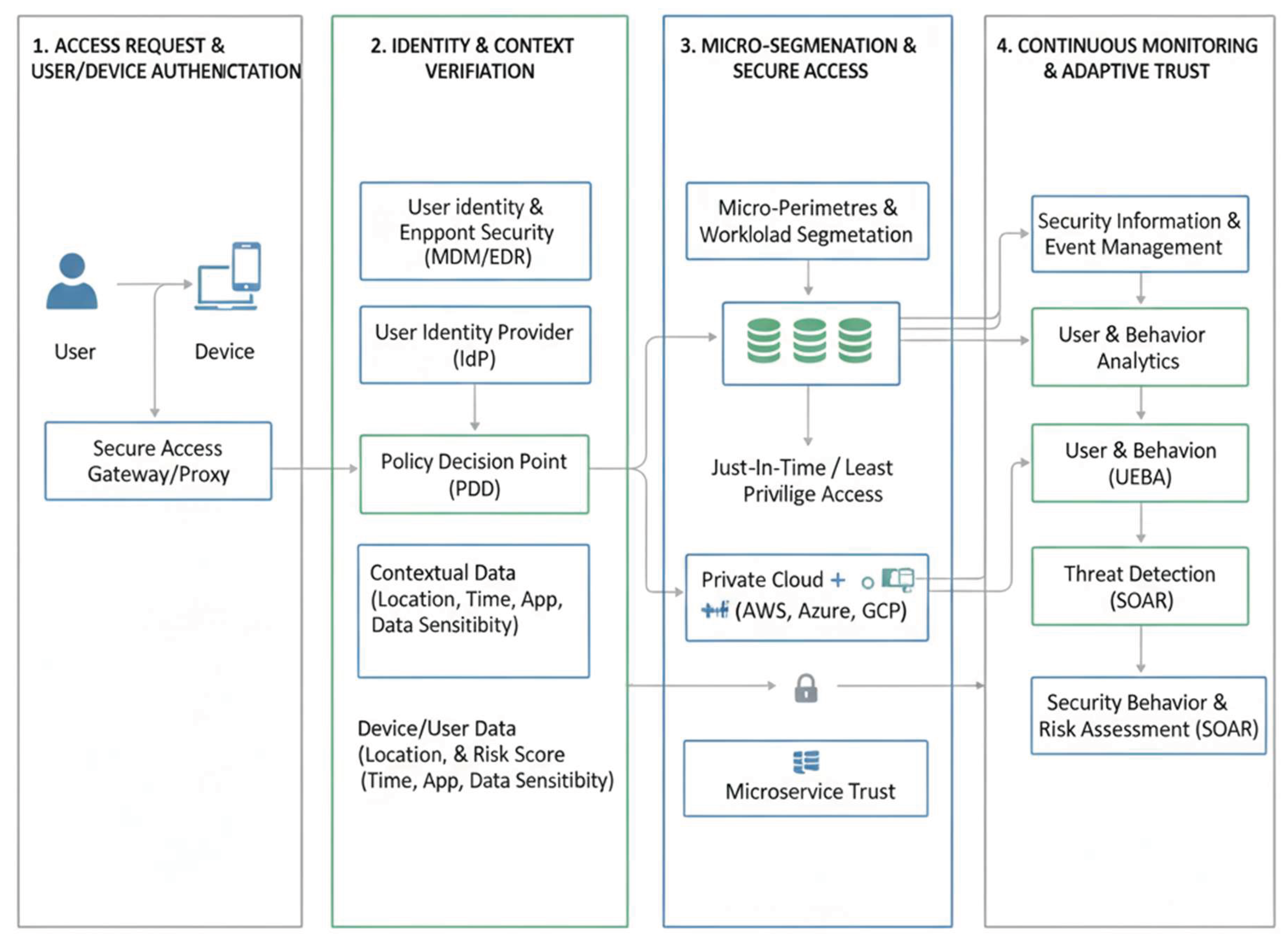
Figure 1.
Zero Trust Security in Hybrid Cloud Infrastructure.
5.3. Role of Multi-Factor and Risk-Based Authentication
Multi-Factor Authentication (MFA) combined with Risk-Based Authentication (RBA) strengthens verification by requiring multiple independent proofs of identity and adapting authentication requirements to assessed risk level . The authentication threshold varies dynamically:
where are independent authentication factors (e.g., password, biometric, token), and is a function increasing with risk, requiring stronger verification under elevated threat scenarios.
5.4. Encryption, Tokenization & Secure API Gateways
Data protection mechanisms like encryption and tokenization ensure confidentiality and integrity throughout data transit and storage. Encryption transforms plaintext into ciphertext using a key :
where is the encryption function. Tokenization replaces sensitive data elements with tokens , reducing exposure risk. Secure API gateways mediate all API traffic, enforcing authentication, traffic encryption, quota limits, and anomaly detection, serving as crucial control points securing cloud-native interactions.
6. Continuous Verification Mechanisms
Continuous verification is the backbone of Zero Trust, requiring that every access request, transaction, and action be authenticated and authorized in real time regardless of prior trust status. This approach ensures that trust is never implicitly granted and must be constantly revalidated based on context such as user identity, device posture, location, and behavior. The verification function at time can be modeled as:
where is the user, the device, and the resource. Access is granted only if meets the policy threshold.
6.1. Behavioral Analytics and Access Scoring
Behavioral analytics enhances continuous verification by evaluating patterns of user and device behaviors to detect anomalies indicating potential threats. An access score is computed to represent trustworthiness dynamically:
where are behavior features (e.g., login times, location changes), and are weights reflecting their importance. Scores below a threshold trigger stricter access controls or re-authentication.
6.2. Device Posture Validation and Endpoint Security
Device posture checks validate endpoint security compliance such as OS version, patch levels, firewall status, and malware protection before granting access. The device compliance score combines multiple posture indicators:
with binary indicators (1 compliant, 0 non-compliant). Only devices with are granted access, minimizing risk from compromised endpoints.
6.3. Session-Based Privilege Management
Privileges are granted per session and can dynamically change based on risk assessment or anomalous behaviors. The effective privilege for session is:
where is the baseline privilege and is a risk factor that decreases privileges under suspicion, ensuring least privilege enforcement continually during the session.
6.4. Real-Time Monitoring & Telemetry
Real-time telemetry collects data from network traffic, devices, user activities, and security controls. The security state evolves as:
where is new telemetry data influencing risk scores and triggering automated responses. Effective telemetry facilitates rapid anomaly detection and adaptive policy updates, closing security gaps proactively.
7. Minimizing Lateral Movement through Micro-Segmentation
Micro-segmentation divides a large network into smaller, isolated segments to restrict lateral movement of threats. By applying strict access controls within each segment, it confines attackers to a limited zone, reducing the risk of widespread compromise. The infection or compromise propagation rate in a network with micro-segmentation is governed by the differential equation:
where is the infection rate and is the total number of devices. Micro-segmentation reduces by limiting communication paths, slowing infection spread and containment time.
7.1. Segmentation Strategies for Hybrid Environments
Effective segmentation in hybrid clouds considers workload types, trust levels, and data sensitivity. Segments may be defined by application tiers or user roles, enforcing policies dynamically across cloud and on-premises environments. Automated clustering algorithms (e.g., OPTICS) help generate segments based on traffic patterns, enhancing policy accuracy and scalability.
7.2. Zero Trust Workload Isolation Models
Workload isolation ensures that each workload or microservice only communicates with explicitly authorized entities, preventing unauthorized lateral access. Isolation policies enforced at the network or host layer follow least privilege principles, drastically minimizing attack surfaces.
7.3. Role of Software-Defined Perimeters (SDP)
SDPs create encrypted, identity-based perimeters dynamically around resources, granting access only to authenticated and authorized users or devices. This model complements micro-segmentation by cloaking resources from unauthorized discovery, reducing attack exposure.
7.4. Case Evaluation: Preventing East-West Attacks
East-West (lateral) attacks exploit internal traffic paths to move stealthily within networks. Micro-segmentation combined with continuous verification and SDP minimizes such threats. By restricting communication strictly to needed channels, the probability of successful lateral movement diminishes exponentially as:
where is the probability of compromise at segment , and is the number of segments an attacker must traverse. Effective segmentation maximizes and minimizes , significantly lowering attack success rates.
8. Implementation of Zero Trust in Hybrid Cloud Environments
Implementing Zero Trust in hybrid cloud environments involves a phased approach starting with a detailed assessment of existing security posture and business priorities. The roadmap typically begins with identity and access management (IAM) deployment, followed by network segmentation, device management, and culminates with continuous monitoring and analytics. This phased approach builds a secure foundation that incrementally expands coverage without disrupting operational continuity.
8.1. Assessment and Maturity Model
A maturity model evaluates readiness across key dimensions such as identity governance, network segmentation, and monitoring capability. Maturity level can be quantified as:
where is the score for security control and its weight or criticality. Regular assessments identify gaps and prioritize areas for improvement, enabling a targeted Zero Trust rollout.
8.2. Policy-Driven Deployment Approach
Deploying Zero Trust controls follows a policy-driven methodology, where access decisions are governed by granular, context-aware policies. Access is dynamically evaluated as:
Policies can be codified in a central policy engine that distributes and enforces rules consistently across hybrid infrastructure.
8.3. Technology Stack and Tools for Zero Trust
The technology stack comprises IAM platforms, multi-factor authentication (MFA), micro-segmentation solutions, secure API gateways, encryption services, and Security Information and Event Management (SIEM) for telemetry aggregation. Integration with cloud native controls (e.g., cloud provider Identity-Aware Proxies) and endpoint management tools is crucial for comprehensive coverage.
8.4. Best Practices and Governance
Establishing governance frameworks ensures adherence to Zero Trust principles, ongoing risk management, and compliance. Key best practices include:
- Continuous staff training and awareness
- Automated policy enforcement and audit trails
- Incident response integration with Zero Trust telemetry
- Periodic policy reviews aligned with evolving threats
Mathematically, governance effectiveness can be tracked via compliance metrics and incident response times :
where improving indicates stronger governance through higher compliance and faster response.
9. Use Cases & Industry Applications
9.1. Financial Services and Compliance-Driven Clouds
In the financial sector, Zero Trust frameworks are crucial for protecting sensitive customer data and meeting strict regulatory requirements such as PCI DSS and GDPR. These organizations implement continuous monitoring, identity-centric access controls, and micro-segmentation to secure financial transactions and customer information. By enforcing dynamic policies based on user context and device posture, Zero Trust minimizes the risk of insider threats and data breaches, ensuring compliance and trust in cloud and hybrid deployments.
9.2. Healthcare Data Protection Under Zero Trust
Healthcare organizations use Zero Trust to secure patient data against ransomware and unauthorized access, aligning with HIPAA and other privacy regulations. Implementation includes multi-factor authentication, encryption of data at rest and in transit, and comprehensive audit trails. Zero Trust continuously validates user access based on risk analytics and device security posture, protecting electronic health records (EHRs) and supporting secure telemedicine initiatives.
9.3. Secure DevOps and CI/CD Pipelines
Zero Trust models are essential in securing DevOps environments and continuous integration/continuous deployment (CI/CD) pipelines by enforcing strict access control to code repositories, build servers, and deployment tools. Role-based access control combined with automated policy enforcement prevents unauthorized code changes and insider threats. Integration of Zero Trust principles into CI/CD workflows enables secure software delivery, reducing vulnerabilities in rapidly evolving hybrid cloud infrastructures.
9.4. Government Digital Infrastructure
Government agencies leverage Zero Trust to protect critical infrastructure and sensitive national data against advanced persistent threats. This includes strict identity verification, micro-segmentation of networks, and real-time telemetry for anomaly detection. Zero Trust supports digital transformation initiatives while maintaining compliance with federal security standards, promoting secure remote work, and safeguarding citizen data across hybrid environments.
In all these sectors, the Zero Trust security posture can be represented by the combination of adaptive access , continuous verification , and threat analytics :
where describes the holistic interaction of these components providing dynamic risk-based security. Implementation leads to reduced attack surfaces, mitigated lateral movement, and enhanced compliance across complex hybrid cloud ecosystems.
10. Performance Evaluation and Security Metrics
10.1. Quantifying Access Control Effectiveness
Access control effectiveness in a Zero Trust hybrid cloud can be quantified by comparing authorized access instances against unauthorized attempts . A common effectiveness metric is:
Table 2.
Access Control Effectiveness Metrics for Performance Evaluation.
| Metric | Description | Typical Value / Range | Purpose |
|---|---|---|---|
| Authorization Failure Rate | % of access requests denied due to lack of permission | 1% - 5% | Measures strictness and enforcement of least privilege principle |
| Access Review Frequency | How often access rights are reviewed/updated | Quarterly to Annually | Ensures access remains appropriate and reduces stale rights |
| Authentication Success Rate | % of successful authentications (MFA, Password, SSO) | 95% - 99.9% | Reflects reliability of authentication mechanisms |
| Access Revocation Success | % of access revocations applied effectively and timely | ≥ 95% | Metrics on how quickly unauthorized access is removed |
| Separation of Duties (SoD) | % compliance with SoD policies | 90% - 100% | Prevents conflicts of interest and unauthorized privilege escalation |
| Mean Time to Detect (MTTD) | Average time taken to detect unauthorized access | Hours to Days | Indicates responsiveness to detect policy violations |
| False Positive Rate (FPR) | % of legitimate access flagged as unauthorized | < 5% | Measures precision of access control monitoring systems |
| False Negative Rate (FNR) | % of unauthorized access that goes undetected | < 1% | Critical for identifying undetected security risks |
Values closer to 1 indicate more effective access control, meaning fewer unauthorized access attempts succeed while legitimate users maintain access.
10.2. Measuring Reduction in Lateral Movement
Reduction in lateral movement can be measured by comparing the rate of lateral movements before () and after implementation () of Zero Trust micro-segmentation and policies:
Table 3.
Metrics for Quantifying Reduction in Lateral Movement in Network Security.
| Metric | Description | Typical Range / Target | Purpose |
|---|---|---|---|
| Time to Detect (TTD) | Average time to detect lateral movement attempts | Minutes to hours | Measures speed of threat detection |
| Number of Lateral Movement Attempts | Count of detected lateral movement incidents | Lower is better | Tracks frequency of adversary lateral movement |
| Percentage Reduction in Lateral Movement | Percent decrease in lateral movement attempts after controls | 50%-90% reduction | Evaluates effectiveness of security improvements |
| Microsegmentation Coverage | % of network segmented to prevent lateral access | 80%-100% | Measures granularity of network segmentation |
| Mean Time to Contain (MTC) | Average time to contain/block lateral movement | Minutes to hours | Shows responsiveness in limiting attacker spread |
| Privilege Escalation Attempts | Number of detected privilege escalations enabling movement | Lower is better | Indicator sensitive to lateral movement vectors |
| Endpoint Detection Rate | % of lateral movement attempts detected on endpoints | ≥ 90% | Reflects strength of endpoint monitoring |
| False Positive Rate | % of false alerts classified as lateral movement | < 5% | Balances detection accuracy and alert noise |
This ratio shows the proportionate decline in internal threat propagation, reflecting improved segmentation and isolation.
10.3. Incident Response and Forensic KPIs
Key performance indicators (KPIs) for incident response include Mean Time to Detect (MTTD) and Mean Time to Respond (MTTR) to security events. Lower MTTD and MTTR imply more efficient detection and containment:
where is the number of incidents, is detection time for incident , and is response time.
Table 4.
Key Performance Indicators (KPIs) for Incident Response and Forensic Effectiveness.
| KPI Name | Description | Typical Value / Target | Purpose |
|---|---|---|---|
| Mean Time to Detect (MTTD) | Average time from incident occurrence to detection | Minutes to hours | Measures how quickly incidents are identified |
| Mean Time to Acknowledge (MTTA) | Average time to acknowledge an incident alert | Minutes | Indicates responsiveness of the incident response team |
| Mean Time to Contain (MTTC) | Average time to halt incident spread or impact | Minutes to hours | Measures effectiveness in limiting damage |
| Mean Time to Resolve (MTTR) | Time from detection to full incident resolution | Hours to days | Indicates overall efficiency in incident handling |
| Incident Volume | Number of incidents within a period | Varies by organization | Measures workload and trends |
| First Response Time | Time from incident creation to initial response | Minutes | Reflects responsiveness at incident start |
| Reopen Rate | % of incidents reopened after being marked resolved | < 5% | Indicates quality of initial resolution |
| Incident Severity Distribution | Breakdown of incidents by severity (Critical, High, etc.) | N/A | Helps prioritize resources and improve planning |
| Forensic Investigation Time | Average time taken for forensic analysis | Hours to days | Measures depth and efficiency of incident investigation |
| Root Cause Identification Rate | % of incidents with identified root cause | > 90% | Indicates thoroughness of analysis and understanding |
| Post-Incident Review Rate | % of incidents with documented post-incident reviews | > 90% | Represents commitment to learning and process improvement |
| Cost per Incident | Average financial impact of incidents | Varies | Quantifies economic impact and helps prioritize investments |
Forensic KPIs track accuracy and completeness of log data used in investigations, impacting the ability to analyze root causes and prevent recurrence.
11. Challenges & Limitations
11.1. Interoperability Between Cloud Providers
Hybrid cloud architectures often span multiple cloud providers with varied security protocols, APIs, and tooling. Achieving seamless interoperability requires standardization of identity federation, policy enforcement, and data exchange formats. Differences in technology stacks and security controls pose integration hurdles and increase complexity in maintaining a unified Zero Trust posture.
11.2. Legacy System Constraints
Legacy systems lacking native support for modern authentication and authorization make full Zero Trust adoption difficult. These systems may require compensating controls such as network segmentation or privileged access management, increasing architectural complexity. Application modernization or replacement is often necessary but can be expensive and time-consuming.
11.3. Overhead in Monitoring and Policy Enforcement
Continuous verification, telemetry collection, and policy enforcement generate computational and network overhead. This can impact system performance, requiring optimization strategies such as event prioritization and edge processing. Balancing comprehensive security with operational efficiency presents a persistent challenge.
11.4. Cost, Skills, and Operational Complexity
Implementing Zero Trust in hybrid environments demands substantial investment in technology, specialized expertise, and ongoing management resources. Organizations face cost implications for advanced tools, training, and potential operational disruptions during phased rollouts. Operational complexity increases as policies must span heterogeneous environments with stringent compliance requirements, necessitating robust governance frameworks and skilled personnel.
These challenges underscore that while Zero Trust significantly enhances hybrid cloud security, practical limitations must be carefully managed through strategic planning, incremental implementation, and leveraging automation to optimize resource utilization and interoperability.
12. Conclusion and Future Enhancements
Zero Trust security models represent a fundamental shift from traditional perimeter-based security toward a continuous, adaptive, and identity-centric approach especially suited to hybrid cloud environments. By rigorously enforcing the principles of "never trust, always verify," least privilege access, micro-segmentation, and continuous monitoring, Zero Trust significantly reduces attack surfaces, constrains lateral movement, and enhances overall security posture. This approach addresses complex challenges posed by cloud-native architectures, distributed workforces, and evolving threat landscapes.
Future enhancements in Zero Trust architectures will likely leverage advancements in artificial intelligence and machine learning to improve behavioral analytics, automate threat detection, and refine adaptive access decisions dynamically. Integration of advanced cryptographic techniques and post-quantum security will further future-proof hybrid cloud security. Increasing standardization and interoperability frameworks among cloud providers will ease integration challenges and foster broader adoption.
Moreover, advances in automation and orchestration will reduce operational overhead, making Zero Trust not only more effective but also more manageable and cost-efficient for organizations of all sizes. Continued emphasis on securing software supply chains and DevSecOps integration will also form a key pillar of evolving Zero Trust strategies.
In essence, Zero Trust security is not a fixed destination but a continuously evolving framework that adapts to technological and threat evolution, driving resilient, agile, and secure hybrid cloud deployments. Adopting this model offers organizations a scalable, proactive defense posture capable of meeting today’s security demands and anticipating future risks.
References
- Arora, A. (2025). THE SIGNIFICANCE AND ROLE OF AI IN IMPROVING CLOUD SECURITY POSTURE FOR MODERN ENTERPRISES. Available at SSRN 5268192.
- Singh, B. (2025). Building Secure Software Faster with DevSecOps Principles, Practices, and Implementation Strategies. Practices, and Implementation Strategies (May 23, 2025), 23 May.
- Akat, G.B.; Magare, B.K. (2023). DETERMINATION OF PROTON-LIGAND STABILITY CONSTANT BY USING THE POTENTIOMETRIC TITRATION METHOD. MATERIAL SCIENCE, 22(07).
- Siddiqui, A.; Chand, K.; Shahi, N.C. (2021). Effect of process parameters on extraction of pectin from sweet lime peels. Journal of The Institution of Engineers (India): Series A, 102(2), 469-478.
- Kumar, J.D.S.; Subramanyam, M.V.; Kumar, A.S. (2024). Hybrid Sand Cat Swarm Optimization Algorithm-based reliable coverage optimization strategy for heterogeneous wireless sensor networks. International Journal of Information Technology, 1-19.
- Shinkar, A.R.; Joshi, D.; Praveen, R.V.S.; Rajesh, Y.; Singh, D. (2024, December). Intelligent solar energy harvesting and management in IoT nodes using deep self-organizing maps. In 2024 International Conference on Emerging Research in Computational Science (ICERCS) (pp. 1-6). IEEE.
- Vikram, A.V.; Arivalagan, S. (2017). Engineering properties on the sugar cane bagasse with sisal fibre reinforced concrete. International Journal of Applied Engineering Research, 12(24), 15142-15146.
- Reddy, D.N.; Venkateswararao, P.; Vani, M.S.; Pranathi, V.; Patil, A. (2025). HybridPPI: A Hybrid Machine Learning Framework for Protein-Protein Interaction Prediction. Indonesian Journal of Electrical Engineering and Informatics (IJEEI), 13(2).
- Atheeq, C.; Sultana, R.; Sabahath, S.A.; Mohammed, M.A.K. (2024). Advancing IoT Cybersecurity: adaptive threat identification with deep learning in Cyber-physical systems. Engineering, Technology & Applied Science Research, 14(2), 13559-13566.
- Arora, A. (2025). Zero Trust Architecture: Revolutionizing Cybersecurity for Modern Digital Environments. Available at SSRN 5268151.
- Mohammed Nabi Anwarbasha, G.T.; Chakrabarti, A.; Bahrami, A.; Venkatesan, V.; Vikram, A.S.V.; Subramanian, J.; Mahesh, V. (2023). Efficient finite element approach to four-variable power-law functionally graded plates. Buildings, 13(10), 2577.
- Kumar, N.; Kurkute, S.L.; Kalpana, V.; Karuppannan, A.; Praveen, R.V.S.; Mishra, S. (2024, August). Modelling and Evaluation of Li-ion Battery Performance Based on the Electric Vehicle Tiled Tests using Kalman Filter-GBDT Approach. In 2024 International Conference on Intelligent Algorithms for Computational Intelligence Systems (IACIS) (pp. 1-6). IEEE.
- Singh, H. (2025). Securing High-Stakes Digital Transactions: A Comprehensive Study on Cybersecurity and Data Privacy in Financial Institutions. Available at SSRN 5267850.
- Singh, B. (2025). Integrating Threat Modeling In Devsecops For Enhanced Application Security. Available at SSRN 5267976.
- Akat, G.B. (2023). Structural Analysis of Ni1-xZnxFe2O4 Ferrite System. MATERIAL SCIENCE, 22(05).
- Vijay Vikram, A.S.; Arivalagan, S. (2017). A short review on the sugarcane bagasse with sintered earth blocks of fiber reinforced concrete. Int J Civil Eng Technol, 8(6), 323-331.
- Yamuna, V.; Praveen, R.V.S.; Sathya, R.; Dhivva, M.; Lidiya, R.; Sowmiya, P. (2024, October). Integrating AI for Improved Brain Tumor Detection and Classification. In 2024 4th International Conference on Sustainable Expert Systems (ICSES) (pp. 1603-1609). IEEE.
- Sultana, R.; Ahmed, N.; Sattar, S.A. (2018). HADOOP based image compression and amassed approach for lossless images. Biomedical Research, 29(8), 1532-1542.
- Kumar, T.V. (2024). Enhanced Kubernetes Monitoring Through Distributed Event Processing.
- Boopathy, D.; Balaji, P. (2023). Effect of different plyometric training volume on selected motor fitness components and performance enhancement of soccer players. Ovidius University Annals, Series Physical Education and Sport/Science, Movement and Health, 23(2), 146-154.
- Rao, A.S.; Reddy, Y.J.; Navya, G.; Gurrapu, N.; Jeevan, J.; Sridhar, M.; Anand, D. High-performance sentiment classification of product reviews using GPU (parallel)-optimized ensembled methods.
- Arora, A. (2025). Securing Multi-Cloud Architectures using Advanced Cloud Security Management Tools. Available at SSRN 5268184.
- Singh, B. (2025). Mastering Oracle Database Security: Best Practices for Enterprise Protection. Available at SSRN 5267920.
- Lopez, S.; Sarada, V.; Praveen, R.V.S.; Pandey, A.; Khuntia, M.; Haralayya, D.B. (2024). Artificial intelligence challenges and role for sustainable education in india: Problems and prospects. Sandeep Lopez, Vani Sarada, RVS Praveen, Anita Pandey, Monalisa Khuntia, Bhadrappa Haralayya (2024) Artificial Intelligence Challenges and Role for Sustainable Education in India: Problems and Prospects. Library Progress International, 44(3), 18261-18271.
- Akat, G.B. (2022). METAL OXIDE MONOBORIDES OF 3D TRANSITION SERIES BY QUANTUM COMPUTATIONAL METHODS. MATERIAL SCIENCE, 21(06).
- Kumar, T.V. (2019). Cloud-Based Core Banking Systems Using Microservices Architecture.
- Kumar, J.D.S.; Subramanyam, M.V.; Kumar, A.P.S. (2023). Hybrid Chameleon Search and Remora Optimization Algorithm-based Dynamic Heterogeneous load balancing clustering protocol for extending the lifetime of wireless sensor networks. International Journal of Communication Systems, 36(17), e5609.
- Arora, A. (2025). Analyzing Best Practices and Strategies for Encrypting Data at Rest (Stored) and Data in Transit (Transmitted) in Cloud Environments. Available at SSRN 5268190.
- Sharma, S.; Vij, S.; Praveen, R.V.S.; Srinivasan, S.; Yadav, D.K.; VS; RK (2024, October). Stress Prediction in Higher Education Students Using Psychometric Assessments and AOA-CNN-XGBoost Models. In 2024 4th International Conference on Sustainable Expert Systems (ICSES) (pp. 1631-1636). IEEE.
- Arora, A. (2025). Transforming Cybersecurity Threat Detection and Prevention Systems using Artificial Intelligence. Available at SSRN 5268166.
- Nizamuddin, M.K.; Raziuddin, S.; Farheen, M.; Atheeq, C.; Sultana, R. (2024). An MLP-CNN Model for Real-time Health Monitoring and Intervention. Engineering, Technology & Applied Science Research, 14(4), 15553-15558.
- Arora, A. (2025). Evaluating Ethical Challenges in Generative AI Development and Responsible Usage Guidelines. Available at SSRN 5268196.
- Kamatchi, S.; Preethi, S.; Kumar, K.S.; Reddy, D.N.; Karthick, S. (2025, May). Multi-Objective Genetic Algorithm Optimised Convolutional Neural Networks for Improved Pancreatic Cancer Detection. In 2025 3rd International Conference on Data Science and Information System (ICDSIS) (pp. 1-7). IEEE.
- Sivakumar, S.; Prakash, R.; Srividhya, S.; Vikram, A.V. (2023). A novel analytical evaluation of the laboratory-measured mechanical properties of lightweight concrete. Structural engineering and mechanics: An international journal, 87(3), 221-229.
- Praveen, R.V.S.; Hemavathi, U.; Sathya, R.; Siddiq, A.A.; Sanjay, M.G.; Gowdish, S. (2024, October). AI Powered Plant Identification and Plant Disease Classification System. In 2024 4th International Conference on Sustainable Expert Systems (ICSES) (pp. 1610-1616). IEEE.
- Akat, G.B. (2022). OPTICAL AND ELECTRICAL STUDY OF SODIUM ZINC PHOSPHATE GLASS. MATERIAL SCIENCE, 21(05).
- Singh, B. (2025). Oracle Database Vault: Advanced Features for Regulatory Compliance and Control. Available at SSRN 5267938.
- Kumar, T.V. (2018). Event-Driven App Design for High-Concurrency Microservices.
- Arora, A. (2025). Integrating Dev-Sec-Ops Practices to Strengthen Cloud Security in Agile Development Environments. Available at SSRN 5268194.
- Singh, B. (2025). Integrating Security Seamlessly into DevOps Development Pipelines through DevSecOpsA Holistic Approach to Secure Software Delivery. Available at SSRN 5267955.
- Kumar, T.V. (2016). Layered App Security Architecture for Protecting Sensitive Data.
- Charanya, J.; Sureshkumar, T.; Kavitha, V.; Nivetha, I.; Pradeep, S.D.; Ajay, C. (2024, June). Customer Churn Prediction Analysis for Retention Using Ensemble Learning. In 2024 15th International Conference on Computing Communication and Networking Technologies (ICCCNT) (pp. 1-10). IEEE.
- Nimma, D.; Rao, P.L.; Ramesh, J.V.N.; Dahan, F.; Reddy, D.N.; Selvakumar, V.; Jangir, P. (2025). Reinforcement Learning-Based Integrated Risk Aware Dynamic Treatment Strategy for Consumer-Centric Next-Gen Healthcare. IEEE Transactions on Consumer Electronics.
- Arora, A. (2025). The Future of Cybersecurity: Trends and Innovations Shaping Tomorrow's Threat Landscape. Available at SSRN 5268161.
- Akat, G.B. (2022). STRUCTURAL AND MAGNETIC STUDY OF CHROMIUM FERRITE NANOPARTICLES. MATERIAL SCIENCE, 21(03).
- Singh, H. (2025). The Role of Multi-Factor Authentication and Encryption in Securing Data Access of Cloud Resources in a Multitenant Environment. Available at SSRN 5267886.
- Raja, M.W.; Nirmala, D.K. (2016). Agile development methods for online training courses web application development. International Journal of Applied Engineering Research ISSN, 0973-4562.
- Anuprathibha, T.; Praveen, R.V.S.; Sukumar, P.; Suganthi, G.; Ravichandran, T. (2024, October). Enhancing Fake Review Detection: A Hierarchical Graph Attention Network Approach Using Text and Ratings. In 2024 Global Conference on Communications and Information Technologies (GCCIT) (pp. 1-5). IEEE.
- Jeyaprabha, B.; Sundar, C. (2021). The mediating effect of e-satisfaction on e-service quality and e-loyalty link in securities brokerage industry. Revista Geintec-gestao Inovacao E Tecnologias, 11(2), 931-940.
- Arora, A. (2025). Comprehensive Cloud Security Strategies for Protecting Sensitive Data in Hybrid Cloud Environments.
- Sultana, R.; Ahmed, N.; Basha, S.M. (2011). Advanced Fractal Image Coding Based on the Quadtree. Computer Engineering and Intelligent Systems, 2 3, 129, 136.
- Singh, H. (2025). Cybersecurity for Smart Cities Protecting Infrastructure in the Era of Digitalization. Available at SSRN 5267856.
- Kemmannu, P.K.; Praveen, R.V.S.; Banupriya, V. (2024, December). Enhancing Sustainable Agriculture Through Smart Architecture: An Adaptive Neuro-Fuzzy Inference System with XGBoost Model. In 2024 International Conference on Sustainable Communication Networks and Application (ICSCNA) (pp. 724-730). IEEE.
- Singh, B. (2017). Enhancing Real-Time Database Security Monitoring Capabilities Using Artificial Intelligence. International Journal of Current Engineering and Scientific Research (IJCESR).
- Singh, H. (2025). STRATEGIES TO BALANCE SCALABILITY AND SECURITY IN CLOUD-NATIVE APPLICATION DEVELOPMENT. Available at SSRN 5267890.
- RAJA; MW; PUSHPAVALLI; DM; BALAMURUGAN; DM; SARANYA; K (2025). ENHANCED MED-CHAIN SECURITY FOR PROTECTING DIABETIC HEALTHCARE DATA IN DECENTRALIZED HEALTHCARE ENVIRONMENT BASED ON ADVANCED CRYPTO AUTHENTICATION POLICY. TPM–Testing, Psychometrics, Methodology in Applied Psychology, 32(S4 (2025): Posted 17 July), 241-255.
- Akat, G.B.; Magare, B.K. (2022). Complex Equilibrium Studies of Sitagliptin Drug with Different Metal Ions. Asian Journal of Organic & Medicinal Chemistry.
- Kumar, T.V. (2020). Generative AI Applications in Customizing User Experiences in Banking Apps.
- Jeyaprabha, B.; Catherine, S.; Vijayakumar, M. (2024). Unveiling the Economic Tapestry: Statistical Insights Into India's Thriving Travel and Tourism Sector. In Managing Tourism and Hospitality Sectors for Sustainable Global Transformation (pp. 249-259). IGI Global Scientific Publishing.
- Arora, A. (2025). Understanding the Security Implications of Generative AI in Sensitive Data Applications.
- JEYAPRABHA; B; SUNDAR; C (2022). The Psychological Dimensions Of Stock Trader Satisfaction With The E-Broking Service Provider. Journal of Positive School Psychology, 6(5).
- Singh, H. (2025). How Generative AI is Revolutionizing Scientific Research by Automating Hypothesis Generation. Available at SSRN 5267912.
- Singh, B. (2025). Advanced Oracle Security Techniques for Safeguarding Data Against Evolving Cyber Threats. Available at SSRN 5267951.
- Praveen, R.V.S. (2024). Data Engineering for Modern Applications. Addition Publishing House.
- Akat, G.B.; Magare, B.K. (2022). Mixed Ligand Complex Formation of Copper (II) with Some Amino Acids and Metoprolol. Asian Journal of Organic & Medicinal Chemistry.
- Singh, B. (2025). DevSecOps: A Comprehensive Framework for Securing Cloud-Native Applications. Available at SSRN 5267982.
- Singh, H. (2025). The Future Of Generative Ai: Opportunities, Challenges, And Industry Disruption Potential. Challenges, And Industry Disruption Potential (May 23, 2025), 23 May.
- Chand, K. (2013). Effect of pre-cooling treatments on shelf life of tomato in ambient condition.
- Rahman, Z.; Mohan, A.; Priya, S. (2021). Electrokinetic remediation: An innovation for heavy metal contamination in the soil environment. Materials Today: Proceedings, 37, 2730-2734.
- Singh, B. (2025). Enhancing Oracle Database Security with Transparent Data Encryption (TDE) Solutions. Available at SSRN 5267924.
- Singh, B. (2025). Challenges and Solutions for Adopting DevSecOps in Large Organizations. Available at SSRN 5267971.
- Singh, H. (2025). Key Cloud Security Challenges for Organizations Embracing Digital Transformation Initiatives. Available at SSRN 5267894.
- Kumar, T.V. (2022). AI-Powered Fraud Detection in Real-Time Financial Transactions.
- Raja, M.W. (2024). Artificial intelligence-based healthcare data analysis using multi-perceptron neural network (MPNN) based on optimal feature selection. SN Computer Science, 5(8), 1034.
- Akat, G.B. (2021). EFFECT OF ATOMIC NUMBER AND MASS ATTENUATION COEFFICIENT IN Ni-Mn FERRITE SYSTEM. MATERIAL SCIENCE, 20(06).
- Thakur, R.R.; Shahi, N.C.; Mangaraj, S.; Lohani, U.C.; Chand, K. (2021). Development of an organic coating powder and optimization of process parameters for shelf life enhancement of button mushrooms (Agaricus bisporus). Journal of Food Processing and Preservation, 45(3), e15306.
- Kumar, T.V. (2015). ANALYSIS OF SQL AND NOSQL DATABASE MANAGEMENT SYSTEMS INTENDED FOR UNSTRUCTURED DATA.
- Kumar, T.V. (2023). REAL-TIME DATA STREAM PROCESSING WITH KAFKA-DRIVEN AI MODELS.
- Nasir, G.; Chand, K.; Azaz Ahmad Azad, Z.R.; Nazir, S. (2020). Optimization of Finger Millet and Carrot Pomace based fiber enriched biscuits using response surface methodology. Journal of Food Science and Technology, 57(12), 4613-4626.
- Singh, H. (2025). Enhancing Cloud Security Posture with AI-Driven Threat Detection and Response Mechanisms. Available at SSRN 5267878.
- Praveen, R.V.S.; Hundekari, S.; Parida, P.; Mittal, T.; Sehgal, A.; Bhavana, M. (2025, February). Autonomous Vehicle Navigation Systems: Machine Learning for Real-Time Traffic Prediction. In 2025 International Conference on Computational, Communication and Information Technology (ICCCIT) (pp. 809-813). IEEE.
- Kumar, T.V. (2021). NATURAL LANGUAGE UNDERSTANDING MODELS FOR PERSONALIZED FINANCIAL SERVICES.
- Chand, K.; Shahi, N.C.; Lohani, U.C.; Garg, S.K. (2011). Effect of storage conditions on keeping qualities of jaggery. Sugar Tech, 13(1), 81-85.
- Kumar, T.V. (2019). BLOCKCHAIN-INTEGRATED PAYMENT GATEWAYS FOR SECURE DIGITAL BANKING.
- Arunmohan, A.M.; Lakshmi, M. (2018). Analysis of modern construction projects using montecarlo simulation technique. International Journal of Engineering & Technology, 7(2.19), 41-44.
Disclaimer/Publisher’s Note: The statements, opinions and data contained in all publications are solely those of the individual author(s) and contributor(s) and not of MDPI and/or the editor(s). MDPI and/or the editor(s) disclaim responsibility for any injury to people or property resulting from any ideas, methods, instructions or products referred to in the content. |
© 2025 by the authors. Licensee MDPI, Basel, Switzerland. This article is an open access article distributed under the terms and conditions of the Creative Commons Attribution (CC BY) license (http://creativecommons.org/licenses/by/4.0/).
Copyright: This open access article is published under a Creative Commons CC BY 4.0 license, which permit the free download, distribution, and reuse, provided that the author and preprint are cited in any reuse.


